Request Free Sample ×

Kindly complete the form below to receive a free sample of this Report

* Please use a valid business email

Leading companies partner with us for data-driven Insights

clients tt-cursor
Hero Background
English
Chinese
French
Japanese
Korean
German
Spanish

Squeeze Tube Market Trends

ID: MRFR/PCM/10347-HCR
111 Pages
Snehal Singh
Last Updated: April 06, 2026

Squeeze Tube Market Research Report Information By Type (LDPE, HDPE, MDPE, LLDPE, and EVOH), By Application (Personal Care, Pharmaceutical, Food, Lubricant, and Others), and By Region (North America, Europe, Asia-Pacific, and Rest Of The World) – Market Forecast Till 2035

Share:
Download PDF ×

We do not share your information with anyone. However, we may send you emails based on your report interest from time to time. You may contact us at any time to opt-out.

Squeeze Tube Market Infographic
Purchase Options

Market Trends

Key Emerging Trends in the Squeeze Tube Market

The squeeze tube market has experienced significant growth in recent years, driven by several key market trends. One notable trend is the increasing demand for convenient and portable packaging solutions. Squeeze tubes offer consumers a convenient way to dispense various products, such as cosmetics, personal care products, and food items, making them an attractive option for on-the-go consumers.

Another important trend driving market growth is the growing emphasis on sustainability and eco-friendly packaging solutions. As consumers become more environmentally conscious, there is a growing demand for packaging options that minimize waste and reduce the environmental impact. Squeeze tubes made from recyclable materials or those that can be easily recycled are gaining popularity among environmentally conscious consumers.

Furthermore, the beauty and personal care industry is witnessing a surge in demand for innovative packaging designs and formats. Squeeze tubes offer brands a versatile packaging solution that allows for unique and eye-catching designs, helping products stand out on crowded store shelves. Additionally, advancements in printing and labeling technologies have enabled brands to customize squeeze tube packaging with vibrant colors, intricate designs, and detailed product information, further enhancing their appeal to consumers.

In the food and beverage sector, squeeze tubes are increasingly being used for packaging sauces, condiments, and other liquid or semi-liquid products. The convenience of squeeze tubes makes them a popular choice for consumers looking for mess-free and portion-controlled dispensing options. Brands are also exploring new product categories and expanding their offerings to include a wider range of products packaged in squeeze tubes, catering to evolving consumer preferences and lifestyles.

Moreover, the COVID-19 pandemic has further accelerated the adoption of squeeze tubes, particularly in the personal care and hygiene sectors. With heightened awareness of hygiene and sanitation, consumers are increasingly opting for products packaged in convenient and hygienic formats like squeeze tubes. Additionally, the pandemic has led to changes in consumer behavior, with more consumers shopping online for everyday essentials. Squeeze tubes are well-suited for e-commerce packaging due to their durability and ease of shipping, further driving market growth.

Looking ahead, innovation will continue to be a key driver of market growth in the squeeze tube industry. Manufacturers are investing in research and development to introduce new materials, designs, and functionalities to meet the evolving needs and preferences of consumers. Additionally, collaborations between packaging manufacturers and brands are expected to drive further innovation in squeeze tube packaging, leading to the development of more sustainable, user-friendly, and visually appealing solutions.


Author
Author Profile
Snehal Singh
Manager - Research

High acumen in analyzing complex macro & micro markets with more than 6 years of work experience in the field of market research. By implementing her analytical skills in forecasting and estimation into market research reports, she has expertise in Packaging, Construction, and Equipment domains. She handles a team size of 20-25 resources and ensures smooth running of the projects, associated marketing activities, and client servicing.

Leave a Comment

FAQs

What is the current valuation of the Squeeze Tube Market as of 2024?

<p>The Squeeze Tube Market was valued at 37.52 USD Billion in 2024.</p>

What is the projected market valuation for the Squeeze Tube Market in 2035?

<p>The market is projected to reach a valuation of 80.63 USD Billion by 2035.</p>

What is the expected CAGR for the Squeeze Tube Market during the forecast period 2025 - 2035?

<p>The expected CAGR for the Squeeze Tube Market during the forecast period 2025 - 2035 is 7.2%.</p>

Which companies are considered key players in the Squeeze Tube Market?

<p>Key players in the Squeeze Tube Market include Albea, Essel Propack, Amcor, Berry Global, M&H Plastics, Crown Holdings, Mondi Group, and ProAmpac.</p>

What are the main types of materials used in squeeze tubes and their market values?

<p>The main types of materials include LDPE valued at 17.0 USD Billion, HDPE at 22.0 USD Billion, MDPE at 10.0 USD Billion, LLDPE at 15.0 USD Billion, and EVOH at 16.63 USD Billion.</p>

What applications dominate the Squeeze Tube Market and their respective valuations?

<p>The dominant applications are Personal Care at 22.0 USD Billion, Pharmaceutical at 15.0 USD Billion, Food at 18.0 USD Billion, Lubricant at 10.0 USD Billion, and Others at 15.63 USD Billion.</p>

How does the growth of the Squeeze Tube Market compare across different applications?

The growth appears robust across applications, with Personal Care and Food leading in market valuation, suggesting a strong consumer demand.

What trends are influencing the Squeeze Tube Market in 2025?

Trends influencing the market include increasing demand for sustainable packaging solutions and innovations in material technology.

How might the competitive landscape of the Squeeze Tube Market evolve by 2035?

The competitive landscape may evolve with increased consolidation among key players and potential new entrants focusing on eco-friendly products.

What factors could impact the growth of the Squeeze Tube Market during the forecast period?

Factors that could impact growth include regulatory changes, shifts in consumer preferences, and advancements in manufacturing technologies.

Market Summary

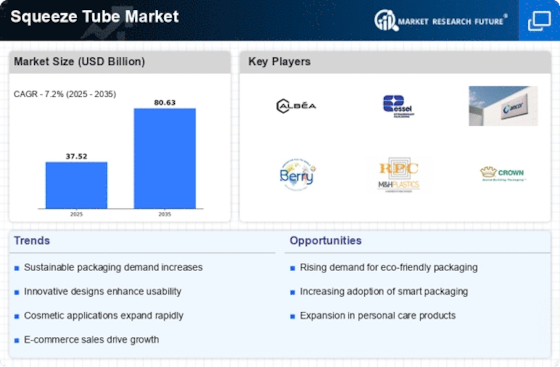
As per Market Research Future analysis, the Squeeze Tube Market Size was estimated at 37.52 USD Billion in 2024. The Squeeze Tube industry is projected to grow from 40.22 USD Billion in 2025 to 80.63 USD Billion by 2035, exhibiting a compound annual growth rate (CAGR) of 7.2% during the forecast period 2025 - 2035

Key Market Trends & Highlights

The Squeeze Tube Market is experiencing a dynamic shift towards sustainability and technological innovation.

  • North America remains the largest market for squeeze tubes, driven by robust demand across various sectors.
  • The Asia-Pacific region is emerging as the fastest-growing market, fueled by increasing consumer preferences for convenience and accessibility.
  • The LDPE segment continues to dominate the market, while the EVOH segment is witnessing rapid growth due to its barrier properties.
  • Rising demand for eco-friendly packaging and increased usage in personal care products are key drivers propelling market expansion.

Market Size & Forecast

2024 Market Size 37.52 (USD Billion)
2035 Market Size 80.63 (USD Billion)
CAGR (2025 - 2035) 7.2%
Largest Regional Market Share in 2024 North America

Major Players

Albea (FR), Essel Propack (IN), Amcor (AU), Berry Global (US), M&H Plastics (GB), Crown Holdings (US), Mondi Group (GB), ProAmpac (US)

Market Trends

The Squeeze Tube Market is currently experiencing a dynamic evolution, driven by various factors that influence consumer preferences and industry practices. The increasing demand for convenient packaging solutions across multiple sectors, including cosmetics, pharmaceuticals, and food, appears to be a primary catalyst for growth. As sustainability becomes a focal point for consumers, manufacturers are likely to explore eco-friendly materials and production methods, which may reshape the competitive landscape. Furthermore, innovations in design and functionality could enhance user experience, thereby attracting a broader customer base. In addition, the rise of e-commerce platforms is transforming distribution channels, allowing for greater accessibility and convenience for consumers. This shift may encourage brands to adopt more flexible packaging solutions that cater to online shopping trends. As the Squeeze Tube Market continues to adapt to these changes, it seems poised for further expansion, with potential opportunities for new entrants and established players alike. The interplay of consumer behavior, technological advancements, and environmental considerations will likely define the future trajectory of this market.

Sustainability Initiatives

There is a growing emphasis on sustainable practices within the Squeeze Tube Market. Companies are increasingly adopting eco-friendly materials and production techniques to meet consumer demand for environmentally responsible products. This trend not only addresses ecological concerns but also enhances brand loyalty among environmentally conscious consumers.

Technological Advancements

Innovations in manufacturing processes and materials are shaping the Squeeze Tube Market. Enhanced production techniques may lead to improved product quality and functionality, allowing brands to differentiate themselves in a competitive landscape. These advancements could also facilitate the introduction of new designs that cater to diverse consumer needs.

E-commerce Growth

The expansion of e-commerce is significantly impacting the Squeeze Tube Market. As online shopping becomes more prevalent, brands are likely to adapt their packaging strategies to enhance convenience and appeal to digital consumers. This trend may drive the development of packaging solutions that are optimized for shipping and storage.

Squeeze Tube Market Market Drivers

Rising Demand for Eco-Friendly Packaging

The Squeeze Tube Market is experiencing a notable shift towards eco-friendly packaging solutions. As consumers become increasingly aware of environmental issues, there is a growing preference for sustainable materials. This trend is reflected in the rising demand for squeeze tubes made from recyclable and biodegradable materials. According to recent data, the market for sustainable packaging is projected to grow at a compound annual growth rate of over 7% in the coming years. Companies are responding by innovating their product lines to include eco-conscious options, which not only meet consumer expectations but also align with regulatory pressures for reduced plastic waste. This shift towards sustainability is likely to drive growth in the Squeeze Tube Market, as brands seek to enhance their environmental credentials and appeal to a more conscientious consumer base.

Growth in E-commerce and Online Retailing

The Squeeze Tube Market is poised for growth as e-commerce and online retailing continue to expand. The shift towards online shopping has transformed consumer purchasing behaviors, with many preferring the convenience of buying products from home. This trend is particularly evident in the beauty and personal care sectors, where squeeze tubes are commonly used. Market data suggests that e-commerce sales in these categories are expected to grow by over 10% annually, creating new opportunities for squeeze tube manufacturers. As brands enhance their online presence and optimize their packaging for shipping, the demand for squeeze tubes is likely to increase. This growth in e-commerce not only provides a platform for reaching a broader audience but also encourages innovation in packaging solutions that cater to the needs of online consumers.

Increased Usage in Personal Care Products

The Squeeze Tube Market is witnessing a surge in the usage of squeeze tubes within the personal care sector. Products such as lotions, creams, and gels are increasingly packaged in squeeze tubes due to their convenience and user-friendly design. Market analysis indicates that the personal care segment accounts for a substantial share of the overall squeeze tube market, with projections suggesting a growth rate of approximately 5% annually. This trend is driven by consumer preferences for easy-to-use packaging that minimizes waste and enhances product accessibility. Furthermore, the versatility of squeeze tubes allows for a wide range of formulations, making them an attractive option for manufacturers in the personal care industry. As brands continue to innovate and expand their product offerings, the demand for squeeze tubes is expected to remain robust.

Technological Innovations in Manufacturing

Technological advancements are playing a crucial role in shaping the Squeeze Tube Market. Innovations in manufacturing processes, such as the introduction of automated production lines and advanced materials, are enhancing efficiency and reducing costs. These developments enable manufacturers to produce high-quality squeeze tubes at a faster rate, meeting the increasing demand from various sectors. Additionally, the integration of smart technologies, such as IoT and AI, is streamlining operations and improving quality control. Market data suggests that companies investing in these technologies are likely to gain a competitive edge, as they can respond more swiftly to market changes and consumer preferences. As the industry evolves, the adoption of cutting-edge manufacturing techniques is expected to drive growth and innovation within the Squeeze Tube Market.

Expansion of Food and Beverage Applications

The Squeeze Tube Market is experiencing significant growth due to the expansion of applications in the food and beverage sector. Squeeze tubes are increasingly utilized for packaging sauces, condiments, and other liquid food products, offering convenience and portion control for consumers. Recent market analysis indicates that the food and beverage segment is projected to grow at a rate of approximately 6% over the next few years, driven by changing consumer lifestyles and preferences for on-the-go products. The ability to provide easy dispensing and minimize waste makes squeeze tubes an attractive option for food manufacturers. As the demand for convenient and ready-to-use food products continues to rise, the Squeeze Tube Market is likely to benefit from this trend, with manufacturers exploring new formulations and packaging designs.

Market Segment Insights

By Type: LDPE (Largest) vs. EVOH (Fastest-Growing)

<p>The Squeeze Tube Market is primarily composed of five main types: LDPE, HDPE, MDPE, LLDPE, and EVOH. Among these, LDPE holds the largest share due to its flexibility and cost-effectiveness, making it a preferred choice for various applications. Conversely, EVOH, known for its superior barrier properties, is quickly gaining traction and is projected to become a significant player in the coming years, appealing to industries focused on sustainability and product preservation.</p>

<p>Type Comparison: LDPE (Dominant) vs. EVOH (Emerging)</p>

<p>LDPE is the dominant type in the Squeeze Tube Market, characterized by its high flexibility, chemical resistance, and excellent sealing properties. This makes it particularly suitable for a wide range of consumer products, including cosmetics and <a href="https://www.marketresearchfuture.com/reports/food-packaging-market-2086" target="_blank" title="food packaging">food packaging</a>. In contrast, EVOH is emerging as a strong force due to its outstanding barrier properties against gases and moisture, which are essential for preserving product integrity. As sustainability becomes increasingly important, EVOH's recyclable attributes set it apart, driving innovation and capturing the interest of manufacturers looking to enhance their product offerings.</p>

By Application: Personal Care (Largest) vs. Food (Fastest-Growing)

<p>The Squeeze Tube Market is characterized by a diverse range of applications, with the Personal Care segment leading in market share due to its extensive use in cosmetic products, hair care items, and skincare formulations. This segment's dominance is primarily driven by the growing demand for convenience packaging and the rise of personal grooming trends. Following Personal Care, the Pharmaceutical segment holds a significant share, while Food applications are emerging rapidly, owing to innovative <a href="https://www.marketresearchfuture.com/reports/packaging-solution-market-21535" target="_blank" title="packaging solution">packaging solutions</a> and the need for hygienic food storage. In terms of growth, the Food segment is witnessing the fastest expansion, spurred by increasing consumer preferences for ready-to-eat products and eco-friendly packaging options. Additionally, the Pharmaceutical segment is growing steadily as health awareness rises among consumers, prompting diverse usage of squeeze tubes for topical medications and supplements. The versatility of squeeze tubes in various applications is enhancing their appeal, positioning them favorably across multiple markets.</p>

<p>Personal Care (Dominant) vs. Food (Emerging)</p>

<p>The Personal Care segment stands out as a dominant force in the Squeeze Tube Market, thanks to its extensive usage in cosmetic and grooming products. Squeeze tubes offer convenience and user-friendly dispensing, leading to greater consumer satisfaction in this sector. This segment is continuously evolving, driven by trends such as premium packaging and sustainability initiatives, ensuring that brands can capture the attention of eco-conscious consumers. Meanwhile, the Food segment is emerging rapidly, fueled by innovation in food packaging solutions and consumer demand for convenience-packed edible products. As consumers increasingly prioritize freshness and hygiene in food options, squeeze tubes are being adapted for sauces, condiments, and other food products. This growth trajectory in the Food application is indicative of a shifting focus towards versatile packaging solutions that cater to everyday consumer needs.</p>

Get more detailed insights about Squeeze Tube Market Research Report—Global Forecast till 2035

Regional Insights

North America : Market Leader in Innovation

North America is the largest market for squeeze tubes, holding approximately 40% of the global share. The region's growth is driven by increasing demand for sustainable packaging solutions and innovations in materials. Regulatory support for eco-friendly practices further catalyzes market expansion. The U.S. and Canada are the primary contributors, with a strong focus on R&D and consumer preferences for convenience and quality. The competitive landscape is robust, featuring key players like Berry Global and Crown Holdings. These companies leverage advanced technologies to enhance product offerings. The presence of established brands and a growing trend towards personalized packaging solutions are significant factors. Additionally, the region's emphasis on compliance with environmental regulations fosters a dynamic market environment.

Europe : Sustainability and Innovation Hub

Europe is the second-largest market for squeeze tubes, accounting for around 30% of the global market share. The region's growth is propelled by stringent regulations on plastic usage and a strong consumer shift towards sustainable packaging. Countries like Germany and France lead in market demand, driven by eco-conscious consumers and innovative packaging solutions that comply with EU regulations. The competitive landscape in Europe is characterized by a mix of established players and emerging companies focusing on sustainability. Key players such as Albea and Mondi Group are at the forefront, investing in R&D to develop biodegradable and recyclable squeeze tubes. The market is also witnessing collaborations aimed at enhancing product functionality and reducing environmental impact, making it a vibrant space for innovation.

Asia-Pacific : Emerging Market with High Potential

Asia-Pacific is witnessing rapid growth in the squeeze tube market, holding approximately 25% of the global share. The region's expansion is driven by increasing urbanization, rising disposable incomes, and a growing demand for personal care and cosmetic products. Countries like China and India are the largest markets, supported by favorable government policies promoting manufacturing and investment in packaging technologies. The competitive landscape is evolving, with both local and international players vying for market share. Companies like Essel Propack and Amcor are expanding their presence through strategic partnerships and innovations. The focus on cost-effective production and customization is significant, catering to diverse consumer preferences. As the region continues to develop, the squeeze tube market is expected to flourish, driven by both demand and innovation.

Middle East and Africa : Untapped Market Opportunities

The Middle East and Africa region is emerging as a potential growth market for squeeze tubes, currently holding about 5% of the global share. The growth is primarily driven by increasing consumer awareness of packaging solutions and a rise in the beauty and personal care sectors. Countries like South Africa and the UAE are leading the way, supported by investments in manufacturing and distribution networks. The competitive landscape is still developing, with a mix of local manufacturers and international players entering the market. Companies are focusing on adapting products to meet regional preferences and regulatory requirements. The presence of key players is gradually increasing, and as the market matures, opportunities for innovation and expansion are expected to rise, making it a promising area for investment.

Key Players and Competitive Insights

Leading market players are investing heavily in research and development in order to expand their product lines, which will help the Squeeze Tube Market, grow even more. Market participants are also undertaking a variety of strategic activities to expand their global footprint, with important market developments including new product launches, contractual agreements, mergers and acquisitions, higher investments, and collaboration with other organizations. To expand and survive in a more competitive and rising market climate, Squeeze Tube Industry must offer cost-effective items.
Manufacturing locally to minimize operational costs is one of the key business tactics used by manufacturers in the global Squeeze Tube Industry to benefit clients and increase the market sector. In recent years, the Squeeze Tube Industry has offered some of the most significant advantages to medicine. Major players in the Squeeze Tube Market, including Amcor Limited, Essel Propack Limited, Albea S.A., Huhtamaki OYJ, Berry Global Inc., Intrapac International Corporation, Montebello Packaging Inc., and Worldwide Packaging Inc., are attempting to increase market demand by investing in research and development operations.
Packaging solutions are provided by Amcor Plc (Amcor). Pet bottles, plastic bottles and jars, capsules and closures, speciality folding cartons, free films, bags and pouches, wrappers, rigid containers, laminates and flow packs are just a few of the plastic, fibre, metal and glass packaging solutions it offers. The company's products are used in a variety of sectors, including the food, pharmaceutical, medical device, personal care, pet care, home care, and specialised cartons industries. Additionally, it services the markets for healthcare, pharmaceuticals, personal care, and home goods. The corporation has operations throughout Oceania, North America, Western Europe, and the Asia-Pacific region.
Berry Global Group Inc. (Berry Global) is a manufacturer and supplier of flexible and nonwoven specialty materials, engineered materials, and plastic consumer packaging. Clothing, applicators, bags and bulk bags, bottles and vials, construction supplies, canisters and jerrycans, caps and closures, containers, tubs, pots, dispenser and dosing, drinking cups, films and laminates, filtration materials, jars, lids and medical devices are among the company's product offerings.
Wavegrip, Sustane, Terram, Ruffies, Typar, Sunfilm, Novagryl, Reicrop, Tubex, Covertan, Adchem, Nashua, Patco, Fabrene, Ludlow Tape, Polyken, Reemay, Geca Tapes, Nashua, Chicopee, and EarthSense are just a few of the trademarks the company sells its products under. Foodservice, healthcare, personal care, domestic, hygiene, industrial, transportation, and the food and beverage industries are all served by Berry Global. The business operates throughout the world, including the US, Canada, Europe, and other regions.

Key Companies in the Squeeze Tube Market include

Industry Developments

February 2021 Hoffman Neopack AG unveiled a plastic tube solution that is lighter and makes use of up to 30% less raw material. The company's EcoDesign collection of environmentally friendly tubes just got a new member with this tube. It supports the goal of the packaging sector to lower carbon footprint and material waste.

January 2020 A new plant is being built by Albea Group in Huai'an, Jiangsu province, China, which is north of Shanghai. To meet the rising demand from both local and international beauty brands, the expansion will also involve the production of new injection, decorating, and assembly equipment.

December 2020 Acquisition of Laminor S.A. (Brazil) by Huhtamaki Oyj. Huhtamaki Oyj will be able to grow its tube laminating business with the aid of this acquisition.

Future Outlook

Squeeze Tube Market Future Outlook

The Squeeze Tube Market is projected to grow at a 7.2% CAGR from 2025 to 2035, driven by increasing demand for sustainable packaging and innovations in product design.

New opportunities lie in:

  • Expansion into biodegradable squeeze tubes for eco-conscious consumers.
  • Development of customized squeeze tube solutions for niche markets.
  • Integration of smart packaging technologies to enhance user experience.

By 2035, the Squeeze Tube Market is expected to achieve substantial growth, reflecting evolving consumer preferences and technological advancements.

Market Segmentation

Squeeze Tube Market Type Outlook

  • LDPE
  • HDPE
  • MDPE
  • LLDPE
  • EVOH

Squeeze Tube Market Application Outlook

  • Personal Care
  • Pharmaceutical
  • Food
  • Lubricant
  • Others

Report Scope

MARKET SIZE 2024 37.52(USD Billion)
MARKET SIZE 2025 40.22(USD Billion)
MARKET SIZE 2035 80.63(USD Billion)
COMPOUND ANNUAL GROWTH RATE (CAGR) 7.2% (2025 - 2035)
REPORT COVERAGE Revenue Forecast, Competitive Landscape, Growth Factors, and Trends
BASE YEAR 2024
Market Forecast Period 2025 - 2035
Historical Data 2019 - 2024
Market Forecast Units USD Billion
Key Companies Profiled Albea (FR), Essel Propack (IN), Amcor (AU), Berry Global (US), M&H Plastics (GB), Crown Holdings (US), Mondi Group (GB), ProAmpac (US)
Segments Covered Type, Application, Region
Key Market Opportunities Growing demand for sustainable packaging solutions in the Squeeze Tube Market presents significant opportunities.
Key Market Dynamics Rising demand for sustainable packaging drives innovation and competition in the squeeze tube market.
Countries Covered North America, Europe, APAC, South America, MEA

FAQs

What is the current valuation of the Squeeze Tube Market as of 2024?

<p>The Squeeze Tube Market was valued at 37.52 USD Billion in 2024.</p>

What is the projected market valuation for the Squeeze Tube Market in 2035?

<p>The market is projected to reach a valuation of 80.63 USD Billion by 2035.</p>

What is the expected CAGR for the Squeeze Tube Market during the forecast period 2025 - 2035?

<p>The expected CAGR for the Squeeze Tube Market during the forecast period 2025 - 2035 is 7.2%.</p>

Which companies are considered key players in the Squeeze Tube Market?

<p>Key players in the Squeeze Tube Market include Albea, Essel Propack, Amcor, Berry Global, M&H Plastics, Crown Holdings, Mondi Group, and ProAmpac.</p>

What are the main types of materials used in squeeze tubes and their market values?

<p>The main types of materials include LDPE valued at 17.0 USD Billion, HDPE at 22.0 USD Billion, MDPE at 10.0 USD Billion, LLDPE at 15.0 USD Billion, and EVOH at 16.63 USD Billion.</p>

What applications dominate the Squeeze Tube Market and their respective valuations?

<p>The dominant applications are Personal Care at 22.0 USD Billion, Pharmaceutical at 15.0 USD Billion, Food at 18.0 USD Billion, Lubricant at 10.0 USD Billion, and Others at 15.63 USD Billion.</p>

How does the growth of the Squeeze Tube Market compare across different applications?

The growth appears robust across applications, with Personal Care and Food leading in market valuation, suggesting a strong consumer demand.

What trends are influencing the Squeeze Tube Market in 2025?

Trends influencing the market include increasing demand for sustainable packaging solutions and innovations in material technology.

How might the competitive landscape of the Squeeze Tube Market evolve by 2035?

The competitive landscape may evolve with increased consolidation among key players and potential new entrants focusing on eco-friendly products.

What factors could impact the growth of the Squeeze Tube Market during the forecast period?

Factors that could impact growth include regulatory changes, shifts in consumer preferences, and advancements in manufacturing technologies.

  1. SECTION I: EXECUTIVE SUMMARY AND KEY HIGHLIGHTS
    1. | 1.1 EXECUTIVE SUMMARY
    2. | | 1.1.1 Market Overview
    3. | | 1.1.2 Key Findings
    4. | | 1.1.3 Market Segmentation
    5. | | 1.1.4 Competitive Landscape
    6. | | 1.1.5 Challenges and Opportunities
    7. | | 1.1.6 Future Outlook
  2. SECTION II: SCOPING, METHODOLOGY AND MARKET STRUCTURE
    1. | 2.1 MARKET INTRODUCTION
    2. | | 2.1.1 Definition
    3. | | 2.1.2 Scope of the study
    4. | | | 2.1.2.1 Research Objective
    5. | | | 2.1.2.2 Assumption
    6. | | | 2.1.2.3 Limitations
    7. | 2.2 RESEARCH METHODOLOGY
    8. | | 2.2.1 Overview
    9. | | 2.2.2 Data Mining
    10. | | 2.2.3 Secondary Research
    11. | | 2.2.4 Primary Research
    12. | | | 2.2.4.1 Primary Interviews and Information Gathering Process
    13. | | | 2.2.4.2 Breakdown of Primary Respondents
    14. | | 2.2.5 Forecasting Model
    15. | | 2.2.6 Market Size Estimation
    16. | | | 2.2.6.1 Bottom-Up Approach
    17. | | | 2.2.6.2 Top-Down Approach
    18. | | 2.2.7 Data Triangulation
    19. | | 2.2.8 Validation
  3. SECTION III: QUALITATIVE ANALYSIS
    1. | 3.1 MARKET DYNAMICS
    2. | | 3.1.1 Overview
    3. | | 3.1.2 Drivers
    4. | | 3.1.3 Restraints
    5. | | 3.1.4 Opportunities
    6. | 3.2 MARKET FACTOR ANALYSIS
    7. | | 3.2.1 Value chain Analysis
    8. | | 3.2.2 Porter's Five Forces Analysis
    9. | | | 3.2.2.1 Bargaining Power of Suppliers
    10. | | | 3.2.2.2 Bargaining Power of Buyers
    11. | | | 3.2.2.3 Threat of New Entrants
    12. | | | 3.2.2.4 Threat of Substitutes
    13. | | | 3.2.2.5 Intensity of Rivalry
    14. | | 3.2.3 COVID-19 Impact Analysis
    15. | | | 3.2.3.1 Market Impact Analysis
    16. | | | 3.2.3.2 Regional Impact
    17. | | | 3.2.3.3 Opportunity and Threat Analysis
  4. SECTION IV: QUANTITATIVE ANALYSIS
    1. | 4.1 Packaging & Transport, BY Type (USD Billion)
    2. | | 4.1.1 LDPE
    3. | | 4.1.2 HDPE
    4. | | 4.1.3 MDPE
    5. | | 4.1.4 LLDPE
    6. | | 4.1.5 EVOH
    7. | 4.2 Packaging & Transport, BY Application (USD Billion)
    8. | | 4.2.1 Personal Care
    9. | | 4.2.2 Pharmaceutical
    10. | | 4.2.3 Food
    11. | | 4.2.4 Lubricant
    12. | | 4.2.5 Others
    13. | 4.3 Packaging & Transport, BY Region (USD Billion)
    14. | | 4.3.1 North America
    15. | | | 4.3.1.1 US
    16. | | | 4.3.1.2 Canada
    17. | | 4.3.2 Europe
    18. | | | 4.3.2.1 Germany
    19. | | | 4.3.2.2 UK
    20. | | | 4.3.2.3 France
    21. | | | 4.3.2.4 Russia
    22. | | | 4.3.2.5 Italy
    23. | | | 4.3.2.6 Spain
    24. | | | 4.3.2.7 Rest of Europe
    25. | | 4.3.3 APAC
    26. | | | 4.3.3.1 China
    27. | | | 4.3.3.2 India
    28. | | | 4.3.3.3 Japan
    29. | | | 4.3.3.4 South Korea
    30. | | | 4.3.3.5 Malaysia
    31. | | | 4.3.3.6 Thailand
    32. | | | 4.3.3.7 Indonesia
    33. | | | 4.3.3.8 Rest of APAC
    34. | | 4.3.4 South America
    35. | | | 4.3.4.1 Brazil
    36. | | | 4.3.4.2 Mexico
    37. | | | 4.3.4.3 Argentina
    38. | | | 4.3.4.4 Rest of South America
    39. | | 4.3.5 MEA
    40. | | | 4.3.5.1 GCC Countries
    41. | | | 4.3.5.2 South Africa
    42. | | | 4.3.5.3 Rest of MEA
  5. SECTION V: COMPETITIVE ANALYSIS
    1. | 5.1 Competitive Landscape
    2. | | 5.1.1 Overview
    3. | | 5.1.2 Competitive Analysis
    4. | | 5.1.3 Market share Analysis
    5. | | 5.1.4 Major Growth Strategy in the Packaging & Transport
    6. | | 5.1.5 Competitive Benchmarking
    7. | | 5.1.6 Leading Players in Terms of Number of Developments in the Packaging & Transport
    8. | | 5.1.7 Key developments and growth strategies
    9. | | | 5.1.7.1 New Product Launch/Service Deployment
    10. | | | 5.1.7.2 Merger & Acquisitions
    11. | | | 5.1.7.3 Joint Ventures
    12. | | 5.1.8 Major Players Financial Matrix
    13. | | | 5.1.8.1 Sales and Operating Income
    14. | | | 5.1.8.2 Major Players R&D Expenditure. 2023
    15. | 5.2 Company Profiles
    16. | | 5.2.1 Albea (FR)
    17. | | | 5.2.1.1 Financial Overview
    18. | | | 5.2.1.2 Products Offered
    19. | | | 5.2.1.3 Key Developments
    20. | | | 5.2.1.4 SWOT Analysis
    21. | | | 5.2.1.5 Key Strategies
    22. | | 5.2.2 Essel Propack (IN)
    23. | | | 5.2.2.1 Financial Overview
    24. | | | 5.2.2.2 Products Offered
    25. | | | 5.2.2.3 Key Developments
    26. | | | 5.2.2.4 SWOT Analysis
    27. | | | 5.2.2.5 Key Strategies
    28. | | 5.2.3 Amcor (AU)
    29. | | | 5.2.3.1 Financial Overview
    30. | | | 5.2.3.2 Products Offered
    31. | | | 5.2.3.3 Key Developments
    32. | | | 5.2.3.4 SWOT Analysis
    33. | | | 5.2.3.5 Key Strategies
    34. | | 5.2.4 Berry Global (US)
    35. | | | 5.2.4.1 Financial Overview
    36. | | | 5.2.4.2 Products Offered
    37. | | | 5.2.4.3 Key Developments
    38. | | | 5.2.4.4 SWOT Analysis
    39. | | | 5.2.4.5 Key Strategies
    40. | | 5.2.5 M&H Plastics (GB)
    41. | | | 5.2.5.1 Financial Overview
    42. | | | 5.2.5.2 Products Offered
    43. | | | 5.2.5.3 Key Developments
    44. | | | 5.2.5.4 SWOT Analysis
    45. | | | 5.2.5.5 Key Strategies
    46. | | 5.2.6 Crown Holdings (US)
    47. | | | 5.2.6.1 Financial Overview
    48. | | | 5.2.6.2 Products Offered
    49. | | | 5.2.6.3 Key Developments
    50. | | | 5.2.6.4 SWOT Analysis
    51. | | | 5.2.6.5 Key Strategies
    52. | | 5.2.7 Mondi Group (GB)
    53. | | | 5.2.7.1 Financial Overview
    54. | | | 5.2.7.2 Products Offered
    55. | | | 5.2.7.3 Key Developments
    56. | | | 5.2.7.4 SWOT Analysis
    57. | | | 5.2.7.5 Key Strategies
    58. | | 5.2.8 ProAmpac (US)
    59. | | | 5.2.8.1 Financial Overview
    60. | | | 5.2.8.2 Products Offered
    61. | | | 5.2.8.3 Key Developments
    62. | | | 5.2.8.4 SWOT Analysis
    63. | | | 5.2.8.5 Key Strategies
    64. | 5.3 Appendix
    65. | | 5.3.1 References
    66. | | 5.3.2 Related Reports
  6. LIST OF FIGURES
    1. | 6.1 MARKET SYNOPSIS
    2. | 6.2 NORTH AMERICA MARKET ANALYSIS
    3. | 6.3 US MARKET ANALYSIS BY TYPE
    4. | 6.4 US MARKET ANALYSIS BY APPLICATION
    5. | 6.5 CANADA MARKET ANALYSIS BY TYPE
    6. | 6.6 CANADA MARKET ANALYSIS BY APPLICATION
    7. | 6.7 EUROPE MARKET ANALYSIS
    8. | 6.8 GERMANY MARKET ANALYSIS BY TYPE
    9. | 6.9 GERMANY MARKET ANALYSIS BY APPLICATION
    10. | 6.10 UK MARKET ANALYSIS BY TYPE
    11. | 6.11 UK MARKET ANALYSIS BY APPLICATION
    12. | 6.12 FRANCE MARKET ANALYSIS BY TYPE
    13. | 6.13 FRANCE MARKET ANALYSIS BY APPLICATION
    14. | 6.14 RUSSIA MARKET ANALYSIS BY TYPE
    15. | 6.15 RUSSIA MARKET ANALYSIS BY APPLICATION
    16. | 6.16 ITALY MARKET ANALYSIS BY TYPE
    17. | 6.17 ITALY MARKET ANALYSIS BY APPLICATION
    18. | 6.18 SPAIN MARKET ANALYSIS BY TYPE
    19. | 6.19 SPAIN MARKET ANALYSIS BY APPLICATION
    20. | 6.20 REST OF EUROPE MARKET ANALYSIS BY TYPE
    21. | 6.21 REST OF EUROPE MARKET ANALYSIS BY APPLICATION
    22. | 6.22 APAC MARKET ANALYSIS
    23. | 6.23 CHINA MARKET ANALYSIS BY TYPE
    24. | 6.24 CHINA MARKET ANALYSIS BY APPLICATION
    25. | 6.25 INDIA MARKET ANALYSIS BY TYPE
    26. | 6.26 INDIA MARKET ANALYSIS BY APPLICATION
    27. | 6.27 JAPAN MARKET ANALYSIS BY TYPE
    28. | 6.28 JAPAN MARKET ANALYSIS BY APPLICATION
    29. | 6.29 SOUTH KOREA MARKET ANALYSIS BY TYPE
    30. | 6.30 SOUTH KOREA MARKET ANALYSIS BY APPLICATION
    31. | 6.31 MALAYSIA MARKET ANALYSIS BY TYPE
    32. | 6.32 MALAYSIA MARKET ANALYSIS BY APPLICATION
    33. | 6.33 THAILAND MARKET ANALYSIS BY TYPE
    34. | 6.34 THAILAND MARKET ANALYSIS BY APPLICATION
    35. | 6.35 INDONESIA MARKET ANALYSIS BY TYPE
    36. | 6.36 INDONESIA MARKET ANALYSIS BY APPLICATION
    37. | 6.37 REST OF APAC MARKET ANALYSIS BY TYPE
    38. | 6.38 REST OF APAC MARKET ANALYSIS BY APPLICATION
    39. | 6.39 SOUTH AMERICA MARKET ANALYSIS
    40. | 6.40 BRAZIL MARKET ANALYSIS BY TYPE
    41. | 6.41 BRAZIL MARKET ANALYSIS BY APPLICATION
    42. | 6.42 MEXICO MARKET ANALYSIS BY TYPE
    43. | 6.43 MEXICO MARKET ANALYSIS BY APPLICATION
    44. | 6.44 ARGENTINA MARKET ANALYSIS BY TYPE
    45. | 6.45 ARGENTINA MARKET ANALYSIS BY APPLICATION
    46. | 6.46 REST OF SOUTH AMERICA MARKET ANALYSIS BY TYPE
    47. | 6.47 REST OF SOUTH AMERICA MARKET ANALYSIS BY APPLICATION
    48. | 6.48 MEA MARKET ANALYSIS
    49. | 6.49 GCC COUNTRIES MARKET ANALYSIS BY TYPE
    50. | 6.50 GCC COUNTRIES MARKET ANALYSIS BY APPLICATION
    51. | 6.51 SOUTH AFRICA MARKET ANALYSIS BY TYPE
    52. | 6.52 SOUTH AFRICA MARKET ANALYSIS BY APPLICATION
    53. | 6.53 REST OF MEA MARKET ANALYSIS BY TYPE
    54. | 6.54 REST OF MEA MARKET ANALYSIS BY APPLICATION
    55. | 6.55 KEY BUYING CRITERIA OF PACKAGING & TRANSPORT
    56. | 6.56 RESEARCH PROCESS OF MRFR
    57. | 6.57 DRO ANALYSIS OF PACKAGING & TRANSPORT
    58. | 6.58 DRIVERS IMPACT ANALYSIS: PACKAGING & TRANSPORT
    59. | 6.59 RESTRAINTS IMPACT ANALYSIS: PACKAGING & TRANSPORT
    60. | 6.60 SUPPLY / VALUE CHAIN: PACKAGING & TRANSPORT
    61. | 6.61 PACKAGING & TRANSPORT, BY TYPE, 2024 (% SHARE)
    62. | 6.62 PACKAGING & TRANSPORT, BY TYPE, 2024 TO 2035 (USD Billion)
    63. | 6.63 PACKAGING & TRANSPORT, BY APPLICATION, 2024 (% SHARE)
    64. | 6.64 PACKAGING & TRANSPORT, BY APPLICATION, 2024 TO 2035 (USD Billion)
    65. | 6.65 BENCHMARKING OF MAJOR COMPETITORS
  7. LIST OF TABLES
    1. | 7.1 LIST OF ASSUMPTIONS
    2. | | 7.1.1
    3. | 7.2 North America MARKET SIZE ESTIMATES; FORECAST
    4. | | 7.2.1 BY TYPE, 2025-2035 (USD Billion)
    5. | | 7.2.2 BY APPLICATION, 2025-2035 (USD Billion)
    6. | 7.3 US MARKET SIZE ESTIMATES; FORECAST
    7. | | 7.3.1 BY TYPE, 2025-2035 (USD Billion)
    8. | | 7.3.2 BY APPLICATION, 2025-2035 (USD Billion)
    9. | 7.4 Canada MARKET SIZE ESTIMATES; FORECAST
    10. | | 7.4.1 BY TYPE, 2025-2035 (USD Billion)
    11. | | 7.4.2 BY APPLICATION, 2025-2035 (USD Billion)
    12. | 7.5 Europe MARKET SIZE ESTIMATES; FORECAST
    13. | | 7.5.1 BY TYPE, 2025-2035 (USD Billion)
    14. | | 7.5.2 BY APPLICATION, 2025-2035 (USD Billion)
    15. | 7.6 Germany MARKET SIZE ESTIMATES; FORECAST
    16. | | 7.6.1 BY TYPE, 2025-2035 (USD Billion)
    17. | | 7.6.2 BY APPLICATION, 2025-2035 (USD Billion)
    18. | 7.7 UK MARKET SIZE ESTIMATES; FORECAST
    19. | | 7.7.1 BY TYPE, 2025-2035 (USD Billion)
    20. | | 7.7.2 BY APPLICATION, 2025-2035 (USD Billion)
    21. | 7.8 France MARKET SIZE ESTIMATES; FORECAST
    22. | | 7.8.1 BY TYPE, 2025-2035 (USD Billion)
    23. | | 7.8.2 BY APPLICATION, 2025-2035 (USD Billion)
    24. | 7.9 Russia MARKET SIZE ESTIMATES; FORECAST
    25. | | 7.9.1 BY TYPE, 2025-2035 (USD Billion)
    26. | | 7.9.2 BY APPLICATION, 2025-2035 (USD Billion)
    27. | 7.10 Italy MARKET SIZE ESTIMATES; FORECAST
    28. | | 7.10.1 BY TYPE, 2025-2035 (USD Billion)
    29. | | 7.10.2 BY APPLICATION, 2025-2035 (USD Billion)
    30. | 7.11 Spain MARKET SIZE ESTIMATES; FORECAST
    31. | | 7.11.1 BY TYPE, 2025-2035 (USD Billion)
    32. | | 7.11.2 BY APPLICATION, 2025-2035 (USD Billion)
    33. | 7.12 Rest of Europe MARKET SIZE ESTIMATES; FORECAST
    34. | | 7.12.1 BY TYPE, 2025-2035 (USD Billion)
    35. | | 7.12.2 BY APPLICATION, 2025-2035 (USD Billion)
    36. | 7.13 APAC MARKET SIZE ESTIMATES; FORECAST
    37. | | 7.13.1 BY TYPE, 2025-2035 (USD Billion)
    38. | | 7.13.2 BY APPLICATION, 2025-2035 (USD Billion)
    39. | 7.14 China MARKET SIZE ESTIMATES; FORECAST
    40. | | 7.14.1 BY TYPE, 2025-2035 (USD Billion)
    41. | | 7.14.2 BY APPLICATION, 2025-2035 (USD Billion)
    42. | 7.15 India MARKET SIZE ESTIMATES; FORECAST
    43. | | 7.15.1 BY TYPE, 2025-2035 (USD Billion)
    44. | | 7.15.2 BY APPLICATION, 2025-2035 (USD Billion)
    45. | 7.16 Japan MARKET SIZE ESTIMATES; FORECAST
    46. | | 7.16.1 BY TYPE, 2025-2035 (USD Billion)
    47. | | 7.16.2 BY APPLICATION, 2025-2035 (USD Billion)
    48. | 7.17 South Korea MARKET SIZE ESTIMATES; FORECAST
    49. | | 7.17.1 BY TYPE, 2025-2035 (USD Billion)
    50. | | 7.17.2 BY APPLICATION, 2025-2035 (USD Billion)
    51. | 7.18 Malaysia MARKET SIZE ESTIMATES; FORECAST
    52. | | 7.18.1 BY TYPE, 2025-2035 (USD Billion)
    53. | | 7.18.2 BY APPLICATION, 2025-2035 (USD Billion)
    54. | 7.19 Thailand MARKET SIZE ESTIMATES; FORECAST
    55. | | 7.19.1 BY TYPE, 2025-2035 (USD Billion)
    56. | | 7.19.2 BY APPLICATION, 2025-2035 (USD Billion)
    57. | 7.20 Indonesia MARKET SIZE ESTIMATES; FORECAST
    58. | | 7.20.1 BY TYPE, 2025-2035 (USD Billion)
    59. | | 7.20.2 BY APPLICATION, 2025-2035 (USD Billion)
    60. | 7.21 Rest of APAC MARKET SIZE ESTIMATES; FORECAST
    61. | | 7.21.1 BY TYPE, 2025-2035 (USD Billion)
    62. | | 7.21.2 BY APPLICATION, 2025-2035 (USD Billion)
    63. | 7.22 South America MARKET SIZE ESTIMATES; FORECAST
    64. | | 7.22.1 BY TYPE, 2025-2035 (USD Billion)
    65. | | 7.22.2 BY APPLICATION, 2025-2035 (USD Billion)
    66. | 7.23 Brazil MARKET SIZE ESTIMATES; FORECAST
    67. | | 7.23.1 BY TYPE, 2025-2035 (USD Billion)
    68. | | 7.23.2 BY APPLICATION, 2025-2035 (USD Billion)
    69. | 7.24 Mexico MARKET SIZE ESTIMATES; FORECAST
    70. | | 7.24.1 BY TYPE, 2025-2035 (USD Billion)
    71. | | 7.24.2 BY APPLICATION, 2025-2035 (USD Billion)
    72. | 7.25 Argentina MARKET SIZE ESTIMATES; FORECAST
    73. | | 7.25.1 BY TYPE, 2025-2035 (USD Billion)
    74. | | 7.25.2 BY APPLICATION, 2025-2035 (USD Billion)
    75. | 7.26 Rest of South America MARKET SIZE ESTIMATES; FORECAST
    76. | | 7.26.1 BY TYPE, 2025-2035 (USD Billion)
    77. | | 7.26.2 BY APPLICATION, 2025-2035 (USD Billion)
    78. | 7.27 MEA MARKET SIZE ESTIMATES; FORECAST
    79. | | 7.27.1 BY TYPE, 2025-2035 (USD Billion)
    80. | | 7.27.2 BY APPLICATION, 2025-2035 (USD Billion)
    81. | 7.28 GCC Countries MARKET SIZE ESTIMATES; FORECAST
    82. | | 7.28.1 BY TYPE, 2025-2035 (USD Billion)
    83. | | 7.28.2 BY APPLICATION, 2025-2035 (USD Billion)
    84. | 7.29 South Africa MARKET SIZE ESTIMATES; FORECAST
    85. | | 7.29.1 BY TYPE, 2025-2035 (USD Billion)
    86. | | 7.29.2 BY APPLICATION, 2025-2035 (USD Billion)
    87. | 7.30 Rest of MEA MARKET SIZE ESTIMATES; FORECAST
    88. | | 7.30.1 BY TYPE, 2025-2035 (USD Billion)
    89. | | 7.30.2 BY APPLICATION, 2025-2035 (USD Billion)
    90. | 7.31 PRODUCT LAUNCH/PRODUCT DEVELOPMENT/APPROVAL
    91. | | 7.31.1
    92. | 7.32 ACQUISITION/PARTNERSHIP
    93. | | 7.32.1

Packaging & Transport Market Segmentation

Packaging & Transport By Type (USD Billion, 2025-2035)

  • LDPE
  • HDPE
  • MDPE
  • LLDPE
  • EVOH

Packaging & Transport By Application (USD Billion, 2025-2035)

  • Personal Care
  • Pharmaceutical
  • Food
  • Lubricant
  • Others
Infographic

Free Sample Request

Kindly complete the form below to receive a free sample of this Report

Get Free Sample

Customer Strories

Compare Licence

×
Features License Type
Single User Multiuser License Enterprise User
Price $4,950 $5,950 $7,250
Maximum User Access Limit 1 User Upto 10 Users Unrestricted Access Throughout the Organization
Free Customization
Direct Access to Analyst
Deliverable Format
Platform Access
Discount on Next Purchase 10% 15% 15%
Printable Versions