Request Free Sample ×

Kindly complete the form below to receive a free sample of this Report

* Please use a valid business email

Leading companies partner with us for data-driven Insights

clients tt-cursor
Hero Background
English
Chinese
French
Japanese
Korean
German
Spanish

Sports Medicine Market Size

ID: MRFR/HC/2407-CR
200 Pages
Satyendra Maurya
July 2025

Sports Medicine Market Research Report By Application (Injury Prevention, Athletic Performance Enhancement, Rehabilitation, Pain Management, Health Monitoring), By Product Type (Braces Supports, Therapeutic Devices, Surgery Equipment, Pain Management, Rehabilitation Equipment), By End Use (Hospitals, Sports Clinics, Home Healthcare, Fitness Centers, Rehabilitation Centers), By Distribution Channel (Direct Sales, Online Sales, Retail Sales, Wholesale, Distributors) and By Regional (North America, Europe, South America, Asia Pacific, Middle East and Africa) - Growth & Industry Forecast Till 2035

Share:
Download PDF ×

We do not share your information with anyone. However, we may send you emails based on your report interest from time to time. You may contact us at any time to opt-out.

Sports Medicine Market Infographic
Purchase Options

Sports Medicine Size

Sports Medicine Market Growth Projections and Opportunities

The rising awareness of sports injuries and the need for preventative and rehabilitative treatment drives the sports medicine industry. Sports medicine goods and services are in demand as athletes and sports fans realize the necessity for specialist medical treatments for injuries. The worldwide rise in sports involvement across ages drives the sports medicine business. More people exercising raises the risk of sports injuries, driving demand for diagnostic tools, braces, and rehabilitation equipment. New treatment methods include less invasive operations, regenerative medicine, and rehabilitation alter the sports medicine sector. These innovations provide sportsmen and patients more effective and less intrusive injury care, driving market development. Wearables, telemedicine, and biomechanical evaluation technologies in sports medicine are market drivers. Technological advances improve injury prevention, diagnosis, and rehabilitation, meeting athletes' changing requirements and growing the sports medicine business. Sports often cause ligament tears, fractures, and joint dislocations. These injuries fuel sports medicine industry demand for orthopedic implants, arthroscopy equipment, and joint preservation methods. Sports are emphasizing injury prevention, leading to preventative and prehabilitation programs. Sports medicine injury prevention goods including protective gear, support braces, and training aids are in demand, affecting market dynamics. Sports medicine's growing awareness of rehabilitation's relevance boosts rehabilitation services and equipment. Physiotherapy gadgets and rehabilitation items are in demand because they help injured athletes recover. An important market component is the participation of children and adolescents in organized sports. Specialized sports medicine treatments for young players are needed due to their risk of sports-related injuries. In sports medicine, regulatory and quality compliance are essential. Sports medicine items, particularly medical devices and medicines, must be safe and effective to enter the market and acquire confidence from healthcare professionals and athletes. Sports medicine education and training affect market dynamics. The market grows as sports medical specialists and injury prevention and treatment expertise spread. World athletic events and sponsorships shape the sports medicine business. These activities raise awareness of sporting injuries and medical care. Sports medicine sponsorships boost brand awareness and exposure. Market trends favor regenerative medicine for sports injury therapy. Sports medicine is growing due to novel regenerative therapies including platelet-rich plasma (PRP) and stem cell treatments that speed healing and tissue regeneration. Digital health solutions including injury monitoring applications, virtual rehabilitation programs, and telehealth consultations are changing sports medicine. Digital technologies improve accessibility and tailored care, shaping the market. Sports medicine, nutrition, and performance improvement are market factors. Sports medicine's holistic approach includes nutritional assistance, performance enhancement, and recuperation products and services, driving market growth. Remote healthcare has grown in sports medicine due to the COVID-19 epidemic. Telemedicine and remote consultations have become essential to sports medicine, providing sportsmen with medical knowledge and pandemic safety. The sports medicine industry is shaped by fierce rivalry and smart mergers, acquisitions, and collaborations. Collaborations support R&D, product innovation, and market growth.

Sports Medicine Market Size Graph
Author
Author Profile
Satyendra Maurya
Research Analyst

An accomplished research analyst with high proficiency in market forecasting, data visualization, competitive benchmarking, and others. He holds a pronounced track record in research and consulting projects for sectors such as life sciences, medical devices, and healthcare IT. His capabilities in qualitative and quantitative analysis have resulted in positive client outcomes. Working on niche market trends, opportunities, sales, and forecasted value is part of his skill set.

Leave a Comment

FAQs

What is the projected market valuation of the Sports Medicine Market by 2035?

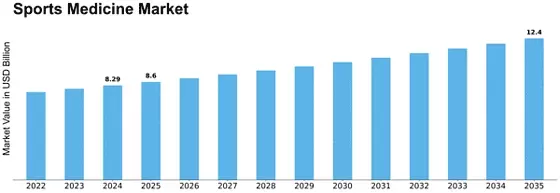
<p>The Sports Medicine Market is projected to reach a valuation of 12.4 USD Billion by 2035.</p>

What was the market valuation of the Sports Medicine Market in 2024?

<p>In 2024, the Sports Medicine Market was valued at 8.29 USD Billion.</p>

What is the expected CAGR for the Sports Medicine Market during the forecast period 2025 - 2035?

<p>The expected CAGR for the Sports Medicine Market during the forecast period 2025 - 2035 is 3.73%.</p>

Which companies are considered key players in the Sports Medicine Market?

<p>Key players in the Sports Medicine Market include Smith & Nephew, Medtronic, Stryker, Johnson & Johnson, and Zimmer Biomet.</p>

What segment of the Sports Medicine Market is projected to grow the most by 2035?

<p>The Rehabilitation segment, valued at 2.07 USD Billion in 2024, is projected to grow to 3.0 USD Billion by 2035.</p>

How does the market for Pain Management products compare between 2024 and 2035?

<p>The Pain Management segment is expected to increase from 1.24 USD Billion in 2024 to 1.8 USD Billion by 2035.</p>

What is the projected growth for the Sports Clinics segment by 2035?

<p>The Sports Clinics segment is anticipated to grow from 1.5 USD Billion in 2024 to 2.3 USD Billion by 2035.</p>

What distribution channel is expected to see the highest growth in the Sports Medicine Market?

<p>Retail Sales, valued at 2.48 USD Billion in 2024, is projected to grow to 3.72 USD Billion by 2035.</p>

What is the expected growth in the market for Rehabilitation Equipment from 2024 to 2035?

<p>The Rehabilitation Equipment segment is expected to grow from 2.29 USD Billion in 2024 to 3.5 USD Billion by 2035.</p>

How does the market for Health Monitoring products evolve from 2024 to 2035?

<p>The Health Monitoring segment is projected to increase from 2.0 USD Billion in 2024 to 3.1 USD Billion by 2035.</p>

Market Summary

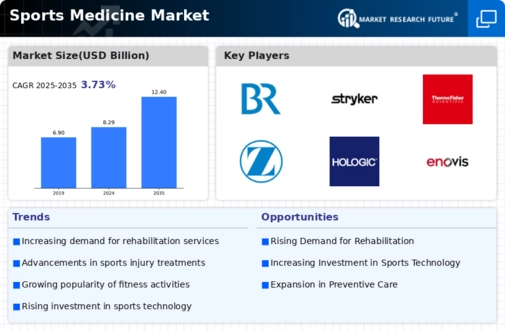
As per Market Research Future analysis, the Sports Medicine Market size was estimated at 8.29 USD Billion in 2024. The Sports Medicine industry is projected to grow from 8.599 USD Billion in 2025 to 12.4 USD Billion by 2035, exhibiting a compound annual growth rate (CAGR) of 3.73% during the forecast period 2026 - 2035

Key Market Trends & Highlights

The Sports Medicine Market is experiencing a dynamic shift towards preventive care and technological integration.

  • The rise of preventive care is reshaping the Sports Medicine Market, particularly in North America. Integration of technology in treatment methods is becoming increasingly prevalent, especially in the Asia-Pacific region. Holistic health approaches are gaining traction, reflecting a broader understanding of athlete well-being. Increased participation in sports and growing awareness of sports injuries are driving demand in the injury prevention segment, while rehabilitation equipment is rapidly expanding due to technological advancements.

Market Size & Forecast

2024 Market Size 8.29 (USD Billion)
2035 Market Size 12.4 (USD Billion)
CAGR (2025 - 2035) 3.73%
Largest Regional Market Share in 2024 North America

Major Players

<a href="https://www.smith-nephew.com/en/sports-medicine">Smith &amp; Nephew</a> (GB), Medtronic (US), <a href="https://www.stryker.com/us/en/sports-medicine.html">Stryker</a> (US), Johnson &amp; Johnson (US), <a href="https://www.zimmerbiomet.com/en/products-and-solutions/specialties/sports-medicine.html">Zimmer Biomet</a> (US), B. Braun (DE), Conmed (US), Medi (DE), Ottobock (DE)

Market Trends

The sports medicine market trends highlight a dynamic evolution driven by increasing participation in sports and fitness activities, technological advancements, and rising awareness of injury prevention across the global sports medicine market. As more individuals engage in physical activities, the demand for specialized care expands, influencing the sports medicine devices market and innovation in treatment solutions. Moreover, the integration of innovative technologies, such as telemedicine and wearable devices, is reshaping the landscape of the sports medicine market, enhancing patient monitoring and personalized treatment approaches. Additionally, holistic approaches addressing both physical and mental health are shaping the modern sports medicine market trends, reinforcing comprehensive athlete care.

This multifaceted perspective acknowledges the importance of psychological well-being in athletic performance and recovery. Furthermore, collaborations between healthcare providers, sports organizations, and technology firms are likely to enhance the delivery of sports medicine services, fostering a more comprehensive ecosystem for athlete care. As the market continues to evolve, it appears poised for sustained growth, driven by the interplay of these various trends and the ongoing commitment to improving athlete health and performance.

Rise of Preventive Care

There is an increasing emphasis on preventive care within the sports medicine market, strengthening long-term sports medicine market growth. Athletes and active individuals are prioritizing injury prevention strategies, leading to a surge in demand for services that focus on conditioning, training, and rehabilitation. This trend reflects a broader understanding of the importance of maintaining physical health to enhance performance and longevity in sports.

Integration of Technology

Technological advancements are transforming the sports medicine devices market, supporting innovation across the sports medicine market. Innovations such as telehealth services, wearable fitness trackers, and mobile health applications are facilitating real-time monitoring and personalized treatment plans. This technological integration not only improves patient outcomes but also enhances accessibility to sports medicine services.

Holistic Health Approaches

Growing recognition of mental and physical health integration supports evolving sports medicine market trends. Practitioners are increasingly adopting holistic approaches that address both physical injuries and psychological well-being. This trend underscores the importance of comprehensive care strategies that support athletes in all aspects of their health.

Sports Medicine Market Market Drivers

Focus on Mental Health in Sports

The increasing recognition of mental health's role in athletic performance is becoming a pivotal driver for the Sports Medicine Market. Athletes are now more aware of the psychological challenges associated with competitive sports, leading to a demand for mental health support services. Research indicates that nearly 30% of athletes experience mental health issues, highlighting the need for comprehensive care that addresses both physical and psychological well-being. As sports organizations and healthcare providers prioritize mental health initiatives, the Sports Medicine Market is likely to expand its offerings to include psychological assessments and interventions. This holistic approach to athlete care not only enhances performance but also promotes overall well-being, suggesting a promising future for the integration of mental health services within the Sports Medicine Market.

Increased Participation in Sports

The rising trend of sports participation among various age groups appears to be a primary driver for the Sports Medicine Market. As more individuals engage in physical activities, the demand for preventive and rehabilitative care intensifies. According to recent data, approximately 60% of adults participate in some form of sports or physical activity, leading to a heightened need for specialized medical services. This surge in participation not only fosters a greater awareness of sports-related injuries but also emphasizes the importance of injury prevention strategies. Consequently, healthcare providers are increasingly focusing on developing tailored programs to address the unique needs of athletes and active individuals. This shift is likely to propel the Sports Medicine Market forward, as stakeholders seek innovative solutions to enhance performance and minimize injury risks.

Growing Awareness of Sports Injuries

The increasing awareness surrounding sports injuries and their long-term implications is driving the Sports Medicine Market. Educational campaigns and media coverage have heightened public consciousness about the risks associated with sports participation. This awareness has led to a greater demand for specialized medical services, including injury prevention programs and rehabilitation therapies. Recent statistics indicate that sports injuries account for nearly 20% of all injuries treated in emergency departments, underscoring the need for effective management strategies. As athletes and recreational participants become more informed about the potential consequences of injuries, they are more likely to seek professional guidance. This trend is expected to bolster the Sports Medicine Market, as healthcare providers adapt their offerings to meet the evolving needs of patients.

Technological Advancements in Treatment

Technological innovations are transforming the landscape of the Sports Medicine Market. The integration of advanced diagnostic tools, such as MRI and ultrasound imaging, has significantly improved the accuracy of injury assessments. Furthermore, the emergence of wearable technology enables real-time monitoring of athletes' performance and health metrics, facilitating timely interventions. Data suggests that the market for sports-related wearable devices is projected to grow at a compound annual growth rate of over 20% in the coming years. These advancements not only enhance treatment efficacy but also empower athletes to make informed decisions regarding their health. As technology continues to evolve, the Sports Medicine Market is likely to witness an influx of novel therapies and rehabilitation techniques, ultimately improving patient outcomes and satisfaction.

Rise of Sports Nutrition and Supplements

The growing emphasis on sports nutrition and dietary supplements is emerging as a significant driver for the Sports Medicine Market. Athletes and fitness enthusiasts are increasingly recognizing the role of nutrition in enhancing performance and recovery. This trend has led to a surge in demand for specialized nutritional products tailored to the needs of active individuals. Market data indicates that the sports nutrition segment is projected to reach a valuation of over 30 billion dollars by 2026. As consumers become more health-conscious, they are seeking evidence-based solutions to optimize their training regimens. Consequently, healthcare professionals are integrating nutritional counseling into their practice, further expanding the scope of the Sports Medicine Market. This convergence of nutrition and sports medicine is likely to foster innovative approaches to athlete care and performance enhancement.

Market Segment Insights

By Application: Injury Prevention (Largest) vs. Rehabilitation (Fastest-Growing)

The Sports Medicine Market is characterized by diverse applications, with Injury Prevention holding the largest share, contributing to overall sports medicine market share and ongoing sports medicine market growth. This segment focuses on reducing risk factors associated with sports injuries through various measures and products like protective gear and training programs. Following closely, Rehabilitation has emerged as the fastest-growing segment, driven by an increasing need for recovery solutions among athletes. Health Monitoring, Athletic Performance Enhancement, and Pain Management also contribute significantly to the market dynamics, albeit on a smaller scale in comparison. Moreover, the growth of the Rehabilitation segment can be attributed to the rising number of injuries in sports and the growing awareness of the importance of effective recovery strategies. With advancements in technology and the rising popularity of fitness among individuals, there is a growing market for products and services centered around rehabilitation. Trends toward preventive medicine in sports are also bolstering the Injury Prevention segment, as more athletes and teams prioritize health and safety, thus influencing overall market growth.

Injury Prevention (Dominant) vs. Pain Management (Emerging)

Injury prevention strategies continue to strengthen the sports medicine devices market, supported by rising demand for advanced technologies. This segment encompasses a wide range of products and services, including wearable technology, training programs, and protective gear. It's formed from a strong foundation of increasing awareness and proactive health measures among athletes and fitness enthusiasts. On the other hand, Pain Management is an emerging segment, gaining traction due to the rising demand for effective solutions among athletes recovering from injuries or dealing with chronic pain conditions. This segment is characterized by a variety of treatments, including physical therapy, medications, and advanced technologies like cryotherapy and ultrasound therapy. While Injury Prevention focuses on avoiding injuries, Pain Management is increasingly recognized for its critical role in enhancing the quality of life for recovering athletes.

By Product Type: Braces Supports (Largest) vs. Rehabilitation Equipment (Fastest-Growing)

The Sports Medicine Market is predominantly driven by braces and supports, expanding the broader sports medicine devices market. This segment is widely utilized for injury prevention and rehabilitation, contributing significantly to overall market dynamics. Therapeutic Devices and Pain Management follow closely, indicating a notable interest in innovative solutions for sports-related injuries. Surgery Equipment holds a smaller share but plays a crucial role in more severe cases requiring intervention. As the focus on active lifestyles increases, the demand for Rehabilitation Equipment is rapidly growing, marking it as the fastest-growing segment. The trend towards personalized care and technologically advanced solutions is boosting this segment's growth. Market drivers include heightened awareness regarding sports injuries and increased investment in sports activities, further enhancing the appeal of specialized medical products.

Braces Supports: Dominant vs. Rehabilitation Equipment: Emerging

Braces Supports is recognized as the dominant player in the Sports Medicine Market sector, providing essential support to athletes recovering from injuries or preventing further occurrences. This segment encompasses a range of products, including ankle supports, knee braces, and other joint stabilizers tailored for specific sports. On the other hand, Rehabilitation Equipment represents an emerging category, focusing on tools and machines used for recovery and physical therapy. These products are increasingly characterized by innovative designs and technology that facilitate quicker recovery times and improve overall efficiency in physical rehabilitation. The juxtaposition of these segments illustrates the dual need for immediate support and long-term recovery solutions in the sports medicine landscape.

By End Use: Hospitals (Largest) vs. Sports Clinics (Fastest-Growing)

The Sports Medicine Market is significantly shaped by its end-use sectors, primarily dominated by hospitals. Hospitals remain dominant contributors to the sports medicine market share, while specialized clinics accelerate innovation. Sports clinics, while currently smaller in market share, exhibit robust growth, capturing attention with specialized care, attracting athletes directly and contributing to increased engagement with sports medicine practices.

Hospitals (Dominant) vs. Sports Clinics (Emerging)

Hospitals represent a dominant force in the Sports Medicine Market, largely because of their capacity to provide extensive medical services, including surgery, rehabilitation, and specialized sports medicine clinics. They are equipped with advanced technology and access to multidisciplinary teams that can cater to various sports-related injuries effectively. In contrast, sports clinics emerge as a dynamic segment, focusing on direct athlete care, rehabilitation, and preventive measures. These clinics cater to sports enthusiasts who often seek immediate attention for sports injuries, and their growth is fueled by the rising awareness of sports-related health issues and preventative care options, making them a vital player in the overall market.

By Distribution Channel: Direct Sales (Largest) vs. Online Sales (Fastest-Growing)

In the Sports Medicine Market, the Distribution expansion contributes to overall sports medicine marketing strategies and evolving digital channels within the sports medicine market. This channel accounts for a significant portion of sales, as it allows for personalized services and tailored solutions for clinical needs. In contrast, Online Sales are rapidly gaining traction, catering to a growing consumer base valuing convenience and accessibility. Many athletes and individuals prefer purchasing sports medicine products online, leading to an increase in this channel's market share.

Direct Sales (Dominant) vs. Wholesale (Emerging)

Direct Sales hold a dominant position in the Sports Medicine Market, characterized by strong relationships between suppliers and healthcare practitioners. This channel allows for specialized knowledge transfer, giving healthcare providers confidence in the products they recommend. On the other hand, Wholesale represents an emerging distribution method that fosters broader product reach, often facilitating quick turnover and access to diverse product lines. While not as personalized as Direct Sales, Wholesalers are crucial for introducing new products to wider markets and cater to lower-volume retail operations.

Get more detailed insights about Sports Medicine Market Research Report- Forecast To 2035

Regional Insights

North America : Market Leader in Innovation

North America remains dominant in the North America sports medicine therapies and betting market share and broader sports medicine market, with strong innovation and healthcare infrastructure supporting growth within the us sports medicine market. Regulatory support from agencies like the FDA has accelerated the approval of innovative medical devices, enhancing market growth. The demand for minimally invasive procedures and advanced rehabilitation technologies further fuels this expansion. The United States is the leading country in this region, with significant contributions from key players such as Medtronic, Stryker, and Johnson & Johnson. The competitive landscape is characterized by continuous innovation and strategic partnerships among these companies. Canada also plays a vital role, focusing on enhancing healthcare infrastructure and promoting sports medicine education, which supports the overall market growth.

Europe : Emerging Market with Potential

Europe demonstrates strong expansion within the Europe sports medicine market, including growth across the France sports medicine market and Italy sports medicine market driven by regulatory advancements and increasing adoption.  Factors such as rising health awareness, increased sports participation, and supportive government initiatives are driving this growth. The European Union's regulations on medical devices have also streamlined the approval process, encouraging innovation and market entry for new products. Germany and the UK are the leading countries in this region, with a strong presence of key players like B. Braun and Ottobock. The competitive landscape is marked by a mix of established companies and emerging startups focusing on advanced technologies. Collaborative efforts between healthcare providers and sports organizations are enhancing the adoption of sports medicine solutions, further propelling market growth.

Asia-Pacific : Rapidly Growing Market

Asia-Pacific is rapidly emerging as a significant player in the sports medicine market, holding around 20% of the global share. Asia-Pacific continues to expand rapidly as the asia pacific sports medicine market, with increasing contributions from the china sports medicine market, japan sports medicine market, and south korea sports medicine market.  Countries like China and India are witnessing a surge in demand for sports medicine products, supported by government initiatives promoting sports and physical activities. China is the largest market in this region, with substantial investments in healthcare infrastructure and sports facilities. The competitive landscape features both international and local players, including Conmed and Medi, who are focusing on innovative solutions tailored to regional needs. The growing awareness of sports injuries and the importance of rehabilitation are further enhancing market prospects in Asia-Pacific.

Middle East and Africa : Untapped Market Potential

The Middle East and Africa region is gradually emerging in the sports medicine market, currently holding about 5% of the global share. The middle east and africa sports medicine market shows emerging opportunities, including developments across the gcc sports medicine market. The growth is primarily driven by increasing participation in sports and fitness activities, along with rising healthcare investments. Governments in countries like the UAE and South Africa are promoting sports initiatives, which is expected to catalyze market expansion in the coming years. The competitive landscape is still developing, with a mix of local and international players. Key companies like Smith & Nephew are establishing a presence in the region, focusing on innovative products and solutions. The growing awareness of sports injuries and the need for rehabilitation services are creating new opportunities for market players, making this region a potential hotspot for future growth.

Key Players and Competitive Insights

The Sports Medicine Market is currently characterized by a dynamic competitive landscape, driven by increasing participation in sports and physical activities, alongside a growing awareness of injury prevention and rehabilitation. Key players such as Smith & Nephew (GB), Medtronic (US), and Stryker (US) are strategically positioned to leverage innovation and technological advancements. Smith & Nephew (GB) focuses on enhancing its product portfolio through research and development, particularly in minimally invasive surgical techniques. Meanwhile, Medtronic (US) emphasizes digital health solutions, integrating advanced technologies into its offerings to improve patient outcomes. Stryker (US) is actively pursuing mergers and acquisitions to expand its market reach and diversify its product lines, thereby shaping a competitive environment that is increasingly reliant on technological prowess and strategic partnerships. The business tactics employed by these companies reflect a concerted effort to optimize supply chains and localize manufacturing processes. The Sports Medicine Market appears moderately fragmented, with a mix of established players and emerging companies vying for market share. The collective influence of these key players fosters a competitive structure that encourages innovation and responsiveness to market demands, ultimately benefiting consumers through enhanced product offerings and services. In August 2025, Smith & Nephew (GB) announced the launch of a new line of advanced orthopedic implants designed to improve recovery times and reduce complications. This strategic move underscores the company's commitment to innovation and positions it favorably against competitors by addressing the growing demand for effective surgical solutions. The introduction of these implants is likely to enhance patient satisfaction and drive market growth. In September 2025, Medtronic (US) unveiled a groundbreaking digital platform aimed at streamlining rehabilitation processes for athletes recovering from injuries. This initiative not only reflects Medtronic's focus on digital health but also signifies a shift towards personalized care solutions. By integrating data analytics and telehealth capabilities, the company is poised to enhance patient engagement and optimize recovery outcomes, thereby reinforcing its competitive edge in the market. In July 2025, Stryker (US) completed the acquisition of a leading sports medicine technology firm, which specializes in innovative surgical tools and techniques. This acquisition is strategically significant as it allows Stryker to expand its product offerings and enhance its technological capabilities. The integration of these advanced tools into Stryker's existing portfolio is expected to strengthen its market position and drive future growth. As of October 2025, the Sports Medicine Market is witnessing a pronounced trend towards digitalization, sustainability, and the integration of artificial intelligence in product development and patient care. Strategic alliances among key players are increasingly shaping the competitive landscape, fostering collaboration that enhances innovation and market responsiveness. Looking ahead, competitive differentiation is likely to evolve from traditional price-based competition to a focus on technological innovation, supply chain reliability, and the ability to deliver personalized healthcare solutions.

Key Companies in the Sports Medicine Market include

Industry Developments

Recent developments in the Sports Medicine Market have shown significant advancements and strategic movements, particularly involving key players such as Hyphen Medical, Bayer, Stryker, and Medtronic.

Dec 2025, Companies launched regenerative biologic products—such as PRP-enhanced implants—for tendon and ligament repair, gaining fast traction among orthopedic sports surgeons in early 2025.

In November 2023, Smith & Nephew finalized the purchase of CartiHeal, obtaining the Agili-C cartilage regeneration implant for knee osteochondral lesions. Agili-C is a commercially available, single-step biological scaffold that was previously classified as an FDA Breakthrough Device and received PMA, therefore substantially augmenting their sports medicine and biologics portfolio.

In October 2023, Smith & Nephew debuted their REGENETEN Bioinductive Implant in Japan, a collagen-based scaffold intended for rotator cuff repair, emphasizing its dedication to biologic and tissue-healing treatments for sports injuries.In November 2024, Johnson & Johnson MedTech declared an exclusive U.S. distribution partnership with Responsive Arthroscopy, enhancing its soft tissue sports medicine portfolio for shoulder, foot, and ankle repair treatments.

Future Outlook

Sports Medicine Market Future Outlook

The Sports Medicine Market is projected to grow at a 3.73% CAGR from 2025 to 2035, driven by increasing sports participation, technological advancements, and rising healthcare expenditures.

New opportunities lie in:

  • <p>Development of personalized rehabilitation programs leveraging AI technology. Expansion of telehealth services for remote sports injury consultations. Investment in wearable technology for real-time performance monitoring.</p>

By 2035, the Sports Medicine Market is expected to be robust, reflecting sustained growth and innovation.

Market Segmentation

Sports Medicine Market End Use Outlook

  • Hospitals
  • Sports Clinics
  • Home Healthcare
  • Fitness Centers
  • Rehabilitation Centers

Sports Medicine Market Application Outlook

  • Injury Prevention
  • Athletic Performance Enhancement
  • Rehabilitation
  • Pain Management
  • Health Monitoring

Sports Medicine Market Product Type Outlook

  • Braces Supports
  • Therapeutic Devices
  • Surgery Equipment
  • Pain Management
  • Rehabilitation Equipment

Sports Medicine Market Distribution Channel Outlook

  • Direct Sales
  • Online Sales
  • Retail Sales
  • Wholesale
  • Distributors

Report Scope

MARKET SIZE 2024 8.29(USD Billion)
MARKET SIZE 2025 8.599(USD Billion)
MARKET SIZE 2035 12.4(USD Billion)
COMPOUND ANNUAL GROWTH RATE (CAGR) 3.73% (2025 - 2035)
REPORT COVERAGE Revenue Forecast, Competitive Landscape, Growth Factors, and Trends
BASE YEAR 2024
Market Forecast Period 2026 - 2035
Historical Data 2019 - 2024
Market Forecast Units USD Billion
Key Companies Profiled Smith & Nephew (GB), Medtronic (US), Stryker (US), Johnson & Johnson (US), Zimmer Biomet (US), B. Braun (DE), Conmed (US), Medi (DE), Ottobock (DE)
Segments Covered Application, Product Type, End Use, Distribution Channel, Regional
Key Market Opportunities Integration of wearable technology enhances injury prevention and recovery in the Sports Medicine Market.
Key Market Dynamics Rising demand for innovative rehabilitation technologies drives competitive dynamics in the Sports Medicine Market.
Countries Covered North America, Europe, APAC, South America, MEA

FAQs

What is the projected market valuation of the Sports Medicine Market by 2035?

<p>The Sports Medicine Market is projected to reach a valuation of 12.4 USD Billion by 2035.</p>

What was the market valuation of the Sports Medicine Market in 2024?

<p>In 2024, the Sports Medicine Market was valued at 8.29 USD Billion.</p>

What is the expected CAGR for the Sports Medicine Market during the forecast period 2025 - 2035?

<p>The expected CAGR for the Sports Medicine Market during the forecast period 2025 - 2035 is 3.73%.</p>

Which companies are considered key players in the Sports Medicine Market?

<p>Key players in the Sports Medicine Market include Smith & Nephew, Medtronic, Stryker, Johnson & Johnson, and Zimmer Biomet.</p>

What segment of the Sports Medicine Market is projected to grow the most by 2035?

<p>The Rehabilitation segment, valued at 2.07 USD Billion in 2024, is projected to grow to 3.0 USD Billion by 2035.</p>

How does the market for Pain Management products compare between 2024 and 2035?

<p>The Pain Management segment is expected to increase from 1.24 USD Billion in 2024 to 1.8 USD Billion by 2035.</p>

What is the projected growth for the Sports Clinics segment by 2035?

<p>The Sports Clinics segment is anticipated to grow from 1.5 USD Billion in 2024 to 2.3 USD Billion by 2035.</p>

What distribution channel is expected to see the highest growth in the Sports Medicine Market?

<p>Retail Sales, valued at 2.48 USD Billion in 2024, is projected to grow to 3.72 USD Billion by 2035.</p>

What is the expected growth in the market for Rehabilitation Equipment from 2024 to 2035?

<p>The Rehabilitation Equipment segment is expected to grow from 2.29 USD Billion in 2024 to 3.5 USD Billion by 2035.</p>

How does the market for Health Monitoring products evolve from 2024 to 2035?

<p>The Health Monitoring segment is projected to increase from 2.0 USD Billion in 2024 to 3.1 USD Billion by 2035.</p>

  1. SECTION I: EXECUTIVE SUMMARY AND KEY HIGHLIGHTS
    1. | 1.1 EXECUTIVE SUMMARY
    2. | | 1.1.1 Market Overview
    3. | | 1.1.2 Key Findings
    4. | | 1.1.3 Market Segmentation
    5. | | 1.1.4 Competitive Landscape
    6. | | 1.1.5 Challenges and Opportunities
    7. | | 1.1.6 Future Outlook
  2. SECTION II: SCOPING, METHODOLOGY AND MARKET STRUCTURE
    1. | 2.1 MARKET INTRODUCTION
    2. | | 2.1.1 Definition
    3. | | 2.1.2 Scope of the study
    4. | | | 2.1.2.1 Research Objective
    5. | | | 2.1.2.2 Assumption
    6. | | | 2.1.2.3 Limitations
    7. | 2.2 RESEARCH METHODOLOGY
    8. | | 2.2.1 Overview
    9. | | 2.2.2 Data Mining
    10. | | 2.2.3 Secondary Research
    11. | | 2.2.4 Primary Research
    12. | | | 2.2.4.1 Primary Interviews and Information Gathering Process
    13. | | | 2.2.4.2 Breakdown of Primary Respondents
    14. | | 2.2.5 Forecasting Model
    15. | | 2.2.6 Market Size Estimation
    16. | | | 2.2.6.1 Bottom-Up Approach
    17. | | | 2.2.6.2 Top-Down Approach
    18. | | 2.2.7 Data Triangulation
    19. | | 2.2.8 Validation
  3. SECTION III: QUALITATIVE ANALYSIS
    1. | 3.1 MARKET DYNAMICS
    2. | | 3.1.1 Overview
    3. | | 3.1.2 Drivers
    4. | | 3.1.3 Restraints
    5. | | 3.1.4 Opportunities
    6. | 3.2 MARKET FACTOR ANALYSIS
    7. | | 3.2.1 Value chain Analysis
    8. | | 3.2.2 Porter's Five Forces Analysis
    9. | | | 3.2.2.1 Bargaining Power of Suppliers
    10. | | | 3.2.2.2 Bargaining Power of Buyers
    11. | | | 3.2.2.3 Threat of New Entrants
    12. | | | 3.2.2.4 Threat of Substitutes
    13. | | | 3.2.2.5 Intensity of Rivalry
    14. | | 3.2.3 COVID-19 Impact Analysis
    15. | | | 3.2.3.1 Market Impact Analysis
    16. | | | 3.2.3.2 Regional Impact
    17. | | | 3.2.3.3 Opportunity and Threat Analysis
  4. SECTION IV: QUANTITATIVE ANALYSIS
    1. | 4.1 Healthcare, BY Application (USD Billion)
    2. | | 4.1.1 Injury Prevention
    3. | | 4.1.2 Athletic Performance Enhancement
    4. | | 4.1.3 Rehabilitation
    5. | | 4.1.4 Pain Management
    6. | | 4.1.5 Health Monitoring
    7. | 4.2 Healthcare, BY Product Type (USD Billion)
    8. | | 4.2.1 Braces Supports
    9. | | 4.2.2 Therapeutic Devices
    10. | | 4.2.3 Surgery Equipment
    11. | | 4.2.4 Pain Management
    12. | | 4.2.5 Rehabilitation Equipment
    13. | 4.3 Healthcare, BY End Use (USD Billion)
    14. | | 4.3.1 Hospitals
    15. | | 4.3.2 Sports Clinics
    16. | | 4.3.3 Home Healthcare
    17. | | 4.3.4 Fitness Centers
    18. | | 4.3.5 Rehabilitation Centers
    19. | 4.4 Healthcare, BY Distribution Channel (USD Billion)
    20. | | 4.4.1 Direct Sales
    21. | | 4.4.2 Online Sales
    22. | | 4.4.3 Retail Sales
    23. | | 4.4.4 Wholesale
    24. | | 4.4.5 Distributors
    25. | 4.5 Healthcare, BY Region (USD Billion)
    26. | | 4.5.1 North America
    27. | | | 4.5.1.1 US
    28. | | | 4.5.1.2 Canada
    29. | | 4.5.2 Europe
    30. | | | 4.5.2.1 Germany
    31. | | | 4.5.2.2 UK
    32. | | | 4.5.2.3 France
    33. | | | 4.5.2.4 Russia
    34. | | | 4.5.2.5 Italy
    35. | | | 4.5.2.6 Spain
    36. | | | 4.5.2.7 Rest of Europe
    37. | | 4.5.3 APAC
    38. | | | 4.5.3.1 China
    39. | | | 4.5.3.2 India
    40. | | | 4.5.3.3 Japan
    41. | | | 4.5.3.4 South Korea
    42. | | | 4.5.3.5 Malaysia
    43. | | | 4.5.3.6 Thailand
    44. | | | 4.5.3.7 Indonesia
    45. | | | 4.5.3.8 Rest of APAC
    46. | | 4.5.4 South America
    47. | | | 4.5.4.1 Brazil
    48. | | | 4.5.4.2 Mexico
    49. | | | 4.5.4.3 Argentina
    50. | | | 4.5.4.4 Rest of South America
    51. | | 4.5.5 MEA
    52. | | | 4.5.5.1 GCC Countries
    53. | | | 4.5.5.2 South Africa
    54. | | | 4.5.5.3 Rest of MEA
  5. SECTION V: COMPETITIVE ANALYSIS
    1. | 5.1 Competitive Landscape
    2. | | 5.1.1 Overview
    3. | | 5.1.2 Competitive Analysis
    4. | | 5.1.3 Market share Analysis
    5. | | 5.1.4 Major Growth Strategy in the Healthcare
    6. | | 5.1.5 Competitive Benchmarking
    7. | | 5.1.6 Leading Players in Terms of Number of Developments in the Healthcare
    8. | | 5.1.7 Key developments and growth strategies
    9. | | | 5.1.7.1 New Product Launch/Service Deployment
    10. | | | 5.1.7.2 Merger & Acquisitions
    11. | | | 5.1.7.3 Joint Ventures
    12. | | 5.1.8 Major Players Financial Matrix
    13. | | | 5.1.8.1 Sales and Operating Income
    14. | | | 5.1.8.2 Major Players R&D Expenditure. 2023
    15. | 5.2 Company Profiles
    16. | | 5.2.1 Smith & Nephew (GB)
    17. | | | 5.2.1.1 Financial Overview
    18. | | | 5.2.1.2 Products Offered
    19. | | | 5.2.1.3 Key Developments
    20. | | | 5.2.1.4 SWOT Analysis
    21. | | | 5.2.1.5 Key Strategies
    22. | | 5.2.2 Medtronic (US)
    23. | | | 5.2.2.1 Financial Overview
    24. | | | 5.2.2.2 Products Offered
    25. | | | 5.2.2.3 Key Developments
    26. | | | 5.2.2.4 SWOT Analysis
    27. | | | 5.2.2.5 Key Strategies
    28. | | 5.2.3 Stryker (US)
    29. | | | 5.2.3.1 Financial Overview
    30. | | | 5.2.3.2 Products Offered
    31. | | | 5.2.3.3 Key Developments
    32. | | | 5.2.3.4 SWOT Analysis
    33. | | | 5.2.3.5 Key Strategies
    34. | | 5.2.4 Johnson & Johnson (US)
    35. | | | 5.2.4.1 Financial Overview
    36. | | | 5.2.4.2 Products Offered
    37. | | | 5.2.4.3 Key Developments
    38. | | | 5.2.4.4 SWOT Analysis
    39. | | | 5.2.4.5 Key Strategies
    40. | | 5.2.5 Zimmer Biomet (US)
    41. | | | 5.2.5.1 Financial Overview
    42. | | | 5.2.5.2 Products Offered
    43. | | | 5.2.5.3 Key Developments
    44. | | | 5.2.5.4 SWOT Analysis
    45. | | | 5.2.5.5 Key Strategies
    46. | | 5.2.6 B. Braun (DE)
    47. | | | 5.2.6.1 Financial Overview
    48. | | | 5.2.6.2 Products Offered
    49. | | | 5.2.6.3 Key Developments
    50. | | | 5.2.6.4 SWOT Analysis
    51. | | | 5.2.6.5 Key Strategies
    52. | | 5.2.7 Conmed (US)
    53. | | | 5.2.7.1 Financial Overview
    54. | | | 5.2.7.2 Products Offered
    55. | | | 5.2.7.3 Key Developments
    56. | | | 5.2.7.4 SWOT Analysis
    57. | | | 5.2.7.5 Key Strategies
    58. | | 5.2.8 Medi (DE)
    59. | | | 5.2.8.1 Financial Overview
    60. | | | 5.2.8.2 Products Offered
    61. | | | 5.2.8.3 Key Developments
    62. | | | 5.2.8.4 SWOT Analysis
    63. | | | 5.2.8.5 Key Strategies
    64. | | 5.2.9 Ottobock (DE)
    65. | | | 5.2.9.1 Financial Overview
    66. | | | 5.2.9.2 Products Offered
    67. | | | 5.2.9.3 Key Developments
    68. | | | 5.2.9.4 SWOT Analysis
    69. | | | 5.2.9.5 Key Strategies
    70. | 5.3 Appendix
    71. | | 5.3.1 References
    72. | | 5.3.2 Related Reports
  6. LIST OF FIGURES
    1. | 6.1 MARKET SYNOPSIS
    2. | 6.2 NORTH AMERICA MARKET ANALYSIS
    3. | 6.3 US MARKET ANALYSIS BY APPLICATION
    4. | 6.4 US MARKET ANALYSIS BY PRODUCT TYPE
    5. | 6.5 US MARKET ANALYSIS BY END USE
    6. | 6.6 US MARKET ANALYSIS BY DISTRIBUTION CHANNEL
    7. | 6.7 CANADA MARKET ANALYSIS BY APPLICATION
    8. | 6.8 CANADA MARKET ANALYSIS BY PRODUCT TYPE
    9. | 6.9 CANADA MARKET ANALYSIS BY END USE
    10. | 6.10 CANADA MARKET ANALYSIS BY DISTRIBUTION CHANNEL
    11. | 6.11 EUROPE MARKET ANALYSIS
    12. | 6.12 GERMANY MARKET ANALYSIS BY APPLICATION
    13. | 6.13 GERMANY MARKET ANALYSIS BY PRODUCT TYPE
    14. | 6.14 GERMANY MARKET ANALYSIS BY END USE
    15. | 6.15 GERMANY MARKET ANALYSIS BY DISTRIBUTION CHANNEL
    16. | 6.16 UK MARKET ANALYSIS BY APPLICATION
    17. | 6.17 UK MARKET ANALYSIS BY PRODUCT TYPE
    18. | 6.18 UK MARKET ANALYSIS BY END USE
    19. | 6.19 UK MARKET ANALYSIS BY DISTRIBUTION CHANNEL
    20. | 6.20 FRANCE MARKET ANALYSIS BY APPLICATION
    21. | 6.21 FRANCE MARKET ANALYSIS BY PRODUCT TYPE
    22. | 6.22 FRANCE MARKET ANALYSIS BY END USE
    23. | 6.23 FRANCE MARKET ANALYSIS BY DISTRIBUTION CHANNEL
    24. | 6.24 RUSSIA MARKET ANALYSIS BY APPLICATION
    25. | 6.25 RUSSIA MARKET ANALYSIS BY PRODUCT TYPE
    26. | 6.26 RUSSIA MARKET ANALYSIS BY END USE
    27. | 6.27 RUSSIA MARKET ANALYSIS BY DISTRIBUTION CHANNEL
    28. | 6.28 ITALY MARKET ANALYSIS BY APPLICATION
    29. | 6.29 ITALY MARKET ANALYSIS BY PRODUCT TYPE
    30. | 6.30 ITALY MARKET ANALYSIS BY END USE
    31. | 6.31 ITALY MARKET ANALYSIS BY DISTRIBUTION CHANNEL
    32. | 6.32 SPAIN MARKET ANALYSIS BY APPLICATION
    33. | 6.33 SPAIN MARKET ANALYSIS BY PRODUCT TYPE
    34. | 6.34 SPAIN MARKET ANALYSIS BY END USE
    35. | 6.35 SPAIN MARKET ANALYSIS BY DISTRIBUTION CHANNEL
    36. | 6.36 REST OF EUROPE MARKET ANALYSIS BY APPLICATION
    37. | 6.37 REST OF EUROPE MARKET ANALYSIS BY PRODUCT TYPE
    38. | 6.38 REST OF EUROPE MARKET ANALYSIS BY END USE
    39. | 6.39 REST OF EUROPE MARKET ANALYSIS BY DISTRIBUTION CHANNEL
    40. | 6.40 APAC MARKET ANALYSIS
    41. | 6.41 CHINA MARKET ANALYSIS BY APPLICATION
    42. | 6.42 CHINA MARKET ANALYSIS BY PRODUCT TYPE
    43. | 6.43 CHINA MARKET ANALYSIS BY END USE
    44. | 6.44 CHINA MARKET ANALYSIS BY DISTRIBUTION CHANNEL
    45. | 6.45 INDIA MARKET ANALYSIS BY APPLICATION
    46. | 6.46 INDIA MARKET ANALYSIS BY PRODUCT TYPE
    47. | 6.47 INDIA MARKET ANALYSIS BY END USE
    48. | 6.48 INDIA MARKET ANALYSIS BY DISTRIBUTION CHANNEL
    49. | 6.49 JAPAN MARKET ANALYSIS BY APPLICATION
    50. | 6.50 JAPAN MARKET ANALYSIS BY PRODUCT TYPE
    51. | 6.51 JAPAN MARKET ANALYSIS BY END USE
    52. | 6.52 JAPAN MARKET ANALYSIS BY DISTRIBUTION CHANNEL
    53. | 6.53 SOUTH KOREA MARKET ANALYSIS BY APPLICATION
    54. | 6.54 SOUTH KOREA MARKET ANALYSIS BY PRODUCT TYPE
    55. | 6.55 SOUTH KOREA MARKET ANALYSIS BY END USE
    56. | 6.56 SOUTH KOREA MARKET ANALYSIS BY DISTRIBUTION CHANNEL
    57. | 6.57 MALAYSIA MARKET ANALYSIS BY APPLICATION
    58. | 6.58 MALAYSIA MARKET ANALYSIS BY PRODUCT TYPE
    59. | 6.59 MALAYSIA MARKET ANALYSIS BY END USE
    60. | 6.60 MALAYSIA MARKET ANALYSIS BY DISTRIBUTION CHANNEL
    61. | 6.61 THAILAND MARKET ANALYSIS BY APPLICATION
    62. | 6.62 THAILAND MARKET ANALYSIS BY PRODUCT TYPE
    63. | 6.63 THAILAND MARKET ANALYSIS BY END USE
    64. | 6.64 THAILAND MARKET ANALYSIS BY DISTRIBUTION CHANNEL
    65. | 6.65 INDONESIA MARKET ANALYSIS BY APPLICATION
    66. | 6.66 INDONESIA MARKET ANALYSIS BY PRODUCT TYPE
    67. | 6.67 INDONESIA MARKET ANALYSIS BY END USE
    68. | 6.68 INDONESIA MARKET ANALYSIS BY DISTRIBUTION CHANNEL
    69. | 6.69 REST OF APAC MARKET ANALYSIS BY APPLICATION
    70. | 6.70 REST OF APAC MARKET ANALYSIS BY PRODUCT TYPE
    71. | 6.71 REST OF APAC MARKET ANALYSIS BY END USE
    72. | 6.72 REST OF APAC MARKET ANALYSIS BY DISTRIBUTION CHANNEL
    73. | 6.73 SOUTH AMERICA MARKET ANALYSIS
    74. | 6.74 BRAZIL MARKET ANALYSIS BY APPLICATION
    75. | 6.75 BRAZIL MARKET ANALYSIS BY PRODUCT TYPE
    76. | 6.76 BRAZIL MARKET ANALYSIS BY END USE
    77. | 6.77 BRAZIL MARKET ANALYSIS BY DISTRIBUTION CHANNEL
    78. | 6.78 MEXICO MARKET ANALYSIS BY APPLICATION
    79. | 6.79 MEXICO MARKET ANALYSIS BY PRODUCT TYPE
    80. | 6.80 MEXICO MARKET ANALYSIS BY END USE
    81. | 6.81 MEXICO MARKET ANALYSIS BY DISTRIBUTION CHANNEL
    82. | 6.82 ARGENTINA MARKET ANALYSIS BY APPLICATION
    83. | 6.83 ARGENTINA MARKET ANALYSIS BY PRODUCT TYPE
    84. | 6.84 ARGENTINA MARKET ANALYSIS BY END USE
    85. | 6.85 ARGENTINA MARKET ANALYSIS BY DISTRIBUTION CHANNEL
    86. | 6.86 REST OF SOUTH AMERICA MARKET ANALYSIS BY APPLICATION
    87. | 6.87 REST OF SOUTH AMERICA MARKET ANALYSIS BY PRODUCT TYPE
    88. | 6.88 REST OF SOUTH AMERICA MARKET ANALYSIS BY END USE
    89. | 6.89 REST OF SOUTH AMERICA MARKET ANALYSIS BY DISTRIBUTION CHANNEL
    90. | 6.90 MEA MARKET ANALYSIS
    91. | 6.91 GCC COUNTRIES MARKET ANALYSIS BY APPLICATION
    92. | 6.92 GCC COUNTRIES MARKET ANALYSIS BY PRODUCT TYPE
    93. | 6.93 GCC COUNTRIES MARKET ANALYSIS BY END USE
    94. | 6.94 GCC COUNTRIES MARKET ANALYSIS BY DISTRIBUTION CHANNEL
    95. | 6.95 SOUTH AFRICA MARKET ANALYSIS BY APPLICATION
    96. | 6.96 SOUTH AFRICA MARKET ANALYSIS BY PRODUCT TYPE
    97. | 6.97 SOUTH AFRICA MARKET ANALYSIS BY END USE
    98. | 6.98 SOUTH AFRICA MARKET ANALYSIS BY DISTRIBUTION CHANNEL
    99. | 6.99 REST OF MEA MARKET ANALYSIS BY APPLICATION
    100. | 6.100 REST OF MEA MARKET ANALYSIS BY PRODUCT TYPE
    101. | 6.101 REST OF MEA MARKET ANALYSIS BY END USE
    102. | 6.102 REST OF MEA MARKET ANALYSIS BY DISTRIBUTION CHANNEL
    103. | 6.103 KEY BUYING CRITERIA OF HEALTHCARE
    104. | 6.104 RESEARCH PROCESS OF MRFR
    105. | 6.105 DRO ANALYSIS OF HEALTHCARE
    106. | 6.106 DRIVERS IMPACT ANALYSIS: HEALTHCARE
    107. | 6.107 RESTRAINTS IMPACT ANALYSIS: HEALTHCARE
    108. | 6.108 SUPPLY / VALUE CHAIN: HEALTHCARE
    109. | 6.109 HEALTHCARE, BY APPLICATION, 2024 (% SHARE)
    110. | 6.110 HEALTHCARE, BY APPLICATION, 2024 TO 2035 (USD Billion)
    111. | 6.111 HEALTHCARE, BY PRODUCT TYPE, 2024 (% SHARE)
    112. | 6.112 HEALTHCARE, BY PRODUCT TYPE, 2024 TO 2035 (USD Billion)
    113. | 6.113 HEALTHCARE, BY END USE, 2024 (% SHARE)
    114. | 6.114 HEALTHCARE, BY END USE, 2024 TO 2035 (USD Billion)
    115. | 6.115 HEALTHCARE, BY DISTRIBUTION CHANNEL, 2024 (% SHARE)
    116. | 6.116 HEALTHCARE, BY DISTRIBUTION CHANNEL, 2024 TO 2035 (USD Billion)
    117. | 6.117 BENCHMARKING OF MAJOR COMPETITORS
  7. LIST OF TABLES
    1. | 7.1 LIST OF ASSUMPTIONS
    2. | | 7.1.1
    3. | 7.2 North America MARKET SIZE ESTIMATES; FORECAST
    4. | | 7.2.1 BY APPLICATION, 2025-2035 (USD Billion)
    5. | | 7.2.2 BY PRODUCT TYPE, 2025-2035 (USD Billion)
    6. | | 7.2.3 BY END USE, 2025-2035 (USD Billion)
    7. | | 7.2.4 BY DISTRIBUTION CHANNEL, 2025-2035 (USD Billion)
    8. | 7.3 US MARKET SIZE ESTIMATES; FORECAST
    9. | | 7.3.1 BY APPLICATION, 2025-2035 (USD Billion)
    10. | | 7.3.2 BY PRODUCT TYPE, 2025-2035 (USD Billion)
    11. | | 7.3.3 BY END USE, 2025-2035 (USD Billion)
    12. | | 7.3.4 BY DISTRIBUTION CHANNEL, 2025-2035 (USD Billion)
    13. | 7.4 Canada MARKET SIZE ESTIMATES; FORECAST
    14. | | 7.4.1 BY APPLICATION, 2025-2035 (USD Billion)
    15. | | 7.4.2 BY PRODUCT TYPE, 2025-2035 (USD Billion)
    16. | | 7.4.3 BY END USE, 2025-2035 (USD Billion)
    17. | | 7.4.4 BY DISTRIBUTION CHANNEL, 2025-2035 (USD Billion)
    18. | 7.5 Europe MARKET SIZE ESTIMATES; FORECAST
    19. | | 7.5.1 BY APPLICATION, 2025-2035 (USD Billion)
    20. | | 7.5.2 BY PRODUCT TYPE, 2025-2035 (USD Billion)
    21. | | 7.5.3 BY END USE, 2025-2035 (USD Billion)
    22. | | 7.5.4 BY DISTRIBUTION CHANNEL, 2025-2035 (USD Billion)
    23. | 7.6 Germany MARKET SIZE ESTIMATES; FORECAST
    24. | | 7.6.1 BY APPLICATION, 2025-2035 (USD Billion)
    25. | | 7.6.2 BY PRODUCT TYPE, 2025-2035 (USD Billion)
    26. | | 7.6.3 BY END USE, 2025-2035 (USD Billion)
    27. | | 7.6.4 BY DISTRIBUTION CHANNEL, 2025-2035 (USD Billion)
    28. | 7.7 UK MARKET SIZE ESTIMATES; FORECAST
    29. | | 7.7.1 BY APPLICATION, 2025-2035 (USD Billion)
    30. | | 7.7.2 BY PRODUCT TYPE, 2025-2035 (USD Billion)
    31. | | 7.7.3 BY END USE, 2025-2035 (USD Billion)
    32. | | 7.7.4 BY DISTRIBUTION CHANNEL, 2025-2035 (USD Billion)
    33. | 7.8 France MARKET SIZE ESTIMATES; FORECAST
    34. | | 7.8.1 BY APPLICATION, 2025-2035 (USD Billion)
    35. | | 7.8.2 BY PRODUCT TYPE, 2025-2035 (USD Billion)
    36. | | 7.8.3 BY END USE, 2025-2035 (USD Billion)
    37. | | 7.8.4 BY DISTRIBUTION CHANNEL, 2025-2035 (USD Billion)
    38. | 7.9 Russia MARKET SIZE ESTIMATES; FORECAST
    39. | | 7.9.1 BY APPLICATION, 2025-2035 (USD Billion)
    40. | | 7.9.2 BY PRODUCT TYPE, 2025-2035 (USD Billion)
    41. | | 7.9.3 BY END USE, 2025-2035 (USD Billion)
    42. | | 7.9.4 BY DISTRIBUTION CHANNEL, 2025-2035 (USD Billion)
    43. | 7.10 Italy MARKET SIZE ESTIMATES; FORECAST
    44. | | 7.10.1 BY APPLICATION, 2025-2035 (USD Billion)
    45. | | 7.10.2 BY PRODUCT TYPE, 2025-2035 (USD Billion)
    46. | | 7.10.3 BY END USE, 2025-2035 (USD Billion)
    47. | | 7.10.4 BY DISTRIBUTION CHANNEL, 2025-2035 (USD Billion)
    48. | 7.11 Spain MARKET SIZE ESTIMATES; FORECAST
    49. | | 7.11.1 BY APPLICATION, 2025-2035 (USD Billion)
    50. | | 7.11.2 BY PRODUCT TYPE, 2025-2035 (USD Billion)
    51. | | 7.11.3 BY END USE, 2025-2035 (USD Billion)
    52. | | 7.11.4 BY DISTRIBUTION CHANNEL, 2025-2035 (USD Billion)
    53. | 7.12 Rest of Europe MARKET SIZE ESTIMATES; FORECAST
    54. | | 7.12.1 BY APPLICATION, 2025-2035 (USD Billion)
    55. | | 7.12.2 BY PRODUCT TYPE, 2025-2035 (USD Billion)
    56. | | 7.12.3 BY END USE, 2025-2035 (USD Billion)
    57. | | 7.12.4 BY DISTRIBUTION CHANNEL, 2025-2035 (USD Billion)
    58. | 7.13 APAC MARKET SIZE ESTIMATES; FORECAST
    59. | | 7.13.1 BY APPLICATION, 2025-2035 (USD Billion)
    60. | | 7.13.2 BY PRODUCT TYPE, 2025-2035 (USD Billion)
    61. | | 7.13.3 BY END USE, 2025-2035 (USD Billion)
    62. | | 7.13.4 BY DISTRIBUTION CHANNEL, 2025-2035 (USD Billion)
    63. | 7.14 China MARKET SIZE ESTIMATES; FORECAST
    64. | | 7.14.1 BY APPLICATION, 2025-2035 (USD Billion)
    65. | | 7.14.2 BY PRODUCT TYPE, 2025-2035 (USD Billion)
    66. | | 7.14.3 BY END USE, 2025-2035 (USD Billion)
    67. | | 7.14.4 BY DISTRIBUTION CHANNEL, 2025-2035 (USD Billion)
    68. | 7.15 India MARKET SIZE ESTIMATES; FORECAST
    69. | | 7.15.1 BY APPLICATION, 2025-2035 (USD Billion)
    70. | | 7.15.2 BY PRODUCT TYPE, 2025-2035 (USD Billion)
    71. | | 7.15.3 BY END USE, 2025-2035 (USD Billion)
    72. | | 7.15.4 BY DISTRIBUTION CHANNEL, 2025-2035 (USD Billion)
    73. | 7.16 Japan MARKET SIZE ESTIMATES; FORECAST
    74. | | 7.16.1 BY APPLICATION, 2025-2035 (USD Billion)
    75. | | 7.16.2 BY PRODUCT TYPE, 2025-2035 (USD Billion)
    76. | | 7.16.3 BY END USE, 2025-2035 (USD Billion)
    77. | | 7.16.4 BY DISTRIBUTION CHANNEL, 2025-2035 (USD Billion)
    78. | 7.17 South Korea MARKET SIZE ESTIMATES; FORECAST
    79. | | 7.17.1 BY APPLICATION, 2025-2035 (USD Billion)
    80. | | 7.17.2 BY PRODUCT TYPE, 2025-2035 (USD Billion)
    81. | | 7.17.3 BY END USE, 2025-2035 (USD Billion)
    82. | | 7.17.4 BY DISTRIBUTION CHANNEL, 2025-2035 (USD Billion)
    83. | 7.18 Malaysia MARKET SIZE ESTIMATES; FORECAST
    84. | | 7.18.1 BY APPLICATION, 2025-2035 (USD Billion)
    85. | | 7.18.2 BY PRODUCT TYPE, 2025-2035 (USD Billion)
    86. | | 7.18.3 BY END USE, 2025-2035 (USD Billion)
    87. | | 7.18.4 BY DISTRIBUTION CHANNEL, 2025-2035 (USD Billion)
    88. | 7.19 Thailand MARKET SIZE ESTIMATES; FORECAST
    89. | | 7.19.1 BY APPLICATION, 2025-2035 (USD Billion)
    90. | | 7.19.2 BY PRODUCT TYPE, 2025-2035 (USD Billion)
    91. | | 7.19.3 BY END USE, 2025-2035 (USD Billion)
    92. | | 7.19.4 BY DISTRIBUTION CHANNEL, 2025-2035 (USD Billion)
    93. | 7.20 Indonesia MARKET SIZE ESTIMATES; FORECAST
    94. | | 7.20.1 BY APPLICATION, 2025-2035 (USD Billion)
    95. | | 7.20.2 BY PRODUCT TYPE, 2025-2035 (USD Billion)
    96. | | 7.20.3 BY END USE, 2025-2035 (USD Billion)
    97. | | 7.20.4 BY DISTRIBUTION CHANNEL, 2025-2035 (USD Billion)
    98. | 7.21 Rest of APAC MARKET SIZE ESTIMATES; FORECAST
    99. | | 7.21.1 BY APPLICATION, 2025-2035 (USD Billion)
    100. | | 7.21.2 BY PRODUCT TYPE, 2025-2035 (USD Billion)
    101. | | 7.21.3 BY END USE, 2025-2035 (USD Billion)
    102. | | 7.21.4 BY DISTRIBUTION CHANNEL, 2025-2035 (USD Billion)
    103. | 7.22 South America MARKET SIZE ESTIMATES; FORECAST
    104. | | 7.22.1 BY APPLICATION, 2025-2035 (USD Billion)
    105. | | 7.22.2 BY PRODUCT TYPE, 2025-2035 (USD Billion)
    106. | | 7.22.3 BY END USE, 2025-2035 (USD Billion)
    107. | | 7.22.4 BY DISTRIBUTION CHANNEL, 2025-2035 (USD Billion)
    108. | 7.23 Brazil MARKET SIZE ESTIMATES; FORECAST
    109. | | 7.23.1 BY APPLICATION, 2025-2035 (USD Billion)
    110. | | 7.23.2 BY PRODUCT TYPE, 2025-2035 (USD Billion)
    111. | | 7.23.3 BY END USE, 2025-2035 (USD Billion)
    112. | | 7.23.4 BY DISTRIBUTION CHANNEL, 2025-2035 (USD Billion)
    113. | 7.24 Mexico MARKET SIZE ESTIMATES; FORECAST
    114. | | 7.24.1 BY APPLICATION, 2025-2035 (USD Billion)
    115. | | 7.24.2 BY PRODUCT TYPE, 2025-2035 (USD Billion)
    116. | | 7.24.3 BY END USE, 2025-2035 (USD Billion)
    117. | | 7.24.4 BY DISTRIBUTION CHANNEL, 2025-2035 (USD Billion)
    118. | 7.25 Argentina MARKET SIZE ESTIMATES; FORECAST
    119. | | 7.25.1 BY APPLICATION, 2025-2035 (USD Billion)
    120. | | 7.25.2 BY PRODUCT TYPE, 2025-2035 (USD Billion)
    121. | | 7.25.3 BY END USE, 2025-2035 (USD Billion)
    122. | | 7.25.4 BY DISTRIBUTION CHANNEL, 2025-2035 (USD Billion)
    123. | 7.26 Rest of South America MARKET SIZE ESTIMATES; FORECAST
    124. | | 7.26.1 BY APPLICATION, 2025-2035 (USD Billion)
    125. | | 7.26.2 BY PRODUCT TYPE, 2025-2035 (USD Billion)
    126. | | 7.26.3 BY END USE, 2025-2035 (USD Billion)
    127. | | 7.26.4 BY DISTRIBUTION CHANNEL, 2025-2035 (USD Billion)
    128. | 7.27 MEA MARKET SIZE ESTIMATES; FORECAST
    129. | | 7.27.1 BY APPLICATION, 2025-2035 (USD Billion)
    130. | | 7.27.2 BY PRODUCT TYPE, 2025-2035 (USD Billion)
    131. | | 7.27.3 BY END USE, 2025-2035 (USD Billion)
    132. | | 7.27.4 BY DISTRIBUTION CHANNEL, 2025-2035 (USD Billion)
    133. | 7.28 GCC Countries MARKET SIZE ESTIMATES; FORECAST
    134. | | 7.28.1 BY APPLICATION, 2025-2035 (USD Billion)
    135. | | 7.28.2 BY PRODUCT TYPE, 2025-2035 (USD Billion)
    136. | | 7.28.3 BY END USE, 2025-2035 (USD Billion)
    137. | | 7.28.4 BY DISTRIBUTION CHANNEL, 2025-2035 (USD Billion)
    138. | 7.29 South Africa MARKET SIZE ESTIMATES; FORECAST
    139. | | 7.29.1 BY APPLICATION, 2025-2035 (USD Billion)
    140. | | 7.29.2 BY PRODUCT TYPE, 2025-2035 (USD Billion)
    141. | | 7.29.3 BY END USE, 2025-2035 (USD Billion)
    142. | | 7.29.4 BY DISTRIBUTION CHANNEL, 2025-2035 (USD Billion)
    143. | 7.30 Rest of MEA MARKET SIZE ESTIMATES; FORECAST
    144. | | 7.30.1 BY APPLICATION, 2025-2035 (USD Billion)
    145. | | 7.30.2 BY PRODUCT TYPE, 2025-2035 (USD Billion)
    146. | | 7.30.3 BY END USE, 2025-2035 (USD Billion)
    147. | | 7.30.4 BY DISTRIBUTION CHANNEL, 2025-2035 (USD Billion)
    148. | 7.31 PRODUCT LAUNCH/PRODUCT DEVELOPMENT/APPROVAL
    149. | | 7.31.1
    150. | 7.32 ACQUISITION/PARTNERSHIP
    151. | | 7.32.1

Healthcare Market Segmentation

Healthcare By Application (USD Billion, 2025-2035)

  • Injury Prevention
  • Athletic Performance Enhancement
  • Rehabilitation
  • Pain Management
  • Health Monitoring

Healthcare By Product Type (USD Billion, 2025-2035)

  • Braces Supports
  • Therapeutic Devices
  • Surgery Equipment
  • Pain Management
  • Rehabilitation Equipment

Healthcare By End Use (USD Billion, 2025-2035)

  • Hospitals
  • Sports Clinics
  • Home Healthcare
  • Fitness Centers
  • Rehabilitation Centers

Healthcare By Distribution Channel (USD Billion, 2025-2035)

  • Direct Sales
  • Online Sales
  • Retail Sales
  • Wholesale
  • Distributors
Infographic

Free Sample Request

Kindly complete the form below to receive a free sample of this Report

Get Free Sample

Customer Strories

Compare Licence

×
Features License Type
Single User Multiuser License Enterprise User
Price $4,950 $5,950 $7,250
Maximum User Access Limit 1 User Upto 10 Users Unrestricted Access Throughout the Organization
Free Customization
Direct Access to Analyst
Deliverable Format
Platform Access
Discount on Next Purchase 10% 15% 15%
Printable Versions
%>