


Market Trends
Introduction
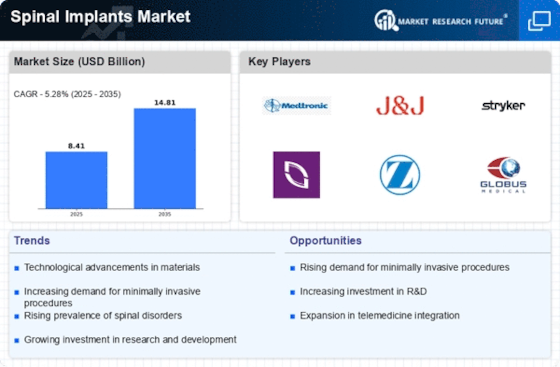
In the year 2024, the spinal implant market is expected to grow in a major way, due to the combination of a number of macroeconomic factors. Technological innovations, especially in the field of minimally invasive surgical techniques and biocompatible materials, are reshaping product offerings and enhancing patient outcomes. In the meantime, the regulatory environment is becoming increasingly stringent, thereby putting increasing pressure on manufacturers to focus on safety and efficacy in their innovations. Meanwhile, a shift in the preferences of consumers, a trend towards a greater focus on individualized treatment and patient-centric solutions, is influencing the market’s dynamics. These trends are of strategic importance to market participants, because they are determining their positioning strategies, their investment decisions, and their product development strategies in a rapidly evolving market.
Top Trends
-
Increased Adoption of Minimally Invasive Surgery (MIS)
Minimally invasive surgical methods are gaining in popularity in the spinal implant market, due to the advantages of reduced downtime and fewer complications. Leading manufacturers are investing in the development of new products to further refine MIS. Studies have shown that a 30 per cent increase in patient satisfaction has resulted from this. This trend is expected to change surgical practice and to lead to the introduction of new training programmes for surgeons. -
Integration of Robotics and AI in Surgical Procedures
INTEGRATION OF ROBOTS AND ARTIFICIAL INTELLIGENCE IN SPINAL SURGERY HAS ALSO RENEWED OUR OPINION OF THIS DISCIPLINE. A few companies have developed devices which have increased the accuracy of the operation and reduced the possibility of human error. For example, the accuracy of the operation has been improved by 20 per cent when the robot is used. This development will increase the efficiencies of the operation and may create a demand for a higher level of training in the use of robots among health-care professionals. -
Focus on Biodegradable and Bioactive Materials
There is increasing emphasis on the development of biodegradable and bioactive materials for spinal implant surgery, which could reduce the need for subsequent operations. These materials may promote healing and bone integration. As regulatory authorities approve more of these innovations, the market may be influenced by sustainable practices and materials, which could change manufacturing processes. -
Telemedicine and Remote Monitoring Solutions
Post-operative care in spinal surgery is being affected by the emergence of telemedicine, which enables the remote observation of the patient’s progress. Telemedicine can reduce the rate of readmission to hospital by up to 25 per cent. This trend is encouraging spinal implant manufacturers to work together with technology companies to develop integrated solutions that could lead to improved outcomes for patients and reduced costs. -
Personalized Medicine and Custom Implants
The trend towards a more individual approach to medicine is resulting in the development of a customised spinal implant that fits the patient’s individual anatomy. Companies are using 3D printing to produce these spinal implants, which could improve surgical outcomes. As patient-specific solutions become more widespread, competition among manufacturers to develop new products and differentiate their offerings will increase. -
Regulatory Changes and Compliance Standards
The regulatory authorities are tightening the rules governing the use of spinal implants. The clinical trials and post-market surveillance have been subject to increasing scrutiny in recent times. The companies must adapt to these evolving regulations which will affect the time and cost of developing new products and thereby influence the market dynamics and the competitive strategies. -
Expansion of Outpatient Surgical Centers
The growth of outpatient surgery centers is changing the market for spinal implant devices. Outpatient surgery can reduce costs by up to 40 percent. This trend is causing manufacturers to develop products that are especially designed for outpatient use, which may increase market access and patient throughput. -
Enhanced Focus on Patient Education and Engagement
In the spinal implant market, there is an increasing emphasis on patient education and involvement, with companies providing resources to help patients understand their options. Patients who are informed about their condition and treatment are more likely to follow up after surgery and so the results are better. This trend may lead to more strategic alliances between companies and health care professionals. -
Emergence of Advanced Imaging Technologies
And in this respect, the new methods of X-ray, X-ray fluoroscopy, and MRI are of the greatest value, since they allow the operation to be performed in a real time mode. This improves the surgical planning and reduces the number of complications. Studies have shown that a 15 percent reduction in the number of re-operations is possible. These methods will become more accessible and will lead to the need for training and integration into surgical workflows. -
Sustainability Initiatives in Manufacturing
The manufacture of spinal implants is beginning to be influenced by the requirements of sustainability, and companies are adopting eco-friendly practices and materials. According to one study, a large majority of consumers prefer to buy products from companies that have a good reputation for their commitment to the environment. This trend will have an effect on the supply chain and may lead to closer collaboration between manufacturers and experts in the field of sustainability.
Conclusion: Navigating the Spinal Implants Landscape
The spinal implant market in 2024 will be characterized by a highly competitive market environment with significant fragmentation. Both established and new companies will compete for market share. In terms of regional trends, the market will be characterized by an increasing demand in Asia-Pacific and North America. Hence, the strategy of the companies will be adapted to this. The big companies will continue to focus on established brands and broad distribution networks, while new companies will continue to focus on innovation and niche products. Companies will be investing in the development of artificial intelligence to improve surgical precision, automation to optimize production and compliance with regulations and consumer expectations. Adaptation to the changing market will also be important for leadership in this changing landscape. This is why it is important for decision-makers to prioritise these strategic implications to be able to navigate the complexities of the market effectively.
























Leave a Comment