Request Free Sample ×

Kindly complete the form below to receive a free sample of this Report

* Please use a valid business email

Leading companies partner with us for data-driven Insights

clients tt-cursor
Hero Background
English
Chinese
French
Japanese
Korean
German
Spanish

Spinal Cord Compression Spinal Stenosis Market Trends

ID: MRFR/MED/2628-CR
128 Pages
Satyendra Maurya
Last Updated: April 15, 2026

Spinal Cord Compression Market Research Report Information by Type (Lumbar Spinal Stenosis, Cervical Stenosis and Central Stenosis), Diagnosis (Physical Examination and Imaging), Treatment Type (Surgical Treatment and Non-Surgical Treatment (Drugs & Therapy)), End User (Hospitals, Ambulatory Surgical Centers and Rehabilitation Centers) and Region (Americas, Europe, Asia-Pacific and Middle East & Africa) - Forecast till 2035

Share:
Download PDF ×

We do not share your information with anyone. However, we may send you emails based on your report interest from time to time. You may contact us at any time to opt-out.

Spinal Cord Compression Spinal Stenosis Market Infographic
Purchase Options

Market Trends

Key Emerging Trends in the Spinal Cord Compression Spinal Stenosis Market

Spinal stenosis stands as a significant contributor to spinal cord compression, posing challenges that have traditionally been addressed through various surgical interventions. Procedures like laminectomy, laminotomy, and foraminotomy have been conventional methods for treating this condition. However, despite their effectiveness, these surgeries come with inherent risks such as bleeding, infections, and other complications, prompting the exploration of alternative treatment modalities.

In recent years, the landscape of spinal cord compression treatment has seen a transformative shift towards minimally invasive procedures. These procedures offer a less invasive approach compared to traditional surgeries, aiming to mitigate the risks associated with more invasive interventions. A key focus has been the development and application of various spinal cord decompression devices designed to address spinal stenosis while minimizing the risks and complications typically associated with traditional surgical methods.

This evolution in treatment approaches has led to a surge in acceptance and adoption of minimally invasive devices within the spinal cord compression market. Notably, pioneering products such as Medtronic's MAST MIDLF and Vertos Medical Inc.'s mild devices have garnered significant attention and acceptance within the medical community and among patients.

Medtronic's MAST MIDLF (Minimally Invasive Decompression) system is a notable innovation in the field of spinal cord decompression. This system is designed to provide surgeons with a minimally invasive approach for spinal decompression, offering an alternative to more invasive procedures. The MAST MIDLF system aims to address spinal stenosis by decompressing nerves and relieving pressure on the spinal cord while reducing the risks associated with traditional surgical methods.

Vertos Medical Inc.'s mild (Minimally Invasive Lumbar Decompression) devices represent another groundbreaking advancement in the realm of minimally invasive treatments for spinal stenosis. The mild procedure offers a minimally invasive alternative for patients suffering from lumbar spinal stenosis. By utilizing specialized tools and techniques, the mild procedure aims to achieve effective spinal decompression with minimal disruption to surrounding tissues, resulting in reduced recovery times and potentially fewer complications compared to traditional surgeries.

The acceptance and adoption of these innovative devices within the market signify a paradigm shift towards safer, more patient-friendly treatment options for spinal cord compression. These devices not only offer effective decompression of the spinal cord but also aim to minimize risks, enhance patient outcomes, and expedite recovery periods.

The emergence of minimally invasive procedures and the development of innovative spinal cord decompression devices have reshaped the landscape of spinal stenosis treatment. The market's response to these advancements underscores a growing demand for safer and more efficient treatment options among patients and healthcare providers alike.

Moving forward, continued research, technological advancements, and the introduction of more innovative devices are expected to further revolutionize the management of spinal cord compression. The market will likely witness a continued emphasis on minimally invasive approaches and the development of advanced devices, ensuring better outcomes and improved quality of life for individuals affected by spinal stenosis and related conditions.


Author
Author Profile
Satyendra Maurya
Research Analyst

An accomplished research analyst with high proficiency in market forecasting, data visualization, competitive benchmarking, and others. He holds a pronounced track record in research and consulting projects for sectors such as life sciences, medical devices, and healthcare IT. His capabilities in qualitative and quantitative analysis have resulted in positive client outcomes. Working on niche market trends, opportunities, sales, and forecasted value is part of his skill set.

Leave a Comment

FAQs

What is the current valuation of the Spinal Cord Compression Market?

<p>As of 2024, the Spinal Cord Compression Market was valued at 13.76 USD Billion.</p>

What is the projected market size for the Spinal Cord Compression Market by 2035?

<p>The market is projected to reach 29.62 USD Billion by 2035.</p>

What is the expected CAGR for the Spinal Cord Compression Market during the forecast period 2025 - 2035?

<p>The expected CAGR for the market during the forecast period 2025 - 2035 is 7.22%.</p>

Which segments are included in the Spinal Cord Compression Market?

<p>The market includes segments such as Type, Diagnosis, Treatment Type, and End-Users.</p>

What are the projected values for the Cervical Stenosis segment by 2035?

<p>The Cervical Stenosis segment is projected to grow from 4.14 USD Billion in 2024 to 8.75 USD Billion by 2035.</p>

How does the Imaging segment perform in the Spinal Cord Compression Market?

The Imaging segment is expected to increase from 8.24 USD Billion in 2024 to 18.37 USD Billion by 2035.

What are the anticipated values for Surgical Treatment in the market?

Surgical Treatment is projected to grow from 6.88 USD Billion in 2024 to 14.81 USD Billion by 2035.

Which end-user segment is expected to have the highest growth?

The Hospitals segment is anticipated to grow from 7.88 USD Billion in 2024 to 16.92 USD Billion by 2035.

Who are the key players in the Spinal Cord Compression Market?

Key players include Medtronic, DePuy Synthes, Stryker, NuVasive, and Zimmer Biomet.

What is the projected growth for the Lumbar Spinal Stenosis segment?

The Lumbar Spinal Stenosis segment is expected to increase from 6.17 USD Billion in 2024 to 13.62 USD Billion by 2035.

Market Summary

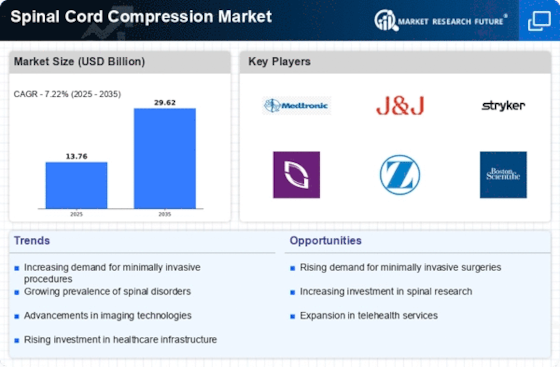
As per Market Research Future analysis, the Spinal Cord Compression Market Size was estimated at 13.76 USD Billion in 2024. The Spinal Cord Compression industry is projected to grow from 14.75 USD Billion in 2025 to 29.62 USD Billion by 2035, exhibiting a compound annual growth rate (CAGR) of 7.22% during the forecast period 2025 - 2035

Key Market Trends & Highlights

The Spinal Cord Compression Market is poised for substantial growth driven by technological advancements and increasing awareness of spinal health.

  • Technological advancements in treatment are reshaping the Spinal Cord Compression Market, particularly in North America, which remains the largest market. The aging population and lifestyle factors are contributing to a rising incidence of spinal disorders, notably in the Asia-Pacific region, recognized as the fastest-growing market. Cervical stenosis continues to dominate as the largest segment, while lumbar spinal stenosis is emerging as the fastest-growing segment in the market. Increased investment in healthcare infrastructure and rising awareness of spinal health are key drivers propelling market expansion.

Market Size & Forecast

2024 Market Size 13.76 (USD Billion)
2035 Market Size 29.62 (USD Billion)
CAGR (2025 - 2035) 7.22%
Largest Regional Market Share in 2024 Americas

Major Players

Medtronic (US), DePuy Synthes (US), Stryker (US), NuVasive (US), Zimmer Biomet (US), Boston Scientific (US), Globus Medical (US), Aesculap (DE), K2M (US)

Market Trends

The Spinal Cord Compression Market is currently experiencing notable developments driven by advancements in medical technology and an increasing awareness of spinal health. As healthcare systems evolve, there is a growing emphasis on early diagnosis and intervention for spinal cord compression, which is often linked to various underlying conditions. This heightened focus is likely to enhance patient outcomes and reduce the long-term impact of spinal disorders. Furthermore, the integration of minimally invasive surgical techniques is transforming treatment approaches, allowing for quicker recovery times and less postoperative discomfort. These innovations may lead to a broader acceptance of surgical interventions among patients and healthcare providers alike. In addition, the demographic shift towards an aging population appears to be influencing the Spinal Cord Compression Market significantly. Older individuals are more susceptible to spinal issues, which could drive demand for effective treatment options. Moreover, the rise in lifestyle-related conditions, such as obesity and sedentary behavior, may further contribute to the prevalence of spinal cord compression. As a result, stakeholders in the market are likely to focus on developing comprehensive care strategies that address both prevention and treatment, ensuring a holistic approach to spinal health.

Technological Advancements in Treatment

The Spinal Cord Compression Market is witnessing a surge in innovative treatment modalities, particularly through the adoption of advanced surgical techniques and technologies. Minimally invasive procedures are gaining traction, as they offer reduced recovery times and lower complication rates. This trend suggests a shift towards more patient-centric care, where the emphasis is placed on enhancing the quality of life for individuals suffering from spinal disorders.

Growing Awareness of Spinal Health

There is an increasing recognition of the importance of spinal health among both healthcare professionals and the general public. Educational initiatives and campaigns aimed at promoting spinal health are likely to contribute to early diagnosis and treatment of spinal cord compression. This trend indicates a proactive approach to managing spinal conditions, potentially leading to improved patient outcomes and reduced healthcare costs.

Aging Population and Lifestyle Factors

The demographic trend of an aging population is expected to have a profound impact on the Spinal Cord Compression Market. As individuals age, the likelihood of developing spinal issues increases, thereby driving demand for effective treatment options. Additionally, lifestyle factors such as obesity and sedentary behavior may exacerbate spinal conditions, prompting a need for targeted interventions and comprehensive care strategies.

Spinal Cord Compression Spinal Stenosis Market Market Drivers

Rising Incidence of Spinal Disorders

The Spinal Cord Compression Market is significantly influenced by the rising incidence of spinal disorders, which is becoming a pressing health concern. Conditions such as herniated discs, spinal stenosis, and degenerative disc disease are increasingly diagnosed, leading to a higher demand for treatment options. Recent statistics indicate that spinal disorders affect approximately 80% of individuals at some point in their lives, creating a substantial patient population in need of intervention. This growing prevalence is likely to drive the Spinal Cord Compression Market, as healthcare systems seek to address the needs of affected individuals through various treatment modalities.

Rising Awareness and Education on Spinal Health

The Spinal Cord Compression Market is significantly impacted by rising awareness and education regarding spinal health. Public health campaigns and educational initiatives are effectively informing individuals about the importance of spinal health and the potential consequences of neglecting spinal disorders. This increased awareness is leading to earlier diagnosis and treatment of spinal cord compression, which is crucial for improving patient outcomes. Data suggests that communities with active educational programs have seen a 20% increase in early intervention rates. As awareness continues to grow, the Spinal Cord Compression Market is likely to expand, driven by proactive patient engagement and timely treatment.

Technological Innovations in Surgical Procedures

The Spinal Cord Compression Market is experiencing a surge in technological innovations that enhance surgical procedures. Advanced techniques such as minimally invasive surgery and robotic-assisted surgeries are becoming more prevalent. These innovations not only reduce recovery times but also improve patient outcomes, which is crucial in a market where patient satisfaction is paramount. According to recent data, the adoption of these technologies has led to a 30% increase in successful surgical interventions for spinal cord compression. As healthcare providers continue to invest in cutting-edge technologies, the Spinal Cord Compression Market is likely to expand, driven by the demand for safer and more effective treatment options.

Growing Demand for Non-Surgical Treatment Options

The Spinal Cord Compression Market is witnessing a growing demand for non-surgical treatment options, reflecting a shift in patient preferences. Many individuals are seeking alternatives to invasive procedures, leading to an increase in the utilization of physical therapy, chiropractic care, and pain management techniques. Recent surveys indicate that approximately 60% of patients prefer conservative treatment options before considering surgery. This trend is likely to influence the Spinal Cord Compression Market, as healthcare providers adapt to meet the needs of patients who are increasingly inclined towards non-invasive therapies.

Increased Investment in Healthcare Infrastructure

The Spinal Cord Compression Market is benefiting from increased investment in healthcare infrastructure across various regions. Governments and private entities are allocating substantial resources to enhance healthcare facilities, particularly in the realm of neurosurgery and orthopedics. This investment is crucial for improving access to advanced treatment options for spinal cord compression. For instance, the establishment of specialized spinal centers has been linked to a 25% increase in patient referrals for surgical interventions. As healthcare infrastructure continues to develop, the Spinal Cord Compression Market is poised for growth, driven by improved access to care and enhanced treatment capabilities.

Market Segment Insights

By Type: Cervical Stenosis (Largest) vs. Lumbar Spinal Stenosis (Fastest-Growing)

In the Spinal Cord Compression Market, Cervical Stenosis holds a significant share as the largest segment. This condition, characterized by narrowing in the cervical spine, prominently affects the elderly and those with degenerative conditions. In contrast, Lumbar Spinal Stenosis is emerging rapidly with increasing recognition of its prevalence and impact, particularly among aging populations and individuals with active lifestyles. As these segments evolve, Central Stenosis remains positioned in between, contributing to market dynamics with a balanced market presence. The growth trends within this segment are influenced by an aging global population and rising incidences of lifestyle-related spinal conditions. Technological advancements in diagnostics and treatment options are further propelling the demand for effective interventions in Cervical and Lumbar Stenosis. The increasing awareness of spinal health and improved access to healthcare are also crucial drivers in the market, encouraging individuals to seek timely treatment and interventions for spinal cord compression issues.

Cervical Stenosis (Dominant) vs. Central Stenosis (Emerging)

Cervical Stenosis is currently the dominant segment in the Spinal Cord Compression Market, characterized by significant patient awareness and established treatment protocols. This condition primarily impacts the cervical region of the spine, leading to a range of symptoms including neck pain and neurological deficits. It has consistently benefited from advancements in surgical procedures and non-invasive therapies. Conversely, Central Stenosis is emerging as a notable segment, marked by increasing diagnosis rates and growing emphasis on tailored therapeutic approaches. Although not as established as Cervical Stenosis, Central Stenosis is gaining attention due to its potential for severe symptoms and the importance of timely treatment, representing a growing opportunity for healthcare providers in spinal care.

By Diagnosis: Imaging (Largest) vs. Physical Examination (Fastest-Growing)

In the Spinal Cord Compression Market, the diagnosis segment is primarily dominated by imaging techniques, which constitute the largest portion of the market share. Methods such as MRI, CT scans, and X-rays are instrumental in accurately diagnosing spinal cord compression, thus providing a solid foundation for effective treatment strategies. On the other hand, physical examinations are increasingly gaining traction, albeit with a smaller share, as clinicians seek to integrate comprehensive assessment models that emphasize patient history and physical evaluation alongside advanced imaging techniques.

Diagnosis Methods: Imaging (Dominant) vs. Physical Examination (Emerging)

Imaging methods are central to the diagnosis of spinal cord compression, serving not only as the dominant approach but also enhancing physician confidence in clinical decisions. Technologies like MRI offer detailed insights into the spinal structure, enabling accurate localization of compression. Physical examination, while currently an emerging method, is increasingly recognized for its importance in initial patient assessment and screening. It allows clinicians to gather immediate data and symptoms which can guide further diagnostic imaging. The integration of these two methods forms a robust diagnostic framework facilitating optimized patient outcomes.

By Treatment Type: Surgical Treatment (Largest) vs. Non-Surgical Treatment (Fastest-Growing)

The Spinal Cord Compression Market shows a significant market share distribution between Surgical and Non-Surgical Treatments. Surgical Treatment currently holds the largest share, reflecting its critical role in managing severe spinal cord compressions. This method typically encompasses interventions like decompression surgeries, which are widely recognized for their efficacy in alleviating persistent symptoms. On the other hand, Non-Surgical Treatment, including physical therapy and medication, is rapidly gaining traction, especially among patients seeking less invasive management options. This shift indicates a growing preference for conservative treatment modalities, significantly bolstered by advancements in non-invasive technologies.

Treatment Type: Surgical Treatment (Dominant) vs. Non-Surgical Treatment (Emerging)

Surgical Treatment remains the dominant approach within the Spinal Cord Compression Market. These treatments are essential for patients with severe symptoms or structural abnormalities that necessitate immediate intervention. The effectiveness and rapid relief provided by surgical options contribute to their preferred status among healthcare professionals. Conversely, Non-Surgical Treatment is emerging as a viable alternative for managing less acute spinal cord compression cases. Patient education and increased awareness about conservative management have catalyzed this trend, making them an appealing option for patients reluctant to undergo surgery. As technology improves, the effectiveness of non-surgical options is anticipated to continue growing, encouraging more patients to explore these alternatives.

By End-Users: Hospitals (Largest) vs. Rehabilitation Centers (Fastest-Growing)

In the Spinal Cord Compression Market, hospitals represent the largest end-user segment, holding a significant share due to their comprehensive facilities and specialized treatment options. They cater to a diverse patient population, offering advanced surgical interventions and postoperative care, thus driving their market dominance. Rehabilitation centers, while currently smaller, are emerging rapidly due to the increasing demand for post-surgery recovery and rehabilitation services as patient care continues beyond hospital discharge.

Hospitals (Dominant) vs. Rehabilitation Centers (Emerging)

Hospitals are positioned as the dominant end-user in the Spinal Cord Compression Market, owing to their extensive resources and ability to handle complex cases. They provide a range of services from diagnostic procedures to intricate surgeries and follow-up care. In contrast, rehabilitation centers are becoming increasingly significant as emerging players, focusing on the recovery and rehabilitation of patients post-surgery. This trend is propelled by the heightened awareness of the importance of comprehensive rehabilitation to improve patient outcomes and quality of life, thereby attracting a growing patient base seeking holistic recovery options.

Get more detailed insights about Spinal Cord Compression Market Research Report - Global Forecast till 2035

Regional Insights

North America : Healthcare Innovation Leader

North America is the largest market for spinal cord compression treatments, holding approximately 45% of the global market share. The region's growth is driven by advanced healthcare infrastructure, increasing prevalence of spinal disorders, and a strong focus on research and development. Regulatory support from agencies like the FDA further catalyzes innovation in spinal care technologies, enhancing patient outcomes and driving demand. The United States is the leading country in this market, with major players such as Medtronic, DePuy Synthes, and Stryker dominating the landscape. The competitive environment is characterized by continuous product innovations and strategic partnerships. Canada also contributes significantly, focusing on improving healthcare access and treatment options for spinal conditions, thereby supporting market growth.

Europe : Emerging Market Dynamics

Europe is the second-largest market for spinal cord compression treatments, accounting for approximately 30% of the global market share. The region's growth is fueled by an aging population, increasing awareness of spinal health, and advancements in surgical techniques. Regulatory frameworks, such as the Medical Device Regulation (MDR), are enhancing safety and efficacy standards, thereby boosting market confidence and demand for innovative solutions. Germany and the UK are the leading countries in this market, with a strong presence of key players like Aesculap and Zimmer Biomet. The competitive landscape is marked by collaborations between healthcare providers and manufacturers to improve treatment outcomes. Additionally, the focus on minimally invasive procedures is gaining traction, further driving market growth and attracting investments in spinal care technologies.

Asia-Pacific : Rapidly Growing Healthcare Sector

Asia-Pacific is witnessing rapid growth in the spinal cord compression market, holding approximately 20% of the global market share. The region's expansion is driven by increasing healthcare expenditure, rising awareness of spinal disorders, and a growing elderly population. Countries like China and India are investing heavily in healthcare infrastructure, which is expected to further enhance access to spinal treatments and technologies. China is the largest market in the region, with significant contributions from local manufacturers and international players like Globus Medical and K2M. The competitive landscape is evolving, with a focus on affordable treatment options and innovative technologies. Additionally, government initiatives aimed at improving healthcare access are expected to bolster market growth, making Asia-Pacific a key player in The Spinal Cord Compression.

Middle East and Africa : Untapped Market Potential

The Middle East and Africa region is gradually emerging in the spinal cord compression market, currently holding about 5% of the global market share. The growth is driven by increasing healthcare investments, rising awareness of spinal health issues, and a growing population. Regulatory bodies are beginning to establish frameworks that support the introduction of advanced medical technologies, which is expected to enhance market dynamics in the coming years. Countries like South Africa and the UAE are leading the way in adopting new spinal care technologies. The competitive landscape is characterized by a mix of local and international players, with a focus on improving healthcare access and treatment options. As healthcare infrastructure continues to develop, the region presents significant opportunities for growth in spinal care solutions, attracting investments from global companies.

Key Players and Competitive Insights

The Spinal Cord Compression Market is characterized by a dynamic competitive landscape, driven by technological advancements and an increasing prevalence of spinal disorders. Key players such as Medtronic (US), DePuy Synthes (US), and Stryker (US) are at the forefront, each adopting distinct strategies to enhance their market positioning. Medtronic (US) focuses on innovation through the development of minimally invasive surgical techniques, while DePuy Synthes (US) emphasizes strategic partnerships to expand its product offerings. Stryker (US) is actively pursuing mergers and acquisitions to bolster its portfolio, indicating a trend towards consolidation in the market. Collectively, these strategies contribute to a competitive environment that is increasingly centered on technological innovation and strategic collaborations.
In terms of business tactics, companies are localizing manufacturing to reduce costs and enhance supply chain efficiency. The Spinal Cord Compression Market appears moderately fragmented, with several key players exerting influence over various segments. This fragmentation allows for niche players to thrive, while larger companies leverage their resources to optimize operations and expand their reach. The collective influence of these key players shapes market dynamics, as they compete not only on product quality but also on operational efficiency and customer engagement.
In August 2025, Medtronic (US) announced the launch of a new spinal implant designed to improve patient outcomes in spinal fusion surgeries. This innovation is significant as it aligns with the growing demand for advanced surgical solutions that minimize recovery time and enhance surgical precision. By investing in research and development, Medtronic (US) reinforces its commitment to leading the market through technological advancements.
In September 2025, DePuy Synthes (US) entered into a strategic partnership with a leading telehealth provider to integrate digital health solutions into its spinal care offerings. This move is indicative of a broader trend towards digital transformation in healthcare, allowing for improved patient monitoring and engagement. Such partnerships may enhance the company's competitive edge by providing comprehensive care solutions that address patient needs beyond the surgical procedure.
In July 2025, Stryker (US) completed the acquisition of a robotics company specializing in spinal surgery, further solidifying its position in the market. This acquisition is pivotal as it not only expands Stryker's technological capabilities but also positions the company to capitalize on the growing trend of robotic-assisted surgeries. The integration of robotics into spinal procedures is likely to enhance surgical precision and patient outcomes, thereby attracting a broader customer base.
As of October 2025, the Spinal Cord Compression Market is witnessing trends such as digitalization, sustainability, and the integration of artificial intelligence in surgical procedures. Strategic alliances are increasingly shaping the competitive landscape, enabling companies to leverage complementary strengths and enhance their service offerings. Looking ahead, competitive differentiation is expected to evolve, with a shift from price-based competition to a focus on innovation, technological advancements, and supply chain reliability. Companies that prioritize these aspects are likely to gain a competitive advantage in an ever-evolving market.

Key Companies in the Spinal Cord Compression Spinal Stenosis Market include

Industry Developments

    • In 2020, Stimgenics have been acquired by Medtronic (Ireland) for developing a novel spinal cord Stimulation (SCS).
    • In 2019, the Symphony Occipitocervico-thoracic system has been launched by DePuy Synthes, a S.-based company.
    • In 2019, Modulus TLIF-O has been launched by NuVasive a S.-based company.
    • In 2018, strategic partnerships have been seen between BiedermannMotech GmbH and Co. KG (Germany) and NuVasive (U.S.) for the right to co-develop state-of-the-art and intellectual properties of complex spine problems and their solutions.
    • In 2018, ProChondrix CR has been launched by a S.-based company namely Stryker Corporation.

Future Outlook

Spinal Cord Compression Spinal Stenosis Market Future Outlook

The Spinal Cord Compression Market is projected to grow at a 7.22% CAGR from 2025 to 2035, driven by advancements in surgical techniques, increasing prevalence of spinal disorders, and rising geriatric population.

New opportunities lie in:

  • <p>Development of minimally invasive surgical tools for spinal decompression procedures. Expansion of telehealth services for remote patient monitoring and consultations. Investment in AI-driven diagnostic tools to enhance early detection of spinal cord issues.</p>

By 2035, the Spinal Cord Compression Market is expected to achieve substantial growth, reflecting evolving healthcare needs.

Market Segmentation

Spinal Cord Compression Spinal Stenosis Market Type Outlook

  • Cervical Stenosis
  • Central Stenosis
  • Lumbar Spinal Stenosis

Spinal Cord Compression Spinal Stenosis Market Diagnosis Outlook

  • Physical Examination
  • Imaging

Spinal Cord Compression Spinal Stenosis Market End-Users Outlook

  • Ambulatory Surgical Centers
  • Rehabilitation Centers
  • Hospitals

Spinal Cord Compression Spinal Stenosis Market Treatment Type Outlook

  • Surgical Treatment
  • Non-Surgical Treatment

Report Scope

MARKET SIZE 2024 13.76(USD Billion)
MARKET SIZE 2025 14.75(USD Billion)
MARKET SIZE 2035 29.62(USD Billion)
COMPOUND ANNUAL GROWTH RATE (CAGR) 7.22% (2025 - 2035)
REPORT COVERAGE Revenue Forecast, Competitive Landscape, Growth Factors, and Trends
BASE YEAR 2024
Market Forecast Period 2025 - 2035
Historical Data 2019 - 2024
Market Forecast Units USD Billion
Key Companies Profiled Medtronic (US), DePuy Synthes (US), Stryker (US), NuVasive (US), Zimmer Biomet (US), Boston Scientific (US), Globus Medical (US), Aesculap (DE), K2M (US)
Segments Covered Type
Key Market Opportunities Advancements in minimally invasive surgical techniques enhance treatment options in the Spinal Cord Compression Market.
Key Market Dynamics Rising demand for minimally invasive surgical techniques drives innovation in spinal cord compression treatment options.
Countries Covered North America, Europe, APAC, South America, MEA

FAQs

What is the current valuation of the Spinal Cord Compression Market?

<p>As of 2024, the Spinal Cord Compression Market was valued at 13.76 USD Billion.</p>

What is the projected market size for the Spinal Cord Compression Market by 2035?

<p>The market is projected to reach 29.62 USD Billion by 2035.</p>

What is the expected CAGR for the Spinal Cord Compression Market during the forecast period 2025 - 2035?

<p>The expected CAGR for the market during the forecast period 2025 - 2035 is 7.22%.</p>

Which segments are included in the Spinal Cord Compression Market?

<p>The market includes segments such as Type, Diagnosis, Treatment Type, and End-Users.</p>

What are the projected values for the Cervical Stenosis segment by 2035?

<p>The Cervical Stenosis segment is projected to grow from 4.14 USD Billion in 2024 to 8.75 USD Billion by 2035.</p>

How does the Imaging segment perform in the Spinal Cord Compression Market?

The Imaging segment is expected to increase from 8.24 USD Billion in 2024 to 18.37 USD Billion by 2035.

What are the anticipated values for Surgical Treatment in the market?

Surgical Treatment is projected to grow from 6.88 USD Billion in 2024 to 14.81 USD Billion by 2035.

Which end-user segment is expected to have the highest growth?

The Hospitals segment is anticipated to grow from 7.88 USD Billion in 2024 to 16.92 USD Billion by 2035.

Who are the key players in the Spinal Cord Compression Market?

Key players include Medtronic, DePuy Synthes, Stryker, NuVasive, and Zimmer Biomet.

What is the projected growth for the Lumbar Spinal Stenosis segment?

The Lumbar Spinal Stenosis segment is expected to increase from 6.17 USD Billion in 2024 to 13.62 USD Billion by 2035.

  1. SECTION I: EXECUTIVE SUMMARY AND KEY HIGHLIGHTS |
    1. EXECUTIVE SUMMARY | |
      1. Market Overview | |
      2. Key Findings | |
      3. Market Segmentation | |
      4. Competitive Landscape | |
      5. Challenges and Opportunities | |
      6. Future Outlook 2
  2. SECTION II: SCOPING, METHODOLOGY AND MARKET STRUCTURE |
    1. MARKET INTRODUCTION | |
      1. Definition | |
      2. Scope of the study | | |
    2. RESEARCH METHODOLOGY | |
      1. Overview | |
      2. Data Mining | |
      3. Secondary Research | |
      4. Primary Research | | |
      5. Forecasting Model | |
      6. Market Size Estimation | | |
      7. Data Triangulation | |
      8. Validation 3
  3. SECTION III: QUALITATIVE ANALYSIS |
    1. MARKET DYNAMICS | |
      1. Overview | |
      2. Drivers | |
      3. Restraints | |
      4. Opportunities |
    2. MARKET FACTOR ANALYSIS | |
      1. Value chain Analysis | |
      2. Porter's Five Forces Analysis | | |
      3. COVID-19 Impact Analysis | | |
  4. SECTION IV: QUANTITATIVE ANALYSIS |
    1. Healthcare, BY Type (USD Billion) | |
      1. Cervical Stenosis | |
      2. Central Stenosis | |
      3. Lumbar Spinal Stenosis |
    2. Healthcare, BY Diagnosis (USD Billion) | |
      1. Physical Examination | |
      2. Imaging |
    3. Healthcare, BY Treatment Type (USD Billion) | |
      1. Surgical Treatment | |
      2. Non-Surgical Treatment |
    4. Healthcare, BY End-Users (USD Billion) | |
      1. Ambulatory Surgical Centers | |
      2. Rehabilitation Centers | |
      3. Hospitals |
    5. Healthcare, BY Region (USD Billion) | |
      1. North America | | |
      2. Europe | | |
      3. APAC | | |
      4. South America | | |
      5. MEA | | |
  5. SECTION V: COMPETITIVE ANALYSIS |
    1. Competitive Landscape | |
      1. Overview | |
      2. Competitive Analysis | |
      3. Market share Analysis | |
      4. Major Growth Strategy in the Healthcare | |
      5. Competitive Benchmarking | |
      6. Leading Players in Terms of Number of Developments in the Healthcare | |
      7. Key developments and growth strategies | | |
      8. Major Players Financial Matrix | | |
    2. Company Profiles | |
      1. Medtronic (US) | | |
      2. DePuy Synthes (US) | | |
      3. Stryker (US) | | |
      4. NuVasive (US) | | |
      5. Zimmer Biomet (US) | | |
      6. Boston Scientific (US) | | |
      7. Globus Medical (US) | | |
      8. Aesculap (DE) | | |
      9. K2M (US) | | |
    3. Appendix | |
      1. References | |
      2. Related Reports 6 LIST OF FIGURES |
    4. MARKET SYNOPSIS |
    5. NORTH AMERICA MARKET ANALYSIS |
    6. US MARKET ANALYSIS BY TYPE |
    7. US MARKET ANALYSIS BY DIAGNOSIS |
    8. US MARKET ANALYSIS BY TREATMENT TYPE |
    9. US MARKET ANALYSIS BY END-USERS |
    10. CANADA MARKET ANALYSIS BY TYPE |
    11. CANADA MARKET ANALYSIS BY DIAGNOSIS |
    12. CANADA MARKET ANALYSIS BY TREATMENT TYPE |
    13. CANADA MARKET ANALYSIS BY END-USERS |
    14. EUROPE MARKET ANALYSIS |
    15. GERMANY MARKET ANALYSIS BY TYPE |
    16. GERMANY MARKET ANALYSIS BY DIAGNOSIS |
    17. GERMANY MARKET ANALYSIS BY TREATMENT TYPE |
    18. GERMANY MARKET ANALYSIS BY END-USERS |
    19. UK MARKET ANALYSIS BY TYPE |
    20. UK MARKET ANALYSIS BY DIAGNOSIS |
    21. UK MARKET ANALYSIS BY TREATMENT TYPE |
    22. UK MARKET ANALYSIS BY END-USERS |
    23. FRANCE MARKET ANALYSIS BY TYPE |
    24. FRANCE MARKET ANALYSIS BY DIAGNOSIS |
    25. FRANCE MARKET ANALYSIS BY TREATMENT TYPE |
    26. FRANCE MARKET ANALYSIS BY END-USERS |
    27. RUSSIA MARKET ANALYSIS BY TYPE |
    28. RUSSIA MARKET ANALYSIS BY DIAGNOSIS |
    29. RUSSIA MARKET ANALYSIS BY TREATMENT TYPE |
    30. RUSSIA MARKET ANALYSIS BY END-USERS |
    31. ITALY MARKET ANALYSIS BY TYPE |
    32. ITALY MARKET ANALYSIS BY DIAGNOSIS |
    33. ITALY MARKET ANALYSIS BY TREATMENT TYPE |
    34. ITALY MARKET ANALYSIS BY END-USERS |
    35. SPAIN MARKET ANALYSIS BY TYPE |
    36. SPAIN MARKET ANALYSIS BY DIAGNOSIS |
    37. SPAIN MARKET ANALYSIS BY TREATMENT TYPE |
    38. SPAIN MARKET ANALYSIS BY END-USERS |
    39. REST OF EUROPE MARKET ANALYSIS BY TYPE |
    40. REST OF EUROPE MARKET ANALYSIS BY DIAGNOSIS |
    41. REST OF EUROPE MARKET ANALYSIS BY TREATMENT TYPE |
    42. REST OF EUROPE MARKET ANALYSIS BY END-USERS |
    43. APAC MARKET ANALYSIS |
    44. CHINA MARKET ANALYSIS BY TYPE |
    45. CHINA MARKET ANALYSIS BY DIAGNOSIS |
    46. CHINA MARKET ANALYSIS BY TREATMENT TYPE |
    47. CHINA MARKET ANALYSIS BY END-USERS |
    48. INDIA MARKET ANALYSIS BY TYPE |
    49. INDIA MARKET ANALYSIS BY DIAGNOSIS |
    50. INDIA MARKET ANALYSIS BY TREATMENT TYPE |
    51. INDIA MARKET ANALYSIS BY END-USERS |
    52. JAPAN MARKET ANALYSIS BY TYPE |
    53. JAPAN MARKET ANALYSIS BY DIAGNOSIS |
    54. JAPAN MARKET ANALYSIS BY TREATMENT TYPE |
    55. JAPAN MARKET ANALYSIS BY END-USERS |
    56. SOUTH KOREA MARKET ANALYSIS BY TYPE |
    57. SOUTH KOREA MARKET ANALYSIS BY DIAGNOSIS |
    58. SOUTH KOREA MARKET ANALYSIS BY TREATMENT TYPE |
    59. SOUTH KOREA MARKET ANALYSIS BY END-USERS |
    60. MALAYSIA MARKET ANALYSIS BY TYPE |
    61. MALAYSIA MARKET ANALYSIS BY DIAGNOSIS |
    62. MALAYSIA MARKET ANALYSIS BY TREATMENT TYPE |
    63. MALAYSIA MARKET ANALYSIS BY END-USERS |
    64. THAILAND MARKET ANALYSIS BY TYPE |
    65. THAILAND MARKET ANALYSIS BY DIAGNOSIS |
    66. THAILAND MARKET ANALYSIS BY TREATMENT TYPE |
    67. THAILAND MARKET ANALYSIS BY END-USERS |
    68. INDONESIA MARKET ANALYSIS BY TYPE |
    69. INDONESIA MARKET ANALYSIS BY DIAGNOSIS |
    70. INDONESIA MARKET ANALYSIS BY TREATMENT TYPE |
    71. INDONESIA MARKET ANALYSIS BY END-USERS |
    72. REST OF APAC MARKET ANALYSIS BY TYPE |
    73. REST OF APAC MARKET ANALYSIS BY DIAGNOSIS |
    74. REST OF APAC MARKET ANALYSIS BY TREATMENT TYPE |
    75. REST OF APAC MARKET ANALYSIS BY END-USERS |
    76. SOUTH AMERICA MARKET ANALYSIS |
    77. BRAZIL MARKET ANALYSIS BY TYPE |
    78. BRAZIL MARKET ANALYSIS BY DIAGNOSIS |
    79. BRAZIL MARKET ANALYSIS BY TREATMENT TYPE |
    80. BRAZIL MARKET ANALYSIS BY END-USERS |
    81. MEXICO MARKET ANALYSIS BY TYPE |
    82. MEXICO MARKET ANALYSIS BY DIAGNOSIS |
    83. MEXICO MARKET ANALYSIS BY TREATMENT TYPE |
    84. MEXICO MARKET ANALYSIS BY END-USERS |
    85. ARGENTINA MARKET ANALYSIS BY TYPE |
    86. ARGENTINA MARKET ANALYSIS BY DIAGNOSIS |
    87. ARGENTINA MARKET ANALYSIS BY TREATMENT TYPE |
    88. ARGENTINA MARKET ANALYSIS BY END-USERS |
    89. REST OF SOUTH AMERICA MARKET ANALYSIS BY TYPE |
    90. REST OF SOUTH AMERICA MARKET ANALYSIS BY DIAGNOSIS |
    91. REST OF SOUTH AMERICA MARKET ANALYSIS BY TREATMENT TYPE |
    92. REST OF SOUTH AMERICA MARKET ANALYSIS BY END-USERS |
    93. MEA MARKET ANALYSIS |
    94. GCC COUNTRIES MARKET ANALYSIS BY TYPE |
    95. GCC COUNTRIES MARKET ANALYSIS BY DIAGNOSIS |
    96. GCC COUNTRIES MARKET ANALYSIS BY TREATMENT TYPE |
    97. GCC COUNTRIES MARKET ANALYSIS BY END-USERS |
    98. SOUTH AFRICA MARKET ANALYSIS BY TYPE |
    99. SOUTH AFRICA MARKET ANALYSIS BY DIAGNOSIS |
    100. SOUTH AFRICA MARKET ANALYSIS BY TREATMENT TYPE |
    101. SOUTH AFRICA MARKET ANALYSIS BY END-USERS |
    102. REST OF MEA MARKET ANALYSIS BY TYPE |
    103. REST OF MEA MARKET ANALYSIS BY DIAGNOSIS |
    104. REST OF MEA MARKET ANALYSIS BY TREATMENT TYPE |
    105. REST OF MEA MARKET ANALYSIS BY END-USERS |
    106. KEY BUYING CRITERIA OF HEALTHCARE |
    107. RESEARCH PROCESS OF MRFR |
    108. DRO ANALYSIS OF HEALTHCARE |
    109. DRIVERS IMPACT ANALYSIS: HEALTHCARE |
    110. RESTRAINTS IMPACT ANALYSIS: HEALTHCARE |
    111. SUPPLY / VALUE CHAIN: HEALTHCARE |
    112. HEALTHCARE, BY TYPE, 2024 (% SHARE) |
    113. HEALTHCARE, BY TYPE, 2024 TO 2035 (USD Billion) |
    114. HEALTHCARE, BY DIAGNOSIS, 2024 (% SHARE) |
    115. HEALTHCARE, BY DIAGNOSIS, 2024 TO 2035 (USD Billion) |
    116. HEALTHCARE, BY TREATMENT TYPE, 2024 (% SHARE) |
    117. HEALTHCARE, BY TREATMENT TYPE, 2024 TO 2035 (USD Billion) |
    118. HEALTHCARE, BY END-USERS, 2024 (% SHARE) |
    119. HEALTHCARE, BY END-USERS, 2024 TO 2035 (USD Billion) |
    120. BENCHMARKING OF MAJOR COMPETITORS 7 LIST OF TABLES |
    121. LIST OF ASSUMPTIONS | |
      1. |
    122. North America MARKET SIZE ESTIMATES; FORECAST | |
      1. BY TYPE, 2025-2035 (USD Billion) | |
      2. BY DIAGNOSIS, 2025-2035 (USD Billion) | |
      3. BY TREATMENT TYPE, 2025-2035 (USD Billion) | |
      4. BY END-USERS, 2025-2035 (USD Billion) |
    123. US MARKET SIZE ESTIMATES; FORECAST | |
      1. BY TYPE, 2025-2035 (USD Billion) | |
      2. BY DIAGNOSIS, 2025-2035 (USD Billion) | |
      3. BY TREATMENT TYPE, 2025-2035 (USD Billion) | |
      4. BY END-USERS, 2025-2035 (USD Billion) |
    124. Canada MARKET SIZE ESTIMATES; FORECAST | |
      1. BY TYPE, 2025-2035 (USD Billion) | |
      2. BY DIAGNOSIS, 2025-2035 (USD Billion) | |
      3. BY TREATMENT TYPE, 2025-2035 (USD Billion) | |
      4. BY END-USERS, 2025-2035 (USD Billion) |
    125. Europe MARKET SIZE ESTIMATES; FORECAST | |
      1. BY TYPE, 2025-2035 (USD Billion) | |
      2. BY DIAGNOSIS, 2025-2035 (USD Billion) | |
      3. BY TREATMENT TYPE, 2025-2035 (USD Billion) | |
      4. BY END-USERS, 2025-2035 (USD Billion) |
    126. Germany MARKET SIZE ESTIMATES; FORECAST | |
      1. BY TYPE, 2025-2035 (USD Billion) | |
      2. BY DIAGNOSIS, 2025-2035 (USD Billion) | |
      3. BY TREATMENT TYPE, 2025-2035 (USD Billion) | |
      4. BY END-USERS, 2025-2035 (USD Billion) |
    127. UK MARKET SIZE ESTIMATES; FORECAST | |
      1. BY TYPE, 2025-2035 (USD Billion) | |
      2. BY DIAGNOSIS, 2025-2035 (USD Billion) | |
      3. BY TREATMENT TYPE, 2025-2035 (USD Billion) | |
      4. BY END-USERS, 2025-2035 (USD Billion) |
    128. France MARKET SIZE ESTIMATES; FORECAST | |
      1. BY TYPE, 2025-2035 (USD Billion) | |
      2. BY DIAGNOSIS, 2025-2035 (USD Billion) | |
      3. BY TREATMENT TYPE, 2025-2035 (USD Billion) | |
      4. BY END-USERS, 2025-2035 (USD Billion) |
    129. Russia MARKET SIZE ESTIMATES; FORECAST | |
      1. BY TYPE, 2025-2035 (USD Billion) | |
      2. BY DIAGNOSIS, 2025-2035 (USD Billion) | |
      3. BY TREATMENT TYPE, 2025-2035 (USD Billion) | |
      4. BY END-USERS, 2025-2035 (USD Billion) |
    130. Italy MARKET SIZE ESTIMATES; FORECAST | |
      1. BY TYPE, 2025-2035 (USD Billion) | |
      2. BY DIAGNOSIS, 2025-2035 (USD Billion) | |
      3. BY TREATMENT TYPE, 2025-2035 (USD Billion) | |
      4. BY END-USERS, 2025-2035 (USD Billion) |
    131. Spain MARKET SIZE ESTIMATES; FORECAST | |
      1. BY TYPE, 2025-2035 (USD Billion) | |
      2. BY DIAGNOSIS, 2025-2035 (USD Billion) | |
      3. BY TREATMENT TYPE, 2025-2035 (USD Billion) | |
      4. BY END-USERS, 2025-2035 (USD Billion) |
    132. Rest of Europe MARKET SIZE ESTIMATES; FORECAST | |
      1. BY TYPE, 2025-2035 (USD Billion) | |
      2. BY DIAGNOSIS, 2025-2035 (USD Billion) | |
      3. BY TREATMENT TYPE, 2025-2035 (USD Billion) | |
      4. BY END-USERS, 2025-2035 (USD Billion) |
    133. APAC MARKET SIZE ESTIMATES; FORECAST | |
      1. BY TYPE, 2025-2035 (USD Billion) | |
      2. BY DIAGNOSIS, 2025-2035 (USD Billion) | |
      3. BY TREATMENT TYPE, 2025-2035 (USD Billion) | |
      4. BY END-USERS, 2025-2035 (USD Billion) |
    134. China MARKET SIZE ESTIMATES; FORECAST | |
      1. BY TYPE, 2025-2035 (USD Billion) | |
      2. BY DIAGNOSIS, 2025-2035 (USD Billion) | |
      3. BY TREATMENT TYPE, 2025-2035 (USD Billion) | |
      4. BY END-USERS, 2025-2035 (USD Billion) |
    135. India MARKET SIZE ESTIMATES; FORECAST | |
      1. BY TYPE, 2025-2035 (USD Billion) | |
      2. BY DIAGNOSIS, 2025-2035 (USD Billion) | |
      3. BY TREATMENT TYPE, 2025-2035 (USD Billion) | |
      4. BY END-USERS, 2025-2035 (USD Billion) |
    136. Japan MARKET SIZE ESTIMATES; FORECAST | |
      1. BY TYPE, 2025-2035 (USD Billion) | |
      2. BY DIAGNOSIS, 2025-2035 (USD Billion) | |
      3. BY TREATMENT TYPE, 2025-2035 (USD Billion) | |
      4. BY END-USERS, 2025-2035 (USD Billion) |
    137. South Korea MARKET SIZE ESTIMATES; FORECAST | |
      1. BY TYPE, 2025-2035 (USD Billion) | |
      2. BY DIAGNOSIS, 2025-2035 (USD Billion) | |
      3. BY TREATMENT TYPE, 2025-2035 (USD Billion) | |
      4. BY END-USERS, 2025-2035 (USD Billion) |
    138. Malaysia MARKET SIZE ESTIMATES; FORECAST | |
      1. BY TYPE, 2025-2035 (USD Billion) | |
      2. BY DIAGNOSIS, 2025-2035 (USD Billion) | |
      3. BY TREATMENT TYPE, 2025-2035 (USD Billion) | |
      4. BY END-USERS, 2025-2035 (USD Billion) |
    139. Thailand MARKET SIZE ESTIMATES; FORECAST | |
      1. BY TYPE, 2025-2035 (USD Billion) | |
      2. BY DIAGNOSIS, 2025-2035 (USD Billion) | |
      3. BY TREATMENT TYPE, 2025-2035 (USD Billion) | |
      4. BY END-USERS, 2025-2035 (USD Billion) |
    140. Indonesia MARKET SIZE ESTIMATES; FORECAST | |
      1. BY TYPE, 2025-2035 (USD Billion) | |
      2. BY DIAGNOSIS, 2025-2035 (USD Billion) | |
      3. BY TREATMENT TYPE, 2025-2035 (USD Billion) | |
      4. BY END-USERS, 2025-2035 (USD Billion) |
    141. Rest of APAC MARKET SIZE ESTIMATES; FORECAST | |
      1. BY TYPE, 2025-2035 (USD Billion) | |
      2. BY DIAGNOSIS, 2025-2035 (USD Billion) | |
      3. BY TREATMENT TYPE, 2025-2035 (USD Billion) | |
      4. BY END-USERS, 2025-2035 (USD Billion) |
    142. South America MARKET SIZE ESTIMATES; FORECAST | |
      1. BY TYPE, 2025-2035 (USD Billion) | |
      2. BY DIAGNOSIS, 2025-2035 (USD Billion) | |
      3. BY TREATMENT TYPE, 2025-2035 (USD Billion) | |
      4. BY END-USERS, 2025-2035 (USD Billion) |
    143. Brazil MARKET SIZE ESTIMATES; FORECAST | |
      1. BY TYPE, 2025-2035 (USD Billion) | |
      2. BY DIAGNOSIS, 2025-2035 (USD Billion) | |
      3. BY TREATMENT TYPE, 2025-2035 (USD Billion) | |
      4. BY END-USERS, 2025-2035 (USD Billion) |
    144. Mexico MARKET SIZE ESTIMATES; FORECAST | |
      1. BY TYPE, 2025-2035 (USD Billion) | |
      2. BY DIAGNOSIS, 2025-2035 (USD Billion) | |
      3. BY TREATMENT TYPE, 2025-2035 (USD Billion) | |
      4. BY END-USERS, 2025-2035 (USD Billion) |
    145. Argentina MARKET SIZE ESTIMATES; FORECAST | |
      1. BY TYPE, 2025-2035 (USD Billion) | |
      2. BY DIAGNOSIS, 2025-2035 (USD Billion) | |
      3. BY TREATMENT TYPE, 2025-2035 (USD Billion) | |
      4. BY END-USERS, 2025-2035 (USD Billion) |
    146. Rest of South America MARKET SIZE ESTIMATES; FORECAST | |
      1. BY TYPE, 2025-2035 (USD Billion) | |
      2. BY DIAGNOSIS, 2025-2035 (USD Billion) | |
      3. BY TREATMENT TYPE, 2025-2035 (USD Billion) | |
      4. BY END-USERS, 2025-2035 (USD Billion) |
    147. MEA MARKET SIZE ESTIMATES; FORECAST | |
      1. BY TYPE, 2025-2035 (USD Billion) | |
      2. BY DIAGNOSIS, 2025-2035 (USD Billion) | |
      3. BY TREATMENT TYPE, 2025-2035 (USD Billion) | |
      4. BY END-USERS, 2025-2035 (USD Billion) |
    148. GCC Countries MARKET SIZE ESTIMATES; FORECAST | |
      1. BY TYPE, 2025-2035 (USD Billion) | |
      2. BY DIAGNOSIS, 2025-2035 (USD Billion) | |
      3. BY TREATMENT TYPE, 2025-2035 (USD Billion) | |
      4. BY END-USERS, 2025-2035 (USD Billion) |
    149. South Africa MARKET SIZE ESTIMATES; FORECAST | |
      1. BY TYPE, 2025-2035 (USD Billion) | |
      2. BY DIAGNOSIS, 2025-2035 (USD Billion) | |
      3. BY TREATMENT TYPE, 2025-2035 (USD Billion) | |
      4. BY END-USERS, 2025-2035 (USD Billion) |
    150. Rest of MEA MARKET SIZE ESTIMATES; FORECAST | |
      1. BY TYPE, 2025-2035 (USD Billion) | |
      2. BY DIAGNOSIS, 2025-2035 (USD Billion) | |
      3. BY TREATMENT TYPE, 2025-2035 (USD Billion) | |
      4. BY END-USERS, 2025-2035 (USD Billion) |
    151. PRODUCT LAUNCH/PRODUCT DEVELOPMENT/APPROVAL | |
      1. |
    152. ACQUISITION/PARTNERSHIP | |

Healthcare Market Segmentation

Healthcare By Type (USD Billion, 2025-2035)

  • Cervical Stenosis
  • Central Stenosis
  • Lumbar Spinal Stenosis

Healthcare By Diagnosis (USD Billion, 2025-2035)

  • Physical Examination
  • Imaging

Healthcare By Treatment Type (USD Billion, 2025-2035)

  • Surgical Treatment
  • Non-Surgical Treatment

Healthcare By End-Users (USD Billion, 2025-2035)

  • Ambulatory Surgical Centers
  • Rehabilitation Centers
  • Hospitals
Infographic

Free Sample Request

Kindly complete the form below to receive a free sample of this Report

Get Free Sample

Customer Strories

Compare Licence

×
Features License Type
Single User Multiuser License Enterprise User
Price $4,950 $5,950 $7,250
Maximum User Access Limit 1 User Upto 10 Users Unrestricted Access Throughout the Organization
Free Customization
Direct Access to Analyst
Deliverable Format
Platform Access
Discount on Next Purchase 10% 15% 15%
Printable Versions