×
Request Free Sample ×

Kindly complete the form below to receive a free sample of this Report

* Please use a valid business email

Leading companies partner with us for data-driven Insights

clients tt-cursor
Hero Background
English
Chinese
French
Japanese
Korean
German
Spanish

Specialty Films Market Size

ID: MRFR/CnM/1412-HCR
140 Pages
Chitranshi Jaiswal
October 2025

Specialty Films Market Research Report Information By Type (Barrier, Decorative, Microporous, Antimicrobial, Protective, and Others), By Materials (Polyester, Fluoropolymer, Polyamide, Polyolefin Polycarbonate, and Others), by End Use Industry (Packaging, Automotive, Construction, Aerospace, Food & Beverage, Electronics, Personal Care & Cosmetics, and Others), And By Region (North America, Europe, Asia-Pacific, And Rest Of The World) –Market Forecast Till 2035

Share:
Download PDF ×

We do not share your information with anyone. However, we may send you emails based on your report interest from time to time. You may contact us at any time to opt-out.

Specialty Films Market Infographic
×
Specialty Films Market Infographic Full View
Purchase Options

Specialty Films Size

Specialty Films Market Growth Projections and Opportunities

The specialty films market is influenced by a multitude of factors that collectively shape its dynamics and demand across various industries. The following key points outline the market factors contributing to the evolution and demand for specialty films:

Diverse End-Use Applications: Specialty films find diverse applications across multiple industries, including packaging, automotive, electronics, construction, and healthcare. The versatility of specialty films allows them to cater to specific requirements in each sector, contributing to their widespread adoption.

Growing Packaging Industry: The packaging industry is a major driver for the specialty films market. Specialty films offer unique properties such as barrier protection, UV resistance, and enhanced aesthetics, making them essential for flexible packaging solutions, food packaging, and labels.

Increasing Demand for Flexible Packaging: The trend towards lightweight and flexible packaging solutions drives the demand for specialty films. These films provide flexibility, durability, and barrier properties, meeting the changing preferences of consumers and manufacturers in the food and beverage, pharmaceutical, and personal care industries.

Advancements in Material Technologies: Ongoing advancements in material technologies contribute to the development of innovative specialty films. The introduction of high-performance polymers, nanocomposites, and bio-based materials enhances the functional properties of specialty films, expanding their applications and performance capabilities.

Rising Automotive Industry Applications: Specialty films play a crucial role in the automotive industry for applications such as interior surfaces, window films, and protective coatings. The demand for lightweight materials, improved aesthetics, and enhanced functionality in vehicles contributes to the growth of specialty films in the automotive sector.

Electronics and Display Protection: The electronics industry relies on specialty films for display protection, anti-reflective coatings, and electronic component packaging. Specialty films enhance the durability and performance of electronic devices, contributing to the quality and longevity of consumer electronics.

Solar Control Films for Construction: In the construction sector, specialty films, especially solar control films, are used to improve energy efficiency and comfort in buildings. These films reduce heat absorption, glare, and UV radiation, contributing to sustainable building practices and energy conservation.

Medical and Healthcare Applications: Specialty films are widely used in the medical and healthcare industries for applications such as medical packaging, wound care, and surgical drapes. The films offer properties like sterility, moisture resistance, and breathability, meeting the stringent requirements of healthcare applications.

Focus on Sustainability: The market is witnessing a growing focus on sustainable specialty films. Manufacturers and end-users prioritize films that are recyclable, biodegradable, or made from renewable sources, aligning with global sustainability goals and addressing environmental concerns.

Technological Innovations in Film Processing: Ongoing technological innovations in film processing contribute to the production of high-quality specialty films. Advanced manufacturing techniques, such as co-extrusion and multi-layer film processing, enable the creation of films with precise properties and enhanced performance characteristics.

Consumer Preference for Aesthetics: Aesthetic considerations play a significant role in the specialty films market. Films with unique textures, finishes, and printing capabilities cater to consumer preferences for visually appealing and branded products in industries such as packaging and labels.

Regulatory Compliance: The specialty films market is influenced by regulatory compliance, particularly in industries such as food packaging and healthcare. Adherence to safety standards, food contact regulations, and environmental requirements is essential for market participants to ensure product quality and consumer safety.

Global Economic Factors: Global economic conditions impact the specialty films market. Economic trends, currency fluctuations, and trade policies influence the cost of raw materials, production costs, and pricing strategies, shaping the overall competitiveness of specialty films in the global market.

Supply Chain Dynamics: The specialty films market is intricately linked to global supply chain dynamics. Factors such as the availability and pricing of raw materials, transportation costs, and geopolitical considerations impact the overall cost structure and supply of specialty films.
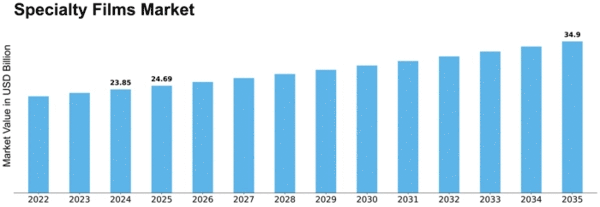
Specialty Films Market Size Graph
Author
Chitranshi Jaiswal
Research Analyst Level I

In her 3 years of experience in the market research field, she has handled critical cross-domain projects. She has an in-depth knowledge of market estimation & analysis, problem-solving, primary as well as secondary research, and team management.She holds an engineering degree and is an MBA professional from a well-known university, capable of evaluating the market and competitive conditions. An exceptional strategist with excellent communication skills and a passion for delivering cutting-edge & practical insights for the market. Proficient in multi-tasking, and can successfully deal with competing demands, while maintaining complete confidentiality. Generated business through active client and project development, networking, and high-quality responses. Her knowledge and skills have helped in making solid business decisions, securing funding from investors, and avoiding business failures.

Leave a Comment

FAQs

How much is the Specialty Films market?

The Specialty Films market size was valued at USD 23.85 Billion in 2024.

What is the growth rate of the Specialty Films market?

Specialty Films Market is projected to grow at a CAGR of 3.52% during the forecast period, 2025-2035

Which region held the largest market share in the Specialty Films market?

North America had the largest share of the market northAmerica had the largest share of the market

Who are the key players in the Specialty Films market?

The key players in the market are Saint-Gobain Performance Plastics, Madico Inc., Berry, SABIC, Solvay, Toray Plastics Inc., and Dow Chemical Company.

Which Type led the Specialty Films market?

The Barrier category dominated the Specialty Films Market in 2024.

Which End Use Industry had the largest market share in the Specialty Films market?

The packaging had the largest share in the Specialty Films Market

Market Summary

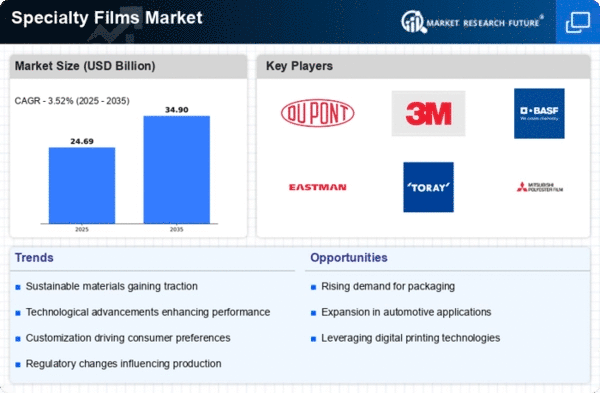
As per MRFR analysis, the Specialty Films Market was estimated at 23.85 USD Billion in 2024. The Specialty Films industry is projected to grow from 24.69 USD Billion in 2025 to 34.9 USD Billion by 2035, exhibiting a compound annual growth rate (CAGR) of 3.52 during the forecast period 2025 - 2035.

Key Market Trends & Highlights

The Specialty Films Market is experiencing robust growth driven by sustainability and technological advancements.

  • North America remains the largest market for specialty films, driven by increasing demand across various industries.
  • Asia-Pacific is recognized as the fastest-growing region, with significant investments in innovative film technologies.
  • The packaging segment continues to dominate the market, while the automotive segment is emerging rapidly due to customization needs.
  • Rising demand for eco-friendly products and regulatory support for sustainable practices are key drivers propelling market expansion.

Market Size & Forecast

2024 Market Size 23.85 (USD Billion)
2035 Market Size 34.9 (USD Billion)
CAGR (2025 - 2035) 3.52%
Largest Regional Market Share in 2024 North America

Major Players

DuPont (US), 3M (US), BASF (DE), Eastman Chemical Company (US), Toray Industries (JP), Mitsubishi Polyester Film (JP), SABIC (SA), Honeywell International Inc. (US), Avery Dennison Corporation (US)

Market Trends

The Specialty Films Market is currently experiencing a dynamic evolution, driven by advancements in technology and increasing demand across various sectors. This market encompasses a diverse range of applications, including packaging, automotive, electronics, and construction. The growing emphasis on sustainability and eco-friendly materials is influencing manufacturers to innovate and develop films that not only meet performance standards but also adhere to environmental regulations. As industries seek to enhance product durability and functionality, the Specialty Films Market is poised for substantial growth, reflecting a shift towards more specialized and high-performance materials. In addition, the Specialty Films Market is witnessing a surge in the adoption of smart films, which offer unique properties such as self-healing, energy efficiency, and enhanced aesthetic appeal. These innovations are likely to attract investments and foster collaborations among key players, further propelling market expansion. The interplay between consumer preferences and technological advancements suggests that the Specialty Films Market will continue to evolve, adapting to the changing landscape of global industries. As stakeholders navigate this complex environment, understanding emerging trends will be crucial for strategic decision-making and long-term success.

Sustainability Initiatives

The Specialty Films Market is increasingly influenced by sustainability initiatives, as manufacturers strive to create eco-friendly products. This trend reflects a broader commitment to reducing environmental impact, with companies exploring biodegradable and recyclable materials. Such efforts not only cater to consumer preferences but also align with regulatory pressures, driving innovation in film production.

Technological Advancements

Technological advancements are reshaping the Specialty Films Market, enabling the development of high-performance films with enhanced properties. Innovations such as nanotechnology and smart materials are gaining traction, allowing for improved functionality and versatility. This trend suggests a potential for new applications across various industries, enhancing the overall market landscape.

Customization and Specialization

Customization and specialization are becoming increasingly prominent in the Specialty Films Market. As industries demand tailored solutions to meet specific requirements, manufacturers are focusing on developing niche products. This trend indicates a shift towards more personalized offerings, allowing companies to differentiate themselves and cater to unique market needs.

Specialty Films Market Market Drivers

Market Growth Projections

The Global Specialty Films Market Industry is projected to experience steady growth, with a market value expected to reach 34.9 USD Billion by 2035. This growth trajectory is underpinned by a compound annual growth rate (CAGR) of 3.52% from 2025 to 2035. The increasing adoption of specialty films across various sectors, including packaging, automotive, and healthcare, contributes to this positive outlook. As industries continue to innovate and seek advanced materials, the specialty films market is likely to expand, driven by technological advancements and evolving consumer preferences. This growth potential suggests a dynamic future for the specialty films industry, characterized by ongoing developments and opportunities.

Expanding Applications in Healthcare

The Global Specialty Films Market Industry is witnessing an expansion in applications within the healthcare sector, driven by the increasing demand for medical packaging and devices. Specialty films are utilized in various healthcare applications, including sterile packaging for medical devices, drug delivery systems, and wound care products. The need for high-performance films that offer barrier protection, moisture resistance, and sterilization compatibility is paramount in this sector. As the healthcare industry continues to innovate and expand, the demand for specialty films is expected to grow, reflecting the critical role these materials play in ensuring product safety and efficacy. This trend highlights the versatility and importance of specialty films in meeting healthcare needs.

Growing Demand for Flexible Packaging

The Global Specialty Films Market Industry experiences a notable surge in demand for flexible packaging solutions. This trend is largely driven by the increasing consumer preference for lightweight and convenient packaging options. Flexible films are not only cost-effective but also provide enhanced barrier properties, which are essential for preserving product freshness. As of 2024, the market is valued at approximately 23.9 USD Billion, indicating a robust growth trajectory. The shift towards sustainable packaging materials further propels this demand, as manufacturers seek to reduce their environmental footprint while meeting consumer expectations. This evolving landscape suggests a promising future for flexible packaging within the specialty films sector.

Increased Focus on Sustainable Solutions

Sustainability emerges as a crucial driver within the Global Specialty Films Market Industry, as consumers and businesses alike prioritize eco-friendly materials. The shift towards biodegradable and recyclable films reflects a broader commitment to reducing plastic waste and environmental impact. Manufacturers are responding by developing specialty films that meet stringent sustainability standards while maintaining performance characteristics. This trend is particularly evident in the packaging sector, where brands are increasingly adopting sustainable films to appeal to environmentally conscious consumers. The growing regulatory pressure to minimize plastic usage further accelerates this transition, suggesting that sustainability will remain a key focus area for the specialty films market in the coming years.

Rising Applications in the Automotive Sector

The automotive sector emerges as a significant driver for the Global Specialty Films Market Industry, as manufacturers increasingly utilize specialty films for various applications. These films are employed in interior and exterior components, providing aesthetic appeal and functional benefits such as UV protection and thermal insulation. The growing emphasis on lightweight materials in automotive design aligns with the properties of specialty films, which contribute to improved fuel efficiency and reduced emissions. As the automotive industry continues to evolve, the demand for specialty films is expected to rise, further bolstering the market's growth trajectory. This trend underscores the importance of specialty films in enhancing vehicle performance and sustainability.

Technological Advancements in Film Production

Technological innovations play a pivotal role in shaping the Global Specialty Films Market Industry. Advances in polymer science and film extrusion techniques have led to the development of high-performance films that cater to diverse applications, including automotive, electronics, and food packaging. These innovations enhance the mechanical properties and thermal stability of specialty films, making them more appealing to manufacturers. Furthermore, the integration of smart technologies, such as sensors and RFID tags, into films is gaining traction, potentially revolutionizing product tracking and inventory management. As the industry embraces these advancements, it is likely to witness sustained growth, with projections indicating a market value of 34.9 USD Billion by 2035.

Market Segment Insights

By Application: Packaging (Largest) vs. Automotive (Fastest-Growing)

In the Specialty Films Market, the application segment is diverse, with packaging being the largest contributor due to its extensive use in food and consumer goods. This segment capitalizes on the demand for lightweight and sustainable packaging solutions, making it a vital part of the industry. Automotive and medical applications also represent significant shares, while construction and electronics follow, reflecting the varied requirements across these sectors.

Packaging (Dominant) vs. Automotive (Emerging)

Packaging stands out as the dominant application in the Specialty Films Market, driven by an increasing emphasis on convenience and sustainability. This segment utilizes advanced materials like biodegradable films to meet eco-friendly standards, positioning itself favorably in consumer preferences. Conversely, the automotive segment is emerging rapidly, influenced by the automotive industry's shift towards lightweight and high-performance materials. Specialty films are increasingly integrated into vehicle design for improved aesthetics and functionality, showcasing a growing trend towards innovation and technological enhancement in this field.

By End Use: Food and Beverage (Largest) vs. Pharmaceuticals (Fastest-Growing)

The Specialty Films Market is distinctly segmented by end usage, with the Food and Beverage sector holding the largest share. This sector's dominance is attributed to the increasing consumer demand for packaged food products, which require efficient and sustainable packaging solutions. The Pharmaceuticals segment, while smaller in share, is the fastest-growing segment due to rising global health awareness and the demand for secure, sterile packaging that complies with regulatory standards. Growth trends indicate a noteworthy shift towards sustainable packaging solutions across all sectors, driven by consumer preferences and stringent regulations. The rising importance of food safety and shelf life in the Food and Beverage sector fuels continued expansion. Conversely, the Pharmaceuticals sector is witnessing growth in specialized films for medication packaging, propelled by innovations in drug delivery systems and increasing investments in the healthcare sector.

Food and Beverage: Dominant vs. Pharmaceuticals: Emerging

The Food and Beverage segment is characterized by its extensive use of specialty films, which cater to a variety of packaging needs from barrier films to biodegradable materials. This dominance is maintained through advancements in technology that enhance product preservation and consumer appeal. In contrast, the Pharmaceuticals sector, while emerging, is rapidly gaining traction. This segment focuses on specialized films designed for compliance with strict regulatory requirements, ensuring safety, security, and efficacy of medicinal products. The growth in healthcare demands coupled with a push for innovations in drug packaging reflects the dynamic nature of the Pharmaceuticals segment, which is adapting to meet the needs of modern therapies and consumers.

By Material Type: Polyethylene (Largest) vs. Polypropylene (Fastest-Growing)

In the Specialty Films Market, the material type segmentation is led by Polyethylene, which captures the largest share due to its versatile applications across various industries, including packaging and agriculture. Polypropylene follows closely but is emerging as a strong contender due to its growing use in food packaging and retail applications. Other materials like Polyvinyl Chloride, Polyester, and Polycarbonate hold smaller but significant portions of the market, catering to niche applications and specialized uses.

Polyethylene (Dominant) vs. Polypropylene (Emerging)

Polyethylene is recognized as the dominant material in the Specialty Films Market owing to its extensive use in packaging solutions, which are prized for their durability and moisture resistance. It also offers cost-effectiveness and ease of processing, making it a preferred choice across industries. In contrast, Polypropylene is rapidly becoming an emerging favorite, particularly in food packaging and industrial applications. It boasts superior clarity and a higher resistance to heat compared to Polyethylene, making it ideal for a wider array of applications, including non-food items. As sustainability becomes increasingly crucial, Polypropylene's recyclability is enhancing its attractiveness in the market.

By Thickness: Thin Films (Largest) vs. Thick Films (Fastest-Growing)

In the Specialty Films Market, Thin Films hold the largest share, catering to versatile applications across various industries such as packaging, automotive, and electronics. Their lightweight nature and excellent barrier properties make them the preferred choice for manufacturers seeking efficiency and sustainability. Meanwhile, Thick Films are gaining traction as they provide better durability and enhanced protection, appealing to sectors like construction and automotive, which demand superior strength and resilience. The growth trends in this segment are influenced by increasing demand for lightweight materials in packaging and sustainable solutions across consumer goods. Additionally, Thick Films are recognized as the fastest-growing segment due to their rising adoption in niche applications that require added performance benefits, such as thermal stability and mechanical strength.

Thin Films (Dominant) vs. Thick Films (Emerging)

Thin Films are characterized by their minimal thickness, often less than 10 micrometers, providing exceptional flexibility and clarity. They are highly sought after in the packaging industry, where lightweight and high-performance materials are essential for efficiency and consumer appeal. On the other hand, Thick Films, typically ranging from 50 to 200 micrometers, offer enhanced strength and durability, making them ideal for applications that require greater protection and longevity. Their emerging status in the market is driven by innovations that optimize their performance in extreme conditions, placing them in a favorable position for future growth as industries continue to seek stronger, yet more efficient film solutions.

Get more detailed insights about Specialty Films Market Research Report - Forecast to 2035

Regional Insights

North America : Market Leader in Specialty Films

North America is poised to maintain its leadership in the Specialty Films Market, holding a significant market share of 10.95 in 2024. The region's growth is driven by increasing demand across various sectors, including packaging, automotive, and electronics. Regulatory support for sustainable materials and innovations in film technology further catalyze market expansion. The focus on eco-friendly solutions is reshaping consumer preferences, leading to a robust market outlook. The competitive landscape in North America is characterized by the presence of major players such as DuPont, 3M, and Eastman Chemical Company. These companies are investing heavily in R&D to enhance product offerings and meet evolving consumer demands. The U.S. remains the largest market, supported by advanced manufacturing capabilities and a strong distribution network. This dynamic environment fosters innovation and positions North America as a hub for specialty film production.

Europe : Emerging Market with Growth Potential

Europe is witnessing a notable increase in the Specialty Films Market, with a market size of 6.95 in 2024. The region's growth is fueled by rising demand for high-performance films in sectors like healthcare, packaging, and automotive. Stringent regulations promoting sustainability and energy efficiency are also driving innovation in film technologies. The European market is adapting to consumer preferences for eco-friendly products, which is expected to enhance market growth further. Leading countries in this region include Germany, France, and the UK, where key players like BASF and Mitsubishi Polyester Film are actively engaged. The competitive landscape is marked by a focus on innovation and collaboration among industry stakeholders. The presence of advanced manufacturing facilities and a skilled workforce supports the region's growth trajectory, making Europe a significant player in The Specialty Films.

Asia-Pacific : Rapid Growth in Emerging Markets

Asia-Pacific is emerging as a significant player in the Specialty Films Market, with a market size of 4.85 in 2024. The region's growth is primarily driven by increasing industrialization, urbanization, and rising disposable incomes. Demand for specialty films in packaging and electronics is surging, supported by favorable government policies promoting manufacturing and exports. The region's focus on sustainable practices is also shaping market dynamics, leading to innovative product developments. Countries like China, Japan, and India are at the forefront of this growth, with key players such as Toray Industries and Honeywell International Inc. leading the charge. The competitive landscape is characterized by rapid technological advancements and strategic partnerships among companies. As the region continues to invest in infrastructure and manufacturing capabilities, Asia-Pacific is set to become a major hub for specialty films production.

Middle East and Africa : Emerging Market with Untapped Potential

The Middle East and Africa region is gradually emerging in the Specialty Films Market, with a market size of 1.1 in 2024. The growth is driven by increasing demand for packaging solutions and advancements in manufacturing technologies. The region's focus on diversifying economies and enhancing industrial capabilities is expected to boost market development. Regulatory frameworks are evolving to support sustainable practices, which will further catalyze growth in specialty films. Leading countries in this region include South Africa and the UAE, where companies are beginning to invest in specialty films production. The competitive landscape is still developing, with opportunities for both local and international players. As the region continues to invest in infrastructure and technology, the Specialty Films Market is poised for significant growth, attracting investments and fostering innovation.

Key Players and Competitive Insights

The Specialty Films Market is currently characterized by a dynamic competitive landscape, driven by innovation, sustainability, and technological advancements. Key players such as DuPont (US), 3M (US), and BASF (DE) are at the forefront, each adopting distinct strategies to enhance their market positioning. DuPont (US) focuses on developing high-performance films that cater to the growing demand for sustainable packaging solutions, while 3M (US) emphasizes innovation in adhesive technologies and advanced materials. BASF (DE) is leveraging its extensive research capabilities to create specialty films that meet stringent environmental regulations, thereby enhancing its competitive edge. Collectively, these strategies contribute to a robust competitive environment, where differentiation is increasingly based on technological prowess and sustainability initiatives.In terms of business tactics, companies are localizing manufacturing to reduce lead times and optimize supply chains. This approach is particularly evident in regions with high demand for specialty films, allowing firms to respond swiftly to market needs. The market structure appears moderately fragmented, with several players vying for market share, yet the influence of major companies remains substantial. Their ability to innovate and adapt to changing consumer preferences shapes the overall competitive dynamics.

In November DuPont (US) announced the launch of a new line of biodegradable specialty films aimed at the food packaging sector. This strategic move not only aligns with global sustainability trends but also positions DuPont (US) as a leader in eco-friendly packaging solutions. The introduction of these films is expected to capture a significant share of the market, appealing to environmentally conscious consumers and businesses alike.

In October 3M (US) unveiled a partnership with a leading automotive manufacturer to develop advanced films for electric vehicles. This collaboration is indicative of 3M's (US) commitment to innovation and its strategic focus on high-growth sectors. By integrating its film technologies into the automotive industry, 3M (US) is likely to enhance its market presence and drive revenue growth in a rapidly evolving market.

In September BASF (DE) expanded its production capacity for specialty films in Asia, responding to the increasing demand in the region. This expansion not only strengthens BASF's (DE) operational capabilities but also reflects its strategic intent to capitalize on emerging markets. The move is expected to enhance supply chain efficiency and improve service levels for customers in Asia, thereby solidifying BASF's (DE) competitive position.

As of December the Specialty Films Market is witnessing trends such as digitalization, sustainability, and the integration of AI technologies. These trends are reshaping competitive strategies, with companies increasingly forming strategic alliances to enhance their capabilities. The shift from price-based competition to a focus on innovation and technology is evident, as firms strive to differentiate themselves through advanced product offerings and reliable supply chains. Looking ahead, it is likely that competitive differentiation will continue to evolve, with an emphasis on sustainable practices and technological advancements driving market growth.

Key Companies in the Specialty Films Market include

Industry Developments

Future Outlook

Specialty Films Market Future Outlook

The Specialty Films Market is projected to grow at a 3.52% CAGR from 2024 to 2035, driven by innovations in packaging, sustainability trends, and increasing demand in electronics.

New opportunities lie in:

  • Development of biodegradable specialty films for eco-conscious consumers.
  • Expansion into emerging markets with tailored product offerings.
  • Investment in advanced manufacturing technologies to enhance production efficiency.

By 2035, the Specialty Films Market is expected to achieve robust growth, positioning itself as a leader in innovative solutions.

Market Segmentation

Specialty Films Market End Use Outlook

  • Food and Beverage
  • Consumer Goods
  • Pharmaceuticals
  • Industrial
  • Agriculture

Specialty Films Market Thickness Outlook

  • Thin Films
  • Medium Films
  • Thick Films

Specialty Films Market Application Outlook

  • Packaging
  • Automotive
  • Construction
  • Electronics
  • Medical

Specialty Films Market Material Type Outlook

  • Polyethylene
  • Polypropylene
  • Polyvinyl Chloride
  • Polyester
  • Polycarbonate

Report Scope

MARKET SIZE 202423.85(USD Billion)
MARKET SIZE 202524.69(USD Billion)
MARKET SIZE 203534.9(USD Billion)
COMPOUND ANNUAL GROWTH RATE (CAGR)3.52% (2025 - 2035)
REPORT COVERAGERevenue Forecast, Competitive Landscape, Growth Factors, and Trends
BASE YEAR2024
Market Forecast Period2025 - 2035
Historical Data2019 - 2024
Market Forecast UnitsUSD Billion
Key Companies ProfiledDuPont (US), 3M (US), BASF (DE), Eastman Chemical Company (US), Toray Industries (JP), Mitsubishi Polyester Film (JP), SABIC (SA), Honeywell International Inc. (US), Avery Dennison Corporation (US)
Segments CoveredApplication, End Use, Material Type, Thickness
Key Market OpportunitiesGrowing demand for sustainable packaging solutions drives innovation in the Specialty Films Market.
Key Market DynamicsRising demand for sustainable packaging drives innovation and competition in the Specialty Films Market.
Countries CoveredNorth America, Europe, APAC, South America, MEA

FAQs

How much is the Specialty Films market?

The Specialty Films market size was valued at USD 23.85 Billion in 2024.

What is the growth rate of the Specialty Films market?

Specialty Films Market is projected to grow at a CAGR of 3.52% during the forecast period, 2025-2035

Which region held the largest market share in the Specialty Films market?

North America had the largest share of the market northAmerica had the largest share of the market

Who are the key players in the Specialty Films market?

The key players in the market are Saint-Gobain Performance Plastics, Madico Inc., Berry, SABIC, Solvay, Toray Plastics Inc., and Dow Chemical Company.

Which Type led the Specialty Films market?

The Barrier category dominated the Specialty Films Market in 2024.

Which End Use Industry had the largest market share in the Specialty Films market?

The packaging had the largest share in the Specialty Films Market

  1. SECTION I: EXECUTIVE SUMMARY AND KEY HIGHLIGHTS
    1. | 1.1 EXECUTIVE SUMMARY
  2. SECTION II: SCOPING, METHODOLOGY AND MARKET STRUCTURE
    1. | 2.1 MARKET INTRODUCTION
    2. | 2.2 RESEARCH METHODOLOGY
  3. SECTION III: QUALITATIVE ANALYSIS
    1. | 3.1 MARKET DYNAMICS
    2. | 3.2 MARKET FACTOR ANALYSIS
  4. SECTION IV: QUANTITATIVE ANALYSIS
    1. | 4.1 Chemicals and Materials, BY Application (USD Billion)
    2. | 4.2 Chemicals and Materials, BY End Use (USD Billion)
    3. | 4.3 Chemicals and Materials, BY Material Type (USD Billion)
    4. | 4.4 Chemicals and Materials, BY Thickness (USD Billion)
    5. | 4.5 Chemicals and Materials, BY Region (USD Billion)
  5. SECTION V: COMPETITIVE ANALYSIS
    1. | 5.1 Competitive Landscape
    2. | 5.2 Company Profiles
    3. | 5.3 Appendix

Specialty Films Market Segmentation

Market Segmentation Overview

  • Detailed segmentation data will be available in the full report
  • Comprehensive analysis by multiple parameters
  • Regional and country-level breakdowns
  • Market size forecasts by segment
Infographic

Free Sample Request

Kindly complete the form below to receive a free sample of this Report

Get Free Sample

Customer Strories

Compare Licence

×
Features License Type
Single User Multiuser License Enterprise User
Price $4,950 $5,950 $7,250
Maximum User Access Limit 1 User Upto 10 Users Unrestricted Access Throughout the Organization
Free Customization
Direct Access to Analyst
Deliverable Format
Platform Access
Discount on Next Purchase 10% 15% 15%
Printable Versions