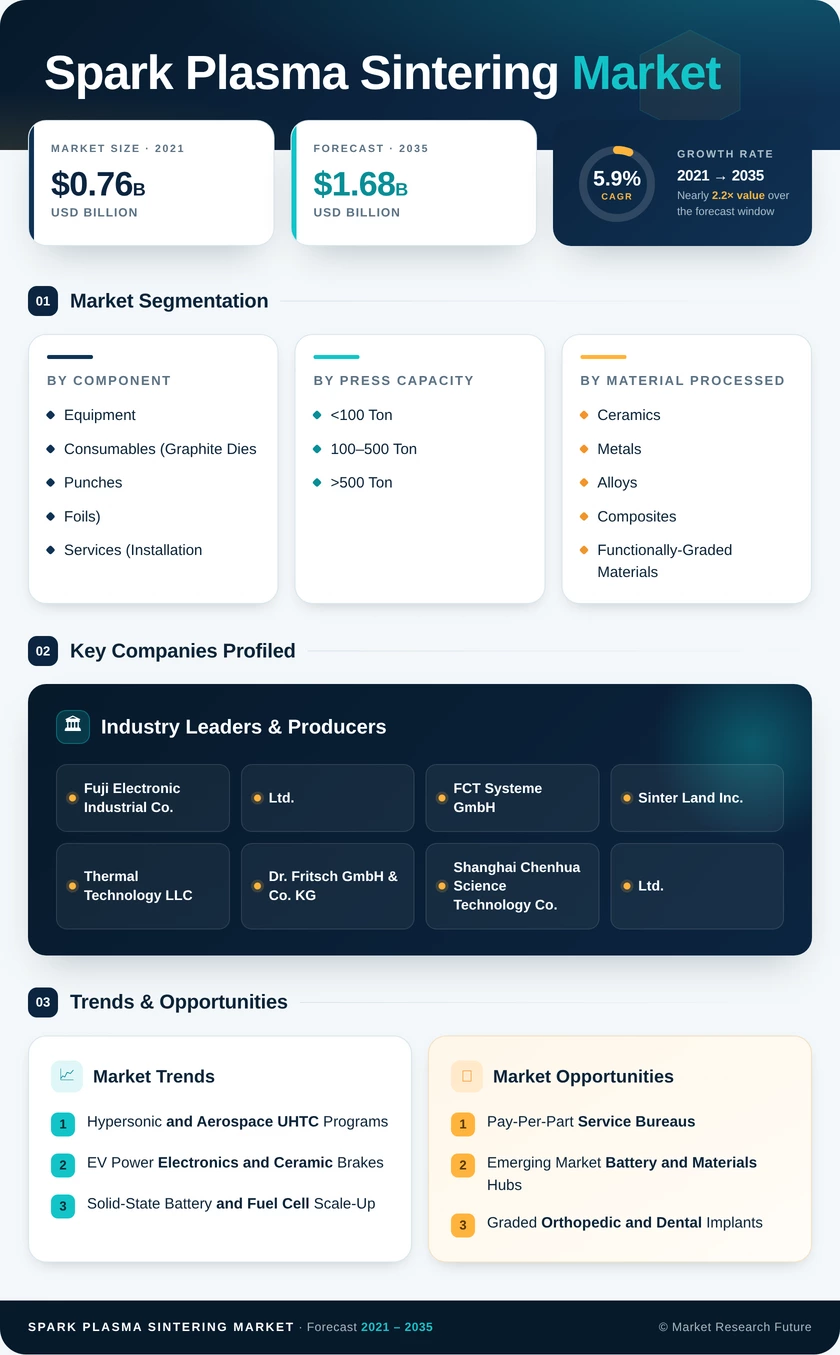
Segmentation Quick Reference
| Dimension | Sub-Segments | Dominant Segment | Fastest Growing Segment |
|---|
| By Component | Equipment; Consumables (Graphite Dies, Punches, Foils); Services (Installation, Maintenance, Retrofits) | Equipment (56.5% share) | Services (Installation, Maintenance, Retrofits) (7.2% CAGR) |
| By Press Capacity | <100 Ton; 100–500 Ton; >500 Ton | 100–500 Ton (58.2% share) | >500 Ton (7.3% CAGR) |
| By Material Processed | Ceramics; Metals and Alloys; Composites; Functionally-Graded Materials | Ceramics (46.8% share) | Functionally-Graded Materials (6.9% CAGR) |
| By End-Use Industry | Aerospace and Defense; Automotive; Electronics and Semiconductor; Energy (Fuel Cells, Batteries); Medical and Dental; Research Institutes | Aerospace and Defense (31.8% share) | Automotive (6.3% CAGR) |
| By Region | North America; South America; Europe; Asia-Pacific; Middle East; Africa | Asia-Pacific (44.5% share) | Asia-Pacific (6.6% CAGR) |
Market Segmentation Overview
| Sub-Segment | Key Trend |
|---|
| Equipment | Shift toward closed-loop control and larger chambers |
| Consumables (Graphite Dies, Punches, Foils) | Coated dies extending life to ~150 cycles |
| Services (Installation, Maintenance, Retrofits) | Multi-year uptime contracts bundled with new presses |
Equipment leads with a 56.5% share because grant-funded laboratories and pilot lines still purchase complete press systems. Services (Installation, Maintenance, Retrofits) grow fastest at 7.2% CAGR as aging presses receive pressure-control and data-logging retrofits. Consumables (Graphite Dies, Punches, Foils) track cycle counts, so their revenue rises with press utilization rather than new installations.
| Sub-Segment | Key Trend |
|---|
| <100 Ton | Entry-level academic and tooling-shop use |
| 100–500 Ton | Standard research and pilot-production class |
| >500 Ton | Large-format battery and aerospace parts |
The 100–500 Ton class holds a 58.2% share because 200-mm parts cover most research and pilot needs without major power upgrades. Presses rated >500 tons grow fastest at 7.3% CAGR as battery makers form 300-mm stacks and aerospace firms consolidate large nose-cone blanks. Units below 100 tons remain an academic entry point rather than a production tool.
| Sub-Segment | Key Trend |
|---|
| Ceramics | Margin pressure as zirconia and alumina recipes spread |
| Metals and Alloys | Defense demand for tungsten and titanium aluminides |
| Composites | Fiber-reinforced ceramics for turbine components |
| Functionally-Graded Materials | Single-run gradient implants and thermal tiles |
Ceramics dominate with a 46.8% share of cutting-tool and zirconia implant volume, though pricing tightens as process know-how diffuses. Functionally-Graded Materials expand fastest at 6.9% CAGR because pulsed-current consolidation can vary porosity and composition within one part, something hot pressing cannot match. Metals and Alloys and Composites serve defense and turbine applications where density and thermal-shock resistance justify premium processing.
| Sub-Segment | Key Trend |
|---|
| Aerospace and Defense | Hypersonic UHTC and turbine prototyping |
| Automotive | SiC inverter substrates and ceramic brake rotors |
| Electronics and Semiconductor | Dense sputtering targets and thermoelectrics |
| Energy (Fuel Cells, Batteries) | Solid-state electrolyte densification |
| Medical and Dental | Translucent zirconia and graded implants |
| Research Institutes | Grant-funded materials discovery |
Aerospace and Defense leads with a 31.8% share, sustained by hypersonic programs that need ultra-high-temperature borides and carbides. Automotive grows fastest at 6.3% CAGR as 800-volt EV platforms adopt SiC substrates and ceramic brakes that reduce particulate emissions. Electronics and Semiconductor and Energy (Fuel Cells, Batteries) follow closely, with solid-state electrolytes set to become a larger demand source after 2030.


 Noah Malgeri
Co-Founder

 Peter Groot koerkamp
Account and Business Manager

 Younghwan Choi
Senior Retail Manager

 Mark Irwin
Management Consultant

 Akif Moroglu
Strategy & Business Development Director

 Guilherme Gomes Martins
Product Management Director

 Joseph Aguayo
Sales Operations & Pricing Manager

 La Terria Dodd
Program Support Specialist

 Rob Kooiker
Group Product Manager HVAC & Fire Protection GMA