×
Hero Background
English
Chinese
French
Japanese
Korean
German
Spanish

Space Situational Awareness Market Size

ID: MRFR/AD/8056-HCR
165 Pages
Sejal Akre
October 2025

Space Situational Awareness (SSA) Market Report: Information by Offering (Services and Software), Object (Mission-Related Debris, Rocket Bodies, Fragmentation Debris, Functional Spacecraft, Non-Functional Spacecraft and others), End User (Commercial and Government & Military) and Region (North America, Europe, Asia-Pacific, Middle East & Africa and Latin America) - Forecast till 2032

Share:
Download PDF ×

We do not share your information with anyone. However, we may send you emails based on your report interest from time to time. You may contact us at any time to opt-out.

Space Situational Awareness Market Infographic
Purchase Options

Space Situational Awareness Size

Space Situational Awareness Market Growth Projections and Opportunities

The Space Situational Awareness (SSA) market is undergoing significant developments, propelled by key market factors that shape its landscape. A primary driver of this market is the escalating importance of monitoring and understanding activities in space. With an increasing number of satellites, debris, and other objects orbiting the Earth, the need for Space Situational Awareness has grown exponentially. Governments, space agencies, and private entities are investing in SSA capabilities to enhance space traffic management, collision avoidance, and overall space domain awareness.

The Space Situational Awareness (SSA) market is anticipated to witness substantial growth, projecting an increase from USD 2.01 billion in 2030, with a Compound Annual Growth Rate (CAGR) of 7% during the period from 2022 to 2030. This market expansion reflects the increasing efforts of individuals and organizations to comprehend the vastness and attributes of outer space enveloping Earth. As the need for understanding and monitoring space activities intensifies, the SSA market continues to evolve, driven by technological advancements and the growing significance of space-related insights.

Technological advancements play a critical role in defining the trajectory of the SSA market. Continuous innovation in sensor technologies, data analytics, and artificial intelligence has bolstered the capabilities of SSA systems. Advanced sensors enable the detection and tracking of space objects with greater accuracy, while sophisticated analytics and AI algorithms process vast amounts of data, providing actionable insights for space operators. These technological enhancements not only improve the effectiveness of SSA but also contribute to the development of more robust and scalable solutions.

Regulatory considerations are another pivotal factor influencing the SSA market. As space activities increase, regulatory frameworks are evolving to address safety, sustainability, and responsible space behavior. Compliance with these regulations is essential for space operators and organizations, shaping the design and implementation of SSA solutions. The integration of SSA capabilities becomes crucial for meeting regulatory requirements related to collision avoidance, space debris mitigation, and overall space domain awareness.

The competitive landscape in the SSA market is marked by a growing number of players offering diverse solutions. Collaboration and partnerships between governments, space agencies, and private companies are common strategies to harness complementary strengths and advance SSA capabilities. The competitive dynamics foster innovation and the development of specialized SSA services, such as conjunction analysis, anomaly detection, and space weather monitoring, contributing to the overall growth of the market.

Economic factors also contribute to the dynamics of the SSA market. The increasing commercialization of space activities, including satellite launches, space tourism, and communication services, drives the demand for SSA services. Companies engaged in space-related ventures recognize the importance of protecting their assets and ensuring the safe operation of their spacecraft, making SSA an integral component of their business strategies. The economic viability of these ventures is closely tied to the effectiveness of SSA solutions in mitigating risks and enhancing overall space operations.

Global geopolitical considerations further impact the SSA market. Space has become a contested domain, and nations are recognizing the strategic importance of space assets. Heightened security concerns and the potential militarization of space emphasize the need for comprehensive SSA capabilities. As countries aim to protect their satellites and space infrastructure, investments in advanced SSA technologies become imperative, influencing the overall market dynamics.

Space Situational Awareness Market Size Graph
Author
Sejal Akre
Senior Research Analyst

She has over 5 years of rich experience, in market research and consulting providing valuable market insights to client. Hands on expertise in management consulting, and extensive knowledge in domain including ICT, Automotive & Transportation and Aerospace & Defense. She is skilled in Go-to market strategy, industry analysis, market sizing, in depth company profiling, competitive intelligence & benchmarking and value chain amongst others.

Leave a Comment

FAQs

What is the projected market value of the global SSA market?

Global SSA market is touted to record a substantial market valuation of USD 2.01 Billion by 2030.

What is the estimated growth rate of the global SSA market?

Global SSA market is projected to register a moderate 7% CAGR in the forecast period.

Who are the significant players operative in the global SSA market?

A few eminent market players operating in the global SSA market are Analytical Graphics (US), Etamax Space (Germany), Exoanalytic Solutions (US), among others.

What is the end-user segment of the global SSA market expected to witness the highest growth?

The OEM segment is slated to expand as the fastest-growing segment.

Market Summary

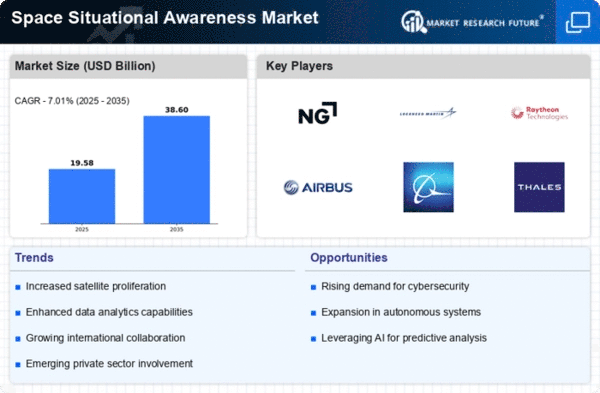
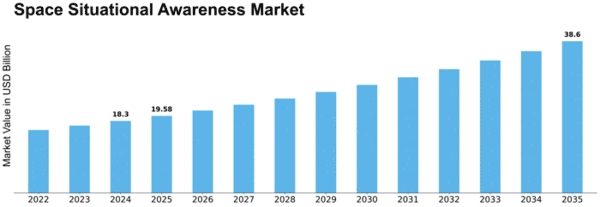
As per MRFR analysis, the Space Situational Awareness Market Size was estimated at 18.3 USD Billion in 2024. The Space Situational Awareness industry is projected to grow from 19.6 USD Billion in 2025 to 38.6 USD Billion by 2035, exhibiting a compound annual growth rate (CAGR) of 7.01 during the forecast period 2025 - 2035.

Key Market Trends & Highlights

The Space Situational Awareness Market is poised for substantial growth driven by technological advancements and increasing collaboration among stakeholders.

  • Technological advancements in monitoring systems are enhancing the capabilities of space situational awareness.
  • North America remains the largest market, while Asia-Pacific is emerging as the fastest-growing region in this sector.
  • The surveillance segment dominates the market, whereas the tracking segment is witnessing rapid growth.
  • Rising demand for satellite services and escalating space debris concerns are key drivers propelling market expansion.

Market Size & Forecast

2024 Market Size 18.3 (USD Billion)
2035 Market Size 38.6 (USD Billion)
CAGR (2025 - 2035) 7.01%
Largest Regional Market Share in 2024 North America

Major Players

<p>Northrop Grumman (US), Lockheed Martin (US), Raytheon Technologies (US), Airbus (DE), Boeing (US), Thales Group (FR), Maxar Technologies (CA), L3Harris Technologies (US), Planet Labs (US)</p>

Market Trends

The Space Situational Awareness Market is currently experiencing a transformative phase, driven by the increasing complexity of space operations and the growing need for effective monitoring of space debris and other potential hazards. As nations and private entities expand their activities in outer space, the demand for advanced technologies and systems that can provide real-time data and analysis is becoming more pronounced. This market encompasses a wide range of services, including satellite tracking, collision avoidance systems, and data analytics, all aimed at ensuring the safety and sustainability of space endeavors. Furthermore, the integration of artificial intelligence and machine learning into these systems is enhancing predictive capabilities, thereby allowing stakeholders to make informed decisions regarding space traffic management and risk mitigation. In addition to technological advancements, regulatory frameworks are evolving to address the challenges posed by increased space activity. Governments and international organizations are recognizing the necessity of collaboration in sharing data and best practices to enhance global space safety. This collaborative approach is likely to foster innovation and drive investment in the Space Situational Awareness Market. As the landscape continues to evolve, stakeholders must remain vigilant and adaptable to emerging threats and opportunities, ensuring that the market can effectively respond to the dynamic nature of space operations.

Technological Advancements in Monitoring Systems

The Space Situational Awareness Market is witnessing rapid advancements in monitoring technologies. Innovations in satellite tracking and sensor technologies are enhancing the ability to detect and analyze space debris. These developments are crucial for improving the accuracy of collision predictions and ensuring the safety of operational satellites.

Increased Collaboration Among Stakeholders

There is a noticeable trend towards greater collaboration among various stakeholders in the Space Situational Awareness Market. Governments, private companies, and international organizations are increasingly sharing data and resources to enhance overall space safety. This cooperative approach is expected to lead to more effective solutions for managing space traffic.

Growing Emphasis on Regulatory Frameworks

As space activities expand, there is a growing emphasis on establishing robust regulatory frameworks. Policymakers are recognizing the need for comprehensive guidelines to govern space operations and mitigate risks associated with space debris. This trend is likely to shape the future landscape of the Space Situational Awareness Market.

Space Situational Awareness Market Market Drivers

Increasing Space Debris

The proliferation of space debris poses a substantial challenge to the Global Space Situational Awareness Market Industry. As of 2024, it is estimated that there are over 36,500 pieces of debris larger than 10 cm orbiting Earth. This increasing volume of debris necessitates advanced tracking and monitoring systems to prevent collisions with operational satellites and spacecraft. The potential for catastrophic events due to debris impacts drives investment in space situational awareness technologies, as stakeholders recognize the need for enhanced safety measures. Consequently, this trend is likely to bolster market growth, contributing to the projected market value of 1.1 USD Billion in 2024.

Market Growth Projections

The Global Space Situational Awareness Market Industry is poised for substantial growth, with projections indicating a market value of 1.1 USD Billion in 2024 and an anticipated increase to 2.46 USD Billion by 2035. This growth trajectory reflects a compound annual growth rate of 7.6% from 2025 to 2035. The increasing demand for effective monitoring solutions, driven by factors such as space debris, commercial activities, and government initiatives, underscores the market's potential. As stakeholders recognize the importance of situational awareness in ensuring safe and sustainable space operations, investments in this sector are expected to rise significantly.

Technological Advancements

Rapid advancements in satellite technology and data analytics are transforming the Global Space Situational Awareness Market Industry. Innovations in sensor technology, artificial intelligence, and machine learning facilitate real-time tracking and analysis of space objects. These developments enable more accurate predictions of potential collisions and enhance decision-making processes for space operators. The integration of advanced technologies is likely to attract investments and drive market expansion. As the industry evolves, the demand for sophisticated solutions is expected to grow, contributing to a compound annual growth rate of 7.6% from 2025 to 2035.

Commercial Space Activities

The surge in commercial space activities, including satellite launches and space tourism, significantly impacts the Global Space Situational Awareness Market Industry. As more private companies enter the space sector, the need for effective monitoring and management of space traffic becomes increasingly critical. This trend is evidenced by the growing number of satellites being deployed, which is projected to reach over 100,000 by 2030. The expansion of commercial ventures necessitates robust situational awareness capabilities to ensure safe operations in crowded orbits. Consequently, this dynamic environment is likely to drive market growth and innovation.

International Collaboration

International collaboration is becoming a cornerstone of the Global Space Situational Awareness Market Industry. Various nations are recognizing the importance of sharing data and resources to enhance global monitoring capabilities. Initiatives such as the Space Data Association facilitate information exchange among satellite operators, improving overall situational awareness. This collaborative approach not only enhances safety but also fosters innovation in tracking technologies. As countries work together to address common challenges in space, the market is poised for growth, driven by shared investments and collective advancements in space situational awareness.

Government Initiatives and Policies

Governments worldwide are increasingly prioritizing space situational awareness, recognizing its critical role in national security and economic stability. Initiatives such as the United States Space Policy Directive-3 emphasize the importance of space traffic management and debris mitigation. These policies foster collaboration among nations and private entities, thereby enhancing the Global Space Situational Awareness Market Industry. As countries invest in advanced technologies and infrastructure to monitor space activities, the market is expected to benefit significantly. This trend aligns with the anticipated growth trajectory, with projections indicating a market value of 2.46 USD Billion by 2035.

Market Segment Insights

By Application: Surveillance (Largest) vs. Tracking (Fastest-Growing)

<p>In the Space Situational Awareness Market, the application segment is characterized by several key components, including Surveillance, Tracking, Collision Avoidance, Data Analysis, and Space Weather Monitoring. Surveillance emerges as the largest application segment, garnering a significant share due to its extensive use in monitoring space objects and providing critical data to ensure the safety of spacecraft. Tracking follows closely, driven by its increasing importance in real-time satellite tracking and object identification in space. Growth trends indicate that ongoing investments in space technologies are propelling the expansion of these application segments. Surveillance continues to dominate, yet Tracking is witnessing rapid advancements and adoption, fueled by the need for timely information and enhanced operational efficiency. Innovations in tracking technologies and systems are transforming how space agencies and companies address the complexities of maintaining situational awareness in an increasingly crowded orbital environment.</p>

<p>Surveillance (Dominant) vs. Tracking (Emerging)</p>

<p>Surveillance capabilities in the Space Situational Awareness Market serve as the cornerstone for monitoring space debris and satellite activities. This dominant application utilizes advanced sensors and satellite equipment to provide comprehensive insights into space activities and detect potential threats. As a result, effective surveillance solutions enhance safety and operational planning for space missions. On the other hand, Tracking has emerged as a vital component, focusing on accurate real-time positioning and identification of objects in space. The rapid development of Tracking technologies, including enhanced algorithms and machine learning, are enabling agencies to improve their responses to potential collisions and operational hazards. With advancements in satellite technology, both Surveillance and Tracking are crucial for future space operations, highlighting the synergistic relationship and continuity of innovation in these applications.</p>

By End Use: Government (Largest) vs. Commercial (Fastest-Growing)

<p>The Space Situational Awareness market exhibits a diverse distribution among its end-use segments. Government agencies currently hold the largest share, leveraging advanced technologies to monitor and manage space activities. This dominance stems from their extensive funding and prioritization of national security, which necessitates a robust understanding of the space environment. In contrast, commercial entities are emerging as significant contributors, reflecting a growing interest in space resources and satellite operations.</p>

<p>Government (Dominant) vs. Commercial (Emerging)</p>

<p>The Government segment in the Space Situational Awareness market is characterized by its substantial investments in satellite tracking and debris management systems, driven by a strong focus on national security and defense capabilities. Agencies are increasingly employing cutting-edge technologies to improve their situational awareness, thus reinforcing their dominant position. Conversely, the Commercial segment is seen as an emerging force, with private companies rapidly expanding their capacities and investing in innovative solutions to capitalize on the burgeoning satellite market. This shift towards commercial interest reflects the rising importance of space operations in global communications and navigation.</p>

By Technology: Ground-Based Systems (Largest) vs. Space-Based Systems (Fastest-Growing)

<p>The Space Situational Awareness Market showcases significant diversification across various technology segments. Ground-Based Systems hold the largest market share, dominating the landscape with a strong infrastructure for tracking and monitoring. These systems benefit from established operational frameworks and extensive data networks, making them the go-to choice for many government and defense agencies. On the other hand, Space-Based Systems represent the fastest-growing segment, leveraging the advancements in satellite technology for a more dynamic and real-time approach to situational awareness. These systems are increasingly being integrated with multi-dimensional data sources, enhancing the utility of space-related information. As the market evolves, growth trends indicate a shift towards more automated and integrated solutions. The surge in commercial space activities and the growing interest in satellite constellations drive the demand for Space-Based Systems. However, Ground-Based Systems continue to play a crucial role in ensuring safety and security within established airspaces. Investments in research and development are poised to enhance both segments, promoting collaborative efforts that maximize situational awareness capabilities across various platforms.</p>

<p>Ground-Based Systems (Dominant) vs. Space-Based Systems (Emerging)</p>

<p>Ground-Based Systems remain the dominant force in the Space Situational Awareness Market, primarily due to their reliability and established operational frameworks. These systems utilize a plethora of ground radars, telescopes, and sensor networks to monitor space activities effectively. They are instrumental in collision avoidance, tracking orbital debris, and ensuring the safety of space missions. Meanwhile, Space-Based Systems are emerging rapidly, driven by technological advancements and the need for real-time monitoring. These systems operate through satellites equipped with sophisticated sensors that provide extensive coverage and operational flexibility. As the landscape changes, both segments must innovate to address the upcoming challenges posed by an increasingly crowded orbital environment.</p>

By Service Type: Data Services (Largest) vs. Consulting Services (Fastest-Growing)

<p>In the Space Situational Awareness Market, the service type segment is predominantly led by Data Services, reflecting its essential role in aggregating and analyzing large volumes of space data. Consulting Services follows closely behind, offering tailored solutions and expert guidance for organizations looking to enhance their operational capabilities in space monitoring. The other services, including Training, Maintenance, and Integration Services, also contribute significantly, although their market shares are smaller in comparison, emphasizing a well-rounded service ecosystem that supports the entire space situational awareness functionality. The growth trends in this segment reveal a surge in demand for Data Services driven by the increasing reliance on real-time data for decision-making in space operations. At the same time, Consulting Services are gaining momentum as organizations seek expert insights to navigate the complexities of space environments. Training Services are also on the rise, emphasizing the necessity of educating personnel to effectively manage and analyze space data. As organizations invest in technological advancements, Maintenance and Integration Services play a crucial role in ensuring the efficiency and reliability of space systems.</p>

<p>Data Services: Dominant vs. Consulting Services: Emerging</p>

<p>Data Services are characterized by their comprehensive capabilities in collecting, processing, and disseminating information crucial for space situational awareness. This service encompasses satellite data processing, data fusion, and analysis, making it indispensable for stakeholders in the space industry. The emphasis on accurate and timely data makes Data Services a dominant force in the market. In contrast, Consulting Services represent an emerging area as they provide expertise in integrating new technologies and optimizing operations for better space surveillance. Companies are increasingly recognizing the need for tailored consulting solutions to address unique challenges in space management, enabling them to adapt strategies effectively as the sector evolves.</p>

Get more detailed insights about Space Situational Awareness (SSA) Market Research Report - Forecast till 2035

Regional Insights

North America : Market Leader in Space Tech

North America continues to lead the Space Situational Awareness (SSA) market, holding a significant share of 9.18 in 2024. The region's growth is driven by increasing investments in defense and space technologies, alongside a rising demand for satellite-based services. Regulatory support from government agencies, such as NASA and the Department of Defense, further catalyzes market expansion, ensuring robust infrastructure and innovation in SSA capabilities. The competitive landscape in North America is characterized by the presence of major players like Northrop Grumman, Lockheed Martin, and Raytheon Technologies. These companies are at the forefront of developing advanced SSA solutions, leveraging cutting-edge technologies such as AI and machine learning. The U.S. government’s focus on enhancing national security through space surveillance and tracking systems solidifies the region's position as a global leader in SSA.

Europe : Emerging Hub for Space Solutions

Europe is rapidly emerging as a significant player in the Space Situational Awareness market, with a market size of 4.92. The region benefits from collaborative initiatives among EU member states, focusing on enhancing space security and sustainability. Regulatory frameworks, such as the European Space Strategy, are pivotal in driving investments and fostering innovation in SSA technologies, addressing both commercial and governmental needs. Leading countries like France, Germany, and the UK are at the forefront of this growth, supported by key players such as Airbus and Thales Group. The competitive landscape is marked by strategic partnerships and joint ventures aimed at developing advanced SSA capabilities. The European Space Agency's commitment to improving space traffic management and debris monitoring further strengthens the region's position in The Space Situational Awareness.

Asia-Pacific : Rising Player in Space Awareness

The Asia-Pacific region is witnessing a burgeoning Space Situational Awareness market, currently valued at 3.66. This growth is fueled by increasing investments in space exploration and satellite technologies, driven by countries like China, India, and Japan. Regulatory initiatives aimed at enhancing space safety and security are also contributing to market expansion, as governments recognize the importance of SSA in national security and economic development. China and India are leading the charge in developing SSA capabilities, with significant investments in satellite systems and ground-based monitoring technologies. The competitive landscape features both established players and emerging startups, fostering innovation and collaboration. As the region continues to prioritize space security, the demand for advanced SSA solutions is expected to rise significantly in the coming years.

Middle East and Africa : Developing Space Infrastructure

The Middle East and Africa region is in the nascent stages of developing its Space Situational Awareness market, currently valued at 0.54. The growth is driven by increasing interest in space technologies and the establishment of national space agencies in countries like the UAE and South Africa. Regulatory frameworks are beginning to take shape, focusing on enhancing space safety and security, which is crucial for the region's economic development and international collaboration. Countries like the UAE are making significant strides in space exploration, with initiatives aimed at building satellite capabilities and enhancing SSA. The competitive landscape is evolving, with both government and private sector investments driving innovation. As the region recognizes the strategic importance of space, the SSA market is poised for growth, attracting The Space Situational Awareness.

Key Players and Competitive Insights

The Space Situational Awareness Market is characterized by a dynamic competitive landscape, driven by the increasing need for monitoring and managing space debris, satellite operations, and potential threats to national security. Key players such as Northrop Grumman (US), Lockheed Martin (US), and Airbus (DE) are at the forefront, each adopting distinct strategies to enhance their market positioning. Northrop Grumman (US) focuses on innovation through advanced sensor technologies, while Lockheed Martin (US) emphasizes partnerships with governmental agencies to bolster its capabilities in space surveillance. Airbus (DE) is leveraging its European presence to expand its offerings in satellite-based monitoring solutions, indicating a trend towards regional specialization in the market.

The business tactics employed by these companies include localizing manufacturing and optimizing supply chains to enhance operational efficiency. The market structure appears moderately fragmented, with a mix of established players and emerging startups. This fragmentation allows for diverse approaches to Space Situational Awareness, as companies strive to differentiate themselves through technological advancements and strategic collaborations.

In November 2025, Northrop Grumman (US) announced a partnership with the U.S. Space Force to develop a new satellite constellation aimed at improving space domain awareness. This strategic move is likely to enhance Northrop Grumman's capabilities in real-time tracking of space objects, thereby solidifying its position as a leader in the market. The collaboration underscores the importance of government partnerships in driving innovation and operational effectiveness in the sector.

In October 2025, Lockheed Martin (US) unveiled its latest AI-driven analytics platform designed to predict potential collisions in space. This initiative not only showcases Lockheed Martin's commitment to integrating cutting-edge technology but also reflects a broader industry trend towards utilizing artificial intelligence for enhanced decision-making in space operations. The platform is expected to significantly reduce the risk of satellite collisions, thereby enhancing overall space safety.

In September 2025, Airbus (DE) launched a new service aimed at providing real-time data on space debris to commercial satellite operators. This service is indicative of Airbus's strategy to capitalize on the growing demand for debris monitoring solutions. By offering such services, Airbus positions itself as a critical player in ensuring the sustainability of space operations, which is increasingly becoming a priority for satellite operators worldwide.

As of December 2025, the competitive trends in the Space Situational Awareness Market are heavily influenced by digitalization, sustainability, and the integration of AI technologies. Strategic alliances are becoming more prevalent, as companies recognize the need to collaborate to enhance their technological capabilities and market reach. Looking ahead, competitive differentiation is likely to evolve from traditional price-based competition to a focus on innovation, advanced technology, and reliable supply chains. This shift may redefine the competitive landscape, emphasizing the importance of strategic partnerships and technological advancements in maintaining a competitive edge.

Key Companies in the Space Situational Awareness Market market include

Industry Developments

Many recent developments foster market growth for the Space Situational Awareness Market sector. The stakeholders take up new device creation, research and development initiatives, and other activities to create improved infrastructure and devices. On the other hand, the companies are also taking up mergers and acquisitions to expand their size and scale of operations. From joint ventures for better technical capabilities to partnerships for better funding, there are many recent developments for the Space Situational Awareness Market.

For example, the Space Weather Prediction Center added a new set of weather prediction tools like WAM-IPE in July 2021 to its weather prediction tool kit. 

On July 05, 2023, Rocket Lab announced that it has signed a deal with Spire Global to launch its first four Space Situational Awareness Market (SSA) satellites to low earth orbit (LEO) for its Space Services customer NorthStar Earth & Space Inc. Spire selected Rocket Lab to meet NorthStar's program requirements to launch the satellites on an accelerated timeline within five months of contract signing.

On Jun. 21, 2023, Digantara, a space situational awareness company, announced that it has raised US$10 MN in a Series A1 funding round led by Peak XV Partners and Kalaari Capital.  The company will use the funds further to develop its revolutionary space-mission assurance platform, Space-Map!  The fundraising will allow the company to deploy the first phase of its surveillance satellite constellation and speed up the development of downstream space situational awareness (SSA) service.

On May 17, 2023, Rivada Space Networks (RSN) and OKAPI: Orbits announced the expansion of their partnership to secure the responsible use of space-based technologies.  OKAPI: Orbits will continue providing satellite mission-analysis tools, comprising analysis and implementation of Collision Avoidance and De-orbiting strategies.  The partnership will combine RSN's interconnected high-speed, Low Earth Orbit satellite network and OKAPI: Orbits' Space Traffic Management Software-as-a-Service solution.

Apr.24, 2023, ArianeGroup announced that the French space agency CNES has selected it to lead its Space Situational Awareness Market Project.  France is investing in this program to improve space situational awareness (SSA) capabilities.  ArianeGroup will lead a consortium, and Eutelsat and Magellium will join it on the project.  The company will provide its space surveillance service from its network of ground telescopes, while Eutelsat will operate a new space sensor to connect to the system, thus, improving the catalog and tracking of objects in orbit.

On Dec. 07, 2022, Slingshot Aerospace announced the closing of Series A-2 to drive a space situational awareness platform.  Slingshot Aerospace is building a real-time digital space twin to allow operators to keep their assets in orbit safe and secure.  The company has raised $40.85 MN in Series A-2 funding and has also received a venture loan for an undisclosed amount from Horizon Technology Finance.


Future Outlook

Space Situational Awareness Market Future Outlook

<p>The Space Situational Awareness Market is projected to grow at a 7.01% CAGR from 2024 to 2035, driven by increasing satellite launches, space debris management needs, and national security concerns.</p>

New opportunities lie in:

  • <p>Development of advanced AI algorithms for real-time space traffic management.</p>
  • <p>Expansion of commercial partnerships for satellite data sharing and analytics.</p>
  • <p>Investment in next-generation sensors for enhanced debris tracking capabilities.</p>

<p>By 2035, the market is expected to be robust, driven by technological advancements and increased global collaboration.</p>

Market Segmentation

Space Situational Awareness Market End Use Outlook

  • Government
  • Commercial
  • Military
  • Research Institutions
  • Non-Governmental Organizations

Space Situational Awareness Market Technology Outlook

  • Ground-Based Systems
  • Space-Based Systems
  • Hybrid Systems
  • Software Solutions
  • Data Analytics Tools

Space Situational Awareness Market Application Outlook

  • Surveillance
  • Tracking
  • Collision Avoidance
  • Data Analysis
  • Space Weather Monitoring

Space Situational Awareness Market Service Type Outlook

  • Consulting Services
  • Data Services
  • Training Services
  • Maintenance Services
  • Integration Services

Report Scope

MARKET SIZE 202418.3(USD Billion)
MARKET SIZE 202519.6(USD Billion)
MARKET SIZE 203538.6(USD Billion)
COMPOUND ANNUAL GROWTH RATE (CAGR)7.01% (2024 - 2035)
REPORT COVERAGERevenue Forecast, Competitive Landscape, Growth Factors, and Trends
BASE YEAR2024
Market Forecast Period2025 - 2035
Historical Data2019 - 2024
Market Forecast UnitsUSD Billion
Key Companies ProfiledNorthrop Grumman (US), Lockheed Martin (US), Raytheon Technologies (US), Airbus (DE), Boeing (US), Thales Group (FR), Maxar Technologies (CA), L3Harris Technologies (US), Planet Labs (US)
Segments CoveredApplication, End Use, Technology, Service Type
Key Market OpportunitiesAdvancements in satellite technology enhance real-time tracking in the Space Situational Awareness Market.
Key Market DynamicsRising demand for advanced satellite systems drives innovation and competition in the Space Situational Awareness Market.
Countries CoveredNorth America, Europe, APAC, South America, MEA

FAQs

What is the projected market value of the global SSA market?

Global SSA market is touted to record a substantial market valuation of USD 2.01 Billion by 2030.

What is the estimated growth rate of the global SSA market?

Global SSA market is projected to register a moderate 7% CAGR in the forecast period.

Who are the significant players operative in the global SSA market?

A few eminent market players operating in the global SSA market are Analytical Graphics (US), Etamax Space (Germany), Exoanalytic Solutions (US), among others.

What is the end-user segment of the global SSA market expected to witness the highest growth?

The OEM segment is slated to expand as the fastest-growing segment.

  1. Executive Summary
    1. Market Attractiveness Analysis
      1. Global Space Situational Awareness Market, by Offering
      2. Global Space Situational Awareness Market, by Object
      3. Global Space Situational Awareness Market, by End User
      4. Global Space Situational Awareness Market, by Region
  2. Market Introduction
    1. Market Definition
    2. Scope of the Study
    3. Market Structure
    4. Key Buying Criteria
    5. Market Factor Indicator Analysis
  3. Research Methodology
    1. Research Process
    2. Primary Research
    3. Secondary Research
    4. Market Size Estimation
    5. Forecast Model
    6. List of Assumptions
  4. Market Insights
  5. Market Dynamics
    1. Introduction
    2. Drivers
      1. Increase in deployment of small satellites
      2. Large-scale investments by private firms in space exploration missions
      3. Increasing volume of space debris
      4. Drivers Impact Analysis
    3. Restraints
      1. Stringent regulations
      2. Restraints Impact Analysis
    4. Opportunities
      1. Technological advancement to lower cost of spacecraft launches
    5. Market/Technological Trends
    6. Patent Trends
    7. Regulatory Landscape/Standards
  6. Market Factor Analysis
    1. Supply Chain Analysis
      1. R&D
      2. Manufacturing
      3. Distribution & Sales
      4. Post-Sales Monitoring
    2. Porter’s Five Forces Analysis
      1. Threat of New Entrants
      2. Bargaining Power of Buyers
      3. Threat of Substitutes
      4. Intensity of Rivalry
      5. Bargaining Power of Suppliers
  7. Global Space Situational Awareness Market, by Offering
    1. Introduction
    2. Services
      1. Space Weather Services
      2. Near-Earth Object Detection Services
      3. Space Surveillance and Tracking Services
    3. Software
      1. Orbit Determination Tool Kit
      2. Commercial Space Operations Center
      3. Joint Space Operations Center
      4. Space Data Center
      5. Space Event Generator
      6. Others
  8. Global Space Situational Awareness Market, by Object
    1. Introduction
      1. Mission-Related Debris
      2. Rocket Bodies
      3. Fragmentation Debris
      4. Functional Spacecraft
      5. Non-Functional Spacecraft
      6. Others
  9. Global Space Situational Awareness Market, by End User
    1. Introduction
      1. Commercial
      2. Government & Military
  10. Global Space Situational Awareness Market, by Region
    1. Introduction
    2. North America
      1. US
      2. Canada
    3. Europe
      1. UK
      2. Germany
      3. France
      4. Italy
      5. Rest of Europe
    4. Asia-Pacific
      1. China
      2. India
      3. Australia
      4. Japan
      5. Rest of Asia-Pacific
    5. Middle East & Africa
      1. Saudi Arabia
      2. UAE
      3. Turkey
      4. Rest of Middle East & Africa
    6. Latin America
      1. Brazil
      2. Rest of Latin America
  11. Competitive Landscape
    1. Competitive Overview
    2. Competitor Dashboard
    3. Major Growth Key Strategies in the Global Space Situational Awareness Market
    4. Competitive Benchmarking
    5. Market Share Analysis
    6. Leading Player in Terms of the Number of Developments in the Global Space Situational Awareness Market
    7. Key Developments & Growth Strategies
      1. Product Launch/Service End User
      2. Mergers and Acquisitions
      3. Joint Ventures
  12. Company Profiles
    1. Key Market Players
      1. Analytical Graphics
      2. Etamax Space
      3. Exoanalytic Solutions
      4. Kratos Defense & Security Solutions
      5. L3 Harris Technologies
      6. Lockheed Martin
      7. Norstar Space Data
      8. Schafer
      9. Sky and Space Global
      10. Vision Engineering Solutions
    2. (Company overview, products & services offered, financial overview, key developments, SWOT Analysis, and key strategies to be covered for the public companies)
    3. Other Prominent Players
      1. Elecnor Deimos Group
      2. GMV Innovating Solutions
      3. Polaris Alpha
      4. Solers
      5. Spacenav
  13. Appendix
    1. References
    2. Related Reports
    3. List of Abbreviation
  14. Industry Insights
    1. Future UAV Programs and Spending
    2. UAV Procurements by Country
    3. List of Tables
  15. LIST OF ASSUMPTIONS
  16. MAJOR PATENTS GRANTED FOR DEFENSE CYBERSECURITY (2015–2021)
  17. OFFERING: GLOBAL SPACE SITUATIONAL AWARENESS MARKET, 2021–2030 (USD MILLION)
  18. OBJECT: GLOBAL SPACE SITUATIONAL AWARENESS MARKET, 2021–2030 (USD MILLION)
  19. END USER: GLOBAL SPACE SITUATIONAL AWARENESS MARKET, 2021–2030 (USD MILLION)
  20. GLOBAL SPACE SITUATIONAL AWARENESS MARKET, BY REGION, 2021–2030 (USD MILLION)
  21. NORTH AMERICA: SPACE SITUATIONAL AWARENESS MARKET, BY COUNTRY, 2021–2030 (USD MILLION)
  22. NORTH AMERICA: SPACE SITUATIONAL AWARENESS MARKET, BY OFFERING, 2021–2030 (USD MILLION)
  23. NORTH AMERICA: SPACE SITUATIONAL AWARENESS MARKET, BY OBJECT, 2021–2030 (USD MILLION)
  24. NORTH AMERICA: SPACE SITUATIONAL AWARENESS MARKET, BY END USER, 2021–2030 (USD MILLION)
  25. US: SPACE SITUATIONAL AWARENESS MARKET, BY OFFERING, 2021–2030 (USD MILLION)
  26. US: SPACE SITUATIONAL AWARENESS MARKET, BY OBJECT, 2021–2030 (USD MILLION)
  27. US: SPACE SITUATIONAL AWARENESS MARKET, BY END USER, 2021–2030 (USD MILLION)
  28. CANADA: SPACE SITUATIONAL AWARENESS MARKET, BY OFFERING, 2021–2030 (USD MILLION)
  29. CANADA: SPACE SITUATIONAL AWARENESS MARKET, BY OBJECT, 2021–2030 (USD MILLION)
  30. CANADA: SPACE SITUATIONAL AWARENESS MARKET, BY END USER, 2021–2030 (USD MILLION)
  31. EUROPE: SPACE SITUATIONAL AWARENESS MARKET, BY COUNTRY, 2021–2030 (USD MILLION)
  32. EUROPE: SPACE SITUATIONAL AWARENESS MARKET, BY OFFERING, 2021–2030 (USD MILLION)
  33. EUROPE: SPACE SITUATIONAL AWARENESS MARKET, BY OBJECT, 2021–2030 (USD MILLION)
  34. EUROPE: SPACE SITUATIONAL AWARENESS MARKET, BY END USER, 2021–2030 (USD MILLION)
  35. UK: SPACE SITUATIONAL AWARENESS MARKET, BY OFFERING, 2021–2030 (USD MILLION)
  36. UK: SPACE SITUATIONAL AWARENESS MARKET, BY OBJECT, 2021–2030 (USD MILLION)
  37. UK: SPACE SITUATIONAL AWARENESS MARKET, BY END USER, 2021–2030 (USD MILLION)
  38. GERMANY: SPACE SITUATIONAL AWARENESS MARKET, BY OFFERING, 2021–2030 (USD MILLION)
  39. GERMANY: SPACE SITUATIONAL AWARENESS MARKET, BY OBJECT, 2021–2030 (USD MILLION)
  40. GERMANY: SPACE SITUATIONAL AWARENESS MARKET, BY END USER, 2021–2030 (USD MILLION)
  41. FRANCE: SPACE SITUATIONAL AWARENESS MARKET, BY OFFERING, 2021–2030 (USD MILLION)
  42. FRANCE: SPACE SITUATIONAL AWARENESS MARKET, BY OBJECT, 2021–2030 (USD MILLION)
  43. FRANCE: SPACE SITUATIONAL AWARENESS MARKET, BY END USER, 2021–2030 (USD MILLION)
  44. ITALY: SPACE SITUATIONAL AWARENESS MARKET, BY OFFERING, 2021–2030 (USD MILLION)
  45. ITALY: SPACE SITUATIONAL AWARENESS MARKET, BY OBJECT, 2021–2030 (USD MILLION)
  46. ITALY: SPACE SITUATIONAL AWARENESS MARKET, BY END USER, 2021–2030 (USD MILLION)
  47. REST OF EUROPE: SPACE SITUATIONAL AWARENESS MARKET, BY OFFERING, 2021–2030 (USD MILLION)
  48. REST OF EUROPE: SPACE SITUATIONAL AWARENESS MARKET, BY OBJECT, 2021–2030 (USD MILLION)
  49. REST OF EUROPE: SPACE SITUATIONAL AWARENESS MARKET, BY END USER, 2021–2030 (USD MILLION)
  50. ASIA-PACIFIC: SPACE SITUATIONAL AWARENESS MARKET, BY COUNTRY, 2021–2030 (USD MILLION)
  51. ASIA-PACIFIC: SPACE SITUATIONAL AWARENESS MARKET, BY OFFERING, 2021–2030 (USD MILLION)
  52. ASIA-PACIFIC: SPACE SITUATIONAL AWARENESS MARKET, BY OBJECT, 2021–2030 (USD MILLION)
  53. ASIA-PACIFIC: SPACE SITUATIONAL AWARENESS MARKET, BY END USER, 2021–2030 (USD MILLION)
  54. CHINA: SPACE SITUATIONAL AWARENESS MARKET, BY OFFERING, 2021–2030 (USD MILLION)
  55. CHINA: SPACE SITUATIONAL AWARENESS MARKET, BY OBJECT, 2021–2030 (USD MILLION)
  56. CHINA: SPACE SITUATIONAL AWARENESS MARKET, BY END USER, 2021–2030 (USD MILLION)
  57. INDIA: SPACE SITUATIONAL AWARENESS MARKET, BY OFFERING, 2021–2030 (USD MILLION)
  58. INDIA: SPACE SITUATIONAL AWARENESS MARKET, BY OBJECT, 2021–2030 (USD MILLION)
  59. INDIA: SPACE SITUATIONAL AWARENESS MARKET, BY END USER, 2021–2030 (USD MILLION)
  60. JAPAN: SPACE SITUATIONAL AWARENESS MARKET, BY OFFERING, 2021–2030 (USD MILLION)
  61. JAPAN: SPACE SITUATIONAL AWARENESS MARKET, BY OBJECT, 2021–2030 (USD MILLION)
  62. JAPAN: SPACE SITUATIONAL AWARENESS MARKET, BY END USER, 2021–2030 (USD MILLION)
  63. AUSTRALIA: SPACE SITUATIONAL AWARENESS MARKET, BY OFFERING, 2021–2030 (USD MILLION)
  64. AUSTRALIA: SPACE SITUATIONAL AWARENESS MARKET, BY OBJECT, 2021–2030 (USD MILLION)
  65. AUSTRALIA: SPACE SITUATIONAL AWARENESS MARKET, BY END USER, 2021–2030 (USD MILLION)
  66. REST OF ASIA-PACIFIC: SPACE SITUATIONAL AWARENESS MARKET, BY OFFERING, 2021–2030 (USD MILLION)
  67. REST OF ASIA-PACIFIC: SPACE SITUATIONAL AWARENESS MARKET, BY OBJECT, 2021–2030 (USD MILLION)
  68. REST OF ASIA-PACIFIC: SPACE SITUATIONAL AWARENESS MARKET, BY END USER, 2021–2030 (USD MILLION)
  69. MIDDLE EAST & AFRICA: SPACE SITUATIONAL AWARENESS MARKET, BY COUNTRY, 2021–2030 (USD MILLION)
  70. MIDDLE EAST & AFRICA: SPACE SITUATIONAL AWARENESS MARKET, BY OFFERING, 2021–2030 (USD MILLION)
  71. MIDDLE EAST & AFRICA: SPACE SITUATIONAL AWARENESS MARKET, BY OBJECT, 2021–2030 (USD MILLION)
  72. MIDDLE EAST & AFRICA: SPACE SITUATIONAL AWARENESS MARKET, BY END USER, 2021–2030 (USD MILLION)
  73. SAUDI ARABIA: SPACE SITUATIONAL AWARENESS MARKET, BY OFFERING, 2021–2030 (USD MILLION)
  74. SAUDI ARABIA: SPACE SITUATIONAL AWARENESS MARKET, BY OBJECT, 2021–2030 (USD MILLION)
  75. SAUDI ARABIA: SPACE SITUATIONAL AWARENESS MARKET, BY END USER, 2021–2030 (USD MILLION)
  76. UAE: SPACE SITUATIONAL AWARENESS MARKET, BY OFFERING, 2021–2030 (USD MILLION)
  77. UAE: SPACE SITUATIONAL AWARENESS MARKET, BY OBJECT, 2021–2030 (USD MILLION)
  78. UAE: SPACE SITUATIONAL AWARENESS MARKET, BY END USER, 2021–2030 (USD MILLION)
  79. REST OF THE MIDDLE EAST & AFRICA: SPACE SITUATIONAL AWARENESS MARKET, BY OFFERING, 2021–2030 (USD MILLION)
  80. REST OF THE MIDDLE EAST & AFRICA: SPACE SITUATIONAL AWARENESS MARKET, BY OBJECT, 2021–2030 (USD MILLION)
  81. REST OF THE MIDDLE EAST & AFRICA: SPACE SITUATIONAL AWARENESS MARKET, BY END USER, 2021–2030 (USD MILLION)
  82. LATIN AMERICA: SPACE SITUATIONAL AWARENESS MARKET, BY COUNTRY, 2021–2030 (USD MILLION)
  83. LATIN AMERICA: SPACE SITUATIONAL AWARENESS MARKET, BY OFFERING, 2021–2030 (USD MILLION)
  84. LATIN AMERICA: SPACE SITUATIONAL AWARENESS MARKET, BY OBJECT, 2021–2030 (USD MILLION)
  85. LATIN AMERICA: SPACE SITUATIONAL AWARENESS MARKET, BY END USER, 2021–2030 (USD MILLION)
  86. BRAZIL: SPACE SITUATIONAL AWARENESS MARKET, BY OFFERING, 2021–2030 (USD MILLION)
  87. BRAZIL: SPACE SITUATIONAL AWARENESS MARKET, BY OBJECT, 2021–2030 (USD MILLION)
  88. BRAZIL: SPACE SITUATIONAL AWARENESS MARKET, BY END USER, 2021–2030 (USD MILLION)
  89. REST OF LATIN AMERICA: SPACE SITUATIONAL AWARENESS MARKET, BY OFFERING, 2021–2030 (USD MILLION)
  90. REST OF LATIN AMERICA: SPACE SITUATIONAL AWARENESS MARKET, BY OBJECT, 2021–2030 (USD MILLION)
  91. REST OF LATIN AMERICA: SPACE SITUATIONAL AWARENESS MARKET, BY END USER, 2021–2030 (USD MILLION)
  92. THE MOST ACTIVE PLAYERS IN THE GLOBAL SPACE SITUATIONAL AWARENESS MARKET
  93. CONTRACTS AND AGREEMENTS
  94. MERGERS AND ACQUISITIONS
  95. PRODUCT DEVELOPMENT
  96. EXPANSIONS AND INVESTMENTS
  97. JOINT VENTURES AND PARTNERSHIPS
    1. List of Figures
  98. MARKET SYNOPSIS
  99. GLOBAL SPACE SITUATIONAL AWARENESS MARKET: MARKET ATTRACTIVENESS ANALYSIS
  100. GLOBAL SPACE SITUATIONAL AWARENESS MARKET ANALYSIS, BY OFFERING
  101. GLOBAL SPACE SITUATIONAL AWARENESS MARKET ANALYSIS, BY OBJECT
  102. GLOBAL SPACE SITUATIONAL AWARENESS MARKET ANALYSIS, BY END USER
  103. GLOBAL SPACE SITUATIONAL AWARENESS MARKET ANALYSIS, BY REGION
  104. GLOBAL SPACE SITUATIONAL AWARENESS MARKET: MARKET STRUCTURE
  105. KEY BUYING CRITERIA FOR DEFENSE CYBERSECURITY OFFERINGS
  106. RESEARCH PROCESS OF MRFR
  107. NORTH AMERICA: MARKET SIZE & MARKET SHARE, BY COUNTRY, 2021 VS 2030
  108. EUROPE: MARKET SIZE & MARKET SHARE, BY COUNTRY, 2021 VS 2030
  109. ASIA-PACIFIC: MARKET SIZE & MARKET SHARE, BY COUNTRY, 2021 VS 2030
  110. MIDDLE EAST & AFRICA: MARKET SIZE & MARKET SHARE, BY COUNTRY, 2021 VS 2030
  111. LATIN AMERICA: MARKET SIZE & MARKET SHARE, BY REGION, 2021 VS 2030
  112. MARKET DYNAMICS OVERVIEW
  113. DRIVERS IMPACT ANALYSIS: GLOBAL SPACE SITUATIONAL AWARENESS MARKET
  114. RESTRAINTS IMPACT ANALYSIS: GLOBAL SPACE SITUATIONAL AWARENESS MARKET
  115. PORTER’S FIVE FORCES ANALYSIS OF THE GLOBAL SPACE SITUATIONAL AWARENESS MARKET
  116. SUPPLY CHAIN: GLOBAL SPACE SITUATIONAL AWARENESS MARKET
  117. GLOBAL SPACE SITUATIONAL AWARENESS MARKET SHARE, BY OFFERING, 2021 (% SHARE)
  118. GLOBAL SPACE SITUATIONAL AWARENESS MARKET SHARE, BY OBJECT, 2021 (% SHARE)
  119. GLOBAL SPACE SITUATIONAL AWARENESS MARKET SHARE, BY END USER, 2021 (% SHARE)
  120. GLOBAL SPACE SITUATIONAL AWARENESS MARKET SHARE, BY REGION, 2021 (% SHARE)
  121. NORTH AMERICA: SPACE SITUATIONAL AWARENESS MARKET SHARE, BY COUNTRY, 2021 (% SHARE)
  122. EUROPE: SPACE SITUATIONAL AWARENESS MARKET SHARE, BY COUNTRY, 2021 (% SHARE)
  123. ASIA-PACIFIC: SPACE SITUATIONAL AWARENESS MARKET SHARE, BY COUNTRY, 2021 (% SHARE)
  124. MIDDLE EAST & AFRICA: SPACE SITUATIONAL AWARENESS MARKET SHARE, BY COUNTRY, 2021 (% SHARE)
  125. LATIN AMERICA: SPACE SITUATIONAL AWARENESS MARKET SHARE, BY COUNTRY, 2021 (% SHARE)
  126. COMPETITOR DASHBOARD: GLOBAL SPACE SITUATIONAL AWARENESS MARKET
  127. CAPITAL MARKET RATIO AND FINANCIAL MATRIX
  128. CONTRACTS & AGREEMENTS: THE MAJOR KEY STRATEGIES ADOPTED BY KEY PLAYERS IN THE GLOBAL SPACE SITUATIONAL AWARENESS MARKET
  129. BENCHMARKING OF MAJOR COMPETITORS
  130. MAJOR MANUFACTURERS MARKET SHARE ANALYSIS, 2021

Space Situational Awareness (SSA) Market Segmentation

Market Segmentation Overview

  • Detailed segmentation data will be available in the full report
  • Comprehensive analysis by multiple parameters
  • Regional and country-level breakdowns
  • Market size forecasts by segment
Infographic

Free Sample Request

Kindly complete the form below to receive a free sample of this Report

Get Free Sample

Customer Strories

Compare Licence

×
Features License Type
Single User Multiuser License Enterprise User
Price $4,950 $5,950 $7,250
Maximum User Access Limit 1 User Upto 10 Users Unrestricted Access Throughout the Organization
Free Customization
Direct Access to Analyst
Deliverable Format
Platform Access
Discount on Next Purchase 10% 15% 15%
Printable Versions