×
Request Free Sample ×

Kindly complete the form below to receive a free sample of this Report

* Please use a valid business email

Leading companies partner with us for data-driven Insights

clients tt-cursor
Hero Background
English
Chinese
French
Japanese
Korean
German
Spanish

Southeast Asia Sodium Bicarbonate Market Share

ID: MRFR/CnM/11162-HCR
128 Pages
Priya Nagrale
October 2025

Southeast Asia Sodium Bicarbonate Market Research Report Information By Product Type (Technical Grade, Medical Grade, and Food Grade), By Application (Food Industry, Feed Industry, Flue Gas Treatment, Pharmaceutical Industry, Chemicals Industry, and Others) – and Southeast Asia Market Forecast Till 2035

Share:
Download PDF ×

We do not share your information with anyone. However, we may send you emails based on your report interest from time to time. You may contact us at any time to opt-out.

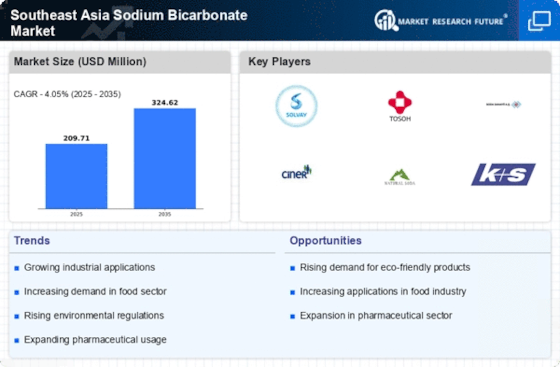
Southeast Asia Sodium Bicarbonate Market Infographic
Purchase Options

Market Share

Southeast Asia Sodium Bicarbonate Market Share Analysis

Companies are making strategic moves to position their market shares within the overall Southeast Asia Sodium Bicarbonate Market by using various strategies. The competition among companies in the region's sodium bicarbonate market, driven by a variety of sectors such as food and beverages, pharmaceuticals, chemicals, etc., makes them adopt effective approaches. A popular strategy is differentiation, where firms focus on creating unique value propositions for their sodium bicarbonate products. They can develop special formulations targeting particular industries like pharmaceuticals that may require high purity grades or even custom blends for food processing. Through product differentiation, companies intend to specialize within a market segment that has specific demands from its customers in terms of sodium bicarbonate properties. Moreover, another approach through which a firm may gain market share is cost leadership. In this case, competitive pricing of the company's products is achieved through optimization of production processes and enhancement of operational efficiency as well as economies of scale. Market segmentation also remains a widely embraced strategy since organizations design their sodium bicarbonate to suit various geographical, demographic, or industrial segments. This enables firms to understand and address unique demands among different customer groups. For example, companies can target and capture specific market segments by designing product formulations in line with the tastes of the food industry or developing specialized grades for pharmaceuticals. Another notable aspect of Southeast Asia's Sodium Bicarbonate market strategies for attaining market share is collaboration and partnerships. They focus on synergies from collaboration with distributors, suppliers, and research institutions. Additionally, positioning for market share has sustainability aspects that are becoming increasingly important. Companies have become eco-friendly conscious in order to incorporate eco-friendly practices into their production process, source sustainable raw materials, and adopt responsible waste management systems due to an increase in environmental awareness. Further, companies seek new markets within Southeast Asia or beyond the region so as to broaden their customer base and reduce dependence on particular markets; hence, geographical diversification as a means of expanding one's business operations is employed across the region. The strategy involves conducting extensive market research activities, being aware of cultural peculiarities, and tailoring one's product offering to meet diverse consumer segment preferences.

Author
Priya Nagrale
Senior Research Analyst

With an experience of over five years in market research industry (Chemicals & Materials domain), I gather and analyze market data from diverse sources to produce results, which are then presented back to a client. Also, provide recommendations based on the findings. As a Senior Research Analyst, I perform quality checks (QC) for market estimations, QC for reports, and handle queries and work extensively on client customizations. Also, handle the responsibilities of client proposals, report planning, report finalization, and execution

Leave a Comment

FAQs

What is the current valuation of the APAC Sodium Bicarbonate Market?

As of 2024, the APAC Sodium Bicarbonate Market was valued at approximately 1408.44 USD Million.

What is the projected market valuation for the APAC Sodium Bicarbonate Market by 2035?

The market is projected to reach a valuation of around 2074.83 USD Million by 2035.

What is the expected CAGR for the APAC Sodium Bicarbonate Market during the forecast period?

The expected CAGR for the APAC Sodium Bicarbonate Market from 2025 to 2035 is 3.58%.

Which companies are considered key players in the APAC Sodium Bicarbonate Market?

Key players in the market include Soda Ash Company, Tata Chemicals, Shandong Haihua Group, and Solvay S.A.

What are the primary applications of sodium bicarbonate in the APAC market?

The primary applications include Food and Beverage, Pharmaceuticals, Personal Care, Agriculture, and Industrial sectors.

Market Summary

As per analysis, the APAC Sodium Bicarbonate Market is projected to grow from USD 1,464.07 Million in 2025 to USD 2,074.83 Million by 2035, exhibiting a compound annual growth rate (CAGR) of 3.58% during the forecast period (2025 - 2035).

Key Market Trends & Highlights

The APAC Sodium Bicarbonate Market is experiencing robust growth driven by diverse applications and increasing health awareness.

  • China remains the largest market for sodium bicarbonate, primarily due to its extensive food and beverage industry.
  • India is emerging as the fastest-growing region, fueled by rising health consciousness and demand for pharmaceutical innovations.
  • The food and beverage segment continues to dominate the market, while the pharmaceutical segment is witnessing the fastest growth.
  • Key market drivers include growing industrial applications and regulatory support for sustainable practices, which are shaping the market landscape.

Market Size & Forecast

2024 Market Size 1408.44 (USD Million)
2035 Market Size 2074.83 (USD Million)
CAGR (2025 - 2035) 3.58%

Major Players

<p>Soda Ash Company (AU), Tata Chemicals (IN), Shandong Haihua Group (CN), Solvay S.A. (BE), K+S Aktiengesellschaft (DE), Kuwait Chemical Industries Company (KW), Korea Soda Company (KR), Ciner Resources Corporation (US)</p>

Market Trends

The APAC Sodium Bicarbonate Market is currently experiencing a notable transformation, driven by various factors that influence demand and supply dynamics. The increasing awareness regarding health and environmental sustainability appears to be propelling the adoption of sodium bicarbonate in diverse applications, including food processing, pharmaceuticals, and personal care products. Furthermore, the region's growing population and urbanization trends suggest a rising need for effective solutions in water treatment and industrial processes, where sodium bicarbonate serves as a versatile agent. As industries evolve, the market seems poised for expansion, with innovations in production methods and applications likely to enhance its appeal. In addition, regulatory frameworks in several APAC countries are becoming more stringent, which may lead to a shift towards higher-quality sodium bicarbonate products. This trend indicates a potential for increased investment in research and development, as manufacturers strive to meet these new standards. The interplay between consumer preferences and regulatory requirements could shape the future landscape of the APAC Sodium Bicarbonate Market, making it essential for stakeholders to remain agile and responsive to these changes.

Rising Demand in Food Industry

The food sector in the APAC region is increasingly utilizing sodium bicarbonate as a leavening agent and pH regulator. This trend is likely driven by a growing consumer preference for baked goods and processed foods that are perceived as healthier and more natural. As food safety regulations tighten, manufacturers may seek to incorporate sodium bicarbonate to enhance product quality and shelf life.

Environmental Applications

Sodium bicarbonate is gaining traction in environmental applications, particularly in water treatment processes across APAC. Its effectiveness in neutralizing acidity and removing contaminants suggests a growing recognition of its role in sustainable practices. This trend may be further supported by government initiatives aimed at improving water quality and promoting eco-friendly solutions.

Pharmaceutical Innovations

The pharmaceutical sector in the APAC Sodium Bicarbonate Market is witnessing innovations that leverage the compound's properties for various therapeutic applications. As research progresses, sodium bicarbonate may find new uses in drug formulations and treatments, reflecting a broader trend towards integrating versatile compounds in healthcare solutions.

Southeast Asia Sodium Bicarbonate Market Market Drivers

Expanding Agricultural Use

The APAC Sodium Bicarbonate Market is also benefiting from its expanding use in agriculture. Sodium bicarbonate is recognized for its role in soil amendment and pest control, contributing to improved crop yields. As agricultural practices evolve towards sustainability, the adoption of sodium bicarbonate as a natural alternative to chemical fertilizers and pesticides is likely to increase. With the agricultural sector in APAC projected to grow steadily, the demand for sodium bicarbonate in this context may present significant opportunities for market players.

Rising Health Consciousness

The APAC Sodium Bicarbonate Market is witnessing a shift in consumer behavior towards health and wellness. As individuals become more health-conscious, the demand for sodium bicarbonate in food and beverage applications is likely to increase. Sodium bicarbonate is often used as a leavening agent and a food preservative, appealing to consumers seeking natural ingredients. Market data suggests that the food sector in APAC is projected to grow at a CAGR of 6% over the next five years, indicating a robust opportunity for sodium bicarbonate suppliers to cater to this evolving consumer preference.

Growing Industrial Applications

The APAC Sodium Bicarbonate Market is experiencing a notable surge in demand due to its diverse industrial applications. Industries such as glass manufacturing, chemical production, and textiles utilize sodium bicarbonate for various processes, including pH regulation and as a buffering agent. The increasing industrialization in countries like China and India is likely to drive the consumption of sodium bicarbonate, with projections indicating a growth rate of approximately 5% annually. This trend suggests that as industries expand, the need for sodium bicarbonate will continue to rise, thereby bolstering the market in the APAC region.

Advancements in Pharmaceutical Applications

The APAC Sodium Bicarbonate Market is poised for growth due to advancements in pharmaceutical applications. Sodium bicarbonate is utilized in various medical formulations, including antacids and electrolyte solutions. The increasing prevalence of gastrointestinal disorders in the APAC region is likely to drive the demand for sodium bicarbonate-based products. Furthermore, research and development efforts aimed at enhancing the efficacy of sodium bicarbonate in drug formulations may lead to new applications, thereby expanding its market presence in the pharmaceutical sector.

Regulatory Support for Sustainable Practices

The APAC Sodium Bicarbonate Market benefits from a growing emphasis on sustainable practices, supported by government regulations. Many APAC countries are implementing policies that encourage the use of environmentally friendly materials, including sodium bicarbonate, which is recognized for its low environmental impact. For instance, initiatives aimed at reducing carbon emissions and promoting green chemistry are likely to enhance the market's growth. The regulatory landscape appears to favor sodium bicarbonate as a viable alternative in various applications, potentially leading to increased adoption across multiple sectors.

Market Segment Insights

By Application: Food and Beverage (Largest) vs. Pharmaceuticals (Fastest-Growing)

<p>In the APAC Sodium Bicarbonate Market, the application segmentation shows that the Food and Beverage sector holds the largest market share. This dominance is largely attributed to the increasing demand for sodium bicarbonate as a leavening agent and pH regulator in various food products. The Pharmaceuticals segment, however, is rapidly gaining ground, featuring significant growth as it is employed in drug formulations and to treat various medical conditions, highlighting a dynamic shift within the market.</p>

<p>Food and Beverage (Dominant) vs. Pharmaceuticals (Emerging)</p>

<p>The Food and Beverage segment of the APAC Sodium Bicarbonate Market remains a dominant force due to its extensive application in baking, beverages, and food preservation. This sector's reliability stems from sodium bicarbonate's effectiveness as a leavening agent and its ability to maintain food quality. On the other hand, the Pharmaceuticals segment is emerging as a crucial player, driven by the rising demand for sodium bicarbonate in therapeutic applications. The increased focus on healthcare, research & development activities, and growing awareness of sodium bicarbonate’s benefits are propelling this segment forward, establishing it as an important alternative for drug formulations and therapeutic interventions.</p>

By End Use: Food Processing (Largest) vs. Water Treatment (Fastest-Growing)

<p>In the APAC Sodium Bicarbonate market, the end use segment is dominated by food processing, which holds the largest share due to the increasing demand for sodium bicarbonate as a food additive, leavening agent, and pH regulator. Water treatment follows closely, benefiting from the rising need for effective water purification methods across urban and industrial sectors. Other significant applications include chemical manufacturing, glass production, and pulp and paper, which collectively contribute to the diverse utilization of sodium bicarbonate in the region.</p>

<p>Food Processing (Dominant) vs. Water Treatment (Emerging)</p>

<p>The food processing sector remains the dominant force in the APAC Sodium Bicarbonate market, driven by the rising consumer preference for processed foods and baked goods that incorporate sodium bicarbonate for its leavening properties. Additionally, the sector benefits from stringent food safety standards that favor the use of food-grade sodium bicarbonate. Conversely, water treatment is emerging as a critical application, especially in response to increasing environmental regulations and the urgent need for sustainable water management solutions. This segment is characterized by rapid technological advancements in filtration methods and a growing awareness among consumers and industries about the importance of safe and clean water supply.</p>

By Form: Powder (Largest) vs. Granular (Fastest-Growing)

<p>In the APAC Sodium Bicarbonate Market, the form segment is primarily dominated by powdered sodium bicarbonate, which has established itself as the largest sub-segment due to its extensive applications in various industries, including food and beverage, pharmaceuticals, and agriculture. The granular form, while currently smaller in market share, is rapidly gaining attention, driven by its ease of use and adaptability in various formulations and processes. Liquid sodium bicarbonate remains a niche product and is mainly utilized in specific applications where a solution form is required. The segment is witnessing robust growth, especially in the granular category, attributed to increasing demand in industries such as personal care and cleaning products. Additionally, the rising trend of eco-friendly and sustainable products is pushing manufacturers to innovate and invest in granulated forms that are simpler to formulate and use. This trend is expected to foster further growth in the form segment, particularly for granulated sodium bicarbonate, as it aligns with market needs for versatility and ease of handling.</p>

<p>Powder (Dominant) vs. Granular (Emerging)</p>

<p>Powdered sodium bicarbonate has long been the dominant form in the APAC market, owing to its high solubility and versatility in various applications ranging from food preservation to pH regulation in swimming pools. Its particle size allows for easy incorporation into various formulations, making it a preferred choice for manufacturers. In contrast, granular sodium bicarbonate is emerging as a significant player due to its benefits, including faster dissolution rates in specific processes and its attractiveness for bulk usage in industrial applications. The trends towards more efficient production methods and the rise of end-use sectors like personal care and cleaning products have led to a growing preference for granular forms. This shift indicates a potential growth trajectory for granulated sodium bicarbonate as it adapts to meet changing consumer demands.</p>

By Distribution Channel: Direct Sales (Largest) vs. Online Sales (Fastest-Growing)

<p>In the APAC Sodium Bicarbonate Market, the distribution channel segment exhibits varied dynamics, with Direct Sales currently holding the largest market share. This segment benefits from established relationships between manufacturers and end-users, allowing for bulk transaction efficiencies. Meanwhile, Online Sales is emerging as a significant player, capturing a growing portion of the market as consumers increasingly turn to digital platforms for their purchasing needs. The growth prospects of the distribution channel segment are propelled by several factors, including the rising trend of e-commerce which has seen Online Sales grow at an unprecedented rate. Moreover, the convenience and accessibility of online shopping are drawing both consumers and businesses towards this channel, thereby transforming the way sodium bicarbonate products are marketed and sold in the region.</p>

<p>Direct Sales: Dominant vs. Online Sales: Emerging</p>

<p>Direct Sales is a well-established distribution channel in the APAC Sodium Bicarbonate Market, characterized by long-term relationships between producers and consumers, often leading to cost-effectiveness and tailored solutions. This channel benefits from direct communication, facilitating better customer service and feedback, which is paramount in retaining clients. On the other hand, Online Sales is rapidly gaining traction due to the escalating internet penetration and changing consumer behaviors favoring digital platforms. This emerging segment is appealing to a younger demographic that appreciates the ease of online transactions, creating a competitive edge against traditional sales approaches. Despite being in the growth stage, Online Sales is expected to redefine the purchasing landscape of sodium bicarbonate products in the APAC region.</p>

Get more detailed insights about Southeast Asia Sodium Bicarbonate Market Research Report—Forecast till 2035

Regional Insights

China : Unmatched Production and Demand Growth

China holds a commanding market share of 55% in the APAC sodium bicarbonate market, valued at $550.0 million. Key growth drivers include the booming chemical industry, increasing demand in food processing, and stringent environmental regulations promoting cleaner production methods. Government initiatives aimed at enhancing industrial efficiency and sustainability further bolster market growth. Infrastructure development, particularly in transportation and logistics, supports the efficient distribution of sodium bicarbonate across the country.

India : Emerging Market with High Potential

India accounts for 30% of the APAC sodium bicarbonate market, valued at $300.0 million. The growth is driven by rising consumption in the food and beverage sector, coupled with increasing awareness of health benefits. Government policies promoting local manufacturing and investments in infrastructure are enhancing market accessibility. The demand for sodium bicarbonate in pharmaceuticals and personal care products is also on the rise, reflecting changing consumer preferences.

Japan : Technological Advancements in Production

Japan holds a 20% share of the APAC sodium bicarbonate market, valued at $200.0 million. The market is driven by technological advancements in production processes and a strong focus on quality. Regulatory frameworks encourage innovation and sustainability, leading to increased efficiency in manufacturing. The demand for sodium bicarbonate in the food industry, particularly in baking and preservation, remains robust, supported by consumer trends towards healthier options.

South Korea : Key Player in Chemical Manufacturing

South Korea represents 15% of the APAC sodium bicarbonate market, valued at $150.0 million. The growth is fueled by the country's strong chemical manufacturing base and increasing applications in various industries, including textiles and pharmaceuticals. Government initiatives aimed at enhancing industrial competitiveness and sustainability are pivotal. The market is characterized by a competitive landscape with major players investing in R&D to innovate and improve product offerings.

Malaysia : Growth Driven by Local Demand

Malaysia captures 7% of the APAC sodium bicarbonate market, valued at $70.0 million. The growth is driven by increasing demand in the food and beverage sector, as well as applications in agriculture and water treatment. Government policies supporting local production and sustainability initiatives are enhancing market conditions. The market is characterized by a mix of local and international players, with a focus on meeting diverse consumer needs.

Thailand : Focus on Eco-Friendly Solutions

Thailand holds a 6% share of the APAC sodium bicarbonate market, valued at $60.0 million. The market is driven by a growing emphasis on sustainable practices in various industries, including food processing and agriculture. Government regulations promoting environmental sustainability are encouraging the use of sodium bicarbonate as a safer alternative. The competitive landscape features both local and international companies, with a focus on innovation and eco-friendly solutions.

Indonesia : Potential for Market Expansion

Indonesia accounts for 5% of the APAC sodium bicarbonate market, valued at $50.0 million. The growth is driven by increasing applications in food processing, pharmaceuticals, and agriculture. Government initiatives aimed at boosting local production and reducing imports are enhancing market dynamics. The competitive landscape is evolving, with local players gaining traction alongside established international companies, reflecting a growing demand for sodium bicarbonate across various sectors.

Rest of APAC : Diverse Applications Across Regions

The Rest of APAC holds a 2.84% share of the sodium bicarbonate market, valued at $28.44 million. This sub-region includes smaller markets with unique applications in food, pharmaceuticals, and agriculture. Growth is driven by localized demand and specific regulatory frameworks that vary by country. The competitive landscape is characterized by smaller players focusing on niche markets, with opportunities for growth in sustainable and eco-friendly products.

Key Players and Competitive Insights

The Sodium Bicarbonate Market is currently characterized by a competitive landscape that is both dynamic and multifaceted. Key growth drivers include increasing demand from various end-use industries such as food and beverage, pharmaceuticals, and personal care. Major players like Tata Chemicals (India) and Solvay S.A. (Belgium) are strategically positioned to leverage their extensive product portfolios and innovative capabilities. Tata Chemicals (India) focuses on sustainability and has been investing in eco-friendly production methods, while Solvay S.A. (Belgium) emphasizes digital transformation and operational efficiency. These strategies collectively enhance their competitive edge and shape the market dynamics.

In terms of business tactics, companies are increasingly localizing manufacturing to reduce logistics costs and optimize supply chains. The market structure appears moderately fragmented, with several key players exerting influence over pricing and availability. This fragmentation allows for niche players to thrive, while larger companies consolidate their market share through strategic partnerships and acquisitions.

In November 2025, Tata Chemicals (India) announced a significant investment in expanding its sodium bicarbonate production capacity in Gujarat. This move is expected to enhance their market presence and meet the growing demand in the region. The strategic importance of this expansion lies in its potential to solidify Tata's position as a leading supplier in the APAC market, particularly in the food and beverage sector, where sodium bicarbonate is increasingly utilized as a leavening agent.

In December 2025, Solvay S.A. (Belgium) launched a new line of sustainable sodium bicarbonate products aimed at the pharmaceutical industry. This initiative reflects Solvay's commitment to sustainability and innovation, catering to the rising demand for environmentally friendly solutions. The introduction of these products is likely to attract new customers and strengthen Solvay's reputation as a leader in sustainable chemical solutions.

In January 2026, Shandong Haihua Group (China) entered into a strategic partnership with a local logistics firm to enhance its distribution capabilities across the APAC region. This collaboration is expected to streamline supply chain operations and improve delivery times, thereby increasing customer satisfaction. The strategic importance of this partnership lies in its potential to bolster Haihua's competitive position in a market where timely delivery is crucial for maintaining customer loyalty.

As of January 2026, current competitive trends indicate a strong emphasis on digitalization, sustainability, and the integration of AI technologies within operations. Strategic alliances are increasingly shaping the landscape, allowing companies to pool resources and expertise. The competitive differentiation is likely to evolve from traditional price-based competition to a focus on innovation, technological advancements, and supply chain reliability. This shift suggests that companies that prioritize these aspects will be better positioned to thrive in the evolving market.

Key Companies in the Southeast Asia Sodium Bicarbonate Market include

Industry Developments

Future Outlook

Southeast Asia Sodium Bicarbonate Market Future Outlook

The APAC Sodium Bicarbonate Market is projected to grow at a 3.58% CAGR from 2025 to 2035, driven by increasing demand in food processing, pharmaceuticals, and environmental applications.

New opportunities lie in:

  • Expansion of sodium bicarbonate production facilities in emerging markets.
  • Development of eco-friendly packaging solutions utilizing sodium bicarbonate.
  • Investment in research for innovative applications in agriculture and water treatment.

By 2035, the market is expected to solidify its position as a key player in various industries.

Market Segmentation

Southeast Asia Sodium Bicarbonate Market Form Outlook

  • Powder
  • Granular
  • Liquid

Southeast Asia Sodium Bicarbonate Market End Use Outlook

  • Food Processing
  • Water Treatment
  • Chemical Manufacturing
  • Glass Production
  • Pulp and Paper

Southeast Asia Sodium Bicarbonate Market Application Outlook

  • Food and Beverage
  • Pharmaceuticals
  • Personal Care
  • Agriculture
  • Industrial

Southeast Asia Sodium Bicarbonate Market Distribution Channel Outlook

  • Direct Sales
  • Online Sales
  • Retail Sales

Report Scope

MARKET SIZE 20241408.44(USD Million)
MARKET SIZE 20251464.07(USD Million)
MARKET SIZE 20352074.83(USD Million)
COMPOUND ANNUAL GROWTH RATE (CAGR)3.58% (2024 - 2035)
REPORT COVERAGERevenue Forecast, Competitive Landscape, Growth Factors, and Trends
BASE YEAR2024
Market Forecast Period2025 - 2035
Historical Data2019 - 2024
Market Forecast UnitsUSD Million
Key Companies ProfiledSoda Ash Company (AU), Tata Chemicals (IN), Shandong Haihua Group (CN), Solvay S.A. (BE), K+S Aktiengesellschaft (DE), Kuwait Chemical Industries Company (KW), Korea Soda Company (KR), Ciner Resources Corporation (US)
Segments CoveredApplication, End Use, Form, Distribution Channel
Key Market OpportunitiesGrowing demand for eco-friendly products drives innovation in the APAC Sodium Bicarbonate Market.
Key Market DynamicsRising demand for sodium bicarbonate in food processing and pharmaceuticals drives market growth across the APAC region.
Countries CoveredChina, India, Japan, South Korea, Malaysia, Thailand, Indonesia, Rest of APAC

FAQs

What is the current valuation of the APAC Sodium Bicarbonate Market?

As of 2024, the APAC Sodium Bicarbonate Market was valued at approximately 1408.44 USD Million.

What is the projected market valuation for the APAC Sodium Bicarbonate Market by 2035?

The market is projected to reach a valuation of around 2074.83 USD Million by 2035.

What is the expected CAGR for the APAC Sodium Bicarbonate Market during the forecast period?

The expected CAGR for the APAC Sodium Bicarbonate Market from 2025 to 2035 is 3.58%.

Which companies are considered key players in the APAC Sodium Bicarbonate Market?

Key players in the market include Soda Ash Company, Tata Chemicals, Shandong Haihua Group, and Solvay S.A.

What are the primary applications of sodium bicarbonate in the APAC market?

The primary applications include Food and Beverage, Pharmaceuticals, Personal Care, Agriculture, and Industrial sectors.

  1. SECTION I: EXECUTIVE SUMMARY AND KEY HIGHLIGHTS
    1. EXECUTIVE SUMMARY
      1. Market Overview
      2. Key Findings
      3. Market Segmentation
      4. Competitive Landscape
      5. Challenges and Opportunities
      6. Future Outlook
  2. SECTION II: SCOPING, METHODOLOGY AND MARKET STRUCTURE
    1. MARKET INTRODUCTION
      1. Definition
      2. Scope of the study
    2. RESEARCH METHODOLOGY
      1. Overview
      2. Data Mining
      3. Secondary Research
      4. Primary Research
      5. Forecasting Model
      6. Market Size Estimation
      7. Data Triangulation
      8. Validation
  3. SECTION III: QUALITATIVE ANALYSIS
    1. MARKET DYNAMICS
      1. Overview
      2. Drivers
      3. Restraints
      4. Opportunities
    2. MARKET FACTOR ANALYSIS
      1. Value chain Analysis
      2. Porter's Five Forces Analysis
      3. COVID-19 Impact Analysis
  4. SECTION IV: QUANTITATIVE ANALYSIS
    1. Chemicals and Materials, BY Type (USD Million)
      1. Technical Grade
      2. Medical Grade
      3. Food Grade
    2. Chemicals and Materials, BY Application (USD Million)
      1. Food Industry
      2. Feed Industry
      3. Flue Gas Treatment
      4. Pharmaceutical Industry
      5. Chemicals Industry
      6. Others
    3. Chemicals and Materials, BY Region (USD Million)
      1. North America
      2. Europe
      3. APAC
      4. South America
      5. MEA
  5. SECTION V: COMPETITIVE ANALYSIS
    1. Competitive Landscape
      1. Overview
      2. Competitive Analysis
      3. Market share Analysis
      4. Major Growth Strategy in the Chemicals and Materials
      5. Competitive Benchmarking
      6. Leading Players in Terms of Number of Developments in the Chemicals and Materials
      7. Key developments and growth strategies
      8. Major Players Financial Matrix
    2. Company Profiles
      1. Solvay (SG)
      2. Tosoh Corporation (JP)
      3. Soda Sanayii A.S. (TR)
      4. Ciner Resources (US)
      5. Natural Soda (US)
      6. K+S Aktiengesellschaft (DE)
      7. Kuwait Petroleum Corporation (KW)
      8. Kuwait Chemical Industries Company (KW)
    3. Appendix
      1. References
      2. Related Reports
  6. LIST OF FIGURES
    1. MARKET SYNOPSIS
    2. NORTH AMERICA MARKET ANALYSIS
    3. US MARKET ANALYSIS BY TYPE
    4. US MARKET ANALYSIS BY APPLICATION
    5. CANADA MARKET ANALYSIS BY TYPE
    6. CANADA MARKET ANALYSIS BY APPLICATION
    7. EUROPE MARKET ANALYSIS
    8. GERMANY MARKET ANALYSIS BY TYPE
    9. GERMANY MARKET ANALYSIS BY APPLICATION
    10. UK MARKET ANALYSIS BY TYPE
    11. UK MARKET ANALYSIS BY APPLICATION
    12. FRANCE MARKET ANALYSIS BY TYPE
    13. FRANCE MARKET ANALYSIS BY APPLICATION
    14. RUSSIA MARKET ANALYSIS BY TYPE
    15. RUSSIA MARKET ANALYSIS BY APPLICATION
    16. ITALY MARKET ANALYSIS BY TYPE
    17. ITALY MARKET ANALYSIS BY APPLICATION
    18. SPAIN MARKET ANALYSIS BY TYPE
    19. SPAIN MARKET ANALYSIS BY APPLICATION
    20. REST OF EUROPE MARKET ANALYSIS BY TYPE
    21. REST OF EUROPE MARKET ANALYSIS BY APPLICATION
    22. APAC MARKET ANALYSIS
    23. CHINA MARKET ANALYSIS BY TYPE
    24. CHINA MARKET ANALYSIS BY APPLICATION
    25. INDIA MARKET ANALYSIS BY TYPE
    26. INDIA MARKET ANALYSIS BY APPLICATION
    27. JAPAN MARKET ANALYSIS BY TYPE
    28. JAPAN MARKET ANALYSIS BY APPLICATION
    29. SOUTH KOREA MARKET ANALYSIS BY TYPE
    30. SOUTH KOREA MARKET ANALYSIS BY APPLICATION
    31. MALAYSIA MARKET ANALYSIS BY TYPE
    32. MALAYSIA MARKET ANALYSIS BY APPLICATION
    33. THAILAND MARKET ANALYSIS BY TYPE
    34. THAILAND MARKET ANALYSIS BY APPLICATION
    35. INDONESIA MARKET ANALYSIS BY TYPE
    36. INDONESIA MARKET ANALYSIS BY APPLICATION
    37. REST OF APAC MARKET ANALYSIS BY TYPE
    38. REST OF APAC MARKET ANALYSIS BY APPLICATION
    39. SOUTH AMERICA MARKET ANALYSIS
    40. BRAZIL MARKET ANALYSIS BY TYPE
    41. BRAZIL MARKET ANALYSIS BY APPLICATION
    42. MEXICO MARKET ANALYSIS BY TYPE
    43. MEXICO MARKET ANALYSIS BY APPLICATION
    44. ARGENTINA MARKET ANALYSIS BY TYPE
    45. ARGENTINA MARKET ANALYSIS BY APPLICATION
    46. REST OF SOUTH AMERICA MARKET ANALYSIS BY TYPE
    47. REST OF SOUTH AMERICA MARKET ANALYSIS BY APPLICATION
    48. MEA MARKET ANALYSIS
    49. GCC COUNTRIES MARKET ANALYSIS BY TYPE
    50. GCC COUNTRIES MARKET ANALYSIS BY APPLICATION
    51. SOUTH AFRICA MARKET ANALYSIS BY TYPE
    52. SOUTH AFRICA MARKET ANALYSIS BY APPLICATION
    53. REST OF MEA MARKET ANALYSIS BY TYPE
    54. REST OF MEA MARKET ANALYSIS BY APPLICATION
    55. KEY BUYING CRITERIA OF CHEMICALS AND MATERIALS
    56. RESEARCH PROCESS OF MRFR
    57. DRO ANALYSIS OF CHEMICALS AND MATERIALS
    58. DRIVERS IMPACT ANALYSIS: CHEMICALS AND MATERIALS
    59. RESTRAINTS IMPACT ANALYSIS: CHEMICALS AND MATERIALS
    60. SUPPLY / VALUE CHAIN: CHEMICALS AND MATERIALS
    61. CHEMICALS AND MATERIALS, BY TYPE, 2024 (% SHARE)
    62. CHEMICALS AND MATERIALS, BY TYPE, 2024 TO 2035 (USD Million)
    63. CHEMICALS AND MATERIALS, BY APPLICATION, 2024 (% SHARE)
    64. CHEMICALS AND MATERIALS, BY APPLICATION, 2024 TO 2035 (USD Million)
    65. BENCHMARKING OF MAJOR COMPETITORS
  7. LIST OF TABLES
    1. LIST OF ASSUMPTIONS
    2. North America MARKET SIZE ESTIMATES; FORECAST
      1. BY TYPE, 2025-2035 (USD Million)
      2. BY APPLICATION, 2025-2035 (USD Million)
    3. US MARKET SIZE ESTIMATES; FORECAST
      1. BY TYPE, 2025-2035 (USD Million)
      2. BY APPLICATION, 2025-2035 (USD Million)
    4. Canada MARKET SIZE ESTIMATES; FORECAST
      1. BY TYPE, 2025-2035 (USD Million)
      2. BY APPLICATION, 2025-2035 (USD Million)
    5. Europe MARKET SIZE ESTIMATES; FORECAST
      1. BY TYPE, 2025-2035 (USD Million)
      2. BY APPLICATION, 2025-2035 (USD Million)
    6. Germany MARKET SIZE ESTIMATES; FORECAST
      1. BY TYPE, 2025-2035 (USD Million)
      2. BY APPLICATION, 2025-2035 (USD Million)
    7. UK MARKET SIZE ESTIMATES; FORECAST
      1. BY TYPE, 2025-2035 (USD Million)
      2. BY APPLICATION, 2025-2035 (USD Million)
    8. France MARKET SIZE ESTIMATES; FORECAST
      1. BY TYPE, 2025-2035 (USD Million)
      2. BY APPLICATION, 2025-2035 (USD Million)
    9. Russia MARKET SIZE ESTIMATES; FORECAST
      1. BY TYPE, 2025-2035 (USD Million)
      2. BY APPLICATION, 2025-2035 (USD Million)
    10. Italy MARKET SIZE ESTIMATES; FORECAST
      1. BY TYPE, 2025-2035 (USD Million)
      2. BY APPLICATION, 2025-2035 (USD Million)
    11. Spain MARKET SIZE ESTIMATES; FORECAST
      1. BY TYPE, 2025-2035 (USD Million)
      2. BY APPLICATION, 2025-2035 (USD Million)
    12. Rest of Europe MARKET SIZE ESTIMATES; FORECAST
      1. BY TYPE, 2025-2035 (USD Million)
      2. BY APPLICATION, 2025-2035 (USD Million)
    13. APAC MARKET SIZE ESTIMATES; FORECAST
      1. BY TYPE, 2025-2035 (USD Million)
      2. BY APPLICATION, 2025-2035 (USD Million)
    14. China MARKET SIZE ESTIMATES; FORECAST
      1. BY TYPE, 2025-2035 (USD Million)
      2. BY APPLICATION, 2025-2035 (USD Million)
    15. India MARKET SIZE ESTIMATES; FORECAST
      1. BY TYPE, 2025-2035 (USD Million)
      2. BY APPLICATION, 2025-2035 (USD Million)
    16. Japan MARKET SIZE ESTIMATES; FORECAST
      1. BY TYPE, 2025-2035 (USD Million)
      2. BY APPLICATION, 2025-2035 (USD Million)
    17. South Korea MARKET SIZE ESTIMATES; FORECAST
      1. BY TYPE, 2025-2035 (USD Million)
      2. BY APPLICATION, 2025-2035 (USD Million)
    18. Malaysia MARKET SIZE ESTIMATES; FORECAST
      1. BY TYPE, 2025-2035 (USD Million)
      2. BY APPLICATION, 2025-2035 (USD Million)
    19. Thailand MARKET SIZE ESTIMATES; FORECAST
      1. BY TYPE, 2025-2035 (USD Million)
      2. BY APPLICATION, 2025-2035 (USD Million)
    20. Indonesia MARKET SIZE ESTIMATES; FORECAST
      1. BY TYPE, 2025-2035 (USD Million)
      2. BY APPLICATION, 2025-2035 (USD Million)
    21. Rest of APAC MARKET SIZE ESTIMATES; FORECAST
      1. BY TYPE, 2025-2035 (USD Million)
      2. BY APPLICATION, 2025-2035 (USD Million)
    22. South America MARKET SIZE ESTIMATES; FORECAST
      1. BY TYPE, 2025-2035 (USD Million)
      2. BY APPLICATION, 2025-2035 (USD Million)
    23. Brazil MARKET SIZE ESTIMATES; FORECAST
      1. BY TYPE, 2025-2035 (USD Million)
      2. BY APPLICATION, 2025-2035 (USD Million)
    24. Mexico MARKET SIZE ESTIMATES; FORECAST
      1. BY TYPE, 2025-2035 (USD Million)
      2. BY APPLICATION, 2025-2035 (USD Million)
    25. Argentina MARKET SIZE ESTIMATES; FORECAST
      1. BY TYPE, 2025-2035 (USD Million)
      2. BY APPLICATION, 2025-2035 (USD Million)
    26. Rest of South America MARKET SIZE ESTIMATES; FORECAST
      1. BY TYPE, 2025-2035 (USD Million)
      2. BY APPLICATION, 2025-2035 (USD Million)
    27. MEA MARKET SIZE ESTIMATES; FORECAST
      1. BY TYPE, 2025-2035 (USD Million)
      2. BY APPLICATION, 2025-2035 (USD Million)
    28. GCC Countries MARKET SIZE ESTIMATES; FORECAST
      1. BY TYPE, 2025-2035 (USD Million)
      2. BY APPLICATION, 2025-2035 (USD Million)
    29. South Africa MARKET SIZE ESTIMATES; FORECAST
      1. BY TYPE, 2025-2035 (USD Million)
      2. BY APPLICATION, 2025-2035 (USD Million)
    30. Rest of MEA MARKET SIZE ESTIMATES; FORECAST
      1. BY TYPE, 2025-2035 (USD Million)
      2. BY APPLICATION, 2025-2035 (USD Million)
    31. PRODUCT LAUNCH/PRODUCT DEVELOPMENT/APPROVAL
    32. ACQUISITION/PARTNERSHIP

Southeast Asia Sodium Bicarbonate Market Segmentation

Market Segmentation Overview

  • Detailed segmentation data will be available in the full report
  • Comprehensive analysis by multiple parameters
  • Regional and country-level breakdowns
  • Market size forecasts by segment
Infographic

Free Sample Request

Kindly complete the form below to receive a free sample of this Report

Get Free Sample

Customer Strories

Compare Licence

×
Features License Type
Single User Multiuser License Enterprise User
Price $4,950 $5,950 $7,250
Maximum User Access Limit 1 User Upto 10 Users Unrestricted Access Throughout the Organization
Free Customization
Direct Access to Analyst
Deliverable Format
Platform Access
Discount on Next Purchase 10% 15% 15%
Printable Versions