Request Free Sample ×

Kindly complete the form below to receive a free sample of this Report

* Please use a valid business email

Leading companies partner with us for data-driven Insights

clients tt-cursor
Hero Background
English
Chinese
French
Japanese
Korean
German
Spanish

Soft Tissue Repair Market Size

ID: MRFR/HC/6340-HCR
90 Pages
Vikita Thakur
April 2026

Soft Tissue Repair Market Research Report: Size, Share, Trend Analysis By Applications (Orthopedics, Cardiovascular, Neurology, General Surgery), By Material (Sutures, Mesh, Adhesives, Grafts), By Procedure Type (Open Surgery, Minimally Invasive Surgery, Robotic Surgery), By End Use (Hospitals, Ambulatory Surgical Centers, Specialty Clinics) and By Regional (North America, Europe, South America, Asia Pacific, Middle East and Africa) - Growth Outlook & Industry Forecast 2025 To 2035

Share:
Download PDF ×

We do not share your information with anyone. However, we may send you emails based on your report interest from time to time. You may contact us at any time to opt-out.

Soft Tissue Repair Market Infographic
Purchase Options

Soft Tissue Repair Size

Soft Tissue Repair Market Growth Projections and Opportunities

The Soft Tissue Repair Market is expected to reach USD 13.43 Billion by 2030 at 4.2% CAGR from 2022-2030. The Soft Tissue Repair Market is shaped by several factors that contribute to its growth. Rising soft tissue wounds and outer muscle issues are key factors. Interest in effective soft tissue healing methods has increased due to an aging population and a rise in sports-related injuries. This pattern is also filled by clinical imaging advances, leading to further research and awareness of the benefits of simple and accurate soft tissue repair.

Administrative variables ensure product safety and viability in the soft tissue repair sector. Soft tissue repair devices and biomaterials are regulated by strict rules. Patient security and a system for mindful industry work are ensured by these principles, building confidence among medical professionals and end-clients.

Financial factors including medical care cost and repayment affect soft tissue repair arrangements. These agreements appeal to medical care providers and payers due to their cost-effectiveness and capacity to reduce the cost of delayed recovery and postoperative care. Financial factors shape market trends and affect soft tissue repair technology availability.

The soft tissue repair industry is serious, with several companies selling meticulous structures, unions, and biologics. Extreme competition drives companies to increase biocompatibility, durability, and usefulness. The diversity of contributions allows medical professionals to choose soft tissue restoration plans according to patient needs, creating a dynamic market.

Segment considerations including population aging and lifestyle-related wounds influence market dynamics. The maturing section is more vulnerable to soft tissue damage and degeneration, necessitating effective repair. The expanding popularity of sports and proactive duties has increased sports-related wounds, prompting interest in cutting-edge soft tissue restoration advances.

Social attitudes regarding medical services and therapeutic mediations also shape the soft tissue repair business. Social perceptions of health, well-being, and cautious intervention affect patient preferences and soft tissue healing capability. The therapy decision cycle is shaped by social factors in medical care provider and patient interactions.
Soft Tissue Repair Market Size Graph
Author
Author Profile
Vikita Thakur
Senior Research Analyst

She holds an experience of about 5+ years in market research and business consulting projects for sectors such as life sciences, medical devices, and healthcare IT. She possesses a robust background in data analysis, market estimation, competitive intelligence, pipeline analysis market trend identification, and consumer behavior insights. Her expertise lies in technical Sales support, client interaction and project management, designing and implementing market research studies, conducting competitive analysis, and synthesizing complex data into actionable recommendations that drive business growth.

Leave a Comment

FAQs

What is the projected market valuation of the Soft Tissue Repair Market by 2035?

<p>The Soft Tissue Repair Market is projected to reach a valuation of 14.43 USD Billion by 2035.</p>

What was the market valuation of the Soft Tissue Repair Market in 2024?

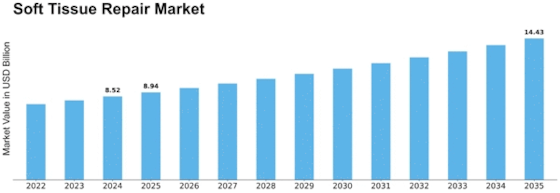
<p>In 2024, the Soft Tissue Repair Market was valued at 8.519 USD Billion.</p>

What is the expected CAGR for the Soft Tissue Repair Market during the forecast period 2025 - 2035?

<p>The expected CAGR for the Soft Tissue Repair Market during the forecast period 2025 - 2035 is 4.91%.</p>

Which application segment is projected to have the highest valuation by 2035?

<p>The Orthopedics application segment is projected to reach 4.2 USD Billion by 2035.</p>

What are the projected valuations for the material segment of the Soft Tissue Repair Market by 2035?

<p>By 2035, the projected valuations for the material segment include 4.2 USD Billion for Grafts and 3.5 USD Billion for Mesh.</p>

Which procedure type is expected to dominate the Soft Tissue Repair Market by 2035?

<p>Open Surgery is expected to dominate the Soft Tissue Repair Market with a projected valuation of 5.5 USD Billion by 2035.</p>

What is the anticipated growth in the Ambulatory Surgical Centers segment by 2035?

<p>The Ambulatory Surgical Centers segment is anticipated to grow to 4.0 USD Billion by 2035.</p>

Who are the key players in the Soft Tissue Repair Market?

Key players in the Soft Tissue Repair Market include Medtronic, Johnson &amp; Johnson, Stryker, and Smith &amp; Nephew.

What is the projected valuation for the Neurology application segment by 2035?

<p>The Neurology application segment is projected to reach a valuation of 2.5 USD Billion by 2035.</p>

How does the Soft Tissue Repair Market's growth compare across different end-use segments?

<p>By 2035, Hospitals are expected to lead with a valuation of 5.8 USD Billion, followed by Specialty Clinics at 4.6 USD Billion.</p>

Market Summary

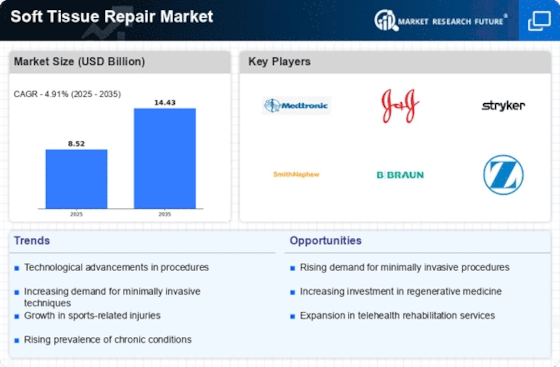
As per Market Research Future analysis, the Soft Tissue Repair Market Size was estimated at 8.519 USD Billion in 2024. The Soft Tissue Repair industry is projected to grow from 8.937 USD Billion in 2025 to 14.43 USD Billion by 2035, exhibiting a compound annual growth rate (CAGR) of 4.9% during the forecast period 2025 - 2035

Key Market Trends & Highlights

The Soft Tissue Repair Market is experiencing dynamic growth driven by technological advancements and increasing demand for innovative solutions.

  • Minimally invasive techniques are gaining traction, enhancing patient recovery and reducing hospital stays. The integration of regenerative medicine is transforming treatment approaches, particularly in orthopedics and sports medicine. North America remains the largest market, while the Asia-Pacific region is emerging as the fastest-growing area for soft tissue repair solutions. Technological advancements in surgical procedures and rising incidence of soft tissue injuries are key drivers propelling market expansion.

Market Size & Forecast

2024 Market Size 8.519 (USD Billion)
2035 Market Size 14.43 (USD Billion)
CAGR (2025 - 2035) 4.91%
Largest Regional Market Share in 2024 North America

Major Players

<a href="https://www.medtronic.com/en-us/healthcare-professionals/products/hernia-repair.html#aq=%40pagetype%3D%22product-model%22&amp;cq=%40products_category%3D%22Hernia%20repair%22%20OR%20%40ontology_isa%3D%22Hernia%20repair%22">Medtronic</a> (US), Johnson &amp; Johnson (US), Stryker (US), Smith &amp; Nephew (GB), B. Braun Melsungen AG (DE), Zimmer Biomet (US), Boston Scientific (US), Conmed Corporation (US), MediTech (US)

Market Trends

The Soft Tissue Repair Market is currently experiencing a dynamic evolution, driven by advancements in surgical techniques and an increasing prevalence of soft tissue injuries. The market appears to be influenced by a growing awareness of the benefits associated with minimally invasive procedures, which tend to result in quicker recovery times and reduced patient discomfort. Furthermore, the rise in sports-related injuries and an aging population may contribute to a heightened demand for effective soft tissue repair solutions. As healthcare providers continue to prioritize patient outcomes, innovative products and technologies are likely to emerge, enhancing the overall landscape of this market.

Ongoing research and development efforts are also shaping the soft tissue repair market trends, particularly through the integration of advanced biomaterials and regenerative medicine. These innovations aim to improve healing efficiency and long-term outcomes. Collaborations between medical device manufacturers and healthcare institutions are fostering the development of customized solutions, enhancing the overall soft tissue repair market share. As a result, the soft tissue repair market is poised for sustained growth with strong potential for innovation.

Minimally Invasive Techniques

The trend towards minimally invasive surgical methods is gaining traction within the Soft Tissue Repair Market. These techniques are associated with reduced recovery times and lower complication rates, appealing to both patients and healthcare providers. As technology advances, the adoption of these methods is likely to increase, potentially transforming traditional surgical practices.

Regenerative Medicine Integration

The incorporation of regenerative medicine into soft tissue repair strategies is emerging as a noteworthy trend. This approach focuses on utilizing biological materials and techniques to enhance healing and tissue regeneration. As research progresses, the Soft Tissue Repair Market may witness a shift towards more biologically-based solutions, offering improved outcomes for patients.

Increased Focus on Sports Medicine

There is a growing emphasis on sports medicine within the Soft Tissue Repair Market, driven by the rising incidence of sports-related injuries. This trend suggests a need for specialized repair solutions tailored to athletes and active individuals. As awareness of sports injuries increases, the demand for effective treatment options is likely to expand, influencing market dynamics.

Soft Tissue Repair Market Market Drivers

Rising Incidence of Soft Tissue Injuries

The prevalence of soft tissue injuries is on the rise, significantly impacting the Soft Tissue Repair Market. Factors such as an aging population and increased participation in sports and physical activities contribute to this trend. Data suggests that approximately 50 million individuals experience soft tissue injuries annually, creating a substantial demand for repair solutions. As awareness of treatment options grows, healthcare providers are increasingly focusing on effective management strategies for these injuries. This surge in incidence not only highlights the need for innovative repair products but also emphasizes the importance of rehabilitation services, further driving the expansion of the Soft Tissue Repair Market.

Increased Investment in Research and Development

Investment in research and development is a critical driver for the Soft Tissue Repair Market. Companies are allocating substantial resources to innovate and develop new products that address the evolving needs of healthcare providers and patients. This focus on R&D has led to the introduction of advanced materials and techniques that enhance the effectiveness of soft tissue repair. For example, the development of bioengineered scaffolds is revolutionizing the way soft tissue injuries are treated. As the market becomes more competitive, the emphasis on R&D is expected to intensify, fostering innovation and ultimately contributing to the growth of the Soft Tissue Repair Market.

Technological Advancements in Surgical Procedures

The Soft Tissue Repair Market is experiencing a notable transformation due to rapid technological advancements in surgical procedures. Innovations such as robotic-assisted surgeries and advanced imaging techniques are enhancing precision and reducing recovery times. For instance, the integration of 3D imaging allows surgeons to visualize soft tissue structures in real-time, leading to improved surgical outcomes. According to recent data, the adoption of minimally invasive techniques has increased by approximately 30% over the past few years, indicating a shift towards more efficient surgical practices. This trend not only enhances patient satisfaction but also drives the demand for advanced soft tissue repair products, thereby propelling the growth of the Soft Tissue Repair Market.

Growing Demand for Biologics in Soft Tissue Repair

The Soft Tissue Repair Market is witnessing a growing demand for biologics, which are increasingly recognized for their potential to enhance healing processes. Biologics, including stem cells and growth factors, are being integrated into repair procedures to promote tissue regeneration and improve patient outcomes. Recent studies indicate that the use of biologics in soft tissue repair can reduce recovery times by up to 40%, making them an attractive option for both patients and healthcare providers. As the understanding of regenerative medicine advances, the incorporation of biologics is likely to become a standard practice, thereby driving the growth of the Soft Tissue Repair Market.

Rising Awareness and Education on Soft Tissue Repair

There is a growing awareness and education surrounding soft tissue repair, which is positively influencing the Soft Tissue Repair Market. Healthcare professionals are increasingly educated about the latest treatment options and techniques, leading to better patient outcomes. Public awareness campaigns are also playing a crucial role in informing individuals about the importance of timely treatment for soft tissue injuries. This heightened awareness is likely to result in increased patient consultations and a greater demand for soft tissue repair products. As more individuals seek effective solutions for their injuries, the Soft Tissue Repair Market is expected to experience significant growth.

Market Segment Insights

By Application: Orthopedics (Largest) vs. Cardiovascular (Fastest-Growing)

In the Soft Tissue Repair Market, the application segment is primarily dominated by Orthopedics, which holds the largest market share due to the increasing incidence of orthopedic injuries and surgeries. This application is highly influenced by advancements in surgical techniques and materials used for soft tissue repair. In contrast, the Cardiovascular application is rapidly gaining traction and expected to witness substantial growth fueled by rising prevalence of cardiovascular diseases and an aging population, leading to increased surgical interventions.

Orthopedics (Dominant) vs. Cardiovascular (Emerging)

The Orthopedics segment stands as the dominant player in the Soft Tissue Repair Market, characterized by its well-established products and technologies that cater to a variety of orthopedic applications such as ligament and tendon repairs. Factors driving this dominance include a high volume of sports-related injuries and advancements in minimally invasive surgeries. On the other hand, the Cardiovascular segment is emerging with strong potential, propelled by innovations in biocompatible materials and an increase in demand for cardiac surgeries. As awareness about cardiovascular health grows, so do the opportunities for soft tissue repair solutions, positioning Cardiovascular as a key area for future growth.

By Material: Sutures (Largest) vs. Grafts (Fastest-Growing)

In the Soft Tissue Repair Market, the material segment showcases diverse components such as sutures, mesh, adhesives, and grafts, each contributing uniquely to the overall landscape. Among these, sutures hold the largest market share, reflecting their critical role in various surgical procedures. In contrast, grafts are rapidly gaining traction, supported by advancements in tissue engineering and an increasing preference for minimally invasive techniques, thereby positioning them as the fastest-growing segment in the market.

Sutures (Dominant) vs. Grafts (Emerging)

Sutures are the dominant material in the Soft Tissue Repair Market, widely recognized for their reliability and versatility in wound closure across numerous surgical specialties. Their robust performance can be attributed to continuous innovation in materials and techniques, enhancing patient outcomes. On the other hand, grafts are an emerging force, driven by technological advancements that facilitate better integration with host tissues. The rising incidence of sports injuries and the demand for reconstructive surgeries propel the adoption of grafts. This dual dynamic showcases the evolving landscape of soft tissue repair, where traditional methods coexist with cutting-edge solutions.

By Procedure Type: Minimally Invasive Surgery (Largest) vs. Robotic Surgery (Fastest-Growing)

The Soft Tissue Repair Market has seen significant distribution among its procedure types, with Open Surgery holding a considerable share but being overshadowed by Minimally Invasive Surgery, which has emerged as the largest segment due to its efficiency and reduced patient recovery times. Robotic Surgery is also gaining traction, appealing to surgeons for its precision and enhancing patient outcomes, indicating a dynamic market distribution that favors innovative approaches to surgical procedures. In recent years, the shift towards Minimally Invasive Surgery has been propelled by technological advancements and increased patient awareness focusing on faster recovery and minimal scarring. Robotic Surgery has captured attention as the fastest-growing segment, driven by improvements in robotic system capabilities, surgeon training, and expanded applications in complex surgical repairs. This trend indicates a progressive transformation in surgical practices within the Soft Tissue Repair Market, emphasizing less invasive solutions.

Minimally Invasive Surgery (Dominant) vs. Robotic Surgery (Emerging)

Minimally Invasive Surgery has established itself as the dominant approach in the Soft Tissue Repair Market, characterized by smaller incisions, reduced pain, and quicker recovery times for patients. This technique attracts an increasing number of healthcare providers aiming to improve patient outcomes and operational efficiencies. In contrast, Robotic Surgery, while emerging, showcases significant advancements in surgical precision and control, leading to its rapid adoption in various procedures. The integration of robotics into soft tissue repairs is supported by ongoing developments in technology and surgeon familiarity, making it increasingly viable and attractive for more complex surgical interventions. As both segments evolve, they represent the future of surgical practice, aligning with patient-centric treatment paradigms.

By End Use: Hospitals (Largest) vs. Ambulatory Surgical Centers (Fastest-Growing)

Within the Soft Tissue Repair Market, the distribution of end use segments highlights the dominance of hospitals, which account for a significant portion of the market share. These facilities are preferred due to their comprehensive surgical capabilities and advanced technologies, making them the go-to choice for complex soft tissue repair procedures. Following closely are ambulatory surgical centers, which have gained momentum in recent years as they offer more convenient and cost-effective options for both patients and healthcare providers. Ambulatory surgical centers provide a viable alternative for minor soft tissue repairs, enabling quicker patient turnover and aligning with the rising demand for outpatient procedures. Specialty clinics also play a role, but their market share remains comparatively smaller as they typically focus on specific types of surgeries.

Hospitals (Dominant) vs. Ambulatory Surgical Centers (Emerging)

The hospitals segment stands out as the dominant player in the Soft Tissue Repair Market due to their robust infrastructure, skilled workforce, and expansive range of surgical services. They are equipped to handle complex surgeries and post-operative care, which adds to their appeal. On the other hand, ambulatory surgical centers represent a rapidly emerging segment that caters to the growing trend of outpatient surgeries. These centers focus on efficiency, providing shorter wait times and lower costs, which make them attractive to a broad patient demographic. Both segments play crucial roles, with hospitals leading in comprehensive services while ambulatory surgical centers are changing the landscape with their increased accessibility and focus on outpatient care.

Get more detailed insights about Soft Tissue Repair Market Research Report - Global Forecast till 2035

Regional Insights

The Soft Tissue Repair Market is poised for steady growth, with regional dynamics showcasing varying potentials. North America stands out as a dominant region, with a market valuation of 3.5 USD Billion in 2023 and an increase to 5.5 USD Billion by 2032, highlighting its majority holding and significance driven by advanced healthcare infrastructure and high prevalence of soft tissue injuries. Europe follows closely, valued at 2.4 USD Billion in 2023 and projected to reach 3.7 USD Billion in 2032, representing a significant share due to rising healthcare expenditures and ongoing research initiatives.

The Asia-Pacific (APAC) region, worth 1.8 USD Billion in 2023 and expected to grow to 2.8 USD Billion by 2032, benefits from improvements in healthcare access and a growing patient population, marking it as an important market influenced by economic development. South America shows a smaller but noteworthy value of 0.8 USD Billion in 2023, growing to 1.2 USD Billion by 2032, as increasing government initiatives in healthcare drive market growth. 

The Middle East and Africa (MEA) represent the least dominant segment, valued at 0.6 USD Billion in 2023, with a forecast of 0.9 USD Billion in 2032, largely due to challenges in healthcare infrastructure, but offers opportunities for expanding medical services.

Overall, the Soft Tissue Repair Market showcases diverse growth opportunities driven by regional developments.

Key Players and Competitive Insights

The Soft Tissue Repair Market has experienced significant advancements driven by increasing incidences of soft tissue injuries and surgical procedures requiring repair solutions. The growing focus on minimally invasive techniques and the advancement of biomaterials have ushered in an era of innovation within this market. Numerous players are competing to offer a variety of products ranging from sutures and staples to synthetic and biologic grafts, each aiming to address specific needs contrasting with traditional methods.  A rising emphasis on research and development, along with robust collaborations and acquisitions among key manufacturers, has intensified competition, making this market dynamic. Players are capitalizing on emerging trends, such as the rising geriatric population and growing awareness regarding orthopedic and sports-related injuries, which collectively enhance market potential.Integra LifeSciences possesses a strong foothold in the Soft Tissue Repair Market primarily due to its extensive portfolio of innovative medical devices aimed at soft tissue and cranial repair. The company's strengths lie in its commitment to research and development, enabling it to introduce cutting-edge technologies that enhance patient outcomes. Integra LifeSciences is well-regarded for its robust distribution channels and strategic partnerships that facilitate global reach and penetration. Furthermore, its focus on high-quality bioengineering innovation fosters trust among healthcare providers and patients alike, solidifying its reputation as a key player in effective soft tissue repair solutions.  The company also benefits from its established presence in diverse markets, ensuring a reliable demand for its products, which positions it advantageously against competitors.Parker Hannifin has carved a niche in the Soft Tissue Repair Market with its advanced medical technologies that cater to various surgical needs, particularly in the realm of soft tissue management. The company's strengths are augmented through its comprehensive understanding of engineering and material sciences, which enables Parker Hannifin to develop highly efficient and effective solutions for soft tissue repair. Its dedication to innovation is mirrored through ongoing investments in research, resulting in the introduction of state-of-the-art products designed to improve surgical outcomes.  Parker Hannifin's established brand recognition and reliable product quality contribute to its competitive edge as healthcare practitioners continually seek out its offerings for surgical interventions. The company's emphasis on high performance and customer satisfaction further amplifies its position in the competitive landscape of the Soft Tissue Repair Market, allowing it to maintain a strong presence within the industry.

Key Companies in the Soft Tissue Repair Market include

Industry Developments

Recent developments in the Soft Tissue Repair Market have seen significant advancements, particularly by major players such as Integra LifeSciences, Medtronic, and Zimmer Biomet. The demand for innovative repair solutions has grown, driven by increasing surgical procedures and a rising geriatric population. Companies like Acelity and Boston Scientific are focusing on advancing their product portfolios through research and development efforts. In terms of mergers and acquisitions, Baxter International's acquisition of a specialized biotech firm reflects a strategic move to enhance its soft tissue repair offerings, while Terumo Corporation has bolstered its position by acquiring a key player in regenerative medicine.

Smith Nephew and Stryker have also engaged in strategic collaborations aimed at expanding their product lines and market reach. Market valuation is on an upward trajectory, fueled by technological advancements and an increase in healthcare expenditure, enabling companies to invest more in innovation and market expansion. The competitive landscape is becoming more dynamic as organizations adapt to regulatory changes and demand for personalized treatment options.

Future Outlook

Soft Tissue Repair Market Future Outlook

The Soft Tissue Repair Market is projected to grow at a 4.91% CAGR from 2025 to 2035, driven by technological advancements, increasing surgical procedures, and rising healthcare expenditures.

New opportunities lie in:

  • <p>Development of biodegradable sutures for enhanced patient recovery. Expansion of telehealth platforms for post-operative care management. Investment in AI-driven surgical tools for precision in soft tissue repairs.</p>

By 2035, the Soft Tissue Repair Market is expected to achieve substantial growth and innovation.

Market Segmentation

Soft Tissue Repair Market End Use Outlook

  • Hospitals
  • Ambulatory Surgical Centers
  • Specialty Clinics

Soft Tissue Repair Market Material Outlook

  • Sutures
  • Mesh
  • Adhesives
  • Grafts

Soft Tissue Repair Market Application Outlook

  • Orthopedics
  • Cardiovascular
  • Neurology
  • General Surgery

Soft Tissue Repair Market Procedure Type Outlook

  • Open Surgery
  • Minimally Invasive Surgery
  • Robotic Surgery

Report Scope

MARKET SIZE 2024 8.519(USD Billion)
MARKET SIZE 2025 8.937(USD Billion)
MARKET SIZE 2035 14.43(USD Billion)
COMPOUND ANNUAL GROWTH RATE (CAGR) 4.91% (2025 - 2035)
REPORT COVERAGE Revenue Forecast, Competitive Landscape, Growth Factors, and Trends
BASE YEAR 2024
Market Forecast Period 2025 - 2035
Historical Data 2019 - 2024
Market Forecast Units USD Billion
Key Companies Profiled Medtronic (US), Johnson & Johnson (US), Stryker (US), Smith & Nephew (GB), B. Braun Melsungen AG (DE), Zimmer Biomet (US), Boston Scientific (US), Conmed Corporation (US), MediTech (US)
Segments Covered Applications, Material, Procedure Type, End Use, Regional
Key Market Opportunities Advancements in biomaterials and minimally invasive techniques enhance growth potential in the Soft Tissue Repair Market.
Key Market Dynamics Technological advancements and regulatory changes drive innovation and competition in the Soft Tissue Repair Market.
Countries Covered North America, Europe, APAC, South America, MEA

FAQs

What is the projected market valuation of the Soft Tissue Repair Market by 2035?

<p>The Soft Tissue Repair Market is projected to reach a valuation of 14.43 USD Billion by 2035.</p>

What was the market valuation of the Soft Tissue Repair Market in 2024?

<p>In 2024, the Soft Tissue Repair Market was valued at 8.519 USD Billion.</p>

What is the expected CAGR for the Soft Tissue Repair Market during the forecast period 2025 - 2035?

<p>The expected CAGR for the Soft Tissue Repair Market during the forecast period 2025 - 2035 is 4.91%.</p>

Which application segment is projected to have the highest valuation by 2035?

<p>The Orthopedics application segment is projected to reach 4.2 USD Billion by 2035.</p>

What are the projected valuations for the material segment of the Soft Tissue Repair Market by 2035?

<p>By 2035, the projected valuations for the material segment include 4.2 USD Billion for Grafts and 3.5 USD Billion for Mesh.</p>

Which procedure type is expected to dominate the Soft Tissue Repair Market by 2035?

<p>Open Surgery is expected to dominate the Soft Tissue Repair Market with a projected valuation of 5.5 USD Billion by 2035.</p>

What is the anticipated growth in the Ambulatory Surgical Centers segment by 2035?

<p>The Ambulatory Surgical Centers segment is anticipated to grow to 4.0 USD Billion by 2035.</p>

Who are the key players in the Soft Tissue Repair Market?

Key players in the Soft Tissue Repair Market include Medtronic, Johnson &amp; Johnson, Stryker, and Smith &amp; Nephew.

What is the projected valuation for the Neurology application segment by 2035?

<p>The Neurology application segment is projected to reach a valuation of 2.5 USD Billion by 2035.</p>

How does the Soft Tissue Repair Market's growth compare across different end-use segments?

<p>By 2035, Hospitals are expected to lead with a valuation of 5.8 USD Billion, followed by Specialty Clinics at 4.6 USD Billion.</p>

  1. SECTION I: EXECUTIVE SUMMARY AND KEY HIGHLIGHTS |
    1. EXECUTIVE SUMMARY | |
      1. Market Overview | |
      2. Key Findings | |
      3. Market Segmentation | |
      4. Competitive Landscape | |
      5. Challenges and Opportunities | |
      6. Future Outlook 2
  2. SECTION II: SCOPING, METHODOLOGY AND MARKET STRUCTURE |
    1. MARKET INTRODUCTION | |
      1. Definition | |
      2. Scope of the study | | |
    2. RESEARCH METHODOLOGY | |
      1. Overview | |
      2. Data Mining | |
      3. Secondary Research | |
      4. Primary Research | | |
      5. Forecasting Model | |
      6. Market Size Estimation | | |
      7. Data Triangulation | |
      8. Validation 3
  3. SECTION III: QUALITATIVE ANALYSIS |
    1. MARKET DYNAMICS | |
      1. Overview | |
      2. Drivers | |
      3. Restraints | |
      4. Opportunities |
    2. MARKET FACTOR ANALYSIS | |
      1. Value chain Analysis | |
      2. Porter's Five Forces Analysis | | |
      3. COVID-19 Impact Analysis | | |
  4. SECTION IV: QUANTITATIVE ANALYSIS |
    1. Healthcare, BY Application (USD Billion) | |
      1. Orthopedics | |
      2. Cardiovascular | |
      3. Neurology | |
      4. General Surgery |
    2. Healthcare, BY Material (USD Billion) | |
      1. Sutures | |
      2. Mesh | |
      3. Adhesives | |
      4. Grafts |
    3. Healthcare, BY Procedure Type (USD Billion) | |
      1. Open Surgery | |
      2. Minimally Invasive Surgery | |
      3. Robotic Surgery |
    4. Healthcare, BY End Use (USD Billion) | |
      1. Hospitals | |
      2. Ambulatory Surgical Centers | |
      3. Specialty Clinics |
    5. Healthcare, BY Region (USD Billion) | |
      1. North America | | |
      2. Europe | | |
      3. APAC | | |
      4. South America | | |
      5. MEA | | |
  5. SECTION V: COMPETITIVE ANALYSIS |
    1. Competitive Landscape | |
      1. Overview | |
      2. Competitive Analysis | |
      3. Market share Analysis | |
      4. Major Growth Strategy in the Healthcare | |
      5. Competitive Benchmarking | |
      6. Leading Players in Terms of Number of Developments in the Healthcare | |
      7. Key developments and growth strategies | | |
      8. Major Players Financial Matrix | | |
    2. Company Profiles | |
      1. Medtronic (US) | | |
      2. Johnson & Johnson (US) | | |
      3. Stryker (US) | | |
      4. Smith & Nephew (GB) | | |
      5. B. Braun Melsungen AG (DE) | | |
      6. Zimmer Biomet (US) | | |
      7. Boston Scientific (US) | | |
      8. Conmed Corporation (US) | | |
      9. MediTech (US) | | |
    3. Appendix | |
      1. References | |
      2. Related Reports 6 LIST OF FIGURES |
    4. MARKET SYNOPSIS |
    5. NORTH AMERICA MARKET ANALYSIS |
    6. US MARKET ANALYSIS BY APPLICATION |
    7. US MARKET ANALYSIS BY MATERIAL |
    8. US MARKET ANALYSIS BY PROCEDURE TYPE |
    9. US MARKET ANALYSIS BY END USE |
    10. CANADA MARKET ANALYSIS BY APPLICATION |
    11. CANADA MARKET ANALYSIS BY MATERIAL |
    12. CANADA MARKET ANALYSIS BY PROCEDURE TYPE |
    13. CANADA MARKET ANALYSIS BY END USE |
    14. EUROPE MARKET ANALYSIS |
    15. GERMANY MARKET ANALYSIS BY APPLICATION |
    16. GERMANY MARKET ANALYSIS BY MATERIAL |
    17. GERMANY MARKET ANALYSIS BY PROCEDURE TYPE |
    18. GERMANY MARKET ANALYSIS BY END USE |
    19. UK MARKET ANALYSIS BY APPLICATION |
    20. UK MARKET ANALYSIS BY MATERIAL |
    21. UK MARKET ANALYSIS BY PROCEDURE TYPE |
    22. UK MARKET ANALYSIS BY END USE |
    23. FRANCE MARKET ANALYSIS BY APPLICATION |
    24. FRANCE MARKET ANALYSIS BY MATERIAL |
    25. FRANCE MARKET ANALYSIS BY PROCEDURE TYPE |
    26. FRANCE MARKET ANALYSIS BY END USE |
    27. RUSSIA MARKET ANALYSIS BY APPLICATION |
    28. RUSSIA MARKET ANALYSIS BY MATERIAL |
    29. RUSSIA MARKET ANALYSIS BY PROCEDURE TYPE |
    30. RUSSIA MARKET ANALYSIS BY END USE |
    31. ITALY MARKET ANALYSIS BY APPLICATION |
    32. ITALY MARKET ANALYSIS BY MATERIAL |
    33. ITALY MARKET ANALYSIS BY PROCEDURE TYPE |
    34. ITALY MARKET ANALYSIS BY END USE |
    35. SPAIN MARKET ANALYSIS BY APPLICATION |
    36. SPAIN MARKET ANALYSIS BY MATERIAL |
    37. SPAIN MARKET ANALYSIS BY PROCEDURE TYPE |
    38. SPAIN MARKET ANALYSIS BY END USE |
    39. REST OF EUROPE MARKET ANALYSIS BY APPLICATION |
    40. REST OF EUROPE MARKET ANALYSIS BY MATERIAL |
    41. REST OF EUROPE MARKET ANALYSIS BY PROCEDURE TYPE |
    42. REST OF EUROPE MARKET ANALYSIS BY END USE |
    43. APAC MARKET ANALYSIS |
    44. CHINA MARKET ANALYSIS BY APPLICATION |
    45. CHINA MARKET ANALYSIS BY MATERIAL |
    46. CHINA MARKET ANALYSIS BY PROCEDURE TYPE |
    47. CHINA MARKET ANALYSIS BY END USE |
    48. INDIA MARKET ANALYSIS BY APPLICATION |
    49. INDIA MARKET ANALYSIS BY MATERIAL |
    50. INDIA MARKET ANALYSIS BY PROCEDURE TYPE |
    51. INDIA MARKET ANALYSIS BY END USE |
    52. JAPAN MARKET ANALYSIS BY APPLICATION |
    53. JAPAN MARKET ANALYSIS BY MATERIAL |
    54. JAPAN MARKET ANALYSIS BY PROCEDURE TYPE |
    55. JAPAN MARKET ANALYSIS BY END USE |
    56. SOUTH KOREA MARKET ANALYSIS BY APPLICATION |
    57. SOUTH KOREA MARKET ANALYSIS BY MATERIAL |
    58. SOUTH KOREA MARKET ANALYSIS BY PROCEDURE TYPE |
    59. SOUTH KOREA MARKET ANALYSIS BY END USE |
    60. MALAYSIA MARKET ANALYSIS BY APPLICATION |
    61. MALAYSIA MARKET ANALYSIS BY MATERIAL |
    62. MALAYSIA MARKET ANALYSIS BY PROCEDURE TYPE |
    63. MALAYSIA MARKET ANALYSIS BY END USE |
    64. THAILAND MARKET ANALYSIS BY APPLICATION |
    65. THAILAND MARKET ANALYSIS BY MATERIAL |
    66. THAILAND MARKET ANALYSIS BY PROCEDURE TYPE |
    67. THAILAND MARKET ANALYSIS BY END USE |
    68. INDONESIA MARKET ANALYSIS BY APPLICATION |
    69. INDONESIA MARKET ANALYSIS BY MATERIAL |
    70. INDONESIA MARKET ANALYSIS BY PROCEDURE TYPE |
    71. INDONESIA MARKET ANALYSIS BY END USE |
    72. REST OF APAC MARKET ANALYSIS BY APPLICATION |
    73. REST OF APAC MARKET ANALYSIS BY MATERIAL |
    74. REST OF APAC MARKET ANALYSIS BY PROCEDURE TYPE |
    75. REST OF APAC MARKET ANALYSIS BY END USE |
    76. SOUTH AMERICA MARKET ANALYSIS |
    77. BRAZIL MARKET ANALYSIS BY APPLICATION |
    78. BRAZIL MARKET ANALYSIS BY MATERIAL |
    79. BRAZIL MARKET ANALYSIS BY PROCEDURE TYPE |
    80. BRAZIL MARKET ANALYSIS BY END USE |
    81. MEXICO MARKET ANALYSIS BY APPLICATION |
    82. MEXICO MARKET ANALYSIS BY MATERIAL |
    83. MEXICO MARKET ANALYSIS BY PROCEDURE TYPE |
    84. MEXICO MARKET ANALYSIS BY END USE |
    85. ARGENTINA MARKET ANALYSIS BY APPLICATION |
    86. ARGENTINA MARKET ANALYSIS BY MATERIAL |
    87. ARGENTINA MARKET ANALYSIS BY PROCEDURE TYPE |
    88. ARGENTINA MARKET ANALYSIS BY END USE |
    89. REST OF SOUTH AMERICA MARKET ANALYSIS BY APPLICATION |
    90. REST OF SOUTH AMERICA MARKET ANALYSIS BY MATERIAL |
    91. REST OF SOUTH AMERICA MARKET ANALYSIS BY PROCEDURE TYPE |
    92. REST OF SOUTH AMERICA MARKET ANALYSIS BY END USE |
    93. MEA MARKET ANALYSIS |
    94. GCC COUNTRIES MARKET ANALYSIS BY APPLICATION |
    95. GCC COUNTRIES MARKET ANALYSIS BY MATERIAL |
    96. GCC COUNTRIES MARKET ANALYSIS BY PROCEDURE TYPE |
    97. GCC COUNTRIES MARKET ANALYSIS BY END USE |
    98. SOUTH AFRICA MARKET ANALYSIS BY APPLICATION |
    99. SOUTH AFRICA MARKET ANALYSIS BY MATERIAL |
    100. SOUTH AFRICA MARKET ANALYSIS BY PROCEDURE TYPE |
    101. SOUTH AFRICA MARKET ANALYSIS BY END USE |
    102. REST OF MEA MARKET ANALYSIS BY APPLICATION |
    103. REST OF MEA MARKET ANALYSIS BY MATERIAL |
    104. REST OF MEA MARKET ANALYSIS BY PROCEDURE TYPE |
    105. REST OF MEA MARKET ANALYSIS BY END USE |
    106. KEY BUYING CRITERIA OF HEALTHCARE |
    107. RESEARCH PROCESS OF MRFR |
    108. DRO ANALYSIS OF HEALTHCARE |
    109. DRIVERS IMPACT ANALYSIS: HEALTHCARE |
    110. RESTRAINTS IMPACT ANALYSIS: HEALTHCARE |
    111. SUPPLY / VALUE CHAIN: HEALTHCARE |
    112. HEALTHCARE, BY APPLICATION, 2024 (% SHARE) |
    113. HEALTHCARE, BY APPLICATION, 2024 TO 2035 (USD Billion) |
    114. HEALTHCARE, BY MATERIAL, 2024 (% SHARE) |
    115. HEALTHCARE, BY MATERIAL, 2024 TO 2035 (USD Billion) |
    116. HEALTHCARE, BY PROCEDURE TYPE, 2024 (% SHARE) |
    117. HEALTHCARE, BY PROCEDURE TYPE, 2024 TO 2035 (USD Billion) |
    118. HEALTHCARE, BY END USE, 2024 (% SHARE) |
    119. HEALTHCARE, BY END USE, 2024 TO 2035 (USD Billion) |
    120. BENCHMARKING OF MAJOR COMPETITORS 7 LIST OF TABLES |
    121. LIST OF ASSUMPTIONS | |
      1. |
    122. North America MARKET SIZE ESTIMATES; FORECAST | |
      1. BY APPLICATION, 2025-2035 (USD Billion) | |
      2. BY MATERIAL, 2025-2035 (USD Billion) | |
      3. BY PROCEDURE TYPE, 2025-2035 (USD Billion) | |
      4. BY END USE, 2025-2035 (USD Billion) |
    123. US MARKET SIZE ESTIMATES; FORECAST | |
      1. BY APPLICATION, 2025-2035 (USD Billion) | |
      2. BY MATERIAL, 2025-2035 (USD Billion) | |
      3. BY PROCEDURE TYPE, 2025-2035 (USD Billion) | |
      4. BY END USE, 2025-2035 (USD Billion) |
    124. Canada MARKET SIZE ESTIMATES; FORECAST | |
      1. BY APPLICATION, 2025-2035 (USD Billion) | |
      2. BY MATERIAL, 2025-2035 (USD Billion) | |
      3. BY PROCEDURE TYPE, 2025-2035 (USD Billion) | |
      4. BY END USE, 2025-2035 (USD Billion) |
    125. Europe MARKET SIZE ESTIMATES; FORECAST | |
      1. BY APPLICATION, 2025-2035 (USD Billion) | |
      2. BY MATERIAL, 2025-2035 (USD Billion) | |
      3. BY PROCEDURE TYPE, 2025-2035 (USD Billion) | |
      4. BY END USE, 2025-2035 (USD Billion) |
    126. Germany MARKET SIZE ESTIMATES; FORECAST | |
      1. BY APPLICATION, 2025-2035 (USD Billion) | |
      2. BY MATERIAL, 2025-2035 (USD Billion) | |
      3. BY PROCEDURE TYPE, 2025-2035 (USD Billion) | |
      4. BY END USE, 2025-2035 (USD Billion) |
    127. UK MARKET SIZE ESTIMATES; FORECAST | |
      1. BY APPLICATION, 2025-2035 (USD Billion) | |
      2. BY MATERIAL, 2025-2035 (USD Billion) | |
      3. BY PROCEDURE TYPE, 2025-2035 (USD Billion) | |
      4. BY END USE, 2025-2035 (USD Billion) |
    128. France MARKET SIZE ESTIMATES; FORECAST | |
      1. BY APPLICATION, 2025-2035 (USD Billion) | |
      2. BY MATERIAL, 2025-2035 (USD Billion) | |
      3. BY PROCEDURE TYPE, 2025-2035 (USD Billion) | |
      4. BY END USE, 2025-2035 (USD Billion) |
    129. Russia MARKET SIZE ESTIMATES; FORECAST | |
      1. BY APPLICATION, 2025-2035 (USD Billion) | |
      2. BY MATERIAL, 2025-2035 (USD Billion) | |
      3. BY PROCEDURE TYPE, 2025-2035 (USD Billion) | |
      4. BY END USE, 2025-2035 (USD Billion) |
    130. Italy MARKET SIZE ESTIMATES; FORECAST | |
      1. BY APPLICATION, 2025-2035 (USD Billion) | |
      2. BY MATERIAL, 2025-2035 (USD Billion) | |
      3. BY PROCEDURE TYPE, 2025-2035 (USD Billion) | |
      4. BY END USE, 2025-2035 (USD Billion) |
    131. Spain MARKET SIZE ESTIMATES; FORECAST | |
      1. BY APPLICATION, 2025-2035 (USD Billion) | |
      2. BY MATERIAL, 2025-2035 (USD Billion) | |
      3. BY PROCEDURE TYPE, 2025-2035 (USD Billion) | |
      4. BY END USE, 2025-2035 (USD Billion) |
    132. Rest of Europe MARKET SIZE ESTIMATES; FORECAST | |
      1. BY APPLICATION, 2025-2035 (USD Billion) | |
      2. BY MATERIAL, 2025-2035 (USD Billion) | |
      3. BY PROCEDURE TYPE, 2025-2035 (USD Billion) | |
      4. BY END USE, 2025-2035 (USD Billion) |
    133. APAC MARKET SIZE ESTIMATES; FORECAST | |
      1. BY APPLICATION, 2025-2035 (USD Billion) | |
      2. BY MATERIAL, 2025-2035 (USD Billion) | |
      3. BY PROCEDURE TYPE, 2025-2035 (USD Billion) | |
      4. BY END USE, 2025-2035 (USD Billion) |
    134. China MARKET SIZE ESTIMATES; FORECAST | |
      1. BY APPLICATION, 2025-2035 (USD Billion) | |
      2. BY MATERIAL, 2025-2035 (USD Billion) | |
      3. BY PROCEDURE TYPE, 2025-2035 (USD Billion) | |
      4. BY END USE, 2025-2035 (USD Billion) |
    135. India MARKET SIZE ESTIMATES; FORECAST | |
      1. BY APPLICATION, 2025-2035 (USD Billion) | |
      2. BY MATERIAL, 2025-2035 (USD Billion) | |
      3. BY PROCEDURE TYPE, 2025-2035 (USD Billion) | |
      4. BY END USE, 2025-2035 (USD Billion) |
    136. Japan MARKET SIZE ESTIMATES; FORECAST | |
      1. BY APPLICATION, 2025-2035 (USD Billion) | |
      2. BY MATERIAL, 2025-2035 (USD Billion) | |
      3. BY PROCEDURE TYPE, 2025-2035 (USD Billion) | |
      4. BY END USE, 2025-2035 (USD Billion) |
    137. South Korea MARKET SIZE ESTIMATES; FORECAST | |
      1. BY APPLICATION, 2025-2035 (USD Billion) | |
      2. BY MATERIAL, 2025-2035 (USD Billion) | |
      3. BY PROCEDURE TYPE, 2025-2035 (USD Billion) | |
      4. BY END USE, 2025-2035 (USD Billion) |
    138. Malaysia MARKET SIZE ESTIMATES; FORECAST | |
      1. BY APPLICATION, 2025-2035 (USD Billion) | |
      2. BY MATERIAL, 2025-2035 (USD Billion) | |
      3. BY PROCEDURE TYPE, 2025-2035 (USD Billion) | |
      4. BY END USE, 2025-2035 (USD Billion) |
    139. Thailand MARKET SIZE ESTIMATES; FORECAST | |
      1. BY APPLICATION, 2025-2035 (USD Billion) | |
      2. BY MATERIAL, 2025-2035 (USD Billion) | |
      3. BY PROCEDURE TYPE, 2025-2035 (USD Billion) | |
      4. BY END USE, 2025-2035 (USD Billion) |
    140. Indonesia MARKET SIZE ESTIMATES; FORECAST | |
      1. BY APPLICATION, 2025-2035 (USD Billion) | |
      2. BY MATERIAL, 2025-2035 (USD Billion) | |
      3. BY PROCEDURE TYPE, 2025-2035 (USD Billion) | |
      4. BY END USE, 2025-2035 (USD Billion) |
    141. Rest of APAC MARKET SIZE ESTIMATES; FORECAST | |
      1. BY APPLICATION, 2025-2035 (USD Billion) | |
      2. BY MATERIAL, 2025-2035 (USD Billion) | |
      3. BY PROCEDURE TYPE, 2025-2035 (USD Billion) | |
      4. BY END USE, 2025-2035 (USD Billion) |
    142. South America MARKET SIZE ESTIMATES; FORECAST | |
      1. BY APPLICATION, 2025-2035 (USD Billion) | |
      2. BY MATERIAL, 2025-2035 (USD Billion) | |
      3. BY PROCEDURE TYPE, 2025-2035 (USD Billion) | |
      4. BY END USE, 2025-2035 (USD Billion) |
    143. Brazil MARKET SIZE ESTIMATES; FORECAST | |
      1. BY APPLICATION, 2025-2035 (USD Billion) | |
      2. BY MATERIAL, 2025-2035 (USD Billion) | |
      3. BY PROCEDURE TYPE, 2025-2035 (USD Billion) | |
      4. BY END USE, 2025-2035 (USD Billion) |
    144. Mexico MARKET SIZE ESTIMATES; FORECAST | |
      1. BY APPLICATION, 2025-2035 (USD Billion) | |
      2. BY MATERIAL, 2025-2035 (USD Billion) | |
      3. BY PROCEDURE TYPE, 2025-2035 (USD Billion) | |
      4. BY END USE, 2025-2035 (USD Billion) |
    145. Argentina MARKET SIZE ESTIMATES; FORECAST | |
      1. BY APPLICATION, 2025-2035 (USD Billion) | |
      2. BY MATERIAL, 2025-2035 (USD Billion) | |
      3. BY PROCEDURE TYPE, 2025-2035 (USD Billion) | |
      4. BY END USE, 2025-2035 (USD Billion) |
    146. Rest of South America MARKET SIZE ESTIMATES; FORECAST | |
      1. BY APPLICATION, 2025-2035 (USD Billion) | |
      2. BY MATERIAL, 2025-2035 (USD Billion) | |
      3. BY PROCEDURE TYPE, 2025-2035 (USD Billion) | |
      4. BY END USE, 2025-2035 (USD Billion) |
    147. MEA MARKET SIZE ESTIMATES; FORECAST | |
      1. BY APPLICATION, 2025-2035 (USD Billion) | |
      2. BY MATERIAL, 2025-2035 (USD Billion) | |
      3. BY PROCEDURE TYPE, 2025-2035 (USD Billion) | |
      4. BY END USE, 2025-2035 (USD Billion) |
    148. GCC Countries MARKET SIZE ESTIMATES; FORECAST | |
      1. BY APPLICATION, 2025-2035 (USD Billion) | |
      2. BY MATERIAL, 2025-2035 (USD Billion) | |
      3. BY PROCEDURE TYPE, 2025-2035 (USD Billion) | |
      4. BY END USE, 2025-2035 (USD Billion) |
    149. South Africa MARKET SIZE ESTIMATES; FORECAST | |
      1. BY APPLICATION, 2025-2035 (USD Billion) | |
      2. BY MATERIAL, 2025-2035 (USD Billion) | |
      3. BY PROCEDURE TYPE, 2025-2035 (USD Billion) | |
      4. BY END USE, 2025-2035 (USD Billion) |
    150. Rest of MEA MARKET SIZE ESTIMATES; FORECAST | |
      1. BY APPLICATION, 2025-2035 (USD Billion) | |
      2. BY MATERIAL, 2025-2035 (USD Billion) | |
      3. BY PROCEDURE TYPE, 2025-2035 (USD Billion) | |
      4. BY END USE, 2025-2035 (USD Billion) |
    151. PRODUCT LAUNCH/PRODUCT DEVELOPMENT/APPROVAL | |
      1. |
    152. ACQUISITION/PARTNERSHIP | |

Healthcare Market Segmentation

Healthcare By Application (USD Billion, 2025-2035)

  • Orthopedics
  • Cardiovascular
  • Neurology
  • General Surgery

Healthcare By Material (USD Billion, 2025-2035)

  • Sutures
  • Mesh
  • Adhesives
  • Grafts

Healthcare By Procedure Type (USD Billion, 2025-2035)

  • Open Surgery
  • Minimally Invasive Surgery
  • Robotic Surgery

Healthcare By End Use (USD Billion, 2025-2035)

  • Hospitals
  • Ambulatory Surgical Centers
  • Specialty Clinics
Infographic

Free Sample Request

Kindly complete the form below to receive a free sample of this Report

Get Free Sample

Customer Strories

Compare Licence

×
Features License Type
Single User Multiuser License Enterprise User
Price $4,950 $5,950 $7,250
Maximum User Access Limit 1 User Upto 10 Users Unrestricted Access Throughout the Organization
Free Customization
Direct Access to Analyst
Deliverable Format
Platform Access
Discount on Next Purchase 10% 15% 15%
Printable Versions
%>