×
Request Free Sample ×

Kindly complete the form below to receive a free sample of this Report

* Please use a valid business email

Leading companies partner with us for data-driven Insights

clients tt-cursor
Hero Background
English
Chinese
French
Japanese
Korean
German
Spanish

Sodium Dichromate Market Share

ID: MRFR/CnM/4299-HCR
140 Pages
Priya Nagrale
October 2025

Sodium Dichromate Market Research Report Information: By Application (Metal Finishing, Pigments, Wood Preservative, Leather Tanning and Others), and Region - Forecast Till 2035

Share:
Download PDF ×

We do not share your information with anyone. However, we may send you emails based on your report interest from time to time. You may contact us at any time to opt-out.

Sodium Dichromate Market Infographic
Purchase Options

Market Share

Sodium Dichromate Market Share Analysis

In the Sodium Dichromate market, companies deploy diverse strategies to position themselves effectively and capture market share. One key approach is differentiation, where companies emphasize unique product features or qualities to distinguish themselves from competitors. For instance, some Sodium Dichromate manufacturers may highlight attributes such as purity, consistency, or compliance with stringent regulatory standards, attracting customers who prioritize these characteristics for their industrial applications. By offering distinct advantages, these companies can carve out a niche within the market and attract customers seeking specific benefits or quality assurances.

Cost leadership is another significant strategy in the Sodium Dichromate market, where companies aim to become the lowest-cost producer. This involves optimizing production processes, sourcing raw materials efficiently, and minimizing expenses to offer competitive prices. By providing cost-effective solutions, companies can appeal to price-sensitive customers and gain market share. However, maintaining cost leadership requires continuous efforts to improve efficiency and control production costs amid competitive pressures.

Market segmentation also plays a crucial role in market share positioning in the Sodium Dichromate industry. Companies may target specific customer segments based on factors such as industry, application, or geographic region. For example, some Sodium Dichromate manufacturers might focus on serving the metallurgical sector for chromium metal production, while others target the textile, leather tanning, or pigments industries. By understanding the unique needs and preferences of different customer segments, companies can tailor their products and marketing strategies to better meet demand and establish themselves as leaders in their chosen markets. The applications of sodium dichromate have increased in the metal finishing industry because it prevents metal surface corrosion.

Innovation is a key driver of market share positioning strategies within the Sodium Dichromate market. Companies that invest in research and development to develop new production techniques, improve product purity, or enhance environmental sustainability can gain a competitive edge. By introducing innovative solutions that offer improved performance, efficiency, or environmental benefits, companies can differentiate themselves from competitors and attract customers seeking cutting-edge solutions. Continuous innovation is crucial for staying ahead in a rapidly evolving market and maintaining a strong market position.

Strategic partnerships and collaborations also play a significant role in market share positioning within the Sodium Dichromate industry. By forming alliances with suppliers, distributors, or other stakeholders, companies can access new markets, technologies, or resources. Collaborative ventures enable companies to leverage complementary strengths and capabilities, creating value for customers and gaining a competitive edge. Strategic partnerships can also provide opportunities for market expansion and diversification, allowing companies to capture a larger share of the market and capitalize on emerging trends.

Market expansion is another key aspect of market share positioning strategies in the Sodium Dichromate market. Companies may pursue growth opportunities by entering new geographic markets or expanding their product offerings to target additional customer segments. This could involve investing in distribution networks, establishing local manufacturing facilities, or acquiring competitors to gain access to new markets or technologies. By expanding their presence and diversifying their product portfolio, companies can mitigate risk and capitalize on emerging opportunities for growth.

Author
Priya Nagrale
Senior Research Analyst

With an experience of over five years in market research industry (Chemicals & Materials domain), I gather and analyze market data from diverse sources to produce results, which are then presented back to a client. Also, provide recommendations based on the findings. As a Senior Research Analyst, I perform quality checks (QC) for market estimations, QC for reports, and handle queries and work extensively on client customizations. Also, handle the responsibilities of client proposals, report planning, report finalization, and execution

Leave a Comment

FAQs

What are the leading applications of sodium dichromate?

Leading applications of sodium dichromate include pigments, metal finishing, wood preservatives, and leather tanning.

What is the major driver for the market?

The growing demand for pigments in industrial paints is the major driver for the sodium dichromate market.

What is the key restraint on the market?

The carcinogenic properties of sodium dichromate are the major restraint on the market.

Which is the leading regional market?

Asia Pacific is likely to be the major regional market for sodium dichromate due to the growing demand for pigments in paints and textiles.

What are the key players in the market?

Leading players in the market include Elementis, Soda Sanayii, and Lanxess, among others.

Market Summary

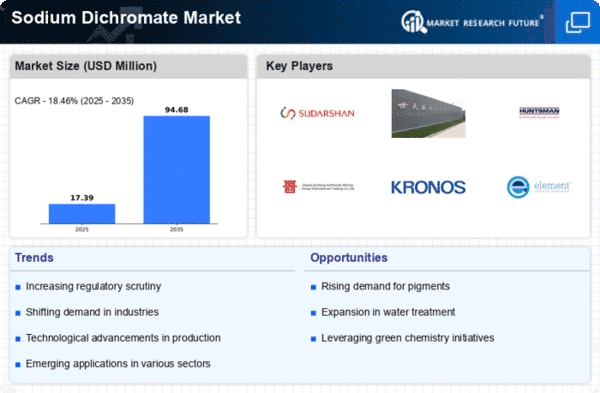
As per MRFR analysis, the Sodium Dichromate Market Size was estimated at 14.68 USD Million in 2024. The Sodium Dichromate industry is projected to grow from 17.39 in 2025 to 94.68 by 2035, exhibiting a compound annual growth rate (CAGR) of 18.46 during the forecast period 2025 - 2035.

Key Market Trends & Highlights

The Sodium Dichromate Market is experiencing a dynamic shift driven by regulatory pressures and evolving consumer preferences.

  • North America remains the largest market for sodium dichromate, primarily due to its extensive applications in the construction sector.
  • The Asia-Pacific region is identified as the fastest-growing market, fueled by increasing industrialization and urbanization.
  • The metal finishing segment continues to dominate the market, while the pigments segment is witnessing rapid growth due to changing consumer preferences.
  • Key market drivers include the rising demand from the construction sector and the growth in the leather tanning industry, which are shaping market dynamics.

Market Size & Forecast

2024 Market Size 14.68 (USD Million)
2035 Market Size 94.68 (USD Million)
CAGR (2025 - 2035) 18.46%
Largest Regional Market Share in 2024 Asia-Pacific

Major Players

Sudarshan Chemical Industries Ltd (IN), Tianjin Hanguang Chemical Co Ltd (CN), Huntsman Corporation (US), Shaanxi Jincheng Anthracite Mining Group Co Ltd (CN), Kronos Worldwide Inc (US), American Elements (US), Elementis plc (GB), Lanxess AG (DE)

Market Trends

The Sodium Dichromate Market is currently experiencing a complex interplay of factors that influence its dynamics. This compound, primarily utilized in various industrial applications such as metal finishing, leather tanning, and pigments, has seen a shift in demand patterns. The increasing focus on environmental regulations and sustainability practices has prompted industries to seek alternatives, potentially impacting the growth trajectory of sodium dichromate. Furthermore, the ongoing advancements in technology and manufacturing processes may lead to more efficient production methods, thereby affecting supply chains and pricing strategies. As industries adapt to changing regulations and consumer preferences, the Sodium Dichromate Market is likely to evolve, presenting both challenges and opportunities for stakeholders. In addition, The Sodium Dichromate landscape. Companies are exploring innovative solutions to minimize environmental impact while maintaining product efficacy. This trend may drive research and development efforts aimed at creating safer substitutes or enhancing the sustainability of existing processes. Overall, the Sodium Dichromate Market appears poised for transformation, influenced by regulatory pressures, technological advancements, and shifting consumer expectations.

Regulatory Pressures and Sustainability

The Sodium Dichromate Market is increasingly shaped by stringent environmental regulations. As industries face mounting pressure to comply with sustainability standards, there is a noticeable shift towards exploring eco-friendly alternatives. This trend may compel manufacturers to innovate and adapt their processes, potentially leading to a decline in traditional sodium dichromate usage.

Technological Advancements in Production

Ongoing technological innovations are likely to enhance production efficiency within the Sodium Dichromate Market. Improved manufacturing techniques may reduce costs and environmental impact, allowing companies to optimize their operations. This evolution could also influence market pricing and availability, as more efficient processes become standard.

Shifting Consumer Preferences

Consumer awareness regarding environmental issues is prompting a reevaluation of product choices across various sectors. In the Sodium Dichromate Market, this shift may lead to increased demand for safer, more sustainable alternatives. As businesses respond to these changing preferences, the market landscape could witness significant transformations.

Sodium Dichromate Market Market Drivers

Increasing Demand in the Chemical Industry

The Global Sodium Dichromate Market Industry experiences a robust demand from the chemical sector, particularly for its use in the production of chromium compounds. As industries seek to enhance their manufacturing processes, sodium dichromate serves as a critical intermediate in the synthesis of various chemicals. In 2024, the market is projected to reach 750 USD Million, driven by the expanding applications in pigments, dyes, and corrosion inhibitors. This growth trajectory suggests a sustained interest in sodium dichromate, which is likely to continue as the chemical industry evolves and diversifies its product offerings.

Market Segment Insights

By Application: Metal Finishing (Largest) vs. Pigments (Fastest-Growing)

The Sodium Dichromate Market is diverse, with the application segments of Metal Finishing, Pigments, Wood Preservation, and Leather Tanning showing varying levels of market share. Metal finishing holds the largest share due to its extensive use in coatings, anodizing, and electroplating processes. In contrast, pigments are rapidly gaining traction, driven by increasing demand in various industries such as construction and automotive, which utilize dyes and pigments for aesthetic and protective purposes.

Metal Finishing (Dominant) vs. Pigments (Emerging)

Metal finishing remains a dominant application for sodium dichromate, attributed to its unmatched performance in enhancing the corrosion resistance and appearance of metals. This segment is particularly pivotal in automotive, aerospace, and machinery sectors, where precision and aesthetics are paramount. Conversely, pigments are emerging as a significant growth area, driven by innovations in color and safety standards in consumer products. The rising trend towards environmentally friendly solutions has also spurred the development of non-toxic alternatives to traditional pigments, positioning it as a crucial area in the sodium dichromate market.

By End Use Industry: Construction (Largest) vs. Automotive (Fastest-Growing)

In the Sodium Dichromate market, the end-use industry distribution reveals a significant dominance of the construction sector, attributed to its extensive application in pigments, corrosion inhibitors, and production of leather. Following closely, the automotive industry showcases remarkable potential, leveraging Sodium Dichromate for manufacturing surfaces and coatings, thus emerging as a substantial segment. The electronics and aerospace industries also contribute but at a lesser scale, mainly focusing on niche applications that require the compound's unique properties.

Construction: Dominant vs. Automotive: Emerging

The construction industry remains the dominant end user of Sodium Dichromate, primarily utilizing it in producing high-quality pigments and corrosion-resistant materials. This sector benefits from the compound's efficacy in enhancing durability and finishes. Conversely, the automotive industry, marked as the fastest-growing segment, leverages Sodium Dichromate predominantly for its applications in surface treatments and adherence properties in paints and coatings, aligning with the rising demand for more sustainable and efficient automotive solutions. This growth reflects a broader trend of innovation and regulatory shift towards eco-friendly chemical applications across industries.

By Form: Powder (Largest) vs. Granules (Fastest-Growing)

In the Sodium Dichromate Market, the 'Form' segment is primarily dominated by the powder variation, which commands a significant share due to its widespread use in various industrial applications, such as metal finishing and pigments. Granules, while smaller in market share, show rapid growth, driven by increasing demand from emerging economies and advancements in product formulations that enhance their usability.

Powder (Dominant) vs. Granules (Emerging)

The Powder form of sodium dichromate is the dominant choice in the market, favored for its versatility and effectiveness in a variety of applications, including electroplating and leather tanning. This form is known for its high purity and stability, leading to its preference among manufacturers. Conversely, Granules are emerging as a fast-growing alternative, attracting interest due to their easier handling and reduced dust generation compared to powders. This makes granules particularly appealing in sectors focusing on safety and efficiency. As industries aim for sustainable practices, the granules' formulation has adapted to meet these needs, driving their market growth.

By Purity Level: High Purity Grade (Largest) vs. Technical Grade (Fastest-Growing)

In the sodium dichromate market, the purity level segment is primarily composed of three key values: standard grade, high purity grade, and technical grade. Among these, the high purity grade dominates the market due to its extensive applications in various industrial processes, including the production of pigments and as a catalyst in chemical reactions. The standard grade follows closely but has a more limited application scope, primarily used in less demanding sectors. The technical grade, while currently smaller in market share, is rapidly gaining prominence as industries look for affordable yet effective solutions for their processes.

High Purity Grade (Dominant) vs. Technical Grade (Emerging)

High purity grade sodium dichromate is widely regarded as the dominant player in the sodium dichromate market due to its superior quality and performance in critical applications. Industries such as aerospace, electronics, and advanced manufacturing favor this grade for its minimal impurities, enhancing product durability and efficacy. In contrast, the technical grade sodium dichromate is emerging as a popular choice among small to medium-scale industries seeking cost-effective alternatives without compromising too much on quality. This segment is accelerating in growth driven by the rising demand in sectors like construction and waste treatment, where larger volumes at competitive pricing can lead to increased adoption.

Get more detailed insights about Sodium Dichromate Market Research Report - Forecast to 2035

Regional Insights

North America : Stable Market with Growth Potential

The North American sodium dichromate market, valued at $2.94 million, is driven by increasing demand in various industries, including pigments and leather tanning. Regulatory frameworks are becoming more stringent, pushing manufacturers to adopt sustainable practices. The market is expected to grow as companies innovate to meet these regulations and consumer preferences for eco-friendly products increase. The U.S. is the leading country in this region, with key players like Huntsman Corporation and Kronos Worldwide Inc. dominating the landscape. The competitive environment is characterized by a mix of established firms and emerging players, all vying for market share. The presence of these companies ensures a robust supply chain and innovation in product offerings, catering to diverse industrial needs.

Europe : Regulatory Focus on Sustainability

Europe's sodium dichromate market, valued at €3.68 million, is significantly influenced by stringent environmental regulations and a shift towards sustainable practices. The demand for sodium dichromate in the region is driven by its applications in pigments and metal treatment, with a growing emphasis on reducing environmental impact. Regulatory bodies are pushing for compliance, which is expected to shape market dynamics positively. Germany and the UK are the leading countries in this market, with major players like Lanxess AG and Elementis plc. The competitive landscape is marked by innovation and a focus on sustainable production methods. Companies are investing in R&D to develop eco-friendly alternatives, ensuring they meet regulatory standards while catering to the evolving needs of consumers.

Asia-Pacific : Dominant Market with High Demand

The Asia-Pacific region leads the sodium dichromate market with a valuation of $7.0 million, driven by rapid industrialization and increasing demand in sectors such as textiles and leather. The region's growth is supported by favorable government policies and investments in infrastructure, which are expected to enhance production capabilities. The market is characterized by a strong focus on meeting both domestic and international standards. China and India are the primary markets within this region, hosting key players like Tianjin Hanguang Chemical Co Ltd and Shaanxi Jincheng Anthracite Mining Group Co Ltd. The competitive landscape is robust, with numerous local and international companies striving for market share. This dynamic environment fosters innovation and efficiency, ensuring a steady supply of sodium dichromate to meet growing industrial needs.

Middle East and Africa : Emerging Market with Growth Opportunities

The Middle East and Africa sodium dichromate market, valued at $1.06 million, is in a nascent stage but shows promising growth potential. The demand is primarily driven by the expanding industrial base and increasing applications in various sectors, including construction and manufacturing. Regulatory frameworks are gradually evolving, which may catalyze market growth as companies adapt to new standards. South Africa and the UAE are the leading countries in this region, with a growing number of local manufacturers entering the market. The competitive landscape is characterized by a mix of established firms and new entrants, all aiming to capitalize on the region's industrial growth. As infrastructure projects increase, the demand for sodium dichromate is expected to rise, providing opportunities for both local and international players.

Key Players and Competitive Insights

The Sodium Dichromate Market is characterized by a competitive landscape that is increasingly shaped by innovation, sustainability, and strategic partnerships. Key players such as Sudarshan Chemical Industries Ltd (IN), Huntsman Corporation (US), and Lanxess AG (DE) are actively pursuing strategies that enhance their market positioning. Sudarshan Chemical Industries Ltd (IN) has focused on expanding its product portfolio to include eco-friendly alternatives, which aligns with the growing demand for sustainable chemicals. Huntsman Corporation (US) has been investing in digital transformation initiatives to optimize its operations and improve customer engagement, while Lanxess AG (DE) is leveraging its strong R&D capabilities to innovate in specialty chemicals, thereby enhancing its competitive edge.The business tactics employed by these companies reflect a concerted effort to localize manufacturing and optimize supply chains, which are crucial in a moderately fragmented market. The collective influence of these key players indicates a shift towards more integrated operations, where collaboration and efficiency are paramount. This competitive structure allows for a dynamic interplay between established firms and emerging players, fostering an environment ripe for innovation and growth.

In November Huntsman Corporation (US) announced a strategic partnership with a leading technology firm to develop AI-driven solutions for its production processes. This move is expected to enhance operational efficiency and reduce costs, positioning Huntsman as a frontrunner in the adoption of advanced manufacturing technologies. The integration of AI into their operations could potentially streamline processes and improve product quality, thereby reinforcing their market presence.

In October Sudarshan Chemical Industries Ltd (IN) launched a new line of sodium dichromate products that are compliant with stringent environmental regulations. This initiative not only caters to the increasing demand for sustainable products but also demonstrates the company's commitment to environmental stewardship. By aligning its product offerings with regulatory trends, Sudarshan is likely to capture a larger market share and enhance its reputation among environmentally conscious consumers.

In September Lanxess AG (DE) completed the acquisition of a specialty chemicals firm, which is anticipated to bolster its capabilities in the sodium dichromate segment. This acquisition is strategically significant as it allows Lanxess to expand its product offerings and enhance its competitive positioning in the market. The integration of new technologies and expertise from the acquired firm could lead to innovative solutions that meet evolving customer needs.

As of December the Sodium Dichromate Market is witnessing trends that emphasize digitalization, sustainability, and strategic alliances. Companies are increasingly recognizing the importance of collaboration to drive innovation and enhance supply chain reliability. The competitive differentiation is likely to evolve from traditional price-based competition to a focus on technological advancements and sustainable practices. This shift suggests that firms that prioritize innovation and operational excellence will be better positioned to thrive in the future.

Key Companies in the Sodium Dichromate Market include

Industry Developments

Future Outlook

Sodium Dichromate Market Future Outlook

The Sodium Dichromate Market is projected to grow at an 18.46% CAGR from 2025 to 2035, driven by increasing demand in various industrial applications and environmental regulations.

New opportunities lie in:

  • Expansion into emerging markets with tailored product offerings.
  • Development of eco-friendly sodium dichromate alternatives.
  • Investment in advanced manufacturing technologies to enhance production efficiency.

By 2035, the Sodium Dichromate Market is expected to achieve substantial growth, solidifying its position in the global chemical industry.

Market Segmentation

Sodium Dichromate Market Form Outlook

  • Powder
  • Granules
  • Liquid

Sodium Dichromate Market Application Outlook

  • Metal Finishing
  • Pigments
  • Wood Preservation
  • Leather Tanning

Sodium Dichromate Market Purity Level Outlook

  • Standard Grade
  • High Purity Grade
  • Technical Grade

Sodium Dichromate Market End Use Industry Outlook

  • Construction
  • Automotive
  • Aerospace
  • Electronics

Report Scope

MARKET SIZE 202414.68(USD Million)
MARKET SIZE 202517.39(USD Million)
MARKET SIZE 203594.68(USD Million)
COMPOUND ANNUAL GROWTH RATE (CAGR)18.46% (2025 - 2035)
REPORT COVERAGERevenue Forecast, Competitive Landscape, Growth Factors, and Trends
BASE YEAR2024
Market Forecast Period2025 - 2035
Historical Data2019 - 2024
Market Forecast UnitsUSD Million
Key Companies ProfiledSudarshan Chemical Industries Ltd (IN), Tianjin Hanguang Chemical Co Ltd (CN), Huntsman Corporation (US), Shaanxi Jincheng Anthracite Mining Group Co Ltd (CN), Kronos Worldwide Inc (US), American Elements (US), Elementis plc (GB), Lanxess AG (DE)
Segments CoveredApplication, End Use Industry, Form, Purity Level
Key Market OpportunitiesGrowing demand for eco-friendly alternatives in the Sodium Dichromate Market presents significant opportunities.
Key Market DynamicsRising environmental regulations drive demand for sodium dichromate in various industrial applications and processes.
Countries CoveredNorth America, Europe, APAC, South America, MEA

FAQs

What are the leading applications of sodium dichromate?

Leading applications of sodium dichromate include pigments, metal finishing, wood preservatives, and leather tanning.

What is the major driver for the market?

The growing demand for pigments in industrial paints is the major driver for the sodium dichromate market.

What is the key restraint on the market?

The carcinogenic properties of sodium dichromate are the major restraint on the market.

Which is the leading regional market?

Asia Pacific is likely to be the major regional market for sodium dichromate due to the growing demand for pigments in paints and textiles.

What are the key players in the market?

Leading players in the market include Elementis, Soda Sanayii, and Lanxess, among others.

  1. SECTION I: EXECUTIVE SUMMARY AND KEY HIGHLIGHTS
    1. | 1.1 EXECUTIVE SUMMARY
    2. | 1.1.1 Market Overview
    3. | 1.1.2 Key Findings
    4. | 1.1.3 Market Segmentation
    5. | 1.1.4 Competitive Landscape
    6. | 1.1.5 Challenges and Opportunities
    7. | 1.1.6 Future Outlook
  2. SECTION II: SCOPING, METHODOLOGY AND MARKET STRUCTURE
    1. | 2.1 MARKET INTRODUCTION
    2. | 2.1.1 Definition
    3. | 2.1.2 Scope of the study
    4. |-- 2.1.2.1 Research Objective
    5. |-- 2.1.2.2 Assumption
    6. |-- 2.1.2.3 Limitations
    7. | 2.2 RESEARCH METHODOLOGY
    8. | 2.2.1 Overview
    9. | 2.2.2 Data Mining
    10. | 2.2.3 Secondary Research
    11. | 2.2.4 Primary Research
    12. |-- 2.2.4.1 Primary Interviews and Information Gathering Process
    13. |-- 2.2.4.2 Breakdown of Primary Respondents
    14. | 2.2.5 Forecasting Model
    15. | 2.2.6 Market Size Estimation
    16. |-- 2.2.6.1 Bottom-Up Approach
    17. |-- 2.2.6.2 Top-Down Approach
    18. | 2.2.7 Data Triangulation
    19. | 2.2.8 Validation
  3. SECTION III: QUALITATIVE ANALYSIS
    1. | 3.1 MARKET DYNAMICS
    2. | 3.1.1 Overview
    3. | 3.1.2 Drivers
    4. | 3.1.3 Restraints
    5. | 3.1.4 Opportunities
    6. | 3.2 MARKET FACTOR ANALYSIS
    7. | 3.2.1 Value chain Analysis
    8. | 3.2.2 Porter's Five Forces Analysis
    9. |-- 3.2.2.1 Bargaining Power of Suppliers
    10. |-- 3.2.2.2 Bargaining Power of Buyers
    11. |-- 3.2.2.3 Threat of New Entrants
    12. |-- 3.2.2.4 Threat of Substitutes
    13. |-- 3.2.2.5 Intensity of Rivalry
    14. | 3.2.3 COVID-19 Impact Analysis
    15. |-- 3.2.3.1 Market Impact Analysis
    16. |-- 3.2.3.2 Regional Impact
    17. |-- 3.2.3.3 Opportunity and Threat Analysis
  4. SECTION IV: QUANTITATIVE ANALYSIS
    1. | 4.1 Chemicals and Materials, BY Application (USD Million)
    2. | 4.1.1 Metal Finishing
    3. | 4.1.2 Pigments
    4. | 4.1.3 Wood Preservation
    5. | 4.1.4 Leather Tanning
    6. | 4.2 Chemicals and Materials, BY End Use Industry (USD Million)
    7. | 4.2.1 Construction
    8. | 4.2.2 Automotive
    9. | 4.2.3 Aerospace
    10. | 4.2.4 Electronics
    11. | 4.3 Chemicals and Materials, BY Form (USD Million)
    12. | 4.3.1 Powder
    13. | 4.3.2 Granules
    14. | 4.3.3 Liquid
    15. | 4.4 Chemicals and Materials, BY Purity Level (USD Million)
    16. | 4.4.1 Standard Grade
    17. | 4.4.2 High Purity Grade
    18. | 4.4.3 Technical Grade
    19. | 4.5 Chemicals and Materials, BY Region (USD Million)
    20. | 4.5.1 North America
    21. |-- 4.5.1.1 US
    22. |-- 4.5.1.2 Canada
    23. | 4.5.2 Europe
    24. |-- 4.5.2.1 Germany
    25. |-- 4.5.2.2 UK
    26. |-- 4.5.2.3 France
    27. |-- 4.5.2.4 Russia
    28. |-- 4.5.2.5 Italy
    29. |-- 4.5.2.6 Spain
    30. |-- 4.5.2.7 Rest of Europe
    31. | 4.5.3 APAC
    32. |-- 4.5.3.1 China
    33. |-- 4.5.3.2 India
    34. |-- 4.5.3.3 Japan
    35. |-- 4.5.3.4 South Korea
    36. |-- 4.5.3.5 Malaysia
    37. |-- 4.5.3.6 Thailand
    38. |-- 4.5.3.7 Indonesia
    39. |-- 4.5.3.8 Rest of APAC
    40. | 4.5.4 South America
    41. |-- 4.5.4.1 Brazil
    42. |-- 4.5.4.2 Mexico
    43. |-- 4.5.4.3 Argentina
    44. |-- 4.5.4.4 Rest of South America
    45. | 4.5.5 MEA
    46. |-- 4.5.5.1 GCC Countries
    47. |-- 4.5.5.2 South Africa
    48. |-- 4.5.5.3 Rest of MEA
  5. SECTION V: COMPETITIVE ANALYSIS
    1. | 5.1 Competitive Landscape
    2. | 5.1.1 Overview
    3. | 5.1.2 Competitive Analysis
    4. | 5.1.3 Market share Analysis
    5. | 5.1.4 Major Growth Strategy in the Chemicals and Materials
    6. | 5.1.5 Competitive Benchmarking
    7. | 5.1.6 Leading Players in Terms of Number of Developments in the Chemicals and Materials
    8. | 5.1.7 Key developments and growth strategies
    9. |-- 5.1.7.1 New Product Launch/Service Deployment
    10. |-- 5.1.7.2 Merger & Acquisitions
    11. |-- 5.1.7.3 Joint Ventures
    12. | 5.1.8 Major Players Financial Matrix
    13. |-- 5.1.8.1 Sales and Operating Income
    14. |-- 5.1.8.2 Major Players R&D Expenditure. 2023
    15. | 5.2 Company Profiles
    16. | 5.2.1 Sudarshan Chemical Industries Ltd (IN)
    17. |-- 5.2.1.1 Financial Overview
    18. |-- 5.2.1.2 Products Offered
    19. |-- 5.2.1.3 Key Developments
    20. |-- 5.2.1.4 SWOT Analysis
    21. |-- 5.2.1.5 Key Strategies
    22. | 5.2.2 Tianjin Hanguang Chemical Co Ltd (CN)
    23. |-- 5.2.2.1 Financial Overview
    24. |-- 5.2.2.2 Products Offered
    25. |-- 5.2.2.3 Key Developments
    26. |-- 5.2.2.4 SWOT Analysis
    27. |-- 5.2.2.5 Key Strategies
    28. | 5.2.3 Huntsman Corporation (US)
    29. |-- 5.2.3.1 Financial Overview
    30. |-- 5.2.3.2 Products Offered
    31. |-- 5.2.3.3 Key Developments
    32. |-- 5.2.3.4 SWOT Analysis
    33. |-- 5.2.3.5 Key Strategies
    34. | 5.2.4 Shaanxi Jincheng Anthracite Mining Group Co Ltd (CN)
    35. |-- 5.2.4.1 Financial Overview
    36. |-- 5.2.4.2 Products Offered
    37. |-- 5.2.4.3 Key Developments
    38. |-- 5.2.4.4 SWOT Analysis
    39. |-- 5.2.4.5 Key Strategies
    40. | 5.2.5 Kronos Worldwide Inc (US)
    41. |-- 5.2.5.1 Financial Overview
    42. |-- 5.2.5.2 Products Offered
    43. |-- 5.2.5.3 Key Developments
    44. |-- 5.2.5.4 SWOT Analysis
    45. |-- 5.2.5.5 Key Strategies
    46. | 5.2.6 American Elements (US)
    47. |-- 5.2.6.1 Financial Overview
    48. |-- 5.2.6.2 Products Offered
    49. |-- 5.2.6.3 Key Developments
    50. |-- 5.2.6.4 SWOT Analysis
    51. |-- 5.2.6.5 Key Strategies
    52. | 5.2.7 Elementis plc (GB)
    53. |-- 5.2.7.1 Financial Overview
    54. |-- 5.2.7.2 Products Offered
    55. |-- 5.2.7.3 Key Developments
    56. |-- 5.2.7.4 SWOT Analysis
    57. |-- 5.2.7.5 Key Strategies
    58. | 5.2.8 Lanxess AG (DE)
    59. |-- 5.2.8.1 Financial Overview
    60. |-- 5.2.8.2 Products Offered
    61. |-- 5.2.8.3 Key Developments
    62. |-- 5.2.8.4 SWOT Analysis
    63. |-- 5.2.8.5 Key Strategies
    64. | 5.3 Appendix
    65. | 5.3.1 References
    66. | 5.3.2 Related Reports

Chemicals and Materials Market Segmentation

Chemicals and Materials By Application (USD Million, 2025-2035)

  • Metal Finishing
  • Pigments
  • Wood Preservation
  • Leather Tanning

Chemicals and Materials By End Use Industry (USD Million, 2025-2035)

  • Construction
  • Automotive
  • Aerospace
  • Electronics

Chemicals and Materials By Form (USD Million, 2025-2035)

  • Powder
  • Granules
  • Liquid

Chemicals and Materials By Purity Level (USD Million, 2025-2035)

  • Standard Grade
  • High Purity Grade
  • Technical Grade
Infographic

Free Sample Request

Kindly complete the form below to receive a free sample of this Report

Get Free Sample

Customer Strories

Compare Licence

×
Features License Type
Single User Multiuser License Enterprise User
Price $4,950 $5,950 $7,250
Maximum User Access Limit 1 User Upto 10 Users Unrestricted Access Throughout the Organization
Free Customization
Direct Access to Analyst
Deliverable Format
Platform Access
Discount on Next Purchase 10% 15% 15%
Printable Versions