• Cat-intel
  • MedIntelliX
  • Resources
  • About Us
  • Hero Background
    English
    Chinese
    French
    Japanese
    Korean
    German
    Spanish

    Smart Stadium Market Trends

    ID: MRFR/SEM/1986-HCR
    100 Pages
    Aarti Dhapte
    October 2025

    Smart Stadium Market Research Report Information By Component (Software and Service), By Deployment Type (On-Premise and Software-as-a-Service), By Platform (Application Management Platform, Device Management Platform, and Network Management Platform), And By Region (North America, Europe, Asia-Pacific, And Rest Of The World) – Industry Forecast Till 2035

    Share:
    Download PDF ×

    We do not share your information with anyone. However, we may send you emails based on your report interest from time to time. You may contact us at any time to opt-out.

    Smart Stadium Market Infographic
    Purchase Options

    Market Trends

    Key Emerging Trends in the Smart Stadium Market

    The Smart Stadium Market is undergoing rapid evolution, driven by the integration of cutting-edge technologies to enhance the overall fan experience and operational efficiency. One prevailing trend is the deployment of advanced connectivity solutions, such as 5G networks, within stadiums. This high-speed and low-latency connectivity not only facilitates seamless internet access for spectators but also enables a range of smart applications, including augmented reality (AR) experiences, instant replays, and interactive fan engagement. The transition to 5G is revolutionizing the way fans interact with sporting events, creating a more immersive and connected stadium experience.

    Furthermore, the incorporation of Internet of Things (IoT) devices is a key trend shaping the Smart Stadium Market. Stadiums are deploying a multitude of sensors and connected devices to gather real-time data on various aspects, such as crowd movement, environmental conditions, and player performance. This data is leveraged to optimize operations, enhance security, and provide personalized services to fans. IoT technologies contribute to the creation of intelligent and data-driven stadiums, paving the way for a more efficient and enjoyable live sports experience.

    Smart ticketing systems are gaining prominence in the market, offering fans a streamlined and contactless entry process. Mobile ticketing apps, equipped with features like in-seat food ordering and digital event guides, enhance convenience for spectators while providing stadiums with valuable insights into fan behavior. The move towards contactless solutions aligns with the broader trend of enhancing hygiene and safety within public spaces.

    Augmented Reality (AR) and Virtual Reality (VR) technologies are also making a significant impact on the Smart Stadium Market. Stadiums are increasingly incorporating AR and VR elements to offer fans immersive experiences, such as virtual tours, interactive displays, and AR-enhanced live broadcasts. These technologies not only entertain spectators but also open up new revenue streams through virtual advertising and sponsorship opportunities, creating a more engaging and futuristic atmosphere within the stadium.

    Moreover, the implementation of facial recognition and biometric technologies is enhancing security measures within smart stadiums. These advanced authentication methods streamline access control, reduce the risk of unauthorized entry, and enhance overall safety for both fans and event organizers. The integration of biometrics aligns with the industry's commitment to providing secure and efficient access solutions, contributing to the market's growth.

    In-stadium analytics and data-driven insights are becoming integral components of the Smart Stadium Market. Advanced analytics platforms process the vast amounts of data collected from IoT devices and other sources to provide actionable insights for stadium operators. This includes optimizing facility management, predicting equipment maintenance needs, and understanding fan preferences to tailor the overall game-day experience. Data-driven decision-making contributes to operational efficiency and ensures stadiums are better equipped to meet the evolving demands of fans.

    Sustainability initiatives are also shaping the Smart Stadium Market. Stadiums are adopting eco-friendly technologies, such as energy-efficient lighting, smart waste management systems, and sustainable building materials, to reduce their environmental impact. The integration of green technologies not only aligns with global efforts to promote sustainability but also appeals to environmentally conscious fans and stakeholders.


    Additionally, the incorporation of mobile apps and beacon technology is transforming the way fans engage with stadiums. Mobile apps provide fans with personalized content, real-time updates, and location-based services, enhancing their overall experience. Beacon technology enables proximity-based interactions, allowing stadiums to send targeted notifications, promotions, and wayfinding information to fans' mobile devices, creating a more connected and enjoyable event atmosphere.

    Author
    Aarti Dhapte
    Team Lead - Research

    She holds an experience of about 6+ years in Market Research and Business Consulting, working under the spectrum of Information Communication Technology, Telecommunications and Semiconductor domains. Aarti conceptualizes and implements a scalable business strategy and provides strategic leadership to the clients. Her expertise lies in market estimation, competitive intelligence, pipeline analysis, customer assessment, etc.

    Leave a Comment

    FAQs

    What is the projected market valuation of the Smart Stadium Market by 2035?

    The Smart Stadium Market is projected to reach a valuation of 85.51 USD Billion by 2035.

    What was the market valuation of the Smart Stadium Market in 2024?

    In 2024, the Smart Stadium Market had a valuation of 8.77 USD Billion.

    What is the expected CAGR for the Smart Stadium Market during the forecast period 2025 - 2035?

    The expected CAGR for the Smart Stadium Market during the forecast period 2025 - 2035 is 23.0%.

    Which companies are considered key players in the Smart Stadium Market?

    Key players in the Smart Stadium Market include Cisco Systems, IBM, Honeywell, Intel Corporation, NEC Corporation, Samsung Electronics, Siemens AG, Verizon Communications, and LG Electronics.

    What are the main components of the Smart Stadium Market?

    The main components of the Smart Stadium Market include Software, valued at 3.51 USD Billion, and Services, valued at 5.26 USD Billion.

    How is the Smart Stadium Market segmented by deployment type?

    The Smart Stadium Market is segmented by deployment type into On-Premise, valued at 3.51 USD Billion, and Software-as-a-Service, valued at 5.26 USD Billion.

    Market Summary

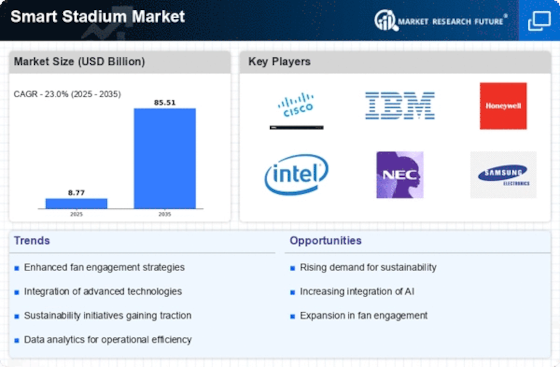
    As per MRFR analysis, the Smart Stadium Market Size was estimated at 8.77 USD Billion in 2024. The Smart Stadium industry is projected to grow from 10.79 USD Billion in 2025 to 85.51 USD Billion by 2035, exhibiting a compound annual growth rate (CAGR) of 23.0 during the forecast period 2025 - 2035.

    Key Market Trends & Highlights

    The Smart Stadium Market is poised for substantial growth driven by technological advancements and evolving consumer preferences.

    • Enhanced fan engagement through immersive experiences is becoming a focal point in stadium design.
    • Sustainability initiatives are increasingly influencing the development of smart stadiums, particularly in North America.
    • Data-driven decision making is gaining traction, with software solutions leading the market in terms of revenue.
    • Technological advancements and a growing demand for sustainable practices are key drivers propelling the market forward.

    Market Size & Forecast

    2024 Market Size 8.77 (USD Billion)
    2035 Market Size 85.51 (USD Billion)
    CAGR (2025 - 2035) 23.0%
    Largest Regional Market Share in 2024 Europe

    Major Players

    <p>Cisco Systems (US), IBM (US), Honeywell (US), Intel Corporation (US), NEC Corporation (JP), Samsung Electronics (KR), Siemens AG (DE), Verizon Communications (US), LG Electronics (KR)</p>

    Market Trends

    The Smart Stadium Market is currently experiencing a transformative phase, driven by advancements in technology and the increasing demand for enhanced fan experiences. Stadiums are evolving into interconnected environments, where digital solutions facilitate seamless interactions between fans, teams, and venue management. This shift is characterized by the integration of smart technologies, such as IoT devices, mobile applications, and data analytics, which collectively aim to improve operational efficiency and elevate spectator engagement. As a result, stakeholders are increasingly investing in infrastructure that supports these innovations, indicating a robust growth trajectory for the market. Moreover, sustainability has emerged as a pivotal consideration within the Smart Stadium Market. Stakeholders are recognizing the importance of eco-friendly practices, which not only contribute to environmental conservation but also resonate with the values of modern consumers. This trend is prompting the adoption of energy-efficient systems, waste management solutions, and sustainable materials in stadium construction and operation. Consequently, the Smart Stadium Market appears poised for continued expansion, as it aligns with broader societal shifts towards sustainability and technological integration.

    Enhanced Fan Engagement

    The Smart Stadium Market is witnessing a notable trend towards enhanced fan engagement through the use of mobile applications and interactive technologies. These tools allow spectators to access real-time information, participate in polls, and enjoy personalized experiences, thereby fostering a deeper connection with the event.

    Sustainability Initiatives

    Sustainability initiatives are gaining traction within the Smart Stadium Market, as venues increasingly adopt eco-friendly practices. This includes the implementation of energy-efficient systems and waste reduction strategies, reflecting a growing commitment to environmental responsibility among stakeholders.

    Data-Driven Decision Making

    Data-driven decision making is becoming a cornerstone of operations in the Smart Stadium Market. By leveraging analytics, stadium management can optimize resource allocation, enhance security measures, and improve overall operational efficiency, leading to a more streamlined experience for all stakeholders.

    <p>The integration of advanced technologies in stadiums is poised to enhance fan engagement and operational efficiency, reflecting a broader trend towards smart infrastructure in urban environments.</p><p>.webp</p>

    U.S. Department of Commerce

    Smart Stadium Market Market Drivers

    Technological Advancements

    The Smart Stadium Market is experiencing a surge in technological advancements that enhance the overall spectator experience. Innovations such as augmented reality, high-speed Wi-Fi, and mobile applications are becoming integral to stadium operations. These technologies facilitate real-time engagement, allowing fans to access information, view instant replays, and interact with the venue in unprecedented ways. According to recent estimates, the integration of advanced technologies in stadiums is projected to increase operational efficiency by up to 30 percent. This trend not only improves fan satisfaction but also drives revenue growth through enhanced advertising opportunities and merchandise sales. As a result, the Smart Stadium Market is likely to witness substantial investments in technology, further propelling its expansion.

    Enhanced Data Analytics Capabilities

    The Smart Stadium Market is increasingly leveraging data analytics to optimize operations and enhance the fan experience. By collecting and analyzing data from various sources, including ticket sales, social media interactions, and in-stadium behavior, operators can make informed decisions that drive engagement and revenue. The use of predictive analytics allows stadiums to anticipate fan needs, tailor marketing strategies, and improve service delivery. Market Research Future indicates that organizations utilizing advanced data analytics can achieve a revenue increase of up to 25 percent. This capability not only enhances operational efficiency but also fosters a more personalized experience for fans, making it a crucial driver in the Smart Stadium Market.

    Increased Focus on Safety and Security

    Safety and security concerns are paramount in the Smart Stadium Market, particularly in light of rising global threats. Stadiums are increasingly adopting advanced surveillance systems, crowd management technologies, and emergency response protocols to ensure the safety of attendees. The implementation of biometric screening and facial recognition systems is becoming more prevalent, enhancing security measures while streamlining entry processes. Market data suggests that investments in security technologies within stadiums are expected to grow significantly, with projections indicating a compound annual growth rate of over 10 percent in the coming years. This heightened focus on safety not only protects fans but also fosters a sense of trust and loyalty, which is essential for the long-term success of the Smart Stadium Market.

    Growing Demand for Sustainable Practices

    Sustainability is emerging as a critical driver in the Smart Stadium Market, as stakeholders increasingly prioritize eco-friendly practices. Stadiums are adopting green building standards, utilizing renewable energy sources, and implementing waste reduction strategies to minimize their environmental impact. The trend towards sustainability is not merely a response to regulatory pressures; it is also driven by fan expectations and corporate responsibility initiatives. Recent studies indicate that nearly 70 percent of fans prefer attending events at venues that demonstrate a commitment to sustainability. This shift is prompting stadium operators to invest in sustainable technologies, which could lead to a reduction in operational costs by up to 20 percent. Consequently, the Smart Stadium Market is likely to see a rise in the adoption of sustainable practices, aligning with broader environmental goals.

    Rising Popularity of Esports and Virtual Events

    The Smart Stadium Market is witnessing a notable shift with the rising popularity of esports and virtual events. As traditional sports venues adapt to accommodate esports tournaments, they are transforming into multifunctional spaces that cater to diverse audiences. This trend is driven by the increasing viewership and participation in esports, which has seen exponential growth in recent years. Stadiums are investing in state-of-the-art broadcasting technologies and immersive experiences to attract esports fans, thereby expanding their market reach. Data suggests that the esports market is projected to surpass 1 billion dollars in revenue, creating new opportunities for stadium operators. This evolution not only diversifies the offerings within the Smart Stadium Market but also positions venues as versatile hubs for entertainment.

    Market Segment Insights

    By Component: Software (Largest) vs. Service (Fastest-Growing)

    <p>In the Smart Stadium Market, the component segmentation reveals that software holds the largest market share, driven by an increasing demand for advanced management systems and data analytics solutions. As stadiums increasingly adopt innovative technologies for enhanced spectator experiences, software solutions that facilitate crowd management, ticketing, and facility operations are becoming indispensable. On the other hand, the service segment is witnessing rapid growth as organizations look to leverage expert services for installation, maintenance, and support. This service sector supports the successful implementation of smart technologies and ensures optimal performance and user experience.</p>

    <p>Software (Dominant) vs. Service (Emerging)</p>

    <p>Software solutions dominate the Smart Stadium Market due to their ability to provide essential functionalities that significantly enhance the operational effectiveness of stadiums. Aspects such as real-time data analytics, enhanced security protocols, and comprehensive event management capabilities are pushing the demand for software higher. Conversely, the service segment, while emerging, is gaining attention as it encompasses critical offerings like consultancy and ongoing support that help stadiums integrate and optimize smart technology. This segment's emergence reflects a growing realization that expert services are vital for maximizing the potential of smart stadium initiatives, illustrating a dynamic interplay between software and service in shaping the future of smart venues.</p>

    By Deployment Type: On-Premise (Largest) vs. Software-as-a-Service (Fastest-Growing)

    <p>In the Smart Stadium Market, the deployment type segment showcases a distinct distribution of preferences among two primary models: On-Premise and Software-as-a-Service (SaaS). On-Premise solutions dominate the market due to their ability to offer higher security and customization tailored to the specific requirements of stadium operators. However, SaaS is rapidly gaining traction as organizations increasingly prioritize flexibility, lower upfront costs, and the convenience of remote access to systems for real-time data management and analysis. In terms of growth trends, the SaaS deployment model for smart stadiums is projected to outpace the On-Premise solution, primarily driven by technological advancements and the growing adoption of Internet of Things (IoT) applications in stadiums. Factors such as increasing consumer demand for enhanced experiences, coupled with the need for efficient management systems and analytics, are propelling the shift towards SaaS-based solutions. This trend reflects a broader evolution in how smart technologies are integrated into sports venues, pointing towards a future where agility and scalability are paramount.</p>

    <p>Deployment Type: On-Premise (Dominant) vs. Software-as-a-Service (Emerging)</p>

    <p>The On-Premise deployment type remains dominant in the Smart Stadium Market, favored for its robust security attributes and ability to handle sensitive data effectively. Stadiums with significant technical infrastructure tend to opt for this model, as it allows complete control over systems and data privacy. This segment also benefits from the customization options it provides, enabling tailored solutions specific to individual venue demands. Conversely, Software-as-a-Service is quickly emerging as a competitive force in the marketplace, appealing particularly to smaller organizations seeking cost-effective solutions without the burden of maintaining extensive hardware. SaaS-based offerings enable greater scalability and rapid deployment of functionalities, aligning with the broader industry trend of digital transformation in stadium management, making it an attractive option for modern sports venues.</p>

    By Platform: Application Management Platform (Largest) vs. Device Management Platform (Fastest-Growing)

    <p>The Smart Stadium Market exhibits a diverse portfolio in the platform segment, with the Application Management Platform commanding the largest share. This platform is instrumental in integrating various applications that enhance fan experiences and stadium operations. Conversely, the Device Management Platform, though currently smaller in comparison, is rapidly gaining traction due to increasing demand for real-time device monitoring and management, making it the fastest-growing segment within the market.</p>

    <p>Application Management Platform (Dominant) vs. Network Management Platform (Emerging)</p>

    <p>The Application Management Platform stands as the dominant force within the Smart Stadium Market, characterized by its ability to deliver seamless application integration across various stadium functions, improving efficiency and user experience. In contrast, the Network Management Platform is emerging as an essential component in the smart stadium ecosystem. With the rising adoption of IoT devices and advanced networking solutions, it is crucial for managing the vast array of interconnected systems. The Network Management Platform focuses on ensuring robust connectivity and security, securing its place as a key player in the evolving digital landscape of smart stadiums.</p>

    Get more detailed insights about Smart Stadium Market Research Report- Global Forecast to 2035

    Regional Insights

    North America : Innovation and Technology Leader

    North America is the largest market for smart stadiums, holding approximately 45% of the global share. The region's growth is driven by increasing investments in technology, enhanced fan experiences, and the integration of IoT solutions. Regulatory support for smart infrastructure and sustainability initiatives further catalyze market expansion. The demand for advanced analytics and real-time data is also on the rise, pushing stadiums to adopt smart technologies. The United States is the leading country in this sector, with significant contributions from major cities hosting large-scale events. Key players like Cisco Systems, IBM, and Honeywell are at the forefront, providing innovative solutions that enhance operational efficiency and fan engagement. The competitive landscape is robust, with ongoing collaborations and partnerships aimed at integrating cutting-edge technologies into stadium operations.

    Europe : Emerging Market with Potential

    Europe is witnessing a growing trend in smart stadium adoption, accounting for approximately 30% of the global market share. The region's growth is fueled by increasing consumer demand for enhanced experiences and the need for energy-efficient solutions. Regulatory frameworks promoting smart city initiatives and sustainability are significant catalysts for this market. Countries are investing in digital infrastructure to support smart technologies in stadiums, enhancing both operational efficiency and fan engagement. Leading countries in this market include the United Kingdom, Germany, and France, where major events drive the need for smart solutions. The competitive landscape features key players like Siemens AG and NEC Corporation, who are innovating to meet the demands of modern stadiums. Collaborations between technology providers and stadium operators are becoming common, ensuring that facilities are equipped with the latest advancements in smart technology.

    Asia-Pacific : Rapid Growth and Adoption

    Asia-Pacific is emerging as a significant player in the smart stadium market, holding around 20% of the global share. The region's rapid urbanization and increasing disposable income are driving demand for enhanced sports and entertainment experiences. Governments are actively promoting smart city initiatives, which include the development of smart stadiums as part of broader urban planning strategies. This regulatory support is crucial for the market's growth, as it encourages investment in advanced technologies. Countries like Japan, South Korea, and Australia are leading the charge in smart stadium development. Major events, such as the Olympics and World Cup, are catalysts for innovation and investment in this sector. Key players like Samsung Electronics and LG Electronics are heavily involved, providing cutting-edge solutions that enhance fan experiences and operational efficiency. The competitive landscape is dynamic, with a focus on integrating IoT and AI technologies into stadium operations.

    Middle East and Africa : Emerging Powerhouse in Sports

    The Middle East and Africa region is gradually emerging in the smart stadium market, holding about 5% of the global share. The growth is primarily driven by the increasing popularity of sports and entertainment events, coupled with significant investments in infrastructure. Governments are recognizing the potential of smart stadiums to enhance fan experiences and operational efficiency, leading to supportive regulatory frameworks. The region's focus on hosting international events is also a key driver for market growth. Countries like the United Arab Emirates and South Africa are at the forefront of this trend, with major developments underway to create state-of-the-art facilities. The competitive landscape includes local and international players, with companies like Honeywell and Siemens AG actively participating in the market. Collaborations between technology providers and stadium operators are essential for integrating smart solutions that meet the evolving demands of fans and event organizers.

    .webp

    Key Players and Competitive Insights

    The Smart Stadium Market is currently characterized by a dynamic competitive landscape, driven by technological advancements and an increasing demand for enhanced fan experiences. Major players such as Cisco Systems (US), IBM (US), and Samsung Electronics (South Korea) are at the forefront, each adopting distinct strategies to solidify their market positions. Cisco Systems (US) focuses on integrating advanced networking solutions to enhance connectivity within stadiums, while IBM (US) emphasizes data analytics and AI to optimize operations and improve fan engagement. Samsung Electronics (South Korea) leverages its expertise in display technology to create immersive environments, thereby enhancing the overall spectator experience. Collectively, these strategies contribute to a competitive environment that prioritizes innovation and customer-centric solutions.

    In terms of business tactics, companies are increasingly localizing manufacturing and optimizing supply chains to enhance operational efficiency. The Smart Stadium Market appears moderately fragmented, with a mix of established players and emerging startups. The collective influence of key players shapes market dynamics, as they engage in strategic partnerships and collaborations to expand their reach and capabilities.

    In August 2025, Cisco Systems (US) announced a partnership with a leading sports league to implement its next-generation networking solutions across multiple stadiums. This strategic move is likely to enhance connectivity and data management, positioning Cisco as a leader in the digital transformation of sports venues. The partnership underscores the importance of robust infrastructure in delivering seamless fan experiences and operational efficiencies.

    In September 2025, IBM (US) launched a new AI-driven analytics platform specifically designed for stadium operations. This platform aims to provide real-time insights into crowd management and resource allocation, which could significantly improve operational efficiency. By harnessing AI, IBM is not only enhancing the operational capabilities of stadiums but also reinforcing its position as a key player in the Smart Stadium Market.

    In July 2025, Samsung Electronics (South Korea) unveiled a series of advanced display solutions tailored for sports venues, featuring enhanced resolution and interactivity. This launch is indicative of Samsung's commitment to innovation in fan engagement technologies. By providing cutting-edge visual experiences, Samsung is likely to attract more partnerships with stadium operators looking to elevate the spectator experience.

    As of October 2025, current competitive trends in the Smart Stadium Market include a strong emphasis on digitalization, sustainability, and AI integration. Strategic alliances are increasingly shaping the landscape, as companies collaborate to leverage complementary strengths. Looking ahead, competitive differentiation is expected to evolve, with a shift from price-based competition to a focus on innovation, technology, and supply chain reliability. This transition suggests that companies that prioritize technological advancements and sustainable practices will likely emerge as leaders in the Smart Stadium Market.

    .webp

    Key Companies in the Smart Stadium Market market include

    Industry Developments

    JIG-SAW joined hands with Climatec in Major League Baseball (MLB) to bring Smart Stadium technology to the San Diego Padres in September 2023. In the same vein, Climatec will play a vital role in JIG-SAW’s IoT technology during the design, installation and service stages. The implementation of this technology is expected to lead to reduced operation as well as maintenance costs, longer lifespan for facilities and improved customer experience for fans.

    Acrisure Stadium, which is home to the Pittsburgh Steelers, announced that Evolv Technology will be its official fan screening provider in March 2023.

    In February 2023, Fujitsu and EintrachtTech GmbH's digital center teamed up for sustainable stadium management at Deutsche Bank Park. Mainova AG has already equipped the stadium with a sensor solution that checks information on the condition of green areas and training fields and sends over the LoRaWAN gateway. However, it is Fujitsu who will take advantage of this existing facility further minimizing water consumption where an AI platform predicts future usage trends. Besides, there are efforts aimed at ensuring smart queue management at fan stores within sports venues.

    Schneider Electric acquired the AVEVA communication technology consulting company in January 2023. The two companies partner together in order to enable complete digitization of their client’s operations. They achieve significant benefits by reducing energy consumption or carbon dioxide emissions per unit of output. This cooperation speeds up customers’ way towards better efficiency side by side with sustainability.

    During December 2022, Cisco Systems Inc. collaborated with WaitTime so realize real-time crowd management platform use at Etihad Stadium.

    A multiyear global partnership between Real Madrid and Cisco Systems Inc was announced by them in November 2022 to develop Europe's first Wi-Fi 6 stadium network at Santiago Bernabéu Stadium. The objective is to make ground rank among the world’s most sophisticated stadiums ever used for any sports event.

    March 2022 saw Cisco Systems Inc. signing a multiyear agreement with Real Madrid, whereby the company will install the biggest Wi-Fi 6 stadium network at Santiago Bernabéu Stadium, which will be one of the most advanced sporting venues when it comes to technology. For instance, this multipurpose stadium is going to have not fewer than 1200 Wi-Fi 6 access points that guarantee a faster and smooth experience for fans, unlike older versions.

    .webp

    Future Outlook

    Smart Stadium Market Future Outlook

    <p>The Smart Stadium Market is projected to grow at a 23.0% CAGR from 2024 to 2035, driven by advancements in technology, enhanced fan experiences, and operational efficiencies.</p>

    New opportunities lie in:

    • <p>Integration of AI-driven analytics for real-time decision-making</p>
    • <p>Development of mobile applications for personalized fan engagement</p>
    • <p>Implementation of sustainable energy solutions for stadium operations</p>

    <p>By 2035, the Smart Stadium Market is expected to be a pivotal sector, reflecting substantial growth and innovation.</p>

    Market Segmentation

    Smart Stadium Market Platform Outlook

    • Application Management Platform
    • Device Management Platform
    • Network Management Platform

    Smart Stadium Market Component Outlook

    • Software
    • Service

    Smart Stadium Market Deployment Type Outlook

    • On-Premise
    • Software-as-a-Service

    Report Scope

    MARKET SIZE 20248.77(USD Billion)
    MARKET SIZE 202510.79(USD Billion)
    MARKET SIZE 203585.51(USD Billion)
    COMPOUND ANNUAL GROWTH RATE (CAGR)23.0% (2024 - 2035)
    REPORT COVERAGERevenue Forecast, Competitive Landscape, Growth Factors, and Trends
    BASE YEAR2024
    Market Forecast Period2025 - 2035
    Historical Data2019 - 2024
    Market Forecast UnitsUSD Billion
    Key Companies ProfiledMarket analysis in progress
    Segments CoveredMarket segmentation analysis in progress
    Key Market OpportunitiesIntegration of advanced technologies enhances fan engagement and operational efficiency in the Smart Stadium Market.
    Key Market DynamicsTechnological advancements drive enhanced fan experiences, influencing competitive dynamics in the Smart Stadium Market.
    Countries CoveredNorth America, Europe, APAC, South America, MEA

    FAQs

    What is the projected market valuation of the Smart Stadium Market by 2035?

    The Smart Stadium Market is projected to reach a valuation of 85.51 USD Billion by 2035.

    What was the market valuation of the Smart Stadium Market in 2024?

    In 2024, the Smart Stadium Market had a valuation of 8.77 USD Billion.

    What is the expected CAGR for the Smart Stadium Market during the forecast period 2025 - 2035?

    The expected CAGR for the Smart Stadium Market during the forecast period 2025 - 2035 is 23.0%.

    Which companies are considered key players in the Smart Stadium Market?

    Key players in the Smart Stadium Market include Cisco Systems, IBM, Honeywell, Intel Corporation, NEC Corporation, Samsung Electronics, Siemens AG, Verizon Communications, and LG Electronics.

    What are the main components of the Smart Stadium Market?

    The main components of the Smart Stadium Market include Software, valued at 3.51 USD Billion, and Services, valued at 5.26 USD Billion.

    How is the Smart Stadium Market segmented by deployment type?

    The Smart Stadium Market is segmented by deployment type into On-Premise, valued at 3.51 USD Billion, and Software-as-a-Service, valued at 5.26 USD Billion.

    1. SECTION I: EXECUTIVE SUMMARY AND KEY HIGHLIGHTS
      1. | 1.1 EXECUTIVE SUMMARY
      2. | | 1.1.1 Market Overview
      3. | | 1.1.2 Key Findings
      4. | | 1.1.3 Market Segmentation
      5. | | 1.1.4 Competitive Landscape
      6. | | 1.1.5 Challenges and Opportunities
      7. | | 1.1.6 Future Outlook
    2. SECTION II: SCOPING, METHODOLOGY AND MARKET STRUCTURE
      1. | 2.1 MARKET INTRODUCTION
      2. | | 2.1.1 Definition
      3. | | 2.1.2 Scope of the study
      4. | | | 2.1.2.1 Research Objective
      5. | | | 2.1.2.2 Assumption
      6. | | | 2.1.2.3 Limitations
      7. | 2.2 RESEARCH METHODOLOGY
      8. | | 2.2.1 Overview
      9. | | 2.2.2 Data Mining
      10. | | 2.2.3 Secondary Research
      11. | | 2.2.4 Primary Research
      12. | | | 2.2.4.1 Primary Interviews and Information Gathering Process
      13. | | | 2.2.4.2 Breakdown of Primary Respondents
      14. | | 2.2.5 Forecasting Model
      15. | | 2.2.6 Market Size Estimation
      16. | | | 2.2.6.1 Bottom-Up Approach
      17. | | | 2.2.6.2 Top-Down Approach
      18. | | 2.2.7 Data Triangulation
      19. | | 2.2.8 Validation
    3. SECTION III: QUALITATIVE ANALYSIS
      1. | 3.1 MARKET DYNAMICS
      2. | | 3.1.1 Overview
      3. | | 3.1.2 Drivers
      4. | | 3.1.3 Restraints
      5. | | 3.1.4 Opportunities
      6. | 3.2 MARKET FACTOR ANALYSIS
      7. | | 3.2.1 Value chain Analysis
      8. | | 3.2.2 Porter's Five Forces Analysis
      9. | | | 3.2.2.1 Bargaining Power of Suppliers
      10. | | | 3.2.2.2 Bargaining Power of Buyers
      11. | | | 3.2.2.3 Threat of New Entrants
      12. | | | 3.2.2.4 Threat of Substitutes
      13. | | | 3.2.2.5 Intensity of Rivalry
      14. | | 3.2.3 COVID-19 Impact Analysis
      15. | | | 3.2.3.1 Market Impact Analysis
      16. | | | 3.2.3.2 Regional Impact
      17. | | | 3.2.3.3 Opportunity and Threat Analysis
    4. SECTION IV: QUANTITATIVE ANALYSIS
      1. | 4.1 Semiconductor & Electronics, BY Component (USD Billion)
      2. | | 4.1.1 Software
      3. | | 4.1.2 Service
      4. | 4.2 Semiconductor & Electronics, BY Deployment Type (USD Billion)
      5. | | 4.2.1 On-Premise
      6. | | 4.2.2 Software-as-a-Service
      7. | 4.3 Semiconductor & Electronics, BY Platform (USD Billion)
      8. | | 4.3.1 Application Management Platform
      9. | | 4.3.2 Device Management Platform
      10. | | 4.3.3 Network Management Platform
      11. | 4.4 Semiconductor & Electronics, BY Region (USD Billion)
      12. | | 4.4.1 North America
      13. | | | 4.4.1.1 US
      14. | | | 4.4.1.2 Canada
      15. | | 4.4.2 Europe
      16. | | | 4.4.2.1 Germany
      17. | | | 4.4.2.2 UK
      18. | | | 4.4.2.3 France
      19. | | | 4.4.2.4 Russia
      20. | | | 4.4.2.5 Italy
      21. | | | 4.4.2.6 Spain
      22. | | | 4.4.2.7 Rest of Europe
      23. | | 4.4.3 APAC
      24. | | | 4.4.3.1 China
      25. | | | 4.4.3.2 India
      26. | | | 4.4.3.3 Japan
      27. | | | 4.4.3.4 South Korea
      28. | | | 4.4.3.5 Malaysia
      29. | | | 4.4.3.6 Thailand
      30. | | | 4.4.3.7 Indonesia
      31. | | | 4.4.3.8 Rest of APAC
      32. | | 4.4.4 South America
      33. | | | 4.4.4.1 Brazil
      34. | | | 4.4.4.2 Mexico
      35. | | | 4.4.4.3 Argentina
      36. | | | 4.4.4.4 Rest of South America
      37. | | 4.4.5 MEA
      38. | | | 4.4.5.1 GCC Countries
      39. | | | 4.4.5.2 South Africa
      40. | | | 4.4.5.3 Rest of MEA
    5. SECTION V: COMPETITIVE ANALYSIS
      1. | 5.1 Competitive Landscape
      2. | | 5.1.1 Overview
      3. | | 5.1.2 Competitive Analysis
      4. | | 5.1.3 Market share Analysis
      5. | | 5.1.4 Major Growth Strategy in the Semiconductor & Electronics
      6. | | 5.1.5 Competitive Benchmarking
      7. | | 5.1.6 Leading Players in Terms of Number of Developments in the Semiconductor & Electronics
      8. | | 5.1.7 Key developments and growth strategies
      9. | | | 5.1.7.1 New Product Launch/Service Deployment
      10. | | | 5.1.7.2 Merger & Acquisitions
      11. | | | 5.1.7.3 Joint Ventures
      12. | | 5.1.8 Major Players Financial Matrix
      13. | | | 5.1.8.1 Sales and Operating Income
      14. | | | 5.1.8.2 Major Players R&D Expenditure. 2023
      15. | 5.2 Company Profiles
      16. | | 5.2.1 Cisco Systems (US)
      17. | | | 5.2.1.1 Financial Overview
      18. | | | 5.2.1.2 Products Offered
      19. | | | 5.2.1.3 Key Developments
      20. | | | 5.2.1.4 SWOT Analysis
      21. | | | 5.2.1.5 Key Strategies
      22. | | 5.2.2 IBM (US)
      23. | | | 5.2.2.1 Financial Overview
      24. | | | 5.2.2.2 Products Offered
      25. | | | 5.2.2.3 Key Developments
      26. | | | 5.2.2.4 SWOT Analysis
      27. | | | 5.2.2.5 Key Strategies
      28. | | 5.2.3 Honeywell (US)
      29. | | | 5.2.3.1 Financial Overview
      30. | | | 5.2.3.2 Products Offered
      31. | | | 5.2.3.3 Key Developments
      32. | | | 5.2.3.4 SWOT Analysis
      33. | | | 5.2.3.5 Key Strategies
      34. | | 5.2.4 Intel Corporation (US)
      35. | | | 5.2.4.1 Financial Overview
      36. | | | 5.2.4.2 Products Offered
      37. | | | 5.2.4.3 Key Developments
      38. | | | 5.2.4.4 SWOT Analysis
      39. | | | 5.2.4.5 Key Strategies
      40. | | 5.2.5 NEC Corporation (JP)
      41. | | | 5.2.5.1 Financial Overview
      42. | | | 5.2.5.2 Products Offered
      43. | | | 5.2.5.3 Key Developments
      44. | | | 5.2.5.4 SWOT Analysis
      45. | | | 5.2.5.5 Key Strategies
      46. | | 5.2.6 Samsung Electronics (KR)
      47. | | | 5.2.6.1 Financial Overview
      48. | | | 5.2.6.2 Products Offered
      49. | | | 5.2.6.3 Key Developments
      50. | | | 5.2.6.4 SWOT Analysis
      51. | | | 5.2.6.5 Key Strategies
      52. | | 5.2.7 Siemens AG (DE)
      53. | | | 5.2.7.1 Financial Overview
      54. | | | 5.2.7.2 Products Offered
      55. | | | 5.2.7.3 Key Developments
      56. | | | 5.2.7.4 SWOT Analysis
      57. | | | 5.2.7.5 Key Strategies
      58. | | 5.2.8 Verizon Communications (US)
      59. | | | 5.2.8.1 Financial Overview
      60. | | | 5.2.8.2 Products Offered
      61. | | | 5.2.8.3 Key Developments
      62. | | | 5.2.8.4 SWOT Analysis
      63. | | | 5.2.8.5 Key Strategies
      64. | | 5.2.9 LG Electronics (KR)
      65. | | | 5.2.9.1 Financial Overview
      66. | | | 5.2.9.2 Products Offered
      67. | | | 5.2.9.3 Key Developments
      68. | | | 5.2.9.4 SWOT Analysis
      69. | | | 5.2.9.5 Key Strategies
      70. | 5.3 Appendix
      71. | | 5.3.1 References
      72. | | 5.3.2 Related Reports
    6. LIST OF FIGURES
      1. | 6.1 MARKET SYNOPSIS
      2. | 6.2 NORTH AMERICA MARKET ANALYSIS
      3. | 6.3 US MARKET ANALYSIS BY COMPONENT
      4. | 6.4 US MARKET ANALYSIS BY DEPLOYMENT TYPE
      5. | 6.5 US MARKET ANALYSIS BY PLATFORM
      6. | 6.6 CANADA MARKET ANALYSIS BY COMPONENT
      7. | 6.7 CANADA MARKET ANALYSIS BY DEPLOYMENT TYPE
      8. | 6.8 CANADA MARKET ANALYSIS BY PLATFORM
      9. | 6.9 EUROPE MARKET ANALYSIS
      10. | 6.10 GERMANY MARKET ANALYSIS BY COMPONENT
      11. | 6.11 GERMANY MARKET ANALYSIS BY DEPLOYMENT TYPE
      12. | 6.12 GERMANY MARKET ANALYSIS BY PLATFORM
      13. | 6.13 UK MARKET ANALYSIS BY COMPONENT
      14. | 6.14 UK MARKET ANALYSIS BY DEPLOYMENT TYPE
      15. | 6.15 UK MARKET ANALYSIS BY PLATFORM
      16. | 6.16 FRANCE MARKET ANALYSIS BY COMPONENT
      17. | 6.17 FRANCE MARKET ANALYSIS BY DEPLOYMENT TYPE
      18. | 6.18 FRANCE MARKET ANALYSIS BY PLATFORM
      19. | 6.19 RUSSIA MARKET ANALYSIS BY COMPONENT
      20. | 6.20 RUSSIA MARKET ANALYSIS BY DEPLOYMENT TYPE
      21. | 6.21 RUSSIA MARKET ANALYSIS BY PLATFORM
      22. | 6.22 ITALY MARKET ANALYSIS BY COMPONENT
      23. | 6.23 ITALY MARKET ANALYSIS BY DEPLOYMENT TYPE
      24. | 6.24 ITALY MARKET ANALYSIS BY PLATFORM
      25. | 6.25 SPAIN MARKET ANALYSIS BY COMPONENT
      26. | 6.26 SPAIN MARKET ANALYSIS BY DEPLOYMENT TYPE
      27. | 6.27 SPAIN MARKET ANALYSIS BY PLATFORM
      28. | 6.28 REST OF EUROPE MARKET ANALYSIS BY COMPONENT
      29. | 6.29 REST OF EUROPE MARKET ANALYSIS BY DEPLOYMENT TYPE
      30. | 6.30 REST OF EUROPE MARKET ANALYSIS BY PLATFORM
      31. | 6.31 APAC MARKET ANALYSIS
      32. | 6.32 CHINA MARKET ANALYSIS BY COMPONENT
      33. | 6.33 CHINA MARKET ANALYSIS BY DEPLOYMENT TYPE
      34. | 6.34 CHINA MARKET ANALYSIS BY PLATFORM
      35. | 6.35 INDIA MARKET ANALYSIS BY COMPONENT
      36. | 6.36 INDIA MARKET ANALYSIS BY DEPLOYMENT TYPE
      37. | 6.37 INDIA MARKET ANALYSIS BY PLATFORM
      38. | 6.38 JAPAN MARKET ANALYSIS BY COMPONENT
      39. | 6.39 JAPAN MARKET ANALYSIS BY DEPLOYMENT TYPE
      40. | 6.40 JAPAN MARKET ANALYSIS BY PLATFORM
      41. | 6.41 SOUTH KOREA MARKET ANALYSIS BY COMPONENT
      42. | 6.42 SOUTH KOREA MARKET ANALYSIS BY DEPLOYMENT TYPE
      43. | 6.43 SOUTH KOREA MARKET ANALYSIS BY PLATFORM
      44. | 6.44 MALAYSIA MARKET ANALYSIS BY COMPONENT
      45. | 6.45 MALAYSIA MARKET ANALYSIS BY DEPLOYMENT TYPE
      46. | 6.46 MALAYSIA MARKET ANALYSIS BY PLATFORM
      47. | 6.47 THAILAND MARKET ANALYSIS BY COMPONENT
      48. | 6.48 THAILAND MARKET ANALYSIS BY DEPLOYMENT TYPE
      49. | 6.49 THAILAND MARKET ANALYSIS BY PLATFORM
      50. | 6.50 INDONESIA MARKET ANALYSIS BY COMPONENT
      51. | 6.51 INDONESIA MARKET ANALYSIS BY DEPLOYMENT TYPE
      52. | 6.52 INDONESIA MARKET ANALYSIS BY PLATFORM
      53. | 6.53 REST OF APAC MARKET ANALYSIS BY COMPONENT
      54. | 6.54 REST OF APAC MARKET ANALYSIS BY DEPLOYMENT TYPE
      55. | 6.55 REST OF APAC MARKET ANALYSIS BY PLATFORM
      56. | 6.56 SOUTH AMERICA MARKET ANALYSIS
      57. | 6.57 BRAZIL MARKET ANALYSIS BY COMPONENT
      58. | 6.58 BRAZIL MARKET ANALYSIS BY DEPLOYMENT TYPE
      59. | 6.59 BRAZIL MARKET ANALYSIS BY PLATFORM
      60. | 6.60 MEXICO MARKET ANALYSIS BY COMPONENT
      61. | 6.61 MEXICO MARKET ANALYSIS BY DEPLOYMENT TYPE
      62. | 6.62 MEXICO MARKET ANALYSIS BY PLATFORM
      63. | 6.63 ARGENTINA MARKET ANALYSIS BY COMPONENT
      64. | 6.64 ARGENTINA MARKET ANALYSIS BY DEPLOYMENT TYPE
      65. | 6.65 ARGENTINA MARKET ANALYSIS BY PLATFORM
      66. | 6.66 REST OF SOUTH AMERICA MARKET ANALYSIS BY COMPONENT
      67. | 6.67 REST OF SOUTH AMERICA MARKET ANALYSIS BY DEPLOYMENT TYPE
      68. | 6.68 REST OF SOUTH AMERICA MARKET ANALYSIS BY PLATFORM
      69. | 6.69 MEA MARKET ANALYSIS
      70. | 6.70 GCC COUNTRIES MARKET ANALYSIS BY COMPONENT
      71. | 6.71 GCC COUNTRIES MARKET ANALYSIS BY DEPLOYMENT TYPE
      72. | 6.72 GCC COUNTRIES MARKET ANALYSIS BY PLATFORM
      73. | 6.73 SOUTH AFRICA MARKET ANALYSIS BY COMPONENT
      74. | 6.74 SOUTH AFRICA MARKET ANALYSIS BY DEPLOYMENT TYPE
      75. | 6.75 SOUTH AFRICA MARKET ANALYSIS BY PLATFORM
      76. | 6.76 REST OF MEA MARKET ANALYSIS BY COMPONENT
      77. | 6.77 REST OF MEA MARKET ANALYSIS BY DEPLOYMENT TYPE
      78. | 6.78 REST OF MEA MARKET ANALYSIS BY PLATFORM
      79. | 6.79 KEY BUYING CRITERIA OF SEMICONDUCTOR & ELECTRONICS
      80. | 6.80 RESEARCH PROCESS OF MRFR
      81. | 6.81 DRO ANALYSIS OF SEMICONDUCTOR & ELECTRONICS
      82. | 6.82 DRIVERS IMPACT ANALYSIS: SEMICONDUCTOR & ELECTRONICS
      83. | 6.83 RESTRAINTS IMPACT ANALYSIS: SEMICONDUCTOR & ELECTRONICS
      84. | 6.84 SUPPLY / VALUE CHAIN: SEMICONDUCTOR & ELECTRONICS
      85. | 6.85 SEMICONDUCTOR & ELECTRONICS, BY COMPONENT, 2024 (% SHARE)
      86. | 6.86 SEMICONDUCTOR & ELECTRONICS, BY COMPONENT, 2024 TO 2035 (USD Billion)
      87. | 6.87 SEMICONDUCTOR & ELECTRONICS, BY DEPLOYMENT TYPE, 2024 (% SHARE)
      88. | 6.88 SEMICONDUCTOR & ELECTRONICS, BY DEPLOYMENT TYPE, 2024 TO 2035 (USD Billion)
      89. | 6.89 SEMICONDUCTOR & ELECTRONICS, BY PLATFORM, 2024 (% SHARE)
      90. | 6.90 SEMICONDUCTOR & ELECTRONICS, BY PLATFORM, 2024 TO 2035 (USD Billion)
      91. | 6.91 BENCHMARKING OF MAJOR COMPETITORS
    7. LIST OF TABLES
      1. | 7.1 LIST OF ASSUMPTIONS
      2. | | 7.1.1
      3. | 7.2 North America MARKET SIZE ESTIMATES; FORECAST
      4. | | 7.2.1 BY COMPONENT, 2025-2035 (USD Billion)
      5. | | 7.2.2 BY DEPLOYMENT TYPE, 2025-2035 (USD Billion)
      6. | | 7.2.3 BY PLATFORM, 2025-2035 (USD Billion)
      7. | 7.3 US MARKET SIZE ESTIMATES; FORECAST
      8. | | 7.3.1 BY COMPONENT, 2025-2035 (USD Billion)
      9. | | 7.3.2 BY DEPLOYMENT TYPE, 2025-2035 (USD Billion)
      10. | | 7.3.3 BY PLATFORM, 2025-2035 (USD Billion)
      11. | 7.4 Canada MARKET SIZE ESTIMATES; FORECAST
      12. | | 7.4.1 BY COMPONENT, 2025-2035 (USD Billion)
      13. | | 7.4.2 BY DEPLOYMENT TYPE, 2025-2035 (USD Billion)
      14. | | 7.4.3 BY PLATFORM, 2025-2035 (USD Billion)
      15. | 7.5 Europe MARKET SIZE ESTIMATES; FORECAST
      16. | | 7.5.1 BY COMPONENT, 2025-2035 (USD Billion)
      17. | | 7.5.2 BY DEPLOYMENT TYPE, 2025-2035 (USD Billion)
      18. | | 7.5.3 BY PLATFORM, 2025-2035 (USD Billion)
      19. | 7.6 Germany MARKET SIZE ESTIMATES; FORECAST
      20. | | 7.6.1 BY COMPONENT, 2025-2035 (USD Billion)
      21. | | 7.6.2 BY DEPLOYMENT TYPE, 2025-2035 (USD Billion)
      22. | | 7.6.3 BY PLATFORM, 2025-2035 (USD Billion)
      23. | 7.7 UK MARKET SIZE ESTIMATES; FORECAST
      24. | | 7.7.1 BY COMPONENT, 2025-2035 (USD Billion)
      25. | | 7.7.2 BY DEPLOYMENT TYPE, 2025-2035 (USD Billion)
      26. | | 7.7.3 BY PLATFORM, 2025-2035 (USD Billion)
      27. | 7.8 France MARKET SIZE ESTIMATES; FORECAST
      28. | | 7.8.1 BY COMPONENT, 2025-2035 (USD Billion)
      29. | | 7.8.2 BY DEPLOYMENT TYPE, 2025-2035 (USD Billion)
      30. | | 7.8.3 BY PLATFORM, 2025-2035 (USD Billion)
      31. | 7.9 Russia MARKET SIZE ESTIMATES; FORECAST
      32. | | 7.9.1 BY COMPONENT, 2025-2035 (USD Billion)
      33. | | 7.9.2 BY DEPLOYMENT TYPE, 2025-2035 (USD Billion)
      34. | | 7.9.3 BY PLATFORM, 2025-2035 (USD Billion)
      35. | 7.10 Italy MARKET SIZE ESTIMATES; FORECAST
      36. | | 7.10.1 BY COMPONENT, 2025-2035 (USD Billion)
      37. | | 7.10.2 BY DEPLOYMENT TYPE, 2025-2035 (USD Billion)
      38. | | 7.10.3 BY PLATFORM, 2025-2035 (USD Billion)
      39. | 7.11 Spain MARKET SIZE ESTIMATES; FORECAST
      40. | | 7.11.1 BY COMPONENT, 2025-2035 (USD Billion)
      41. | | 7.11.2 BY DEPLOYMENT TYPE, 2025-2035 (USD Billion)
      42. | | 7.11.3 BY PLATFORM, 2025-2035 (USD Billion)
      43. | 7.12 Rest of Europe MARKET SIZE ESTIMATES; FORECAST
      44. | | 7.12.1 BY COMPONENT, 2025-2035 (USD Billion)
      45. | | 7.12.2 BY DEPLOYMENT TYPE, 2025-2035 (USD Billion)
      46. | | 7.12.3 BY PLATFORM, 2025-2035 (USD Billion)
      47. | 7.13 APAC MARKET SIZE ESTIMATES; FORECAST
      48. | | 7.13.1 BY COMPONENT, 2025-2035 (USD Billion)
      49. | | 7.13.2 BY DEPLOYMENT TYPE, 2025-2035 (USD Billion)
      50. | | 7.13.3 BY PLATFORM, 2025-2035 (USD Billion)
      51. | 7.14 China MARKET SIZE ESTIMATES; FORECAST
      52. | | 7.14.1 BY COMPONENT, 2025-2035 (USD Billion)
      53. | | 7.14.2 BY DEPLOYMENT TYPE, 2025-2035 (USD Billion)
      54. | | 7.14.3 BY PLATFORM, 2025-2035 (USD Billion)
      55. | 7.15 India MARKET SIZE ESTIMATES; FORECAST
      56. | | 7.15.1 BY COMPONENT, 2025-2035 (USD Billion)
      57. | | 7.15.2 BY DEPLOYMENT TYPE, 2025-2035 (USD Billion)
      58. | | 7.15.3 BY PLATFORM, 2025-2035 (USD Billion)
      59. | 7.16 Japan MARKET SIZE ESTIMATES; FORECAST
      60. | | 7.16.1 BY COMPONENT, 2025-2035 (USD Billion)
      61. | | 7.16.2 BY DEPLOYMENT TYPE, 2025-2035 (USD Billion)
      62. | | 7.16.3 BY PLATFORM, 2025-2035 (USD Billion)
      63. | 7.17 South Korea MARKET SIZE ESTIMATES; FORECAST
      64. | | 7.17.1 BY COMPONENT, 2025-2035 (USD Billion)
      65. | | 7.17.2 BY DEPLOYMENT TYPE, 2025-2035 (USD Billion)
      66. | | 7.17.3 BY PLATFORM, 2025-2035 (USD Billion)
      67. | 7.18 Malaysia MARKET SIZE ESTIMATES; FORECAST
      68. | | 7.18.1 BY COMPONENT, 2025-2035 (USD Billion)
      69. | | 7.18.2 BY DEPLOYMENT TYPE, 2025-2035 (USD Billion)
      70. | | 7.18.3 BY PLATFORM, 2025-2035 (USD Billion)
      71. | 7.19 Thailand MARKET SIZE ESTIMATES; FORECAST
      72. | | 7.19.1 BY COMPONENT, 2025-2035 (USD Billion)
      73. | | 7.19.2 BY DEPLOYMENT TYPE, 2025-2035 (USD Billion)
      74. | | 7.19.3 BY PLATFORM, 2025-2035 (USD Billion)
      75. | 7.20 Indonesia MARKET SIZE ESTIMATES; FORECAST
      76. | | 7.20.1 BY COMPONENT, 2025-2035 (USD Billion)
      77. | | 7.20.2 BY DEPLOYMENT TYPE, 2025-2035 (USD Billion)
      78. | | 7.20.3 BY PLATFORM, 2025-2035 (USD Billion)
      79. | 7.21 Rest of APAC MARKET SIZE ESTIMATES; FORECAST
      80. | | 7.21.1 BY COMPONENT, 2025-2035 (USD Billion)
      81. | | 7.21.2 BY DEPLOYMENT TYPE, 2025-2035 (USD Billion)
      82. | | 7.21.3 BY PLATFORM, 2025-2035 (USD Billion)
      83. | 7.22 South America MARKET SIZE ESTIMATES; FORECAST
      84. | | 7.22.1 BY COMPONENT, 2025-2035 (USD Billion)
      85. | | 7.22.2 BY DEPLOYMENT TYPE, 2025-2035 (USD Billion)
      86. | | 7.22.3 BY PLATFORM, 2025-2035 (USD Billion)
      87. | 7.23 Brazil MARKET SIZE ESTIMATES; FORECAST
      88. | | 7.23.1 BY COMPONENT, 2025-2035 (USD Billion)
      89. | | 7.23.2 BY DEPLOYMENT TYPE, 2025-2035 (USD Billion)
      90. | | 7.23.3 BY PLATFORM, 2025-2035 (USD Billion)
      91. | 7.24 Mexico MARKET SIZE ESTIMATES; FORECAST
      92. | | 7.24.1 BY COMPONENT, 2025-2035 (USD Billion)
      93. | | 7.24.2 BY DEPLOYMENT TYPE, 2025-2035 (USD Billion)
      94. | | 7.24.3 BY PLATFORM, 2025-2035 (USD Billion)
      95. | 7.25 Argentina MARKET SIZE ESTIMATES; FORECAST
      96. | | 7.25.1 BY COMPONENT, 2025-2035 (USD Billion)
      97. | | 7.25.2 BY DEPLOYMENT TYPE, 2025-2035 (USD Billion)
      98. | | 7.25.3 BY PLATFORM, 2025-2035 (USD Billion)
      99. | 7.26 Rest of South America MARKET SIZE ESTIMATES; FORECAST
      100. | | 7.26.1 BY COMPONENT, 2025-2035 (USD Billion)
      101. | | 7.26.2 BY DEPLOYMENT TYPE, 2025-2035 (USD Billion)
      102. | | 7.26.3 BY PLATFORM, 2025-2035 (USD Billion)
      103. | 7.27 MEA MARKET SIZE ESTIMATES; FORECAST
      104. | | 7.27.1 BY COMPONENT, 2025-2035 (USD Billion)
      105. | | 7.27.2 BY DEPLOYMENT TYPE, 2025-2035 (USD Billion)
      106. | | 7.27.3 BY PLATFORM, 2025-2035 (USD Billion)
      107. | 7.28 GCC Countries MARKET SIZE ESTIMATES; FORECAST
      108. | | 7.28.1 BY COMPONENT, 2025-2035 (USD Billion)
      109. | | 7.28.2 BY DEPLOYMENT TYPE, 2025-2035 (USD Billion)
      110. | | 7.28.3 BY PLATFORM, 2025-2035 (USD Billion)
      111. | 7.29 South Africa MARKET SIZE ESTIMATES; FORECAST
      112. | | 7.29.1 BY COMPONENT, 2025-2035 (USD Billion)
      113. | | 7.29.2 BY DEPLOYMENT TYPE, 2025-2035 (USD Billion)
      114. | | 7.29.3 BY PLATFORM, 2025-2035 (USD Billion)
      115. | 7.30 Rest of MEA MARKET SIZE ESTIMATES; FORECAST
      116. | | 7.30.1 BY COMPONENT, 2025-2035 (USD Billion)
      117. | | 7.30.2 BY DEPLOYMENT TYPE, 2025-2035 (USD Billion)
      118. | | 7.30.3 BY PLATFORM, 2025-2035 (USD Billion)
      119. | 7.31 PRODUCT LAUNCH/PRODUCT DEVELOPMENT/APPROVAL
      120. | | 7.31.1
      121. | 7.32 ACQUISITION/PARTNERSHIP
      122. | | 7.32.1

    Smart Stadium Market Segmentation

    Market Segmentation Overview

    • Detailed segmentation data will be available in the full report
    • Comprehensive analysis by multiple parameters
    • Regional and country-level breakdowns
    • Market size forecasts by segment
    Infographic

    Free Sample Request

    Kindly complete the form below to receive a free sample of this Report

    Get Free Sample

    Customer Strories

    “I am very pleased with how market segments have been defined in a relevant way for my purposes (such as "Portable Freezers & refrigerators" and "last-mile"). In general the report is well structured. Thanks very much for your efforts.”

    Victoria Milne

    Founder
    Case Study
    Chemicals and Materials

    Compare Licence

    ×
    Features License Type
    Single User Multiuser License Enterprise User
    Price $4,950 $5,950 $7,250
    Maximum User Access Limit 1 User Upto 10 Users Unrestricted Access Throughout the Organization
    Free Customization
    Direct Access to Analyst
    Deliverable Format
    Platform Access
    Discount on Next Purchase 10% 15% 15%
    Printable Versions