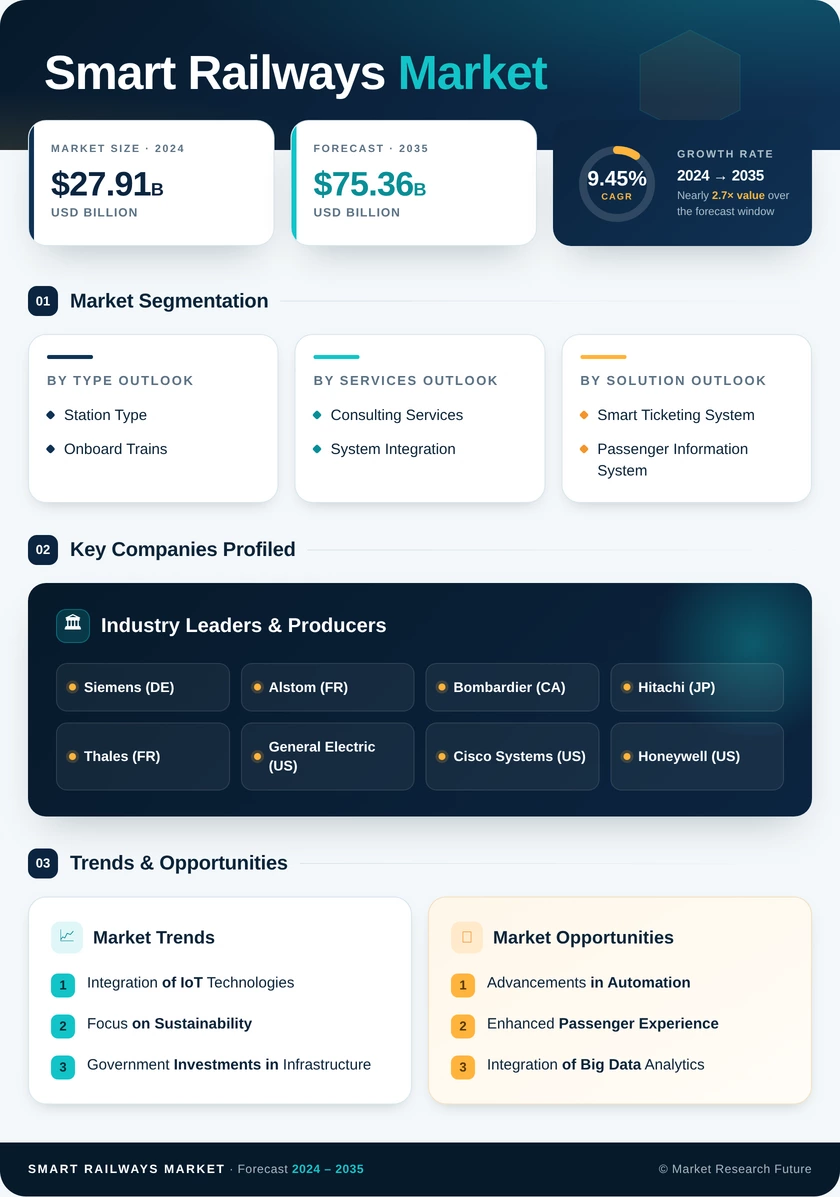
Market Segmentation Analysis
By Solution
9.1.1 Rail Analytics System
9.1.2 Communication and Networking System
9.1.3 Rail Asset Management and Maintenance
9.1.4 Smart Ticketing and Revenue Management
9.1.5 Cyber-Security and Safety
By Rail Type
9.2.1 Passenger Rail
9.2.2 Freight Rail
9.2.3 High-Speed Rail
9.2.4 Urban Transit
9.2.5 Light Rail
By Service
9.3.1 Professional Services
9.3.2 Managed Services
By Deployment Mode
9.4.1 On-Premise
9.4.2 Cloud
9.4.3 Hybrid
| Dimension | Sub-Segments | Dominant Segment | Fastest Growing Segment |
| By Solution | Rail Analytics System; Communication and Networking System; Rail Asset Management and Maintenance; Smart Ticketing and Revenue Management; Cyber-Security and Safety | Communication and Networking System (30.3% share, 2025) | Rail Analytics System (13.0% CAGR, 2026–2035) |
| By Rail Type | Passenger Rail; Freight Rail; High-Speed Rail; Urban Transit; Light Rail | Passenger Rail (44.0% share, 2025) | High-Speed Rail (12.5% CAGR, 2026–2035) |
| By Service | Professional Services; Managed Services | Professional Services (38.3% share, 2025) | Managed Services (12.4% CAGR, 2026–2035) |
| By Deployment Mode | On-Premise; Cloud; Hybrid | Cloud (45.6% share, 2025) | Hybrid (12.6% CAGR, 2026–2035) |
Market Segmentation Overview
By Solution
| Sub-Segment | Key Trend |
| Rail Analytics System | Computer-vision defect detection and on-device inference to satisfy data-residency rules |
| Communication and Networking System | GSM-R retirement driving FRMCS trackside and onboard radio replacement |
| Rail Asset Management and Maintenance | Fusion of historical failure logs with live sensor feeds for condition-triggered work |
| Smart Ticketing and Revenue Management | Account-based fares replacing card-centric gate logic |
| Cyber-Security and Safety | Conformance evidence becoming a tender prerequisite rather than a differentiator |
Communication and Networking System holds the largest solution pool because radio replacement is capital-heavy and deadline-driven, yet its growth curve flattens as first-wave corridors complete commissioning. Rail Analytics System grows fastest since maintenance engineers can attribute avoided failures and released spares inventory directly to the software, producing payback inside three years. Rail Asset Management and Maintenance depends on that analytics layer for its inputs, while Cyber-Security and Safety spending remains partly deferred pending conformance guidance.
By Rail Type
| Sub-Segment | Key Trend |
| Passenger Rail | Video analytics and crowd monitoring deployed to shorten platform dwell times |
| Freight Rail | Beacon and telematics mandates pushing lessors toward fleet-wide instrumentation |
| High-Speed Rail | Digital twins modelling pantograph-catenary interaction and tilt control |
| Urban Transit | Communications-based train control specified at design stage for new lines |
| Light Rail | Standardised interfaces enabling traffic-signal priority across agency boundaries |
Passenger Rail leads because transit and intercity operators fund the broadest application set and answer to service-quality regulators who measure punctuality directly. High-Speed Rail grows fastest, since disruption on these corridors carries the steepest revenue penalty and track possession for physical testing is scarce, making simulation-led upgrades economically obvious. Freight Rail trails on adoption breadth but scales quickly once telematics mandates reach leasing pools, while Urban Transit benefits from greenfield specification and Light Rail stays municipally constrained.
By Service
| Sub-Segment | Key Trend |
| Professional Services | Migration planning and safety-case authoring constrained by assessor availability |
| Managed Services | Multi-year availability agreements bundling monitoring, patching and cyber-risk |
Professional Services holds the larger share because ERTMS migration, hazard analysis and authorisation documentation remain human-intensive and cannot be compressed under current assessment procedures — a bottleneck that has pushed specialist day rates upward. Managed Services grows faster as operators with thin internal engineering benches transfer whole radio networks and monitoring functions to suppliers, converting unpredictable capital events into contracted operating expense with defined uptime obligations.
By Deployment Mode
| Sub-Segment | Key Trend |
| On-Premise | Workload repatriation for dispatch systems after third-party outage exposure |
| Cloud | Elastic scaling for ticketing, journey planning and customer-facing applications |
| Hybrid | Dual-plane designs keeping fail-safe logs local while analysing patterns centrally |
Cloud carries the largest share because passenger-facing systems experience sharp demand peaks that local infrastructure cannot economically serve, and content delivery matters for journey-planning responsiveness. Hybrid grows fastest as safety standards oblige operators to retain fail-safe evidence within their own estates without forfeiting central analytics, and dual-plane reference designs have now been proven in service. On-Premise persists among freight dispatchers who treat local execution as an availability requirement after outage experience.

 Noah Malgeri
Co-Founder
Noah Malgeri
Co-Founder

 Peter Groot koerkamp
Account and Business Manager
Peter Groot koerkamp
Account and Business Manager

 Younghwan Choi
Senior Retail Manager
Younghwan Choi
Senior Retail Manager

 Mark Irwin
Management Consultant
Mark Irwin
Management Consultant

 Akif Moroglu
Strategy & Business Development Director
Akif Moroglu
Strategy & Business Development Director

 Guilherme Gomes Martins
Product Management Director
Guilherme Gomes Martins
Product Management Director

 Joseph Aguayo
Sales Operations & Pricing Manager
Joseph Aguayo
Sales Operations & Pricing Manager

 La Terria Dodd
Program Support Specialist
La Terria Dodd
Program Support Specialist

 Rob Kooiker
Group Product Manager HVAC & Fire Protection GMA
Rob Kooiker
Group Product Manager HVAC & Fire Protection GMA