
×
Request Free Sample ×

Kindly complete the form below to receive a free sample of this Report

* Please use a valid business email

Leading companies partner with us for data-driven Insights

clients tt-cursor
Hero Background
English
Chinese
French
Japanese
Korean
German
Spanish

Smart Education and Learning Market Size

ID: MRFR/ICT/2124-HCR
100 Pages
Shubham Munde
February 2026

Smart Education and Learning Market Size, Share and Research Report Information By Software (Learning Management System, Learning Content Management System, Assessment Services, and Adaptive Learning Platform), By Hardware (Interactive White Boards (WBS), Interactive Displays, Interactive Tables, and Student Response Systems), By Application (Government, Enterprise/Business Education, NGOS And Association, Professional Services, and Healthcare) And By Region (North America, Europe, Asia-Pacific, And Rest Of The World) –Market Forecast Till 2035

Share:
Download PDF ×

We do not share your information with anyone. However, we may send you emails based on your report interest from time to time. You may contact us at any time to opt-out.

Smart Education and Learning Market Infographic
Purchase Options

Smart Education And Learning Size

Smart Education and Learning Market Growth Projections and Opportunities

The market dynamics of Smart Education and Learning are currently going through a transformational shift driven by rapid technology advancements and an increased focus on digital learning options. The growth of this market is driven by the increasing number of mobile devices, as well as internet connectivity. Now, educational content is available all the time due to the ubiquity of smartphones and tablets, which extend beyond traditional classroom setups. Smart Education and Learning are also shaped by artificial intelligence (AI) and machine learning (ML). They personalize learning solutions, thus revolutionizing the whole process. By analyzing personal cognitive capabilities, preferences, and performance, AI-driven platforms develop course materials tailored to meet individual learners' needs. Moreover, the conventional school setting has experienced a shake-up because of Virtual Reality (VR) /Augmented Reality (AR) technologies. VR/AR applications for education generate immersive surroundings that bring real-life experiences into classrooms where students can interact with them. The global pandemic also boosted the adoption of smart education tools. For remotely delivered education that would continue uninterrupted, there was a sudden need for digital infrastructure and innovative technologies. As a result, schools have been investing in robust online learning systems, video conferencing tools, and collaboration software, which will forever affect the Smart Education and Learning industry. However, obstacles such as the digital divide challenge or data security and privacy concerns still hinder the wider acceptance of smart education solutions in general. It is important to overcome these hurdles in order to provide equality in accessing education resources while promoting trustworthiness among end users. In terms of competition within this sector, the Smart Education and Learning marketplace boasts many diverse players ranging from established educational institutions to new start-ups looking to get a piece of it all. Traditional providers of academic materials are adapting their products according to online trends. At the same time, emerging companies rely on intelligence-based creativity, leading to disruptive approaches being introduced in kindergartens, too. Edtech companies and education institutions are increasingly partnering to create a collaborative landscape where industry knowledge merges with technological advancements.

Smart Education and Learning Market Size Graph
Author
Shubham Munde
Team Lead - Research

Shubham brings over 7 years of expertise in Market Intelligence and Strategic Consulting, with a strong focus on the Automotive, Aerospace, and Defense sectors. Backed by a solid foundation in semiconductors, electronics, and software, he has successfully delivered high-impact syndicated and custom research on a global scale. His core strengths include market sizing, forecasting, competitive intelligence, consumer insights, and supply chain mapping. Widely recognized for developing scalable growth strategies, Shubham empowers clients to navigate complex markets and achieve a lasting competitive edge. Trusted by start-ups and Fortune 500 companies alike, he consistently converts challenges into strategic opportunities that drive sustainable growth.

Leave a Comment

FAQs

What is the current valuation of the Smart Education and Learning Market?

<p>The Smart Education and Learning Market was valued at 341.1 USD Billion in 2024.</p>

What is the projected market size for the Smart Education and Learning Market by 2035?

<p>The market is projected to reach 2443.0 USD Billion by 2035.</p>

What is the expected CAGR for the Smart Education and Learning Market during the forecast period?

<p>The expected CAGR for the market from 2025 to 2035 is 19.6%.</p>

Which companies are considered key players in the Smart Education and Learning Market?

<p>Key players include Google, Microsoft, IBM, Pearson, Blackboard, Coursera, Udacity, Instructure, D2L, and Knewton.</p>

What are the main segments of the Smart Education and Learning Market?

<p>The main segments include Software, Hardware, and Application.</p>

What was the valuation of the Learning Management System segment in 2024?

<p>The Learning Management System segment was valued at 85.0 USD Billion in 2024.</p>

How much is the Adaptive Learning Platform segment projected to be worth by 2035?

<p>The Adaptive Learning Platform segment is projected to reach 1043.0 USD Billion by 2035.</p>

What is the valuation of the Interactive Displays segment in 2024?

<p>The Interactive Displays segment was valued at 80.0 USD Billion in 2024.</p>

What is the projected valuation for the Healthcare application segment by 2035?

<p>The Healthcare application segment is projected to reach 240.0 USD Billion by 2035.</p>

How does the Enterprise/Business Education segment perform in terms of valuation?

<p>The Enterprise/Business Education segment was valued at 68.2 USD Billion in 2024 and is expected to grow significantly.</p>

Market Summary

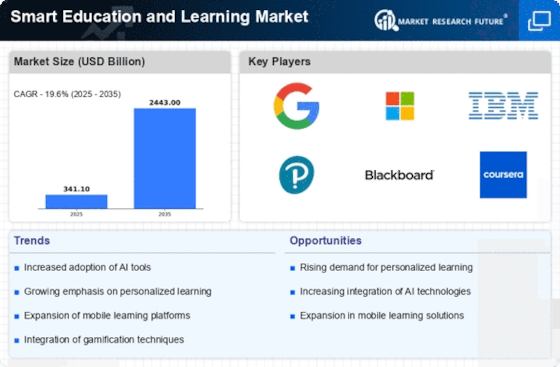
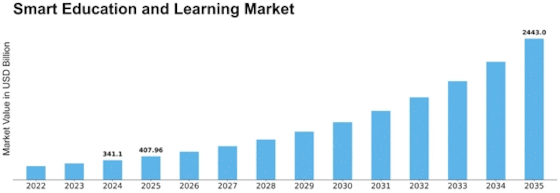
As per Market Research Future analysis, the Smart Education and Learning Market Size was estimated at 341.1 USD Billion in 2024. The Smart Education and Learning industry is projected to grow from 407.95 USD Billion in 2025 to 2443.0 USD Billion by 2035, exhibiting a compound annual growth rate (CAGR) of 19.6% during the forecast period 2025 - 2035

Key Market Trends & Highlights

The Smart Education and Learning Market is experiencing robust growth driven by technological advancements and evolving educational needs.

  • Personalized learning solutions are increasingly being adopted to cater to diverse student needs. The integration of artificial intelligence is transforming educational methodologies and enhancing learning experiences. North America remains the largest market, while the Asia-Pacific region is recognized as the fastest-growing area in smart education. The increased demand for flexible learning solutions and technological advancements in educational tools are key drivers propelling market growth.

Market Size & Forecast

2024 Market Size 341.1 (USD Billion)
2035 Market Size 2443.0 (USD Billion)
CAGR (2025 - 2035) 19.6%
Largest Regional Market Share in 2024 North America

Major Players

Google (US), Microsoft (US), IBM (US), Pearson (GB), Blackboard (US), Coursera (US), Udacity (US), Instructure (US), D2L (CA), Knewton (US)

Market Trends

The Smart Education and Learning Market is currently experiencing a transformative phase, driven by advancements in technology and a growing emphasis on personalized learning experiences. Educational institutions are increasingly adopting digital tools and platforms that facilitate interactive and engaging learning environments. This shift not only enhances student engagement but also allows for tailored educational pathways that cater to individual learning styles and paces. Furthermore, the integration of artificial intelligence and data analytics into educational frameworks appears to be reshaping how educators assess student performance and adapt their teaching methodologies accordingly.

This Smart Education and Learning Market Research Report is part of a broader set of education market research reports offering detailed insights into market size, segmentation, and growth trends through 2035. The Smart Education and Learning Market represents a significant segment of the global education and training market, driven by rapid digital transformation and increasing adoption of smart learning solutions. The learning market is undergoing rapid evolution, with smart for education initiatives enabling technology-driven teaching models that enhance accessibility, engagement, and learning outcomes.

In addition, the rise of remote learning solutions has expanded access to quality education across diverse demographics. This trend suggests a potential democratization of learning opportunities, enabling students from various backgrounds to benefit from innovative educational resources. As the Smart Education and Learning Market continues to evolve, it is likely that collaboration between technology providers and educational institutions will intensify, fostering an ecosystem that prioritizes learner-centric approaches and continuous improvement in educational outcomes.

Advancements in the education software industry, including learning management systems, adaptive learning platforms, and AI-powered analytics tools, are playing a crucial role in shaping the Smart Education and Learning Market. The dominance of learning management systems highlights the maturity of the education software industry, particularly in academic and enterprise learning environments. Continued investments in digital infrastructure and workforce upskilling are expected to strengthen the role of smart learning solutions within the broader education and training market over the forecast period.

Personalized Learning Solutions

The demand for personalized learning solutions is on the rise, as educational institutions seek to cater to the unique needs of each student. This trend emphasizes the importance of adaptive learning technologies that adjust content and pacing based on individual performance, thereby enhancing overall learning effectiveness.

Integration of Artificial Intelligence

Artificial intelligence is increasingly being integrated into educational platforms, providing tools for automating administrative tasks and offering insights into student learning patterns. This integration not only streamlines operations but also supports educators in making data-driven decisions to improve teaching strategies.

Expansion of Remote Learning Platforms

The expansion of remote learning platforms is reshaping the educational landscape, allowing for greater flexibility and accessibility. This trend indicates a shift towards hybrid learning models, where traditional classroom experiences are complemented by online resources, thus broadening the reach of educational opportunities.

Smart Education and Learning Market Market Drivers

Increased Investment in EdTech Startups

The Smart Education and Learning Market is experiencing a significant increase in investment directed towards EdTech startups. Investors are recognizing the potential of innovative educational technologies to transform traditional learning paradigms. In recent years, funding for EdTech ventures has surged, with estimates suggesting that investments could exceed USD 10 billion annually by 2025. This influx of capital is enabling startups to develop cutting-edge solutions that address various educational challenges, from personalized learning platforms to advanced assessment tools. As these startups emerge and scale, they contribute to the diversification of the Smart Education and Learning Market, fostering competition and innovation. This trend not only enhances the availability of educational resources but also encourages established institutions to adopt new technologies, ultimately benefiting learners worldwide.

Rise of Collaborative Learning Environments

The Smart Education and Learning Market is increasingly characterized by the rise of collaborative learning environments. These environments promote teamwork and peer-to-peer interaction, which are essential for developing critical thinking and problem-solving skills. Educational institutions are recognizing the value of collaborative learning, leading to the implementation of group projects, discussion forums, and interactive workshops. Research indicates that students engaged in collaborative learning demonstrate higher levels of engagement and retention. As a result, the market is likely to see a proliferation of tools and platforms that facilitate collaboration among students and educators. This trend reflects a broader understanding of the importance of social learning dynamics in the educational process, thereby shaping the future landscape of the Smart Education and Learning Market.

Growing Emphasis on Data-Driven Decision Making

The Smart Education and Learning Market is witnessing a growing emphasis on data-driven decision making. Educational institutions are increasingly utilizing analytics to assess student performance, identify learning gaps, and tailor educational strategies accordingly. This shift towards data-informed practices is expected to enhance the effectiveness of educational programs, leading to improved student outcomes. According to recent studies, institutions that leverage data analytics report a 15% increase in student retention rates. As a result, the demand for data analytics tools and platforms is on the rise, prompting educational providers to invest in solutions that facilitate real-time data collection and analysis. This trend not only supports personalized learning but also fosters a culture of continuous improvement within the Smart Education and Learning Market.

Technological Advancements in Educational Tools

Technological advancements are playing a pivotal role in shaping the Smart Education and Learning Market. Innovations such as augmented reality, virtual reality, and gamification are enhancing the learning experience, making it more interactive and engaging. These technologies not only capture students' attention but also facilitate deeper understanding of complex subjects. The market for educational technology is expected to reach USD 300 billion by 2025, reflecting the increasing integration of advanced tools in educational settings. As educational institutions recognize the potential of these technologies, they are more likely to invest in smart learning solutions that align with modern pedagogical practices. This trend underscores the importance of continuous innovation within the Smart Education and Learning Market, as stakeholders seek to leverage technology to improve educational outcomes.

Increased Demand for Flexible Learning Solutions

The Smart Education and Learning Market is experiencing a notable surge in demand for flexible learning solutions. This trend is largely driven by the need for educational institutions to adapt to diverse learning styles and schedules. As students increasingly seek personalized education experiences, the market is projected to grow at a compound annual growth rate of approximately 20% over the next five years. This growth is indicative of a broader shift towards learner-centric approaches, where flexibility in learning environments becomes paramount. Institutions are investing in technologies that facilitate blended learning, allowing students to engage with content both in-person and online. Consequently, the Smart Education and Learning Market is evolving to meet these demands, fostering an ecosystem that prioritizes adaptability and accessibility.

Market Segment Insights

By Software: Learning Management System (Largest) vs. Adaptive Learning Platform (Fastest-Growing)

<p>The Smart Education and Learning Market is experiencing significant growth across various software segments, with the Learning Management System (LMS) currently holding the largest market share. This segment benefits from widespread adoption in educational institutions and corporate environments, facilitating structured learning experiences. Meanwhile, the Adaptive Learning Platform is emerging as a prominent player, utilizing artificial intelligence to customize learning paths based on individual student performance, thus gaining traction among educators seeking personalized learning solutions.</p>

<p>Learning Management System (Dominant) vs. Adaptive Learning Platform (Emerging)</p>

<p>The Learning Management System (LMS) remains the dominant force in the Smart Education and Learning Market, providing comprehensive tools for course management, tracking learner progress, and facilitating collaboration among students and instructors. It is widely adopted due to its versatile functionalities and proven effectiveness in both academic and corporate settings. On the other hand, the Adaptive Learning Platform represents the emerging trend towards personalized education, leveraging data analytics to adjust content delivery to cater to diverse learning styles and paces. As educational institutions increasingly prioritize student engagement and outcome improvement, the Adaptive Learning Platform is rapidly gaining traction, making it a key focus area for future development.</p>

By Hardware: Interactive White Boards (Largest) vs. Student Response Systems (Fastest-Growing)

<p>In the Smart Education and Learning Market, interactive white boards (WBS) hold a significant share as the most widely adopted hardware. Their popularity stems from their versatility, enabling real-time collaboration and interactive lessons in classrooms and training environments. Following WBS, interactive displays and tables offer alternative engaging solutions that enhance learner participation. Student response systems, while smaller in market share, are increasingly incorporated to foster interactivity and assess understanding in real-time, gaining traction among educators looking to enhance student engagement.</p>

<p>Interactive White Boards (Dominant) vs. Student Response Systems (Emerging)</p>

<p>Interactive white boards (WBS) are at the forefront of the smart education ecosystem, acting as multifunctional teaching tools that combine display capabilities with interactivity. They allow instructors to deliver dynamic lessons and engage students effectively through visual and tactile interaction. Conversely, student response systems are emerging as vital tools for assessing student understanding and encouraging participation. They utilize wireless technology to collect real-time feedback from students, aiding teachers in creating responsive learning environments. While WBS continues to dominate, student response systems are quickly carving out their role as essential components in modern educational practices, driven by an increasing emphasis on student-centric learning.</p>

By Application: Government (Largest) vs. Enterprise/Business Education (Fastest-Growing)

<p>In the Smart Education and Learning Market, the Government sector holds a dominant position, driven by substantial investments in educational reforms and digital initiatives aimed at enhancing accessibility and quality of education. This sector's focus on integrating technology in public educational institutions ensures that government programs advance educational standards while meeting population needs. On the other hand, the Enterprise/Business Education segment is rapidly gaining traction, thanks to the increasing need for continuous skill development and training in an evolving workforce environment. Companies are investing in smart learning solutions to foster employee engagement and improve professional development.</p>

<p>Government (Dominant) vs. Enterprise/Business Education (Emerging)</p>

<p>Government educational initiatives are characterized by a strong emphasis on inclusivity, digital literacy, and equitable access to resources. This segment typically features large-scale implementations of online learning systems and collaboration tools that can be utilized across various public institutions. In contrast, Enterprise/Business Education has emerged significantly due to the fast-paced nature of business environments. Organizations are adopting personalized learning experiences and on-demand training resources to adapt to rapid changes in market dynamics. This sector often leverages advanced technologies such as AI and data analytics to curate content that meets the specific needs of their workforce, fostering a culture of continuous improvement and learning.</p>

By Deployment Model: Cloud-Based (Largest) vs. On-Premises (Fastest-Growing)

<p>In the smart education learning market, the deployment model segment is characterized by a significant shift towards Cloud-Based solutions, which dominate the market due to their flexibility and scalability. Currently, Cloud-Based solutions account for a substantial share as educational institutions increasingly adopt digital tools to enhance learning experiences. On-Premises models have shown resilience, catering to organizations that prioritize data security and control, thereby maintaining a competitive presence in the market.</p>

<p>On-Premises (Dominant) vs. Hybrid (Emerging)</p>

<p>The On-Premises deployment model remains dominant in the smart education learning market, particularly among large institutions with comprehensive IT infrastructures that require in-depth customization and data security. This model offers organizations full control over their systems and data, making it a preferred choice for those concerned about privacy and regulatory compliance. Conversely, the Hybrid model is emerging as a flexible option, integrating both On-Premises and Cloud-Based solutions. This adaptability allows institutions to optimize resource utilization while transitioning toward more innovative approaches, satisfying diverse needs. As educational mandates evolve, the Hybrid model may see significant uptake, appealing to organizations aiming for a balanced solution.</p>

By User Type: Students (Largest) vs. Educators (Fastest-Growing)

<p>In the smart education learning market, the distribution of user types reveals that students represent the largest segment, driven by the increasing reliance on technology for personalized learning experiences. As schools and universities integrate smart education solutions, students are increasingly participating in blended and online learning environments, significantly contributing to overall market share. Following students, educators constitute a key segment as their adoption of innovative teaching methods and digital tools expands, leading to more dynamic classroom experiences.</p>

<p>Students: Largest vs. Educators: Fastest-Growing</p>

<p>Students dominate the smart education learning market, leveraging technology to enhance their learning experiences through interactive platforms, virtual classrooms, and personalized resources. This segment thrives due to the growing availability of digital tools and curricula tailored to diverse learning preferences. Conversely, educators are emerging as the fastest-growing segment, motivated by the continuous evolution of teaching methodologies. They adopt smart education solutions to facilitate engagement and improve outcomes in diverse educational contexts. The increasing demand for professional development and training on these technologies highlights the significant role of educators in shaping the future landscape of smart education.</p>

Get more detailed insights about Smart Education and Learning Market Research Report- Global Forecast 2035

Regional Insights

By Region, the study provides the market insights into North America, Europe, Asia-Pacific and Rest of the World. North America holds the largest market share in the Smart Education and Learning Market, owing to the presence of several key players in the region and a well-established infrastructure for technology adoption. The region has witnessed an increasing adoption of e-learning methods in corporate and academic institutions, which has driven the growth of the Smart Education and Learning Market in the region.

Further, the major countries studied in the market report are The U.S., Canada, German, France, the UK, Italy, Spain, China, Japan, India, Australia, South Korea, and Brazil.

Europe Smart Education and Learning Market accounts for the second-largest market share due to increasing focus on enhancing the quality of education and learning outcomes, and the adoption of advanced technologies in education. Additionally, government initiatives aimed at promoting e-learning and digital literacy have also contributed to the growth of the Smart Education and Learning Market in the region. Further, the German Smart Education and Learning Market held the largest market share, and the UK Smart Education and Learning Market was the fastest growing market in the European region

The Asia-Pacific Smart Education and Learning Market is expected to grow at the fastest CAGR from 2023 to 2030. This is due to the increasing adoption of e-learning methods in academic institutions and the growing demand for upskilling and reskilling programs among employees. The region has a large population and a significant portion of it is young, which creates a strong demand for modern education and training solutions. Moreover, China’s Smart Education and Learning Market held the largest market share, and the Indian Smart Education and Learning Market was the fastest growing market in the Asia-Pacific region.

Key Players and Competitive Insights

Leading market players are investing heavily in research and development in order to expand their product lines, which will help the Smart Education and Learning Market, grow even more. Market participants are also undertaking a variety of strategic activities to expand their global footprint, with important market developments including new product launches, contractual agreements, mergers and acquisitions, higher investments, and collaboration with other organizations. To expand and survive in a more competitive and rising market climate, Smart Education and Learning industry must offer cost-effective items. In recent years, the Smart Education and Learning industry has offered some of the most significant advantages to education. Major players in the Smart Education and Learning Market, including McGraw-Hill Education (U.S.), NIIT Limited (India), Pearson Plc. (the U.K.), Desire2Learn (Canada), SumTotal System Inc. (U.S.), Blackboard (U.S.), Promethean Inc. (U.K.) and Others. McGraw-Hill Education is a major player in the Smart Education and Learning industry. The company offers a wide range of digital learning solutions that leverage the latest technologies, such as artificial intelligence, adaptive learning, and analytics, to improve learning outcomes and enhance student engagement. McGraw-Hill Education's smart education and learning solutions cater to a wide range of segments, including K-12 schools, higher education institutions, and professional training organizations. The company's offerings include adaptive learning platforms, learning management systems, digital textbooks, e-books, and assessment tools. NIIT Limited is a global learning solutions company that provides a wide range of training and education solutions to individuals, corporations, and institutions. The company is headquartered in Gurugram, India and has operations in over 40 countries worldwide. NIIT's offerings in the Smart Education and Learning industry include a range of digital learning solutions, such as e-learning courses, learning management systems, and other technology-based learning solutions. The company has a strong presence in the corporate training segment, providing customized training solutions to organizations across various industries.

Key Companies in the Smart Education and Learning Market include

Industry Developments

June 2023:

McGraw Hill and Verizon have announced updates to their McGraw Hill AR mobile app, enhancing its capabilities for K-12 learning. The app now offers expanded subject offerings and collaborative features, aiming to engage students through interactive activities. Exclusive lesson plans are available to educators via Verizon Innovative Learning HQ. Updates include new social studies activities, expanded science and math offerings, multi-language support, web versions for Chromebooks, and a spatial mapping activity for immersive learning.

October 2023:

Anthology introduces AI-powered authentic assessment building for Blackboard Learn Ultra, addressing academic integrity challenges in the AI age. The new feature empowers instructors to create more authentic assessments aligned with Bloom's Taxonomy, promoting critical thinking skills like analyzing and creating. It aims to efficiently evaluate learners' understanding and application of course material while confronting AI plagiarism by inspiring instructors to develop assessments that limit its efficacy.

January 2022:

Pearson, a leading learning company, has acquired Credly, the market leader in digital workforce credentialing. This acquisition strengthens Pearson's presence in the workforce skills sector by adding robust credentialing services to its portfolio. Credly offers a platform for awarding trusted digital credentials to employees, helping connect them with opportunities, and has issued over 50 million credentials to date. The acquisition represents a significant step in Pearson's strategy to address the growing skills gap in the labor market.

Future Outlook

Smart Education and Learning Market Future Outlook

The Smart Education and Learning Market is projected to grow at a 19.6% CAGR from 2025 to 2035, driven by technological advancements, increased digital adoption, and personalized learning solutions.

New opportunities lie in:

  • <p>Development of AI-driven personalized learning platforms Expansion of virtual reality training modules for educators Integration of blockchain for secure credentialing and student records</p>

By 2035, the market is expected to be robust, driven by innovation and widespread adoption.

Market Segmentation

Smart Education and Learning Market Hardware Outlook

  • Interactive White Boards (WBS)
  • Interactive Displays
  • Interactive Tables
  • Student Response Systems

Smart Education and Learning Market Software Outlook

  • Learning Management System
  • Learning Content Management System
  • Assessment Services
  • Adaptive Learning Platform

Smart Education and Learning Market Application Outlook

  • Government
  • Enterprise/Business Education
  • NGOS And Association
  • Professional Services
  • Healthcare

Report Scope

MARKET SIZE 2024 341.1(USD Billion)
MARKET SIZE 2025 407.95(USD Billion)
MARKET SIZE 2035 2443.0(USD Billion)
COMPOUND ANNUAL GROWTH RATE (CAGR) 19.6% (2025 - 2035)
REPORT COVERAGE Revenue Forecast, Competitive Landscape, Growth Factors, and Trends
BASE YEAR 2024
Market Forecast Period 2025 - 2035
Historical Data 2019 - 2024
Market Forecast Units USD Billion
Key Companies Profiled Google (US), Microsoft (US), IBM (US), Pearson (GB), Blackboard (US), Coursera (US), Udacity (US), Instructure (US), D2L (CA), Knewton (US)
Segments Covered Software, Hardware, Application, Region
Key Market Opportunities Integration of artificial intelligence and personalized learning solutions in the Smart Education and Learning Market.
Key Market Dynamics Rising demand for personalized learning solutions drives technological innovation and competitive dynamics in the Smart Education and Learning Market.
Countries Covered North America, Europe, APAC, South America, MEA

FAQs

What is the current valuation of the Smart Education and Learning Market?

<p>The Smart Education and Learning Market was valued at 341.1 USD Billion in 2024.</p>

What is the projected market size for the Smart Education and Learning Market by 2035?

<p>The market is projected to reach 2443.0 USD Billion by 2035.</p>

What is the expected CAGR for the Smart Education and Learning Market during the forecast period?

<p>The expected CAGR for the market from 2025 to 2035 is 19.6%.</p>

Which companies are considered key players in the Smart Education and Learning Market?

<p>Key players include Google, Microsoft, IBM, Pearson, Blackboard, Coursera, Udacity, Instructure, D2L, and Knewton.</p>

What are the main segments of the Smart Education and Learning Market?

<p>The main segments include Software, Hardware, and Application.</p>

What was the valuation of the Learning Management System segment in 2024?

<p>The Learning Management System segment was valued at 85.0 USD Billion in 2024.</p>

How much is the Adaptive Learning Platform segment projected to be worth by 2035?

<p>The Adaptive Learning Platform segment is projected to reach 1043.0 USD Billion by 2035.</p>

What is the valuation of the Interactive Displays segment in 2024?

<p>The Interactive Displays segment was valued at 80.0 USD Billion in 2024.</p>

What is the projected valuation for the Healthcare application segment by 2035?

<p>The Healthcare application segment is projected to reach 240.0 USD Billion by 2035.</p>

How does the Enterprise/Business Education segment perform in terms of valuation?

<p>The Enterprise/Business Education segment was valued at 68.2 USD Billion in 2024 and is expected to grow significantly.</p>

  1. SECTION I: EXECUTIVE SUMMARY AND KEY HIGHLIGHTS
    1. | 1.1 EXECUTIVE SUMMARY
    2. | | 1.1.1 Market Overview
    3. | | 1.1.2 Key Findings
    4. | | 1.1.3 Market Segmentation
    5. | | 1.1.4 Competitive Landscape
    6. | | 1.1.5 Challenges and Opportunities
    7. | | 1.1.6 Future Outlook
  2. SECTION II: SCOPING, METHODOLOGY AND MARKET STRUCTURE
    1. | 2.1 MARKET INTRODUCTION
    2. | | 2.1.1 Definition
    3. | | 2.1.2 Scope of the study
    4. | | | 2.1.2.1 Research Objective
    5. | | | 2.1.2.2 Assumption
    6. | | | 2.1.2.3 Limitations
    7. | 2.2 RESEARCH METHODOLOGY
    8. | | 2.2.1 Overview
    9. | | 2.2.2 Data Mining
    10. | | 2.2.3 Secondary Research
    11. | | 2.2.4 Primary Research
    12. | | | 2.2.4.1 Primary Interviews and Information Gathering Process
    13. | | | 2.2.4.2 Breakdown of Primary Respondents
    14. | | 2.2.5 Forecasting Model
    15. | | 2.2.6 Market Size Estimation
    16. | | | 2.2.6.1 Bottom-Up Approach
    17. | | | 2.2.6.2 Top-Down Approach
    18. | | 2.2.7 Data Triangulation
    19. | | 2.2.8 Validation
  3. SECTION III: QUALITATIVE ANALYSIS
    1. | 3.1 MARKET DYNAMICS
    2. | | 3.1.1 Overview
    3. | | 3.1.2 Drivers
    4. | | 3.1.3 Restraints
    5. | | 3.1.4 Opportunities
    6. | 3.2 MARKET FACTOR ANALYSIS
    7. | | 3.2.1 Value chain Analysis
    8. | | 3.2.2 Porter's Five Forces Analysis
    9. | | | 3.2.2.1 Bargaining Power of Suppliers
    10. | | | 3.2.2.2 Bargaining Power of Buyers
    11. | | | 3.2.2.3 Threat of New Entrants
    12. | | | 3.2.2.4 Threat of Substitutes
    13. | | | 3.2.2.5 Intensity of Rivalry
    14. | | 3.2.3 COVID-19 Impact Analysis
    15. | | | 3.2.3.1 Market Impact Analysis
    16. | | | 3.2.3.2 Regional Impact
    17. | | | 3.2.3.3 Opportunity and Threat Analysis
  4. SECTION IV: QUANTITATIVE ANALYSIS
    1. | 4.1 Information and Communications Technology, BY Application (USD Billion)
    2. | | 4.1.1 Learning Management System
    3. | | 4.1.2 Virtual Classroom
    4. | | 4.1.3 Assessment Tools
    5. | | 4.1.4 Content Management System
    6. | | 4.1.5 Collaboration Tools
    7. | 4.2 Information and Communications Technology, BY End Use (USD Billion)
    8. | | 4.2.1 K-12 Education
    9. | | 4.2.2 Higher Education
    10. | | 4.2.3 Corporate Training
    11. | | 4.2.4 Vocational Training
    12. | 4.3 Information and Communications Technology, BY Technology (USD Billion)
    13. | | 4.3.1 Artificial Intelligence
    14. | | 4.3.2 Augmented Reality
    15. | | 4.3.3 Virtual Reality
    16. | | 4.3.4 Cloud Computing
    17. | 4.4 Information and Communications Technology, BY Deployment Model (USD Billion)
    18. | | 4.4.1 On-Premises
    19. | | 4.4.2 Cloud-Based
    20. | | 4.4.3 Hybrid
    21. | 4.5 Information and Communications Technology, BY User Type (USD Billion)
    22. | | 4.5.1 Students
    23. | | 4.5.2 Educators
    24. | | 4.5.3 Administrators
    25. | | 4.5.4 Parents
    26. | 4.6 Information and Communications Technology, BY Region (USD Billion)
    27. | | 4.6.1 North America
    28. | | | 4.6.1.1 US
    29. | | | 4.6.1.2 Canada
    30. | | 4.6.2 Europe
    31. | | | 4.6.2.1 Germany
    32. | | | 4.6.2.2 UK
    33. | | | 4.6.2.3 France
    34. | | | 4.6.2.4 Russia
    35. | | | 4.6.2.5 Italy
    36. | | | 4.6.2.6 Spain
    37. | | | 4.6.2.7 Rest of Europe
    38. | | 4.6.3 APAC
    39. | | | 4.6.3.1 China
    40. | | | 4.6.3.2 India
    41. | | | 4.6.3.3 Japan
    42. | | | 4.6.3.4 South Korea
    43. | | | 4.6.3.5 Malaysia
    44. | | | 4.6.3.6 Thailand
    45. | | | 4.6.3.7 Indonesia
    46. | | | 4.6.3.8 Rest of APAC
    47. | | 4.6.4 South America
    48. | | | 4.6.4.1 Brazil
    49. | | | 4.6.4.2 Mexico
    50. | | | 4.6.4.3 Argentina
    51. | | | 4.6.4.4 Rest of South America
    52. | | 4.6.5 MEA
    53. | | | 4.6.5.1 GCC Countries
    54. | | | 4.6.5.2 South Africa
    55. | | | 4.6.5.3 Rest of MEA
  5. SECTION V: COMPETITIVE ANALYSIS
    1. | 5.1 Competitive Landscape
    2. | | 5.1.1 Overview
    3. | | 5.1.2 Competitive Analysis
    4. | | 5.1.3 Market share Analysis
    5. | | 5.1.4 Major Growth Strategy in the Information and Communications Technology
    6. | | 5.1.5 Competitive Benchmarking
    7. | | 5.1.6 Leading Players in Terms of Number of Developments in the Information and Communications Technology
    8. | | 5.1.7 Key developments and growth strategies
    9. | | | 5.1.7.1 New Product Launch/Service Deployment
    10. | | | 5.1.7.2 Merger & Acquisitions
    11. | | | 5.1.7.3 Joint Ventures
    12. | | 5.1.8 Major Players Financial Matrix
    13. | | | 5.1.8.1 Sales and Operating Income
    14. | | | 5.1.8.2 Major Players R&D Expenditure. 2023
    15. | 5.2 Company Profiles
    16. | | 5.2.1 Google (US)
    17. | | | 5.2.1.1 Financial Overview
    18. | | | 5.2.1.2 Products Offered
    19. | | | 5.2.1.3 Key Developments
    20. | | | 5.2.1.4 SWOT Analysis
    21. | | | 5.2.1.5 Key Strategies
    22. | | 5.2.2 Microsoft (US)
    23. | | | 5.2.2.1 Financial Overview
    24. | | | 5.2.2.2 Products Offered
    25. | | | 5.2.2.3 Key Developments
    26. | | | 5.2.2.4 SWOT Analysis
    27. | | | 5.2.2.5 Key Strategies
    28. | | 5.2.3 Apple (US)
    29. | | | 5.2.3.1 Financial Overview
    30. | | | 5.2.3.2 Products Offered
    31. | | | 5.2.3.3 Key Developments
    32. | | | 5.2.3.4 SWOT Analysis
    33. | | | 5.2.3.5 Key Strategies
    34. | | 5.2.4 Pearson (GB)
    35. | | | 5.2.4.1 Financial Overview
    36. | | | 5.2.4.2 Products Offered
    37. | | | 5.2.4.3 Key Developments
    38. | | | 5.2.4.4 SWOT Analysis
    39. | | | 5.2.4.5 Key Strategies
    40. | | 5.2.5 Blackboard (US)
    41. | | | 5.2.5.1 Financial Overview
    42. | | | 5.2.5.2 Products Offered
    43. | | | 5.2.5.3 Key Developments
    44. | | | 5.2.5.4 SWOT Analysis
    45. | | | 5.2.5.5 Key Strategies
    46. | | 5.2.6 Coursera (US)
    47. | | | 5.2.6.1 Financial Overview
    48. | | | 5.2.6.2 Products Offered
    49. | | | 5.2.6.3 Key Developments
    50. | | | 5.2.6.4 SWOT Analysis
    51. | | | 5.2.6.5 Key Strategies
    52. | | 5.2.7 Edmodo (US)
    53. | | | 5.2.7.1 Financial Overview
    54. | | | 5.2.7.2 Products Offered
    55. | | | 5.2.7.3 Key Developments
    56. | | | 5.2.7.4 SWOT Analysis
    57. | | | 5.2.7.5 Key Strategies
    58. | | 5.2.8 Khan Academy (US)
    59. | | | 5.2.8.1 Financial Overview
    60. | | | 5.2.8.2 Products Offered
    61. | | | 5.2.8.3 Key Developments
    62. | | | 5.2.8.4 SWOT Analysis
    63. | | | 5.2.8.5 Key Strategies
    64. | | 5.2.9 Udacity (US)
    65. | | | 5.2.9.1 Financial Overview
    66. | | | 5.2.9.2 Products Offered
    67. | | | 5.2.9.3 Key Developments
    68. | | | 5.2.9.4 SWOT Analysis
    69. | | | 5.2.9.5 Key Strategies
    70. | | 5.2.10 Skillshare (US)
    71. | | | 5.2.10.1 Financial Overview
    72. | | | 5.2.10.2 Products Offered
    73. | | | 5.2.10.3 Key Developments
    74. | | | 5.2.10.4 SWOT Analysis
    75. | | | 5.2.10.5 Key Strategies
    76. | 5.3 Appendix
    77. | | 5.3.1 References
    78. | | 5.3.2 Related Reports
  6. LIST OF FIGURES
    1. | 6.1 MARKET SYNOPSIS
    2. | 6.2 NORTH AMERICA MARKET ANALYSIS
    3. | 6.3 US MARKET ANALYSIS BY APPLICATION
    4. | 6.4 US MARKET ANALYSIS BY END USE
    5. | 6.5 US MARKET ANALYSIS BY TECHNOLOGY
    6. | 6.6 US MARKET ANALYSIS BY DEPLOYMENT MODEL
    7. | 6.7 US MARKET ANALYSIS BY USER TYPE
    8. | 6.8 CANADA MARKET ANALYSIS BY APPLICATION
    9. | 6.9 CANADA MARKET ANALYSIS BY END USE
    10. | 6.10 CANADA MARKET ANALYSIS BY TECHNOLOGY
    11. | 6.11 CANADA MARKET ANALYSIS BY DEPLOYMENT MODEL
    12. | 6.12 CANADA MARKET ANALYSIS BY USER TYPE
    13. | 6.13 EUROPE MARKET ANALYSIS
    14. | 6.14 GERMANY MARKET ANALYSIS BY APPLICATION
    15. | 6.15 GERMANY MARKET ANALYSIS BY END USE
    16. | 6.16 GERMANY MARKET ANALYSIS BY TECHNOLOGY
    17. | 6.17 GERMANY MARKET ANALYSIS BY DEPLOYMENT MODEL
    18. | 6.18 GERMANY MARKET ANALYSIS BY USER TYPE
    19. | 6.19 UK MARKET ANALYSIS BY APPLICATION
    20. | 6.20 UK MARKET ANALYSIS BY END USE
    21. | 6.21 UK MARKET ANALYSIS BY TECHNOLOGY
    22. | 6.22 UK MARKET ANALYSIS BY DEPLOYMENT MODEL
    23. | 6.23 UK MARKET ANALYSIS BY USER TYPE
    24. | 6.24 FRANCE MARKET ANALYSIS BY APPLICATION
    25. | 6.25 FRANCE MARKET ANALYSIS BY END USE
    26. | 6.26 FRANCE MARKET ANALYSIS BY TECHNOLOGY
    27. | 6.27 FRANCE MARKET ANALYSIS BY DEPLOYMENT MODEL
    28. | 6.28 FRANCE MARKET ANALYSIS BY USER TYPE
    29. | 6.29 RUSSIA MARKET ANALYSIS BY APPLICATION
    30. | 6.30 RUSSIA MARKET ANALYSIS BY END USE
    31. | 6.31 RUSSIA MARKET ANALYSIS BY TECHNOLOGY
    32. | 6.32 RUSSIA MARKET ANALYSIS BY DEPLOYMENT MODEL
    33. | 6.33 RUSSIA MARKET ANALYSIS BY USER TYPE
    34. | 6.34 ITALY MARKET ANALYSIS BY APPLICATION
    35. | 6.35 ITALY MARKET ANALYSIS BY END USE
    36. | 6.36 ITALY MARKET ANALYSIS BY TECHNOLOGY
    37. | 6.37 ITALY MARKET ANALYSIS BY DEPLOYMENT MODEL
    38. | 6.38 ITALY MARKET ANALYSIS BY USER TYPE
    39. | 6.39 SPAIN MARKET ANALYSIS BY APPLICATION
    40. | 6.40 SPAIN MARKET ANALYSIS BY END USE
    41. | 6.41 SPAIN MARKET ANALYSIS BY TECHNOLOGY
    42. | 6.42 SPAIN MARKET ANALYSIS BY DEPLOYMENT MODEL
    43. | 6.43 SPAIN MARKET ANALYSIS BY USER TYPE
    44. | 6.44 REST OF EUROPE MARKET ANALYSIS BY APPLICATION
    45. | 6.45 REST OF EUROPE MARKET ANALYSIS BY END USE
    46. | 6.46 REST OF EUROPE MARKET ANALYSIS BY TECHNOLOGY
    47. | 6.47 REST OF EUROPE MARKET ANALYSIS BY DEPLOYMENT MODEL
    48. | 6.48 REST OF EUROPE MARKET ANALYSIS BY USER TYPE
    49. | 6.49 APAC MARKET ANALYSIS
    50. | 6.50 CHINA MARKET ANALYSIS BY APPLICATION
    51. | 6.51 CHINA MARKET ANALYSIS BY END USE
    52. | 6.52 CHINA MARKET ANALYSIS BY TECHNOLOGY
    53. | 6.53 CHINA MARKET ANALYSIS BY DEPLOYMENT MODEL
    54. | 6.54 CHINA MARKET ANALYSIS BY USER TYPE
    55. | 6.55 INDIA MARKET ANALYSIS BY APPLICATION
    56. | 6.56 INDIA MARKET ANALYSIS BY END USE
    57. | 6.57 INDIA MARKET ANALYSIS BY TECHNOLOGY
    58. | 6.58 INDIA MARKET ANALYSIS BY DEPLOYMENT MODEL
    59. | 6.59 INDIA MARKET ANALYSIS BY USER TYPE
    60. | 6.60 JAPAN MARKET ANALYSIS BY APPLICATION
    61. | 6.61 JAPAN MARKET ANALYSIS BY END USE
    62. | 6.62 JAPAN MARKET ANALYSIS BY TECHNOLOGY
    63. | 6.63 JAPAN MARKET ANALYSIS BY DEPLOYMENT MODEL
    64. | 6.64 JAPAN MARKET ANALYSIS BY USER TYPE
    65. | 6.65 SOUTH KOREA MARKET ANALYSIS BY APPLICATION
    66. | 6.66 SOUTH KOREA MARKET ANALYSIS BY END USE
    67. | 6.67 SOUTH KOREA MARKET ANALYSIS BY TECHNOLOGY
    68. | 6.68 SOUTH KOREA MARKET ANALYSIS BY DEPLOYMENT MODEL
    69. | 6.69 SOUTH KOREA MARKET ANALYSIS BY USER TYPE
    70. | 6.70 MALAYSIA MARKET ANALYSIS BY APPLICATION
    71. | 6.71 MALAYSIA MARKET ANALYSIS BY END USE
    72. | 6.72 MALAYSIA MARKET ANALYSIS BY TECHNOLOGY
    73. | 6.73 MALAYSIA MARKET ANALYSIS BY DEPLOYMENT MODEL
    74. | 6.74 MALAYSIA MARKET ANALYSIS BY USER TYPE
    75. | 6.75 THAILAND MARKET ANALYSIS BY APPLICATION
    76. | 6.76 THAILAND MARKET ANALYSIS BY END USE
    77. | 6.77 THAILAND MARKET ANALYSIS BY TECHNOLOGY
    78. | 6.78 THAILAND MARKET ANALYSIS BY DEPLOYMENT MODEL
    79. | 6.79 THAILAND MARKET ANALYSIS BY USER TYPE
    80. | 6.80 INDONESIA MARKET ANALYSIS BY APPLICATION
    81. | 6.81 INDONESIA MARKET ANALYSIS BY END USE
    82. | 6.82 INDONESIA MARKET ANALYSIS BY TECHNOLOGY
    83. | 6.83 INDONESIA MARKET ANALYSIS BY DEPLOYMENT MODEL
    84. | 6.84 INDONESIA MARKET ANALYSIS BY USER TYPE
    85. | 6.85 REST OF APAC MARKET ANALYSIS BY APPLICATION
    86. | 6.86 REST OF APAC MARKET ANALYSIS BY END USE
    87. | 6.87 REST OF APAC MARKET ANALYSIS BY TECHNOLOGY
    88. | 6.88 REST OF APAC MARKET ANALYSIS BY DEPLOYMENT MODEL
    89. | 6.89 REST OF APAC MARKET ANALYSIS BY USER TYPE
    90. | 6.90 SOUTH AMERICA MARKET ANALYSIS
    91. | 6.91 BRAZIL MARKET ANALYSIS BY APPLICATION
    92. | 6.92 BRAZIL MARKET ANALYSIS BY END USE
    93. | 6.93 BRAZIL MARKET ANALYSIS BY TECHNOLOGY
    94. | 6.94 BRAZIL MARKET ANALYSIS BY DEPLOYMENT MODEL
    95. | 6.95 BRAZIL MARKET ANALYSIS BY USER TYPE
    96. | 6.96 MEXICO MARKET ANALYSIS BY APPLICATION
    97. | 6.97 MEXICO MARKET ANALYSIS BY END USE
    98. | 6.98 MEXICO MARKET ANALYSIS BY TECHNOLOGY
    99. | 6.99 MEXICO MARKET ANALYSIS BY DEPLOYMENT MODEL
    100. | 6.100 MEXICO MARKET ANALYSIS BY USER TYPE
    101. | 6.101 ARGENTINA MARKET ANALYSIS BY APPLICATION
    102. | 6.102 ARGENTINA MARKET ANALYSIS BY END USE
    103. | 6.103 ARGENTINA MARKET ANALYSIS BY TECHNOLOGY
    104. | 6.104 ARGENTINA MARKET ANALYSIS BY DEPLOYMENT MODEL
    105. | 6.105 ARGENTINA MARKET ANALYSIS BY USER TYPE
    106. | 6.106 REST OF SOUTH AMERICA MARKET ANALYSIS BY APPLICATION
    107. | 6.107 REST OF SOUTH AMERICA MARKET ANALYSIS BY END USE
    108. | 6.108 REST OF SOUTH AMERICA MARKET ANALYSIS BY TECHNOLOGY
    109. | 6.109 REST OF SOUTH AMERICA MARKET ANALYSIS BY DEPLOYMENT MODEL
    110. | 6.110 REST OF SOUTH AMERICA MARKET ANALYSIS BY USER TYPE
    111. | 6.111 MEA MARKET ANALYSIS
    112. | 6.112 GCC COUNTRIES MARKET ANALYSIS BY APPLICATION
    113. | 6.113 GCC COUNTRIES MARKET ANALYSIS BY END USE
    114. | 6.114 GCC COUNTRIES MARKET ANALYSIS BY TECHNOLOGY
    115. | 6.115 GCC COUNTRIES MARKET ANALYSIS BY DEPLOYMENT MODEL
    116. | 6.116 GCC COUNTRIES MARKET ANALYSIS BY USER TYPE
    117. | 6.117 SOUTH AFRICA MARKET ANALYSIS BY APPLICATION
    118. | 6.118 SOUTH AFRICA MARKET ANALYSIS BY END USE
    119. | 6.119 SOUTH AFRICA MARKET ANALYSIS BY TECHNOLOGY
    120. | 6.120 SOUTH AFRICA MARKET ANALYSIS BY DEPLOYMENT MODEL
    121. | 6.121 SOUTH AFRICA MARKET ANALYSIS BY USER TYPE
    122. | 6.122 REST OF MEA MARKET ANALYSIS BY APPLICATION
    123. | 6.123 REST OF MEA MARKET ANALYSIS BY END USE
    124. | 6.124 REST OF MEA MARKET ANALYSIS BY TECHNOLOGY
    125. | 6.125 REST OF MEA MARKET ANALYSIS BY DEPLOYMENT MODEL
    126. | 6.126 REST OF MEA MARKET ANALYSIS BY USER TYPE
    127. | 6.127 KEY BUYING CRITERIA OF INFORMATION AND COMMUNICATIONS TECHNOLOGY
    128. | 6.128 RESEARCH PROCESS OF MRFR
    129. | 6.129 DRO ANALYSIS OF INFORMATION AND COMMUNICATIONS TECHNOLOGY
    130. | 6.130 DRIVERS IMPACT ANALYSIS: INFORMATION AND COMMUNICATIONS TECHNOLOGY
    131. | 6.131 RESTRAINTS IMPACT ANALYSIS: INFORMATION AND COMMUNICATIONS TECHNOLOGY
    132. | 6.132 SUPPLY / VALUE CHAIN: INFORMATION AND COMMUNICATIONS TECHNOLOGY
    133. | 6.133 INFORMATION AND COMMUNICATIONS TECHNOLOGY, BY APPLICATION, 2024 (% SHARE)
    134. | 6.134 INFORMATION AND COMMUNICATIONS TECHNOLOGY, BY APPLICATION, 2024 TO 2035 (USD Billion)
    135. | 6.135 INFORMATION AND COMMUNICATIONS TECHNOLOGY, BY END USE, 2024 (% SHARE)
    136. | 6.136 INFORMATION AND COMMUNICATIONS TECHNOLOGY, BY END USE, 2024 TO 2035 (USD Billion)
    137. | 6.137 INFORMATION AND COMMUNICATIONS TECHNOLOGY, BY TECHNOLOGY, 2024 (% SHARE)
    138. | 6.138 INFORMATION AND COMMUNICATIONS TECHNOLOGY, BY TECHNOLOGY, 2024 TO 2035 (USD Billion)
    139. | 6.139 INFORMATION AND COMMUNICATIONS TECHNOLOGY, BY DEPLOYMENT MODEL, 2024 (% SHARE)
    140. | 6.140 INFORMATION AND COMMUNICATIONS TECHNOLOGY, BY DEPLOYMENT MODEL, 2024 TO 2035 (USD Billion)
    141. | 6.141 INFORMATION AND COMMUNICATIONS TECHNOLOGY, BY USER TYPE, 2024 (% SHARE)
    142. | 6.142 INFORMATION AND COMMUNICATIONS TECHNOLOGY, BY USER TYPE, 2024 TO 2035 (USD Billion)
    143. | 6.143 BENCHMARKING OF MAJOR COMPETITORS
  7. LIST OF TABLES
    1. | 7.1 LIST OF ASSUMPTIONS
    2. | | 7.1.1
    3. | 7.2 North America MARKET SIZE ESTIMATES; FORECAST
    4. | | 7.2.1 BY APPLICATION, 2025-2035 (USD Billion)
    5. | | 7.2.2 BY END USE, 2025-2035 (USD Billion)
    6. | | 7.2.3 BY TECHNOLOGY, 2025-2035 (USD Billion)
    7. | | 7.2.4 BY DEPLOYMENT MODEL, 2025-2035 (USD Billion)
    8. | | 7.2.5 BY USER TYPE, 2025-2035 (USD Billion)
    9. | 7.3 US MARKET SIZE ESTIMATES; FORECAST
    10. | | 7.3.1 BY APPLICATION, 2025-2035 (USD Billion)
    11. | | 7.3.2 BY END USE, 2025-2035 (USD Billion)
    12. | | 7.3.3 BY TECHNOLOGY, 2025-2035 (USD Billion)
    13. | | 7.3.4 BY DEPLOYMENT MODEL, 2025-2035 (USD Billion)
    14. | | 7.3.5 BY USER TYPE, 2025-2035 (USD Billion)
    15. | 7.4 Canada MARKET SIZE ESTIMATES; FORECAST
    16. | | 7.4.1 BY APPLICATION, 2025-2035 (USD Billion)
    17. | | 7.4.2 BY END USE, 2025-2035 (USD Billion)
    18. | | 7.4.3 BY TECHNOLOGY, 2025-2035 (USD Billion)
    19. | | 7.4.4 BY DEPLOYMENT MODEL, 2025-2035 (USD Billion)
    20. | | 7.4.5 BY USER TYPE, 2025-2035 (USD Billion)
    21. | 7.5 Europe MARKET SIZE ESTIMATES; FORECAST
    22. | | 7.5.1 BY APPLICATION, 2025-2035 (USD Billion)
    23. | | 7.5.2 BY END USE, 2025-2035 (USD Billion)
    24. | | 7.5.3 BY TECHNOLOGY, 2025-2035 (USD Billion)
    25. | | 7.5.4 BY DEPLOYMENT MODEL, 2025-2035 (USD Billion)
    26. | | 7.5.5 BY USER TYPE, 2025-2035 (USD Billion)
    27. | 7.6 Germany MARKET SIZE ESTIMATES; FORECAST
    28. | | 7.6.1 BY APPLICATION, 2025-2035 (USD Billion)
    29. | | 7.6.2 BY END USE, 2025-2035 (USD Billion)
    30. | | 7.6.3 BY TECHNOLOGY, 2025-2035 (USD Billion)
    31. | | 7.6.4 BY DEPLOYMENT MODEL, 2025-2035 (USD Billion)
    32. | | 7.6.5 BY USER TYPE, 2025-2035 (USD Billion)
    33. | 7.7 UK MARKET SIZE ESTIMATES; FORECAST
    34. | | 7.7.1 BY APPLICATION, 2025-2035 (USD Billion)
    35. | | 7.7.2 BY END USE, 2025-2035 (USD Billion)
    36. | | 7.7.3 BY TECHNOLOGY, 2025-2035 (USD Billion)
    37. | | 7.7.4 BY DEPLOYMENT MODEL, 2025-2035 (USD Billion)
    38. | | 7.7.5 BY USER TYPE, 2025-2035 (USD Billion)
    39. | 7.8 France MARKET SIZE ESTIMATES; FORECAST
    40. | | 7.8.1 BY APPLICATION, 2025-2035 (USD Billion)
    41. | | 7.8.2 BY END USE, 2025-2035 (USD Billion)
    42. | | 7.8.3 BY TECHNOLOGY, 2025-2035 (USD Billion)
    43. | | 7.8.4 BY DEPLOYMENT MODEL, 2025-2035 (USD Billion)
    44. | | 7.8.5 BY USER TYPE, 2025-2035 (USD Billion)
    45. | 7.9 Russia MARKET SIZE ESTIMATES; FORECAST
    46. | | 7.9.1 BY APPLICATION, 2025-2035 (USD Billion)
    47. | | 7.9.2 BY END USE, 2025-2035 (USD Billion)
    48. | | 7.9.3 BY TECHNOLOGY, 2025-2035 (USD Billion)
    49. | | 7.9.4 BY DEPLOYMENT MODEL, 2025-2035 (USD Billion)
    50. | | 7.9.5 BY USER TYPE, 2025-2035 (USD Billion)
    51. | 7.10 Italy MARKET SIZE ESTIMATES; FORECAST
    52. | | 7.10.1 BY APPLICATION, 2025-2035 (USD Billion)
    53. | | 7.10.2 BY END USE, 2025-2035 (USD Billion)
    54. | | 7.10.3 BY TECHNOLOGY, 2025-2035 (USD Billion)
    55. | | 7.10.4 BY DEPLOYMENT MODEL, 2025-2035 (USD Billion)
    56. | | 7.10.5 BY USER TYPE, 2025-2035 (USD Billion)
    57. | 7.11 Spain MARKET SIZE ESTIMATES; FORECAST
    58. | | 7.11.1 BY APPLICATION, 2025-2035 (USD Billion)
    59. | | 7.11.2 BY END USE, 2025-2035 (USD Billion)
    60. | | 7.11.3 BY TECHNOLOGY, 2025-2035 (USD Billion)
    61. | | 7.11.4 BY DEPLOYMENT MODEL, 2025-2035 (USD Billion)
    62. | | 7.11.5 BY USER TYPE, 2025-2035 (USD Billion)
    63. | 7.12 Rest of Europe MARKET SIZE ESTIMATES; FORECAST
    64. | | 7.12.1 BY APPLICATION, 2025-2035 (USD Billion)
    65. | | 7.12.2 BY END USE, 2025-2035 (USD Billion)
    66. | | 7.12.3 BY TECHNOLOGY, 2025-2035 (USD Billion)
    67. | | 7.12.4 BY DEPLOYMENT MODEL, 2025-2035 (USD Billion)
    68. | | 7.12.5 BY USER TYPE, 2025-2035 (USD Billion)
    69. | 7.13 APAC MARKET SIZE ESTIMATES; FORECAST
    70. | | 7.13.1 BY APPLICATION, 2025-2035 (USD Billion)
    71. | | 7.13.2 BY END USE, 2025-2035 (USD Billion)
    72. | | 7.13.3 BY TECHNOLOGY, 2025-2035 (USD Billion)
    73. | | 7.13.4 BY DEPLOYMENT MODEL, 2025-2035 (USD Billion)
    74. | | 7.13.5 BY USER TYPE, 2025-2035 (USD Billion)
    75. | 7.14 China MARKET SIZE ESTIMATES; FORECAST
    76. | | 7.14.1 BY APPLICATION, 2025-2035 (USD Billion)
    77. | | 7.14.2 BY END USE, 2025-2035 (USD Billion)
    78. | | 7.14.3 BY TECHNOLOGY, 2025-2035 (USD Billion)
    79. | | 7.14.4 BY DEPLOYMENT MODEL, 2025-2035 (USD Billion)
    80. | | 7.14.5 BY USER TYPE, 2025-2035 (USD Billion)
    81. | 7.15 India MARKET SIZE ESTIMATES; FORECAST
    82. | | 7.15.1 BY APPLICATION, 2025-2035 (USD Billion)
    83. | | 7.15.2 BY END USE, 2025-2035 (USD Billion)
    84. | | 7.15.3 BY TECHNOLOGY, 2025-2035 (USD Billion)
    85. | | 7.15.4 BY DEPLOYMENT MODEL, 2025-2035 (USD Billion)
    86. | | 7.15.5 BY USER TYPE, 2025-2035 (USD Billion)
    87. | 7.16 Japan MARKET SIZE ESTIMATES; FORECAST
    88. | | 7.16.1 BY APPLICATION, 2025-2035 (USD Billion)
    89. | | 7.16.2 BY END USE, 2025-2035 (USD Billion)
    90. | | 7.16.3 BY TECHNOLOGY, 2025-2035 (USD Billion)
    91. | | 7.16.4 BY DEPLOYMENT MODEL, 2025-2035 (USD Billion)
    92. | | 7.16.5 BY USER TYPE, 2025-2035 (USD Billion)
    93. | 7.17 South Korea MARKET SIZE ESTIMATES; FORECAST
    94. | | 7.17.1 BY APPLICATION, 2025-2035 (USD Billion)
    95. | | 7.17.2 BY END USE, 2025-2035 (USD Billion)
    96. | | 7.17.3 BY TECHNOLOGY, 2025-2035 (USD Billion)
    97. | | 7.17.4 BY DEPLOYMENT MODEL, 2025-2035 (USD Billion)
    98. | | 7.17.5 BY USER TYPE, 2025-2035 (USD Billion)
    99. | 7.18 Malaysia MARKET SIZE ESTIMATES; FORECAST
    100. | | 7.18.1 BY APPLICATION, 2025-2035 (USD Billion)
    101. | | 7.18.2 BY END USE, 2025-2035 (USD Billion)
    102. | | 7.18.3 BY TECHNOLOGY, 2025-2035 (USD Billion)
    103. | | 7.18.4 BY DEPLOYMENT MODEL, 2025-2035 (USD Billion)
    104. | | 7.18.5 BY USER TYPE, 2025-2035 (USD Billion)
    105. | 7.19 Thailand MARKET SIZE ESTIMATES; FORECAST
    106. | | 7.19.1 BY APPLICATION, 2025-2035 (USD Billion)
    107. | | 7.19.2 BY END USE, 2025-2035 (USD Billion)
    108. | | 7.19.3 BY TECHNOLOGY, 2025-2035 (USD Billion)
    109. | | 7.19.4 BY DEPLOYMENT MODEL, 2025-2035 (USD Billion)
    110. | | 7.19.5 BY USER TYPE, 2025-2035 (USD Billion)
    111. | 7.20 Indonesia MARKET SIZE ESTIMATES; FORECAST
    112. | | 7.20.1 BY APPLICATION, 2025-2035 (USD Billion)
    113. | | 7.20.2 BY END USE, 2025-2035 (USD Billion)
    114. | | 7.20.3 BY TECHNOLOGY, 2025-2035 (USD Billion)
    115. | | 7.20.4 BY DEPLOYMENT MODEL, 2025-2035 (USD Billion)
    116. | | 7.20.5 BY USER TYPE, 2025-2035 (USD Billion)
    117. | 7.21 Rest of APAC MARKET SIZE ESTIMATES; FORECAST
    118. | | 7.21.1 BY APPLICATION, 2025-2035 (USD Billion)
    119. | | 7.21.2 BY END USE, 2025-2035 (USD Billion)
    120. | | 7.21.3 BY TECHNOLOGY, 2025-2035 (USD Billion)
    121. | | 7.21.4 BY DEPLOYMENT MODEL, 2025-2035 (USD Billion)
    122. | | 7.21.5 BY USER TYPE, 2025-2035 (USD Billion)
    123. | 7.22 South America MARKET SIZE ESTIMATES; FORECAST
    124. | | 7.22.1 BY APPLICATION, 2025-2035 (USD Billion)
    125. | | 7.22.2 BY END USE, 2025-2035 (USD Billion)
    126. | | 7.22.3 BY TECHNOLOGY, 2025-2035 (USD Billion)
    127. | | 7.22.4 BY DEPLOYMENT MODEL, 2025-2035 (USD Billion)
    128. | | 7.22.5 BY USER TYPE, 2025-2035 (USD Billion)
    129. | 7.23 Brazil MARKET SIZE ESTIMATES; FORECAST
    130. | | 7.23.1 BY APPLICATION, 2025-2035 (USD Billion)
    131. | | 7.23.2 BY END USE, 2025-2035 (USD Billion)
    132. | | 7.23.3 BY TECHNOLOGY, 2025-2035 (USD Billion)
    133. | | 7.23.4 BY DEPLOYMENT MODEL, 2025-2035 (USD Billion)
    134. | | 7.23.5 BY USER TYPE, 2025-2035 (USD Billion)
    135. | 7.24 Mexico MARKET SIZE ESTIMATES; FORECAST
    136. | | 7.24.1 BY APPLICATION, 2025-2035 (USD Billion)
    137. | | 7.24.2 BY END USE, 2025-2035 (USD Billion)
    138. | | 7.24.3 BY TECHNOLOGY, 2025-2035 (USD Billion)
    139. | | 7.24.4 BY DEPLOYMENT MODEL, 2025-2035 (USD Billion)
    140. | | 7.24.5 BY USER TYPE, 2025-2035 (USD Billion)
    141. | 7.25 Argentina MARKET SIZE ESTIMATES; FORECAST
    142. | | 7.25.1 BY APPLICATION, 2025-2035 (USD Billion)
    143. | | 7.25.2 BY END USE, 2025-2035 (USD Billion)
    144. | | 7.25.3 BY TECHNOLOGY, 2025-2035 (USD Billion)
    145. | | 7.25.4 BY DEPLOYMENT MODEL, 2025-2035 (USD Billion)
    146. | | 7.25.5 BY USER TYPE, 2025-2035 (USD Billion)
    147. | 7.26 Rest of South America MARKET SIZE ESTIMATES; FORECAST
    148. | | 7.26.1 BY APPLICATION, 2025-2035 (USD Billion)
    149. | | 7.26.2 BY END USE, 2025-2035 (USD Billion)
    150. | | 7.26.3 BY TECHNOLOGY, 2025-2035 (USD Billion)
    151. | | 7.26.4 BY DEPLOYMENT MODEL, 2025-2035 (USD Billion)
    152. | | 7.26.5 BY USER TYPE, 2025-2035 (USD Billion)
    153. | 7.27 MEA MARKET SIZE ESTIMATES; FORECAST
    154. | | 7.27.1 BY APPLICATION, 2025-2035 (USD Billion)
    155. | | 7.27.2 BY END USE, 2025-2035 (USD Billion)
    156. | | 7.27.3 BY TECHNOLOGY, 2025-2035 (USD Billion)
    157. | | 7.27.4 BY DEPLOYMENT MODEL, 2025-2035 (USD Billion)
    158. | | 7.27.5 BY USER TYPE, 2025-2035 (USD Billion)
    159. | 7.28 GCC Countries MARKET SIZE ESTIMATES; FORECAST
    160. | | 7.28.1 BY APPLICATION, 2025-2035 (USD Billion)
    161. | | 7.28.2 BY END USE, 2025-2035 (USD Billion)
    162. | | 7.28.3 BY TECHNOLOGY, 2025-2035 (USD Billion)
    163. | | 7.28.4 BY DEPLOYMENT MODEL, 2025-2035 (USD Billion)
    164. | | 7.28.5 BY USER TYPE, 2025-2035 (USD Billion)
    165. | 7.29 South Africa MARKET SIZE ESTIMATES; FORECAST
    166. | | 7.29.1 BY APPLICATION, 2025-2035 (USD Billion)
    167. | | 7.29.2 BY END USE, 2025-2035 (USD Billion)
    168. | | 7.29.3 BY TECHNOLOGY, 2025-2035 (USD Billion)
    169. | | 7.29.4 BY DEPLOYMENT MODEL, 2025-2035 (USD Billion)
    170. | | 7.29.5 BY USER TYPE, 2025-2035 (USD Billion)
    171. | 7.30 Rest of MEA MARKET SIZE ESTIMATES; FORECAST
    172. | | 7.30.1 BY APPLICATION, 2025-2035 (USD Billion)
    173. | | 7.30.2 BY END USE, 2025-2035 (USD Billion)
    174. | | 7.30.3 BY TECHNOLOGY, 2025-2035 (USD Billion)
    175. | | 7.30.4 BY DEPLOYMENT MODEL, 2025-2035 (USD Billion)
    176. | | 7.30.5 BY USER TYPE, 2025-2035 (USD Billion)
    177. | 7.31 PRODUCT LAUNCH/PRODUCT DEVELOPMENT/APPROVAL
    178. | | 7.31.1
    179. | 7.32 ACQUISITION/PARTNERSHIP
    180. | | 7.32.1

Information and Communications Technology Market Segmentation

Information and Communications Technology By Application (USD Billion, 2025-2035)

  • Learning Management System
  • Virtual Classroom
  • Assessment Tools
  • Content Management System
  • Collaboration Tools

Information and Communications Technology By End Use (USD Billion, 2025-2035)

  • K-12 Education
  • Higher Education
  • Corporate Training
  • Vocational Training

Information and Communications Technology By Technology (USD Billion, 2025-2035)

  • Artificial Intelligence
  • Augmented Reality
  • Virtual Reality
  • Cloud Computing

Information and Communications Technology By Deployment Model (USD Billion, 2025-2035)

  • On-Premises
  • Cloud-Based
  • Hybrid

Information and Communications Technology By User Type (USD Billion, 2025-2035)

  • Students
  • Educators
  • Administrators
  • Parents
Infographic

Free Sample Request

Kindly complete the form below to receive a free sample of this Report

Get Free Sample

Customer Strories

Compare Licence

×
Features License Type
Single User Multiuser License Enterprise User
Price $4,950 $5,950 $7,250
Maximum User Access Limit 1 User Upto 10 Users Unrestricted Access Throughout the Organization
Free Customization
Direct Access to Analyst
Deliverable Format
Platform Access
Discount on Next Purchase 10% 15% 15%
Printable Versions