Request Free Sample ×

Kindly complete the form below to receive a free sample of this Report

* Please use a valid business email

Leading companies partner with us for data-driven Insights

clients tt-cursor
Hero Background

Smart City Market

ID: MRFR/SEM/1955-CR
187 Pages
Nirmit Biswas
November 2023

Smart City Market Size, Share and Research Report By Component (Hardware, Software, Services), Application (Utility (Smart Meter Management, Smart Lighting Management, Smart Energy Management, Other), Transport (Smart Parking Management, Smart Ticketing, Intelligent Transportation System, Other), Government (Smart Governance, Smart Environmental Solutions, Other), Residential (Smart Homes, Smart Building), Smart Education, Smart Healthcare, Other), and Region (North America, Europe, Asia-Pacific & Rest Of The World)- Industry Forecast Till 2035

Share:
Download PDF ×

We do not share your information with anyone. However, we may send you emails based on your report interest from time to time. You may contact us at any time to opt-out.

Smart City Market Infographic
Purchase Options

Smart City Market Summary

As per Market Research Future analysis, The Global Smart City Market was estimated at 2.37 USD Billion in 2024. The Smart City industry is projected to grow from 2.804 USD Billion in 2025 to 15.05 USD Billion by 2035, exhibiting a compound annual growth rate (CAGR) of 18.3% during the forecast period 2025 - 2035

Key Market Trends & Highlights

The Global Smart City Market is poised for substantial growth driven by technological advancements and urbanization.

  • Sustainable urban development emerges as a pivotal trend, reshaping city planning and infrastructure.
  • Enhanced connectivity and mobility solutions are increasingly prioritized to improve urban transportation efficiency.
  • Data-driven decision making is becoming essential for city management, leveraging analytics for better governance.
  • Key market drivers include sustainable infrastructure investment and government initiatives, particularly in North America and Asia-Pacific.

Market Size & Forecast

2024 Market Size 2.37 (USD Billion)
2035 Market Size 15.05 (USD Billion)
CAGR (2025 - 2035) 18.3%

Major Players

Siemens (DE), Cisco (US), IBM (US), Schneider Electric (FR), Honeywell (US), Microsoft (US), Oracle (US), Huawei (CN), Samsung (KR)

Our Impact
Enabled $4.3B Revenue Impact for Fortune 500 and Leading Multinationals
Partnering with 2000+ Global Organizations Each Year
30K+ Citations by Top-Tier Firms in the Industry

Smart City Market Trends

The Global Smart City Market is currently experiencing a transformative phase, characterized by the integration of advanced technologies aimed at enhancing urban living. This market encompasses a wide array of sectors, including transportation, energy management, and public safety, all of which are increasingly adopting smart solutions. The emphasis on sustainability and efficiency appears to drive the demand for innovative infrastructure, as cities strive to improve the quality of life for their residents. Furthermore, the collaboration between public and private sectors seems to foster an environment conducive to the development of smart city initiatives, potentially leading to more cohesive urban planning and resource management. In addition, the rise of data analytics and the Internet of Things (IoT) is reshaping how cities operate. These technologies facilitate real-time monitoring and decision-making, which may enhance service delivery and operational efficiency. As urban populations continue to grow, the need for smart solutions becomes more pressing. Consequently, stakeholders in The Global Smart City Market are likely to focus on creating integrated systems that address the complexities of modern urban environments, ensuring that cities are not only livable but also resilient to future challenges.

Sustainable Urban Development

The trend towards sustainable urban development is gaining momentum within The Global Smart City Market. Cities are increasingly prioritizing eco-friendly practices, such as green building initiatives and renewable energy sources. This shift reflects a broader commitment to reducing carbon footprints and enhancing environmental resilience.

Enhanced Connectivity and Mobility Solutions

Enhanced connectivity is a pivotal trend in The Global Smart City Market, as cities invest in smart transportation systems. These solutions aim to improve traffic management, reduce congestion, and promote the use of public transport. The integration of smart technologies facilitates seamless mobility, thereby enhancing the overall urban experience.

Data-Driven Decision Making

Data-driven decision making is emerging as a crucial trend in The Global Smart City Market. The utilization of big data analytics allows city planners and administrators to make informed choices based on real-time information. This approach not only optimizes resource allocation but also enhances service delivery across various urban sectors.

Smart City Market Drivers

Rising Urbanization Trends

The ongoing trends of urbanization are a significant driver for The Global Smart City Industry. As more individuals migrate to urban areas, cities are faced with the challenge of accommodating growing populations while maintaining quality of life. It is estimated that by 2050, nearly 68% of the global population will reside in urban areas, necessitating the implementation of smart solutions to manage resources effectively. Urbanization leads to increased demand for efficient public services, transportation systems, and housing. Consequently, cities are investing in smart technologies to enhance infrastructure and service delivery. This trend is likely to stimulate innovation and investment in The Global Smart City Industry, as urban planners seek to create sustainable and livable environments for their residents.

Increased Focus on Public Safety

The heightened focus on public safety is emerging as a vital driver for The Global Smart City Industry. With urban areas facing various security challenges, cities are increasingly adopting smart technologies to enhance safety measures. The integration of surveillance systems, emergency response solutions, and data analytics is becoming commonplace in urban planning. According to recent studies, The Global Smart City Market is projected to reach USD 100 billion by 2025, reflecting the growing emphasis on safety in smart city initiatives. These technologies not only improve crime prevention but also enhance emergency response times, thereby fostering a sense of security among residents. The prioritization of public safety is likely to drive further investment and innovation within The Global Smart City Industry.

Technological Advancements in IoT

The rapid advancements in Internet of Things (IoT) technologies are significantly influencing The Global Smart City Industry. IoT enables the interconnectivity of devices, allowing for real-time data collection and analysis. This capability is crucial for enhancing urban services such as traffic management, waste management, and public safety. The market for IoT in smart cities is projected to grow at a compound annual growth rate (CAGR) of 25% from 2023 to 2030, reflecting the increasing reliance on smart technologies. Cities are leveraging IoT to optimize resource allocation and improve operational efficiency, which in turn enhances the quality of life for residents. The proliferation of smart sensors and devices is facilitating the development of intelligent urban ecosystems, thereby driving the demand for innovative solutions within The Global Smart City Industry.

Government Initiatives and Policies

Government initiatives and policies play a crucial role in shaping The Global Smart City Industry. Many governments are actively promoting smart city projects through strategic frameworks and funding programs. For instance, initiatives aimed at enhancing urban mobility and sustainability are being prioritized, with substantial investments allocated to infrastructure development. The European Union has earmarked over EUR 100 billion for smart city projects as part of its Green Deal, indicating a strong commitment to urban innovation. Such policies not only foster public-private partnerships but also encourage local governments to adopt smart technologies. The alignment of national and local policies with smart city objectives is likely to create a conducive environment for growth, thereby propelling The Global Smart City Industry forward.

Sustainable Infrastructure Investment

Investment in sustainable infrastructure is a pivotal driver for The Global Smart City Industry. As urban populations continue to swell, cities are increasingly prioritizing eco-friendly construction and energy-efficient systems. This trend is evidenced by the projected growth of the green building market, which is expected to reach USD 1.6 trillion by 2025. Such investments not only enhance the livability of urban areas but also contribute to reducing carbon footprints. Furthermore, governments are incentivizing sustainable practices through grants and subsidies, thereby accelerating the adoption of smart technologies. The integration of renewable energy sources, such as solar and wind, into urban planning is becoming commonplace, indicating a shift towards more resilient city infrastructures. This focus on sustainability is likely to drive innovation and investment in The Global Smart City Industry.

Market Segment Insights

By Component: Hardware (Largest) vs. Software (Fastest-Growing)

In The Global Smart City, the component segment reveals significant insights into the distribution of market share among Hardware, Software, and Services. Hardware currently takes the lead as the largest segment, driven by essential physical components such as sensors, connectivity devices, and infrastructure. Software, while smaller in market share, is rapidly catching up as cities increasingly adopt intelligent applications for data processing, analytics, and management.

Technology: Hardware (Dominant) vs. Software (Emerging)

Hardware remains the dominant component in The Global Smart City, encompassing a range of technologies including IoT devices, communication equipment, and surveillance systems. This segment's robust performance is largely attributed to the increased investment in urban infrastructure and the push towards modernization of city services. On the other hand, Software is an emerging force as demand for smart city applications continues to rise. These applications harness Big Data Analytics, AI, and machine learning to optimize city operations and improve citizen engagement, positioning software as a key driver of innovation in smart city development.

By Application: Utility (Largest) vs. Transport (Fastest-Growing)

The Global Smart City's application segment is primarily dominated by the Utility sector, which encompasses energy management, water resources, and waste management systems. This segment represents a significant portion of the market share, driven by the consistent demand for enhanced efficiency and sustainability within urban infrastructure. Conversely, the Transport application is rapidly emerging, leveraging advanced technologies to improve traffic management and public transportation systems, thereby acting as a catalyst for overall urban mobility enhancements. As urban populations continue to grow, the demand for improved infrastructure within these applications has surged. The Utility sector, while established, is being challenged to innovate amidst rising sustainability goals. Meanwhile, the Transport segment is experiencing rapid advancements with the integration of IoT and smart mobility solutions, making it the fastest-growing category. Increasing investments in smart infrastructure by governments and private entities further bolster these trends, paving the way for smarter, more efficient cities.

Utility: Smart Grids (Dominant) vs. Transport: Intelligent Transport Systems (Emerging)

In The Global Smart City, Smart Grids represent the dominant force within the Utility segment. These advanced energy management systems allow for a more efficient distribution of electricity, integrating renewable energy sources and enhancing grid reliability. Smart Grids facilitate real-time monitoring, leading to reduced energy wastage and improved sustainability, positioning themselves as critical infrastructure in modern urban settings. On the other hand, Intelligent Transport Systems (ITS) are emerging as a vital component of the Transport sector. ITS integrate communication technologies to optimize traffic flow, reduce congestion, and improve public transit efficiency. The growing focus on reducing urban traffic and enhancing passenger experience positions ITS as a necessary evolution in transport planning, making them a significant player in the future landscape of smart cities.

By Sales Channel: OEM (Largest) vs. Aftermarket (Fastest-Growing)

In The Global Smart City, the sales channel segment is primarily divided between OEM and aftermarket sales. The OEM sales channel has established itself as the dominant player, accounting for a significant share of the market. This distribution indicates that manufacturers who produce smart city technologies are effectively reaching customers directly through original equipment. On the other hand, the aftermarket segment is gaining traction, illustrating a shift toward enhanced consumer access to a broader array of products and services that augment existing installations.

Sales Channel: OEM (Dominant) vs. Aftermarket (Emerging)

The OEM sales channel is recognized for its large-scale integration of smart city technologies, typically involving partnerships with government agencies and large enterprises. This channel focuses on creating systems before they reach the consumer, offering solutions that are tested and reliable. Conversely, the aftermarket segment is catching up rapidly, fueled by an increasing trend towards customization and upgrades of existing smart city solutions. Consumers are gradually realizing the benefits of adapting current infrastructure with aftermarket products, leading to it being the fastest-growing segment. As technology evolves, both segments will need to innovate to meet changing demands.

Get more detailed insights about Smart City Market

Regional Insights

North America : Innovation and Investment Hub

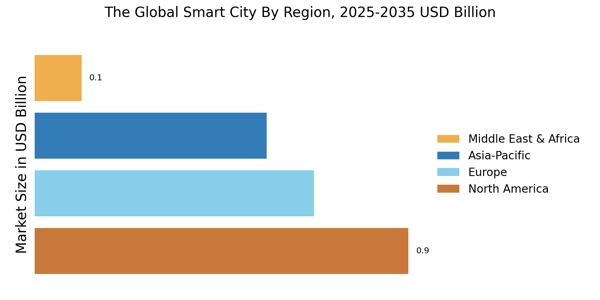
North America is the largest market for smart cities, holding approximately 40% of the global share. The region's growth is driven by significant investments in infrastructure, advanced technology adoption, and supportive government policies. Cities like New York and San Francisco are at the forefront, implementing smart solutions to enhance urban living. Regulatory frameworks promoting sustainability and innovation further catalyze market expansion. The competitive landscape is dominated by key players such as Cisco, IBM, and Siemens, who are actively involved in developing smart city technologies. The U.S. government has initiated various programs to support smart city projects, fostering collaboration between public and private sectors. This synergy is crucial for the successful implementation of smart solutions, ensuring that cities can meet the demands of their growing populations.

Europe : Sustainable Urban Development Focus

Europe is the second-largest market for smart cities, accounting for around 30% of the global market share. The region's growth is propelled by stringent environmental regulations and a strong emphasis on sustainability. Initiatives like the European Green Deal aim to make cities more sustainable and resilient, driving demand for smart technologies. Countries such as Germany and the Netherlands are leading the charge, implementing innovative solutions to enhance urban living. The competitive landscape features major players like Schneider Electric and Siemens, who are investing heavily in smart city projects. European cities are increasingly adopting integrated solutions that combine energy efficiency, mobility, and data analytics. The presence of robust regulatory frameworks encourages collaboration among stakeholders, ensuring that smart city initiatives align with broader sustainability goals.

Asia-Pacific : Rapid Urbanization and Growth

Asia-Pacific is witnessing rapid growth in the smart city market, holding approximately 25% of the global share. The region's urbanization trends and increasing population density are driving demand for smart solutions. Countries like China and India are investing heavily in smart city initiatives, supported by government policies aimed at improving urban infrastructure and quality of life. The focus on digital transformation and sustainability is further enhancing market dynamics. Leading countries in this region include China, which is home to numerous smart city projects, and India, which is implementing its Smart Cities Mission. The competitive landscape is characterized by the presence of key players like Huawei and Samsung, who are actively developing innovative technologies. The collaboration between government and private sectors is crucial for the successful implementation of smart city solutions, ensuring that they meet the needs of rapidly growing urban populations.

Middle East and Africa : Emerging Markets and Innovations

The Middle East and Africa region is emerging as a significant player in the smart city market, holding about 5% of the global share. The growth is driven by urbanization, government initiatives, and investments in technology. Countries like the UAE and South Africa are leading the way, implementing smart city projects that focus on sustainability and efficiency. The region's unique challenges, such as resource management, are also catalysts for smart solutions. In the competitive landscape, key players like Honeywell and Oracle are actively involved in developing smart city technologies tailored to local needs. The presence of government-backed initiatives encourages innovation and collaboration among stakeholders. As cities in this region continue to evolve, the demand for smart solutions is expected to rise, paving the way for future growth in the market.

Smart City Market Regional Image

Key Players and Competitive Insights

The Global Smart City is characterized by a dynamic competitive landscape, driven by rapid urbanization, technological advancements, and increasing demand for sustainable solutions. Key players such as Siemens (DE), Cisco (US), and IBM (US) are strategically positioned to leverage their technological expertise and innovative capabilities. Siemens (DE) focuses on integrating smart infrastructure with digital solutions, while Cisco (US) emphasizes connectivity and cybersecurity in urban environments. IBM (US) is heavily invested in data analytics and AI to enhance city management systems. Collectively, these strategies foster a competitive environment that prioritizes innovation and sustainability, shaping the future of urban living.In terms of business tactics, companies are increasingly localizing manufacturing and optimizing supply chains to enhance operational efficiency. The market structure appears moderately fragmented, with a mix of established players and emerging startups. This fragmentation allows for diverse solutions tailored to specific regional needs, while the collective influence of key players drives technological advancements and sets industry standards.

In August Siemens (DE) announced a partnership with a leading European city to implement a comprehensive smart mobility solution, integrating electric vehicle charging infrastructure with real-time traffic management systems. This strategic move not only enhances urban mobility but also aligns with sustainability goals, positioning Siemens as a leader in smart transportation solutions. The partnership underscores the importance of collaboration between technology providers and municipal authorities in addressing urban challenges.

In September Cisco (US) launched a new cybersecurity framework specifically designed for smart city applications, aimed at protecting critical infrastructure from cyber threats. This initiative reflects Cisco's commitment to ensuring the security of interconnected systems in urban environments. By prioritizing cybersecurity, Cisco strengthens its market position and addresses growing concerns regarding data privacy and system vulnerabilities in smart cities.

In July IBM (US) expanded its AI-driven analytics platform to include predictive maintenance solutions for urban infrastructure. This enhancement allows city planners to anticipate and mitigate potential failures in public services, thereby improving operational efficiency. IBM's focus on AI integration not only enhances its service offerings but also positions the company as a key player in the digital transformation of urban management.

As of October current competitive trends in The Global Smart City are heavily influenced by digitalization, sustainability, and AI integration. Strategic alliances among key players are increasingly shaping the landscape, fostering innovation and collaborative solutions. The shift from price-based competition to a focus on technological advancement and supply chain reliability is evident, suggesting that future differentiation will hinge on the ability to innovate and adapt to evolving urban challenges.

Key Companies in the Smart City Market include

Industry Developments

March 2024: Connected Urban is an innovative design to improve our streets’ connectivity, given the need for densification in 4G networks following the 5G rollout. It enables both macro cells and small cells to be within one compact footprint, thereby accommodating multi-faceted services such as antennas, CCTV systems, or even public address systems, including smart lighting, among others. This range is composed of sleek modular scalable smart poles that do more than just meet modern cities’ connectivity requirements since they are designed to support multiple services at once.

February 2024: NEC Corp India announced the launch of new smart city tech products for “organizations and authorities to manage operations efficiently”. The solutions include NEC Mi-Command (integrated command and control center), NEC Mi-City (citizen engagement portal), NEC Mi-Eye (intelligent video analytics), and NEC Mi-WareSync (warehouse management system). These solutions will ensure seamless operations among organizations and authorities by providing transparency and visibility for efficient management and decision-making, as well as offering enhanced experiences for citizens, businesses, communities, etc., according to a statement released by NEC Corp India.

February 2024: BT launched its new NB-IoT network, which is set to cover 97%* of the UK population, thus paving the way for more smart cities and industries. The network is supported by an award-winning EE mobile network.

With low-power wide-area technology, NB-IoT BT now provides an opportunity for utility construction in the public sector, among other fields where devices can be securely connected to automate processes still done manually or requiring direct involvement at the present moment; this will not only realize long battery life, but it can also save money because efficiency may increase significantly, especially when leaks are detected automatically from water infrastructure.

March 2023: AT&T has chosen Fortress Solutions as a partner to provide facilities management services for fiber optics, edge data centers, and 5G infrastructure as part of its ambition to build "the US' first 5G Smart City Market at scale" in Washington, DC.

October 2022: Honeywell and Accelerator for America unveiled the Honeywell Smart City Market Accelerator Program, which assists communities in strategically planning their futures and building capacity to support transformational initiatives. Honeywell is working with five cities including Kansas City, Louisville, San Diego, Cleveland, and Waterloo, among others in the United States to give in-kind assistance in order to speed the development of their Smart City Market strategy planning.

July 2021: Microsoft had planned to buy AT&T's network cloud technologies and intellectual property. In exchange, AT&T will relocate its 5G mobile network to Azure. The companies will begin with AT&T's 5G core and work their way up. The collaboration expands on an existing USD 2 billion agreement in which AT&T relocated its back-end office to Microsoft Azure.

Intended Audience

  • Smart City Market Hardware Manufacturers
  • Smart City Market Software Companies
  • Technology Investors
  • Regulatory Industries
  • Government Bodies
  • Manufacturing Industry
  • Environment Regulators
  • Smart City Market Operators
  • Others

Future Outlook

Smart City Market Future Outlook

The Global Smart City Market is projected to grow at 18.3% CAGR from 2025 to 2035, driven by urbanization, technological advancements, and sustainability initiatives.

New opportunities lie in:

  • Integration of AI-driven traffic management systems
  • Development of smart waste management solutions
  • Expansion of IoT-enabled public safety networks

By 2035, the market is expected to be robust, reflecting substantial advancements and investments in smart city technologies.

Market Segmentation

Smart City Market Component Outlook

  • Hardware
  • Software
  • Services

Smart City Market Application Outlook

  • Utility
  • Transport
  • Government
  • Residential

Smart City Market Sales Channel Outlook

  • OEM
  • Aftermarket

Report Scope

MARKET SIZE 2024 2.37(USD Billion)
MARKET SIZE 2025 2.804(USD Billion)
MARKET SIZE 2035 15.05(USD Billion)
COMPOUND ANNUAL GROWTH RATE (CAGR) 18.3% (2025 - 2035)
REPORT COVERAGE Revenue Forecast, Competitive Landscape, Growth Factors, and Trends
BASE YEAR 2024
Market Forecast Period 2025 - 2035
Historical Data 2019 - 2024
Market Forecast Units USD Billion
Key Companies Profiled Siemens (DE), Cisco (US), IBM (US), Schneider Electric (FR), Honeywell (US), Microsoft (US), Oracle (US), Huawei (CN), Samsung (KR)
Segments Covered Component
Key Market Opportunities Integration of Internet of Things (IoT) solutions enhances urban infrastructure efficiency in The Global Smart City.
Key Market Dynamics Rising demand for sustainable urban solutions drives innovation and investment in smart city technologies and infrastructure.
Countries Covered North America, Europe, APAC, South America, MEA

Market Highlights

Author
Author
Author Profile
Nirmit Biswas LinkedIn
Senior Research Analyst
With 5+ years of expertise in Market Intelligence and Strategic Research, Nirmit Biswas specializes in ICT, Semiconductors, and BFSI. Backed by an MBA in Financial Services and a Computer Science foundation, Nirmit blends technical depth with business acumen. He has successfully led 100+ projects for global enterprises and startups, including Amazon, Cisco, L&T and Huawei, delivering market estimations, competitive benchmarking, and GTM strategies. His focus lies in transforming complex data into clear, actionable insights that drive growth, innovation, and investment decisions. Recognized for bridging engineering innovation with executive strategy, Nirmit helps businesses navigate dynamic markets with confidence.
Co-Author
Co-Author Profile
Aarti Dhapte LinkedIn
AVP - Research
A consulting professional focused on helping businesses navigate complex markets through structured research and strategic insights. I partner with clients to solve high-impact business problems across market entry strategy, competitive intelligence, and opportunity assessment. Over the course of my experience, I have led and contributed to 100+ market research and consulting engagements, delivering insights across multiple industries and geographies, and supporting strategic decisions linked to $500M+ market opportunities. My core expertise lies in building robust market sizing, forecasting, and commercial models (top-down and bottom-up), alongside deep-dive competitive and industry analysis. I have played a key role in shaping go-to-market strategies, investment cases, and growth roadmaps, enabling clients to make confident, data-backed decisions in dynamic markets.
Leave a Comment

FAQs

What is the projected market valuation of The Global Smart City by 2035?

The projected market valuation for The Global Smart City is expected to reach 15.05 USD Billion by 2035.

What was the market valuation of The Global Smart City in 2024?

The overall market valuation of The Global Smart City was 2.37 USD Billion in 2024.

What is the expected CAGR for The Global Smart City during the forecast period 2025 - 2035?

The expected CAGR for The Global Smart City during the forecast period 2025 - 2035 is 18.3%.

Which companies are considered key players in The Global Smart City?

Key players in The Global Smart City include Siemens, Cisco, IBM, Schneider Electric, Honeywell, Microsoft, Oracle, Huawei, and Samsung.

What are the main components of The Global Smart City and their valuations?

The main components include Hardware valued at 3.5 USD Billion, Software at 5.0 USD Billion, and Services at 6.55 USD Billion.

How does the valuation of the Utility application segment compare to others in The Global Smart City?

The Utility application segment is valued at 3.2 USD Billion, which is lower than Transport at 4.5 USD Billion and Government at 5.0 USD Billion.

What is the valuation of the Residential application segment in The Global Smart City?

The Residential application segment is valued at 2.35 USD Billion.

What are the sales channels in The Global Smart City and their respective valuations?

The sales channels include OEM valued at 7.45 USD Billion and Aftermarket at 7.6 USD Billion.

How does the Smart City Market's growth potential appear in comparison to its current valuation?

The Smart City Market's growth potential appears robust, with a projected increase from 2.37 USD Billion in 2024 to 15.05 USD Billion by 2035.

What trends might influence the development of The Global Smart City in the coming years?

Trends such as increased urbanization, technological advancements, and government initiatives may influence the development of The Global Smart City.

Research Approach

Secondary Research

The secondary research process involved comprehensive analysis of regulatory databases, peer-reviewed technology journals, government policy documents, and authoritative urban development organizations. Key sources included the US Department of Transportation (USDOT), National Institute of Standards and Technology (NIST) Smart Grid and Cybersecurity Divisions, European Commission Directorate-General for Regional and Urban Policy, European Committee for Standardization (CEN/CENELEC), International Telecommunication Union (ITU), International Organization for Standardization (ISO) Technical Committee 268 (Sustainable Cities and Communities), United Nations Human Settlements Programme (UN-Habitat), World Bank Group - Urban Development & Smart Cities Initiative, International Energy Agency (IEA), Organisation for Economic Co-operation and Development (OECD) Urban Policy Programme, C40 Cities Climate Leadership Group, Smart Cities Council, IEEE Standards Association, American Society of Civil Engineers (ASCE), National League of Cities (NLC), Eurostat - Urban Audit Database, UNESCO Institute for Statistics, World Economic Forum (WEF) Global Future Council on Cities and Urbanization, International Association of Public Transport (UITP), and national digital transformation reports from key markets (e.g., India's Smart Cities Mission, UAE Dubai Smart City Strategy, China National New-Type Urbanization Plan). These sources were used to collect smart infrastructure investment data, regulatory approval frameworks, IoT deployment statistics, urban demographic trends, sustainability metrics, and competitive landscape analysis for smart utility solutions, intelligent transportation systems, smart governance platforms, and integrated urban management technologies.

Primary Research

Qualitative and quantitative insights were obtained by interviewing supply-side and demand-side stakeholders during the primary research process. The supply-side sources consist of CEOs, CTOs, VPs of Product Development, chiefs of Government Affairs, and commercial directors from system integrators, IoT platform vendors, and smart infrastructure providers. Municipal CIOs, urban planners, smart city program directors, infrastructure procurement leads from city governments, transit authority executives, and facility management chiefs from commercial real estate developers were among the demand-side sources. Market segmentation was validated, public-private partnership timelines were confirmed, and insights regarding technology adoption patterns, procurement strategies, and public financing dynamics were obtained through primary research.

Primary Respondent Breakdown:

By Designation: C-level Primaries (32%), Director Level (31%), Others (37%)

By Region: North America (32%), Europe (30%), Asia-Pacific (28%), Rest of World (10%)

Market Size Estimation

Global market valuation was derived through revenue mapping and deployment volume analysis. The methodology included:

Identification of 55+ key technology providers and infrastructure vendors across North America, Europe, Asia-Pacific, Middle East & Africa, and Latin America

Product mapping across smart metering, intelligent transportation systems, smart lighting, urban data platforms, IoT sensors, and integrated command & control solutions

Analysis of reported and modeled annual revenues specific to smart city solution portfolios

Coverage of manufacturers and service providers representing 75-80% of global market share in 2024

Extrapolation using bottom-up (deployment volume × ASP by city tier/country) and top-down (vendor revenue validation) approaches to derive segment-specific valuations across hardware, software, and services categories

Download Free Sample

Kindly complete the form below to receive a free sample of this Report

Compare Licence

×
Features License Type
Single User Multiuser License Enterprise User
Price $4,950 $5,950 $7,250
Maximum User Access Limit 1 User Upto 10 Users Unrestricted Access Throughout the Organization
Free Customization
Direct Access to Analyst
Deliverable Format
Platform Access
Discount on Next Purchase 10% 15% 15%
Printable Versions