
Request Free Sample ×

Kindly complete the form below to receive a free sample of this Report

* Please use a valid business email

Leading companies partner with us for data-driven Insights

clients tt-cursor
Hero Background
English
Chinese
French
Japanese
Korean
German
Spanish

Smart Airport Market Trends

ID: MRFR/AD/4426-HCR
100 Pages
Shubham Munde
April 2026

Smart Airport Market Size, Share, Industry Trend & Analysis Research Report Information By Technology (Security Systems, Communication Systems, Cargo Baggage Handling Control, Air/Ground Traffic Control, Passenger, Endpoint Devices, and Others), By Application (Aeronautical Operations And Non-aeronautical Operations), By Terminal Type (Baggage Handling, Check-in Systems, Building Operations, and Sustainable Energy Management), By Airside (ATM, Resource Management, Aircraft Parking, Aircraft Maintenance) By Region –Forecast 2030.

Share:
Download PDF ×

We do not share your information with anyone. However, we may send you emails based on your report interest from time to time. You may contact us at any time to opt-out.

Smart Airport Market Infographic
Purchase Options

Market Trends

Key Emerging Trends in the Smart Airport Market

In the fiercely competitive landscape of the Smart Airport market, market share positioning strategies play a pivotal role in determining the success and prominence of industry players. One core strategy is centered around technological leadership and innovation. Companies that invest heavily in research and development to pioneer cutting-edge solutions, such as advanced biometrics, Artificial Intelligence (AI), and Internet of Things (IoT) applications, position themselves as industry leaders. By continuously pushing the boundaries of technological capabilities, these companies not only differentiate themselves but also attract clients seeking the most advanced and future-proof smart airport solutions.

Strategic collaborations and partnerships are instrumental in market share positioning within the Smart Airport sector. Forming alliances with other industry players, technology providers, and airport stakeholders creates synergies that lead to integrated and comprehensive solutions. Smart airport ecosystems thrive on interoperability, and companies that foster collaborations position themselves as holistic solution providers capable of addressing diverse operational needs. These partnerships often extend beyond technological collaborations to include joint marketing efforts, shared resources, and a combined approach to industry challenges.

A customer-centric approach is another effective market share positioning strategy. Understanding the specific needs and pain points of airport operators and passengers allows companies to tailor their solutions accordingly. User-friendly interfaces, seamless integration with existing airport infrastructure, and a focus on enhancing the passenger experience contribute to market differentiation. Companies that prioritize customer satisfaction and engagement often build long-lasting relationships, leading to customer loyalty and positive word-of-mouth referrals.

Strategic marketing and branding efforts are critical components of market share positioning in the Smart Airport market. Establishing a strong brand presence through targeted marketing campaigns, thought leadership, and participation in industry events contributes to market visibility. A compelling and distinct brand image that communicates innovation, reliability, and a commitment to excellence can influence customer perceptions and preferences, ultimately contributing to a larger market share.

Cost leadership is a significant strategy for market positioning, especially in an industry where cost-effectiveness is a critical consideration for airport operators. Companies that offer competitive pricing without compromising the quality and performance of their solutions gain a competitive advantage. The ability to deliver cost-efficient smart airport solutions positions these companies favorably, particularly in regions with budget constraints and cost-sensitive procurement practices.

Regulatory compliance is a fundamental aspect of market share positioning in the Smart Airport sector. Adherence to national and international regulations, safety standards, and privacy laws is not only a legal requirement but also a key factor in gaining the trust of airport authorities and stakeholders. Companies that demonstrate a commitment to compliance and ethical business practices position themselves as reliable and responsible partners in the development and implementation of smart airport solutions.

The ability to customize and adapt solutions to the unique requirements of different airports is a strategic market positioning approach. Smart airports vary in size, infrastructure, and operational needs, and companies that offer flexible and scalable solutions gain an advantage. The capacity to tailor products and services to the specific demands of diverse airports positions a company as adaptable and capable of addressing the nuanced challenges of different markets.

Strategic geographical positioning and global presence contribute to market share strategies in the Smart Airport industry. Establishing a strong international footprint allows companies to access diverse markets, respond effectively to global trends, and address region-specific challenges. Regional partnerships and a deep understanding of local regulations and cultural nuances enhance a company's ability to position itself as a global player capable of meeting the varied demands of smart airport implementations worldwide.


Author
Author Profile
Shubham Munde
Team Lead - Research

Shubham brings over 7 years of expertise in Market Intelligence and Strategic Consulting, with a strong focus on the Automotive, Aerospace, and Defense sectors. Backed by a solid foundation in semiconductors, electronics, and software, he has successfully delivered high-impact syndicated and custom research on a global scale. His core strengths include market sizing, forecasting, competitive intelligence, consumer insights, and supply chain mapping. Widely recognized for developing scalable growth strategies, Shubham empowers clients to navigate complex markets and achieve a lasting competitive edge. Trusted by start-ups and Fortune 500 companies alike, he consistently converts challenges into strategic opportunities that drive sustainable growth.

Leave a Comment

FAQs

What is the projected market valuation of the Smart Airport Market by 2035?

<p>The Smart Airport Market is projected to reach a valuation of 189.95 USD Billion by 2035.</p>

What was the market valuation of the Smart Airport Market in 2024?

<p>In 2024, the Smart Airport Market was valued at 48.57 USD Billion.</p>

What is the expected CAGR for the Smart Airport Market during the forecast period 2025 - 2035?

<p>The expected CAGR for the Smart Airport Market during the forecast period 2025 - 2035 is 13.2%.</p>

Which companies are considered key players in the Smart Airport Market?

<p>Key players in the Smart Airport Market include Siemens, Honeywell, Thales, Cisco Systems, Amadeus IT Group, SITA, IBM, Indra Sistemas, and Rockwell Collins.</p>

What are the major segments of the Smart Airport Market?

<p>The major segments of the Smart Airport Market include Technology, Application, Terminal Type, and Airside.</p>

How much is the Communication Systems segment expected to grow by 2035?

<p>The Communication Systems segment is expected to grow from 10.0 USD Billion to 40.0 USD Billion by 2035.</p>

What is the projected growth for the Baggage Handling segment by 2035?

<p>The Baggage Handling segment is projected to increase from 10.0 USD Billion to 39.0 USD Billion by 2035.</p>

What is the expected valuation for Aeronautical Operations by 2035?

<p>Aeronautical Operations is expected to grow from 24.29 USD Billion to 94.98 USD Billion by 2035.</p>

What is the anticipated growth for Sustainable Energy Management in the Smart Airport Market?

<p>Sustainable Energy Management is anticipated to grow from 15.57 USD Billion to 60.95 USD Billion by 2035.</p>

How does the Smart Airport Market's growth compare to other sectors?

<p>The Smart Airport Market's growth appears robust, with a projected valuation increase from 48.57 USD Billion in 2024 to 189.95 USD Billion by 2035.</p>

Market Summary

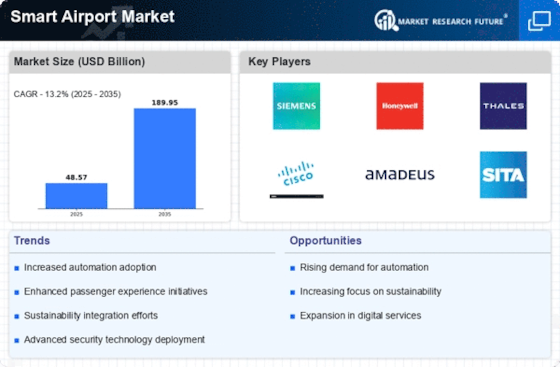
As per Market Research Future analysis, the Smart Airport Market Size was estimated at 48.57 USD Billion in 2024. The Smart Airport industry is projected to grow from 54.98 USD Billion in 2025 to 189.95 USD Billion by 2035, exhibiting a compound annual growth rate (CAGR) of 13.2% during the forecast period 2025 - 2035

Key Market Trends & Highlights

The Smart Airport Market is poised for substantial growth driven by technological advancements and evolving passenger expectations.

  • North America remains the largest market for smart airports, characterized by significant investments in advanced technologies. Asia-Pacific is emerging as the fastest-growing region, with rapid adoption of smart solutions to enhance airport efficiency. Security systems dominate the market, while passenger endpoint devices are witnessing the fastest growth due to increasing demand for seamless travel experiences. Key market drivers include the rising emphasis on automation and security enhancements, which are crucial for meeting modern passenger needs.

Market Size & Forecast

2024 Market Size 48.57 (USD Billion)
2035 Market Size 189.95 (USD Billion)
CAGR (2025 - 2035) 13.2%
Largest Regional Market Share in 2024 North America

Major Players

Siemens (DE), Honeywell (US), Thales (FR), Cisco Systems (US), Amadeus IT Group (ES), SITA (CH), IBM (US), Indra Sistemas (ES), Rockwell Collins (US)

Market Trends

The Smart Airport Market is currently experiencing a transformative phase, driven by advancements in technology and a growing emphasis on enhancing passenger experience. Airports are increasingly adopting smart technologies to streamline operations, improve security, and facilitate seamless travel. Innovations such as biometric screening, automated baggage handling, and real-time data analytics are becoming commonplace, allowing airports to operate more efficiently and respond to passenger needs more effectively. This shift towards digitization not only enhances operational efficiency but also fosters a more enjoyable travel experience for passengers, who are increasingly seeking convenience and personalization in their journeys. These developments strongly reflect emerging smart airport market trends shaping the industry.

Moreover, the integration of Internet of Things (IoT) devices and artificial intelligence (AI) is reshaping the landscape of airport management. These technologies enable airports to gather and analyze vast amounts of data, leading to informed decision-making and proactive service delivery. As sustainability becomes a focal point for many industries, the Smart Airport Market is also witnessing a push towards eco-friendly practices, with airports exploring renewable energy sources and waste reduction strategies, including innovations linked with the airport smart lighting market. This multifaceted evolution suggests that the Smart Airport Market is poised for continued growth, as stakeholders recognize the potential benefits of investing in smart infrastructure and technology.

Enhanced Passenger Experience

The Smart Airport Market is increasingly focused on improving the overall passenger journey. Technologies such as mobile applications, self-service kiosks, and personalized notifications are being implemented to provide travelers with real-time information and streamline processes. This trend indicates a shift towards a more customer-centric approach, where convenience and satisfaction are prioritized across the global smart airport market.

Integration of Advanced Technologies

The adoption of advanced technologies, including AI and IoT, is becoming a hallmark of the Smart Airport Market. These innovations facilitate better data management and operational efficiency, allowing airports to optimize resource allocation and enhance security measures. This trend suggests a growing reliance on technology to address the complexities of modern air travel.

Sustainability Initiatives

Sustainability is emerging as a critical focus within the Smart Airport Market. Airports are exploring various eco-friendly practices, such as energy-efficient systems and waste management solutions, to reduce their environmental impact. This trend reflects a broader commitment to sustainability, as stakeholders recognize the importance of aligning with global environmental goals.

Smart Airport Market Market Drivers

Rise of Smart Technologies

The rise of smart technologies is a defining characteristic of the Smart Airport Market. Innovations such as Internet of Things (IoT) devices, artificial intelligence, and mobile applications are reshaping the airport experience. These technologies facilitate real-time communication between passengers and airport services, enhancing convenience and efficiency. For instance, IoT-enabled baggage tracking systems have reduced lost luggage incidents by 15%. As these technologies become more sophisticated, they are likely to play a crucial role in the evolution of the Smart Airport Market, driving further investment and development.

Integration of Data Analytics

The integration of data analytics is transforming operations within the Smart Airport Market. Airports are leveraging big data to optimize resource allocation, enhance operational efficiency, and improve passenger experiences. By analyzing passenger flow and operational data, airports can make informed decisions that lead to better service delivery. Recent findings indicate that airports utilizing data analytics have improved their operational efficiency by 20%. This trend is expected to continue, as the Smart Airport Market increasingly relies on data-driven insights to navigate the complexities of modern air travel.

Focus on Security Enhancements

Security remains a paramount concern within the Smart Airport Market. The rise in global travel has necessitated the implementation of advanced security measures to ensure passenger safety. Technologies such as biometric screening and AI-driven surveillance systems are becoming increasingly prevalent. Recent statistics indicate that airports investing in these technologies have seen a 25% decrease in security-related incidents. This focus on security not only enhances passenger confidence but also drives investment in the Smart Airport Market, as stakeholders seek to adopt cutting-edge solutions to safeguard travelers.

Increased Demand for Automation

The Smart Airport Market is experiencing a notable surge in demand for automation technologies. Airports are increasingly adopting automated systems to streamline operations, enhance efficiency, and reduce human error. This trend is driven by the need for faster processing times and improved passenger experiences. According to recent data, the implementation of automated check-in kiosks and baggage handling systems has led to a 30% reduction in wait times at major airports. As a result, the Smart Airport Market is projected to grow significantly, with automation technologies expected to account for a substantial share of the market by 2026.

Growing Emphasis on Sustainability

Sustainability initiatives are gaining traction within the Smart Airport Market, as stakeholders recognize the importance of reducing environmental impact. Airports are increasingly investing in green technologies, such as energy-efficient lighting and renewable energy sources. Data suggests that airports implementing sustainable practices have reduced their carbon footprints by up to 40%. This shift towards sustainability not only aligns with global environmental goals but also attracts eco-conscious travelers, thereby enhancing the overall appeal of the Smart Airport Market. As regulations become stricter, the demand for sustainable solutions is likely to rise.

Market Segment Insights

By Technology: Security Systems (Largest) vs. Passenger Endpoint Devices (Fastest-Growing)

In the Smart Airport Market, Security Systems dominate the technology segment, representing a significant portion of total market share. This encompasses advanced surveillance, screening, and access control systems that are essential for ensuring the safety of passengers and airport facilities. Following Security Systems, Passenger Endpoint Devices are gaining traction due to the increasing demand for self-service solutions and enhanced passenger experiences.

Technology: Security Systems (Dominant) vs. Passenger Endpoint Devices (Emerging)

Security Systems are characterized by their comprehensive nature, incorporating video surveillance, biometrics, and integrated alarm systems, thus fulfilling critical safety requirements. They are essential in managing risk and responding to potential threats in real-time. In contrast, Passenger Endpoint Devices, including kiosks and mobile applications, have emerged as innovative solutions designed to streamline processes and enhance user engagement. The rapid technological advancements and changing consumer behavior favor the rise of these devices, making them pivotal for future airport operations.

By Application: Aeronautical Operations (Largest) vs. Non-aeronautical Operations (Fastest-Growing)

In the Smart Airport Market, aeronautical operations hold the largest share, encompassing crucial elements such as <a href="https://www.marketresearchfuture.com/reports/air-traffic-management-market-6775" target="_blank" rel="noopener">air traffic management</a>, baggage handling, and passenger processing. This segment benefits from continuous technological enhancements that streamline operational efficiency and improve the passenger experience. On the other hand, non-aeronautical operations, which include retail services, advertising, and parking solutions, are rapidly growing, reflecting a shift towards enhanced revenue generation strategies beyond traditional aeronautical services.

Operations: Aeronautical (Dominant) vs. Non-aeronautical (Emerging)

Aeronautical operations are characterized by their essential role in maintaining safety and efficiency within airport environments. This segment includes systems for <a href="https://www.marketresearchfuture.com/reports/air-traffic-market-33794" target="_blank" rel="noopener">air traffic</a> control, ground handling, and passenger boarding processes, all critical to airport functionality. Conversely, non-aeronautical operations are emerging as a critical revenue driver, leveraging digital advancements to create innovative services and enhance customer engagement. These operations often involve retail partnerships and amenities that target the passenger experience, leading to increased airport revenues and the prospect of developing integrated service offerings that appeal to a broader audience.

By Terminal Type: Baggage Handling (Largest) vs. Check-in Systems (Fastest-Growing)

In the Smart Airport Market, the terminal type segment is primarily driven by Baggage Handling systems, which command the largest market share due to their critical role in enhancing operational efficiency and passenger experience. Check-in Systems are also significantly substantial, yet they hold the position of the fastest-growing segment, propelled by advancements in automation and customer-centric technology. This dynamic is changing the landscape of ground handling operations as airports prioritize efficiency in passenger processing.

Baggage Handling (Dominant) vs. Check-in Systems (Emerging)

Baggage Handling systems in the Smart Airport Market dominate due to their integral function in managing the complex flow of luggage, a core focus for operational improvement. Their reliability and efficiency directly impact passenger satisfaction. Meanwhile, Check-in Systems are emerging with innovative solutions that leverage self-service technology and mobile applications, enhancing user experience by facilitating quicker processing times. This duality in the segment showcases a shift towards integrating technology to meet evolving traveler expectations, while also maintaining robust traditional practices.

By Airside: Resource Management (Largest) vs. Aircraft Maintenance (Fastest-Growing)

In the Smart Airport Market's Airside segment, Resource Management solutions take the lead with the largest market share, reflecting their critical role in optimizing airport operations. This dominance is attributed to the reliance on efficient resource allocation like gate assignments, staffing, and schedule management which are integral to airport functionality. Aircraft Maintenance follows closely as it becomes increasingly essential given the growing emphasis on safety, reliability, and regulatory compliance, making it a fundamental area for investment and technological advancement.

Resource Management (Dominant) vs. Aircraft Maintenance (Emerging)

Resource Management solutions dominate the Airside segment of the Smart Airport Market, characterized by their extensive application in enhancing operational efficiency and overall <a href="https://www.marketresearchfuture.com/reports/airport-management-market-4267" target="_blank" rel="noopener">airport management</a>. Key features include real-time tracking of assets, workforce optimization, and streamlined processes that help in reducing delays and improving passenger experience. On the other hand, Aircraft Maintenance is emerging as a vital area due to heightened safety regulations and the need for predictive maintenance technologies. This segment sees growing investment in IoT and AI technologies to ensure aircraft readiness and operational safety, thus elevating the maintenance sector to a critical component of airport operations.

Get more detailed insights about Smart Airport Market Research Report - Forecast till 2035

Regional Insights

By Region, the study provides market insights into North America, Europe, Asia-Pacific and the Rest of the World. The North America Smart Airport Market will dominate this market. The U. S. has recently increased spending on updating its airport systems significantly. Additionally, significant manufacturers like Honeywell International Inc. and Raytheon Technologies Inc. drive market growth in the U.S. and governmental organizations like the Transportation Security Administration (TSA). S. Furthermore, the Hartsfield-Jackson Atlanta International Airport (ATL), the largest international airport in the world, will help this region's market growth.

Further, the major countries studied in the market report are The U.S., Canada, German, France, the UK, Italy, Spain, China, Japan, India, Australia, South Korea, and Brazil.

Figure 2 SMART AIRPORT MARKET SHARE BY REGION 2022 (%)

Europe’s Smart Airport Market accounts for the second-largest market share due to the significant investments in replacing outdated systems with more modern ones and the anticipated demand for smart and environmentally friendly airports in the coming years. These airports' cyber-security-based systems are actively being designed, developed, and implemented by the European Union Agency for Cyber-Security (EUAC). It will accelerate market expansion in this area. Further, the German Smart Airport Market held the largest market share, and the UK Smart Airport Market was the fastest-growing market in the European region.

The Asia Pacific, Smart Airport Market, is expected to grow at the fastest CAGR from 2023 to 2030 during the forecast period and is anticipated to have the fastest growth. Due to a significant increase in air traffic in nations like China, Singapore, and India, the region is anticipated to experience strong market growth during the forecast period. The region is anticipated to experience market growth over the long term. Moreover, the India Smart Airport Market held the largest market share, and the China Smart Airport Market was the fastest-growing market in the Asia Pacific region.

Key Players and Competitive Insights

Leading market players are investing heavily in research and development to expand their product lines, which will help the Smart Airport Market grow even more. Market participants are also undertaking various strategic activities to expand their  footprint, with important market developments including new product launches, contractual agreements, mergers and acquisitions, higher investments, and collaboration with other organizations. To expand and survive in a more competitive and rising market climate, the Smart Airport industry must offer cost-effective items.Manufacturing locally to minimize operational costs is one of the key business tactics manufacturers use in the  Smart Airport industry to benefit clients and increase the market sector. The Smart Airport industry has recently offered some of the most significant medical advantages. Major players in the Smart Airport Market, including Honeywell Corporation Inc, Collins Aerospace, SITA, Siemens AG, IBM Corporation, Cisco Systems Inc, Raytheon Company, Kiewit, Larsen &Toubro Amadeus IT Group SA and others, are attempting to increase market demand by investing in research and development operations.IBM Corporation With its headquarters in Armonk, New York, and operations in more than 175 nations, International Business Machines Corporation (IBM), also known as Big Blue, is an American multinational technology company. It focuses on computer hardware, middleware, and software and offers to host and consult services in fields like mainframe computing and nanotechnology. With 19 research facilities spread across 12 nations, IBM is the largest industrial research organization in the world and has held the record for the most annual U.S. S. patents produced by a company for 29 years, from 1993 to 2021.Cisco Systems Inc is a multinational corporation with a San Jose, California, headquarters that deals in digital communications technology. Cisco creates, produces, and markets networking hardware, software, telecommunications gear, and other high-tech services and goods. Cisco is an industry leader in niche tech markets, including the Internet of Things (IoT), domain security, videoconferencing, and energy management. Some of its top products include Webex, OpenDNS, Jabber, Duo Security, and Jasper. With over $51 billion in revenue and close to 80,000 employees, Cisco ranks as one of the top 100 technology companies in the world.

Key Companies in the Smart Airport Market include

Industry Developments

For instance, September 2022 Self-service bag drop machines and facial recognition technology will be implemented at Tokyo's Narita Airport, according to a plan announced by Japan Airlines (JAL) in October 2019. This technology's introduction will reduce the time it takes to board an aircraft.

For instance, August 2021 The second stage of the ground-breaking smart airport program at Hamad International Airport (HIA) has begun. Facial biometric recognition across all significant passenger locations is a key component of this program's focus on the digital transformation of the passenger's journey.

Future Outlook

Smart Airport Market Future Outlook

The Smart Airport Market is projected to grow at a 13.2% CAGR from 2025 to 2035, driven by technological advancements, increased passenger traffic, and enhanced operational efficiency.

New opportunities lie in:

  • <p>Integration of AI-driven predictive maintenance systems Development of autonomous baggage handling solutions Implementation of advanced biometric security technologies</p>

By 2035, the Smart Airport Market is expected to be robust, driven by innovation and efficiency.

Market Segmentation

Smart Airport Market Airside Outlook

  • ATM
  • Resource Management
  • Aircraft Parking
  • Aircraft Maintenance

Smart Airport Market Technology Outlook

  • Security Systems
  • Communication Systems
  • Cargo & Baggage Handling Control
  • Air/Ground Traffic Control
  • Passenger Endpoint Devices
  • Other

Smart Airport Market Application Outlook

  • Aeronautical Operations
  • Non-aeronautical Operations

Smart Airport Market Terminal Type Outlook

  • Baggage Handling
  • Check-in Systems
  • Building Operations
  • Sustainable Energy Management

Report Scope

MARKET SIZE 2024 48.57(USD Billion)
MARKET SIZE 2025 54.98(USD Billion)
MARKET SIZE 2035 189.95(USD Billion)
COMPOUND ANNUAL GROWTH RATE (CAGR) 13.2% (2025 - 2035)
REPORT COVERAGE Revenue Forecast, Competitive Landscape, Growth Factors, and Trends
BASE YEAR 2024
Market Forecast Period 2025 - 2035
Historical Data 2019 - 2024
Market Forecast Units USD Billion
Key Companies Profiled Siemens (DE), Honeywell (US), Thales (FR), Cisco Systems (US), Amadeus IT Group (ES), SITA (CH), IBM (US), Indra Sistemas (ES), Rockwell Collins (US)
Segments Covered Technology, Application, Terminal Type, Airside, Region –Forecast 2030.
Key Market Opportunities Integration of advanced biometrics and automation enhances passenger experience in the Smart Airport Market.
Key Market Dynamics Technological advancements drive competitive forces, enhancing operational efficiency and passenger experience in the Smart Airport Market.
Countries Covered North America, Europe, APAC, South America, MEA

FAQs

What is the projected market valuation of the Smart Airport Market by 2035?

<p>The Smart Airport Market is projected to reach a valuation of 189.95 USD Billion by 2035.</p>

What was the market valuation of the Smart Airport Market in 2024?

<p>In 2024, the Smart Airport Market was valued at 48.57 USD Billion.</p>

What is the expected CAGR for the Smart Airport Market during the forecast period 2025 - 2035?

<p>The expected CAGR for the Smart Airport Market during the forecast period 2025 - 2035 is 13.2%.</p>

Which companies are considered key players in the Smart Airport Market?

<p>Key players in the Smart Airport Market include Siemens, Honeywell, Thales, Cisco Systems, Amadeus IT Group, SITA, IBM, Indra Sistemas, and Rockwell Collins.</p>

What are the major segments of the Smart Airport Market?

<p>The major segments of the Smart Airport Market include Technology, Application, Terminal Type, and Airside.</p>

How much is the Communication Systems segment expected to grow by 2035?

<p>The Communication Systems segment is expected to grow from 10.0 USD Billion to 40.0 USD Billion by 2035.</p>

What is the projected growth for the Baggage Handling segment by 2035?

<p>The Baggage Handling segment is projected to increase from 10.0 USD Billion to 39.0 USD Billion by 2035.</p>

What is the expected valuation for Aeronautical Operations by 2035?

<p>Aeronautical Operations is expected to grow from 24.29 USD Billion to 94.98 USD Billion by 2035.</p>

What is the anticipated growth for Sustainable Energy Management in the Smart Airport Market?

<p>Sustainable Energy Management is anticipated to grow from 15.57 USD Billion to 60.95 USD Billion by 2035.</p>

How does the Smart Airport Market's growth compare to other sectors?

<p>The Smart Airport Market's growth appears robust, with a projected valuation increase from 48.57 USD Billion in 2024 to 189.95 USD Billion by 2035.</p>

  1. SECTION I: EXECUTIVE SUMMARY AND KEY HIGHLIGHTS
    1. | 1.1 EXECUTIVE SUMMARY
    2. | | 1.1.1 Market Overview
    3. | | 1.1.2 Key Findings
    4. | | 1.1.3 Market Segmentation
    5. | | 1.1.4 Competitive Landscape
    6. | | 1.1.5 Challenges and Opportunities
    7. | | 1.1.6 Future Outlook
  2. SECTION II: SCOPING, METHODOLOGY AND MARKET STRUCTURE
    1. | 2.1 MARKET INTRODUCTION
    2. | | 2.1.1 Definition
    3. | | 2.1.2 Scope of the study
    4. | | | 2.1.2.1 Research Objective
    5. | | | 2.1.2.2 Assumption
    6. | | | 2.1.2.3 Limitations
    7. | 2.2 RESEARCH METHODOLOGY
    8. | | 2.2.1 Overview
    9. | | 2.2.2 Data Mining
    10. | | 2.2.3 Secondary Research
    11. | | 2.2.4 Primary Research
    12. | | | 2.2.4.1 Primary Interviews and Information Gathering Process
    13. | | | 2.2.4.2 Breakdown of Primary Respondents
    14. | | 2.2.5 Forecasting Model
    15. | | 2.2.6 Market Size Estimation
    16. | | | 2.2.6.1 Bottom-Up Approach
    17. | | | 2.2.6.2 Top-Down Approach
    18. | | 2.2.7 Data Triangulation
    19. | | 2.2.8 Validation
  3. SECTION III: QUALITATIVE ANALYSIS
    1. | 3.1 MARKET DYNAMICS
    2. | | 3.1.1 Overview
    3. | | 3.1.2 Drivers
    4. | | 3.1.3 Restraints
    5. | | 3.1.4 Opportunities
    6. | 3.2 MARKET FACTOR ANALYSIS
    7. | | 3.2.1 Value chain Analysis
    8. | | 3.2.2 Porter's Five Forces Analysis
    9. | | | 3.2.2.1 Bargaining Power of Suppliers
    10. | | | 3.2.2.2 Bargaining Power of Buyers
    11. | | | 3.2.2.3 Threat of New Entrants
    12. | | | 3.2.2.4 Threat of Substitutes
    13. | | | 3.2.2.5 Intensity of Rivalry
    14. | | 3.2.3 COVID-19 Impact Analysis
    15. | | | 3.2.3.1 Market Impact Analysis
    16. | | | 3.2.3.2 Regional Impact
    17. | | | 3.2.3.3 Opportunity and Threat Analysis
  4. SECTION IV: QUANTITATIVE ANALYSIS
    1. | 4.1 Aerospace & Defense, BY Technology (USD Billion)
    2. | | 4.1.1 Security Systems
    3. | | 4.1.2 Communication Systems
    4. | | 4.1.3 Cargo & Baggage Handling Control
    5. | | 4.1.4 Air/Ground Traffic Control
    6. | | 4.1.5 Passenger Endpoint Devices
    7. | | 4.1.6 Other
    8. | 4.2 Aerospace & Defense, BY Application (USD Billion)
    9. | | 4.2.1 Aeronautical Operations
    10. | | 4.2.2 Non-aeronautical Operations
    11. | 4.3 Aerospace & Defense, BY Terminal Type (USD Billion)
    12. | | 4.3.1 Baggage Handling
    13. | | 4.3.2 Check-in Systems
    14. | | 4.3.3 Building Operations
    15. | | 4.3.4 Sustainable Energy Management
    16. | 4.4 Aerospace & Defense, BY Airside (USD Billion)
    17. | | 4.4.1 ATM
    18. | | 4.4.2 Resource Management
    19. | | 4.4.3 Aircraft Parking
    20. | | 4.4.4 Aircraft Maintenance
    21. | 4.5 Aerospace & Defense, BY Region (USD Billion)
    22. | | 4.5.1 North America
    23. | | | 4.5.1.1 US
    24. | | | 4.5.1.2 Canada
    25. | | 4.5.2 Europe
    26. | | | 4.5.2.1 Germany
    27. | | | 4.5.2.2 UK
    28. | | | 4.5.2.3 France
    29. | | | 4.5.2.4 Russia
    30. | | | 4.5.2.5 Italy
    31. | | | 4.5.2.6 Spain
    32. | | | 4.5.2.7 Rest of Europe
    33. | | 4.5.3 APAC
    34. | | | 4.5.3.1 China
    35. | | | 4.5.3.2 India
    36. | | | 4.5.3.3 Japan
    37. | | | 4.5.3.4 South Korea
    38. | | | 4.5.3.5 Malaysia
    39. | | | 4.5.3.6 Thailand
    40. | | | 4.5.3.7 Indonesia
    41. | | | 4.5.3.8 Rest of APAC
    42. | | 4.5.4 South America
    43. | | | 4.5.4.1 Brazil
    44. | | | 4.5.4.2 Mexico
    45. | | | 4.5.4.3 Argentina
    46. | | | 4.5.4.4 Rest of South America
    47. | | 4.5.5 MEA
    48. | | | 4.5.5.1 GCC Countries
    49. | | | 4.5.5.2 South Africa
    50. | | | 4.5.5.3 Rest of MEA
  5. SECTION V: COMPETITIVE ANALYSIS
    1. | 5.1 Competitive Landscape
    2. | | 5.1.1 Overview
    3. | | 5.1.2 Competitive Analysis
    4. | | 5.1.3 Market share Analysis
    5. | | 5.1.4 Major Growth Strategy in the Aerospace & Defense
    6. | | 5.1.5 Competitive Benchmarking
    7. | | 5.1.6 Leading Players in Terms of Number of Developments in the Aerospace & Defense
    8. | | 5.1.7 Key developments and growth strategies
    9. | | | 5.1.7.1 New Product Launch/Service Deployment
    10. | | | 5.1.7.2 Merger & Acquisitions
    11. | | | 5.1.7.3 Joint Ventures
    12. | | 5.1.8 Major Players Financial Matrix
    13. | | | 5.1.8.1 Sales and Operating Income
    14. | | | 5.1.8.2 Major Players R&D Expenditure. 2023
    15. | 5.2 Company Profiles
    16. | | 5.2.1 Siemens (DE)
    17. | | | 5.2.1.1 Financial Overview
    18. | | | 5.2.1.2 Products Offered
    19. | | | 5.2.1.3 Key Developments
    20. | | | 5.2.1.4 SWOT Analysis
    21. | | | 5.2.1.5 Key Strategies
    22. | | 5.2.2 Honeywell (US)
    23. | | | 5.2.2.1 Financial Overview
    24. | | | 5.2.2.2 Products Offered
    25. | | | 5.2.2.3 Key Developments
    26. | | | 5.2.2.4 SWOT Analysis
    27. | | | 5.2.2.5 Key Strategies
    28. | | 5.2.3 Thales (FR)
    29. | | | 5.2.3.1 Financial Overview
    30. | | | 5.2.3.2 Products Offered
    31. | | | 5.2.3.3 Key Developments
    32. | | | 5.2.3.4 SWOT Analysis
    33. | | | 5.2.3.5 Key Strategies
    34. | | 5.2.4 Cisco Systems (US)
    35. | | | 5.2.4.1 Financial Overview
    36. | | | 5.2.4.2 Products Offered
    37. | | | 5.2.4.3 Key Developments
    38. | | | 5.2.4.4 SWOT Analysis
    39. | | | 5.2.4.5 Key Strategies
    40. | | 5.2.5 Amadeus IT Group (ES)
    41. | | | 5.2.5.1 Financial Overview
    42. | | | 5.2.5.2 Products Offered
    43. | | | 5.2.5.3 Key Developments
    44. | | | 5.2.5.4 SWOT Analysis
    45. | | | 5.2.5.5 Key Strategies
    46. | | 5.2.6 SITA (CH)
    47. | | | 5.2.6.1 Financial Overview
    48. | | | 5.2.6.2 Products Offered
    49. | | | 5.2.6.3 Key Developments
    50. | | | 5.2.6.4 SWOT Analysis
    51. | | | 5.2.6.5 Key Strategies
    52. | | 5.2.7 IBM (US)
    53. | | | 5.2.7.1 Financial Overview
    54. | | | 5.2.7.2 Products Offered
    55. | | | 5.2.7.3 Key Developments
    56. | | | 5.2.7.4 SWOT Analysis
    57. | | | 5.2.7.5 Key Strategies
    58. | | 5.2.8 Indra Sistemas (ES)
    59. | | | 5.2.8.1 Financial Overview
    60. | | | 5.2.8.2 Products Offered
    61. | | | 5.2.8.3 Key Developments
    62. | | | 5.2.8.4 SWOT Analysis
    63. | | | 5.2.8.5 Key Strategies
    64. | | 5.2.9 Rockwell Collins (US)
    65. | | | 5.2.9.1 Financial Overview
    66. | | | 5.2.9.2 Products Offered
    67. | | | 5.2.9.3 Key Developments
    68. | | | 5.2.9.4 SWOT Analysis
    69. | | | 5.2.9.5 Key Strategies
    70. | 5.3 Appendix
    71. | | 5.3.1 References
    72. | | 5.3.2 Related Reports
  6. LIST OF FIGURES
    1. | 6.1 MARKET SYNOPSIS
    2. | 6.2 NORTH AMERICA MARKET ANALYSIS
    3. | 6.3 US MARKET ANALYSIS BY TECHNOLOGY
    4. | 6.4 US MARKET ANALYSIS BY APPLICATION
    5. | 6.5 US MARKET ANALYSIS BY TERMINAL TYPE
    6. | 6.6 US MARKET ANALYSIS BY AIRSIDE
    7. | 6.7 CANADA MARKET ANALYSIS BY TECHNOLOGY
    8. | 6.8 CANADA MARKET ANALYSIS BY APPLICATION
    9. | 6.9 CANADA MARKET ANALYSIS BY TERMINAL TYPE
    10. | 6.10 CANADA MARKET ANALYSIS BY AIRSIDE
    11. | 6.11 EUROPE MARKET ANALYSIS
    12. | 6.12 GERMANY MARKET ANALYSIS BY TECHNOLOGY
    13. | 6.13 GERMANY MARKET ANALYSIS BY APPLICATION
    14. | 6.14 GERMANY MARKET ANALYSIS BY TERMINAL TYPE
    15. | 6.15 GERMANY MARKET ANALYSIS BY AIRSIDE
    16. | 6.16 UK MARKET ANALYSIS BY TECHNOLOGY
    17. | 6.17 UK MARKET ANALYSIS BY APPLICATION
    18. | 6.18 UK MARKET ANALYSIS BY TERMINAL TYPE
    19. | 6.19 UK MARKET ANALYSIS BY AIRSIDE
    20. | 6.20 FRANCE MARKET ANALYSIS BY TECHNOLOGY
    21. | 6.21 FRANCE MARKET ANALYSIS BY APPLICATION
    22. | 6.22 FRANCE MARKET ANALYSIS BY TERMINAL TYPE
    23. | 6.23 FRANCE MARKET ANALYSIS BY AIRSIDE
    24. | 6.24 RUSSIA MARKET ANALYSIS BY TECHNOLOGY
    25. | 6.25 RUSSIA MARKET ANALYSIS BY APPLICATION
    26. | 6.26 RUSSIA MARKET ANALYSIS BY TERMINAL TYPE
    27. | 6.27 RUSSIA MARKET ANALYSIS BY AIRSIDE
    28. | 6.28 ITALY MARKET ANALYSIS BY TECHNOLOGY
    29. | 6.29 ITALY MARKET ANALYSIS BY APPLICATION
    30. | 6.30 ITALY MARKET ANALYSIS BY TERMINAL TYPE
    31. | 6.31 ITALY MARKET ANALYSIS BY AIRSIDE
    32. | 6.32 SPAIN MARKET ANALYSIS BY TECHNOLOGY
    33. | 6.33 SPAIN MARKET ANALYSIS BY APPLICATION
    34. | 6.34 SPAIN MARKET ANALYSIS BY TERMINAL TYPE
    35. | 6.35 SPAIN MARKET ANALYSIS BY AIRSIDE
    36. | 6.36 REST OF EUROPE MARKET ANALYSIS BY TECHNOLOGY
    37. | 6.37 REST OF EUROPE MARKET ANALYSIS BY APPLICATION
    38. | 6.38 REST OF EUROPE MARKET ANALYSIS BY TERMINAL TYPE
    39. | 6.39 REST OF EUROPE MARKET ANALYSIS BY AIRSIDE
    40. | 6.40 APAC MARKET ANALYSIS
    41. | 6.41 CHINA MARKET ANALYSIS BY TECHNOLOGY
    42. | 6.42 CHINA MARKET ANALYSIS BY APPLICATION
    43. | 6.43 CHINA MARKET ANALYSIS BY TERMINAL TYPE
    44. | 6.44 CHINA MARKET ANALYSIS BY AIRSIDE
    45. | 6.45 INDIA MARKET ANALYSIS BY TECHNOLOGY
    46. | 6.46 INDIA MARKET ANALYSIS BY APPLICATION
    47. | 6.47 INDIA MARKET ANALYSIS BY TERMINAL TYPE
    48. | 6.48 INDIA MARKET ANALYSIS BY AIRSIDE
    49. | 6.49 JAPAN MARKET ANALYSIS BY TECHNOLOGY
    50. | 6.50 JAPAN MARKET ANALYSIS BY APPLICATION
    51. | 6.51 JAPAN MARKET ANALYSIS BY TERMINAL TYPE
    52. | 6.52 JAPAN MARKET ANALYSIS BY AIRSIDE
    53. | 6.53 SOUTH KOREA MARKET ANALYSIS BY TECHNOLOGY
    54. | 6.54 SOUTH KOREA MARKET ANALYSIS BY APPLICATION
    55. | 6.55 SOUTH KOREA MARKET ANALYSIS BY TERMINAL TYPE
    56. | 6.56 SOUTH KOREA MARKET ANALYSIS BY AIRSIDE
    57. | 6.57 MALAYSIA MARKET ANALYSIS BY TECHNOLOGY
    58. | 6.58 MALAYSIA MARKET ANALYSIS BY APPLICATION
    59. | 6.59 MALAYSIA MARKET ANALYSIS BY TERMINAL TYPE
    60. | 6.60 MALAYSIA MARKET ANALYSIS BY AIRSIDE
    61. | 6.61 THAILAND MARKET ANALYSIS BY TECHNOLOGY
    62. | 6.62 THAILAND MARKET ANALYSIS BY APPLICATION
    63. | 6.63 THAILAND MARKET ANALYSIS BY TERMINAL TYPE
    64. | 6.64 THAILAND MARKET ANALYSIS BY AIRSIDE
    65. | 6.65 INDONESIA MARKET ANALYSIS BY TECHNOLOGY
    66. | 6.66 INDONESIA MARKET ANALYSIS BY APPLICATION
    67. | 6.67 INDONESIA MARKET ANALYSIS BY TERMINAL TYPE
    68. | 6.68 INDONESIA MARKET ANALYSIS BY AIRSIDE
    69. | 6.69 REST OF APAC MARKET ANALYSIS BY TECHNOLOGY
    70. | 6.70 REST OF APAC MARKET ANALYSIS BY APPLICATION
    71. | 6.71 REST OF APAC MARKET ANALYSIS BY TERMINAL TYPE
    72. | 6.72 REST OF APAC MARKET ANALYSIS BY AIRSIDE
    73. | 6.73 SOUTH AMERICA MARKET ANALYSIS
    74. | 6.74 BRAZIL MARKET ANALYSIS BY TECHNOLOGY
    75. | 6.75 BRAZIL MARKET ANALYSIS BY APPLICATION
    76. | 6.76 BRAZIL MARKET ANALYSIS BY TERMINAL TYPE
    77. | 6.77 BRAZIL MARKET ANALYSIS BY AIRSIDE
    78. | 6.78 MEXICO MARKET ANALYSIS BY TECHNOLOGY
    79. | 6.79 MEXICO MARKET ANALYSIS BY APPLICATION
    80. | 6.80 MEXICO MARKET ANALYSIS BY TERMINAL TYPE
    81. | 6.81 MEXICO MARKET ANALYSIS BY AIRSIDE
    82. | 6.82 ARGENTINA MARKET ANALYSIS BY TECHNOLOGY
    83. | 6.83 ARGENTINA MARKET ANALYSIS BY APPLICATION
    84. | 6.84 ARGENTINA MARKET ANALYSIS BY TERMINAL TYPE
    85. | 6.85 ARGENTINA MARKET ANALYSIS BY AIRSIDE
    86. | 6.86 REST OF SOUTH AMERICA MARKET ANALYSIS BY TECHNOLOGY
    87. | 6.87 REST OF SOUTH AMERICA MARKET ANALYSIS BY APPLICATION
    88. | 6.88 REST OF SOUTH AMERICA MARKET ANALYSIS BY TERMINAL TYPE
    89. | 6.89 REST OF SOUTH AMERICA MARKET ANALYSIS BY AIRSIDE
    90. | 6.90 MEA MARKET ANALYSIS
    91. | 6.91 GCC COUNTRIES MARKET ANALYSIS BY TECHNOLOGY
    92. | 6.92 GCC COUNTRIES MARKET ANALYSIS BY APPLICATION
    93. | 6.93 GCC COUNTRIES MARKET ANALYSIS BY TERMINAL TYPE
    94. | 6.94 GCC COUNTRIES MARKET ANALYSIS BY AIRSIDE
    95. | 6.95 SOUTH AFRICA MARKET ANALYSIS BY TECHNOLOGY
    96. | 6.96 SOUTH AFRICA MARKET ANALYSIS BY APPLICATION
    97. | 6.97 SOUTH AFRICA MARKET ANALYSIS BY TERMINAL TYPE
    98. | 6.98 SOUTH AFRICA MARKET ANALYSIS BY AIRSIDE
    99. | 6.99 REST OF MEA MARKET ANALYSIS BY TECHNOLOGY
    100. | 6.100 REST OF MEA MARKET ANALYSIS BY APPLICATION
    101. | 6.101 REST OF MEA MARKET ANALYSIS BY TERMINAL TYPE
    102. | 6.102 REST OF MEA MARKET ANALYSIS BY AIRSIDE
    103. | 6.103 KEY BUYING CRITERIA OF AEROSPACE & DEFENSE
    104. | 6.104 RESEARCH PROCESS OF MRFR
    105. | 6.105 DRO ANALYSIS OF AEROSPACE & DEFENSE
    106. | 6.106 DRIVERS IMPACT ANALYSIS: AEROSPACE & DEFENSE
    107. | 6.107 RESTRAINTS IMPACT ANALYSIS: AEROSPACE & DEFENSE
    108. | 6.108 SUPPLY / VALUE CHAIN: AEROSPACE & DEFENSE
    109. | 6.109 AEROSPACE & DEFENSE, BY TECHNOLOGY, 2024 (% SHARE)
    110. | 6.110 AEROSPACE & DEFENSE, BY TECHNOLOGY, 2024 TO 2035 (USD Billion)
    111. | 6.111 AEROSPACE & DEFENSE, BY APPLICATION, 2024 (% SHARE)
    112. | 6.112 AEROSPACE & DEFENSE, BY APPLICATION, 2024 TO 2035 (USD Billion)
    113. | 6.113 AEROSPACE & DEFENSE, BY TERMINAL TYPE, 2024 (% SHARE)
    114. | 6.114 AEROSPACE & DEFENSE, BY TERMINAL TYPE, 2024 TO 2035 (USD Billion)
    115. | 6.115 AEROSPACE & DEFENSE, BY AIRSIDE, 2024 (% SHARE)
    116. | 6.116 AEROSPACE & DEFENSE, BY AIRSIDE, 2024 TO 2035 (USD Billion)
    117. | 6.117 BENCHMARKING OF MAJOR COMPETITORS
  7. LIST OF TABLES
    1. | 7.1 LIST OF ASSUMPTIONS
    2. | | 7.1.1
    3. | 7.2 North America MARKET SIZE ESTIMATES; FORECAST
    4. | | 7.2.1 BY TECHNOLOGY, 2025-2035 (USD Billion)
    5. | | 7.2.2 BY APPLICATION, 2025-2035 (USD Billion)
    6. | | 7.2.3 BY TERMINAL TYPE, 2025-2035 (USD Billion)
    7. | | 7.2.4 BY AIRSIDE, 2025-2035 (USD Billion)
    8. | 7.3 US MARKET SIZE ESTIMATES; FORECAST
    9. | | 7.3.1 BY TECHNOLOGY, 2025-2035 (USD Billion)
    10. | | 7.3.2 BY APPLICATION, 2025-2035 (USD Billion)
    11. | | 7.3.3 BY TERMINAL TYPE, 2025-2035 (USD Billion)
    12. | | 7.3.4 BY AIRSIDE, 2025-2035 (USD Billion)
    13. | 7.4 Canada MARKET SIZE ESTIMATES; FORECAST
    14. | | 7.4.1 BY TECHNOLOGY, 2025-2035 (USD Billion)
    15. | | 7.4.2 BY APPLICATION, 2025-2035 (USD Billion)
    16. | | 7.4.3 BY TERMINAL TYPE, 2025-2035 (USD Billion)
    17. | | 7.4.4 BY AIRSIDE, 2025-2035 (USD Billion)
    18. | 7.5 Europe MARKET SIZE ESTIMATES; FORECAST
    19. | | 7.5.1 BY TECHNOLOGY, 2025-2035 (USD Billion)
    20. | | 7.5.2 BY APPLICATION, 2025-2035 (USD Billion)
    21. | | 7.5.3 BY TERMINAL TYPE, 2025-2035 (USD Billion)
    22. | | 7.5.4 BY AIRSIDE, 2025-2035 (USD Billion)
    23. | 7.6 Germany MARKET SIZE ESTIMATES; FORECAST
    24. | | 7.6.1 BY TECHNOLOGY, 2025-2035 (USD Billion)
    25. | | 7.6.2 BY APPLICATION, 2025-2035 (USD Billion)
    26. | | 7.6.3 BY TERMINAL TYPE, 2025-2035 (USD Billion)
    27. | | 7.6.4 BY AIRSIDE, 2025-2035 (USD Billion)
    28. | 7.7 UK MARKET SIZE ESTIMATES; FORECAST
    29. | | 7.7.1 BY TECHNOLOGY, 2025-2035 (USD Billion)
    30. | | 7.7.2 BY APPLICATION, 2025-2035 (USD Billion)
    31. | | 7.7.3 BY TERMINAL TYPE, 2025-2035 (USD Billion)
    32. | | 7.7.4 BY AIRSIDE, 2025-2035 (USD Billion)
    33. | 7.8 France MARKET SIZE ESTIMATES; FORECAST
    34. | | 7.8.1 BY TECHNOLOGY, 2025-2035 (USD Billion)
    35. | | 7.8.2 BY APPLICATION, 2025-2035 (USD Billion)
    36. | | 7.8.3 BY TERMINAL TYPE, 2025-2035 (USD Billion)
    37. | | 7.8.4 BY AIRSIDE, 2025-2035 (USD Billion)
    38. | 7.9 Russia MARKET SIZE ESTIMATES; FORECAST
    39. | | 7.9.1 BY TECHNOLOGY, 2025-2035 (USD Billion)
    40. | | 7.9.2 BY APPLICATION, 2025-2035 (USD Billion)
    41. | | 7.9.3 BY TERMINAL TYPE, 2025-2035 (USD Billion)
    42. | | 7.9.4 BY AIRSIDE, 2025-2035 (USD Billion)
    43. | 7.10 Italy MARKET SIZE ESTIMATES; FORECAST
    44. | | 7.10.1 BY TECHNOLOGY, 2025-2035 (USD Billion)
    45. | | 7.10.2 BY APPLICATION, 2025-2035 (USD Billion)
    46. | | 7.10.3 BY TERMINAL TYPE, 2025-2035 (USD Billion)
    47. | | 7.10.4 BY AIRSIDE, 2025-2035 (USD Billion)
    48. | 7.11 Spain MARKET SIZE ESTIMATES; FORECAST
    49. | | 7.11.1 BY TECHNOLOGY, 2025-2035 (USD Billion)
    50. | | 7.11.2 BY APPLICATION, 2025-2035 (USD Billion)
    51. | | 7.11.3 BY TERMINAL TYPE, 2025-2035 (USD Billion)
    52. | | 7.11.4 BY AIRSIDE, 2025-2035 (USD Billion)
    53. | 7.12 Rest of Europe MARKET SIZE ESTIMATES; FORECAST
    54. | | 7.12.1 BY TECHNOLOGY, 2025-2035 (USD Billion)
    55. | | 7.12.2 BY APPLICATION, 2025-2035 (USD Billion)
    56. | | 7.12.3 BY TERMINAL TYPE, 2025-2035 (USD Billion)
    57. | | 7.12.4 BY AIRSIDE, 2025-2035 (USD Billion)
    58. | 7.13 APAC MARKET SIZE ESTIMATES; FORECAST
    59. | | 7.13.1 BY TECHNOLOGY, 2025-2035 (USD Billion)
    60. | | 7.13.2 BY APPLICATION, 2025-2035 (USD Billion)
    61. | | 7.13.3 BY TERMINAL TYPE, 2025-2035 (USD Billion)
    62. | | 7.13.4 BY AIRSIDE, 2025-2035 (USD Billion)
    63. | 7.14 China MARKET SIZE ESTIMATES; FORECAST
    64. | | 7.14.1 BY TECHNOLOGY, 2025-2035 (USD Billion)
    65. | | 7.14.2 BY APPLICATION, 2025-2035 (USD Billion)
    66. | | 7.14.3 BY TERMINAL TYPE, 2025-2035 (USD Billion)
    67. | | 7.14.4 BY AIRSIDE, 2025-2035 (USD Billion)
    68. | 7.15 India MARKET SIZE ESTIMATES; FORECAST
    69. | | 7.15.1 BY TECHNOLOGY, 2025-2035 (USD Billion)
    70. | | 7.15.2 BY APPLICATION, 2025-2035 (USD Billion)
    71. | | 7.15.3 BY TERMINAL TYPE, 2025-2035 (USD Billion)
    72. | | 7.15.4 BY AIRSIDE, 2025-2035 (USD Billion)
    73. | 7.16 Japan MARKET SIZE ESTIMATES; FORECAST
    74. | | 7.16.1 BY TECHNOLOGY, 2025-2035 (USD Billion)
    75. | | 7.16.2 BY APPLICATION, 2025-2035 (USD Billion)
    76. | | 7.16.3 BY TERMINAL TYPE, 2025-2035 (USD Billion)
    77. | | 7.16.4 BY AIRSIDE, 2025-2035 (USD Billion)
    78. | 7.17 South Korea MARKET SIZE ESTIMATES; FORECAST
    79. | | 7.17.1 BY TECHNOLOGY, 2025-2035 (USD Billion)
    80. | | 7.17.2 BY APPLICATION, 2025-2035 (USD Billion)
    81. | | 7.17.3 BY TERMINAL TYPE, 2025-2035 (USD Billion)
    82. | | 7.17.4 BY AIRSIDE, 2025-2035 (USD Billion)
    83. | 7.18 Malaysia MARKET SIZE ESTIMATES; FORECAST
    84. | | 7.18.1 BY TECHNOLOGY, 2025-2035 (USD Billion)
    85. | | 7.18.2 BY APPLICATION, 2025-2035 (USD Billion)
    86. | | 7.18.3 BY TERMINAL TYPE, 2025-2035 (USD Billion)
    87. | | 7.18.4 BY AIRSIDE, 2025-2035 (USD Billion)
    88. | 7.19 Thailand MARKET SIZE ESTIMATES; FORECAST
    89. | | 7.19.1 BY TECHNOLOGY, 2025-2035 (USD Billion)
    90. | | 7.19.2 BY APPLICATION, 2025-2035 (USD Billion)
    91. | | 7.19.3 BY TERMINAL TYPE, 2025-2035 (USD Billion)
    92. | | 7.19.4 BY AIRSIDE, 2025-2035 (USD Billion)
    93. | 7.20 Indonesia MARKET SIZE ESTIMATES; FORECAST
    94. | | 7.20.1 BY TECHNOLOGY, 2025-2035 (USD Billion)
    95. | | 7.20.2 BY APPLICATION, 2025-2035 (USD Billion)
    96. | | 7.20.3 BY TERMINAL TYPE, 2025-2035 (USD Billion)
    97. | | 7.20.4 BY AIRSIDE, 2025-2035 (USD Billion)
    98. | 7.21 Rest of APAC MARKET SIZE ESTIMATES; FORECAST
    99. | | 7.21.1 BY TECHNOLOGY, 2025-2035 (USD Billion)
    100. | | 7.21.2 BY APPLICATION, 2025-2035 (USD Billion)
    101. | | 7.21.3 BY TERMINAL TYPE, 2025-2035 (USD Billion)
    102. | | 7.21.4 BY AIRSIDE, 2025-2035 (USD Billion)
    103. | 7.22 South America MARKET SIZE ESTIMATES; FORECAST
    104. | | 7.22.1 BY TECHNOLOGY, 2025-2035 (USD Billion)
    105. | | 7.22.2 BY APPLICATION, 2025-2035 (USD Billion)
    106. | | 7.22.3 BY TERMINAL TYPE, 2025-2035 (USD Billion)
    107. | | 7.22.4 BY AIRSIDE, 2025-2035 (USD Billion)
    108. | 7.23 Brazil MARKET SIZE ESTIMATES; FORECAST
    109. | | 7.23.1 BY TECHNOLOGY, 2025-2035 (USD Billion)
    110. | | 7.23.2 BY APPLICATION, 2025-2035 (USD Billion)
    111. | | 7.23.3 BY TERMINAL TYPE, 2025-2035 (USD Billion)
    112. | | 7.23.4 BY AIRSIDE, 2025-2035 (USD Billion)
    113. | 7.24 Mexico MARKET SIZE ESTIMATES; FORECAST
    114. | | 7.24.1 BY TECHNOLOGY, 2025-2035 (USD Billion)
    115. | | 7.24.2 BY APPLICATION, 2025-2035 (USD Billion)
    116. | | 7.24.3 BY TERMINAL TYPE, 2025-2035 (USD Billion)
    117. | | 7.24.4 BY AIRSIDE, 2025-2035 (USD Billion)
    118. | 7.25 Argentina MARKET SIZE ESTIMATES; FORECAST
    119. | | 7.25.1 BY TECHNOLOGY, 2025-2035 (USD Billion)
    120. | | 7.25.2 BY APPLICATION, 2025-2035 (USD Billion)
    121. | | 7.25.3 BY TERMINAL TYPE, 2025-2035 (USD Billion)
    122. | | 7.25.4 BY AIRSIDE, 2025-2035 (USD Billion)
    123. | 7.26 Rest of South America MARKET SIZE ESTIMATES; FORECAST
    124. | | 7.26.1 BY TECHNOLOGY, 2025-2035 (USD Billion)
    125. | | 7.26.2 BY APPLICATION, 2025-2035 (USD Billion)
    126. | | 7.26.3 BY TERMINAL TYPE, 2025-2035 (USD Billion)
    127. | | 7.26.4 BY AIRSIDE, 2025-2035 (USD Billion)
    128. | 7.27 MEA MARKET SIZE ESTIMATES; FORECAST
    129. | | 7.27.1 BY TECHNOLOGY, 2025-2035 (USD Billion)
    130. | | 7.27.2 BY APPLICATION, 2025-2035 (USD Billion)
    131. | | 7.27.3 BY TERMINAL TYPE, 2025-2035 (USD Billion)
    132. | | 7.27.4 BY AIRSIDE, 2025-2035 (USD Billion)
    133. | 7.28 GCC Countries MARKET SIZE ESTIMATES; FORECAST
    134. | | 7.28.1 BY TECHNOLOGY, 2025-2035 (USD Billion)
    135. | | 7.28.2 BY APPLICATION, 2025-2035 (USD Billion)
    136. | | 7.28.3 BY TERMINAL TYPE, 2025-2035 (USD Billion)
    137. | | 7.28.4 BY AIRSIDE, 2025-2035 (USD Billion)
    138. | 7.29 South Africa MARKET SIZE ESTIMATES; FORECAST
    139. | | 7.29.1 BY TECHNOLOGY, 2025-2035 (USD Billion)
    140. | | 7.29.2 BY APPLICATION, 2025-2035 (USD Billion)
    141. | | 7.29.3 BY TERMINAL TYPE, 2025-2035 (USD Billion)
    142. | | 7.29.4 BY AIRSIDE, 2025-2035 (USD Billion)
    143. | 7.30 Rest of MEA MARKET SIZE ESTIMATES; FORECAST
    144. | | 7.30.1 BY TECHNOLOGY, 2025-2035 (USD Billion)
    145. | | 7.30.2 BY APPLICATION, 2025-2035 (USD Billion)
    146. | | 7.30.3 BY TERMINAL TYPE, 2025-2035 (USD Billion)
    147. | | 7.30.4 BY AIRSIDE, 2025-2035 (USD Billion)
    148. | 7.31 PRODUCT LAUNCH/PRODUCT DEVELOPMENT/APPROVAL
    149. | | 7.31.1
    150. | 7.32 ACQUISITION/PARTNERSHIP
    151. | | 7.32.1

Aerospace & Defense Market Segmentation

Aerospace & Defense By Technology (USD Billion, 2025-2035)

  • Security Systems
  • Communication Systems
  • Cargo & Baggage Handling Control
  • Air/Ground Traffic Control
  • Passenger Endpoint Devices
  • Other

Aerospace & Defense By Application (USD Billion, 2025-2035)

  • Aeronautical Operations
  • Non-aeronautical Operations

Aerospace & Defense By Terminal Type (USD Billion, 2025-2035)

  • Baggage Handling
  • Check-in Systems
  • Building Operations
  • Sustainable Energy Management

Aerospace & Defense By Airside (USD Billion, 2025-2035)

  • ATM
  • Resource Management
  • Aircraft Parking
  • Aircraft Maintenance
Infographic

Free Sample Request

Kindly complete the form below to receive a free sample of this Report

Get Free Sample

Customer Strories

Compare Licence

×
Features License Type
Single User Multiuser License Enterprise User
Price $4,950 $5,950 $7,250
Maximum User Access Limit 1 User Upto 10 Users Unrestricted Access Throughout the Organization
Free Customization
Direct Access to Analyst
Deliverable Format
Platform Access
Discount on Next Purchase 10% 15% 15%
Printable Versions
%>