Request Free Sample ×

Kindly complete the form below to receive a free sample of this Report

* Please use a valid business email

Leading companies partner with us for data-driven Insights

clients tt-cursor
Hero Background
English
Chinese
French
Japanese
Korean
German
Spanish

Sleep Testing Services Market Trends

ID: MRFR/HC/5808-CR
213 Pages
Rahul Gotadki
Last Updated: April 20, 2026

Sleep Testing Market Research Report information, By Product & Services ((Product (Polysomnography Device (Clinical Devices, and Ambulatory Devices), Actigraphy Systems, Oximeters (Fingertip, Handheld, Wrist-Worn, Tabletop), Respiratory Polygraphs, and Others), and Services (In-lab Polysomnography, Home Sleep Apnea Testing, and Sleep Study Consulting Services)), By Indication (Sleep Apnea, Insomnia, Narcolepsy, Parasomnia, and others), By Age Group (Children, Adults, and Geriatrics), By End User (Sleep Testing Centers, Hospitals, Home Care Settings, and Others), By Region –Market Forecast Till 2035

Share:
Download PDF ×

We do not share your information with anyone. However, we may send you emails based on your report interest from time to time. You may contact us at any time to opt-out.

Sleep Testing Services Market Infographic
Purchase Options

Market Trends

Key Emerging Trends in the Sleep Testing Services Market

The sleep testing services market is experiencing significant growth due to the rising prevalence of sleep disorders globally. Factors such as increased stress, lifestyle changes, and the aging population contribute to a higher incidence of conditions like sleep apnea, insomnia, and restless legs syndrome, driving the demand for diagnostic sleep testing. A significant proportion of medical practices show home sleep testing (HST) as a new direction in treating people diagnosed with sleep disorders to avoid expensive circumstances and time-consuming setups. The advent of technological developments in the field of portable monitoring devices combines with logs to allow for data collection accuracy arising out from such home environment due to which they make achieved on a reasonable level patient compliant with respect to sleep test services. Wearable Technology provides a way to allow the integration of technology, which revolutionizes the market process. Wearable technology devices – like smartwatches or fitness trackers – which have sleep tracking functionality are gaining traction. This development dovetails well with the classical sleep testing service that only offered holistic data of one’s sleeping habit nearing to perfectionism in a controlled environment. Growing market awareness related to the sleep health importance is one of factors, which shape the industry. Public awareness campaigns by promotions, sleep research conducted by non-profitorganizations culminating in a more conscious attempt that seeks sleep testing services when confronted with any form of the Sleep Disorder. Sleep testing service providers and primary care providers are finding more of themselves in the same entities. Integrated care models position primary care physicians to identify suitable patients who require referrals for sleep testing, thus seamlessly simplifying the process and leading to good patient outcomes. Athena modifiers that contribute to the development of sleep testing markets include an increase in the number and volume of international sleep clinics, built for both observation and testing. The growth in knowledge of sleep disorders among the global populace is also matched by the opening of outreach specialised sleep centers across countries which make diagnostic facilities and complete treatment for individuals more accessible Ongoing research and development activities in sleep medicine are shaping market trends. The discovery of new biomarkers, the development of innovative treatments, and the exploration of personalized sleep interventions contribute to the evolution of sleep testing services, offering more tailored solutions for individuals with sleep disorders.


Author
Author Profile
Rahul Gotadki
Research Manager

He holds an experience of about 9+ years in Market Research and Business Consulting, working under the spectrum of Life Sciences and Healthcare domains. Rahul conceptualizes and implements a scalable business strategy and provides strategic leadership to the clients. His expertise lies in market estimation, competitive intelligence, pipeline analysis, customer assessment, etc.

Leave a Comment

FAQs

What is the current valuation of the Sleep Testing Market?

<p>The Sleep Testing Market was valued at 30.1 USD Billion in 2024.</p>

What is the projected market size for the Sleep Testing Market by 2035?

<p>The market is projected to reach 98.89 USD Billion by 2035.</p>

What is the expected CAGR for the Sleep Testing Market during the forecast period 2025 - 2035?

<p>The expected CAGR for the Sleep Testing Market during 2025 - 2035 is 11.42%.</p>

Which segments are included in the Sleep Testing Market?

<p>Key segments include Polysomnography Devices, Actigraphy Systems, and Sleep Apnea among others.</p>

What are the projected revenues for Polysomnography Devices by 2035?

<p>Polysomnography Devices are projected to generate revenues between 10.0 and 35.0 USD Billion by 2035.</p>

How does the Sleep Testing Market perform across different age groups?

The market shows projected revenues of 15.05 to 50.0 USD Billion for adults aged 18 to 60 by 2035.

What are the anticipated revenues for Sleep Testing Centers by 2035?

Sleep Testing Centers are expected to generate revenues between 5.0 and 17.0 USD Billion by 2035.

Who are the key players in the Sleep Testing Market?

Key players include Philips, ResMed, Medtronic, and Natus Medical among others.

What is the revenue outlook for Home Sleep Apnea Testing by 2035?

Home Sleep Apnea Testing is projected to generate revenues between 2.0 and 7.0 USD Billion by 2035.

What indications are driving growth in the Sleep Testing Market?

Sleep Apnea is projected to drive revenues between 12.0 and 40.0 USD Billion by 2035.

Market Summary

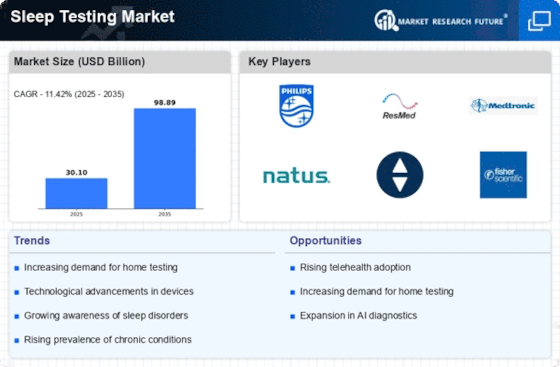
As per Market Research Future analysis, the Sleep Testing Market Size was estimated at 30.1 USD Billion in 2024. The Sleep Testing industry is projected to grow from 33.54 USD Billion in 2025 to 98.89 USD Billion by 2035, exhibiting a compound annual growth rate (CAGR) of 11.42% during the forecast period 2025 - 2035

Key Market Trends & Highlights

The Sleep Testing Market is experiencing robust growth driven by technological advancements and rising awareness of sleep disorders.

  • Technological advancements in sleep testing devices are enhancing diagnostic accuracy and patient comfort. North America remains the largest market, while Asia-Pacific is emerging as the fastest-growing region in sleep testing. Polysomnography devices dominate the market, whereas home sleep apnea testing is witnessing rapid growth. The rising prevalence of sleep disorders and increased consumer awareness are key drivers propelling market expansion.

Market Size & Forecast

2024 Market Size 30.1 (USD Billion)
2035 Market Size 98.89 (USD Billion)
CAGR (2025 - 2035) 11.42%
Largest Regional Market Share in 2024 North America

Major Players

<a href="https://www.usa.philips.com/c-m-pe/healthcare-products">Philips</a> (NL), ResMed (AU), Medtronic (US), Natus Medical (US), Sleep Number (US), Fisher &amp; Paykel Healthcare (NZ), Compumedics (AU), Itamar Medical (IL), SomnoMed (AU)

Market Trends

The Sleep Testing Market is currently experiencing a notable evolution, driven by increasing awareness of sleep disorders and their impact on overall health. As more individuals recognize the importance of quality sleep, the demand for effective diagnostic tools and services is on the rise. This market encompasses a variety of testing methods, including polysomnography and home sleep apnea testing, which are becoming more accessible to patients. Technological advancements are also playing a crucial role, with innovations in wearable devices and telemedicine facilitating remote monitoring and diagnosis. Moreover, the growing emphasis on personalized healthcare is influencing the Sleep Testing Market. Patients are seeking tailored solutions that address their specific sleep issues, prompting providers to develop customized testing protocols. This shift towards individualized care is likely to enhance patient satisfaction and improve treatment outcomes. As the market continues to expand, stakeholders must remain vigilant to emerging trends and adapt their strategies accordingly, ensuring they meet the evolving needs of consumers and healthcare professionals alike.

Technological Advancements

The integration of advanced technology in sleep testing is transforming the landscape. Innovations such as wearable devices and mobile applications are enabling continuous monitoring of sleep patterns, providing valuable data for both patients and healthcare providers. This trend suggests a shift towards more user-friendly and accessible testing options.

Increased Awareness of Sleep Disorders

There is a growing recognition of the importance of sleep health among the general population. As awareness of sleep disorders rises, more individuals are seeking diagnostic testing. This trend indicates a potential increase in demand for sleep testing services, as people prioritize their well-being.

Personalized Testing Approaches

The movement towards personalized healthcare is influencing the Sleep Testing Market. Patients are increasingly looking for tailored solutions that cater to their unique sleep challenges. This trend may lead to the development of customized testing protocols, enhancing the overall effectiveness of sleep disorder management.

Sleep Testing Services Market Market Drivers

Rising Prevalence of Sleep Disorders

The increasing prevalence of sleep disorders, such as sleep apnea and insomnia, is a primary driver of the Sleep Testing Market. Recent studies indicate that approximately 30% of adults experience some form of sleep disorder, leading to a heightened demand for diagnostic testing. This surge in cases necessitates the development and implementation of advanced sleep testing solutions. As awareness of the health implications associated with untreated sleep disorders grows, healthcare providers are more likely to recommend sleep testing as a standard procedure. Consequently, the Sleep Testing Market is expected to expand significantly, with projections suggesting a compound annual growth rate of around 7% over the next few years. This trend underscores the critical need for effective sleep disorder management and the role of sleep testing in achieving better health outcomes.

Growing Focus on Preventive Healthcare

The growing emphasis on preventive healthcare is significantly influencing the Sleep Testing Market. As healthcare systems shift towards proactive measures, the identification and management of sleep disorders have become integral components of overall health strategies. Preventive approaches not only aim to reduce the incidence of sleep-related issues but also seek to mitigate associated risks such as cardiovascular diseases and obesity. This shift is reflected in the increasing number of health insurance plans that cover sleep testing as part of routine health assessments. Consequently, the demand for sleep testing services is expected to rise, with market analysts projecting a steady growth trajectory. The integration of sleep testing into preventive healthcare frameworks highlights its importance in promoting long-term health and wellness.

Increased Investment in Sleep Research

The Sleep Testing Market is experiencing a surge in investment directed towards sleep research. Governments and private organizations are recognizing the critical need to understand sleep disorders better and their impact on public health. This influx of funding is facilitating the development of innovative testing methodologies and treatment options. Research initiatives are focusing on the genetic, environmental, and lifestyle factors contributing to sleep disorders, which could lead to more personalized and effective testing solutions. As a result, the market is likely to benefit from enhanced research outcomes, potentially leading to breakthroughs in sleep disorder management. The increased investment in sleep research not only supports the growth of the Sleep Testing Market but also fosters collaboration between academic institutions and healthcare providers.

Rising Consumer Awareness and Education

Consumer awareness regarding the importance of sleep health is on the rise, significantly impacting the Sleep Testing Market. Educational campaigns and resources are increasingly informing the public about the consequences of untreated sleep disorders. As individuals become more knowledgeable about the symptoms and risks associated with poor sleep quality, they are more likely to seek professional help. This heightened awareness is driving demand for sleep testing services, as people recognize the value of early diagnosis and intervention. Market data suggests that the number of individuals seeking sleep testing has increased by approximately 15% in recent years. This trend indicates a shift in consumer behavior, where proactive health management is prioritized, thereby contributing to the overall growth of the Sleep Testing Market.

Technological Innovations in Sleep Testing

Technological advancements play a crucial role in shaping the Sleep Testing Market. Innovations such as portable sleep monitors and advanced polysomnography systems have revolutionized the way sleep disorders are diagnosed. These technologies not only enhance the accuracy of sleep studies but also improve patient comfort and convenience. For instance, the introduction of wearable devices has made it possible for individuals to undergo sleep testing in their own homes, thereby increasing accessibility. The market for these devices is projected to grow, with estimates indicating a potential increase in revenue by over 20% in the coming years. As technology continues to evolve, the Sleep Testing Market is likely to witness further enhancements, leading to more efficient and effective testing methods.

Market Segment Insights

By Product & Services: Polysomnography Devices (Largest) vs. Home Sleep Apnea Testing (Fastest-Growing)

In the Sleep Testing Market, Polysomnography Devices maintain a significant lead, capturing the largest market share among various product offerings. Other notable segments include Actigraphy Systems, Oximeters, and Respiratory Polygraphs, each contributing to the overall growth of this market. The rise in awareness surrounding sleep disorders and the increasing demand for effective diagnostic tools drive this distribution, making these devices essential for efficient sleep evaluations.

Polysomnography Devices (Dominant) vs. Home Sleep Apnea Testing (Emerging)

Polysomnography Devices are the cornerstone of the Sleep Testing Market, celebrated for their comprehensive data collection capabilities and ability to provide detailed insights into sleep patterns and disorders. These devices are extensively utilized in clinical settings, ensuring accurate diagnoses. On the other hand, Home Sleep Apnea Testing represents an emerging trend, reflecting the growing preference for convenient and accessible solutions that allow patients to self-monitor their sleep at home. This shift indicates a change in consumer behavior, driven by advances in technology that facilitate easy-to-use testing solutions without compromising on quality. As awareness of sleep disorders increases, both segments are poised to grow, albeit at different rates.

By Indication: Sleep Apnea (Largest) vs. Insomnia (Fastest-Growing)

In the Sleep Testing Market, Sleep Apnea occupies the largest market share, reflecting its significant prevalence and recognition as a critical health issue. This segment typically encompasses several diagnostic methods, ranging from home sleep testing to polysomnography, which contribute to its widespread adoption. Insomnia, while trailing in market share, is rapidly gaining traction due to increased awareness and the rising incidence of sleep-related disorders, particularly in urban populations.

Sleep Apnea (Dominant) vs. Insomnia (Emerging)

Sleep Apnea is known for its profound impact on healthcare systems and its association with comorbidities such as cardiovascular diseases, which solidifies its position as the dominant segment in the Sleep Testing Market. This segment's comprehensive approach encompasses various diagnostics and therapeutic options, making it critical for effective patient management. Meanwhile, Insomnia is emerging as a vital segment, fueled by changing lifestyle patterns and heightened stress levels. The growing focus on mental health and overall well-being drives demand for effective insomnia interventions, enhancing its growth prospects in this dynamic market.

By Age Group: Adults (Largest) vs. Geriatric (Fastest-Growing)

The Sleep Testing Market is significantly influenced by various age groups, with adults aged 18 to 60 holding the largest share. This demographic has shown a pronounced interest in sleep health, driven by increasing stress levels and lifestyle-related issues prevalent in adulthood. In contrast, the geriatric segment, comprising individuals aged 60 and above, is experiencing rapid growth as awareness regarding sleep disorders and their impacts on overall health increases within this age group.

Adults (Dominant) vs. Geriatric (Emerging)

Adults represent the dominant segment in the Sleep Testing Market, mainly due to their heightened concern over sleep quality and related health implications. Factors contributing to this include a rise in sleep-related health issues tied to busy lifestyles and work pressures. Meanwhile, the geriatric population is emerging as a critical segment, spurred by the aging population and a growing recognition of sleep issues' prevalence among seniors. This demographic shift prompts healthcare providers to develop tailored sleep solutions for older adults, thereby addressing their unique sleep health challenges.

By End User: Sleep Testing Centers (Largest) vs. Home Care Settings (Fastest-Growing)

The sleep testing market is primarily driven by four key end-user segments: Sleep Testing Centers, Hospitals, Home Care Settings, and Others. Among these, Sleep Testing Centers command the largest market share due to their specialized services and comprehensive testing capabilities. Hospitals also play a significant role, providing integrated healthcare solutions. Meanwhile, Home Care Settings are gaining momentum as they offer more accessible and convenient testing options for patients. Growth in the Sleep Testing Market is influenced by the rising prevalence of sleep disorders, increased awareness about sleep health, and technological advancements in testing methods. Home Care Settings are rapidly becoming the preferred choice for many consumers, driven by the convenience of at-home testing and the desire for cost-effective solutions. As healthcare continues to shift towards more patient-centric models, Home Care Settings are expected to experience significant growth in the coming years.

Sleep Testing Centers (Dominant) vs. Hospitals (Emerging)

Sleep Testing Centers are currently the dominant force in the Sleep Testing Market, offering specialized facilities equipped with advanced diagnostic tools and trained personnel. They are renowned for their ability to conduct comprehensive assessments and provide tailored treatment recommendations, which enhances patient satisfaction and outcomes. Conversely, Hospitals, while still important, are viewed as an emerging segment due to their potential to integrate sleep testing into broader healthcare services. Hospitals are increasingly initiating sleep clinics that can leverage existing resources and patient data to offer holistic care. As collaboration between these end-users grows, both segments are likely to benefit from advancements in sleep medicine and diagnostic technologies.

Get more detailed insights about Sleep Testing Market Research Report–Forecast Till 2035

Regional Insights

North America : Leading Market for Sleep Testing

North America is the largest market for sleep testing, accounting for approximately 45% of the global share. The region's growth is driven by increasing awareness of sleep disorders, advancements in technology, and supportive healthcare policies. Regulatory catalysts, such as the FDA's approval of innovative sleep testing devices, further enhance market dynamics. The demand for home sleep testing solutions is also on the rise, reflecting a shift towards more accessible healthcare options. The United States is the primary contributor to this market, with key players like Philips, ResMed, and Medtronic leading the competitive landscape. Canada also plays a significant role, focusing on improving healthcare access and quality. The presence of established companies and ongoing research initiatives contribute to a robust market environment, fostering innovation and enhancing patient care.

Europe : Emerging Market with Growth Potential

Europe is witnessing significant growth in the sleep testing market, holding approximately 30% of the global share. The region benefits from increasing healthcare expenditure, a rising prevalence of sleep disorders, and a growing emphasis on preventive healthcare. Regulatory frameworks, such as the European Medical Device Regulation (MDR), are facilitating the introduction of advanced sleep testing technologies, thereby driving market expansion. Leading countries in this region include Germany, France, and the UK, where healthcare systems are increasingly adopting innovative sleep solutions. The competitive landscape features key players like Philips and Natus Medical, who are investing in research and development to enhance product offerings. Collaborative efforts between healthcare providers and technology firms are also fostering a conducive environment for market growth, ensuring better patient outcomes.

Asia-Pacific : Rapidly Growing Sleep Market

Asia-Pacific is emerging as a significant player in the sleep testing market, accounting for about 20% of the global share. The region's growth is fueled by increasing urbanization, rising disposable incomes, and heightened awareness of sleep disorders. Governments are also implementing policies to improve healthcare access, which is expected to further drive demand for sleep testing solutions. The growing prevalence of lifestyle-related health issues is a key factor in this trend. Countries like Australia, Japan, and China are at the forefront of this market, with a competitive landscape featuring companies such as ResMed and Fisher & Paykel Healthcare. The presence of innovative startups and established firms is fostering a dynamic environment for product development. Collaborative initiatives between healthcare providers and technology companies are enhancing the availability of advanced sleep testing solutions, catering to the growing consumer demand.

Middle East and Africa : Untapped Potential in Sleep Testing

The Middle East and Africa region is gradually emerging in the sleep testing market, holding approximately 5% of the global share. The growth is driven by increasing awareness of sleep disorders, rising healthcare investments, and a growing focus on improving healthcare infrastructure. Regulatory initiatives aimed at enhancing healthcare quality are also contributing to market development, creating opportunities for innovative sleep testing solutions. Countries like South Africa and the UAE are leading the way in adopting sleep testing technologies, with a competitive landscape that includes both local and international players. The presence of key companies such as Itamar Medical and Compumedics is fostering innovation and improving access to sleep testing services. As healthcare systems evolve, the demand for effective sleep solutions is expected to rise, presenting significant growth opportunities in this region.

Key Players and Competitive Insights

The Sleep Testing Market is distinguished by the presence of numerous regional and local players catering to the Sleep Testing Market. Furthermore, rising prevalence of sleep disorders and increasing awareness and health consciousness are driving the Sleep Testing Market. The Sleep Testing Market is extremely competitive, with players competing and investing heavily in the development of innovative products to gain a significant market share. The market is moderately fragmented with high competition in the market, increasing collaborative partnerships, and other strategic decisions to achieve operational efficiency. The growth of prominent industry players is dependent on various factors, such as market conditions, product differentiation and innovation, and pricing strategies. It is also projected the growing geriatric population and increasing funding and investment associated with sleep testing products will also boost the market's growth in the upcoming future.

Key Companies in the Sleep Testing Services Market include

Industry Developments

December 2024: Compumedics Limited announced that the US Food & Drug Administration (FDA) has cleared the Somf it device to be marketed in the USA.

December 2021: ZOLL Medical Corporation has announced the successful completion of its acquisition of Itamar Medical Ltd., a company specializing in medical devices and digital health solutions, including at-home testing for sleep apnea.

October 2021: ResMed has successfully acquired Ectosense, a leader in cloud-connected home sleep test (HST) devices, which have the potential to assist millions of people with undiagnosed sleep apnea in receiving the treatment they need, while also raising awareness of the condition. Ectosense's FDA-approved NightOwl device is currently available for sale in the United States, Australia, New Zealand, India, and select European markets.

June 2021: Cadwell Industries, Inc. announced a partnership with EnsoData, a healthcare artificial intelligence (AI) company dedicated to enhancing the lives of medical professionals and patients. Cadwell is the first sleep diagnostic equipment manufacturer to alter its Easy III PSG software platform to better integrate EnsoData's EnsoSleep AI scoring solution. This deeper integration allows doctors to invest more time on improving patient care and treatment results rather than challenging data.


Future Outlook

Sleep Testing Services Market Future Outlook

The Sleep Testing Market is projected to grow at 11.42% CAGR from 2025 to 2035, driven by increasing awareness of sleep disorders and technological advancements in testing methods.

New opportunities lie in:

  • <p>Development of portable sleep testing devices for home use. Integration of AI-driven analytics for personalized sleep solutions. Expansion of telehealth services for remote sleep consultations.</p>

By 2035, the Sleep Testing Market is expected to be robust, driven by innovation and increased consumer demand.

Market Segmentation

Sleep Testing Services Market End User Outlook

  • Sleep Testing Centers
  • Hospitals
  • Home Care Settings
  • Others

Sleep Testing Services Market Age Group Outlook

  • Children (1 to 17)
  • Adults (18 to 60)
  • Geriatric (60 Above)

Sleep Testing Services Market Indication Outlook

  • Sleep Apnea
  • Insomnia
  • Narcolepsy
  • Parasomnia
  • Others

Sleep Testing Services Market Product & Services Outlook

  • Polysomnography Devices
  • Actigraphy Systems
  • Oximeters
  • Respiratory Polygraphs
  • Others
  • In-lab Polysomnography
  • Home Sleep Apnea Testing
  • Sleep Study Consultation Services

Report Scope

MARKET SIZE 2024 30.1(USD Billion)
MARKET SIZE 2025 33.54(USD Billion)
MARKET SIZE 2035 98.89(USD Billion)
COMPOUND ANNUAL GROWTH RATE (CAGR) 11.42% (2025 - 2035)
REPORT COVERAGE Revenue Forecast, Competitive Landscape, Growth Factors, and Trends
BASE YEAR 2024
Market Forecast Period 2025 - 2035
Historical Data 2019 - 2024
Market Forecast Units USD Billion
Key Companies Profiled Philips (NL), ResMed (AU), Medtronic (US), Natus Medical (US), Sleep Number (US), Fisher & Paykel Healthcare (NZ), Compumedics (AU), Itamar Medical (IL), SomnoMed (AU)
Segments Covered Product & Services, Indication, Age Group, End User, Region –Market Forecast Till 2035
Key Market Opportunities Integration of telehealth solutions enhances accessibility in the Sleep Testing Market.
Key Market Dynamics Rising consumer awareness and technological advancements drive growth in the sleep testing market, enhancing diagnostic accuracy.
Countries Covered North America, Europe, APAC, South America, MEA

FAQs

What is the current valuation of the Sleep Testing Market?

<p>The Sleep Testing Market was valued at 30.1 USD Billion in 2024.</p>

What is the projected market size for the Sleep Testing Market by 2035?

<p>The market is projected to reach 98.89 USD Billion by 2035.</p>

What is the expected CAGR for the Sleep Testing Market during the forecast period 2025 - 2035?

<p>The expected CAGR for the Sleep Testing Market during 2025 - 2035 is 11.42%.</p>

Which segments are included in the Sleep Testing Market?

<p>Key segments include Polysomnography Devices, Actigraphy Systems, and Sleep Apnea among others.</p>

What are the projected revenues for Polysomnography Devices by 2035?

<p>Polysomnography Devices are projected to generate revenues between 10.0 and 35.0 USD Billion by 2035.</p>

How does the Sleep Testing Market perform across different age groups?

The market shows projected revenues of 15.05 to 50.0 USD Billion for adults aged 18 to 60 by 2035.

What are the anticipated revenues for Sleep Testing Centers by 2035?

Sleep Testing Centers are expected to generate revenues between 5.0 and 17.0 USD Billion by 2035.

Who are the key players in the Sleep Testing Market?

Key players include Philips, ResMed, Medtronic, and Natus Medical among others.

What is the revenue outlook for Home Sleep Apnea Testing by 2035?

Home Sleep Apnea Testing is projected to generate revenues between 2.0 and 7.0 USD Billion by 2035.

What indications are driving growth in the Sleep Testing Market?

Sleep Apnea is projected to drive revenues between 12.0 and 40.0 USD Billion by 2035.

  1. SECTION I: EXECUTIVE SUMMARY AND KEY HIGHLIGHTS |
    1. EXECUTIVE SUMMARY | |
      1. Market Overview | |
      2. Key Findings | |
      3. Market Segmentation | |
      4. Competitive Landscape | |
      5. Challenges and Opportunities | |
      6. Future Outlook 2
  2. SECTION II: SCOPING, METHODOLOGY AND MARKET STRUCTURE |
    1. MARKET INTRODUCTION | |
      1. Definition | |
      2. Scope of the study | | |
    2. RESEARCH METHODOLOGY | |
      1. Overview | |
      2. Data Mining | |
      3. Secondary Research | |
      4. Primary Research | | |
      5. Forecasting Model | |
      6. Market Size Estimation | | |
      7. Data Triangulation | |
      8. Validation 3
  3. SECTION III: QUALITATIVE ANALYSIS |
    1. MARKET DYNAMICS | |
      1. Overview | |
      2. Drivers | |
      3. Restraints | |
      4. Opportunities |
    2. MARKET FACTOR ANALYSIS | |
      1. Value chain Analysis | |
      2. Porter's Five Forces Analysis | | |
      3. COVID-19 Impact Analysis | | |
  4. SECTION IV: QUANTITATIVE ANALYSIS |
    1. Healthcare, BY Product & Services (USD Billion) | |
      1. Polysomnography Devices | |
      2. Actigraphy Systems | |
      3. Oximeters | |
      4. Respiratory Polygraphs | |
      5. Others | |
      6. In-lab Polysomnography | |
      7. Home Sleep Apnea Testing | |
      8. Sleep Study Consultation Services |
    2. Healthcare, BY Indication (USD Billion) | |
      1. Sleep Apnea | |
      2. Insomnia | |
      3. Narcolepsy | |
      4. Parasomnia | |
      5. Others |
    3. Healthcare, BY Age Group (USD Billion) | |
      1. Children (1 to 17) | |
      2. Adults (18 to 60) | |
      3. Geriatric (60 Above) |
    4. Healthcare, BY End User (USD Billion) | |
      1. Sleep Testing Centers | |
      2. Hospitals | |
      3. Home Care Settings | |
      4. Others |
    5. Healthcare, BY Region (USD Billion) | |
      1. North America | | |
      2. Europe | | |
      3. APAC | | |
      4. South America | | |
      5. MEA | | |
  5. SECTION V: COMPETITIVE ANALYSIS |
    1. Competitive Landscape | |
      1. Overview | |
      2. Competitive Analysis | |
      3. Market share Analysis | |
      4. Major Growth Strategy in the Healthcare | |
      5. Competitive Benchmarking | |
      6. Leading Players in Terms of Number of Developments in the Healthcare | |
      7. Key developments and growth strategies | | |
      8. Major Players Financial Matrix | | |
    2. Company Profiles | |
      1. Philips (NL) | | |
      2. ResMed (AU) | | |
      3. Medtronic (US) | | |
      4. Natus Medical (US) | | |
      5. Sleep Number (US) | | |
      6. Fisher & Paykel Healthcare (NZ) | | |
      7. Compumedics (AU) | | |
      8. Itamar Medical (IL) | | |
      9. SomnoMed (AU) | | |
    3. Appendix | |
      1. References | |
      2. Related Reports 6 LIST OF FIGURES |
    4. MARKET SYNOPSIS |
    5. NORTH AMERICA MARKET ANALYSIS |
    6. US MARKET ANALYSIS BY PRODUCT & SERVICES |
    7. US MARKET ANALYSIS BY INDICATION |
    8. US MARKET ANALYSIS BY AGE GROUP |
    9. US MARKET ANALYSIS BY END USER |
    10. CANADA MARKET ANALYSIS BY PRODUCT & SERVICES |
    11. CANADA MARKET ANALYSIS BY INDICATION |
    12. CANADA MARKET ANALYSIS BY AGE GROUP |
    13. CANADA MARKET ANALYSIS BY END USER |
    14. EUROPE MARKET ANALYSIS |
    15. GERMANY MARKET ANALYSIS BY PRODUCT & SERVICES |
    16. GERMANY MARKET ANALYSIS BY INDICATION |
    17. GERMANY MARKET ANALYSIS BY AGE GROUP |
    18. GERMANY MARKET ANALYSIS BY END USER |
    19. UK MARKET ANALYSIS BY PRODUCT & SERVICES |
    20. UK MARKET ANALYSIS BY INDICATION |
    21. UK MARKET ANALYSIS BY AGE GROUP |
    22. UK MARKET ANALYSIS BY END USER |
    23. FRANCE MARKET ANALYSIS BY PRODUCT & SERVICES |
    24. FRANCE MARKET ANALYSIS BY INDICATION |
    25. FRANCE MARKET ANALYSIS BY AGE GROUP |
    26. FRANCE MARKET ANALYSIS BY END USER |
    27. RUSSIA MARKET ANALYSIS BY PRODUCT & SERVICES |
    28. RUSSIA MARKET ANALYSIS BY INDICATION |
    29. RUSSIA MARKET ANALYSIS BY AGE GROUP |
    30. RUSSIA MARKET ANALYSIS BY END USER |
    31. ITALY MARKET ANALYSIS BY PRODUCT & SERVICES |
    32. ITALY MARKET ANALYSIS BY INDICATION |
    33. ITALY MARKET ANALYSIS BY AGE GROUP |
    34. ITALY MARKET ANALYSIS BY END USER |
    35. SPAIN MARKET ANALYSIS BY PRODUCT & SERVICES |
    36. SPAIN MARKET ANALYSIS BY INDICATION |
    37. SPAIN MARKET ANALYSIS BY AGE GROUP |
    38. SPAIN MARKET ANALYSIS BY END USER |
    39. REST OF EUROPE MARKET ANALYSIS BY PRODUCT & SERVICES |
    40. REST OF EUROPE MARKET ANALYSIS BY INDICATION |
    41. REST OF EUROPE MARKET ANALYSIS BY AGE GROUP |
    42. REST OF EUROPE MARKET ANALYSIS BY END USER |
    43. APAC MARKET ANALYSIS |
    44. CHINA MARKET ANALYSIS BY PRODUCT & SERVICES |
    45. CHINA MARKET ANALYSIS BY INDICATION |
    46. CHINA MARKET ANALYSIS BY AGE GROUP |
    47. CHINA MARKET ANALYSIS BY END USER |
    48. INDIA MARKET ANALYSIS BY PRODUCT & SERVICES |
    49. INDIA MARKET ANALYSIS BY INDICATION |
    50. INDIA MARKET ANALYSIS BY AGE GROUP |
    51. INDIA MARKET ANALYSIS BY END USER |
    52. JAPAN MARKET ANALYSIS BY PRODUCT & SERVICES |
    53. JAPAN MARKET ANALYSIS BY INDICATION |
    54. JAPAN MARKET ANALYSIS BY AGE GROUP |
    55. JAPAN MARKET ANALYSIS BY END USER |
    56. SOUTH KOREA MARKET ANALYSIS BY PRODUCT & SERVICES |
    57. SOUTH KOREA MARKET ANALYSIS BY INDICATION |
    58. SOUTH KOREA MARKET ANALYSIS BY AGE GROUP |
    59. SOUTH KOREA MARKET ANALYSIS BY END USER |
    60. MALAYSIA MARKET ANALYSIS BY PRODUCT & SERVICES |
    61. MALAYSIA MARKET ANALYSIS BY INDICATION |
    62. MALAYSIA MARKET ANALYSIS BY AGE GROUP |
    63. MALAYSIA MARKET ANALYSIS BY END USER |
    64. THAILAND MARKET ANALYSIS BY PRODUCT & SERVICES |
    65. THAILAND MARKET ANALYSIS BY INDICATION |
    66. THAILAND MARKET ANALYSIS BY AGE GROUP |
    67. THAILAND MARKET ANALYSIS BY END USER |
    68. INDONESIA MARKET ANALYSIS BY PRODUCT & SERVICES |
    69. INDONESIA MARKET ANALYSIS BY INDICATION |
    70. INDONESIA MARKET ANALYSIS BY AGE GROUP |
    71. INDONESIA MARKET ANALYSIS BY END USER |
    72. REST OF APAC MARKET ANALYSIS BY PRODUCT & SERVICES |
    73. REST OF APAC MARKET ANALYSIS BY INDICATION |
    74. REST OF APAC MARKET ANALYSIS BY AGE GROUP |
    75. REST OF APAC MARKET ANALYSIS BY END USER |
    76. SOUTH AMERICA MARKET ANALYSIS |
    77. BRAZIL MARKET ANALYSIS BY PRODUCT & SERVICES |
    78. BRAZIL MARKET ANALYSIS BY INDICATION |
    79. BRAZIL MARKET ANALYSIS BY AGE GROUP |
    80. BRAZIL MARKET ANALYSIS BY END USER |
    81. MEXICO MARKET ANALYSIS BY PRODUCT & SERVICES |
    82. MEXICO MARKET ANALYSIS BY INDICATION |
    83. MEXICO MARKET ANALYSIS BY AGE GROUP |
    84. MEXICO MARKET ANALYSIS BY END USER |
    85. ARGENTINA MARKET ANALYSIS BY PRODUCT & SERVICES |
    86. ARGENTINA MARKET ANALYSIS BY INDICATION |
    87. ARGENTINA MARKET ANALYSIS BY AGE GROUP |
    88. ARGENTINA MARKET ANALYSIS BY END USER |
    89. REST OF SOUTH AMERICA MARKET ANALYSIS BY PRODUCT & SERVICES |
    90. REST OF SOUTH AMERICA MARKET ANALYSIS BY INDICATION |
    91. REST OF SOUTH AMERICA MARKET ANALYSIS BY AGE GROUP |
    92. REST OF SOUTH AMERICA MARKET ANALYSIS BY END USER |
    93. MEA MARKET ANALYSIS |
    94. GCC COUNTRIES MARKET ANALYSIS BY PRODUCT & SERVICES |
    95. GCC COUNTRIES MARKET ANALYSIS BY INDICATION |
    96. GCC COUNTRIES MARKET ANALYSIS BY AGE GROUP |
    97. GCC COUNTRIES MARKET ANALYSIS BY END USER |
    98. SOUTH AFRICA MARKET ANALYSIS BY PRODUCT & SERVICES |
    99. SOUTH AFRICA MARKET ANALYSIS BY INDICATION |
    100. SOUTH AFRICA MARKET ANALYSIS BY AGE GROUP |
    101. SOUTH AFRICA MARKET ANALYSIS BY END USER |
    102. REST OF MEA MARKET ANALYSIS BY PRODUCT & SERVICES |
    103. REST OF MEA MARKET ANALYSIS BY INDICATION |
    104. REST OF MEA MARKET ANALYSIS BY AGE GROUP |
    105. REST OF MEA MARKET ANALYSIS BY END USER |
    106. KEY BUYING CRITERIA OF HEALTHCARE |
    107. RESEARCH PROCESS OF MRFR |
    108. DRO ANALYSIS OF HEALTHCARE |
    109. DRIVERS IMPACT ANALYSIS: HEALTHCARE |
    110. RESTRAINTS IMPACT ANALYSIS: HEALTHCARE |
    111. SUPPLY / VALUE CHAIN: HEALTHCARE |
    112. HEALTHCARE, BY PRODUCT & SERVICES, 2024 (% SHARE) |
    113. HEALTHCARE, BY PRODUCT & SERVICES, 2024 TO 2035 (USD Billion) |
    114. HEALTHCARE, BY INDICATION, 2024 (% SHARE) |
    115. HEALTHCARE, BY INDICATION, 2024 TO 2035 (USD Billion) |
    116. HEALTHCARE, BY AGE GROUP, 2024 (% SHARE) |
    117. HEALTHCARE, BY AGE GROUP, 2024 TO 2035 (USD Billion) |
    118. HEALTHCARE, BY END USER, 2024 (% SHARE) |
    119. HEALTHCARE, BY END USER, 2024 TO 2035 (USD Billion) |
    120. BENCHMARKING OF MAJOR COMPETITORS 7 LIST OF TABLES |
    121. LIST OF ASSUMPTIONS | |
      1. |
    122. North America MARKET SIZE ESTIMATES; FORECAST | |
      1. BY PRODUCT & SERVICES, 2025-2035 (USD Billion) | |
      2. BY INDICATION, 2025-2035 (USD Billion) | |
      3. BY AGE GROUP, 2025-2035 (USD Billion) | |
      4. BY END USER, 2025-2035 (USD Billion) |
    123. US MARKET SIZE ESTIMATES; FORECAST | |
      1. BY PRODUCT & SERVICES, 2025-2035 (USD Billion) | |
      2. BY INDICATION, 2025-2035 (USD Billion) | |
      3. BY AGE GROUP, 2025-2035 (USD Billion) | |
      4. BY END USER, 2025-2035 (USD Billion) |
    124. Canada MARKET SIZE ESTIMATES; FORECAST | |
      1. BY PRODUCT & SERVICES, 2025-2035 (USD Billion) | |
      2. BY INDICATION, 2025-2035 (USD Billion) | |
      3. BY AGE GROUP, 2025-2035 (USD Billion) | |
      4. BY END USER, 2025-2035 (USD Billion) |
    125. Europe MARKET SIZE ESTIMATES; FORECAST | |
      1. BY PRODUCT & SERVICES, 2025-2035 (USD Billion) | |
      2. BY INDICATION, 2025-2035 (USD Billion) | |
      3. BY AGE GROUP, 2025-2035 (USD Billion) | |
      4. BY END USER, 2025-2035 (USD Billion) |
    126. Germany MARKET SIZE ESTIMATES; FORECAST | |
      1. BY PRODUCT & SERVICES, 2025-2035 (USD Billion) | |
      2. BY INDICATION, 2025-2035 (USD Billion) | |
      3. BY AGE GROUP, 2025-2035 (USD Billion) | |
      4. BY END USER, 2025-2035 (USD Billion) |
    127. UK MARKET SIZE ESTIMATES; FORECAST | |
      1. BY PRODUCT & SERVICES, 2025-2035 (USD Billion) | |
      2. BY INDICATION, 2025-2035 (USD Billion) | |
      3. BY AGE GROUP, 2025-2035 (USD Billion) | |
      4. BY END USER, 2025-2035 (USD Billion) |
    128. France MARKET SIZE ESTIMATES; FORECAST | |
      1. BY PRODUCT & SERVICES, 2025-2035 (USD Billion) | |
      2. BY INDICATION, 2025-2035 (USD Billion) | |
      3. BY AGE GROUP, 2025-2035 (USD Billion) | |
      4. BY END USER, 2025-2035 (USD Billion) |
    129. Russia MARKET SIZE ESTIMATES; FORECAST | |
      1. BY PRODUCT & SERVICES, 2025-2035 (USD Billion) | |
      2. BY INDICATION, 2025-2035 (USD Billion) | |
      3. BY AGE GROUP, 2025-2035 (USD Billion) | |
      4. BY END USER, 2025-2035 (USD Billion) |
    130. Italy MARKET SIZE ESTIMATES; FORECAST | |
      1. BY PRODUCT & SERVICES, 2025-2035 (USD Billion) | |
      2. BY INDICATION, 2025-2035 (USD Billion) | |
      3. BY AGE GROUP, 2025-2035 (USD Billion) | |
      4. BY END USER, 2025-2035 (USD Billion) |
    131. Spain MARKET SIZE ESTIMATES; FORECAST | |
      1. BY PRODUCT & SERVICES, 2025-2035 (USD Billion) | |
      2. BY INDICATION, 2025-2035 (USD Billion) | |
      3. BY AGE GROUP, 2025-2035 (USD Billion) | |
      4. BY END USER, 2025-2035 (USD Billion) |
    132. Rest of Europe MARKET SIZE ESTIMATES; FORECAST | |
      1. BY PRODUCT & SERVICES, 2025-2035 (USD Billion) | |
      2. BY INDICATION, 2025-2035 (USD Billion) | |
      3. BY AGE GROUP, 2025-2035 (USD Billion) | |
      4. BY END USER, 2025-2035 (USD Billion) |
    133. APAC MARKET SIZE ESTIMATES; FORECAST | |
      1. BY PRODUCT & SERVICES, 2025-2035 (USD Billion) | |
      2. BY INDICATION, 2025-2035 (USD Billion) | |
      3. BY AGE GROUP, 2025-2035 (USD Billion) | |
      4. BY END USER, 2025-2035 (USD Billion) |
    134. China MARKET SIZE ESTIMATES; FORECAST | |
      1. BY PRODUCT & SERVICES, 2025-2035 (USD Billion) | |
      2. BY INDICATION, 2025-2035 (USD Billion) | |
      3. BY AGE GROUP, 2025-2035 (USD Billion) | |
      4. BY END USER, 2025-2035 (USD Billion) |
    135. India MARKET SIZE ESTIMATES; FORECAST | |
      1. BY PRODUCT & SERVICES, 2025-2035 (USD Billion) | |
      2. BY INDICATION, 2025-2035 (USD Billion) | |
      3. BY AGE GROUP, 2025-2035 (USD Billion) | |
      4. BY END USER, 2025-2035 (USD Billion) |
    136. Japan MARKET SIZE ESTIMATES; FORECAST | |
      1. BY PRODUCT & SERVICES, 2025-2035 (USD Billion) | |
      2. BY INDICATION, 2025-2035 (USD Billion) | |
      3. BY AGE GROUP, 2025-2035 (USD Billion) | |
      4. BY END USER, 2025-2035 (USD Billion) |
    137. South Korea MARKET SIZE ESTIMATES; FORECAST | |
      1. BY PRODUCT & SERVICES, 2025-2035 (USD Billion) | |
      2. BY INDICATION, 2025-2035 (USD Billion) | |
      3. BY AGE GROUP, 2025-2035 (USD Billion) | |
      4. BY END USER, 2025-2035 (USD Billion) |
    138. Malaysia MARKET SIZE ESTIMATES; FORECAST | |
      1. BY PRODUCT & SERVICES, 2025-2035 (USD Billion) | |
      2. BY INDICATION, 2025-2035 (USD Billion) | |
      3. BY AGE GROUP, 2025-2035 (USD Billion) | |
      4. BY END USER, 2025-2035 (USD Billion) |
    139. Thailand MARKET SIZE ESTIMATES; FORECAST | |
      1. BY PRODUCT & SERVICES, 2025-2035 (USD Billion) | |
      2. BY INDICATION, 2025-2035 (USD Billion) | |
      3. BY AGE GROUP, 2025-2035 (USD Billion) | |
      4. BY END USER, 2025-2035 (USD Billion) |
    140. Indonesia MARKET SIZE ESTIMATES; FORECAST | |
      1. BY PRODUCT & SERVICES, 2025-2035 (USD Billion) | |
      2. BY INDICATION, 2025-2035 (USD Billion) | |
      3. BY AGE GROUP, 2025-2035 (USD Billion) | |
      4. BY END USER, 2025-2035 (USD Billion) |
    141. Rest of APAC MARKET SIZE ESTIMATES; FORECAST | |
      1. BY PRODUCT & SERVICES, 2025-2035 (USD Billion) | |
      2. BY INDICATION, 2025-2035 (USD Billion) | |
      3. BY AGE GROUP, 2025-2035 (USD Billion) | |
      4. BY END USER, 2025-2035 (USD Billion) |
    142. South America MARKET SIZE ESTIMATES; FORECAST | |
      1. BY PRODUCT & SERVICES, 2025-2035 (USD Billion) | |
      2. BY INDICATION, 2025-2035 (USD Billion) | |
      3. BY AGE GROUP, 2025-2035 (USD Billion) | |
      4. BY END USER, 2025-2035 (USD Billion) |
    143. Brazil MARKET SIZE ESTIMATES; FORECAST | |
      1. BY PRODUCT & SERVICES, 2025-2035 (USD Billion) | |
      2. BY INDICATION, 2025-2035 (USD Billion) | |
      3. BY AGE GROUP, 2025-2035 (USD Billion) | |
      4. BY END USER, 2025-2035 (USD Billion) |
    144. Mexico MARKET SIZE ESTIMATES; FORECAST | |
      1. BY PRODUCT & SERVICES, 2025-2035 (USD Billion) | |
      2. BY INDICATION, 2025-2035 (USD Billion) | |
      3. BY AGE GROUP, 2025-2035 (USD Billion) | |
      4. BY END USER, 2025-2035 (USD Billion) |
    145. Argentina MARKET SIZE ESTIMATES; FORECAST | |
      1. BY PRODUCT & SERVICES, 2025-2035 (USD Billion) | |
      2. BY INDICATION, 2025-2035 (USD Billion) | |
      3. BY AGE GROUP, 2025-2035 (USD Billion) | |
      4. BY END USER, 2025-2035 (USD Billion) |
    146. Rest of South America MARKET SIZE ESTIMATES; FORECAST | |
      1. BY PRODUCT & SERVICES, 2025-2035 (USD Billion) | |
      2. BY INDICATION, 2025-2035 (USD Billion) | |
      3. BY AGE GROUP, 2025-2035 (USD Billion) | |
      4. BY END USER, 2025-2035 (USD Billion) |
    147. MEA MARKET SIZE ESTIMATES; FORECAST | |
      1. BY PRODUCT & SERVICES, 2025-2035 (USD Billion) | |
      2. BY INDICATION, 2025-2035 (USD Billion) | |
      3. BY AGE GROUP, 2025-2035 (USD Billion) | |
      4. BY END USER, 2025-2035 (USD Billion) |
    148. GCC Countries MARKET SIZE ESTIMATES; FORECAST | |
      1. BY PRODUCT & SERVICES, 2025-2035 (USD Billion) | |
      2. BY INDICATION, 2025-2035 (USD Billion) | |
      3. BY AGE GROUP, 2025-2035 (USD Billion) | |
      4. BY END USER, 2025-2035 (USD Billion) |
    149. South Africa MARKET SIZE ESTIMATES; FORECAST | |
      1. BY PRODUCT & SERVICES, 2025-2035 (USD Billion) | |
      2. BY INDICATION, 2025-2035 (USD Billion) | |
      3. BY AGE GROUP, 2025-2035 (USD Billion) | |
      4. BY END USER, 2025-2035 (USD Billion) |
    150. Rest of MEA MARKET SIZE ESTIMATES; FORECAST | |
      1. BY PRODUCT & SERVICES, 2025-2035 (USD Billion) | |
      2. BY INDICATION, 2025-2035 (USD Billion) | |
      3. BY AGE GROUP, 2025-2035 (USD Billion) | |
      4. BY END USER, 2025-2035 (USD Billion) |
    151. PRODUCT LAUNCH/PRODUCT DEVELOPMENT/APPROVAL | |
      1. |
    152. ACQUISITION/PARTNERSHIP | |

Healthcare Market Segmentation

Healthcare By Product & Services (USD Billion, 2025-2035)

  • Polysomnography Devices
  • Actigraphy Systems
  • Oximeters
  • Respiratory Polygraphs
  • Others
  • In-lab Polysomnography
  • Home Sleep Apnea Testing
  • Sleep Study Consultation Services

Healthcare By Indication (USD Billion, 2025-2035)

  • Sleep Apnea
  • Insomnia
  • Narcolepsy
  • Parasomnia
  • Others

Healthcare By Age Group (USD Billion, 2025-2035)

  • Children (1 to 17)
  • Adults (18 to 60)
  • Geriatric (60 Above)

Healthcare By End User (USD Billion, 2025-2035)

  • Sleep Testing Centers
  • Hospitals
  • Home Care Settings
  • Others
Infographic

Free Sample Request

Kindly complete the form below to receive a free sample of this Report

Get Free Sample

Customer Strories

Compare Licence

×
Features License Type
Single User Multiuser License Enterprise User
Price $4,950 $5,950 $7,250
Maximum User Access Limit 1 User Upto 10 Users Unrestricted Access Throughout the Organization
Free Customization
Direct Access to Analyst
Deliverable Format
Platform Access
Discount on Next Purchase 10% 15% 15%
Printable Versions