Request Free Sample ×

Kindly complete the form below to receive a free sample of this Report

* Please use a valid business email

Leading companies partner with us for data-driven Insights

clients tt-cursor
Hero Background
English
Chinese
French
Japanese
Korean
German
Spanish

Skin Packaging Market Trends

ID: MRFR/PCM/1433-HCR
112 Pages
Pradeep Nandi
Last Updated: April 06, 2026

Skin Packaging Market Research Report Information By Material (Paper & Paperboard, LDPE, PVC And Other), By Application (Food, Consumer Goods, Industrial Goods And Others) And By Region (North America, Europe, Asia-Pacific, And Rest Of The World) –Market Forecast Till 2035

Share:
Download PDF ×

We do not share your information with anyone. However, we may send you emails based on your report interest from time to time. You may contact us at any time to opt-out.

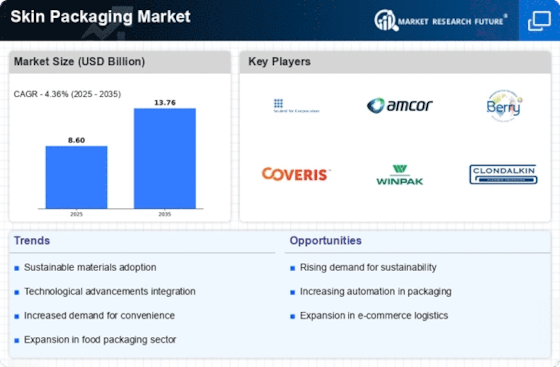
Skin Packaging Market Infographic
Purchase Options

Market Trends

Key Emerging Trends in the Skin Packaging Market

Skin packaging, a form of packaging where a thin plastic film is draped over a product and sealed to a backing board, has seen notable market trends in recent years, reflecting shifts in consumer preferences, technological advancements, and sustainability concerns. This packaging method is widely used in various industries, including food, electronics, and healthcare, due to its ability to provide product visibility, protection, and shelf appeal.

Some of the strict government rules concerning avoiding wastage while packaging and increasing the capability for rising the shelf life of skin packaging products steer up the skin packaging market size. The high rise in cost-effective packaging products that use less raw materials and resources is the other most important challenging factor.

One significant trend in the global skin packaging market is the increasing demand for sustainable and eco-friendly packaging solutions. With growing awareness of environmental issues and regulatory pressures to reduce plastic waste, there is a rising preference for packaging materials that are recyclable, biodegradable, or made from renewable sources. Manufacturers are responding to this trend by developing skin packaging solutions using environmentally friendly materials such as recycled plastics, bio-based films, and compostable materials. These sustainable options not only align with consumer preferences but also help companies meet their corporate sustainability goals and regulatory requirements.

Moreover, technological advancements have played a crucial role in shaping market trends in the skin packaging industry. Innovations in packaging machinery, materials, and printing technologies have led to the development of advanced skin packaging solutions with improved functionality, efficiency, and aesthetics. For instance, the adoption of modified atmosphere packaging (MAP) technology allows skin packaging to extend the shelf life of perishable products by creating a controlled atmosphere within the package, reducing food waste and enhancing product freshness. Additionally, advancements in printing techniques such as flexography and digital printing enable manufacturers to create visually appealing and informative skin packaging designs that enhance brand visibility and consumer engagement.

Additionally, the global skin packaging market is influenced by shifting consumer preferences and buying behavior, particularly in the food and retail sectors. With consumers seeking convenience, freshness, and visual appeal in packaged products, there is a growing demand for skin packaging solutions that offer clear product visibility, tamper resistance, and attractive branding. Skin packaging meets these requirements by securely encasing products in a transparent film that showcases the contents while providing protection against contamination and tampering. This trend is driving increased adoption of skin packaging by food manufacturers, retailers, and consumer goods companies looking to enhance product presentation and differentiate their offerings in the market.

Furthermore, market trends in the global skin packaging market are shaped by evolving regulatory landscapes and industry standards governing packaging and labeling practices. Regulatory bodies such as the Food and Drug Administration (FDA) in the United States and the European Food Safety Authority (EFSA) in Europe establish guidelines and requirements for food packaging materials, safety, and labeling. Compliance with these regulations drives the adoption of skin packaging materials and designs that meet specific criteria for food contact safety, labeling information, and packaging integrity, ensuring consumer safety and regulatory compliance.

Author
Author Profile
Pradeep Nandi
Senior Research Analyst

I have a bachelor's degree in mechanical engineering and an MBA. I have more than two years of expertise in the retail, food, and beverage, chemical, and material industries, and hence have developed a sound cross-domain expertise. A firm believer in lifelong learning and sharing of knowledge. Having a proclivity for hatching ideas and trying to absorb as much information as possible in a short amount of time. Introducing corporates to the data and insight, which enables them to move from probability to possibility, has been my key areas of interest. 

Leave a Comment

FAQs

What is the current valuation of the Skin Packaging Market as of 2024?

<p>The Skin Packaging Market was valued at 8.6 USD Billion in 2024.</p>

What is the projected market valuation for the Skin Packaging Market in 2035?

<p>The market is projected to reach 13.76 USD Billion by 2035.</p>

What is the expected CAGR for the Skin Packaging Market during the forecast period 2025 - 2035?

<p>The expected CAGR for the Skin Packaging Market during 2025 - 2035 is 4.36%.</p>

Which materials are leading in the Skin Packaging Market, and what are their valuations?

<p>Key materials include Paper & Paperboard at 4.12 USD Billion, LDPE at 3.38 USD Billion, and PVC at 2.73 USD Billion.</p>

What applications are driving growth in the Skin Packaging Market?

<p>The primary applications include Food at 5.5 USD Billion, Consumer Goods at 4.0 USD Billion, and Industrial Goods at 2.5 USD Billion.</p>

Who are the key players in the Skin Packaging Market?

<p>Key players include Sealed Air Corporation, Amcor plc, and Berry Global Inc., among others.</p>

How does the Skin Packaging Market's growth compare across different materials?

The market for Paper &amp; Paperboard and LDPE appears to show the most robust growth potential.

What trends are influencing the Skin Packaging Market in 2025?

Trends include increased demand for sustainable packaging solutions and innovations in material technology.

What is the significance of the projected growth in the Skin Packaging Market?

The projected growth indicates a strong demand for efficient packaging solutions across various industries.

How do the valuations of different applications in the Skin Packaging Market compare?

Food applications lead with a valuation of 5.5 USD Billion, followed by Consumer Goods at 4.0 USD Billion.

Market Summary

As per Market Research Future analysis, the Skin Packaging Market was estimated at 8.6 USD Billion in 2024. The Skin Packaging industry is projected to grow from 8.975 USD Billion in 2025 to 13.76 USD Billion by 2035, exhibiting a compound annual growth rate (CAGR) of 4.36% during the forecast period 2025 - 2035

Key Market Trends & Highlights

The Skin Packaging Market is experiencing a dynamic shift towards sustainability and technological innovation.

  • North America remains the largest market for skin packaging, driven by increasing demand for convenience foods. Asia-Pacific is recognized as the fastest-growing region, reflecting a surge in e-commerce and online retail. The LDPE segment holds the largest market share, while the PVC segment is rapidly gaining traction due to its versatility. Key market drivers include the rising demand for convenience foods and a heightened focus on sustainability and eco-friendly packaging solutions.

Market Size & Forecast

2024 Market Size 8.6 (USD Billion)
2035 Market Size 13.76 (USD Billion)
CAGR (2025 - 2035) 4.36%
Largest Regional Market Share in 2024 North America

Major Players

Sealed Air Corporation (US), Amcor plc (GB), Berry Global Inc. (US), Coveris Holdings S.A. (LU), <a href="https://www.winpak.com/">Winpak Ltd</a>. (CA), Clondalkin Group Holdings B.V. (NL), Glenroy, Inc. (US), Multivac Sepp Haggenmuller SE &amp; Co. KG (DE), Pactiv Evergreen Inc. (US)

Market Trends

The Skin Packaging Market is currently experiencing a notable transformation, driven by evolving consumer preferences and advancements in packaging technology. This sector is characterized by its ability to enhance product visibility and extend shelf life, which are increasingly valued by manufacturers and retailers alike. As sustainability becomes a focal point for many industries, the Skin Packaging Market is adapting by incorporating eco-friendly materials and processes. This shift not only meets regulatory demands but also aligns with consumer expectations for environmentally responsible products. Moreover, the rise of e-commerce has further influenced the Skin Packaging Market, as brands seek innovative solutions to ensure product integrity during transit. The demand for customized packaging solutions is on the rise, reflecting a broader trend towards personalization in consumer goods. As companies strive to differentiate themselves in a competitive landscape, the Skin Packaging Market is poised for continued growth, with a focus on both functionality and aesthetic appeal. The interplay of these factors suggests a dynamic future for this sector, where adaptability and innovation will be key drivers of success.

Sustainability Initiatives

The Skin Packaging Market is increasingly prioritizing sustainability, with manufacturers exploring biodegradable and recyclable materials. This trend reflects a broader commitment to reducing environmental impact and meeting consumer demand for greener options. Companies are likely to invest in research and development to create packaging solutions that align with eco-friendly practices.

Technological Advancements

Innovations in packaging technology are shaping the Skin Packaging Market, with advancements in machinery and materials enhancing efficiency and product protection. Automation and smart packaging solutions are becoming more prevalent, allowing for improved production processes and better consumer engagement through interactive features.

Customization and Personalization

The demand for customized packaging solutions is rising within the Skin Packaging Market, as brands seek to create unique experiences for consumers. This trend is driven by the need for differentiation in a crowded marketplace, prompting companies to offer tailored designs that resonate with specific target audiences.

Skin Packaging Market Market Drivers

Rising Demand for Convenience Foods

The Skin Packaging Market experiences a notable surge in demand for convenience foods, driven by changing consumer lifestyles. As more individuals seek quick and easy meal solutions, manufacturers are increasingly adopting skin packaging techniques to enhance product shelf life and maintain freshness. This trend is particularly evident in sectors such as ready-to-eat meals and snacks, where packaging plays a crucial role in consumer purchasing decisions. According to recent data, the convenience food sector is projected to grow at a compound annual growth rate of approximately 4.5% over the next few years, further propelling the skin packaging market. The ability of skin packaging to provide an appealing presentation while ensuring product integrity aligns well with consumer preferences, thereby solidifying its position within the Skin Packaging Market.

Increased Focus on Product Shelf Life

The Skin Packaging Market is witnessing a heightened emphasis on extending product shelf life, a critical factor for both manufacturers and consumers. As competition intensifies, companies are increasingly adopting skin packaging solutions that provide superior barrier properties, thereby preserving the freshness and quality of perishable goods. This trend is particularly relevant in the meat and dairy sectors, where spoilage can lead to significant financial losses. Market analysis suggests that the demand for packaging solutions that enhance shelf life is projected to grow by approximately 5% annually. By utilizing skin packaging, manufacturers can effectively reduce waste and improve product longevity, which is becoming an essential consideration in the Skin Packaging Market.

Growth in E-commerce and Online Retail

The Skin Packaging Market is significantly influenced by the rapid expansion of e-commerce and online retail platforms. As consumers increasingly turn to online shopping for their food and beverage needs, the demand for effective packaging solutions that ensure product safety during transit becomes paramount. Skin packaging offers a reliable method to secure products, minimizing damage and spoilage during shipping. Recent statistics indicate that e-commerce sales in the food sector are expected to rise by over 20% annually, highlighting the necessity for innovative packaging solutions. This shift not only enhances the consumer experience but also encourages manufacturers to invest in skin packaging technologies, thereby driving growth within the Skin Packaging Market.

Technological Innovations in Packaging Machinery

The Skin Packaging Market is significantly impacted by ongoing technological innovations in packaging machinery. Advances in automation and robotics are enhancing the efficiency and precision of skin packaging processes, allowing manufacturers to meet increasing production demands. These innovations not only improve operational efficiency but also reduce labor costs, making skin packaging a more attractive option for various sectors. Recent data indicates that investments in packaging machinery are expected to grow by approximately 6% annually, reflecting the industry's commitment to modernization. As companies adopt state-of-the-art technologies, the quality and performance of skin packaging solutions are likely to improve, further driving growth within the Skin Packaging Market.

Sustainability and Eco-friendly Packaging Solutions

The Skin Packaging Market is increasingly shaped by the growing consumer preference for sustainability and eco-friendly packaging solutions. As environmental concerns gain prominence, manufacturers are exploring biodegradable and recyclable materials for skin packaging. This shift not only addresses consumer demand for sustainable practices but also aligns with regulatory pressures aimed at reducing plastic waste. Recent surveys indicate that over 60% of consumers are willing to pay a premium for products packaged in environmentally friendly materials. Consequently, companies that prioritize sustainable skin packaging solutions are likely to gain a competitive edge in the market. This trend underscores the importance of innovation in the Skin Packaging Market, as businesses strive to meet both consumer expectations and regulatory requirements.

Market Segment Insights

By Material: LDPE (Largest) vs. PVC (Fastest-Growing)

<p>In the Skin Packaging Market, the material segment has a varied distribution with LDPE leading as the largest segment, recognized for its flexibility and moisture resistance, essential features for maintaining product shelf life. Following closely are PVC and Paper & Paperboard, where PVC is gaining traction due to its excellent clarity and barrier properties, making it increasingly popular among manufacturers looking for quality packaging solutions.</p>

<p>LDPE (Dominant) vs. PVC (Emerging)</p>

<p>LDPE, known for its versatility, dominates the material segment with its strong presence due to its ability to conform to product shapes, thus providing an effective seal and enhanced protection. Its extensive application across sectors like food packaging emphasizes its significance in the market. On the other hand, PVC is emerging rapidly with advancements in technology that improve its safety and sustainability aspects. It’s favored in applications requiring strong visual appeal, making it a preferred choice for branding. This shift toward PVC highlights growing consumer demands for high-quality packaging solutions.</p>

By Application: Food (Largest) vs. Consumer Goods (Fastest-Growing)

<p>The Skin Packaging Market shows a significant share distribution across various application segments, with the Food sector dominating the landscape. This segment benefits from the increasing demand for fresh and processed food products, as skin packaging enhances product visibility and extends shelf life. Meanwhile, the Consumer Goods segment is emerging rapidly, driven by innovations in packaging that appeal to eco-conscious consumers and the need for efficient product presentation. Overall, the market is characterized by a competitive landscape where both segments are poised for growth. Growth trends indicate a diversification of application areas in the Skin Packaging Market, with the Food segment experiencing a steady demand as consumer preferences shift toward convenience and quality. The Consumer Goods sector is not far behind; it is predicted to witness significant growth due to the rise of e-commerce and online retailing, which places emphasis on attractive packaging. Industrial Goods and Others also play a role in this market, yet they remain smaller in terms of overall share and growth compared to the leading segments. This upward trajectory showcases an evolving market that is adapting to the changing needs of consumers.</p>

<p>Food (Dominant) vs. Consumer Goods (Emerging)</p>

<p>In the Skin Packaging Market, the Food application stands out as the dominant segment, offering not only essential functionalities such as preservation and protection but also visual appeal to attract consumers. This dominance arises from the food industry's broader scope, which consists of fresh produce, meats, and ready-to-eat meals requiring effective packaging. On the other hand, the Consumer Goods segment is emerging rapidly, characterized by innovative packaging solutions that emphasize sustainability and convenience. This shift is driven by consumer demand for visually appealing packaging in personal care and household products, which enhances brand image. Together, these segments reflect the diverse applications of skin packaging and their responsiveness to market trends and consumer needs.</p>

Get more detailed insights about Skin Packaging Market Research Report - Forecast to 2035

Regional Insights

North America : Market Leader in Innovation

North America is the largest market for skin packaging, holding approximately 40% of the global share. The region's growth is driven by increasing demand for convenient packaging solutions in the food and pharmaceutical sectors. Regulatory support for sustainable packaging practices further catalyzes market expansion, with initiatives aimed at reducing plastic waste and promoting recyclable materials. The United States and Canada are the leading countries in this region, with major players like Sealed Air Corporation and Berry Global Inc. driving innovation. The competitive landscape is characterized by a focus on advanced technologies and sustainable practices, ensuring that North America remains at the forefront of the skin packaging market.

Europe : Sustainability and Innovation Focus

Europe is the second-largest market for skin packaging, accounting for around 30% of the global market share. The region's growth is propelled by stringent regulations on packaging waste and a strong consumer preference for sustainable products. The European Union's directives on plastic waste management are significant catalysts, pushing companies to adopt eco-friendly materials and practices. Leading countries in Europe include Germany, the UK, and France, where companies like Amcor plc and Coveris Holdings S.A. are prominent. The competitive landscape is marked by innovation in biodegradable materials and advanced packaging technologies, positioning Europe as a leader in sustainable skin packaging solutions.

Asia-Pacific : Emerging Market with High Potential

Asia-Pacific is witnessing rapid growth in the skin packaging market, holding approximately 25% of the global share. The region's expansion is driven by increasing urbanization, rising disposable incomes, and a growing demand for packaged food products. Additionally, favorable government policies supporting manufacturing and export activities are significant growth drivers. Key countries in this region include China, Japan, and India, where companies like Winpak Ltd. and Multivac Sepp Haggenmuller SE & Co. KG are establishing a strong presence. The competitive landscape is evolving, with local players emerging alongside established global brands, enhancing the market's dynamism and innovation.

Middle East and Africa : Untapped Market Opportunities

The Middle East and Africa region is an emerging market for skin packaging, accounting for about 5% of the global share. The growth is driven by increasing investments in the food and beverage sector and a rising demand for packaged goods. Additionally, government initiatives aimed at improving infrastructure and manufacturing capabilities are fostering market development. Leading countries include South Africa and the UAE, where companies are beginning to adopt advanced packaging technologies. The competitive landscape is still developing, with opportunities for both local and international players to expand their market presence and innovate in skin packaging solutions.

Key Players and Competitive Insights

Leading market players are investing heavily in research and development in order to expand their product lines, which will help the Skin Packaging Market, grow even more. Market participants are also undertaking a variety of strategic activities to expand their  footprint, with important market developments including new product launches, contractual agreements, mergers and acquisitions, higher investments, and collaboration with other organizations. To expand and survive in a more competitive and rising market climate, Skin Packagingindustry must offer cost-effective items. Manufacturing locally to minimize operational costs is one of the key business tactics used by manufacturers in the  Skin Packaging industry to benefit clients and increase the market sector. In recent years, the Skin Packaging industry has offered some of the most significant advantages to medicine. Major players in the Skin Packaging Market, including Bemis Company Inc (U S), Berry  Group, Inc. (U.S.), LINPAC Packaging Limited (U K. Sealed Air Corporation (U S.) and others, are attempting to increase market demand by investing in research and development operations. Berry , Inc. is a Fortune 500  manufacturer and marketer of plastic packaging goods. It was formerly known as Berry Plastics Group, Inc. It is headquartered in Evansville, Indiana, and has over 265 sites and 46,000 employees worldwide.[3] In Fortune Magazine's rating, the corporation is one of the largest Indiana-based companies, with revenues of $14 billion or more in fiscal year 2022.[4] In 2017, the company's name was changed from Berry Plastics to Berry . March 2022,  Berry  Group collaborated with Koa to create Body Cleanser and Body Moisturiser bottles made entirely of recycled plastic. Berry, as an industry leader in sustainability, focuses on reducing environmental impact through streamlined processes, continuously engaged partners, and optimised goods, a vision shared by Koa. Because of their shared objective for sustainability in packaging, Koa chose Berry as their supplier for this project. Anuga FoodTec is a food and beverage sector trade show. It discusses process technology, filling and packaging technology, packaging materials, ingredients and food safety, and food production. Food processing, food packaging, safety and analytics, digitalisation, automation, intralogistics, environment and energy, science and pioneering are the eight product segments. Cologne hosts the fair every three years. Koelnmesse organises the event, which is supported by the Deutsche Landwirtschafts-Gesellschaft e.V. (German Agricultural Society).  In April 2022,  Mondi showcased new food packaging alternatives at Anuga FoodTec in Cologne, Germany. Two-tray packaging products offer recyclable options to fresh food producers, hence minimising food waste. PerFORMing Monoloop and Mono Formable PP will provide high-barrier food protection, demonstrating the critical role that packaging plays throughout the supply chain.Amcor Plc has developed PowerPostTM technology that can create a bottle of up to 30% lighter made from 100% recycled material. It is designed for hot-filled beverages and prevents spills from overflowing. Additionally, it’s built on vacuum-absorbing technology PowerStrap.

Key Companies in the Skin Packaging Market include

Industry Developments

  • Q2 2024: The Skinny on the Skin Packaging Market In May 2024, the skin packaging sector saw manufacturers increasingly adopt sustainable materials such as compostable substrates, biodegradable films, and recyclable plastics in response to environmental legislation and consumer demand for eco-friendly packaging.

Future Outlook

Skin Packaging Market Future Outlook

The Skin Packaging Market is projected to grow at a 4.36% CAGR from 2025 to 2035, driven by increasing demand for sustainable packaging and advancements in technology.

New opportunities lie in:

  • <p>Development of biodegradable skin packaging materials Integration of smart packaging technologies for inventory management Expansion into emerging markets with tailored packaging solutions</p>

By 2035, the Skin Packaging Market is expected to achieve robust growth, reflecting evolving consumer preferences and technological advancements.

Market Segmentation

Skin Packaging Market Material Outlook

  • Paper & Paperboard
  • LDPE
  • PVC
  • Other

Skin Packaging Market Application Outlook

  • Food
  • Consumer Goods
  • Industrial Goods
  • Others

Report Scope

MARKET SIZE 2024 8.6(USD Billion)
MARKET SIZE 2025 8.975(USD Billion)
MARKET SIZE 2035 13.76(USD Billion)
COMPOUND ANNUAL GROWTH RATE (CAGR) 4.36% (2025 - 2035)
REPORT COVERAGE Revenue Forecast, Competitive Landscape, Growth Factors, and Trends
BASE YEAR 2024
Market Forecast Period 2025 - 2035
Historical Data 2019 - 2024
Market Forecast Units USD Billion
Key Companies Profiled Sealed Air Corporation (US), Amcor plc (GB), Berry Global Inc. (US), Coveris Holdings S.A. (LU), Winpak Ltd. (CA), Clondalkin Group Holdings B.V. (NL), Glenroy, Inc. (US), Multivac Sepp Haggenmuller SE & Co. KG (DE), Pactiv Evergreen Inc. (US)
Segments Covered Material, Application, Region
Key Market Opportunities Adoption of sustainable materials in Skin Packaging Market enhances environmental compliance and consumer appeal.
Key Market Dynamics Rising demand for sustainable packaging solutions drives innovation and competition in the skin packaging market.
Countries Covered North America, Europe, APAC, South America, MEA

FAQs

What is the current valuation of the Skin Packaging Market as of 2024?

<p>The Skin Packaging Market was valued at 8.6 USD Billion in 2024.</p>

What is the projected market valuation for the Skin Packaging Market in 2035?

<p>The market is projected to reach 13.76 USD Billion by 2035.</p>

What is the expected CAGR for the Skin Packaging Market during the forecast period 2025 - 2035?

<p>The expected CAGR for the Skin Packaging Market during 2025 - 2035 is 4.36%.</p>

Which materials are leading in the Skin Packaging Market, and what are their valuations?

<p>Key materials include Paper & Paperboard at 4.12 USD Billion, LDPE at 3.38 USD Billion, and PVC at 2.73 USD Billion.</p>

What applications are driving growth in the Skin Packaging Market?

<p>The primary applications include Food at 5.5 USD Billion, Consumer Goods at 4.0 USD Billion, and Industrial Goods at 2.5 USD Billion.</p>

Who are the key players in the Skin Packaging Market?

<p>Key players include Sealed Air Corporation, Amcor plc, and Berry Global Inc., among others.</p>

How does the Skin Packaging Market's growth compare across different materials?

The market for Paper &amp; Paperboard and LDPE appears to show the most robust growth potential.

What trends are influencing the Skin Packaging Market in 2025?

Trends include increased demand for sustainable packaging solutions and innovations in material technology.

What is the significance of the projected growth in the Skin Packaging Market?

The projected growth indicates a strong demand for efficient packaging solutions across various industries.

How do the valuations of different applications in the Skin Packaging Market compare?

Food applications lead with a valuation of 5.5 USD Billion, followed by Consumer Goods at 4.0 USD Billion.

  1. SECTION I: EXECUTIVE SUMMARY AND KEY HIGHLIGHTS
    1. | 1.1 EXECUTIVE SUMMARY
    2. | | 1.1.1 Market Overview
    3. | | 1.1.2 Key Findings
    4. | | 1.1.3 Market Segmentation
    5. | | 1.1.4 Competitive Landscape
    6. | | 1.1.5 Challenges and Opportunities
    7. | | 1.1.6 Future Outlook
  2. SECTION II: SCOPING, METHODOLOGY AND MARKET STRUCTURE
    1. | 2.1 MARKET INTRODUCTION
    2. | | 2.1.1 Definition
    3. | | 2.1.2 Scope of the study
    4. | | | 2.1.2.1 Research Objective
    5. | | | 2.1.2.2 Assumption
    6. | | | 2.1.2.3 Limitations
    7. | 2.2 RESEARCH METHODOLOGY
    8. | | 2.2.1 Overview
    9. | | 2.2.2 Data Mining
    10. | | 2.2.3 Secondary Research
    11. | | 2.2.4 Primary Research
    12. | | | 2.2.4.1 Primary Interviews and Information Gathering Process
    13. | | | 2.2.4.2 Breakdown of Primary Respondents
    14. | | 2.2.5 Forecasting Model
    15. | | 2.2.6 Market Size Estimation
    16. | | | 2.2.6.1 Bottom-Up Approach
    17. | | | 2.2.6.2 Top-Down Approach
    18. | | 2.2.7 Data Triangulation
    19. | | 2.2.8 Validation
  3. SECTION III: QUALITATIVE ANALYSIS
    1. | 3.1 MARKET DYNAMICS
    2. | | 3.1.1 Overview
    3. | | 3.1.2 Drivers
    4. | | 3.1.3 Restraints
    5. | | 3.1.4 Opportunities
    6. | 3.2 MARKET FACTOR ANALYSIS
    7. | | 3.2.1 Value chain Analysis
    8. | | 3.2.2 Porter's Five Forces Analysis
    9. | | | 3.2.2.1 Bargaining Power of Suppliers
    10. | | | 3.2.2.2 Bargaining Power of Buyers
    11. | | | 3.2.2.3 Threat of New Entrants
    12. | | | 3.2.2.4 Threat of Substitutes
    13. | | | 3.2.2.5 Intensity of Rivalry
    14. | | 3.2.3 COVID-19 Impact Analysis
    15. | | | 3.2.3.1 Market Impact Analysis
    16. | | | 3.2.3.2 Regional Impact
    17. | | | 3.2.3.3 Opportunity and Threat Analysis
  4. SECTION IV: QUANTITATIVE ANALYSIS
    1. | 4.1 Packaging & Transport, BY Material (USD Billion)
    2. | | 4.1.1 Paper & Paperboard
    3. | | 4.1.2 LDPE
    4. | | 4.1.3 PVC
    5. | | 4.1.4 Other
    6. | 4.2 Packaging & Transport, BY Application (USD Billion)
    7. | | 4.2.1 Food
    8. | | 4.2.2 Consumer Goods
    9. | | 4.2.3 Industrial Goods
    10. | | 4.2.4 Others
    11. | 4.3 Packaging & Transport, BY Region (USD Billion)
    12. | | 4.3.1 North America
    13. | | | 4.3.1.1 US
    14. | | | 4.3.1.2 Canada
    15. | | 4.3.2 Europe
    16. | | | 4.3.2.1 Germany
    17. | | | 4.3.2.2 UK
    18. | | | 4.3.2.3 France
    19. | | | 4.3.2.4 Russia
    20. | | | 4.3.2.5 Italy
    21. | | | 4.3.2.6 Spain
    22. | | | 4.3.2.7 Rest of Europe
    23. | | 4.3.3 APAC
    24. | | | 4.3.3.1 China
    25. | | | 4.3.3.2 India
    26. | | | 4.3.3.3 Japan
    27. | | | 4.3.3.4 South Korea
    28. | | | 4.3.3.5 Malaysia
    29. | | | 4.3.3.6 Thailand
    30. | | | 4.3.3.7 Indonesia
    31. | | | 4.3.3.8 Rest of APAC
    32. | | 4.3.4 South America
    33. | | | 4.3.4.1 Brazil
    34. | | | 4.3.4.2 Mexico
    35. | | | 4.3.4.3 Argentina
    36. | | | 4.3.4.4 Rest of South America
    37. | | 4.3.5 MEA
    38. | | | 4.3.5.1 GCC Countries
    39. | | | 4.3.5.2 South Africa
    40. | | | 4.3.5.3 Rest of MEA
  5. SECTION V: COMPETITIVE ANALYSIS
    1. | 5.1 Competitive Landscape
    2. | | 5.1.1 Overview
    3. | | 5.1.2 Competitive Analysis
    4. | | 5.1.3 Market share Analysis
    5. | | 5.1.4 Major Growth Strategy in the Packaging & Transport
    6. | | 5.1.5 Competitive Benchmarking
    7. | | 5.1.6 Leading Players in Terms of Number of Developments in the Packaging & Transport
    8. | | 5.1.7 Key developments and growth strategies
    9. | | | 5.1.7.1 New Product Launch/Service Deployment
    10. | | | 5.1.7.2 Merger & Acquisitions
    11. | | | 5.1.7.3 Joint Ventures
    12. | | 5.1.8 Major Players Financial Matrix
    13. | | | 5.1.8.1 Sales and Operating Income
    14. | | | 5.1.8.2 Major Players R&D Expenditure. 2023
    15. | 5.2 Company Profiles
    16. | | 5.2.1 Sealed Air Corporation (US)
    17. | | | 5.2.1.1 Financial Overview
    18. | | | 5.2.1.2 Products Offered
    19. | | | 5.2.1.3 Key Developments
    20. | | | 5.2.1.4 SWOT Analysis
    21. | | | 5.2.1.5 Key Strategies
    22. | | 5.2.2 Amcor plc (GB)
    23. | | | 5.2.2.1 Financial Overview
    24. | | | 5.2.2.2 Products Offered
    25. | | | 5.2.2.3 Key Developments
    26. | | | 5.2.2.4 SWOT Analysis
    27. | | | 5.2.2.5 Key Strategies
    28. | | 5.2.3 Berry Global Inc. (US)
    29. | | | 5.2.3.1 Financial Overview
    30. | | | 5.2.3.2 Products Offered
    31. | | | 5.2.3.3 Key Developments
    32. | | | 5.2.3.4 SWOT Analysis
    33. | | | 5.2.3.5 Key Strategies
    34. | | 5.2.4 Coveris Holdings S.A. (LU)
    35. | | | 5.2.4.1 Financial Overview
    36. | | | 5.2.4.2 Products Offered
    37. | | | 5.2.4.3 Key Developments
    38. | | | 5.2.4.4 SWOT Analysis
    39. | | | 5.2.4.5 Key Strategies
    40. | | 5.2.5 Winpak Ltd. (CA)
    41. | | | 5.2.5.1 Financial Overview
    42. | | | 5.2.5.2 Products Offered
    43. | | | 5.2.5.3 Key Developments
    44. | | | 5.2.5.4 SWOT Analysis
    45. | | | 5.2.5.5 Key Strategies
    46. | | 5.2.6 Clondalkin Group Holdings B.V. (NL)
    47. | | | 5.2.6.1 Financial Overview
    48. | | | 5.2.6.2 Products Offered
    49. | | | 5.2.6.3 Key Developments
    50. | | | 5.2.6.4 SWOT Analysis
    51. | | | 5.2.6.5 Key Strategies
    52. | | 5.2.7 Glenroy, Inc. (US)
    53. | | | 5.2.7.1 Financial Overview
    54. | | | 5.2.7.2 Products Offered
    55. | | | 5.2.7.3 Key Developments
    56. | | | 5.2.7.4 SWOT Analysis
    57. | | | 5.2.7.5 Key Strategies
    58. | | 5.2.8 Multivac Sepp Haggenmuller SE & Co. KG (DE)
    59. | | | 5.2.8.1 Financial Overview
    60. | | | 5.2.8.2 Products Offered
    61. | | | 5.2.8.3 Key Developments
    62. | | | 5.2.8.4 SWOT Analysis
    63. | | | 5.2.8.5 Key Strategies
    64. | | 5.2.9 Pactiv Evergreen Inc. (US)
    65. | | | 5.2.9.1 Financial Overview
    66. | | | 5.2.9.2 Products Offered
    67. | | | 5.2.9.3 Key Developments
    68. | | | 5.2.9.4 SWOT Analysis
    69. | | | 5.2.9.5 Key Strategies
    70. | 5.3 Appendix
    71. | | 5.3.1 References
    72. | | 5.3.2 Related Reports
  6. LIST OF FIGURES
    1. | 6.1 MARKET SYNOPSIS
    2. | 6.2 NORTH AMERICA MARKET ANALYSIS
    3. | 6.3 US MARKET ANALYSIS BY MATERIAL
    4. | 6.4 US MARKET ANALYSIS BY APPLICATION
    5. | 6.5 CANADA MARKET ANALYSIS BY MATERIAL
    6. | 6.6 CANADA MARKET ANALYSIS BY APPLICATION
    7. | 6.7 EUROPE MARKET ANALYSIS
    8. | 6.8 GERMANY MARKET ANALYSIS BY MATERIAL
    9. | 6.9 GERMANY MARKET ANALYSIS BY APPLICATION
    10. | 6.10 UK MARKET ANALYSIS BY MATERIAL
    11. | 6.11 UK MARKET ANALYSIS BY APPLICATION
    12. | 6.12 FRANCE MARKET ANALYSIS BY MATERIAL
    13. | 6.13 FRANCE MARKET ANALYSIS BY APPLICATION
    14. | 6.14 RUSSIA MARKET ANALYSIS BY MATERIAL
    15. | 6.15 RUSSIA MARKET ANALYSIS BY APPLICATION
    16. | 6.16 ITALY MARKET ANALYSIS BY MATERIAL
    17. | 6.17 ITALY MARKET ANALYSIS BY APPLICATION
    18. | 6.18 SPAIN MARKET ANALYSIS BY MATERIAL
    19. | 6.19 SPAIN MARKET ANALYSIS BY APPLICATION
    20. | 6.20 REST OF EUROPE MARKET ANALYSIS BY MATERIAL
    21. | 6.21 REST OF EUROPE MARKET ANALYSIS BY APPLICATION
    22. | 6.22 APAC MARKET ANALYSIS
    23. | 6.23 CHINA MARKET ANALYSIS BY MATERIAL
    24. | 6.24 CHINA MARKET ANALYSIS BY APPLICATION
    25. | 6.25 INDIA MARKET ANALYSIS BY MATERIAL
    26. | 6.26 INDIA MARKET ANALYSIS BY APPLICATION
    27. | 6.27 JAPAN MARKET ANALYSIS BY MATERIAL
    28. | 6.28 JAPAN MARKET ANALYSIS BY APPLICATION
    29. | 6.29 SOUTH KOREA MARKET ANALYSIS BY MATERIAL
    30. | 6.30 SOUTH KOREA MARKET ANALYSIS BY APPLICATION
    31. | 6.31 MALAYSIA MARKET ANALYSIS BY MATERIAL
    32. | 6.32 MALAYSIA MARKET ANALYSIS BY APPLICATION
    33. | 6.33 THAILAND MARKET ANALYSIS BY MATERIAL
    34. | 6.34 THAILAND MARKET ANALYSIS BY APPLICATION
    35. | 6.35 INDONESIA MARKET ANALYSIS BY MATERIAL
    36. | 6.36 INDONESIA MARKET ANALYSIS BY APPLICATION
    37. | 6.37 REST OF APAC MARKET ANALYSIS BY MATERIAL
    38. | 6.38 REST OF APAC MARKET ANALYSIS BY APPLICATION
    39. | 6.39 SOUTH AMERICA MARKET ANALYSIS
    40. | 6.40 BRAZIL MARKET ANALYSIS BY MATERIAL
    41. | 6.41 BRAZIL MARKET ANALYSIS BY APPLICATION
    42. | 6.42 MEXICO MARKET ANALYSIS BY MATERIAL
    43. | 6.43 MEXICO MARKET ANALYSIS BY APPLICATION
    44. | 6.44 ARGENTINA MARKET ANALYSIS BY MATERIAL
    45. | 6.45 ARGENTINA MARKET ANALYSIS BY APPLICATION
    46. | 6.46 REST OF SOUTH AMERICA MARKET ANALYSIS BY MATERIAL
    47. | 6.47 REST OF SOUTH AMERICA MARKET ANALYSIS BY APPLICATION
    48. | 6.48 MEA MARKET ANALYSIS
    49. | 6.49 GCC COUNTRIES MARKET ANALYSIS BY MATERIAL
    50. | 6.50 GCC COUNTRIES MARKET ANALYSIS BY APPLICATION
    51. | 6.51 SOUTH AFRICA MARKET ANALYSIS BY MATERIAL
    52. | 6.52 SOUTH AFRICA MARKET ANALYSIS BY APPLICATION
    53. | 6.53 REST OF MEA MARKET ANALYSIS BY MATERIAL
    54. | 6.54 REST OF MEA MARKET ANALYSIS BY APPLICATION
    55. | 6.55 KEY BUYING CRITERIA OF PACKAGING & TRANSPORT
    56. | 6.56 RESEARCH PROCESS OF MRFR
    57. | 6.57 DRO ANALYSIS OF PACKAGING & TRANSPORT
    58. | 6.58 DRIVERS IMPACT ANALYSIS: PACKAGING & TRANSPORT
    59. | 6.59 RESTRAINTS IMPACT ANALYSIS: PACKAGING & TRANSPORT
    60. | 6.60 SUPPLY / VALUE CHAIN: PACKAGING & TRANSPORT
    61. | 6.61 PACKAGING & TRANSPORT, BY MATERIAL, 2024 (% SHARE)
    62. | 6.62 PACKAGING & TRANSPORT, BY MATERIAL, 2024 TO 2035 (USD Billion)
    63. | 6.63 PACKAGING & TRANSPORT, BY APPLICATION, 2024 (% SHARE)
    64. | 6.64 PACKAGING & TRANSPORT, BY APPLICATION, 2024 TO 2035 (USD Billion)
    65. | 6.65 BENCHMARKING OF MAJOR COMPETITORS
  7. LIST OF TABLES
    1. | 7.1 LIST OF ASSUMPTIONS
    2. | | 7.1.1
    3. | 7.2 North America MARKET SIZE ESTIMATES; FORECAST
    4. | | 7.2.1 BY MATERIAL, 2025-2035 (USD Billion)
    5. | | 7.2.2 BY APPLICATION, 2025-2035 (USD Billion)
    6. | 7.3 US MARKET SIZE ESTIMATES; FORECAST
    7. | | 7.3.1 BY MATERIAL, 2025-2035 (USD Billion)
    8. | | 7.3.2 BY APPLICATION, 2025-2035 (USD Billion)
    9. | 7.4 Canada MARKET SIZE ESTIMATES; FORECAST
    10. | | 7.4.1 BY MATERIAL, 2025-2035 (USD Billion)
    11. | | 7.4.2 BY APPLICATION, 2025-2035 (USD Billion)
    12. | 7.5 Europe MARKET SIZE ESTIMATES; FORECAST
    13. | | 7.5.1 BY MATERIAL, 2025-2035 (USD Billion)
    14. | | 7.5.2 BY APPLICATION, 2025-2035 (USD Billion)
    15. | 7.6 Germany MARKET SIZE ESTIMATES; FORECAST
    16. | | 7.6.1 BY MATERIAL, 2025-2035 (USD Billion)
    17. | | 7.6.2 BY APPLICATION, 2025-2035 (USD Billion)
    18. | 7.7 UK MARKET SIZE ESTIMATES; FORECAST
    19. | | 7.7.1 BY MATERIAL, 2025-2035 (USD Billion)
    20. | | 7.7.2 BY APPLICATION, 2025-2035 (USD Billion)
    21. | 7.8 France MARKET SIZE ESTIMATES; FORECAST
    22. | | 7.8.1 BY MATERIAL, 2025-2035 (USD Billion)
    23. | | 7.8.2 BY APPLICATION, 2025-2035 (USD Billion)
    24. | 7.9 Russia MARKET SIZE ESTIMATES; FORECAST
    25. | | 7.9.1 BY MATERIAL, 2025-2035 (USD Billion)
    26. | | 7.9.2 BY APPLICATION, 2025-2035 (USD Billion)
    27. | 7.10 Italy MARKET SIZE ESTIMATES; FORECAST
    28. | | 7.10.1 BY MATERIAL, 2025-2035 (USD Billion)
    29. | | 7.10.2 BY APPLICATION, 2025-2035 (USD Billion)
    30. | 7.11 Spain MARKET SIZE ESTIMATES; FORECAST
    31. | | 7.11.1 BY MATERIAL, 2025-2035 (USD Billion)
    32. | | 7.11.2 BY APPLICATION, 2025-2035 (USD Billion)
    33. | 7.12 Rest of Europe MARKET SIZE ESTIMATES; FORECAST
    34. | | 7.12.1 BY MATERIAL, 2025-2035 (USD Billion)
    35. | | 7.12.2 BY APPLICATION, 2025-2035 (USD Billion)
    36. | 7.13 APAC MARKET SIZE ESTIMATES; FORECAST
    37. | | 7.13.1 BY MATERIAL, 2025-2035 (USD Billion)
    38. | | 7.13.2 BY APPLICATION, 2025-2035 (USD Billion)
    39. | 7.14 China MARKET SIZE ESTIMATES; FORECAST
    40. | | 7.14.1 BY MATERIAL, 2025-2035 (USD Billion)
    41. | | 7.14.2 BY APPLICATION, 2025-2035 (USD Billion)
    42. | 7.15 India MARKET SIZE ESTIMATES; FORECAST
    43. | | 7.15.1 BY MATERIAL, 2025-2035 (USD Billion)
    44. | | 7.15.2 BY APPLICATION, 2025-2035 (USD Billion)
    45. | 7.16 Japan MARKET SIZE ESTIMATES; FORECAST
    46. | | 7.16.1 BY MATERIAL, 2025-2035 (USD Billion)
    47. | | 7.16.2 BY APPLICATION, 2025-2035 (USD Billion)
    48. | 7.17 South Korea MARKET SIZE ESTIMATES; FORECAST
    49. | | 7.17.1 BY MATERIAL, 2025-2035 (USD Billion)
    50. | | 7.17.2 BY APPLICATION, 2025-2035 (USD Billion)
    51. | 7.18 Malaysia MARKET SIZE ESTIMATES; FORECAST
    52. | | 7.18.1 BY MATERIAL, 2025-2035 (USD Billion)
    53. | | 7.18.2 BY APPLICATION, 2025-2035 (USD Billion)
    54. | 7.19 Thailand MARKET SIZE ESTIMATES; FORECAST
    55. | | 7.19.1 BY MATERIAL, 2025-2035 (USD Billion)
    56. | | 7.19.2 BY APPLICATION, 2025-2035 (USD Billion)
    57. | 7.20 Indonesia MARKET SIZE ESTIMATES; FORECAST
    58. | | 7.20.1 BY MATERIAL, 2025-2035 (USD Billion)
    59. | | 7.20.2 BY APPLICATION, 2025-2035 (USD Billion)
    60. | 7.21 Rest of APAC MARKET SIZE ESTIMATES; FORECAST
    61. | | 7.21.1 BY MATERIAL, 2025-2035 (USD Billion)
    62. | | 7.21.2 BY APPLICATION, 2025-2035 (USD Billion)
    63. | 7.22 South America MARKET SIZE ESTIMATES; FORECAST
    64. | | 7.22.1 BY MATERIAL, 2025-2035 (USD Billion)
    65. | | 7.22.2 BY APPLICATION, 2025-2035 (USD Billion)
    66. | 7.23 Brazil MARKET SIZE ESTIMATES; FORECAST
    67. | | 7.23.1 BY MATERIAL, 2025-2035 (USD Billion)
    68. | | 7.23.2 BY APPLICATION, 2025-2035 (USD Billion)
    69. | 7.24 Mexico MARKET SIZE ESTIMATES; FORECAST
    70. | | 7.24.1 BY MATERIAL, 2025-2035 (USD Billion)
    71. | | 7.24.2 BY APPLICATION, 2025-2035 (USD Billion)
    72. | 7.25 Argentina MARKET SIZE ESTIMATES; FORECAST
    73. | | 7.25.1 BY MATERIAL, 2025-2035 (USD Billion)
    74. | | 7.25.2 BY APPLICATION, 2025-2035 (USD Billion)
    75. | 7.26 Rest of South America MARKET SIZE ESTIMATES; FORECAST
    76. | | 7.26.1 BY MATERIAL, 2025-2035 (USD Billion)
    77. | | 7.26.2 BY APPLICATION, 2025-2035 (USD Billion)
    78. | 7.27 MEA MARKET SIZE ESTIMATES; FORECAST
    79. | | 7.27.1 BY MATERIAL, 2025-2035 (USD Billion)
    80. | | 7.27.2 BY APPLICATION, 2025-2035 (USD Billion)
    81. | 7.28 GCC Countries MARKET SIZE ESTIMATES; FORECAST
    82. | | 7.28.1 BY MATERIAL, 2025-2035 (USD Billion)
    83. | | 7.28.2 BY APPLICATION, 2025-2035 (USD Billion)
    84. | 7.29 South Africa MARKET SIZE ESTIMATES; FORECAST
    85. | | 7.29.1 BY MATERIAL, 2025-2035 (USD Billion)
    86. | | 7.29.2 BY APPLICATION, 2025-2035 (USD Billion)
    87. | 7.30 Rest of MEA MARKET SIZE ESTIMATES; FORECAST
    88. | | 7.30.1 BY MATERIAL, 2025-2035 (USD Billion)
    89. | | 7.30.2 BY APPLICATION, 2025-2035 (USD Billion)
    90. | 7.31 PRODUCT LAUNCH/PRODUCT DEVELOPMENT/APPROVAL
    91. | | 7.31.1
    92. | 7.32 ACQUISITION/PARTNERSHIP
    93. | | 7.32.1

Packaging & Transport Market Segmentation

Packaging & Transport By Material (USD Billion, 2025-2035)

  • Paper & Paperboard
  • LDPE
  • PVC
  • Other

Packaging & Transport By Application (USD Billion, 2025-2035)

  • Food
  • Consumer Goods
  • Industrial Goods
  • Others
Infographic

Free Sample Request

Kindly complete the form below to receive a free sample of this Report

Get Free Sample

Customer Strories

Compare Licence

×
Features License Type
Single User Multiuser License Enterprise User
Price $4,950 $5,950 $7,250
Maximum User Access Limit 1 User Upto 10 Users Unrestricted Access Throughout the Organization
Free Customization
Direct Access to Analyst
Deliverable Format
Platform Access
Discount on Next Purchase 10% 15% 15%
Printable Versions