Request Free Sample ×

Kindly complete the form below to receive a free sample of this Report

* Please use a valid business email

Leading companies partner with us for data-driven Insights

clients tt-cursor
Hero Background
English
Chinese
French
Japanese
Korean
German
Spanish

Single Multi Stage Semiconductor Coolers Market Share

ID: MRFR/SEM/11037-CR
128 Pages
Aarti Dhapte
Last Updated: April 06, 2026

Single and Multi Stage Semiconductor Coolers Market Size, Share and Research Report By Product Designs (Thin-Film Substrate Module, Square Modules, Round Modules, Multi Hole Module, Center Hole Module, and Others), By Application (Temperature Cycling, Optoelectronics Cooling, Conventional Cooling, and Others), By End User (Industrial, Semiconductor, Consumer Electronics, Automotive, Healthcare, and Communication Technology, and Others), And By Region- Industry Forecast Till 2035

Share:
Download PDF ×

We do not share your information with anyone. However, we may send you emails based on your report interest from time to time. You may contact us at any time to opt-out.

Single Multi Stage Semiconductor Coolers Market Infographic
Purchase Options

Market Share

Single Multi Stage Semiconductor Coolers Market Share Analysis

Strategic market share positioning is highly paramount in the Single Multi Stage Semiconductor Coolers market especially for niche companies operating in niche industries. A standard strategy for companies involves product differentiation, in which the objective entails a niche focus on unique features, efficiency and modern technological aspects that sets it apart from its rivals. This can be done through creation of semiconductor coolers with state-of- the art cooling capacities, energy efficient or reducing size such that customers would not find other elements of applications in the industry as better options.

Pricing strategies are key indicators of presence in the market as far as the Single Multi Stage Semiconductor Coolers industry is concerned. Cost leadership is also noted by some companies’ whose choice tagline is to be providers of low-cost yet high quality products but at the same time fine examples of cooling solutions. This strategy is designed as a way of wooing price-conscious customers seeking value for money cost coolers that offer quality performance and effectiveness in cooling semiconductor materials. However, other companies that offer technology, superior performance, and reliability target customers willing to splurge on once money they turn their semiconductor applications therefore secondary pricing strategies are being adopted.

The other key component of positioning market share in this industry is the segmentation of the market itself. To address the heterogeneity needs of customers for coolers in different industries or application, companies develop customizable semiconductor coolers to satisfy onset requirements. For example, medical equipment coolers might be engineered for greatest accuracy and stability while industrial applications might have more durability in mind. Through the proper understanding of unique market requirements for various segments, businesses effectively position themselves as leaders in areas where no one has established dominance.

However, the dominant strategies in the single multi stage semiconductor coolers are strategic partnerships and collaborations. In attempting to achieve this, companies make alliance with semiconductor manufacturers’ electronic component suppliers or research institutions in an effort of improving their product line. These cooperations allow for expensive investments in research and development buffered with new markets and distribution channels which then create big benefits to market positions of companies involved. Innovation is always in motion, and therefore companies must be one step ahead of technology to develop cooler technologies successfully.

Compared to companies that are not active in innovation, debt is an incentive for top performers. Innovating by focusing on research and development by seeking better efficiency and lower energy consumption also means positioning oneself as one of the innovators in a whole market. It is therefore also essential to consider such new innovations as semiconductor coolers Leveraging the latest materials and design principles, or with features like intelligent temperature control in this sense will be more attractive to customers looking for leading edge technology.

Author
Author Profile
Aarti Dhapte
AVP - Research

A consulting professional focused on helping businesses navigate complex markets through structured research and strategic insights. I partner with clients to solve high-impact business problems across market entry strategy, competitive intelligence, and opportunity assessment. Over the course of my experience, I have led and contributed to 100+ market research and consulting engagements, delivering insights across multiple industries and geographies, and supporting strategic decisions linked to $500M+ market opportunities. My core expertise lies in building robust market sizing, forecasting, and commercial models (top-down and bottom-up), alongside deep-dive competitive and industry analysis. I have played a key role in shaping go-to-market strategies, investment cases, and growth roadmaps, enabling clients to make confident, data-backed decisions in dynamic markets.

Leave a Comment

FAQs

What is the projected market valuation for the Single and Multi Stage Semiconductor Coolers Market in 2035?

<p>The projected market valuation for the Single and Multi Stage Semiconductor Coolers Market in 2035 is 6.499 USD Billion.</p>

What was the overall market valuation for the Single and Multi Stage Semiconductor Coolers Market in 2024?

<p>The overall market valuation for the Single and Multi Stage Semiconductor Coolers Market in 2024 was 3.606 USD Billion.</p>

What is the expected CAGR for the Single and Multi Stage Semiconductor Coolers Market during the forecast period 2025 - 2035?

<p>The expected CAGR for the Single and Multi Stage Semiconductor Coolers Market during the forecast period 2025 - 2035 is 5.5%.</p>

Which product design segment had the highest valuation in 2024?

<p>In 2024, the Square Modules segment had the highest valuation at 0.903 USD Billion.</p>

What is the projected valuation for the Thin-Film Substrate Module segment by 2035?

<p>The projected valuation for the Thin-Film Substrate Module segment by 2035 is 1.305 USD Billion.</p>

Which application segment is expected to grow the most by 2035?

<p>The Optoelectronics Cooling application segment is expected to grow the most, reaching a valuation of 2.2 USD Billion by 2035.</p>

What was the valuation of the Semiconductor end-user segment in 2024?

<p>The valuation of the Semiconductor end-user segment in 2024 was 0.902 USD Billion.</p>

Which key player is based in the United States and is a leader in the market?

<p>TE Technology Inc, based in the United States, is one of the key players leading the market.</p>

What is the projected valuation for the Automotive end-user segment by 2035?

<p>The projected valuation for the Automotive end-user segment by 2035 is 0.778 USD Billion.</p>

How does the valuation of the Consumer Electronics segment compare between 2024 and 2035?

<p>The valuation of the Consumer Electronics segment is expected to increase from 0.541 USD Billion in 2024 to 0.975 USD Billion by 2035.</p>

Market Summary

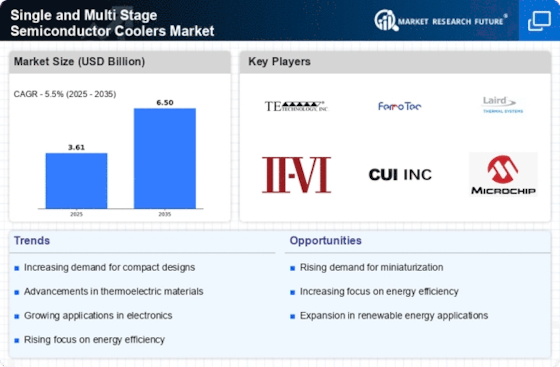
As per Market Research Future analysis, the Single and Multi Stage Semiconductor Coolers Market was estimated at 3.606 USD Billion in 2024. The market is projected to grow from 3.805 USD Billion in 2025 to 6.499 USD Billion by 2035, exhibiting a compound annual growth rate (CAGR) of 5.5% during the forecast period 2025 - 2035

Key Market Trends & Highlights

The Single and Multi Stage Semiconductor Coolers Market is poised for growth driven by technological advancements and diverse applications.

  • North America remains the largest market for semiconductor coolers, driven by robust industrial applications. Asia-Pacific is emerging as the fastest-growing region, fueled by increasing demand for energy-efficient cooling solutions. Thin-Film Substrate Modules dominate the market, while Square Modules are experiencing rapid growth due to their compact design. Technological advancements and a rising focus on energy efficiency are key drivers propelling market expansion.

Market Size & Forecast

2024 Market Size 3.606 (USD Billion)
2035 Market Size 6.499 (USD Billion)
CAGR (2025 - 2035) 5.5%
Largest Regional Market Share in 2024 North America

Major Players

TE Technology Inc (US), Ferrotec Holdings Corporation (JP), Laird Thermal Systems (US), II-VI Incorporated (US), CUI Inc (US), Microchip Technology Inc (US), RMT Ltd (AU), Kryotherm (RU), Advanced Cooling Technologies Inc (US)

Market Trends

The Single and Multi Stage Semiconductor Coolers Market is currently experiencing a notable evolution, driven by advancements in technology and increasing demand across various sectors. These coolers, which utilize thermoelectric principles, are becoming increasingly popular in applications ranging from consumer electronics to industrial processes. The growing emphasis on energy efficiency and miniaturization of devices appears to be propelling the market forward, as manufacturers seek solutions that not only enhance performance but also reduce energy consumption. Furthermore, the integration of these coolers into emerging technologies, such as electric vehicles and renewable energy systems, suggests a promising trajectory for future growth. In addition to technological advancements, the market landscape is also influenced by shifting consumer preferences and regulatory frameworks aimed at promoting sustainable practices. As industries strive to meet environmental standards, the demand for efficient cooling solutions is likely to rise. This trend is further supported by the increasing awareness of climate change and the need for innovative solutions that minimize environmental impact. Overall, the Single and Multi Stage Semiconductor Coolers Market appears poised for continued expansion, with opportunities for innovation and collaboration across various sectors.

Technological Advancements

Recent innovations in thermoelectric materials and designs are enhancing the efficiency and performance of semiconductor coolers. These advancements enable manufacturers to create more compact and powerful cooling solutions, catering to the needs of modern applications.

Sustainability Focus

The growing emphasis on environmental sustainability is driving demand for energy-efficient cooling solutions. Industries are increasingly adopting semiconductor coolers to comply with regulations and reduce their carbon footprint, reflecting a broader trend towards eco-friendly practices.

Diverse Applications

The versatility of Single and Multi Stage Semiconductor Coolers is leading to their adoption in a wide range of applications, from consumer electronics to medical devices. This trend indicates a broadening market scope, as various sectors recognize the benefits of these cooling technologies.

Single Multi Stage Semiconductor Coolers Market Market Drivers

Increased Focus on Miniaturization

The Single and Multi Stage Semiconductor Coolers Market is influenced by the increasing focus on miniaturization in electronic devices. As consumer electronics trend towards smaller, more compact designs, the demand for efficient cooling solutions that fit within limited spaces is rising. Semiconductor coolers, with their small form factor and lightweight characteristics, are ideally suited for this trend. This miniaturization is particularly evident in portable devices, such as laptops and smartphones, where effective thermal management is crucial for performance and longevity. The market is likely to benefit from this trend as manufacturers seek to integrate advanced cooling solutions into their compact designs, thereby enhancing product performance and user experience.

Diverse Applications Across Industries

The Single and Multi Stage Semiconductor Coolers Market is characterized by its diverse applications across various sectors. From telecommunications to medical devices, semiconductor coolers are utilized for their ability to provide precise temperature control in compact spaces. The telecommunications sector, for instance, relies on these coolers to maintain optimal operating temperatures for critical equipment, ensuring reliability and performance. Additionally, the medical industry employs semiconductor coolers in diagnostic equipment, where temperature stability is paramount. As industries continue to innovate and develop new applications for semiconductor cooling technologies, the market is expected to see sustained growth. The versatility of these coolers positions them as essential components in a wide range of products, further driving market expansion.

Rising Demand for Energy-Efficient Solutions

The Single and Multi Stage Semiconductor Coolers Market is witnessing a growing demand for energy-efficient cooling solutions. As energy costs continue to rise, industries are increasingly seeking technologies that minimize energy consumption while maximizing cooling performance. Semiconductor coolers, known for their low power requirements, are becoming a preferred choice in applications ranging from consumer electronics to industrial machinery. According to recent data, the energy-efficient cooling segment is projected to grow at a compound annual growth rate of over 8% in the coming years. This trend is further fueled by regulatory pressures aimed at reducing carbon footprints, prompting manufacturers to invest in energy-efficient cooling technologies. Consequently, the market for semiconductor coolers is likely to expand as businesses prioritize sustainability and operational efficiency.

Growing Investment in Research and Development

The Single and Multi Stage Semiconductor Coolers Market is bolstered by growing investments in research and development. Companies are increasingly allocating resources to innovate and improve semiconductor cooling technologies, aiming to enhance performance and reduce costs. This investment is evident in the development of next-generation thermoelectric materials and designs that promise higher efficiency and reliability. Furthermore, collaborations between academic institutions and industry players are fostering innovation, leading to breakthroughs that could redefine cooling solutions. As R&D efforts continue to advance, the market is expected to evolve, with new products and technologies emerging that cater to the evolving needs of various industries.

Technological Advancements in Cooling Solutions

The Single and Multi Stage Semiconductor Coolers Market is experiencing a surge in technological advancements that enhance cooling efficiency and performance. Innovations in materials, such as the development of advanced thermoelectric materials, are enabling cooler systems to operate at lower power levels while maintaining high cooling capacities. This trend is reflected in the increasing adoption of semiconductor coolers in various sectors, including electronics and automotive, where precise temperature control is critical. Furthermore, the integration of smart technologies, such as IoT-enabled cooling systems, is likely to drive market growth by providing real-time monitoring and control capabilities. As these technologies evolve, they may lead to more compact and efficient designs, thereby expanding the potential applications of semiconductor coolers.

Market Segment Insights

By Product Designs: Thin-Film Substrate Module (Largest) vs. Square Modules (Fastest-Growing)

<p>The Single and Multi Stage Semiconductor Coolers Market is currently dominated by the Thin-Film Substrate Module segment, which holds the largest market share due to its efficiency and effectiveness in thermal management. Following closely is the Square Modules segment, which is emerging as the fastest-growing segment thanks to its compact design and suitability for diverse applications. Other notable segments include Round Modules, Multi Hole Module, Center Hole Module, and Other Product Designs, which collectively contribute to the overall market diversity.</p>

<p>Thin-Film Substrate Module (Dominant) vs. Square Modules (Emerging)</p>

<p>The Thin-Film Substrate Module has established itself as the dominant design in the Single and Multi Stage Semiconductor Coolers Market, known for its superior thermal conductivity and compact size, making it ideal for high-performance applications. This module design allows for efficient heat dissipation, optimizing the performance of semiconductor devices. On the other hand, Square Modules are rapidly gaining traction as an emerging product design. Their geometric versatility enables better integration into various systems and easier manufacturing processes. The increasing demand for efficient cooling solutions in electronics and other industries further drives their adoption. As a result, the competition between these two designs is shaping the future landscape of this market.</p>

By Application: Temperature Cycling (Largest) vs. Optoelectronics Cooling (Fastest-Growing)

<p>In the Single and Multi Stage Semiconductor Coolers Market, the application segment is characterized by diverse categories such as Temperature Cycling, Optoelectronics Cooling, Conventional Cooling, and Other Applications. Among these, Temperature Cycling holds the largest market share, primarily due to its widespread applications in various high-precision industries. Optoelectronics Cooling, on the other hand, is gaining traction as innovative technologies in optics and photonics evolve, catering to the demand for higher efficiency and power density in cooling solutions.</p>

<p>Cooling Technologies: Temperature Cycling (Dominant) vs. Optoelectronics Cooling (Emerging)</p>

<p>Temperature Cycling, as a dominant application in the semiconductor cooler market, is primarily utilized in sectors requiring precise thermal management, such as aerospace and telecommunications. Its robust performance in maintaining temperature stability sets it apart from other applications. Conversely, Optoelectronics Cooling is an emerging segment that leverages advances in semiconductor technology to enhance light-emitting diodes and laser diodes. As capabilities improve and demand for efficient cooling systems rises, this segment is projected to expand rapidly, driven by innovations in electronic devices and consumer electronics.</p>

By End Users: Industrial (Largest) vs. Semiconductor (Fastest-Growing)

<p>The Single and Multi Stage Semiconductor Coolers Market exhibits a diverse distribution across various end-user segments. The Industrial segment holds the largest share, driven by increasing demand for efficient cooling solutions in manufacturing processes. This is followed closely by the Semiconductor segment, which is capitalizing on innovations in cooling technologies and is characterized as the fastest-growing part of the market. Consumer Electronics and Automotive sectors also contribute significantly, leveraging semiconductor coolers for enhanced performance and energy efficiency. Growth trends within the end users' segment reflect the ongoing technological advancements and rising awareness about energy consumption. The Semiconductor segment's rapid expansion is propelled by advancements in chip production and increased reliance on microelectronics. Simultaneously, the Healthcare and Pharmaceutical sectors are witnessing rising investments in cooling solutions for sensitive equipment, further accentuating the market's growth dynamics. Overall, as industries continue to evolve, the demand for effective semiconductor cooling solutions is poised to grow significantly across the various segments.</p>

<p>Industrial (Dominant) vs. Semiconductor (Emerging)</p>

<p>The Industrial segment stands out as the dominant player in the Single and Multi Stage Semiconductor Coolers Market, primarily due to its extensive application in heavy machinery and manufacturing environments, where temperature control is crucial for operational efficiency. Companies in this segment are increasingly adopting advanced cooling technologies to enhance product reliability and performance. On the other hand, the Semiconductor segment is emerging swiftly, driven by a surge in microelectronics and the increasing complexity of semiconductor manufacturing processes. Innovations in this segment focus on developing cooler systems that offer higher efficiency and lower energy consumption, catering to the growing demand for high-performance electronics. As the market evolves, both segments are likely to play pivotal roles by influencing technology trends and shaping the competitive landscape.</p>

Get more detailed insights about Single and Multi Stage Semiconductor Coolers Market Research Report – Forecast till 2035

Regional Insights

North America : Innovation and Market Leadership

North America is the largest market for single and multi-stage semiconductor coolers, holding approximately 45% of the global market share. The region's growth is driven by advancements in technology, increasing demand for efficient cooling solutions in electronics, and supportive regulatory frameworks promoting energy efficiency. The presence of major players like TE Technology Inc and II-VI Incorporated further fuels market expansion. The United States leads the North American market, followed by Canada. The competitive landscape is characterized by innovation and strategic partnerships among key players. Companies are focusing on R&D to enhance product performance and energy efficiency. The market is also witnessing a rise in applications across various sectors, including telecommunications and automotive, which are critical for future growth.

Europe : Emerging Market with Regulations

Europe is witnessing significant growth in the single and multi-stage semiconductor coolers market, accounting for approximately 30% of the global share. The region's growth is propelled by stringent regulations aimed at reducing energy consumption and promoting sustainable technologies. Countries like Germany and France are at the forefront, driving demand through innovation and investment in advanced cooling solutions. Germany is the largest market in Europe, followed by France and the UK. The competitive landscape is marked by the presence of key players such as Laird Thermal Systems and Ferrotec Holdings Corporation. European companies are increasingly focusing on eco-friendly products and compliance with EU regulations, which is shaping the market dynamics and encouraging technological advancements.

Asia-Pacific : Rapid Growth and Adoption

Asia-Pacific is rapidly emerging as a significant player in the single and multi-stage semiconductor coolers market, holding around 20% of the global market share. The region's growth is driven by increasing industrialization, rising demand for consumer electronics, and government initiatives to enhance energy efficiency. Countries like China and Japan are leading the charge, with substantial investments in technology and infrastructure. China is the largest market in the region, followed by Japan and South Korea. The competitive landscape is characterized by a mix of local and international players, including CUI Inc and Microchip Technology Inc. The focus on innovation and cost-effective solutions is driving market growth, as companies strive to meet the increasing demand for efficient cooling systems across various applications, including automotive and telecommunications.

Middle East and Africa : Untapped Potential and Growth

The Middle East and Africa region is gradually emerging in the single and multi-stage semiconductor coolers market, currently holding about 5% of the global market share. The growth is primarily driven by increasing investments in technology and infrastructure, alongside a growing awareness of energy-efficient solutions. Countries like South Africa and the UAE are beginning to adopt advanced cooling technologies, spurred by government initiatives and foreign investments. South Africa is the leading market in the region, followed by the UAE. The competitive landscape is still developing, with opportunities for both local and international players. Companies are focusing on establishing a presence in this untapped market, leveraging partnerships and collaborations to enhance their offerings and meet the rising demand for efficient cooling solutions in various sectors, including telecommunications and healthcare.

Key Players and Competitive Insights

Leading market players are investing heavily in the Single and Multi Stage Semiconductor Coolers market is characterized by a mix of international and regional players. The market is characterized by a diverse set of suppliers, both large and small, who serve various market segments and geographic regions, with important market developments including new product launches, contractual agreements, mergers and acquisitions, higher investments, and collaboration with other organizations. To expand and survive in a more competitive and rising market climate, Single and Multi Stage Semiconductor Coolers industry must offer cost-effective products.
The growth of end user industries has enabled companies to reach a wider customer base used by key players in the global Single and Multi Stage Semiconductor Coolers industry to benefit clients and increase the market sector. In recent years, the Single and Multi Stage Semiconductor Coolers industry has offered some of the most significant advantages to enterprises.
Major players in the Single and Multi Stage Semiconductor Coolers market, including RMT, Ltd, Ferrotec Corporation, Micropelt, II-VI Incorporated, Thermion Company, Wellen Technology Co., Ltd., Phononic, Inc., Hicooltec Electronic, Tellurex Corporation, KELK, Ltd, Merit Technology Group, Hi-Z Technology, Komatsu, Laird PLC., Advanced Thermal Solutions Inc., Coherent Corp, and others, are attempting to increase market demand by investing in research and development operations.
RMT, Ltd, is a globally recognized company specializing in precision machining and manufacturing solutions. Established in 1993, RMT has earned a reputation for its cutting-edge technology, innovation, and dedication to delivering high-quality products to a diverse range of industries. The company's core competencies include CNC machining, custom metal fabrication, and the production of intricate components for various applications. RMT's commitment to excellence is underscored by its state-of-the-art manufacturing facilities and a highly skilled workforce.
With a focus on customer satisfaction and a dedication to providing tailored solutions, RMT has solidified its position as a trusted partner for industries such as aerospace, automotive, healthcare, and beyond. The company's relentless pursuit of precision and quality has made it a leader in the manufacturing sector, consistently meeting the demanding needs of clients worldwide.
Ferrotec Corporation is a global leader in the development and production of advanced materials, components, and systems for a wide range of industries. Founded in 1980, Ferrotec has built an impeccable reputation for its expertise in ferrofluids, advanced ceramics, and thermal management solutions. The company's diverse portfolio includes products and technologies used in semiconductor manufacturing, automotive sensors, medical devices, and more. Ferrotec's dedication to innovation and sustainability is evident through its continuous research and development efforts to create cutting-edge materials and components.
With a global presence and a commitment to customer-centric solutions, Ferrotec is well-positioned to address the unique and evolving needs of various sectors. Their contributions to industries, such as the electronics and healthcare sectors, have established Ferrotec as a trusted partner known for its quality, reliability, and dedication to advancing technology and improving lives.

Key Companies in the Single Multi Stage Semiconductor Coolers Market include

Industry Developments

In April 2021: Ferrotec (USA) Corporation has revealed its partnership with Metamaterial Inc., focusing on the validation of key elements within Metamaterial's NanoWeb® production approach through the utilization of Temescal systems. Ferrotec's Temescal systems division successfully confirmed the validity of Metamaterial's procedural approach and offered them a technological route spanning from an economically efficient entry point to the scalability of thin film production for high volumes.

In March 2021: Hanon Systems has officially initiated the construction of its fifth facility in South Korea. The forthcoming plant, situated in Naengcheon-ri, Oedong-eup, Gyeongju-si, will be erected on a land parcel encompassing approximately 33,000 square meters. The Gyeongju facility's construction is on track to conclude by the second quarter of 2021, with production operations set to commence in the third quarter of the same year.

Future Outlook

Single Multi Stage Semiconductor Coolers Market Future Outlook

The Single and Multi Stage Semiconductor Coolers Market is projected to grow at a 5.5% CAGR from 2025 to 2035, driven by technological advancements and increasing demand for efficient cooling solutions.

New opportunities lie in:

  • Development of compact, high-efficiency semiconductor coolers for portable devices.
  • Expansion into renewable energy sectors with specialized cooling solutions.
  • Partnerships with automotive manufacturers for electric vehicle thermal management systems.

By 2035, the market is expected to achieve robust growth, solidifying its position as a key player in thermal management solutions.

Market Segmentation

Single Multi Stage Semiconductor Coolers Market End Users Outlook

  • Industrial
  • Semiconductor
  • Consumer Electronics
  • Automotive
  • Consumer Appliances
  • Healthcare
  • Pharmaceutical
  • Information and Communication Technology
  • Other End Users

Single Multi Stage Semiconductor Coolers Market Application Outlook

  • Temperature Cycling
  • Optoelectronics Cooling
  • Conventional Cooling
  • Other Application

Single Multi Stage Semiconductor Coolers Market Product Designs Outlook

  • Thin-Film Substrate Module
  • Square Modules
  • Round Modules
  • Multi Hole Module
  • Center Hole Module
  • Other Product Designs

Report Scope

MARKET SIZE 2024 3.606(USD Billion)
MARKET SIZE 2025 3.805(USD Billion)
MARKET SIZE 2035 6.499(USD Billion)
COMPOUND ANNUAL GROWTH RATE (CAGR) 5.5% (2025 - 2035)
REPORT COVERAGE Revenue Forecast, Competitive Landscape, Growth Factors, and Trends
BASE YEAR 2024
Market Forecast Period 2025 - 2035
Historical Data 2019 - 2024
Market Forecast Units USD Billion
Key Companies Profiled TE Technology Inc (US), Ferrotec Holdings Corporation (JP), Laird Thermal Systems (US), II-VI Incorporated (US), CUI Inc (US), Microchip Technology Inc (US), RMT Ltd (AU), Kryotherm (RU), Advanced Cooling Technologies Inc (US)
Segments Covered Product Designs, Application, End User, Region- Industry Forecast Till 2035
Key Market Opportunities Advancements in thermoelectric materials enhance efficiency in the Single and Multi Stage Semiconductor Coolers Market.
Key Market Dynamics Technological advancements drive demand for efficient cooling solutions in electronics and automotive applications.
Countries Covered North America, Europe, APAC, South America, MEA

FAQs

What is the projected market valuation for the Single and Multi Stage Semiconductor Coolers Market in 2035?

<p>The projected market valuation for the Single and Multi Stage Semiconductor Coolers Market in 2035 is 6.499 USD Billion.</p>

What was the overall market valuation for the Single and Multi Stage Semiconductor Coolers Market in 2024?

<p>The overall market valuation for the Single and Multi Stage Semiconductor Coolers Market in 2024 was 3.606 USD Billion.</p>

What is the expected CAGR for the Single and Multi Stage Semiconductor Coolers Market during the forecast period 2025 - 2035?

<p>The expected CAGR for the Single and Multi Stage Semiconductor Coolers Market during the forecast period 2025 - 2035 is 5.5%.</p>

Which product design segment had the highest valuation in 2024?

<p>In 2024, the Square Modules segment had the highest valuation at 0.903 USD Billion.</p>

What is the projected valuation for the Thin-Film Substrate Module segment by 2035?

<p>The projected valuation for the Thin-Film Substrate Module segment by 2035 is 1.305 USD Billion.</p>

Which application segment is expected to grow the most by 2035?

<p>The Optoelectronics Cooling application segment is expected to grow the most, reaching a valuation of 2.2 USD Billion by 2035.</p>

What was the valuation of the Semiconductor end-user segment in 2024?

<p>The valuation of the Semiconductor end-user segment in 2024 was 0.902 USD Billion.</p>

Which key player is based in the United States and is a leader in the market?

<p>TE Technology Inc, based in the United States, is one of the key players leading the market.</p>

What is the projected valuation for the Automotive end-user segment by 2035?

<p>The projected valuation for the Automotive end-user segment by 2035 is 0.778 USD Billion.</p>

How does the valuation of the Consumer Electronics segment compare between 2024 and 2035?

<p>The valuation of the Consumer Electronics segment is expected to increase from 0.541 USD Billion in 2024 to 0.975 USD Billion by 2035.</p>

  1. SECTION I: EXECUTIVE SUMMARY AND KEY HIGHLIGHTS
    1. | 1.1 EXECUTIVE SUMMARY
    2. | | 1.1.1 Market Overview
    3. | | 1.1.2 Key Findings
    4. | | 1.1.3 Market Segmentation
    5. | | 1.1.4 Competitive Landscape
    6. | | 1.1.5 Challenges and Opportunities
    7. | | 1.1.6 Future Outlook
  2. SECTION II: SCOPING, METHODOLOGY AND MARKET STRUCTURE
    1. | 2.1 MARKET INTRODUCTION
    2. | | 2.1.1 Definition
    3. | | 2.1.2 Scope of the study
    4. | | | 2.1.2.1 Research Objective
    5. | | | 2.1.2.2 Assumption
    6. | | | 2.1.2.3 Limitations
    7. | 2.2 RESEARCH METHODOLOGY
    8. | | 2.2.1 Overview
    9. | | 2.2.2 Data Mining
    10. | | 2.2.3 Secondary Research
    11. | | 2.2.4 Primary Research
    12. | | | 2.2.4.1 Primary Interviews and Information Gathering Process
    13. | | | 2.2.4.2 Breakdown of Primary Respondents
    14. | | 2.2.5 Forecasting Model
    15. | | 2.2.6 Market Size Estimation
    16. | | | 2.2.6.1 Bottom-Up Approach
    17. | | | 2.2.6.2 Top-Down Approach
    18. | | 2.2.7 Data Triangulation
    19. | | 2.2.8 Validation
  3. SECTION III: QUALITATIVE ANALYSIS
    1. | 3.1 MARKET DYNAMICS
    2. | | 3.1.1 Overview
    3. | | 3.1.2 Drivers
    4. | | 3.1.3 Restraints
    5. | | 3.1.4 Opportunities
    6. | 3.2 MARKET FACTOR ANALYSIS
    7. | | 3.2.1 Value chain Analysis
    8. | | 3.2.2 Porter's Five Forces Analysis
    9. | | | 3.2.2.1 Bargaining Power of Suppliers
    10. | | | 3.2.2.2 Bargaining Power of Buyers
    11. | | | 3.2.2.3 Threat of New Entrants
    12. | | | 3.2.2.4 Threat of Substitutes
    13. | | | 3.2.2.5 Intensity of Rivalry
    14. | | 3.2.3 COVID-19 Impact Analysis
    15. | | | 3.2.3.1 Market Impact Analysis
    16. | | | 3.2.3.2 Regional Impact
    17. | | | 3.2.3.3 Opportunity and Threat Analysis
  4. SECTION IV: QUANTITATIVE ANALYSIS
    1. | 4.1 Semiconductor & Electronics, BY Product Designs (USD Billion)
    2. | | 4.1.1 Thin-Film Substrate Module
    3. | | 4.1.2 Square Modules
    4. | | 4.1.3 Round Modules
    5. | | 4.1.4 Multi Hole Module
    6. | | 4.1.5 Center Hole Module
    7. | | 4.1.6 Other Product Designs
    8. | 4.2 Semiconductor & Electronics, BY Application (USD Billion)
    9. | | 4.2.1 Temperature Cycling
    10. | | 4.2.2 Optoelectronics Cooling
    11. | | 4.2.3 Conventional Cooling
    12. | | 4.2.4 Other Application
    13. | 4.3 Semiconductor & Electronics, BY End Users (USD Billion)
    14. | | 4.3.1 Industrial
    15. | | 4.3.2 Semiconductor
    16. | | 4.3.3 Consumer Electronics
    17. | | 4.3.4 Automotive
    18. | | 4.3.5 Consumer Appliances
    19. | | 4.3.6 Healthcare
    20. | | 4.3.7 Pharmaceutical
    21. | | 4.3.8 Information and Communication Technology
    22. | | 4.3.9 Other End Users
    23. | 4.4 Semiconductor & Electronics, BY Region (USD Billion)
    24. | | 4.4.1 North America
    25. | | | 4.4.1.1 US
    26. | | | 4.4.1.2 Canada
    27. | | 4.4.2 Europe
    28. | | | 4.4.2.1 Germany
    29. | | | 4.4.2.2 UK
    30. | | | 4.4.2.3 France
    31. | | | 4.4.2.4 Russia
    32. | | | 4.4.2.5 Italy
    33. | | | 4.4.2.6 Spain
    34. | | | 4.4.2.7 Rest of Europe
    35. | | 4.4.3 APAC
    36. | | | 4.4.3.1 China
    37. | | | 4.4.3.2 India
    38. | | | 4.4.3.3 Japan
    39. | | | 4.4.3.4 South Korea
    40. | | | 4.4.3.5 Malaysia
    41. | | | 4.4.3.6 Thailand
    42. | | | 4.4.3.7 Indonesia
    43. | | | 4.4.3.8 Rest of APAC
    44. | | 4.4.4 South America
    45. | | | 4.4.4.1 Brazil
    46. | | | 4.4.4.2 Mexico
    47. | | | 4.4.4.3 Argentina
    48. | | | 4.4.4.4 Rest of South America
    49. | | 4.4.5 MEA
    50. | | | 4.4.5.1 GCC Countries
    51. | | | 4.4.5.2 South Africa
    52. | | | 4.4.5.3 Rest of MEA
  5. SECTION V: COMPETITIVE ANALYSIS
    1. | 5.1 Competitive Landscape
    2. | | 5.1.1 Overview
    3. | | 5.1.2 Competitive Analysis
    4. | | 5.1.3 Market share Analysis
    5. | | 5.1.4 Major Growth Strategy in the Semiconductor & Electronics
    6. | | 5.1.5 Competitive Benchmarking
    7. | | 5.1.6 Leading Players in Terms of Number of Developments in the Semiconductor & Electronics
    8. | | 5.1.7 Key developments and growth strategies
    9. | | | 5.1.7.1 New Product Launch/Service Deployment
    10. | | | 5.1.7.2 Merger & Acquisitions
    11. | | | 5.1.7.3 Joint Ventures
    12. | | 5.1.8 Major Players Financial Matrix
    13. | | | 5.1.8.1 Sales and Operating Income
    14. | | | 5.1.8.2 Major Players R&D Expenditure. 2023
    15. | 5.2 Company Profiles
    16. | | 5.2.1 TE Technology Inc (US)
    17. | | | 5.2.1.1 Financial Overview
    18. | | | 5.2.1.2 Products Offered
    19. | | | 5.2.1.3 Key Developments
    20. | | | 5.2.1.4 SWOT Analysis
    21. | | | 5.2.1.5 Key Strategies
    22. | | 5.2.2 Ferrotec Holdings Corporation (JP)
    23. | | | 5.2.2.1 Financial Overview
    24. | | | 5.2.2.2 Products Offered
    25. | | | 5.2.2.3 Key Developments
    26. | | | 5.2.2.4 SWOT Analysis
    27. | | | 5.2.2.5 Key Strategies
    28. | | 5.2.3 Laird Thermal Systems (US)
    29. | | | 5.2.3.1 Financial Overview
    30. | | | 5.2.3.2 Products Offered
    31. | | | 5.2.3.3 Key Developments
    32. | | | 5.2.3.4 SWOT Analysis
    33. | | | 5.2.3.5 Key Strategies
    34. | | 5.2.4 II-VI Incorporated (US)
    35. | | | 5.2.4.1 Financial Overview
    36. | | | 5.2.4.2 Products Offered
    37. | | | 5.2.4.3 Key Developments
    38. | | | 5.2.4.4 SWOT Analysis
    39. | | | 5.2.4.5 Key Strategies
    40. | | 5.2.5 CUI Inc (US)
    41. | | | 5.2.5.1 Financial Overview
    42. | | | 5.2.5.2 Products Offered
    43. | | | 5.2.5.3 Key Developments
    44. | | | 5.2.5.4 SWOT Analysis
    45. | | | 5.2.5.5 Key Strategies
    46. | | 5.2.6 Microchip Technology Inc (US)
    47. | | | 5.2.6.1 Financial Overview
    48. | | | 5.2.6.2 Products Offered
    49. | | | 5.2.6.3 Key Developments
    50. | | | 5.2.6.4 SWOT Analysis
    51. | | | 5.2.6.5 Key Strategies
    52. | | 5.2.7 RMT Ltd (AU)
    53. | | | 5.2.7.1 Financial Overview
    54. | | | 5.2.7.2 Products Offered
    55. | | | 5.2.7.3 Key Developments
    56. | | | 5.2.7.4 SWOT Analysis
    57. | | | 5.2.7.5 Key Strategies
    58. | | 5.2.8 Kryotherm (RU)
    59. | | | 5.2.8.1 Financial Overview
    60. | | | 5.2.8.2 Products Offered
    61. | | | 5.2.8.3 Key Developments
    62. | | | 5.2.8.4 SWOT Analysis
    63. | | | 5.2.8.5 Key Strategies
    64. | | 5.2.9 Advanced Cooling Technologies Inc (US)
    65. | | | 5.2.9.1 Financial Overview
    66. | | | 5.2.9.2 Products Offered
    67. | | | 5.2.9.3 Key Developments
    68. | | | 5.2.9.4 SWOT Analysis
    69. | | | 5.2.9.5 Key Strategies
    70. | 5.3 Appendix
    71. | | 5.3.1 References
    72. | | 5.3.2 Related Reports
  6. LIST OF FIGURES
    1. | 6.1 MARKET SYNOPSIS
    2. | 6.2 NORTH AMERICA MARKET ANALYSIS
    3. | 6.3 US MARKET ANALYSIS BY PRODUCT DESIGNS
    4. | 6.4 US MARKET ANALYSIS BY APPLICATION
    5. | 6.5 US MARKET ANALYSIS BY END USERS
    6. | 6.6 CANADA MARKET ANALYSIS BY PRODUCT DESIGNS
    7. | 6.7 CANADA MARKET ANALYSIS BY APPLICATION
    8. | 6.8 CANADA MARKET ANALYSIS BY END USERS
    9. | 6.9 EUROPE MARKET ANALYSIS
    10. | 6.10 GERMANY MARKET ANALYSIS BY PRODUCT DESIGNS
    11. | 6.11 GERMANY MARKET ANALYSIS BY APPLICATION
    12. | 6.12 GERMANY MARKET ANALYSIS BY END USERS
    13. | 6.13 UK MARKET ANALYSIS BY PRODUCT DESIGNS
    14. | 6.14 UK MARKET ANALYSIS BY APPLICATION
    15. | 6.15 UK MARKET ANALYSIS BY END USERS
    16. | 6.16 FRANCE MARKET ANALYSIS BY PRODUCT DESIGNS
    17. | 6.17 FRANCE MARKET ANALYSIS BY APPLICATION
    18. | 6.18 FRANCE MARKET ANALYSIS BY END USERS
    19. | 6.19 RUSSIA MARKET ANALYSIS BY PRODUCT DESIGNS
    20. | 6.20 RUSSIA MARKET ANALYSIS BY APPLICATION
    21. | 6.21 RUSSIA MARKET ANALYSIS BY END USERS
    22. | 6.22 ITALY MARKET ANALYSIS BY PRODUCT DESIGNS
    23. | 6.23 ITALY MARKET ANALYSIS BY APPLICATION
    24. | 6.24 ITALY MARKET ANALYSIS BY END USERS
    25. | 6.25 SPAIN MARKET ANALYSIS BY PRODUCT DESIGNS
    26. | 6.26 SPAIN MARKET ANALYSIS BY APPLICATION
    27. | 6.27 SPAIN MARKET ANALYSIS BY END USERS
    28. | 6.28 REST OF EUROPE MARKET ANALYSIS BY PRODUCT DESIGNS
    29. | 6.29 REST OF EUROPE MARKET ANALYSIS BY APPLICATION
    30. | 6.30 REST OF EUROPE MARKET ANALYSIS BY END USERS
    31. | 6.31 APAC MARKET ANALYSIS
    32. | 6.32 CHINA MARKET ANALYSIS BY PRODUCT DESIGNS
    33. | 6.33 CHINA MARKET ANALYSIS BY APPLICATION
    34. | 6.34 CHINA MARKET ANALYSIS BY END USERS
    35. | 6.35 INDIA MARKET ANALYSIS BY PRODUCT DESIGNS
    36. | 6.36 INDIA MARKET ANALYSIS BY APPLICATION
    37. | 6.37 INDIA MARKET ANALYSIS BY END USERS
    38. | 6.38 JAPAN MARKET ANALYSIS BY PRODUCT DESIGNS
    39. | 6.39 JAPAN MARKET ANALYSIS BY APPLICATION
    40. | 6.40 JAPAN MARKET ANALYSIS BY END USERS
    41. | 6.41 SOUTH KOREA MARKET ANALYSIS BY PRODUCT DESIGNS
    42. | 6.42 SOUTH KOREA MARKET ANALYSIS BY APPLICATION
    43. | 6.43 SOUTH KOREA MARKET ANALYSIS BY END USERS
    44. | 6.44 MALAYSIA MARKET ANALYSIS BY PRODUCT DESIGNS
    45. | 6.45 MALAYSIA MARKET ANALYSIS BY APPLICATION
    46. | 6.46 MALAYSIA MARKET ANALYSIS BY END USERS
    47. | 6.47 THAILAND MARKET ANALYSIS BY PRODUCT DESIGNS
    48. | 6.48 THAILAND MARKET ANALYSIS BY APPLICATION
    49. | 6.49 THAILAND MARKET ANALYSIS BY END USERS
    50. | 6.50 INDONESIA MARKET ANALYSIS BY PRODUCT DESIGNS
    51. | 6.51 INDONESIA MARKET ANALYSIS BY APPLICATION
    52. | 6.52 INDONESIA MARKET ANALYSIS BY END USERS
    53. | 6.53 REST OF APAC MARKET ANALYSIS BY PRODUCT DESIGNS
    54. | 6.54 REST OF APAC MARKET ANALYSIS BY APPLICATION
    55. | 6.55 REST OF APAC MARKET ANALYSIS BY END USERS
    56. | 6.56 SOUTH AMERICA MARKET ANALYSIS
    57. | 6.57 BRAZIL MARKET ANALYSIS BY PRODUCT DESIGNS
    58. | 6.58 BRAZIL MARKET ANALYSIS BY APPLICATION
    59. | 6.59 BRAZIL MARKET ANALYSIS BY END USERS
    60. | 6.60 MEXICO MARKET ANALYSIS BY PRODUCT DESIGNS
    61. | 6.61 MEXICO MARKET ANALYSIS BY APPLICATION
    62. | 6.62 MEXICO MARKET ANALYSIS BY END USERS
    63. | 6.63 ARGENTINA MARKET ANALYSIS BY PRODUCT DESIGNS
    64. | 6.64 ARGENTINA MARKET ANALYSIS BY APPLICATION
    65. | 6.65 ARGENTINA MARKET ANALYSIS BY END USERS
    66. | 6.66 REST OF SOUTH AMERICA MARKET ANALYSIS BY PRODUCT DESIGNS
    67. | 6.67 REST OF SOUTH AMERICA MARKET ANALYSIS BY APPLICATION
    68. | 6.68 REST OF SOUTH AMERICA MARKET ANALYSIS BY END USERS
    69. | 6.69 MEA MARKET ANALYSIS
    70. | 6.70 GCC COUNTRIES MARKET ANALYSIS BY PRODUCT DESIGNS
    71. | 6.71 GCC COUNTRIES MARKET ANALYSIS BY APPLICATION
    72. | 6.72 GCC COUNTRIES MARKET ANALYSIS BY END USERS
    73. | 6.73 SOUTH AFRICA MARKET ANALYSIS BY PRODUCT DESIGNS
    74. | 6.74 SOUTH AFRICA MARKET ANALYSIS BY APPLICATION
    75. | 6.75 SOUTH AFRICA MARKET ANALYSIS BY END USERS
    76. | 6.76 REST OF MEA MARKET ANALYSIS BY PRODUCT DESIGNS
    77. | 6.77 REST OF MEA MARKET ANALYSIS BY APPLICATION
    78. | 6.78 REST OF MEA MARKET ANALYSIS BY END USERS
    79. | 6.79 KEY BUYING CRITERIA OF SEMICONDUCTOR & ELECTRONICS
    80. | 6.80 RESEARCH PROCESS OF MRFR
    81. | 6.81 DRO ANALYSIS OF SEMICONDUCTOR & ELECTRONICS
    82. | 6.82 DRIVERS IMPACT ANALYSIS: SEMICONDUCTOR & ELECTRONICS
    83. | 6.83 RESTRAINTS IMPACT ANALYSIS: SEMICONDUCTOR & ELECTRONICS
    84. | 6.84 SUPPLY / VALUE CHAIN: SEMICONDUCTOR & ELECTRONICS
    85. | 6.85 SEMICONDUCTOR & ELECTRONICS, BY PRODUCT DESIGNS, 2024 (% SHARE)
    86. | 6.86 SEMICONDUCTOR & ELECTRONICS, BY PRODUCT DESIGNS, 2024 TO 2035 (USD Billion)
    87. | 6.87 SEMICONDUCTOR & ELECTRONICS, BY APPLICATION, 2024 (% SHARE)
    88. | 6.88 SEMICONDUCTOR & ELECTRONICS, BY APPLICATION, 2024 TO 2035 (USD Billion)
    89. | 6.89 SEMICONDUCTOR & ELECTRONICS, BY END USERS, 2024 (% SHARE)
    90. | 6.90 SEMICONDUCTOR & ELECTRONICS, BY END USERS, 2024 TO 2035 (USD Billion)
    91. | 6.91 BENCHMARKING OF MAJOR COMPETITORS
  7. LIST OF TABLES
    1. | 7.1 LIST OF ASSUMPTIONS
    2. | | 7.1.1
    3. | 7.2 North America MARKET SIZE ESTIMATES; FORECAST
    4. | | 7.2.1 BY PRODUCT DESIGNS, 2025-2035 (USD Billion)
    5. | | 7.2.2 BY APPLICATION, 2025-2035 (USD Billion)
    6. | | 7.2.3 BY END USERS, 2025-2035 (USD Billion)
    7. | 7.3 US MARKET SIZE ESTIMATES; FORECAST
    8. | | 7.3.1 BY PRODUCT DESIGNS, 2025-2035 (USD Billion)
    9. | | 7.3.2 BY APPLICATION, 2025-2035 (USD Billion)
    10. | | 7.3.3 BY END USERS, 2025-2035 (USD Billion)
    11. | 7.4 Canada MARKET SIZE ESTIMATES; FORECAST
    12. | | 7.4.1 BY PRODUCT DESIGNS, 2025-2035 (USD Billion)
    13. | | 7.4.2 BY APPLICATION, 2025-2035 (USD Billion)
    14. | | 7.4.3 BY END USERS, 2025-2035 (USD Billion)
    15. | 7.5 Europe MARKET SIZE ESTIMATES; FORECAST
    16. | | 7.5.1 BY PRODUCT DESIGNS, 2025-2035 (USD Billion)
    17. | | 7.5.2 BY APPLICATION, 2025-2035 (USD Billion)
    18. | | 7.5.3 BY END USERS, 2025-2035 (USD Billion)
    19. | 7.6 Germany MARKET SIZE ESTIMATES; FORECAST
    20. | | 7.6.1 BY PRODUCT DESIGNS, 2025-2035 (USD Billion)
    21. | | 7.6.2 BY APPLICATION, 2025-2035 (USD Billion)
    22. | | 7.6.3 BY END USERS, 2025-2035 (USD Billion)
    23. | 7.7 UK MARKET SIZE ESTIMATES; FORECAST
    24. | | 7.7.1 BY PRODUCT DESIGNS, 2025-2035 (USD Billion)
    25. | | 7.7.2 BY APPLICATION, 2025-2035 (USD Billion)
    26. | | 7.7.3 BY END USERS, 2025-2035 (USD Billion)
    27. | 7.8 France MARKET SIZE ESTIMATES; FORECAST
    28. | | 7.8.1 BY PRODUCT DESIGNS, 2025-2035 (USD Billion)
    29. | | 7.8.2 BY APPLICATION, 2025-2035 (USD Billion)
    30. | | 7.8.3 BY END USERS, 2025-2035 (USD Billion)
    31. | 7.9 Russia MARKET SIZE ESTIMATES; FORECAST
    32. | | 7.9.1 BY PRODUCT DESIGNS, 2025-2035 (USD Billion)
    33. | | 7.9.2 BY APPLICATION, 2025-2035 (USD Billion)
    34. | | 7.9.3 BY END USERS, 2025-2035 (USD Billion)
    35. | 7.10 Italy MARKET SIZE ESTIMATES; FORECAST
    36. | | 7.10.1 BY PRODUCT DESIGNS, 2025-2035 (USD Billion)
    37. | | 7.10.2 BY APPLICATION, 2025-2035 (USD Billion)
    38. | | 7.10.3 BY END USERS, 2025-2035 (USD Billion)
    39. | 7.11 Spain MARKET SIZE ESTIMATES; FORECAST
    40. | | 7.11.1 BY PRODUCT DESIGNS, 2025-2035 (USD Billion)
    41. | | 7.11.2 BY APPLICATION, 2025-2035 (USD Billion)
    42. | | 7.11.3 BY END USERS, 2025-2035 (USD Billion)
    43. | 7.12 Rest of Europe MARKET SIZE ESTIMATES; FORECAST
    44. | | 7.12.1 BY PRODUCT DESIGNS, 2025-2035 (USD Billion)
    45. | | 7.12.2 BY APPLICATION, 2025-2035 (USD Billion)
    46. | | 7.12.3 BY END USERS, 2025-2035 (USD Billion)
    47. | 7.13 APAC MARKET SIZE ESTIMATES; FORECAST
    48. | | 7.13.1 BY PRODUCT DESIGNS, 2025-2035 (USD Billion)
    49. | | 7.13.2 BY APPLICATION, 2025-2035 (USD Billion)
    50. | | 7.13.3 BY END USERS, 2025-2035 (USD Billion)
    51. | 7.14 China MARKET SIZE ESTIMATES; FORECAST
    52. | | 7.14.1 BY PRODUCT DESIGNS, 2025-2035 (USD Billion)
    53. | | 7.14.2 BY APPLICATION, 2025-2035 (USD Billion)
    54. | | 7.14.3 BY END USERS, 2025-2035 (USD Billion)
    55. | 7.15 India MARKET SIZE ESTIMATES; FORECAST
    56. | | 7.15.1 BY PRODUCT DESIGNS, 2025-2035 (USD Billion)
    57. | | 7.15.2 BY APPLICATION, 2025-2035 (USD Billion)
    58. | | 7.15.3 BY END USERS, 2025-2035 (USD Billion)
    59. | 7.16 Japan MARKET SIZE ESTIMATES; FORECAST
    60. | | 7.16.1 BY PRODUCT DESIGNS, 2025-2035 (USD Billion)
    61. | | 7.16.2 BY APPLICATION, 2025-2035 (USD Billion)
    62. | | 7.16.3 BY END USERS, 2025-2035 (USD Billion)
    63. | 7.17 South Korea MARKET SIZE ESTIMATES; FORECAST
    64. | | 7.17.1 BY PRODUCT DESIGNS, 2025-2035 (USD Billion)
    65. | | 7.17.2 BY APPLICATION, 2025-2035 (USD Billion)
    66. | | 7.17.3 BY END USERS, 2025-2035 (USD Billion)
    67. | 7.18 Malaysia MARKET SIZE ESTIMATES; FORECAST
    68. | | 7.18.1 BY PRODUCT DESIGNS, 2025-2035 (USD Billion)
    69. | | 7.18.2 BY APPLICATION, 2025-2035 (USD Billion)
    70. | | 7.18.3 BY END USERS, 2025-2035 (USD Billion)
    71. | 7.19 Thailand MARKET SIZE ESTIMATES; FORECAST
    72. | | 7.19.1 BY PRODUCT DESIGNS, 2025-2035 (USD Billion)
    73. | | 7.19.2 BY APPLICATION, 2025-2035 (USD Billion)
    74. | | 7.19.3 BY END USERS, 2025-2035 (USD Billion)
    75. | 7.20 Indonesia MARKET SIZE ESTIMATES; FORECAST
    76. | | 7.20.1 BY PRODUCT DESIGNS, 2025-2035 (USD Billion)
    77. | | 7.20.2 BY APPLICATION, 2025-2035 (USD Billion)
    78. | | 7.20.3 BY END USERS, 2025-2035 (USD Billion)
    79. | 7.21 Rest of APAC MARKET SIZE ESTIMATES; FORECAST
    80. | | 7.21.1 BY PRODUCT DESIGNS, 2025-2035 (USD Billion)
    81. | | 7.21.2 BY APPLICATION, 2025-2035 (USD Billion)
    82. | | 7.21.3 BY END USERS, 2025-2035 (USD Billion)
    83. | 7.22 South America MARKET SIZE ESTIMATES; FORECAST
    84. | | 7.22.1 BY PRODUCT DESIGNS, 2025-2035 (USD Billion)
    85. | | 7.22.2 BY APPLICATION, 2025-2035 (USD Billion)
    86. | | 7.22.3 BY END USERS, 2025-2035 (USD Billion)
    87. | 7.23 Brazil MARKET SIZE ESTIMATES; FORECAST
    88. | | 7.23.1 BY PRODUCT DESIGNS, 2025-2035 (USD Billion)
    89. | | 7.23.2 BY APPLICATION, 2025-2035 (USD Billion)
    90. | | 7.23.3 BY END USERS, 2025-2035 (USD Billion)
    91. | 7.24 Mexico MARKET SIZE ESTIMATES; FORECAST
    92. | | 7.24.1 BY PRODUCT DESIGNS, 2025-2035 (USD Billion)
    93. | | 7.24.2 BY APPLICATION, 2025-2035 (USD Billion)
    94. | | 7.24.3 BY END USERS, 2025-2035 (USD Billion)
    95. | 7.25 Argentina MARKET SIZE ESTIMATES; FORECAST
    96. | | 7.25.1 BY PRODUCT DESIGNS, 2025-2035 (USD Billion)
    97. | | 7.25.2 BY APPLICATION, 2025-2035 (USD Billion)
    98. | | 7.25.3 BY END USERS, 2025-2035 (USD Billion)
    99. | 7.26 Rest of South America MARKET SIZE ESTIMATES; FORECAST
    100. | | 7.26.1 BY PRODUCT DESIGNS, 2025-2035 (USD Billion)
    101. | | 7.26.2 BY APPLICATION, 2025-2035 (USD Billion)
    102. | | 7.26.3 BY END USERS, 2025-2035 (USD Billion)
    103. | 7.27 MEA MARKET SIZE ESTIMATES; FORECAST
    104. | | 7.27.1 BY PRODUCT DESIGNS, 2025-2035 (USD Billion)
    105. | | 7.27.2 BY APPLICATION, 2025-2035 (USD Billion)
    106. | | 7.27.3 BY END USERS, 2025-2035 (USD Billion)
    107. | 7.28 GCC Countries MARKET SIZE ESTIMATES; FORECAST
    108. | | 7.28.1 BY PRODUCT DESIGNS, 2025-2035 (USD Billion)
    109. | | 7.28.2 BY APPLICATION, 2025-2035 (USD Billion)
    110. | | 7.28.3 BY END USERS, 2025-2035 (USD Billion)
    111. | 7.29 South Africa MARKET SIZE ESTIMATES; FORECAST
    112. | | 7.29.1 BY PRODUCT DESIGNS, 2025-2035 (USD Billion)
    113. | | 7.29.2 BY APPLICATION, 2025-2035 (USD Billion)
    114. | | 7.29.3 BY END USERS, 2025-2035 (USD Billion)
    115. | 7.30 Rest of MEA MARKET SIZE ESTIMATES; FORECAST
    116. | | 7.30.1 BY PRODUCT DESIGNS, 2025-2035 (USD Billion)
    117. | | 7.30.2 BY APPLICATION, 2025-2035 (USD Billion)
    118. | | 7.30.3 BY END USERS, 2025-2035 (USD Billion)
    119. | 7.31 PRODUCT LAUNCH/PRODUCT DEVELOPMENT/APPROVAL
    120. | | 7.31.1
    121. | 7.32 ACQUISITION/PARTNERSHIP
    122. | | 7.32.1

Semiconductor & Electronics Market Segmentation

Semiconductor & Electronics By Product Designs (USD Billion, 2025-2035)

  • Thin-Film Substrate Module
  • Square Modules
  • Round Modules
  • Multi Hole Module
  • Center Hole Module
  • Other Product Designs

Semiconductor & Electronics By Application (USD Billion, 2025-2035)

  • Temperature Cycling
  • Optoelectronics Cooling
  • Conventional Cooling
  • Other Application

Semiconductor & Electronics By End Users (USD Billion, 2025-2035)

  • Industrial
  • Semiconductor
  • Consumer Electronics
  • Automotive
  • Consumer Appliances
  • Healthcare
  • Pharmaceutical
  • Information and Communication Technology
  • Other End Users
Infographic

Free Sample Request

Kindly complete the form below to receive a free sample of this Report

Get Free Sample

Customer Strories

Compare Licence

×
Features License Type
Single User Multiuser License Enterprise User
Price $4,950 $5,950 $7,250
Maximum User Access Limit 1 User Upto 10 Users Unrestricted Access Throughout the Organization
Free Customization
Direct Access to Analyst
Deliverable Format
Platform Access
Discount on Next Purchase 10% 15% 15%
Printable Versions