Request Free Sample ×

Kindly complete the form below to receive a free sample of this Report

* Please use a valid business email

Leading companies partner with us for data-driven Insights

clients tt-cursor
Hero Background
English
Chinese
French
Japanese
Korean
German
Spanish

Silicones Market Trends

ID: MRFR/CnM/4030-HCR
111 Pages
Chitranshi Jaiswal
March 2026

Silicone Market Research Report Information By Type (Resins, Fluids, Gels And Elastomer), By Application (Building & Construction, Personal Care & Consumer Products, Automotive & Transportation, Medical & Healthcare And Industrial Process) And By Region (North America, Europe, Asia-Pacific, And Rest Of The World) –Market Forecast Till 2035.

Share:
Download PDF ×

We do not share your information with anyone. However, we may send you emails based on your report interest from time to time. You may contact us at any time to opt-out.

Silicones Market Infographic
Purchase Options

Market Trends

Key Emerging Trends in the Silicones Market

The industry's dynamism has been manifested through remarkable trends occurring within this sector lately; this is according to trends observed in the silicone sector. Due to its special features, silicone, which is a versatile polymer made up of silicon-oxygen-carbon-hydrogen atoms, finds its use in many industries. One of these trends concerns the increased use of Silicones in construction industries across different countries. Moreover, automotive is now one of the most significant drivers for silicones on the market. With a particular focus on weight reduction, the fuel economy and electric vehicles’ manufacturing process cannot completely ignore the importance of silicones. The components that can be produced with it include gasket hose coatings, among others, that can be used to improve vehicle performance. With its abilities it becomes helpful for automobiles when any liquid needs to move through unturned corners. This presents a huge challenge to silicone raw material price variability. Volatile raw material costs and energy prices affect operation on a worldwide scale for all silicone markets. For over two years now, silicones have not been making money at all. This means that due to volatility, the final price for silicone has risen. Medical application is another growing area where there is great demand for silicones. The compatibility of silicones with living tissues, as well as their flexibility, makes them suitable for medical devices, prosthetics, and other healthcare products. As healthcare technology improves, the need for unique silicone materials that meet strict health regulatory measures increases. This trend is, therefore, likely to remain prominent as the industry seeks new ways and materials to apply in medicine. The silicone market is also highly influenced by the electronics and electrical industry. Silicones are extensively used in electronic components such as potting compounds, adhesives, and encapsulants due to their excellent thermal stability and electrical insulation properties. In terms of market trends, sustainability has also been the most significant issue in silicone markets. This changing business environment necessitates eco-friendly silicone development because industries operate under a lot of pressure to minimize environmental pollution. Conversely, challenges such as fluctuating raw material prices and supply chain disruptions can significantly affect the silicon market. Different industries with evolving consumer demands drive dynamic trends in the silicone market today. They continue to play an important part not only within construction, automotive, and healthcare but also in the electronics sectors, where they show how easy it is to make anything using them.

Author
Author Profile
Chitranshi Jaiswal
Team Lead - Research

Chitranshi is a Team Leader in the Chemicals & Materials (CnM) and Energy & Power (EnP) domains, with 6+ years of experience in market research. She leads and mentors teams to deliver cross-domain projects that equip clients with actionable insights and growth strategies. She is skilled in market estimation, forecasting, competitive benchmarking, and both primary & secondary research, enabling her to turn complex data into decision-ready insights. An engineer and MBA professional, she combines technical expertise with strategic acumen to solve dynamic market challenges. Chitranshi has successfully managed projects that support market entry, investment planning, and competitive positioning, while building strong client relationships. Certified in Advanced Excel & Power BI she leverages data-driven approaches to ensure accuracy, clarity, and impactful outcomes.

Leave a Comment

FAQs

What is the projected market valuation of The Global Silicones by 2035?

<p>The projected market valuation of The Global Silicones is expected to reach 17.94 USD Billion by 2035.</p>

What was the market valuation of The Global Silicones in 2024?

<p>The overall market valuation of The Global Silicones was 11.17 USD Billion in 2024.</p>

What is the expected CAGR for The Global Silicones during the forecast period 2025 - 2035?

<p>The expected CAGR for The Global Silicones during the forecast period 2025 - 2035 is 4.4%.</p>

Which segments are projected to show growth in The Global Silicones?

<p>Segments such as Elastomers and Industrial Processes are projected to show notable growth, with valuations reaching 6.74 USD Billion and 5.14 USD Billion, respectively, by 2035.</p>

Who are the key players in The Global Silicones?

<p>Key players in The Global Silicones include Dow, Wacker Chemie AG, Momentive Performance Materials, and Shin-Etsu Chemical Co., Ltd.</p>

What applications are driving the demand for silicones?

<p>Applications in Building & Construction and Medical & Healthcare are driving demand, with projected valuations of 4.0 USD Billion and 3.0 USD Billion, respectively, by 2035.</p>

How did the valuation of silicone elastomers change from 2024 to 2035?

<p>The valuation of silicone elastomers increased from 4.17 USD Billion in 2024 to a projected 6.74 USD Billion by 2035.</p>

What is the expected growth in the personal care and consumer products segment?

<p>The personal care and consumer products segment is expected to grow from 2.0 USD Billion in 2024 to 3.0 USD Billion by 2035.</p>

Which company is likely to lead in The Global Silicones?

<p>Companies like Dow and Wacker Chemie AG are likely to maintain leadership positions in The Global Silicones due to their extensive product portfolios.</p>

What trends are influencing The Global Silicones?

<p>Trends such as increasing demand in automotive and healthcare applications are influencing The Global Silicones, with automotive applications projected to reach 2.8 USD Billion by 2035.</p>

Market Summary

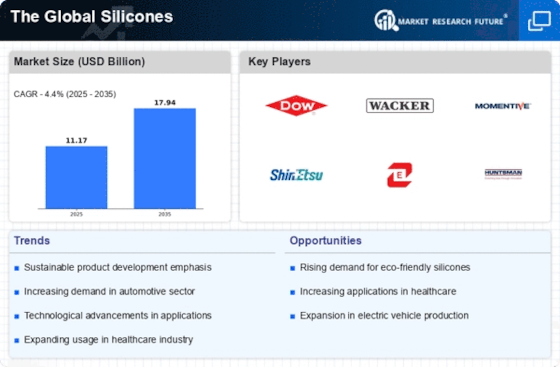
As per Market Research Future analysis, The Global Silicones Market Size was estimated at 11.17 USD Billion in 2024. The silicones industry is projected to grow from 11.66 USD Billion in 2025 to 17.94 USD Billion by 2035, exhibiting a compound annual growth rate (CAGR) of 4% during the forecast period 2025 - 2035

Key Market Trends & Highlights

The Global Silicones Market is poised for robust growth driven by diverse applications and technological advancements.

  • North America remains the largest market for silicones, driven by extensive applications in various industries. Asia-Pacific is the fastest-growing region, reflecting increasing demand for silicones in emerging economies. Elastomers dominate the market, while fluids are experiencing the fastest growth due to their versatility in applications. Rising demand in the automotive sector and growth in construction activities are key drivers propelling market expansion.

Market Size & Forecast

2024 Market Size 11.17 (USD Billion)
2035 Market Size 17.94 (USD Billion)
CAGR (2025 - 2035) 4.4%
Largest Regional Market Share in 2024 Asia Pacific

Major Players

Dow (US), Wacker Chemie AG (DE), Momentive Performance Materials (US), Shin-Etsu Chemical Co., Ltd. (JP), Elkem ASA (NO), Huntsman Corporation (US), KCC Corporation (KR), Silicone Solutions (US), China National Bluestar (Group) Co., Ltd. (CN)

Market Trends

The Global Silicones Market is currently experiencing a dynamic evolution, driven by a multitude of factors that influence its trajectory. The increasing demand for silicone-based products across various industries, such as automotive, construction, and healthcare, appears to be a primary catalyst for growth. Innovations in silicone formulations and applications are likely to enhance performance characteristics, making them more appealing to manufacturers and consumers alike. Furthermore, the trend towards sustainability and eco-friendly materials is prompting companies to explore bio-based silicones, which could reshape the competitive landscape. As industries seek to reduce their environmental footprint, the adoption of sustainable practices may become a defining feature of the market. In addition to sustainability, The Global Silicones Market is witnessing a surge in technological advancements. The integration of silicones in electronics, particularly in the production of semiconductors and flexible displays, suggests a promising future for this segment. Moreover, the rise of smart technologies and the Internet of Things (IoT) is likely to create new opportunities for silicone applications. As the market continues to evolve, stakeholders must remain vigilant to emerging trends and shifts in consumer preferences, which could significantly impact market dynamics in the coming years.

Sustainability Initiatives

The focus on eco-friendly materials is reshaping The Global Silicones Market. Companies are increasingly investing in bio-based silicones, which align with the growing consumer demand for sustainable products. This trend may lead to a shift in production practices and supply chain management.

Technological Advancements

Innovations in silicone applications are driving growth within The Global Silicones Market. The integration of silicones in electronics, particularly in semiconductors and flexible displays, indicates a potential expansion of market opportunities as technology continues to advance.

Diverse Industry Applications

The versatility of silicones is evident in their widespread use across various sectors, including automotive, construction, and healthcare. This broad applicability suggests that The Global Silicones Market may continue to thrive as industries seek high-performance materials.

Silicones Market Market Drivers

Growth in Construction Activities

The construction industry is witnessing robust growth, which is significantly impacting The Global Silicones Industry. Silicones Market are extensively used in construction applications, including sealants, adhesives, and insulation materials, due to their superior properties such as weather resistance and durability. In recent years, the construction sector has expanded, with a projected growth rate of 4.5% annually through 2025. This expansion is driven by urbanization, infrastructure development, and the increasing focus on sustainable building practices. As a result, the demand for silicone products in construction is expected to rise, as builders and contractors seek materials that enhance energy efficiency and reduce environmental impact. The integration of silicones in green building initiatives further underscores their importance in modern construction.

Rising Demand in Automotive Sector

The automotive sector is experiencing a notable surge in demand for silicone materials, driven by the need for lightweight, durable, and high-performance components. Silicones Market are increasingly utilized in various applications, including sealants, adhesives, and coatings, which enhance vehicle performance and longevity. In 2023, the automotive industry accounted for approximately 25% of the total consumption of silicones, reflecting a growing trend towards the integration of advanced materials in vehicle manufacturing. This shift is likely to continue, as manufacturers seek to improve fuel efficiency and reduce emissions, thereby propelling The Global Silicones Industry forward. Furthermore, the increasing adoption of electric vehicles is expected to further amplify the demand for silicone-based products, as these vehicles require specialized materials to meet their unique performance requirements.

Expansion of Electronics and Consumer Goods

The electronics and consumer goods sectors are experiencing rapid growth, which is positively influencing The Global Silicones Industry. Silicones Market are widely used in the production of electronic components, such as insulators, encapsulants, and thermal interface materials, due to their excellent electrical properties and thermal stability. In 2023, the electronics sector accounted for around 20% of the total silicone market share, driven by the increasing demand for consumer electronics and smart devices. This trend is expected to continue, as technological advancements lead to the development of more sophisticated electronic products. Additionally, the growing trend of smart homes and IoT devices is likely to further boost the demand for silicone materials, as manufacturers seek reliable and high-performance solutions for their products.

Increasing Focus on Healthcare Applications

The healthcare sector is increasingly recognizing the value of silicone materials, which are essential in various medical applications. Silicones Market are utilized in medical devices, implants, and drug delivery systems due to their biocompatibility and flexibility. The Global Silicones Industry is projected to see substantial growth in this segment, as the demand for advanced medical technologies continues to rise. In 2023, the healthcare application accounted for approximately 15% of the total silicone consumption, reflecting a growing trend towards the use of high-quality materials in medical applications. As the global population ages and the prevalence of chronic diseases increases, the need for innovative healthcare solutions is likely to drive further demand for silicone products, thereby enhancing the market's growth prospects.

Technological Innovations in Silicone Production

Technological advancements in silicone production processes are playing a crucial role in shaping The Global Silicones Industry. Innovations such as the development of new synthesis methods and the enhancement of existing manufacturing techniques are leading to improved product quality and reduced production costs. For instance, the introduction of eco-friendly production methods has not only minimized environmental impact but also catered to the increasing demand for sustainable materials. In 2023, the silicone production capacity increased by approximately 10%, driven by these technological improvements. This growth is expected to continue, as manufacturers invest in research and development to create high-performance silicone products that meet diverse industry needs. Consequently, the market is likely to benefit from a wider range of applications and enhanced product offerings.

Market Segment Insights

By Type: Elastomer (Largest) vs. Fluids (Fastest-Growing)

The Global Silicones Market presents a diverse range of segment values, with <a href="https://www.marketresearchfuture.com/reports/elastomers-market-8342">elastomers</a> constituting the largest share due to their extensive applications in automotive, construction, and healthcare sectors. This segment is preferred for its durability and flexibility, making it an integral part of various manufacturing processes. Meanwhile, fluids are emerging as the fastest-growing segment, driven by increased demand in cosmetics and personal care products, as well as in industrial applications where high-performance lubrication is essential. As industries evolve, the growth drivers for silicones in different forms continue to expand. Elastomers demonstrate consistent demand due to innovations in materials that enhance their properties, leading to wider adoption across various industries. Fluids, on the other hand, are witnessing a surge fueled by their versatility and the rising trend of eco-friendly formulations that do not compromise performance. Manufacturers are actively investing in R&amp;D to develop advanced silicone formulations that cater to dynamic market trends, bolstering both segments' positions in the market.

Elastomers (Dominant) vs. Gels (Emerging)

Elastomers are the dominant player in The Global Silicones Market, known for their unique properties including flexibility, durability, and resistance to extreme temperatures. They are widely utilized in various applications across multiple industries, particularly in automotive seals, gaskets, and medical devices. This segment has benefitted from innovative developments enhancing performance and sustainability. In contrast, gels are emerging as a significant segment, primarily in cosmetic and personal care applications. Their lightweight and non-greasy characteristics make them appealing for formulations aimed at consumers seeking enhanced sensory experiences. As manufacturers continue to explore multifunctional properties of gels, their market presence is expected to expand, complementing the established elastomer segment.

By Application: Building & Construction (Largest) vs. Personal Care & Consumer Products (Fastest-Growing)

The Global Silicones Market showcases diverse application areas with significant competition among the segments. As of now, the Building &amp; Construction segment holds the largest market share due to extensive usage in <a href="https://www.marketresearchfuture.com/reports/bio-based-adhesives-and-sealants-market-27006">sealants &amp; adhesives</a>, and coatings. Following closely is the Personal Care &amp; Consumer Products segment, which, fueled by rising consumer demands for silicone-based products in cosmetics and personal hygiene, has become a formidable contender in the market. The Automotive &amp; Transportation, Medical &amp; Healthcare, and Industrial Process segments also contribute meaningfully, though they do not match the leading segments in overall market share.

Building &amp; Construction (Dominant) vs. Personal Care &amp; Consumer Products (Emerging)

The Building &amp; Construction segment remains dominant in The Global Silicones Market, primarily due to its critical functionalities such as enhancing durability, flexibility, and resistance to weathering in construction materials. With a rising emphasis on sustainable building practices, this segment is witnessing a steady demand for innovative silicone solutions that cater to eco-friendly standards. Conversely, the Personal Care &amp; Consumer Products segment is viewed as emerging, leveraging trends in health and wellness to drive growth. Silicon-related compounds in this sector offer superior properties, such as improved skin feel and enhanced product performance, making them increasingly prevalent in formulations like lotions and shampoos. Together, these segments illustrate the dynamic nature of the silicones market and consumer preferences.

Get more detailed insights about Silicones Market Research Report- Forecast till 2035

Regional Insights

By Region, the study provides the market insights into North America, Europe, Asia-Pacific and Rest of the World. In 2022, Asia Pacific dominated the market, accounting for more than 44.0% of market revenue. The existence of various small, medium, and major market participants in the region is linked to the region's large market share.

Further, the major countries studied in the market report are The U.S., Canada, German, France, the UK, Italy, Spain, China, Japan, India, Australia, South Korea, and Brazil.

Europe’s silicones market accounts for the second-largest market share, the rise in EU financing and supportive measures (such as incentives, subsidies, and tax breaks) implemented by numerous governments are projected to enhance the expansion of the region's building sector. Further, the German silicones market held the largest market share, and the UK silicones market was the fastest-growing market in the European region

The North America silicones Market Is expected to grow at the fastest CAGR from 2023 to 2032. This is because of its high demand in plastics and composites, chemicals, paints and coatings, and food and beverages. Moreover, China’s silicones market held the largest market share, and the Indian silicones market was the fastest-growing market in the North American region.

The Indian government has launched schemes such as '100 smart cities' and 'Housing for All by 2022' to push the Indian residential industry.

Key Players and Competitive Insights

Leading market players are extensively investing in research and development in order to extend their product lines, which will help the silicones market grow even more. Market participants are also engaging in a number of strategic initiatives to grow their worldwide presence, with significant market developments including new product launches, contractual agreements, mergers and acquisitions, increased investments, and collaboration with other organizations. To expand and survive in a more competitive and rising market climate, the silicones industry must provide cost-effective products.

Manufacturing locally to reduce operational costs is one of the primary business strategies adopted by manufacturers in the silicones industry to serve clients and expand the market sector. In recent years, the silicones industry has provided some of the most significant benefits to medicine. Major silicones market players such as KCC Corporation (South Korea), GELEST, INC. (U.S.), NuSil Technology LLC (U.S.), Specialty silicones Products, Inc. (U.S.), and others are seeking to raise market demand by investing in research and development operations.

Shin-Etsu Chemical Co., Ltd. is Japan's largest chemical corporation, ranking ninth in the Forbes 2000 for the chemical sector. Shin-Etsu dominates the polyvinyl chloride, semiconductor silicon, and photomask substrate markets. In 2011, 2012, 2013, and 2014, the company was designated one of Thomson Reuters' Top 100 Innovators.The name "Shin-Etsu" is derived from the Shin'etsu Region, where the firm founded the first chemical plant as Shin-Etsu Nitrogen Fertilizer in 1926, while the corporation is now based in Tokyo and has manufacturing facilities in 14 countries across the world.

In April 2022, Shin-Etsu Chemical Co., Ltd. has announced the creation of a novel thermal interface silicones rubber sheet series for use in electric vehicle (EV) components. These thermal interface silicones materials can be employed as heat dissipation measures for electric car component components with growing high voltage needs.

Elkem is a manufacturer of silicones, silicon, foundry alloys, carbon and microsilica, and other materials. Elkem was formed in 1904 and now employs over 7,000 people across 30 production facilities worldwide[citation needed]. Elkem's operating profit is NOK 33.7 billion[citation needed]. In 2021, Elkem will be accountable for 2.52 million tonnes of scope 1 emissions. Elkem is traded on the Oslo Stock Exchange under the ticker symbol ELK. Sam Eyde (1866 - 1940), an industrial entrepreneur, founded Elkem in 1904.

Det Norske Aktieselskap för Elektrokemisk Industri (Elektrokemisk) was his business's name, and his ambition was to develop an international industry company based on Norwegian natural resources. Elkem purchased a ferroalloy mill in 1917 and began producing the Söderberg.

In October Elkem ASA has announced the launch of a new specialist facility on Timberland Court. The new 18,000-square-foot facility will manufacture high-purity medical silicones products for the MedTech and Pharma markets.

Wacker Chemie AG said it would invest $160.34m (€150m) as it expands its Chinese silicone production sites to make room for silicone fluids, emulsions and elastomer gels this September.

Key Companies in the Silicones Market include

Industry Developments

In December 2020, Wacker Chemie AG has launched new silicones sealants made from renewable raw resources. It is marketed under the brand name ELASTOSIL eco, and with the introduction of this new product, the company will be able to supply silicones sealant suppliers with goods made from bio-based methanol. Some of the major participants in the silicones market

In September 2022, In York, South Carolina, Elkem establishes a new specialized plant for making high purity medical silicones. This new 18,000-square-foot facility has ISO-certified Class 7 and Class 8 clean rooms and is designed to produce high purity silicones products for the MedTech and Pharma markets.

In October 2019, Dow has announced the availability of new liquid silicones rubber 3D printing materials for use in LAM 3D printing. Its most recent entry into the North American elastomer market provides improved design freedom and process efficiency.

Future Outlook

Silicones Market Future Outlook

The Global Silicones Market is projected to grow at a 4.4% CAGR from 2025 to 2035, driven by advancements in automotive, construction, and electronics sectors.

New opportunities lie in:

  • Development of bio-based silicone products for sustainable applications.
  • Expansion into emerging markets with tailored silicone solutions.
  • Investment in R&amp;D for high-performance silicone materials in electronics.

By 2035, the market is expected to solidify its position as a leader in innovative material solutions.

Market Segmentation

Silicones Market Type Outlook

  • Resins
  • Fluids
  • Gels
  • Elastomer

Silicones Market Application Outlook

  • Building & construction
  • Personal care & consumer products
  • Automotive & transportation
  • Medical & healthcare
  • Industrial process

Report Scope

MARKET SIZE 2024 11.17(USD Billion)
MARKET SIZE 2025 11.66(USD Billion)
MARKET SIZE 2035 17.94(USD Billion)
COMPOUND ANNUAL GROWTH RATE (CAGR) 4.4% (2025 - 2035)
REPORT COVERAGE Revenue Forecast, Competitive Landscape, Growth Factors, and Trends
BASE YEAR 2024
Market Forecast Period 2025 - 2035
Historical Data 2019 - 2024
Market Forecast Units USD Billion
Key Companies Profiled Dow (US), Wacker Chemie AG (DE), Momentive Performance Materials (US), Shin-Etsu Chemical Co., Ltd. (JP), Elkem ASA (NO), Huntsman Corporation (US), KCC Corporation (KR), Silicone Solutions (US), China National Bluestar (Group) Co., Ltd. (CN)
Segments Covered Type, Application, Region
Key Market Opportunities Growing demand for sustainable silicone solutions in automotive and construction sectors presents significant opportunities.
Key Market Dynamics Rising demand for sustainable materials drives innovation and competition in the silicones market.
Countries Covered North America, Europe, APAC, South America, MEA

FAQs

What is the projected market valuation of The Global Silicones by 2035?

<p>The projected market valuation of The Global Silicones is expected to reach 17.94 USD Billion by 2035.</p>

What was the market valuation of The Global Silicones in 2024?

<p>The overall market valuation of The Global Silicones was 11.17 USD Billion in 2024.</p>

What is the expected CAGR for The Global Silicones during the forecast period 2025 - 2035?

<p>The expected CAGR for The Global Silicones during the forecast period 2025 - 2035 is 4.4%.</p>

Which segments are projected to show growth in The Global Silicones?

<p>Segments such as Elastomers and Industrial Processes are projected to show notable growth, with valuations reaching 6.74 USD Billion and 5.14 USD Billion, respectively, by 2035.</p>

Who are the key players in The Global Silicones?

<p>Key players in The Global Silicones include Dow, Wacker Chemie AG, Momentive Performance Materials, and Shin-Etsu Chemical Co., Ltd.</p>

What applications are driving the demand for silicones?

<p>Applications in Building & Construction and Medical & Healthcare are driving demand, with projected valuations of 4.0 USD Billion and 3.0 USD Billion, respectively, by 2035.</p>

How did the valuation of silicone elastomers change from 2024 to 2035?

<p>The valuation of silicone elastomers increased from 4.17 USD Billion in 2024 to a projected 6.74 USD Billion by 2035.</p>

What is the expected growth in the personal care and consumer products segment?

<p>The personal care and consumer products segment is expected to grow from 2.0 USD Billion in 2024 to 3.0 USD Billion by 2035.</p>

Which company is likely to lead in The Global Silicones?

<p>Companies like Dow and Wacker Chemie AG are likely to maintain leadership positions in The Global Silicones due to their extensive product portfolios.</p>

What trends are influencing The Global Silicones?

<p>Trends such as increasing demand in automotive and healthcare applications are influencing The Global Silicones, with automotive applications projected to reach 2.8 USD Billion by 2035.</p>

  1. SECTION I: EXECUTIVE SUMMARY AND KEY HIGHLIGHTS
    1. | 1.1 EXECUTIVE SUMMARY
    2. | | 1.1.1 Market Overview
    3. | | 1.1.2 Key Findings
    4. | | 1.1.3 Market Segmentation
    5. | | 1.1.4 Competitive Landscape
    6. | | 1.1.5 Challenges and Opportunities
    7. | | 1.1.6 Future Outlook
  2. SECTION II: SCOPING, METHODOLOGY AND MARKET STRUCTURE
    1. | 2.1 MARKET INTRODUCTION
    2. | | 2.1.1 Definition
    3. | | 2.1.2 Scope of the study
    4. | | | 2.1.2.1 Research Objective
    5. | | | 2.1.2.2 Assumption
    6. | | | 2.1.2.3 Limitations
    7. | 2.2 RESEARCH METHODOLOGY
    8. | | 2.2.1 Overview
    9. | | 2.2.2 Data Mining
    10. | | 2.2.3 Secondary Research
    11. | | 2.2.4 Primary Research
    12. | | | 2.2.4.1 Primary Interviews and Information Gathering Process
    13. | | | 2.2.4.2 Breakdown of Primary Respondents
    14. | | 2.2.5 Forecasting Model
    15. | | 2.2.6 Market Size Estimation
    16. | | | 2.2.6.1 Bottom-Up Approach
    17. | | | 2.2.6.2 Top-Down Approach
    18. | | 2.2.7 Data Triangulation
    19. | | 2.2.8 Validation
  3. SECTION III: QUALITATIVE ANALYSIS
    1. | 3.1 MARKET DYNAMICS
    2. | | 3.1.1 Overview
    3. | | 3.1.2 Drivers
    4. | | 3.1.3 Restraints
    5. | | 3.1.4 Opportunities
    6. | 3.2 MARKET FACTOR ANALYSIS
    7. | | 3.2.1 Value chain Analysis
    8. | | 3.2.2 Porter's Five Forces Analysis
    9. | | | 3.2.2.1 Bargaining Power of Suppliers
    10. | | | 3.2.2.2 Bargaining Power of Buyers
    11. | | | 3.2.2.3 Threat of New Entrants
    12. | | | 3.2.2.4 Threat of Substitutes
    13. | | | 3.2.2.5 Intensity of Rivalry
    14. | | 3.2.3 COVID-19 Impact Analysis
    15. | | | 3.2.3.1 Market Impact Analysis
    16. | | | 3.2.3.2 Regional Impact
    17. | | | 3.2.3.3 Opportunity and Threat Analysis
  4. SECTION IV: QUANTITATIVE ANALYSIS
    1. | 4.1 Chemicals and Materials, BY Type (USD Billion)
    2. | | 4.1.1 Resins
    3. | | 4.1.2 Fluids
    4. | | 4.1.3 Gels
    5. | | 4.1.4 Elastomer
    6. | 4.2 Chemicals and Materials, BY Application (USD Billion)
    7. | | 4.2.1 Building & construction
    8. | | 4.2.2 Personal care & consumer products
    9. | | 4.2.3 Automotive & transportation
    10. | | 4.2.4 Medical & healthcare
    11. | | 4.2.5 Industrial process
    12. | 4.3 Chemicals and Materials, BY Region (USD Billion)
    13. | | 4.3.1 North America
    14. | | | 4.3.1.1 US
    15. | | | 4.3.1.2 Canada
    16. | | 4.3.2 Europe
    17. | | | 4.3.2.1 Germany
    18. | | | 4.3.2.2 UK
    19. | | | 4.3.2.3 France
    20. | | | 4.3.2.4 Russia
    21. | | | 4.3.2.5 Italy
    22. | | | 4.3.2.6 Spain
    23. | | | 4.3.2.7 Rest of Europe
    24. | | 4.3.3 APAC
    25. | | | 4.3.3.1 China
    26. | | | 4.3.3.2 India
    27. | | | 4.3.3.3 Japan
    28. | | | 4.3.3.4 South Korea
    29. | | | 4.3.3.5 Malaysia
    30. | | | 4.3.3.6 Thailand
    31. | | | 4.3.3.7 Indonesia
    32. | | | 4.3.3.8 Rest of APAC
    33. | | 4.3.4 South America
    34. | | | 4.3.4.1 Brazil
    35. | | | 4.3.4.2 Mexico
    36. | | | 4.3.4.3 Argentina
    37. | | | 4.3.4.4 Rest of South America
    38. | | 4.3.5 MEA
    39. | | | 4.3.5.1 GCC Countries
    40. | | | 4.3.5.2 South Africa
    41. | | | 4.3.5.3 Rest of MEA
  5. SECTION V: COMPETITIVE ANALYSIS
    1. | 5.1 Competitive Landscape
    2. | | 5.1.1 Overview
    3. | | 5.1.2 Competitive Analysis
    4. | | 5.1.3 Market share Analysis
    5. | | 5.1.4 Major Growth Strategy in the Chemicals and Materials
    6. | | 5.1.5 Competitive Benchmarking
    7. | | 5.1.6 Leading Players in Terms of Number of Developments in the Chemicals and Materials
    8. | | 5.1.7 Key developments and growth strategies
    9. | | | 5.1.7.1 New Product Launch/Service Deployment
    10. | | | 5.1.7.2 Merger & Acquisitions
    11. | | | 5.1.7.3 Joint Ventures
    12. | | 5.1.8 Major Players Financial Matrix
    13. | | | 5.1.8.1 Sales and Operating Income
    14. | | | 5.1.8.2 Major Players R&D Expenditure. 2023
    15. | 5.2 Company Profiles
    16. | | 5.2.1 Dow (US)
    17. | | | 5.2.1.1 Financial Overview
    18. | | | 5.2.1.2 Products Offered
    19. | | | 5.2.1.3 Key Developments
    20. | | | 5.2.1.4 SWOT Analysis
    21. | | | 5.2.1.5 Key Strategies
    22. | | 5.2.2 Wacker Chemie AG (DE)
    23. | | | 5.2.2.1 Financial Overview
    24. | | | 5.2.2.2 Products Offered
    25. | | | 5.2.2.3 Key Developments
    26. | | | 5.2.2.4 SWOT Analysis
    27. | | | 5.2.2.5 Key Strategies
    28. | | 5.2.3 Momentive Performance Materials (US)
    29. | | | 5.2.3.1 Financial Overview
    30. | | | 5.2.3.2 Products Offered
    31. | | | 5.2.3.3 Key Developments
    32. | | | 5.2.3.4 SWOT Analysis
    33. | | | 5.2.3.5 Key Strategies
    34. | | 5.2.4 Shin-Etsu Chemical Co., Ltd. (JP)
    35. | | | 5.2.4.1 Financial Overview
    36. | | | 5.2.4.2 Products Offered
    37. | | | 5.2.4.3 Key Developments
    38. | | | 5.2.4.4 SWOT Analysis
    39. | | | 5.2.4.5 Key Strategies
    40. | | 5.2.5 Elkem ASA (NO)
    41. | | | 5.2.5.1 Financial Overview
    42. | | | 5.2.5.2 Products Offered
    43. | | | 5.2.5.3 Key Developments
    44. | | | 5.2.5.4 SWOT Analysis
    45. | | | 5.2.5.5 Key Strategies
    46. | | 5.2.6 Huntsman Corporation (US)
    47. | | | 5.2.6.1 Financial Overview
    48. | | | 5.2.6.2 Products Offered
    49. | | | 5.2.6.3 Key Developments
    50. | | | 5.2.6.4 SWOT Analysis
    51. | | | 5.2.6.5 Key Strategies
    52. | | 5.2.7 KCC Corporation (KR)
    53. | | | 5.2.7.1 Financial Overview
    54. | | | 5.2.7.2 Products Offered
    55. | | | 5.2.7.3 Key Developments
    56. | | | 5.2.7.4 SWOT Analysis
    57. | | | 5.2.7.5 Key Strategies
    58. | | 5.2.8 Silicone Solutions (US)
    59. | | | 5.2.8.1 Financial Overview
    60. | | | 5.2.8.2 Products Offered
    61. | | | 5.2.8.3 Key Developments
    62. | | | 5.2.8.4 SWOT Analysis
    63. | | | 5.2.8.5 Key Strategies
    64. | | 5.2.9 China National Bluestar (Group) Co., Ltd. (CN)
    65. | | | 5.2.9.1 Financial Overview
    66. | | | 5.2.9.2 Products Offered
    67. | | | 5.2.9.3 Key Developments
    68. | | | 5.2.9.4 SWOT Analysis
    69. | | | 5.2.9.5 Key Strategies
    70. | 5.3 Appendix
    71. | | 5.3.1 References
    72. | | 5.3.2 Related Reports
  6. LIST OF FIGURES
    1. | 6.1 MARKET SYNOPSIS
    2. | 6.2 NORTH AMERICA MARKET ANALYSIS
    3. | 6.3 US MARKET ANALYSIS BY TYPE
    4. | 6.4 US MARKET ANALYSIS BY APPLICATION
    5. | 6.5 CANADA MARKET ANALYSIS BY TYPE
    6. | 6.6 CANADA MARKET ANALYSIS BY APPLICATION
    7. | 6.7 EUROPE MARKET ANALYSIS
    8. | 6.8 GERMANY MARKET ANALYSIS BY TYPE
    9. | 6.9 GERMANY MARKET ANALYSIS BY APPLICATION
    10. | 6.10 UK MARKET ANALYSIS BY TYPE
    11. | 6.11 UK MARKET ANALYSIS BY APPLICATION
    12. | 6.12 FRANCE MARKET ANALYSIS BY TYPE
    13. | 6.13 FRANCE MARKET ANALYSIS BY APPLICATION
    14. | 6.14 RUSSIA MARKET ANALYSIS BY TYPE
    15. | 6.15 RUSSIA MARKET ANALYSIS BY APPLICATION
    16. | 6.16 ITALY MARKET ANALYSIS BY TYPE
    17. | 6.17 ITALY MARKET ANALYSIS BY APPLICATION
    18. | 6.18 SPAIN MARKET ANALYSIS BY TYPE
    19. | 6.19 SPAIN MARKET ANALYSIS BY APPLICATION
    20. | 6.20 REST OF EUROPE MARKET ANALYSIS BY TYPE
    21. | 6.21 REST OF EUROPE MARKET ANALYSIS BY APPLICATION
    22. | 6.22 APAC MARKET ANALYSIS
    23. | 6.23 CHINA MARKET ANALYSIS BY TYPE
    24. | 6.24 CHINA MARKET ANALYSIS BY APPLICATION
    25. | 6.25 INDIA MARKET ANALYSIS BY TYPE
    26. | 6.26 INDIA MARKET ANALYSIS BY APPLICATION
    27. | 6.27 JAPAN MARKET ANALYSIS BY TYPE
    28. | 6.28 JAPAN MARKET ANALYSIS BY APPLICATION
    29. | 6.29 SOUTH KOREA MARKET ANALYSIS BY TYPE
    30. | 6.30 SOUTH KOREA MARKET ANALYSIS BY APPLICATION
    31. | 6.31 MALAYSIA MARKET ANALYSIS BY TYPE
    32. | 6.32 MALAYSIA MARKET ANALYSIS BY APPLICATION
    33. | 6.33 THAILAND MARKET ANALYSIS BY TYPE
    34. | 6.34 THAILAND MARKET ANALYSIS BY APPLICATION
    35. | 6.35 INDONESIA MARKET ANALYSIS BY TYPE
    36. | 6.36 INDONESIA MARKET ANALYSIS BY APPLICATION
    37. | 6.37 REST OF APAC MARKET ANALYSIS BY TYPE
    38. | 6.38 REST OF APAC MARKET ANALYSIS BY APPLICATION
    39. | 6.39 SOUTH AMERICA MARKET ANALYSIS
    40. | 6.40 BRAZIL MARKET ANALYSIS BY TYPE
    41. | 6.41 BRAZIL MARKET ANALYSIS BY APPLICATION
    42. | 6.42 MEXICO MARKET ANALYSIS BY TYPE
    43. | 6.43 MEXICO MARKET ANALYSIS BY APPLICATION
    44. | 6.44 ARGENTINA MARKET ANALYSIS BY TYPE
    45. | 6.45 ARGENTINA MARKET ANALYSIS BY APPLICATION
    46. | 6.46 REST OF SOUTH AMERICA MARKET ANALYSIS BY TYPE
    47. | 6.47 REST OF SOUTH AMERICA MARKET ANALYSIS BY APPLICATION
    48. | 6.48 MEA MARKET ANALYSIS
    49. | 6.49 GCC COUNTRIES MARKET ANALYSIS BY TYPE
    50. | 6.50 GCC COUNTRIES MARKET ANALYSIS BY APPLICATION
    51. | 6.51 SOUTH AFRICA MARKET ANALYSIS BY TYPE
    52. | 6.52 SOUTH AFRICA MARKET ANALYSIS BY APPLICATION
    53. | 6.53 REST OF MEA MARKET ANALYSIS BY TYPE
    54. | 6.54 REST OF MEA MARKET ANALYSIS BY APPLICATION
    55. | 6.55 KEY BUYING CRITERIA OF CHEMICALS AND MATERIALS
    56. | 6.56 RESEARCH PROCESS OF MRFR
    57. | 6.57 DRO ANALYSIS OF CHEMICALS AND MATERIALS
    58. | 6.58 DRIVERS IMPACT ANALYSIS: CHEMICALS AND MATERIALS
    59. | 6.59 RESTRAINTS IMPACT ANALYSIS: CHEMICALS AND MATERIALS
    60. | 6.60 SUPPLY / VALUE CHAIN: CHEMICALS AND MATERIALS
    61. | 6.61 CHEMICALS AND MATERIALS, BY TYPE, 2024 (% SHARE)
    62. | 6.62 CHEMICALS AND MATERIALS, BY TYPE, 2024 TO 2035 (USD Billion)
    63. | 6.63 CHEMICALS AND MATERIALS, BY APPLICATION, 2024 (% SHARE)
    64. | 6.64 CHEMICALS AND MATERIALS, BY APPLICATION, 2024 TO 2035 (USD Billion)
    65. | 6.65 BENCHMARKING OF MAJOR COMPETITORS
  7. LIST OF TABLES
    1. | 7.1 LIST OF ASSUMPTIONS
    2. | | 7.1.1
    3. | 7.2 North America MARKET SIZE ESTIMATES; FORECAST
    4. | | 7.2.1 BY TYPE, 2025-2035 (USD Billion)
    5. | | 7.2.2 BY APPLICATION, 2025-2035 (USD Billion)
    6. | 7.3 US MARKET SIZE ESTIMATES; FORECAST
    7. | | 7.3.1 BY TYPE, 2025-2035 (USD Billion)
    8. | | 7.3.2 BY APPLICATION, 2025-2035 (USD Billion)
    9. | 7.4 Canada MARKET SIZE ESTIMATES; FORECAST
    10. | | 7.4.1 BY TYPE, 2025-2035 (USD Billion)
    11. | | 7.4.2 BY APPLICATION, 2025-2035 (USD Billion)
    12. | 7.5 Europe MARKET SIZE ESTIMATES; FORECAST
    13. | | 7.5.1 BY TYPE, 2025-2035 (USD Billion)
    14. | | 7.5.2 BY APPLICATION, 2025-2035 (USD Billion)
    15. | 7.6 Germany MARKET SIZE ESTIMATES; FORECAST
    16. | | 7.6.1 BY TYPE, 2025-2035 (USD Billion)
    17. | | 7.6.2 BY APPLICATION, 2025-2035 (USD Billion)
    18. | 7.7 UK MARKET SIZE ESTIMATES; FORECAST
    19. | | 7.7.1 BY TYPE, 2025-2035 (USD Billion)
    20. | | 7.7.2 BY APPLICATION, 2025-2035 (USD Billion)
    21. | 7.8 France MARKET SIZE ESTIMATES; FORECAST
    22. | | 7.8.1 BY TYPE, 2025-2035 (USD Billion)
    23. | | 7.8.2 BY APPLICATION, 2025-2035 (USD Billion)
    24. | 7.9 Russia MARKET SIZE ESTIMATES; FORECAST
    25. | | 7.9.1 BY TYPE, 2025-2035 (USD Billion)
    26. | | 7.9.2 BY APPLICATION, 2025-2035 (USD Billion)
    27. | 7.10 Italy MARKET SIZE ESTIMATES; FORECAST
    28. | | 7.10.1 BY TYPE, 2025-2035 (USD Billion)
    29. | | 7.10.2 BY APPLICATION, 2025-2035 (USD Billion)
    30. | 7.11 Spain MARKET SIZE ESTIMATES; FORECAST
    31. | | 7.11.1 BY TYPE, 2025-2035 (USD Billion)
    32. | | 7.11.2 BY APPLICATION, 2025-2035 (USD Billion)
    33. | 7.12 Rest of Europe MARKET SIZE ESTIMATES; FORECAST
    34. | | 7.12.1 BY TYPE, 2025-2035 (USD Billion)
    35. | | 7.12.2 BY APPLICATION, 2025-2035 (USD Billion)
    36. | 7.13 APAC MARKET SIZE ESTIMATES; FORECAST
    37. | | 7.13.1 BY TYPE, 2025-2035 (USD Billion)
    38. | | 7.13.2 BY APPLICATION, 2025-2035 (USD Billion)
    39. | 7.14 China MARKET SIZE ESTIMATES; FORECAST
    40. | | 7.14.1 BY TYPE, 2025-2035 (USD Billion)
    41. | | 7.14.2 BY APPLICATION, 2025-2035 (USD Billion)
    42. | 7.15 India MARKET SIZE ESTIMATES; FORECAST
    43. | | 7.15.1 BY TYPE, 2025-2035 (USD Billion)
    44. | | 7.15.2 BY APPLICATION, 2025-2035 (USD Billion)
    45. | 7.16 Japan MARKET SIZE ESTIMATES; FORECAST
    46. | | 7.16.1 BY TYPE, 2025-2035 (USD Billion)
    47. | | 7.16.2 BY APPLICATION, 2025-2035 (USD Billion)
    48. | 7.17 South Korea MARKET SIZE ESTIMATES; FORECAST
    49. | | 7.17.1 BY TYPE, 2025-2035 (USD Billion)
    50. | | 7.17.2 BY APPLICATION, 2025-2035 (USD Billion)
    51. | 7.18 Malaysia MARKET SIZE ESTIMATES; FORECAST
    52. | | 7.18.1 BY TYPE, 2025-2035 (USD Billion)
    53. | | 7.18.2 BY APPLICATION, 2025-2035 (USD Billion)
    54. | 7.19 Thailand MARKET SIZE ESTIMATES; FORECAST
    55. | | 7.19.1 BY TYPE, 2025-2035 (USD Billion)
    56. | | 7.19.2 BY APPLICATION, 2025-2035 (USD Billion)
    57. | 7.20 Indonesia MARKET SIZE ESTIMATES; FORECAST
    58. | | 7.20.1 BY TYPE, 2025-2035 (USD Billion)
    59. | | 7.20.2 BY APPLICATION, 2025-2035 (USD Billion)
    60. | 7.21 Rest of APAC MARKET SIZE ESTIMATES; FORECAST
    61. | | 7.21.1 BY TYPE, 2025-2035 (USD Billion)
    62. | | 7.21.2 BY APPLICATION, 2025-2035 (USD Billion)
    63. | 7.22 South America MARKET SIZE ESTIMATES; FORECAST
    64. | | 7.22.1 BY TYPE, 2025-2035 (USD Billion)
    65. | | 7.22.2 BY APPLICATION, 2025-2035 (USD Billion)
    66. | 7.23 Brazil MARKET SIZE ESTIMATES; FORECAST
    67. | | 7.23.1 BY TYPE, 2025-2035 (USD Billion)
    68. | | 7.23.2 BY APPLICATION, 2025-2035 (USD Billion)
    69. | 7.24 Mexico MARKET SIZE ESTIMATES; FORECAST
    70. | | 7.24.1 BY TYPE, 2025-2035 (USD Billion)
    71. | | 7.24.2 BY APPLICATION, 2025-2035 (USD Billion)
    72. | 7.25 Argentina MARKET SIZE ESTIMATES; FORECAST
    73. | | 7.25.1 BY TYPE, 2025-2035 (USD Billion)
    74. | | 7.25.2 BY APPLICATION, 2025-2035 (USD Billion)
    75. | 7.26 Rest of South America MARKET SIZE ESTIMATES; FORECAST
    76. | | 7.26.1 BY TYPE, 2025-2035 (USD Billion)
    77. | | 7.26.2 BY APPLICATION, 2025-2035 (USD Billion)
    78. | 7.27 MEA MARKET SIZE ESTIMATES; FORECAST
    79. | | 7.27.1 BY TYPE, 2025-2035 (USD Billion)
    80. | | 7.27.2 BY APPLICATION, 2025-2035 (USD Billion)
    81. | 7.28 GCC Countries MARKET SIZE ESTIMATES; FORECAST
    82. | | 7.28.1 BY TYPE, 2025-2035 (USD Billion)
    83. | | 7.28.2 BY APPLICATION, 2025-2035 (USD Billion)
    84. | 7.29 South Africa MARKET SIZE ESTIMATES; FORECAST
    85. | | 7.29.1 BY TYPE, 2025-2035 (USD Billion)
    86. | | 7.29.2 BY APPLICATION, 2025-2035 (USD Billion)
    87. | 7.30 Rest of MEA MARKET SIZE ESTIMATES; FORECAST
    88. | | 7.30.1 BY TYPE, 2025-2035 (USD Billion)
    89. | | 7.30.2 BY APPLICATION, 2025-2035 (USD Billion)
    90. | 7.31 PRODUCT LAUNCH/PRODUCT DEVELOPMENT/APPROVAL
    91. | | 7.31.1
    92. | 7.32 ACQUISITION/PARTNERSHIP
    93. | | 7.32.1

Chemicals and Materials Market Segmentation

Chemicals and Materials By Type (USD Billion, 2025-2035)

  • Resins
  • Fluids
  • Gels
  • Elastomer

Chemicals and Materials By Application (USD Billion, 2025-2035)

  • Building & construction
  • Personal care & consumer products
  • Automotive & transportation
  • Medical & healthcare
  • Industrial process
Infographic

Free Sample Request

Kindly complete the form below to receive a free sample of this Report

Get Free Sample

Customer Strories

Compare Licence

×
Features License Type
Single User Multiuser License Enterprise User
Price $4,950 $5,950 $7,250
Maximum User Access Limit 1 User Upto 10 Users Unrestricted Access Throughout the Organization
Free Customization
Direct Access to Analyst
Deliverable Format
Platform Access
Discount on Next Purchase 10% 15% 15%
Printable Versions
%>