×
Request Free Sample ×

Kindly complete the form below to receive a free sample of this Report

* Please use a valid business email

Leading companies partner with us for data-driven Insights

clients tt-cursor
Hero Background

silicon-wafer-manufacturing

ID: MRFR/SEM/66024-CR
200 Pages
MRFR Team
December 2025

Share:
Download PDF ×

We do not share your information with anyone. However, we may send you emails based on your report interest from time to time. You may contact us at any time to opt-out.

silicon-wafer-manufacturing Infographic
Purchase Options

silicon-wafer-manufacturing Summary

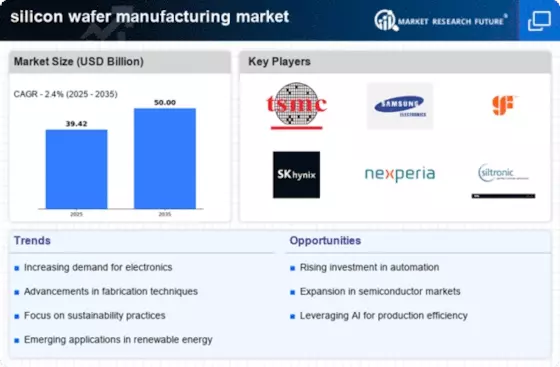
As per MRFR analysis, the silicon wafer manufacturing market was estimated at 38.5 USD Billion in 2024. The silicon wafer manufacturing industry is projected to grow from 39.42 USD Billion in 2025 to 50.0 USD Billion by 2035, exhibiting a compound annual growth rate (CAGR) of 2.4 during the forecast period 2025 - 2035.

Key Market Trends & Highlights

The silicon wafer manufacturing market is poised for substantial growth driven by technological advancements and increasing demand across various sectors.

  • The market is experiencing a shift towards larger diameter wafers to enhance efficiency and performance.
  • Integration of automation and AI technologies is transforming manufacturing processes, leading to improved productivity.
  • Sustainability initiatives are gaining traction, with a focus on reducing environmental impact in production.
  • Rising demand for semiconductors and advancements in photovoltaic technology are key drivers propelling growth in North America and Asia-Pacific, particularly in the semiconductor and solar cell segments.

Market Size & Forecast

2024 Market Size 38.5 (USD Billion)
2035 Market Size 50.0 (USD Billion)
CAGR (2025 - 2035) 2.4%

Major Players

Taiwan Semiconductor Manufacturing Company (TW), Samsung Electronics Co., Ltd. (KR), GlobalFoundries Inc. (US), SK Hynix Inc. (KR), Nexperia B.V. (NL), Silicon Wafer Inc. (US), Shin-Etsu Chemical Co., Ltd. (JP), Sumco Corporation (JP), Wafer World Inc. (US)

silicon-wafer-manufacturing Trends

The silicon wafer manufacturing market is currently experiencing a dynamic evolution, driven by advancements in technology and increasing demand for high-performance electronic devices. As industries such as automotive, telecommunications, and consumer electronics continue to expand, the need for efficient and reliable silicon wafers becomes more pronounced. This market appears to be characterized by a shift towards larger diameter wafers, which may enhance production efficiency and reduce costs. Furthermore, the integration of automation and artificial intelligence in manufacturing processes suggests a potential for improved quality control and yield rates. In addition to technological advancements, sustainability concerns are influencing the silicon wafer manufacturing market. Manufacturers are increasingly focusing on eco-friendly practices, such as reducing waste and energy consumption during production. This trend indicates a growing awareness of environmental impacts and a commitment to sustainable development. As the market progresses, it seems likely that innovations in materials and processes will continue to shape the landscape, potentially leading to new applications and opportunities for growth. Overall, the silicon wafer manufacturing market is poised for a transformative phase, with various factors contributing to its ongoing development and expansion.

Shift Towards Larger Diameter Wafers

The trend towards larger diameter silicon wafers is becoming increasingly prevalent, as manufacturers seek to enhance production efficiency. Larger wafers can yield more chips per unit, potentially lowering costs and improving overall productivity.

Integration of Automation and AI

The incorporation of automation and artificial intelligence in the manufacturing process is gaining traction. This shift may lead to improved quality control, higher yield rates, and reduced operational costs, thereby enhancing competitiveness in the market.

Focus on Sustainability

Sustainability is emerging as a critical consideration within the silicon wafer manufacturing market. Companies are prioritizing eco-friendly practices, such as minimizing waste and energy usage, reflecting a broader commitment to environmental responsibility.

Market Segment Insights

By Application: Semiconductor (Largest) vs. Solar Cells (Fastest-Growing)

In the silicon wafer manufacturing market, the application segment is diversified across several key areas including semiconductors, solar cells, LEDs, power devices, and microelectromechanical systems (MEMS). Among these, semiconductors hold the largest share, significantly driven by the proliferation of electronics and the increasing demand for high-performance chips. Solar cells are emerging as a fast-growing sector, propelled by the global shift towards renewable energy sources and government incentives. As the market evolves, various segments exhibit distinct growth trajectories. The semiconductor sector experiences steady demand due to advancements in computing technologies, while solar cells thrive on innovations in photovoltaic materials. Other segments, such as LEDs and power devices, are also witnessing increased adoption, fueled by sustainability trends and the Internet of Things (IoT).

Semiconductors (Dominant) vs. MEMS (Emerging)

Semiconductors represent the dominant application within the silicon wafer manufacturing market, primarily due to their critical role in modern electronics, ranging from consumer gadgets to industrial automation. The growing complexity of semiconductor devices and the miniaturization of components demand high-quality silicon wafers. In contrast, microelectromechanical systems (MEMS), though currently considered emerging, are gaining traction owing to their applications in sensors and actuators across various industries, including automotive and healthcare. The development of smaller, more efficient MEMS devices is bolstered by innovations in fabrication techniques, allowing for complex functionalities in compact forms. As technology advances, both segments are expected to evolve, with semiconductors continuing to dominate while MEMS steadily increase their market presence.

By Wafer Type: Monocrystalline (Largest) vs. Polycrystalline (Fastest-Growing)

The silicon wafer manufacturing market is diverse, with key segments including monocrystalline, polycrystalline, silicon-on-insulator, epitaxial, and thin film wafers. Monocrystalline wafers hold the largest share of the market, driven by their superior efficiency and performance in solar applications. Polycrystalline wafers are rapidly gaining traction, fueled by advancements in manufacturing techniques and growing demand for cost-effective solar solutions. Each segment contributes uniquely to the overall landscape of the market.

Monocrystalline (Dominant) vs. Polycrystalline (Emerging)

Monocrystalline silicon wafers are recognized as the dominant value in the market due to their high efficiency rates and longevity, making them the preferred choice for many photovoltaic applications. Their uniformity and ability to capture sunlight effectively set them apart from competitors. In contrast, polycrystalline wafers are emerging as a robust alternative, known for their cost-effectiveness and lower production expenses. As technology evolves, these wafers are becoming increasingly competitive, appealing particularly to customers seeking affordable yet reliable solar solutions. The shift towards sustainability also favors polycrystalline’s advancements, although monocrystalline retains a stronghold in high-performance sectors.

By Diameter: 300 mm (Largest) vs. 450 mm (Fastest-Growing)

In the silicon wafer manufacturing market, the diameter segments showcase a diverse distribution of market share. Currently, the 300 mm segment holds the largest share, reflecting its widespread adoption in high-performance semiconductor applications. This dominance is further accentuated by the established infrastructure supporting 300 mm wafer production, making it a preferred choice among manufacturers. Meanwhile, the 150 mm and 200 mm segments continue to serve niche applications but struggle to compete with the advancements seen in larger diameter wafers. As the demand for advanced technology and miniaturization rises, the 450 mm segment emerges as the fastest-growing diameter in silicon wafer manufacturing. This growth is propelled by investments in next-generation manufacturing facilities and the need for increased production efficiency. The shift towards larger diameter wafers indicates a broader trend towards enhanced performance, lower material costs, and the need to optimize output in high-tech industries, signaling a transformative period for the silicon wafer sector.

300 mm (Dominant) vs. 150 mm (Emerging)

The 300 mm diameter wafers are characterized by their significant impact on the semiconductor manufacturing landscape, serving high-end applications requiring larger substrates. Their dominance is attributed to the ability to accommodate a greater number of chips per wafer, leading to enhanced productivity and cost efficiencies for manufacturers. In contrast, the 150 mm wafers, while smaller and traditionally used for older technology nodes, are witnessing renewed interest due to their relevance in specific applications such as power devices and MEMS. The evolving landscape showcases 150 mm as an emerging segment that, despite its size, holds potential for growth through innovations tailored to niche requirements, demonstrating that smaller wafers can coexist with larger alternatives in a diversified market.

By Production Method: Czochralski Process (Largest) vs. Float Zone Process (Fastest-Growing)

The silicon wafer manufacturing market is predominantly driven by the Czochralski Process, which accounts for a significant share of production due to its cost-efficiency and ability to produce large-diameter wafers. This method has long been the preferred choice for manufacturers, offering exceptional quality and reliability in wafer production. Conversely, the Float Zone Process, while historically smaller in market share, is gaining traction as it provides a higher purity level and better electrical properties, making it increasingly attractive to semiconductor manufacturers. In recent years, the production method segment has witnessed notable growth, particularly for the Float Zone Process. The increasing demand for high-performance wafers in advanced applications drives this trend. Innovations in technology and process efficiency contribute to the Float Zone Process's appeal, positioning it as the fastest-growing method. As manufacturers seek to enhance product quality and meet stringent industry standards, the market dynamics continue to evolve, favoring diverse production methods.

Production Method: Czochralski Process (Dominant) vs. Float Zone Process (Emerging)

The Czochralski Process is the dominant production method in the silicon wafer manufacturing market, known for its efficiency and ability to produce high-quality silicon crystals in large quantities. This method's prevalence stems from its established processes and reliability for producing wafers suitable for high-volume applications such as microelectronics. On the other hand, the Float Zone Process, while historically less common, is emerging as a notable alternative due to its capability to achieve higher purity levels in silicon wafers. This process minimizes contamination, which is critical for advanced semiconductor applications. As industries increasingly demand superior performance and reliability from their silicon wafers, both production methods maintain vital positions, with the Czochralski Process leading in volume and the Float Zone Process gaining momentum.

By End Use Industry: Consumer Electronics (Largest) vs. Automotive (Fastest-Growing)

In the silicon wafer manufacturing market, the 'End Use Industry' segment showcases a diverse distribution of applications, with Consumer Electronics holding the largest share. This segment includes smartphones, laptops, and tablets, where the demand for high-performance chips drives continuous growth. Following closely, Automotive applications are rapidly emerging due to the increasing integration of advanced electronics in vehicles, such as electric and autonomous cars, thereby expanding the market landscape.

Consumer Electronics: Dominant vs. Automotive: Emerging

The Consumer Electronics segment remains dominant in the silicon wafer manufacturing market, primarily driven by the insatiable consumer demand for innovative electronic devices. Manufacturers are continuously adapting their offerings to provide higher efficiency and performance, leading to advancements in wafer technology. Meanwhile, the Automotive segment, although currently emerging, is expected to grow significantly due to the shift towards electric vehicles and advancements in automotive electronics. This segment is witnessing rising investments in new technologies, which enhance functionality and safety, positioning it as a vital player in the industry.

Get more detailed insights about silicon-wafer-manufacturing

Regional Insights

North America : Innovation and Growth Hub

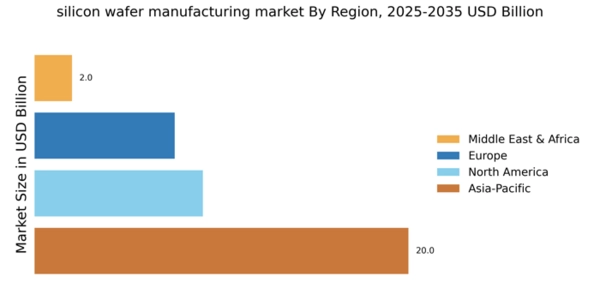
North America is witnessing significant growth in the silicon wafer manufacturing market, driven by increasing demand for advanced semiconductor technologies. The region's market size is projected at $9.0 billion, reflecting a robust growth trajectory. Key drivers include the rise of electric vehicles, IoT devices, and AI applications, which are pushing the demand for high-quality silicon wafers. Regulatory support for semiconductor manufacturing further enhances this growth, positioning North America as a critical player in the global market. Leading countries in this region include the US and Canada, with major companies like GlobalFoundries Inc. and Silicon Wafer Inc. spearheading innovation. The competitive landscape is characterized by a mix of established players and emerging startups, all vying for market share. The presence of advanced research institutions and favorable government policies fosters a conducive environment for growth, ensuring that North America remains at the forefront of silicon wafer production.

Europe : Emerging Technology Leader

Europe's silicon wafer manufacturing market is poised for growth, with a market size of $7.5 billion. The region is focusing on enhancing its semiconductor capabilities, driven by the European Union's initiatives to boost local production and reduce dependency on imports. Regulatory frameworks are evolving to support innovation and sustainability, which are crucial for the industry's future. The demand for silicon wafers is expected to rise as industries like automotive and renewable energy increasingly adopt advanced technologies. Germany, France, and the Netherlands are leading the charge in this sector, with key players such as Nexperia B.V. and other local manufacturers contributing to the competitive landscape. The presence of strong research and development institutions further strengthens Europe's position in the global market. As the region invests in new technologies and production methods, it is set to become a significant player in the silicon wafer industry.

Asia-Pacific : Global Manufacturing Powerhouse

Asia-Pacific is the largest market for silicon wafer manufacturing, with a market size of $20.0 billion. The region's growth is fueled by the rapid expansion of the electronics and semiconductor industries, particularly in countries like China, Japan, and South Korea. The demand for silicon wafers is driven by the increasing adoption of consumer electronics, automotive applications, and renewable energy technologies. Government initiatives aimed at boosting local manufacturing capabilities further support this growth trajectory. China and Japan are the leading countries in this market, with major players like Taiwan Semiconductor Manufacturing Company and Shin-Etsu Chemical Co., Ltd. dominating the landscape. The competitive environment is intense, with numerous manufacturers striving to innovate and enhance production efficiency. As the region continues to invest in advanced technologies, it solidifies its position as a global leader in silicon wafer production.

Middle East and Africa : Emerging Market Potential

The Middle East and Africa region is gradually emerging in the silicon wafer manufacturing market, with a market size of $2.0 billion. Growth is driven by increasing investments in technology and infrastructure, as well as a rising demand for electronics and renewable energy solutions. Governments in the region are beginning to recognize the importance of developing local semiconductor capabilities, which is expected to catalyze further growth in the coming years. Countries like South Africa and the UAE are taking steps to enhance their semiconductor manufacturing capabilities, with a focus on attracting foreign investment and fostering local talent. The competitive landscape is still developing, with a few key players beginning to establish a foothold. As the region continues to invest in technology and innovation, it holds significant potential for growth in the silicon wafer market.

Key Players and Competitive Insights

The silicon wafer manufacturing market is characterized by a dynamic competitive landscape, driven by technological advancements and increasing demand for semiconductor applications across various industries. Key players such as Taiwan Semiconductor Manufacturing Company (TW), Samsung Electronics Co., Ltd. (KR), and Shin-Etsu Chemical Co., Ltd. (JP) are at the forefront, each adopting distinct strategies to enhance their market positioning. For instance, Taiwan Semiconductor Manufacturing Company (TW) focuses on innovation and capacity expansion, aiming to meet the surging demand for advanced chips. Meanwhile, Samsung Electronics Co., Ltd. (KR) emphasizes vertical integration and strategic partnerships to bolster its supply chain resilience, while Shin-Etsu Chemical Co., Ltd. (JP) prioritizes sustainability and eco-friendly manufacturing processes, collectively shaping a competitive environment that is increasingly focused on technological prowess and operational efficiency.

In terms of business tactics, companies are localizing manufacturing to mitigate supply chain disruptions and optimize logistics. The market structure appears moderately fragmented, with a mix of established giants and emerging players. This fragmentation allows for diverse strategies, as companies leverage their unique strengths to capture market share. The collective influence of these key players fosters a competitive atmosphere where innovation and operational excellence are paramount.

In November 2025, GlobalFoundries Inc. (US) announced a strategic partnership with a leading AI technology firm to enhance its wafer fabrication processes. This collaboration is expected to integrate AI-driven analytics into production, potentially increasing yield rates and reducing operational costs. Such a move underscores the growing importance of AI in manufacturing, positioning GlobalFoundries as a forward-thinking player in the market.

In October 2025, SK Hynix Inc. (KR) unveiled plans to invest $1 billion in expanding its wafer production capacity in response to rising global demand. This investment is likely to enhance SK Hynix's competitive edge by enabling it to meet customer needs more effectively and solidifying its position as a key supplier in the semiconductor ecosystem. The strategic focus on capacity expansion reflects a broader trend among manufacturers to scale operations in anticipation of future demand surges.

In September 2025, Sumco Corporation (JP) launched a new line of eco-friendly silicon wafers, which are produced using sustainable materials and processes. This initiative not only aligns with global sustainability trends but also positions Sumco as a leader in environmentally responsible manufacturing. The introduction of these products may attract customers who prioritize sustainability, thereby enhancing Sumco's market appeal.

As of December 2025, the competitive trends in the silicon wafer manufacturing market are increasingly defined by digitalization, sustainability, and AI integration. Strategic alliances are becoming more prevalent, as companies recognize the need to collaborate to enhance technological capabilities and market reach. Looking ahead, competitive differentiation is likely to evolve from traditional price-based competition to a focus on innovation, advanced technology, and supply chain reliability. This shift suggests that companies that can effectively leverage these trends will be better positioned to thrive in an ever-evolving market.

Key Companies in the silicon-wafer-manufacturing market include

Future Outlook

silicon-wafer-manufacturing Future Outlook

The silicon wafer manufacturing market is projected to grow at a 2.4% CAGR from 2024 to 2035, driven by advancements in semiconductor technology and increasing demand for renewable energy applications.

New opportunities lie in:

  • Expansion into emerging markets with tailored silicon solutions.
  • Development of high-efficiency solar wafers for renewable energy sectors.
  • Investment in automation technologies to enhance production efficiency.

By 2035, the silicon wafer manufacturing market is expected to achieve robust growth and increased competitiveness.

Market Segmentation

silicon-wafer-manufacturing Diameter Outlook

  • 150 mm
  • 200 mm
  • 300 mm
  • 450 mm

silicon-wafer-manufacturing Wafer Type Outlook

  • Monocrystalline
  • Polycrystalline
  • Silicon-on-Insulator
  • Epitaxial
  • Thin Film

silicon-wafer-manufacturing Application Outlook

  • Semiconductor
  • Solar Cells
  • LEDs
  • Power Devices
  • Microelectromechanical Systems

silicon-wafer-manufacturing End Use Industry Outlook

  • Consumer Electronics
  • Automotive
  • Telecommunications
  • Industrial Equipment

silicon-wafer-manufacturing Production Method Outlook

  • Czochralski Process
  • Float Zone Process
  • Epitaxial Growth
  • Chemical Vapor Deposition

Report Scope

MARKET SIZE 202438.5(USD Billion)
MARKET SIZE 202539.42(USD Billion)
MARKET SIZE 203550.0(USD Billion)
COMPOUND ANNUAL GROWTH RATE (CAGR)2.4% (2024 - 2035)
REPORT COVERAGERevenue Forecast, Competitive Landscape, Growth Factors, and Trends
BASE YEAR2024
Market Forecast Period2025 - 2035
Historical Data2019 - 2024
Market Forecast UnitsUSD Billion
Key Companies ProfiledTaiwan Semiconductor Manufacturing Company (TW), Samsung Electronics Co., Ltd. (KR), GlobalFoundries Inc. (US), SK Hynix Inc. (KR), Nexperia B.V. (NL), Silicon Wafer Inc. (US), Shin-Etsu Chemical Co., Ltd. (JP), Sumco Corporation (JP), Wafer World Inc. (US)
Segments CoveredApplication, Wafer Type, Diameter, Production Method, End Use Industry
Key Market OpportunitiesAdvancements in semiconductor technology drive demand for high-quality silicon wafers in emerging applications.
Key Market DynamicsTechnological advancements drive efficiency in silicon wafer manufacturing, influencing competitive dynamics and supply chain strategies.
Countries CoveredNorth America, Europe, APAC, South America, MEA

Leave a Comment

Download Free Sample

Kindly complete the form below to receive a free sample of this Report

Compare Licence

×
Features License Type
Single User Multiuser License Enterprise User
Price $4,950 $5,950 $7,250
Maximum User Access Limit 1 User Upto 10 Users Unrestricted Access Throughout the Organization
Free Customization
Direct Access to Analyst
Deliverable Format
Platform Access
Discount on Next Purchase 10% 15% 15%
Printable Versions