×
Request Free Sample ×

Kindly complete the form below to receive a free sample of this Report

* Please use a valid business email

Leading companies partner with us for data-driven Insights

clients tt-cursor
Hero Background
English
Chinese
French
Japanese
Korean
German
Spanish

Silanes and Silicones Market Size

ID: MRFR/CnM/5006-CR
246 Pages
Chitranshi Jaiswal
October 2018

Silanes and Silicones Market Research Report Information Report by Type, Silane Application, Silicone Application and by Regions Forecast to 2035

Share:
Download PDF ×

We do not share your information with anyone. However, we may send you emails based on your report interest from time to time. You may contact us at any time to opt-out.

Silanes and Silicones Market Infographic
×
Silanes and Silicones Market Infographic Full View
Purchase Options

Silanes And Silicones Size

Silanes and Silicones Market Growth Projections and Opportunities

In addition to their widespread use in various industries, silicones and silanes play a crucial role in enhancing the performance and durability of a broad spectrum of consumer and industrial products. Let's delve deeper into the characteristics and applications of these versatile materials.

Silicones, belonging to the family of synthetic materials, are renowned for their flexibility, anti-foam properties, and resistance to moisture, heat, chemicals, and UV radiation. These attributes make them indispensable in numerous sectors such as healthcare, aerospace, personal care, electronics, construction, and transportation. Their flexibility allows them to adapt to different environments and applications, making them suitable for a wide range of uses.

Silanes, on the other hand, are a diverse category of silicon chemical compounds, commonly known as silicon hydride. These compounds, including amino, alkyl, vinyl, sulfur, mono/chloro, epoxy, methacryloxy, and others, exhibit unique properties that contribute to their extensive application. Silanes are particularly significant in the improvement of wetting properties, compression strength, shear strength, and mechanical properties when integrated into thermosetting and thermoplastic resins.

One crucial area where silanes demonstrate their utility is in fiberglass production. Silanes are employed to enhance the mechanical and electrical properties of fiberglass materials. This is achieved by acting as dispersing agents for fillers and crosslinking modifiers that improve the mechanical properties of polymer blends. The use of silanes in the production of ultrapure silicon, especially in the semiconductor industry, underscores their importance in advanced technology and electronics.

Moreover, silanes serve as adhesives and sealants, providing increased adhesion and chemical resistance. This not only enhances the overall strength of materials but also contributes to their long-term durability. In essence, the combination of silicones and silanes acts as a cornerstone in the creation and improvement of a wide array of consumer and industrial products.

Taking a closer look at the market dynamics, the global silanes and silicones market has exhibited a Compound Annual Growth Rate (CAGR) of 5.93% during the period from 2018 to 2023. In terms of revenue, the market is anticipated to reach USD 22,403.0 million by 2023, reflecting a significant increase from USD 15,945.2 million in 2017. The market landscape is characterized by a degree of fragmentation, with DowDuPont leading the way, commanding 35% of the market share, followed by Wacker Chemie AG and Momentive Performance Materials Inc. with respective shares of 17%.

Diving deeper into the types of silanes, the market has been segmented into various categories, including amino, alkyl, vinyl, sulfur, mono/chloro, epoxy, methacryloxy, and others. Among these, the mono/chloro silane segment emerged as the largest in 2017, accounting for 27.4% of the market revenue. Its superior performance as an intermediate in the production of ultrapure silicon positions it as a key driver of demand in the semiconductor industry. The amino silane segment, the second-largest in 2017, is expected to witness a CAGR of 6.08% during the assessment period, driven by increasing demand for enhancing the chemical bonding of resins in inorganic fillers and reinforcing materials.

Moving on to the applications, the market has been bifurcated into silane application and silicone application. Silane applications cover areas such as paints and coatings, adhesives and sealants, rubber and plastics, fiber treatment, and others. The paints and coatings segment accounted for a significant 31.3% market share, valued at USD 4,985.1 million in 2017, and is projected to reach USD 7,369.2 million by 2023. The growth in this segment is attributed to the rising use of silanes in building and construction, industrial machinery, and electronics due to their superior properties, including resistance to UV, water, and chemicals, as well as improved adhesion. The increasing infrastructure spending, particularly in BRICS countries, is expected to further boost the demand for these materials during the forecast period.

As for silicone applications, the market has been segmented into construction materials, transportation, industrial processing, consumer care, electronics, healthcare, energy, and others. The construction materials segment held approximately 31.4% of the market, valued at USD 4,998.9 million in 2017, and is projected to register a considerable CAGR of 7.06% during the forecast period. The growth in this segment is fueled by the expanding residential and construction industry, coupled with the rising demand for waterproofing and flame-resistant materials. Following closely, the transportation segment, encompassing aerospace and automotive, is expected to witness a CAGR of 6.01% due to the increased demand for lightweight automobiles aimed at reducing emissions and enhancing fuel efficiency.

Considering the geographical distribution, the market is segmented into North America, Europe, Asia-Pacific, Latin America, and the Middle East & Africa. Asia-Pacific takes the lead, accounting for a substantial 40.6% market share, with a valuation of USD 6,467.4 million in 2017. This figure is anticipated to reach USD 9,571.0 million by the end of 2023. The remarkable growth in the Asia-Pacific region is attributed to the expanding automotive industry, marked by the increased production of electric and lightweight vehicles in both developed and developing countries. This trend is expected to be a key driver in the global silanes and silicones market during the review period.

In conclusion, silicones and silanes have become indispensable components in various industries, contributing significantly to the enhancement of material properties and the creation of innovative products. Their flexibility, resistance to environmental factors, and adhesive properties make them key players in the development of advanced materials for diverse applications. As industries continue to evolve and technology advances, the demand for silicones and silanes is expected to persist, driving the growth of the global market in the coming years.
Silanes and Silicones Market Size Graph
Author
Chitranshi Jaiswal
Research Analyst Level I

In her 3 years of experience in the market research field, she has handled critical cross-domain projects. She has an in-depth knowledge of market estimation & analysis, problem-solving, primary as well as secondary research, and team management.She holds an engineering degree and is an MBA professional from a well-known university, capable of evaluating the market and competitive conditions. An exceptional strategist with excellent communication skills and a passion for delivering cutting-edge & practical insights for the market. Proficient in multi-tasking, and can successfully deal with competing demands, while maintaining complete confidentiality. Generated business through active client and project development, networking, and high-quality responses. Her knowledge and skills have helped in making solid business decisions, securing funding from investors, and avoiding business failures.

Leave a Comment

FAQs

What would be the expected silanes and silicones market value by 2035?

The market value would be USD 22,400 million by 2035

What was the previous valuation of the silanes and silicones market in 2020?

The valuation in 2020 was USD 16 million.

What is the projected CAGR for the silanes and silicones market during the forecast period 2020-2035?

The CAGR is 5.93% for the forecast period of 2025-2035

Name the major applications of the silanes and silicones market?

Major applications are transportation, construction materials, consumer care, electronics, industrial processes, energy, healthcare, and others.

What was the North American silanes and silicones market valuation in 2020?

The valuation was USD 3927.2 million in 2020.

Market Summary

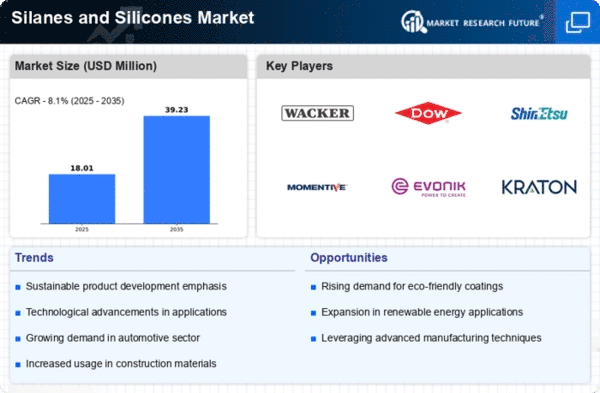
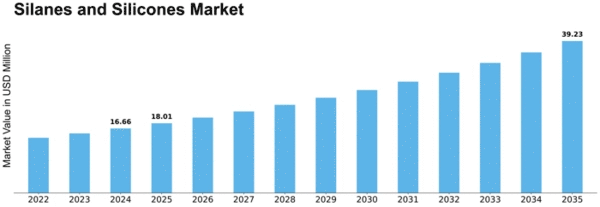
As per MRFR analysis, the Silanes and Silicones Market Size was estimated at 16.66 USD Million in 2024. The Silanes and Silicones industry is projected to grow from 18.0 in 2025 to 39.23 by 2035, exhibiting a compound annual growth rate (CAGR) of 8.1 during the forecast period 2025 - 2035.

Key Market Trends & Highlights

The Silanes and Silicones Market is poised for robust growth driven by sustainability and technological advancements.

  • North America remains the largest market for silanes and silicones, driven by strong demand in construction and automotive sectors.
  • Asia-Pacific is emerging as the fastest-growing region, fueled by increasing industrialization and urbanization.
  • The adhesives segment continues to dominate the market, while the coatings segment is experiencing rapid growth due to innovative applications.
  • Key market drivers include rising demand in the construction sector and an increasing focus on sustainable solutions.

Market Size & Forecast

2024 Market Size 16.66 (USD Million)
2035 Market Size 39.23 (USD Million)
CAGR (2025 - 2035) 8.1%
Largest Regional Market Share in 2024 Asia-Pacific

Major Players

Wacker Chemie AG (DE), Dow Inc. (US), Shin-Etsu Chemical Co., Ltd. (JP), Momentive Performance Materials Inc. (US), Evonik Industries AG (DE), Kraton Corporation (US), Huntsman Corporation (US), Silicone Solutions (US), KCC Corporation (KR)

Market Trends

The Silanes and Silicones Market is currently experiencing a dynamic evolution, driven by diverse applications across various industries. The demand for silanes and silicones is notably increasing in sectors such as automotive, construction, electronics, and healthcare. This growth is largely attributed to the unique properties of these materials, including their durability, flexibility, and resistance to extreme temperatures. As industries continue to innovate, the need for advanced materials that enhance product performance becomes more pronounced. Furthermore, sustainability concerns are prompting manufacturers to explore eco-friendly alternatives, which may reshape the market landscape in the coming years. In addition to the rising demand, technological advancements are playing a crucial role in the Silanes and Silicones Market. Innovations in production processes and formulations are enabling the development of high-performance products that meet specific industry requirements. This trend suggests a shift towards more specialized applications, where tailored solutions are favored over generic offerings. As the market evolves, collaboration between manufacturers and end-users is likely to intensify, fostering a more integrated approach to product development and application. Overall, the Silanes and Silicones Market appears poised for continued growth, driven by both demand and innovation.

Sustainability Initiatives

The Silanes and Silicones Market is witnessing a growing emphasis on sustainability. Manufacturers are increasingly focusing on developing eco-friendly products and processes, responding to consumer demand for greener alternatives. This trend may lead to the introduction of bio-based silanes and silicones, which could significantly reduce environmental impact.

Technological Advancements

Technological progress is reshaping the Silanes and Silicones Market. Innovations in production techniques and material formulations are enabling the creation of high-performance products tailored to specific applications. This trend suggests a move towards more specialized solutions, enhancing product efficacy across various sectors.

Expanding Applications

The applications of silanes and silicones are broadening, particularly in emerging industries. New uses in sectors such as renewable energy, electronics, and healthcare are becoming more prevalent. This expansion indicates a potential for market growth as industries seek advanced materials to meet evolving demands.

Silanes and Silicones Market Market Drivers

Market Growth Projections

The Global Silanes and Silicones Market Industry is projected to experience substantial growth over the next decade. With a compound annual growth rate of 14.39% anticipated from 2025 to 2035, the market is expected to expand significantly. By 2035, the market could reach an impressive 29.9 USD Billion, reflecting the increasing adoption of silanes and silicones across various industries. This growth trajectory suggests a robust demand for innovative applications and products, positioning the Global Silanes and Silicones Market Industry as a key player in the global materials landscape.

Rising Demand in Automotive Sector

The Global Silanes and Silicones Market Industry experiences a notable surge in demand driven by the automotive sector. As manufacturers increasingly utilize silicone-based materials for their durability and heat resistance, the market is projected to reach 6.81 USD Billion in 2024. This growth is largely attributed to the automotive industry's shift towards lightweight materials that enhance fuel efficiency. Furthermore, the integration of silanes in tire manufacturing and coatings is expected to bolster this trend, indicating a robust future for the Global Silanes and Silicones Market Industry.

Innovations in Personal Care Products

The Global Silanes and Silicones Market Industry is also driven by innovations in personal care products. Silicones are favored for their unique properties, such as smooth application and long-lasting effects, making them essential in cosmetics and skincare formulations. As consumer preferences shift towards high-quality, multifunctional personal care products, the demand for silicone-based ingredients is likely to increase. This trend indicates a dynamic growth potential for the Global Silanes and Silicones Market Industry, as brands continue to innovate and expand their product lines to meet evolving consumer needs.

Growth in Construction and Building Materials

The Global Silanes and Silicones Market Industry benefits from the growth in construction and building materials. Silanes are widely used as bonding agents and surface treatments in construction applications, enhancing the durability and performance of materials. As urbanization accelerates globally, the demand for innovative building solutions is on the rise. The construction sector's increasing focus on sustainability and energy efficiency further propels the use of silicone-based products. This trend suggests a promising outlook for the Global Silanes and Silicones Market Industry, particularly as it aligns with global construction initiatives.

Expansion in Electronics and Electrical Applications

The Global Silanes and Silicones Market Industry is significantly influenced by the expansion of electronics and electrical applications. Silicones are integral in the production of semiconductors, insulation materials, and adhesives, which are essential for modern electronic devices. With the increasing proliferation of smart devices and the Internet of Things, the demand for high-performance silicone materials is anticipated to rise. This sector's growth contributes to the overall market, which is expected to reach 29.9 USD Billion by 2035, reflecting a strong trajectory for the Global Silanes and Silicones Market Industry.

Environmental Regulations and Sustainability Initiatives

The Global Silanes and Silicones Market Industry is influenced by environmental regulations and sustainability initiatives. Governments worldwide are implementing stricter regulations regarding chemical usage and emissions, prompting manufacturers to adopt eco-friendly practices. Silicones, known for their low environmental impact, are increasingly favored in various applications, from automotive to construction. This shift towards sustainable materials is likely to enhance the market's growth, as companies seek to comply with regulations while meeting consumer demand for greener products. The Global Silanes and Silicones Market Industry appears well-positioned to thrive in this evolving regulatory landscape.

Market Segment Insights

By Application: Adhesives (Largest) vs. Coatings (Fastest-Growing)

The Silanes and Silicones Market is characterized by distinct divisions across various applications, wherein Adhesives stand out as the largest segment, capturing a significant portion of the market. Following closely are Coatings, Sealants, Elastomers, and Textiles, each contributing to the market ecosystem with unique functionalities that enhance performance in diverse applications. The distribution of market share reflects the growing preference for products that integrate silanes and silicones due to their superior adhesion capabilities and chemical resistance, thus emphasizing the importance of Adhesives in various industrial applications.

Adhesives: Largest vs. Sealants: Emerging

Adhesives have firmly established their position as the dominant application within the Silanes and Silicones Market due to their essential role in bonding materials across industries such as construction, automotive, and electronics. These products are known for their strong performance, durability, and ability to withstand various environmental conditions. On the other hand, Sealants, while still emerging, are gaining traction as industries increasingly seek advanced materials that offer flexibility, weather resistance, and longevity. The synergy between these segments illustrates a trend toward multifunctional products that maximize performance, leading to an integrated approach in material applications.

By End Use Industry: Automotive (Largest) vs. Healthcare (Fastest-Growing)

In the Silanes and Silicones Market, the automotive industry holds the largest share among various end-use industries, reflecting its critical role in manufacturing and automotive applications. This segment benefits from the increasing demand for lightweight materials, improved fuel efficiency, and durable components, which significantly leverage the unique properties of silanes and silicones. Conversely, the healthcare sector, while currently smaller, is emerging rapidly due to heightened investments in medical devices and healthcare innovations that require advanced materials. Such applications enhance the performance and safety of products in this sector.

Automotive: (Dominant) vs. Healthcare (Emerging)

The automotive segment in the Silanes and Silicones Market is characterized by its extensive use in various applications such as coatings, adhesives, and sealants, largely driven by the industry's push towards advanced technology and safety standards. The versatile properties of silicones, including temperature resistance and durability, make them indispensable in car manufacturing. On the other hand, the healthcare segment is gaining traction as it witnesses increasing demand for silicone-based products in medical devices, prosthetics, and personal care items. As new technologies and innovations enter the healthcare field, this segment is poised for rapid growth, highlighting its emerging status in comparison to the well-established automotive industry.

By Type: Amino Silanes (Largest) vs. Silicone Polymers (Fastest-Growing)

The Silanes and Silicones Market is characterized by a diverse range of products, each having its unique applications and market share. Among these, Amino Silanes hold the largest share as they are widely used in various industries such as construction, automotive, and electronics due to their adhesive properties and ability to enhance surface functionality. They cater to specific needs including corrosion resistance and durability, making them a preferred choice. In contrast, Silicone Polymers are emerging as the fastest-growing segment due to their versatility and performance in high-temperature applications, medical devices, and consumer goods, reflecting a shift in market demand towards these innovative products.

Amino Silanes (Dominant) vs. Silicone Polymers (Emerging)

Amino Silanes remain the dominant force in the Silanes and Silicones Market, primarily because of their wide-ranging applications that leverage their unique chemical properties to create strong bonds with various substrates. They are particularly valued in the automotive and construction sectors where adhesion, moisture resistance, and durability are critical. Silicone Polymers, on the other hand, are rapidly emerging as a significant segment. Their unique elasticity, thermal stability, and biocompatibility make them increasingly popular in healthcare, consumer applications, and electronics. As industries continue to innovate, the demand for Silicone Polymers is expected to grow at an accelerated pace, providing new opportunities for manufacturers.

By Form: Liquid (Largest) vs. Gel (Fastest-Growing)

The Silanes and Silicones Market exhibits a diverse distribution across various forms, with liquid formulations securing the largest share. Their versatility and range of applications, from automotive to construction, contribute to their dominance in the market. Meanwhile, gel formulations have emerged as the fastest-growing segment, gaining traction in the cosmetics and pharmaceuticals sectors due to their unique properties and favorable consumer acceptance. Growth trends indicate a significant shift towards innovative formulations that enhance performance and usability. Liquid silanes and silicones continue to thrive in industries requiring high-performance adhesives and coatings, while gel formulations benefit from rising demand for skincare and personal care products. The adaptability of these forms to meet specific application needs drives their respective growth trajectories in the market.

Liquid (Dominant) vs. Gel (Emerging)

Liquid silanes and silicones are known for their exceptional versatility, offering significant advantages in a wide array of applications such as coatings, adhesives, and sealants. Their ability to seamlessly blend with various substrates enhances their adhesion properties, ensuring strong performance in demanding conditions. In contrast, gel formulations are gaining momentum as an emerging trend, particularly in personal care and cosmetic applications. The unique texture and ease of application of gels appeal to consumers seeking innovative skincare solutions. As the market evolves, gel formulations are expected to leverage their distinct characteristics to carve out a more substantial market position.

By Functionality: Surface Treatment (Largest) vs. Bonding Agents (Fastest-Growing)

In the Silanes and Silicones Market, the functionality segment is primarily driven by surface treatment applications, which dominate due to their widespread use in corrosion resistance, adhesion promotion, and improving the durability of various substrates. Bonding agents have also carved a significant niche for themselves, being essential in industries such as automotive and construction where strong, durable bonds are necessary. These two functionalities represent key areas of focus for manufacturers, with surface treatment capturing the largest share of the segment shares while bonding agents are quickly gaining traction.

Surface Treatment (Dominant) vs. Bonding Agents (Emerging)

Surface treatment remains the dominant segment within the Silanes and Silicones Market, primarily utilized to enhance the performance of materials through effective moisture control and adhesion. Its applications span multiple industries, including automotive, electronics, and textiles, where properties like corrosion resistance and UV stability are critical. Conversely, bonding agents are emerging rapidly in the market as their use in high-performance adhesives becomes increasingly vital. With advancements in technology, bonding agents are evolving to meet the demands for stronger, more resilient applications, suggesting a robust future growth trajectory.

Get more detailed insights about Silanes and Silicones Market Research Report – Forecast to 2035

Regional Insights

North America : Innovation and Demand Growth

The North American Silanes and Silicones market is projected to reach $4.99 billion by 2025, driven by increasing demand in automotive, construction, and electronics sectors. Regulatory support for sustainable materials and innovations in manufacturing processes are key growth catalysts. The region's focus on advanced technologies and eco-friendly solutions is expected to further enhance market dynamics, contributing to a robust growth trajectory. Leading countries such as the US and Canada dominate the market, with major players like Dow Inc. and Momentive Performance Materials Inc. spearheading innovation. The competitive landscape is characterized by strategic partnerships and mergers, aimed at enhancing product offerings and market reach. The presence of established companies ensures a steady supply chain and fosters a competitive environment, positioning North America as a significant player in the global market.

Europe : Sustainability and Innovation Focus

The European Silanes and Silicones market is valued at $3.33 billion, with a strong emphasis on sustainability and innovation. Regulatory frameworks promoting eco-friendly materials and stringent environmental standards are driving demand. The region's commitment to reducing carbon footprints and enhancing energy efficiency is expected to propel market growth, making it a leader in sustainable practices within the industry. Germany, France, and the UK are key players in this market, with companies like Wacker Chemie AG and Evonik Industries AG leading the charge. The competitive landscape is marked by a focus on R&D and technological advancements, ensuring that European firms remain at the forefront of innovation. Collaborative efforts among industry stakeholders are fostering a dynamic environment, enhancing the region's market resilience and adaptability.

Asia-Pacific : Dominance in Market Share

Asia-Pacific is the largest market for Silanes and Silicones, projected to reach $7.99 billion by 2025. The region's rapid industrialization, urbanization, and growing demand from sectors like automotive, electronics, and construction are key growth drivers. Additionally, favorable government policies and investments in infrastructure are expected to further boost market dynamics, solidifying its leading position in the global landscape. China, Japan, and South Korea are the primary contributors to this market, with major players such as Shin-Etsu Chemical Co., Ltd. and KCC Corporation actively expanding their operations. The competitive landscape is characterized by a mix of local and international firms, fostering innovation and enhancing product offerings. The presence of established companies ensures a robust supply chain, catering to the increasing demand across various industries in the region.

Middle East and Africa : Emerging Market Potential

The Middle East and Africa (MEA) market for Silanes and Silicones is valued at $0.35 billion, with significant growth potential driven by increasing industrial activities and infrastructure development. The region's focus on diversifying economies and enhancing manufacturing capabilities is expected to catalyze demand for Silanes and Silicones, particularly in construction and automotive sectors. Regulatory support for industrial growth is also a contributing factor. Countries like the UAE and South Africa are leading the charge, with a growing number of local and international players entering the market. The competitive landscape is evolving, with companies focusing on innovation and strategic partnerships to enhance their market presence. As the region continues to develop, the Silanes and Silicones market is poised for substantial growth, reflecting the broader economic trends in MEA.

Key Players and Competitive Insights

The Silanes and Silicones Market is characterized by a dynamic competitive landscape, driven by innovation, sustainability, and strategic partnerships. Key players such as Wacker Chemie AG (DE), Dow Inc. (US), and Shin-Etsu Chemical Co., Ltd. (JP) are at the forefront, each adopting distinct strategies to enhance their market positioning. Wacker Chemie AG (DE) focuses on expanding its product portfolio through innovative solutions, particularly in the automotive and electronics sectors, while Dow Inc. (US) emphasizes sustainability in its operations, aiming to reduce its carbon footprint and enhance product recyclability. Shin-Etsu Chemical Co., Ltd. (JP) appears to prioritize technological advancements, investing heavily in R&D to develop high-performance silicones that cater to diverse applications, thereby shaping a competitive environment that is increasingly centered around innovation and sustainability.The market structure is moderately fragmented, with a mix of established players and emerging companies vying for market share. Key business tactics include localizing manufacturing to reduce costs and optimize supply chains, which is particularly relevant in the context of global economic fluctuations. The collective influence of these major players fosters a competitive atmosphere where agility and responsiveness to market demands are crucial for success.

In November Wacker Chemie AG (DE) announced the launch of a new line of eco-friendly silicone products aimed at the construction industry. This strategic move not only aligns with the growing demand for sustainable building materials but also positions Wacker as a leader in environmentally conscious product development. The introduction of these products is likely to enhance their market share and appeal to a broader customer base focused on sustainability.

In October Dow Inc. (US) unveiled a partnership with a leading automotive manufacturer to develop advanced silicone materials for electric vehicles. This collaboration underscores Dow's commitment to innovation and sustainability, as it seeks to provide solutions that meet the evolving needs of the automotive sector. The strategic importance of this partnership lies in its potential to drive growth in a rapidly expanding market segment, thereby reinforcing Dow's competitive edge.

In September Shin-Etsu Chemical Co., Ltd. (JP) expanded its production capacity for specialty silicones in response to increasing global demand. This expansion is indicative of the company's proactive approach to market trends and its commitment to maintaining a robust supply chain. By enhancing production capabilities, Shin-Etsu is likely to strengthen its position in the market and better serve its customers.

As of December current competitive trends in the Silanes and Silicones Market are heavily influenced by digitalization, sustainability, and the integration of AI technologies. Strategic alliances are becoming increasingly important, as companies seek to leverage complementary strengths to enhance their offerings. The competitive differentiation is expected to evolve from traditional price-based competition towards a focus on innovation, technological advancements, and supply chain reliability, suggesting a transformative shift in how companies engage with the market.

Key Companies in the Silanes and Silicones Market include

Industry Developments

July 2021: Wacker Group, headquartered in Munich, begun building of an alcoholysis coating plant at its Nünchritz location. The facility will provide critical precursors for the development of silicone-based building protection solutions as well as binders for facade paints and industrial coatings. At the moment, these compounds are manufactured entirely at the Burghausen plant. By the end of 2022, the plant is projected to be operating. The investment will be approximately USD 34 million.

Wacker formulates a variety of silicone specialties using silanes and liquid resins: Architectural preservatives and concrete protection coatings, as well as binders for facade paints, corrosion-resistant protective coatings, and heat-resistant powder coatings, contain such hydrophobic and hence water-repellent active components.The increased use of composites, plastics, reinforced plastics for the silanes reinforces tire is likely to meet the fuel standard set by both the EU, as well as, the US federal agencies. Hence, the market is likely to witness a steep demand and growth by the end of the global forecast period in 2023

In 2015, several products under SILRES WH, BS, as well as, GENIOSIL XT were launched by a major market player with the name of Wacker Chemie AG. the investment for the production of these products in China was worth USD 8 million.Further in 2015, Evonik, with a motive of expansion, launched a new range of production facilities in both China, as well as, Germany. The motive behind this is to optimally serve the market end-users like furniture, construction companies, coating companies, as well as, the textile sector.Sivate A 200 was launched in 2016 by Gelesr Inc.

This is an activated form of silane. The major purpose behind this establishment was to increase the product portfolio of the company.

Future Outlook

Silanes and Silicones Market Future Outlook

The Silanes and Silicones Market is projected to grow at 8.1% CAGR from 2025 to 2035, driven by increasing demand in automotive, construction, and electronics sectors.

New opportunities lie in:

  • Development of eco-friendly silicone formulations for sustainable products.
  • Expansion into emerging markets with tailored silane solutions.
  • Investment in advanced manufacturing technologies to enhance production efficiency.

By 2035, the market is expected to achieve robust growth, solidifying its position as a key industry.

Market Segmentation

Silanes and Silicones Market Form Outlook

  • Liquid
  • Solid
  • Gel
  • Powder

Silanes and Silicones Market Type Outlook

  • Amino Silanes
  • Epoxy Silanes
  • Vinyl Silanes
  • Chlorosilanes
  • Silicone Polymers

Silanes and Silicones Market Application Outlook

  • Adhesives
  • Coatings
  • Sealants
  • Elastomers
  • Textiles

Silanes and Silicones Market Functionality Outlook

  • Surface Treatment
  • Bonding Agents
  • Crosslinking Agents
  • Filler Agents

Silanes and Silicones Market End Use Industry Outlook

  • Automotive
  • Construction
  • Electronics
  • Healthcare
  • Personal Care

Report Scope

MARKET SIZE 202416.66(USD Million)
MARKET SIZE 202518.0(USD Million)
MARKET SIZE 203539.23(USD Million)
COMPOUND ANNUAL GROWTH RATE (CAGR)8.1% (2025 - 2035)
REPORT COVERAGERevenue Forecast, Competitive Landscape, Growth Factors, and Trends
BASE YEAR2024
Market Forecast Period2025 - 2035
Historical Data2019 - 2024
Market Forecast UnitsUSD Million
Key Companies ProfiledWacker Chemie AG (DE), Dow Inc. (US), Shin-Etsu Chemical Co., Ltd. (JP), Momentive Performance Materials Inc. (US), Evonik Industries AG (DE), Kraton Corporation (US), Huntsman Corporation (US), Silicone Solutions (US), KCC Corporation (KR)
Segments CoveredApplication, End Use Industry, Type, Form, Functionality
Key Market OpportunitiesGrowing demand for sustainable materials drives innovation in the Silanes and Silicones Market.
Key Market DynamicsRising demand for eco-friendly products drives innovation and competition in the Silanes and Silicones Market.
Countries CoveredNorth America, Europe, APAC, South America, MEA

FAQs

What would be the expected silanes and silicones market value by 2035?

The market value would be USD 22,400 million by 2035

What was the previous valuation of the silanes and silicones market in 2020?

The valuation in 2020 was USD 16 million.

What is the projected CAGR for the silanes and silicones market during the forecast period 2020-2035?

The CAGR is 5.93% for the forecast period of 2025-2035

Name the major applications of the silanes and silicones market?

Major applications are transportation, construction materials, consumer care, electronics, industrial processes, energy, healthcare, and others.

What was the North American silanes and silicones market valuation in 2020?

The valuation was USD 3927.2 million in 2020.

  1. SECTION I: EXECUTIVE SUMMARY AND KEY HIGHLIGHTS
    1. | 1.1 EXECUTIVE SUMMARY
    2. | 1.1.1 Market Overview
    3. | 1.1.2 Key Findings
    4. | 1.1.3 Market Segmentation
    5. | 1.1.4 Competitive Landscape
    6. | 1.1.5 Challenges and Opportunities
    7. | 1.1.6 Future Outlook
  2. SECTION II: SCOPING, METHODOLOGY AND MARKET STRUCTURE
    1. | 2.1 MARKET INTRODUCTION
    2. | 2.1.1 Definition
    3. | 2.1.2 Scope of the study
    4. |-- 2.1.2.1 Research Objective
    5. |-- 2.1.2.2 Assumption
    6. |-- 2.1.2.3 Limitations
    7. | 2.2 RESEARCH METHODOLOGY
    8. | 2.2.1 Overview
    9. | 2.2.2 Data Mining
    10. | 2.2.3 Secondary Research
    11. | 2.2.4 Primary Research
    12. |-- 2.2.4.1 Primary Interviews and Information Gathering Process
    13. |-- 2.2.4.2 Breakdown of Primary Respondents
    14. | 2.2.5 Forecasting Model
    15. | 2.2.6 Market Size Estimation
    16. |-- 2.2.6.1 Bottom-Up Approach
    17. |-- 2.2.6.2 Top-Down Approach
    18. | 2.2.7 Data Triangulation
    19. | 2.2.8 Validation
  3. SECTION III: QUALITATIVE ANALYSIS
    1. | 3.1 MARKET DYNAMICS
    2. | 3.1.1 Overview
    3. | 3.1.2 Drivers
    4. | 3.1.3 Restraints
    5. | 3.1.4 Opportunities
    6. | 3.2 MARKET FACTOR ANALYSIS
    7. | 3.2.1 Value chain Analysis
    8. | 3.2.2 Porter's Five Forces Analysis
    9. |-- 3.2.2.1 Bargaining Power of Suppliers
    10. |-- 3.2.2.2 Bargaining Power of Buyers
    11. |-- 3.2.2.3 Threat of New Entrants
    12. |-- 3.2.2.4 Threat of Substitutes
    13. |-- 3.2.2.5 Intensity of Rivalry
    14. | 3.2.3 COVID-19 Impact Analysis
    15. |-- 3.2.3.1 Market Impact Analysis
    16. |-- 3.2.3.2 Regional Impact
    17. |-- 3.2.3.3 Opportunity and Threat Analysis
  4. SECTION IV: QUANTITATIVE ANALYSIS
    1. | 4.1 Chemicals and Materials, BY Application (USD Million)
    2. | 4.1.1 Adhesives
    3. | 4.1.2 Coatings
    4. | 4.1.3 Sealants
    5. | 4.1.4 Elastomers
    6. | 4.1.5 Textiles
    7. | 4.2 Chemicals and Materials, BY End Use Industry (USD Million)
    8. | 4.2.1 Automotive
    9. | 4.2.2 Construction
    10. | 4.2.3 Electronics
    11. | 4.2.4 Healthcare
    12. | 4.2.5 Personal Care
    13. | 4.3 Chemicals and Materials, BY Type (USD Million)
    14. | 4.3.1 Amino Silanes
    15. | 4.3.2 Epoxy Silanes
    16. | 4.3.3 Vinyl Silanes
    17. | 4.3.4 Chlorosilanes
    18. | 4.3.5 Silicone Polymers
    19. | 4.4 Chemicals and Materials, BY Form (USD Million)
    20. | 4.4.1 Liquid
    21. | 4.4.2 Solid
    22. | 4.4.3 Gel
    23. | 4.4.4 Powder
    24. | 4.5 Chemicals and Materials, BY Functionality (USD Million)
    25. | 4.5.1 Surface Treatment
    26. | 4.5.2 Bonding Agents
    27. | 4.5.3 Crosslinking Agents
    28. | 4.5.4 Filler Agents
    29. | 4.6 Chemicals and Materials, BY Region (USD Million)
    30. | 4.6.1 North America
    31. |-- 4.6.1.1 US
    32. |-- 4.6.1.2 Canada
    33. | 4.6.2 Europe
    34. |-- 4.6.2.1 Germany
    35. |-- 4.6.2.2 UK
    36. |-- 4.6.2.3 France
    37. |-- 4.6.2.4 Russia
    38. |-- 4.6.2.5 Italy
    39. |-- 4.6.2.6 Spain
    40. |-- 4.6.2.7 Rest of Europe
    41. | 4.6.3 APAC
    42. |-- 4.6.3.1 China
    43. |-- 4.6.3.2 India
    44. |-- 4.6.3.3 Japan
    45. |-- 4.6.3.4 South Korea
    46. |-- 4.6.3.5 Malaysia
    47. |-- 4.6.3.6 Thailand
    48. |-- 4.6.3.7 Indonesia
    49. |-- 4.6.3.8 Rest of APAC
    50. | 4.6.4 South America
    51. |-- 4.6.4.1 Brazil
    52. |-- 4.6.4.2 Mexico
    53. |-- 4.6.4.3 Argentina
    54. |-- 4.6.4.4 Rest of South America
    55. | 4.6.5 MEA
    56. |-- 4.6.5.1 GCC Countries
    57. |-- 4.6.5.2 South Africa
    58. |-- 4.6.5.3 Rest of MEA
  5. SECTION V: COMPETITIVE ANALYSIS
    1. | 5.1 Competitive Landscape
    2. | 5.1.1 Overview
    3. | 5.1.2 Competitive Analysis
    4. | 5.1.3 Market share Analysis
    5. | 5.1.4 Major Growth Strategy in the Chemicals and Materials
    6. | 5.1.5 Competitive Benchmarking
    7. | 5.1.6 Leading Players in Terms of Number of Developments in the Chemicals and Materials
    8. | 5.1.7 Key developments and growth strategies
    9. |-- 5.1.7.1 New Product Launch/Service Deployment
    10. |-- 5.1.7.2 Merger & Acquisitions
    11. |-- 5.1.7.3 Joint Ventures
    12. | 5.1.8 Major Players Financial Matrix
    13. |-- 5.1.8.1 Sales and Operating Income
    14. |-- 5.1.8.2 Major Players R&D Expenditure. 2023
    15. | 5.2 Company Profiles
    16. | 5.2.1 Wacker Chemie AG (DE)
    17. |-- 5.2.1.1 Financial Overview
    18. |-- 5.2.1.2 Products Offered
    19. |-- 5.2.1.3 Key Developments
    20. |-- 5.2.1.4 SWOT Analysis
    21. |-- 5.2.1.5 Key Strategies
    22. | 5.2.2 Dow Inc. (US)
    23. |-- 5.2.2.1 Financial Overview
    24. |-- 5.2.2.2 Products Offered
    25. |-- 5.2.2.3 Key Developments
    26. |-- 5.2.2.4 SWOT Analysis
    27. |-- 5.2.2.5 Key Strategies
    28. | 5.2.3 Shin-Etsu Chemical Co., Ltd. (JP)
    29. |-- 5.2.3.1 Financial Overview
    30. |-- 5.2.3.2 Products Offered
    31. |-- 5.2.3.3 Key Developments
    32. |-- 5.2.3.4 SWOT Analysis
    33. |-- 5.2.3.5 Key Strategies
    34. | 5.2.4 Momentive Performance Materials Inc. (US)
    35. |-- 5.2.4.1 Financial Overview
    36. |-- 5.2.4.2 Products Offered
    37. |-- 5.2.4.3 Key Developments
    38. |-- 5.2.4.4 SWOT Analysis
    39. |-- 5.2.4.5 Key Strategies
    40. | 5.2.5 Evonik Industries AG (DE)
    41. |-- 5.2.5.1 Financial Overview
    42. |-- 5.2.5.2 Products Offered
    43. |-- 5.2.5.3 Key Developments
    44. |-- 5.2.5.4 SWOT Analysis
    45. |-- 5.2.5.5 Key Strategies
    46. | 5.2.6 Kraton Corporation (US)
    47. |-- 5.2.6.1 Financial Overview
    48. |-- 5.2.6.2 Products Offered
    49. |-- 5.2.6.3 Key Developments
    50. |-- 5.2.6.4 SWOT Analysis
    51. |-- 5.2.6.5 Key Strategies
    52. | 5.2.7 Huntsman Corporation (US)
    53. |-- 5.2.7.1 Financial Overview
    54. |-- 5.2.7.2 Products Offered
    55. |-- 5.2.7.3 Key Developments
    56. |-- 5.2.7.4 SWOT Analysis
    57. |-- 5.2.7.5 Key Strategies
    58. | 5.2.8 Silicone Solutions (US)
    59. |-- 5.2.8.1 Financial Overview
    60. |-- 5.2.8.2 Products Offered
    61. |-- 5.2.8.3 Key Developments
    62. |-- 5.2.8.4 SWOT Analysis
    63. |-- 5.2.8.5 Key Strategies
    64. | 5.2.9 KCC Corporation (KR)
    65. |-- 5.2.9.1 Financial Overview
    66. |-- 5.2.9.2 Products Offered
    67. |-- 5.2.9.3 Key Developments
    68. |-- 5.2.9.4 SWOT Analysis
    69. |-- 5.2.9.5 Key Strategies
    70. | 5.3 Appendix
    71. | 5.3.1 References
    72. | 5.3.2 Related Reports

Chemicals and Materials Market Segmentation

Chemicals and Materials By Application (USD Million, 2025-2035)

  • Adhesives
  • Coatings
  • Sealants
  • Elastomers
  • Textiles

Chemicals and Materials By End Use Industry (USD Million, 2025-2035)

  • Automotive
  • Construction
  • Electronics
  • Healthcare
  • Personal Care

Chemicals and Materials By Type (USD Million, 2025-2035)

  • Amino Silanes
  • Epoxy Silanes
  • Vinyl Silanes
  • Chlorosilanes
  • Silicone Polymers

Chemicals and Materials By Form (USD Million, 2025-2035)

  • Liquid
  • Solid
  • Gel
  • Powder

Chemicals and Materials By Functionality (USD Million, 2025-2035)

  • Surface Treatment
  • Bonding Agents
  • Crosslinking Agents
  • Filler Agents
Infographic

Free Sample Request

Kindly complete the form below to receive a free sample of this Report

Get Free Sample

Customer Strories

Compare Licence

×
Features License Type
Single User Multiuser License Enterprise User
Price $4,950 $5,950 $7,250
Maximum User Access Limit 1 User Upto 10 Users Unrestricted Access Throughout the Organization
Free Customization
Direct Access to Analyst
Deliverable Format
Platform Access
Discount on Next Purchase 10% 15% 15%
Printable Versions