×
Request Free Sample ×

Kindly complete the form below to receive a free sample of this Report

* Please use a valid business email

Leading companies partner with us for data-driven Insights

clients tt-cursor
Hero Background
English
Chinese
French
Japanese
Korean
German
Spanish

Shunt Capacitor Market Trends

ID: MRFR/EnP/2645-CR
90 Pages
Priya Nagrale
October 2020

Shunt Capacitor Market Research Report Information Report by Voltage (Low Voltage, Medium Voltage and High Voltage), by End User (Utilities, Industries and Others) and by Region - Global Forecast To 2035

Share:
Download PDF ×

We do not share your information with anyone. However, we may send you emails based on your report interest from time to time. You may contact us at any time to opt-out.

Shunt Capacitor Market Infographic
×
Shunt Capacitor Market Infographic Full View
Purchase Options

Market Trends

Key Emerging Trends in the Shunt Capacitor Market

Electricity serves as the cornerstone powering a multitude of functions critical to modern life, facilitating interactions, driving industrial activities, and supporting essential services. The exponential growth witnessed in global economies and population expansion has significantly propelled the consumption of power. This surge in power consumption can be attributed to several factors, primarily the economic advancements of nations and the consequent improvements in living standards, leading to an escalating demand for energy.

As countries undergo development and witness improvements in their socio-economic landscapes, there arises an increased necessity for energy consumption. Notably, the surge in economic growth within nations directly translates to a heightened demand for improved housing infrastructure. This surge in construction and urban development activities necessitates a commensurate rise in energy consumption to meet the power demands associated with these developmental endeavors.

Consequently, countries worldwide are embarking on extensive expansions and upgrades of their electric grid infrastructure. This strategic move is aimed at meeting the burgeoning demand for power and integrating grids to facilitate inter-grid connections. The overarching objective is to fortify the existing infrastructure and establish interconnected grids that can seamlessly cater to the escalating power requirements. These substantial developments in electric grid infrastructure serve as pivotal groundwork, laying the foundation for the growth and expansion of the shunt capacitor market.

The burgeoning advancements and upgrades in electric grid infrastructure play a fundamental role in shaping the landscape for shunt capacitors. These devices stand as critical components within power systems, aiding in enhancing the quality and efficiency of electricity supply. Shunt capacitors are strategically deployed within power grids to facilitate capacitive reactive compensation and power factor correction, essential for maintaining a stable and optimized power transmission network.

The ongoing developments in electric grid infrastructure bolster the prospects for the shunt capacitor market. The expansion and reinforcement of power grids not only accommodate the growing power demand but also set the stage for the widespread deployment of shunt capacitors across various segments of the grid. These capacitors play a pivotal role in ensuring optimal power transmission, reducing losses, and enhancing the overall efficiency of power systems.

Moreover, the integration of shunt capacitors into modern electric grid infrastructures aligns with the broader objectives of achieving enhanced reliability, stability, and efficiency in power transmission and distribution networks. This integration enables utilities and grid operators to optimize power flow, mitigate voltage fluctuations, and improve the overall performance of the power system.

In essence, the dynamic developments and expansions in electric grid infrastructure globally lay a solid foundation for the shunt capacitor market's growth. These endeavors fortify the power infrastructure, necessitating the deployment of shunt capacitors to optimize power transmission and meet the escalating energy demands driven by economic growth, population expansion, and urban development initiatives worldwide.
Author
Priya Nagrale
Senior Research Analyst

With an experience of over five years in market research industry (Chemicals & Materials domain), I gather and analyze market data from diverse sources to produce results, which are then presented back to a client. Also, provide recommendations based on the findings. As a Senior Research Analyst, I perform quality checks (QC) for market estimations, QC for reports, and handle queries and work extensively on client customizations. Also, handle the responsibilities of client proposals, report planning, report finalization, and execution

Leave a Comment

FAQs

What is the study period of the shunt capacitor market report?

The shunt capacitor market forecast period is 2023 - 2032

What is the shunt capacitor market growth rate?

The shunt capacitor market is growing at a CAGR of 6.70% over the next 10 years, according to shunt capacitor market research.

Which region has the highest shunt capacitor market growth rate?

North America is expected to register the highest CAGR during 2023 - 2032

Which region has the largest share in the shunt capacitor market?

Asia Pacific held the largest share in 2021

What growth rate is the market expected to achieve in the near future?

The market size is expected to be USD 1.5 billion by 2032.

Who are the key players in the shunt capacitor market?

ABB Ltd., General Electric Company, Siemens AG, Larsen & Toubro Ltd., Eaton Corporation Plc, and Magnewin Energy Pvt. Ltd. are the key companies operating in the shunt capacitor market.

Market Summary

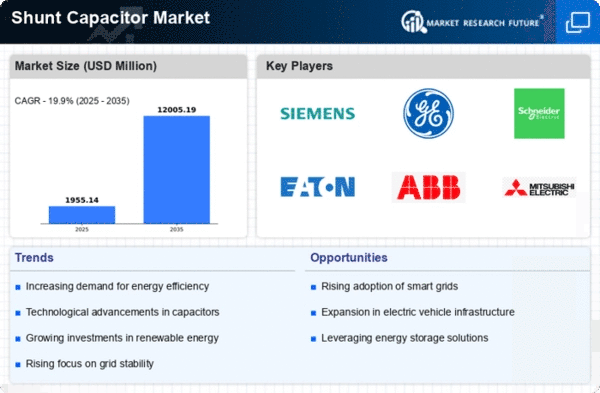
As per MRFR analysis, the Shunt Capacitor Market Size was estimated at 1630.64 USD Million in 2024. The Shunt Capacitor industry is projected to grow from 1955.14 in 2025 to 12005.19 by 2035, exhibiting a compound annual growth rate (CAGR) of 19.9 during the forecast period 2025 - 2035.

Key Market Trends & Highlights

The Shunt Capacitor Market is poised for substantial growth driven by technological advancements and increasing demand for energy efficiency.

  • North America remains the largest market for shunt capacitors, driven by robust infrastructure and urbanization.
  • The Asia-Pacific region is the fastest-growing market, fueled by rapid industrialization and energy demands.
  • Power Factor Correction is the largest segment, while Reactive Power Compensation is emerging as the fastest-growing segment.
  • Key market drivers include increasing urbanization and regulatory support for power quality improvement.

Market Size & Forecast

2024 Market Size 1630.64 (USD Million)
2035 Market Size 12005.19 (USD Million)
CAGR (2025 - 2035) 19.9%
Largest Regional Market Share in 2024 North America

Major Players

<p>Siemens AG (DE), General Electric (US), Schneider Electric (FR), Eaton Corporation (US), ABB Ltd (CH), Mitsubishi Electric Corporation (JP), Crompton Greaves Consumer Electricals Limited (IN), Toshiba Corporation (JP), Nexans S.A. (FR)</p>

Market Trends

The Shunt Capacitor Market is currently experiencing a transformative phase, driven by the increasing demand for efficient power management solutions across various sectors. This market appears to be influenced by the growing emphasis on renewable energy sources and the need for grid stability. As industries strive to enhance energy efficiency, shunt capacitors are becoming essential components in power systems, facilitating voltage regulation and reactive power compensation. Furthermore, advancements in technology are likely to lead to the development of more compact and efficient capacitor designs, which could further stimulate market growth. In addition, the rising awareness regarding energy conservation and sustainability is propelling investments in infrastructure upgrades. Utilities and industrial players are increasingly adopting shunt capacitors to mitigate power losses and improve overall system performance. This trend suggests a shift towards smarter grid solutions, where shunt capacitors play a pivotal role in enhancing the reliability and efficiency of electrical networks. As the Shunt Capacitor Market evolves, it is poised to adapt to the changing landscape of energy consumption and distribution, potentially leading to innovative applications and expanded market opportunities.

Growing Demand for Renewable Energy

The Shunt Capacitor Market is witnessing a surge in demand due to the increasing integration of renewable energy sources. As more countries commit to sustainable energy goals, the need for effective power management solutions becomes paramount. Shunt capacitors are essential in stabilizing voltage levels and ensuring efficient energy distribution, making them critical in renewable energy applications.

Technological Advancements

Recent technological innovations are reshaping the Shunt Capacitor Market. Enhanced manufacturing processes and materials are leading to the production of more efficient and compact capacitors. These advancements not only improve performance but also reduce the overall footprint of capacitor installations, making them more appealing to various sectors.

Focus on Energy Efficiency

There is a growing emphasis on energy efficiency across industries, which is positively impacting the Shunt Capacitor Market. Organizations are increasingly recognizing the importance of reducing energy consumption and operational costs. Shunt capacitors contribute significantly to this goal by improving power factor and minimizing energy losses in electrical systems.

Shunt Capacitor Market Market Drivers

Market Growth Projections

The Global Shunt Capacitor Market Industry is projected to experience notable growth over the next decade. With a market value of 1.39 USD Billion anticipated in 2024, the industry is expected to expand further, reaching 1.82 USD Billion by 2035. This growth trajectory indicates a compound annual growth rate of 2.47% from 2025 to 2035. Such projections reflect the increasing demand for power quality solutions across various sectors, driven by technological advancements, regulatory support, and the ongoing expansion of electrical infrastructure.

Growing Demand for Renewable Energy

The increasing global emphasis on renewable energy sources is driving the Global Shunt Capacitor Market Industry. As countries transition towards sustainable energy solutions, the integration of renewable sources such as wind and solar power necessitates improved power quality and stability. Shunt capacitors play a crucial role in enhancing the efficiency of these energy systems by compensating for reactive power. This trend is expected to contribute to the market's growth, with projections indicating a market value of 1.39 USD Billion in 2024, reflecting the industry's adaptation to evolving energy demands.

Expansion of Electrical Infrastructure

The ongoing expansion of electrical infrastructure across various regions is a significant driver for the Global Shunt Capacitor Market Industry. As urbanization accelerates and populations grow, there is a pressing need for enhanced power distribution systems. Shunt capacitors are essential in maintaining voltage levels and improving the overall reliability of electrical networks. Governments and utility companies are investing heavily in modernizing their infrastructure, which is likely to bolster the demand for shunt capacitors. This investment trend aligns with the projected market growth, with expectations of reaching 1.82 USD Billion by 2035.

Rising Industrialization and Urbanization

The rise of industrialization and urbanization is a key factor propelling the Global Shunt Capacitor Market Industry. As industries expand and urban areas develop, the demand for reliable and efficient power supply systems intensifies. Shunt capacitors are vital for managing reactive power and ensuring voltage stability in these growing electrical networks. This trend is particularly evident in emerging economies, where rapid urban growth necessitates substantial investments in electrical infrastructure. Consequently, the market is likely to experience robust growth, supported by the increasing need for effective power management solutions.

Technological Advancements in Capacitor Design

Technological advancements in capacitor design are reshaping the Global Shunt Capacitor Market Industry. Innovations in materials and manufacturing processes have led to the development of more efficient and durable capacitors. These advancements not only enhance performance but also reduce maintenance costs, making shunt capacitors more appealing to utility companies and industrial users. As the industry embraces these technologies, the market is poised for growth, with a compound annual growth rate of 2.47% anticipated from 2025 to 2035. This growth reflects the industry's commitment to improving energy efficiency and reliability.

Regulatory Support for Power Quality Improvement

Regulatory frameworks aimed at improving power quality are significantly influencing the Global Shunt Capacitor Market Industry. Governments worldwide are implementing standards and regulations that mandate the use of power factor correction devices, including shunt capacitors. These regulations are designed to enhance grid stability and reduce energy losses, thereby promoting the adoption of shunt capacitors in various applications. As regulatory support strengthens, the market is expected to benefit from increased investments in power quality solutions, further driving its growth in the coming years.

Market Segment Insights

By Application: Power Factor Correction (Largest) vs. Reactive Power Compensation (Fastest-Growing)

<p>The Shunt Capacitor Market showcases a diverse range of applications such as Power Factor Correction, Voltage Regulation, Harmonic Filtering, Energy Storage, and Reactive Power Compensation. Power Factor Correction occupies the largest share of this market, as it is fundamentally essential for enhancing electrical efficiency and minimizing energy losses. Reactive Power Compensation is witnessing significant growth, driven by the increasing need for improving voltage stability and optimizing the performance of power systems.</p>

<p>Power Factor Correction (Dominant) vs. Reactive Power Compensation (Emerging)</p>

<p>Power Factor Correction is a dominant application in the Shunt Capacitor Market, primarily aimed at improving the power factor in electrical systems. This application is extensively used in industrial and commercial settings, leading to considerable energy savings and operational efficiency. On the other hand, Reactive Power Compensation is emerging rapidly due to the growing demand for solutions that address voltage fluctuations and enhance overall system reliability. These capacitors play a pivotal role in stabilizing power systems, making them essential for modern energy infrastructure, especially as renewable energy sources gain traction.</p>

By End Use Industry: Utilities (Largest) vs. Renewable Energy (Fastest-Growing)

<p>The Shunt Capacitor Market is segmented by end use industries, with Utilities holding the largest share due to the increasing demand for power quality and stability in electrical distribution systems. Other segments, including Industrial, Commercial, Transportation, and Renewable Energy, contribute significantly but with varying shares. Specifically, the Renewable Energy segment is expanding rapidly as more investments are made in alternative energy sources, like solar and wind, which necessitate enhanced power management solutions.</p>

<p>Utilities: Dominant vs. Renewable Energy: Emerging</p>

<p>Utilities dominate the Shunt Capacitor Market, driven by the need for efficient power distribution and grid stability. They utilize shunt capacitors to improve power factor and reduce losses in transmission systems. On the other hand, Renewable Energy, an emerging market segment, is on an accelerated growth path due to the increasing integration of renewable sources into the national grids. This segment benefits from technological advancements and supportive government policies, signalling a shift towards greener energy solutions that further boosts the demand for shunt capacitors.</p>

By Capacitance Type: Low Voltage (Largest) vs. High Voltage (Fastest-Growing)

<p>The Shunt Capacitor Market exhibits a distinctive distribution of market share across different capacitance types. The Low Voltage segment is the largest, favored for its widespread application in residential and commercial systems, essential for power factor correction. Meanwhile, the Medium and High Voltage segments cater to industrial and utility-scale applications, with High Voltage capacitors experiencing heightened demand in modern energy infrastructure due to their efficiency and reliability.</p>

<p>Low Voltage (Dominant) vs. Medium Voltage (Emerging)</p>

<p>The Low Voltage capacitance type stands as the dominant choice in the Shunt Capacitor Market, characterized by its extensive use in light industrial, commercial, and residential applications. Its ability to improve power quality and energy efficiency while being cost-effective drives its popularity. Conversely, the Medium Voltage segment is considered an emerging player, with growing applications in various industries such as manufacturing and renewable energy. It benefits from innovations in capacitor technology, enhancing performance and expanding its market presence as industries transition towards sustainable energy solutions.</p>

By Installation Type: Indoor (Largest) vs. Outdoor (Fastest-Growing)

<p>The Shunt Capacitor Market, segmented by installation type, presents a diverse distribution of preferences among users. Indoor installations dominate this market, being favored for their extensive operational capabilities within controlled environments, offering enhanced safety and reliability. Outdoor installations are experiencing a significant rise in adoption driven by increasing demand for renewable energy sources and the need for improved power quality in open environments. Growth trends indicate that outdoor shunt capacitors are the fastest-growing segment due to their adaptability in various applications, including those associated with wind and solar power systems. The shift towards decentralized power generation and electrification initiatives in urban settings is further propelling this segment's expansion. Additionally, technological advancements are enhancing the efficiency and lifespan of outdoor installations, making them more attractive for organizations looking to optimize their power systems.</p>

<p>Indoor (Dominant) vs. Outdoor (Emerging)</p>

<p>Indoor shunt capacitors hold a dominant position in the market due to their suitability for energy-intensive applications, particularly in industrial and commercial settings. They are designed to withstand rigorous operational demands and ensure stable voltage levels, making them vital for power quality management. On the other hand, outdoor shunt capacitors are emerging rapidly as the market shifts toward renewable energy integration and smart grid technologies. These capacitors are engineered for durability against environmental factors, providing flexibility in utility applications and rural electrification projects. Their ability to manage loads in outdoor installations enhances their appeal, offering utilities and independent power producers enhanced energy management capabilities. With the rising focus on sustainability, both segments are crucial in advancing overall grid efficiency.</p>

By Material Type: Aluminum (Largest) vs. Polypropylene (Fastest-Growing)

<p>In the Shunt Capacitor Market, the material type segment showcases significant diversity, with Aluminum holding the largest share among the various materials utilized. The robust demand for Aluminum-based shunt capacitors stems from their excellent conductivity and reliability in power applications. On the other hand, Polypropylene is emerging rapidly, leveraging its favorable dielectric properties and efficiency, making it increasingly popular in modern electrical systems.</p>

<p>Aluminum (Dominant) vs. Polypropylene (Emerging)</p>

<p>Aluminum shunt capacitors are widely recognized for their outstanding performance in high voltage applications, which contributes to their dominance in the market. They offer excellent thermal stability and longevity, making them a preferred choice among manufacturers and consumers alike. Conversely, Polypropylene shunt capacitors are gaining traction due to their lightweight nature and superior electrical characteristics, including lower loss rates. This makes them ideal for applications demanding high efficiency and reliability, positioning them as an emerging force in the market.</p>

Get more detailed insights about Shunt Capacitor Market Research Report - Global Forecast to 2035

Regional Insights

North America : Market Leader in Shunt Capacitors

North America is poised to maintain its leadership in the shunt capacitor market, holding a significant market share of 650.0 million. The region's growth is driven by increasing investments in renewable energy and grid modernization initiatives. Regulatory support for energy efficiency and sustainability is further propelling demand for shunt capacitors, which are essential for voltage regulation and power factor correction. The United States stands out as the leading country in this market, with major players like Siemens AG, General Electric, and Eaton Corporation driving innovation and competition. The presence of established manufacturers and a robust distribution network enhances market accessibility. As the demand for reliable power solutions grows, North America is expected to continue attracting investments in shunt capacitor technologies.

Europe : Emerging Market with Growth Potential

Europe's shunt capacitor market is valued at 450.0 million, reflecting a growing demand driven by the transition to renewable energy sources and stringent environmental regulations. The European Union's commitment to reducing carbon emissions is a key catalyst, encouraging investments in energy-efficient technologies, including shunt capacitors, which play a vital role in stabilizing power systems. Leading countries such as Germany, France, and the UK are at the forefront of this market, with key players like Schneider Electric and ABB Ltd. actively participating in the competitive landscape. The region's focus on innovation and sustainability is fostering a favorable environment for new entrants and technological advancements, positioning Europe as a significant player in The Shunt Capacitor.

Asia-Pacific : Rapid Growth in Emerging Economies

The Asia-Pacific region, with a market size of 400.0 million, is experiencing rapid growth in the shunt capacitor sector, driven by urbanization and industrialization. Countries like China and India are investing heavily in infrastructure development and renewable energy projects, creating a robust demand for shunt capacitors to enhance grid stability and efficiency. Regulatory frameworks promoting energy conservation are also contributing to market expansion. China is the dominant player in this region, with significant contributions from companies like Mitsubishi Electric and Toshiba Corporation. The competitive landscape is characterized by a mix of local and international players, fostering innovation and price competition. As the region continues to develop, the demand for advanced shunt capacitor technologies is expected to rise significantly, making Asia-Pacific a key market to watch.

Middle East and Africa : Emerging Market with Untapped Potential

The Middle East and Africa (MEA) region, with a market size of 130.64 million, presents significant growth opportunities in the shunt capacitor market. The increasing demand for reliable power supply and the expansion of renewable energy projects are key drivers of market growth. Governments in the region are implementing policies to enhance energy efficiency, which is expected to boost the adoption of shunt capacitors in various applications. Countries like South Africa and the UAE are leading the way in this market, with investments in infrastructure and energy projects. The competitive landscape is evolving, with both local and international players seeking to establish a foothold. As the region continues to develop its energy sector, the demand for shunt capacitors is anticipated to grow, making MEA a promising market for future investments.

Key Players and Competitive Insights

The Shunt Capacitor Market is currently characterized by a dynamic competitive landscape, driven by the increasing demand for power quality improvement and energy efficiency across various sectors. Key players such as Siemens AG (DE), General Electric (US), and Schneider Electric (FR) are strategically positioned to leverage their technological expertise and extensive product portfolios. Siemens AG (DE) focuses on innovation and digital transformation, enhancing its offerings with smart grid technologies. General Electric (US) emphasizes regional expansion and partnerships, particularly in emerging markets, to capture new growth opportunities. Schneider Electric (FR) is committed to sustainability, integrating eco-friendly practices into its manufacturing processes, which collectively shapes a competitive environment that prioritizes technological advancement and environmental responsibility.

In terms of business tactics, companies are increasingly localizing manufacturing to reduce lead times and optimize supply chains. The market structure appears moderately fragmented, with several players vying for market share while also collaborating on various initiatives. This collective influence of key players fosters a competitive atmosphere where innovation and operational efficiency are paramount.

In November 2025, Siemens AG (DE) announced a strategic partnership with a leading renewable energy firm to develop advanced shunt capacitor solutions tailored for solar power applications. This collaboration is expected to enhance Siemens' product offerings and position the company as a leader in the renewable energy sector, aligning with global sustainability goals. The strategic importance of this partnership lies in its potential to drive innovation and meet the growing demand for efficient energy solutions.

In October 2025, General Electric (US) launched a new line of shunt capacitors designed specifically for industrial applications, featuring enhanced durability and performance. This product introduction is significant as it reflects GE's commitment to addressing the evolving needs of its customers while reinforcing its competitive edge in the market. The focus on industrial applications indicates a strategic shift towards sectors that require robust and reliable power solutions.

In September 2025, Schneider Electric (FR) unveiled a comprehensive digital platform aimed at optimizing the performance of shunt capacitors in smart grid environments. This initiative underscores Schneider's dedication to integrating digital technologies into its product offerings, enhancing operational efficiency and customer engagement. The strategic importance of this platform lies in its ability to provide real-time data analytics, enabling users to make informed decisions regarding energy management.

As of December 2025, current competitive trends in the Shunt Capacitor Market are heavily influenced by digitalization, sustainability, and the integration of artificial intelligence (AI). Strategic alliances are increasingly shaping the landscape, allowing companies to pool resources and expertise to drive innovation. The competitive differentiation is likely to evolve from traditional price-based competition towards a focus on technological advancements, reliability in supply chains, and sustainable practices. This shift indicates a growing recognition that long-term success will hinge on the ability to innovate and adapt to changing market demands.

Key Companies in the Shunt Capacitor Market include

Industry Developments

Future Outlook

Shunt Capacitor Market Future Outlook

<p>The Shunt Capacitor Market is projected to grow at a 19.9% CAGR from 2024 to 2035, driven by increasing demand for power quality improvement and renewable energy integration.</p>

New opportunities lie in:

  • <p>Development of smart grid solutions incorporating shunt capacitors.</p>
  • <p>Expansion into emerging markets with aging infrastructure.</p>
  • <p>Innovative capacitor designs for energy storage applications.</p>

<p>By 2035, the Shunt Capacitor Market is expected to achieve substantial growth and technological advancement.</p>

Market Segmentation

Shunt Capacitor Market Application Outlook

  • Power Factor Correction
  • Voltage Regulation
  • Harmonic Filtering
  • Energy Storage
  • Reactive Power Compensation

Shunt Capacitor Market Material Type Outlook

  • Aluminum
  • Polypropylene
  • Paper
  • Ceramic

Shunt Capacitor Market Capacitance Type Outlook

  • Low Voltage
  • Medium Voltage
  • High Voltage

Shunt Capacitor Market End Use Industry Outlook

  • Utilities
  • Industrial
  • Commercial
  • Renewable Energy
  • Transportation

Shunt Capacitor Market Installation Type Outlook

  • Indoor
  • Outdoor
  • Pole Mounted
  • Pad Mounted

Report Scope

MARKET SIZE 20241630.64(USD Million)
MARKET SIZE 20251955.14(USD Million)
MARKET SIZE 203512005.19(USD Million)
COMPOUND ANNUAL GROWTH RATE (CAGR)19.9% (2024 - 2035)
REPORT COVERAGERevenue Forecast, Competitive Landscape, Growth Factors, and Trends
BASE YEAR2024
Market Forecast Period2025 - 2035
Historical Data2019 - 2024
Market Forecast UnitsUSD Million
Key Companies ProfiledSiemens AG (DE), General Electric (US), Schneider Electric (FR), Eaton Corporation (US), ABB Ltd (CH), Mitsubishi Electric Corporation (JP), Crompton Greaves Consumer Electricals Limited (IN), Toshiba Corporation (JP), Nexans S.A. (FR)
Segments CoveredApplication, End Use Industry, Capacitance Type, Installation Type, Material Type
Key Market OpportunitiesGrowing demand for energy efficiency drives innovation in the Shunt Capacitor Market.
Key Market DynamicsRising demand for energy efficiency drives innovation and competition in the shunt capacitor market.
Countries CoveredNorth America, Europe, APAC, South America, MEA

FAQs

What is the study period of the shunt capacitor market report?

The shunt capacitor market forecast period is 2023 - 2032

What is the shunt capacitor market growth rate?

The shunt capacitor market is growing at a CAGR of 6.70% over the next 10 years, according to shunt capacitor market research.

Which region has the highest shunt capacitor market growth rate?

North America is expected to register the highest CAGR during 2023 - 2032

Which region has the largest share in the shunt capacitor market?

Asia Pacific held the largest share in 2021

What growth rate is the market expected to achieve in the near future?

The market size is expected to be USD 1.5 billion by 2032.

Who are the key players in the shunt capacitor market?

ABB Ltd., General Electric Company, Siemens AG, Larsen &amp; Toubro Ltd., Eaton Corporation Plc, and Magnewin Energy Pvt. Ltd. are the key companies operating in the shunt capacitor market.

  1. SECTION I: EXECUTIVE SUMMARY AND KEY HIGHLIGHTS
    1. | 1.1 EXECUTIVE SUMMARY
  2. SECTION II: SCOPING, METHODOLOGY AND MARKET STRUCTURE
    1. | 2.1 MARKET INTRODUCTION
    2. | 2.2 RESEARCH METHODOLOGY
  3. SECTION III: QUALITATIVE ANALYSIS
    1. | 3.1 MARKET DYNAMICS
    2. | 3.2 MARKET FACTOR ANALYSIS
  4. SECTION IV: QUANTITATIVE ANALYSIS
    1. | 4.1 Energy & Power, BY Application (USD Million)
    2. | 4.2 Energy & Power, BY End Use Industry (USD Million)
    3. | 4.3 Energy & Power, BY Capacitance Type (USD Million)
    4. | 4.4 Energy & Power, BY Installation Type (USD Million)
    5. | 4.5 Energy & Power, BY Material Type (USD Million)
    6. | 4.6 Energy & Power, BY Region (USD Million)
  5. SECTION V: COMPETITIVE ANALYSIS
    1. | 5.1 Competitive Landscape
    2. | 5.2 Company Profiles
    3. | 5.3 Appendix

Shunt Capacitor Market Segmentation

Market Segmentation Overview

  • Detailed segmentation data will be available in the full report
  • Comprehensive analysis by multiple parameters
  • Regional and country-level breakdowns
  • Market size forecasts by segment
Infographic

Free Sample Request

Kindly complete the form below to receive a free sample of this Report

Get Free Sample

Customer Strories

Compare Licence

×
Features License Type
Single User Multiuser License Enterprise User
Price $4,950 $5,950 $7,250
Maximum User Access Limit 1 User Upto 10 Users Unrestricted Access Throughout the Organization
Free Customization
Direct Access to Analyst
Deliverable Format
Platform Access
Discount on Next Purchase 10% 15% 15%
Printable Versions