Request Free Sample ×

Kindly complete the form below to receive a free sample of this Report

* Please use a valid business email

Leading companies partner with us for data-driven Insights

clients tt-cursor
Hero Background
English
Chinese
French
Japanese
Korean
German
Spanish

Shoe Packaging Market Share

ID: MRFR/PCM/10507-HCR
128 Pages
Harshita Gorde
Last Updated: April 06, 2026

Shoe Packaging Market Research Report Information By Type (Flexible and Rigid), By Material (Paper, Plastic, and Others), By Distribution Channel (Online and Offline), and By Region (North America, Europe, Asia-Pacific, and Rest Of The World) – Market Forecast Till 2035

Share:
Download PDF ×

We do not share your information with anyone. However, we may send you emails based on your report interest from time to time. You may contact us at any time to opt-out.

Shoe Packaging Market Infographic
Purchase Options

Market Share

Shoe Packaging Market Share Analysis

Companies use a range of techniques to stand out in the competitive Shoe Packaging Market. Innovation in shoe package design, materials, and sustainability is key to market share positioning. Companies spend in research and development to improve shoe packaging's aesthetics, functionality, and eco-friendliness to satisfy customers and retail partners. By delivering innovative and sustainable packaging, firms may attract customers that value footwear protection and environmental responsibility.

Shoe Packaging Market share positioning depends on pricing tactics. To attract budget-conscious shoe producers and retailers, certain firms provide competitive shoe packaging. Companies that emphasize customisable designs, luxury materials, or eco-friendly packaging use premium pricing tactics. This premium strategy attracts buyers who respect excellent and unique shoe packaging, increasing profit margins and value.

For market share positioning, an effective and large distribution network is essential. Companies work with shoemakers, merchants, and e-commerce platforms to distribute their shoe packaging solutions. A well-organized distribution infrastructure increases market reach and gives brands and customers easy access to attractive and practical packaging alternatives when packaging or buying footwear. Accessibility influences buying decisions, so organizations position themselves to fulfill demand.

Strategic relationships and collaborations with footwear and retail giants are also important for Shoe Packaging Market market share positioning. Packaging firms may exchange knowledge, enter new markets, and collaborate on packaging standards, legislation, and consumer preferences by partnering with shoe brands, retailers, or sustainable fashion initiatives. Joint ventures, strategic acquisitions, and collaborations boost a shoe packaging company's market share and placement.

Effective marketing and branding are key to market share growth. Digital marketing, footwear and fashion events, and involvement with sustainable and eco-conscious customers help companies build brand awareness and promote shoe packaging. A well-known brand draws new clients and increases confidence among footwear brands, retailers, and consumers seeking innovative and sustainable packaging solutions, consolidating a shoe packaging company's market share.

Innovation drives Shoe Packaging Market share positioning. Companies invest in R&D to create new package designs, materials, and sustainability practises that match fashion trends, customer preferences, and environmental aims. Biodegradable, reusable, or unique packaging designs that improve unpacking can establish a firm as a leader in shoe packaging solutions.

Market share positioning also depends on customer-centric tactics. Shoe packaging companies adapt their products and services to footwear brands, retailers, and ecologically aware consumers. Quality customer service, customisation, and sustainability compliance generate trust and long-term connections. Happy consumers are more likely to return and promote eco-friendly shoe packing, improving a company's brand and market share."

Author
Author Profile
Harshita Gorde
Research Analyst

Harshita Post graduate MBA in Business Administration from Welingkar Institute, Mumbai and 5 years of experience in the field of product market research. As a Research Analyst, I have cross-domain experience in packaging, and industrial Automation & Equipment. I am currently looking after the research process of packaging, logistics & transportation, and industrial automation & equipment at Market Research Future Reports. My responsibilities at the organization involve handling syndicate and custom reports as well as responding to client inquiries, and organize, co-ordinate with a group of 5 to 6 persons to manage all workflows.

Leave a Comment

FAQs

What is the current valuation of the Shoe Packaging Market as of 2025?

<p>The Shoe Packaging Market is valued at approximately 779.58 USD Million in 2024.</p>

What is the projected market valuation for the Shoe Packaging Market in 2035?

<p>The market is projected to reach approximately 1051.77 USD Million by 2035.</p>

What is the expected CAGR for the Shoe Packaging Market during the forecast period 2025 - 2035?

<p>The expected CAGR for the Shoe Packaging Market during the forecast period 2025 - 2035 is 3.04%.</p>

Which companies are considered key players in the Shoe Packaging Market?

<p>Key players in the market include Smurfit Kappa, Mondi Group, WestRock, Sealed Air, DS Smith, International Paper, Packaging Corporation of America, and Amcor.</p>

What are the main application segments of the Shoe Packaging Market?

<p>The main application segments include Retail Packaging, E-commerce Packaging, Gift Packaging, and Storage Packaging.</p>

How does the valuation of E-commerce Packaging compare to Retail Packaging?

<p>E-commerce Packaging is valued between 250.0 and 350.0 USD Million, whereas Retail Packaging is valued between 200.0 and 250.0 USD Million.</p>

What materials are predominantly used in Shoe Packaging?

The predominant materials used include Cardboard, Plastic, Paper, and Biodegradable Materials.

What is the valuation range for Biodegradable Materials in Shoe Packaging?

The valuation range for Biodegradable Materials in Shoe Packaging is between 179.58 and 301.77 USD Million.

What types of closures are utilized in Shoe Packaging?

Closure types include Tape, Adhesive, Strap, and Box Flap, with Box Flap having a valuation range of 279.58 to 401.77 USD Million.

What design types are available in the Shoe Packaging Market?

Available design types include Custom Design, Standard Design, and Eco-friendly Design, with Standard Design valued between 350.0 and 450.0 USD Million.

Market Summary

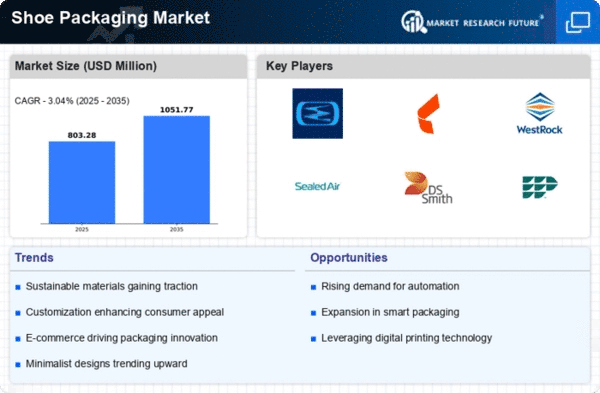
As per MRFR analysis, the Shoe Packaging Market Size was estimated at 779.58 USD Million in 2024. The Shoe Packaging industry is projected to grow from 803.28 in 2025 to 1051.77 by 2035, exhibiting a compound annual growth rate (CAGR) of 3.04% during the forecast period 2025 - 2035.

Key Market Trends & Highlights

The Shoe Packaging Market is experiencing a transformative shift towards sustainability and customization, driven by e-commerce growth.

  • The market is increasingly prioritizing sustainability, with a notable shift towards biodegradable materials in packaging solutions.
  • E-commerce continues to influence packaging design, leading to innovative solutions tailored for online retail.
  • Customization and personalization are becoming essential, as brands seek to enhance consumer engagement through unique packaging experiences.
  • Key drivers such as sustainability initiatives and the rapid growth of e-commerce are propelling the demand for both retail and e-commerce packaging solutions.

Market Size & Forecast

2024 Market Size 779.58 (USD Million)
2035 Market Size 1051.77 (USD Million)
CAGR (2025 - 2035) 3.04%
Largest Regional Market Share in 2024 North America

Major Players

Smurfit Kappa (IE), Mondi Group (GB), WestRock (US), Sealed Air (US), DS Smith (GB), International Paper (US), Packaging Corporation of America (US), Amcor (AU)

Market Trends

The Shoe Packaging Market is currently experiencing a transformative phase, driven by evolving consumer preferences and increasing environmental awareness. As sustainability becomes a focal point for brands and consumers alike, there is a noticeable shift towards eco-friendly materials and practices. This trend is not merely a response to regulatory pressures but reflects a broader societal movement towards responsible consumption. Companies are exploring innovative packaging solutions that minimize waste and enhance recyclability, thereby aligning their products with the values of environmentally conscious consumers. Moreover, the rise of e-commerce has significantly influenced the Shoe Packaging Market. With more consumers opting for online shopping, packaging must not only protect the product but also provide an engaging unboxing experience. This has led to a surge in creative designs and personalized packaging options that cater to individual preferences. As brands strive to differentiate themselves in a crowded marketplace, the emphasis on aesthetics and functionality in shoe packaging is likely to intensify, suggesting a dynamic future for this sector.

Sustainability Focus

The Shoe Packaging Market is increasingly prioritizing sustainable materials and practices. Brands are adopting eco-friendly packaging solutions to meet consumer demand for environmentally responsible products. This trend reflects a broader commitment to reducing environmental impact and enhancing brand reputation.

E-commerce Influence

The growth of online shopping is reshaping the Shoe Packaging Market. Packaging must now ensure product protection during transit while also creating a memorable unboxing experience. This shift encourages brands to innovate in design and functionality to attract and retain customers.

Customization and Personalization

There is a rising trend towards customized packaging in the Shoe Packaging Market. Brands are exploring personalized options to enhance customer engagement and loyalty. Tailored packaging solutions not only reflect individual consumer preferences but also serve as a marketing tool.

Shoe Packaging Market Market Drivers

E-commerce Growth

The rise of e-commerce significantly impacts the Global Shoe Packaging Market Industry. With online shopping becoming a preferred choice for consumers, the demand for efficient and protective packaging solutions has surged. Packaging must not only safeguard products during transit but also enhance the unboxing experience. Companies are investing in innovative designs that cater to this need, such as custom boxes and protective inserts. This shift is reflected in the market's anticipated growth, with a projected value of 9.53 USD Billion by 2035. The e-commerce boom is likely to drive a compound annual growth rate of 3.29% from 2025 to 2035.

Consumer Preferences

Consumer preferences are a driving force in the Global Shoe Packaging Market Industry. Today's consumers prioritize aesthetics and functionality in packaging, seeking designs that reflect their personal style while ensuring product protection. Brands are responding by creating visually appealing packaging that enhances the overall shopping experience. This trend is particularly pronounced among younger demographics, who are more likely to share their unboxing experiences on social media. As a result, companies are investing in innovative packaging designs that resonate with their target audience, thereby fostering brand loyalty and driving sales growth in the industry.

Regulatory Compliance

Regulatory compliance is an essential driver in the Global Shoe Packaging Market Industry. Governments worldwide are implementing stringent regulations regarding packaging materials and waste management. Brands must navigate these regulations to avoid penalties and maintain their market presence. This compliance often necessitates the adoption of sustainable packaging solutions, which can lead to increased operational costs. However, companies that proactively embrace these regulations may gain a competitive edge by appealing to environmentally conscious consumers. As the industry adapts to these regulatory changes, the demand for compliant packaging solutions is expected to rise, influencing market dynamics.

Sustainability Initiatives

The Global Shoe Packaging Market Industry is increasingly influenced by sustainability initiatives. As consumers become more environmentally conscious, brands are compelled to adopt eco-friendly packaging solutions. This shift is evident as companies explore biodegradable materials and recyclable options to minimize their carbon footprint. For instance, several leading footwear brands have committed to reducing plastic usage in their packaging, aligning with global sustainability goals. This trend not only enhances brand image but also meets regulatory requirements in various regions. The industry's focus on sustainability is expected to drive growth, contributing to the projected market value of 6.67 USD Billion in 2024.

Technological Advancements

Technological advancements play a crucial role in shaping the Global Shoe Packaging Market Industry. Innovations in materials science have led to the development of lighter, stronger, and more sustainable packaging options. For example, the introduction of smart packaging technologies, such as QR codes and NFC tags, enhances consumer engagement and provides valuable product information. These advancements not only improve the functionality of packaging but also contribute to brand differentiation in a competitive market. As companies adopt these technologies, the overall efficiency and effectiveness of shoe packaging are expected to improve, further driving market growth.

Market Segment Insights

By Application: Retail Packaging (Largest) vs. E-commerce Packaging (Fastest-Growing)

The Shoe Packaging Market is characterized by various application segments, with Retail Packaging holding the largest market share due to its traditional use in brick-and-mortar retail outlets. Retail Packaging consists of standard shoe boxes that are widely recognized and trusted by consumers, providing an expected and familiar experience. In contrast, E-commerce Packaging is rapidly increasing in significance as online shopping continues to soar, driven by convenience and the demand for personalized experiences. This shift is prompting many brands to innovate packaging specifically for online sales, creating protective and sustainable options. The growth in the Shoe Packaging Market is heavily influenced by the rise of online shopping, with E-commerce Packaging emerging as the fastest-growing segment. This surge can be attributed to changing consumer behaviors, where convenience and quick access to products are prioritized. The importance of robust packaging that can safeguard shoes during transit while enhancing user experience has led to innovative design solutions. Furthermore, sustainability trends are shaping both Retail and E-commerce Packaging strategies, pushing brands to adopt eco-friendly materials and practices to appeal to environmentally conscious consumers.

Retail Packaging (Dominant) vs. Gift Packaging (Emerging)

Retail Packaging remains the dominant application segment in the Shoe Packaging Market, primarily due to its established presence and familiarity among consumers. Standard shoe boxes are not only functional but also serve as a vital branding tool for retailers, showcasing designs and logos that resonate with target audiences. As store displays play a crucial role in consumer purchasing decisions, aesthetic and sturdy retail packaging facilitates an inviting point of sale experience. On the other hand, Gift Packaging is emerging as a notable segment, appealing to consumers looking for attractive and unique packaging options for gifting purposes. This segment is characterized by vibrant designs, premium materials, and added embellishments that enhance the presentation of shoes. The rising trend of gifting, especially during festive seasons, is driving demand for bespoke gift packaging solutions that elevate the overall consumer experience.

By Material Type: Cardboard (Largest) vs. Biodegradable Materials (Fastest-Growing)

In the Shoe Packaging Market, the material type segment comprises several key players. Cardboard packaging remains the largest segment due to its affordability, recyclability, and robustness, making it a favored choice among manufacturers and consumers alike. Plastic packaging follows, as it offers versatility and protective qualities, but it faces growing scrutiny due to environmental concerns. Paper is gaining traction as an alternative to plastic, while biodegradable materials are rising rapidly in popularity, reflecting the shift toward sustainability.

Cardboard (Dominant) vs. Biodegradable Materials (Emerging)

Cardboard packaging is the dominant force in the Shoe Packaging Market, known for its strength, lightweight nature, and ability to be easily recycled. Its established use in the industry ensures that it meets both functional and environmental criteria effectively. On the other hand, biodegradable materials are an emerging segment driven by increasing consumer preference for eco-friendly products. These materials promise to reduce environmental impact and align with sustainability initiatives, making them a compelling choice for brands aiming to appeal to environmentally conscious shoppers. As regulatory pressures mount against single-use plastics, the rise of biodegradable solutions indicates a significant shift towards sustainability in shoe packaging.

By Closure Type: Box Flap (Largest) vs. Tape (Fastest-Growing)

<p>The closure type segment in the shoe packaging market is increasingly dominated by Box Flap solutions, which account for a substantial market share due to their versatility and protective capabilities. Tape closures, while smaller in market share, are rapidly gaining traction due to their ease of use and cost effectiveness, making them popular among emerging brands. Overall, the segmentation reflects a diverse approach to packaging within the shoe industry, with various closures catering to different consumer preferences and market demands.</p>

<p>Box Flap (Dominant) vs. Tape (Emerging)</p>

<p>Box Flap closures are established as the dominant choice in the shoe packaging market due to their robustness and ability to securely enclose various shoe styles. They offer enhanced protection for products during transit and storage, appealing to brands seeking quality. In contrast, Tape closures are emerging due to their simplicity and lower production costs. The growing trend towards eco-friendly packaging is also benefiting Tape, as brands look to reduce material usage while still achieving effective closure. Both solutions address distinct market needs, allowing brands to choose based on their target demographic and sustainability goals.</p>

By Design Type: Custom Design (Largest) vs. Eco-friendly Design (Fastest-Growing)

In the Shoe Packaging Market, the design type segment exhibits distinct characteristics with Custom Design being the largest portion. Custom Design caters to brands seeking unique branding opportunities, allowing for enhanced customer experience and brand recognition. In contrast, Eco-friendly Design, while currently smaller in share, is rapidly gaining momentum due to increasing consumer demand for sustainable practices and materials in product packaging.

Design Type: Custom Design (Dominant) vs. Eco-friendly Design (Emerging)

Custom Design consistently leads the Shoe Packaging Market, appealing to both high-end and mass-market brands. This segment prioritizes aesthetics and brand identity, offering bespoke solutions tailored to specific shoe designs. Conversely, the Eco-friendly Design segment is emerging as a strong contender, driven by eco-conscious consumer preferences and regulatory pressures. Brands adopting eco-friendly packaging solutions often utilize recyclable and biodegradable materials, thus enhancing their market appeal. While Custom Design emphasizes personalization and branding, Eco-friendly Design captures the growing desire for sustainability, creating a diverse landscape in the design type segment.

By End User: Footwear Manufacturers (Largest) vs. E-commerce Companies (Fastest-Growing)

<p>The shoe packaging market is primarily driven by three key end users: footwear manufacturers, retailers, and e-commerce companies. Among these, footwear manufacturers command the largest share, as they need efficient packaging solutions to ensure safe transportation and presentation of their products. Retailers also play a significant role, providing the visibility and accessibility required for consumers. E-commerce companies, in contrast, represent a rapidly growing segment, fueled by online shopping trends that necessitate innovative packaging to enhance customer experience. Recent trends indicate a shift towards sustainable and eco-friendly packaging options, particularly among e-commerce companies, which are responding to growing consumer demand for environmental responsibility. Footwear manufacturers are also exploring innovative designs and materials to maintain competitiveness. As the market evolves, the collaboration between these segment values will likely intensify, resulting in innovative packaging solutions that meet diverse consumer preferences.</p>

<p>Footwear Manufacturers (Dominant) vs. Retailers (Emerging)</p>

<p>Footwear manufacturers are the dominant force in the shoe packaging market, leveraging their volume requirements and brand identity to dictate packaging standards. They prioritize protective, aesthetic, and functional elements in packaging to ensure products reach retailers in optimal condition. In contrast, retailers are categorized as an emerging segment, increasingly influencing packaging trends as they demand eye-catching displays and sustainable solutions that align with modern consumer values. The shift towards e-commerce has compelled retailers to adapt their packaging strategies, focusing on durability and branding to enhance customer retention. Both segments are essential to the shoe packaging ecosystem, where manufacturers set the tone and retailers amplify the brand experience at the point of sale.</p>

Get more detailed insights about Shoe Packaging Market Research Report—Global Forecast till 2035

Regional Insights

North America : Market Leader in Shoe Packaging

North America is poised to maintain its leadership in the shoe packaging market, holding a significant share of 350.0 million. The region's growth is driven by increasing consumer demand for sustainable packaging solutions and stringent regulations promoting eco-friendly materials. The rise in e-commerce and online retailing further fuels the need for innovative packaging that ensures product safety and enhances customer experience. The United States stands out as the leading country in this market, with major players like WestRock and International Paper driving innovation and competition. The presence of established companies such as Smurfit Kappa and Mondi Group enhances the competitive landscape, ensuring a diverse range of packaging solutions. As the market evolves, these companies are focusing on sustainable practices to meet regulatory requirements and consumer preferences.

Europe : Sustainable Packaging Initiatives

Europe's shoe packaging market is valued at 250.0 million, reflecting a robust demand for sustainable packaging solutions. The region is witnessing a shift towards eco-friendly materials, driven by consumer awareness and regulatory frameworks aimed at reducing plastic waste. Initiatives from the European Union to promote circular economy practices are further catalyzing this trend, making sustainability a key driver of market growth. Leading countries such as Germany and France are at the forefront of this transformation, with companies like Mondi Group and DS Smith leading the charge in innovative packaging solutions. The competitive landscape is characterized by a mix of local and international players, all striving to meet the growing demand for sustainable packaging. As regulations tighten, companies are investing in research and development to create environmentally friendly packaging options that align with consumer expectations.

Asia-Pacific : Emerging Market Potential

The Asia-Pacific shoe packaging market, valued at 150.0 million, is experiencing rapid growth driven by increasing urbanization and rising disposable incomes. The demand for footwear is surging, particularly in countries like China and India, where a growing middle class is seeking quality packaging solutions. Additionally, government initiatives to boost manufacturing and exports are creating a favorable environment for market expansion. China is the dominant player in this region, with numerous local and international companies vying for market share. Key players such as Amcor and Sealed Air are investing in innovative packaging technologies to cater to the evolving needs of consumers. The competitive landscape is becoming increasingly dynamic, with a focus on sustainability and efficiency in packaging solutions to meet both regulatory standards and consumer preferences.

Middle East and Africa : Developing Market Landscape

The Middle East and Africa shoe packaging market, valued at 29.58 million, is in a developing stage with significant growth opportunities. The region is witnessing an increase in footwear consumption, driven by urbanization and changing lifestyles. Additionally, the rise of e-commerce is creating demand for efficient and protective packaging solutions, which is essential for the growing online retail sector. Countries like South Africa and the UAE are leading the market, with local manufacturers and international players exploring opportunities to expand their footprint. The competitive landscape is characterized by a mix of established companies and new entrants, all aiming to capture the growing demand for innovative packaging solutions. As the market matures, there is a strong emphasis on sustainability and compliance with emerging regulations.

Key Players and Competitive Insights

The Shoe Packaging Market is currently characterized by a dynamic competitive landscape, driven by increasing consumer demand for sustainable packaging solutions and the ongoing evolution of e-commerce. Key players such as Smurfit Kappa (IE), Mondi Group (GB), and WestRock (US) are strategically positioning themselves through innovation and sustainability initiatives. For instance, Smurfit Kappa (IE) has focused on enhancing its product offerings with eco-friendly materials, while Mondi Group (GB) emphasizes its commitment to circular economy principles, thereby shaping a competitive environment that prioritizes environmental responsibility alongside operational efficiency.In terms of business tactics, companies are increasingly localizing manufacturing to reduce lead times and optimize supply chains. The market appears moderately fragmented, with several key players exerting influence through strategic partnerships and technological advancements. This collective approach not only enhances operational capabilities but also fosters a competitive structure that encourages innovation and responsiveness to market demands.

In November WestRock (US) announced a significant investment in a new manufacturing facility aimed at increasing its production capacity for sustainable shoe packaging solutions. This strategic move is likely to bolster WestRock's market position by enabling it to meet the growing demand for eco-friendly packaging, thereby enhancing its competitive edge in a market that increasingly values sustainability.

In October Mondi Group (GB) launched a new line of biodegradable shoe packaging products, which aligns with its sustainability goals. This initiative not only reflects the company's commitment to reducing environmental impact but also positions it favorably against competitors who may not yet have adopted such innovative solutions. The introduction of these products could potentially attract environmentally conscious consumers and brands looking to enhance their sustainability profiles.

In September Sealed Air (US) entered into a strategic partnership with a leading footwear brand to develop customized packaging solutions that enhance product protection and reduce waste. This collaboration underscores the importance of tailored solutions in the market, as companies seek to differentiate themselves through innovative packaging that meets specific customer needs. Such partnerships are indicative of a broader trend towards collaboration in the industry, which may redefine competitive dynamics.

As of December the Shoe Packaging Market is witnessing trends such as digitalization, sustainability, and AI integration, which are reshaping competitive strategies. The emphasis on strategic alliances is becoming increasingly pronounced, as companies recognize the value of collaboration in driving innovation. Looking ahead, competitive differentiation is likely to evolve from traditional price-based competition to a focus on innovation, technology, and supply chain reliability, suggesting a transformative shift in how companies approach market challenges.

Key Companies in the Shoe Packaging Market include

Industry Developments

October 2022: The most adaptable training shoe made for athletes, the UA SlipSpeed, was introduced by Under Armour. Such situations increase need for fresh shoe packaging that showcases the distinctiveness of the shoes.

December 2020: A new multi-brand paper packaging solution that is recyclable and reusable has been introduced by the fashion retailer H&M as part of its sustainable operations.

Future Outlook

Shoe Packaging Market Future Outlook

The Shoe Packaging Market is projected to grow at a 3.04% CAGR from 2025 to 2035, driven by sustainability trends, e-commerce growth, and innovative packaging solutions.

New opportunities lie in:

  • Development of biodegradable packaging materials for eco-conscious consumers.
  • Integration of <a href="https://www.marketresearchfuture.com/reports/smart-packaging-market-1981" target="_blank" title="smart packaging">smart packaging</a> technologies to enhance customer engagement.
  • Expansion of customized packaging solutions for niche footwear markets.

By 2035, the Shoe Packaging Market is expected to achieve robust growth, driven by innovation and sustainability.

Market Segmentation

Shoe Packaging Market End Use Outlook

  • Footwear Manufacturers
  • Retailers
  • Online Retailers
  • Distributors

Shoe Packaging Market Application Outlook

  • Retail Packaging
  • E-commerce Packaging
  • Gift Packaging
  • Storage Packaging

Shoe Packaging Market Design Type Outlook

  • Custom Design
  • Standard Design
  • Eco-friendly Design

Shoe Packaging Market Closure Type Outlook

  • Tape
  • Adhesive
  • Strap
  • Box Flap

Shoe Packaging Market Material Type Outlook

  • Cardboard
  • Plastic
  • Paper
  • Biodegradable Materials

Report Scope

MARKET SIZE 2024 779.58(USD Million)
MARKET SIZE 2025 803.28(USD Million)
MARKET SIZE 2035 1051.77(USD Million)
COMPOUND ANNUAL GROWTH RATE (CAGR) 3.04% (2025 - 2035)
REPORT COVERAGE Revenue Forecast, Competitive Landscape, Growth Factors, and Trends
BASE YEAR 2024
Market Forecast Period 2025 - 2035
Historical Data 2019 - 2024
Market Forecast Units USD Million
Key Companies Profiled Smurfit Kappa (IE), Mondi Group (GB), WestRock (US), Sealed Air (US), DS Smith (GB), International Paper (US), Packaging Corporation of America (US), Amcor (AU)
Segments Covered Application, Material Type, Closure Type, Design Type, End Use
Key Market Opportunities Adoption of sustainable materials in Shoe Packaging Market aligns with growing consumer demand for eco-friendly products.
Key Market Dynamics Rising demand for sustainable materials drives innovation in shoe packaging solutions and reshapes competitive dynamics.
Countries Covered North America, Europe, APAC, South America, MEA

FAQs

What is the current valuation of the Shoe Packaging Market as of 2025?

<p>The Shoe Packaging Market is valued at approximately 779.58 USD Million in 2024.</p>

What is the projected market valuation for the Shoe Packaging Market in 2035?

<p>The market is projected to reach approximately 1051.77 USD Million by 2035.</p>

What is the expected CAGR for the Shoe Packaging Market during the forecast period 2025 - 2035?

<p>The expected CAGR for the Shoe Packaging Market during the forecast period 2025 - 2035 is 3.04%.</p>

Which companies are considered key players in the Shoe Packaging Market?

<p>Key players in the market include Smurfit Kappa, Mondi Group, WestRock, Sealed Air, DS Smith, International Paper, Packaging Corporation of America, and Amcor.</p>

What are the main application segments of the Shoe Packaging Market?

<p>The main application segments include Retail Packaging, E-commerce Packaging, Gift Packaging, and Storage Packaging.</p>

How does the valuation of E-commerce Packaging compare to Retail Packaging?

<p>E-commerce Packaging is valued between 250.0 and 350.0 USD Million, whereas Retail Packaging is valued between 200.0 and 250.0 USD Million.</p>

What materials are predominantly used in Shoe Packaging?

The predominant materials used include Cardboard, Plastic, Paper, and Biodegradable Materials.

What is the valuation range for Biodegradable Materials in Shoe Packaging?

The valuation range for Biodegradable Materials in Shoe Packaging is between 179.58 and 301.77 USD Million.

What types of closures are utilized in Shoe Packaging?

Closure types include Tape, Adhesive, Strap, and Box Flap, with Box Flap having a valuation range of 279.58 to 401.77 USD Million.

What design types are available in the Shoe Packaging Market?

Available design types include Custom Design, Standard Design, and Eco-friendly Design, with Standard Design valued between 350.0 and 450.0 USD Million.

  1. SECTION I: EXECUTIVE SUMMARY AND KEY HIGHLIGHTS
    1. | 1.1 EXECUTIVE SUMMARY
    2. | | 1.1.1 Market Overview
    3. | | 1.1.2 Key Findings
    4. | | 1.1.3 Market Segmentation
    5. | | 1.1.4 Competitive Landscape
    6. | | 1.1.5 Challenges and Opportunities
    7. | | 1.1.6 Future Outlook
  2. SECTION II: SCOPING, METHODOLOGY AND MARKET STRUCTURE
    1. | 2.1 MARKET INTRODUCTION
    2. | | 2.1.1 Definition
    3. | | 2.1.2 Scope of the study
    4. | | | 2.1.2.1 Research Objective
    5. | | | 2.1.2.2 Assumption
    6. | | | 2.1.2.3 Limitations
    7. | 2.2 RESEARCH METHODOLOGY
    8. | | 2.2.1 Overview
    9. | | 2.2.2 Data Mining
    10. | | 2.2.3 Secondary Research
    11. | | 2.2.4 Primary Research
    12. | | | 2.2.4.1 Primary Interviews and Information Gathering Process
    13. | | | 2.2.4.2 Breakdown of Primary Respondents
    14. | | 2.2.5 Forecasting Model
    15. | | 2.2.6 Market Size Estimation
    16. | | | 2.2.6.1 Bottom-Up Approach
    17. | | | 2.2.6.2 Top-Down Approach
    18. | | 2.2.7 Data Triangulation
    19. | | 2.2.8 Validation
  3. SECTION III: QUALITATIVE ANALYSIS
    1. | 3.1 MARKET DYNAMICS
    2. | | 3.1.1 Overview
    3. | | 3.1.2 Drivers
    4. | | 3.1.3 Restraints
    5. | | 3.1.4 Opportunities
    6. | 3.2 MARKET FACTOR ANALYSIS
    7. | | 3.2.1 Value chain Analysis
    8. | | 3.2.2 Porter's Five Forces Analysis
    9. | | | 3.2.2.1 Bargaining Power of Suppliers
    10. | | | 3.2.2.2 Bargaining Power of Buyers
    11. | | | 3.2.2.3 Threat of New Entrants
    12. | | | 3.2.2.4 Threat of Substitutes
    13. | | | 3.2.2.5 Intensity of Rivalry
    14. | | 3.2.3 COVID-19 Impact Analysis
    15. | | | 3.2.3.1 Market Impact Analysis
    16. | | | 3.2.3.2 Regional Impact
    17. | | | 3.2.3.3 Opportunity and Threat Analysis
  4. SECTION IV: QUANTITATIVE ANALYSIS
    1. | 4.1 Packaging & Transport, BY Application (USD Million)
    2. | | 4.1.1 Retail Packaging
    3. | | 4.1.2 E-commerce Packaging
    4. | | 4.1.3 Gift Packaging
    5. | | 4.1.4 Storage Packaging
    6. | 4.2 Packaging & Transport, BY Material Type (USD Million)
    7. | | 4.2.1 Cardboard
    8. | | 4.2.2 Plastic
    9. | | 4.2.3 Paper
    10. | | 4.2.4 Biodegradable Materials
    11. | 4.3 Packaging & Transport, BY Closure Type (USD Million)
    12. | | 4.3.1 Tape
    13. | | 4.3.2 Adhesive
    14. | | 4.3.3 Strap
    15. | | 4.3.4 Box Flap
    16. | 4.4 Packaging & Transport, BY Design Type (USD Million)
    17. | | 4.4.1 Custom Design
    18. | | 4.4.2 Standard Design
    19. | | 4.4.3 Eco-friendly Design
    20. | 4.5 Packaging & Transport, BY End User (USD Million)
    21. | | 4.5.1 Footwear Manufacturers
    22. | | 4.5.2 Retailers
    23. | | 4.5.3 E-commerce Companies
    24. | 4.6 Packaging & Transport, BY Region (USD Million)
    25. | | 4.6.1 North America
    26. | | | 4.6.1.1 US
    27. | | | 4.6.1.2 Canada
    28. | | 4.6.2 Europe
    29. | | | 4.6.2.1 Germany
    30. | | | 4.6.2.2 UK
    31. | | | 4.6.2.3 France
    32. | | | 4.6.2.4 Russia
    33. | | | 4.6.2.5 Italy
    34. | | | 4.6.2.6 Spain
    35. | | | 4.6.2.7 Rest of Europe
    36. | | 4.6.3 APAC
    37. | | | 4.6.3.1 China
    38. | | | 4.6.3.2 India
    39. | | | 4.6.3.3 Japan
    40. | | | 4.6.3.4 South Korea
    41. | | | 4.6.3.5 Malaysia
    42. | | | 4.6.3.6 Thailand
    43. | | | 4.6.3.7 Indonesia
    44. | | | 4.6.3.8 Rest of APAC
    45. | | 4.6.4 South America
    46. | | | 4.6.4.1 Brazil
    47. | | | 4.6.4.2 Mexico
    48. | | | 4.6.4.3 Argentina
    49. | | | 4.6.4.4 Rest of South America
    50. | | 4.6.5 MEA
    51. | | | 4.6.5.1 GCC Countries
    52. | | | 4.6.5.2 South Africa
    53. | | | 4.6.5.3 Rest of MEA
  5. SECTION V: COMPETITIVE ANALYSIS
    1. | 5.1 Competitive Landscape
    2. | | 5.1.1 Overview
    3. | | 5.1.2 Competitive Analysis
    4. | | 5.1.3 Market share Analysis
    5. | | 5.1.4 Major Growth Strategy in the Packaging & Transport
    6. | | 5.1.5 Competitive Benchmarking
    7. | | 5.1.6 Leading Players in Terms of Number of Developments in the Packaging & Transport
    8. | | 5.1.7 Key developments and growth strategies
    9. | | | 5.1.7.1 New Product Launch/Service Deployment
    10. | | | 5.1.7.2 Merger & Acquisitions
    11. | | | 5.1.7.3 Joint Ventures
    12. | | 5.1.8 Major Players Financial Matrix
    13. | | | 5.1.8.1 Sales and Operating Income
    14. | | | 5.1.8.2 Major Players R&D Expenditure. 2023
    15. | 5.2 Company Profiles
    16. | | 5.2.1 Smurfit Kappa (IE)
    17. | | | 5.2.1.1 Financial Overview
    18. | | | 5.2.1.2 Products Offered
    19. | | | 5.2.1.3 Key Developments
    20. | | | 5.2.1.4 SWOT Analysis
    21. | | | 5.2.1.5 Key Strategies
    22. | | 5.2.2 Mondi Group (GB)
    23. | | | 5.2.2.1 Financial Overview
    24. | | | 5.2.2.2 Products Offered
    25. | | | 5.2.2.3 Key Developments
    26. | | | 5.2.2.4 SWOT Analysis
    27. | | | 5.2.2.5 Key Strategies
    28. | | 5.2.3 WestRock (US)
    29. | | | 5.2.3.1 Financial Overview
    30. | | | 5.2.3.2 Products Offered
    31. | | | 5.2.3.3 Key Developments
    32. | | | 5.2.3.4 SWOT Analysis
    33. | | | 5.2.3.5 Key Strategies
    34. | | 5.2.4 Sealed Air (US)
    35. | | | 5.2.4.1 Financial Overview
    36. | | | 5.2.4.2 Products Offered
    37. | | | 5.2.4.3 Key Developments
    38. | | | 5.2.4.4 SWOT Analysis
    39. | | | 5.2.4.5 Key Strategies
    40. | | 5.2.5 DS Smith (GB)
    41. | | | 5.2.5.1 Financial Overview
    42. | | | 5.2.5.2 Products Offered
    43. | | | 5.2.5.3 Key Developments
    44. | | | 5.2.5.4 SWOT Analysis
    45. | | | 5.2.5.5 Key Strategies
    46. | | 5.2.6 International Paper (US)
    47. | | | 5.2.6.1 Financial Overview
    48. | | | 5.2.6.2 Products Offered
    49. | | | 5.2.6.3 Key Developments
    50. | | | 5.2.6.4 SWOT Analysis
    51. | | | 5.2.6.5 Key Strategies
    52. | | 5.2.7 Packaging Corporation of America (US)
    53. | | | 5.2.7.1 Financial Overview
    54. | | | 5.2.7.2 Products Offered
    55. | | | 5.2.7.3 Key Developments
    56. | | | 5.2.7.4 SWOT Analysis
    57. | | | 5.2.7.5 Key Strategies
    58. | | 5.2.8 Amcor (AU)
    59. | | | 5.2.8.1 Financial Overview
    60. | | | 5.2.8.2 Products Offered
    61. | | | 5.2.8.3 Key Developments
    62. | | | 5.2.8.4 SWOT Analysis
    63. | | | 5.2.8.5 Key Strategies
    64. | 5.3 Appendix
    65. | | 5.3.1 References
    66. | | 5.3.2 Related Reports
  6. LIST OF FIGURES
    1. | 6.1 MARKET SYNOPSIS
    2. | 6.2 NORTH AMERICA MARKET ANALYSIS
    3. | 6.3 US MARKET ANALYSIS BY APPLICATION
    4. | 6.4 US MARKET ANALYSIS BY MATERIAL TYPE
    5. | 6.5 US MARKET ANALYSIS BY CLOSURE TYPE
    6. | 6.6 US MARKET ANALYSIS BY DESIGN TYPE
    7. | 6.7 US MARKET ANALYSIS BY END USER
    8. | 6.8 CANADA MARKET ANALYSIS BY APPLICATION
    9. | 6.9 CANADA MARKET ANALYSIS BY MATERIAL TYPE
    10. | 6.10 CANADA MARKET ANALYSIS BY CLOSURE TYPE
    11. | 6.11 CANADA MARKET ANALYSIS BY DESIGN TYPE
    12. | 6.12 CANADA MARKET ANALYSIS BY END USER
    13. | 6.13 EUROPE MARKET ANALYSIS
    14. | 6.14 GERMANY MARKET ANALYSIS BY APPLICATION
    15. | 6.15 GERMANY MARKET ANALYSIS BY MATERIAL TYPE
    16. | 6.16 GERMANY MARKET ANALYSIS BY CLOSURE TYPE
    17. | 6.17 GERMANY MARKET ANALYSIS BY DESIGN TYPE
    18. | 6.18 GERMANY MARKET ANALYSIS BY END USER
    19. | 6.19 UK MARKET ANALYSIS BY APPLICATION
    20. | 6.20 UK MARKET ANALYSIS BY MATERIAL TYPE
    21. | 6.21 UK MARKET ANALYSIS BY CLOSURE TYPE
    22. | 6.22 UK MARKET ANALYSIS BY DESIGN TYPE
    23. | 6.23 UK MARKET ANALYSIS BY END USER
    24. | 6.24 FRANCE MARKET ANALYSIS BY APPLICATION
    25. | 6.25 FRANCE MARKET ANALYSIS BY MATERIAL TYPE
    26. | 6.26 FRANCE MARKET ANALYSIS BY CLOSURE TYPE
    27. | 6.27 FRANCE MARKET ANALYSIS BY DESIGN TYPE
    28. | 6.28 FRANCE MARKET ANALYSIS BY END USER
    29. | 6.29 RUSSIA MARKET ANALYSIS BY APPLICATION
    30. | 6.30 RUSSIA MARKET ANALYSIS BY MATERIAL TYPE
    31. | 6.31 RUSSIA MARKET ANALYSIS BY CLOSURE TYPE
    32. | 6.32 RUSSIA MARKET ANALYSIS BY DESIGN TYPE
    33. | 6.33 RUSSIA MARKET ANALYSIS BY END USER
    34. | 6.34 ITALY MARKET ANALYSIS BY APPLICATION
    35. | 6.35 ITALY MARKET ANALYSIS BY MATERIAL TYPE
    36. | 6.36 ITALY MARKET ANALYSIS BY CLOSURE TYPE
    37. | 6.37 ITALY MARKET ANALYSIS BY DESIGN TYPE
    38. | 6.38 ITALY MARKET ANALYSIS BY END USER
    39. | 6.39 SPAIN MARKET ANALYSIS BY APPLICATION
    40. | 6.40 SPAIN MARKET ANALYSIS BY MATERIAL TYPE
    41. | 6.41 SPAIN MARKET ANALYSIS BY CLOSURE TYPE
    42. | 6.42 SPAIN MARKET ANALYSIS BY DESIGN TYPE
    43. | 6.43 SPAIN MARKET ANALYSIS BY END USER
    44. | 6.44 REST OF EUROPE MARKET ANALYSIS BY APPLICATION
    45. | 6.45 REST OF EUROPE MARKET ANALYSIS BY MATERIAL TYPE
    46. | 6.46 REST OF EUROPE MARKET ANALYSIS BY CLOSURE TYPE
    47. | 6.47 REST OF EUROPE MARKET ANALYSIS BY DESIGN TYPE
    48. | 6.48 REST OF EUROPE MARKET ANALYSIS BY END USER
    49. | 6.49 APAC MARKET ANALYSIS
    50. | 6.50 CHINA MARKET ANALYSIS BY APPLICATION
    51. | 6.51 CHINA MARKET ANALYSIS BY MATERIAL TYPE
    52. | 6.52 CHINA MARKET ANALYSIS BY CLOSURE TYPE
    53. | 6.53 CHINA MARKET ANALYSIS BY DESIGN TYPE
    54. | 6.54 CHINA MARKET ANALYSIS BY END USER
    55. | 6.55 INDIA MARKET ANALYSIS BY APPLICATION
    56. | 6.56 INDIA MARKET ANALYSIS BY MATERIAL TYPE
    57. | 6.57 INDIA MARKET ANALYSIS BY CLOSURE TYPE
    58. | 6.58 INDIA MARKET ANALYSIS BY DESIGN TYPE
    59. | 6.59 INDIA MARKET ANALYSIS BY END USER
    60. | 6.60 JAPAN MARKET ANALYSIS BY APPLICATION
    61. | 6.61 JAPAN MARKET ANALYSIS BY MATERIAL TYPE
    62. | 6.62 JAPAN MARKET ANALYSIS BY CLOSURE TYPE
    63. | 6.63 JAPAN MARKET ANALYSIS BY DESIGN TYPE
    64. | 6.64 JAPAN MARKET ANALYSIS BY END USER
    65. | 6.65 SOUTH KOREA MARKET ANALYSIS BY APPLICATION
    66. | 6.66 SOUTH KOREA MARKET ANALYSIS BY MATERIAL TYPE
    67. | 6.67 SOUTH KOREA MARKET ANALYSIS BY CLOSURE TYPE
    68. | 6.68 SOUTH KOREA MARKET ANALYSIS BY DESIGN TYPE
    69. | 6.69 SOUTH KOREA MARKET ANALYSIS BY END USER
    70. | 6.70 MALAYSIA MARKET ANALYSIS BY APPLICATION
    71. | 6.71 MALAYSIA MARKET ANALYSIS BY MATERIAL TYPE
    72. | 6.72 MALAYSIA MARKET ANALYSIS BY CLOSURE TYPE
    73. | 6.73 MALAYSIA MARKET ANALYSIS BY DESIGN TYPE
    74. | 6.74 MALAYSIA MARKET ANALYSIS BY END USER
    75. | 6.75 THAILAND MARKET ANALYSIS BY APPLICATION
    76. | 6.76 THAILAND MARKET ANALYSIS BY MATERIAL TYPE
    77. | 6.77 THAILAND MARKET ANALYSIS BY CLOSURE TYPE
    78. | 6.78 THAILAND MARKET ANALYSIS BY DESIGN TYPE
    79. | 6.79 THAILAND MARKET ANALYSIS BY END USER
    80. | 6.80 INDONESIA MARKET ANALYSIS BY APPLICATION
    81. | 6.81 INDONESIA MARKET ANALYSIS BY MATERIAL TYPE
    82. | 6.82 INDONESIA MARKET ANALYSIS BY CLOSURE TYPE
    83. | 6.83 INDONESIA MARKET ANALYSIS BY DESIGN TYPE
    84. | 6.84 INDONESIA MARKET ANALYSIS BY END USER
    85. | 6.85 REST OF APAC MARKET ANALYSIS BY APPLICATION
    86. | 6.86 REST OF APAC MARKET ANALYSIS BY MATERIAL TYPE
    87. | 6.87 REST OF APAC MARKET ANALYSIS BY CLOSURE TYPE
    88. | 6.88 REST OF APAC MARKET ANALYSIS BY DESIGN TYPE
    89. | 6.89 REST OF APAC MARKET ANALYSIS BY END USER
    90. | 6.90 SOUTH AMERICA MARKET ANALYSIS
    91. | 6.91 BRAZIL MARKET ANALYSIS BY APPLICATION
    92. | 6.92 BRAZIL MARKET ANALYSIS BY MATERIAL TYPE
    93. | 6.93 BRAZIL MARKET ANALYSIS BY CLOSURE TYPE
    94. | 6.94 BRAZIL MARKET ANALYSIS BY DESIGN TYPE
    95. | 6.95 BRAZIL MARKET ANALYSIS BY END USER
    96. | 6.96 MEXICO MARKET ANALYSIS BY APPLICATION
    97. | 6.97 MEXICO MARKET ANALYSIS BY MATERIAL TYPE
    98. | 6.98 MEXICO MARKET ANALYSIS BY CLOSURE TYPE
    99. | 6.99 MEXICO MARKET ANALYSIS BY DESIGN TYPE
    100. | 6.100 MEXICO MARKET ANALYSIS BY END USER
    101. | 6.101 ARGENTINA MARKET ANALYSIS BY APPLICATION
    102. | 6.102 ARGENTINA MARKET ANALYSIS BY MATERIAL TYPE
    103. | 6.103 ARGENTINA MARKET ANALYSIS BY CLOSURE TYPE
    104. | 6.104 ARGENTINA MARKET ANALYSIS BY DESIGN TYPE
    105. | 6.105 ARGENTINA MARKET ANALYSIS BY END USER
    106. | 6.106 REST OF SOUTH AMERICA MARKET ANALYSIS BY APPLICATION
    107. | 6.107 REST OF SOUTH AMERICA MARKET ANALYSIS BY MATERIAL TYPE
    108. | 6.108 REST OF SOUTH AMERICA MARKET ANALYSIS BY CLOSURE TYPE
    109. | 6.109 REST OF SOUTH AMERICA MARKET ANALYSIS BY DESIGN TYPE
    110. | 6.110 REST OF SOUTH AMERICA MARKET ANALYSIS BY END USER
    111. | 6.111 MEA MARKET ANALYSIS
    112. | 6.112 GCC COUNTRIES MARKET ANALYSIS BY APPLICATION
    113. | 6.113 GCC COUNTRIES MARKET ANALYSIS BY MATERIAL TYPE
    114. | 6.114 GCC COUNTRIES MARKET ANALYSIS BY CLOSURE TYPE
    115. | 6.115 GCC COUNTRIES MARKET ANALYSIS BY DESIGN TYPE
    116. | 6.116 GCC COUNTRIES MARKET ANALYSIS BY END USER
    117. | 6.117 SOUTH AFRICA MARKET ANALYSIS BY APPLICATION
    118. | 6.118 SOUTH AFRICA MARKET ANALYSIS BY MATERIAL TYPE
    119. | 6.119 SOUTH AFRICA MARKET ANALYSIS BY CLOSURE TYPE
    120. | 6.120 SOUTH AFRICA MARKET ANALYSIS BY DESIGN TYPE
    121. | 6.121 SOUTH AFRICA MARKET ANALYSIS BY END USER
    122. | 6.122 REST OF MEA MARKET ANALYSIS BY APPLICATION
    123. | 6.123 REST OF MEA MARKET ANALYSIS BY MATERIAL TYPE
    124. | 6.124 REST OF MEA MARKET ANALYSIS BY CLOSURE TYPE
    125. | 6.125 REST OF MEA MARKET ANALYSIS BY DESIGN TYPE
    126. | 6.126 REST OF MEA MARKET ANALYSIS BY END USER
    127. | 6.127 KEY BUYING CRITERIA OF PACKAGING & TRANSPORT
    128. | 6.128 RESEARCH PROCESS OF MRFR
    129. | 6.129 DRO ANALYSIS OF PACKAGING & TRANSPORT
    130. | 6.130 DRIVERS IMPACT ANALYSIS: PACKAGING & TRANSPORT
    131. | 6.131 RESTRAINTS IMPACT ANALYSIS: PACKAGING & TRANSPORT
    132. | 6.132 SUPPLY / VALUE CHAIN: PACKAGING & TRANSPORT
    133. | 6.133 PACKAGING & TRANSPORT, BY APPLICATION, 2024 (% SHARE)
    134. | 6.134 PACKAGING & TRANSPORT, BY APPLICATION, 2024 TO 2035 (USD Million)
    135. | 6.135 PACKAGING & TRANSPORT, BY MATERIAL TYPE, 2024 (% SHARE)
    136. | 6.136 PACKAGING & TRANSPORT, BY MATERIAL TYPE, 2024 TO 2035 (USD Million)
    137. | 6.137 PACKAGING & TRANSPORT, BY CLOSURE TYPE, 2024 (% SHARE)
    138. | 6.138 PACKAGING & TRANSPORT, BY CLOSURE TYPE, 2024 TO 2035 (USD Million)
    139. | 6.139 PACKAGING & TRANSPORT, BY DESIGN TYPE, 2024 (% SHARE)
    140. | 6.140 PACKAGING & TRANSPORT, BY DESIGN TYPE, 2024 TO 2035 (USD Million)
    141. | 6.141 PACKAGING & TRANSPORT, BY END USER, 2024 (% SHARE)
    142. | 6.142 PACKAGING & TRANSPORT, BY END USER, 2024 TO 2035 (USD Million)
    143. | 6.143 BENCHMARKING OF MAJOR COMPETITORS
  7. LIST OF TABLES
    1. | 7.1 LIST OF ASSUMPTIONS
    2. | | 7.1.1
    3. | 7.2 North America MARKET SIZE ESTIMATES; FORECAST
    4. | | 7.2.1 BY APPLICATION, 2025-2035 (USD Million)
    5. | | 7.2.2 BY MATERIAL TYPE, 2025-2035 (USD Million)
    6. | | 7.2.3 BY CLOSURE TYPE, 2025-2035 (USD Million)
    7. | | 7.2.4 BY DESIGN TYPE, 2025-2035 (USD Million)
    8. | | 7.2.5 BY END USER, 2025-2035 (USD Million)
    9. | 7.3 US MARKET SIZE ESTIMATES; FORECAST
    10. | | 7.3.1 BY APPLICATION, 2025-2035 (USD Million)
    11. | | 7.3.2 BY MATERIAL TYPE, 2025-2035 (USD Million)
    12. | | 7.3.3 BY CLOSURE TYPE, 2025-2035 (USD Million)
    13. | | 7.3.4 BY DESIGN TYPE, 2025-2035 (USD Million)
    14. | | 7.3.5 BY END USER, 2025-2035 (USD Million)
    15. | 7.4 Canada MARKET SIZE ESTIMATES; FORECAST
    16. | | 7.4.1 BY APPLICATION, 2025-2035 (USD Million)
    17. | | 7.4.2 BY MATERIAL TYPE, 2025-2035 (USD Million)
    18. | | 7.4.3 BY CLOSURE TYPE, 2025-2035 (USD Million)
    19. | | 7.4.4 BY DESIGN TYPE, 2025-2035 (USD Million)
    20. | | 7.4.5 BY END USER, 2025-2035 (USD Million)
    21. | 7.5 Europe MARKET SIZE ESTIMATES; FORECAST
    22. | | 7.5.1 BY APPLICATION, 2025-2035 (USD Million)
    23. | | 7.5.2 BY MATERIAL TYPE, 2025-2035 (USD Million)
    24. | | 7.5.3 BY CLOSURE TYPE, 2025-2035 (USD Million)
    25. | | 7.5.4 BY DESIGN TYPE, 2025-2035 (USD Million)
    26. | | 7.5.5 BY END USER, 2025-2035 (USD Million)
    27. | 7.6 Germany MARKET SIZE ESTIMATES; FORECAST
    28. | | 7.6.1 BY APPLICATION, 2025-2035 (USD Million)
    29. | | 7.6.2 BY MATERIAL TYPE, 2025-2035 (USD Million)
    30. | | 7.6.3 BY CLOSURE TYPE, 2025-2035 (USD Million)
    31. | | 7.6.4 BY DESIGN TYPE, 2025-2035 (USD Million)
    32. | | 7.6.5 BY END USER, 2025-2035 (USD Million)
    33. | 7.7 UK MARKET SIZE ESTIMATES; FORECAST
    34. | | 7.7.1 BY APPLICATION, 2025-2035 (USD Million)
    35. | | 7.7.2 BY MATERIAL TYPE, 2025-2035 (USD Million)
    36. | | 7.7.3 BY CLOSURE TYPE, 2025-2035 (USD Million)
    37. | | 7.7.4 BY DESIGN TYPE, 2025-2035 (USD Million)
    38. | | 7.7.5 BY END USER, 2025-2035 (USD Million)
    39. | 7.8 France MARKET SIZE ESTIMATES; FORECAST
    40. | | 7.8.1 BY APPLICATION, 2025-2035 (USD Million)
    41. | | 7.8.2 BY MATERIAL TYPE, 2025-2035 (USD Million)
    42. | | 7.8.3 BY CLOSURE TYPE, 2025-2035 (USD Million)
    43. | | 7.8.4 BY DESIGN TYPE, 2025-2035 (USD Million)
    44. | | 7.8.5 BY END USER, 2025-2035 (USD Million)
    45. | 7.9 Russia MARKET SIZE ESTIMATES; FORECAST
    46. | | 7.9.1 BY APPLICATION, 2025-2035 (USD Million)
    47. | | 7.9.2 BY MATERIAL TYPE, 2025-2035 (USD Million)
    48. | | 7.9.3 BY CLOSURE TYPE, 2025-2035 (USD Million)
    49. | | 7.9.4 BY DESIGN TYPE, 2025-2035 (USD Million)
    50. | | 7.9.5 BY END USER, 2025-2035 (USD Million)
    51. | 7.10 Italy MARKET SIZE ESTIMATES; FORECAST
    52. | | 7.10.1 BY APPLICATION, 2025-2035 (USD Million)
    53. | | 7.10.2 BY MATERIAL TYPE, 2025-2035 (USD Million)
    54. | | 7.10.3 BY CLOSURE TYPE, 2025-2035 (USD Million)
    55. | | 7.10.4 BY DESIGN TYPE, 2025-2035 (USD Million)
    56. | | 7.10.5 BY END USER, 2025-2035 (USD Million)
    57. | 7.11 Spain MARKET SIZE ESTIMATES; FORECAST
    58. | | 7.11.1 BY APPLICATION, 2025-2035 (USD Million)
    59. | | 7.11.2 BY MATERIAL TYPE, 2025-2035 (USD Million)
    60. | | 7.11.3 BY CLOSURE TYPE, 2025-2035 (USD Million)
    61. | | 7.11.4 BY DESIGN TYPE, 2025-2035 (USD Million)
    62. | | 7.11.5 BY END USER, 2025-2035 (USD Million)
    63. | 7.12 Rest of Europe MARKET SIZE ESTIMATES; FORECAST
    64. | | 7.12.1 BY APPLICATION, 2025-2035 (USD Million)
    65. | | 7.12.2 BY MATERIAL TYPE, 2025-2035 (USD Million)
    66. | | 7.12.3 BY CLOSURE TYPE, 2025-2035 (USD Million)
    67. | | 7.12.4 BY DESIGN TYPE, 2025-2035 (USD Million)
    68. | | 7.12.5 BY END USER, 2025-2035 (USD Million)
    69. | 7.13 APAC MARKET SIZE ESTIMATES; FORECAST
    70. | | 7.13.1 BY APPLICATION, 2025-2035 (USD Million)
    71. | | 7.13.2 BY MATERIAL TYPE, 2025-2035 (USD Million)
    72. | | 7.13.3 BY CLOSURE TYPE, 2025-2035 (USD Million)
    73. | | 7.13.4 BY DESIGN TYPE, 2025-2035 (USD Million)
    74. | | 7.13.5 BY END USER, 2025-2035 (USD Million)
    75. | 7.14 China MARKET SIZE ESTIMATES; FORECAST
    76. | | 7.14.1 BY APPLICATION, 2025-2035 (USD Million)
    77. | | 7.14.2 BY MATERIAL TYPE, 2025-2035 (USD Million)
    78. | | 7.14.3 BY CLOSURE TYPE, 2025-2035 (USD Million)
    79. | | 7.14.4 BY DESIGN TYPE, 2025-2035 (USD Million)
    80. | | 7.14.5 BY END USER, 2025-2035 (USD Million)
    81. | 7.15 India MARKET SIZE ESTIMATES; FORECAST
    82. | | 7.15.1 BY APPLICATION, 2025-2035 (USD Million)
    83. | | 7.15.2 BY MATERIAL TYPE, 2025-2035 (USD Million)
    84. | | 7.15.3 BY CLOSURE TYPE, 2025-2035 (USD Million)
    85. | | 7.15.4 BY DESIGN TYPE, 2025-2035 (USD Million)
    86. | | 7.15.5 BY END USER, 2025-2035 (USD Million)
    87. | 7.16 Japan MARKET SIZE ESTIMATES; FORECAST
    88. | | 7.16.1 BY APPLICATION, 2025-2035 (USD Million)
    89. | | 7.16.2 BY MATERIAL TYPE, 2025-2035 (USD Million)
    90. | | 7.16.3 BY CLOSURE TYPE, 2025-2035 (USD Million)
    91. | | 7.16.4 BY DESIGN TYPE, 2025-2035 (USD Million)
    92. | | 7.16.5 BY END USER, 2025-2035 (USD Million)
    93. | 7.17 South Korea MARKET SIZE ESTIMATES; FORECAST
    94. | | 7.17.1 BY APPLICATION, 2025-2035 (USD Million)
    95. | | 7.17.2 BY MATERIAL TYPE, 2025-2035 (USD Million)
    96. | | 7.17.3 BY CLOSURE TYPE, 2025-2035 (USD Million)
    97. | | 7.17.4 BY DESIGN TYPE, 2025-2035 (USD Million)
    98. | | 7.17.5 BY END USER, 2025-2035 (USD Million)
    99. | 7.18 Malaysia MARKET SIZE ESTIMATES; FORECAST
    100. | | 7.18.1 BY APPLICATION, 2025-2035 (USD Million)
    101. | | 7.18.2 BY MATERIAL TYPE, 2025-2035 (USD Million)
    102. | | 7.18.3 BY CLOSURE TYPE, 2025-2035 (USD Million)
    103. | | 7.18.4 BY DESIGN TYPE, 2025-2035 (USD Million)
    104. | | 7.18.5 BY END USER, 2025-2035 (USD Million)
    105. | 7.19 Thailand MARKET SIZE ESTIMATES; FORECAST
    106. | | 7.19.1 BY APPLICATION, 2025-2035 (USD Million)
    107. | | 7.19.2 BY MATERIAL TYPE, 2025-2035 (USD Million)
    108. | | 7.19.3 BY CLOSURE TYPE, 2025-2035 (USD Million)
    109. | | 7.19.4 BY DESIGN TYPE, 2025-2035 (USD Million)
    110. | | 7.19.5 BY END USER, 2025-2035 (USD Million)
    111. | 7.20 Indonesia MARKET SIZE ESTIMATES; FORECAST
    112. | | 7.20.1 BY APPLICATION, 2025-2035 (USD Million)
    113. | | 7.20.2 BY MATERIAL TYPE, 2025-2035 (USD Million)
    114. | | 7.20.3 BY CLOSURE TYPE, 2025-2035 (USD Million)
    115. | | 7.20.4 BY DESIGN TYPE, 2025-2035 (USD Million)
    116. | | 7.20.5 BY END USER, 2025-2035 (USD Million)
    117. | 7.21 Rest of APAC MARKET SIZE ESTIMATES; FORECAST
    118. | | 7.21.1 BY APPLICATION, 2025-2035 (USD Million)
    119. | | 7.21.2 BY MATERIAL TYPE, 2025-2035 (USD Million)
    120. | | 7.21.3 BY CLOSURE TYPE, 2025-2035 (USD Million)
    121. | | 7.21.4 BY DESIGN TYPE, 2025-2035 (USD Million)
    122. | | 7.21.5 BY END USER, 2025-2035 (USD Million)
    123. | 7.22 South America MARKET SIZE ESTIMATES; FORECAST
    124. | | 7.22.1 BY APPLICATION, 2025-2035 (USD Million)
    125. | | 7.22.2 BY MATERIAL TYPE, 2025-2035 (USD Million)
    126. | | 7.22.3 BY CLOSURE TYPE, 2025-2035 (USD Million)
    127. | | 7.22.4 BY DESIGN TYPE, 2025-2035 (USD Million)
    128. | | 7.22.5 BY END USER, 2025-2035 (USD Million)
    129. | 7.23 Brazil MARKET SIZE ESTIMATES; FORECAST
    130. | | 7.23.1 BY APPLICATION, 2025-2035 (USD Million)
    131. | | 7.23.2 BY MATERIAL TYPE, 2025-2035 (USD Million)
    132. | | 7.23.3 BY CLOSURE TYPE, 2025-2035 (USD Million)
    133. | | 7.23.4 BY DESIGN TYPE, 2025-2035 (USD Million)
    134. | | 7.23.5 BY END USER, 2025-2035 (USD Million)
    135. | 7.24 Mexico MARKET SIZE ESTIMATES; FORECAST
    136. | | 7.24.1 BY APPLICATION, 2025-2035 (USD Million)
    137. | | 7.24.2 BY MATERIAL TYPE, 2025-2035 (USD Million)
    138. | | 7.24.3 BY CLOSURE TYPE, 2025-2035 (USD Million)
    139. | | 7.24.4 BY DESIGN TYPE, 2025-2035 (USD Million)
    140. | | 7.24.5 BY END USER, 2025-2035 (USD Million)
    141. | 7.25 Argentina MARKET SIZE ESTIMATES; FORECAST
    142. | | 7.25.1 BY APPLICATION, 2025-2035 (USD Million)
    143. | | 7.25.2 BY MATERIAL TYPE, 2025-2035 (USD Million)
    144. | | 7.25.3 BY CLOSURE TYPE, 2025-2035 (USD Million)
    145. | | 7.25.4 BY DESIGN TYPE, 2025-2035 (USD Million)
    146. | | 7.25.5 BY END USER, 2025-2035 (USD Million)
    147. | 7.26 Rest of South America MARKET SIZE ESTIMATES; FORECAST
    148. | | 7.26.1 BY APPLICATION, 2025-2035 (USD Million)
    149. | | 7.26.2 BY MATERIAL TYPE, 2025-2035 (USD Million)
    150. | | 7.26.3 BY CLOSURE TYPE, 2025-2035 (USD Million)
    151. | | 7.26.4 BY DESIGN TYPE, 2025-2035 (USD Million)
    152. | | 7.26.5 BY END USER, 2025-2035 (USD Million)
    153. | 7.27 MEA MARKET SIZE ESTIMATES; FORECAST
    154. | | 7.27.1 BY APPLICATION, 2025-2035 (USD Million)
    155. | | 7.27.2 BY MATERIAL TYPE, 2025-2035 (USD Million)
    156. | | 7.27.3 BY CLOSURE TYPE, 2025-2035 (USD Million)
    157. | | 7.27.4 BY DESIGN TYPE, 2025-2035 (USD Million)
    158. | | 7.27.5 BY END USER, 2025-2035 (USD Million)
    159. | 7.28 GCC Countries MARKET SIZE ESTIMATES; FORECAST
    160. | | 7.28.1 BY APPLICATION, 2025-2035 (USD Million)
    161. | | 7.28.2 BY MATERIAL TYPE, 2025-2035 (USD Million)
    162. | | 7.28.3 BY CLOSURE TYPE, 2025-2035 (USD Million)
    163. | | 7.28.4 BY DESIGN TYPE, 2025-2035 (USD Million)
    164. | | 7.28.5 BY END USER, 2025-2035 (USD Million)
    165. | 7.29 South Africa MARKET SIZE ESTIMATES; FORECAST
    166. | | 7.29.1 BY APPLICATION, 2025-2035 (USD Million)
    167. | | 7.29.2 BY MATERIAL TYPE, 2025-2035 (USD Million)
    168. | | 7.29.3 BY CLOSURE TYPE, 2025-2035 (USD Million)
    169. | | 7.29.4 BY DESIGN TYPE, 2025-2035 (USD Million)
    170. | | 7.29.5 BY END USER, 2025-2035 (USD Million)
    171. | 7.30 Rest of MEA MARKET SIZE ESTIMATES; FORECAST
    172. | | 7.30.1 BY APPLICATION, 2025-2035 (USD Million)
    173. | | 7.30.2 BY MATERIAL TYPE, 2025-2035 (USD Million)
    174. | | 7.30.3 BY CLOSURE TYPE, 2025-2035 (USD Million)
    175. | | 7.30.4 BY DESIGN TYPE, 2025-2035 (USD Million)
    176. | | 7.30.5 BY END USER, 2025-2035 (USD Million)
    177. | 7.31 PRODUCT LAUNCH/PRODUCT DEVELOPMENT/APPROVAL
    178. | | 7.31.1
    179. | 7.32 ACQUISITION/PARTNERSHIP
    180. | | 7.32.1

Packaging & Transport Market Segmentation

Packaging & Transport By Application (USD Million, 2025-2035)

  • Retail Packaging
  • E-commerce Packaging
  • Gift Packaging
  • Storage Packaging

Packaging & Transport By Material Type (USD Million, 2025-2035)

  • Cardboard
  • Plastic
  • Paper
  • Biodegradable Materials

Packaging & Transport By Closure Type (USD Million, 2025-2035)

  • Tape
  • Adhesive
  • Strap
  • Box Flap

Packaging & Transport By Design Type (USD Million, 2025-2035)

  • Custom Design
  • Standard Design
  • Eco-friendly Design

Packaging & Transport By End User (USD Million, 2025-2035)

  • Footwear Manufacturers
  • Retailers
  • E-commerce Companies
Infographic

Free Sample Request

Kindly complete the form below to receive a free sample of this Report

Get Free Sample

Customer Strories

Compare Licence

×
Features License Type
Single User Multiuser License Enterprise User
Price $4,950 $5,950 $7,250
Maximum User Access Limit 1 User Upto 10 Users Unrestricted Access Throughout the Organization
Free Customization
Direct Access to Analyst
Deliverable Format
Platform Access
Discount on Next Purchase 10% 15% 15%
Printable Versions