Request Free Sample ×

Kindly complete the form below to receive a free sample of this Report

* Please use a valid business email

Leading companies partner with us for data-driven Insights

clients tt-cursor
Hero Background

MEMS & Sensors Market

ID: MRFR/SEM/0553-CR
100 Pages
Ankit Gupta
Last Updated: March 30, 2026

MEMS Sensors Market Size, Share and Research Report By Material (Silicon, Polymers, Metals, and Ceramics), Type (Accelerometers, Inertial Measurement Units (IMU), Magnetometer, Pressure and Inertial Sensors, MEMS Microphone, Temperature Sensors, and Others), Application (Consumer Electronics, Healthcare, Industrial, Aerospace & Defense, and Automotive), and By Region (North America, Europe, Asia-Pacific, Middle East & Africa, and South America) - Industry Forecast Till 2035

Share:
Download PDF ×

We do not share your information with anyone. However, we may send you emails based on your report interest from time to time. You may contact us at any time to opt-out.

MEMS & Sensors Market Infographic
Purchase Options

MEMS & Sensors Market Summary

As per MRFR analysis, the MEMS & Sensors Market Size was estimated at 26634.84 USD Million in 2024. The MEMS & Sensors industry is projected to grow from 31147.32 in 2025 to 148979.59 by 2035, exhibiting a compound annual growth rate (CAGR) of 16.94% during the forecast period 2025 - 2035.

Key Market Trends & Highlights

The MEMS and Sensors Market is poised for substantial growth driven by technological advancements and increasing applications across various sectors.

  • The rise of smart technologies is significantly shaping the MEMS and sensors landscape, particularly in North America.
  • Energy efficiency remains a focal point, influencing design and application across consumer electronics and automotive segments.
  • Automotive applications are expanding rapidly, with Asia-Pacific emerging as the fastest-growing region in this domain.
  • The increasing demand for wearable devices and the growth in IoT applications are key drivers propelling market expansion.

Market Size & Forecast

2024 Market Size 26634.84 (USD Million)
2035 Market Size 148979.59 (USD Million)
CAGR (2025 - 2035) 16.94%

Major Players

Bosch (DE), Texas Instruments (US), STMicroelectronics (FR), Analog Devices (US), Honeywell (US), NXP Semiconductors (NL), Infineon Technologies (DE), Qualcomm (US), Murata Manufacturing (JP)

Our Impact
Enabled $4.3B Revenue Impact for Fortune 500 and Leading Multinationals
Partnering with 2000+ Global Organizations Each Year
30K+ Citations by Top-Tier Firms in the Industry

MEMS & Sensors Market Trends

The MEMS & Sensors Market is currently experiencing a transformative phase, driven by advancements in technology and increasing demand across various sectors. The integration of micro-electromechanical systems (MEMS) and sensors into consumer electronics, automotive applications, and industrial automation is reshaping the landscape. As industries seek to enhance efficiency and performance, the adoption of these technologies appears to be accelerating. Furthermore, the growing emphasis on smart devices and the Internet of Things (IoT) is likely to propel the market forward, as these innovations require sophisticated sensing capabilities to function effectively. In addition, environmental concerns and the push for sustainability are influencing the MEMS & Sensors Market. Companies are increasingly focusing on developing energy-efficient solutions that minimize environmental impact. This trend suggests a shift towards more responsible manufacturing practices and product designs. As the market evolves, collaboration among stakeholders, including manufacturers, technology providers, and end-users, seems essential for fostering innovation and addressing emerging challenges. Overall, the MEMS & Sensors Market is poised for growth, with numerous opportunities for development and expansion in the coming years.

Rise of Smart Technologies

The MEMS & Sensors Market is witnessing a notable increase in the adoption of smart technologies. This trend is characterized by the integration of sensors into everyday devices, enabling enhanced functionality and connectivity. As consumers demand more intelligent solutions, manufacturers are responding by incorporating advanced sensing capabilities into their products.

Focus on Energy Efficiency

A growing emphasis on energy efficiency is shaping the MEMS & Sensors Market. Companies are prioritizing the development of low-power sensors and MEMS devices that reduce energy consumption. This focus not only addresses environmental concerns but also aligns with the global push for sustainable practices in technology.

Expansion in Automotive Applications

The automotive sector is increasingly leveraging MEMS and sensors to enhance vehicle performance and safety. This trend includes the integration of advanced sensing technologies for applications such as collision avoidance, navigation, and driver assistance systems. As the automotive industry evolves, the demand for innovative MEMS solutions is expected to rise.

MEMS & Sensors Market Drivers

Market Growth Projections

The Global MEMS Sensors Market Industry is poised for substantial growth, with projections indicating a market value of 26.6 USD Billion in 2024 and an impressive increase to 148.9 USD Billion by 2035. This growth trajectory suggests a robust compound annual growth rate (CAGR) of 16.94% from 2025 to 2035. Such figures reflect the increasing integration of MEMS sensors across various sectors, including consumer electronics, automotive, industrial automation, IoT, and healthcare. The anticipated expansion underscores the critical role of MEMS technology in driving innovation and enhancing functionality in modern applications.

Growth in Industrial Automation

The Global MEMS Sensors Market Industry is bolstered by the rising trend of industrial automation, where MEMS sensors play a crucial role in monitoring and controlling processes. These sensors facilitate real-time data collection, enabling manufacturers to optimize operations and enhance productivity. For example, MEMS pressure sensors are utilized in various industrial applications, including process control and environmental monitoring. As industries increasingly adopt smart manufacturing practices, the MEMS sensor market is poised for substantial growth, with a projected CAGR of 16.94% from 2025 to 2035, underscoring the technology's importance in the industrial landscape.

Rising Demand for Consumer Electronics

The Global MEMS Sensors Market Industry is experiencing a surge in demand driven by the proliferation of consumer electronics. As devices such as smartphones, wearables, and smart home appliances become increasingly sophisticated, the integration of MEMS sensors enhances functionality and user experience. For instance, MEMS accelerometers and gyroscopes are pivotal in enabling features like motion detection and orientation sensing. This trend is reflected in the market's projected growth, with an estimated value of 26.6 USD Billion in 2024, indicating a robust consumer appetite for advanced sensor technologies.

Advancements in Automotive Applications

The automotive sector significantly contributes to the Global MEMS Sensors Market Industry, as manufacturers increasingly adopt MEMS technology to enhance vehicle safety and performance. MEMS sensors are integral to systems such as airbag deployment, tire pressure monitoring, and stability control. With the automotive industry shifting towards electric and autonomous vehicles, the demand for MEMS sensors is expected to escalate. This is evidenced by the anticipated market growth, with projections indicating a value of 148.9 USD Billion by 2035, highlighting the critical role of MEMS in modern automotive innovations.

Emergence of IoT and Smart Technologies

The integration of MEMS sensors within the Internet of Things (IoT) ecosystem is a key driver for the Global MEMS Sensors Market Industry. As smart devices proliferate, the demand for sensors that can collect and transmit data seamlessly is escalating. MEMS sensors enable functionalities such as environmental monitoring, health tracking, and smart city applications. This trend is indicative of a broader shift towards interconnected systems, which is expected to propel the market forward. The anticipated growth trajectory suggests that the MEMS sensor market will continue to expand, reflecting the increasing reliance on smart technologies across various sectors.

Healthcare Innovations and Wearable Devices

The healthcare sector is a significant contributor to the Global MEMS Sensors Market Industry, particularly through the rise of wearable devices that monitor health metrics. MEMS sensors are essential in devices that track vital signs, such as heart rate and blood pressure, providing real-time data to users and healthcare providers. This trend is likely to grow as the demand for remote patient monitoring and personalized healthcare solutions increases. The market's expansion is supported by advancements in sensor technology, which enhance accuracy and reliability, thereby fostering greater adoption of MEMS sensors in healthcare applications.

Market Segment Insights

By Application: Consumer Electronics (Largest) vs. Automotive (Fastest-Growing)

The MEMS & Sensors Market is experiencing diverse growth across its applications. Consumer electronics dominate the segment, driven by the increasing integration of advanced sensors in devices such as smartphones, wearables, and smart home appliances. This application captures a significant portion of the market share, reflecting the demand for enhanced functionality and user experience in everyday gadgets. Conversely, the automotive sector is emerging as the fastest-growing segment, particularly with the rise of electric vehicles and autonomous driving technologies. Growth trends within these applications are influenced by technological advancements and changing consumer preferences. In the consumer electronics sector, innovation in sensor technology, such as miniaturization and energy efficiency, propels demand. Meanwhile, the automotive application benefits from regulatory push towards safety and efficiency improvements, with MEMS sensors playing crucial roles in safety, navigation, and vehicle performance monitoring. Overall, both segments are poised for significant developments based on market-driven needs and technological breakthroughs.

Consumer Electronics (Dominant) vs. Automotive (Emerging)

The consumer electronics segment in the MEMS & Sensors Market is characterized by its comprehensive integration of sensors across a wide range of devices, catering to rising consumer expectations for smart technology. MEMS technology enhances the functionality of devices, enabling features such as touch sensitivity and motion detection. As a dominant force, this segment is continually evolving with trends like the Internet of Things (IoT) and 5G connectivity, which facilitate deeper interactivity and connectivity across devices. In contrast, the automotive segment is emerging strongly, fueled by the demand for safety and efficiency innovations. With the advent of smart cars and autonomous technologies, MEMS sensors are being deployed for various applications, including collision avoidance, navigation, and condition monitoring, positioning this sector for robust future growth.

By End Use: Smartphones (Largest) vs. Wearable Devices (Fastest-Growing)

The MEMS & sensors market shows a diverse distribution across various end-use segments. Smartphones dominate the market, capturing a significant share due to the increasing integration of advanced sensors for enhanced functionalities. Following closely are wearable devices, which are rapidly gaining traction thanks to the rising consumer demand for health monitoring and fitness-related technologies. The home automation sector also exhibits a steady growth pattern as smart living solutions gain popularity, while medical devices and automotive systems represent emerging applications that are gradually increasing their presence in the market.

Wearable Devices: Health Monitoring (Dominant) vs. Home Automation (Emerging)

Within the wearable devices segment, health monitoring stands as a dominant player, leveraging the rise of health-conscious consumers seeking personalized fitness solutions. These devices are equipped with advanced MEMS and sensors that track varied metrics such as heart rates and activity levels, fueling their widespread adoption. Conversely, the home automation segment is emerging, characterized by smart home devices that improve convenience and security. The integration of MEMS technology enables these systems to operate seamlessly, driving innovation and attracting consumers interested in sophisticated living environments. The balance between these two segments illustrates the MEMS & sensors market's adaptability to consumer preferences and technological advancements.

By Type: Microphone (Largest) vs. Accelerometer (Fastest-Growing)

In the MEMS & Sensors Market, the microphone segment holds the largest market share, driven by its widespread applications in consumer electronics, healthcare, and automotive industries. Conversely, the accelerometer segment is on the rise, becoming the fastest-growing in this domain, particularly propelled by the increasing demand for wearable technology and IoT devices. Other segments like gyroscopes, pressure sensors, and temperature sensors also hold significant positions, though they represent smaller portions of the market.

Microphone (Dominant) vs. Accelerometer (Emerging)

Microphone sensors, as a dominant force in the MEMS market, are known for their efficiency and compact size, making them ideal for smartphones, tablets, and voice recognition systems. Their ability to convert sound into electrical signals with high precision contributes to their widespread adoption across various sectors. On the other hand, accelerometers are emerging as key players, especially in smart wearables and automotive applications, where they enable advanced features like motion detection and orientation. Their growth is fueled by technological advancements and the integration of sensors into everyday devices, indicating a promising future for this segment.

By Technology: MEMS Technology (Largest) vs. Nanotechnology (Fastest-Growing)

The MEMS & Sensors Market has a diverse array of technologies driving its growth, with MEMS Technology holding the largest market share due to its widespread adoption across various industries including automotive, healthcare, and consumer electronics. Nanotechnology, while currently a smaller segment, is rapidly gaining traction, propelled by advancements in miniaturization and enhanced performance of sensors. Each technology plays a crucial role in addressing specific application requirements, contributing to an overall dynamic market landscape.

Technology: MEMS Technology (Dominant) vs. Nanotechnology (Emerging)

MEMS Technology is characterized by its ability to integrate mechanical and electrical functionalities, making it critical in creating compact and efficient sensors that enhance performance in numerous applications. Strong investments in research and development driven by increasing consumer demand for smart devices have solidified its position as the dominant technology. In contrast, Nanotechnology is an emerging force within the MEMS & Sensors Market, known for its potential to significantly enhance sensor sensitivity and performance through the manipulation of materials at the nanoscale. The growing interest in miniaturized sensors for portable electronics and the Internet of Things (IoT) applications is propelling its rapid growth.

By Material: Silicon (Largest) vs. Ceramics (Fastest-Growing)

In the MEMS & Sensors Market, Silicon dominates the material segment, capturing the largest share due to its excellent mechanical properties and compatibility with semiconductor processes. Following Silicon, Ceramics are gaining traction, steadily increasing their market presence owing to their superior thermal and chemical stability, making them ideal for various applications, including automotive and healthcare sensors.

Silicon (Dominant) vs. Ceramics (Emerging)

Silicon stands out as the dominant material in the MEMS & Sensors Market, largely due to its well-established manufacturing processes and widespread use in microelectronic devices. Its robust mechanical and electrical properties allow for miniaturized sensors with enhanced performance capabilities. In contrast, Ceramics are emerging as a strong alternative, particularly for applications requiring durability and resistance to harsh environments. With advancements in manufacturing techniques, Ceramic sensors are becoming increasingly cost-effective, driving their adoption in sectors such as medical devices and industrial automation.

Get more detailed insights about MEMS & Sensors Market

Regional Insights

North America : Market Leader in MEMS & Sensors

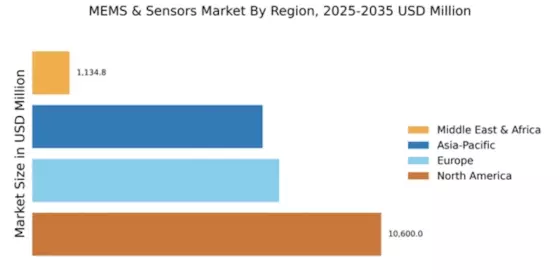
North America is poised to maintain its leadership in the MEMS & Sensors market, holding a significant share of 10600.0 million. The region's growth is driven by robust demand in automotive, healthcare, and consumer electronics sectors. Regulatory support for innovation and technology adoption further catalyzes market expansion. The increasing integration of MEMS in IoT devices and smart technologies is also a key growth driver, enhancing operational efficiencies and user experiences. The competitive landscape in North America is characterized by the presence of major players such as Texas Instruments, Honeywell, and Qualcomm. These companies are investing heavily in R&D to develop advanced MEMS technologies. The U.S. leads the market, followed by Canada, with a strong focus on innovation and sustainability. The region's established supply chain and technological infrastructure provide a solid foundation for continued growth in the MEMS & Sensors sector.

Europe : Emerging Hub for Innovation

Europe, with a market size of 7500.0 million, is emerging as a significant player in the MEMS & Sensors market. The region benefits from strong regulatory frameworks that promote research and development, particularly in automotive and industrial applications. The push for sustainability and energy efficiency is driving demand for MEMS technologies, as they enable smarter and more efficient systems. Additionally, the increasing adoption of MEMS in healthcare devices is contributing to market growth, aligning with the region's focus on health innovation. Leading countries in Europe include Germany, France, and the UK, where companies like Bosch and STMicroelectronics are at the forefront of MEMS technology development. The competitive landscape is marked by collaborations between industry and academia, fostering innovation. The European market is characterized by a diverse range of applications, from automotive sensors to consumer electronics, ensuring a robust growth trajectory in the coming years.

Asia-Pacific : Rapid Growth in Emerging Markets

The Asia-Pacific region, with a market size of 7000.0 million, is witnessing rapid growth in the MEMS & Sensors market, driven by increasing demand from consumer electronics and automotive sectors. Countries like China, Japan, and South Korea are leading this growth, supported by government initiatives aimed at boosting technology adoption. The region's focus on smart cities and IoT applications is further propelling the demand for MEMS technologies, as they play a crucial role in enhancing connectivity and efficiency. The competitive landscape in Asia-Pacific is vibrant, with key players such as Murata Manufacturing and Infineon Technologies leading the charge. The region is characterized by a mix of established companies and startups, fostering innovation and competition. As the demand for advanced sensors and MEMS devices continues to rise, Asia-Pacific is set to become a critical hub for MEMS technology development and deployment.

Middle East and Africa : Emerging Market Potential

The Middle East & Africa region, with a market size of 1134.84 million, presents emerging opportunities in the MEMS & Sensors market. The growth is primarily driven by increasing investments in smart infrastructure and technology adoption across various sectors, including healthcare and automotive. Governments in the region are focusing on diversifying their economies, which is leading to a rise in demand for advanced technologies, including MEMS. The regulatory environment is gradually evolving to support innovation and attract foreign investments. Leading countries in this region include South Africa and the UAE, where there is a growing interest in MEMS applications. The competitive landscape is still developing, with a mix of local and international players entering the market. As the region continues to invest in technology and infrastructure, the MEMS market is expected to grow significantly, providing numerous opportunities for stakeholders.

MEMS & Sensors Market Regional Image

Key Players and Competitive Insights

The MEMS & Sensors Market is currently characterized by a dynamic competitive landscape, driven by rapid technological advancements and increasing demand across various sectors, including automotive, healthcare, and consumer electronics. Key players such as Bosch (DE), Texas Instruments (US), and STMicroelectronics (FR) are strategically positioned to leverage their extensive R&D capabilities and innovative product offerings. Bosch (DE) focuses on enhancing its MEMS technology for automotive applications, while Texas Instruments (US) emphasizes the integration of sensors into its analog and embedded processing solutions. STMicroelectronics (FR) is actively pursuing partnerships to expand its sensor portfolio, particularly in the Internet of Things (IoT) space, thereby shaping a competitive environment that prioritizes innovation and collaboration.In terms of business tactics, companies are increasingly localizing manufacturing to mitigate supply chain disruptions and optimize operational efficiency. The market structure appears moderately fragmented, with several players vying for market share, yet the collective influence of major companies like Honeywell (US) and NXP Semiconductors (NL) is notable. These firms are not only enhancing their product lines but also investing in advanced manufacturing technologies to improve production capabilities and reduce costs.

In November Honeywell (US) announced the launch of a new line of MEMS-based environmental sensors aimed at improving air quality monitoring in urban areas. This strategic move underscores Honeywell's commitment to sustainability and positions the company as a leader in the growing market for environmental monitoring solutions. The introduction of these sensors is expected to enhance data accuracy and reliability, thereby attracting a broader customer base.

In October NXP Semiconductors (NL) unveiled a partnership with a leading automotive manufacturer to develop advanced driver assistance systems (ADAS) utilizing MEMS technology. This collaboration is significant as it not only strengthens NXP's foothold in the automotive sector but also highlights the increasing integration of MEMS sensors in enhancing vehicle safety and performance. The partnership is likely to accelerate the adoption of smart automotive technologies, further driving market growth.

In September STMicroelectronics (FR) expanded its sensor offerings by acquiring a startup specializing in MEMS technology for wearable devices. This acquisition is indicative of STMicroelectronics' strategy to diversify its product portfolio and tap into the burgeoning market for health and fitness applications. By integrating advanced MEMS technology into wearables, STMicroelectronics aims to enhance user experience and capture a larger share of the consumer electronics market.

As of December current competitive trends in the MEMS & Sensors Market are increasingly defined by digitalization, sustainability, and the integration of artificial intelligence (AI). Strategic alliances among key players are shaping the landscape, fostering innovation and enhancing product capabilities. The shift from price-based competition to a focus on technological advancement and supply chain reliability is evident, suggesting that future competitive differentiation will hinge on the ability to innovate and adapt to evolving market demands.

Key Companies in the MEMS & Sensors Market include

Industry Developments

January 2023, Ams OSRAM introduces 0.5Mpixel global shutter CMOS image sensors for wearable and mobile devices to conserve space and electricity.

In August 2022, STMicroelectronics, a family-friendly MEMS manufacturer as well as a major contributor to the global semiconductor market, launched its third generation of MEMS sensors for consumer mobile devices, smart industries, healthcare and retail sectors. Advanced motion and environmental sensors that enable context awareness in today's smartphones and wearables are based on MEMS technology. Output accuracy and power consumption parameters for ST's most recent MEMS sensor generation currently exceed the technical boundaries, providing amazing enhancements.

In April 2022, Bosch Sensortec launched its first-ever capacitive barometric pressure sensor known as BMP581. The energy-efficient barometric is an accurate resource that enhances tracking of altitude within an indoor location and its interception floor US drone automation and navigation applications. The sensor adopts and supports various communication interfaces that include: I2C together with I3C as well as SPI set of digital serial interfaces. Its small size and power consumption make it particularly valuable for smart wearables, wearables and IoT devices.

In March 2022, MG Motors, a subsidiary of SAIC Motor Corp., announced that they wish to invest between USD 350 and USD 500 million in confidential equity within India to meet their future requirements, which include the expansion of their EV fleet. Such changes in the automobiles will further boost the growth of the market under study.

In January 2022, TDK launched the latest in MEMS microphones, that has SoundWire features. The new T5828 MEMS (micro-electromechanical systems) microphone is based on MIPI SoundWire protocol. It encompasses 68dBA SNR (signal-to-noise ratio) and Acoustic activity detection elements with an ultra-low power mode that is always active.

In 2022, Abbott announced its CardioMEMS HF System as a medical device that recently gained more approval from the United States Food and Drug Administration (FDA) to be used in bettering the management of heart failure systems. The broadening of indications enables an additional 1.2 million patients in the United States to use Abbott's sensor, increasing the previously targeted population by a significant amount. 

Future Outlook

MEMS & Sensors Market Future Outlook

The MEMS & Sensors Market is projected to grow at a 16.94% CAGR from 2025 to 2035, driven by advancements in IoT, automotive applications, and healthcare innovations.

New opportunities lie in:

  • Development of smart wearable health monitoring devices
  • Integration of MEMS sensors in autonomous vehicle systems
  • Expansion of MEMS technology in industrial automation solutions

By 2035, the MEMS & Sensors Market is expected to achieve substantial growth and innovation.

Market Segmentation

MEMS & Sensors Market End Use Outlook

  • Smartphones
  • Wearable Devices
  • Home Automation
  • Medical Devices
  • Automotive Systems

MEMS & Sensors Market Technology Outlook

  • Microelectromechanical Systems
  • Microfabrication
  • Nanotechnology
  • Optoelectronics
  • Wireless Technology

MEMS & Sensors Market Application Outlook

  • Consumer Electronics
  • Automotive
  • Industrial
  • Healthcare
  • Aerospace

MEMS & Sensors Market Sensor Type Outlook

  • Pressure Sensors
  • Accelerometers
  • Gyroscopes
  • Temperature Sensors
  • Magnetic Sensors

Report Scope

MARKET SIZE 2024 26634.84(USD Million)
MARKET SIZE 2025 31147.32(USD Million)
MARKET SIZE 2035 148979.59(USD Million)
COMPOUND ANNUAL GROWTH RATE (CAGR) 16.94% (2025 - 2035)
REPORT COVERAGE Revenue Forecast, Competitive Landscape, Growth Factors, and Trends
BASE YEAR 2024
Market Forecast Period 2025 - 2035
Historical Data 2019 - 2024
Market Forecast Units USD Million
Key Companies Profiled Bosch (DE), Texas Instruments (US), STMicroelectronics (FR), Analog Devices (US), Honeywell (US), NXP Semiconductors (NL), Infineon Technologies (DE), Qualcomm (US), Murata Manufacturing (JP)
Segments Covered Application, End Use, Sensor Type, Technology
Key Market Opportunities Integration of advanced artificial intelligence in MEMS & Sensors Market enhances automation and data analytics capabilities.
Key Market Dynamics Technological advancements drive innovation in MEMS and sensors, enhancing applications across diverse industries and consumer electronics.
Countries Covered North America, Europe, APAC, South America, MEA

Market Highlights

Author
Author
Author Profile
Ankit Gupta LinkedIn
Team Lead - Research
Ankit Gupta is a seasoned market intelligence and strategic research professional with over six plus years of experience in the ICT and Semiconductor industries. With academic roots in Telecom, Marketing, and Electronics, he blends technical insight with business strategy. Ankit has led 200+ projects, including work for Fortune 500 clients like Microsoft and Rio Tinto, covering market sizing, tech forecasting, and go-to-market strategies. Known for bridging engineering and enterprise decision-making, his insights support growth, innovation, and investment planning across diverse technology markets.
Leave a Comment

FAQs

What is the projected market valuation for the MEMS & Sensors Market in 2035?

The MEMS & Sensors Market is projected to reach a valuation of 143.29 USD Million by 2035.

What was the market valuation for the MEMS & Sensors Market in 2024?

In 2024, the MEMS & Sensors Market had a valuation of 26.63 USD Million.

What is the expected CAGR for the MEMS & Sensors Market from 2025 to 2035?

The expected CAGR for the MEMS & Sensors Market during the forecast period 2025 - 2035 is 16.69%.

Which application segment had the highest valuation in 2024?

In 2024, the Consumer Electronics application segment had the highest valuation at 42.0 USD Million.

What are the key players in the MEMS & Sensors Market?

Key players in the MEMS & Sensors Market include Bosch, Texas Instruments, STMicroelectronics, and Honeywell.

Which end-use segment is projected to grow the most by 2035?

The Automotive Sensors end-use segment is projected to grow significantly, reaching 30.0 USD Million by 2035.

What was the valuation of the Pressure Sensor type in 2024?

The Pressure Sensor type had a valuation of 6.0 USD Million in 2024.

How does the MEMS Technology segment compare to others in terms of valuation?

The MEMS Technology segment is expected to lead with a valuation of 50.0 USD Million by 2035.

What material segment is anticipated to have the highest growth by 2035?

The Silicon material segment is anticipated to have the highest growth, reaching 50.0 USD Million by 2035.

Which technology segment had the lowest valuation in 2024?

In 2024, the RF Technology segment had the lowest valuation at 3.0 USD Million.
Download Free Sample

Kindly complete the form below to receive a free sample of this Report

Compare Licence

×
Features License Type
Single User Multiuser License Enterprise User
Price $4,950 $5,950 $7,250
Maximum User Access Limit 1 User Upto 10 Users Unrestricted Access Throughout the Organization
Free Customization
Direct Access to Analyst
Deliverable Format
Platform Access
Discount on Next Purchase 10% 15% 15%
Printable Versions