
Request Free Sample ×

Kindly complete the form below to receive a free sample of this Report

* Please use a valid business email

Leading companies partner with us for data-driven Insights

clients tt-cursor
Hero Background
English
Chinese
French
Japanese
Korean
German
Spanish

Semiconductor Wafer Transfer Robots Market Trends

ID: MRFR/SEM/10966-CR
128 Pages
Nirmit Biswas
November 2023

Semiconductor Wafer Transfer Robots Market Size, Share and Research Report By Application (Etching Equipment, Deposition (PVD & CVD), Semiconductor Inspection Equipment, Coater and Developer, Lithography Machine, Cleaning Equipment, Ion Implanter, CMP Equipment, and Others), By Product Type (Atmosphere WTR, and Vacuum WTR), And By Region (North America, Europe, Asia-Pacific, And Rest of The World) –Industry Forecast Till 2035

Share:
Download PDF ×

We do not share your information with anyone. However, we may send you emails based on your report interest from time to time. You may contact us at any time to opt-out.

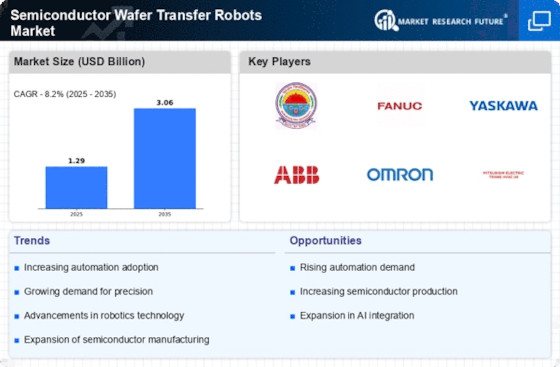
Semiconductor Wafer Transfer Robots Market Infographic
Purchase Options

Market Trends

Key Emerging Trends in the Semiconductor Wafer Transfer Robots Market

Semiconductor Wafer Transfer Robots market is seeing a number of interesting trends which have been playing huge role in redefining the landscape of this eagerly important segment within semiconductor industry. Automation and robotics in semiconductor manufacturing processes are significant cases of notable trend. Due to the ever-increasing trend towards improving precision and overall productivity, semiconductor wafer transfer robots have a critical role in handling sensitive wafers. This as a result, offers high accuracy, reduced human errors, increase yields between these devices as well improve the flow of manufacture.

In addition, there is a rising trend to create advanced wafer transfer robots characterized by increased capacities of wafers The semiconductor industry is migrating to 300mm and 450 mm wafer due to the need for greater efficiency in manufacturing processes as well as increased yield. This transition requires the development and incorporation of wafer transfer robots that can perform for these bigger sizes. As manufacturers are continually working on major developments in the field of automation and robotics, they seek to learn from their peers in order to keep up with customers’ demand increase for higher levels of accuracy, precision and payload dimension.

A distinctive trend that has been observed in the market for Semiconductor Wafer Transfer Robots is smart technologies associated with connectivity like IoT and others. Under Industry 4.0 emergence, semiconductor producers integrate robotics endowed with sensors, artificial intelligence, and real-time interconnectivity discounts. More specifically, these smart robots allow operations to monitor their systems in real-time, utilise predictive maintenance techniques and make data-driven decisions so that efficiency increases together with reducing the downtime periods.

Other growth dynamic that is finding expression in the Semiconductor Wafer Transfer Robots market, which is giving favorable signs of developing into a significant pattern, is energy efficiency. Manufacturers are focusing on developing robots that can operate with minimal power which leads and ties hand in hand with provisions for the needed sustainability initiatives as well as acts in line with the wider industry’s goal of environmental preservation. In this regard, such a trend is particularly important for semiconductor fabrication facilities focused on reducing energy utilization without interfering with maximum productivity levels.

Additionally, the market is growing with cobots, or collaborative robots that are widely used for Wafer handling semiconductor applications. Different from the traditional industrial robots, that work totally alone with their human counterparts and often impede overall operational flexibility, cobots are safe co-working companions of human operators aimed at improving flexibility in operations. In semiconductor manufacturing, especially where high accuracy is important collaborative robot leads to safe human worker interact while also aiming factory machineability.

Increasing demand for semiconductor wafer transfer robots from both the automotive and consumer electronics sector leads to its growth. As these industries are slowly adopting technologies such as electric vehicles, 5G and IoT devices requirement for semiconductor wafers increases which in turn stimulates demand for wafer transfer robots.


Author
Author Profile
Nirmit Biswas
Senior Research Analyst

With 5+ years of expertise in Market Intelligence and Strategic Research, Nirmit Biswas specializes in ICT, Semiconductors, and BFSI. Backed by an MBA in Financial Services and a Computer Science foundation, Nirmit blends technical depth with business acumen. He has successfully led 100+ projects for global enterprises and startups, including Amazon, Cisco, L&T and Huawei, delivering market estimations, competitive benchmarking, and GTM strategies. His focus lies in transforming complex data into clear, actionable insights that drive growth, innovation, and investment decisions. Recognized for bridging engineering innovation with executive strategy, Nirmit helps businesses navigate dynamic markets with confidence.

Leave a Comment

FAQs

What is the projected market valuation for the Semiconductor Wafer Transfer Robots Market in 2035?

<p>The projected market valuation for the Semiconductor Wafer Transfer Robots Market in 2035 is 3.065 USD Billion.</p>

What was the market valuation for the Semiconductor Wafer Transfer Robots Market in 2024?

<p>The market valuation for the Semiconductor Wafer Transfer Robots Market in 2024 was 1.288 USD Billion.</p>

What is the expected CAGR for the Semiconductor Wafer Transfer Robots Market during the forecast period 2025 - 2035?

<p>The expected CAGR for the Semiconductor Wafer Transfer Robots Market during the forecast period 2025 - 2035 is 8.2%.</p>

Which companies are considered key players in the Semiconductor Wafer Transfer Robots Market?

<p>Key players in the Semiconductor Wafer Transfer Robots Market include KUKA, FANUC, Yaskawa Electric, ABB, Omron, Mitsubishi Electric, Applied Materials, Brooks Automation, and SEMI.</p>

What are the main product types in the Semiconductor Wafer Transfer Robots Market?

<p>The main product types in the Semiconductor Wafer Transfer Robots Market are Atmosphere WTR and Vacuum WTR.</p>

What was the market size for Atmosphere WTR in 2024?

<p>The market size for Atmosphere WTR in 2024 was 0.7744 USD Billion.</p>

What is the projected market size for Vacuum WTR by 2035?

The projected market size for Vacuum WTR by 2035 is 1.2725 USD Billion.

How did the market for Etching Equipment perform in 2024?

The market for Etching Equipment was valued at 0.258 USD Billion in 2024.

What is the expected market size for Semiconductor Inspection Equipment in 2035?

The expected market size for Semiconductor Inspection Equipment in 2035 is 0.4 USD Billion.

What segment is projected to show the highest growth in the Semiconductor Wafer Transfer Robots Market?

The segment for Cleaning Equipment is projected to show notable growth, with a market size of 0.23 USD Billion by 2035.

Market Summary

As per Market Research Future analysis, the Semiconductor Wafer Transfer Robots Market was estimated at 1.288 USD Billion in 2024. The Semiconductor Wafer Transfer Robots industry is projected to grow from 1.393 USD Billion in 2025 to 3.065 USD Billion by 2035, exhibiting a compound annual growth rate (CAGR) of 8.2% during the forecast period 2025 - 2035

Key Market Trends & Highlights

The Semiconductor Wafer Transfer Robots Market is poised for substantial growth driven by automation and technological advancements.

  • The market is experiencing increased automation, enhancing operational efficiency across semiconductor manufacturing processes. Integration of AI technologies is becoming prevalent, enabling smarter and more adaptive wafer transfer solutions. North America remains the largest market, while Asia-Pacific is emerging as the fastest-growing region in this sector. Rising demand for semiconductor manufacturing and technological advancements in robotics are key drivers propelling market expansion.

Market Size & Forecast

2024 Market Size 1.288 (USD Billion)
2035 Market Size 3.065 (USD Billion)
CAGR (2025 - 2035) 8.2%
Largest Regional Market Share in 2024 Asia Pacific

Major Players

KUKA (DE), FANUC (JP), Yaskawa Electric (JP), ABB (CH), Omron (JP), Mitsubishi Electric (JP), Applied Materials (US), Brooks Automation (US), SEMI (US)

Market Trends

The Semiconductor Wafer Transfer Robots Market is currently experiencing a notable evolution, driven by advancements in automation and the increasing demand for precision in semiconductor manufacturing. As industries strive for enhanced efficiency, these robots are becoming integral to the production process, facilitating the movement of delicate wafers with minimal risk of damage. The integration of artificial intelligence and machine learning technologies into these systems appears to enhance their operational capabilities, allowing for real-time monitoring and adjustments. This trend suggests a shift towards more intelligent manufacturing environments, where robots not only perform tasks but also learn and adapt to optimize performance. Moreover, the growing emphasis on sustainability within the semiconductor sector is influencing the design and functionality of wafer transfer robots. Manufacturers are increasingly focusing on energy-efficient solutions that reduce waste and lower operational costs. This shift towards eco-friendly practices may lead to innovations in materials and technologies used in robot construction. As the Semiconductor Wafer Transfer Robots Market continues to evolve, it seems poised to play a crucial role in shaping the future of semiconductor production, aligning with broader industry trends towards automation, efficiency, and sustainability.

Increased Automation

The Semiconductor Wafer Transfer Robots Market is witnessing a surge in automation, driven by the need for higher efficiency and reduced human intervention. This trend indicates a growing reliance on robotic systems to handle delicate semiconductor wafers, thereby minimizing the risk of contamination and damage during the manufacturing process.

Integration of AI Technologies

The incorporation of artificial intelligence into wafer transfer robots is becoming increasingly prevalent. This integration allows for enhanced decision-making capabilities, enabling robots to adapt to varying production conditions and optimize their operations in real-time, which could lead to improved overall productivity.

Focus on Sustainability

There is a noticeable shift towards sustainable practices within the Semiconductor Wafer Transfer Robots Market. Manufacturers are prioritizing energy-efficient designs and materials, reflecting a broader industry commitment to reducing environmental impact while maintaining high production standards.

Semiconductor Wafer Transfer Robots Market Market Drivers

Technological Advancements in Robotics

Technological advancements play a crucial role in shaping the Semiconductor Wafer Transfer Robots Market. Innovations in robotics, such as enhanced automation capabilities, improved precision, and the integration of artificial intelligence, are transforming the landscape of semiconductor manufacturing. These advancements enable robots to perform complex tasks with greater efficiency and accuracy, thereby reducing production costs and minimizing errors. The market for industrial robots is projected to grow significantly, with estimates suggesting a compound annual growth rate of over 10% in the coming years. This trend indicates a robust demand for wafer transfer robots that can keep pace with evolving manufacturing requirements.

Increased Focus on Production Efficiency

The Semiconductor Wafer Transfer Robots Market is driven by an increased focus on production efficiency among semiconductor manufacturers. As competition intensifies, companies are seeking ways to optimize their manufacturing processes to reduce costs and enhance output. Wafer transfer robots contribute to this goal by streamlining the handling of wafers, minimizing human intervention, and ensuring consistent quality. Reports indicate that manufacturers utilizing automated systems can achieve up to 30% higher productivity compared to traditional methods. This emphasis on efficiency is likely to propel the adoption of wafer transfer robots, as companies strive to remain competitive in a rapidly evolving market.

Rising Demand for Semiconductor Manufacturing

The Semiconductor Wafer Transfer Robots Market is experiencing a surge in demand due to the increasing need for semiconductor devices across various sectors, including consumer electronics, automotive, and telecommunications. As industries continue to digitize and adopt advanced technologies, the requirement for efficient and precise semiconductor manufacturing processes becomes paramount. This demand is reflected in the projected growth of the semiconductor market, which is expected to reach approximately 600 billion USD by 2025. Consequently, the need for wafer transfer robots, which facilitate the handling and movement of delicate semiconductor wafers, is likely to rise, driving innovation and investment in this sector.

Expansion of Semiconductor Manufacturing Facilities

The expansion of semiconductor manufacturing facilities is a key factor influencing the Semiconductor Wafer Transfer Robots Market. As demand for semiconductor products continues to rise, manufacturers are investing in new facilities and upgrading existing ones to increase production capacity. This trend is evident in various regions, where companies are establishing state-of-the-art fabs equipped with advanced automation technologies. The construction of new semiconductor plants is anticipated to drive the demand for wafer transfer robots, as these facilities require efficient systems for wafer handling and processing. Analysts predict that the number of semiconductor fabs will increase significantly, further bolstering the market for wafer transfer robots.

Growing Investment in Semiconductor Research and Development

Investment in semiconductor research and development is a significant driver for the Semiconductor Wafer Transfer Robots Market. Governments and private entities are increasingly allocating funds to advance semiconductor technologies, which in turn fuels the demand for advanced manufacturing equipment, including wafer transfer robots. The global semiconductor R&D expenditure is projected to exceed 100 billion USD by 2025, reflecting a commitment to innovation and technological advancement. This influx of investment is expected to create opportunities for manufacturers of wafer transfer robots, as they seek to provide solutions that meet the evolving needs of the semiconductor industry.

Market Segment Insights

By Application: Etching Equipment (Largest) vs. Semiconductor Inspection Equipment (Fastest-Growing)

<p>In the Semiconductor Wafer Transfer Robots Market, the application segment showcases a diverse distribution of market share among various equipment types. Etching Equipment holds a substantial portion of the market, driven by its essential role in the semiconductor manufacturing processes. In contrast, segments such as Semiconductor Inspection Equipment are gaining traction, indicating a shift towards quality assurance and performance optimization in production environments. As semiconductor technology advances, the demand for robust wafer handling and processing solutions continues to evolve, further shaping this segment. Growth trends within the application segment are heavily influenced by advancements in semiconductor manufacturing technologies and the increasing complexity of chip designs. The rapid integration of automation and robotics in production lines is also acting as a catalyst for the adoption of wafer transfer robots, particularly in Semiconductor Inspection Equipment, which is witnessing significant growth due to its critical role in ensuring the reliability of semiconductor devices. Manufacturers are focusing on developing cutting-edge solutions that not only enhance performance but also improve efficiency and reduce production costs, driving the market forward.</p>

<p>Etching Equipment (Dominant) vs. Semiconductor Inspection Equipment (Emerging)</p>

<p>Etching Equipment plays a dominant role in the Semiconductor Wafer Transfer Robots Market as it is fundamental to the manufacturing of semiconductor devices. It involves precise material removal processes, making it essential for creating intricate circuit patterns on wafers. This segment benefits from continuous innovation aimed at enhancing accuracy and speed. Conversely, Semiconductor Inspection Equipment is emerging as a vital area in semiconductor production. With the industry's pivot towards higher complexity and miniaturization of devices, the need for rigorous inspection processes has surged. This equipment not only guarantees the integrity of produced wafers but also aligns with increasing regulatory requirements. As manufacturers seek to bolster quality control and minimize defects, the Semiconductor Inspection Equipment segment is expected to expand significantly.</p>

By Product Type: Atmosphere WTR (Largest) vs. Vacuum WTR (Fastest-Growing)

<p>The Semiconductor Wafer Transfer Robots Market showcases a notable market share distribution between the Atmosphere WTR and Vacuum WTR segments. Atmosphere WaTR has established itself as the dominant force in the market, catering to a wide range of semiconductor manufacturing processes. In contrast, Vacuum WTR is steadily gaining traction, appealing to sectors needing precision handling in controlled environments, typically found in advanced manufacturing setups.</p>

<p>Product Type: Atmosphere WTR (Dominant) vs. Vacuum WTR (Emerging)</p>

<p>Atmosphere WTR is the dominant segment, primarily due to its established application in traditional semiconductor fabrication processes where ambient conditions are adequate. Its reliability and adaptability make it a preferred choice among manufacturers. On the other hand, Vacuum WTR is seen as an emerging player, driven by the increasing demand for high-precision transfers in cleanroom environments. This segment is experiencing faster growth due to the surge in advanced technology applications, such as microelectronics and MEMS, where vacuum conditions minimize contamination and enhance yield.</p>

Get more detailed insights about Semiconductor Wafer Transfer Robots Market Research Report – Forecast till 2035

Regional Insights

North America : Innovation and Leadership Hub

North America is the largest market for semiconductor wafer transfer robots, holding approximately 45% of the global market share. The region benefits from a robust technological infrastructure, significant investments in R&D, and a strong presence of leading manufacturers. Regulatory support for advanced manufacturing technologies further drives demand, particularly in states like California and Texas, which are home to major semiconductor firms. The competitive landscape is characterized by key players such as Applied Materials, Brooks Automation, and KUKA. The U.S. government’s initiatives to bolster domestic semiconductor production, including the CHIPS Act, are expected to enhance market growth. Additionally, Canada is emerging as a significant player, focusing on innovation and sustainability in semiconductor manufacturing, contributing to the region's overall market strength.

Europe : Emerging Semiconductor Powerhouse

Europe is witnessing a surge in the semiconductor wafer transfer robots market, accounting for approximately 30% of the global share. The region's growth is fueled by increasing demand for automation in manufacturing processes and supportive government policies aimed at enhancing semiconductor production capabilities. Countries like Germany and France are leading this growth, with initiatives to strengthen local supply chains and reduce dependency on imports. Germany stands out as a key player, hosting major manufacturers like KUKA and ABB. The competitive landscape is evolving, with a focus on sustainability and energy efficiency. The European Union's commitment to investing in semiconductor technology, as outlined in the European Chips Act, is expected to further stimulate market growth and innovation in the region.

Asia-Pacific : Manufacturing and Innovation Hub

Asia-Pacific is the second-largest market for semiconductor wafer transfer robots, holding around 25% of the global market share. The region's growth is driven by the rapid expansion of semiconductor manufacturing in countries like China, Japan, and South Korea. Government initiatives to promote advanced manufacturing technologies and significant investments in automation are key factors contributing to this growth, particularly in the context of increasing demand for consumer electronics. China is the largest market within the region, with substantial investments in semiconductor production facilities. Japan and South Korea are also significant players, with companies like FANUC and Yaskawa Electric leading the competitive landscape. The presence of these key players, along with a focus on innovation and efficiency, positions Asia-Pacific as a critical region for the future of semiconductor wafer transfer robots.

Middle East and Africa : Emerging Market Potential

The Middle East and Africa region is gradually emerging in the semiconductor wafer transfer robots market, currently holding about 5% of the global share. The growth is primarily driven by increasing investments in technology and infrastructure, particularly in countries like Israel and the UAE. Government initiatives aimed at diversifying economies and promoting high-tech industries are also contributing to market development, albeit at a slower pace compared to other regions. Israel is leading the charge with its advanced technology sector, while the UAE is making strides in establishing itself as a tech hub. The competitive landscape is still developing, with opportunities for international players to enter the market. As local industries grow and demand for automation increases, the region is expected to see significant advancements in semiconductor manufacturing technologies.

Key Players and Competitive Insights

Leading market players are investing heavily in research and development to expand their product lines, which will help the Semiconductor Wafer Transfer Robots Market, grow even more. Market participants are also undertaking a variety of strategic activities to expand their global footprint, with important market developments including new product launches, contractual agreements, mergers and acquisitions, higher investments, and collaboration with other organizations. To expand and survive in a more competitive and rising market climate, the Semiconductor Wafer Transfer Robots industry must offer cost-effective items.
Manufacturing locally to minimize operational costs is one of the key business tactics used by manufacturers in the global Semiconductor Wafer Transfer Robots industry to benefit clients and increase the market sector. In recent years, the Semiconductor Wafer Transfer Robots industry has offered some of the most significant advantages to the power grid and energy infrastructure.
Major players in the Semiconductor Wafer Transfer Robots Market, including Kawasaki Robotics, RORZE Corporation, Brooks Automation, DAIHEN Corporation, Hirata Corporation, Yaskawa, Nidec (Genmark Automation), JEL Corporation, Shibaura Machine, Robostar, Robots and Design (RND), HYULIM Robot, RAONTEC Inc, KORO, Tazmo, Rexxam Co Ltd, ULVAC, Kensington Laboratories, EPSON Robots, Hine Automation, Moog Inc, Innovative Robotics, Staubli, isel Germany AG, Sanwa Engineering Corporation, Siasun Robot & Automation, HIWIN TECHNOLOGIES, and He-Five LLC. are attempting to increase market demand by investing in research and development operations.
Yaskawa is a global manufacturer and supplier of a wide range of products, including AC drives, controllers, robots, and servo motors. Their product offerings encompass AC drives for various applications, medium-voltage AC drives, and power regenerative units used in diverse industries such as manufacturing, logistics, and steel plants. They also provide a suite of industrial electrical products for steel-making and other industrial facilities, along with servo motors, machine controllers, and vision systems for applications in chip mounters, robotic systems, and metalworking machinery. Yaskawa has a strong international presence, serving markets in the Americas, Europe, Asia-Pacific, the Middle East, and Africa.
The company is headquartered in Kitakyushu, Fukuoka, Japan.
Nidec is a prominent electric motor manufacturer known for its diverse product range, which encompasses small precision motors, motors for home appliances, commercial and industrial applications, automotive systems, machinery, and electronic components, among others. Their portfolio includes motors of varying sizes, from small and precise ones to medium and large-scale variants. Nidec's motors find applications in a wide array of industries, including information technology, telecommunications, home appliances, automobiles, office equipment, industrial machinery, and clean energy solutions. With a global presence and manufacturing facilities worldwide, Nidec operates in North America, the Asia Pacific region, Europe, and other key markets.
The company's headquarters are situated in Minami-ku, Kyoto, Japan.

Key Companies in the Semiconductor Wafer Transfer Robots Market include

Industry Developments

May 2023: Purdue University entered into a significant contract with the leadership of the India Semiconductor Mission, marking a noteworthy international collaboration. This agreement followed another substantial partnership announced earlier in the month, involving Purdue, the state of Indiana, and the Indiana Economic Development Corporation, in conjunction with imec, a Belgian organization. Purdue's proactive efforts to address urgent national semiconductor requirements have also been evident in recent initiatives.

February 2023: The US Semiconductor Industry Association (SIA) and the India Electronics and Semiconductor Association (IESA) announced their intention to enhance public-private cooperation within the semiconductor ecosystem by establishing a private-sector task force. This strategic move aims to reinforce collaboration between the two nations in the global semiconductor industry. Notably, this collaboration builds upon an MOU signed in April 2022, which sought to promote cooperation and identify potential business opportunities in the semiconductor sector between the United States and India.

Future Outlook

Semiconductor Wafer Transfer Robots Market Future Outlook

The Semiconductor Wafer Transfer Robots Market is projected to grow at an 8.2% CAGR from 2025 to 2035, driven by advancements in automation, increased semiconductor demand, and technological innovations.

New opportunities lie in:

  • Integration of AI-driven predictive maintenance solutions
  • Development of modular robotic systems for flexible manufacturing
  • Expansion into emerging markets with tailored automation solutions

By 2035, the market is expected to achieve robust growth, solidifying its position as a critical component in semiconductor manufacturing.

Market Segmentation

Semiconductor Wafer Transfer Robots Market Application Outlook

  • Etching Equipment
  • Deposition (PVD & CVD)
  • Semiconductor Inspection Equipment
  • Coater and Developer
  • Lithography Machine
  • Cleaning Equipment
  • Ion Implanter
  • CMP Equipment
  • Others

Semiconductor Wafer Transfer Robots Market Product Type Outlook

  • Atmosphere WTR
  • Vacuum WTR

Report Scope

MARKET SIZE 2024 1.288(USD Billion)
MARKET SIZE 2025 1.393(USD Billion)
MARKET SIZE 2035 3.065(USD Billion)
COMPOUND ANNUAL GROWTH RATE (CAGR) 8.2% (2025 - 2035)
REPORT COVERAGE Revenue Forecast, Competitive Landscape, Growth Factors, and Trends
BASE YEAR 2024
Market Forecast Period 2025 - 2035
Historical Data 2019 - 2024
Market Forecast Units USD Billion
Key Companies Profiled KUKA (DE), FANUC (JP), Yaskawa Electric (JP), ABB (CH), Omron (JP), Mitsubishi Electric (JP), Applied Materials (US), Brooks Automation (US), SEMI (US)
Segments Covered Application, Product Type, Region
Key Market Opportunities Integration of artificial intelligence in Semiconductor Wafer Transfer Robots enhances efficiency and precision in manufacturing processes.
Key Market Dynamics Rising demand for automation in semiconductor manufacturing drives innovation in wafer transfer robot technologies.
Countries Covered North America, Europe, APAC, South America, MEA

FAQs

What is the projected market valuation for the Semiconductor Wafer Transfer Robots Market in 2035?

<p>The projected market valuation for the Semiconductor Wafer Transfer Robots Market in 2035 is 3.065 USD Billion.</p>

What was the market valuation for the Semiconductor Wafer Transfer Robots Market in 2024?

<p>The market valuation for the Semiconductor Wafer Transfer Robots Market in 2024 was 1.288 USD Billion.</p>

What is the expected CAGR for the Semiconductor Wafer Transfer Robots Market during the forecast period 2025 - 2035?

<p>The expected CAGR for the Semiconductor Wafer Transfer Robots Market during the forecast period 2025 - 2035 is 8.2%.</p>

Which companies are considered key players in the Semiconductor Wafer Transfer Robots Market?

<p>Key players in the Semiconductor Wafer Transfer Robots Market include KUKA, FANUC, Yaskawa Electric, ABB, Omron, Mitsubishi Electric, Applied Materials, Brooks Automation, and SEMI.</p>

What are the main product types in the Semiconductor Wafer Transfer Robots Market?

<p>The main product types in the Semiconductor Wafer Transfer Robots Market are Atmosphere WTR and Vacuum WTR.</p>

What was the market size for Atmosphere WTR in 2024?

<p>The market size for Atmosphere WTR in 2024 was 0.7744 USD Billion.</p>

What is the projected market size for Vacuum WTR by 2035?

The projected market size for Vacuum WTR by 2035 is 1.2725 USD Billion.

How did the market for Etching Equipment perform in 2024?

The market for Etching Equipment was valued at 0.258 USD Billion in 2024.

What is the expected market size for Semiconductor Inspection Equipment in 2035?

The expected market size for Semiconductor Inspection Equipment in 2035 is 0.4 USD Billion.

What segment is projected to show the highest growth in the Semiconductor Wafer Transfer Robots Market?

The segment for Cleaning Equipment is projected to show notable growth, with a market size of 0.23 USD Billion by 2035.

  1. SECTION I: EXECUTIVE SUMMARY AND KEY HIGHLIGHTS
    1. | 1.1 EXECUTIVE SUMMARY
    2. | | 1.1.1 Market Overview
    3. | | 1.1.2 Key Findings
    4. | | 1.1.3 Market Segmentation
    5. | | 1.1.4 Competitive Landscape
    6. | | 1.1.5 Challenges and Opportunities
    7. | | 1.1.6 Future Outlook
  2. SECTION II: SCOPING, METHODOLOGY AND MARKET STRUCTURE
    1. | 2.1 MARKET INTRODUCTION
    2. | | 2.1.1 Definition
    3. | | 2.1.2 Scope of the study
    4. | | | 2.1.2.1 Research Objective
    5. | | | 2.1.2.2 Assumption
    6. | | | 2.1.2.3 Limitations
    7. | 2.2 RESEARCH METHODOLOGY
    8. | | 2.2.1 Overview
    9. | | 2.2.2 Data Mining
    10. | | 2.2.3 Secondary Research
    11. | | 2.2.4 Primary Research
    12. | | | 2.2.4.1 Primary Interviews and Information Gathering Process
    13. | | | 2.2.4.2 Breakdown of Primary Respondents
    14. | | 2.2.5 Forecasting Model
    15. | | 2.2.6 Market Size Estimation
    16. | | | 2.2.6.1 Bottom-Up Approach
    17. | | | 2.2.6.2 Top-Down Approach
    18. | | 2.2.7 Data Triangulation
    19. | | 2.2.8 Validation
  3. SECTION III: QUALITATIVE ANALYSIS
    1. | 3.1 MARKET DYNAMICS
    2. | | 3.1.1 Overview
    3. | | 3.1.2 Drivers
    4. | | 3.1.3 Restraints
    5. | | 3.1.4 Opportunities
    6. | 3.2 MARKET FACTOR ANALYSIS
    7. | | 3.2.1 Value chain Analysis
    8. | | 3.2.2 Porter's Five Forces Analysis
    9. | | | 3.2.2.1 Bargaining Power of Suppliers
    10. | | | 3.2.2.2 Bargaining Power of Buyers
    11. | | | 3.2.2.3 Threat of New Entrants
    12. | | | 3.2.2.4 Threat of Substitutes
    13. | | | 3.2.2.5 Intensity of Rivalry
    14. | | 3.2.3 COVID-19 Impact Analysis
    15. | | | 3.2.3.1 Market Impact Analysis
    16. | | | 3.2.3.2 Regional Impact
    17. | | | 3.2.3.3 Opportunity and Threat Analysis
  4. SECTION IV: QUANTITATIVE ANALYSIS
    1. | 4.1 Semiconductor & Electronics, BY Application (USD Billion)
    2. | | 4.1.1 Etching Equipment
    3. | | 4.1.2 Deposition (PVD & CVD)
    4. | | 4.1.3 Semiconductor Inspection Equipment
    5. | | 4.1.4 Coater and Developer
    6. | | 4.1.5 Lithography Machine
    7. | | 4.1.6 Cleaning Equipment
    8. | | 4.1.7 Ion Implanter
    9. | | 4.1.8 CMP Equipment
    10. | | 4.1.9 Others
    11. | 4.2 Semiconductor & Electronics, BY Product Type (USD Billion)
    12. | | 4.2.1 Atmosphere WTR
    13. | | 4.2.2 Vacuum WTR
    14. | 4.3 Semiconductor & Electronics, BY Region (USD Billion)
    15. | | 4.3.1 North America
    16. | | | 4.3.1.1 US
    17. | | | 4.3.1.2 Canada
    18. | | 4.3.2 Europe
    19. | | | 4.3.2.1 Germany
    20. | | | 4.3.2.2 UK
    21. | | | 4.3.2.3 France
    22. | | | 4.3.2.4 Russia
    23. | | | 4.3.2.5 Italy
    24. | | | 4.3.2.6 Spain
    25. | | | 4.3.2.7 Rest of Europe
    26. | | 4.3.3 APAC
    27. | | | 4.3.3.1 China
    28. | | | 4.3.3.2 India
    29. | | | 4.3.3.3 Japan
    30. | | | 4.3.3.4 South Korea
    31. | | | 4.3.3.5 Malaysia
    32. | | | 4.3.3.6 Thailand
    33. | | | 4.3.3.7 Indonesia
    34. | | | 4.3.3.8 Rest of APAC
    35. | | 4.3.4 South America
    36. | | | 4.3.4.1 Brazil
    37. | | | 4.3.4.2 Mexico
    38. | | | 4.3.4.3 Argentina
    39. | | | 4.3.4.4 Rest of South America
    40. | | 4.3.5 MEA
    41. | | | 4.3.5.1 GCC Countries
    42. | | | 4.3.5.2 South Africa
    43. | | | 4.3.5.3 Rest of MEA
  5. SECTION V: COMPETITIVE ANALYSIS
    1. | 5.1 Competitive Landscape
    2. | | 5.1.1 Overview
    3. | | 5.1.2 Competitive Analysis
    4. | | 5.1.3 Market share Analysis
    5. | | 5.1.4 Major Growth Strategy in the Semiconductor & Electronics
    6. | | 5.1.5 Competitive Benchmarking
    7. | | 5.1.6 Leading Players in Terms of Number of Developments in the Semiconductor & Electronics
    8. | | 5.1.7 Key developments and growth strategies
    9. | | | 5.1.7.1 New Product Launch/Service Deployment
    10. | | | 5.1.7.2 Merger & Acquisitions
    11. | | | 5.1.7.3 Joint Ventures
    12. | | 5.1.8 Major Players Financial Matrix
    13. | | | 5.1.8.1 Sales and Operating Income
    14. | | | 5.1.8.2 Major Players R&D Expenditure. 2023
    15. | 5.2 Company Profiles
    16. | | 5.2.1 KUKA (DE)
    17. | | | 5.2.1.1 Financial Overview
    18. | | | 5.2.1.2 Products Offered
    19. | | | 5.2.1.3 Key Developments
    20. | | | 5.2.1.4 SWOT Analysis
    21. | | | 5.2.1.5 Key Strategies
    22. | | 5.2.2 FANUC (JP)
    23. | | | 5.2.2.1 Financial Overview
    24. | | | 5.2.2.2 Products Offered
    25. | | | 5.2.2.3 Key Developments
    26. | | | 5.2.2.4 SWOT Analysis
    27. | | | 5.2.2.5 Key Strategies
    28. | | 5.2.3 Yaskawa Electric (JP)
    29. | | | 5.2.3.1 Financial Overview
    30. | | | 5.2.3.2 Products Offered
    31. | | | 5.2.3.3 Key Developments
    32. | | | 5.2.3.4 SWOT Analysis
    33. | | | 5.2.3.5 Key Strategies
    34. | | 5.2.4 ABB (CH)
    35. | | | 5.2.4.1 Financial Overview
    36. | | | 5.2.4.2 Products Offered
    37. | | | 5.2.4.3 Key Developments
    38. | | | 5.2.4.4 SWOT Analysis
    39. | | | 5.2.4.5 Key Strategies
    40. | | 5.2.5 Omron (JP)
    41. | | | 5.2.5.1 Financial Overview
    42. | | | 5.2.5.2 Products Offered
    43. | | | 5.2.5.3 Key Developments
    44. | | | 5.2.5.4 SWOT Analysis
    45. | | | 5.2.5.5 Key Strategies
    46. | | 5.2.6 Mitsubishi Electric (JP)
    47. | | | 5.2.6.1 Financial Overview
    48. | | | 5.2.6.2 Products Offered
    49. | | | 5.2.6.3 Key Developments
    50. | | | 5.2.6.4 SWOT Analysis
    51. | | | 5.2.6.5 Key Strategies
    52. | | 5.2.7 Applied Materials (US)
    53. | | | 5.2.7.1 Financial Overview
    54. | | | 5.2.7.2 Products Offered
    55. | | | 5.2.7.3 Key Developments
    56. | | | 5.2.7.4 SWOT Analysis
    57. | | | 5.2.7.5 Key Strategies
    58. | | 5.2.8 Brooks Automation (US)
    59. | | | 5.2.8.1 Financial Overview
    60. | | | 5.2.8.2 Products Offered
    61. | | | 5.2.8.3 Key Developments
    62. | | | 5.2.8.4 SWOT Analysis
    63. | | | 5.2.8.5 Key Strategies
    64. | | 5.2.9 SEMI (US)
    65. | | | 5.2.9.1 Financial Overview
    66. | | | 5.2.9.2 Products Offered
    67. | | | 5.2.9.3 Key Developments
    68. | | | 5.2.9.4 SWOT Analysis
    69. | | | 5.2.9.5 Key Strategies
    70. | 5.3 Appendix
    71. | | 5.3.1 References
    72. | | 5.3.2 Related Reports
  6. LIST OF FIGURES
    1. | 6.1 MARKET SYNOPSIS
    2. | 6.2 NORTH AMERICA MARKET ANALYSIS
    3. | 6.3 US MARKET ANALYSIS BY APPLICATION
    4. | 6.4 US MARKET ANALYSIS BY PRODUCT TYPE
    5. | 6.5 CANADA MARKET ANALYSIS BY APPLICATION
    6. | 6.6 CANADA MARKET ANALYSIS BY PRODUCT TYPE
    7. | 6.7 EUROPE MARKET ANALYSIS
    8. | 6.8 GERMANY MARKET ANALYSIS BY APPLICATION
    9. | 6.9 GERMANY MARKET ANALYSIS BY PRODUCT TYPE
    10. | 6.10 UK MARKET ANALYSIS BY APPLICATION
    11. | 6.11 UK MARKET ANALYSIS BY PRODUCT TYPE
    12. | 6.12 FRANCE MARKET ANALYSIS BY APPLICATION
    13. | 6.13 FRANCE MARKET ANALYSIS BY PRODUCT TYPE
    14. | 6.14 RUSSIA MARKET ANALYSIS BY APPLICATION
    15. | 6.15 RUSSIA MARKET ANALYSIS BY PRODUCT TYPE
    16. | 6.16 ITALY MARKET ANALYSIS BY APPLICATION
    17. | 6.17 ITALY MARKET ANALYSIS BY PRODUCT TYPE
    18. | 6.18 SPAIN MARKET ANALYSIS BY APPLICATION
    19. | 6.19 SPAIN MARKET ANALYSIS BY PRODUCT TYPE
    20. | 6.20 REST OF EUROPE MARKET ANALYSIS BY APPLICATION
    21. | 6.21 REST OF EUROPE MARKET ANALYSIS BY PRODUCT TYPE
    22. | 6.22 APAC MARKET ANALYSIS
    23. | 6.23 CHINA MARKET ANALYSIS BY APPLICATION
    24. | 6.24 CHINA MARKET ANALYSIS BY PRODUCT TYPE
    25. | 6.25 INDIA MARKET ANALYSIS BY APPLICATION
    26. | 6.26 INDIA MARKET ANALYSIS BY PRODUCT TYPE
    27. | 6.27 JAPAN MARKET ANALYSIS BY APPLICATION
    28. | 6.28 JAPAN MARKET ANALYSIS BY PRODUCT TYPE
    29. | 6.29 SOUTH KOREA MARKET ANALYSIS BY APPLICATION
    30. | 6.30 SOUTH KOREA MARKET ANALYSIS BY PRODUCT TYPE
    31. | 6.31 MALAYSIA MARKET ANALYSIS BY APPLICATION
    32. | 6.32 MALAYSIA MARKET ANALYSIS BY PRODUCT TYPE
    33. | 6.33 THAILAND MARKET ANALYSIS BY APPLICATION
    34. | 6.34 THAILAND MARKET ANALYSIS BY PRODUCT TYPE
    35. | 6.35 INDONESIA MARKET ANALYSIS BY APPLICATION
    36. | 6.36 INDONESIA MARKET ANALYSIS BY PRODUCT TYPE
    37. | 6.37 REST OF APAC MARKET ANALYSIS BY APPLICATION
    38. | 6.38 REST OF APAC MARKET ANALYSIS BY PRODUCT TYPE
    39. | 6.39 SOUTH AMERICA MARKET ANALYSIS
    40. | 6.40 BRAZIL MARKET ANALYSIS BY APPLICATION
    41. | 6.41 BRAZIL MARKET ANALYSIS BY PRODUCT TYPE
    42. | 6.42 MEXICO MARKET ANALYSIS BY APPLICATION
    43. | 6.43 MEXICO MARKET ANALYSIS BY PRODUCT TYPE
    44. | 6.44 ARGENTINA MARKET ANALYSIS BY APPLICATION
    45. | 6.45 ARGENTINA MARKET ANALYSIS BY PRODUCT TYPE
    46. | 6.46 REST OF SOUTH AMERICA MARKET ANALYSIS BY APPLICATION
    47. | 6.47 REST OF SOUTH AMERICA MARKET ANALYSIS BY PRODUCT TYPE
    48. | 6.48 MEA MARKET ANALYSIS
    49. | 6.49 GCC COUNTRIES MARKET ANALYSIS BY APPLICATION
    50. | 6.50 GCC COUNTRIES MARKET ANALYSIS BY PRODUCT TYPE
    51. | 6.51 SOUTH AFRICA MARKET ANALYSIS BY APPLICATION
    52. | 6.52 SOUTH AFRICA MARKET ANALYSIS BY PRODUCT TYPE
    53. | 6.53 REST OF MEA MARKET ANALYSIS BY APPLICATION
    54. | 6.54 REST OF MEA MARKET ANALYSIS BY PRODUCT TYPE
    55. | 6.55 KEY BUYING CRITERIA OF SEMICONDUCTOR & ELECTRONICS
    56. | 6.56 RESEARCH PROCESS OF MRFR
    57. | 6.57 DRO ANALYSIS OF SEMICONDUCTOR & ELECTRONICS
    58. | 6.58 DRIVERS IMPACT ANALYSIS: SEMICONDUCTOR & ELECTRONICS
    59. | 6.59 RESTRAINTS IMPACT ANALYSIS: SEMICONDUCTOR & ELECTRONICS
    60. | 6.60 SUPPLY / VALUE CHAIN: SEMICONDUCTOR & ELECTRONICS
    61. | 6.61 SEMICONDUCTOR & ELECTRONICS, BY APPLICATION, 2024 (% SHARE)
    62. | 6.62 SEMICONDUCTOR & ELECTRONICS, BY APPLICATION, 2024 TO 2035 (USD Billion)
    63. | 6.63 SEMICONDUCTOR & ELECTRONICS, BY PRODUCT TYPE, 2024 (% SHARE)
    64. | 6.64 SEMICONDUCTOR & ELECTRONICS, BY PRODUCT TYPE, 2024 TO 2035 (USD Billion)
    65. | 6.65 BENCHMARKING OF MAJOR COMPETITORS
  7. LIST OF TABLES
    1. | 7.1 LIST OF ASSUMPTIONS
    2. | | 7.1.1
    3. | 7.2 North America MARKET SIZE ESTIMATES; FORECAST
    4. | | 7.2.1 BY APPLICATION, 2025-2035 (USD Billion)
    5. | | 7.2.2 BY PRODUCT TYPE, 2025-2035 (USD Billion)
    6. | 7.3 US MARKET SIZE ESTIMATES; FORECAST
    7. | | 7.3.1 BY APPLICATION, 2025-2035 (USD Billion)
    8. | | 7.3.2 BY PRODUCT TYPE, 2025-2035 (USD Billion)
    9. | 7.4 Canada MARKET SIZE ESTIMATES; FORECAST
    10. | | 7.4.1 BY APPLICATION, 2025-2035 (USD Billion)
    11. | | 7.4.2 BY PRODUCT TYPE, 2025-2035 (USD Billion)
    12. | 7.5 Europe MARKET SIZE ESTIMATES; FORECAST
    13. | | 7.5.1 BY APPLICATION, 2025-2035 (USD Billion)
    14. | | 7.5.2 BY PRODUCT TYPE, 2025-2035 (USD Billion)
    15. | 7.6 Germany MARKET SIZE ESTIMATES; FORECAST
    16. | | 7.6.1 BY APPLICATION, 2025-2035 (USD Billion)
    17. | | 7.6.2 BY PRODUCT TYPE, 2025-2035 (USD Billion)
    18. | 7.7 UK MARKET SIZE ESTIMATES; FORECAST
    19. | | 7.7.1 BY APPLICATION, 2025-2035 (USD Billion)
    20. | | 7.7.2 BY PRODUCT TYPE, 2025-2035 (USD Billion)
    21. | 7.8 France MARKET SIZE ESTIMATES; FORECAST
    22. | | 7.8.1 BY APPLICATION, 2025-2035 (USD Billion)
    23. | | 7.8.2 BY PRODUCT TYPE, 2025-2035 (USD Billion)
    24. | 7.9 Russia MARKET SIZE ESTIMATES; FORECAST
    25. | | 7.9.1 BY APPLICATION, 2025-2035 (USD Billion)
    26. | | 7.9.2 BY PRODUCT TYPE, 2025-2035 (USD Billion)
    27. | 7.10 Italy MARKET SIZE ESTIMATES; FORECAST
    28. | | 7.10.1 BY APPLICATION, 2025-2035 (USD Billion)
    29. | | 7.10.2 BY PRODUCT TYPE, 2025-2035 (USD Billion)
    30. | 7.11 Spain MARKET SIZE ESTIMATES; FORECAST
    31. | | 7.11.1 BY APPLICATION, 2025-2035 (USD Billion)
    32. | | 7.11.2 BY PRODUCT TYPE, 2025-2035 (USD Billion)
    33. | 7.12 Rest of Europe MARKET SIZE ESTIMATES; FORECAST
    34. | | 7.12.1 BY APPLICATION, 2025-2035 (USD Billion)
    35. | | 7.12.2 BY PRODUCT TYPE, 2025-2035 (USD Billion)
    36. | 7.13 APAC MARKET SIZE ESTIMATES; FORECAST
    37. | | 7.13.1 BY APPLICATION, 2025-2035 (USD Billion)
    38. | | 7.13.2 BY PRODUCT TYPE, 2025-2035 (USD Billion)
    39. | 7.14 China MARKET SIZE ESTIMATES; FORECAST
    40. | | 7.14.1 BY APPLICATION, 2025-2035 (USD Billion)
    41. | | 7.14.2 BY PRODUCT TYPE, 2025-2035 (USD Billion)
    42. | 7.15 India MARKET SIZE ESTIMATES; FORECAST
    43. | | 7.15.1 BY APPLICATION, 2025-2035 (USD Billion)
    44. | | 7.15.2 BY PRODUCT TYPE, 2025-2035 (USD Billion)
    45. | 7.16 Japan MARKET SIZE ESTIMATES; FORECAST
    46. | | 7.16.1 BY APPLICATION, 2025-2035 (USD Billion)
    47. | | 7.16.2 BY PRODUCT TYPE, 2025-2035 (USD Billion)
    48. | 7.17 South Korea MARKET SIZE ESTIMATES; FORECAST
    49. | | 7.17.1 BY APPLICATION, 2025-2035 (USD Billion)
    50. | | 7.17.2 BY PRODUCT TYPE, 2025-2035 (USD Billion)
    51. | 7.18 Malaysia MARKET SIZE ESTIMATES; FORECAST
    52. | | 7.18.1 BY APPLICATION, 2025-2035 (USD Billion)
    53. | | 7.18.2 BY PRODUCT TYPE, 2025-2035 (USD Billion)
    54. | 7.19 Thailand MARKET SIZE ESTIMATES; FORECAST
    55. | | 7.19.1 BY APPLICATION, 2025-2035 (USD Billion)
    56. | | 7.19.2 BY PRODUCT TYPE, 2025-2035 (USD Billion)
    57. | 7.20 Indonesia MARKET SIZE ESTIMATES; FORECAST
    58. | | 7.20.1 BY APPLICATION, 2025-2035 (USD Billion)
    59. | | 7.20.2 BY PRODUCT TYPE, 2025-2035 (USD Billion)
    60. | 7.21 Rest of APAC MARKET SIZE ESTIMATES; FORECAST
    61. | | 7.21.1 BY APPLICATION, 2025-2035 (USD Billion)
    62. | | 7.21.2 BY PRODUCT TYPE, 2025-2035 (USD Billion)
    63. | 7.22 South America MARKET SIZE ESTIMATES; FORECAST
    64. | | 7.22.1 BY APPLICATION, 2025-2035 (USD Billion)
    65. | | 7.22.2 BY PRODUCT TYPE, 2025-2035 (USD Billion)
    66. | 7.23 Brazil MARKET SIZE ESTIMATES; FORECAST
    67. | | 7.23.1 BY APPLICATION, 2025-2035 (USD Billion)
    68. | | 7.23.2 BY PRODUCT TYPE, 2025-2035 (USD Billion)
    69. | 7.24 Mexico MARKET SIZE ESTIMATES; FORECAST
    70. | | 7.24.1 BY APPLICATION, 2025-2035 (USD Billion)
    71. | | 7.24.2 BY PRODUCT TYPE, 2025-2035 (USD Billion)
    72. | 7.25 Argentina MARKET SIZE ESTIMATES; FORECAST
    73. | | 7.25.1 BY APPLICATION, 2025-2035 (USD Billion)
    74. | | 7.25.2 BY PRODUCT TYPE, 2025-2035 (USD Billion)
    75. | 7.26 Rest of South America MARKET SIZE ESTIMATES; FORECAST
    76. | | 7.26.1 BY APPLICATION, 2025-2035 (USD Billion)
    77. | | 7.26.2 BY PRODUCT TYPE, 2025-2035 (USD Billion)
    78. | 7.27 MEA MARKET SIZE ESTIMATES; FORECAST
    79. | | 7.27.1 BY APPLICATION, 2025-2035 (USD Billion)
    80. | | 7.27.2 BY PRODUCT TYPE, 2025-2035 (USD Billion)
    81. | 7.28 GCC Countries MARKET SIZE ESTIMATES; FORECAST
    82. | | 7.28.1 BY APPLICATION, 2025-2035 (USD Billion)
    83. | | 7.28.2 BY PRODUCT TYPE, 2025-2035 (USD Billion)
    84. | 7.29 South Africa MARKET SIZE ESTIMATES; FORECAST
    85. | | 7.29.1 BY APPLICATION, 2025-2035 (USD Billion)
    86. | | 7.29.2 BY PRODUCT TYPE, 2025-2035 (USD Billion)
    87. | 7.30 Rest of MEA MARKET SIZE ESTIMATES; FORECAST
    88. | | 7.30.1 BY APPLICATION, 2025-2035 (USD Billion)
    89. | | 7.30.2 BY PRODUCT TYPE, 2025-2035 (USD Billion)
    90. | 7.31 PRODUCT LAUNCH/PRODUCT DEVELOPMENT/APPROVAL
    91. | | 7.31.1
    92. | 7.32 ACQUISITION/PARTNERSHIP
    93. | | 7.32.1

Semiconductor & Electronics Market Segmentation

Semiconductor & Electronics By Application (USD Billion, 2025-2035)

  • Etching Equipment
  • Deposition (PVD & CVD)
  • Semiconductor Inspection Equipment
  • Coater and Developer
  • Lithography Machine
  • Cleaning Equipment
  • Ion Implanter
  • CMP Equipment
  • Others

Semiconductor & Electronics By Product Type (USD Billion, 2025-2035)

  • Atmosphere WTR
  • Vacuum WTR
Infographic

Free Sample Request

Kindly complete the form below to receive a free sample of this Report

Get Free Sample

Customer Strories

Compare Licence

×
Features License Type
Single User Multiuser License Enterprise User
Price $4,950 $5,950 $7,250
Maximum User Access Limit 1 User Upto 10 Users Unrestricted Access Throughout the Organization
Free Customization
Direct Access to Analyst
Deliverable Format
Platform Access
Discount on Next Purchase 10% 15% 15%
Printable Versions