×
Hero Background
English
Chinese
French
Japanese
Korean
German
Spanish

Semiconductor Bonding Market Trends

ID: MRFR/SEM/9254-HCR
141 Pages
Shubham Munde
October 2025

Semiconductor Bonding Market Research Report Information By on Process Type Type (Die-To-Die Bonding, Die-To-Wafer Bonding, and Wafer-To-Wafer Bonding), By on Technology (Die Bonding, Epoxy Die Bonding, Eutectic Die Bonding, Flip-chip Attachment, and Hybrid Bonding), And By Region (North America, Europe, Asia-Pacific, And Rest Of The World) – Market Forecast Till 2035.

Share:
Download PDF ×

We do not share your information with anyone. However, we may send you emails based on your report interest from time to time. You may contact us at any time to opt-out.

Semiconductor Bonding Market Infographic
Purchase Options

Market Trends

Key Emerging Trends in the Semiconductor Bonding Market

Semiconductor bonding has changed significantly. Increasing demand for complicated semiconductor devices and the hunt for novel production procedures drive these trends. Semiconductor bonding is essential to the production of integrated circuits and microelectronic devices. Direct, adhesive, and thermo-compression bonding are prominent complicated bonding methods in this area. These are some instances. This tendency is noteworthy. These technologies enhance accuracy, efficiency, and reliability for semiconductor production, which has to downsize. This meets industrial requirements. Electronic gadgets need better bonding methods as form factors shrink and functions increase. The tendency against increased functionality drives this need. Increased wafer-level bonding in semiconductor fabrication is another semiconductor industry achievement. Wafer-level bonding reduces manufacturing time and cost.

It lets you put several semiconductor components on a wafer. Complex devices like MEMS, sensors, and sophisticated memory solutions like computer architectures are especially affected by this development. The semiconductor business requires efficient, cost-effective, large-scale production. Wafer-level bonding may boost manufacturing efficiency and yields. The semiconductor bonding sector is witnessing more use of its solutions as 3D ICs are packaged. Stacking and connecting multiple layers of semiconductor dies requires semiconductor bonding. The industry is researching new ways to overcome the limits of standard two-dimensional integrated circuits. The purpose aligns with this trend, which aims to increase electronic device usage while reducing power consumption and boosting performance. To make matters worse, the industry is seeking innovative packaging solutions in this heterogeneous integration era.

Heterogeneous integration, which combines semiconductor materials and processes, may generate small, multifunctional devices. Semiconductor bonding is essential for integrating silicon, compound semiconductors, and developing materials like GaN and SiC. Because it allows mixing several ingredients. As a result of this tendency, the semiconductor industry is improving classic semiconductor materials to meet the changing needs of a variety of applications. Innovative semiconductor bonding materials are becoming popular. Market interest is clear. This study seeks materials with better thermal conductivity, electrical properties, and compatibility with developing semiconductor technology. Weatherproof, high-temperature, and long-lasting bonding materials are becoming more common. This trend will certainly continue. This tendency is rising as the industry invests in semiconductor bonding materials research.

Copper bonding is replacing gold bonding in semiconductor packaging. This trend is clear. Copper's key advantages are electrical conductivity and component cost-effectiveness. Copper bonding is growing more popular due to the need for affordable, high-performance solutions. This is especially true for high-volume, cost-sensitive applications like consumer electronics. Semiconductor bonding is also growing as more applications are coupled to IoT devices, 5G network architecture, and car electronics. Better reliability, performance, and minification are needed for semiconductor devices to meet application requirements. Modern semiconductors are made possible by semiconductor bonding methods to meet the needs of the automobile sector, high-frequency communication systems, and the growing Internet of Things. These technologies are crucial to achieving requirements.

Author
Shubham Munde
Research Analyst Level II

With a technical background in information technology & semiconductors, Shubham has 4.5+ years of experience in market research and analytics with the tasks of data mining, analysis, and project execution. He is the POC for our clients, for their consulting projects running under the ICT/Semiconductor domain. Shubham holds a Bachelor’s in Information and Technology and a Master of Business Administration (MBA). Shubham has executed over 150 research projects for our clients under the brand name Market Research Future in the last 2 years. His core skill is building the research respondent relation for gathering the primary information from industry and market estimation for niche markets. He is having expertise in conducting secondary & primary research, market estimations, market projections, competitive analysis, analysing current market trends and market dynamics, deep-dive analysis on market scenarios, consumer behaviour, technological impact analysis, consulting, analytics, etc. He has worked on fortune 500 companies' syndicate and consulting projects along with several government projects. He has worked on the projects of top tech brands such as IBM, Google, Microsoft, AWS, Meta, Oracle, Cisco Systems, Samsung, Accenture, VMware, Schneider Electric, Dell, HP, Ericsson, and so many others. He has worked on Metaverse, Web 3.0, Zero-Trust security, cyber-security, blockchain, quantum computing, robotics, 5G technology, High-Performance computing, data centers, AI, automation, IT equipment, sensors, semiconductors, consumer electronics and so many tech domain projects.

Leave a Comment

FAQs

How much is the Semiconductor Bonding market?

The Semiconductor Bonding market size was valued at USD 0.70 Billion in 2021.

What is the growth rate of the Semiconductor Bonding market?

The market for Semiconductor Bonding is projected to grow at a CAGR of 3.11% during the forecast period, 2022-2030.

Which region held the largest market share in the Semiconductor Bonding market?

North America had the largest share in the market for Semiconductor Bonding.

Who are the key players in the Semiconductor Bonding market?

The key players in the market for Semiconductor Bonding are BE Semiconductor Industries N.V., ASM Pacific Technology Ltd, Kulicke & Soffa, Panasonic, and others.

Which process type led the Semiconductor Bonding market?

The wafer-to-wafer process type Semiconductor Bonding category dominated the market in 2021.

Which technology had the largest market share in the Semiconductor Bonding market?

The die bonding technology had the largest share in the Semiconductor Bonding market.

Market Summary

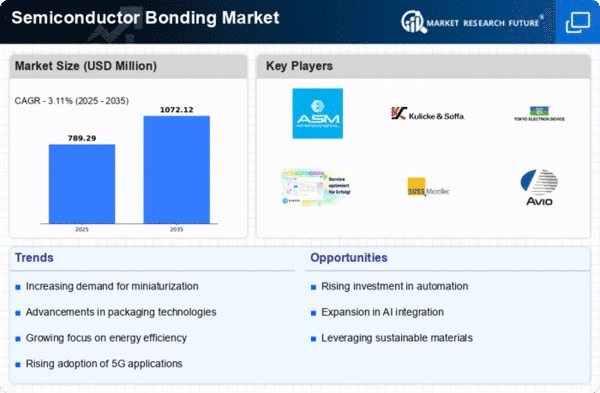
As per MRFR analysis, the Semiconductor Bonding Market Size was estimated at 765.48 USD Million in 2024. The Semiconductor Bonding industry is projected to grow from 789.29 USD Million in 2025 to 1072.12 USD Million by 2035, exhibiting a compound annual growth rate (CAGR) of 3.11 during the forecast period 2025 - 2035.

Key Market Trends & Highlights

The Semiconductor Bonding Market is poised for substantial growth driven by technological advancements and increasing demand for miniaturization.

  • Technological advancements in bonding techniques are reshaping the semiconductor bonding landscape.
  • The demand for miniaturization in electronics is propelling innovations in the semiconductor bonding market.
  • North America remains the largest market, while Asia-Pacific is emerging as the fastest-growing region in this sector.
  • Key drivers include rising demand for high-performance electronics and increased investment in semiconductor manufacturing.

Market Size & Forecast

2024 Market Size 765.48 (USD Million)
2035 Market Size 1072.12 (USD Million)
CAGR (2025 - 2035) 3.11%
Largest Regional Market Share in 2024 Asia-Pacific

Major Players

<p>ASM International (NL), Kulicke and Soffa Industries (US), Tokyo Electron (JP), Bonder (US), SUSS MicroTec (DE), Hesse Mechatronics (DE), Palomar Technologies (US), Shinkawa (JP)</p>

Market Trends

The Semiconductor Bonding Market is currently experiencing a transformative phase, driven by advancements in technology and increasing demand for miniaturization in electronic devices. As industries such as automotive, consumer electronics, and telecommunications evolve, the need for efficient and reliable bonding techniques becomes paramount. This market appears to be influenced by the growing complexity of semiconductor packaging, which necessitates innovative bonding solutions to ensure optimal performance and reliability. Furthermore, the integration of new materials and processes is likely to enhance the capabilities of semiconductor devices, thereby expanding the market's potential. In addition, the Semiconductor Bonding Market seems to be shaped by the rising emphasis on sustainability and energy efficiency. Manufacturers are increasingly focusing on eco-friendly materials and processes, which may lead to the development of greener bonding technologies. This shift not only addresses environmental concerns but also aligns with the broader industry trend towards sustainable practices. As the market continues to evolve, it is essential for stakeholders to remain agile and responsive to these changes, ensuring they capitalize on emerging opportunities while navigating potential challenges ahead.

Technological Advancements in Bonding Techniques

The Semiconductor Bonding Market is witnessing rapid technological advancements that enhance bonding techniques. Innovations such as laser bonding and thermocompression bonding are gaining traction, offering improved precision and efficiency. These advancements may lead to better performance in semiconductor devices, catering to the increasing demands of various applications.

Growing Demand for Miniaturization

There is a notable trend towards miniaturization in the Semiconductor Bonding Market, driven by the need for smaller and more efficient electronic devices. This trend necessitates the development of advanced bonding solutions that can accommodate tighter spaces while maintaining performance. As consumer preferences shift towards compact devices, the market is likely to adapt accordingly.

Sustainability and Eco-Friendly Practices

The Semiconductor Bonding Market is increasingly influenced by sustainability initiatives. Manufacturers are exploring eco-friendly materials and processes to reduce environmental impact. This trend not only addresses regulatory pressures but also aligns with consumer expectations for greener products, potentially reshaping the market landscape.

Semiconductor Bonding Market Market Drivers

Increasing Adoption of IoT Devices

The increasing adoption of Internet of Things (IoT) devices significantly impacts the Global Semiconductor Bonding Market Industry. As more devices become interconnected, the demand for efficient and reliable semiconductor bonding solutions escalates. IoT applications span various sectors, including healthcare, smart homes, and industrial automation, all of which require advanced semiconductor technologies. The need for miniaturization and enhanced performance in these devices drives innovation in bonding techniques. Consequently, the Global Semiconductor Bonding Market Industry is likely to experience sustained growth as manufacturers adapt to the evolving landscape of IoT technology.

Expansion of Automotive Electronics

The expansion of automotive electronics serves as a significant driver for the Global Semiconductor Bonding Market Industry. As vehicles become increasingly equipped with advanced electronic systems, the demand for reliable semiconductor bonding solutions rises. Technologies such as autonomous driving, electric vehicles, and connected car systems necessitate robust semiconductor components that can withstand harsh conditions. This trend is expected to propel the market forward, as automotive manufacturers seek to integrate sophisticated bonding techniques into their production processes. The growing emphasis on automotive electronics underscores the pivotal role of the Global Semiconductor Bonding Market Industry in supporting the evolution of the automotive sector.

Rising Demand for Advanced Electronics

The Global Semiconductor Bonding Market Industry experiences a notable surge in demand driven by the proliferation of advanced electronics. As consumer electronics become increasingly sophisticated, the need for high-performance semiconductor devices intensifies. This trend is particularly evident in sectors such as smartphones, tablets, and wearable technology, where compact and efficient bonding solutions are essential. In 2024, the market is projected to reach 0.77 USD Billion, reflecting the industry's response to these evolving consumer preferences. The integration of semiconductor bonding technologies enables manufacturers to enhance device performance and reliability, thereby supporting the overall growth of the Global Semiconductor Bonding Market Industry.

Technological Advancements in Bonding Techniques

Technological innovations in bonding techniques significantly influence the Global Semiconductor Bonding Market Industry. The introduction of advanced methods such as flip-chip bonding and micro-bump bonding enhances the efficiency and effectiveness of semiconductor assembly processes. These techniques allow for improved thermal and electrical performance, which is crucial for high-density applications. As the industry evolves, manufacturers are increasingly adopting these cutting-edge bonding technologies to meet the demands of next-generation devices. This shift is expected to contribute to the market's growth, with projections indicating an increase to 1.04 USD Billion by 2035, underscoring the importance of technological advancements in shaping the Global Semiconductor Bonding Market Industry.

Growing Investment in Semiconductor Manufacturing

The Global Semiconductor Bonding Market Industry benefits from a substantial increase in investment directed towards semiconductor manufacturing. Governments and private entities are recognizing the strategic importance of semiconductor production, leading to the establishment of new fabrication facilities and the expansion of existing ones. This influx of capital not only enhances production capabilities but also fosters innovation in bonding technologies. As a result, the market is poised for growth, with a projected compound annual growth rate (CAGR) of 2.8% from 2025 to 2035. This investment trend reflects a broader commitment to strengthening the semiconductor supply chain and ensuring the competitiveness of the Global Semiconductor Bonding Market Industry.

Market Segment Insights

By Application: Microelectronics (Largest) vs. Optoelectronics (Fastest-Growing)

<p>In the Semiconductor Bonding Market, the application segment is notably diverse, with microelectronics holding the largest market share. Microelectronics is essential for the wide range of consumer electronics, which consistently demands advanced bonding technologies. Meanwhile, optoelectronics is emerging rapidly, driven by the increasing incorporation of optical components in communication and sensing applications. As the demand for compact and efficient devices grows, both segments are continually evolving to meet technological advancements. Growth trends in this segment are propelled by innovation and the increasing demand for miniaturized electronic components. While microelectronics remains dominant due to its established applications in smartphones and computers, optoelectronics is recognized as the fastest-growing sector, fueled by advancements in LED technology and the expansion of fiber optic networks. The heightened focus on energy efficiency and sustainability also encourages the adoption of optoelectronic devices.</p>

<p>Microelectronics (Dominant) vs. RFID (Emerging)</p>

<p>The microelectronics segment of the Semiconductor Bonding Market remains dominant, representing a critical area for technological advancements in consumer electronics, automotive applications, and industrial machinery. Characterized by a robust demand for miniaturization and functionality, this segment encompasses a wide range of applications such as chips used in smartphones, tablets, and computers. On the other hand, the RFID segment is emerging, shaped by advancements in supply chain management and inventory tracking. RFID technology's increasing integration into sectors like retail and healthcare is enhancing efficiency and security. As the market transitions towards smart technologies and IoT applications, RFID is set to gain significant traction, bridging systems and improving data accessibility.</p>

By Technology: Thermal Bonding (Largest) vs. Laser Bonding (Fastest-Growing)

<p>The Semiconductor Bonding Market is primarily driven by Thermal Bonding, which holds the largest share among the technologies used for bonding semiconductor devices. Following Thermal Bonding, Ultrasonic and Adhesive Bonding are significant, with the latter seeing a steady demand due to its versatility. Laser Bonding, while currently smaller in market share, has been gaining traction rapidly due to technological advancements and increased applications in modern semiconductor manufacturing.</p>

<p>Technology: Thermal Bonding (Dominant) vs. Laser Bonding (Emerging)</p>

<p>Thermal Bonding is recognized as the dominant technology in the Semiconductor Bonding Market, primarily because of its effectiveness in creating strong and reliable bonds essential for device performance. Its ability to work across various materials used in semiconductors positions it favorably among manufacturers. On the other hand, Laser Bonding is emerging, known for its precision and speed, making it ideal for the fast-paced semiconductor manufacturing environment. As the demand for smaller, more complex devices rises, Laser Bonding technology is quickly becoming preferred for newer applications, indicating a significant shift in bonding methods as market needs evolve.</p>

By End Use Industry: Consumer Electronics (Largest) vs. Automotive (Fastest-Growing)

<p>The semiconductor bonding market is significantly influenced by its end-use industries, with consumer electronics holding the largest market share due to the increasing demand for smart devices and advanced electronics. Other notable segments include automotive and telecommunications, which, while smaller in share compared to consumer electronics, are crucial due to their technological advancements and integration of semiconductors in modern applications. Aerospace and healthcare also contribute to the market, albeit to a lesser extent, driven by specific requirements for high reliability and efficiency in their respective technologies.</p>

<p>Consumer Electronics: Dominant vs. Automotive: Emerging</p>

<p>The consumer electronics segment stands as a dominant force within the semiconductor bonding market, primarily fueled by the surge in demand for smartphones, tablets, and smart home devices. This segment emphasizes the need for advanced bonding techniques that enhance device performance and energy efficiency. In contrast, the automotive segment is emerging rapidly as a critical growth area, propelled by the automotive industry's shift towards electric vehicles and autonomous driving technologies. The integration of sophisticated semiconductor devices within vehicles necessitates innovative bonding solutions, making automotive the fastest-growing segment as manufacturers strive to meet new technological standards.</p>

Get more detailed insights about Semiconductor Bonding Market Research Report—Global Forecast till 2035

Regional Insights

North America : Innovation and Growth Hub

The North American semiconductor bonding market is projected to reach $150.0 million by December 2025, driven by increasing demand for advanced electronics and automotive applications. Regulatory support for semiconductor manufacturing and R&D initiatives is fostering innovation, while the region's robust infrastructure enhances production capabilities. The growing trend towards miniaturization and high-performance devices is further propelling market growth. Leading countries in this region include the US and Canada, with major players like Kulicke and Soffa Industries and Palomar Technologies establishing a strong foothold. The competitive landscape is characterized by continuous technological advancements and strategic partnerships. The presence of key players ensures a dynamic market environment, positioning North America as a leader in semiconductor bonding technology.

Europe : Emerging Technology Leader

Europe's semiconductor bonding market is expected to reach $120.0 million by December 2025, driven by increasing investments in semiconductor technology and a focus on sustainability. The European Union's initiatives to enhance semiconductor production capabilities and reduce dependency on external suppliers are key growth drivers. Regulatory frameworks are encouraging innovation and collaboration among industry stakeholders, fostering a conducive environment for market expansion. Germany, France, and the Netherlands are leading countries in this region, with companies like SUSS MicroTec and Hesse Mechatronics playing pivotal roles. The competitive landscape is marked by a mix of established firms and emerging startups, all striving to innovate and capture market share. The presence of key players ensures a vibrant ecosystem, positioning Europe as a significant player in The Semiconductor Bonding.

Asia-Pacific : Dominant Market Player

The Asia-Pacific region dominates the semiconductor bonding market, projected to reach $450.0 million by December 2025. This growth is fueled by the rapid expansion of electronics manufacturing, particularly in countries like China, Japan, and South Korea. The region's strong focus on technological advancements and government initiatives to boost semiconductor production are significant growth drivers. Additionally, the increasing demand for consumer electronics and automotive applications is propelling market expansion. China and Japan are the leading countries in this market, with key players such as Tokyo Electron and Shinkawa establishing a strong presence. The competitive landscape is characterized by intense rivalry and continuous innovation, with companies investing heavily in R&D to enhance their product offerings. The presence of major players ensures a dynamic market environment, solidifying Asia-Pacific's position as a leader in semiconductor bonding technology.

Middle East and Africa : Emerging Market Potential

The Middle East and Africa semiconductor bonding market is projected to reach $45.48 million by December 2025, driven by increasing investments in technology and infrastructure development. The region is witnessing a gradual shift towards advanced manufacturing processes, supported by government initiatives aimed at enhancing local production capabilities. The growing demand for electronics and automotive applications is also contributing to market growth. Countries like South Africa and the UAE are emerging as key players in this market, with a focus on developing local semiconductor manufacturing capabilities. The competitive landscape is still in its nascent stages, with opportunities for both established firms and new entrants. The presence of key players is expected to drive innovation and growth, positioning the Middle East and Africa as a potential hub for semiconductor bonding technology.

Key Players and Competitive Insights

The Semiconductor Bonding Market is characterized by a dynamic competitive landscape, driven by technological advancements and increasing demand for miniaturized electronic components. Key players such as ASM International (NL), Kulicke and Soffa Industries (US), and Tokyo Electron (JP) are at the forefront, each adopting distinct strategies to enhance their market positioning. ASM International (NL) focuses on innovation in advanced packaging technologies, while Kulicke and Soffa Industries (US) emphasizes strategic partnerships to expand its product offerings. Tokyo Electron (JP) is investing heavily in R&D to develop next-generation bonding solutions, collectively shaping a competitive environment that prioritizes technological leadership and market responsiveness.

In terms of business tactics, companies are increasingly localizing manufacturing to mitigate supply chain disruptions and optimize operational efficiency. The market structure appears moderately fragmented, with several players vying for market share. However, the collective influence of major companies is significant, as they leverage their technological capabilities and market reach to establish a competitive edge.

In November 2025, ASM International (NL) announced the launch of a new bonding technology aimed at enhancing the performance of semiconductor devices. This strategic move is expected to solidify its position as a leader in the advanced packaging segment, catering to the growing demand for high-performance electronics. The introduction of this technology may not only attract new customers but also reinforce existing relationships with key clients in the semiconductor industry.

In October 2025, Kulicke and Soffa Industries (US) entered into a strategic partnership with a leading semiconductor manufacturer to co-develop innovative bonding solutions. This collaboration is likely to enhance their product portfolio and provide tailored solutions that meet the specific needs of the semiconductor market. Such partnerships are indicative of a broader trend where companies seek to combine strengths to drive innovation and capture market opportunities.

In September 2025, Tokyo Electron (JP) expanded its manufacturing capabilities by investing in a new facility dedicated to semiconductor bonding technologies. This expansion is anticipated to increase production capacity and improve supply chain reliability, positioning the company to better serve its global customer base. The investment reflects a commitment to meeting the rising demand for semiconductor devices, particularly in emerging markets.

As of December 2025, current competitive trends in the Semiconductor Bonding Market are increasingly defined by digitalization, sustainability, and the integration of AI technologies. Strategic alliances are becoming more prevalent, as companies recognize the need to collaborate to enhance innovation and address complex market demands. Looking ahead, competitive differentiation is likely to evolve from traditional price-based competition to a focus on technological innovation, supply chain reliability, and sustainable practices, underscoring the importance of adaptability in a rapidly changing market.

Key Companies in the Semiconductor Bonding Market market include

Industry Developments

  • Q2 2024: ASM International opens new semiconductor equipment facility in Singapore ASM International inaugurated a new manufacturing facility in Singapore to expand its production capacity for advanced wafer bonding equipment, aiming to meet rising demand from semiconductor packaging customers.
  • Q2 2024: Kulicke & Soffa Announces Strategic Partnership with Samsung for Advanced Chip Bonding Kulicke & Soffa entered a strategic partnership with Samsung Electronics to co-develop next-generation semiconductor bonding solutions for 3D packaging and high-performance computing applications.
  • Q2 2024: BondingTech raises $40M Series B to scale hybrid wafer bonding technology BondingTech, a startup specializing in hybrid wafer bonding, secured $40 million in Series B funding led by a consortium of venture capital firms to accelerate product development and expand its engineering team.
  • Q3 2024: EV Group Unveils Next-Generation Wafer Bonding System for 3D IC Integration EV Group launched its new EVG850 automated wafer bonding system, designed to support high-volume manufacturing of 3D integrated circuits and advanced packaging solutions.
  • Q3 2024: Applied Materials acquires BondAlign for $250 million to boost advanced packaging portfolio Applied Materials completed the acquisition of BondAlign, a specialist in precision die bonding, to strengthen its offerings in advanced semiconductor packaging and hybrid bonding technologies.
  • Q3 2024: SÜSS MicroTec wins major contract for wafer bonding equipment from leading Asian foundry SÜSS MicroTec announced a significant contract win to supply its latest wafer bonding equipment to a top-tier Asian semiconductor foundry, supporting the customer's expansion in 3D chip packaging.
  • Q4 2024: Tokyo Electron opens R&D center focused on next-gen semiconductor bonding Tokyo Electron launched a new research and development center in Japan dedicated to innovating next-generation bonding technologies for advanced semiconductor manufacturing.
  • Q4 2024: Nordson Corporation appoints new VP of Semiconductor Bonding Market Solutions Nordson Corporation announced the appointment of Dr. Lisa Chen as Vice President of its Semiconductor Bonding Market Solutions division, overseeing global strategy and product development.
  • Q1 2025: Intel and ASE Group sign multi-year agreement for advanced die bonding collaboration Intel and ASE Group entered a multi-year collaboration agreement to jointly develop advanced die bonding processes for next-generation chiplet architectures.
  • Q1 2025: Kulicke & Soffa launches new high-precision die bonder for AI and 5G applications Kulicke & Soffa introduced its latest high-precision die bonder, targeting the growing demand for AI processors and 5G infrastructure requiring advanced semiconductor bonding.
  • Q2 2025: Lam Research announces $100M investment in semiconductor bonding R&D Lam Research committed $100 million to expand its research and development efforts in semiconductor bonding technologies, focusing on hybrid and thermocompression bonding for next-generation devices.
  • Q2 2025: EV Group secures regulatory approval for new wafer bonding facility in Austria EV Group received regulatory approval to construct a new wafer bonding equipment manufacturing facility in Austria, aimed at increasing production capacity for global customers.

Future Outlook

Semiconductor Bonding Market Future Outlook

<p>The Semiconductor Bonding Market is projected to grow at a 3.11% CAGR from 2024 to 2035, driven by advancements in technology, increasing demand for miniaturization, and the rise of IoT applications.</p>

New opportunities lie in:

  • <p>Development of advanced hybrid bonding techniques for enhanced performance.</p>
  • <p>Expansion into emerging markets with tailored bonding solutions.</p>
  • <p>Investment in R&D for next-generation semiconductor materials and processes.</p>

<p>By 2035, the Semiconductor Bonding Market is expected to achieve robust growth and innovation.</p>

Market Segmentation

Semiconductor Bonding Market Technology Outlook

  • Thermal Bonding
  • Ultrasonic Bonding
  • Laser Bonding
  • Adhesive Bonding
  • Die Attach

Semiconductor Bonding Market Application Outlook

  • Microelectronics
  • Optoelectronics
  • Power Electronics
  • RFID
  • MEMS

Semiconductor Bonding Market End Use Industry Outlook

  • Consumer Electronics
  • Automotive
  • Telecommunications
  • Aerospace
  • Healthcare

Report Scope

MARKET SIZE 2024765.48(USD Million)
MARKET SIZE 2025789.29(USD Million)
MARKET SIZE 20351072.12(USD Million)
COMPOUND ANNUAL GROWTH RATE (CAGR)3.11% (2024 - 2035)
REPORT COVERAGERevenue Forecast, Competitive Landscape, Growth Factors, and Trends
BASE YEAR2024
Market Forecast Period2025 - 2035
Historical Data2019 - 2024
Market Forecast UnitsUSD Million
Key Companies ProfiledASM International (NL), Kulicke and Soffa Industries (US), Tokyo Electron (JP), Bonder (US), SUSS MicroTec (DE), Hesse Mechatronics (DE), Palomar Technologies (US), Shinkawa (JP)
Segments CoveredApplication, Technology, End Use Industry
Key Market OpportunitiesAdvancements in 5G technology drive demand for innovative solutions in the Semiconductor Bonding Market.
Key Market DynamicsTechnological advancements in semiconductor bonding techniques drive competitive dynamics and influence market consolidation trends.
Countries CoveredNorth America, Europe, APAC, South America, MEA

FAQs

How much is the Semiconductor Bonding market?

The Semiconductor Bonding market size was valued at USD 0.70 Billion in 2021.

What is the growth rate of the Semiconductor Bonding market?

The market for Semiconductor Bonding is projected to grow at a CAGR of 3.11% during the forecast period, 2022-2030.

Which region held the largest market share in the Semiconductor Bonding market?

North America had the largest share in the market for Semiconductor Bonding.

Who are the key players in the Semiconductor Bonding market?

The key players in the market for Semiconductor Bonding are BE Semiconductor Industries N.V., ASM Pacific Technology Ltd, Kulicke &amp; Soffa, Panasonic, and others.

Which process type led the Semiconductor Bonding market?

The wafer-to-wafer process type Semiconductor Bonding category dominated the market in 2021.

Which technology had the largest market share in the Semiconductor Bonding market?

The die bonding technology had the largest share in the Semiconductor Bonding market.

  1. EXECUTIVE SUMMARY
    1. Market Attractiveness Analysis
      1. Global Semiconductor Bonding Market, By Process Type
      2. Global Semiconductor Bonding Market, By Technology
      3. Global Semiconductor Bonding Market, By Type
      4. Global Semiconductor Bonding Market, By Application
      5. Global Semiconductor Bonding Market, By Region
  2. MARKET INTRODUCTION
    1. Definition
    2. Scope of the Study
    3. Market Structure
  3. RESEARCH METHODOLOGY
    1. Research Process
    2. Primary Research
    3. Secondary Research
    4. Market Size Estimation
    5. Forecast Model
    6. List of Assumptions & Limitations
  4. MARKET DYNAMICS
    1. Introduction
    2. Drivers
      1. Growing demand for miniature electronic components
      2. Increasing adoption of stacked die technology in IoT devices
      3. Rising demand for electric and hybrid vehicles
    3. Restraint
      1. High cost of ownership
    4. Opportunity
      1. Increasing demand for 3D semiconductor assembly and packaging
    5. Impact of COVID-19
      1. Impact on Semiconductor Manufacturers
      2. Impact on Model Manufacturers
      3. Impact on Device Manufacturers
      4. Impact on Supply Chain Delays
  5. MARKET FACTOR ANALYSIS
    1. Value Chain Analysis/Supply Chain Analysis
    2. Porter’s Five Forces Model
      1. Bargaining Power of Suppliers
      2. Bargaining Power of Buyers
      3. Threat of New Entrants
      4. Threat of Substitutes
      5. Intensity of Rivalry
  6. GLOBAL SEMICONDUCTOR BONDING MARKET, BY PROCESS TYPE
    1. Introduction
    2. Die-To-Die Bonding
    3. Die-To-Wafer Bonding
    4. Wafer-To-Wafer Bonding
  7. GLOBAL SEMICONDUCTOR BONDING MARKET, BY TECHNOLOGY
    1. Introduction
    2. Die Bonding
      1. Epoxy Die Bonding
      2. Eutectic Die Bonding
      3. Flip Chip Attachment
      4. Hybrid Bonding
    3. Wafer Bonding
      1. Direct Wafer Bonding
      2. Anodic Wafer Bonding
      3. TCB Wafer Bonding,
      4. Hybrid Bonding
  8. GLOBAL SEMICONDUCTOR BONDING MARKET, BY TYPE
    1. Introduction
    2. Die Bonder
    3. Wafer Bonder
    4. Flip Chip Bonder
  9. GLOBAL SEMICONDUCTOR BONDING MARKET, BY APPLICATION
    1. Introduction
    2. Rf Devices
    3. Mems And Sensors
    4. Cmos Image Sensors
    5. Led
    6. 3d Nand
  10. GLOBAL SEMICONDUCTOR BONDING MARKET, BY REGION
    1. Introduction
    2. North America
      1. Market Size & Estimates, by Process Type, 2022-2030
      2. Market Size & Estimates, by Technology, 2022-2030
      3. Market Size & Estimates, by Type, 2022-2030
      4. Market Size & Estimates, by Application, 2022-2030
      5. US
      6. Canada
      7. Mexico
    3. Europe
      1. Market Size & Estimates, by Country, 2022-2030
      2. Market Size & Estimates, by Process Type, 2022-2030
      3. Market Size & Estimates, by Technology, 2022-2030
      4. Market Size & Estimates, by Type, 2022-2030
      5. Market Size & Estimates, by Application, 2022-2030
      6. Germany
      7. France
      8. UK
      9. Rest of Europe
    4. Asia-Pacific
      1. Market Size & Estimates, by Process Type, 2022-2030
      2. Market Size & Estimates, by Technology, 2022-2030
      3. Market Size & Estimates, by Type, 2022-2030
      4. Market Size & Estimates, by Application, 2022-2030
      5. China
      6. Japan
      7. India
      8. Rest of Asia-Pacific
    5. Middle East & Africa
    6. South America
  11. COMPETITIVE LANDSCAPE
    1. Introduction
    2. Key Players Market Share Analysis, 2020 (%)
    3. Competitive Benchmarking
    4. Competitor Dashboard
    5. Major Growth Strategy in the Market
    6. Key Developments & Growth Strategies
      1. Product Developments
      2. Mergers & Acquisitions
      3. Contracts & Agreements
  12. COMPANY PROFILES
    1. BE Semiconductor Industries N.V.
      1. Company Overview
      2. Financial Overview
      3. Products Offered
      4. Key Developments
      5. SWOT Analysis
      6. Key Strategies
    2. ASM Pacific Technology Ltd
      1. Company Overview
      2. Financial Overview
      3. Products Offered
      4. Key Developments
      5. SWOT Analysis
      6. Key Strategies
    3. Kulicke & Soffa
      1. Company Overview
      2. Financial Overview
      3. Products Offered
      4. Key Developments
      5. SWOT Analysis
      6. Key Strategies
    4. Panasonic
      1. Company Overview
      2. Financial Overview
      3. Products Offered
      4. Key Developments
      5. SWOT Analysis
      6. Key Strategies
    5. Fuji Corporation
      1. Company Overview
      2. Financial Overview
      3. Products Offered
      4. Key Developments
      5. SWOT Analysis
      6. Key Strategies
    6. Yamaha Motor Robotics Corporation Co.
      1. Company Overview
      2. Financial Overview
      3. Products Offered
      4. Key Developments
      5. SWOT Analysis
      6. Key Strategies
    7. SUSS MicroTech SE
      1. Company Overview
      2. Financial Overview
      3. Products Offered
      4. Key Developments
      5. SWOT Analysis
      6. Key Strategies
    8. Shiaura Mechatronics
      1. Company Overview
      2. Financial Overview
      3. Products Offered
      4. Key Developments
      5. SWOT Analysis
      6. Key Strategies
    9. TDK CORPORATION
      1. Company Overview
      2. Financial Overview
      3. Products Offered
      4. Key Developments
      5. SWOT Analysis
      6. Key Strategies
    10. TOKYO ELECTRON LIMITED
      1. Company Overview
      2. Financial Overview
      3. Products Offered
      4. Key Developments
      5. SWOT Analysis
      6. Key Strategies
    11. MITSUBISHI HEAVY INDUSTRIES MACHINE TOOLS
      1. Company Overview
      2. Financial Overview
      3. Products Offered
      4. Key Developments
      5. SWOT Analysis
      6. Key Strategies
    12. MYCRONIC GROUP
      1. Company Overview
      2. Financial Overview
      3. Products Offered
      4. Key Developments
      5. SWOT Analysis
      6. Key Strategies
    13. INTEL
      1. Company Overview
      2. Financial Overview
      3. Products Offered
      4. Key Developments
      5. SWOT Analysis
      6. Key Strategies
    14. SAMSUNG
      1. Company Overview
      2. Financial Overview
      3. Products Offered
      4. Key Developments
      5. SWOT Analysis
      6. Key Strategies
    15. CANON ANELVA CORPORATION
      1. Company Overview
      2. Financial Overview
      3. Products Offered
      4. Key Developments
      5. SWOT Analysis
      6. Key Strategies
  13. APPENDIX
  14. Discussion Blueprint
  15. LIST OF TABLES
  16. LIST OF ASSUMPTIONS & LIMITATIONS
  17. GLOBAL SEMICONDUCTOR BONDING MARKET, BY PROCESS TYPE, 2022-2030 (USD MILLION)
  18. GLOBAL SEMICONDUCTOR BONDING MARKET, BY TECHNOLOGY, 2022-2030 (USD MILLION)
  19. GLOBAL SEMICONDUCTOR BONDING MARKET, BY TYPE, 2022-2030 (USD MILLION)
  20. GLOBAL SEMICONDUCTOR BONDING MARKET, BY APPLICATION, 2022-2030 (USD MILLION)
  21. GLOBAL SEMICONDUCTOR BONDING MARKET, BY REGION, 2022-2030 (USD MILLION)
  22. NORTH AMERICA: SEMICONDUCTOR BONDING MARKET, BY COUNTRY, 2022-2030 (USD MILLION)
  23. NORTH AMERICA: SEMICONDUCTOR BONDING MARKET, BY PROCESS TYPE, 2022-2030 (USD MILLION)
  24. NORTH AMERICA: SEMICONDUCTOR BONDING MARKET, BY TECHNOLOGY, 2022-2030 (USD MILLION)
  25. NORTH AMERICA: SEMICONDUCTOR BONDING MARKET, BY TYPE, 2022-2030 (USD MILLION)
  26. NORTH AMERICA: SEMICONDUCTOR BONDING MARKET, BY APPLICATION, 2022-2030 (USD MILLION)
  27. US: SEMICONDUCTOR BONDING MARKET, BY PROCESS TYPE, 2022-2030 (USD MILLION)
  28. US: SEMICONDUCTOR BONDING MARKET, BY TECHNOLOGY, 2022-2030 (USD MILLION)
  29. US: SEMICONDUCTOR BONDING MARKET, BY TYPE, 2022-2030 (USD MILLION)
  30. US: SEMICONDUCTOR BONDING MARKET, BY APPLICATION, 2022-2030 (USD MILLION)
  31. CANADA: SEMICONDUCTOR BONDING MARKET, BY PROCESS TYPE, 2022-2030 (USD MILLION)
  32. CANADA: SEMICONDUCTOR BONDING MARKET, BY TECHNOLOGY, 2022-2030 (USD MILLION)
  33. CANADA: SEMICONDUCTOR BONDING MARKET, BY TYPE, 2022-2030 (USD MILLION)
  34. CANADA: SEMICONDUCTOR BONDING MARKET, BY APPLICATION, 2022-2030 (USD MILLION)
  35. MEXICO: SEMICONDUCTOR BONDING MARKET, BY PROCESS TYPE, 2022-2030 (USD MILLION)
  36. MEXICO: SEMICONDUCTOR BONDING MARKET, BY TECHNOLOGY, 2022-2030 (USD MILLION)
  37. MEXICO: SEMICONDUCTOR BONDING MARKET, BY TYPE, 2022-2030 (USD MILLION)
  38. MEXICO: SEMICONDUCTOR BONDING MARKET, BY APPLICATION, 2022-2030 (USD MILLION)
  39. EUROPE: SEMICONDUCTOR BONDING MARKET, BY COUNTRY, 2022-2030 (USD MILLION)
  40. EUROPE: SEMICONDUCTOR BONDING MARKET, BY PROCESS TYPE, 2022-2030 (USD MILLION)
  41. EUROPE: SEMICONDUCTOR BONDING MARKET, BY TECHNOLOGY, 2022-2030 (USD MILLION)
  42. EUROPE: SEMICONDUCTOR BONDING MARKET, BY TYPE, 2022-2030 (USD MILLION)
  43. EUROPE: SEMICONDUCTOR BONDING MARKET, BY APPLICATION, 2022-2030 (USD MILLION)
  44. UK: SEMICONDUCTOR BONDING MARKET, BY PROCESS TYPE, 2022-2030 (USD MILLION)
  45. UK: SEMICONDUCTOR BONDING MARKET, BY TECHNOLOGY, 2022-2030 (USD MILLION)
  46. UK: SEMICONDUCTOR BONDING MARKET, BY TYPE, 2022-2030 (USD MILLION)
  47. UK: SEMICONDUCTOR BONDING MARKET, BY APPLICATION, 2022-2030 (USD MILLION)
  48. GERMANY: SEMICONDUCTOR BONDING MARKET, BY PROCESS TYPE, 2022-2030 (USD MILLION)
  49. GERMANY: SEMICONDUCTOR BONDING MARKET, BY TECHNOLOGY, 2022-2030 (USD MILLION)
  50. GERMANY: SEMICONDUCTOR BONDING MARKET, BY TYPE, 2022-2030 (USD MILLION)
  51. GERMANY: SEMICONDUCTOR BONDING MARKET, BY APPLICATION, 2022-2030 (USD MILLION)
  52. FRANCE: SEMICONDUCTOR BONDING MARKET, BY PROCESS TYPE, 2022-2030 (USD MILLION)
  53. FRANCE: SEMICONDUCTOR BONDING MARKET, BY TECHNOLOGY, 2022-2030 (USD MILLION)
  54. FRANCE: SEMICONDUCTOR BONDING MARKET, BY TYPE, 2022-2030 (USD MILLION)
  55. FRANCE: SEMICONDUCTOR BONDING MARKET, BY APPLICATION, 2022-2030 (USD MILLION)
  56. REST OF EUROPE: SEMICONDUCTOR BONDING MARKET, BY PROCESS TYPE, 2022-2030 (USD MILLION)
  57. REST OF EUROPE: SEMICONDUCTOR BONDING MARKET, BY TECHNOLOGY, 2022-2030 (USD MILLION)
  58. REST OF EUROPE: SEMICONDUCTOR BONDING MARKET, BY TYPE, 2022-2030 (USD MILLION)
  59. REST OF EUROPE: SEMICONDUCTOR BONDING MARKET, BY APPLICATION, 2022-2030 (USD MILLION)
  60. ASIA-PACIFIC: SEMICONDUCTOR BONDING MARKET, BY PROCESS TYPE, 2022-2030 (USD MILLION)
  61. ASIA-PACIFIC: SEMICONDUCTOR BONDING MARKET, BY TECHNOLOGY, 2022-2030 (USD MILLION)
  62. ASIA-PACIFIC: SEMICONDUCTOR BONDING MARKET, BY TYPE, 2022-2030 (USD MILLION)
  63. ASIA-PACIFIC: SEMICONDUCTOR BONDING MARKET, BY APPLICATION, 2022-2030 (USD MILLION)
  64. CHINA: SEMICONDUCTOR BONDING MARKET, BY PROCESS TYPE, 2022-2030 (USD MILLION)
  65. CHINA: SEMICONDUCTOR BONDING MARKET, BY TECHNOLOGY, 2022-2030 (USD MILLION)
  66. CHINA: SEMICONDUCTOR BONDING MARKET, BY TYPE, 2022-2030 (USD MILLION)
  67. CHINA: SEMICONDUCTOR BONDING MARKET, BY APPLICATION, 2022-2030 (USD MILLION)
  68. INDIA: SEMICONDUCTOR BONDING MARKET, BY PROCESS TYPE, 2022-2030 (USD MILLION)
  69. INDIA: SEMICONDUCTOR BONDING MARKET, BY TECHNOLOGY, 2022-2030 (USD MILLION)
  70. INDIA: SEMICONDUCTOR BONDING MARKET, BY TYPE, 2022-2030 (USD MILLION)
  71. INDIA: SEMICONDUCTOR BONDING MARKET, BY APPLICATION, 2022-2030 (USD MILLION)
  72. JAPAN: SEMICONDUCTOR BONDING MARKET, BY PROCESS TYPE, 2022-2030 (USD MILLION)
  73. JAPAN: SEMICONDUCTOR BONDING MARKET, BY TECHNOLOGY, 2022-2030 (USD MILLION)
  74. JAPAN: SEMICONDUCTOR BONDING MARKET, BY TYPE, 2022-2030 (USD MILLION)
  75. JAPAN: SEMICONDUCTOR BONDING MARKET, BY APPLICATION, 2022-2030 (USD MILLION)
  76. REST OF ASIA-PACIFIC: SEMICONDUCTOR BONDING MARKET, BY PROCESS TYPE, 2022-2030 (USD MILLION)
  77. REST OF ASIA-PACIFIC: SEMICONDUCTOR BONDING MARKET, BY TECHNOLOGY, 2022-2030 (USD MILLION)
  78. REST OF ASIA-PACIFIC: SEMICONDUCTOR BONDING MARKET, BY TYPE, 2022-2030 (USD MILLION)
  79. REST OF ASIA-PACIFIC: SEMICONDUCTOR BONDING MARKET, BY APPLICATION, 2022-2030 (USD MILLION)
  80. MIDDLE EAST & AFRICA: SEMICONDUCTOR BONDING MARKET, BY PROCESS TYPE, 2022-2030 (USD MILLION)
  81. MIDDLE EAST & AFRICA: SEMICONDUCTOR BONDING MARKET, BY TECHNOLOGY, 2022-2030 (USD MILLION)
  82. MIDDLE EAST & AFRICA: SEMICONDUCTOR BONDING MARKET, BY TYPE, 2022-2030 (USD MILLION)
  83. MIDDLE EAST & AFRICA: SEMICONDUCTOR BONDING MARKET, BY APPLICATION, 2022-2030 (USD MILLION)
  84. SOUTH AMERICA: SEMICONDUCTOR BONDING MARKET, BY PROCESS TYPE, 2022-2030 (USD MILLION)
  85. SOUTH AMERICA: SEMICONDUCTOR BONDING MARKET, BY TECHNOLOGY, 2022-2030 (USD MILLION)
  86. SOUTH AMERICA: SEMICONDUCTOR BONDING MARKET, BY TYPE, 2022-2030 (USD MILLION)
  87. SOUTH AMERICA: SEMICONDUCTOR BONDING MARKET, BY APPLICATION, 2022-2030 (USD MILLION) 
  88. LIST OF FIGURES
  89. MARKET SYNOPSIS
  90. RESEARCH PROCESS OF MRFR
  91. TOP-DOWN AND BOTTOM-UP APPROACH
  92. GLOBAL SEMICONDUCTOR BONDING MARKET, BY PROCESS TYPE, 2022-2030 (USD MILLION)
  93. GLOBAL SEMICONDUCTOR BONDING MARKET, BY TECHNOLOGY, 2022-2030 (USD MILLION)
  94. GLOBAL SEMICONDUCTOR BONDING MARKET, BY TYPE, 2022-2030 (USD MILLION)
  95. GLOBAL SEMICONDUCTOR BONDING MARKET, BY APPLICATION, 2022-2030 (USD MILLION)
  96. GLOBAL SEMICONDUCTOR BONDING MARKET, BY REGION, 2022-2030 (USD MILLION)
  97. NORTH AMERICA: SEMICONDUCTOR BONDING MARKET, BY COUNTRY, 2022-2030 (USD MILLION)
  98. NORTH AMERICA: SEMICONDUCTOR BONDING MARKET, BY PROCESS TYPE, 2022-2030 (USD MILLION)
  99. NORTH AMERICA: SEMICONDUCTOR BONDING MARKET, BY TECHNOLOGY, 2022-2030 (USD MILLION)
  100. NORTH AMERICA: SEMICONDUCTOR BONDING MARKET, BY TYPE, 2022-2030 (USD MILLION)
  101. NORTH AMERICA: SEMICONDUCTOR BONDING MARKET, BY APPLICATION, 2022-2030 (USD MILLION)
  102. EUROPE: SEMICONDUCTOR BONDING MARKET, BY COUNTRY, 2022-2030 (USD MILLION)
  103. EUROPE: SEMICONDUCTOR BONDING MARKET, BY PROCESS TYPE, 2022-2030 (USD MILLION)
  104. EUROPE: SEMICONDUCTOR BONDING MARKET, BY TECHNOLOGY, 2022-2030 (USD MILLION)
  105. EUROPE: SEMICONDUCTOR BONDING MARKET, BY TYPE, 2022-2030 (USD MILLION)
  106. EUROPE: SEMICONDUCTOR BONDING MARKET, BY APPLICATION, 2022-2030 (USD MILLION)
  107. ASIA-PACIFIC: SEMICONDUCTOR BONDING MARKET, BY COUNTRY, 2022-2030 (USD MILLION)
  108. ASIA-PACIFIC: SEMICONDUCTOR BONDING MARKET, BY PROCESS TYPE, 2022-2030 (USD MILLION)
  109. ASIA-PACIFIC: SEMICONDUCTOR BONDING MARKET, BY TECHNOLOGY, 2022-2030 (USD MILLION)
  110. ASIA-PACIFIC: SEMICONDUCTOR BONDING MARKET, BY TYPE, 2022-2030 (USD MILLION)
  111. ASIA-PACIFIC: SEMICONDUCTOR BONDING MARKET, BY APPLICATION, 2022-2030 (USD MILLION)
  112. MIDDLE EAST & AFRICA: SEMICONDUCTOR BONDING MARKET, BY COMPONENT, 2022-2030 (USD MILLION)
  113. MIDDLE EAST & AFRICA: SEMICONDUCTOR BONDING MARKET, BY PROCESS TYPE, 2022-2030 (USD MILLION)
  114. MIDDLE EAST & AFRICA: SEMICONDUCTOR BONDING MARKET, BY TECHNOLOGY, 2022-2030 (USD MILLION)
  115. MIDDLE EAST & AFRICA: SEMICONDUCTOR BONDING MARKET, BY TYPE, 2022-2030 (USD MILLION)
  116. MIDDLE EAST & AFRICA: SEMICONDUCTOR BONDING MARKET, BY APPLICATION, 2022-2030 (USD MILLION)
  117. SOUTH AMERICA: SEMICONDUCTOR BONDING MARKET, BY COMPONENT, 2022-2030 (USD MILLION)
  118. SOUTH AMERICA: SEMICONDUCTOR BONDING MARKET, BY PROCESS TYPE, 2022-2030 (USD MILLION)
  119. SOUTH AMERICA: SEMICONDUCTOR BONDING MARKET, BY TECHNOLOGY, 2022-2030 (USD MILLION)
  120. SOUTH AMERICA: SEMICONDUCTOR BONDING MARKET, BY TYPE, 2022-2030 (USD MILLION)
  121. SOUTH AMERICA: SEMICONDUCTOR BONDING MARKET, BY APPLICATION, 2022-2030 (USD MILLION)

Semiconductor Bonding Market Segmentation

Semiconductor Bonding Process Type Outlook (USD Billion, 2021-2030)

Die-To-Die Bonding

Die-To-Wafer Bonding

Wafer-To-Wafer Bonding

Semiconductor Bonding Technology Outlook (USD Billion, 2021-2030)

Die Bonding

Epoxy Die Bonding

Eutectic Die Bonding

Flip-chip Attachment

Hybrid Bonding

Semiconductor Bonding Regional Outlook (USD Billion, 2021-2030)

North America Outlook (USD Billion, 2021-2030)

North America Semiconductor Bonding by Process Type

Die-To-Die Bonding

Die-To-Wafer Bonding

Wafer-To-Wafer Bonding

North America Semiconductor Bonding by Technology

Die Bonding

Epoxy Die Bonding

Eutectic Die Bonding

Flip-chip Attachment

Hybrid Bonding

US Outlook (USD Billion, 2021-2030)

US Semiconductor Bonding by Process Type

Die-To-Die Bonding

Die-To-Wafer Bonding

Wafer-To-Wafer Bonding

US Semiconductor Bonding by Technology

Die Bonding

Epoxy Die Bonding

Eutectic Die Bonding

Flip-chip Attachment

Hybrid Bonding

CANADA Outlook (USD Billion, 2021-2030)

Canada Semiconductor Bonding by Process Type

Die-To-Die Bonding

Die-To-Wafer Bonding

Wafer-To-Wafer Bonding

Canada Semiconductor Bonding by Technology

Die Bonding

Epoxy Die Bonding

Eutectic Die Bonding

Flip-chip Attachment

Hybrid Bonding

Europe Outlook (USD Billion, 2021-2030)

Europe Semiconductor Bonding by Process Type

Die-To-Die Bonding

Die-To-Wafer Bonding

Wafer-To-Wafer Bonding

Europe Semiconductor Bonding by Technology

Die Bonding

Epoxy Die Bonding

Eutectic Die Bonding

Flip-chip Attachment

Hybrid Bonding

Germany Outlook (USD Billion, 2021-2030)

Germany Semiconductor Bonding by Process Type

Die-To-Die Bonding

Die-To-Wafer Bonding

Wafer-To-Wafer Bonding

Germany Semiconductor Bonding by Technology

Die Bonding

Epoxy Die Bonding

Eutectic Die Bonding

Flip-chip Attachment

Hybrid Bonding

France Outlook (USD Billion, 2021-2030)

France Semiconductor Bonding by Process Type

Die-To-Die Bonding

Die-To-Wafer Bonding

Wafer-To-Wafer Bonding

France Semiconductor Bonding by Technology

Die Bonding

Epoxy Die Bonding

Eutectic Die Bonding

Flip-chip Attachment

Hybrid Bonding

UK Outlook (USD Billion, 2021-2030)

UK Semiconductor Bonding by Process Type

Die-To-Die Bonding

Die-To-Wafer Bonding

Wafer-To-Wafer Bonding

UK Semiconductor Bonding by Technology

Die Bonding

Epoxy Die Bonding

Eutectic Die Bonding

Flip-chip Attachment

Hybrid Bonding

ITALY Outlook (USD Billion, 2021-2030)

Italy Semiconductor Bonding by Process Type

Die-To-Die Bonding

Die-To-Wafer Bonding

Wafer-To-Wafer Bonding

Italy Semiconductor Bonding by Technology

Die Bonding

Epoxy Die Bonding

Eutectic Die Bonding

Flip-chip Attachment

Hybrid Bonding

SPAIN Outlook (USD Billion, 2021-2030)

Spain Semiconductor Bonding by Process Type

Die-To-Die Bonding

Die-To-Wafer Bonding

Wafer-To-Wafer Bonding

Spain Semiconductor Bonding by Technology

Die Bonding

Epoxy Die Bonding

Eutectic Die Bonding

Flip-chip Attachment

Hybrid Bonding

Rest Of Europe Outlook (USD Billion, 2021-2030)

Rest of Europe Semiconductor Bonding by Process Type

Die-To-Die Bonding

Die-To-Wafer Bonding

Wafer-To-Wafer Bonding

Rest of Europe Semiconductor Bonding by Technology

Die Bonding

Epoxy Die Bonding

Eutectic Die Bonding

Flip-chip Attachment

Hybrid Bonding

Asia-Pacific Outlook (USD Billion, 2021-2030)

Asia-Pacific Semiconductor Bonding by Process Type

Die-To-Die Bonding

Die-To-Wafer Bonding

Wafer-To-Wafer Bonding

Asia-Pacific Semiconductor Bonding by Technology

Die Bonding

Epoxy Die Bonding

Eutectic Die Bonding

Flip-chip Attachment

Hybrid Bonding

China Outlook (USD Billion, 2021-2030)

China Semiconductor Bonding by Process Type

Die-To-Die Bonding

Die-To-Wafer Bonding

Wafer-To-Wafer Bonding

China Semiconductor Bonding by Technology

Die Bonding

Epoxy Die Bonding

Eutectic Die Bonding

Flip-chip Attachment

Hybrid Bonding

Japan Outlook (USD Billion, 2021-2030)

Japan Semiconductor Bonding by Process Type

Die-To-Die Bonding

Die-To-Wafer Bonding

Wafer-To-Wafer Bonding

Japan Semiconductor Bonding by Technology

Die Bonding

Epoxy Die Bonding

Eutectic Die Bonding

Flip-chip Attachment

Hybrid Bonding

India Outlook (USD Billion, 2021-2030)

India Semiconductor Bonding by Process Type

Die-To-Die Bonding

Die-To-Wafer Bonding

Wafer-To-Wafer Bonding

India Semiconductor Bonding by Technology

Die Bonding

Epoxy Die Bonding

Eutectic Die Bonding

Flip-chip Attachment

Hybrid Bonding

Australia Outlook (USD Billion, 2021-2030)

Australia Semiconductor Bonding by Process Type

Die-To-Die Bonding

Die-To-Wafer Bonding

Wafer-To-Wafer Bonding

Australia Semiconductor Bonding by Technology

Die Bonding

Epoxy Die Bonding

Eutectic Die Bonding

Flip-chip Attachment

Hybrid Bonding

Rest of Asia-Pacific Outlook (USD Billion, 2021-2030)

Rest of Asia-Pacific Semiconductor Bonding by Process Type

Die-To-Die Bonding

Die-To-Wafer Bonding

Wafer-To-Wafer Bonding

Rest of Asia-Pacific Semiconductor Bonding by Technology

Die Bonding

Epoxy Die Bonding

Eutectic Die Bonding

Flip-chip Attachment

Hybrid Bonding

Rest of the World Outlook (USD Billion, 2021-2030)

Rest of the World Semiconductor Bonding by Process Type

Die-To-Die Bonding

Die-To-Wafer Bonding

Wafer-To-Wafer Bonding

Rest of the World Semiconductor Bonding by Technology

Die Bonding

Epoxy Die Bonding

Eutectic Die Bonding

Flip-chip Attachment

Hybrid Bonding

Middle East Outlook (USD Billion, 2021-2030)

Middle East Semiconductor Bonding by Process Type

Die-To-Die Bonding

Die-To-Wafer Bonding

Wafer-To-Wafer Bonding

Middle East Semiconductor Bonding by Technology

Die Bonding

Epoxy Die Bonding

Eutectic Die Bonding

Flip-chip Attachment

Hybrid Bonding

Africa Outlook (USD Billion, 2021-2030)

Africa Semiconductor Bonding by Process Type

Die-To-Die Bonding

Die-To-Wafer Bonding

Wafer-To-Wafer Bonding

Africa Semiconductor Bonding by Technology

Die Bonding

Epoxy Die Bonding

Eutectic Die Bonding

Flip-chip Attachment

Hybrid Bonding

Latin America Outlook (USD Billion, 2021-2030)

Latin America Semiconductor Bonding by Process Type

Die-To-Die Bonding

Die-To-Wafer Bonding

Wafer-To-Wafer Bonding

Latin America Semiconductor Bonding by Technology

Die Bonding

Epoxy Die Bonding

Eutectic Die Bonding

Flip-chip Attachment

Hybrid Bonding

Infographic

Free Sample Request

Kindly complete the form below to receive a free sample of this Report

Get Free Sample

Customer Strories

Compare Licence

×
Features License Type
Single User Multiuser License Enterprise User
Price $4,950 $5,950 $7,250
Maximum User Access Limit 1 User Upto 10 Users Unrestricted Access Throughout the Organization
Free Customization
Direct Access to Analyst
Deliverable Format
Platform Access
Discount on Next Purchase 10% 15% 15%
Printable Versions