
×
Request Free Sample ×

Kindly complete the form below to receive a free sample of this Report

* Please use a valid business email

Leading companies partner with us for data-driven Insights

clients tt-cursor
Hero Background
English
Chinese
French
Japanese
Korean
German
Spanish

Self Healing Networks Market Trends

ID: MRFR/ICT/10290-HCR
128 Pages
Ankit Gupta
February 2026

Self-Healing Networks Market Size, Share and Research Report: By Component (Solutions and Services), Network Type (Physical, Virtual, and Hybrid), Organization Size (Large Enterprises and SMEs), Deployment Mode (On-premises and Cloud), Application (Network Provisioning, Network Bandwidth Monitoring, Security Compliance Management, Root Cause Analysis, Network Management), Verticals (ITES, BFSI, Media and Entertainment, Healthcare and Life Sciences, Telecom, Retail and Consumer Goods, Education), and By Regions - Forecast Till 2035

Share:
Download PDF ×

We do not share your information with anyone. However, we may send you emails based on your report interest from time to time. You may contact us at any time to opt-out.

Self Healing Networks Market Infographic
Purchase Options

Market Trends

Introduction

Into the year 2025, the Self-Healing Neural Networks market is expected to be significantly influenced by a number of macroeconomic factors such as rapid technological advancements, changes in the regulatory framework, and changing consumer behavior. The increasing complexity of the networked devices and the demand for uninterrupted connection have made it essential for the network operators to adopt self-healing capabilities in order to improve the operational efficiency and reliability of the network. Also, the growing regulatory pressure to improve the data security and the privacy of the users is putting further pressure on the companies to invest in self-healing capabilities that can automatically and proactively address the network issues. The changing customer expectations in terms of service availability and real-time response are also driving the network operators to focus on network resilience and adaptability. These factors are expected to create new opportunities for the players operating in the market.

Top Trends

  1. AI-Driven Automation
    The integration of AI into self-healing networks is revolutionizing the efficiency of operations. IBM is deploying artificial intelligence to anticipate and resolve problems in the network before they impact users. A recent study shows that automation and AI can reduce downtime by as much as 30 percent. This is expected to lead to a major increase in customer satisfaction.
  2. Enhanced Security Protocols
    As the cyber threats evolve, self-healing networks are introducing new security measures. For example, Cisco has introduced self-healing, which automatically detects and eliminates security breaches. In companies that have implemented these protocols, the number of security breaches has fallen by 40 percent. In the future, these networks may also be connected to the Internet of Threats in real time, thus increasing their resilience.
  3. Decentralized Network Management
    In the sphere of self-healing networks, decentralization is becoming a growing tendency, enabling a more agile reaction to problems. Companies such as Ericsson are experimenting with decentralized architectures, where decision-making is devolved to the lowest possible level. This can result in a 25 per cent reduction in reaction times. The tendency may be towards a more fully devolved network management.
  4. Real-Time Analytics
    Proactive management of self-healing networks requires real-time monitoring. The platforms used by companies provide immediate visibility into the performance of their networks. Ivanti reports a 50% reduction in troubleshooting time. The trend will continue with the development of increasingly accurate predictive analytics, which will enable even faster problem resolution.
  5. Integration of IoT Devices
    IoT devices are growing rapidly, which means that self-healing networks are required to manage large amounts of data. For this purpose, Fortra has developed a system that automatically adjusts the network to the IoT traffic pattern. It has been proven that IoT-integrated networks can support up to 60% more devices without performance degradation, thus enabling smarter cities and industries.
  6. Cloud-Native Architectures
    Cloud-native architectures are becoming essential for self-healing networks that can scale and be flexible. The VMware NSX network virtualization platform enables a smooth integration of cloud services with self-healing capabilities. This can reduce the cost of network management by as much as 20 percent. Future developments may focus on hybrid cloud solutions that can increase resilience.
  7. User-Centric Design
    The design of self-healing networks has increasingly adopted a “user-centric” approach to improve the quality of the users’ experience. Companies such as CommScope focus on developing intuitive and easy-to-use interfaces for monitoring and managing the health of the network. Surveys have shown that such designs can increase user engagement by as much as 35%. This trend may lead to more individualized solutions for managing networks.
  8. Collaboration with Telecom Providers
    With the advent of self-healing networks, the number of collaborations between self-healing network operators and telecommunications operators has increased, enhancing service quality. For example, VersaNet Inc. has established a partnership with many major telecommunications operators, enabling them to implement self-healing capabilities in their own networks. This has increased the availability of the telecommunications operators’ networks by 15 percent. Future collaborations may include expanding the scope of services and the global reach of the network.
  9. Sustainability Initiatives
    Self-healing networks are becoming a priority in the development of a society. In industry, energy-saving techniques are being applied to reduce the carbon footprint. It has been estimated that networks based on green technology can save up to 30 per cent of energy. In the future, the emphasis on eco-friendly practices in the design and operation of networks will probably increase.
  10. Edge Computing Integration
    Self-healing networks will be enhanced by the integration of edge computing. It is the processing of data closer to the source which makes it possible to reduce latency. According to studies, the speed of response can be reduced by up to 50 per cent. And this is going to continue with more and more applications relying on real-time processing at the edge.

Conclusion: Navigating the Self Healing Networks Landscape

The market for self-healing networks will be characterized by a highly competitive environment and significant fragmentation as we approach 2025, with a combination of both established and new players competing for market share. Regional trends indicate a growing emphasis on AI-driven solutions and automation capabilities, which are becoming essential for vendors to differentiate themselves. These capabilities will enable the large players to make use of their existing resources, while new companies will focus on developing flexible, smart, and sustainable solutions. Adapting to evolving customer requirements will be critical to gaining a foothold in the market. To maintain a competitive advantage, vendors must strategically align their offerings to meet not only current demands but also anticipate future trends.


Author
Ankit Gupta
Team Lead - Research

Ankit Gupta is a seasoned market intelligence and strategic research professional with over six plus years of experience in the ICT and Semiconductor industries. With academic roots in Telecom, Marketing, and Electronics, he blends technical insight with business strategy. Ankit has led 200+ projects, including work for Fortune 500 clients like Microsoft and Rio Tinto, covering market sizing, tech forecasting, and go-to-market strategies. Known for bridging engineering and enterprise decision-making, his insights support growth, innovation, and investment planning across diverse technology markets.

Leave a Comment

FAQs

What is the projected market valuation of the Self-Healing Networks Market by 2035?

<p>The Self-Healing Networks Market is projected to reach a valuation of 37.54 USD Billion by 2035.</p>

What was the market valuation of the Self-Healing Networks Market in 2024?

<p>In 2024, the Self-Healing Networks Market was valued at 1.476 USD Billion.</p>

What is the expected CAGR for the Self-Healing Networks Market during the forecast period 2025 - 2035?

<p>The expected CAGR for the Self-Healing Networks Market during the forecast period 2025 - 2035 is 34.2%.</p>

Which companies are considered key players in the Self-Healing Networks Market?

<p>Key players in the Self-Healing Networks Market include Cisco Systems, Nokia, Ericsson, Juniper Networks, Huawei Technologies, IBM, ZTE Corporation, Arista Networks, and Ciena Corporation.</p>

What are the main components of the Self-Healing Networks Market?

<p>The main components of the Self-Healing Networks Market include Solutions, valued at 0.885 USD Billion, and Services, valued at 0.591 USD Billion.</p>

How is the Self-Healing Networks Market segmented by organization size?

<p>The market is segmented by organization size into Large Enterprises, valued at 1.0 USD Billion, and SMEs, valued at 0.476 USD Billion.</p>

What are the different deployment modes in the Self-Healing Networks Market?

Deployment modes in the Self-Healing Networks Market include On-premises, valued at 0.885 USD Billion, and Cloud, valued at 0.591 USD Billion.

What applications are driving growth in the Self-Healing Networks Market?

Key applications driving growth include Network Provisioning, Network Bandwidth Monitoring, and Security Compliance Management, among others.

Which verticals are most involved in the Self-Healing Networks Market?

The most involved verticals include IT and ITES, BFSI, Telecom, and Healthcare, with varying valuations.

What network types are represented in the Self-Healing Networks Market?

The Self-Healing Networks Market includes Physical, Virtual, and Hybrid network types, with respective valuations.

Market Summary

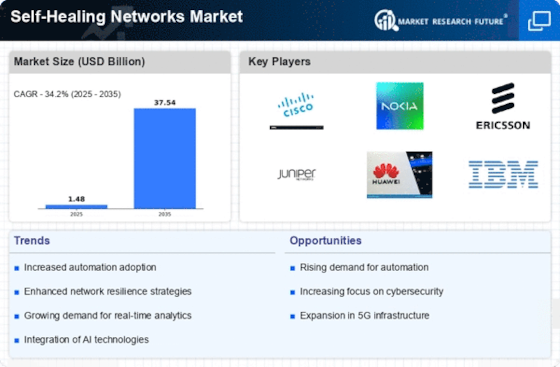
As per Market Research Future analysis, the Self-Healing Networks Market Size was estimated at 1.476 USD Billion in 2024. The Self-Healing Networks industry is projected to grow from 1.981 USD Billion in 2025 to 37.54 USD Billion by 2035, exhibiting a compound annual growth rate (CAGR) of 34.2% during the forecast period 2025 - 2035

Key Market Trends & Highlights

The Self-Healing Networks Market is poised for substantial growth driven by technological advancements and increasing network complexities.

  • The market is witnessing an increased adoption of AI technologies, enhancing network resilience and efficiency. North America remains the largest market, while Asia-Pacific is emerging as the fastest-growing region in self-healing networks. Solutions represent the largest segment, whereas services are experiencing the fastest growth due to rising demand for comprehensive support. Rising network complexity and the need for enhanced user experience are key drivers propelling market expansion.

Market Size & Forecast

2024 Market Size 1.476 (USD Billion)
2035 Market Size 37.54 (USD Billion)
CAGR (2025 - 2035) 34.2%
Largest Regional Market Share in 2024 North America

Major Players

Cisco Systems (US), Nokia (FI), Ericsson (SE), Juniper Networks (US), Huawei Technologies (CN), IBM (US), ZTE Corporation (CN), Arista Networks (US), Ciena Corporation (US)

Market Trends

The Self-Healing Networks Market is currently experiencing a transformative phase, driven by the increasing demand for resilient and adaptive network infrastructures. Organizations are recognizing the necessity of self-healing capabilities to enhance operational efficiency and minimize downtime. This trend is particularly evident in sectors such as telecommunications, healthcare, and finance, where uninterrupted service is paramount. The integration of artificial intelligence and machine learning technologies into network management systems appears to be a key factor in facilitating self-healing functionalities. These advancements enable networks to autonomously detect, diagnose, and rectify issues, thereby reducing the reliance on human intervention. Moreover, the growing complexity of network architectures, coupled with the rise of Internet of Things (IoT) devices, necessitates more sophisticated solutions. Self-healing networks seem to offer a viable approach to managing this complexity, as they can adapt to changing conditions and optimize performance in real-time. As organizations continue to invest in digital transformation initiatives, the Self-Healing Networks Market is poised for substantial growth. The emphasis on cybersecurity also plays a crucial role, as self-healing capabilities can enhance the resilience of networks against potential threats. Overall, the market is evolving rapidly, with innovations likely to shape its future landscape.

Increased Adoption of AI Technologies

The integration of artificial intelligence into network management is becoming more prevalent. AI technologies facilitate the automation of network monitoring and issue resolution, allowing for quicker responses to potential disruptions. This trend indicates a shift towards more intelligent systems that can learn from past incidents and improve their self-healing capabilities.

Focus on Cybersecurity Enhancements

As cyber threats continue to evolve, the Self-Healing Networks Market is witnessing a heightened emphasis on security measures. Self-healing networks are being designed to not only recover from failures but also to proactively defend against attacks. This dual focus on resilience and security is likely to drive further innovation in the sector.

Growing Demand for IoT Integration

The proliferation of IoT devices is creating a need for networks that can seamlessly manage vast amounts of data and connectivity. Self-healing networks are emerging as a solution to address the challenges posed by IoT, ensuring that networks remain operational and efficient despite the increasing load and complexity.

Self Healing Networks Market Market Drivers

Rising Network Complexity

The increasing complexity of network infrastructures is a primary driver for the Self-Healing Networks Market. As organizations expand their digital footprints, they encounter multifaceted network environments that require sophisticated management solutions. This complexity often leads to higher incidences of network failures and downtime, which can be detrimental to business operations. Self-healing networks, with their ability to autonomously detect and rectify issues, are becoming essential. According to recent estimates, the market for self-healing technologies is projected to grow at a compound annual growth rate of over 20% in the coming years, indicating a robust demand for solutions that can simplify network management while enhancing reliability.

Integration of Advanced Analytics

The integration of advanced analytics into network management is transforming the Self-Healing Networks Market. By utilizing data analytics, organizations can gain insights into network performance and potential vulnerabilities. This proactive approach enables the identification of issues before they escalate into significant problems. The incorporation of machine learning algorithms further enhances the self-healing capabilities, allowing networks to adapt and optimize in real-time. Industry forecasts suggest that the analytics segment within the self-healing networks market could witness a growth rate exceeding 15% annually, reflecting the increasing reliance on data-driven decision-making in network management.

Demand for Enhanced User Experience

The demand for improved user experience is a crucial factor propelling the Self-Healing Networks Market. As customer expectations rise, organizations are compelled to ensure seamless connectivity and service availability. Self-healing networks play a pivotal role in maintaining optimal performance levels, thereby enhancing user satisfaction. With the proliferation of digital services, any disruption can lead to significant customer dissatisfaction and potential revenue loss. Market analyses indicate that businesses leveraging self-healing capabilities can experience a 25% increase in customer retention rates, underscoring the importance of these technologies in fostering positive user experiences.

Increased Focus on Operational Efficiency

Organizations are increasingly prioritizing operational efficiency, which significantly influences the Self-Healing Networks Market. The need to minimize downtime and optimize resource utilization drives the adoption of self-healing technologies. By automating network recovery processes, businesses can reduce the time and costs associated with manual interventions. This trend is particularly evident in sectors such as telecommunications and finance, where uninterrupted service is critical. Reports suggest that companies implementing self-healing networks can achieve up to 30% reductions in operational costs, thereby reinforcing the value proposition of these solutions in enhancing overall efficiency.

Regulatory Compliance and Security Concerns

Regulatory compliance and security concerns are increasingly shaping the Self-Healing Networks Market. As data protection regulations become more stringent, organizations must ensure their networks are resilient against breaches and failures. Self-healing networks offer a robust solution by automatically addressing vulnerabilities and ensuring compliance with industry standards. This capability is particularly vital in sectors such as healthcare and finance, where data integrity is paramount. Market Research Future indicates that the demand for self-healing solutions in compliance-heavy industries is expected to grow significantly, as organizations seek to mitigate risks associated with non-compliance and enhance their security postures.

Market Segment Insights

By Component: Solutions (Largest) vs. Services (Fastest-Growing)

<p>In the Self-Healing Networks Market, the 'Solutions' segment has emerged as the largest component, dominating the market landscape. This segment encompasses various technological solutions designed to automate recovery processes and enhance network resilience. Solutions include advanced software platforms and hardware integrations that facilitate self-healing capabilities, ensuring minimal downtime and efficient operations across networks. Meanwhile, the 'Services' segment is witnessing rapid growth, driven by an increasing demand for deployment, maintenance, and continuous optimization of self-healing networks. As businesses strive to enhance their operational efficiency, they are increasingly turning to specialized service providers for expertise and support.</p>

<p>Self-Healing Networks: Solutions (Dominant) vs. Services (Emerging)</p>

<p>The 'Solutions' segment remains the dominant force within the Self-Healing Networks Market, characterized by a comprehensive array of products that enable automated error detection and recovery. These solutions leverage cutting-edge technologies like AI and machine learning to proactively manage network issues, significantly improving reliability and performance. On the other hand, the 'Services' segment is rapidly emerging, marked by a growing trend towards outsourcing network management and maintenance. Companies are investing in these service offerings to benefit from expert knowledge and support, effectively complementing technological solutions. Together, both segments play critical roles, as solutions provide the essential framework, while services enhance operational capabilities and efficiencies.</p>

By Network Type: Physical (Largest) vs. Hybrid (Fastest-Growing)

In the Self-Healing Networks Market, the distribution of market share among physical, virtual, and hybrid network types reveals a clear dominance of physical networks. This segment has established itself as the backbone of self-healing solutions, being widely adopted for its reliability and robustness. Virtual networks, while significant, have not captured the same level of attention, primarily due to their dependence on underlying physical infrastructure for optimal performance.

Physical (Dominant) vs. Hybrid (Emerging)

Physical networks are known for their stability and user dependence, leading the market with a robust foundation in self-healing frameworks. They are essential in environments where uptime and reliability are critical. On the other hand, hybrid networks are gaining traction as a flexible and adaptable solution, blending the strengths of both physical and virtual components. As businesses seek innovative solutions for dynamic environments, hybrid networks are emerging as a vital contributor to the self-healing landscape, ensuring efficient resource allocation and resilience against failures.

By Organization Size: Large Enterprises (Dominant) vs. SMEs (Fastest-Growing)

In the Self-Healing Networks Market, the distribution of market share indicates that large enterprises hold a significant portion of the market. Their robust infrastructure and substantial budgets enable them to adopt advanced self-healing technologies more rapidly than SMEs. As a result, large enterprises are currently the dominant players in this segment. On the other hand, SMEs are carving out a niche in this market, slowly increasing their share through innovative solutions and cost-effective offerings, addressing their need for reliability and efficiency in network management. The growth trends within the organization size segment demonstrate a clear divergence in pace between large enterprises and SMEs. Large enterprises are capitalizing on their established market presence, leveraging comprehensive network solutions to optimize operational capabilities. Meanwhile, SMEs are emerging as a fast-growing segment, driven by a shift toward <a href="digital%20transformation%20-%20https://www.marketresearchfuture.com/reports/digital-transformation-market-8685">digital transformation </a>and the need for automated network solutions to enhance their agility and competitiveness. This trend suggests that SMEs will continue to expand their footprint in the self-healing networks market over the coming years.

Large Enterprises (Dominant) vs. SMEs (Emerging)

Large enterprises are characterized by their extensive resources and established market presence, making them the dominant force in the Self-Healing Networks Market. They typically employ sophisticated self-healing technologies that allow for automated <a href="network%20management%20-%20https://www.marketresearchfuture.com/reports/network-management-market-5242">network management</a>, reducing downtime and operational costs. This segment of the market benefits from a large customer base and significant investments in infrastructure, which facilitates the adoption of cutting-edge solutions. Conversely, SMEs represent an emerging segment with a growing inclination towards agile and cost-effective self-healing network solutions. They prioritize efficiency and innovation, often seeking scalable technologies to enhance their network resilience. As SMEs continue to embrace digitalization, their potential to carve out a more substantial market share is becoming evident, highlighting an exciting dynamic within this sector.

By Deployment Mode: On-premises (Largest) vs. Cloud (Fastest-Growing)

In the Self-Healing Networks Market, the deployment mode segment is primarily characterized by two main categories: On-premises and Cloud. The On-premises deployment mode currently holds the largest market share, as organizations continue to invest in robust local infrastructure to ensure security, data management, and operational control. This preference reflects the traditional approach favored by industries with stringent compliance requirements and critical operational needs. However, Cloud deployment is gaining traction, supported by its flexibility, cost-effectiveness, and ease of deployment, making significant inroads into the market.

Deployment Mode: On-premises (Dominant) vs. Cloud (Emerging)

The On-premises deployment mode for self-healing networks remains dominant, especially for large enterprises requiring extensive customization and control over their IT systems. It offers improved security and reliability, which are paramount in sectors like finance and healthcare. In contrast, the Cloud deployment mode is emerging rapidly, driven by the increasing demand for scalability and the ability to manage networks remotely. The Cloud enables organizations to reduce infrastructure costs and leverage <a href="advanced%20analytics%20-%20https://www.marketresearchfuture.com/reports/advanced-analytics-market-5285">advanced analytics </a>and automation features that facilitate self-healing capabilities. Both deployment modes cater to different organizational needs, balancing traditional control with modern flexibility in network management.

By Application: Security Compliance Management (Largest) vs. Network Provisioning (Fastest-Growing)

Among the various applications in the Self-Healing Networks Market, Security Compliance Management holds the largest market share due to the increasing importance of maintaining network integrity and implementing security policies. Following closely is Network Provisioning, which is rapidly gaining traction as organizations strive for automated and efficient network setup processes. Other significant applications include Network Traffic Management and Policy Management, which play crucial roles in ensuring the smooth functioning of networks through effective monitoring and control.

Security Compliance Management (Dominant) vs. Network Provisioning (Emerging)

Security Compliance Management serves as a dominant force in the Self-Healing Networks Market, as it encompasses critical processes that ensure adherence to regulatory security standards and protect against vulnerabilities. This application is essential for enterprises aiming for robust <a href="network%20device%20-%20https://www.marketresearchfuture.com/reports/network-device-market-23630">network defenses </a>amidst evolving cybersecurity threats. In contrast, Network Provisioning is emerging swiftly, driven by the need for agile network configurations and scalability in various environments. As organizations adopt cloud solutions and virtualized services, the demand for automated provisioning tools is surging, leading to its designation as a fast-growing segment within the market.

By Verticals: IT and ITES (Largest) vs. Healthcare and Life Sciences (Fastest-Growing)

The Self-Healing Networks Market has a diverse landscape across various verticals, with IT and ITES holding the largest market share. This segment benefits from the increasing complexity of IT infrastructures and the need for robust, automated network management solutions. Other significant segments include BFSI, Telecom, and Media and Entertainment, each contributing to the market with specialized network healing needs. Healthcare and Life Sciences, while smaller, is emerging rapidly as organizations seek to ensure uninterrupted connectivity and secure data transmission for patient care and regulatory compliance. Growth trends in the Self-Healing Networks Market are primarily driven by the increasing demand for reliable and resilient network infrastructures. The rapid digital transformation across sectors like Telecom and Healthcare enhances the focus on automated solutions that minimize downtime. Furthermore, advancements in AI and <a href="machine%20learning%20-%20https://www.marketresearchfuture.com/reports/machine-learning-market-2494">machine learning </a>are propelling the development of self-healing technologies, offering real-time fault detection and recovery, which significantly appeals to sectors that cannot afford disruptions. Retail and Consumer Goods and Education also show promising growth as organizations recognize the necessity for efficient network operations in their ever-evolving environments.

IT and ITES (Dominant) vs. Healthcare and Life Sciences (Emerging)

The IT and ITES segment stands out as the dominant force within the Self-Healing Networks Market, driven by the necessity for agile and adaptive network solutions. Organizations within this vertical are heavily reliant on sophisticated IT infrastructures that require constant availability and resilience against disruptions. On the other hand, the Healthcare and Life Sciences segment, while emerging, is gaining momentum due to the crucial importance of secure, uninterrupted communication networks in facilitating patient care and operational efficiency. As healthcare providers increasingly adopt digital solutions, the demand for self-healing networks that can sustain operational integrity without human intervention is becoming paramount. This makes Healthcare a focal point for innovative self-healing technologies, uniquely positioning it for rapid growth.

Get more detailed insights about Self-Healing Networks Market Research Report - Global Forecast till 2035

Regional Insights

By region, the study provides the market insights into North America, Europe, Asia-Pacific and Rest of the World. The North America Self-Healing Networks Market dominated this market in 2022 (45.80%). Because it was the first to embrace self-healing networks technology, the North American region dominates the worldwide self-healing networks market in terms of revenue. Additionally, it has a strong economy that has seen significant investments in digitalized IT infrastructure. Further, the U.S. Self-Healing Networks market held the largest market share, and the Canada Self-Healing Networks market was the fastest growing market in the North America region.

Further, the major countries studied in the market report are The US, Canada, German, France, the UK, Italy, Spain, China, Japan, India, Australia, South Korea, and Brazil.

Figure 3: SELF-HEALING NETWORKS MARKET SHARE BY REGION 2022 (USD Billion)

Europe Self-Healing Networks market accounted for the healthy market share in 2022. The Europe region has been very open to adopting new and innovative technologies, and it is anticipated that it will present market growth opportunities for vendors of self-healing networks due to the region's anticipated exponential growth of data generated by IT and network devices as well as its strict laws and policies for network data security. Further, the German Self-Healing Networks market held the largest market share, and the U.K Self-Healing Networks market was the fastest growing market in the European region

The Asia Pacific Self-Healing Networks market is expected to register significant growth from 2023 to 2032. Regional market expansion will be aided by the rapid adoption of new and innovative technologies, the exponential growth in data produced by IT and network equipment, and strict laws and regulations regulating network data security. Moreover, China’s Self-Healing Networks market held the largest market share, and the Indian Self-Healing Networks market was the fastest growing market in the Asia-Pacific region.

Key Players and Competitive Insights

Leading market players are investing heavily in research and development in order to expand their product lines, which will help the Self-Healing Networks market, grow even more. Market participants are also undertaking a variety of strategic activities to expand their global footprint, with important market developments including new product launches, contractual agreements, mergers and acquisitions, higher investments, and collaboration with other organizations. To expand and survive in a more competitive and rising market climate, Self-Healing Networks Organization Size must offer cost-effective items. Manufacturing locally to minimize operational costs is one of the key business tactics used by manufacturers in the global Self-Healing Networks Organization Size to benefit clients and increase the market sector. In recent years, the Self-Healing Networks Organization Size has offered some of the most significant advantages to medicine. Major players in the Self-Healing Networks market, including Nokia, Ericsson, Fortra LLC, Versa Networks, Inc., Ivanti, IBM Corporation, Cisco Systems, Inc., VMware, Inc., CommScope, and Appnomic, are attempting to increase market demand by investing in research and development operations. Information technology (IT) goods and services are offered by International Business Machines Corp (IBM). The business creates and markets software and hardware for computers, in addition to providing infrastructure, hosting, and consulting services. Analytics, automation, blockchain, cloud computing, IT infrastructure, IT management, cybersecurity, and software development tools are all part of IBM's product range. In addition to Asia-Pacific, the corporation also conducts business in the Americas, Europe, the Middle East, and Africa. United States-based IBM is based in Armonk, New York. In partnership with Pliant.io, IBM Cloud Pak for Network Automation will enable organisations in October 2022 boost productivity, reduce total operating costs, standardise configuration and management across numerous vendors, and guarantee network security and stability. IT management software created by Fortra is intended to automate business and IT procedures. In addition to document management software that enables businesses to go paperless by digitally managing the entire lifecycle of their documents and data, the company's automation software assists in managing repetitive tasks, centralised job scheduling through robotic process automation for the desktop that is simple for any user, and helps businesses increase operational efficiency, decrease downtime, and streamline mission-critical IT and business processes. Fortra bought FileCatalyst in January 2021 to continue growing its automation and cybersecurity portfolio. FileCatalyst is a market leader in enterprise file transfer acceleration.

Key Companies in the Self Healing Networks Market include

Industry Developments

  • Q2 2024: Cisco Unveils New Self-Healing Network Platform Powered by AI Cisco announced the launch of its next-generation self-healing network platform, integrating advanced AI and machine learning to automate network monitoring, anomaly detection, and real-time remediation for enterprise clients.
  • Q1 2024: Elisa Polystar Launches Autonomous Self-Healing Network Solution for 5G Operators Elisa Polystar introduced a new autonomous self-healing network solution designed specifically for 5G mobile operators, enabling real-time detection and resolution of network faults to improve service reliability.
  • Q3 2024: CommScope Expands Self-Healing Network Capabilities with New Software Suite CommScope released a new software suite that enhances self-healing capabilities for enterprise and service provider networks, focusing on automated fault detection and network optimization.
  • Q2 2024: SolarWinds Introduces AI-Driven Self-Healing Network Management Tools SolarWinds launched a set of AI-driven network management tools that provide self-healing features, including automated incident response and predictive maintenance for IT infrastructure.
  • Q4 2024: Juniper Networks Acquires Self-Healing Network Startup NetAutoIQ Juniper Networks announced the acquisition of NetAutoIQ, a startup specializing in self-healing network automation, to strengthen its AI-driven network management portfolio.
  • Q1 2025: Nokia Partners with AWS to Deliver Self-Healing Network Solutions for Cloud Providers Nokia entered a strategic partnership with Amazon Web Services to co-develop and deliver self-healing network solutions tailored for large-scale cloud providers.
  • Q2 2025: Arista Networks Launches Self-Healing Data Center Fabric Arista Networks unveiled a new self-healing data center fabric, leveraging AI and intent-based networking to automatically detect and resolve network issues in real time.
  • Q3 2024: Cisco Announces $100 Million Investment in Self-Healing Network R&D Cisco committed $100 million to research and development focused on advancing self-healing network technologies, with an emphasis on AI-driven automation and cybersecurity.
  • Q2 2024: Fortra Debuts Self-Healing Network Security Platform Fortra launched a new self-healing network security platform that uses machine learning to automatically detect, isolate, and remediate security threats across enterprise networks.
  • Q1 2025: Huawei Opens New R&D Center for Self-Healing Network Technologies in Singapore Huawei inaugurated a new research and development center in Singapore dedicated to the advancement of self-healing network technologies for telecom and enterprise markets.
  • Q4 2024: Self-Healing Network Startup NetGuard Raises $40M Series B Funding NetGuard, a startup developing AI-powered self-healing network solutions, secured $40 million in Series B funding to accelerate product development and global expansion.
  • Q2 2025: Ericsson Wins Major Contract to Deploy Self-Healing Networks for European Telecom Consortium Ericsson secured a multi-year contract to deploy its self-healing network solutions across a consortium of leading European telecom operators, aiming to enhance network resilience and reduce downtime.

.webp

Future Outlook

Self Healing Networks Market Future Outlook

The Self-Healing Networks Market is projected to grow at a 34.2% CAGR from 2025 to 2035, driven by advancements in AI, increased network complexity, and demand for reliability.

New opportunities lie in:

  • <p>Development of AI-driven <a href="predictive%20maintenance%20-%20https://www.marketresearchfuture.com/reports/predictive-maintenance-market-2377">predictive maintenance </a>tools Integration of self-healing capabilities in IoT devices Creation of subscription-based <a href="network%20management%20-%20https://www.marketresearchfuture.com/reports/network-management-market-5242">network management </a>services</p>

By 2035, the Self-Healing Networks Market is expected to be a cornerstone of resilient network infrastructure.

Market Segmentation

Self Healing Networks Market Component Outlook

  • Solutions
  • Services

Self Healing Networks Market Verticals Outlook

  • IT and ITES
  • BFSI
  • Media and Entertainment
  • Healthcare and Life Sciences
  • Telecom
  • Retail and Consumer Goods
  • Education
  • Other Verticals

Self Healing Networks Market Application Outlook

  • Network Provisioning
  • Network Bandwidth Monitoring
  • Policy Management
  • Security Compliance Management
  • Root Cause Analysis
  • Network Traffic Management
  • Network Access Control
  • Other Applications

Self Healing Networks Market Network Type Outlook

  • Physical
  • Virtual
  • Hybrid

Self Healing Networks Market Deployment Mode Outlook

  • On-premises
  • Cloud

Self Healing Networks Market Organization Size Outlook

  • Large Enterprises
  • SMEs

Report Scope

MARKET SIZE 2024 1.476(USD Billion)
MARKET SIZE 2025 1.981(USD Billion)
MARKET SIZE 2035 37.54(USD Billion)
COMPOUND ANNUAL GROWTH RATE (CAGR) 34.2% (2025 - 2035)
REPORT COVERAGE Revenue Forecast, Competitive Landscape, Growth Factors, and Trends
BASE YEAR 2024
Market Forecast Period 2025 - 2035
Historical Data 2019 - 2024
Market Forecast Units USD Billion
Key Companies Profiled Cisco Systems (US), Nokia (FI), Ericsson (SE), Juniper Networks (US), Huawei Technologies (CN), IBM (US), ZTE Corporation (CN), Arista Networks (US), Ciena Corporation (US)
Segments Covered Component, Regions - Forecast Till 2035
Key Market Opportunities Integration of artificial intelligence enhances resilience in the Self-Healing Networks Market.
Key Market Dynamics Rising demand for automated network management drives innovation in self-healing network technologies and competitive market dynamics.
Countries Covered North America, Europe, APAC, South America, MEA

FAQs

What is the projected market valuation of the Self-Healing Networks Market by 2035?

<p>The Self-Healing Networks Market is projected to reach a valuation of 37.54 USD Billion by 2035.</p>

What was the market valuation of the Self-Healing Networks Market in 2024?

<p>In 2024, the Self-Healing Networks Market was valued at 1.476 USD Billion.</p>

What is the expected CAGR for the Self-Healing Networks Market during the forecast period 2025 - 2035?

<p>The expected CAGR for the Self-Healing Networks Market during the forecast period 2025 - 2035 is 34.2%.</p>

Which companies are considered key players in the Self-Healing Networks Market?

<p>Key players in the Self-Healing Networks Market include Cisco Systems, Nokia, Ericsson, Juniper Networks, Huawei Technologies, IBM, ZTE Corporation, Arista Networks, and Ciena Corporation.</p>

What are the main components of the Self-Healing Networks Market?

<p>The main components of the Self-Healing Networks Market include Solutions, valued at 0.885 USD Billion, and Services, valued at 0.591 USD Billion.</p>

How is the Self-Healing Networks Market segmented by organization size?

<p>The market is segmented by organization size into Large Enterprises, valued at 1.0 USD Billion, and SMEs, valued at 0.476 USD Billion.</p>

What are the different deployment modes in the Self-Healing Networks Market?

Deployment modes in the Self-Healing Networks Market include On-premises, valued at 0.885 USD Billion, and Cloud, valued at 0.591 USD Billion.

What applications are driving growth in the Self-Healing Networks Market?

Key applications driving growth include Network Provisioning, Network Bandwidth Monitoring, and Security Compliance Management, among others.

Which verticals are most involved in the Self-Healing Networks Market?

The most involved verticals include IT and ITES, BFSI, Telecom, and Healthcare, with varying valuations.

What network types are represented in the Self-Healing Networks Market?

The Self-Healing Networks Market includes Physical, Virtual, and Hybrid network types, with respective valuations.

  1. SECTION I: EXECUTIVE SUMMARY AND KEY HIGHLIGHTS
    1. | 1.1 EXECUTIVE SUMMARY
    2. | | 1.1.1 Market Overview
    3. | | 1.1.2 Key Findings
    4. | | 1.1.3 Market Segmentation
    5. | | 1.1.4 Competitive Landscape
    6. | | 1.1.5 Challenges and Opportunities
    7. | | 1.1.6 Future Outlook
  2. SECTION II: SCOPING, METHODOLOGY AND MARKET STRUCTURE
    1. | 2.1 MARKET INTRODUCTION
    2. | | 2.1.1 Definition
    3. | | 2.1.2 Scope of the study
    4. | | | 2.1.2.1 Research Objective
    5. | | | 2.1.2.2 Assumption
    6. | | | 2.1.2.3 Limitations
    7. | 2.2 RESEARCH METHODOLOGY
    8. | | 2.2.1 Overview
    9. | | 2.2.2 Data Mining
    10. | | 2.2.3 Secondary Research
    11. | | 2.2.4 Primary Research
    12. | | | 2.2.4.1 Primary Interviews and Information Gathering Process
    13. | | | 2.2.4.2 Breakdown of Primary Respondents
    14. | | 2.2.5 Forecasting Model
    15. | | 2.2.6 Market Size Estimation
    16. | | | 2.2.6.1 Bottom-Up Approach
    17. | | | 2.2.6.2 Top-Down Approach
    18. | | 2.2.7 Data Triangulation
    19. | | 2.2.8 Validation
  3. SECTION III: QUALITATIVE ANALYSIS
    1. | 3.1 MARKET DYNAMICS
    2. | | 3.1.1 Overview
    3. | | 3.1.2 Drivers
    4. | | 3.1.3 Restraints
    5. | | 3.1.4 Opportunities
    6. | 3.2 MARKET FACTOR ANALYSIS
    7. | | 3.2.1 Value chain Analysis
    8. | | 3.2.2 Porter's Five Forces Analysis
    9. | | | 3.2.2.1 Bargaining Power of Suppliers
    10. | | | 3.2.2.2 Bargaining Power of Buyers
    11. | | | 3.2.2.3 Threat of New Entrants
    12. | | | 3.2.2.4 Threat of Substitutes
    13. | | | 3.2.2.5 Intensity of Rivalry
    14. | | 3.2.3 COVID-19 Impact Analysis
    15. | | | 3.2.3.1 Market Impact Analysis
    16. | | | 3.2.3.2 Regional Impact
    17. | | | 3.2.3.3 Opportunity and Threat Analysis
  4. SECTION IV: QUANTITATIVE ANALYSIS
    1. | 4.1 Information and Communications Technology, BY Component (USD Billion)
    2. | | 4.1.1 Solutions
    3. | | 4.1.2 Services
    4. | 4.2 Information and Communications Technology, BY Network Type (USD Billion)
    5. | | 4.2.1 Physical
    6. | | 4.2.2 Virtual
    7. | | 4.2.3 Hybrid
    8. | 4.3 Information and Communications Technology, BY Organization Size (USD Billion)
    9. | | 4.3.1 Large Enterprises
    10. | | 4.3.2 SMEs
    11. | 4.4 Information and Communications Technology, BY Deployment Mode (USD Billion)
    12. | | 4.4.1 On-premises
    13. | | 4.4.2 Cloud
    14. | 4.5 Information and Communications Technology, BY Application (USD Billion)
    15. | | 4.5.1 Network Provisioning
    16. | | 4.5.2 Network Bandwidth Monitoring
    17. | | 4.5.3 Policy Management
    18. | | 4.5.4 Security Compliance Management
    19. | | 4.5.5 Root Cause Analysis
    20. | | 4.5.6 Network Traffic Management
    21. | | 4.5.7 Network Access Control
    22. | | 4.5.8 Other Applications
    23. | 4.6 Information and Communications Technology, BY Verticals (USD Billion)
    24. | | 4.6.1 IT and ITES
    25. | | 4.6.2 BFSI
    26. | | 4.6.3 Media and Entertainment
    27. | | 4.6.4 Healthcare and Life Sciences
    28. | | 4.6.5 Telecom
    29. | | 4.6.6 Retail and Consumer Goods
    30. | | 4.6.7 Education
    31. | | 4.6.8 Other Verticals
    32. | 4.7 Information and Communications Technology, BY Region (USD Billion)
    33. | | 4.7.1 North America
    34. | | | 4.7.1.1 US
    35. | | | 4.7.1.2 Canada
    36. | | 4.7.2 Europe
    37. | | | 4.7.2.1 Germany
    38. | | | 4.7.2.2 UK
    39. | | | 4.7.2.3 France
    40. | | | 4.7.2.4 Russia
    41. | | | 4.7.2.5 Italy
    42. | | | 4.7.2.6 Spain
    43. | | | 4.7.2.7 Rest of Europe
    44. | | 4.7.3 APAC
    45. | | | 4.7.3.1 China
    46. | | | 4.7.3.2 India
    47. | | | 4.7.3.3 Japan
    48. | | | 4.7.3.4 South Korea
    49. | | | 4.7.3.5 Malaysia
    50. | | | 4.7.3.6 Thailand
    51. | | | 4.7.3.7 Indonesia
    52. | | | 4.7.3.8 Rest of APAC
    53. | | 4.7.4 South America
    54. | | | 4.7.4.1 Brazil
    55. | | | 4.7.4.2 Mexico
    56. | | | 4.7.4.3 Argentina
    57. | | | 4.7.4.4 Rest of South America
    58. | | 4.7.5 MEA
    59. | | | 4.7.5.1 GCC Countries
    60. | | | 4.7.5.2 South Africa
    61. | | | 4.7.5.3 Rest of MEA
  5. SECTION V: COMPETITIVE ANALYSIS
    1. | 5.1 Competitive Landscape
    2. | | 5.1.1 Overview
    3. | | 5.1.2 Competitive Analysis
    4. | | 5.1.3 Market share Analysis
    5. | | 5.1.4 Major Growth Strategy in the Information and Communications Technology
    6. | | 5.1.5 Competitive Benchmarking
    7. | | 5.1.6 Leading Players in Terms of Number of Developments in the Information and Communications Technology
    8. | | 5.1.7 Key developments and growth strategies
    9. | | | 5.1.7.1 New Product Launch/Service Deployment
    10. | | | 5.1.7.2 Merger & Acquisitions
    11. | | | 5.1.7.3 Joint Ventures
    12. | | 5.1.8 Major Players Financial Matrix
    13. | | | 5.1.8.1 Sales and Operating Income
    14. | | | 5.1.8.2 Major Players R&D Expenditure. 2023
    15. | 5.2 Company Profiles
    16. | | 5.2.1 Cisco Systems (US)
    17. | | | 5.2.1.1 Financial Overview
    18. | | | 5.2.1.2 Products Offered
    19. | | | 5.2.1.3 Key Developments
    20. | | | 5.2.1.4 SWOT Analysis
    21. | | | 5.2.1.5 Key Strategies
    22. | | 5.2.2 Nokia (FI)
    23. | | | 5.2.2.1 Financial Overview
    24. | | | 5.2.2.2 Products Offered
    25. | | | 5.2.2.3 Key Developments
    26. | | | 5.2.2.4 SWOT Analysis
    27. | | | 5.2.2.5 Key Strategies
    28. | | 5.2.3 Ericsson (SE)
    29. | | | 5.2.3.1 Financial Overview
    30. | | | 5.2.3.2 Products Offered
    31. | | | 5.2.3.3 Key Developments
    32. | | | 5.2.3.4 SWOT Analysis
    33. | | | 5.2.3.5 Key Strategies
    34. | | 5.2.4 Juniper Networks (US)
    35. | | | 5.2.4.1 Financial Overview
    36. | | | 5.2.4.2 Products Offered
    37. | | | 5.2.4.3 Key Developments
    38. | | | 5.2.4.4 SWOT Analysis
    39. | | | 5.2.4.5 Key Strategies
    40. | | 5.2.5 Huawei Technologies (CN)
    41. | | | 5.2.5.1 Financial Overview
    42. | | | 5.2.5.2 Products Offered
    43. | | | 5.2.5.3 Key Developments
    44. | | | 5.2.5.4 SWOT Analysis
    45. | | | 5.2.5.5 Key Strategies
    46. | | 5.2.6 IBM (US)
    47. | | | 5.2.6.1 Financial Overview
    48. | | | 5.2.6.2 Products Offered
    49. | | | 5.2.6.3 Key Developments
    50. | | | 5.2.6.4 SWOT Analysis
    51. | | | 5.2.6.5 Key Strategies
    52. | | 5.2.7 ZTE Corporation (CN)
    53. | | | 5.2.7.1 Financial Overview
    54. | | | 5.2.7.2 Products Offered
    55. | | | 5.2.7.3 Key Developments
    56. | | | 5.2.7.4 SWOT Analysis
    57. | | | 5.2.7.5 Key Strategies
    58. | | 5.2.8 Arista Networks (US)
    59. | | | 5.2.8.1 Financial Overview
    60. | | | 5.2.8.2 Products Offered
    61. | | | 5.2.8.3 Key Developments
    62. | | | 5.2.8.4 SWOT Analysis
    63. | | | 5.2.8.5 Key Strategies
    64. | | 5.2.9 Ciena Corporation (US)
    65. | | | 5.2.9.1 Financial Overview
    66. | | | 5.2.9.2 Products Offered
    67. | | | 5.2.9.3 Key Developments
    68. | | | 5.2.9.4 SWOT Analysis
    69. | | | 5.2.9.5 Key Strategies
    70. | 5.3 Appendix
    71. | | 5.3.1 References
    72. | | 5.3.2 Related Reports
  6. LIST OF FIGURES
    1. | 6.1 MARKET SYNOPSIS
    2. | 6.2 NORTH AMERICA MARKET ANALYSIS
    3. | 6.3 US MARKET ANALYSIS BY COMPONENT
    4. | 6.4 US MARKET ANALYSIS BY NETWORK TYPE
    5. | 6.5 US MARKET ANALYSIS BY ORGANIZATION SIZE
    6. | 6.6 US MARKET ANALYSIS BY DEPLOYMENT MODE
    7. | 6.7 US MARKET ANALYSIS BY APPLICATION
    8. | 6.8 US MARKET ANALYSIS BY VERTICALS
    9. | 6.9 CANADA MARKET ANALYSIS BY COMPONENT
    10. | 6.10 CANADA MARKET ANALYSIS BY NETWORK TYPE
    11. | 6.11 CANADA MARKET ANALYSIS BY ORGANIZATION SIZE
    12. | 6.12 CANADA MARKET ANALYSIS BY DEPLOYMENT MODE
    13. | 6.13 CANADA MARKET ANALYSIS BY APPLICATION
    14. | 6.14 CANADA MARKET ANALYSIS BY VERTICALS
    15. | 6.15 EUROPE MARKET ANALYSIS
    16. | 6.16 GERMANY MARKET ANALYSIS BY COMPONENT
    17. | 6.17 GERMANY MARKET ANALYSIS BY NETWORK TYPE
    18. | 6.18 GERMANY MARKET ANALYSIS BY ORGANIZATION SIZE
    19. | 6.19 GERMANY MARKET ANALYSIS BY DEPLOYMENT MODE
    20. | 6.20 GERMANY MARKET ANALYSIS BY APPLICATION
    21. | 6.21 GERMANY MARKET ANALYSIS BY VERTICALS
    22. | 6.22 UK MARKET ANALYSIS BY COMPONENT
    23. | 6.23 UK MARKET ANALYSIS BY NETWORK TYPE
    24. | 6.24 UK MARKET ANALYSIS BY ORGANIZATION SIZE
    25. | 6.25 UK MARKET ANALYSIS BY DEPLOYMENT MODE
    26. | 6.26 UK MARKET ANALYSIS BY APPLICATION
    27. | 6.27 UK MARKET ANALYSIS BY VERTICALS
    28. | 6.28 FRANCE MARKET ANALYSIS BY COMPONENT
    29. | 6.29 FRANCE MARKET ANALYSIS BY NETWORK TYPE
    30. | 6.30 FRANCE MARKET ANALYSIS BY ORGANIZATION SIZE
    31. | 6.31 FRANCE MARKET ANALYSIS BY DEPLOYMENT MODE
    32. | 6.32 FRANCE MARKET ANALYSIS BY APPLICATION
    33. | 6.33 FRANCE MARKET ANALYSIS BY VERTICALS
    34. | 6.34 RUSSIA MARKET ANALYSIS BY COMPONENT
    35. | 6.35 RUSSIA MARKET ANALYSIS BY NETWORK TYPE
    36. | 6.36 RUSSIA MARKET ANALYSIS BY ORGANIZATION SIZE
    37. | 6.37 RUSSIA MARKET ANALYSIS BY DEPLOYMENT MODE
    38. | 6.38 RUSSIA MARKET ANALYSIS BY APPLICATION
    39. | 6.39 RUSSIA MARKET ANALYSIS BY VERTICALS
    40. | 6.40 ITALY MARKET ANALYSIS BY COMPONENT
    41. | 6.41 ITALY MARKET ANALYSIS BY NETWORK TYPE
    42. | 6.42 ITALY MARKET ANALYSIS BY ORGANIZATION SIZE
    43. | 6.43 ITALY MARKET ANALYSIS BY DEPLOYMENT MODE
    44. | 6.44 ITALY MARKET ANALYSIS BY APPLICATION
    45. | 6.45 ITALY MARKET ANALYSIS BY VERTICALS
    46. | 6.46 SPAIN MARKET ANALYSIS BY COMPONENT
    47. | 6.47 SPAIN MARKET ANALYSIS BY NETWORK TYPE
    48. | 6.48 SPAIN MARKET ANALYSIS BY ORGANIZATION SIZE
    49. | 6.49 SPAIN MARKET ANALYSIS BY DEPLOYMENT MODE
    50. | 6.50 SPAIN MARKET ANALYSIS BY APPLICATION
    51. | 6.51 SPAIN MARKET ANALYSIS BY VERTICALS
    52. | 6.52 REST OF EUROPE MARKET ANALYSIS BY COMPONENT
    53. | 6.53 REST OF EUROPE MARKET ANALYSIS BY NETWORK TYPE
    54. | 6.54 REST OF EUROPE MARKET ANALYSIS BY ORGANIZATION SIZE
    55. | 6.55 REST OF EUROPE MARKET ANALYSIS BY DEPLOYMENT MODE
    56. | 6.56 REST OF EUROPE MARKET ANALYSIS BY APPLICATION
    57. | 6.57 REST OF EUROPE MARKET ANALYSIS BY VERTICALS
    58. | 6.58 APAC MARKET ANALYSIS
    59. | 6.59 CHINA MARKET ANALYSIS BY COMPONENT
    60. | 6.60 CHINA MARKET ANALYSIS BY NETWORK TYPE
    61. | 6.61 CHINA MARKET ANALYSIS BY ORGANIZATION SIZE
    62. | 6.62 CHINA MARKET ANALYSIS BY DEPLOYMENT MODE
    63. | 6.63 CHINA MARKET ANALYSIS BY APPLICATION
    64. | 6.64 CHINA MARKET ANALYSIS BY VERTICALS
    65. | 6.65 INDIA MARKET ANALYSIS BY COMPONENT
    66. | 6.66 INDIA MARKET ANALYSIS BY NETWORK TYPE
    67. | 6.67 INDIA MARKET ANALYSIS BY ORGANIZATION SIZE
    68. | 6.68 INDIA MARKET ANALYSIS BY DEPLOYMENT MODE
    69. | 6.69 INDIA MARKET ANALYSIS BY APPLICATION
    70. | 6.70 INDIA MARKET ANALYSIS BY VERTICALS
    71. | 6.71 JAPAN MARKET ANALYSIS BY COMPONENT
    72. | 6.72 JAPAN MARKET ANALYSIS BY NETWORK TYPE
    73. | 6.73 JAPAN MARKET ANALYSIS BY ORGANIZATION SIZE
    74. | 6.74 JAPAN MARKET ANALYSIS BY DEPLOYMENT MODE
    75. | 6.75 JAPAN MARKET ANALYSIS BY APPLICATION
    76. | 6.76 JAPAN MARKET ANALYSIS BY VERTICALS
    77. | 6.77 SOUTH KOREA MARKET ANALYSIS BY COMPONENT
    78. | 6.78 SOUTH KOREA MARKET ANALYSIS BY NETWORK TYPE
    79. | 6.79 SOUTH KOREA MARKET ANALYSIS BY ORGANIZATION SIZE
    80. | 6.80 SOUTH KOREA MARKET ANALYSIS BY DEPLOYMENT MODE
    81. | 6.81 SOUTH KOREA MARKET ANALYSIS BY APPLICATION
    82. | 6.82 SOUTH KOREA MARKET ANALYSIS BY VERTICALS
    83. | 6.83 MALAYSIA MARKET ANALYSIS BY COMPONENT
    84. | 6.84 MALAYSIA MARKET ANALYSIS BY NETWORK TYPE
    85. | 6.85 MALAYSIA MARKET ANALYSIS BY ORGANIZATION SIZE
    86. | 6.86 MALAYSIA MARKET ANALYSIS BY DEPLOYMENT MODE
    87. | 6.87 MALAYSIA MARKET ANALYSIS BY APPLICATION
    88. | 6.88 MALAYSIA MARKET ANALYSIS BY VERTICALS
    89. | 6.89 THAILAND MARKET ANALYSIS BY COMPONENT
    90. | 6.90 THAILAND MARKET ANALYSIS BY NETWORK TYPE
    91. | 6.91 THAILAND MARKET ANALYSIS BY ORGANIZATION SIZE
    92. | 6.92 THAILAND MARKET ANALYSIS BY DEPLOYMENT MODE
    93. | 6.93 THAILAND MARKET ANALYSIS BY APPLICATION
    94. | 6.94 THAILAND MARKET ANALYSIS BY VERTICALS
    95. | 6.95 INDONESIA MARKET ANALYSIS BY COMPONENT
    96. | 6.96 INDONESIA MARKET ANALYSIS BY NETWORK TYPE
    97. | 6.97 INDONESIA MARKET ANALYSIS BY ORGANIZATION SIZE
    98. | 6.98 INDONESIA MARKET ANALYSIS BY DEPLOYMENT MODE
    99. | 6.99 INDONESIA MARKET ANALYSIS BY APPLICATION
    100. | 6.100 INDONESIA MARKET ANALYSIS BY VERTICALS
    101. | 6.101 REST OF APAC MARKET ANALYSIS BY COMPONENT
    102. | 6.102 REST OF APAC MARKET ANALYSIS BY NETWORK TYPE
    103. | 6.103 REST OF APAC MARKET ANALYSIS BY ORGANIZATION SIZE
    104. | 6.104 REST OF APAC MARKET ANALYSIS BY DEPLOYMENT MODE
    105. | 6.105 REST OF APAC MARKET ANALYSIS BY APPLICATION
    106. | 6.106 REST OF APAC MARKET ANALYSIS BY VERTICALS
    107. | 6.107 SOUTH AMERICA MARKET ANALYSIS
    108. | 6.108 BRAZIL MARKET ANALYSIS BY COMPONENT
    109. | 6.109 BRAZIL MARKET ANALYSIS BY NETWORK TYPE
    110. | 6.110 BRAZIL MARKET ANALYSIS BY ORGANIZATION SIZE
    111. | 6.111 BRAZIL MARKET ANALYSIS BY DEPLOYMENT MODE
    112. | 6.112 BRAZIL MARKET ANALYSIS BY APPLICATION
    113. | 6.113 BRAZIL MARKET ANALYSIS BY VERTICALS
    114. | 6.114 MEXICO MARKET ANALYSIS BY COMPONENT
    115. | 6.115 MEXICO MARKET ANALYSIS BY NETWORK TYPE
    116. | 6.116 MEXICO MARKET ANALYSIS BY ORGANIZATION SIZE
    117. | 6.117 MEXICO MARKET ANALYSIS BY DEPLOYMENT MODE
    118. | 6.118 MEXICO MARKET ANALYSIS BY APPLICATION
    119. | 6.119 MEXICO MARKET ANALYSIS BY VERTICALS
    120. | 6.120 ARGENTINA MARKET ANALYSIS BY COMPONENT
    121. | 6.121 ARGENTINA MARKET ANALYSIS BY NETWORK TYPE
    122. | 6.122 ARGENTINA MARKET ANALYSIS BY ORGANIZATION SIZE
    123. | 6.123 ARGENTINA MARKET ANALYSIS BY DEPLOYMENT MODE
    124. | 6.124 ARGENTINA MARKET ANALYSIS BY APPLICATION
    125. | 6.125 ARGENTINA MARKET ANALYSIS BY VERTICALS
    126. | 6.126 REST OF SOUTH AMERICA MARKET ANALYSIS BY COMPONENT
    127. | 6.127 REST OF SOUTH AMERICA MARKET ANALYSIS BY NETWORK TYPE
    128. | 6.128 REST OF SOUTH AMERICA MARKET ANALYSIS BY ORGANIZATION SIZE
    129. | 6.129 REST OF SOUTH AMERICA MARKET ANALYSIS BY DEPLOYMENT MODE
    130. | 6.130 REST OF SOUTH AMERICA MARKET ANALYSIS BY APPLICATION
    131. | 6.131 REST OF SOUTH AMERICA MARKET ANALYSIS BY VERTICALS
    132. | 6.132 MEA MARKET ANALYSIS
    133. | 6.133 GCC COUNTRIES MARKET ANALYSIS BY COMPONENT
    134. | 6.134 GCC COUNTRIES MARKET ANALYSIS BY NETWORK TYPE
    135. | 6.135 GCC COUNTRIES MARKET ANALYSIS BY ORGANIZATION SIZE
    136. | 6.136 GCC COUNTRIES MARKET ANALYSIS BY DEPLOYMENT MODE
    137. | 6.137 GCC COUNTRIES MARKET ANALYSIS BY APPLICATION
    138. | 6.138 GCC COUNTRIES MARKET ANALYSIS BY VERTICALS
    139. | 6.139 SOUTH AFRICA MARKET ANALYSIS BY COMPONENT
    140. | 6.140 SOUTH AFRICA MARKET ANALYSIS BY NETWORK TYPE
    141. | 6.141 SOUTH AFRICA MARKET ANALYSIS BY ORGANIZATION SIZE
    142. | 6.142 SOUTH AFRICA MARKET ANALYSIS BY DEPLOYMENT MODE
    143. | 6.143 SOUTH AFRICA MARKET ANALYSIS BY APPLICATION
    144. | 6.144 SOUTH AFRICA MARKET ANALYSIS BY VERTICALS
    145. | 6.145 REST OF MEA MARKET ANALYSIS BY COMPONENT
    146. | 6.146 REST OF MEA MARKET ANALYSIS BY NETWORK TYPE
    147. | 6.147 REST OF MEA MARKET ANALYSIS BY ORGANIZATION SIZE
    148. | 6.148 REST OF MEA MARKET ANALYSIS BY DEPLOYMENT MODE
    149. | 6.149 REST OF MEA MARKET ANALYSIS BY APPLICATION
    150. | 6.150 REST OF MEA MARKET ANALYSIS BY VERTICALS
    151. | 6.151 KEY BUYING CRITERIA OF INFORMATION AND COMMUNICATIONS TECHNOLOGY
    152. | 6.152 RESEARCH PROCESS OF MRFR
    153. | 6.153 DRO ANALYSIS OF INFORMATION AND COMMUNICATIONS TECHNOLOGY
    154. | 6.154 DRIVERS IMPACT ANALYSIS: INFORMATION AND COMMUNICATIONS TECHNOLOGY
    155. | 6.155 RESTRAINTS IMPACT ANALYSIS: INFORMATION AND COMMUNICATIONS TECHNOLOGY
    156. | 6.156 SUPPLY / VALUE CHAIN: INFORMATION AND COMMUNICATIONS TECHNOLOGY
    157. | 6.157 INFORMATION AND COMMUNICATIONS TECHNOLOGY, BY COMPONENT, 2024 (% SHARE)
    158. | 6.158 INFORMATION AND COMMUNICATIONS TECHNOLOGY, BY COMPONENT, 2024 TO 2035 (USD Billion)
    159. | 6.159 INFORMATION AND COMMUNICATIONS TECHNOLOGY, BY NETWORK TYPE, 2024 (% SHARE)
    160. | 6.160 INFORMATION AND COMMUNICATIONS TECHNOLOGY, BY NETWORK TYPE, 2024 TO 2035 (USD Billion)
    161. | 6.161 INFORMATION AND COMMUNICATIONS TECHNOLOGY, BY ORGANIZATION SIZE, 2024 (% SHARE)
    162. | 6.162 INFORMATION AND COMMUNICATIONS TECHNOLOGY, BY ORGANIZATION SIZE, 2024 TO 2035 (USD Billion)
    163. | 6.163 INFORMATION AND COMMUNICATIONS TECHNOLOGY, BY DEPLOYMENT MODE, 2024 (% SHARE)
    164. | 6.164 INFORMATION AND COMMUNICATIONS TECHNOLOGY, BY DEPLOYMENT MODE, 2024 TO 2035 (USD Billion)
    165. | 6.165 INFORMATION AND COMMUNICATIONS TECHNOLOGY, BY APPLICATION, 2024 (% SHARE)
    166. | 6.166 INFORMATION AND COMMUNICATIONS TECHNOLOGY, BY APPLICATION, 2024 TO 2035 (USD Billion)
    167. | 6.167 INFORMATION AND COMMUNICATIONS TECHNOLOGY, BY VERTICALS, 2024 (% SHARE)
    168. | 6.168 INFORMATION AND COMMUNICATIONS TECHNOLOGY, BY VERTICALS, 2024 TO 2035 (USD Billion)
    169. | 6.169 BENCHMARKING OF MAJOR COMPETITORS
  7. LIST OF TABLES
    1. | 7.1 LIST OF ASSUMPTIONS
    2. | | 7.1.1
    3. | 7.2 North America MARKET SIZE ESTIMATES; FORECAST
    4. | | 7.2.1 BY COMPONENT, 2025-2035 (USD Billion)
    5. | | 7.2.2 BY NETWORK TYPE, 2025-2035 (USD Billion)
    6. | | 7.2.3 BY ORGANIZATION SIZE, 2025-2035 (USD Billion)
    7. | | 7.2.4 BY DEPLOYMENT MODE, 2025-2035 (USD Billion)
    8. | | 7.2.5 BY APPLICATION, 2025-2035 (USD Billion)
    9. | | 7.2.6 BY VERTICALS, 2025-2035 (USD Billion)
    10. | 7.3 US MARKET SIZE ESTIMATES; FORECAST
    11. | | 7.3.1 BY COMPONENT, 2025-2035 (USD Billion)
    12. | | 7.3.2 BY NETWORK TYPE, 2025-2035 (USD Billion)
    13. | | 7.3.3 BY ORGANIZATION SIZE, 2025-2035 (USD Billion)
    14. | | 7.3.4 BY DEPLOYMENT MODE, 2025-2035 (USD Billion)
    15. | | 7.3.5 BY APPLICATION, 2025-2035 (USD Billion)
    16. | | 7.3.6 BY VERTICALS, 2025-2035 (USD Billion)
    17. | 7.4 Canada MARKET SIZE ESTIMATES; FORECAST
    18. | | 7.4.1 BY COMPONENT, 2025-2035 (USD Billion)
    19. | | 7.4.2 BY NETWORK TYPE, 2025-2035 (USD Billion)
    20. | | 7.4.3 BY ORGANIZATION SIZE, 2025-2035 (USD Billion)
    21. | | 7.4.4 BY DEPLOYMENT MODE, 2025-2035 (USD Billion)
    22. | | 7.4.5 BY APPLICATION, 2025-2035 (USD Billion)
    23. | | 7.4.6 BY VERTICALS, 2025-2035 (USD Billion)
    24. | 7.5 Europe MARKET SIZE ESTIMATES; FORECAST
    25. | | 7.5.1 BY COMPONENT, 2025-2035 (USD Billion)
    26. | | 7.5.2 BY NETWORK TYPE, 2025-2035 (USD Billion)
    27. | | 7.5.3 BY ORGANIZATION SIZE, 2025-2035 (USD Billion)
    28. | | 7.5.4 BY DEPLOYMENT MODE, 2025-2035 (USD Billion)
    29. | | 7.5.5 BY APPLICATION, 2025-2035 (USD Billion)
    30. | | 7.5.6 BY VERTICALS, 2025-2035 (USD Billion)
    31. | 7.6 Germany MARKET SIZE ESTIMATES; FORECAST
    32. | | 7.6.1 BY COMPONENT, 2025-2035 (USD Billion)
    33. | | 7.6.2 BY NETWORK TYPE, 2025-2035 (USD Billion)
    34. | | 7.6.3 BY ORGANIZATION SIZE, 2025-2035 (USD Billion)
    35. | | 7.6.4 BY DEPLOYMENT MODE, 2025-2035 (USD Billion)
    36. | | 7.6.5 BY APPLICATION, 2025-2035 (USD Billion)
    37. | | 7.6.6 BY VERTICALS, 2025-2035 (USD Billion)
    38. | 7.7 UK MARKET SIZE ESTIMATES; FORECAST
    39. | | 7.7.1 BY COMPONENT, 2025-2035 (USD Billion)
    40. | | 7.7.2 BY NETWORK TYPE, 2025-2035 (USD Billion)
    41. | | 7.7.3 BY ORGANIZATION SIZE, 2025-2035 (USD Billion)
    42. | | 7.7.4 BY DEPLOYMENT MODE, 2025-2035 (USD Billion)
    43. | | 7.7.5 BY APPLICATION, 2025-2035 (USD Billion)
    44. | | 7.7.6 BY VERTICALS, 2025-2035 (USD Billion)
    45. | 7.8 France MARKET SIZE ESTIMATES; FORECAST
    46. | | 7.8.1 BY COMPONENT, 2025-2035 (USD Billion)
    47. | | 7.8.2 BY NETWORK TYPE, 2025-2035 (USD Billion)
    48. | | 7.8.3 BY ORGANIZATION SIZE, 2025-2035 (USD Billion)
    49. | | 7.8.4 BY DEPLOYMENT MODE, 2025-2035 (USD Billion)
    50. | | 7.8.5 BY APPLICATION, 2025-2035 (USD Billion)
    51. | | 7.8.6 BY VERTICALS, 2025-2035 (USD Billion)
    52. | 7.9 Russia MARKET SIZE ESTIMATES; FORECAST
    53. | | 7.9.1 BY COMPONENT, 2025-2035 (USD Billion)
    54. | | 7.9.2 BY NETWORK TYPE, 2025-2035 (USD Billion)
    55. | | 7.9.3 BY ORGANIZATION SIZE, 2025-2035 (USD Billion)
    56. | | 7.9.4 BY DEPLOYMENT MODE, 2025-2035 (USD Billion)
    57. | | 7.9.5 BY APPLICATION, 2025-2035 (USD Billion)
    58. | | 7.9.6 BY VERTICALS, 2025-2035 (USD Billion)
    59. | 7.10 Italy MARKET SIZE ESTIMATES; FORECAST
    60. | | 7.10.1 BY COMPONENT, 2025-2035 (USD Billion)
    61. | | 7.10.2 BY NETWORK TYPE, 2025-2035 (USD Billion)
    62. | | 7.10.3 BY ORGANIZATION SIZE, 2025-2035 (USD Billion)
    63. | | 7.10.4 BY DEPLOYMENT MODE, 2025-2035 (USD Billion)
    64. | | 7.10.5 BY APPLICATION, 2025-2035 (USD Billion)
    65. | | 7.10.6 BY VERTICALS, 2025-2035 (USD Billion)
    66. | 7.11 Spain MARKET SIZE ESTIMATES; FORECAST
    67. | | 7.11.1 BY COMPONENT, 2025-2035 (USD Billion)
    68. | | 7.11.2 BY NETWORK TYPE, 2025-2035 (USD Billion)
    69. | | 7.11.3 BY ORGANIZATION SIZE, 2025-2035 (USD Billion)
    70. | | 7.11.4 BY DEPLOYMENT MODE, 2025-2035 (USD Billion)
    71. | | 7.11.5 BY APPLICATION, 2025-2035 (USD Billion)
    72. | | 7.11.6 BY VERTICALS, 2025-2035 (USD Billion)
    73. | 7.12 Rest of Europe MARKET SIZE ESTIMATES; FORECAST
    74. | | 7.12.1 BY COMPONENT, 2025-2035 (USD Billion)
    75. | | 7.12.2 BY NETWORK TYPE, 2025-2035 (USD Billion)
    76. | | 7.12.3 BY ORGANIZATION SIZE, 2025-2035 (USD Billion)
    77. | | 7.12.4 BY DEPLOYMENT MODE, 2025-2035 (USD Billion)
    78. | | 7.12.5 BY APPLICATION, 2025-2035 (USD Billion)
    79. | | 7.12.6 BY VERTICALS, 2025-2035 (USD Billion)
    80. | 7.13 APAC MARKET SIZE ESTIMATES; FORECAST
    81. | | 7.13.1 BY COMPONENT, 2025-2035 (USD Billion)
    82. | | 7.13.2 BY NETWORK TYPE, 2025-2035 (USD Billion)
    83. | | 7.13.3 BY ORGANIZATION SIZE, 2025-2035 (USD Billion)
    84. | | 7.13.4 BY DEPLOYMENT MODE, 2025-2035 (USD Billion)
    85. | | 7.13.5 BY APPLICATION, 2025-2035 (USD Billion)
    86. | | 7.13.6 BY VERTICALS, 2025-2035 (USD Billion)
    87. | 7.14 China MARKET SIZE ESTIMATES; FORECAST
    88. | | 7.14.1 BY COMPONENT, 2025-2035 (USD Billion)
    89. | | 7.14.2 BY NETWORK TYPE, 2025-2035 (USD Billion)
    90. | | 7.14.3 BY ORGANIZATION SIZE, 2025-2035 (USD Billion)
    91. | | 7.14.4 BY DEPLOYMENT MODE, 2025-2035 (USD Billion)
    92. | | 7.14.5 BY APPLICATION, 2025-2035 (USD Billion)
    93. | | 7.14.6 BY VERTICALS, 2025-2035 (USD Billion)
    94. | 7.15 India MARKET SIZE ESTIMATES; FORECAST
    95. | | 7.15.1 BY COMPONENT, 2025-2035 (USD Billion)
    96. | | 7.15.2 BY NETWORK TYPE, 2025-2035 (USD Billion)
    97. | | 7.15.3 BY ORGANIZATION SIZE, 2025-2035 (USD Billion)
    98. | | 7.15.4 BY DEPLOYMENT MODE, 2025-2035 (USD Billion)
    99. | | 7.15.5 BY APPLICATION, 2025-2035 (USD Billion)
    100. | | 7.15.6 BY VERTICALS, 2025-2035 (USD Billion)
    101. | 7.16 Japan MARKET SIZE ESTIMATES; FORECAST
    102. | | 7.16.1 BY COMPONENT, 2025-2035 (USD Billion)
    103. | | 7.16.2 BY NETWORK TYPE, 2025-2035 (USD Billion)
    104. | | 7.16.3 BY ORGANIZATION SIZE, 2025-2035 (USD Billion)
    105. | | 7.16.4 BY DEPLOYMENT MODE, 2025-2035 (USD Billion)
    106. | | 7.16.5 BY APPLICATION, 2025-2035 (USD Billion)
    107. | | 7.16.6 BY VERTICALS, 2025-2035 (USD Billion)
    108. | 7.17 South Korea MARKET SIZE ESTIMATES; FORECAST
    109. | | 7.17.1 BY COMPONENT, 2025-2035 (USD Billion)
    110. | | 7.17.2 BY NETWORK TYPE, 2025-2035 (USD Billion)
    111. | | 7.17.3 BY ORGANIZATION SIZE, 2025-2035 (USD Billion)
    112. | | 7.17.4 BY DEPLOYMENT MODE, 2025-2035 (USD Billion)
    113. | | 7.17.5 BY APPLICATION, 2025-2035 (USD Billion)
    114. | | 7.17.6 BY VERTICALS, 2025-2035 (USD Billion)
    115. | 7.18 Malaysia MARKET SIZE ESTIMATES; FORECAST
    116. | | 7.18.1 BY COMPONENT, 2025-2035 (USD Billion)
    117. | | 7.18.2 BY NETWORK TYPE, 2025-2035 (USD Billion)
    118. | | 7.18.3 BY ORGANIZATION SIZE, 2025-2035 (USD Billion)
    119. | | 7.18.4 BY DEPLOYMENT MODE, 2025-2035 (USD Billion)
    120. | | 7.18.5 BY APPLICATION, 2025-2035 (USD Billion)
    121. | | 7.18.6 BY VERTICALS, 2025-2035 (USD Billion)
    122. | 7.19 Thailand MARKET SIZE ESTIMATES; FORECAST
    123. | | 7.19.1 BY COMPONENT, 2025-2035 (USD Billion)
    124. | | 7.19.2 BY NETWORK TYPE, 2025-2035 (USD Billion)
    125. | | 7.19.3 BY ORGANIZATION SIZE, 2025-2035 (USD Billion)
    126. | | 7.19.4 BY DEPLOYMENT MODE, 2025-2035 (USD Billion)
    127. | | 7.19.5 BY APPLICATION, 2025-2035 (USD Billion)
    128. | | 7.19.6 BY VERTICALS, 2025-2035 (USD Billion)
    129. | 7.20 Indonesia MARKET SIZE ESTIMATES; FORECAST
    130. | | 7.20.1 BY COMPONENT, 2025-2035 (USD Billion)
    131. | | 7.20.2 BY NETWORK TYPE, 2025-2035 (USD Billion)
    132. | | 7.20.3 BY ORGANIZATION SIZE, 2025-2035 (USD Billion)
    133. | | 7.20.4 BY DEPLOYMENT MODE, 2025-2035 (USD Billion)
    134. | | 7.20.5 BY APPLICATION, 2025-2035 (USD Billion)
    135. | | 7.20.6 BY VERTICALS, 2025-2035 (USD Billion)
    136. | 7.21 Rest of APAC MARKET SIZE ESTIMATES; FORECAST
    137. | | 7.21.1 BY COMPONENT, 2025-2035 (USD Billion)
    138. | | 7.21.2 BY NETWORK TYPE, 2025-2035 (USD Billion)
    139. | | 7.21.3 BY ORGANIZATION SIZE, 2025-2035 (USD Billion)
    140. | | 7.21.4 BY DEPLOYMENT MODE, 2025-2035 (USD Billion)
    141. | | 7.21.5 BY APPLICATION, 2025-2035 (USD Billion)
    142. | | 7.21.6 BY VERTICALS, 2025-2035 (USD Billion)
    143. | 7.22 South America MARKET SIZE ESTIMATES; FORECAST
    144. | | 7.22.1 BY COMPONENT, 2025-2035 (USD Billion)
    145. | | 7.22.2 BY NETWORK TYPE, 2025-2035 (USD Billion)
    146. | | 7.22.3 BY ORGANIZATION SIZE, 2025-2035 (USD Billion)
    147. | | 7.22.4 BY DEPLOYMENT MODE, 2025-2035 (USD Billion)
    148. | | 7.22.5 BY APPLICATION, 2025-2035 (USD Billion)
    149. | | 7.22.6 BY VERTICALS, 2025-2035 (USD Billion)
    150. | 7.23 Brazil MARKET SIZE ESTIMATES; FORECAST
    151. | | 7.23.1 BY COMPONENT, 2025-2035 (USD Billion)
    152. | | 7.23.2 BY NETWORK TYPE, 2025-2035 (USD Billion)
    153. | | 7.23.3 BY ORGANIZATION SIZE, 2025-2035 (USD Billion)
    154. | | 7.23.4 BY DEPLOYMENT MODE, 2025-2035 (USD Billion)
    155. | | 7.23.5 BY APPLICATION, 2025-2035 (USD Billion)
    156. | | 7.23.6 BY VERTICALS, 2025-2035 (USD Billion)
    157. | 7.24 Mexico MARKET SIZE ESTIMATES; FORECAST
    158. | | 7.24.1 BY COMPONENT, 2025-2035 (USD Billion)
    159. | | 7.24.2 BY NETWORK TYPE, 2025-2035 (USD Billion)
    160. | | 7.24.3 BY ORGANIZATION SIZE, 2025-2035 (USD Billion)
    161. | | 7.24.4 BY DEPLOYMENT MODE, 2025-2035 (USD Billion)
    162. | | 7.24.5 BY APPLICATION, 2025-2035 (USD Billion)
    163. | | 7.24.6 BY VERTICALS, 2025-2035 (USD Billion)
    164. | 7.25 Argentina MARKET SIZE ESTIMATES; FORECAST
    165. | | 7.25.1 BY COMPONENT, 2025-2035 (USD Billion)
    166. | | 7.25.2 BY NETWORK TYPE, 2025-2035 (USD Billion)
    167. | | 7.25.3 BY ORGANIZATION SIZE, 2025-2035 (USD Billion)
    168. | | 7.25.4 BY DEPLOYMENT MODE, 2025-2035 (USD Billion)
    169. | | 7.25.5 BY APPLICATION, 2025-2035 (USD Billion)
    170. | | 7.25.6 BY VERTICALS, 2025-2035 (USD Billion)
    171. | 7.26 Rest of South America MARKET SIZE ESTIMATES; FORECAST
    172. | | 7.26.1 BY COMPONENT, 2025-2035 (USD Billion)
    173. | | 7.26.2 BY NETWORK TYPE, 2025-2035 (USD Billion)
    174. | | 7.26.3 BY ORGANIZATION SIZE, 2025-2035 (USD Billion)
    175. | | 7.26.4 BY DEPLOYMENT MODE, 2025-2035 (USD Billion)
    176. | | 7.26.5 BY APPLICATION, 2025-2035 (USD Billion)
    177. | | 7.26.6 BY VERTICALS, 2025-2035 (USD Billion)
    178. | 7.27 MEA MARKET SIZE ESTIMATES; FORECAST
    179. | | 7.27.1 BY COMPONENT, 2025-2035 (USD Billion)
    180. | | 7.27.2 BY NETWORK TYPE, 2025-2035 (USD Billion)
    181. | | 7.27.3 BY ORGANIZATION SIZE, 2025-2035 (USD Billion)
    182. | | 7.27.4 BY DEPLOYMENT MODE, 2025-2035 (USD Billion)
    183. | | 7.27.5 BY APPLICATION, 2025-2035 (USD Billion)
    184. | | 7.27.6 BY VERTICALS, 2025-2035 (USD Billion)
    185. | 7.28 GCC Countries MARKET SIZE ESTIMATES; FORECAST
    186. | | 7.28.1 BY COMPONENT, 2025-2035 (USD Billion)
    187. | | 7.28.2 BY NETWORK TYPE, 2025-2035 (USD Billion)
    188. | | 7.28.3 BY ORGANIZATION SIZE, 2025-2035 (USD Billion)
    189. | | 7.28.4 BY DEPLOYMENT MODE, 2025-2035 (USD Billion)
    190. | | 7.28.5 BY APPLICATION, 2025-2035 (USD Billion)
    191. | | 7.28.6 BY VERTICALS, 2025-2035 (USD Billion)
    192. | 7.29 South Africa MARKET SIZE ESTIMATES; FORECAST
    193. | | 7.29.1 BY COMPONENT, 2025-2035 (USD Billion)
    194. | | 7.29.2 BY NETWORK TYPE, 2025-2035 (USD Billion)
    195. | | 7.29.3 BY ORGANIZATION SIZE, 2025-2035 (USD Billion)
    196. | | 7.29.4 BY DEPLOYMENT MODE, 2025-2035 (USD Billion)
    197. | | 7.29.5 BY APPLICATION, 2025-2035 (USD Billion)
    198. | | 7.29.6 BY VERTICALS, 2025-2035 (USD Billion)
    199. | 7.30 Rest of MEA MARKET SIZE ESTIMATES; FORECAST
    200. | | 7.30.1 BY COMPONENT, 2025-2035 (USD Billion)
    201. | | 7.30.2 BY NETWORK TYPE, 2025-2035 (USD Billion)
    202. | | 7.30.3 BY ORGANIZATION SIZE, 2025-2035 (USD Billion)
    203. | | 7.30.4 BY DEPLOYMENT MODE, 2025-2035 (USD Billion)
    204. | | 7.30.5 BY APPLICATION, 2025-2035 (USD Billion)
    205. | | 7.30.6 BY VERTICALS, 2025-2035 (USD Billion)
    206. | 7.31 PRODUCT LAUNCH/PRODUCT DEVELOPMENT/APPROVAL
    207. | | 7.31.1
    208. | 7.32 ACQUISITION/PARTNERSHIP
    209. | | 7.32.1

Information and Communications Technology Market Segmentation

Information and Communications Technology By Component (USD Billion, 2025-2035)

  • Solutions
  • Services

Information and Communications Technology By Network Type (USD Billion, 2025-2035)

  • Physical
  • Virtual
  • Hybrid

Information and Communications Technology By Organization Size (USD Billion, 2025-2035)

  • Large Enterprises
  • SMEs

Information and Communications Technology By Deployment Mode (USD Billion, 2025-2035)

  • On-premises
  • Cloud

Information and Communications Technology By Application (USD Billion, 2025-2035)

  • Network Provisioning
  • Network Bandwidth Monitoring
  • Policy Management
  • Security Compliance Management
  • Root Cause Analysis
  • Network Traffic Management
  • Network Access Control
  • Other Applications

Information and Communications Technology By Verticals (USD Billion, 2025-2035)

  • IT and ITES
  • BFSI
  • Media and Entertainment
  • Healthcare and Life Sciences
  • Telecom
  • Retail and Consumer Goods
  • Education
  • Other Verticals
Infographic

Free Sample Request

Kindly complete the form below to receive a free sample of this Report

Get Free Sample

Customer Strories

Compare Licence

×
Features License Type
Single User Multiuser License Enterprise User
Price $4,950 $5,950 $7,250
Maximum User Access Limit 1 User Upto 10 Users Unrestricted Access Throughout the Organization
Free Customization
Direct Access to Analyst
Deliverable Format
Platform Access
Discount on Next Purchase 10% 15% 15%
Printable Versions