Request Free Sample ×

Kindly complete the form below to receive a free sample of this Report

* Please use a valid business email

Leading companies partner with us for data-driven Insights

clients tt-cursor
Hero Background
English
Chinese
French
Japanese
Korean
German
Spanish

Self Balancing Scooter Market Share

ID: MRFR/AT/10088-HCR
128 Pages
Shubham Munde
April 2026

Global Self-Balancing Scooter Market Research Report Information By Product Type (Single-wheeled and Double-wheeled), By End Use Industries (Personal Use and Commercial Use), By Region (North America, Europe, Asia-Pacific, And Rest of The World) – Market Forecast Till 2035

Share:
Download PDF ×

We do not share your information with anyone. However, we may send you emails based on your report interest from time to time. You may contact us at any time to opt-out.

Self Balancing Scooter Market Infographic
Purchase Options

Market Share

Self Balancing Scooter Market Share Analysis

The self-balancing scooter market is experiencing notable trends as personal transportation preferences evolve towards more innovative and eco-friendly options. One prominent trend is the growing popularity of electric self-balancing scooters, commonly known as hoverboards. With an increasing emphasis on sustainability and zero-emission transportation, consumers are turning to electric scooters as an efficient and eco-conscious means of commuting for short distances. The market is witnessing a surge in demand for compact and portable electric scooters that provide a convenient solution for urban mobility.

Advancements in technology are shaping the self-balancing scooter market, with manufacturers focusing on improving performance, safety, and user experience. The integration of smart features, such as Bluetooth connectivity, mobile app compatibility, and built-in GPS, is becoming a standard in many self-balancing scooters. These features not only enhance user convenience but also contribute to the overall appeal of these personal transportation devices.

In response to safety concerns and regulatory requirements, there is a noticeable trend towards incorporating advanced safety features in self-balancing scooters. Enhanced stability control systems, anti-slip foot pads, and durable construction materials are being employed to ensure rider safety. Manufacturers are also investing in research and development to implement technologies that prevent overcharging and overheating of batteries, addressing safety concerns associated with electric scooters.

The market is witnessing a diversification of product offerings to cater to different consumer segments. Self-balancing scooters are now available in various designs, sizes, and performance capabilities, allowing consumers to choose models that suit their preferences and requirements. From compact and lightweight scooters for short commutes to robust and off-road-ready models, the market is evolving to meet the diverse needs of riders.

The rise of ride-sharing and micro-mobility services is influencing the self-balancing scooter market. In urban areas, these scooters are increasingly being used as part of shared mobility fleets, providing a convenient last-mile transportation solution. The accessibility and ease of use of self-balancing scooters make them ideal for short trips within city limits, reducing reliance on traditional modes of transportation and contributing to the development of more sustainable urban mobility systems.

Innovations in battery technology are playing a crucial role in the evolution of the self-balancing scooter market. Manufacturers are exploring advanced lithium-ion battery solutions that offer longer range and faster charging times. Improved battery performance not only extends the practicality of self-balancing scooters for daily commuting but also contributes to the overall efficiency and competitiveness of these devices in the personal transportation market.

Geographically, the self-balancing scooter market is witnessing growth in urban areas with high population density and increasing traffic congestion. As cities around the world seek to address transportation challenges and promote sustainable mobility, self-balancing scooters are becoming popular choices for short-distance commuting. Government initiatives and infrastructure developments that support micro-mobility solutions further contribute to the expansion of the market in urban environments.

The market is also influenced by the integration of self-balancing scooter technologies into other transportation systems. Collaborations between scooter manufacturers and public transportation providers, such as bus and train services, are creating seamless and interconnected mobility options for commuters. This trend aligns with the broader vision of creating integrated and multi-modal transportation networks in urban areas.

Regulatory frameworks are shaping the self-balancing scooter market, with governments introducing guidelines and standards to ensure the safe and responsible use of these devices. Compliance with regulations related to speed limits, rider age restrictions, and safety features is becoming a key consideration for manufacturers and riders alike. The establishment of clear and supportive regulatory environments is crucial for the continued growth and acceptance of self-balancing scooters in various regions.

In conclusion, the self-balancing scooter market is undergoing significant transformations driven by the increasing demand for electric and sustainable transportation solutions, technological advancements, safety considerations, product diversification, the influence of ride-sharing services, innovations in battery technology, urbanization trends, integration into transportation systems, and evolving regulatory frameworks. As personal mobility preferences continue to shift towards more efficient and eco-friendly options, the self-balancing scooter market is poised to play a prominent role in the future of urban transportation.


Author
Author Profile
Shubham Munde
Team Lead - Research

Shubham brings over 7 years of expertise in Market Intelligence and Strategic Consulting, with a strong focus on the Automotive, Aerospace, and Defense sectors. Backed by a solid foundation in semiconductors, electronics, and software, he has successfully delivered high-impact syndicated and custom research on a global scale. His core strengths include market sizing, forecasting, competitive intelligence, consumer insights, and supply chain mapping. Widely recognized for developing scalable growth strategies, Shubham empowers clients to navigate complex markets and achieve a lasting competitive edge. Trusted by start-ups and Fortune 500 companies alike, he consistently converts challenges into strategic opportunities that drive sustainable growth.

Leave a Comment

FAQs

What is the current valuation of the Self-Balancing Scooter Market as of 2024?

<p>The market valuation was 2.45 USD Billion in 2024.</p>

What is the projected market size for the Self-Balancing Scooter Market by 2035?

<p>The market is projected to reach 22.84 USD Billion by 2035.</p>

What is the expected CAGR for the Self-Balancing Scooter Market during the forecast period 2025 - 2035?

<p>The expected CAGR for the market is 22.5% during the forecast period.</p>

Which product type segment shows the highest valuation in the Self-Balancing Scooter Market?

<p>The Double-Wheeled segment shows a valuation of 18.27 USD Billion.</p>

What are the two main end-use industries for self-balancing scooters?

<p>The two main end-use industries are Personal use, valued at 12.84 USD Billion, and Commercial use, valued at 10.0 USD Billion.</p>

Who are the key players in the Self-Balancing Scooter Market?

<p>Key players include Segway, Xiaomi, Razor, Swagtron, Tomoloo, Jetson, Hoverboard, and InMotion.</p>

How does the market valuation for Personal use compare to Commercial use in 2024?

In 2024, the market valuation for Personal use was 1.47 USD Billion, while Commercial use was 0.98 USD Billion.

What is the valuation of the Single-Wheeled segment in the Self-Balancing Scooter Market?

The Single-Wheeled segment had a valuation of 0.49 USD Billion.

What trends are expected to influence the Self-Balancing Scooter Market from 2025 to 2035?

Trends likely include increased adoption in both personal and commercial sectors, driven by technological advancements.

How does the market's growth potential appear for the Self-Balancing Scooter Market?

The market's growth potential appears robust, with a projected increase from 2.45 USD Billion in 2024 to 22.84 USD Billion by 2035.

Market Summary

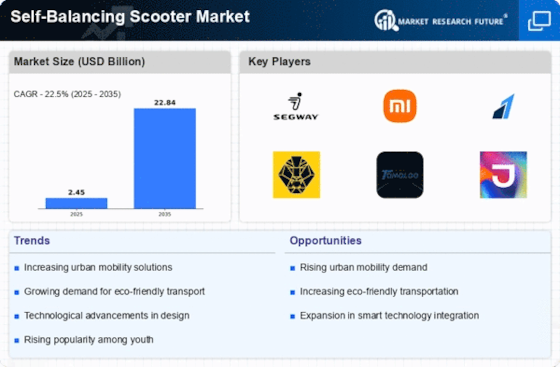
As per Market Research Future analysis, the Self-Balancing Scooter Market Size was estimated at 2.45 USD Billion in 2024. The Self-Balancing Scooter industry is projected to grow from 3.001 USD Billion in 2025 to 22.84 USD Billion by 2035, exhibiting a compound annual growth rate (CAGR) of 22.5% during the forecast period 2025 - 2035

Key Market Trends & Highlights

The self-balancing scooter market is poised for substantial growth driven by technological advancements and urban mobility solutions.

  • North America remains the largest market for self-balancing scooters, reflecting a strong consumer base and established infrastructure. Asia-Pacific is emerging as the fastest-growing region, fueled by increasing urbanization and a youthful population eager for innovative transport solutions. The double-wheeled segment dominates the market, while the single-wheeled segment is gaining traction due to its compact design and maneuverability. Technological innovations and rising consumer demand are key drivers propelling the market forward, alongside a growing emphasis on sustainability.

Market Size & Forecast

2024 Market Size 2.45 (USD Billion)
2035 Market Size 22.84 (USD Billion)
CAGR (2025 - 2035) 22.5%
Largest Regional Market Share in 2024 North America

Major Players

<a href="https://store.segway.com/self-balancing-scooter">Segway</a> (US), Xiaomi (CN), Razor (US), Swagtron (US), Tomoloo (CN), Jetson (US), Hoverboard (US), <a href="https://inmotionworld.com/">InMotion</a> (CN)

Market Trends

The Self-Balancing Scooter Market is currently experiencing a dynamic evolution, driven by advancements in technology and shifting consumer preferences. As urban mobility solutions gain traction, these scooters are increasingly viewed as viable alternatives to traditional transportation methods. The integration of smart features, such as mobile app connectivity and enhanced safety mechanisms, appears to be a focal point for manufacturers aiming to attract a broader audience. Furthermore, the growing emphasis on eco-friendly transportation options suggests that self-balancing scooters may play a pivotal role in reducing urban congestion and carbon emissions. In addition to technological innovations, the Self-Balancing Scooter Market is influenced by changing demographics and lifestyle choices. Younger consumers, in particular, seem to favor personal mobility devices that offer convenience and fun. This trend is further supported by the rise of shared mobility services, which may encourage more individuals to consider self-balancing scooters as a practical mode of transport. As the market continues to mature, it is likely that manufacturers will explore new designs and functionalities to meet the evolving demands of consumers, thereby enhancing the overall appeal of these innovative vehicles.

Technological Advancements

The Self-Balancing Scooter Market is witnessing rapid technological progress, with manufacturers incorporating features such as GPS navigation, Bluetooth connectivity, and enhanced battery life. These innovations not only improve user experience but also address safety concerns, making scooters more appealing to a wider audience.

Sustainability Focus

There is a growing trend towards sustainability within the Self-Balancing Scooter Market, as consumers increasingly prioritize eco-friendly transportation options. This shift is prompting manufacturers to develop scooters that utilize sustainable materials and energy-efficient technologies, aligning with global efforts to reduce carbon footprints.

Urban Mobility Solutions

The Self-Balancing Scooter Market is becoming an integral part of urban mobility strategies, as cities seek to alleviate traffic congestion and promote alternative transportation methods. This trend indicates a potential for collaboration between scooter manufacturers and city planners to create infrastructure that supports the use of these devices.

Self Balancing Scooter Market Market Drivers

Urbanization Trends

The Self-Balancing Scooter Market is significantly influenced by ongoing urbanization trends. As cities expand and populations increase, the demand for efficient and compact transportation solutions rises. Self-balancing scooters offer a practical alternative to traditional vehicles, particularly in congested urban areas. They provide a means of navigating through traffic and accessing areas that may be difficult for larger vehicles. Recent data suggests that urban areas are increasingly adopting micro-mobility solutions, with self-balancing scooters being a prominent choice. This shift towards urban mobility solutions is likely to drive market growth, as more individuals seek convenient and eco-friendly transportation options in densely populated regions.

Government Initiatives

The Self-Balancing Scooter Market is also being propelled by various government initiatives aimed at promoting sustainable transportation. Many governments are implementing policies that encourage the use of electric and self-balancing vehicles as part of broader efforts to reduce traffic congestion and lower emissions. Incentives such as subsidies, tax breaks, and the establishment of dedicated lanes for micro-mobility vehicles are becoming more common. These initiatives not only enhance the visibility of self-balancing scooters but also make them a more attractive option for consumers. As of 2025, it is anticipated that these government policies will significantly contribute to the growth of the self-balancing scooter market, fostering a more favorable environment for adoption.

Rising Consumer Demand

The Self-Balancing Scooter Market is witnessing a notable increase in consumer demand, driven by a combination of factors including convenience, affordability, and lifestyle changes. As more individuals seek efficient modes of transportation for short distances, self-balancing scooters are emerging as a popular choice. The market has seen a diversification of models catering to various consumer preferences, from budget-friendly options to high-end models with advanced features. Recent surveys indicate that a significant percentage of consumers are considering self-balancing scooters as a viable alternative to traditional commuting methods. This rising consumer interest is likely to stimulate market growth, as manufacturers respond to the demand with innovative designs and enhanced functionalities.

Environmental Awareness

The Self-Balancing Scooter Market is benefiting from a growing awareness of environmental issues. As consumers become more conscious of their carbon footprints, there is a noticeable shift towards sustainable transportation options. Self-balancing scooters, which produce zero emissions during operation, align well with this trend. The market is witnessing an increase in demand as individuals seek alternatives to fossil fuel-powered vehicles. In 2025, it is estimated that the market for electric scooters, including self-balancing models, will reach a valuation of several billion dollars, reflecting the rising preference for eco-friendly transportation. This heightened environmental awareness is likely to propel the self-balancing scooter market forward, as consumers prioritize sustainability in their purchasing decisions.

Technological Innovations

The Self-Balancing Scooter Market is experiencing a surge in technological innovations that enhance user experience and safety. Advanced features such as improved gyroscopic sensors, enhanced battery life, and integrated smart technology are becoming commonplace. These innovations not only make scooters more user-friendly but also increase their appeal to a broader audience. For instance, the introduction of mobile applications that allow users to track their scooter's performance and location has gained traction. As of 2025, the market is projected to grow at a compound annual growth rate of approximately 8%, driven by these technological advancements. This trend indicates a shift towards more sophisticated and reliable self-balancing scooters, which could potentially reshape consumer expectations and preferences.

Market Segment Insights

By Product Type: Double-Wheeled (Largest) vs. Single-Wheeled (Fastest-Growing)

<p>The self-balancing scooter market has seen a notable distribution in its product types, with double-wheeled scooters commanding the largest share. This segment's popularity stems from enhanced stability and user confidence, especially among beginner riders. Meanwhile, single-wheeled scooters, while holding a smaller market share, are gaining traction due to their unique design and appeal to enthusiasts seeking a challenge in navigation and riding techniques. As urban mobility preferences evolve, these distinct product types are tailored to different consumer needs, shaping their market presence.</p>

<p>Scooter Type: Double-Wheeled (Dominant) vs. Single-Wheeled (Emerging)</p>

<p>Double-wheeled self-balancing scooters are recognized for their user-friendly experience, making them the dominant choice for casual users and commuters. Their stability and ease of use cater to a broader audience, contributing to their market leadership. In contrast, single-wheeled scooters are emerging as a trend among thrill-seekers and tech-savvy individuals, looking for innovative and compact designs. These scooters require more balance and skill to operate, thus attracting a niche market focused on performance and agility. As urban mobility challenges persist, both product types provide distinct yet complementary options for consumers.</p>

By End Use Industries: Personal Use (Largest) vs. Commercial Use (Fastest-Growing)

<p>In the Self-Balancing Scooter Market, the personal use segment dominates the landscape, capturing a significant portion of the overall market share. This segment includes consumers who utilize scooters for leisure, commuting, and recreational activities. As more individuals seek eco-friendly transport options, the demand for personal-use scooters continues to rise, driving substantial market presence. Conversely, the commercial use segment is emerging as the fastest-growing area, increasingly adopted by businesses for various applications, including last-mile delivery and employee transportation.</p>

<p>End Use: Personal Use (Dominant) vs. Commercial Use (Emerging)</p>

<p>The personal use segment of the self-balancing scooter market remains the dominant player, favored for its convenience and efficiency in urban commuting and recreational activities. Consumers seek lightweight, portable, and user-friendly designs, often prioritizing style and ease of use. In contrast, the commercial use segment is rapidly gaining traction, appealing to businesses looking for innovative solutions to enhance logistics and employee mobility. Commercial applications are characterized by bulk purchases and tailored specifications, focusing on durability and performance to meet organizational needs. This growing demand for commercial use is indicative of the market's potential to evolve as businesses adopt more sustainable transport methods.</p>

Get more detailed insights about Self Balancing Scooter Market Research - Global Forecast to 2035

Regional Insights

North America : Leading Market for Innovation

North America is the largest market for self-balancing scooters, accounting for approximately 40% of the global market share. The growth is driven by increasing urbanization, a shift towards eco-friendly transportation, and supportive regulations promoting electric mobility. The demand for personal mobility solutions is further fueled by the rise in e-commerce and delivery services, which have increased the need for efficient last-mile transportation options. The United States and Canada are the leading countries in this region, with major players like Segway, Razor, and Swagtron dominating the market. The competitive landscape is characterized by continuous innovation and product launches, with companies focusing on enhancing safety features and battery life. The presence of established brands and a growing consumer base for recreational and commuting purposes are key factors contributing to market growth.

Europe : Emerging Market with Regulations

Europe is witnessing significant growth in the self-balancing scooter market, holding approximately 30% of the global share. The region's growth is driven by stringent environmental regulations and a strong push towards sustainable urban mobility solutions. Countries like Germany and France are leading the charge, implementing policies that encourage the use of electric scooters and other personal mobility devices, thus creating a favorable market environment. Germany, France, and the UK are the primary markets in Europe, with a competitive landscape featuring key players such as Xiaomi and InMotion. The market is characterized by a mix of established brands and emerging startups, all vying for consumer attention. The increasing popularity of shared mobility services and the rise of e-commerce are also contributing to the demand for self-balancing scooters, making Europe a dynamic market for innovation and growth.

Asia-Pacific : Rapid Growth and Adoption

Asia-Pacific is rapidly emerging as a significant player in the self-balancing scooter market, accounting for around 25% of the global market share. The growth is primarily driven by rising disposable incomes, urbanization, and a growing awareness of eco-friendly transportation options. Countries like China and India are at the forefront, with increasing investments in electric mobility infrastructure and favorable government policies promoting the adoption of electric scooters. China is the largest market in the region, with major manufacturers like Xiaomi and Tomoloo leading the charge. The competitive landscape is marked by a high number of local players, which intensifies competition and drives innovation. The increasing popularity of personal mobility solutions among the youth demographic and the expansion of e-commerce platforms are further propelling market growth in this region.

Middle East and Africa : Emerging Market Potential

The Middle East and Africa region is gradually emerging in the self-balancing scooter market, holding about 5% of the global share. The growth is driven by increasing urbanization, a rising middle class, and a growing interest in alternative transportation solutions. Countries like South Africa and the UAE are leading the way, with urban centers investing in infrastructure to support electric mobility and personal transport solutions. South Africa and the UAE are the key markets in this region, with a competitive landscape that includes both local and international players. The presence of companies like Jetson and Hoverboard is notable, as they cater to the growing demand for personal mobility devices. The region's unique challenges, such as varying regulations and infrastructure development, present both opportunities and hurdles for market players looking to expand their footprint.

Key Players and Competitive Insights

Leading market players are investing heavily in research and development to expand their product lines, which will help the Self-Balancing Scooter market, grow even more. Market participants are also undertaking a variety of strategic activities to expand their global footprint, with important market developments including new product launches, contractual agreements, mergers and acquisitions, higher investments, and collaboration with other organizations. To expand and survive in a more competitive and rising market climate, the balancing Scooter industry must offer cost-effective items. Manufacturing locally to minimize operational costs is one of the key business tactics used by manufacturers in the global Self Balancing Scooter industry to benefit clients and increase the market sector. In recent years, the Self Balancing Scooter industry has offered some of the most significant advantages to the global community, addressing pressing concerns related to water quality, accessibility, and public health. Major players in the Self-Balancing Scooter Market, including Kent RO limited, GE Corporation, Best Water Technology, Whirlpool Corporation, Brita, SteriPEN, General Ecology Inc., Mechanical Equipment Co., Inc., Blue Spring Corporation, SAFH20 UV, GRAYL, Inc, Vestergaard, Portable Aqua, Aquasana, Inc.., Panasonic, Amway Corporation, HaloSource Inc., Eureka Forbes Limited are attempting to increase market demand by investing in research and development operations. ESWING TECH is committed to addressing transportation challenges related to cost, inconvenience, and carbon emissions, the focus revolves around developing energy-efficient products for environmental protection. The goal is to offer diverse electric scooter options, such as golf carts, three-wheeled models, kids' scooters, and electric bikes, tailored to various consumer needs. With two decades of experience in refining motor and battery technologies, the aim is to provide an ideal range of personal transportation devices. By adopting a direct-from-factory-to-consumer sales approach, unnecessary intermediaries and associated costs are eliminated, enabling consumers to acquire a new scooter at a cost akin to a daily coffee purchase. Established in 2004, Airwheel operates with a global perspective and has established research and development, marketing, manufacturing, and logistics centers in key locations including the United States, Belgium, and China. Recognized as a leading manufacturer of smart transportation devices worldwide, Airwheel is dedicated to delivering the delights of technology and embodies the corporate culture of "Free Intelligent Life." With a fully integrated portable transportation industrial chain and a global brand presence, Airwheel's smart scooters and skateboards have catered to the needs of over 30 million customers across 68 countries. The foundation of Airwheel's success lies in facilitating customer freedom, providing intelligent companionship, and fostering passion and joy in life, thereby enhancing personal value. Emphasizing the role of intelligent tools in enriching lives and bridging the gap between dreams and reality, Airwheel strategically invested in areas like IOT sensors, robotics, and deep learning since 2015.

Key Companies in the Self Balancing Scooter Market include

Industry Developments

June 2018: On June 18, Airwheel Technology unveiled its latest self-balancing scooter, the S5, during the Airwheel 2015 New Products Release Conference at the Wanda Sheraton Hotel in Changzhou, China. As the third iteration in the S-series, the S5 distinguishes itself with a standing platform and an extended control shaft, differing from Airwheel's single-wheeled X series and dual-wheeled Q series.

January 2023: Mumbai-based tech start-up Liger Mobility aims to revolutionize the two-wheeler market with what it asserts is a pioneering made-in-India solution: self-balancing technology designed for the Electric Two-Wheeler segment. The company has unveiled its inaugural product, the Liger X, expected to be available for purchase at approximately Rs 90,000 after factoring in FAME subsidies upon its launch.

Future Outlook

Self Balancing Scooter Market Future Outlook

The Self-Balancing Scooter Market is projected to grow at a 22.5% CAGR from 2025 to 2035, driven by technological advancements, urban mobility trends, and increasing consumer demand.

New opportunities lie in:

  • <p>Development of smart self-balancing scooters with IoT integration for enhanced user experience. Expansion into rental services targeting urban commuters and tourists. Partnerships with e-commerce platforms for direct-to-consumer sales channels.</p>

By 2035, the market is expected to be robust, reflecting substantial growth and innovation.

Market Segmentation

Self Balancing Scooter Market Product Type Outlook

  • Single-Wheeled
  • Double-Wheeled

Self Balancing Scooter Market End Use Industries Outlook

  • Personal use
  • Commercial use

Report Scope

MARKET SIZE 2024 2.45(USD Billion)
MARKET SIZE 2025 3.001(USD Billion)
MARKET SIZE 2035 22.84(USD Billion)
COMPOUND ANNUAL GROWTH RATE (CAGR) 22.5% (2025 - 2035)
REPORT COVERAGE Revenue Forecast, Competitive Landscape, Growth Factors, and Trends
BASE YEAR 2024
Market Forecast Period 2025 - 2035
Historical Data 2019 - 2024
Market Forecast Units USD Billion
Key Companies Profiled Segway (US), Xiaomi (CN), Razor (US), Swagtron (US), Tomoloo (CN), Jetson (US), Hoverboard (US), InMotion (CN)
Segments Covered Product Type, End Use Industries, Region
Key Market Opportunities Integration of advanced battery technologies enhances performance and sustainability in the Self-Balancing Scooter Market.
Key Market Dynamics Rising consumer demand for eco-friendly transportation options drives innovation and competition in the self-balancing scooter market.
Countries Covered North America, Europe, APAC, South America, MEA

FAQs

What is the current valuation of the Self-Balancing Scooter Market as of 2024?

<p>The market valuation was 2.45 USD Billion in 2024.</p>

What is the projected market size for the Self-Balancing Scooter Market by 2035?

<p>The market is projected to reach 22.84 USD Billion by 2035.</p>

What is the expected CAGR for the Self-Balancing Scooter Market during the forecast period 2025 - 2035?

<p>The expected CAGR for the market is 22.5% during the forecast period.</p>

Which product type segment shows the highest valuation in the Self-Balancing Scooter Market?

<p>The Double-Wheeled segment shows a valuation of 18.27 USD Billion.</p>

What are the two main end-use industries for self-balancing scooters?

<p>The two main end-use industries are Personal use, valued at 12.84 USD Billion, and Commercial use, valued at 10.0 USD Billion.</p>

Who are the key players in the Self-Balancing Scooter Market?

<p>Key players include Segway, Xiaomi, Razor, Swagtron, Tomoloo, Jetson, Hoverboard, and InMotion.</p>

How does the market valuation for Personal use compare to Commercial use in 2024?

In 2024, the market valuation for Personal use was 1.47 USD Billion, while Commercial use was 0.98 USD Billion.

What is the valuation of the Single-Wheeled segment in the Self-Balancing Scooter Market?

The Single-Wheeled segment had a valuation of 0.49 USD Billion.

What trends are expected to influence the Self-Balancing Scooter Market from 2025 to 2035?

Trends likely include increased adoption in both personal and commercial sectors, driven by technological advancements.

How does the market's growth potential appear for the Self-Balancing Scooter Market?

The market's growth potential appears robust, with a projected increase from 2.45 USD Billion in 2024 to 22.84 USD Billion by 2035.

  1. SECTION I: EXECUTIVE SUMMARY AND KEY HIGHLIGHTS
    1. | 1.1 EXECUTIVE SUMMARY
    2. | | 1.1.1 Market Overview
    3. | | 1.1.2 Key Findings
    4. | | 1.1.3 Market Segmentation
    5. | | 1.1.4 Competitive Landscape
    6. | | 1.1.5 Challenges and Opportunities
    7. | | 1.1.6 Future Outlook
  2. SECTION II: SCOPING, METHODOLOGY AND MARKET STRUCTURE
    1. | 2.1 MARKET INTRODUCTION
    2. | | 2.1.1 Definition
    3. | | 2.1.2 Scope of the study
    4. | | | 2.1.2.1 Research Objective
    5. | | | 2.1.2.2 Assumption
    6. | | | 2.1.2.3 Limitations
    7. | 2.2 RESEARCH METHODOLOGY
    8. | | 2.2.1 Overview
    9. | | 2.2.2 Data Mining
    10. | | 2.2.3 Secondary Research
    11. | | 2.2.4 Primary Research
    12. | | | 2.2.4.1 Primary Interviews and Information Gathering Process
    13. | | | 2.2.4.2 Breakdown of Primary Respondents
    14. | | 2.2.5 Forecasting Model
    15. | | 2.2.6 Market Size Estimation
    16. | | | 2.2.6.1 Bottom-Up Approach
    17. | | | 2.2.6.2 Top-Down Approach
    18. | | 2.2.7 Data Triangulation
    19. | | 2.2.8 Validation
  3. SECTION III: QUALITATIVE ANALYSIS
    1. | 3.1 MARKET DYNAMICS
    2. | | 3.1.1 Overview
    3. | | 3.1.2 Drivers
    4. | | 3.1.3 Restraints
    5. | | 3.1.4 Opportunities
    6. | 3.2 MARKET FACTOR ANALYSIS
    7. | | 3.2.1 Value chain Analysis
    8. | | 3.2.2 Porter's Five Forces Analysis
    9. | | | 3.2.2.1 Bargaining Power of Suppliers
    10. | | | 3.2.2.2 Bargaining Power of Buyers
    11. | | | 3.2.2.3 Threat of New Entrants
    12. | | | 3.2.2.4 Threat of Substitutes
    13. | | | 3.2.2.5 Intensity of Rivalry
    14. | | 3.2.3 COVID-19 Impact Analysis
    15. | | | 3.2.3.1 Market Impact Analysis
    16. | | | 3.2.3.2 Regional Impact
    17. | | | 3.2.3.3 Opportunity and Threat Analysis
  4. SECTION IV: QUANTITATIVE ANALYSIS
    1. | 4.1 Automobile, BY Product Type (USD Billion)
    2. | | 4.1.1 Single-Wheeled
    3. | | 4.1.2 Double-Wheeled
    4. | 4.2 Automobile, BY End Use Industries (USD Billion)
    5. | | 4.2.1 Personal use
    6. | | 4.2.2 Commercial use
    7. | 4.3 Automobile, BY Region (USD Billion)
    8. | | 4.3.1 North America
    9. | | | 4.3.1.1 US
    10. | | | 4.3.1.2 Canada
    11. | | 4.3.2 Europe
    12. | | | 4.3.2.1 Germany
    13. | | | 4.3.2.2 UK
    14. | | | 4.3.2.3 France
    15. | | | 4.3.2.4 Russia
    16. | | | 4.3.2.5 Italy
    17. | | | 4.3.2.6 Spain
    18. | | | 4.3.2.7 Rest of Europe
    19. | | 4.3.3 APAC
    20. | | | 4.3.3.1 China
    21. | | | 4.3.3.2 India
    22. | | | 4.3.3.3 Japan
    23. | | | 4.3.3.4 South Korea
    24. | | | 4.3.3.5 Malaysia
    25. | | | 4.3.3.6 Thailand
    26. | | | 4.3.3.7 Indonesia
    27. | | | 4.3.3.8 Rest of APAC
    28. | | 4.3.4 South America
    29. | | | 4.3.4.1 Brazil
    30. | | | 4.3.4.2 Mexico
    31. | | | 4.3.4.3 Argentina
    32. | | | 4.3.4.4 Rest of South America
    33. | | 4.3.5 MEA
    34. | | | 4.3.5.1 GCC Countries
    35. | | | 4.3.5.2 South Africa
    36. | | | 4.3.5.3 Rest of MEA
  5. SECTION V: COMPETITIVE ANALYSIS
    1. | 5.1 Competitive Landscape
    2. | | 5.1.1 Overview
    3. | | 5.1.2 Competitive Analysis
    4. | | 5.1.3 Market share Analysis
    5. | | 5.1.4 Major Growth Strategy in the Automobile
    6. | | 5.1.5 Competitive Benchmarking
    7. | | 5.1.6 Leading Players in Terms of Number of Developments in the Automobile
    8. | | 5.1.7 Key developments and growth strategies
    9. | | | 5.1.7.1 New Product Launch/Service Deployment
    10. | | | 5.1.7.2 Merger & Acquisitions
    11. | | | 5.1.7.3 Joint Ventures
    12. | | 5.1.8 Major Players Financial Matrix
    13. | | | 5.1.8.1 Sales and Operating Income
    14. | | | 5.1.8.2 Major Players R&D Expenditure. 2023
    15. | 5.2 Company Profiles
    16. | | 5.2.1 Segway (US)
    17. | | | 5.2.1.1 Financial Overview
    18. | | | 5.2.1.2 Products Offered
    19. | | | 5.2.1.3 Key Developments
    20. | | | 5.2.1.4 SWOT Analysis
    21. | | | 5.2.1.5 Key Strategies
    22. | | 5.2.2 Xiaomi (CN)
    23. | | | 5.2.2.1 Financial Overview
    24. | | | 5.2.2.2 Products Offered
    25. | | | 5.2.2.3 Key Developments
    26. | | | 5.2.2.4 SWOT Analysis
    27. | | | 5.2.2.5 Key Strategies
    28. | | 5.2.3 Razor (US)
    29. | | | 5.2.3.1 Financial Overview
    30. | | | 5.2.3.2 Products Offered
    31. | | | 5.2.3.3 Key Developments
    32. | | | 5.2.3.4 SWOT Analysis
    33. | | | 5.2.3.5 Key Strategies
    34. | | 5.2.4 Swagtron (US)
    35. | | | 5.2.4.1 Financial Overview
    36. | | | 5.2.4.2 Products Offered
    37. | | | 5.2.4.3 Key Developments
    38. | | | 5.2.4.4 SWOT Analysis
    39. | | | 5.2.4.5 Key Strategies
    40. | | 5.2.5 Tomoloo (CN)
    41. | | | 5.2.5.1 Financial Overview
    42. | | | 5.2.5.2 Products Offered
    43. | | | 5.2.5.3 Key Developments
    44. | | | 5.2.5.4 SWOT Analysis
    45. | | | 5.2.5.5 Key Strategies
    46. | | 5.2.6 Jetson (US)
    47. | | | 5.2.6.1 Financial Overview
    48. | | | 5.2.6.2 Products Offered
    49. | | | 5.2.6.3 Key Developments
    50. | | | 5.2.6.4 SWOT Analysis
    51. | | | 5.2.6.5 Key Strategies
    52. | | 5.2.7 Hoverboard (US)
    53. | | | 5.2.7.1 Financial Overview
    54. | | | 5.2.7.2 Products Offered
    55. | | | 5.2.7.3 Key Developments
    56. | | | 5.2.7.4 SWOT Analysis
    57. | | | 5.2.7.5 Key Strategies
    58. | | 5.2.8 InMotion (CN)
    59. | | | 5.2.8.1 Financial Overview
    60. | | | 5.2.8.2 Products Offered
    61. | | | 5.2.8.3 Key Developments
    62. | | | 5.2.8.4 SWOT Analysis
    63. | | | 5.2.8.5 Key Strategies
    64. | 5.3 Appendix
    65. | | 5.3.1 References
    66. | | 5.3.2 Related Reports
  6. LIST OF FIGURES
    1. | 6.1 MARKET SYNOPSIS
    2. | 6.2 NORTH AMERICA MARKET ANALYSIS
    3. | 6.3 US MARKET ANALYSIS BY PRODUCT TYPE
    4. | 6.4 US MARKET ANALYSIS BY END USE INDUSTRIES
    5. | 6.5 CANADA MARKET ANALYSIS BY PRODUCT TYPE
    6. | 6.6 CANADA MARKET ANALYSIS BY END USE INDUSTRIES
    7. | 6.7 EUROPE MARKET ANALYSIS
    8. | 6.8 GERMANY MARKET ANALYSIS BY PRODUCT TYPE
    9. | 6.9 GERMANY MARKET ANALYSIS BY END USE INDUSTRIES
    10. | 6.10 UK MARKET ANALYSIS BY PRODUCT TYPE
    11. | 6.11 UK MARKET ANALYSIS BY END USE INDUSTRIES
    12. | 6.12 FRANCE MARKET ANALYSIS BY PRODUCT TYPE
    13. | 6.13 FRANCE MARKET ANALYSIS BY END USE INDUSTRIES
    14. | 6.14 RUSSIA MARKET ANALYSIS BY PRODUCT TYPE
    15. | 6.15 RUSSIA MARKET ANALYSIS BY END USE INDUSTRIES
    16. | 6.16 ITALY MARKET ANALYSIS BY PRODUCT TYPE
    17. | 6.17 ITALY MARKET ANALYSIS BY END USE INDUSTRIES
    18. | 6.18 SPAIN MARKET ANALYSIS BY PRODUCT TYPE
    19. | 6.19 SPAIN MARKET ANALYSIS BY END USE INDUSTRIES
    20. | 6.20 REST OF EUROPE MARKET ANALYSIS BY PRODUCT TYPE
    21. | 6.21 REST OF EUROPE MARKET ANALYSIS BY END USE INDUSTRIES
    22. | 6.22 APAC MARKET ANALYSIS
    23. | 6.23 CHINA MARKET ANALYSIS BY PRODUCT TYPE
    24. | 6.24 CHINA MARKET ANALYSIS BY END USE INDUSTRIES
    25. | 6.25 INDIA MARKET ANALYSIS BY PRODUCT TYPE
    26. | 6.26 INDIA MARKET ANALYSIS BY END USE INDUSTRIES
    27. | 6.27 JAPAN MARKET ANALYSIS BY PRODUCT TYPE
    28. | 6.28 JAPAN MARKET ANALYSIS BY END USE INDUSTRIES
    29. | 6.29 SOUTH KOREA MARKET ANALYSIS BY PRODUCT TYPE
    30. | 6.30 SOUTH KOREA MARKET ANALYSIS BY END USE INDUSTRIES
    31. | 6.31 MALAYSIA MARKET ANALYSIS BY PRODUCT TYPE
    32. | 6.32 MALAYSIA MARKET ANALYSIS BY END USE INDUSTRIES
    33. | 6.33 THAILAND MARKET ANALYSIS BY PRODUCT TYPE
    34. | 6.34 THAILAND MARKET ANALYSIS BY END USE INDUSTRIES
    35. | 6.35 INDONESIA MARKET ANALYSIS BY PRODUCT TYPE
    36. | 6.36 INDONESIA MARKET ANALYSIS BY END USE INDUSTRIES
    37. | 6.37 REST OF APAC MARKET ANALYSIS BY PRODUCT TYPE
    38. | 6.38 REST OF APAC MARKET ANALYSIS BY END USE INDUSTRIES
    39. | 6.39 SOUTH AMERICA MARKET ANALYSIS
    40. | 6.40 BRAZIL MARKET ANALYSIS BY PRODUCT TYPE
    41. | 6.41 BRAZIL MARKET ANALYSIS BY END USE INDUSTRIES
    42. | 6.42 MEXICO MARKET ANALYSIS BY PRODUCT TYPE
    43. | 6.43 MEXICO MARKET ANALYSIS BY END USE INDUSTRIES
    44. | 6.44 ARGENTINA MARKET ANALYSIS BY PRODUCT TYPE
    45. | 6.45 ARGENTINA MARKET ANALYSIS BY END USE INDUSTRIES
    46. | 6.46 REST OF SOUTH AMERICA MARKET ANALYSIS BY PRODUCT TYPE
    47. | 6.47 REST OF SOUTH AMERICA MARKET ANALYSIS BY END USE INDUSTRIES
    48. | 6.48 MEA MARKET ANALYSIS
    49. | 6.49 GCC COUNTRIES MARKET ANALYSIS BY PRODUCT TYPE
    50. | 6.50 GCC COUNTRIES MARKET ANALYSIS BY END USE INDUSTRIES
    51. | 6.51 SOUTH AFRICA MARKET ANALYSIS BY PRODUCT TYPE
    52. | 6.52 SOUTH AFRICA MARKET ANALYSIS BY END USE INDUSTRIES
    53. | 6.53 REST OF MEA MARKET ANALYSIS BY PRODUCT TYPE
    54. | 6.54 REST OF MEA MARKET ANALYSIS BY END USE INDUSTRIES
    55. | 6.55 KEY BUYING CRITERIA OF AUTOMOBILE
    56. | 6.56 RESEARCH PROCESS OF MRFR
    57. | 6.57 DRO ANALYSIS OF AUTOMOBILE
    58. | 6.58 DRIVERS IMPACT ANALYSIS: AUTOMOBILE
    59. | 6.59 RESTRAINTS IMPACT ANALYSIS: AUTOMOBILE
    60. | 6.60 SUPPLY / VALUE CHAIN: AUTOMOBILE
    61. | 6.61 AUTOMOBILE, BY PRODUCT TYPE, 2024 (% SHARE)
    62. | 6.62 AUTOMOBILE, BY PRODUCT TYPE, 2024 TO 2035 (USD Billion)
    63. | 6.63 AUTOMOBILE, BY END USE INDUSTRIES, 2024 (% SHARE)
    64. | 6.64 AUTOMOBILE, BY END USE INDUSTRIES, 2024 TO 2035 (USD Billion)
    65. | 6.65 BENCHMARKING OF MAJOR COMPETITORS
  7. LIST OF TABLES
    1. | 7.1 LIST OF ASSUMPTIONS
    2. | | 7.1.1
    3. | 7.2 North America MARKET SIZE ESTIMATES; FORECAST
    4. | | 7.2.1 BY PRODUCT TYPE, 2025-2035 (USD Billion)
    5. | | 7.2.2 BY END USE INDUSTRIES, 2025-2035 (USD Billion)
    6. | 7.3 US MARKET SIZE ESTIMATES; FORECAST
    7. | | 7.3.1 BY PRODUCT TYPE, 2025-2035 (USD Billion)
    8. | | 7.3.2 BY END USE INDUSTRIES, 2025-2035 (USD Billion)
    9. | 7.4 Canada MARKET SIZE ESTIMATES; FORECAST
    10. | | 7.4.1 BY PRODUCT TYPE, 2025-2035 (USD Billion)
    11. | | 7.4.2 BY END USE INDUSTRIES, 2025-2035 (USD Billion)
    12. | 7.5 Europe MARKET SIZE ESTIMATES; FORECAST
    13. | | 7.5.1 BY PRODUCT TYPE, 2025-2035 (USD Billion)
    14. | | 7.5.2 BY END USE INDUSTRIES, 2025-2035 (USD Billion)
    15. | 7.6 Germany MARKET SIZE ESTIMATES; FORECAST
    16. | | 7.6.1 BY PRODUCT TYPE, 2025-2035 (USD Billion)
    17. | | 7.6.2 BY END USE INDUSTRIES, 2025-2035 (USD Billion)
    18. | 7.7 UK MARKET SIZE ESTIMATES; FORECAST
    19. | | 7.7.1 BY PRODUCT TYPE, 2025-2035 (USD Billion)
    20. | | 7.7.2 BY END USE INDUSTRIES, 2025-2035 (USD Billion)
    21. | 7.8 France MARKET SIZE ESTIMATES; FORECAST
    22. | | 7.8.1 BY PRODUCT TYPE, 2025-2035 (USD Billion)
    23. | | 7.8.2 BY END USE INDUSTRIES, 2025-2035 (USD Billion)
    24. | 7.9 Russia MARKET SIZE ESTIMATES; FORECAST
    25. | | 7.9.1 BY PRODUCT TYPE, 2025-2035 (USD Billion)
    26. | | 7.9.2 BY END USE INDUSTRIES, 2025-2035 (USD Billion)
    27. | 7.10 Italy MARKET SIZE ESTIMATES; FORECAST
    28. | | 7.10.1 BY PRODUCT TYPE, 2025-2035 (USD Billion)
    29. | | 7.10.2 BY END USE INDUSTRIES, 2025-2035 (USD Billion)
    30. | 7.11 Spain MARKET SIZE ESTIMATES; FORECAST
    31. | | 7.11.1 BY PRODUCT TYPE, 2025-2035 (USD Billion)
    32. | | 7.11.2 BY END USE INDUSTRIES, 2025-2035 (USD Billion)
    33. | 7.12 Rest of Europe MARKET SIZE ESTIMATES; FORECAST
    34. | | 7.12.1 BY PRODUCT TYPE, 2025-2035 (USD Billion)
    35. | | 7.12.2 BY END USE INDUSTRIES, 2025-2035 (USD Billion)
    36. | 7.13 APAC MARKET SIZE ESTIMATES; FORECAST
    37. | | 7.13.1 BY PRODUCT TYPE, 2025-2035 (USD Billion)
    38. | | 7.13.2 BY END USE INDUSTRIES, 2025-2035 (USD Billion)
    39. | 7.14 China MARKET SIZE ESTIMATES; FORECAST
    40. | | 7.14.1 BY PRODUCT TYPE, 2025-2035 (USD Billion)
    41. | | 7.14.2 BY END USE INDUSTRIES, 2025-2035 (USD Billion)
    42. | 7.15 India MARKET SIZE ESTIMATES; FORECAST
    43. | | 7.15.1 BY PRODUCT TYPE, 2025-2035 (USD Billion)
    44. | | 7.15.2 BY END USE INDUSTRIES, 2025-2035 (USD Billion)
    45. | 7.16 Japan MARKET SIZE ESTIMATES; FORECAST
    46. | | 7.16.1 BY PRODUCT TYPE, 2025-2035 (USD Billion)
    47. | | 7.16.2 BY END USE INDUSTRIES, 2025-2035 (USD Billion)
    48. | 7.17 South Korea MARKET SIZE ESTIMATES; FORECAST
    49. | | 7.17.1 BY PRODUCT TYPE, 2025-2035 (USD Billion)
    50. | | 7.17.2 BY END USE INDUSTRIES, 2025-2035 (USD Billion)
    51. | 7.18 Malaysia MARKET SIZE ESTIMATES; FORECAST
    52. | | 7.18.1 BY PRODUCT TYPE, 2025-2035 (USD Billion)
    53. | | 7.18.2 BY END USE INDUSTRIES, 2025-2035 (USD Billion)
    54. | 7.19 Thailand MARKET SIZE ESTIMATES; FORECAST
    55. | | 7.19.1 BY PRODUCT TYPE, 2025-2035 (USD Billion)
    56. | | 7.19.2 BY END USE INDUSTRIES, 2025-2035 (USD Billion)
    57. | 7.20 Indonesia MARKET SIZE ESTIMATES; FORECAST
    58. | | 7.20.1 BY PRODUCT TYPE, 2025-2035 (USD Billion)
    59. | | 7.20.2 BY END USE INDUSTRIES, 2025-2035 (USD Billion)
    60. | 7.21 Rest of APAC MARKET SIZE ESTIMATES; FORECAST
    61. | | 7.21.1 BY PRODUCT TYPE, 2025-2035 (USD Billion)
    62. | | 7.21.2 BY END USE INDUSTRIES, 2025-2035 (USD Billion)
    63. | 7.22 South America MARKET SIZE ESTIMATES; FORECAST
    64. | | 7.22.1 BY PRODUCT TYPE, 2025-2035 (USD Billion)
    65. | | 7.22.2 BY END USE INDUSTRIES, 2025-2035 (USD Billion)
    66. | 7.23 Brazil MARKET SIZE ESTIMATES; FORECAST
    67. | | 7.23.1 BY PRODUCT TYPE, 2025-2035 (USD Billion)
    68. | | 7.23.2 BY END USE INDUSTRIES, 2025-2035 (USD Billion)
    69. | 7.24 Mexico MARKET SIZE ESTIMATES; FORECAST
    70. | | 7.24.1 BY PRODUCT TYPE, 2025-2035 (USD Billion)
    71. | | 7.24.2 BY END USE INDUSTRIES, 2025-2035 (USD Billion)
    72. | 7.25 Argentina MARKET SIZE ESTIMATES; FORECAST
    73. | | 7.25.1 BY PRODUCT TYPE, 2025-2035 (USD Billion)
    74. | | 7.25.2 BY END USE INDUSTRIES, 2025-2035 (USD Billion)
    75. | 7.26 Rest of South America MARKET SIZE ESTIMATES; FORECAST
    76. | | 7.26.1 BY PRODUCT TYPE, 2025-2035 (USD Billion)
    77. | | 7.26.2 BY END USE INDUSTRIES, 2025-2035 (USD Billion)
    78. | 7.27 MEA MARKET SIZE ESTIMATES; FORECAST
    79. | | 7.27.1 BY PRODUCT TYPE, 2025-2035 (USD Billion)
    80. | | 7.27.2 BY END USE INDUSTRIES, 2025-2035 (USD Billion)
    81. | 7.28 GCC Countries MARKET SIZE ESTIMATES; FORECAST
    82. | | 7.28.1 BY PRODUCT TYPE, 2025-2035 (USD Billion)
    83. | | 7.28.2 BY END USE INDUSTRIES, 2025-2035 (USD Billion)
    84. | 7.29 South Africa MARKET SIZE ESTIMATES; FORECAST
    85. | | 7.29.1 BY PRODUCT TYPE, 2025-2035 (USD Billion)
    86. | | 7.29.2 BY END USE INDUSTRIES, 2025-2035 (USD Billion)
    87. | 7.30 Rest of MEA MARKET SIZE ESTIMATES; FORECAST
    88. | | 7.30.1 BY PRODUCT TYPE, 2025-2035 (USD Billion)
    89. | | 7.30.2 BY END USE INDUSTRIES, 2025-2035 (USD Billion)
    90. | 7.31 PRODUCT LAUNCH/PRODUCT DEVELOPMENT/APPROVAL
    91. | | 7.31.1
    92. | 7.32 ACQUISITION/PARTNERSHIP
    93. | | 7.32.1

Automobile Market Segmentation

Automobile By Product Type (USD Billion, 2025-2035)

  • Single-Wheeled
  • Double-Wheeled

Automobile By End Use Industries (USD Billion, 2025-2035)

  • Personal use
  • Commercial use
Infographic

Free Sample Request

Kindly complete the form below to receive a free sample of this Report

Get Free Sample

Customer Strories

Compare Licence

×
Features License Type
Single User Multiuser License Enterprise User
Price $4,950 $5,950 $7,250
Maximum User Access Limit 1 User Upto 10 Users Unrestricted Access Throughout the Organization
Free Customization
Direct Access to Analyst
Deliverable Format
Platform Access
Discount on Next Purchase 10% 15% 15%
Printable Versions
%>