×
Request Free Sample ×

Kindly complete the form below to receive a free sample of this Report

* Please use a valid business email

Leading companies partner with us for data-driven Insights

clients tt-cursor
Hero Background
English
Chinese
French
Japanese
Korean
German
Spanish

Seed Treatment Market Trends

ID: MRFR/Agri/4695-CR
111 Pages
Snehal Singh
May 2020

Seed Treatment Market Size, Share, Industry Trend & Analysis Research Report Information By Function (Seed Protection and Seed Enhancement), By Application Technique (Dressing, Coating, Pelleting, and Others), By Crop Type (Cereals & Grains, Oilseeds & Pulses, Fruits & Vegetables, and Others), And By Region (North America, Europe, Asia-Pacific, And Rest Of The World) –Market Size, Share, Industry Trend & Analysis Forecast Till 2035

Share:
Download PDF ×

We do not share your information with anyone. However, we may send you emails based on your report interest from time to time. You may contact us at any time to opt-out.

Seed Treatment Market Infographic
×
Seed Treatment Market Infographic Full View
Purchase Options

Market Trends

Key Emerging Trends in the Seed Treatment Market

To compete, seed treatment companies utilize numerous market share positioning methods. Protective chemicals are applied to seeds before planting to improve crop yield and avoid pests.

Technical innovation is a Seed Treatment Market strategy. To improve seed treatments, companies invest much on R&D. This requires innovative active ingredients, delivery methods, and eco-friendly solutions. Staying ahead of technology may help companies stand out and attract farmers seeking innovative seed treatments.

Companies develop custom seed treatment regimens for farmers and crops. Disease and insect protection varies by crop and location. By offering farmers customized seed treatments, companies may become comprehensive seed treatment providers. Customization helps companies target specific markets and gain an edge.

Geographical expansion is essential for Seed Treatment Market players seeking growth. To succeed, seed treatment formulae must fit climate, soil, and farming. Companies with many sites may attract farmers and wholesalers. Product adaptation, distribution network growth, and agricultural collaboration are part of this approach.

Successful market share positioning needs partnership with research institutions, universities, and agricultural extension organizations. Company partnerships with specialists yield insights, new technologies, and research. Collaboration often creates new seed treatments. Through joint marketing, partnerships may help firms grow and gain reputation.

As sustainable agriculture gains popularity, Seed Treatment Market companies are stressing their goods' environmental advantages. Develop seed treatments that reduce environmental impact, chemical residues, and promote sustainable farming. Meeting growing demand for eco-friendly products may attract environmentally conscious farmers and increase market position.

Education and training are effective market share positioning strategies. Companies teach farmers about seed care through workshops, field demonstrations, and training. By informing farmers about seed treatment benefits, corporations may influence purchases and build loyalty. Market share positioning requires strong branding and marketing. Companies build brands around seed treatment product reliability and efficacy. Marketing uses testimonies, case studies, and data to explain how seed treatment increases crop yields. Customer retention requires a positive brand image.

Cereals & grains, oilseeds & pulses, fruits & vegetables, etc. divide the global seed treatment market. Due to wireworms on cereal and grain seeds, this group dominates the market. In early development, seed treatment maximizes kernel potential. This treatment controls soil-borne fungus and stabilizes crops.

Pelleting canola seeds by Syngenta may decrease planting errors like missing or double- or triple-hits. In early May, Syngenta Canada debuted Pelta, a seed pelleting technology that optimizes seed quality to increase singulation planter performance. Syngenta says its Pelta-based canola-seeding technology will reduce expensive planting mistakes in a recent press release. The Pelta coating promotes bag-wide seed uniformity."

Author
Snehal Singh
Assistant Manager - Research

High acumen in analyzing complex macro & micro markets with more than 6 years of work experience in the field of market research. By implementing her analytical skills in forecasting and estimation into market research reports, she has expertise in Packaging, Construction, and Equipment domains. She handles a team size of 20-25 resources and ensures smooth running of the projects, associated marketing activities, and client servicing.

Leave a Comment

FAQs

How much is the seed treatment market?

The seed treatment market size was valued at USD 5.5 Billion in 2022.

What is the growth rate of the seed treatment market?

The market is projected to grow at a CAGR of 7.41 % during the forecast period, 2024-2032.

Which region held the largest market share in the seed treatment market?

North America had the largest share of the market.

Who are the key players in the seed treatment market?

The key players in the market are Syngenta (Switzerland), BASF SE (Germany), FMC Corporation (US), Corteva Agriscience (US), Bayer AG (Germany), UPL Ltd (India), Novozymes A/S (Denmark), Solvay (Belgium), Eastman Chemicals Ltd (US), ADAMA Ltd (Israel), Certis Europe (Netherlands), Croda International Plc (UK), Rizobacter (Argentina), Sumitomo Chemical (Japan), Marrone Bio Innovations Inc (US), and Bioworks Inc (US).

Which function led the seed treatment market?

The seed protection category dominated the market in 2022.

Which application technique had the largest market share in the seed treatment market?

The coating had the largest share of the market.

Market Summary

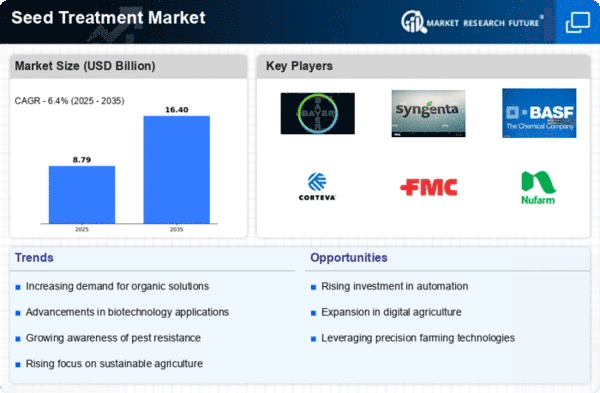
As per MRFR analysis, the Seed Treatment Market Size was estimated at 8.26 USD Billion in 2024. The Seed Treatment industry is projected to grow from 8.88 USD Billion in 2025 to 16.4 USD Billion by 2035, exhibiting a compound annual growth rate (CAGR) of 6.4 during the forecast period 2025 - 2035.

Key Market Trends & Highlights

The Seed Treatment Market is experiencing a transformative shift towards sustainable and innovative practices.

  • The rise of biological seed treatments is reshaping the market landscape, particularly in the Asia-Pacific region.
  • Technological advancements in seed treatment are enhancing efficiency and effectiveness, especially in North America.
  • Increased focus on regulatory compliance is driving market dynamics, as stakeholders seek to meet evolving standards.
  • Growing demand for sustainable agriculture and rising awareness of seed quality and performance are key drivers propelling market growth.

Market Size & Forecast

2024 Market Size 8.26 (USD Billion)
2035 Market Size 16.4 (USD Billion)
CAGR (2025 - 2035) 6.4%
Largest Regional Market Share in 2024 North America

Major Players

Bayer AG (DE), Syngenta AG (CH), BASF SE (DE), Corteva Agriscience (US), FMC Corporation (US), Nufarm Limited (AU), UPL Limited (IN), Adama Agricultural Solutions Ltd. (IL), Nutrien Ltd. (CA)

Market Trends

The Seed Treatment Market is currently experiencing a notable transformation, driven by the increasing demand for sustainable agricultural practices and the need for enhanced crop protection. This market encompasses a variety of products and technologies aimed at improving seed performance and safeguarding against pests and diseases. As farmers seek to optimize yields while minimizing environmental impact, the adoption of innovative seed treatment solutions appears to be on the rise. Furthermore, the integration of advanced technologies, such as biological treatments and precision agriculture, is likely to reshape the landscape of this sector, offering new opportunities for growth and development. In addition, the Seed Treatment Market is influenced by evolving regulatory frameworks and consumer preferences that favor eco-friendly products. Stakeholders in this market are increasingly focusing on research and development to create effective, safe, and sustainable seed treatment options. This shift not only addresses the challenges posed by climate change but also aligns with the global movement towards responsible farming practices. As the market continues to evolve, it may witness a surge in collaborations between agricultural companies and research institutions, fostering innovation and enhancing the overall efficacy of seed treatments.

Rise of Biological Seed Treatments

There is a growing trend towards the use of biological seed treatments, which utilize natural organisms to protect seeds from pests and diseases. This approach is gaining traction due to its environmentally friendly nature and effectiveness in promoting plant health. As consumers increasingly demand sustainable agricultural practices, the adoption of biological solutions in the Seed Treatment Market is likely to expand.

Technological Advancements in Seed Treatment

The Seed Treatment Market is witnessing significant technological advancements, particularly in the development of precision application methods. These innovations enable more efficient and targeted application of treatments, reducing waste and enhancing effectiveness. As farmers seek to maximize productivity while minimizing resource use, these technologies may play a crucial role in shaping future practices.

Increased Focus on Regulatory Compliance

With the evolving landscape of agricultural regulations, there is an increased emphasis on compliance within the Seed Treatment Market. Companies are investing in research to ensure that their products meet stringent safety and environmental standards. This focus on regulatory adherence not only enhances product credibility but also aligns with the growing consumer demand for transparency and sustainability in agricultural practices.

Seed Treatment Market Market Drivers

Global Population Growth and Food Demand

The Global Seed Treatment Market Industry is directly impacted by the increasing global population and the corresponding demand for food. As the world population continues to rise, the pressure on agricultural systems to produce more food becomes more pronounced. Seed treatments are essential in maximizing crop yields and ensuring food security. With projections indicating a population of nearly 9.7 billion by 2050, the need for efficient agricultural practices, including seed treatment, is more critical than ever. This demand is expected to drive the market towards substantial growth in the coming years.

Increasing Demand for High-Quality Seeds

The Global Seed Treatment Market Industry experiences a notable surge in demand for high-quality seeds, driven by the need for enhanced crop yields and improved resistance to pests and diseases. Farmers are increasingly adopting seed treatment technologies to ensure better germination rates and robust plant growth. This trend is particularly evident in regions with intensive agricultural practices, where the focus on quality is paramount. The market is projected to reach 6.47 USD Billion in 2024, reflecting the growing recognition of seed treatment as a vital component in achieving agricultural sustainability and productivity.

Government Support and Regulatory Frameworks

Government initiatives and supportive regulatory frameworks significantly influence the Global Seed Treatment Market Industry. Many countries are implementing policies that encourage the adoption of seed treatment technologies to enhance food security and agricultural productivity. Financial incentives, research funding, and educational programs aimed at farmers are becoming more prevalent. This support not only fosters innovation but also facilitates the widespread adoption of effective seed treatments. As a result, the market is poised for growth, with an anticipated increase in investment and development in seed treatment solutions.

Technological Advancements in Seed Treatment

Technological innovations play a crucial role in shaping the Global Seed Treatment Market Industry. The introduction of advanced seed treatment formulations, such as biological and chemical agents, enhances the effectiveness of pest and disease control. Moreover, precision agriculture technologies facilitate targeted applications, optimizing resource use and minimizing environmental impact. As farmers increasingly seek efficient solutions, the market is expected to expand significantly, with projections indicating a growth to 14.2 USD Billion by 2035. This evolution in technology not only improves crop performance but also aligns with global sustainability goals.

Rising Awareness of Sustainable Agriculture Practices

The Global Seed Treatment Market Industry is witnessing a paradigm shift towards sustainable agricultural practices. Farmers are becoming more aware of the environmental implications of traditional farming methods and are increasingly adopting seed treatments that promote sustainability. These treatments often involve the use of biological agents and eco-friendly chemicals, which contribute to soil health and biodiversity. As a result, the market is likely to experience a compound annual growth rate (CAGR) of 7.41% from 2025 to 2035, reflecting the growing preference for sustainable solutions that align with global environmental standards.

Market Segment Insights

By Application: Seed Protection (Largest) vs. Seed Enhancement (Fastest-Growing)

In the Seed Treatment Market, 'Seed Protection' commands the largest market share, primarily due to its vital role in safeguarding crops from pests and diseases. This segment comprises various chemical and organic solutions designed to ensure seed viability and healthy plant development. Conversely, 'Seed Enhancement', encompassing biostimulants and growth promoters, is experiencing rapid growth, reflecting an increasing demand for sustainable agricultural practices and improved crop productivity.

Seed Protection (Dominant) vs. Seed Germination (Emerging)

The 'Seed Protection' segment plays a dominant role in the seed treatment market by providing essential solutions that cater to increasing agricultural challenges, including pest resistance and disease management. This segment is characterized by a comprehensive range of chemical and biological treatments that not only protect seeds but also enhance their overall performance. In contrast, 'Seed Germination' is an emerging segment that focuses on innovative treatments designed to facilitate rapid and uniform germination. While it currently holds a smaller share, it is gaining traction due to advancements in technology and growing awareness of the significance of optimizing germination rates for enhanced agricultural yields.

By Type: Chemical Treatment (Largest) vs. Biological Treatment (Fastest-Growing)

In the Seed Treatment Market, the distribution among the segments reveals that Chemical Treatment holds the largest share. This dominance can be attributed to its effectiveness in controlling a myriad of pathogens and its widespread adoption among farmers. Conversely, Biological Treatment, while currently smaller in market share, is quickly gaining traction due to the increasing demand for sustainable and environmentally-friendly solutions in agriculture. This shift presents a noteworthy trend as conventional farmers begin to recognize the benefits of biological methods. Growth trends within the Seed Treatment segment are increasingly influenced by both regulatory changes and consumer demand for organic food. The surge in organic agriculture is driving interest in Biological Treatment, making it the fastest-growing segment. Meanwhile, the reliability and proven results of Chemical Treatment mean that it remains a staple for many growers, suggesting a nuanced landscape where both methods can co-exist while appealing to different market segments.

Chemical Treatment (Dominant) vs. Biological Treatment (Emerging)

Chemical Treatment remains the dominant force in the Seed Treatment Market due to its broad acceptance and effectiveness against various seed-borne diseases and pests. This segment's key characteristics include an extensive portfolio of synthetic pesticides and fungicides that are crucial for protecting crops at their early stages. In contrast, Biological Treatment is viewed as an emerging option, characterized by the use of biopesticides and biofungicides derived from natural sources. This trend is increasingly appealing to growers looking to align their practices with eco-friendly principles and market demands for organic products. As the agriculture sector evolves, both treatments are likely to complement one another, with Chemical Treatment satisfying immediate agricultural needs while Biological Treatment capitalizes on the growing shift towards sustainability.

By Crop Type: Cereals (Largest) vs. Fruits and Vegetables (Fastest-Growing)

The Seed Treatment Market encompasses a diverse array of crop types, with cereals holding the largest market share due to their extensive cultivation across various regions. This dominance is augmented by the increasing demand for cereals as staple foods globally. Following closely are oilseeds and pulses, which also showcase significant entry points for seed treatment innovations. Fruits and vegetables, while smaller in overall share, are rapidly growing as consumer preferences shift towards healthier diets, thereby creating a surge in demand for effective seed treatments to enhance yield and quality.

Cereals (Dominant) vs. Fruits and Vegetables (Emerging)

Cereals represent the dominant crop type in the seed treatment market, thanks to their established agronomic practices and high demand for yield enhancement. This segment benefits from advances in seed treatment technologies that bolster disease resistance and plant vigor, critical factors in maximizing agricultural output. On the other hand, fruits and vegetables are emerging as key growth segments, driven by consumer trends favoring fresh produce and organic options. Innovations aimed at improving seed quality and resilience to environmental stresses are fueling this growth, making fruits and vegetables a pivotal area for future seed treatment developments.

By Formulation Type: Liquid Formulation (Largest) vs. Coated Formulation (Fastest-Growing)

In the Seed Treatment Market, the formulation type segment is significantly influenced by three main values: liquid, granular, and coated formulations. Among these, liquid formulation commands the largest share owing to its versatility and effectiveness in delivering nutrients and protection to seeds. Granular formulation follows closely, favored for its ease of application and residual effectiveness. Coated formulation, while presently smaller in market share, shows promising potential for growth as it combines the benefits of both liquid and granular types.

Formulation Type: Liquid (Dominant) vs. Coated (Emerging)

Liquid formulation is the dominant player in the seed treatment market, widely recognized for its effectiveness and ease of use. This formulation type allows for uniform distribution of treatment active ingredients, making it suitable for a variety of seed types. It is popular among farmers seeking efficient and effective solutions for pest and disease control. On the other hand, coated formulation is emerging rapidly due to its advanced technology that allows for precise delivery of active ingredients, improving seed performance and germination rates. The growing trend towards sustainable agriculture boosts the use of coated formulations as they reduce wastage and environmental impact.

By Distribution Channel: Direct Sales (Largest) vs. Retail Sales (Fastest-Growing)

The seed treatment market displays a diverse distribution channel segmentation, with direct sales taking the lead in market share. This channel offers benefits such as personalized service, better customer relationships, and direct access to consumers, establishing itself as the largest sales channel. Retail sales follow closely, serving as a popular choice among farmers and agricultural businesses due to their accessibility and the availability of a wide range of products. The introduction of new product lines and promotional activities in retail outlets is further enhancing their market presence.

Direct Sales (Dominant) vs. Retail Sales (Emerging)

Direct sales in the seed treatment market continues to dominate by providing a tailored approach to customer service, allowing producers to better understand and meet the specific needs of farmers. This channel offers comprehensive solutions, often bundled with expert advice and support, which is attracting significant interest. On the other hand, retail sales are emerging as a crucial channel, catering to the growing demand for easy access and convenience. Retail outlets are evolving with the integration of modern agricultural products, making them more appealing to broader consumer segments. This dynamic creates opportunities for both channels to coexist and thrive within the shifting landscape of the seed treatment market.

Get more detailed insights about Seed Treatment Market Research Report - Global Forecast till 2035

Regional Insights

North America : Market Leader in Seed Treatment

North America is poised to maintain its leadership in the seed treatment market, holding a significant share of 3.5 in 2024. The region's growth is driven by increasing demand for high-yield crops and stringent regulations promoting sustainable agricultural practices. The adoption of advanced seed treatment technologies is further fueled by government initiatives aimed at enhancing food security and agricultural productivity. The United States and Canada are the leading countries in this market, with major players like Bayer AG, Corteva Agriscience, and FMC Corporation actively investing in R&D. The competitive landscape is characterized by innovation and strategic partnerships, ensuring a robust supply chain. The presence of established companies enhances market stability and fosters growth, making North America a focal point for seed treatment advancements.

Europe : Emerging Innovations in Agriculture

Europe's seed treatment market is projected to grow significantly, with a market size of 2.5 in 2024. The region is witnessing a shift towards sustainable agricultural practices, driven by EU regulations that encourage the use of eco-friendly seed treatments. This regulatory environment is fostering innovation and increasing demand for products that enhance crop resilience and yield. Leading countries such as Germany, France, and the Netherlands are at the forefront of this transformation, with key players like BASF SE and Syngenta AG leading the charge. The competitive landscape is marked by a focus on research and development, as companies strive to meet the evolving regulatory standards and consumer preferences for sustainable agriculture. This dynamic environment positions Europe as a hub for innovative seed treatment solutions.

Asia-Pacific : Rapid Growth in Agricultural Sector

The Asia-Pacific region is emerging as a significant player in the seed treatment market, with a market size of 2.0 in 2024. The growth is driven by increasing agricultural productivity demands and the adoption of modern farming techniques. Governments are promoting seed treatment solutions to combat pests and diseases, enhancing crop yields and food security across the region. Countries like India, China, and Australia are leading the charge, with a competitive landscape featuring companies such as UPL Limited and Nufarm Limited. The presence of these key players is crucial for market expansion, as they invest in innovative solutions tailored to local agricultural needs. The region's diverse agricultural landscape presents both challenges and opportunities for seed treatment advancements, making it a focal point for future growth.

Middle East and Africa : Untapped Potential in Agriculture

The Middle East and Africa (MEA) region, with a market size of 0.26 in 2024, presents untapped potential in the seed treatment market. The growth is driven by increasing agricultural investments and a rising need for food security in the face of climate challenges. Governments are beginning to recognize the importance of seed treatments in enhancing crop resilience and productivity, leading to a gradual shift in agricultural practices. Countries like South Africa and Kenya are emerging as key players in this market, with local and international companies exploring opportunities for growth. The competitive landscape is evolving, with investments in research and development aimed at addressing regional agricultural challenges. This focus on innovation and sustainability positions MEA as a promising market for seed treatment solutions.

Key Players and Competitive Insights

The Seed Treatment Market is currently characterized by a dynamic competitive landscape, driven by increasing demand for sustainable agricultural practices and the need for enhanced crop protection. Key players such as Bayer AG (DE), Syngenta AG (CH), and Corteva Agriscience (US) are strategically positioned to leverage innovation and technological advancements. Bayer AG (DE) focuses on integrating digital solutions into its seed treatment offerings, enhancing precision agriculture capabilities. Syngenta AG (CH) emphasizes partnerships with local farmers to tailor solutions that meet specific regional needs, while Corteva Agriscience (US) is investing heavily in research and development to introduce novel seed treatment products that address emerging pest and disease challenges. Collectively, these strategies contribute to a competitive environment that prioritizes innovation and customer-centric solutions.In terms of business tactics, companies are increasingly localizing manufacturing to reduce supply chain vulnerabilities and optimize logistics. The market structure appears moderately fragmented, with several players vying for market share. However, the influence of major companies is substantial, as they set industry standards and drive technological advancements. This competitive structure fosters an environment where smaller firms may struggle to keep pace with the rapid innovation cycles established by larger entities.In November 2025, Bayer AG (DE) announced a strategic partnership with a leading agtech firm to develop AI-driven seed treatment solutions. This collaboration aims to enhance the efficacy of seed treatments by utilizing data analytics to predict pest outbreaks and optimize application timing. The strategic importance of this move lies in Bayer's commitment to integrating cutting-edge technology into its product offerings, potentially setting a new benchmark for the industry.In October 2025, Syngenta AG (CH) launched a new line of bio-based seed treatments designed to improve soil health and promote sustainable farming practices. This initiative reflects Syngenta's focus on sustainability and its response to growing consumer demand for environmentally friendly agricultural solutions. By prioritizing bio-based products, Syngenta positions itself as a leader in the transition towards more sustainable agricultural practices.In September 2025, Corteva Agriscience (US) expanded its research facilities in Brazil, focusing on developing region-specific seed treatments that address local agricultural challenges. This expansion underscores Corteva's strategy of regional customization, allowing the company to better serve diverse markets and enhance its competitive edge. By investing in localized research, Corteva aims to strengthen its market presence in key agricultural regions.As of December 2025, the Seed Treatment Market is witnessing trends that emphasize digitalization, sustainability, and the integration of AI technologies. Strategic alliances are increasingly shaping the competitive landscape, enabling companies to pool resources and expertise to drive innovation. The shift from price-based competition to a focus on technological advancement and supply chain reliability is evident. Moving forward, competitive differentiation will likely hinge on the ability to innovate and adapt to evolving market demands, with a clear emphasis on sustainable practices and advanced technological solutions.

Key Companies in the Seed Treatment Market include

Industry Developments

December 2023: BASF introduced a new range of seed treatment products, Acceleron, designed to enhance the health and productivity of crops by protecting seeds from early-stage diseases, pests, and environmental stresses. The product line includes both biological and chemical solutions, offering improved seed vigor, faster germination, and higher crop yields. BASF emphasized the role of its Acceleron seed treatment products in sustainable farming by reducing the need for post-emergence pesticide applications and improving crop resilience against adverse weather conditions.

The company is targeting North America, Latin America, and Asia as key markets, where seed treatment adoption is rapidly increasing due to the rising demand for sustainable and efficient agricultural solutions.

November 2023: Syngenta launched Vibrance, an innovative seed treatment solution aimed at improving disease control and promoting healthier root development in crops. Vibrance incorporates a novel fungicide formulation that provides long-lasting protection against soil-borne diseases such as Fusarium and Pythium. Syngenta highlighted that the product not only protects seeds from pathogens but also improves plant vigor, enhancing crop emergence and early growth. The company’s focus with Vibrance is on crops like corn, soybeans, and wheat, which are essential for global food production.

Syngenta is also committed to advancing its research in biological seed treatments, aligning with the growing demand for eco-friendly alternatives to traditional chemical solutions. The company is expanding Vibrance across North America and Europe, with plans for further distribution in Asia and Latin America.

Future Outlook

Seed Treatment Market Future Outlook

The Seed Treatment Market is projected to grow at a 6.4% CAGR from 2024 to 2035, driven by increasing demand for sustainable agriculture and advancements in seed technology.

New opportunities lie in:

  • Development of precision seed treatment technologies for targeted application.
  • Expansion into emerging markets with tailored seed treatment solutions.
  • Partnerships with biotech firms for innovative seed protection products.

By 2035, the Seed Treatment Market is expected to achieve robust growth, reflecting evolving agricultural practices.

Market Segmentation

Seed Treatment Market Type Outlook

  • Chemical Treatment
  • Biological Treatment
  • Physical Treatment

Seed Treatment Market Crop Type Outlook

  • Cereals
  • Oilseeds
  • Fruits and Vegetables
  • Pulses

Seed Treatment Market Application Outlook

  • Seed Protection
  • Seed Enhancement
  • Seed Germination
  • Seed Quality Improvement

Seed Treatment Market Formulation Type Outlook

  • Liquid Formulation
  • Granular Formulation
  • Coated Formulation

Seed Treatment Market Distribution Channel Outlook

  • Direct Sales
  • Retail Sales
  • Online Sales

Report Scope

MARKET SIZE 20248.26(USD Billion)
MARKET SIZE 20258.88(USD Billion)
MARKET SIZE 203516.4(USD Billion)
COMPOUND ANNUAL GROWTH RATE (CAGR)6.4% (2025 - 2035)
REPORT COVERAGERevenue Forecast, Competitive Landscape, Growth Factors, and Trends
BASE YEAR2024
Market Forecast Period2025 - 2035
Historical Data2019 - 2024
Market Forecast UnitsUSD Billion
Key Companies ProfiledBayer AG (DE), Syngenta AG (CH), BASF SE (DE), Corteva Agriscience (US), FMC Corporation (US), Nufarm Limited (AU), UPL Limited (IN), Adama Agricultural Solutions Ltd. (IL), Nutrien Ltd. (CA)
Segments CoveredApplication, Type, Crop Type, Formulation Type, Distribution Channel
Key Market OpportunitiesAdvancements in biological seed treatments enhance crop resilience and sustainability in the Seed Treatment Market.
Key Market DynamicsRising demand for sustainable agriculture drives innovation in seed treatment technologies and regulatory compliance.
Countries CoveredNorth America, Europe, APAC, South America, MEA

FAQs

How much is the seed treatment market?

The seed treatment market size was valued at USD 5.5 Billion in 2022.

What is the growth rate of the seed treatment market?

The market is projected to grow at a CAGR of 7.41 % during the forecast period, 2024-2032.

Which region held the largest market share in the seed treatment market?

North America had the largest share of the market.

Who are the key players in the seed treatment market?

The key players in the market are Syngenta (Switzerland), BASF SE (Germany), FMC Corporation (US), Corteva Agriscience (US), Bayer AG (Germany), UPL Ltd (India), Novozymes A/S (Denmark), Solvay (Belgium), Eastman Chemicals Ltd (US), ADAMA Ltd (Israel), Certis Europe (Netherlands), Croda International Plc (UK), Rizobacter (Argentina), Sumitomo Chemical (Japan), Marrone Bio Innovations Inc (US), and Bioworks Inc (US).

Which function led the seed treatment market?

The seed protection category dominated the market in 2022.

Which application technique had the largest market share in the seed treatment market?

The coating had the largest share of the market.

  1. SECTION I: EXECUTIVE SUMMARY AND KEY HIGHLIGHTS
    1. | 1.1 EXECUTIVE SUMMARY
  2. SECTION II: SCOPING, METHODOLOGY AND MARKET STRUCTURE
    1. | 2.1 MARKET INTRODUCTION
    2. | 2.2 RESEARCH METHODOLOGY
  3. SECTION III: QUALITATIVE ANALYSIS
    1. | 3.1 MARKET DYNAMICS
    2. | 3.2 MARKET FACTOR ANALYSIS
  4. SECTION IV: QUANTITATIVE ANALYSIS
    1. | 4.1 Healthcare, BY Application (USD Billion)
    2. | 4.2 Healthcare, BY Type (USD Billion)
    3. | 4.3 Healthcare, BY Crop Type (USD Billion)
    4. | 4.4 Healthcare, BY Formulation Type (USD Billion)
    5. | 4.5 Healthcare, BY Distribution Channel (USD Billion)
    6. | 4.6 Healthcare, BY Region (USD Billion)
  5. SECTION V: COMPETITIVE ANALYSIS
    1. | 5.1 Competitive Landscape
    2. | 5.2 Company Profiles
    3. | 5.3 Appendix

Seed Treatment Market Segmentation

Market Segmentation Overview

  • Detailed segmentation data will be available in the full report
  • Comprehensive analysis by multiple parameters
  • Regional and country-level breakdowns
  • Market size forecasts by segment
Infographic

Free Sample Request

Kindly complete the form below to receive a free sample of this Report

Get Free Sample

Customer Strories

Compare Licence

×
Features License Type
Single User Multiuser License Enterprise User
Price $4,950 $5,950 $7,250
Maximum User Access Limit 1 User Upto 10 Users Unrestricted Access Throughout the Organization
Free Customization
Direct Access to Analyst
Deliverable Format
Platform Access
Discount on Next Purchase 10% 15% 15%
Printable Versions