
Request Free Sample ×

Kindly complete the form below to receive a free sample of this Report

* Please use a valid business email

Leading companies partner with us for data-driven Insights

clients tt-cursor
Hero Background
English
Chinese
French
Japanese
Korean
German
Spanish

Secondary Paper and Paperboard Luxury Packaging Market Analysis

ID: MRFR/PCM/9332-CR
186 Pages
Snehal Singh
April 2022

Secondary Paper & Paperboard Luxury Packaging Market Research Report Information By Material (Paper & Paperboard, Plastic, and Metal), By End User (Food & Beverages, Confectionery, Personal Care & Cosmetics, Wines & Spirits, and Fashion), and By Region (North America, Europe, Asia-Pacific, and Rest Of The World) – Market Forecast Till 2035

Share:
Download PDF ×

We do not share your information with anyone. However, we may send you emails based on your report interest from time to time. You may contact us at any time to opt-out.

Secondary Paper and Paperboard Luxury Packaging Market Infographic
Purchase Options

Market Analysis

In-depth Analysis of Secondary Paper and Paperboard Luxury Packaging Market Industry Landscape

The trend of purchasing consumer goods and appliances online, including items like consumer durables, high-quality cosmetics, packaged food and beverages, confectionery, personal care and hygiene products, wines and spirits, as well as clothing, apparel, and fashion items, is experiencing a significant surge. This surge can be primarily attributed to the increasing per capita disposable incomes and the ease of access to credit. Various factors, such as rapid urbanization, an elevated standard of living, and a growing inclination towards luxury items, collectively contribute to the escalating demand for consumer goods.

Moreover, emerging economies like Canada, Brazil, Vietnam, India, and the Philippines are undergoing rapid growth, fueled by technological advancements and industrialization. This growth translates to increased employability and the creation of skilled jobs, empowering individuals with the means to spend on luxury products. Consequently, the rise in individual spending capacities is expected to open up lucrative growth opportunities for businesses operating in the global secondary paper and paperboard luxury packaging market.

The online marketplace is witnessing a notable shift in consumer behavior, with more individuals opting for the convenience and accessibility offered by e-commerce platforms to fulfill their diverse needs. This shift is particularly evident in the purchase of a wide range of products, from durable goods to indulgent items such as premium cosmetics and luxury foods and beverages. The ability to make these purchases is facilitated by factors like growing disposable incomes and the availability of credit options, making luxury items more accessible to a broader consumer base.

In addition to the economic factors influencing consumer behavior, societal changes, like rapid urbanization and an improved standard of living, contribute to an increased demand for luxury goods. As individuals experience an improvement in their financial situations, there is a natural inclination towards products that signify a higher status or enhanced quality. This phenomenon is observed not only in established economies but also in emerging markets where technological advancements and industrialization play pivotal roles in economic development.

Emerging economies, including Canada, Brazil, Vietnam, India, and the Philippines, are witnessing accelerated growth, leading to improved economic conditions for their populations. As a result, there is a growing segment of the population in these countries with increased spending capabilities. This economic empowerment, coupled with the allure of luxury items, is propelling the demand for secondary paper and paperboard luxury packaging. This trend signifies a promising opportunity for businesses operating in this market, as they cater to the evolving preferences and purchasing patterns of consumers in a dynamic global landscape.


Author
Author Profile
Snehal Singh
Manager - Research

High acumen in analyzing complex macro & micro markets with more than 6 years of work experience in the field of market research. By implementing her analytical skills in forecasting and estimation into market research reports, she has expertise in Packaging, Construction, and Equipment domains. She handles a team size of 20-25 resources and ensures smooth running of the projects, associated marketing activities, and client servicing.

Leave a Comment

FAQs

What is the current market valuation of the secondary paper paperboard luxury packaging market?

<p>As of 2024, the market valuation was 12.5 USD Billion.</p>

What is the projected market size for the secondary paper paperboard luxury packaging market by 2035?

<p>The market is expected to reach 20.0 USD Billion by 2035.</p>

What is the expected CAGR for the secondary paper paperboard luxury packaging market during the forecast period 2025 - 2035?

<p>The expected CAGR for this market is 4.37% from 2025 to 2035.</p>

Which companies are considered key players in the secondary paper paperboard luxury packaging market?

<p>Key players include Mondi Group, Smurfit Kappa, WestRock Company, and others.</p>

What are the primary applications of secondary paper paperboard luxury packaging?

<p>Primary applications include cosmetics, food and beverage, fashion, and jewelry.</p>

How does the market for luxury goods packaging compare to other end-use segments?

<p>Luxury goods packaging is projected to be valued between 4.0 and 6.0 USD Billion.</p>

What types of materials are predominantly used in secondary paper paperboard luxury packaging?

<p>Common materials include recycled paper, kraft paper, coated paper, and cardboard.</p>

What design complexities are prevalent in the secondary paper paperboard luxury packaging market?

<p>Design complexities range from simple to custom, premium, and eco-friendly designs.</p>

Which printing technologies are utilized in the secondary paper paperboard luxury packaging market?

<p>Printing technologies include digital, flexographic, offset, and screen printing.</p>

What is the expected growth trajectory for the food and beverage segment within this market?

<p>The food and beverage segment is projected to grow from 3.0 to 5.0 USD Billion.</p>

Market Summary

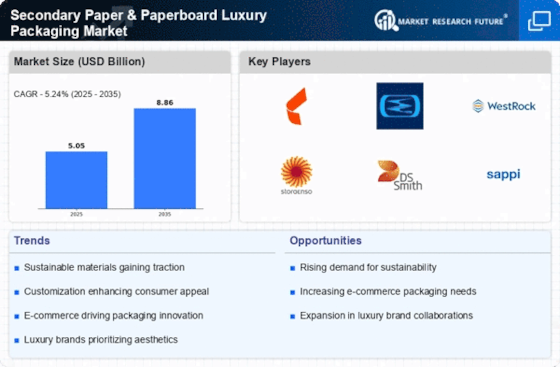
As per Market Research Future analysis, the Secondary Paper & Paperboard Luxury Packaging Market was estimated at 5.05 USD Billion in 2024. The market is projected to grow from 5.315 USD Billion in 2025 to 8.859 USD Billion by 2035, exhibiting a compound annual growth rate (CAGR) of 5.24% during the forecast period 2025 - 2035

Key Market Trends & Highlights

The Secondary Paper and Paperboard Luxury Packaging Market is experiencing a transformative shift towards sustainability and customization.

  • Sustainability is increasingly becoming a core value in packaging design, particularly in North America.
  • E-commerce is significantly influencing packaging aesthetics and functionality, especially in the Asia-Pacific region.
  • Customization and personalization trends are gaining traction, particularly within the fashion segment.
  • Key market drivers include sustainability initiatives and the rapid growth of e-commerce, which are shaping the future of luxury packaging.

Market Size & Forecast

2024 Market Size 5.05 (USD Billion)
2035 Market Size 8.859 (USD Billion)
CAGR (2025 - 2035) 5.24%
Largest Regional Market Share in 2024 North America

Major Players

Mondi Group (GB), Smurfit Kappa (IE), WestRock Company (US), Stora Enso (FI), DS Smith (GB), Sappi Limited (ZA), International Paper (US), Graphic Packaging Holding Company (US)

Market Trends

The Secondary Paper & Paperboard Luxury Packaging Market is currently experiencing a notable transformation, driven by evolving consumer preferences and a growing emphasis on sustainability. As brands increasingly seek to differentiate themselves in a competitive landscape, the demand for high-quality, aesthetically pleasing packaging solutions has surged. This shift is not merely about visual appeal; it also reflects a broader trend towards environmentally responsible practices. Companies are now prioritizing materials that are recyclable, biodegradable, or sourced from sustainable forests, aligning their packaging strategies with the values of eco-conscious consumers. Moreover, the rise of e-commerce has further influenced the dynamics of the Secondary Paper & Paperboard Luxury Packaging Market. With online shopping becoming a prevalent mode of purchasing, brands are compelled to invest in packaging that not only protects products during transit but also enhances the unboxing experience. This dual focus on functionality and luxury is reshaping how packaging is designed and produced. As the market continues to evolve, it appears that innovation in materials and design will play a crucial role in meeting the diverse needs of consumers and brands alike, ensuring that the market remains vibrant and competitive.

Sustainability as a Core Value

There is a growing trend towards sustainable packaging solutions within the Secondary Paper & Paperboard Luxury Packaging Market. Brands are increasingly adopting eco-friendly materials and practices, reflecting a commitment to environmental responsibility. This shift not only appeals to consumers who prioritize sustainability but also aligns with regulatory pressures and industry standards.

E-commerce Influence on Packaging Design

The expansion of e-commerce is significantly impacting the design and functionality of packaging in the Secondary Paper & Paperboard Luxury Packaging Market. Brands are focusing on creating packaging that enhances the customer experience during online purchases, ensuring that products arrive safely while also providing an engaging unboxing experience.

Customization and Personalization Trends

Customization is becoming a prominent trend in the Secondary Paper & Paperboard Luxury Packaging Market. Brands are increasingly offering personalized packaging options to cater to individual consumer preferences. This trend not only enhances brand loyalty but also allows for unique marketing opportunities, as customized packaging can create a memorable impression.

Secondary Paper and Paperboard Luxury Packaging Market Market Drivers

E-commerce Growth

The rapid expansion of e-commerce is significantly influencing the Secondary Paper & Paperboard Luxury Packaging Market. As online shopping continues to gain traction, the need for effective packaging solutions that ensure product safety during transit has become paramount. Data suggests that e-commerce sales are expected to grow exponentially, necessitating packaging that not only protects products but also enhances the unboxing experience. Luxury brands are increasingly focusing on packaging that reflects their identity while being functional for shipping. This trend is driving innovation in the design and materials used in luxury packaging, thereby propelling the growth of the Secondary Paper & Paperboard Luxury Packaging Market. The intersection of e-commerce and luxury packaging is likely to create new opportunities for brands to engage consumers.

Customization Demand

The desire for customization and personalization is a significant driver in the Secondary Paper & Paperboard Luxury Packaging Market. Consumers are increasingly seeking unique experiences, prompting brands to offer tailored packaging solutions that resonate with individual preferences. This trend is particularly pronounced in the luxury sector, where packaging serves as a critical touchpoint for brand identity. Market data indicates that personalized packaging can enhance customer loyalty and increase perceived value, making it a strategic focus for luxury brands. As a result, the Secondary Paper & Paperboard Luxury Packaging Market is witnessing a rise in demand for bespoke packaging options that cater to diverse consumer needs, thereby fostering brand differentiation and customer engagement.

Regulatory Compliance

Regulatory compliance is increasingly influencing the Secondary Paper & Paperboard Luxury Packaging Market. Governments and regulatory bodies are implementing stricter guidelines regarding packaging materials and waste management, pushing brands to adapt their packaging strategies accordingly. This trend is particularly relevant in the luxury sector, where brands must balance compliance with maintaining their premium image. Data indicates that companies investing in compliant packaging solutions are likely to gain a competitive edge, as consumers become more aware of environmental regulations. Consequently, the Secondary Paper & Paperboard Luxury Packaging Market is expected to see a shift towards materials and designs that not only meet regulatory standards but also appeal to eco-conscious consumers, thereby driving market growth.

Sustainability Initiatives

The increasing emphasis on sustainability is a pivotal driver for the Secondary Paper & Paperboard Luxury Packaging Market. Consumers are becoming more environmentally conscious, leading brands to adopt eco-friendly packaging solutions. This shift is reflected in the growing demand for recyclable and biodegradable materials, which are integral to luxury packaging. According to recent data, the market for sustainable packaging is projected to reach substantial figures, indicating a robust growth trajectory. Companies are investing in innovative materials and processes that minimize environmental impact, thereby enhancing their brand image. As a result, the Secondary Paper & Paperboard Luxury Packaging Market is likely to witness a surge in demand for sustainable options, aligning with consumer preferences and regulatory requirements.

Technological Advancements

Technological advancements are playing a crucial role in shaping the Secondary Paper & Paperboard Luxury Packaging Market. Innovations in printing, design, and material science are enabling brands to create more sophisticated and visually appealing packaging solutions. The integration of digital printing technologies allows for high-quality graphics and intricate designs, which are essential for luxury packaging. Furthermore, advancements in material technology are leading to the development of lighter yet stronger paper and paperboard options, enhancing both functionality and aesthetics. As brands strive to stand out in a competitive market, the adoption of these technologies is likely to drive growth in the Secondary Paper & Paperboard Luxury Packaging Market, offering new avenues for creativity and brand expression.

Market Segment Insights

By Application: Cosmetics (Largest) vs. Food and Beverage (Fastest-Growing)

<p>In the secondary paper paperboard <a href="https://www.marketresearchfuture.com/reports/luxury-packaging-market-5145" target="_blank" title="luxury packaging">luxury packaging</a> market, the cosmetics segment holds the largest market share, driven by the premium nature of products and the increasing demand for eco-friendly packaging solutions. The unique textures, finishes, and customization options offered by paperboard packaging appeal to brands looking to enhance their luxury image, thereby consolidating cosmetics as the leading application. Meanwhile, the food and beverage sector is rapidly gaining traction, reflecting a shift towards sustainable packaging practices. This segment is adapting to the growing consumer preference for organic and high-quality food products, particularly in premium categories, which in turn is fueling its growth.</p>

<p>Cosmetics: Dominant vs. Food and Beverage: Emerging</p>

<p>The cosmetics segment exhibits a strong dominance in the secondary paper paperboard luxury packaging market due to its emphasis on aesthetics and brand storytelling. Luxury beauty brands increasingly prioritize sustainable packaging, showcasing their commitment to environmental responsibility while attracting eco-conscious consumers. On the other hand, the food and beverage segment, although currently classified as emerging, is experiencing significant growth due to consumer trends favoring high-quality and sustainably packaged products. Brands are innovating with paperboard solutions, incorporating elegant designs that resonate with premium positioning. As food and beverage brands recognize the importance of packaging in enhancing overall product appeal, this segment is expected to witness continued expansion.</p>

By Material Type: Recycled Paper (Largest) vs. Kraft Paper (Fastest-Growing)

<p>In the secondary paper paperboard luxury packaging market, the material types exhibit a diverse share distribution. Recycled paper stands out as the largest segment, driven by increasing consumer preference for sustainability and environmentally friendly products. Kraft paper follows as a significant contender, particularly favored for its durability and aesthetic appeal in luxury packaging applications. Meanwhile, coated paper and cardboard segments hold a smaller share but play important roles in specific niche markets. Together, these material types cater to the varying demands of luxury packaging designs.</p>

<p>Kraft Paper (Dominant) vs. Coated Paper (Emerging)</p>

<p>Kraft paper emerges as a dominant force in the secondary paper paperboard luxury packaging market due to its robust nature and superior strength, making it an ideal choice for high-end packaging solutions. Its natural appearance and branding versatility resonate with luxury brands aiming for an aesthetic appeal. In contrast, coated paper is an emerging segment, gaining traction for its superior printability and ability to enhance product display. Coated paper allows for vibrant graphics and finishes, appealing to brands that prioritize visual impact. Together, these materials balance aesthetics and functionality, catering to the evolving tastes of luxury consumers.</p>

By End Use: Retail Packaging (Largest) vs. Gift Packaging (Fastest-Growing)

<p>In the secondary paper paperboard luxury packaging market, 'Retail Packaging' holds the largest share among the end use segments, primarily driven by the growing demand for high-quality, sustainable packaging solutions that enhance the consumer experience. Following closely, 'Gift Packaging' is rapidly gaining traction, becoming a significant contributor as consumers increasingly seek personalized and aesthetically pleasing packaging to elevate the gifting experience.</p>

<p>Retail Packaging (Dominant) vs. Gift Packaging (Emerging)</p>

<p>'Retail Packaging' stands out as the dominant force in the secondary paper paperboard luxury packaging market, characterized by its broad application across various retail sectors. Brands are leveraging stylish and eco-friendly paperboard solutions to attract customers and promote brand identity. On the other hand, 'Gift Packaging' is emerging rapidly, driven by trends toward unique and luxurious presentations for special occasions. This segment thrives on customization, allowing consumers to convey personal sentiments through bespoke designs. The growing e-commerce sector also influences this market, as online shopping for gifts increasingly demands eye-catching and high-quality packaging to enhance unboxing experiences.</p>

By Design Complexity: Custom Design (Largest) vs. Eco-friendly Design (Fastest-Growing)

<p>In the secondary paper paperboard luxury packaging market, the design complexity segment showcases a diverse distribution among various values. Custom Design currently leads the segment due to its unique offerings that cater to personalized brand needs, appealing to luxury brands looking to differentiate themselves. Simple Design, while popular for its ease of production, holds a smaller market share as brands increasingly opt for designs that resonate with consumers on an emotional level. Premium and Eco-friendly Designs are gaining traction due to heightened consumer awareness about sustainability. The growth trends within the design complexity segment are driven predominantly by the rise in consumer preferences for bespoke and sustainable packaging options. As a result, Eco-friendly Design is emerging as the fastest-growing segment, capitalizing on the demand for environmentally responsible solutions. The trend towards personalization continues to fuel Custom Design, appealing to brands aiming for exclusivity in their packaging solutions. Investments in innovative design technologies and materials are enhancing the segment's overall appeal, indicating a shift towards versatility and sustainability.</p>

<p>Custom Design: Dominant vs. Eco-friendly Design: Emerging</p>

<p>Custom Design in the secondary paper paperboard luxury packaging market stands as a dominant segment, symbolizing uniqueness and personalization in brand packaging. Brands leveraging custom designs benefit from creating an emotional connect with consumers, thus enhancing brand loyalty. This segment allows companies to reflect their identity through bespoke solutions. Conversely, Eco-friendly Design represents an emerging trend, aligning with global sustainability efforts. This value caters to a growing consumer base that prioritizes environmental consciousness. Brands adopting eco-friendly designs not only contribute to sustainability but also tap into a market segment increasingly driven by values. While Custom Design focuses on personalization, Eco-friendly Design emphasizes responsible packaging, showcasing two significant but distinct consumer interests.</p>

By Printing Technology: Digital Printing (Largest) vs. Flexographic Printing (Fastest-Growing)

<p>In the secondary paper paperboard luxury packaging market, Digital Printing holds the largest share among various printing technologies, owing to its versatility and ability to produce high-quality prints at lower costs. The ability to customize packaging solutions quickly helps businesses respond to market needs efficiently. On the other hand, Flexographic Printing is witnessing rapid growth, propelled by its efficiency in high-volume production runs. This technology is increasingly preferred for flexible packaging and labels, accommodating diverse consumer demands. Businesses are investing in advanced flexographic solutions to enhance printing speed and quality, ensuring its ascent in the luxury packaging sector.</p>

<p>Digital Printing (Dominant) vs. Screen Printing (Emerging)</p>

<p>Digital Printing emerges as the dominant technology in the secondary paper paperboard luxury packaging market due to its ability to offer intricate designs and quick turnaround times for custom orders, making it highly appealing for brands looking to stand out. Its efficiency in short runs contrasts sharply with Screen Printing, which, while being an emerging technology, is often limited by its speed and the complexity of designs it can achieve. Screen Printing is gaining recognition for its unique texture and finish, making it suitable for niche luxury packaging. As sustainability becomes a priority, both printing methods are evolving to incorporate eco-friendly materials, aligning with market trends towards sustainable packaging.</p>

Get more detailed insights about Secondary Paper & Paperboard Luxury Packaging Market Research Report—Global Forecast till 2035

Regional Insights

North America : Market Leader in Luxury Packaging

North America is the largest market for secondary paper and paperboard luxury packaging, holding approximately 40% of the global market share. The region's growth is driven by increasing consumer demand for sustainable packaging solutions and stringent regulations promoting eco-friendly materials. The rise in e-commerce and luxury goods consumption further fuels this demand, making it a key player in the market. The United States and Canada are the leading countries in this region, with major companies like WestRock Company and International Paper dominating the landscape. The competitive environment is characterized by innovation in sustainable packaging technologies and a focus on reducing carbon footprints. As consumer preferences shift towards environmentally responsible products, these companies are well-positioned to capture market share and drive growth.

Europe : Innovative Packaging Solutions

Europe is the second-largest market for secondary paper and paperboard luxury packaging, accounting for approximately 30% of the global market share. The region's growth is propelled by a strong emphasis on sustainability and circular economy initiatives, supported by EU regulations that encourage the use of recyclable materials. The demand for luxury packaging in sectors like cosmetics and gourmet food is also on the rise, contributing to market expansion. Leading countries in Europe include Germany, France, and the UK, where companies like Mondi Group and Smurfit Kappa are key players. The competitive landscape is marked by innovation in design and materials, with a focus on reducing environmental impact. The presence of stringent regulations and consumer awareness about sustainability further enhances the market's growth potential, making Europe a hub for luxury packaging innovation.

Asia-Pacific : Emerging Market Potential

Asia-Pacific is witnessing rapid growth in the secondary paper and paperboard luxury packaging market, holding approximately 25% of the global market share. The region's expansion is driven by increasing disposable incomes, urbanization, and a growing middle class that demands premium packaging for luxury goods. Additionally, government initiatives promoting sustainable packaging solutions are catalyzing market growth, making it a significant player in the global landscape. China and Japan are the leading countries in this region, with a competitive landscape featuring key players like Stora Enso and DS Smith. The market is characterized by a mix of local and international companies, all vying for a share in the burgeoning luxury packaging sector. As consumer preferences evolve towards high-quality and sustainable packaging, the region is poised for continued growth and innovation in this space.

Middle East and Africa : Untapped Market Opportunities

The Middle East and Africa region is emerging as a significant player in the secondary paper and paperboard luxury packaging market, holding approximately 5% of the global market share. The growth is driven by increasing urbanization, a rise in disposable incomes, and a burgeoning luxury goods market. Regulatory frameworks are gradually evolving to support sustainable packaging practices, which is expected to further enhance market dynamics in the coming years. Countries like South Africa and the UAE are at the forefront of this market, with local companies and international players like Sappi Limited making strides in luxury packaging solutions. The competitive landscape is still developing, with opportunities for innovation and investment in sustainable practices. As the region continues to grow economically, the demand for high-quality packaging solutions is likely to increase, presenting significant opportunities for market players.

Key Players and Competitive Insights

Leading market players are investing heavily in research and development in order to expand their product lines, which will help the Secondary Paper & Paperboard Luxury Packaging market, grow even more. Market participants are also undertaking a variety of strategic activities to expand their footprint, with important market developments including new product launches, contractual agreements, mergers and acquisitions, higher investments, and collaboration with other organizations. To expand and survive in a more competitive and rising market climate, Secondary Paper & Paperboard Luxury Packaging industry must offer cost-effective items.
Manufacturing locally to minimize operational costs is one of the key business tactics used by manufacturers in the Secondary Paper & Paperboard Luxury Packaging industry to benefit clients and increase the market sector. In recent years, the Secondary Paper & Paperboard Luxury Packaging industry has offered some of the most significant advantages to medicine.
Major players in the Secondary Paper & Paperboard Luxury Packaging market, including Amcor Limited, HH Deluxe packaging, DS Smith Plc, MW Creative Ltd, Winter & Company AG, Progress Packaging, and CLP Packaging Solution Inc., are attempting to increase market demand by investing in research and development operations.
Packaging solutions are provided by Amcor Plc (Amcor). Pet bottles, plastic bottles and jars, capsules and closures, speciality folding cartons, free films, bags and pouches, wrappers, rigid containers, laminates and flow packs are just a few of the plastic, fibre, metal and glass packaging solutions it offers. Products from the company are used in a variety of technical applications as well as the beverage, food, pharmaceutical, medical device, homecare, personal care, and animal care industries. Additionally, it services the markets for healthcare, pharmaceuticals, personal care, and home goods.
The corporation has operations throughout Oceania, North America, Western Europe, and the Asia-Pacific region. The UK city of Bristol serves as the headquarters of Amcor. Amcor introduced the ACT2100 heat seal covering for paper packaging with medical-grade DuPont Tyvek2 in June 2021. The improved performance attributes offered by this next-generation coating technique are ideal for healthcare applications.
To protect vintage items, Winter & Company designs and produces inventive leather covers. Winter & Company AG introduced their SIMPLY PURE COATED RECYCLABLE PAPERS line in June 2021. This line includes CORVON PURE MANO and ECOREL PURE SKIVER. These papers are recyclable and have recycled fibre content of over 50%.

Key Companies in the Secondary Paper and Paperboard Luxury Packaging Market include

Industry Developments

October 2020: The USD 138.070 million Circular Economy R&D programme launched by DC Smith Plc includes the seaweed project. The company will recycle natural fibres as part of this effort, incorporating novel natural resources like hemp, miscanthus, cotton, straw, and odd sources like the daisy-flowered cup plant and agricultural waste like cocoa shells or bagasse.

Future Outlook

Secondary Paper and Paperboard Luxury Packaging Market Future Outlook

The Secondary Paper & Paperboard Luxury Packaging Market is projected to grow at a 5.24% CAGR from 2025 to 2035, driven by sustainability trends, premiumization, and e-commerce expansion.

New opportunities lie in:

  • Invest in biodegradable coatings for enhanced product appeal.
  • Develop customizable packaging solutions for luxury brands.
  • Leverage <a href="https://www.marketresearchfuture.com/reports/digital-printing-market-10622" target="_blank" title="digital printing">digital printing</a> technologies for short-run production efficiency.

By 2035, the market is expected to solidify its position as a leader in sustainable luxury packaging.

Market Segmentation

Secondary Paper and Paperboard Luxury Packaging Market End User Outlook

  • Food & Beverages
  • Confectionery
  • Personal Care & Cosmetics
  • Wines & Spirits
  • Fashion

Secondary Paper and Paperboard Luxury Packaging Market Material Outlook

  • Paper & Paperboard
  • Plastic
  • Metal

Report Scope

MARKET SIZE 2024 5.05(USD Billion)
MARKET SIZE 2025 5.315(USD Billion)
MARKET SIZE 2035 8.859(USD Billion)
COMPOUND ANNUAL GROWTH RATE (CAGR) 5.24% (2025 - 2035)
REPORT COVERAGE Revenue Forecast, Competitive Landscape, Growth Factors, and Trends
BASE YEAR 2024
Market Forecast Period 2025 - 2035
Historical Data 2019 - 2024
Market Forecast Units USD Billion
Key Companies Profiled Mondi Group (GB), Smurfit Kappa (IE), WestRock Company (US), Stora Enso (FI), DS Smith (GB), Sappi Limited (ZA), International Paper (US), Graphic Packaging Holding Company (US)
Segments Covered Material, End User, Region
Key Market Opportunities Growing demand for sustainable packaging solutions drives innovation in the Secondary Paper and Paperboard Luxury Packaging Market.
Key Market Dynamics Rising consumer preference for sustainable packaging drives innovation and competition in the Secondary Paper and Paperboard Luxury Packaging Market.
Countries Covered North America, Europe, APAC, South America, MEA

FAQs

What is the current market valuation of the secondary paper paperboard luxury packaging market?

<p>As of 2024, the market valuation was 12.5 USD Billion.</p>

What is the projected market size for the secondary paper paperboard luxury packaging market by 2035?

<p>The market is expected to reach 20.0 USD Billion by 2035.</p>

What is the expected CAGR for the secondary paper paperboard luxury packaging market during the forecast period 2025 - 2035?

<p>The expected CAGR for this market is 4.37% from 2025 to 2035.</p>

Which companies are considered key players in the secondary paper paperboard luxury packaging market?

<p>Key players include Mondi Group, Smurfit Kappa, WestRock Company, and others.</p>

What are the primary applications of secondary paper paperboard luxury packaging?

<p>Primary applications include cosmetics, food and beverage, fashion, and jewelry.</p>

How does the market for luxury goods packaging compare to other end-use segments?

<p>Luxury goods packaging is projected to be valued between 4.0 and 6.0 USD Billion.</p>

What types of materials are predominantly used in secondary paper paperboard luxury packaging?

<p>Common materials include recycled paper, kraft paper, coated paper, and cardboard.</p>

What design complexities are prevalent in the secondary paper paperboard luxury packaging market?

<p>Design complexities range from simple to custom, premium, and eco-friendly designs.</p>

Which printing technologies are utilized in the secondary paper paperboard luxury packaging market?

<p>Printing technologies include digital, flexographic, offset, and screen printing.</p>

What is the expected growth trajectory for the food and beverage segment within this market?

<p>The food and beverage segment is projected to grow from 3.0 to 5.0 USD Billion.</p>

  1. SECTION I: EXECUTIVE SUMMARY AND KEY HIGHLIGHTS
    1. | 1.1 EXECUTIVE SUMMARY
    2. | | 1.1.1 Market Overview
    3. | | 1.1.2 Key Findings
    4. | | 1.1.3 Market Segmentation
    5. | | 1.1.4 Competitive Landscape
    6. | | 1.1.5 Challenges and Opportunities
    7. | | 1.1.6 Future Outlook
  2. SECTION II: SCOPING, METHODOLOGY AND MARKET STRUCTURE
    1. | 2.1 MARKET INTRODUCTION
    2. | | 2.1.1 Definition
    3. | | 2.1.2 Scope of the study
    4. | | | 2.1.2.1 Research Objective
    5. | | | 2.1.2.2 Assumption
    6. | | | 2.1.2.3 Limitations
    7. | 2.2 RESEARCH METHODOLOGY
    8. | | 2.2.1 Overview
    9. | | 2.2.2 Data Mining
    10. | | 2.2.3 Secondary Research
    11. | | 2.2.4 Primary Research
    12. | | | 2.2.4.1 Primary Interviews and Information Gathering Process
    13. | | | 2.2.4.2 Breakdown of Primary Respondents
    14. | | 2.2.5 Forecasting Model
    15. | | 2.2.6 Market Size Estimation
    16. | | | 2.2.6.1 Bottom-Up Approach
    17. | | | 2.2.6.2 Top-Down Approach
    18. | | 2.2.7 Data Triangulation
    19. | | 2.2.8 Validation
  3. SECTION III: QUALITATIVE ANALYSIS
    1. | 3.1 MARKET DYNAMICS
    2. | | 3.1.1 Overview
    3. | | 3.1.2 Drivers
    4. | | 3.1.3 Restraints
    5. | | 3.1.4 Opportunities
    6. | 3.2 MARKET FACTOR ANALYSIS
    7. | | 3.2.1 Value chain Analysis
    8. | | 3.2.2 Porter's Five Forces Analysis
    9. | | | 3.2.2.1 Bargaining Power of Suppliers
    10. | | | 3.2.2.2 Bargaining Power of Buyers
    11. | | | 3.2.2.3 Threat of New Entrants
    12. | | | 3.2.2.4 Threat of Substitutes
    13. | | | 3.2.2.5 Intensity of Rivalry
    14. | | 3.2.3 COVID-19 Impact Analysis
    15. | | | 3.2.3.1 Market Impact Analysis
    16. | | | 3.2.3.2 Regional Impact
    17. | | | 3.2.3.3 Opportunity and Threat Analysis
  4. SECTION IV: QUANTITATIVE ANALYSIS
    1. | 4.1 Packaging & Transport, BY Application (USD Billion)
    2. | | 4.1.1 Cosmetics
    3. | | 4.1.2 Food and Beverage
    4. | | 4.1.3 Fashion
    5. | | 4.1.4 Jewelry
    6. | 4.2 Packaging & Transport, BY Material Type (USD Billion)
    7. | | 4.2.1 Recycled Paper
    8. | | 4.2.2 Kraft Paper
    9. | | 4.2.3 Coated Paper
    10. | | 4.2.4 Cardboard
    11. | 4.3 Packaging & Transport, BY End Use (USD Billion)
    12. | | 4.3.1 Retail Packaging
    13. | | 4.3.2 Gift Packaging
    14. | | 4.3.3 Luxury Goods Packaging
    15. | | 4.3.4 E-commerce Packaging
    16. | 4.4 Packaging & Transport, BY Design Complexity (USD Billion)
    17. | | 4.4.1 Simple Design
    18. | | 4.4.2 Custom Design
    19. | | 4.4.3 Premium Design
    20. | | 4.4.4 Eco-friendly Design
    21. | 4.5 Packaging & Transport, BY Printing Technology (USD Billion)
    22. | | 4.5.1 Digital Printing
    23. | | 4.5.2 Flexographic Printing
    24. | | 4.5.3 Offset Printing
    25. | | 4.5.4 Screen Printing
    26. | 4.6 Packaging & Transport, BY Region (USD Billion)
    27. | | 4.6.1 North America
    28. | | | 4.6.1.1 US
    29. | | | 4.6.1.2 Canada
    30. | | 4.6.2 Europe
    31. | | | 4.6.2.1 Germany
    32. | | | 4.6.2.2 UK
    33. | | | 4.6.2.3 France
    34. | | | 4.6.2.4 Russia
    35. | | | 4.6.2.5 Italy
    36. | | | 4.6.2.6 Spain
    37. | | | 4.6.2.7 Rest of Europe
    38. | | 4.6.3 APAC
    39. | | | 4.6.3.1 China
    40. | | | 4.6.3.2 India
    41. | | | 4.6.3.3 Japan
    42. | | | 4.6.3.4 South Korea
    43. | | | 4.6.3.5 Malaysia
    44. | | | 4.6.3.6 Thailand
    45. | | | 4.6.3.7 Indonesia
    46. | | | 4.6.3.8 Rest of APAC
    47. | | 4.6.4 South America
    48. | | | 4.6.4.1 Brazil
    49. | | | 4.6.4.2 Mexico
    50. | | | 4.6.4.3 Argentina
    51. | | | 4.6.4.4 Rest of South America
    52. | | 4.6.5 MEA
    53. | | | 4.6.5.1 GCC Countries
    54. | | | 4.6.5.2 South Africa
    55. | | | 4.6.5.3 Rest of MEA
  5. SECTION V: COMPETITIVE ANALYSIS
    1. | 5.1 Competitive Landscape
    2. | | 5.1.1 Overview
    3. | | 5.1.2 Competitive Analysis
    4. | | 5.1.3 Market share Analysis
    5. | | 5.1.4 Major Growth Strategy in the Packaging & Transport
    6. | | 5.1.5 Competitive Benchmarking
    7. | | 5.1.6 Leading Players in Terms of Number of Developments in the Packaging & Transport
    8. | | 5.1.7 Key developments and growth strategies
    9. | | | 5.1.7.1 New Product Launch/Service Deployment
    10. | | | 5.1.7.2 Merger & Acquisitions
    11. | | | 5.1.7.3 Joint Ventures
    12. | | 5.1.8 Major Players Financial Matrix
    13. | | | 5.1.8.1 Sales and Operating Income
    14. | | | 5.1.8.2 Major Players R&D Expenditure. 2023
    15. | 5.2 Company Profiles
    16. | | 5.2.1 Mondi Group (GB)
    17. | | | 5.2.1.1 Financial Overview
    18. | | | 5.2.1.2 Products Offered
    19. | | | 5.2.1.3 Key Developments
    20. | | | 5.2.1.4 SWOT Analysis
    21. | | | 5.2.1.5 Key Strategies
    22. | | 5.2.2 Smurfit Kappa (IE)
    23. | | | 5.2.2.1 Financial Overview
    24. | | | 5.2.2.2 Products Offered
    25. | | | 5.2.2.3 Key Developments
    26. | | | 5.2.2.4 SWOT Analysis
    27. | | | 5.2.2.5 Key Strategies
    28. | | 5.2.3 WestRock Company (US)
    29. | | | 5.2.3.1 Financial Overview
    30. | | | 5.2.3.2 Products Offered
    31. | | | 5.2.3.3 Key Developments
    32. | | | 5.2.3.4 SWOT Analysis
    33. | | | 5.2.3.5 Key Strategies
    34. | | 5.2.4 Stora Enso (FI)
    35. | | | 5.2.4.1 Financial Overview
    36. | | | 5.2.4.2 Products Offered
    37. | | | 5.2.4.3 Key Developments
    38. | | | 5.2.4.4 SWOT Analysis
    39. | | | 5.2.4.5 Key Strategies
    40. | | 5.2.5 DS Smith (GB)
    41. | | | 5.2.5.1 Financial Overview
    42. | | | 5.2.5.2 Products Offered
    43. | | | 5.2.5.3 Key Developments
    44. | | | 5.2.5.4 SWOT Analysis
    45. | | | 5.2.5.5 Key Strategies
    46. | | 5.2.6 Sappi Limited (ZA)
    47. | | | 5.2.6.1 Financial Overview
    48. | | | 5.2.6.2 Products Offered
    49. | | | 5.2.6.3 Key Developments
    50. | | | 5.2.6.4 SWOT Analysis
    51. | | | 5.2.6.5 Key Strategies
    52. | | 5.2.7 International Paper (US)
    53. | | | 5.2.7.1 Financial Overview
    54. | | | 5.2.7.2 Products Offered
    55. | | | 5.2.7.3 Key Developments
    56. | | | 5.2.7.4 SWOT Analysis
    57. | | | 5.2.7.5 Key Strategies
    58. | | 5.2.8 Graphic Packaging Holding Company (US)
    59. | | | 5.2.8.1 Financial Overview
    60. | | | 5.2.8.2 Products Offered
    61. | | | 5.2.8.3 Key Developments
    62. | | | 5.2.8.4 SWOT Analysis
    63. | | | 5.2.8.5 Key Strategies
    64. | | 5.2.9 Packaging Corporation of America (US)
    65. | | | 5.2.9.1 Financial Overview
    66. | | | 5.2.9.2 Products Offered
    67. | | | 5.2.9.3 Key Developments
    68. | | | 5.2.9.4 SWOT Analysis
    69. | | | 5.2.9.5 Key Strategies
    70. | 5.3 Appendix
    71. | | 5.3.1 References
    72. | | 5.3.2 Related Reports
  6. LIST OF FIGURES
    1. | 6.1 MARKET SYNOPSIS
    2. | 6.2 NORTH AMERICA MARKET ANALYSIS
    3. | 6.3 US MARKET ANALYSIS BY APPLICATION
    4. | 6.4 US MARKET ANALYSIS BY MATERIAL TYPE
    5. | 6.5 US MARKET ANALYSIS BY END USE
    6. | 6.6 US MARKET ANALYSIS BY DESIGN COMPLEXITY
    7. | 6.7 US MARKET ANALYSIS BY PRINTING TECHNOLOGY
    8. | 6.8 CANADA MARKET ANALYSIS BY APPLICATION
    9. | 6.9 CANADA MARKET ANALYSIS BY MATERIAL TYPE
    10. | 6.10 CANADA MARKET ANALYSIS BY END USE
    11. | 6.11 CANADA MARKET ANALYSIS BY DESIGN COMPLEXITY
    12. | 6.12 CANADA MARKET ANALYSIS BY PRINTING TECHNOLOGY
    13. | 6.13 EUROPE MARKET ANALYSIS
    14. | 6.14 GERMANY MARKET ANALYSIS BY APPLICATION
    15. | 6.15 GERMANY MARKET ANALYSIS BY MATERIAL TYPE
    16. | 6.16 GERMANY MARKET ANALYSIS BY END USE
    17. | 6.17 GERMANY MARKET ANALYSIS BY DESIGN COMPLEXITY
    18. | 6.18 GERMANY MARKET ANALYSIS BY PRINTING TECHNOLOGY
    19. | 6.19 UK MARKET ANALYSIS BY APPLICATION
    20. | 6.20 UK MARKET ANALYSIS BY MATERIAL TYPE
    21. | 6.21 UK MARKET ANALYSIS BY END USE
    22. | 6.22 UK MARKET ANALYSIS BY DESIGN COMPLEXITY
    23. | 6.23 UK MARKET ANALYSIS BY PRINTING TECHNOLOGY
    24. | 6.24 FRANCE MARKET ANALYSIS BY APPLICATION
    25. | 6.25 FRANCE MARKET ANALYSIS BY MATERIAL TYPE
    26. | 6.26 FRANCE MARKET ANALYSIS BY END USE
    27. | 6.27 FRANCE MARKET ANALYSIS BY DESIGN COMPLEXITY
    28. | 6.28 FRANCE MARKET ANALYSIS BY PRINTING TECHNOLOGY
    29. | 6.29 RUSSIA MARKET ANALYSIS BY APPLICATION
    30. | 6.30 RUSSIA MARKET ANALYSIS BY MATERIAL TYPE
    31. | 6.31 RUSSIA MARKET ANALYSIS BY END USE
    32. | 6.32 RUSSIA MARKET ANALYSIS BY DESIGN COMPLEXITY
    33. | 6.33 RUSSIA MARKET ANALYSIS BY PRINTING TECHNOLOGY
    34. | 6.34 ITALY MARKET ANALYSIS BY APPLICATION
    35. | 6.35 ITALY MARKET ANALYSIS BY MATERIAL TYPE
    36. | 6.36 ITALY MARKET ANALYSIS BY END USE
    37. | 6.37 ITALY MARKET ANALYSIS BY DESIGN COMPLEXITY
    38. | 6.38 ITALY MARKET ANALYSIS BY PRINTING TECHNOLOGY
    39. | 6.39 SPAIN MARKET ANALYSIS BY APPLICATION
    40. | 6.40 SPAIN MARKET ANALYSIS BY MATERIAL TYPE
    41. | 6.41 SPAIN MARKET ANALYSIS BY END USE
    42. | 6.42 SPAIN MARKET ANALYSIS BY DESIGN COMPLEXITY
    43. | 6.43 SPAIN MARKET ANALYSIS BY PRINTING TECHNOLOGY
    44. | 6.44 REST OF EUROPE MARKET ANALYSIS BY APPLICATION
    45. | 6.45 REST OF EUROPE MARKET ANALYSIS BY MATERIAL TYPE
    46. | 6.46 REST OF EUROPE MARKET ANALYSIS BY END USE
    47. | 6.47 REST OF EUROPE MARKET ANALYSIS BY DESIGN COMPLEXITY
    48. | 6.48 REST OF EUROPE MARKET ANALYSIS BY PRINTING TECHNOLOGY
    49. | 6.49 APAC MARKET ANALYSIS
    50. | 6.50 CHINA MARKET ANALYSIS BY APPLICATION
    51. | 6.51 CHINA MARKET ANALYSIS BY MATERIAL TYPE
    52. | 6.52 CHINA MARKET ANALYSIS BY END USE
    53. | 6.53 CHINA MARKET ANALYSIS BY DESIGN COMPLEXITY
    54. | 6.54 CHINA MARKET ANALYSIS BY PRINTING TECHNOLOGY
    55. | 6.55 INDIA MARKET ANALYSIS BY APPLICATION
    56. | 6.56 INDIA MARKET ANALYSIS BY MATERIAL TYPE
    57. | 6.57 INDIA MARKET ANALYSIS BY END USE
    58. | 6.58 INDIA MARKET ANALYSIS BY DESIGN COMPLEXITY
    59. | 6.59 INDIA MARKET ANALYSIS BY PRINTING TECHNOLOGY
    60. | 6.60 JAPAN MARKET ANALYSIS BY APPLICATION
    61. | 6.61 JAPAN MARKET ANALYSIS BY MATERIAL TYPE
    62. | 6.62 JAPAN MARKET ANALYSIS BY END USE
    63. | 6.63 JAPAN MARKET ANALYSIS BY DESIGN COMPLEXITY
    64. | 6.64 JAPAN MARKET ANALYSIS BY PRINTING TECHNOLOGY
    65. | 6.65 SOUTH KOREA MARKET ANALYSIS BY APPLICATION
    66. | 6.66 SOUTH KOREA MARKET ANALYSIS BY MATERIAL TYPE
    67. | 6.67 SOUTH KOREA MARKET ANALYSIS BY END USE
    68. | 6.68 SOUTH KOREA MARKET ANALYSIS BY DESIGN COMPLEXITY
    69. | 6.69 SOUTH KOREA MARKET ANALYSIS BY PRINTING TECHNOLOGY
    70. | 6.70 MALAYSIA MARKET ANALYSIS BY APPLICATION
    71. | 6.71 MALAYSIA MARKET ANALYSIS BY MATERIAL TYPE
    72. | 6.72 MALAYSIA MARKET ANALYSIS BY END USE
    73. | 6.73 MALAYSIA MARKET ANALYSIS BY DESIGN COMPLEXITY
    74. | 6.74 MALAYSIA MARKET ANALYSIS BY PRINTING TECHNOLOGY
    75. | 6.75 THAILAND MARKET ANALYSIS BY APPLICATION
    76. | 6.76 THAILAND MARKET ANALYSIS BY MATERIAL TYPE
    77. | 6.77 THAILAND MARKET ANALYSIS BY END USE
    78. | 6.78 THAILAND MARKET ANALYSIS BY DESIGN COMPLEXITY
    79. | 6.79 THAILAND MARKET ANALYSIS BY PRINTING TECHNOLOGY
    80. | 6.80 INDONESIA MARKET ANALYSIS BY APPLICATION
    81. | 6.81 INDONESIA MARKET ANALYSIS BY MATERIAL TYPE
    82. | 6.82 INDONESIA MARKET ANALYSIS BY END USE
    83. | 6.83 INDONESIA MARKET ANALYSIS BY DESIGN COMPLEXITY
    84. | 6.84 INDONESIA MARKET ANALYSIS BY PRINTING TECHNOLOGY
    85. | 6.85 REST OF APAC MARKET ANALYSIS BY APPLICATION
    86. | 6.86 REST OF APAC MARKET ANALYSIS BY MATERIAL TYPE
    87. | 6.87 REST OF APAC MARKET ANALYSIS BY END USE
    88. | 6.88 REST OF APAC MARKET ANALYSIS BY DESIGN COMPLEXITY
    89. | 6.89 REST OF APAC MARKET ANALYSIS BY PRINTING TECHNOLOGY
    90. | 6.90 SOUTH AMERICA MARKET ANALYSIS
    91. | 6.91 BRAZIL MARKET ANALYSIS BY APPLICATION
    92. | 6.92 BRAZIL MARKET ANALYSIS BY MATERIAL TYPE
    93. | 6.93 BRAZIL MARKET ANALYSIS BY END USE
    94. | 6.94 BRAZIL MARKET ANALYSIS BY DESIGN COMPLEXITY
    95. | 6.95 BRAZIL MARKET ANALYSIS BY PRINTING TECHNOLOGY
    96. | 6.96 MEXICO MARKET ANALYSIS BY APPLICATION
    97. | 6.97 MEXICO MARKET ANALYSIS BY MATERIAL TYPE
    98. | 6.98 MEXICO MARKET ANALYSIS BY END USE
    99. | 6.99 MEXICO MARKET ANALYSIS BY DESIGN COMPLEXITY
    100. | 6.100 MEXICO MARKET ANALYSIS BY PRINTING TECHNOLOGY
    101. | 6.101 ARGENTINA MARKET ANALYSIS BY APPLICATION
    102. | 6.102 ARGENTINA MARKET ANALYSIS BY MATERIAL TYPE
    103. | 6.103 ARGENTINA MARKET ANALYSIS BY END USE
    104. | 6.104 ARGENTINA MARKET ANALYSIS BY DESIGN COMPLEXITY
    105. | 6.105 ARGENTINA MARKET ANALYSIS BY PRINTING TECHNOLOGY
    106. | 6.106 REST OF SOUTH AMERICA MARKET ANALYSIS BY APPLICATION
    107. | 6.107 REST OF SOUTH AMERICA MARKET ANALYSIS BY MATERIAL TYPE
    108. | 6.108 REST OF SOUTH AMERICA MARKET ANALYSIS BY END USE
    109. | 6.109 REST OF SOUTH AMERICA MARKET ANALYSIS BY DESIGN COMPLEXITY
    110. | 6.110 REST OF SOUTH AMERICA MARKET ANALYSIS BY PRINTING TECHNOLOGY
    111. | 6.111 MEA MARKET ANALYSIS
    112. | 6.112 GCC COUNTRIES MARKET ANALYSIS BY APPLICATION
    113. | 6.113 GCC COUNTRIES MARKET ANALYSIS BY MATERIAL TYPE
    114. | 6.114 GCC COUNTRIES MARKET ANALYSIS BY END USE
    115. | 6.115 GCC COUNTRIES MARKET ANALYSIS BY DESIGN COMPLEXITY
    116. | 6.116 GCC COUNTRIES MARKET ANALYSIS BY PRINTING TECHNOLOGY
    117. | 6.117 SOUTH AFRICA MARKET ANALYSIS BY APPLICATION
    118. | 6.118 SOUTH AFRICA MARKET ANALYSIS BY MATERIAL TYPE
    119. | 6.119 SOUTH AFRICA MARKET ANALYSIS BY END USE
    120. | 6.120 SOUTH AFRICA MARKET ANALYSIS BY DESIGN COMPLEXITY
    121. | 6.121 SOUTH AFRICA MARKET ANALYSIS BY PRINTING TECHNOLOGY
    122. | 6.122 REST OF MEA MARKET ANALYSIS BY APPLICATION
    123. | 6.123 REST OF MEA MARKET ANALYSIS BY MATERIAL TYPE
    124. | 6.124 REST OF MEA MARKET ANALYSIS BY END USE
    125. | 6.125 REST OF MEA MARKET ANALYSIS BY DESIGN COMPLEXITY
    126. | 6.126 REST OF MEA MARKET ANALYSIS BY PRINTING TECHNOLOGY
    127. | 6.127 KEY BUYING CRITERIA OF PACKAGING & TRANSPORT
    128. | 6.128 RESEARCH PROCESS OF MRFR
    129. | 6.129 DRO ANALYSIS OF PACKAGING & TRANSPORT
    130. | 6.130 DRIVERS IMPACT ANALYSIS: PACKAGING & TRANSPORT
    131. | 6.131 RESTRAINTS IMPACT ANALYSIS: PACKAGING & TRANSPORT
    132. | 6.132 SUPPLY / VALUE CHAIN: PACKAGING & TRANSPORT
    133. | 6.133 PACKAGING & TRANSPORT, BY APPLICATION, 2024 (% SHARE)
    134. | 6.134 PACKAGING & TRANSPORT, BY APPLICATION, 2024 TO 2035 (USD Billion)
    135. | 6.135 PACKAGING & TRANSPORT, BY MATERIAL TYPE, 2024 (% SHARE)
    136. | 6.136 PACKAGING & TRANSPORT, BY MATERIAL TYPE, 2024 TO 2035 (USD Billion)
    137. | 6.137 PACKAGING & TRANSPORT, BY END USE, 2024 (% SHARE)
    138. | 6.138 PACKAGING & TRANSPORT, BY END USE, 2024 TO 2035 (USD Billion)
    139. | 6.139 PACKAGING & TRANSPORT, BY DESIGN COMPLEXITY, 2024 (% SHARE)
    140. | 6.140 PACKAGING & TRANSPORT, BY DESIGN COMPLEXITY, 2024 TO 2035 (USD Billion)
    141. | 6.141 PACKAGING & TRANSPORT, BY PRINTING TECHNOLOGY, 2024 (% SHARE)
    142. | 6.142 PACKAGING & TRANSPORT, BY PRINTING TECHNOLOGY, 2024 TO 2035 (USD Billion)
    143. | 6.143 BENCHMARKING OF MAJOR COMPETITORS
  7. LIST OF TABLES
    1. | 7.1 LIST OF ASSUMPTIONS
    2. | | 7.1.1
    3. | 7.2 North America MARKET SIZE ESTIMATES; FORECAST
    4. | | 7.2.1 BY APPLICATION, 2025-2035 (USD Billion)
    5. | | 7.2.2 BY MATERIAL TYPE, 2025-2035 (USD Billion)
    6. | | 7.2.3 BY END USE, 2025-2035 (USD Billion)
    7. | | 7.2.4 BY DESIGN COMPLEXITY, 2025-2035 (USD Billion)
    8. | | 7.2.5 BY PRINTING TECHNOLOGY, 2025-2035 (USD Billion)
    9. | 7.3 US MARKET SIZE ESTIMATES; FORECAST
    10. | | 7.3.1 BY APPLICATION, 2025-2035 (USD Billion)
    11. | | 7.3.2 BY MATERIAL TYPE, 2025-2035 (USD Billion)
    12. | | 7.3.3 BY END USE, 2025-2035 (USD Billion)
    13. | | 7.3.4 BY DESIGN COMPLEXITY, 2025-2035 (USD Billion)
    14. | | 7.3.5 BY PRINTING TECHNOLOGY, 2025-2035 (USD Billion)
    15. | 7.4 Canada MARKET SIZE ESTIMATES; FORECAST
    16. | | 7.4.1 BY APPLICATION, 2025-2035 (USD Billion)
    17. | | 7.4.2 BY MATERIAL TYPE, 2025-2035 (USD Billion)
    18. | | 7.4.3 BY END USE, 2025-2035 (USD Billion)
    19. | | 7.4.4 BY DESIGN COMPLEXITY, 2025-2035 (USD Billion)
    20. | | 7.4.5 BY PRINTING TECHNOLOGY, 2025-2035 (USD Billion)
    21. | 7.5 Europe MARKET SIZE ESTIMATES; FORECAST
    22. | | 7.5.1 BY APPLICATION, 2025-2035 (USD Billion)
    23. | | 7.5.2 BY MATERIAL TYPE, 2025-2035 (USD Billion)
    24. | | 7.5.3 BY END USE, 2025-2035 (USD Billion)
    25. | | 7.5.4 BY DESIGN COMPLEXITY, 2025-2035 (USD Billion)
    26. | | 7.5.5 BY PRINTING TECHNOLOGY, 2025-2035 (USD Billion)
    27. | 7.6 Germany MARKET SIZE ESTIMATES; FORECAST
    28. | | 7.6.1 BY APPLICATION, 2025-2035 (USD Billion)
    29. | | 7.6.2 BY MATERIAL TYPE, 2025-2035 (USD Billion)
    30. | | 7.6.3 BY END USE, 2025-2035 (USD Billion)
    31. | | 7.6.4 BY DESIGN COMPLEXITY, 2025-2035 (USD Billion)
    32. | | 7.6.5 BY PRINTING TECHNOLOGY, 2025-2035 (USD Billion)
    33. | 7.7 UK MARKET SIZE ESTIMATES; FORECAST
    34. | | 7.7.1 BY APPLICATION, 2025-2035 (USD Billion)
    35. | | 7.7.2 BY MATERIAL TYPE, 2025-2035 (USD Billion)
    36. | | 7.7.3 BY END USE, 2025-2035 (USD Billion)
    37. | | 7.7.4 BY DESIGN COMPLEXITY, 2025-2035 (USD Billion)
    38. | | 7.7.5 BY PRINTING TECHNOLOGY, 2025-2035 (USD Billion)
    39. | 7.8 France MARKET SIZE ESTIMATES; FORECAST
    40. | | 7.8.1 BY APPLICATION, 2025-2035 (USD Billion)
    41. | | 7.8.2 BY MATERIAL TYPE, 2025-2035 (USD Billion)
    42. | | 7.8.3 BY END USE, 2025-2035 (USD Billion)
    43. | | 7.8.4 BY DESIGN COMPLEXITY, 2025-2035 (USD Billion)
    44. | | 7.8.5 BY PRINTING TECHNOLOGY, 2025-2035 (USD Billion)
    45. | 7.9 Russia MARKET SIZE ESTIMATES; FORECAST
    46. | | 7.9.1 BY APPLICATION, 2025-2035 (USD Billion)
    47. | | 7.9.2 BY MATERIAL TYPE, 2025-2035 (USD Billion)
    48. | | 7.9.3 BY END USE, 2025-2035 (USD Billion)
    49. | | 7.9.4 BY DESIGN COMPLEXITY, 2025-2035 (USD Billion)
    50. | | 7.9.5 BY PRINTING TECHNOLOGY, 2025-2035 (USD Billion)
    51. | 7.10 Italy MARKET SIZE ESTIMATES; FORECAST
    52. | | 7.10.1 BY APPLICATION, 2025-2035 (USD Billion)
    53. | | 7.10.2 BY MATERIAL TYPE, 2025-2035 (USD Billion)
    54. | | 7.10.3 BY END USE, 2025-2035 (USD Billion)
    55. | | 7.10.4 BY DESIGN COMPLEXITY, 2025-2035 (USD Billion)
    56. | | 7.10.5 BY PRINTING TECHNOLOGY, 2025-2035 (USD Billion)
    57. | 7.11 Spain MARKET SIZE ESTIMATES; FORECAST
    58. | | 7.11.1 BY APPLICATION, 2025-2035 (USD Billion)
    59. | | 7.11.2 BY MATERIAL TYPE, 2025-2035 (USD Billion)
    60. | | 7.11.3 BY END USE, 2025-2035 (USD Billion)
    61. | | 7.11.4 BY DESIGN COMPLEXITY, 2025-2035 (USD Billion)
    62. | | 7.11.5 BY PRINTING TECHNOLOGY, 2025-2035 (USD Billion)
    63. | 7.12 Rest of Europe MARKET SIZE ESTIMATES; FORECAST
    64. | | 7.12.1 BY APPLICATION, 2025-2035 (USD Billion)
    65. | | 7.12.2 BY MATERIAL TYPE, 2025-2035 (USD Billion)
    66. | | 7.12.3 BY END USE, 2025-2035 (USD Billion)
    67. | | 7.12.4 BY DESIGN COMPLEXITY, 2025-2035 (USD Billion)
    68. | | 7.12.5 BY PRINTING TECHNOLOGY, 2025-2035 (USD Billion)
    69. | 7.13 APAC MARKET SIZE ESTIMATES; FORECAST
    70. | | 7.13.1 BY APPLICATION, 2025-2035 (USD Billion)
    71. | | 7.13.2 BY MATERIAL TYPE, 2025-2035 (USD Billion)
    72. | | 7.13.3 BY END USE, 2025-2035 (USD Billion)
    73. | | 7.13.4 BY DESIGN COMPLEXITY, 2025-2035 (USD Billion)
    74. | | 7.13.5 BY PRINTING TECHNOLOGY, 2025-2035 (USD Billion)
    75. | 7.14 China MARKET SIZE ESTIMATES; FORECAST
    76. | | 7.14.1 BY APPLICATION, 2025-2035 (USD Billion)
    77. | | 7.14.2 BY MATERIAL TYPE, 2025-2035 (USD Billion)
    78. | | 7.14.3 BY END USE, 2025-2035 (USD Billion)
    79. | | 7.14.4 BY DESIGN COMPLEXITY, 2025-2035 (USD Billion)
    80. | | 7.14.5 BY PRINTING TECHNOLOGY, 2025-2035 (USD Billion)
    81. | 7.15 India MARKET SIZE ESTIMATES; FORECAST
    82. | | 7.15.1 BY APPLICATION, 2025-2035 (USD Billion)
    83. | | 7.15.2 BY MATERIAL TYPE, 2025-2035 (USD Billion)
    84. | | 7.15.3 BY END USE, 2025-2035 (USD Billion)
    85. | | 7.15.4 BY DESIGN COMPLEXITY, 2025-2035 (USD Billion)
    86. | | 7.15.5 BY PRINTING TECHNOLOGY, 2025-2035 (USD Billion)
    87. | 7.16 Japan MARKET SIZE ESTIMATES; FORECAST
    88. | | 7.16.1 BY APPLICATION, 2025-2035 (USD Billion)
    89. | | 7.16.2 BY MATERIAL TYPE, 2025-2035 (USD Billion)
    90. | | 7.16.3 BY END USE, 2025-2035 (USD Billion)
    91. | | 7.16.4 BY DESIGN COMPLEXITY, 2025-2035 (USD Billion)
    92. | | 7.16.5 BY PRINTING TECHNOLOGY, 2025-2035 (USD Billion)
    93. | 7.17 South Korea MARKET SIZE ESTIMATES; FORECAST
    94. | | 7.17.1 BY APPLICATION, 2025-2035 (USD Billion)
    95. | | 7.17.2 BY MATERIAL TYPE, 2025-2035 (USD Billion)
    96. | | 7.17.3 BY END USE, 2025-2035 (USD Billion)
    97. | | 7.17.4 BY DESIGN COMPLEXITY, 2025-2035 (USD Billion)
    98. | | 7.17.5 BY PRINTING TECHNOLOGY, 2025-2035 (USD Billion)
    99. | 7.18 Malaysia MARKET SIZE ESTIMATES; FORECAST
    100. | | 7.18.1 BY APPLICATION, 2025-2035 (USD Billion)
    101. | | 7.18.2 BY MATERIAL TYPE, 2025-2035 (USD Billion)
    102. | | 7.18.3 BY END USE, 2025-2035 (USD Billion)
    103. | | 7.18.4 BY DESIGN COMPLEXITY, 2025-2035 (USD Billion)
    104. | | 7.18.5 BY PRINTING TECHNOLOGY, 2025-2035 (USD Billion)
    105. | 7.19 Thailand MARKET SIZE ESTIMATES; FORECAST
    106. | | 7.19.1 BY APPLICATION, 2025-2035 (USD Billion)
    107. | | 7.19.2 BY MATERIAL TYPE, 2025-2035 (USD Billion)
    108. | | 7.19.3 BY END USE, 2025-2035 (USD Billion)
    109. | | 7.19.4 BY DESIGN COMPLEXITY, 2025-2035 (USD Billion)
    110. | | 7.19.5 BY PRINTING TECHNOLOGY, 2025-2035 (USD Billion)
    111. | 7.20 Indonesia MARKET SIZE ESTIMATES; FORECAST
    112. | | 7.20.1 BY APPLICATION, 2025-2035 (USD Billion)
    113. | | 7.20.2 BY MATERIAL TYPE, 2025-2035 (USD Billion)
    114. | | 7.20.3 BY END USE, 2025-2035 (USD Billion)
    115. | | 7.20.4 BY DESIGN COMPLEXITY, 2025-2035 (USD Billion)
    116. | | 7.20.5 BY PRINTING TECHNOLOGY, 2025-2035 (USD Billion)
    117. | 7.21 Rest of APAC MARKET SIZE ESTIMATES; FORECAST
    118. | | 7.21.1 BY APPLICATION, 2025-2035 (USD Billion)
    119. | | 7.21.2 BY MATERIAL TYPE, 2025-2035 (USD Billion)
    120. | | 7.21.3 BY END USE, 2025-2035 (USD Billion)
    121. | | 7.21.4 BY DESIGN COMPLEXITY, 2025-2035 (USD Billion)
    122. | | 7.21.5 BY PRINTING TECHNOLOGY, 2025-2035 (USD Billion)
    123. | 7.22 South America MARKET SIZE ESTIMATES; FORECAST
    124. | | 7.22.1 BY APPLICATION, 2025-2035 (USD Billion)
    125. | | 7.22.2 BY MATERIAL TYPE, 2025-2035 (USD Billion)
    126. | | 7.22.3 BY END USE, 2025-2035 (USD Billion)
    127. | | 7.22.4 BY DESIGN COMPLEXITY, 2025-2035 (USD Billion)
    128. | | 7.22.5 BY PRINTING TECHNOLOGY, 2025-2035 (USD Billion)
    129. | 7.23 Brazil MARKET SIZE ESTIMATES; FORECAST
    130. | | 7.23.1 BY APPLICATION, 2025-2035 (USD Billion)
    131. | | 7.23.2 BY MATERIAL TYPE, 2025-2035 (USD Billion)
    132. | | 7.23.3 BY END USE, 2025-2035 (USD Billion)
    133. | | 7.23.4 BY DESIGN COMPLEXITY, 2025-2035 (USD Billion)
    134. | | 7.23.5 BY PRINTING TECHNOLOGY, 2025-2035 (USD Billion)
    135. | 7.24 Mexico MARKET SIZE ESTIMATES; FORECAST
    136. | | 7.24.1 BY APPLICATION, 2025-2035 (USD Billion)
    137. | | 7.24.2 BY MATERIAL TYPE, 2025-2035 (USD Billion)
    138. | | 7.24.3 BY END USE, 2025-2035 (USD Billion)
    139. | | 7.24.4 BY DESIGN COMPLEXITY, 2025-2035 (USD Billion)
    140. | | 7.24.5 BY PRINTING TECHNOLOGY, 2025-2035 (USD Billion)
    141. | 7.25 Argentina MARKET SIZE ESTIMATES; FORECAST
    142. | | 7.25.1 BY APPLICATION, 2025-2035 (USD Billion)
    143. | | 7.25.2 BY MATERIAL TYPE, 2025-2035 (USD Billion)
    144. | | 7.25.3 BY END USE, 2025-2035 (USD Billion)
    145. | | 7.25.4 BY DESIGN COMPLEXITY, 2025-2035 (USD Billion)
    146. | | 7.25.5 BY PRINTING TECHNOLOGY, 2025-2035 (USD Billion)
    147. | 7.26 Rest of South America MARKET SIZE ESTIMATES; FORECAST
    148. | | 7.26.1 BY APPLICATION, 2025-2035 (USD Billion)
    149. | | 7.26.2 BY MATERIAL TYPE, 2025-2035 (USD Billion)
    150. | | 7.26.3 BY END USE, 2025-2035 (USD Billion)
    151. | | 7.26.4 BY DESIGN COMPLEXITY, 2025-2035 (USD Billion)
    152. | | 7.26.5 BY PRINTING TECHNOLOGY, 2025-2035 (USD Billion)
    153. | 7.27 MEA MARKET SIZE ESTIMATES; FORECAST
    154. | | 7.27.1 BY APPLICATION, 2025-2035 (USD Billion)
    155. | | 7.27.2 BY MATERIAL TYPE, 2025-2035 (USD Billion)
    156. | | 7.27.3 BY END USE, 2025-2035 (USD Billion)
    157. | | 7.27.4 BY DESIGN COMPLEXITY, 2025-2035 (USD Billion)
    158. | | 7.27.5 BY PRINTING TECHNOLOGY, 2025-2035 (USD Billion)
    159. | 7.28 GCC Countries MARKET SIZE ESTIMATES; FORECAST
    160. | | 7.28.1 BY APPLICATION, 2025-2035 (USD Billion)
    161. | | 7.28.2 BY MATERIAL TYPE, 2025-2035 (USD Billion)
    162. | | 7.28.3 BY END USE, 2025-2035 (USD Billion)
    163. | | 7.28.4 BY DESIGN COMPLEXITY, 2025-2035 (USD Billion)
    164. | | 7.28.5 BY PRINTING TECHNOLOGY, 2025-2035 (USD Billion)
    165. | 7.29 South Africa MARKET SIZE ESTIMATES; FORECAST
    166. | | 7.29.1 BY APPLICATION, 2025-2035 (USD Billion)
    167. | | 7.29.2 BY MATERIAL TYPE, 2025-2035 (USD Billion)
    168. | | 7.29.3 BY END USE, 2025-2035 (USD Billion)
    169. | | 7.29.4 BY DESIGN COMPLEXITY, 2025-2035 (USD Billion)
    170. | | 7.29.5 BY PRINTING TECHNOLOGY, 2025-2035 (USD Billion)
    171. | 7.30 Rest of MEA MARKET SIZE ESTIMATES; FORECAST
    172. | | 7.30.1 BY APPLICATION, 2025-2035 (USD Billion)
    173. | | 7.30.2 BY MATERIAL TYPE, 2025-2035 (USD Billion)
    174. | | 7.30.3 BY END USE, 2025-2035 (USD Billion)
    175. | | 7.30.4 BY DESIGN COMPLEXITY, 2025-2035 (USD Billion)
    176. | | 7.30.5 BY PRINTING TECHNOLOGY, 2025-2035 (USD Billion)
    177. | 7.31 PRODUCT LAUNCH/PRODUCT DEVELOPMENT/APPROVAL
    178. | | 7.31.1
    179. | 7.32 ACQUISITION/PARTNERSHIP
    180. | | 7.32.1

Packaging & Transport Market Segmentation

Packaging & Transport By Application (USD Billion, 2025-2035)

  • Cosmetics
  • Food and Beverage
  • Fashion
  • Jewelry

Packaging & Transport By Material Type (USD Billion, 2025-2035)

  • Recycled Paper
  • Kraft Paper
  • Coated Paper
  • Cardboard

Packaging & Transport By End Use (USD Billion, 2025-2035)

  • Retail Packaging
  • Gift Packaging
  • Luxury Goods Packaging
  • E-commerce Packaging

Packaging & Transport By Design Complexity (USD Billion, 2025-2035)

  • Simple Design
  • Custom Design
  • Premium Design
  • Eco-friendly Design

Packaging & Transport By Printing Technology (USD Billion, 2025-2035)

  • Digital Printing
  • Flexographic Printing
  • Offset Printing
  • Screen Printing
Infographic

Free Sample Request

Kindly complete the form below to receive a free sample of this Report

Get Free Sample

Customer Strories

Compare Licence

×
Features License Type
Single User Multiuser License Enterprise User
Price $4,950 $5,950 $7,250
Maximum User Access Limit 1 User Upto 10 Users Unrestricted Access Throughout the Organization
Free Customization
Direct Access to Analyst
Deliverable Format
Platform Access
Discount on Next Purchase 10% 15% 15%
Printable Versions