
Request Free Sample ×

Kindly complete the form below to receive a free sample of this Report

* Please use a valid business email

Leading companies partner with us for data-driven Insights

clients tt-cursor
Hero Background
English
Chinese
French
Japanese
Korean
German
Spanish

School Management System Market Analysis

ID: MRFR/ICT/6926-HCR
111 Pages
Ankit Gupta
April 2026

School Management System Market Research Report Information By Component (Software, Services, Support, Maintenance, Consulting, and Implementation), By Deployment Type(On-premise, and Cloud-based technology), By Application (Stores and procurement management, Student management, Academic management, Finance and accounting, and Human resource management), And By Region (North America, Europe, Asia-Pacific, And Rest Of The World) – Market Forecast Till 2035.

Share:
Download PDF ×

We do not share your information with anyone. However, we may send you emails based on your report interest from time to time. You may contact us at any time to opt-out.

School Management System Market Infographic
Purchase Options

Market Analysis

In-depth Analysis of School Management System Market Industry Landscape

The global school management system market reached USD 15.5 BN in 2021 and is poised to grow to USD 55.17 BN by 2030, registering a 17.20% CAGR during the review period (2022-2030). The School Management System (SMS) market is witnessing dynamic shifts driven by technological advancements and the growing need for efficient educational administration. As schools and educational institutions seek to streamline their operations, the demand for comprehensive and user-friendly SMS solutions has surged.

The market dynamics of the School Management System are characterized by various factors that contribute to its evolution and growth. One key driver of the SMS market is the increasing digitization of education. With the advent of smart classrooms and online learning, schools are increasingly adopting technology to enhance administrative processes. SMS solutions play a crucial role in automating tasks such as student enrollment, attendance tracking, and grade management, contributing to operational efficiency and reducing the burden on administrative staff. Additionally, the growing awareness of the benefits offered by School Management Systems is fueling market growth. Educational institutions are recognizing the need for centralized platforms that integrate various functions, including student information management, communication tools, and resource planning.

This awareness has led to a shift from traditional manual methods to automated systems, boosting the demand for SMS solutions. The competitive landscape of the SMS market is marked by the presence of numerous vendors offering a diverse range of features and functionalities. Schools are increasingly looking for customizable solutions that cater to their specific needs and requirements. This has led to a surge in innovation within the market as vendors strive to differentiate their products through unique features, user interfaces, and pricing models. Moreover, the regulatory environment and compliance standards in the education sector are influencing the dynamics of the SMS market. Educational institutions are under pressure to adhere to data privacy regulations, security standards, and reporting requirements. As a result, SMS vendors are incorporating robust security measures, data encryption, and compliance features to address these concerns and gain a competitive edge in the market.

The global nature of education has also impacted the SMS market dynamics. With the rise of remote and online learning, there is a growing demand for cloud-based SMS solutions that enable seamless access to information from anywhere. Cloud-based systems offer scalability, flexibility, and cost-effectiveness, making them increasingly popular among educational institutions of all sizes. On the flip side, challenges such as budget constraints and resistance to change from traditionalists within the education sector pose obstacles to the widespread adoption of School Management Systems. Vendors must navigate these challenges by offering cost-effective solutions, providing robust training programs, and demonstrating the long-term benefits of SMS implementation.


Author
Author Profile
Ankit Gupta
Team Lead - Research

Ankit Gupta is a seasoned market intelligence and strategic research professional with over six plus years of experience in the ICT and Semiconductor industries. With academic roots in Telecom, Marketing, and Electronics, he blends technical insight with business strategy. Ankit has led 200+ projects, including work for Fortune 500 clients like Microsoft and Rio Tinto, covering market sizing, tech forecasting, and go-to-market strategies. Known for bridging engineering and enterprise decision-making, his insights support growth, innovation, and investment planning across diverse technology markets.

Leave a Comment

FAQs

What is the current valuation of the School Management System Market?

<p>The market valuation reached 25.0 USD Billion in 2024.</p>

What is the projected market size for the School Management System Market by 2035?

<p>The market is expected to grow to 143.54 USD Billion by 2035.</p>

What is the expected CAGR for the School Management System Market during the forecast period?

<p>The anticipated CAGR for the market from 2025 to 2035 is 17.22%.</p>

Which companies are considered key players in the School Management System Market?

<p>Key players include PowerSchool, Blackbaud, Infinite Campus, and Schoology, among others.</p>

What are the main components of the School Management System Market?

<p>The primary components include software, services, support, maintenance, consulting, and implementation.</p>

How does the deployment type affect the School Management System Market?

<p>The market is segmented into on-premise and cloud-based technology, with cloud-based solutions projected to dominate.</p>

What applications are driving growth in the School Management System Market?

Key applications include student management, academic management, finance &amp; accounting, and human resource management.

What was the valuation of software in the School Management System Market in 2024?

In 2024, the software segment was valued at 10.0 USD Billion.

How does the services segment compare to other components in the market?

The services segment was valued at 7.5 USD Billion in 2024, indicating substantial demand.

What is the significance of the human resource management application in the market?

The human resource management application was valued at 7.0 USD Billion in 2024, highlighting its importance.

Market Summary

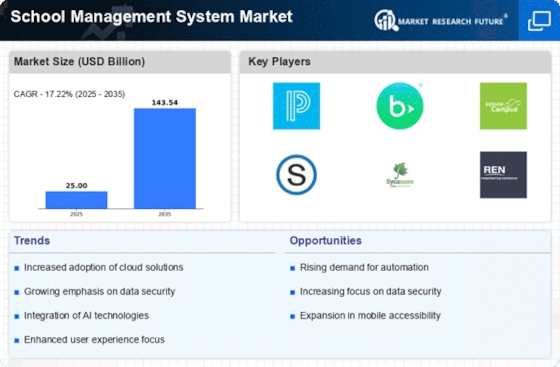
As per Market Research Future analysis, the School Management System Market was estimated at 25.0 USD Billion in 2024. The School Management System industry is projected to grow from 29.31 USD Billion in 2025 to 143.54 USD Billion by 2035, exhibiting a compound annual growth rate (CAGR) of 17.22% during the forecast period 2025 - 2035

Key Market Trends & Highlights

The School Management System Market is experiencing robust growth driven by technological advancements and evolving educational needs.

  • Cloud-based solutions are increasingly preferred, particularly in North America, due to their scalability and accessibility.
  • Data security and privacy concerns are prompting educational institutions to adopt more stringent measures, especially in the Asia-Pacific region.
  • Personalized learning experiences are gaining traction, with software solutions leading the market in customization capabilities.
  • The rise in parental engagement and the increased adoption of digital learning tools are key drivers propelling market growth.

Market Size & Forecast

2024 Market Size 25.0 (USD Billion)
2035 Market Size 143.54 (USD Billion)
CAGR (2025 - 2035) 17.22%
Largest Regional Market Share in 2024 North America

Major Players

PowerSchool (US), Blackbaud (US), Infinite Campus (US), Schoology (US), Sycamore Education (US), RenWeb (US), EduSys (IN), Fedena (IN), TgW (DE), Froebel (DE)

Market Trends

The School Management System Market is currently experiencing a transformative phase, driven by the increasing demand for efficient administrative solutions in educational institutions. As schools and universities seek to streamline operations, the integration of technology into management processes has become paramount. This shift not only enhances communication between stakeholders but also facilitates data management, thereby improving overall educational outcomes. Furthermore, the growing emphasis on personalized learning experiences suggests that these systems are evolving to cater to diverse student needs, potentially reshaping traditional educational paradigms. In addition, the rise of cloud-based solutions appears to be a significant trend within the School Management System Market. These platforms offer flexibility and scalability, allowing institutions to adapt to changing requirements with ease. Moreover, the focus on data security and privacy is likely to influence the development of these systems, as educational entities prioritize safeguarding sensitive information. Overall, the market seems poised for continued growth, with innovations in technology and a commitment to enhancing educational experiences driving its evolution.

Cloud-Based Solutions

The adoption of cloud-based platforms is gaining traction in the School Management System Market. These solutions provide educational institutions with the ability to access data remotely, ensuring flexibility and ease of use. As schools increasingly prioritize digital transformation, cloud technology appears to be a key enabler of efficient management.

Data Security and Privacy

With the growing reliance on digital systems, concerns regarding data security and privacy are becoming more pronounced. Educational institutions are likely to invest in robust security measures to protect sensitive information. This trend indicates a shift towards prioritizing the safeguarding of student and institutional data.

Personalized Learning Experiences

The demand for personalized learning is influencing the development of School Management Systems. These systems are evolving to accommodate diverse learning styles and needs, suggesting a move towards more tailored educational experiences. This trend reflects a broader shift in educational philosophy, emphasizing individual student growth.

School Management System Market Market Drivers

Rise in Parental Engagement

Parental engagement is emerging as a crucial driver in the School Management System Market. Schools are increasingly recognizing the importance of involving parents in the educational process, which has led to the development of systems that facilitate communication between educators and families. Features such as real-time updates on student progress, attendance tracking, and direct messaging capabilities are becoming standard in management systems. This trend is supported by research indicating that schools with high levels of parental engagement see improved student performance. Consequently, the demand for School Management Systems that enhance parental involvement is likely to grow, further propelling the market forward.

Growing Demand for Data Analytics

The demand for data analytics in education is a significant driver for the School Management System Market. Educational institutions are increasingly recognizing the value of data-driven decision-making to enhance student outcomes and operational efficiency. By leveraging analytics, schools can identify trends, monitor student performance, and tailor educational strategies accordingly. Recent studies indicate that institutions utilizing data analytics have seen a 20% improvement in student retention rates. This trend is prompting schools to invest in advanced management systems that offer robust analytics capabilities, thereby fueling growth in the School Management System Market. The ability to harness data effectively is becoming a competitive advantage for educational institutions.

Integration of Artificial Intelligence

The integration of artificial intelligence (AI) into educational management systems is a transformative driver for the School Management System Market. AI technologies are being utilized to automate administrative tasks, personalize learning experiences, and provide predictive analytics for student performance. This innovation not only streamlines operations but also enhances the educational experience for both students and educators. As institutions seek to improve efficiency and effectiveness, the adoption of AI-driven management systems is expected to rise. Reports suggest that the AI in education market could reach a valuation of several billion dollars in the coming years, indicating a strong potential for growth within the School Management System Market.

Regulatory Compliance and Standardization

Regulatory compliance is becoming increasingly critical within the School Management System Market. Governments and educational authorities are implementing stringent regulations to ensure quality education and data protection. For instance, many regions have established guidelines for data privacy, necessitating that schools adopt management systems that comply with these regulations. This compliance not only protects student information but also enhances institutional credibility. As a result, educational institutions are investing in School Management Systems that can adapt to these regulatory requirements, thereby driving market growth. The emphasis on standardization across educational platforms further underscores the importance of these systems in maintaining compliance and ensuring quality education.

Increased Adoption of Digital Learning Tools

The rise in digital learning tools is a pivotal driver for the School Management System Market. Educational institutions are increasingly integrating technology into their curricula, which necessitates robust management systems to streamline operations. According to recent data, approximately 70% of schools have adopted some form of digital learning tool, which has led to a corresponding demand for comprehensive management systems. These systems facilitate the administration of online classes, track student progress, and manage resources efficiently. As educational institutions continue to embrace digital transformation, the School Management System Market is likely to experience substantial growth, driven by the need for effective management solutions that support these digital initiatives.

Market Segment Insights

By Component: Software (Largest) vs. Services (Fastest-Growing)

<p>In the School Management System Market, the 'Component' segment is predominantly led by software solutions, which have established a substantial market share due to their critical role in automating administrative tasks and enhancing learning experiences. Services, on the other hand, have become increasingly integral, as educators seek comprehensive solutions that include ongoing support and service components to ensure system effectiveness and user satisfaction. Growth trends indicate that while software remains the dominant player, the services sector is rapidly expanding, driven by an increasing demand for tailored solutions, professional support, and cloud-based implementations. The shift towards user-centered services that adapt to educational needs is propelling this sector forward, making it the fastest-growing component in the market as educational institutions recognize the importance of holistic management approaches.</p>

<p>Software (Dominant) vs. Services (Emerging)</p>

<p>In the School Management System Market, software is recognized as the dominant component due to its ability to streamline processes such as enrollment, grading, and communication between stakeholders. This segment includes various applications designed to meet the diverse needs of institutions, from K-12 to higher education. As schools increasingly move towards digitization, the role software plays in enhancing operational efficiency cannot be overstated. Conversely, the services segment is emerging as a vital player, catering to the essential need for deployment support, continuous training, and tailored consulting. As educational institutions prioritize user engagement and feedback, service providers are adapting their offerings to ensure that clients maximize their temporary and long-term investment in school management systems.</p>

By Deployment Type: Cloud-Based Technology (Largest) vs. On-Premise (Fastest-Growing)

<p>In the School Management System Market, the deployment types reveal significant differentiation in market share. Cloud-based technology dominates the landscape due to its scalability, ease of access, and lower maintenance costs, appealing to a diverse range of educational institutions. In contrast, on-premise solutions, while traditionally favored for their control and security, are carving out a niche in the market as more entities seek to digitize their operations.</p>

<p>Deployment Type: Cloud-Based Technology (Dominant) vs. On-Premise (Emerging)</p>

<p>Cloud-based technology continues to be the dominant deployment type in the School Management System Market, thanks to its ability to offer flexible solutions that cater to the needs of schools and colleges. This type of deployment enhances collaboration through features such as real-time access to data and the ability to support remote teaching and learning. On the other hand, on-premise systems are seeing a resurgence as schools prioritize data security and customization, particularly in regions where regulatory compliance is critical. While traditional, the on-premise model is adapting to include more modern functionalities to remain relevant, making it an emerging choice among educational institutions.</p>

By Application: Student Management (Largest) vs. Finance & Accounting (Fastest-Growing)

<p>In the School Management System Market, the application segment is primarily divided into five key areas: Stores and Procurement Management, Student Management, Academic Management, Finance & Accounting, and Human Resource Management. Among these, the Student Management application holds the largest share, as it plays a crucial role in maintaining student records, performance tracking, and communication with parents. Additionally, Finance & Accounting has emerged as the fastest-growing sector, driven by increasing financial compliance needs and the rising demand for digital solutions in educational institutions.</p>

<p>Student Management (Dominant) vs. Finance & Accounting (Emerging)</p>

<p>Student Management systems are pivotal in the School Management System Market, catering to various functionalities such as enrollment, attendance tracking, and academic performance monitoring. They are widely adopted by educational institutions, contributing significantly to administrative efficiency and student engagement. On the other hand, Finance & Accounting applications are gaining traction, emerging as essential tools for managing the financial operations of school systems. The demand for automation in financial reporting, payment processing, and budgeting is propelling this segment forward, making it an attractive area for future development and investment. As schools increasingly prioritize comprehensive management solutions, both segments remain integral to operational success.</p>

Get more detailed insights about School Management System Market Research Report - Global Forecast till 2035

Regional Insights

North America : Education Technology Leader

North America is the largest market for School Management Systems, holding approximately 45% of the global market share. The region's growth is driven by increasing digitalization in education, government initiatives promoting technology integration, and a rising demand for efficient administrative solutions. Regulatory support, such as the Every Student Succeeds Act, further catalyzes this growth by encouraging the adoption of innovative educational technologies. The competitive landscape in North America is robust, featuring key players like PowerSchool, Blackbaud, and Infinite Campus. These companies dominate the market with comprehensive solutions that cater to various educational institutions. The presence of advanced infrastructure and a high level of investment in educational technology contribute to the region's leadership in the School Management System Market.

Europe : Emerging Market Dynamics

Europe is witnessing significant growth in the School Management System Market, accounting for approximately 30% of the global share. The region's demand is fueled by increasing government investments in digital education and a shift towards online learning platforms. Regulatory frameworks, such as the European Digital Education Action Plan, are pivotal in promoting the integration of technology in schools, thereby enhancing educational outcomes and operational efficiency. Leading countries in Europe include Germany, the UK, and France, where the presence of key players like TgW and Froebel strengthens the competitive landscape. The market is characterized by a mix of established companies and innovative startups, fostering a dynamic environment for educational technology. The focus on personalized learning and data-driven decision-making is shaping the future of school management systems in the region.

Asia-Pacific : Rapidly Growing Education Sector

Asia-Pacific is rapidly emerging as a significant player in the School Management System Market, holding around 20% of the global market share. The region's growth is driven by increasing enrollment rates, government initiatives to enhance educational infrastructure, and a growing emphasis on digital learning solutions. Countries like India and China are at the forefront, with substantial investments in educational technology aimed at improving access and quality of education. The competitive landscape in Asia-Pacific features key players such as EduSys and Fedena, which cater to diverse educational needs across various institutions. The region is characterized by a mix of local and international companies, fostering innovation and competition. As educational institutions increasingly adopt technology to streamline operations, the demand for comprehensive school management systems is expected to rise significantly in the coming years.

Middle East and Africa : Untapped Market Potential

The Middle East and Africa region is gradually emerging in the School Management System Market, currently holding about 5% of the global share. The growth is driven by increasing investments in education, government initiatives to improve educational standards, and a rising demand for technology-driven solutions. Countries like South Africa and the UAE are leading the charge, focusing on enhancing educational infrastructure and integrating technology into classrooms. The competitive landscape is still developing, with a mix of local and international players entering the market. The presence of key players is limited, but there is a growing interest from companies looking to expand their footprint in this region. As educational institutions seek to modernize their operations, the demand for effective school management systems is expected to grow, presenting significant opportunities for growth and innovation.

Key Players and Competitive Insights

Major market players are spending a lot of money on R&D to increase their product lines, which will help the School Management System Market grow even more. Market participants are also taking a range of strategic initiatives to grow their worldwide footprint, with key market developments such as new product launches, contractual agreements, mergers and acquisitions, increased investments, and collaboration with other organizations. Competitors in the School Management System industry must offer cost-effective items to expand and survive in an increasingly competitive and rising market environment.One of the primary business strategies adopted by manufacturers in the School Management System industry to benefit clients and expand the market sector is to manufacture locally to reduce operating costs. In recent years, School Management System industry has provided medicine with some of the most significant benefits. The School Management System Market major player such as Illuminate education Corp., Campus Management Corp., Unit4, Black baud, Tyler Technologies, Brainvire, Sparkrock, Edumarshal and others are working to expand the market demand by investing in research and development activities.Campus Management Corp. provides enterprise software solutions and services. The Company offers student information systems, e-learning, web portal, accounting, analysis, recruiting, retention, advising, and alumni relations. Campus Management serves customers worldwide.

in November Campus Management Corp. (Anthology Inc.) announced the partnership with Together We Rise, a nonprofit organization, to provide service opportunities for Anthology employees and monetary support for Together We Rise initiatives. This partnership includes virtual service opportunities for Anthology employees to build education-related kits for students in foster care, including back-to-school, tech, and STEM packs.Additionally, product differentiation and upgrading in the form of cloud services are expected to pave way for the growth of companies in the market..Also, Illuminate provides a streamlined solution that helps educators to accurately assess learning, identify needs, align whole child supports, and drive school improvement in order to equitably accelerate growth for every learner.

In December Illuminate Education announced the partnership with the Association of Supervision and Curriculum Development (ASCD), to expand its CaseNEX (an online course powered by Illuminate Education) professional development course offerings with resources from ASCD, such as the ASCD Activate Professional Learning Library. With the help of this partnership, CaseNEX offers professional development opportunities for educators to enhance their skills, maintain certifications, and earn university credits.

Key Companies in the School Management System Market include

Industry Developments

May 2020: Jenzabar, Inc. has announced the introduction of its Jenzabar One suite, which will enable competency-based education (CBE) programmes.

February 2020: Ellucian collaborated with OnePLM to enable digital transformation for higher education specialists.

May 2022: ESLSCA University in Egypt partnered with Ellucian, the leading higher education technology solutions provider, and ITB Gulf DMCC, an ITG company, to transform technology operations with a focus on improving the experience for students, faculty, and administrators.

Future Outlook

School Management System Market Future Outlook

The School Management System Market is projected to grow at a 17.22% CAGR from 2025 to 2035, driven by technological advancements, increasing digitalization, and demand for efficient administrative solutions.

New opportunities lie in:

  • Integration of AI-driven analytics for personalized learning experiences.
  • Development of mobile applications for real-time communication between parents and schools.
  • Expansion of cloud-based solutions to enhance data accessibility and security.

By 2035, the market is expected to be robust, reflecting substantial growth and innovation.

Market Segmentation

School Management System Market Component Outlook

  • Software
  • Services
  • Support
  • Maintenance
  • Consulting
  • Implementation

School Management System Market Application Outlook

  • Stores and procurement management
  • Student management
  • Academic management
  • Finance & accounting
  • Human resource management

School Management System Market Deployment Type Outlook

  • On-premise
  • Cloud-based technology

Report Scope

MARKET SIZE 2024 25.0(USD Billion)
MARKET SIZE 2025 29.31(USD Billion)
MARKET SIZE 2035 143.54(USD Billion)
COMPOUND ANNUAL GROWTH RATE (CAGR) 17.22% (2025 - 2035)
REPORT COVERAGE Revenue Forecast, Competitive Landscape, Growth Factors, and Trends
BASE YEAR 2024
Market Forecast Period 2025 - 2035
Historical Data 2019 - 2024
Market Forecast Units USD Billion
Key Companies Profiled PowerSchool (US), Blackbaud (US), Infinite Campus (US), Schoology (US), Sycamore Education (US), RenWeb (US), EduSys (IN), Fedena (IN), TgW (DE), Froebel (DE)
Segments Covered Component, Deployment Type, Application, Region
Key Market Opportunities Integration of artificial intelligence and data analytics in the School Management System Market enhances operational efficiency.
Key Market Dynamics Rising demand for integrated solutions drives innovation and competition in the School Management System market.
Countries Covered North America, Europe, APAC, South America, MEA

FAQs

What is the current valuation of the School Management System Market?

<p>The market valuation reached 25.0 USD Billion in 2024.</p>

What is the projected market size for the School Management System Market by 2035?

<p>The market is expected to grow to 143.54 USD Billion by 2035.</p>

What is the expected CAGR for the School Management System Market during the forecast period?

<p>The anticipated CAGR for the market from 2025 to 2035 is 17.22%.</p>

Which companies are considered key players in the School Management System Market?

<p>Key players include PowerSchool, Blackbaud, Infinite Campus, and Schoology, among others.</p>

What are the main components of the School Management System Market?

<p>The primary components include software, services, support, maintenance, consulting, and implementation.</p>

How does the deployment type affect the School Management System Market?

<p>The market is segmented into on-premise and cloud-based technology, with cloud-based solutions projected to dominate.</p>

What applications are driving growth in the School Management System Market?

Key applications include student management, academic management, finance &amp; accounting, and human resource management.

What was the valuation of software in the School Management System Market in 2024?

In 2024, the software segment was valued at 10.0 USD Billion.

How does the services segment compare to other components in the market?

The services segment was valued at 7.5 USD Billion in 2024, indicating substantial demand.

What is the significance of the human resource management application in the market?

The human resource management application was valued at 7.0 USD Billion in 2024, highlighting its importance.

  1. SECTION I: EXECUTIVE SUMMARY AND KEY HIGHLIGHTS
    1. | 1.1 EXECUTIVE SUMMARY
    2. | | 1.1.1 Market Overview
    3. | | 1.1.2 Key Findings
    4. | | 1.1.3 Market Segmentation
    5. | | 1.1.4 Competitive Landscape
    6. | | 1.1.5 Challenges and Opportunities
    7. | | 1.1.6 Future Outlook
  2. SECTION II: SCOPING, METHODOLOGY AND MARKET STRUCTURE
    1. | 2.1 MARKET INTRODUCTION
    2. | | 2.1.1 Definition
    3. | | 2.1.2 Scope of the study
    4. | | | 2.1.2.1 Research Objective
    5. | | | 2.1.2.2 Assumption
    6. | | | 2.1.2.3 Limitations
    7. | 2.2 RESEARCH METHODOLOGY
    8. | | 2.2.1 Overview
    9. | | 2.2.2 Data Mining
    10. | | 2.2.3 Secondary Research
    11. | | 2.2.4 Primary Research
    12. | | | 2.2.4.1 Primary Interviews and Information Gathering Process
    13. | | | 2.2.4.2 Breakdown of Primary Respondents
    14. | | 2.2.5 Forecasting Model
    15. | | 2.2.6 Market Size Estimation
    16. | | | 2.2.6.1 Bottom-Up Approach
    17. | | | 2.2.6.2 Top-Down Approach
    18. | | 2.2.7 Data Triangulation
    19. | | 2.2.8 Validation
  3. SECTION III: QUALITATIVE ANALYSIS
    1. | 3.1 MARKET DYNAMICS
    2. | | 3.1.1 Overview
    3. | | 3.1.2 Drivers
    4. | | 3.1.3 Restraints
    5. | | 3.1.4 Opportunities
    6. | 3.2 MARKET FACTOR ANALYSIS
    7. | | 3.2.1 Value chain Analysis
    8. | | 3.2.2 Porter's Five Forces Analysis
    9. | | | 3.2.2.1 Bargaining Power of Suppliers
    10. | | | 3.2.2.2 Bargaining Power of Buyers
    11. | | | 3.2.2.3 Threat of New Entrants
    12. | | | 3.2.2.4 Threat of Substitutes
    13. | | | 3.2.2.5 Intensity of Rivalry
    14. | | 3.2.3 COVID-19 Impact Analysis
    15. | | | 3.2.3.1 Market Impact Analysis
    16. | | | 3.2.3.2 Regional Impact
    17. | | | 3.2.3.3 Opportunity and Threat Analysis
  4. SECTION IV: QUANTITATIVE ANALYSIS
    1. | 4.1 Information and Communications Technology, BY Component (USD Billion)
    2. | | 4.1.1 Software
    3. | | 4.1.2 Services
    4. | | 4.1.3 Support
    5. | | 4.1.4 Maintenance
    6. | | 4.1.5 Consulting
    7. | | 4.1.6 Implementation
    8. | 4.2 Information and Communications Technology, BY Deployment Type (USD Billion)
    9. | | 4.2.1 On-premise
    10. | | 4.2.2 Cloud-based technology
    11. | 4.3 Information and Communications Technology, BY Application (USD Billion)
    12. | | 4.3.1 Stores and procurement management
    13. | | 4.3.2 Student management
    14. | | 4.3.3 Academic management
    15. | | 4.3.4 Finance & accounting
    16. | | 4.3.5 Human resource management
    17. | 4.4 Information and Communications Technology, BY Region (USD Billion)
    18. | | 4.4.1 North America
    19. | | | 4.4.1.1 US
    20. | | | 4.4.1.2 Canada
    21. | | 4.4.2 Europe
    22. | | | 4.4.2.1 Germany
    23. | | | 4.4.2.2 UK
    24. | | | 4.4.2.3 France
    25. | | | 4.4.2.4 Russia
    26. | | | 4.4.2.5 Italy
    27. | | | 4.4.2.6 Spain
    28. | | | 4.4.2.7 Rest of Europe
    29. | | 4.4.3 APAC
    30. | | | 4.4.3.1 China
    31. | | | 4.4.3.2 India
    32. | | | 4.4.3.3 Japan
    33. | | | 4.4.3.4 South Korea
    34. | | | 4.4.3.5 Malaysia
    35. | | | 4.4.3.6 Thailand
    36. | | | 4.4.3.7 Indonesia
    37. | | | 4.4.3.8 Rest of APAC
    38. | | 4.4.4 South America
    39. | | | 4.4.4.1 Brazil
    40. | | | 4.4.4.2 Mexico
    41. | | | 4.4.4.3 Argentina
    42. | | | 4.4.4.4 Rest of South America
    43. | | 4.4.5 MEA
    44. | | | 4.4.5.1 GCC Countries
    45. | | | 4.4.5.2 South Africa
    46. | | | 4.4.5.3 Rest of MEA
  5. SECTION V: COMPETITIVE ANALYSIS
    1. | 5.1 Competitive Landscape
    2. | | 5.1.1 Overview
    3. | | 5.1.2 Competitive Analysis
    4. | | 5.1.3 Market share Analysis
    5. | | 5.1.4 Major Growth Strategy in the Information and Communications Technology
    6. | | 5.1.5 Competitive Benchmarking
    7. | | 5.1.6 Leading Players in Terms of Number of Developments in the Information and Communications Technology
    8. | | 5.1.7 Key developments and growth strategies
    9. | | | 5.1.7.1 New Product Launch/Service Deployment
    10. | | | 5.1.7.2 Merger & Acquisitions
    11. | | | 5.1.7.3 Joint Ventures
    12. | | 5.1.8 Major Players Financial Matrix
    13. | | | 5.1.8.1 Sales and Operating Income
    14. | | | 5.1.8.2 Major Players R&D Expenditure. 2023
    15. | 5.2 Company Profiles
    16. | | 5.2.1 PowerSchool (US)
    17. | | | 5.2.1.1 Financial Overview
    18. | | | 5.2.1.2 Products Offered
    19. | | | 5.2.1.3 Key Developments
    20. | | | 5.2.1.4 SWOT Analysis
    21. | | | 5.2.1.5 Key Strategies
    22. | | 5.2.2 Blackbaud (US)
    23. | | | 5.2.2.1 Financial Overview
    24. | | | 5.2.2.2 Products Offered
    25. | | | 5.2.2.3 Key Developments
    26. | | | 5.2.2.4 SWOT Analysis
    27. | | | 5.2.2.5 Key Strategies
    28. | | 5.2.3 Infinite Campus (US)
    29. | | | 5.2.3.1 Financial Overview
    30. | | | 5.2.3.2 Products Offered
    31. | | | 5.2.3.3 Key Developments
    32. | | | 5.2.3.4 SWOT Analysis
    33. | | | 5.2.3.5 Key Strategies
    34. | | 5.2.4 Schoology (US)
    35. | | | 5.2.4.1 Financial Overview
    36. | | | 5.2.4.2 Products Offered
    37. | | | 5.2.4.3 Key Developments
    38. | | | 5.2.4.4 SWOT Analysis
    39. | | | 5.2.4.5 Key Strategies
    40. | | 5.2.5 Sycamore Education (US)
    41. | | | 5.2.5.1 Financial Overview
    42. | | | 5.2.5.2 Products Offered
    43. | | | 5.2.5.3 Key Developments
    44. | | | 5.2.5.4 SWOT Analysis
    45. | | | 5.2.5.5 Key Strategies
    46. | | 5.2.6 RenWeb (US)
    47. | | | 5.2.6.1 Financial Overview
    48. | | | 5.2.6.2 Products Offered
    49. | | | 5.2.6.3 Key Developments
    50. | | | 5.2.6.4 SWOT Analysis
    51. | | | 5.2.6.5 Key Strategies
    52. | | 5.2.7 EduSys (IN)
    53. | | | 5.2.7.1 Financial Overview
    54. | | | 5.2.7.2 Products Offered
    55. | | | 5.2.7.3 Key Developments
    56. | | | 5.2.7.4 SWOT Analysis
    57. | | | 5.2.7.5 Key Strategies
    58. | | 5.2.8 Fedena (IN)
    59. | | | 5.2.8.1 Financial Overview
    60. | | | 5.2.8.2 Products Offered
    61. | | | 5.2.8.3 Key Developments
    62. | | | 5.2.8.4 SWOT Analysis
    63. | | | 5.2.8.5 Key Strategies
    64. | | 5.2.9 TgW (DE)
    65. | | | 5.2.9.1 Financial Overview
    66. | | | 5.2.9.2 Products Offered
    67. | | | 5.2.9.3 Key Developments
    68. | | | 5.2.9.4 SWOT Analysis
    69. | | | 5.2.9.5 Key Strategies
    70. | | 5.2.10 Froebel (DE)
    71. | | | 5.2.10.1 Financial Overview
    72. | | | 5.2.10.2 Products Offered
    73. | | | 5.2.10.3 Key Developments
    74. | | | 5.2.10.4 SWOT Analysis
    75. | | | 5.2.10.5 Key Strategies
    76. | 5.3 Appendix
    77. | | 5.3.1 References
    78. | | 5.3.2 Related Reports
  6. LIST OF FIGURES
    1. | 6.1 MARKET SYNOPSIS
    2. | 6.2 NORTH AMERICA MARKET ANALYSIS
    3. | 6.3 US MARKET ANALYSIS BY COMPONENT
    4. | 6.4 US MARKET ANALYSIS BY DEPLOYMENT TYPE
    5. | 6.5 US MARKET ANALYSIS BY APPLICATION
    6. | 6.6 CANADA MARKET ANALYSIS BY COMPONENT
    7. | 6.7 CANADA MARKET ANALYSIS BY DEPLOYMENT TYPE
    8. | 6.8 CANADA MARKET ANALYSIS BY APPLICATION
    9. | 6.9 EUROPE MARKET ANALYSIS
    10. | 6.10 GERMANY MARKET ANALYSIS BY COMPONENT
    11. | 6.11 GERMANY MARKET ANALYSIS BY DEPLOYMENT TYPE
    12. | 6.12 GERMANY MARKET ANALYSIS BY APPLICATION
    13. | 6.13 UK MARKET ANALYSIS BY COMPONENT
    14. | 6.14 UK MARKET ANALYSIS BY DEPLOYMENT TYPE
    15. | 6.15 UK MARKET ANALYSIS BY APPLICATION
    16. | 6.16 FRANCE MARKET ANALYSIS BY COMPONENT
    17. | 6.17 FRANCE MARKET ANALYSIS BY DEPLOYMENT TYPE
    18. | 6.18 FRANCE MARKET ANALYSIS BY APPLICATION
    19. | 6.19 RUSSIA MARKET ANALYSIS BY COMPONENT
    20. | 6.20 RUSSIA MARKET ANALYSIS BY DEPLOYMENT TYPE
    21. | 6.21 RUSSIA MARKET ANALYSIS BY APPLICATION
    22. | 6.22 ITALY MARKET ANALYSIS BY COMPONENT
    23. | 6.23 ITALY MARKET ANALYSIS BY DEPLOYMENT TYPE
    24. | 6.24 ITALY MARKET ANALYSIS BY APPLICATION
    25. | 6.25 SPAIN MARKET ANALYSIS BY COMPONENT
    26. | 6.26 SPAIN MARKET ANALYSIS BY DEPLOYMENT TYPE
    27. | 6.27 SPAIN MARKET ANALYSIS BY APPLICATION
    28. | 6.28 REST OF EUROPE MARKET ANALYSIS BY COMPONENT
    29. | 6.29 REST OF EUROPE MARKET ANALYSIS BY DEPLOYMENT TYPE
    30. | 6.30 REST OF EUROPE MARKET ANALYSIS BY APPLICATION
    31. | 6.31 APAC MARKET ANALYSIS
    32. | 6.32 CHINA MARKET ANALYSIS BY COMPONENT
    33. | 6.33 CHINA MARKET ANALYSIS BY DEPLOYMENT TYPE
    34. | 6.34 CHINA MARKET ANALYSIS BY APPLICATION
    35. | 6.35 INDIA MARKET ANALYSIS BY COMPONENT
    36. | 6.36 INDIA MARKET ANALYSIS BY DEPLOYMENT TYPE
    37. | 6.37 INDIA MARKET ANALYSIS BY APPLICATION
    38. | 6.38 JAPAN MARKET ANALYSIS BY COMPONENT
    39. | 6.39 JAPAN MARKET ANALYSIS BY DEPLOYMENT TYPE
    40. | 6.40 JAPAN MARKET ANALYSIS BY APPLICATION
    41. | 6.41 SOUTH KOREA MARKET ANALYSIS BY COMPONENT
    42. | 6.42 SOUTH KOREA MARKET ANALYSIS BY DEPLOYMENT TYPE
    43. | 6.43 SOUTH KOREA MARKET ANALYSIS BY APPLICATION
    44. | 6.44 MALAYSIA MARKET ANALYSIS BY COMPONENT
    45. | 6.45 MALAYSIA MARKET ANALYSIS BY DEPLOYMENT TYPE
    46. | 6.46 MALAYSIA MARKET ANALYSIS BY APPLICATION
    47. | 6.47 THAILAND MARKET ANALYSIS BY COMPONENT
    48. | 6.48 THAILAND MARKET ANALYSIS BY DEPLOYMENT TYPE
    49. | 6.49 THAILAND MARKET ANALYSIS BY APPLICATION
    50. | 6.50 INDONESIA MARKET ANALYSIS BY COMPONENT
    51. | 6.51 INDONESIA MARKET ANALYSIS BY DEPLOYMENT TYPE
    52. | 6.52 INDONESIA MARKET ANALYSIS BY APPLICATION
    53. | 6.53 REST OF APAC MARKET ANALYSIS BY COMPONENT
    54. | 6.54 REST OF APAC MARKET ANALYSIS BY DEPLOYMENT TYPE
    55. | 6.55 REST OF APAC MARKET ANALYSIS BY APPLICATION
    56. | 6.56 SOUTH AMERICA MARKET ANALYSIS
    57. | 6.57 BRAZIL MARKET ANALYSIS BY COMPONENT
    58. | 6.58 BRAZIL MARKET ANALYSIS BY DEPLOYMENT TYPE
    59. | 6.59 BRAZIL MARKET ANALYSIS BY APPLICATION
    60. | 6.60 MEXICO MARKET ANALYSIS BY COMPONENT
    61. | 6.61 MEXICO MARKET ANALYSIS BY DEPLOYMENT TYPE
    62. | 6.62 MEXICO MARKET ANALYSIS BY APPLICATION
    63. | 6.63 ARGENTINA MARKET ANALYSIS BY COMPONENT
    64. | 6.64 ARGENTINA MARKET ANALYSIS BY DEPLOYMENT TYPE
    65. | 6.65 ARGENTINA MARKET ANALYSIS BY APPLICATION
    66. | 6.66 REST OF SOUTH AMERICA MARKET ANALYSIS BY COMPONENT
    67. | 6.67 REST OF SOUTH AMERICA MARKET ANALYSIS BY DEPLOYMENT TYPE
    68. | 6.68 REST OF SOUTH AMERICA MARKET ANALYSIS BY APPLICATION
    69. | 6.69 MEA MARKET ANALYSIS
    70. | 6.70 GCC COUNTRIES MARKET ANALYSIS BY COMPONENT
    71. | 6.71 GCC COUNTRIES MARKET ANALYSIS BY DEPLOYMENT TYPE
    72. | 6.72 GCC COUNTRIES MARKET ANALYSIS BY APPLICATION
    73. | 6.73 SOUTH AFRICA MARKET ANALYSIS BY COMPONENT
    74. | 6.74 SOUTH AFRICA MARKET ANALYSIS BY DEPLOYMENT TYPE
    75. | 6.75 SOUTH AFRICA MARKET ANALYSIS BY APPLICATION
    76. | 6.76 REST OF MEA MARKET ANALYSIS BY COMPONENT
    77. | 6.77 REST OF MEA MARKET ANALYSIS BY DEPLOYMENT TYPE
    78. | 6.78 REST OF MEA MARKET ANALYSIS BY APPLICATION
    79. | 6.79 KEY BUYING CRITERIA OF INFORMATION AND COMMUNICATIONS TECHNOLOGY
    80. | 6.80 RESEARCH PROCESS OF MRFR
    81. | 6.81 DRO ANALYSIS OF INFORMATION AND COMMUNICATIONS TECHNOLOGY
    82. | 6.82 DRIVERS IMPACT ANALYSIS: INFORMATION AND COMMUNICATIONS TECHNOLOGY
    83. | 6.83 RESTRAINTS IMPACT ANALYSIS: INFORMATION AND COMMUNICATIONS TECHNOLOGY
    84. | 6.84 SUPPLY / VALUE CHAIN: INFORMATION AND COMMUNICATIONS TECHNOLOGY
    85. | 6.85 INFORMATION AND COMMUNICATIONS TECHNOLOGY, BY COMPONENT, 2024 (% SHARE)
    86. | 6.86 INFORMATION AND COMMUNICATIONS TECHNOLOGY, BY COMPONENT, 2024 TO 2035 (USD Billion)
    87. | 6.87 INFORMATION AND COMMUNICATIONS TECHNOLOGY, BY DEPLOYMENT TYPE, 2024 (% SHARE)
    88. | 6.88 INFORMATION AND COMMUNICATIONS TECHNOLOGY, BY DEPLOYMENT TYPE, 2024 TO 2035 (USD Billion)
    89. | 6.89 INFORMATION AND COMMUNICATIONS TECHNOLOGY, BY APPLICATION, 2024 (% SHARE)
    90. | 6.90 INFORMATION AND COMMUNICATIONS TECHNOLOGY, BY APPLICATION, 2024 TO 2035 (USD Billion)
    91. | 6.91 BENCHMARKING OF MAJOR COMPETITORS
  7. LIST OF TABLES
    1. | 7.1 LIST OF ASSUMPTIONS
    2. | | 7.1.1
    3. | 7.2 North America MARKET SIZE ESTIMATES; FORECAST
    4. | | 7.2.1 BY COMPONENT, 2025-2035 (USD Billion)
    5. | | 7.2.2 BY DEPLOYMENT TYPE, 2025-2035 (USD Billion)
    6. | | 7.2.3 BY APPLICATION, 2025-2035 (USD Billion)
    7. | 7.3 US MARKET SIZE ESTIMATES; FORECAST
    8. | | 7.3.1 BY COMPONENT, 2025-2035 (USD Billion)
    9. | | 7.3.2 BY DEPLOYMENT TYPE, 2025-2035 (USD Billion)
    10. | | 7.3.3 BY APPLICATION, 2025-2035 (USD Billion)
    11. | 7.4 Canada MARKET SIZE ESTIMATES; FORECAST
    12. | | 7.4.1 BY COMPONENT, 2025-2035 (USD Billion)
    13. | | 7.4.2 BY DEPLOYMENT TYPE, 2025-2035 (USD Billion)
    14. | | 7.4.3 BY APPLICATION, 2025-2035 (USD Billion)
    15. | 7.5 Europe MARKET SIZE ESTIMATES; FORECAST
    16. | | 7.5.1 BY COMPONENT, 2025-2035 (USD Billion)
    17. | | 7.5.2 BY DEPLOYMENT TYPE, 2025-2035 (USD Billion)
    18. | | 7.5.3 BY APPLICATION, 2025-2035 (USD Billion)
    19. | 7.6 Germany MARKET SIZE ESTIMATES; FORECAST
    20. | | 7.6.1 BY COMPONENT, 2025-2035 (USD Billion)
    21. | | 7.6.2 BY DEPLOYMENT TYPE, 2025-2035 (USD Billion)
    22. | | 7.6.3 BY APPLICATION, 2025-2035 (USD Billion)
    23. | 7.7 UK MARKET SIZE ESTIMATES; FORECAST
    24. | | 7.7.1 BY COMPONENT, 2025-2035 (USD Billion)
    25. | | 7.7.2 BY DEPLOYMENT TYPE, 2025-2035 (USD Billion)
    26. | | 7.7.3 BY APPLICATION, 2025-2035 (USD Billion)
    27. | 7.8 France MARKET SIZE ESTIMATES; FORECAST
    28. | | 7.8.1 BY COMPONENT, 2025-2035 (USD Billion)
    29. | | 7.8.2 BY DEPLOYMENT TYPE, 2025-2035 (USD Billion)
    30. | | 7.8.3 BY APPLICATION, 2025-2035 (USD Billion)
    31. | 7.9 Russia MARKET SIZE ESTIMATES; FORECAST
    32. | | 7.9.1 BY COMPONENT, 2025-2035 (USD Billion)
    33. | | 7.9.2 BY DEPLOYMENT TYPE, 2025-2035 (USD Billion)
    34. | | 7.9.3 BY APPLICATION, 2025-2035 (USD Billion)
    35. | 7.10 Italy MARKET SIZE ESTIMATES; FORECAST
    36. | | 7.10.1 BY COMPONENT, 2025-2035 (USD Billion)
    37. | | 7.10.2 BY DEPLOYMENT TYPE, 2025-2035 (USD Billion)
    38. | | 7.10.3 BY APPLICATION, 2025-2035 (USD Billion)
    39. | 7.11 Spain MARKET SIZE ESTIMATES; FORECAST
    40. | | 7.11.1 BY COMPONENT, 2025-2035 (USD Billion)
    41. | | 7.11.2 BY DEPLOYMENT TYPE, 2025-2035 (USD Billion)
    42. | | 7.11.3 BY APPLICATION, 2025-2035 (USD Billion)
    43. | 7.12 Rest of Europe MARKET SIZE ESTIMATES; FORECAST
    44. | | 7.12.1 BY COMPONENT, 2025-2035 (USD Billion)
    45. | | 7.12.2 BY DEPLOYMENT TYPE, 2025-2035 (USD Billion)
    46. | | 7.12.3 BY APPLICATION, 2025-2035 (USD Billion)
    47. | 7.13 APAC MARKET SIZE ESTIMATES; FORECAST
    48. | | 7.13.1 BY COMPONENT, 2025-2035 (USD Billion)
    49. | | 7.13.2 BY DEPLOYMENT TYPE, 2025-2035 (USD Billion)
    50. | | 7.13.3 BY APPLICATION, 2025-2035 (USD Billion)
    51. | 7.14 China MARKET SIZE ESTIMATES; FORECAST
    52. | | 7.14.1 BY COMPONENT, 2025-2035 (USD Billion)
    53. | | 7.14.2 BY DEPLOYMENT TYPE, 2025-2035 (USD Billion)
    54. | | 7.14.3 BY APPLICATION, 2025-2035 (USD Billion)
    55. | 7.15 India MARKET SIZE ESTIMATES; FORECAST
    56. | | 7.15.1 BY COMPONENT, 2025-2035 (USD Billion)
    57. | | 7.15.2 BY DEPLOYMENT TYPE, 2025-2035 (USD Billion)
    58. | | 7.15.3 BY APPLICATION, 2025-2035 (USD Billion)
    59. | 7.16 Japan MARKET SIZE ESTIMATES; FORECAST
    60. | | 7.16.1 BY COMPONENT, 2025-2035 (USD Billion)
    61. | | 7.16.2 BY DEPLOYMENT TYPE, 2025-2035 (USD Billion)
    62. | | 7.16.3 BY APPLICATION, 2025-2035 (USD Billion)
    63. | 7.17 South Korea MARKET SIZE ESTIMATES; FORECAST
    64. | | 7.17.1 BY COMPONENT, 2025-2035 (USD Billion)
    65. | | 7.17.2 BY DEPLOYMENT TYPE, 2025-2035 (USD Billion)
    66. | | 7.17.3 BY APPLICATION, 2025-2035 (USD Billion)
    67. | 7.18 Malaysia MARKET SIZE ESTIMATES; FORECAST
    68. | | 7.18.1 BY COMPONENT, 2025-2035 (USD Billion)
    69. | | 7.18.2 BY DEPLOYMENT TYPE, 2025-2035 (USD Billion)
    70. | | 7.18.3 BY APPLICATION, 2025-2035 (USD Billion)
    71. | 7.19 Thailand MARKET SIZE ESTIMATES; FORECAST
    72. | | 7.19.1 BY COMPONENT, 2025-2035 (USD Billion)
    73. | | 7.19.2 BY DEPLOYMENT TYPE, 2025-2035 (USD Billion)
    74. | | 7.19.3 BY APPLICATION, 2025-2035 (USD Billion)
    75. | 7.20 Indonesia MARKET SIZE ESTIMATES; FORECAST
    76. | | 7.20.1 BY COMPONENT, 2025-2035 (USD Billion)
    77. | | 7.20.2 BY DEPLOYMENT TYPE, 2025-2035 (USD Billion)
    78. | | 7.20.3 BY APPLICATION, 2025-2035 (USD Billion)
    79. | 7.21 Rest of APAC MARKET SIZE ESTIMATES; FORECAST
    80. | | 7.21.1 BY COMPONENT, 2025-2035 (USD Billion)
    81. | | 7.21.2 BY DEPLOYMENT TYPE, 2025-2035 (USD Billion)
    82. | | 7.21.3 BY APPLICATION, 2025-2035 (USD Billion)
    83. | 7.22 South America MARKET SIZE ESTIMATES; FORECAST
    84. | | 7.22.1 BY COMPONENT, 2025-2035 (USD Billion)
    85. | | 7.22.2 BY DEPLOYMENT TYPE, 2025-2035 (USD Billion)
    86. | | 7.22.3 BY APPLICATION, 2025-2035 (USD Billion)
    87. | 7.23 Brazil MARKET SIZE ESTIMATES; FORECAST
    88. | | 7.23.1 BY COMPONENT, 2025-2035 (USD Billion)
    89. | | 7.23.2 BY DEPLOYMENT TYPE, 2025-2035 (USD Billion)
    90. | | 7.23.3 BY APPLICATION, 2025-2035 (USD Billion)
    91. | 7.24 Mexico MARKET SIZE ESTIMATES; FORECAST
    92. | | 7.24.1 BY COMPONENT, 2025-2035 (USD Billion)
    93. | | 7.24.2 BY DEPLOYMENT TYPE, 2025-2035 (USD Billion)
    94. | | 7.24.3 BY APPLICATION, 2025-2035 (USD Billion)
    95. | 7.25 Argentina MARKET SIZE ESTIMATES; FORECAST
    96. | | 7.25.1 BY COMPONENT, 2025-2035 (USD Billion)
    97. | | 7.25.2 BY DEPLOYMENT TYPE, 2025-2035 (USD Billion)
    98. | | 7.25.3 BY APPLICATION, 2025-2035 (USD Billion)
    99. | 7.26 Rest of South America MARKET SIZE ESTIMATES; FORECAST
    100. | | 7.26.1 BY COMPONENT, 2025-2035 (USD Billion)
    101. | | 7.26.2 BY DEPLOYMENT TYPE, 2025-2035 (USD Billion)
    102. | | 7.26.3 BY APPLICATION, 2025-2035 (USD Billion)
    103. | 7.27 MEA MARKET SIZE ESTIMATES; FORECAST
    104. | | 7.27.1 BY COMPONENT, 2025-2035 (USD Billion)
    105. | | 7.27.2 BY DEPLOYMENT TYPE, 2025-2035 (USD Billion)
    106. | | 7.27.3 BY APPLICATION, 2025-2035 (USD Billion)
    107. | 7.28 GCC Countries MARKET SIZE ESTIMATES; FORECAST
    108. | | 7.28.1 BY COMPONENT, 2025-2035 (USD Billion)
    109. | | 7.28.2 BY DEPLOYMENT TYPE, 2025-2035 (USD Billion)
    110. | | 7.28.3 BY APPLICATION, 2025-2035 (USD Billion)
    111. | 7.29 South Africa MARKET SIZE ESTIMATES; FORECAST
    112. | | 7.29.1 BY COMPONENT, 2025-2035 (USD Billion)
    113. | | 7.29.2 BY DEPLOYMENT TYPE, 2025-2035 (USD Billion)
    114. | | 7.29.3 BY APPLICATION, 2025-2035 (USD Billion)
    115. | 7.30 Rest of MEA MARKET SIZE ESTIMATES; FORECAST
    116. | | 7.30.1 BY COMPONENT, 2025-2035 (USD Billion)
    117. | | 7.30.2 BY DEPLOYMENT TYPE, 2025-2035 (USD Billion)
    118. | | 7.30.3 BY APPLICATION, 2025-2035 (USD Billion)
    119. | 7.31 PRODUCT LAUNCH/PRODUCT DEVELOPMENT/APPROVAL
    120. | | 7.31.1
    121. | 7.32 ACQUISITION/PARTNERSHIP
    122. | | 7.32.1

Information and Communications Technology Market Segmentation

Information and Communications Technology By Component (USD Billion, 2025-2035)

  • Software
  • Services
  • Support
  • Maintenance
  • Consulting
  • Implementation

Information and Communications Technology By Deployment Type (USD Billion, 2025-2035)

  • On-premise
  • Cloud-based technology

Information and Communications Technology By Application (USD Billion, 2025-2035)

  • Stores and procurement management
  • Student management
  • Academic management
  • Finance & accounting
  • Human resource management
Infographic

Free Sample Request

Kindly complete the form below to receive a free sample of this Report

Get Free Sample

Customer Strories

Compare Licence

×
Features License Type
Single User Multiuser License Enterprise User
Price $4,950 $5,950 $7,250
Maximum User Access Limit 1 User Upto 10 Users Unrestricted Access Throughout the Organization
Free Customization
Direct Access to Analyst
Deliverable Format
Platform Access
Discount on Next Purchase 10% 15% 15%
Printable Versions
%>