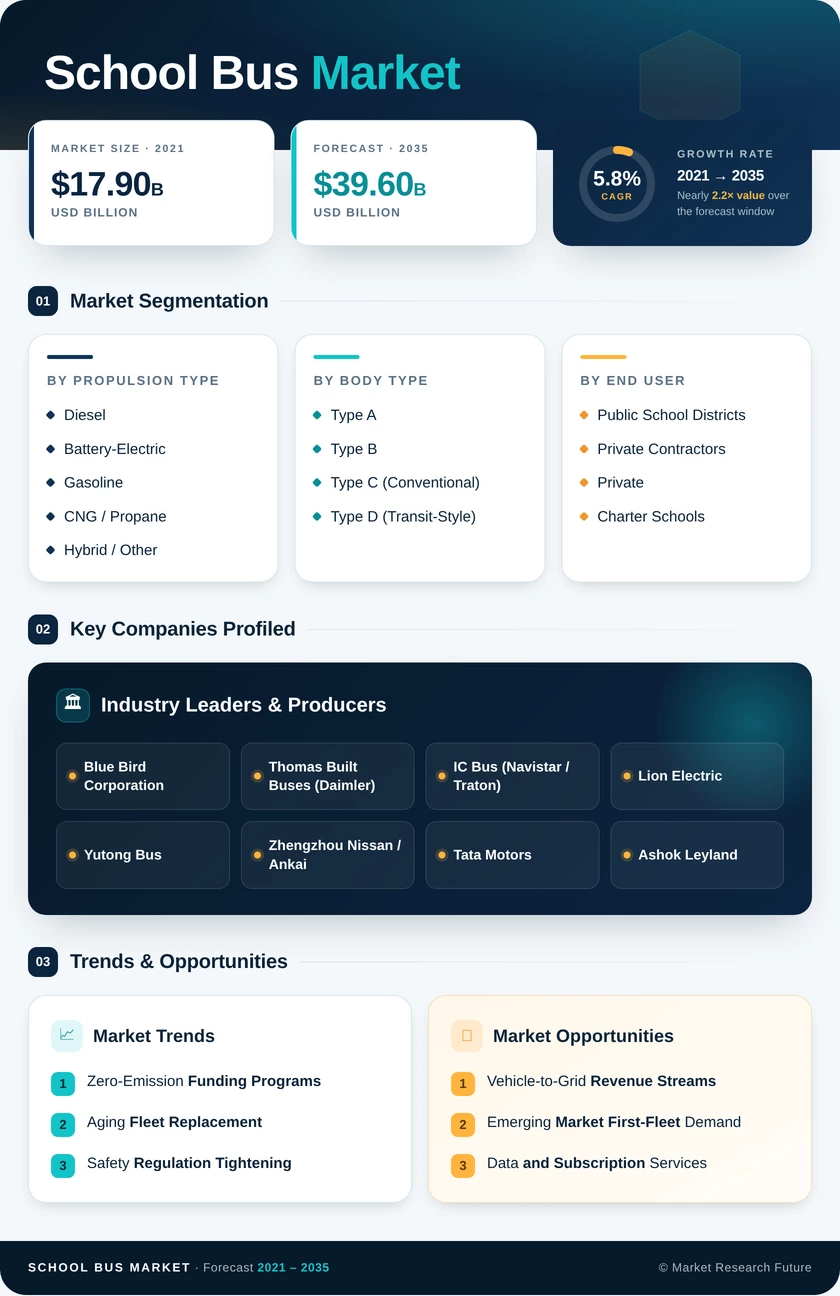
Segmentation Quick Reference
| Dimension | Sub-Segments | Dominant Segment | Fastest Growing Segment |
| By Propulsion Type | Diesel; Battery-Electric; Gasoline; CNG / Propane; Hybrid / Other | Diesel | Battery-Electric |
| By Body Type | Type A; Type B; Type C (Conventional); Type D (Transit-Style) | Type C (Conventional) | Type A |
| By End User | Public School Districts; Private Contractors; Private and Charter Schools | Public School Districts | Private Contractors |
| By Region | North America; Europe; Asia-Pacific; South America; Middle East & Africa | North America | Asia-Pacific |
Market Segmentation Overview
By Propulsion Type
| Sub-Segment | Key Trend |
| Diesel | Share erodes annually as grant-funded replacements shift toward zero-emission platforms |
| Battery-Electric | Fastest expansion, driven by federal rebate cycles and falling pack costs |
| Gasoline | Steady niche demand on short, low-mileage suburban routes |
| CNG / Propane | Fuel-price stability and existing depot fueling infrastructure sustain fleet loyalty |
| Hybrid / Other | Transitional role for range-constrained rural and cold-climate routes |
Propulsion is where the next decade's competitive advantage is decided. Manufacturers with credible offerings across all five sub-segments hedge against policy reversal, while pure-play electric specialists carry higher upside and materially higher execution risk.
By Body Type
| Sub-Segment | Key Trend |
| Type A | Growing fastest on special-needs enrollment and flexible small-route deployment |
| Type B | Narrow niche serving specific capacity and access requirements |
| Type C (Conventional) | Remains the volume standard for full-size route operations |
| Type D (Transit-Style) | Premium high-capacity platform favored for electric conversions |
Body-class selection increasingly follows powertrain packaging rather than seating capacity alone. Flat-front Type D architecture accommodates larger under-floor battery packs, which is why electric penetration runs ahead of the fleet average in that class.
By End User
| Sub-Segment | Key Trend |
| Public School Districts | Statutory transport obligations sustain the largest and most stable demand base |
| Private Contractors | Fastest growth as districts outsource fleet operations and maintenance overhead |
| Private and Charter Schools | Enrollment growth and parent safety expectations lift specification levels |
Ownership is migrating. Districts confronting driver shortages and depot capital requirements increasingly hand operations to contractors, which concentrates purchasing power among a smaller set of professional fleet buyers who negotiate harder on price and total cost.


 Noah Malgeri
Co-Founder

 Peter Groot koerkamp
Account and Business Manager

 Younghwan Choi
Senior Retail Manager

 Mark Irwin
Management Consultant

 Akif Moroglu
Strategy & Business Development Director

 Guilherme Gomes Martins
Product Management Director

 Joseph Aguayo
Sales Operations & Pricing Manager

 La Terria Dodd
Program Support Specialist

 Rob Kooiker
Group Product Manager HVAC & Fire Protection GMA