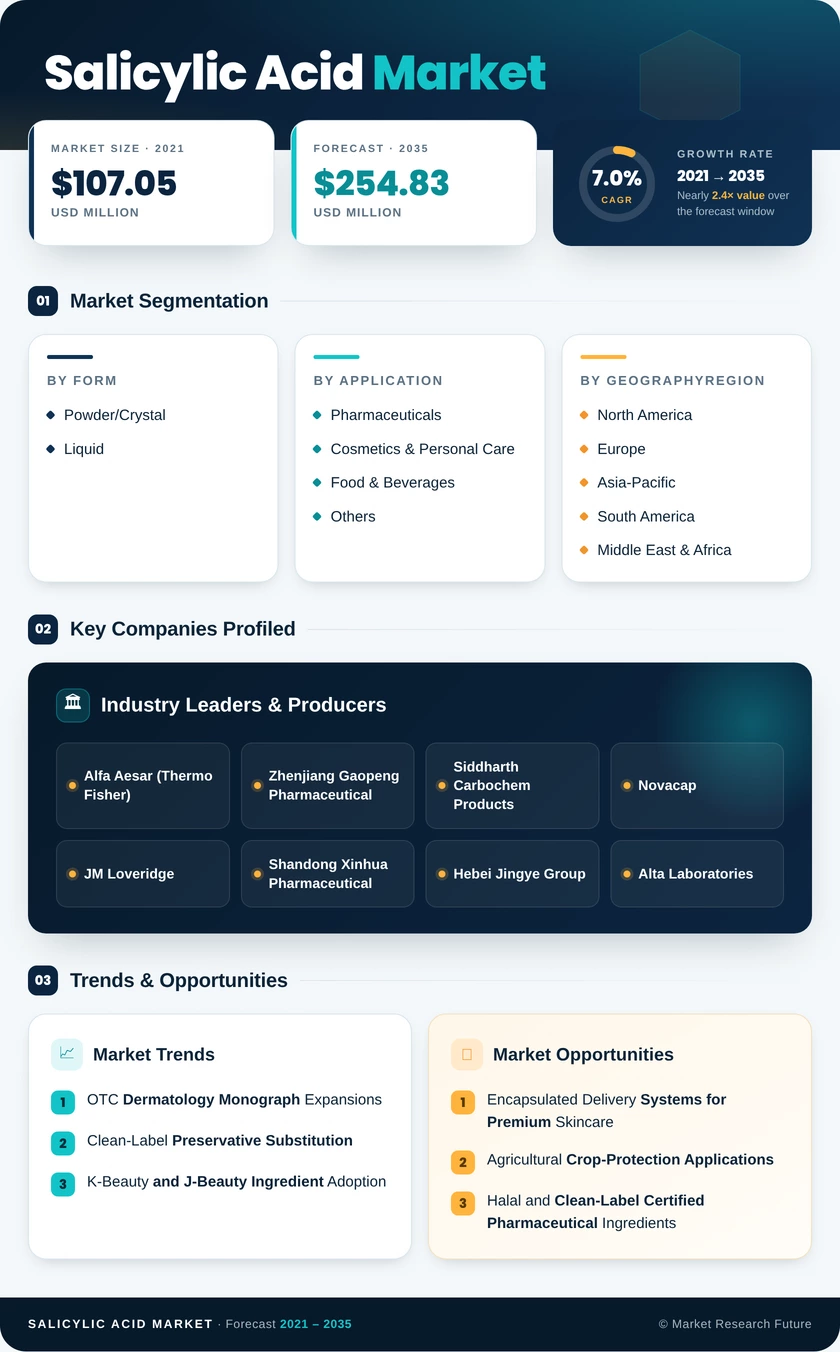
Salicylic Acid Market (2026 - 2035)

ID: MRFR/CnM/1604-HCR
111 Pages
Chitranshi Jaiswal
Last Updated: June 22, 2026
Salicylic Acid Market Research Report By Application (Skin Care Products, Hair Care Products, Pharmaceuticals, Cosmetics, Agricultural Chemicals), By Formulation (Creams, Gels, Lotions, Powders, Solutions), By End Use (Personal Care, Healthcare, Agriculture), By Distribution Channel (Online Retail, Pharmacies, Supermarkets, Specialty Stores) and By Regional (North America, Europe, South America, Asia Pacific, Middle East and Africa) - Forecast to 2035.
Download PDF ×

We do not share your information with anyone. However, we may send you emails based on your report interest from time to time. You may contact us at any time to opt-out.

Salicylic Acid Market

Market Size

Forecast Period2026-2035
CAGR (2026-2035)7.0%
2025 Market SizeUSD 130.12 Million
2035 Market SizeUSD 254.83 Million

Key Players

Alfa Aesar
Zhenjiang Gaopeng Pharmaceutical
Siddharth Carbochem Products
Novacap
JM Loveridge
Shandong Xinhua Pharmaceutical
Opportunities
  • Encapsulated Delivery Systems for Premium Skincare
  • Agricultural Crop-Protection Applications
  • Halal and Clean-Label Certified Pharmaceutical Ingredients
  1. 1 Market Overview |
    1. 1.1 Study Assumptions & Market Definition |
    2. 1.2 Scope of the Study |
    3. 1.3 Research Methodology
  2. 2 Market Summary & Key Takeaways
  3. 3 Market Dynamics |
    1. 3.1 Market Drivers Analysis | |
      1. 3.1.1 OTC Dermatology Monograph Expansions | |
      2. 3.1.2 Clean-Label Preservative Substitution | |
      3. 3.1.3 K-Beauty / J-Beauty Ingredient Adoption | |
      4. 3.1.4 Green Synthesis Cost Reduction | |
      5. 3.1.5 Agricultural Fungicide Demand | |
      6. 3.1.6 Expanding Food-Grade Applications | |
      7. 3.1.7 Rising Acne Prevalence in Urban Populations |
    2. 3.2 Market Restraints Analysis | |
      1. 3.2.1 Raw Material (Phenol) Price Volatility | |
      2. 3.2.2 Stringent Pediatric Concentration Limits | |
      3. 3.2.3 Competition from Glycolic and Lactic Acids | |
      4. 3.2.4 Regulatory Divergence Across ASEAN Markets | |
      5. 3.2.5 Environmental Discharge Restrictions |
    3. 3.3 Market Opportunity Analysis | |
      1. 3.3.1 Encapsulated Delivery Systems for Premium Skincare | |
      2. 3.3.2 Agricultural Crop-Protection Applications | |
      3. 3.3.3 Halal and Clean-Label Certified Pharmaceutical Ingredients | |
      4. 3.3.4 Digital Skin Diagnostics Driving Personalized Formulation | |
      5. 3.3.5 Expansion into Veterinary Dermatology |
    4. 3.4 Industry Value Chain Analysis |
    5. 3.5 Porter's Five Forces Analysis
  4. 4 Global Salicylic Acid Market Size & Forecast (2021–2035) |
    1. 4.1 Historical Market Size (2021–2025) |
    2. 4.2 Current & Forecast Market Size (2026–2035) |
    3. 4.3 Market Size by Revenue (USD Million) |
    4. 4.4 Year-over-Year Growth Analysis
  5. 5 Segmentation Analysis |
    1. 5.1 By Form | |
      1. 5.1.1 Powder/Crystal | |
      2. 5.1.2 Liquid |
    2. 5.2 By Application | |
      1. 5.2.1 Pharmaceuticals | |
      2. 5.2.2 Cosmetics and Personal Care | |
      3. 5.2.3 Food and Beverages | |
      4. 5.2.4 Others (Agriculture, Chemical Intermediates) |
    3. 5.3 By Region | |
      1. 5.3.1 North America | |
      2. 5.3.2 Europe | |
      3. 5.3.3 Asia-Pacific | |
      4. 5.3.4 South America | |
      5. 5.3.5 Middle East & Africa
  6. 6 Regional Analysis |
    1. 6.1 North America | |
      1. 6.1.1 United States | |
      2. 6.1.2 Canada | |
      3. 6.1.3 Mexico |
    2. 6.2 Europe | |
      1. 6.2.1 Germany | |
      2. 6.2.2 United Kingdom | |
      3. 6.2.3 France | |
      4. 6.2.4 Italy | |
      5. 6.2.5 Spain | |
      6. 6.2.6 Nordic Countries | |
      7. 6.2.7 Russia | |
      8. 6.2.8 Rest of Europe |
    3. 6.3 Asia-Pacific | |
      1. 6.3.1 China | |
      2. 6.3.2 India | |
      3. 6.3.3 Japan | |
      4. 6.3.4 South Korea | |
      5. 6.3.5 ASEAN | |
      6. 6.3.6 Rest of Asia-Pacific |
    4. 6.4 South America | |
      1. 6.4.1 Brazil | |
      2. 6.4.2 Argentina | |
      3. 6.4.3 Rest of South America |
    5. 6.5 Middle East & Africa | |
      1. 6.5.1 Saudi Arabia | |
      2. 6.5.2 UAE | |
      3. 6.5.3 South Africa | |
      4. 6.5.4 Egypt | |
      5. 6.5.5 Rest of MEA
  7. 7 Competitive Landscape |
    1. 7.1 Market Share Analysis (2025) |
    2. 7.2 Competitive Benchmarking Matrix |
    3. 7.3 Company Profiles | |
      1. 7.3.1 Alfa Aesar (Thermo Fisher Scientific) | |
      2. 7.3.2 Zhenjiang Gaopeng Pharmaceutical | |
      3. 7.3.3 Siddharth Carbochem Products | |
      4. 7.3.4 Novacap | |
      5. 7.3.5 JM Loveridge | |
      6. 7.3.6 Shandong Xinhua Pharmaceutical | |
      7. 7.3.7 Hebei Jingye Group | |
      8. 7.3.8 Alta Laboratories | |
      9. 7.3.9 Salicylates & Chemicals Pvt. Ltd. | |
      10. 7.3.10 Simco Chemicals
  8. 8 Future Outlook & Strategic Recommendations (2026–2035) |
    1. 8.1 Sustainable Chemistry and Circular Feedstock Models |
    2. 8.2 AI-Driven Formulation and Predictive Dermatology |
    3. 8.3 Regulatory Convergence Across Emerging Markets |
    4. 8.4 Premiumization and Clinical-Grade Positioning
  9. 9 Recent Developments & News
  10. 10 Frequently Asked Questions (FAQs)
  11. 11 Report Scope & Methodology |
    1. 11.1 Study Period & Base Year |
    2. 11.2 Data Sources & Citations |
    3. 11.3 Abbreviations
  12. 12 LIST OF TABLES
  13. 13 LIST OF FIGURES

Segmentation Quick Reference

DimensionSub-SegmentsDominant SegmentFastest Growing Segment
By FormPowder/Crystal, LiquidPowder/Crystal (~67% share, 2025)Liquid (7.7% CAGR)
By ApplicationPharmaceuticals, Cosmetics & Personal Care, Food & Beverages, OthersPharmaceuticals (~39% share, 2025)Cosmetics & Personal Care (7.4% CAGR)
By RegionNorth America, Europe, Asia-Pacific, South America, Middle East & AfricaEurope (~33% share, 2025)Asia-Pacific (8.8% CAGR)


Market Segmentation Overview

By Form

Sub-SegmentKey Trend
Powder/CrystalPreferred for pharmaceutical compounding and medicated patches due to stability and precise dosing
LiquidGrowing adoption in ready-to-use cosmetic serums and toner formulations; shorter shelf life but reduced manufacturing complexity


Powder/crystal form remains the backbone of the salicylic acid supply chain, commanding the majority of global volume. Liquid formulations are closing the gap as cosmetics manufacturers prioritize streamlined production workflows and direct-fill packaging lines.

By Application

Sub-SegmentKey Trend
PharmaceuticalsAnchored by OTC acne and keratolytic products with established regulatory monographs
Cosmetics & Personal CareFastest-growing segment driven by BHA-based skincare innovation and K-beauty influence
Food & BeveragesEmerging clean-label preservative alternative, particularly in European bakery and dairy
OthersAgricultural SAR inducers and chemical intermediate demand in dye manufacturing


Pharmaceutical demand provides baseline stability for global salicylic acid producers, while cosmetics and personal care applications deliver incremental growth. Food-grade and agricultural uses represent earlier-stage diversification opportunities with long-term upside.

By Region

Sub-SegmentKey Trend
North AmericaOTC monograph reform drives reformulation; strong DTC e-commerce channel
EuropeRegulatory clarity under the EU Cosmetics Regulation supports premium formulations.
Asia-PacificK-beauty/J-beauty innovation and Indian API manufacturing fuel fastest growth
South AmericaDual demand from the beauty market and agricultural biopesticide applications
Middle East & AfricaHalal certification requirements and pharma localization create niche opportunities.


Europe's regulatory infrastructure gives it a structural advantage in the salicylic acid market, while Asia-Pacific's scale economics and consumer growth trajectory position it as the primary engine for incremental demand through 2035.