
Request Free Sample ×

Kindly complete the form below to receive a free sample of this Report

* Please use a valid business email

Leading companies partner with us for data-driven Insights

clients tt-cursor
Hero Background
English
Chinese
French
Japanese
Korean
German
Spanish

Rockets Missiles Market Share

ID: MRFR/AD/10392-HCR
200 Pages
Abbas Raut
March 2026

Rockets and Missiles Market Size, Share, Industry Trend & Analysis Research Report By Application (Defense, Space Exploration, Commercial Launch Services, Scientific Research), By Type (Ballistic Missiles, Cruise Missiles, Space Launch Vehicles, Tactical Missiles), By Launch Mode (Vertical Launch, Horizontal Launch, Suborbital Launch), By Technology (Solid Propellant, Liquid Propellant, Hybrid Propellant) and By Regional (North America, Europe, South America, Asia Pacific, Middle East and Africa) - Forecast to 2035

Share:
Download PDF ×

We do not share your information with anyone. However, we may send you emails based on your report interest from time to time. You may contact us at any time to opt-out.

Rockets Missiles Market Infographic
Purchase Options

Market Share

Rockets Missiles Market Share Analysis

Geopolitical events, technical advances, and contemporary warfare are shaping the Rockets and Missiles industry. This market is seeing a rise in precision-guided bombs. Advanced guidance systems on rockets and missiles are being used more by militaries worldwide to improve accuracy and reduce collateral damage. The demand for more accurate and effective striking capabilities in counter-terrorism and conventional combat drives this development.

Additionally, hypersonic missiles are emerging. Hypersonic technology, which exceeds Mach 5, is gaining popularity in Rockets and Missiles. Countries are spending considerably in hypersonic missile research and development because they can deliver quick and unexpected strikes, making them difficult to intercept. Hypersonic capabilities are changing strategic concerns and forcing governments to improve their missile defense systems.

The market also favors long-range artillery rockets and missiles. Military forces are investing on long-range capabilities to face new threats and project power farther. The development of extended-range artillery systems with greater attack capabilities allows governments to maintain a strong deterrent posture and respond effectively to prospective adversaries across longer operational ranges.

Another major Rockets and Missiles trend is AI and autonomous technology integration. Smart rockets and missiles with AI algorithms and autonomous targeting systems are being developed to improve combat decision-making and flexibility. As military systems become more autonomous, rockets and missiles can function more precisely and effectively in dynamic and disputed contexts.

Cost-effective and reusable rocket systems are also being prioritized. Several nations are studying military reusable launch vehicle designs after the space industry's success with reusable rocket technology. Reusable rocket systems can reduce missile program costs, making them appealing to governments looking to cut defense spending without sacrificing capability.

ASAT missile development is also gaining popularity. Nations are investing in anti-satellite capabilities to safeguard their interests and destroy prospective rivals' space-based capabilities. This trend shows the militarization of space and the necessity for comprehensive space defense systems to protect satellite infrastructure.

Rockets and missiles are also seeing advances in propulsion technology like scramjet engines and reusable rocket engines. These inventions attempt to improve rocket and missile speed, range, and adaptability, giving armed forces more versatile platforms. Advanced propulsion technologies shape missile development and help governments stay ahead.


Author
Author Profile
Abbas Raut
Research Analyst

Abbas Raut is a Senior Research Analyst with 5+ years of experience delivering data-driven insights and strategic recommendations across the Automotive and Aerospace & Defense sectors. He specializes in emerging technologies, industry value chains, and global market dynamics shaping the future of mobility and defense. In automotive, Abbas has led studies on EVs, charging stations, BMS, superchargers, and more, guiding stakeholders through electrification and regulatory shifts. In Aerospace & Defense, he has analyzed markets for military electronics, drones, radars, and electronic warfare solutions, supporting procurement and investment strategies. With expertise in market sizing, forecasting, benchmarking, and technology adoption, Abbas is known for transforming complex datasets into actionable insights that drive strategy, innovation, and growth.

Leave a Comment

FAQs

What is the current valuation of the Rockets and Missiles Market as of 2024?

<p>The Rockets and Missiles Market was valued at 65.23 USD Billion in 2024.</p>

What is the projected market valuation for the Rockets and Missiles Market in 2035?

The market is projected to reach 113.94 USD Billion by 2035.

What is the expected CAGR for the Rockets and Missiles Market during the forecast period 2025 - 2035?

The expected CAGR for the market during 2025 - 2035 is 5.2%.

Which companies are considered key players in the Rockets and Missiles Market?

Key players include Lockheed Martin, Northrop Grumman, Raytheon Technologies, Boeing, Airbus, Thales Group, Rostec, China Aerospace Science and Technology Corporation, and Israel Aerospace Industries.

What are the primary applications of rockets and missiles in the market?

The primary applications include Defense, Space Exploration, Commercial Launch Services, and Scientific Research, with Defense valued between 30.0 and 50.0 USD Billion.

How do ballistic and cruise missiles compare in terms of market valuation?

Ballistic Missiles are valued between 20.0 and 35.0 USD Billion, whereas Cruise Missiles are valued between 15.0 and 25.0 USD Billion.

What are the different launch modes available in the Rockets and Missiles Market?

The market features Vertical Launch, Horizontal Launch, and Suborbital Launch, with Vertical Launch valued between 30.0 and 50.0 USD Billion.

What types of propellants are utilized in the Rockets and Missiles Market?

The market utilizes Solid Propellant, Liquid Propellant, and Hybrid Propellant, with Solid Propellant valued between 30.0 and 50.0 USD Billion.

What segment of the Rockets and Missiles Market is expected to grow the most by 2035?

The Defense segment is likely to see substantial growth, projected between 30.0 and 50.0 USD Billion by 2035.

How does the market for space launch vehicles compare to tactical missiles?

Space Launch Vehicles are valued between 20.0 and 30.0 USD Billion, while Tactical Missiles are valued between 10.23 and 23.94 USD Billion.

Market Summary

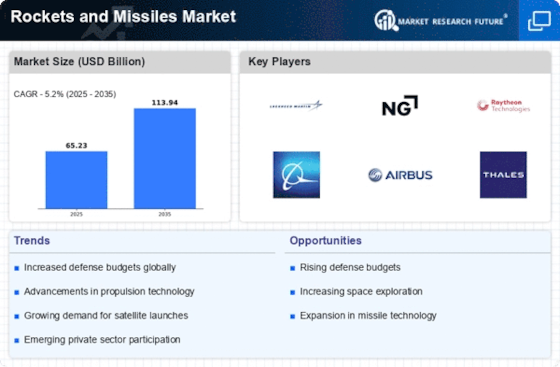
As per Market Research Future analysis, the Rockets and Missiles Market Size was estimated at 65.23 USD Billion in 2024. The Rockets and Missiles industry is projected to grow from 68.62 USD Billion in 2025 to 113.94 USD Billion by 2035, exhibiting a compound annual growth rate (CAGR) of 5.2% during the forecast period 2025 - 2035

Key Market Trends & Highlights

The Rockets and Missiles Market is poised for growth driven by technological advancements and geopolitical dynamics.

  • Technological advancements in missile systems are reshaping capabilities across the sector. Increased geopolitical tensions are prompting nations to bolster their defense strategies, particularly in North America. Collaborative defense initiatives are gaining traction, especially in the Asia-Pacific region, to enhance regional security. Technological innovations and escalating defense budgets are key drivers fueling growth in the defense and ballistic missile segments.

Market Size & Forecast

2024 Market Size 65.23 (USD Billion)
2035 Market Size 113.94 (USD Billion)
CAGR (2025 - 2035) 5.2%
Largest Regional Market Share in 2024 North America

Major Players

Lockheed Martin (US), Northrop Grumman (US), Raytheon Technologies (US), Boeing (US), Airbus (FR), Thales Group (FR), Rostec (RU), China Aerospace Science and Technology Corporation (CN), Israel Aerospace Industries (IL)

Market Trends

The Rockets and Missiles Market is currently experiencing a dynamic evolution, driven by advancements in technology and increasing geopolitical tensions shaping the global rocket and missile market landscape. Nations are investing heavily in developing sophisticated missile systems and launch vehicles, which are perceived as essential components of national defense strategies. The integration of artificial intelligence and automation into missile guidance systems is enhancing precision and effectiveness, thereby reshaping operational capabilities within the rocket and missiles market. Furthermore, the growing emphasis on space exploration and satellite deployment is propelling the demand for advanced rocket systems, as countries seek to establish a foothold in the increasingly competitive space domain.

In addition to technological advancements, the Rockets and Missiles Market is influenced by shifting alliances and defense partnerships among nations within the expanding rockets and missiles market. Collaborative efforts in research and development are becoming more prevalent, as countries recognize the benefits of sharing expertise and resources. This trend is likely to foster innovation and accelerate the introduction of next-generation systems. Moreover, the rising focus on missile defense systems, aimed at countering potential threats, is expected to further stimulate growth in the rocket and missile market. Overall, the Rockets and Missiles Market appears poised for continued expansion, driven by a combination of technological innovation and evolving security needs.

Technological Advancements in Missile Systems

The Rockets and Missiles Market is witnessing rapid technological advancements, particularly in missile guidance and propulsion systems across the global rocket and missile market forcast period. Innovations such as hypersonic technology and enhanced targeting capabilities are becoming increasingly prominent, allowing for greater accuracy and speed. These developments are likely to redefine military strategies and operational effectiveness in the rocket and missiles market.

Increased Geopolitical Tensions

Ongoing geopolitical tensions are significantly impacting the Rockets and Missiles Market and shaping the trajectory of the rocket and missile market. Nations are prioritizing defense spending to bolster their military capabilities in response to perceived threats. This trend is fostering a competitive environment, where countries are keen to develop and deploy advanced missile systems within the rockets and missiles market.

Collaborative Defense Initiatives

The trend towards collaborative defense initiatives is gaining traction within the Rockets and Missiles Market and strengthening the global rocket and missiles market ecosystem. Countries are forming partnerships to share knowledge and resources, which may lead to accelerated innovation. Such collaborations are expected to enhance the development of next-generation missile systems and improve overall defense capabilities across the rocket and missile market forecast timeline.

Rockets Missiles Market Market Drivers

Escalating Defense Budgets

In response to rising security threats, many nations are increasing their defense budgets, which directly impacts the Rockets and Missiles Market Industry. Countries are prioritizing the modernization of their military capabilities, leading to substantial investments in missile defense systems and offensive capabilities. For example, the United States has allocated over $20 billion for missile defense initiatives in its recent budget, reflecting a broader trend among allied nations. This financial commitment is expected to stimulate demand for advanced missile systems, thereby propelling market growth. As nations seek to enhance their deterrence strategies, the focus on developing next-generation rockets and missiles is likely to intensify.

International Arms Treaties and Regulations

The Rockets and Missiles Market Industry is affected by international arms treaties and regulations that govern the development and proliferation of missile technologies. Treaties such as the Missile Technology Control Regime (MTCR) aim to prevent the spread of missile systems capable of delivering weapons of mass destruction. Compliance with these regulations can influence market dynamics, as countries may seek to develop alternative systems that adhere to treaty obligations while still enhancing their military capabilities. The ongoing discussions around arms control may lead to shifts in defense strategies, impacting the demand for certain types of rockets and missiles. This regulatory landscape is crucial for understanding future market trends.

Emerging Space Programs and Satellite Launches

The Rockets and Missiles Market Industry is also being shaped by the emergence of new space programs and the increasing frequency of satellite launches. As nations strive to establish a presence in space, the demand for launch vehicles is on the rise. Countries like India and China are expanding their space capabilities, which necessitates the development of advanced rockets. The commercial space sector is also contributing to this trend, with private companies investing heavily in launch technologies. This growing interest in space exploration and satellite deployment is likely to create new opportunities for the rockets and missiles market, as innovative solutions are required to meet these demands.

Geopolitical Instability and Regional Conflicts

The Rockets and Missiles Market Industry is significantly influenced by geopolitical instability and ongoing regional conflicts. Areas experiencing heightened tensions, such as the Middle East and Eastern Europe, are witnessing increased military expenditures as nations seek to bolster their defense capabilities. The proliferation of missile technology among various states is a growing concern, prompting countries to invest in advanced missile systems to counter potential threats. This environment of uncertainty is likely to drive demand for both offensive and defensive missile systems, as nations aim to secure their borders and maintain strategic advantages. The market is expected to respond dynamically to these geopolitical developments.

Technological Innovations in Rockets and Missiles

The Rockets and Missiles Market Industry is experiencing a surge in technological innovations, particularly in propulsion systems and guidance technologies. Advanced materials and manufacturing techniques are enhancing the performance and reliability of missile systems. For instance, the integration of artificial intelligence in targeting systems is expected to improve accuracy and reduce collateral damage. The market is projected to grow at a compound annual growth rate of approximately 5.2% from 2025 to 2030, driven by these advancements. Furthermore, the development of hypersonic missiles, which can travel at speeds exceeding Mach 5, is likely to reshape strategic military capabilities, making them a focal point in defense budgets worldwide.

Market Segment Insights

By Application: Defense (Largest) vs. Space Exploration (Fastest-Growing)

In the Rockets and Missiles Market, the application segments exhibit distinct market share distributions across the rocket and missile market. The Defense sector remains the cornerstone, commanding the largest share due to ongoing national security concerns and military advancements. Space Exploration has been gaining traction, particularly with new entrants and more nations pursuing their own space programs, reflecting a notable increase in demand for launch services and technology innovations within the rockets and missiles market.

Defense (Dominant) vs. Space Exploration (Emerging)

The Defense application is characterized by robust government investments in military capabilities and a consistent demand for missile systems and rocket launches across the rocket and missile market. It is heavily supported by both conventional military and emerging technologies, fostering innovations that enhance operational efficiencies. Conversely, the Space Exploration segment is rapidly emerging, fueled by advancements in reusable rocket technologies and the increasing number of private players in the rocket and missiles market. This sector prioritizes satellite deployment and interplanetary missions, making it a catalyst for growth, with enhanced collaboration between private companies and government agencies facilitating groundbreaking missions.

By Type: Ballistic Missiles (Largest) vs. Cruise Missiles (Fastest-Growing)

In the Rockets and Missiles Market, the distribution of market share among different types showcases Ballistic Missiles as the predominant segment within the rocket and missile market. They hold a significant share due to their extensive applications in defense strategies worldwide, including deterrence and precision strikes. Conversely, Cruise Missiles are emerging rapidly, favored for their accuracy and versatility across various mission profiles, leading to a noteworthy share increase in recent years across the rockets and missiles market. The growth trends in this market segment are driven by advancements in technology and escalating defense budgets globally. The increasing geopolitical tensions and the need for enhanced military capabilities have catalyzed investment in rapid development of Cruise Missiles, positioning them as the fastest-growing sector. Meanwhile, Ballistic Missiles continue to evolve with improved targeting systems and capabilities, solidifying their dominant status in the market.

Ballistic Missiles (Dominant) vs. Tactical Missiles (Emerging)

Ballistic Missiles represent the dominant force in the Rockets and Missiles Market, renowned for their ability to deliver payloads over vast distances. Their reliability and effectiveness in strategic defense have led to substantial investments and advancements in their technology, ensuring they remain at the forefront of military capabilities. On the other hand, Tactical Missiles are rapidly emerging, specifically designed for shorter-range deployments and precision strikes on tactical targets. Their growing significance is attributed to their versatility and effectiveness in modern warfare scenarios, enabling forces to engage opponents promptly and accurately. As defense forces increasingly adopt hybrid warfare tactics, Tactical Missiles are gaining traction, pushing manufacturers to innovate and enhance their offerings significantly.

By Launch Mode: Vertical Launch (Largest) vs. Horizontal Launch (Fastest-Growing)

In the Rockets and Missiles Market, the launch mode segment is primarily dominated by vertical launches, which hold the largest market share due to their critical role in delivering payloads into orbit effectively. Horizontal launches are emerging as significant competitors, particularly in the development of reusable launch systems and commercial applications, which also provide an efficient alternative for specific missions. This market distribution reflects the diverse applications and innovative technologies adopted in the space industry.

Launch Mode: Vertical Launch (Dominant) vs. Horizontal Launch (Emerging)

Vertical launch systems remain the cornerstone of the Rockets and Missiles Market, characterized by their ability to carry heavy payloads and reach high altitudes quickly. These systems utilize large rocket stages and are typically designed for satellite deployment and deep-space missions. On the other hand, horizontal launch mechanisms are gaining traction, particularly for their cost-effectiveness and flexibility in launching small satellites. This emerging technology leverages aircraft-like systems that can utilize runways, making them suitable for rapid and frequent launches to meet the growing demand in commercial satellite markets.

By Technology: Solid Propellant (Largest) vs. Liquid Propellant (Fastest-Growing)

In the Rockets and Missiles Market, the technology segment is clearly dominated by solid propellant systems, which capture the largest share due to their simplicity, reliability, and cost-effectiveness. Solid propellants are widely used in various missile systems and launch vehicles, enabling quicker responsiveness and reduced logistical challenges. On the other hand, liquid propellants, while currently smaller in market share, are gaining traction due to their higher efficiency and performance capabilities, appealing to advanced missile systems that require precision guidance and adaptable thrust profiles. The growth trajectory of the technology segment shows a distinct preference for liquid propellant systems, which have become the fastest-growing category amid increasing demands for sophisticated and versatile military applications. Technological advancements, such as improved cryogenic technology and modular designs, are driving liquid propulsion systems. Additionally, the shift towards hybrid propulsion systems is emerging as an innovative solution that combines the advantages of both solid and liquid fuel technologies, further energizing the growth landscape of this segment.

Technology: Solid Propellant (Dominant) vs. Liquid Propellant (Emerging)

Solid propellant technology remains the dominant force in the Rockets and Missiles Market, characterized by its straightforward manufacturing process, storage benefits, and reliability under various conditions. This technology is commonly employed in tactical missiles, space launch systems, and some modern rockets due to its robustness and shelf stability. In contrast, liquid propellant technology is an emerging player, recognized for its superior thrust capabilities and efficiency, which cater to advanced missile systems that necessitate precise control over thrust and guidance. The complex infrastructure for maintenance and fueling poses challenges; however, ongoing advancements are making liquid propulsion systems more competitive. As military and space applications evolve, the balance between solid and liquid systems will significantly shape future technological trends.

Get more detailed insights about Rockets and Missiles Market Research Report—Global Forecast till 2035

Regional Insights

The Rockets and Missiles Market revenue showcases a diverse landscape across various regional segments. In 2024, North America leads with a valuation of 18.0 USD billion, which is expected to grow to 26.74 USD billion by 2035, primarily due to increased defense spending and technological advancements. Europe follows, with a market size of 12.0 USD billion in 2024, projected to reach 17.55 USD billion by 2035, driven by strategic partnerships and a focus on enhancing military capabilities.

The Asia Pacific region, valued at 8.0 USD billion in 2024, is anticipated to rise to 11.66 USD billion, fueled by growing regional tensions and military modernization efforts.Meanwhile, South America, with a 2024 valuation of 3.0 USD billion expected to reach 4.39 USD billion by 2035, representing an emerging market with potential defense investments. The Middle East and Africa, holding a projected value of 3.54 USD billion in 2024 and 4.66 USD billion by 2035, are characterized by local conflicts and a push for advanced military technologies.

These segments not only underline significant geographical disparities in the Rockets and Missiles Market data but also reveal various growth drivers such as geopolitical tensions and modernization initiatives in defense strategies, contributing to overall market growth while presenting unique challenges and opportunities.

Key Players and Competitive Insights

The Rockets and Missiles Market is characterized by intense competition and rapid advancements in technology, driven by geopolitical tensions and the continuous demand for enhanced defense capabilities. The landscape is shaped by multiple players ranging from established defense contractors to emerging companies striving to innovate and capture market share. As countries invest heavily in their military capabilities, the focus on developing advanced missile systems, propulsive capabilities, and versatile launch vehicles has further heightened the competitive nature of this market. This environment is creating opportunities for strategic partnerships, joint ventures, and mergers, as companies seek to strengthen their portfolios and present comprehensive solutions to meet the diverse requirements of governments and military organizations worldwide.Aerojet Rocketdyne holds a significant position within the Rockets and Missiles Market, with robust capabilities in rocket propulsion and related technologies. The company's strengths lie in its innovative approach to developing advanced propulsion systems that cater to both strategic and tactical applications. Aerojet Rocketdyne has built a solid reputation for reliability and performance, which is crucial in the defense sector where mission success is paramount. This company effectively utilizes its expertise in propulsion to deliver high-performance rocket motors and systems that enhance the effectiveness of various missile applications. Given its commitment to research and development, Aerojet Rocketdyne continues to expand its technological edge and operational efficiency, allowing it to maintain a competitive stance in a rapidly evolving market.Lockheed Martin stands out in the Rockets and Missiles Market due to its diverse portfolio and extensive capabilities in aerospace and defense. The company is known for its advanced missile systems, particularly in the domains of air defense and strike capabilities. Lockheed Martin’s key products include guided missiles, hypersonic systems, and various launch vehicles that cater to a wide range of defense needs on a scale. With a strong market presence bolstered by a history of successful projects, the company benefits from significant investments in research, innovation, and partnerships with governmental agencies.  Lockheed Martin has also pursued mergers and acquisitions to enhance its technological capabilities and expand its market reach, demonstrating its commitment to maintaining leadership in the defense sector. Its ongoing efforts in developing next-generation systems position Lockheed Martin favorably amidst the competitive pressures of the Rockets and Missiles Market, ensuring that it remains a key player in shaping future defense technologies.

Key Companies in the Rockets Missiles Market include

Industry Developments

The Rockets and Missiles Market has seen notable developments, particularly with key players like Aerojet Rocketdyne, Lockheed Martin, and Raytheon Technologies advancing their technologies amid increased defense spending worldwide. In November 2022, Northrop Grumman announced the commencement of development for a new missile system, further capitalizing on the demand for advanced military capabilities. Additionally, in March 2023, General Dynamics secured a significant contract for missile systems aimed at enhancing national security. The market’s valuation is expected to grow, driven by geopolitical tensions and the pursuit of innovative defense solutions.

In terms of mergers and acquisitions, Lockheed Martin announced its acquisition of Aerojet Rocketdyne in early 2021, further consolidating its position in the sector. Growth from companies such as Boeing and Leonardo indicates a robust demand for next-generation missiles and rocket systems, shaping the landscape of defense technologies. The overall increase in defense budgets globally, particularly in North America and Europe, has fueled investment in research and development across the sector, enabling the rapid advancement of missile technology and enhancing security measures.

Future Outlook

Rockets Missiles Market Future Outlook

The Rockets and Missiles Market is projected to grow at a 5.2% CAGR from 2025 to 2035, driven by advancements in defense technologies and increasing geopolitical tensions.

New opportunities lie in:

  • <p>Development of hypersonic missile systems for rapid response capabilities. Integration of AI for enhanced targeting and operational efficiency. Expansion of commercial space launch services for satellite deployment.</p>

By 2035, the market is expected to be robust, reflecting substantial growth and innovation.

Market Segmentation

Rockets Missiles Market Type Outlook

  • Ballistic Missiles
  • Cruise Missiles
  • Space Launch Vehicles
  • Tactical Missiles

Rockets Missiles Market Technology Outlook

  • Solid Propellant
  • Liquid Propellant
  • Hybrid Propellant

Rockets Missiles Market Application Outlook

  • Defense
  • Space Exploration
  • Commercial Launch Services
  • Scientific Research

Rockets Missiles Market Launch Mode Outlook

  • Vertical Launch
  • Horizontal Launch
  • Suborbital Launch

Report Scope

MARKET SIZE 2024 65.23(USD Billion)
MARKET SIZE 2025 68.62(USD Billion)
MARKET SIZE 2035 113.94(USD Billion)
COMPOUND ANNUAL GROWTH RATE (CAGR) 5.2% (2025 - 2035)
REPORT COVERAGE Revenue Forecast, Competitive Landscape, Growth Factors, and Trends
BASE YEAR 2024
Market Forecast Period 2025 - 2035
Historical Data 2019 - 2024
Market Forecast Units USD Billion
Key Companies Profiled Lockheed Martin (US), Northrop Grumman (US), Raytheon Technologies (US), Boeing (US), Airbus (FR), Thales Group (FR), Rostec (RU), China Aerospace Science and Technology Corporation (CN), Israel Aerospace Industries (IL)
Segments Covered Application, Type, Launch Mode, Technology, Regional
Key Market Opportunities Advancements in hypersonic technology drive innovation in the Rockets and Missiles Market.
Key Market Dynamics Technological advancements and regulatory changes drive competition and innovation in the Rockets and Missiles Market.
Countries Covered North America, Europe, APAC, South America, MEA

FAQs

What is the current valuation of the Rockets and Missiles Market as of 2024?

<p>The Rockets and Missiles Market was valued at 65.23 USD Billion in 2024.</p>

What is the projected market valuation for the Rockets and Missiles Market in 2035?

The market is projected to reach 113.94 USD Billion by 2035.

What is the expected CAGR for the Rockets and Missiles Market during the forecast period 2025 - 2035?

The expected CAGR for the market during 2025 - 2035 is 5.2%.

Which companies are considered key players in the Rockets and Missiles Market?

Key players include Lockheed Martin, Northrop Grumman, Raytheon Technologies, Boeing, Airbus, Thales Group, Rostec, China Aerospace Science and Technology Corporation, and Israel Aerospace Industries.

What are the primary applications of rockets and missiles in the market?

The primary applications include Defense, Space Exploration, Commercial Launch Services, and Scientific Research, with Defense valued between 30.0 and 50.0 USD Billion.

How do ballistic and cruise missiles compare in terms of market valuation?

Ballistic Missiles are valued between 20.0 and 35.0 USD Billion, whereas Cruise Missiles are valued between 15.0 and 25.0 USD Billion.

What are the different launch modes available in the Rockets and Missiles Market?

The market features Vertical Launch, Horizontal Launch, and Suborbital Launch, with Vertical Launch valued between 30.0 and 50.0 USD Billion.

What types of propellants are utilized in the Rockets and Missiles Market?

The market utilizes Solid Propellant, Liquid Propellant, and Hybrid Propellant, with Solid Propellant valued between 30.0 and 50.0 USD Billion.

What segment of the Rockets and Missiles Market is expected to grow the most by 2035?

The Defense segment is likely to see substantial growth, projected between 30.0 and 50.0 USD Billion by 2035.

How does the market for space launch vehicles compare to tactical missiles?

Space Launch Vehicles are valued between 20.0 and 30.0 USD Billion, while Tactical Missiles are valued between 10.23 and 23.94 USD Billion.

  1. SECTION I: EXECUTIVE SUMMARY AND KEY HIGHLIGHTS
    1. | 1.1 EXECUTIVE SUMMARY
    2. | | 1.1.1 Market Overview
    3. | | 1.1.2 Key Findings
    4. | | 1.1.3 Market Segmentation
    5. | | 1.1.4 Competitive Landscape
    6. | | 1.1.5 Challenges and Opportunities
    7. | | 1.1.6 Future Outlook
  2. SECTION II: SCOPING, METHODOLOGY AND MARKET STRUCTURE
    1. | 2.1 MARKET INTRODUCTION
    2. | | 2.1.1 Definition
    3. | | 2.1.2 Scope of the study
    4. | | | 2.1.2.1 Research Objective
    5. | | | 2.1.2.2 Assumption
    6. | | | 2.1.2.3 Limitations
    7. | 2.2 RESEARCH METHODOLOGY
    8. | | 2.2.1 Overview
    9. | | 2.2.2 Data Mining
    10. | | 2.2.3 Secondary Research
    11. | | 2.2.4 Primary Research
    12. | | | 2.2.4.1 Primary Interviews and Information Gathering Process
    13. | | | 2.2.4.2 Breakdown of Primary Respondents
    14. | | 2.2.5 Forecasting Model
    15. | | 2.2.6 Market Size Estimation
    16. | | | 2.2.6.1 Bottom-Up Approach
    17. | | | 2.2.6.2 Top-Down Approach
    18. | | 2.2.7 Data Triangulation
    19. | | 2.2.8 Validation
  3. SECTION III: QUALITATIVE ANALYSIS
    1. | 3.1 MARKET DYNAMICS
    2. | | 3.1.1 Overview
    3. | | 3.1.2 Drivers
    4. | | 3.1.3 Restraints
    5. | | 3.1.4 Opportunities
    6. | 3.2 MARKET FACTOR ANALYSIS
    7. | | 3.2.1 Value chain Analysis
    8. | | 3.2.2 Porter's Five Forces Analysis
    9. | | | 3.2.2.1 Bargaining Power of Suppliers
    10. | | | 3.2.2.2 Bargaining Power of Buyers
    11. | | | 3.2.2.3 Threat of New Entrants
    12. | | | 3.2.2.4 Threat of Substitutes
    13. | | | 3.2.2.5 Intensity of Rivalry
    14. | | 3.2.3 COVID-19 Impact Analysis
    15. | | | 3.2.3.1 Market Impact Analysis
    16. | | | 3.2.3.2 Regional Impact
    17. | | | 3.2.3.3 Opportunity and Threat Analysis
  4. SECTION IV: QUANTITATIVE ANALYSIS
    1. | 4.1 Aerospace & Defense, BY Application (USD Billion)
    2. | | 4.1.1 Defense
    3. | | 4.1.2 Space Exploration
    4. | | 4.1.3 Commercial Launch Services
    5. | | 4.1.4 Scientific Research
    6. | 4.2 Aerospace & Defense, BY Type (USD Billion)
    7. | | 4.2.1 Ballistic Missiles
    8. | | 4.2.2 Cruise Missiles
    9. | | 4.2.3 Space Launch Vehicles
    10. | | 4.2.4 Tactical Missiles
    11. | 4.3 Aerospace & Defense, BY Launch Mode (USD Billion)
    12. | | 4.3.1 Vertical Launch
    13. | | 4.3.2 Horizontal Launch
    14. | | 4.3.3 Suborbital Launch
    15. | 4.4 Aerospace & Defense, BY Technology (USD Billion)
    16. | | 4.4.1 Solid Propellant
    17. | | 4.4.2 Liquid Propellant
    18. | | 4.4.3 Hybrid Propellant
    19. | 4.5 Aerospace & Defense, BY Region (USD Billion)
    20. | | 4.5.1 North America
    21. | | | 4.5.1.1 US
    22. | | | 4.5.1.2 Canada
    23. | | 4.5.2 Europe
    24. | | | 4.5.2.1 Germany
    25. | | | 4.5.2.2 UK
    26. | | | 4.5.2.3 France
    27. | | | 4.5.2.4 Russia
    28. | | | 4.5.2.5 Italy
    29. | | | 4.5.2.6 Spain
    30. | | | 4.5.2.7 Rest of Europe
    31. | | 4.5.3 APAC
    32. | | | 4.5.3.1 China
    33. | | | 4.5.3.2 India
    34. | | | 4.5.3.3 Japan
    35. | | | 4.5.3.4 South Korea
    36. | | | 4.5.3.5 Malaysia
    37. | | | 4.5.3.6 Thailand
    38. | | | 4.5.3.7 Indonesia
    39. | | | 4.5.3.8 Rest of APAC
    40. | | 4.5.4 South America
    41. | | | 4.5.4.1 Brazil
    42. | | | 4.5.4.2 Mexico
    43. | | | 4.5.4.3 Argentina
    44. | | | 4.5.4.4 Rest of South America
    45. | | 4.5.5 MEA
    46. | | | 4.5.5.1 GCC Countries
    47. | | | 4.5.5.2 South Africa
    48. | | | 4.5.5.3 Rest of MEA
  5. SECTION V: COMPETITIVE ANALYSIS
    1. | 5.1 Competitive Landscape
    2. | | 5.1.1 Overview
    3. | | 5.1.2 Competitive Analysis
    4. | | 5.1.3 Market share Analysis
    5. | | 5.1.4 Major Growth Strategy in the Aerospace & Defense
    6. | | 5.1.5 Competitive Benchmarking
    7. | | 5.1.6 Leading Players in Terms of Number of Developments in the Aerospace & Defense
    8. | | 5.1.7 Key developments and growth strategies
    9. | | | 5.1.7.1 New Product Launch/Service Deployment
    10. | | | 5.1.7.2 Merger & Acquisitions
    11. | | | 5.1.7.3 Joint Ventures
    12. | | 5.1.8 Major Players Financial Matrix
    13. | | | 5.1.8.1 Sales and Operating Income
    14. | | | 5.1.8.2 Major Players R&D Expenditure. 2023
    15. | 5.2 Company Profiles
    16. | | 5.2.1 Lockheed Martin (US)
    17. | | | 5.2.1.1 Financial Overview
    18. | | | 5.2.1.2 Products Offered
    19. | | | 5.2.1.3 Key Developments
    20. | | | 5.2.1.4 SWOT Analysis
    21. | | | 5.2.1.5 Key Strategies
    22. | | 5.2.2 Northrop Grumman (US)
    23. | | | 5.2.2.1 Financial Overview
    24. | | | 5.2.2.2 Products Offered
    25. | | | 5.2.2.3 Key Developments
    26. | | | 5.2.2.4 SWOT Analysis
    27. | | | 5.2.2.5 Key Strategies
    28. | | 5.2.3 Raytheon Technologies (US)
    29. | | | 5.2.3.1 Financial Overview
    30. | | | 5.2.3.2 Products Offered
    31. | | | 5.2.3.3 Key Developments
    32. | | | 5.2.3.4 SWOT Analysis
    33. | | | 5.2.3.5 Key Strategies
    34. | | 5.2.4 Boeing (US)
    35. | | | 5.2.4.1 Financial Overview
    36. | | | 5.2.4.2 Products Offered
    37. | | | 5.2.4.3 Key Developments
    38. | | | 5.2.4.4 SWOT Analysis
    39. | | | 5.2.4.5 Key Strategies
    40. | | 5.2.5 Airbus (FR)
    41. | | | 5.2.5.1 Financial Overview
    42. | | | 5.2.5.2 Products Offered
    43. | | | 5.2.5.3 Key Developments
    44. | | | 5.2.5.4 SWOT Analysis
    45. | | | 5.2.5.5 Key Strategies
    46. | | 5.2.6 Thales Group (FR)
    47. | | | 5.2.6.1 Financial Overview
    48. | | | 5.2.6.2 Products Offered
    49. | | | 5.2.6.3 Key Developments
    50. | | | 5.2.6.4 SWOT Analysis
    51. | | | 5.2.6.5 Key Strategies
    52. | | 5.2.7 Rostec (RU)
    53. | | | 5.2.7.1 Financial Overview
    54. | | | 5.2.7.2 Products Offered
    55. | | | 5.2.7.3 Key Developments
    56. | | | 5.2.7.4 SWOT Analysis
    57. | | | 5.2.7.5 Key Strategies
    58. | | 5.2.8 China Aerospace Science and Technology Corporation (CN)
    59. | | | 5.2.8.1 Financial Overview
    60. | | | 5.2.8.2 Products Offered
    61. | | | 5.2.8.3 Key Developments
    62. | | | 5.2.8.4 SWOT Analysis
    63. | | | 5.2.8.5 Key Strategies
    64. | | 5.2.9 Israel Aerospace Industries (IL)
    65. | | | 5.2.9.1 Financial Overview
    66. | | | 5.2.9.2 Products Offered
    67. | | | 5.2.9.3 Key Developments
    68. | | | 5.2.9.4 SWOT Analysis
    69. | | | 5.2.9.5 Key Strategies
    70. | 5.3 Appendix
    71. | | 5.3.1 References
    72. | | 5.3.2 Related Reports
  6. LIST OF FIGURES
    1. | 6.1 MARKET SYNOPSIS
    2. | 6.2 NORTH AMERICA MARKET ANALYSIS
    3. | 6.3 US MARKET ANALYSIS BY APPLICATION
    4. | 6.4 US MARKET ANALYSIS BY TYPE
    5. | 6.5 US MARKET ANALYSIS BY LAUNCH MODE
    6. | 6.6 US MARKET ANALYSIS BY TECHNOLOGY
    7. | 6.7 CANADA MARKET ANALYSIS BY APPLICATION
    8. | 6.8 CANADA MARKET ANALYSIS BY TYPE
    9. | 6.9 CANADA MARKET ANALYSIS BY LAUNCH MODE
    10. | 6.10 CANADA MARKET ANALYSIS BY TECHNOLOGY
    11. | 6.11 EUROPE MARKET ANALYSIS
    12. | 6.12 GERMANY MARKET ANALYSIS BY APPLICATION
    13. | 6.13 GERMANY MARKET ANALYSIS BY TYPE
    14. | 6.14 GERMANY MARKET ANALYSIS BY LAUNCH MODE
    15. | 6.15 GERMANY MARKET ANALYSIS BY TECHNOLOGY
    16. | 6.16 UK MARKET ANALYSIS BY APPLICATION
    17. | 6.17 UK MARKET ANALYSIS BY TYPE
    18. | 6.18 UK MARKET ANALYSIS BY LAUNCH MODE
    19. | 6.19 UK MARKET ANALYSIS BY TECHNOLOGY
    20. | 6.20 FRANCE MARKET ANALYSIS BY APPLICATION
    21. | 6.21 FRANCE MARKET ANALYSIS BY TYPE
    22. | 6.22 FRANCE MARKET ANALYSIS BY LAUNCH MODE
    23. | 6.23 FRANCE MARKET ANALYSIS BY TECHNOLOGY
    24. | 6.24 RUSSIA MARKET ANALYSIS BY APPLICATION
    25. | 6.25 RUSSIA MARKET ANALYSIS BY TYPE
    26. | 6.26 RUSSIA MARKET ANALYSIS BY LAUNCH MODE
    27. | 6.27 RUSSIA MARKET ANALYSIS BY TECHNOLOGY
    28. | 6.28 ITALY MARKET ANALYSIS BY APPLICATION
    29. | 6.29 ITALY MARKET ANALYSIS BY TYPE
    30. | 6.30 ITALY MARKET ANALYSIS BY LAUNCH MODE
    31. | 6.31 ITALY MARKET ANALYSIS BY TECHNOLOGY
    32. | 6.32 SPAIN MARKET ANALYSIS BY APPLICATION
    33. | 6.33 SPAIN MARKET ANALYSIS BY TYPE
    34. | 6.34 SPAIN MARKET ANALYSIS BY LAUNCH MODE
    35. | 6.35 SPAIN MARKET ANALYSIS BY TECHNOLOGY
    36. | 6.36 REST OF EUROPE MARKET ANALYSIS BY APPLICATION
    37. | 6.37 REST OF EUROPE MARKET ANALYSIS BY TYPE
    38. | 6.38 REST OF EUROPE MARKET ANALYSIS BY LAUNCH MODE
    39. | 6.39 REST OF EUROPE MARKET ANALYSIS BY TECHNOLOGY
    40. | 6.40 APAC MARKET ANALYSIS
    41. | 6.41 CHINA MARKET ANALYSIS BY APPLICATION
    42. | 6.42 CHINA MARKET ANALYSIS BY TYPE
    43. | 6.43 CHINA MARKET ANALYSIS BY LAUNCH MODE
    44. | 6.44 CHINA MARKET ANALYSIS BY TECHNOLOGY
    45. | 6.45 INDIA MARKET ANALYSIS BY APPLICATION
    46. | 6.46 INDIA MARKET ANALYSIS BY TYPE
    47. | 6.47 INDIA MARKET ANALYSIS BY LAUNCH MODE
    48. | 6.48 INDIA MARKET ANALYSIS BY TECHNOLOGY
    49. | 6.49 JAPAN MARKET ANALYSIS BY APPLICATION
    50. | 6.50 JAPAN MARKET ANALYSIS BY TYPE
    51. | 6.51 JAPAN MARKET ANALYSIS BY LAUNCH MODE
    52. | 6.52 JAPAN MARKET ANALYSIS BY TECHNOLOGY
    53. | 6.53 SOUTH KOREA MARKET ANALYSIS BY APPLICATION
    54. | 6.54 SOUTH KOREA MARKET ANALYSIS BY TYPE
    55. | 6.55 SOUTH KOREA MARKET ANALYSIS BY LAUNCH MODE
    56. | 6.56 SOUTH KOREA MARKET ANALYSIS BY TECHNOLOGY
    57. | 6.57 MALAYSIA MARKET ANALYSIS BY APPLICATION
    58. | 6.58 MALAYSIA MARKET ANALYSIS BY TYPE
    59. | 6.59 MALAYSIA MARKET ANALYSIS BY LAUNCH MODE
    60. | 6.60 MALAYSIA MARKET ANALYSIS BY TECHNOLOGY
    61. | 6.61 THAILAND MARKET ANALYSIS BY APPLICATION
    62. | 6.62 THAILAND MARKET ANALYSIS BY TYPE
    63. | 6.63 THAILAND MARKET ANALYSIS BY LAUNCH MODE
    64. | 6.64 THAILAND MARKET ANALYSIS BY TECHNOLOGY
    65. | 6.65 INDONESIA MARKET ANALYSIS BY APPLICATION
    66. | 6.66 INDONESIA MARKET ANALYSIS BY TYPE
    67. | 6.67 INDONESIA MARKET ANALYSIS BY LAUNCH MODE
    68. | 6.68 INDONESIA MARKET ANALYSIS BY TECHNOLOGY
    69. | 6.69 REST OF APAC MARKET ANALYSIS BY APPLICATION
    70. | 6.70 REST OF APAC MARKET ANALYSIS BY TYPE
    71. | 6.71 REST OF APAC MARKET ANALYSIS BY LAUNCH MODE
    72. | 6.72 REST OF APAC MARKET ANALYSIS BY TECHNOLOGY
    73. | 6.73 SOUTH AMERICA MARKET ANALYSIS
    74. | 6.74 BRAZIL MARKET ANALYSIS BY APPLICATION
    75. | 6.75 BRAZIL MARKET ANALYSIS BY TYPE
    76. | 6.76 BRAZIL MARKET ANALYSIS BY LAUNCH MODE
    77. | 6.77 BRAZIL MARKET ANALYSIS BY TECHNOLOGY
    78. | 6.78 MEXICO MARKET ANALYSIS BY APPLICATION
    79. | 6.79 MEXICO MARKET ANALYSIS BY TYPE
    80. | 6.80 MEXICO MARKET ANALYSIS BY LAUNCH MODE
    81. | 6.81 MEXICO MARKET ANALYSIS BY TECHNOLOGY
    82. | 6.82 ARGENTINA MARKET ANALYSIS BY APPLICATION
    83. | 6.83 ARGENTINA MARKET ANALYSIS BY TYPE
    84. | 6.84 ARGENTINA MARKET ANALYSIS BY LAUNCH MODE
    85. | 6.85 ARGENTINA MARKET ANALYSIS BY TECHNOLOGY
    86. | 6.86 REST OF SOUTH AMERICA MARKET ANALYSIS BY APPLICATION
    87. | 6.87 REST OF SOUTH AMERICA MARKET ANALYSIS BY TYPE
    88. | 6.88 REST OF SOUTH AMERICA MARKET ANALYSIS BY LAUNCH MODE
    89. | 6.89 REST OF SOUTH AMERICA MARKET ANALYSIS BY TECHNOLOGY
    90. | 6.90 MEA MARKET ANALYSIS
    91. | 6.91 GCC COUNTRIES MARKET ANALYSIS BY APPLICATION
    92. | 6.92 GCC COUNTRIES MARKET ANALYSIS BY TYPE
    93. | 6.93 GCC COUNTRIES MARKET ANALYSIS BY LAUNCH MODE
    94. | 6.94 GCC COUNTRIES MARKET ANALYSIS BY TECHNOLOGY
    95. | 6.95 SOUTH AFRICA MARKET ANALYSIS BY APPLICATION
    96. | 6.96 SOUTH AFRICA MARKET ANALYSIS BY TYPE
    97. | 6.97 SOUTH AFRICA MARKET ANALYSIS BY LAUNCH MODE
    98. | 6.98 SOUTH AFRICA MARKET ANALYSIS BY TECHNOLOGY
    99. | 6.99 REST OF MEA MARKET ANALYSIS BY APPLICATION
    100. | 6.100 REST OF MEA MARKET ANALYSIS BY TYPE
    101. | 6.101 REST OF MEA MARKET ANALYSIS BY LAUNCH MODE
    102. | 6.102 REST OF MEA MARKET ANALYSIS BY TECHNOLOGY
    103. | 6.103 KEY BUYING CRITERIA OF AEROSPACE & DEFENSE
    104. | 6.104 RESEARCH PROCESS OF MRFR
    105. | 6.105 DRO ANALYSIS OF AEROSPACE & DEFENSE
    106. | 6.106 DRIVERS IMPACT ANALYSIS: AEROSPACE & DEFENSE
    107. | 6.107 RESTRAINTS IMPACT ANALYSIS: AEROSPACE & DEFENSE
    108. | 6.108 SUPPLY / VALUE CHAIN: AEROSPACE & DEFENSE
    109. | 6.109 AEROSPACE & DEFENSE, BY APPLICATION, 2024 (% SHARE)
    110. | 6.110 AEROSPACE & DEFENSE, BY APPLICATION, 2024 TO 2035 (USD Billion)
    111. | 6.111 AEROSPACE & DEFENSE, BY TYPE, 2024 (% SHARE)
    112. | 6.112 AEROSPACE & DEFENSE, BY TYPE, 2024 TO 2035 (USD Billion)
    113. | 6.113 AEROSPACE & DEFENSE, BY LAUNCH MODE, 2024 (% SHARE)
    114. | 6.114 AEROSPACE & DEFENSE, BY LAUNCH MODE, 2024 TO 2035 (USD Billion)
    115. | 6.115 AEROSPACE & DEFENSE, BY TECHNOLOGY, 2024 (% SHARE)
    116. | 6.116 AEROSPACE & DEFENSE, BY TECHNOLOGY, 2024 TO 2035 (USD Billion)
    117. | 6.117 BENCHMARKING OF MAJOR COMPETITORS
  7. LIST OF TABLES
    1. | 7.1 LIST OF ASSUMPTIONS
    2. | | 7.1.1
    3. | 7.2 North America MARKET SIZE ESTIMATES; FORECAST
    4. | | 7.2.1 BY APPLICATION, 2025-2035 (USD Billion)
    5. | | 7.2.2 BY TYPE, 2025-2035 (USD Billion)
    6. | | 7.2.3 BY LAUNCH MODE, 2025-2035 (USD Billion)
    7. | | 7.2.4 BY TECHNOLOGY, 2025-2035 (USD Billion)
    8. | 7.3 US MARKET SIZE ESTIMATES; FORECAST
    9. | | 7.3.1 BY APPLICATION, 2025-2035 (USD Billion)
    10. | | 7.3.2 BY TYPE, 2025-2035 (USD Billion)
    11. | | 7.3.3 BY LAUNCH MODE, 2025-2035 (USD Billion)
    12. | | 7.3.4 BY TECHNOLOGY, 2025-2035 (USD Billion)
    13. | 7.4 Canada MARKET SIZE ESTIMATES; FORECAST
    14. | | 7.4.1 BY APPLICATION, 2025-2035 (USD Billion)
    15. | | 7.4.2 BY TYPE, 2025-2035 (USD Billion)
    16. | | 7.4.3 BY LAUNCH MODE, 2025-2035 (USD Billion)
    17. | | 7.4.4 BY TECHNOLOGY, 2025-2035 (USD Billion)
    18. | 7.5 Europe MARKET SIZE ESTIMATES; FORECAST
    19. | | 7.5.1 BY APPLICATION, 2025-2035 (USD Billion)
    20. | | 7.5.2 BY TYPE, 2025-2035 (USD Billion)
    21. | | 7.5.3 BY LAUNCH MODE, 2025-2035 (USD Billion)
    22. | | 7.5.4 BY TECHNOLOGY, 2025-2035 (USD Billion)
    23. | 7.6 Germany MARKET SIZE ESTIMATES; FORECAST
    24. | | 7.6.1 BY APPLICATION, 2025-2035 (USD Billion)
    25. | | 7.6.2 BY TYPE, 2025-2035 (USD Billion)
    26. | | 7.6.3 BY LAUNCH MODE, 2025-2035 (USD Billion)
    27. | | 7.6.4 BY TECHNOLOGY, 2025-2035 (USD Billion)
    28. | 7.7 UK MARKET SIZE ESTIMATES; FORECAST
    29. | | 7.7.1 BY APPLICATION, 2025-2035 (USD Billion)
    30. | | 7.7.2 BY TYPE, 2025-2035 (USD Billion)
    31. | | 7.7.3 BY LAUNCH MODE, 2025-2035 (USD Billion)
    32. | | 7.7.4 BY TECHNOLOGY, 2025-2035 (USD Billion)
    33. | 7.8 France MARKET SIZE ESTIMATES; FORECAST
    34. | | 7.8.1 BY APPLICATION, 2025-2035 (USD Billion)
    35. | | 7.8.2 BY TYPE, 2025-2035 (USD Billion)
    36. | | 7.8.3 BY LAUNCH MODE, 2025-2035 (USD Billion)
    37. | | 7.8.4 BY TECHNOLOGY, 2025-2035 (USD Billion)
    38. | 7.9 Russia MARKET SIZE ESTIMATES; FORECAST
    39. | | 7.9.1 BY APPLICATION, 2025-2035 (USD Billion)
    40. | | 7.9.2 BY TYPE, 2025-2035 (USD Billion)
    41. | | 7.9.3 BY LAUNCH MODE, 2025-2035 (USD Billion)
    42. | | 7.9.4 BY TECHNOLOGY, 2025-2035 (USD Billion)
    43. | 7.10 Italy MARKET SIZE ESTIMATES; FORECAST
    44. | | 7.10.1 BY APPLICATION, 2025-2035 (USD Billion)
    45. | | 7.10.2 BY TYPE, 2025-2035 (USD Billion)
    46. | | 7.10.3 BY LAUNCH MODE, 2025-2035 (USD Billion)
    47. | | 7.10.4 BY TECHNOLOGY, 2025-2035 (USD Billion)
    48. | 7.11 Spain MARKET SIZE ESTIMATES; FORECAST
    49. | | 7.11.1 BY APPLICATION, 2025-2035 (USD Billion)
    50. | | 7.11.2 BY TYPE, 2025-2035 (USD Billion)
    51. | | 7.11.3 BY LAUNCH MODE, 2025-2035 (USD Billion)
    52. | | 7.11.4 BY TECHNOLOGY, 2025-2035 (USD Billion)
    53. | 7.12 Rest of Europe MARKET SIZE ESTIMATES; FORECAST
    54. | | 7.12.1 BY APPLICATION, 2025-2035 (USD Billion)
    55. | | 7.12.2 BY TYPE, 2025-2035 (USD Billion)
    56. | | 7.12.3 BY LAUNCH MODE, 2025-2035 (USD Billion)
    57. | | 7.12.4 BY TECHNOLOGY, 2025-2035 (USD Billion)
    58. | 7.13 APAC MARKET SIZE ESTIMATES; FORECAST
    59. | | 7.13.1 BY APPLICATION, 2025-2035 (USD Billion)
    60. | | 7.13.2 BY TYPE, 2025-2035 (USD Billion)
    61. | | 7.13.3 BY LAUNCH MODE, 2025-2035 (USD Billion)
    62. | | 7.13.4 BY TECHNOLOGY, 2025-2035 (USD Billion)
    63. | 7.14 China MARKET SIZE ESTIMATES; FORECAST
    64. | | 7.14.1 BY APPLICATION, 2025-2035 (USD Billion)
    65. | | 7.14.2 BY TYPE, 2025-2035 (USD Billion)
    66. | | 7.14.3 BY LAUNCH MODE, 2025-2035 (USD Billion)
    67. | | 7.14.4 BY TECHNOLOGY, 2025-2035 (USD Billion)
    68. | 7.15 India MARKET SIZE ESTIMATES; FORECAST
    69. | | 7.15.1 BY APPLICATION, 2025-2035 (USD Billion)
    70. | | 7.15.2 BY TYPE, 2025-2035 (USD Billion)
    71. | | 7.15.3 BY LAUNCH MODE, 2025-2035 (USD Billion)
    72. | | 7.15.4 BY TECHNOLOGY, 2025-2035 (USD Billion)
    73. | 7.16 Japan MARKET SIZE ESTIMATES; FORECAST
    74. | | 7.16.1 BY APPLICATION, 2025-2035 (USD Billion)
    75. | | 7.16.2 BY TYPE, 2025-2035 (USD Billion)
    76. | | 7.16.3 BY LAUNCH MODE, 2025-2035 (USD Billion)
    77. | | 7.16.4 BY TECHNOLOGY, 2025-2035 (USD Billion)
    78. | 7.17 South Korea MARKET SIZE ESTIMATES; FORECAST
    79. | | 7.17.1 BY APPLICATION, 2025-2035 (USD Billion)
    80. | | 7.17.2 BY TYPE, 2025-2035 (USD Billion)
    81. | | 7.17.3 BY LAUNCH MODE, 2025-2035 (USD Billion)
    82. | | 7.17.4 BY TECHNOLOGY, 2025-2035 (USD Billion)
    83. | 7.18 Malaysia MARKET SIZE ESTIMATES; FORECAST
    84. | | 7.18.1 BY APPLICATION, 2025-2035 (USD Billion)
    85. | | 7.18.2 BY TYPE, 2025-2035 (USD Billion)
    86. | | 7.18.3 BY LAUNCH MODE, 2025-2035 (USD Billion)
    87. | | 7.18.4 BY TECHNOLOGY, 2025-2035 (USD Billion)
    88. | 7.19 Thailand MARKET SIZE ESTIMATES; FORECAST
    89. | | 7.19.1 BY APPLICATION, 2025-2035 (USD Billion)
    90. | | 7.19.2 BY TYPE, 2025-2035 (USD Billion)
    91. | | 7.19.3 BY LAUNCH MODE, 2025-2035 (USD Billion)
    92. | | 7.19.4 BY TECHNOLOGY, 2025-2035 (USD Billion)
    93. | 7.20 Indonesia MARKET SIZE ESTIMATES; FORECAST
    94. | | 7.20.1 BY APPLICATION, 2025-2035 (USD Billion)
    95. | | 7.20.2 BY TYPE, 2025-2035 (USD Billion)
    96. | | 7.20.3 BY LAUNCH MODE, 2025-2035 (USD Billion)
    97. | | 7.20.4 BY TECHNOLOGY, 2025-2035 (USD Billion)
    98. | 7.21 Rest of APAC MARKET SIZE ESTIMATES; FORECAST
    99. | | 7.21.1 BY APPLICATION, 2025-2035 (USD Billion)
    100. | | 7.21.2 BY TYPE, 2025-2035 (USD Billion)
    101. | | 7.21.3 BY LAUNCH MODE, 2025-2035 (USD Billion)
    102. | | 7.21.4 BY TECHNOLOGY, 2025-2035 (USD Billion)
    103. | 7.22 South America MARKET SIZE ESTIMATES; FORECAST
    104. | | 7.22.1 BY APPLICATION, 2025-2035 (USD Billion)
    105. | | 7.22.2 BY TYPE, 2025-2035 (USD Billion)
    106. | | 7.22.3 BY LAUNCH MODE, 2025-2035 (USD Billion)
    107. | | 7.22.4 BY TECHNOLOGY, 2025-2035 (USD Billion)
    108. | 7.23 Brazil MARKET SIZE ESTIMATES; FORECAST
    109. | | 7.23.1 BY APPLICATION, 2025-2035 (USD Billion)
    110. | | 7.23.2 BY TYPE, 2025-2035 (USD Billion)
    111. | | 7.23.3 BY LAUNCH MODE, 2025-2035 (USD Billion)
    112. | | 7.23.4 BY TECHNOLOGY, 2025-2035 (USD Billion)
    113. | 7.24 Mexico MARKET SIZE ESTIMATES; FORECAST
    114. | | 7.24.1 BY APPLICATION, 2025-2035 (USD Billion)
    115. | | 7.24.2 BY TYPE, 2025-2035 (USD Billion)
    116. | | 7.24.3 BY LAUNCH MODE, 2025-2035 (USD Billion)
    117. | | 7.24.4 BY TECHNOLOGY, 2025-2035 (USD Billion)
    118. | 7.25 Argentina MARKET SIZE ESTIMATES; FORECAST
    119. | | 7.25.1 BY APPLICATION, 2025-2035 (USD Billion)
    120. | | 7.25.2 BY TYPE, 2025-2035 (USD Billion)
    121. | | 7.25.3 BY LAUNCH MODE, 2025-2035 (USD Billion)
    122. | | 7.25.4 BY TECHNOLOGY, 2025-2035 (USD Billion)
    123. | 7.26 Rest of South America MARKET SIZE ESTIMATES; FORECAST
    124. | | 7.26.1 BY APPLICATION, 2025-2035 (USD Billion)
    125. | | 7.26.2 BY TYPE, 2025-2035 (USD Billion)
    126. | | 7.26.3 BY LAUNCH MODE, 2025-2035 (USD Billion)
    127. | | 7.26.4 BY TECHNOLOGY, 2025-2035 (USD Billion)
    128. | 7.27 MEA MARKET SIZE ESTIMATES; FORECAST
    129. | | 7.27.1 BY APPLICATION, 2025-2035 (USD Billion)
    130. | | 7.27.2 BY TYPE, 2025-2035 (USD Billion)
    131. | | 7.27.3 BY LAUNCH MODE, 2025-2035 (USD Billion)
    132. | | 7.27.4 BY TECHNOLOGY, 2025-2035 (USD Billion)
    133. | 7.28 GCC Countries MARKET SIZE ESTIMATES; FORECAST
    134. | | 7.28.1 BY APPLICATION, 2025-2035 (USD Billion)
    135. | | 7.28.2 BY TYPE, 2025-2035 (USD Billion)
    136. | | 7.28.3 BY LAUNCH MODE, 2025-2035 (USD Billion)
    137. | | 7.28.4 BY TECHNOLOGY, 2025-2035 (USD Billion)
    138. | 7.29 South Africa MARKET SIZE ESTIMATES; FORECAST
    139. | | 7.29.1 BY APPLICATION, 2025-2035 (USD Billion)
    140. | | 7.29.2 BY TYPE, 2025-2035 (USD Billion)
    141. | | 7.29.3 BY LAUNCH MODE, 2025-2035 (USD Billion)
    142. | | 7.29.4 BY TECHNOLOGY, 2025-2035 (USD Billion)
    143. | 7.30 Rest of MEA MARKET SIZE ESTIMATES; FORECAST
    144. | | 7.30.1 BY APPLICATION, 2025-2035 (USD Billion)
    145. | | 7.30.2 BY TYPE, 2025-2035 (USD Billion)
    146. | | 7.30.3 BY LAUNCH MODE, 2025-2035 (USD Billion)
    147. | | 7.30.4 BY TECHNOLOGY, 2025-2035 (USD Billion)
    148. | 7.31 PRODUCT LAUNCH/PRODUCT DEVELOPMENT/APPROVAL
    149. | | 7.31.1
    150. | 7.32 ACQUISITION/PARTNERSHIP
    151. | | 7.32.1

Aerospace & Defense Market Segmentation

Aerospace & Defense By Application (USD Billion, 2025-2035)

  • Defense
  • Space Exploration
  • Commercial Launch Services
  • Scientific Research

Aerospace & Defense By Type (USD Billion, 2025-2035)

  • Ballistic Missiles
  • Cruise Missiles
  • Space Launch Vehicles
  • Tactical Missiles

Aerospace & Defense By Launch Mode (USD Billion, 2025-2035)

  • Vertical Launch
  • Horizontal Launch
  • Suborbital Launch

Aerospace & Defense By Technology (USD Billion, 2025-2035)

  • Solid Propellant
  • Liquid Propellant
  • Hybrid Propellant
Infographic

Free Sample Request

Kindly complete the form below to receive a free sample of this Report

Get Free Sample

Customer Strories

Compare Licence

×
Features License Type
Single User Multiuser License Enterprise User
Price $4,950 $5,950 $7,250
Maximum User Access Limit 1 User Upto 10 Users Unrestricted Access Throughout the Organization
Free Customization
Direct Access to Analyst
Deliverable Format
Platform Access
Discount on Next Purchase 10% 15% 15%
Printable Versions