Request Free Sample ×

Kindly complete the form below to receive a free sample of this Report

* Please use a valid business email

Leading companies partner with us for data-driven Insights

clients tt-cursor
Hero Background
English
Chinese
French
Japanese
Korean
German
Spanish

Rheology Modifiers Market Share

ID: MRFR/CnM/3783-HCR
111 Pages
Chitranshi Jaiswal
March 2026

Rheology Modifiers Market Research Report Information By Type (Organic and Inorganic), By Application (Paints & Coatings, Cosmetics & Personal Care, Adhesives & Sealants, Construction, Inks, Pharmaceuticals and Oil & Gas) And By Region (North America, Europe, Asia-Pacific, And Rest Of The World) –Market Forecast Till 2035

Share:
Download PDF ×

We do not share your information with anyone. However, we may send you emails based on your report interest from time to time. You may contact us at any time to opt-out.

Rheology Modifiers Market Infographic
Purchase Options

Market Share

Rheology Modifiers Market Share Analysis

In the Rheology Modifiers Market, companies implement a range of strategic initiatives to establish a strong market presence and navigate the competitive landscape. As these modifiers find applications in diverse industries such as paints and coatings, cosmetics, and construction, strategic positioning is crucial for success. The following key pointers outline the market share positioning strategies employed in the Rheology Modifiers industry:

Innovative Product Development: Companies prioritize innovation in the development of rheology modifiers. Investing in research and development enables the creation of modifiers with enhanced rheological properties, providing advantages such as improved viscosity control, stability, and application-specific functionalities. Innovation serves as a differentiator in a market where product performance is paramount.

Application-Specific Formulations: Recognizing the varied applications of rheology modifiers in different industries, companies tailor formulations to meet specific needs. Customizing modifiers for applications in paints, cosmetics, or adhesives ensures that they address the unique requirements of each sector, enhancing their market relevance.

Strategic Partnerships and Collaborations: Collaborative efforts with suppliers, manufacturers, or industry partners are common strategies. Forming strategic alliances allows companies to access complementary resources, share expertise, and accelerate innovation, contributing to a more robust market position.

Global Market Expansion: Companies explore opportunities for global expansion to tap into new markets and diversify their customer base. Expanding operations internationally not only broadens market reach but also helps companies adapt to diverse regional preferences, regulations, and economic conditions.

Sustainability Initiatives: With a growing emphasis on sustainability, companies in the rheology modifiers market are incorporating eco-friendly practices. Developing environmentally friendly modifiers, promoting sustainable sourcing, and reducing environmental impact can appeal to environmentally conscious customers and align with market trends.

Brand Building and Marketing: Establishing a strong brand presence is vital for market positioning. Effective branding, marketing campaigns, and communication strategies help create awareness about rheology modifier products, build customer trust, and differentiate companies in a competitive market.

Technological Advancements and Digitalization: Staying at the forefront of technological advancements is imperative. Companies that invest in digital technologies and advanced manufacturing processes can gain a competitive edge, offering precise and efficient rheology modifiers that meet the evolving needs of the market.

Customer Relationship Management (CRM): Building and maintaining strong relationships with customers are essential. Excellent customer service, technical support, and proactive engagement contribute to customer satisfaction, fostering loyalty and repeat business.

Regulatory Compliance and Quality Assurance: Adhering to stringent regulatory standards and ensuring product quality are fundamental strategies. Companies that prioritize compliance demonstrate commitment to quality and safety, building trust with customers and regulatory authorities.

Cost Efficiency and Competitive Pricing: Some companies adopt a cost leadership strategy by focusing on operational efficiency and cost-effective production processes. Offering rheology modifiers at competitive prices can attract a broader customer base and secure a significant share of the market.


Author
Author Profile
Chitranshi Jaiswal
Team Lead - Research

Chitranshi is a Team Leader in the Chemicals & Materials (CnM) and Energy & Power (EnP) domains, with 6+ years of experience in market research. She leads and mentors teams to deliver cross-domain projects that equip clients with actionable insights and growth strategies. She is skilled in market estimation, forecasting, competitive benchmarking, and both primary & secondary research, enabling her to turn complex data into decision-ready insights. An engineer and MBA professional, she combines technical expertise with strategic acumen to solve dynamic market challenges. Chitranshi has successfully managed projects that support market entry, investment planning, and competitive positioning, while building strong client relationships. Certified in Advanced Excel & Power BI she leverages data-driven approaches to ensure accuracy, clarity, and impactful outcomes.

Leave a Comment

FAQs

What is the projected market valuation of The Global Rheology Modifiers by 2035?

<p>The projected market valuation for The Global Rheology Modifiers is expected to reach 13.71 USD Billion by 2035.</p>

What was the market valuation of The Global Rheology Modifiers in 2024?

<p>The overall market valuation of The Global Rheology Modifiers was 9.22 USD Billion in 2024.</p>

What is the expected CAGR for The Global Rheology Modifiers during the forecast period 2025 - 2035?

<p>The expected CAGR for The Global Rheology Modifiers during the forecast period 2025 - 2035 is 3.67%.</p>

Which companies are considered key players in The Global Rheology Modifiers?

<p>Key players in The Global Rheology Modifiers include BASF SE, Dow Inc., Evonik Industries AG, and Ashland Global Holdings Inc.</p>

What are the projected valuations for organic and inorganic rheology modifiers by 2035?

<p>By 2035, organic rheology modifiers are projected to reach 5.56 USD Billion, while inorganic modifiers are expected to reach 8.15 USD Billion.</p>

Which application segment is expected to show the highest growth in The Global Rheology Modifiers?

<p>The Paints & Coatings segment is anticipated to grow significantly, with a projected valuation of 4.12 USD Billion by 2035.</p>

What was the valuation of the Cosmetics & Personal Care segment in 2024?

In 2024, the Cosmetics &amp; Personal Care segment was valued at 1.84 USD Billion.

How does the projected growth of the Oil & Gas segment compare to other applications by 2035?

The Oil &amp; Gas segment is expected to reach 2.09 USD Billion by 2035, indicating robust growth compared to other applications.

What is the expected valuation for the Pharmaceuticals segment by 2035?

The Pharmaceuticals segment is projected to reach a valuation of 1.06 USD Billion by 2035.

How do the projected valuations of Adhesives & Sealants compare to Construction by 2035?

By 2035, Adhesives &amp; Sealants are expected to reach 2.01 USD Billion, surpassing the Construction segment, which is projected at 1.68 USD Billion.

Market Summary

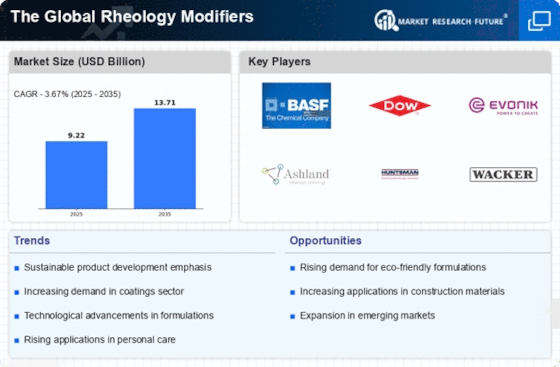
As per Market Research Future analysis, The Global Rheology Modifiers Market Size was estimated at 9.22 USD Billion in 2024. The Global Rheology Modifiers industry is projected to grow from 9.559 USD Billion in 2025 to 13.71 USD Billion by 2035, exhibiting a compound annual growth rate (CAGR) of 3.67% during the forecast period 2025 - 2035

Key Market Trends & Highlights

The Global Rheology Modifiers Market is poised for substantial growth driven by sustainability and innovation.

  • North America remains the largest market for rheology modifiers, reflecting robust demand across various industries. The Asia-Pacific region is currently the fastest-growing market, indicating a shift towards increased production capabilities. Organic rheology modifiers dominate the market, while inorganic modifiers are experiencing rapid growth due to technological advancements. Key market drivers include rising demand in the construction sector and an increasing focus on sustainable products.

Market Size & Forecast

2024 Market Size 9.22 (USD Billion)
2035 Market Size 13.71 (USD Billion)
CAGR (2025 - 2035) 3.67%
Largest Regional Market Share in 2024 Asia Pacific

Major Players

BASF SE (DE), Dow Inc. (US), Evonik Industries AG (DE), Ashland Global Holdings Inc. (US), Huntsman Corporation (US), Wacker Chemie AG (DE), Kraton Corporation (US), Solvay SA (BE), Clariant AG (CH)

Market Trends

The Global Rheology Modifiers Market is currently experiencing a dynamic evolution, driven by the increasing demand for enhanced product performance across various industries. These modifiers play a crucial role in adjusting the flow and viscosity of materials, which is essential in applications ranging from coatings to personal care products. As industries strive for improved efficiency and sustainability, the incorporation of advanced rheology modifiers appears to be a strategic approach to meet these objectives. Furthermore, the growing emphasis on eco-friendly formulations is likely to propel the development of bio-based rheology modifiers, aligning with global sustainability goals. In addition, the market landscape is characterized by continuous innovation and technological advancements. Manufacturers are increasingly focusing on research and development to create novel products that cater to specific customer needs. This trend suggests a shift towards customized solutions, where rheology modifiers are tailored to enhance the performance of end products. Moreover, the rise of e-commerce platforms is facilitating greater accessibility to these modifiers, enabling smaller businesses to leverage high-quality materials. Overall, The Global Rheology Modifiers Market is poised for substantial growth, driven by evolving consumer preferences and the need for high-performance materials.

Sustainability Focus

The emphasis on sustainable practices is reshaping The Global Rheology Modifiers Market. Companies are increasingly seeking eco-friendly alternatives, leading to a rise in bio-based rheology modifiers. This trend reflects a broader commitment to environmental responsibility and aligns with consumer preferences for greener products.

Customization and Innovation

There is a notable shift towards customization in The Global Rheology Modifiers Market. Manufacturers are investing in research and development to create tailored solutions that meet specific application requirements. This trend indicates a growing demand for innovative products that enhance performance across various sectors.

Digital Transformation

The rise of digital platforms is transforming the way rheology modifiers are marketed and distributed. E-commerce is providing greater access to these products, allowing smaller enterprises to compete effectively. This trend suggests a significant change in market dynamics, driven by technology and consumer behavior.

Rheology Modifiers Market Market Drivers

Expansion of End-Use Industries

The expansion of various end-use industries, including personal care, food and beverage, and pharmaceuticals, is driving the demand for rheology modifiers. These industries require rheology modifiers to enhance product texture, stability, and performance. The Global Rheology Modifiers Industry is benefiting from this diversification, as manufacturers adapt their offerings to cater to the specific needs of these sectors. In 2023, the personal care industry accounted for approximately 20% of the total market share, highlighting the importance of rheology modifiers in formulating creams, lotions, and other cosmetic products. This trend is expected to continue, as the demand for high-quality, performance-driven products in these industries grows, thereby supporting the overall expansion of the market.

Growth in Automotive Applications

The automotive industry is witnessing a significant transformation, with rheology modifiers playing a crucial role in enhancing the performance of various automotive products. These modifiers are utilized in coatings, sealants, and adhesives, contributing to improved durability and aesthetic appeal. The Global Rheology Modifiers Industry is poised to capitalize on this growth, as the automotive sector increasingly adopts advanced materials to meet stringent regulatory standards and consumer expectations. In 2023, automotive applications represented around 25% of the overall market share for rheology modifiers. This trend is expected to persist, driven by the rising demand for lightweight and high-performance vehicles, which necessitate the use of innovative materials that incorporate rheology modifiers.

Rising Demand in Construction Sector

The construction sector is experiencing a notable surge in demand for rheology modifiers, driven by the need for high-performance materials. These modifiers enhance the viscosity and stability of construction materials, such as paints, coatings, and adhesives. As infrastructure projects expand, The Global Rheology Modifiers Industry is likely to benefit from this trend. In 2023, the construction industry accounted for approximately 30% of the total demand for rheology modifiers, indicating a robust growth trajectory. This demand is expected to continue, as construction companies increasingly prioritize the use of advanced materials to improve durability and performance. Furthermore, the integration of rheology modifiers in construction applications is anticipated to enhance product quality, thereby fostering greater market penetration and expansion.

Increasing Focus on Sustainable Products

The growing emphasis on sustainability is reshaping The Global Rheology Modifiers Industry. Consumers and manufacturers alike are increasingly seeking eco-friendly alternatives that minimize environmental impact. Rheology modifiers derived from renewable resources are gaining traction, as they align with the global shift towards sustainable practices. In 2023, the market for bio-based rheology modifiers grew by approximately 15%, reflecting a broader trend towards sustainability in various industries. This shift is likely to encourage manufacturers to innovate and develop products that not only meet performance standards but also adhere to environmental regulations. As sustainability becomes a key purchasing criterion, the demand for eco-friendly rheology modifiers is expected to rise, further propelling market growth.

Technological Advancements in Manufacturing

Technological advancements in manufacturing processes are significantly influencing The Global Rheology Modifiers Industry. Innovations in production techniques, such as the development of new polymer blends and formulations, are enhancing the performance characteristics of rheology modifiers. These advancements enable manufacturers to create products that meet specific application requirements, thereby expanding their market reach. In recent years, the introduction of smart manufacturing technologies has streamlined production, resulting in increased efficiency and reduced costs. This trend is likely to continue, as companies invest in research and development to create more effective and sustainable rheology modifiers. The ability to customize products based on end-user needs is expected to drive further growth in the market.

Market Segment Insights

By Type: Organic (Largest) vs. Inorganic (Fastest-Growing)

In The Global Rheology Modifiers Market, the segment distribution reveals that organic rheology modifiers hold the largest share due to their versatility and effectiveness in a wide range of applications, including paints, coatings, and personal care products. Organic modifiers are preferred for their environmentally friendly properties and are increasingly chosen for sensitive formulations. In contrast, inorganic modifiers, while currently smaller in market share, are witnessing rapid adoption, driven by their unique performance characteristics in high-temperature applications and their cost-effectiveness. The growth trends in this segment are largely propelled by evolving consumer preferences for sustainable and eco-friendly products which favor organic modifiers. However, the surge in industrial applications requiring specialized performance profiles is making inorganic modifiers an emerging choice among manufacturers. As industries seek innovative solutions to enhance product efficiency and quality, both organic and inorganic modifiers are expected to exhibit growth, with inorganic outpacing organic in certain sectors due to technological advancements.

Organic (Dominant) vs. Inorganic (Emerging)

In The Global Rheology Modifiers Market, organic rheology modifiers are currently the dominant segment, characterized by their ability to improve the flow and stability of formulations. They are widely used in industries such as <a href="https://www.marketresearchfuture.com/reports/construction-market-16065">construction</a>, automotive, and personal care, thanks to their favorable properties like biodegradability and lower toxicity. On the other hand, inorganic rheology modifiers are recognized as an emerging segment, gaining traction due to their ability to perform well in extreme conditions, such as high temperatures and corrosive environments. The increasing demand for high-performance materials in sectors like <a href="https://www.marketresearchfuture.com/reports/oil-and-gas-market-68197" target="_blank" title="oil and gas">oil and gas</a> is driving innovation in inorganic modifiers, presenting new opportunities for market players. As these two segments evolve, their distinct advantages will influence their adoption rates across various applications.

By Applications: Paints & Coatings (Largest) vs. Cosmetics & Personal Care (Fastest-Growing)

The Global Rheology Modifiers Market is significantly driven by the applications in the <a href="https://www.marketresearchfuture.com/reports/paints-coatings-market-854">Paints &amp; Coatings</a> segment, which holds the largest market share among all applications. The demand for high-performance coatings due to their excellent durability and appearance properties is propelling the use of rheology modifiers in this sector. Following closely, the Cosmetics &amp; Personal Care segment is experiencing rapid growth fueled by the rising consumer preference for high-quality personal care products that require specific texture and consistency provided by rheology modifiers.

Paints &amp; Coatings (Dominant) vs. Cosmetics &amp; Personal Care (Emerging)

The Paints &amp; Coatings segment is recognized as a dominant force within The Global Rheology Modifiers Market, leveraging rheology modifiers to enhance product performance, stability, and application efficiency. This sector benefits from innovations in formulation technology and increased demand for sustainable and eco-friendly coatings, which require precise flow control. In contrast, the Cosmetics &amp; Personal Care segment presents an emerging opportunity, characterized by a surge in demand for cosmetic products that exhibit appealing sensory attributes. This growth is driven by consumer trends favoring natural ingredients and unique texture experiences, necessitating advanced rheology solutions for optimal formulation.

Get more detailed insights about Rheology Modifiers Market Research Report- Forecast till 2035

Regional Insights

By region, the study provides market insights into North America, Europe, Asia-Pacific and Rest of the World. The Asia Pacific rheology modifiers market will dominate this market, India and China are two of the world's top producers and consumers of dairy products. Due to changing taste preferences and rising income levels, consumers' daily dietary needs for dairy products are growing quickly. Manufacturers are making the most of this chance by creating various dairy products like curd, paneer, ice cream, milkshakes, and others that require significant food rheology modifiers during processing.

It demonstrates that a rise in demand for food rheology modifiers is anticipated in the coming years.

Further, the major countries studied in the market report are The US, Canada, German, France, the UK, Italy, Spain, China, Japan, India, Australia, South Korea, and Brazil.

Figure 2:  RHEOLOGY MODIFIERS MARKET SHARE BY REGION 2022 (USD Billion)

Europe’s rheology modifiers market accounts for the second-largest market share. In developing economies, population growth and economic change have led to an increase in housing transactions and disposable income, directly affecting the construction sector's market for paints, adhesives, and coatings. Further, the German rheology modifiers market held the largest market share, and the UK rheology modifiers market was the fastest-growing market in the European region.

The North American Rheology Modifiers Market is expected to grow at the fastest CAGR from 2023 to 2032. The region's growing infrastructure and population growth have improved the use of rheology modifiers in various applications. The accelerating economic growth was followed by a flurry of investments in various sectors like building, oil and gas, power production, and others. As the market for rheology modifiers expands, industry alliances are also anticipated to help. Moreover, China’s rheology modifiers market held the largest market share, and the Indian rheology modifiers market was the fastest-growing market in the North American region.

Key Players and Competitive Insights

Leading market players are investing heavily in research and development in order to expand their product lines, which will help the rheology modifiers market grow even more. Market participants are also undertaking various strategic activities to expand their  footprint, with important market developments including new product launches, contractual agreements, mergers and acquisitions, higher investments, and collaboration with other organizations. The rheology modifiers industry must offer cost-effective items to expand and survive in a more competitive and rising market climate.
Manufacturing locally to minimize operational costs is one of the key business tactics manufacturers use in the  rheology modifiers industry to benefit clients and increase the market sector. The rheology modifiers industry has offered some of the most significant advantages in recent years.
Major players in the rheology modifiers market, including BASF SE (Germany), Arkema S.A.(France), Clariant (Switzerland), The Dow Chemical Company (U.S.), Elementis plc (U.K.), Akzo Nobel N.V. (the Netherlands), The Lubrizol Corporation (U.S.), Croda International Plc (U.K.), Ashland (U.S), and Air Products and Chemicals, Inc (U.S.) and others, are attempting to increase market demand by investing in research and development operations.
German company BASF SE, At BASF, they believe that everyone has potential and that our people are the key to our long-term success. We achieve this by providing our workers with the tools, guidance, and opportunities they need to develop and flourish in both their professional and personal lives. We foster chemistry by providing you with the support needed to operate at your best and accomplish your objectives.
Ashland (US), International additives and specialty ingredients company Ashland (NYSE: ASH) is actively working to improve the world. It is focused on the consumer market. It serve clients in the pharmaceutical, personal care, architectural coatings, construction, energy, food, beverage, and nutraceutical industries through science and a conscientious and proactive mindset for sustainability. At Ashland are a team of about 3,900 passionate, persistent problem-solvers who get great satisfaction from creating workable, cutting-edge, and sophisticated solutions for clients in more than 100 nations. More than just abstract concepts, vision, mission, and way are real. They serve as foundational values.
At Ashland, all share a fundamental desire to find solutions to technical issues that produce ground-breaking capabilities and expand the realm of the possible. We are dedicated to one another, communities, safety, sustainability, and a host of other things. Here are a few examples of how it have lived the Ashland Way. Its agenda for growth is shaped by  megatrends. To meet the rising demands of customers for sustainable ingredients and help them achieve their environmental objectives, technology and ESG-enablement are driving forces. Using OECD guidelines, more than 80% of portfolio is natural, derived from nature, inherently biodegradable, or sustainable.
The success depends on achieving innovation goals, and it have a strong innovation culture and capability.

Key Companies in the Rheology Modifiers Market include

Industry Developments

March 2022: DuPont de Nemours Inc. (U. ACULYN Siltouch Rheology Modifier (S). Water viscosity and instant thickening are features of the product.

January 2022: By CP Kelco U.S., Inc. (U. S), a major international manufacturer and innovator of hydrocolloid solutions, has announced plans to invest in the production capabilities in U. S.

Future Outlook

Rheology Modifiers Market Future Outlook

The Global Rheology Modifiers Market is projected to grow at a 3.67% CAGR from 2025 to 2035, driven by increasing demand in coatings, adhesives, and personal care products.

New opportunities lie in:

  • Development of bio-based rheology modifiers for sustainable applications.
  • Expansion into emerging markets with tailored product offerings.
  • Investment in advanced manufacturing technologies to enhance product performance.

By 2035, the market is expected to achieve robust growth, reflecting evolving industry needs and innovations.

Market Segmentation

Rheology Modifiers Market Type Outlook

  • Organic
  • Inorganic

Rheology Modifiers Market Applications Outlook

  • Paints & Coatings
  • Cosmetics & Personal Care
  • Adhesives & Sealants
  • Construction
  • Inks
  • Pharmaceuticals
  • Oil & Gas

Report Scope

MARKET SIZE 2024 9.22(USD Billion)
MARKET SIZE 2025 9.559(USD Billion)
MARKET SIZE 2035 13.71(USD Billion)
COMPOUND ANNUAL GROWTH RATE (CAGR) 3.67% (2025 - 2035)
REPORT COVERAGE Revenue Forecast, Competitive Landscape, Growth Factors, and Trends
BASE YEAR 2024
Market Forecast Period 2025 - 2035
Historical Data 2019 - 2024
Market Forecast Units USD Billion
Key Companies Profiled BASF SE (DE), Dow Inc. (US), Evonik Industries AG (DE), Ashland Global Holdings Inc. (US), Huntsman Corporation (US), Wacker Chemie AG (DE), Kraton Corporation (US), Solvay SA (BE), Clariant AG (CH)
Segments Covered Type, Application, Region
Key Market Opportunities Growing demand for eco-friendly rheology modifiers in sustainable formulations presents a key opportunity.
Key Market Dynamics Rising demand for eco-friendly formulations drives innovation in rheology modifiers across various industries.
Countries Covered North America, Europe, APAC, South America, MEA

FAQs

What is the projected market valuation of The Global Rheology Modifiers by 2035?

<p>The projected market valuation for The Global Rheology Modifiers is expected to reach 13.71 USD Billion by 2035.</p>

What was the market valuation of The Global Rheology Modifiers in 2024?

<p>The overall market valuation of The Global Rheology Modifiers was 9.22 USD Billion in 2024.</p>

What is the expected CAGR for The Global Rheology Modifiers during the forecast period 2025 - 2035?

<p>The expected CAGR for The Global Rheology Modifiers during the forecast period 2025 - 2035 is 3.67%.</p>

Which companies are considered key players in The Global Rheology Modifiers?

<p>Key players in The Global Rheology Modifiers include BASF SE, Dow Inc., Evonik Industries AG, and Ashland Global Holdings Inc.</p>

What are the projected valuations for organic and inorganic rheology modifiers by 2035?

<p>By 2035, organic rheology modifiers are projected to reach 5.56 USD Billion, while inorganic modifiers are expected to reach 8.15 USD Billion.</p>

Which application segment is expected to show the highest growth in The Global Rheology Modifiers?

<p>The Paints & Coatings segment is anticipated to grow significantly, with a projected valuation of 4.12 USD Billion by 2035.</p>

What was the valuation of the Cosmetics & Personal Care segment in 2024?

In 2024, the Cosmetics &amp; Personal Care segment was valued at 1.84 USD Billion.

How does the projected growth of the Oil & Gas segment compare to other applications by 2035?

The Oil &amp; Gas segment is expected to reach 2.09 USD Billion by 2035, indicating robust growth compared to other applications.

What is the expected valuation for the Pharmaceuticals segment by 2035?

The Pharmaceuticals segment is projected to reach a valuation of 1.06 USD Billion by 2035.

How do the projected valuations of Adhesives & Sealants compare to Construction by 2035?

By 2035, Adhesives &amp; Sealants are expected to reach 2.01 USD Billion, surpassing the Construction segment, which is projected at 1.68 USD Billion.

  1. SECTION I: EXECUTIVE SUMMARY AND KEY HIGHLIGHTS
    1. | 1.1 EXECUTIVE SUMMARY
    2. | | 1.1.1 Market Overview
    3. | | 1.1.2 Key Findings
    4. | | 1.1.3 Market Segmentation
    5. | | 1.1.4 Competitive Landscape
    6. | | 1.1.5 Challenges and Opportunities
    7. | | 1.1.6 Future Outlook
  2. SECTION II: SCOPING, METHODOLOGY AND MARKET STRUCTURE
    1. | 2.1 MARKET INTRODUCTION
    2. | | 2.1.1 Definition
    3. | | 2.1.2 Scope of the study
    4. | | | 2.1.2.1 Research Objective
    5. | | | 2.1.2.2 Assumption
    6. | | | 2.1.2.3 Limitations
    7. | 2.2 RESEARCH METHODOLOGY
    8. | | 2.2.1 Overview
    9. | | 2.2.2 Data Mining
    10. | | 2.2.3 Secondary Research
    11. | | 2.2.4 Primary Research
    12. | | | 2.2.4.1 Primary Interviews and Information Gathering Process
    13. | | | 2.2.4.2 Breakdown of Primary Respondents
    14. | | 2.2.5 Forecasting Model
    15. | | 2.2.6 Market Size Estimation
    16. | | | 2.2.6.1 Bottom-Up Approach
    17. | | | 2.2.6.2 Top-Down Approach
    18. | | 2.2.7 Data Triangulation
    19. | | 2.2.8 Validation
  3. SECTION III: QUALITATIVE ANALYSIS
    1. | 3.1 MARKET DYNAMICS
    2. | | 3.1.1 Overview
    3. | | 3.1.2 Drivers
    4. | | 3.1.3 Restraints
    5. | | 3.1.4 Opportunities
    6. | 3.2 MARKET FACTOR ANALYSIS
    7. | | 3.2.1 Value chain Analysis
    8. | | 3.2.2 Porter's Five Forces Analysis
    9. | | | 3.2.2.1 Bargaining Power of Suppliers
    10. | | | 3.2.2.2 Bargaining Power of Buyers
    11. | | | 3.2.2.3 Threat of New Entrants
    12. | | | 3.2.2.4 Threat of Substitutes
    13. | | | 3.2.2.5 Intensity of Rivalry
    14. | | 3.2.3 COVID-19 Impact Analysis
    15. | | | 3.2.3.1 Market Impact Analysis
    16. | | | 3.2.3.2 Regional Impact
    17. | | | 3.2.3.3 Opportunity and Threat Analysis
  4. SECTION IV: QUANTITATIVE ANALYSIS
    1. | 4.1 Chemicals and Materials, BY Type (USD Billion)
    2. | | 4.1.1 Organic
    3. | | 4.1.2 Inorganic
    4. | 4.2 Chemicals and Materials, BY Applications (USD Billion)
    5. | | 4.2.1 Paints & Coatings
    6. | | 4.2.2 Cosmetics & Personal Care
    7. | | 4.2.3 Adhesives & Sealants
    8. | | 4.2.4 Construction
    9. | | 4.2.5 Inks
    10. | | 4.2.6 Pharmaceuticals
    11. | | 4.2.7 Oil & Gas
    12. | 4.3 Chemicals and Materials, BY Region (USD Billion)
    13. | | 4.3.1 North America
    14. | | | 4.3.1.1 US
    15. | | | 4.3.1.2 Canada
    16. | | 4.3.2 Europe
    17. | | | 4.3.2.1 Germany
    18. | | | 4.3.2.2 UK
    19. | | | 4.3.2.3 France
    20. | | | 4.3.2.4 Russia
    21. | | | 4.3.2.5 Italy
    22. | | | 4.3.2.6 Spain
    23. | | | 4.3.2.7 Rest of Europe
    24. | | 4.3.3 APAC
    25. | | | 4.3.3.1 China
    26. | | | 4.3.3.2 India
    27. | | | 4.3.3.3 Japan
    28. | | | 4.3.3.4 South Korea
    29. | | | 4.3.3.5 Malaysia
    30. | | | 4.3.3.6 Thailand
    31. | | | 4.3.3.7 Indonesia
    32. | | | 4.3.3.8 Rest of APAC
    33. | | 4.3.4 South America
    34. | | | 4.3.4.1 Brazil
    35. | | | 4.3.4.2 Mexico
    36. | | | 4.3.4.3 Argentina
    37. | | | 4.3.4.4 Rest of South America
    38. | | 4.3.5 MEA
    39. | | | 4.3.5.1 GCC Countries
    40. | | | 4.3.5.2 South Africa
    41. | | | 4.3.5.3 Rest of MEA
  5. SECTION V: COMPETITIVE ANALYSIS
    1. | 5.1 Competitive Landscape
    2. | | 5.1.1 Overview
    3. | | 5.1.2 Competitive Analysis
    4. | | 5.1.3 Market share Analysis
    5. | | 5.1.4 Major Growth Strategy in the Chemicals and Materials
    6. | | 5.1.5 Competitive Benchmarking
    7. | | 5.1.6 Leading Players in Terms of Number of Developments in the Chemicals and Materials
    8. | | 5.1.7 Key developments and growth strategies
    9. | | | 5.1.7.1 New Product Launch/Service Deployment
    10. | | | 5.1.7.2 Merger & Acquisitions
    11. | | | 5.1.7.3 Joint Ventures
    12. | | 5.1.8 Major Players Financial Matrix
    13. | | | 5.1.8.1 Sales and Operating Income
    14. | | | 5.1.8.2 Major Players R&D Expenditure. 2023
    15. | 5.2 Company Profiles
    16. | | 5.2.1 BASF SE (DE)
    17. | | | 5.2.1.1 Financial Overview
    18. | | | 5.2.1.2 Products Offered
    19. | | | 5.2.1.3 Key Developments
    20. | | | 5.2.1.4 SWOT Analysis
    21. | | | 5.2.1.5 Key Strategies
    22. | | 5.2.2 Dow Inc. (US)
    23. | | | 5.2.2.1 Financial Overview
    24. | | | 5.2.2.2 Products Offered
    25. | | | 5.2.2.3 Key Developments
    26. | | | 5.2.2.4 SWOT Analysis
    27. | | | 5.2.2.5 Key Strategies
    28. | | 5.2.3 Evonik Industries AG (DE)
    29. | | | 5.2.3.1 Financial Overview
    30. | | | 5.2.3.2 Products Offered
    31. | | | 5.2.3.3 Key Developments
    32. | | | 5.2.3.4 SWOT Analysis
    33. | | | 5.2.3.5 Key Strategies
    34. | | 5.2.4 Ashland Global Holdings Inc. (US)
    35. | | | 5.2.4.1 Financial Overview
    36. | | | 5.2.4.2 Products Offered
    37. | | | 5.2.4.3 Key Developments
    38. | | | 5.2.4.4 SWOT Analysis
    39. | | | 5.2.4.5 Key Strategies
    40. | | 5.2.5 Huntsman Corporation (US)
    41. | | | 5.2.5.1 Financial Overview
    42. | | | 5.2.5.2 Products Offered
    43. | | | 5.2.5.3 Key Developments
    44. | | | 5.2.5.4 SWOT Analysis
    45. | | | 5.2.5.5 Key Strategies
    46. | | 5.2.6 Wacker Chemie AG (DE)
    47. | | | 5.2.6.1 Financial Overview
    48. | | | 5.2.6.2 Products Offered
    49. | | | 5.2.6.3 Key Developments
    50. | | | 5.2.6.4 SWOT Analysis
    51. | | | 5.2.6.5 Key Strategies
    52. | | 5.2.7 Kraton Corporation (US)
    53. | | | 5.2.7.1 Financial Overview
    54. | | | 5.2.7.2 Products Offered
    55. | | | 5.2.7.3 Key Developments
    56. | | | 5.2.7.4 SWOT Analysis
    57. | | | 5.2.7.5 Key Strategies
    58. | | 5.2.8 Solvay SA (BE)
    59. | | | 5.2.8.1 Financial Overview
    60. | | | 5.2.8.2 Products Offered
    61. | | | 5.2.8.3 Key Developments
    62. | | | 5.2.8.4 SWOT Analysis
    63. | | | 5.2.8.5 Key Strategies
    64. | | 5.2.9 Clariant AG (CH)
    65. | | | 5.2.9.1 Financial Overview
    66. | | | 5.2.9.2 Products Offered
    67. | | | 5.2.9.3 Key Developments
    68. | | | 5.2.9.4 SWOT Analysis
    69. | | | 5.2.9.5 Key Strategies
    70. | 5.3 Appendix
    71. | | 5.3.1 References
    72. | | 5.3.2 Related Reports
  6. LIST OF FIGURES
    1. | 6.1 MARKET SYNOPSIS
    2. | 6.2 NORTH AMERICA MARKET ANALYSIS
    3. | 6.3 US MARKET ANALYSIS BY TYPE
    4. | 6.4 US MARKET ANALYSIS BY APPLICATIONS
    5. | 6.5 CANADA MARKET ANALYSIS BY TYPE
    6. | 6.6 CANADA MARKET ANALYSIS BY APPLICATIONS
    7. | 6.7 EUROPE MARKET ANALYSIS
    8. | 6.8 GERMANY MARKET ANALYSIS BY TYPE
    9. | 6.9 GERMANY MARKET ANALYSIS BY APPLICATIONS
    10. | 6.10 UK MARKET ANALYSIS BY TYPE
    11. | 6.11 UK MARKET ANALYSIS BY APPLICATIONS
    12. | 6.12 FRANCE MARKET ANALYSIS BY TYPE
    13. | 6.13 FRANCE MARKET ANALYSIS BY APPLICATIONS
    14. | 6.14 RUSSIA MARKET ANALYSIS BY TYPE
    15. | 6.15 RUSSIA MARKET ANALYSIS BY APPLICATIONS
    16. | 6.16 ITALY MARKET ANALYSIS BY TYPE
    17. | 6.17 ITALY MARKET ANALYSIS BY APPLICATIONS
    18. | 6.18 SPAIN MARKET ANALYSIS BY TYPE
    19. | 6.19 SPAIN MARKET ANALYSIS BY APPLICATIONS
    20. | 6.20 REST OF EUROPE MARKET ANALYSIS BY TYPE
    21. | 6.21 REST OF EUROPE MARKET ANALYSIS BY APPLICATIONS
    22. | 6.22 APAC MARKET ANALYSIS
    23. | 6.23 CHINA MARKET ANALYSIS BY TYPE
    24. | 6.24 CHINA MARKET ANALYSIS BY APPLICATIONS
    25. | 6.25 INDIA MARKET ANALYSIS BY TYPE
    26. | 6.26 INDIA MARKET ANALYSIS BY APPLICATIONS
    27. | 6.27 JAPAN MARKET ANALYSIS BY TYPE
    28. | 6.28 JAPAN MARKET ANALYSIS BY APPLICATIONS
    29. | 6.29 SOUTH KOREA MARKET ANALYSIS BY TYPE
    30. | 6.30 SOUTH KOREA MARKET ANALYSIS BY APPLICATIONS
    31. | 6.31 MALAYSIA MARKET ANALYSIS BY TYPE
    32. | 6.32 MALAYSIA MARKET ANALYSIS BY APPLICATIONS
    33. | 6.33 THAILAND MARKET ANALYSIS BY TYPE
    34. | 6.34 THAILAND MARKET ANALYSIS BY APPLICATIONS
    35. | 6.35 INDONESIA MARKET ANALYSIS BY TYPE
    36. | 6.36 INDONESIA MARKET ANALYSIS BY APPLICATIONS
    37. | 6.37 REST OF APAC MARKET ANALYSIS BY TYPE
    38. | 6.38 REST OF APAC MARKET ANALYSIS BY APPLICATIONS
    39. | 6.39 SOUTH AMERICA MARKET ANALYSIS
    40. | 6.40 BRAZIL MARKET ANALYSIS BY TYPE
    41. | 6.41 BRAZIL MARKET ANALYSIS BY APPLICATIONS
    42. | 6.42 MEXICO MARKET ANALYSIS BY TYPE
    43. | 6.43 MEXICO MARKET ANALYSIS BY APPLICATIONS
    44. | 6.44 ARGENTINA MARKET ANALYSIS BY TYPE
    45. | 6.45 ARGENTINA MARKET ANALYSIS BY APPLICATIONS
    46. | 6.46 REST OF SOUTH AMERICA MARKET ANALYSIS BY TYPE
    47. | 6.47 REST OF SOUTH AMERICA MARKET ANALYSIS BY APPLICATIONS
    48. | 6.48 MEA MARKET ANALYSIS
    49. | 6.49 GCC COUNTRIES MARKET ANALYSIS BY TYPE
    50. | 6.50 GCC COUNTRIES MARKET ANALYSIS BY APPLICATIONS
    51. | 6.51 SOUTH AFRICA MARKET ANALYSIS BY TYPE
    52. | 6.52 SOUTH AFRICA MARKET ANALYSIS BY APPLICATIONS
    53. | 6.53 REST OF MEA MARKET ANALYSIS BY TYPE
    54. | 6.54 REST OF MEA MARKET ANALYSIS BY APPLICATIONS
    55. | 6.55 KEY BUYING CRITERIA OF CHEMICALS AND MATERIALS
    56. | 6.56 RESEARCH PROCESS OF MRFR
    57. | 6.57 DRO ANALYSIS OF CHEMICALS AND MATERIALS
    58. | 6.58 DRIVERS IMPACT ANALYSIS: CHEMICALS AND MATERIALS
    59. | 6.59 RESTRAINTS IMPACT ANALYSIS: CHEMICALS AND MATERIALS
    60. | 6.60 SUPPLY / VALUE CHAIN: CHEMICALS AND MATERIALS
    61. | 6.61 CHEMICALS AND MATERIALS, BY TYPE, 2024 (% SHARE)
    62. | 6.62 CHEMICALS AND MATERIALS, BY TYPE, 2024 TO 2035 (USD Billion)
    63. | 6.63 CHEMICALS AND MATERIALS, BY APPLICATIONS, 2024 (% SHARE)
    64. | 6.64 CHEMICALS AND MATERIALS, BY APPLICATIONS, 2024 TO 2035 (USD Billion)
    65. | 6.65 BENCHMARKING OF MAJOR COMPETITORS
  7. LIST OF TABLES
    1. | 7.1 LIST OF ASSUMPTIONS
    2. | | 7.1.1
    3. | 7.2 North America MARKET SIZE ESTIMATES; FORECAST
    4. | | 7.2.1 BY TYPE, 2025-2035 (USD Billion)
    5. | | 7.2.2 BY APPLICATIONS, 2025-2035 (USD Billion)
    6. | 7.3 US MARKET SIZE ESTIMATES; FORECAST
    7. | | 7.3.1 BY TYPE, 2025-2035 (USD Billion)
    8. | | 7.3.2 BY APPLICATIONS, 2025-2035 (USD Billion)
    9. | 7.4 Canada MARKET SIZE ESTIMATES; FORECAST
    10. | | 7.4.1 BY TYPE, 2025-2035 (USD Billion)
    11. | | 7.4.2 BY APPLICATIONS, 2025-2035 (USD Billion)
    12. | 7.5 Europe MARKET SIZE ESTIMATES; FORECAST
    13. | | 7.5.1 BY TYPE, 2025-2035 (USD Billion)
    14. | | 7.5.2 BY APPLICATIONS, 2025-2035 (USD Billion)
    15. | 7.6 Germany MARKET SIZE ESTIMATES; FORECAST
    16. | | 7.6.1 BY TYPE, 2025-2035 (USD Billion)
    17. | | 7.6.2 BY APPLICATIONS, 2025-2035 (USD Billion)
    18. | 7.7 UK MARKET SIZE ESTIMATES; FORECAST
    19. | | 7.7.1 BY TYPE, 2025-2035 (USD Billion)
    20. | | 7.7.2 BY APPLICATIONS, 2025-2035 (USD Billion)
    21. | 7.8 France MARKET SIZE ESTIMATES; FORECAST
    22. | | 7.8.1 BY TYPE, 2025-2035 (USD Billion)
    23. | | 7.8.2 BY APPLICATIONS, 2025-2035 (USD Billion)
    24. | 7.9 Russia MARKET SIZE ESTIMATES; FORECAST
    25. | | 7.9.1 BY TYPE, 2025-2035 (USD Billion)
    26. | | 7.9.2 BY APPLICATIONS, 2025-2035 (USD Billion)
    27. | 7.10 Italy MARKET SIZE ESTIMATES; FORECAST
    28. | | 7.10.1 BY TYPE, 2025-2035 (USD Billion)
    29. | | 7.10.2 BY APPLICATIONS, 2025-2035 (USD Billion)
    30. | 7.11 Spain MARKET SIZE ESTIMATES; FORECAST
    31. | | 7.11.1 BY TYPE, 2025-2035 (USD Billion)
    32. | | 7.11.2 BY APPLICATIONS, 2025-2035 (USD Billion)
    33. | 7.12 Rest of Europe MARKET SIZE ESTIMATES; FORECAST
    34. | | 7.12.1 BY TYPE, 2025-2035 (USD Billion)
    35. | | 7.12.2 BY APPLICATIONS, 2025-2035 (USD Billion)
    36. | 7.13 APAC MARKET SIZE ESTIMATES; FORECAST
    37. | | 7.13.1 BY TYPE, 2025-2035 (USD Billion)
    38. | | 7.13.2 BY APPLICATIONS, 2025-2035 (USD Billion)
    39. | 7.14 China MARKET SIZE ESTIMATES; FORECAST
    40. | | 7.14.1 BY TYPE, 2025-2035 (USD Billion)
    41. | | 7.14.2 BY APPLICATIONS, 2025-2035 (USD Billion)
    42. | 7.15 India MARKET SIZE ESTIMATES; FORECAST
    43. | | 7.15.1 BY TYPE, 2025-2035 (USD Billion)
    44. | | 7.15.2 BY APPLICATIONS, 2025-2035 (USD Billion)
    45. | 7.16 Japan MARKET SIZE ESTIMATES; FORECAST
    46. | | 7.16.1 BY TYPE, 2025-2035 (USD Billion)
    47. | | 7.16.2 BY APPLICATIONS, 2025-2035 (USD Billion)
    48. | 7.17 South Korea MARKET SIZE ESTIMATES; FORECAST
    49. | | 7.17.1 BY TYPE, 2025-2035 (USD Billion)
    50. | | 7.17.2 BY APPLICATIONS, 2025-2035 (USD Billion)
    51. | 7.18 Malaysia MARKET SIZE ESTIMATES; FORECAST
    52. | | 7.18.1 BY TYPE, 2025-2035 (USD Billion)
    53. | | 7.18.2 BY APPLICATIONS, 2025-2035 (USD Billion)
    54. | 7.19 Thailand MARKET SIZE ESTIMATES; FORECAST
    55. | | 7.19.1 BY TYPE, 2025-2035 (USD Billion)
    56. | | 7.19.2 BY APPLICATIONS, 2025-2035 (USD Billion)
    57. | 7.20 Indonesia MARKET SIZE ESTIMATES; FORECAST
    58. | | 7.20.1 BY TYPE, 2025-2035 (USD Billion)
    59. | | 7.20.2 BY APPLICATIONS, 2025-2035 (USD Billion)
    60. | 7.21 Rest of APAC MARKET SIZE ESTIMATES; FORECAST
    61. | | 7.21.1 BY TYPE, 2025-2035 (USD Billion)
    62. | | 7.21.2 BY APPLICATIONS, 2025-2035 (USD Billion)
    63. | 7.22 South America MARKET SIZE ESTIMATES; FORECAST
    64. | | 7.22.1 BY TYPE, 2025-2035 (USD Billion)
    65. | | 7.22.2 BY APPLICATIONS, 2025-2035 (USD Billion)
    66. | 7.23 Brazil MARKET SIZE ESTIMATES; FORECAST
    67. | | 7.23.1 BY TYPE, 2025-2035 (USD Billion)
    68. | | 7.23.2 BY APPLICATIONS, 2025-2035 (USD Billion)
    69. | 7.24 Mexico MARKET SIZE ESTIMATES; FORECAST
    70. | | 7.24.1 BY TYPE, 2025-2035 (USD Billion)
    71. | | 7.24.2 BY APPLICATIONS, 2025-2035 (USD Billion)
    72. | 7.25 Argentina MARKET SIZE ESTIMATES; FORECAST
    73. | | 7.25.1 BY TYPE, 2025-2035 (USD Billion)
    74. | | 7.25.2 BY APPLICATIONS, 2025-2035 (USD Billion)
    75. | 7.26 Rest of South America MARKET SIZE ESTIMATES; FORECAST
    76. | | 7.26.1 BY TYPE, 2025-2035 (USD Billion)
    77. | | 7.26.2 BY APPLICATIONS, 2025-2035 (USD Billion)
    78. | 7.27 MEA MARKET SIZE ESTIMATES; FORECAST
    79. | | 7.27.1 BY TYPE, 2025-2035 (USD Billion)
    80. | | 7.27.2 BY APPLICATIONS, 2025-2035 (USD Billion)
    81. | 7.28 GCC Countries MARKET SIZE ESTIMATES; FORECAST
    82. | | 7.28.1 BY TYPE, 2025-2035 (USD Billion)
    83. | | 7.28.2 BY APPLICATIONS, 2025-2035 (USD Billion)
    84. | 7.29 South Africa MARKET SIZE ESTIMATES; FORECAST
    85. | | 7.29.1 BY TYPE, 2025-2035 (USD Billion)
    86. | | 7.29.2 BY APPLICATIONS, 2025-2035 (USD Billion)
    87. | 7.30 Rest of MEA MARKET SIZE ESTIMATES; FORECAST
    88. | | 7.30.1 BY TYPE, 2025-2035 (USD Billion)
    89. | | 7.30.2 BY APPLICATIONS, 2025-2035 (USD Billion)
    90. | 7.31 PRODUCT LAUNCH/PRODUCT DEVELOPMENT/APPROVAL
    91. | | 7.31.1
    92. | 7.32 ACQUISITION/PARTNERSHIP
    93. | | 7.32.1

Chemicals and Materials Market Segmentation

Chemicals and Materials By Type (USD Billion, 2025-2035)

  • Organic
  • Inorganic

Chemicals and Materials By Applications (USD Billion, 2025-2035)

  • Paints & Coatings
  • Cosmetics & Personal Care
  • Adhesives & Sealants
  • Construction
  • Inks
  • Pharmaceuticals
  • Oil & Gas
Infographic

Free Sample Request

Kindly complete the form below to receive a free sample of this Report

Get Free Sample

Customer Strories

Compare Licence

×
Features License Type
Single User Multiuser License Enterprise User
Price $4,950 $5,950 $7,250
Maximum User Access Limit 1 User Upto 10 Users Unrestricted Access Throughout the Organization
Free Customization
Direct Access to Analyst
Deliverable Format
Platform Access
Discount on Next Purchase 10% 15% 15%
Printable Versions