
Request Free Sample ×

Kindly complete the form below to receive a free sample of this Report

* Please use a valid business email

Leading companies partner with us for data-driven Insights

clients tt-cursor
Hero Background
English
Chinese
French
Japanese
Korean
German
Spanish

RFID Tags Market Share

ID: MRFR/SEM/1476-CR
200 Pages
Ankit Gupta
April 2022

RFID Tags Market Size, Share and Research Report: By Application (Retail, Logistics and Supply Chain, Healthcare, Automotive, Industrial Manufacturing), By Type (Passive RFID Tags, Active RFID Tags, Semi-Passive RFID Tags), By Frequency (Low Frequency, High Frequency, Ultra High Frequency), By Material (Plastic, Paper, Metal, Silicone), By End Use (Consumer Goods, Pharmaceuticals, Automotive Components, Food and Beverage) and By Regional (North America, Europe, South America, Asia Pacific, Middle East and Africa) - Industry Forecast Till 2035

Share:
Download PDF ×

We do not share your information with anyone. However, we may send you emails based on your report interest from time to time. You may contact us at any time to opt-out.

RFID Tags Market Infographic
Purchase Options

Market Share

Introduction: Navigating the Competitive Landscape of RFID Tags

The market for RFID tags is going through a period of tremendous change, due to the fast development of the technology, the emergence of a new regulatory framework, and the increased expectations of consumers for transparency and efficiency. Competition is fierce, with many players, including original equipment manufacturers, system integrators and technology suppliers, competing to be the first to exploit new developments in the area of artificial intelligence and the Internet of Things. These innovations will not only improve operational efficiency but also enable real-time data analysis. And they will separate the leaders from the followers. The market is being shaken up by agile start-ups that are focusing on biometrics and green IT. These start-ups are able to respond quickly to new developments, and are already deploying their solutions in Asia-Pacific and North America, which are expected to be the fastest-growing markets. The strategic deployment of solutions is increasingly being driven by a focus on automation and energy efficiency. The ability to understand the competition and the technological drivers will be crucial for C-level managers and strategic planners seeking to exploit the opportunities in the market for RFID tags.

Competitive Positioning

Full-Suite Integrators

These vendors offer comprehensive RFID solutions, integrating hardware, software, and services for end-to-end deployment.

Vendor Competitive Edge Solution Focus Regional Focus
Avery Dennison Strong brand recognition and innovation RFID tags and inlays Global
Honeywell Robust supply chain solutions RFID hardware and software North America, Europe
Zebra Technologies Comprehensive data capture solutions RFID printers and readers Global

Specialized Technology Vendors

These vendors focus on specific RFID technologies or applications, providing niche solutions tailored to particular industries.

Vendor Competitive Edge Solution Focus Regional Focus
Impinj Leading in RAIN RFID technology RFID readers and software Global
Alien Technology Innovative tag designs and performance RFID tags and inlays Global
Confidex Durable tags for harsh environments Specialized RFID tags Global

Infrastructure & Equipment Providers

These vendors supply the necessary infrastructure and equipment to support RFID systems, including readers and antennas.

Vendor Competitive Edge Solution Focus Regional Focus
NXP Semiconductors Advanced semiconductor technology RFID chips and readers Global
STMicroelectronics Strong focus on IoT integration RFID chips and solutions Global
TagMaster Specialization in vehicle identification RFID readers and tags Europe, North America
Cimtec Custom solutions for industrial applications RFID systems and integration North America
Hexagon AB Focus on geospatial solutions RFID for asset tracking Global
RFID Global Solution Expertise in RFID consulting RFID implementation services North America
Smartrac Innovative inlays and tags RFID inlays and tags Global
Dai Nippon Printing Diverse printing capabilities RFID labels and tags Asia, Global

Emerging Players & Regional Champions

  • Avery Dennison (US): This company specializes in the production of RFID inlays and labels for the retail and supply chain industries. It has teamed up with major retailers to offer inventory management solutions and complements the leading vendors by offering cost-effective and inventive solutions.
  • Impinj (USA): Focuses on RAIN RFID solutions, recently secured contracts with logistics companies to enhance tracking capabilities, challenging established players by providing advanced data analytics and integration with IoT.
  • SML Group (Hong Kong): Offers a wide range of RFID tags and labels, recently implemented solutions for a large fashion retailer, complements established vendors by providing customizable and scalable solutions tailored to specific industry needs.
  • Confidex (Finland): Known for high-performance RFID tags for industrial applications, recently expanded its offerings to include smart city solutions, challenging traditional vendors by entering new markets with innovative technology.
  • Zebra Technologies (USA): Provides RFID solutions for healthcare and retail, recently launched a new line of RFID printers, complements established vendors by enhancing the user experience with integrated solutions.

Regional Trends: In 2024, the RFID tags market is expected to grow significantly in North America and Asia-Pacific, driven by the increased adoption in the retail, logistics, and health care industries. The use of new technology such as RAIN RFID and NFC will help companies improve their inventory management and tracking capabilities. And the integration of RFID with the Internet of Things and big data analysis will help companies to gain insights into real-time data and improve their operations.

Collaborations & M&A Movements

  • Zebra Technologies and Avery Dennison entered a partnership to develop advanced RFID solutions aimed at enhancing inventory management for retail businesses, thereby strengthening their competitive positioning in the retail sector.
  • Impinj acquired the RFID technology division of NXP Semiconductors in early 2024 to expand its product offerings and increase market share in the IoT space, positioning itself as a leader in RFID solutions.
  • Alien Technology and Smartrac collaborated to create a new line of eco-friendly RFID tags, responding to increasing regulatory pressures for sustainable practices in the packaging industry.

Competitive Summary Table

Capability Leading Players Remarks
Biometric Self-Boarding Zebra Technologies, Impinj The combination of biometrics and RFID enables boarding to be performed more quickly and securely. Impinj’s products enable rapid integration with existing biometric systems.
AI-Powered Ops Mgmt Avery Dennison, Alien Technology Artificial intelligence is used by Avery Dennison to optimize the supply chain and reduce waste in retail. Artificial intelligence provides a real-time insight into the supply chain and improves the decisions made in the supply chain.
Border Control Savi Technology, Nedap The Savi RFID solutions provide real-time monitoring of the movement of people and goods at airports. This is where the efficiency of the border control systems of Nedap can be increased by combining RFID with a comprehensive screening of people and goods.
Sustainability Smartrac, Confidex Smartrac has focused on the use of eco-friendly RFID tags made of recycled materials, thereby promoting the principle of sustainable supply chains. Confidex has developed tags that are less harmful to the environment without compromising performance, thus demonstrating its commitment to green technology.
Passenger Experience RFID Journal, Tageos RFID Journal presents a number of examples where RFID has improved the passenger experience, with faster check-ins and baggage tracking. Tageos offers a number of RFID solutions to enhance customer engagement and improve efficiency in the retail and travel industries.

Conclusion: Navigating the RFID Tags Competitive Landscape

In the years approaching 2024, the RFID tags market is characterized by intense competition and notable fragmentation, with both established and new companies vying for market share. Regionally, the trend is towards a growing use of RFID tags in Asia-Pacific and North America, driven by improvements in supply chain management and the need to track inventories. The strategic challenge for vendors is to establish a position for themselves in terms of the AI, automation, and flexibility of their solutions. New companies are focusing on innovation in the form of new, flexible, and sustainable solutions, while the established players are focusing on enhancing their existing solutions with new technological features. The ability to combine these features will be the key to success in this developing market, as decision-makers seek to find a supplier who can not only optimize efficiency but also provide long-term value.


Author
Author Profile
Ankit Gupta
Team Lead - Research

Ankit Gupta is a seasoned market intelligence and strategic research professional with over six plus years of experience in the ICT and Semiconductor industries. With academic roots in Telecom, Marketing, and Electronics, he blends technical insight with business strategy. Ankit has led 200+ projects, including work for Fortune 500 clients like Microsoft and Rio Tinto, covering market sizing, tech forecasting, and go-to-market strategies. Known for bridging engineering and enterprise decision-making, his insights support growth, innovation, and investment planning across diverse technology markets.

Leave a Comment

FAQs

What is the projected market valuation of the RFID Tags Market by 2035?

<p>The RFID Tags Market is projected to reach a valuation of 14243.53 USD Billion by 2035.</p>

What was the overall market valuation of the RFID Tags Market in 2024?

<p>In 2024, the overall market valuation of the RFID Tags Market was 4907.19 USD Billion.</p>

What is the expected CAGR for the RFID Tags Market during the forecast period 2025 - 2035?

<p>The expected CAGR for the RFID Tags Market during the forecast period 2025 - 2035 is 10.17%.</p>

Which application segment is projected to have the highest valuation by 2035?

<p>By 2035, the Logistics application segment is projected to reach a valuation of 3600.0 USD Billion.</p>

What are the key players in the RFID Tags Market?

<p>Key players in the RFID Tags Market include Zebra Technologies, Impinj, Avery Dennison, and NXP Semiconductors.</p>

How does the valuation of the Inventory Management segment change from 2024 to 2035?

<p>The Inventory Management segment's valuation is expected to increase from 1200.0 USD Billion in 2024 to 3500.0 USD Billion by 2035.</p>

What is the projected valuation for Passive RFID Tags by 2035?

<p>Passive RFID Tags are projected to reach a valuation of 7356.76 USD Billion by 2035.</p>

Which form factor of RFID Tags is expected to dominate the market by 2035?

<p>The Tag RFID Tags form factor is expected to dominate the market, reaching a valuation of 10243.53 USD Billion by 2035.</p>

What is the projected growth for the Healthcare application segment by 2035?

<p>The Healthcare application segment is projected to grow to a valuation of 1800.0 USD Billion by 2035.</p>

What is the expected valuation for Asset Tracking by 2035?

<p>The Asset Tracking segment is expected to reach a valuation of 2300.0 USD Billion by 2035.</p>

Market Summary

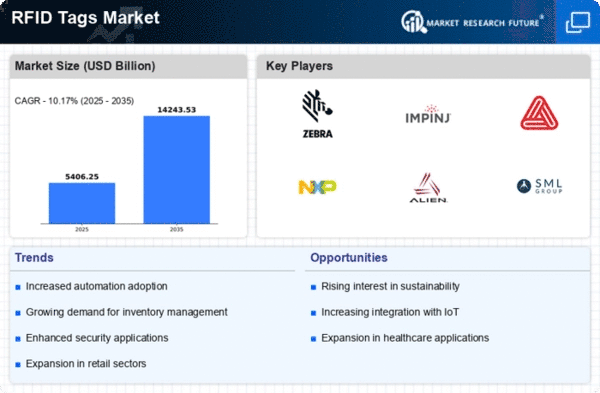
As per MRFR analysis, the RFID Tags Market Size was estimated at 4907.19 USD Billion in 2024. The RFID Tags industry is projected to grow from 5406.35 USD Billion in 2025 to 14243.53 USD Billion by 2035, exhibiting a compound annual growth rate (CAGR) of 10.17% during the forecast period 2025 - 2035.

Key Market Trends & Highlights

The RFID Tags Market is experiencing robust growth driven by technological advancements and increasing applications across various sectors.

  • The retail sector remains the largest market for RFID tags, showcasing a notable increase in adoption for inventory management. Healthcare applications are expanding rapidly, indicating a significant growth trajectory in the use of RFID technology for patient tracking and asset management. North America continues to dominate the RFID tags market, while the Asia-Pacific region emerges as the fastest-growing area, reflecting diverse regional demands. Enhanced supply chain efficiency and rising demand in asset tracking are key drivers propelling the growth of the RFID tags market.

Market Size & Forecast

2024 Market Size 4907.19 (USD Billion)
2035 Market Size 14243.53 (USD Billion)
CAGR (2025 - 2035) 10.17%
Largest Regional Market Share in 2024 North America

Major Players

Zebra Technologies (US), Impinj (US), Avery Dennison (US), NXP Semiconductors (NL), Alien Technology (US), SML Group (HK), RFID Global Solution (US), Mojix (US), TagMaster (SE)

Market Trends

The RFID Tags Market is currently experiencing a dynamic evolution, driven by advancements in technology and increasing adoption across various sectors. Industries such as retail, healthcare, and logistics are integrating RFID solutions to enhance operational efficiency and improve inventory management. This integration appears to be fostering a more streamlined approach to tracking assets and managing supply chains, which could lead to significant cost savings and improved customer satisfaction. The RFID tags market is experiencing steady growth, driven by increasing adoption of automated identification and tracking solutions across retail, logistics, and manufacturing industries. Furthermore, the growing emphasis on automation and data analytics is likely to propel the demand for RFID tags, as organizations seek to leverage real-time data for informed decision-making. Growth in the RFID tag market is supported by rising demand for inventory visibility, supply chain optimization, and asset tracking applications.

In addition to technological advancements, regulatory frameworks and standards are evolving to support the widespread implementation of RFID systems. This regulatory landscape may encourage businesses to invest in RFID technology, as compliance becomes increasingly critical. Moreover, the rise of the Internet of Things (IoT) is expected to further enhance the capabilities of RFID tags, enabling seamless connectivity and data exchange between devices. Expansion of the RFID tags market size is influenced by declining tag costs, technological advancements, and wider adoption across end-use sectors. As the RFID Tags Market continues to mature, it is poised to play a pivotal role in shaping the future of various industries, offering innovative solutions that address contemporary challenges and drive growth.

Increased Adoption in Retail

The retail sector is witnessing a notable surge in the utilization of RFID tags, primarily for inventory management and loss prevention. Retailers are increasingly recognizing the benefits of real-time tracking, which enhances stock visibility and reduces shrinkage. This trend suggests a shift towards more efficient supply chain practices, as businesses aim to optimize their operations. The vehicle RFID tag market is gaining traction due to increasing deployment in electronic toll collection, access control, and fleet management systems.

Expansion in Healthcare Applications

Healthcare organizations are increasingly utilizing RFID tags for asset tracking and patient management. This trend suggests a heightened focus on improving operational efficiency and ensuring patient safety, as RFID technology facilitates real-time monitoring of medical equipment and supplies.

Integration with IoT Solutions

The convergence of RFID technology with Internet of Things (IoT) solutions is emerging as a significant trend. This integration appears to enhance data collection and analysis capabilities, enabling businesses to make informed decisions and optimize their operations.

RFID Tags Market Market Drivers

Market Growth Projections

The Global RFID Tags Market Industry is poised for substantial growth, with projections indicating a market size of 13.1 USD Billion in 2024 and an anticipated increase to 28.5 USD Billion by 2035. This growth trajectory reflects a compound annual growth rate (CAGR) of 7.32% from 2025 to 2035. The expansion of RFID applications across various sectors, including retail, healthcare, and logistics, is likely to drive this growth. As industries continue to recognize the benefits of RFID technology in improving efficiency and accuracy, the market is expected to flourish, presenting numerous opportunities for stakeholders.

Regulatory Compliance and Standards

The Global RFID Tags Market Industry is influenced by the increasing emphasis on regulatory compliance and standards across various sectors. Governments and regulatory bodies are mandating the use of RFID technology for tracking and monitoring purposes, particularly in industries such as healthcare and transportation. For instance, regulations requiring the tracking of pharmaceuticals from production to distribution are driving the adoption of RFID tags. This compliance not only enhances safety and accountability but also propels market growth. As organizations strive to meet these regulatory requirements, the demand for RFID solutions is likely to escalate, further solidifying the industry's position.

Increasing Adoption of IoT Technologies

The Global RFID Tags Market Industry is experiencing a surge in demand due to the increasing adoption of Internet of Things (IoT) technologies. As industries integrate IoT solutions, RFID tags play a crucial role in enhancing connectivity and data collection. For instance, in supply chain management, RFID tags facilitate real-time tracking of goods, thereby improving operational efficiency. This trend is expected to contribute to the market's growth, with projections indicating a market size of 13.1 USD Billion in 2024. The integration of RFID with IoT systems is likely to drive innovation and create new applications across various sectors.

Technological Advancements in RFID Solutions

The Global RFID Tags Market Industry is propelled by continuous technological advancements in RFID solutions. Innovations such as the development of passive and active RFID tags, along with improvements in read range and data storage capacity, are enhancing the functionality of RFID systems. These advancements enable more versatile applications across various sectors, including logistics, healthcare, and retail. For instance, the introduction of RFID tags with improved battery life and miniaturization is expanding their usability in diverse environments. As technology evolves, the market is expected to witness sustained growth, aligning with the projected figures for the coming years.

Growing Demand for Inventory Management Solutions

The Global RFID Tags Market Industry is significantly influenced by the growing demand for efficient inventory management solutions. Retailers and manufacturers are increasingly utilizing RFID technology to streamline their inventory processes, reduce losses, and enhance customer satisfaction. For example, companies employing RFID systems have reported inventory accuracy rates exceeding 95%. This heightened efficiency not only reduces operational costs but also supports the projected market growth, with estimates suggesting a rise to 28.5 USD Billion by 2035. The ability of RFID tags to provide real-time data on stock levels is likely to be a key driver in this sector.

Enhanced Security and Anti-Counterfeiting Measures

The Global RFID Tags Market Industry is also driven by the need for enhanced security and anti-counterfeiting measures. Industries such as pharmaceuticals and luxury goods are increasingly adopting RFID technology to combat counterfeiting and ensure product authenticity. RFID tags can store unique identifiers that help verify the legitimacy of products throughout the supply chain. This trend is particularly relevant in sectors where brand integrity is paramount. As businesses recognize the value of RFID in safeguarding their products, the market is expected to grow at a CAGR of 7.32% from 2025 to 2035, indicating a robust future for RFID solutions.

Market Segment Insights

By Application: Retail (Largest) vs. Logistics (Fastest-Growing)

<p>In the RFID Tags Market, the application segment is dominated by retail, where the tags are extensively used for inventory management, theft prevention, and customer engagement. Retail accounts for a significant share of the overall market, reflecting the critical role that RFID technology plays in enhancing operational efficiencies and improving customer experiences. Conversely, logistics is rapidly gaining traction and is recognized as the fastest-growing sector, as companies increasingly adopt RFID tags for tracking and managing supply chains effectively. The growth trends in the RFID tags application segment are primarily driven by the demand for automation and enhanced visibility in supply chain operations. Retailers are leveraging this technology to streamline inventory processes, while logistics companies are investing in RFID solutions to improve shipment accuracy and reduce costs. The healthcare sector is also emerging, utilizing RFID for patient and asset tracking, indicating a broadening application spectrum where businesses across various industries recognize the value of adopting RFID technologies for operational improvements.</p>

<p>Retail (Dominant) vs. Logistics (Emerging)</p>

<p>In the context of the RFID Tags Market, retail stands out as the dominant application, characterized by its robust integration into inventory management and customer-facing processes. Retailers utilize RFID tags to achieve real-time visibility into stock levels, optimize product placement, and enhance the shopping experience through personalized marketing strategies. On the other hand, logistics, identified as an emerging segment, is transitioning rapidly as more companies seek to harness RFID technology to ensure efficient tracking of goods throughout the supply chain. This application focuses on improving accuracy in inventory counts, reducing loss through better tracking, and boosting overall operational efficiency. Both segments illustrate the multifaceted benefits of RFID technology, driving innovation and improving operational efficiencies across industries.</p>

By End Use: Asset Tracking (Largest) vs. Inventory Management (Fastest-Growing)

<p>In the RFID Tags Market, Asset Tracking holds the largest market share among the end use segments, reflecting its established applications in various industries such as healthcare, manufacturing, and logistics. Meanwhile, Inventory Management is showing robust growth, increasingly adopted by retailers and warehouses to streamline operations and reduce losses. This shift indicates the sector's reliance on precise data for optimizing stock levels and enhancing supply chain efficiency.</p>

<p>Asset Tracking (Dominant) vs. Supply Chain Management (Emerging)</p>

<p>Asset Tracking stands as the dominant segment in the RFID Tags Market, primarily favored by businesses looking to enhance visibility and control over physical assets. It encompasses a wide range of applications, from equipment tracking to monitoring biological samples in laboratories. On the other hand, Supply Chain Management, while emerging, is gaining traction as companies look to leverage RFID technology to improve transparency, reduce bottlenecks, and facilitate real-time data exchange across their logistics networks. The shift towards smarter supply chain solutions positions this segment as a key player in optimizing overall operational efficiency.</p>

By Technology: Active RFID Tags (Largest) vs. Passive RFID Tags (Fastest-Growing)

<p>The RFID Tags Market is primarily segmented into Active, Passive, Semi-Passive, Ultra-High Frequency, and High Frequency RFID Tags. Currently, Active RFID Tags hold the largest market share, due to their superior data transmission capabilities and longer range, making them ideal for real-time tracking of valuable assets. Passive RFID Tags, on the other hand, are rapidly gaining traction in various industries, driven by their lower cost and widespread adoption in supply chain management and retail environments. Growth trends indicate that the demand for Passive RFID Tags is accelerating, attributed to their increasing use in inventory management and logistics applications. Additionally, technological advancements in RFID technology, like enhanced read ranges and miniaturization, are propelling the market forward. Active RFID Tags continue to benefit from industries requiring precise tracking solutions, while Passive RFID Tags are expected to expand their footprint due to rising awareness and operational efficiencies they offer.</p>

<p>Active RFID Tags (Dominant) vs. Passive RFID Tags (Emerging)</p>

<p>Active RFID Tags are characterized by their battery-powered transmitters, enabling higher data transmission rates and longer communication ranges, making them suitable for tracking high-value assets such as vehicles and equipment over large areas. Their dominant market position is reinforced by their reliability in environments where precision tracking is crucial. Conversely, Passive RFID Tags, which derive power from the reader's signal, represent an emerging trend, particularly in supply chains and retail. Their cost-effectiveness and ability to minimize operational expenses are appealing to businesses striving for efficiency. While Active tags are preferred for real-time tracking, Passive tags are increasingly adopted for inventory tracking and asset management, showcasing a growing preference for diverse RFID solutions across different market segments.</p>

By Form Factor: Label RFID Tags (Largest) vs. Card RFID Tags (Fastest-Growing)

<p>The RFID Tags Market shows varied distribution among its form factors. Label RFID Tags hold the largest market share, favored for their versatility and ease of integration across numerous industries. They are widely adopted in retail, logistics, and healthcare sectors. In contrast, Card RFID Tags, while not as dominant overall, are experiencing the fastest growth, largely driven by the rising demand for identification and access control solutions. As businesses increasingly seek efficient and secure solutions, the growth in Card RFID Tags can be attributed to innovations in design and functionality. Their adoption is spurred by the push towards contactless interactions and enhanced security measures in various applications. Consequently, industries are leveraging these advanced tags to improve user convenience and operational efficiency, solidifying their place in the market.</p>

<p>Label RFID Tags (Dominant) vs. Wristband RFID Tags (Emerging)</p>

<p>Label RFID Tags are recognized as the dominant form factor in the RFID Tags Market, providing a reliable and cost-effective solution for a variety of uses, including inventory management and asset tracking. Their thin and customizable nature makes them suitable for labeling a wide range of products. In contrast, Wristband RFID Tags are emerging as a significant player due to their unique application in events, healthcare, and security sectors. These wristbands offer a hands-free approach to access control and attendee tracking, appealing particularly to event organizers and hospitals. With their growing acceptance and functionality, both segments contribute distinctly to the overall market landscape.</p>

By Frequency: Ultra High Frequency (Largest) vs. High Frequency (Fastest-Growing)

The RFID tags market exhibits a diverse distribution across various frequency segments, with Ultra High Frequency (UHF) tags commanding the largest share due to their extensive range and high read rates. They are predominantly used in applications like supply chain management and retail. On the other hand, High Frequency (HF) tags, although smaller in terms of market share, are rapidly gaining traction in sectors like healthcare and access control, making them a significant player in the industry. Growth trends in the RFID tags market are largely driven by the increasing adoption of automation and digitalization across industries. UHF tags continue to benefit from technological advancements, enhancing their performance and reliability. Meanwhile, the HF segment is seeing growth fueled by the demand for secure transactions and efficient data management, particularly with the rise of contactless payment systems and smart technologies.

High Frequency (Dominant) vs. Microwave Frequency (Emerging)

High Frequency (HF) RFID tags have established themselves as a dominant force within the RFID tags market, thanks to their versatility and effectiveness in various applications such as access control and inventory management. Operating at a frequency of 13.56 MHz, HF tags are recognized for their short reading range, which lends itself well to secure data transmission. In contrast, Microwave Frequency tags, though still emerging, are positioned to serve niche markets that require high-speed data processing and communication. These tags operate at frequencies above 2.45 GHz and are being explored for applications in high-speed rail systems and potentially for faster data transfer in IoT devices, highlighting their innovative potential as they come into more widespread use.

Get more detailed insights about RFID Tags Market Research Report—Global Forecast till 2035

Regional Insights

North America : Market Leader in RFID Technology

North America continues to lead the RFID tags market, holding a significant share of 2450.0 million in 2024. The region's growth is driven by increasing adoption across various sectors, including retail, healthcare, and logistics. Regulatory support and technological advancements further fuel demand, as businesses seek efficient inventory management and tracking solutions. The push for automation and smart technologies is also a key catalyst for market expansion. The competitive landscape in North America is robust, featuring key players such as Zebra Technologies, Impinj, and Avery Dennison. These companies are at the forefront of innovation, offering advanced RFID solutions tailored to diverse industry needs. The U.S. remains the largest market, with Canada and Mexico also contributing to regional growth. The presence of established firms and a strong focus on R&D ensure that North America maintains its leadership position in the RFID tags market.

Europe : Emerging RFID Adoption Hub

Europe is witnessing a significant rise in the RFID tags market, with a market size of 1300.0 million in 2024. The growth is fueled by increasing demand for automation and efficiency in supply chains, particularly in retail and manufacturing sectors. The Europe RFID tags market continues to expand as regulatory support, retail digitization, and logistics automation drive adoption. Regulatory initiatives aimed at enhancing traceability and security are also driving adoption. The region's commitment to sustainability and smart technology integration further supports market expansion. Leading countries in Europe include Germany, the UK, and France, where key players like NXP Semiconductors and Avery Dennison are actively innovating. The competitive landscape is characterized by a mix of established firms and emerging startups, fostering a dynamic environment for RFID solutions. As European businesses increasingly recognize the benefits of RFID technology, the market is expected to continue its upward trajectory.

Asia-Pacific : Rapid Growth in Emerging Markets

The Asia-Pacific RFID tags market is estimated at 950.0 million, reflecting rapid growth driven by increasing industrial automation and the rise of e-commerce. Countries like China, Japan, and India are leading the charge, with significant investments in RFID technology to enhance logistics and inventory management. Government initiatives promoting smart manufacturing and digital transformation are also key growth drivers in the region. China stands out as the largest market, with a burgeoning demand for RFID solutions across various sectors, including retail and healthcare. The competitive landscape features both local and international players, such as SML Group and Alien Technology, who are innovating to meet the diverse needs of the market. As the region continues to embrace digital technologies, the RFID tags market is poised for substantial growth, supported by favorable economic conditions and regulatory frameworks.

Middle East and Africa : Emerging Frontier for RFID Solutions

The Middle East and Africa RFID tags market is valued at 207.19 million, with significant growth potential driven by increasing awareness of RFID technology's benefits. The region is witnessing a gradual shift towards automation in sectors like retail, logistics, and healthcare. Government initiatives aimed at enhancing supply chain efficiency and security are also contributing to market growth, as businesses seek to adopt innovative solutions. Leading countries in the region include the UAE and South Africa, where key players like RFID Global Solution and Mojix are establishing a presence. The competitive landscape is evolving, with both local and international firms vying for market share. As the region continues to invest in technology and infrastructure, the RFID tags market is expected to expand, supported by a growing emphasis on digital transformation and regulatory compliance.

Key Players and Competitive Insights

The RFID Tags Market is currently characterized by a dynamic competitive landscape, driven by technological advancements and increasing demand across various sectors such as retail, logistics, and healthcare. Key players like Zebra Technologies (US), Impinj (US), and Avery Dennison (US) are strategically positioned to leverage innovation and partnerships to enhance their market presence. Zebra Technologies (US) focuses on integrating advanced analytics and IoT capabilities into its RFID solutions, thereby enhancing operational efficiency for its clients. Meanwhile, Impinj (US) emphasizes its commitment to expanding its product portfolio through continuous innovation, which appears to be a critical factor in maintaining its competitive edge. Avery Dennison (US) is also actively pursuing strategic partnerships to bolster its RFID offerings, indicating a trend towards collaborative innovation in the market. The business tactics employed by these companies reflect a concerted effort to optimize supply chains and localize manufacturing processes. The RFID Tags Market is moderately fragmented, with several players vying for market share. However, the collective influence of major companies like Zebra Technologies (US) and Impinj (US) suggests a trend towards consolidation, as these firms seek to enhance their operational capabilities and market reach. Growth in the paper RFID hang tag market is supported by increasing use in apparel retail for item-level tracking and improved inventory management. In November 2025, Zebra Technologies (US) announced a strategic partnership with a leading logistics firm to enhance supply chain visibility through RFID technology. This collaboration is poised to streamline operations and improve inventory management, showcasing Zebra's commitment to innovation and customer-centric solutions. The strategic importance of this partnership lies in its potential to set new benchmarks for efficiency in logistics, thereby reinforcing Zebra's market position. In October 2025, Impinj (US) launched a new line of RFID tags designed specifically for the healthcare sector, aimed at improving patient tracking and asset management. This move not only diversifies Impinj's product offerings but also addresses a critical need in the healthcare industry, where accurate tracking can significantly impact patient outcomes. The introduction of these specialized tags indicates Impinj's strategic focus on niche markets, which may enhance its competitive advantage. In September 2025, Avery Dennison (US) unveiled a sustainability initiative aimed at reducing the environmental impact of its RFID products. This initiative includes the development of biodegradable RFID tags, which aligns with the growing consumer demand for sustainable solutions. The strategic importance of this move is multifaceted; it not only positions Avery Dennison as a leader in sustainability but also caters to a market increasingly focused on eco-friendly practices. As of December 2025, current trends in the RFID Tags Market are heavily influenced by digitalization, sustainability, and the integration of AI technologies. Strategic alliances among key players are shaping the competitive landscape, fostering innovation and enhancing product offerings. The shift from price-based competition to a focus on technological advancement and supply chain reliability is evident. Moving forward, companies that prioritize innovation and sustainability are likely to differentiate themselves in an increasingly competitive environment.

Key Companies in the RFID Tags Market include

Industry Developments

  • Q2 2024: Impinj Announces New RAIN RFID Tag Chip Family to Enable Item Intelligence at Scale Impinj launched a new family of RAIN RFID tag chips designed to deliver enhanced performance and reliability for item-level tracking in retail, supply chain, and logistics applications. The new chips aim to support large-scale deployments and improve inventory accuracy.
  • Q2 2024: Avery Dennison Opens New RFID Manufacturing Facility in Brazil Avery Dennison inaugurated a new RFID inlay manufacturing facility in Vinhedo, Brazil, expanding its production capacity to meet growing demand for RFID tags in Latin America. The facility is expected to support local supply chains and reduce lead times.
  • Q1 2024: SML Group Launches EcoInspire™ RFID Tag Made from Recycled Materials SML Group introduced EcoInspire™, a new line of RFID tags manufactured using recycled materials, targeting retailers and brands seeking sustainable supply chain solutions. The product launch aligns with increasing environmental regulations and customer demand for eco-friendly options.
  • Q2 2024: Identiv Acquires Xtreme RFID to Expand Industrial RFID Tag Portfolio Identiv completed the acquisition of Xtreme RFID, a manufacturer specializing in rugged RFID tags for industrial and outdoor applications. The deal is expected to strengthen Identiv’s position in the industrial IoT and asset tracking markets.
  • Q1 2024: Confidex and NXP Semiconductors Announce Partnership to Develop Next-Generation RFID Tags Market Confidex and NXP Semiconductors entered a strategic partnership to co-develop advanced RFID tags with enhanced security and sensing capabilities, targeting automotive, logistics, and healthcare sectors.
  • Q3 2024: Zebra Technologies Launches New Line of RFID Tags Market for Healthcare Asset Tracking Zebra Technologies introduced a new series of RFID tags specifically designed for tracking medical equipment and supplies in hospitals, aiming to improve patient safety and operational efficiency.
  • Q2 2024: Alien Technology Appoints New CEO to Drive RFID Business Expansion Alien Technology announced the appointment of a new Chief Executive Officer, signaling a renewed focus on innovation and global expansion in the RFID tag market.
  • Q1 2024: Smartrac Receives Certification for New RFID Tag for Food Safety Applications Smartrac obtained regulatory certification for its latest RFID tag designed for direct contact with food products, enabling improved traceability and safety in the food supply chain.
  • Q2 2024: HID Global Launches Ultra-High Frequency RFID Tag for Automotive Parts Tracking HID Global released a new ultra-high frequency RFID tag engineered for tracking automotive components throughout the manufacturing and supply chain process, supporting greater transparency and efficiency.
  • Q3 2024: Checkpoint Systems Wins Major RFID Tagging Contract with European Retailer Checkpoint Systems secured a significant contract to supply RFID tags and solutions to a leading European retail chain, supporting large-scale inventory management and loss prevention initiatives.
  • Q2 2024: Invengo Announces Strategic Investment to Expand RFID Tag Production Capacity Invengo announced a multi-million dollar investment to expand its RFID tag manufacturing facilities, aiming to meet rising global demand and shorten delivery times for key customers.
  • Q1 2024: Trace-ID Launches New RFID Tag for Pharmaceutical Supply Chain Compliance Trace-ID introduced a new RFID tag designed to help pharmaceutical companies comply with serialization and traceability regulations, enhancing drug safety and supply chain visibility.

Future Outlook

RFID Tags Market Future Outlook

The RFID Tags Market is projected to grow at a 10.17% CAGR from 2025 to 2035, driven by advancements in IoT, supply chain optimization, and increased demand for automation.

New opportunities lie in:

  • <p>Integration of RFID with blockchain for enhanced supply chain transparency. Development of RFID-enabled smart packaging solutions for retail. Expansion of RFID applications in healthcare asset tracking systems.</p>

By 2035, the RFID Tags Market is expected to be robust, driven by innovative applications and technological advancements.

Market Segmentation

RFID Tags Market End Use Outlook

  • Inventory Management
  • Asset Tracking
  • Supply Chain Management
  • Access Control
  • Product Authentication

RFID Tags Market Frequency Outlook

  • Low Frequency
  • High Frequency
  • Ultra High Frequency
  • Microwave Frequency
  • Near Field Communication

RFID Tags Market Technology Outlook

  • Active RFID Tags
  • Passive RFID Tags
  • Semi-Passive RFID Tags
  • Ultra-High Frequency RFID Tags
  • High Frequency RFID Tags

RFID Tags Market Application Outlook

  • Retail
  • Logistics
  • Healthcare
  • Manufacturing
  • Transportation

RFID Tags Market Form Factor Outlook

  • Label
  • Card
  • Key Fob
  • Tag
  • Wristband

Report Scope

MARKET SIZE 2024 4907.19(USD Billion)
MARKET SIZE 2025 5406.35(USD Billion)
MARKET SIZE 2035 14243.53(USD Billion)
COMPOUND ANNUAL GROWTH RATE (CAGR) 10.17% (2025 - 2035)
REPORT COVERAGE Revenue Forecast, Competitive Landscape, Growth Factors, and Trends
BASE YEAR 2024
Market Forecast Period 2025 - 2035
Historical Data 2019 - 2024
Market Forecast Units USD Billion
Key Companies Profiled Zebra Technologies (US), Impinj (US), Avery Dennison (US), NXP Semiconductors (NL), Alien Technology (US), SML Group (HK), RFID Global Solution (US), Mojix (US), TagMaster (SE)
Segments Covered Application, End Use, Technology, Form Factor, Frequency
Key Market Opportunities Integration of RFID technology in supply chain management enhances efficiency and traceability.
Key Market Dynamics Rising demand for automation drives innovation and competition in the RFID tags market across various industries.
Countries Covered North America, Europe, APAC, South America, MEA

FAQs

What is the projected market valuation of the RFID Tags Market by 2035?

<p>The RFID Tags Market is projected to reach a valuation of 14243.53 USD Billion by 2035.</p>

What was the overall market valuation of the RFID Tags Market in 2024?

<p>In 2024, the overall market valuation of the RFID Tags Market was 4907.19 USD Billion.</p>

What is the expected CAGR for the RFID Tags Market during the forecast period 2025 - 2035?

<p>The expected CAGR for the RFID Tags Market during the forecast period 2025 - 2035 is 10.17%.</p>

Which application segment is projected to have the highest valuation by 2035?

<p>By 2035, the Logistics application segment is projected to reach a valuation of 3600.0 USD Billion.</p>

What are the key players in the RFID Tags Market?

<p>Key players in the RFID Tags Market include Zebra Technologies, Impinj, Avery Dennison, and NXP Semiconductors.</p>

How does the valuation of the Inventory Management segment change from 2024 to 2035?

<p>The Inventory Management segment's valuation is expected to increase from 1200.0 USD Billion in 2024 to 3500.0 USD Billion by 2035.</p>

What is the projected valuation for Passive RFID Tags by 2035?

<p>Passive RFID Tags are projected to reach a valuation of 7356.76 USD Billion by 2035.</p>

Which form factor of RFID Tags is expected to dominate the market by 2035?

<p>The Tag RFID Tags form factor is expected to dominate the market, reaching a valuation of 10243.53 USD Billion by 2035.</p>

What is the projected growth for the Healthcare application segment by 2035?

<p>The Healthcare application segment is projected to grow to a valuation of 1800.0 USD Billion by 2035.</p>

What is the expected valuation for Asset Tracking by 2035?

<p>The Asset Tracking segment is expected to reach a valuation of 2300.0 USD Billion by 2035.</p>

  1. SECTION I: EXECUTIVE SUMMARY AND KEY HIGHLIGHTS
    1. | 1.1 EXECUTIVE SUMMARY
    2. | | 1.1.1 Market Overview
    3. | | 1.1.2 Key Findings
    4. | | 1.1.3 Market Segmentation
    5. | | 1.1.4 Competitive Landscape
    6. | | 1.1.5 Challenges and Opportunities
    7. | | 1.1.6 Future Outlook
  2. SECTION II: SCOPING, METHODOLOGY AND MARKET STRUCTURE
    1. | 2.1 MARKET INTRODUCTION
    2. | | 2.1.1 Definition
    3. | | 2.1.2 Scope of the study
    4. | | | 2.1.2.1 Research Objective
    5. | | | 2.1.2.2 Assumption
    6. | | | 2.1.2.3 Limitations
    7. | 2.2 RESEARCH METHODOLOGY
    8. | | 2.2.1 Overview
    9. | | 2.2.2 Data Mining
    10. | | 2.2.3 Secondary Research
    11. | | 2.2.4 Primary Research
    12. | | | 2.2.4.1 Primary Interviews and Information Gathering Process
    13. | | | 2.2.4.2 Breakdown of Primary Respondents
    14. | | 2.2.5 Forecasting Model
    15. | | 2.2.6 Market Size Estimation
    16. | | | 2.2.6.1 Bottom-Up Approach
    17. | | | 2.2.6.2 Top-Down Approach
    18. | | 2.2.7 Data Triangulation
    19. | | 2.2.8 Validation
  3. SECTION III: QUALITATIVE ANALYSIS
    1. | 3.1 MARKET DYNAMICS
    2. | | 3.1.1 Overview
    3. | | 3.1.2 Drivers
    4. | | 3.1.3 Restraints
    5. | | 3.1.4 Opportunities
    6. | 3.2 MARKET FACTOR ANALYSIS
    7. | | 3.2.1 Value chain Analysis
    8. | | 3.2.2 Porter's Five Forces Analysis
    9. | | | 3.2.2.1 Bargaining Power of Suppliers
    10. | | | 3.2.2.2 Bargaining Power of Buyers
    11. | | | 3.2.2.3 Threat of New Entrants
    12. | | | 3.2.2.4 Threat of Substitutes
    13. | | | 3.2.2.5 Intensity of Rivalry
    14. | | 3.2.3 COVID-19 Impact Analysis
    15. | | | 3.2.3.1 Market Impact Analysis
    16. | | | 3.2.3.2 Regional Impact
    17. | | | 3.2.3.3 Opportunity and Threat Analysis
  4. SECTION IV: QUANTITATIVE ANALYSIS
    1. | 4.1 Semiconductor & Electronics, BY Application (USD Billion)
    2. | | 4.1.1 Retail
    3. | | 4.1.2 Logistics
    4. | | 4.1.3 Healthcare
    5. | | 4.1.4 Manufacturing
    6. | | 4.1.5 Transportation
    7. | 4.2 Semiconductor & Electronics, BY End Use (USD Billion)
    8. | | 4.2.1 Asset Tracking
    9. | | 4.2.2 Inventory Management
    10. | | 4.2.3 Access Control
    11. | | 4.2.4 Supply Chain Management
    12. | | 4.2.5 Product Authentication
    13. | 4.3 Semiconductor & Electronics, BY Technology (USD Billion)
    14. | | 4.3.1 Active RFID Tags
    15. | | 4.3.2 Passive RFID Tags
    16. | | 4.3.3 Semi-Passive RFID Tags
    17. | | 4.3.4 Ultra-High Frequency RFID Tags
    18. | | 4.3.5 High Frequency RFID Tags
    19. | 4.4 Semiconductor & Electronics, BY Form Factor (USD Billion)
    20. | | 4.4.1 Label RFID Tags
    21. | | 4.4.2 Card RFID Tags
    22. | | 4.4.3 Key Fob RFID Tags
    23. | | 4.4.4 Wristband RFID Tags
    24. | | 4.4.5 Tag RFID Tags
    25. | 4.5 Semiconductor & Electronics, BY Region (USD Billion)
    26. | | 4.5.1 North America
    27. | | | 4.5.1.1 US
    28. | | | 4.5.1.2 Canada
    29. | | 4.5.2 Europe
    30. | | | 4.5.2.1 Germany
    31. | | | 4.5.2.2 UK
    32. | | | 4.5.2.3 France
    33. | | | 4.5.2.4 Russia
    34. | | | 4.5.2.5 Italy
    35. | | | 4.5.2.6 Spain
    36. | | | 4.5.2.7 Rest of Europe
    37. | | 4.5.3 APAC
    38. | | | 4.5.3.1 China
    39. | | | 4.5.3.2 India
    40. | | | 4.5.3.3 Japan
    41. | | | 4.5.3.4 South Korea
    42. | | | 4.5.3.5 Malaysia
    43. | | | 4.5.3.6 Thailand
    44. | | | 4.5.3.7 Indonesia
    45. | | | 4.5.3.8 Rest of APAC
    46. | | 4.5.4 South America
    47. | | | 4.5.4.1 Brazil
    48. | | | 4.5.4.2 Mexico
    49. | | | 4.5.4.3 Argentina
    50. | | | 4.5.4.4 Rest of South America
    51. | | 4.5.5 MEA
    52. | | | 4.5.5.1 GCC Countries
    53. | | | 4.5.5.2 South Africa
    54. | | | 4.5.5.3 Rest of MEA
  5. SECTION V: COMPETITIVE ANALYSIS
    1. | 5.1 Competitive Landscape
    2. | | 5.1.1 Overview
    3. | | 5.1.2 Competitive Analysis
    4. | | 5.1.3 Market share Analysis
    5. | | 5.1.4 Major Growth Strategy in the Semiconductor & Electronics
    6. | | 5.1.5 Competitive Benchmarking
    7. | | 5.1.6 Leading Players in Terms of Number of Developments in the Semiconductor & Electronics
    8. | | 5.1.7 Key developments and growth strategies
    9. | | | 5.1.7.1 New Product Launch/Service Deployment
    10. | | | 5.1.7.2 Merger & Acquisitions
    11. | | | 5.1.7.3 Joint Ventures
    12. | | 5.1.8 Major Players Financial Matrix
    13. | | | 5.1.8.1 Sales and Operating Income
    14. | | | 5.1.8.2 Major Players R&D Expenditure. 2023
    15. | 5.2 Company Profiles
    16. | | 5.2.1 Zebra Technologies (US)
    17. | | | 5.2.1.1 Financial Overview
    18. | | | 5.2.1.2 Products Offered
    19. | | | 5.2.1.3 Key Developments
    20. | | | 5.2.1.4 SWOT Analysis
    21. | | | 5.2.1.5 Key Strategies
    22. | | 5.2.2 Impinj (US)
    23. | | | 5.2.2.1 Financial Overview
    24. | | | 5.2.2.2 Products Offered
    25. | | | 5.2.2.3 Key Developments
    26. | | | 5.2.2.4 SWOT Analysis
    27. | | | 5.2.2.5 Key Strategies
    28. | | 5.2.3 Avery Dennison (US)
    29. | | | 5.2.3.1 Financial Overview
    30. | | | 5.2.3.2 Products Offered
    31. | | | 5.2.3.3 Key Developments
    32. | | | 5.2.3.4 SWOT Analysis
    33. | | | 5.2.3.5 Key Strategies
    34. | | 5.2.4 NXP Semiconductors (NL)
    35. | | | 5.2.4.1 Financial Overview
    36. | | | 5.2.4.2 Products Offered
    37. | | | 5.2.4.3 Key Developments
    38. | | | 5.2.4.4 SWOT Analysis
    39. | | | 5.2.4.5 Key Strategies
    40. | | 5.2.5 Alien Technology (US)
    41. | | | 5.2.5.1 Financial Overview
    42. | | | 5.2.5.2 Products Offered
    43. | | | 5.2.5.3 Key Developments
    44. | | | 5.2.5.4 SWOT Analysis
    45. | | | 5.2.5.5 Key Strategies
    46. | | 5.2.6 SML Group (HK)
    47. | | | 5.2.6.1 Financial Overview
    48. | | | 5.2.6.2 Products Offered
    49. | | | 5.2.6.3 Key Developments
    50. | | | 5.2.6.4 SWOT Analysis
    51. | | | 5.2.6.5 Key Strategies
    52. | | 5.2.7 RFID Global Solution (US)
    53. | | | 5.2.7.1 Financial Overview
    54. | | | 5.2.7.2 Products Offered
    55. | | | 5.2.7.3 Key Developments
    56. | | | 5.2.7.4 SWOT Analysis
    57. | | | 5.2.7.5 Key Strategies
    58. | | 5.2.8 Mojix (US)
    59. | | | 5.2.8.1 Financial Overview
    60. | | | 5.2.8.2 Products Offered
    61. | | | 5.2.8.3 Key Developments
    62. | | | 5.2.8.4 SWOT Analysis
    63. | | | 5.2.8.5 Key Strategies
    64. | | 5.2.9 TagMaster (SE)
    65. | | | 5.2.9.1 Financial Overview
    66. | | | 5.2.9.2 Products Offered
    67. | | | 5.2.9.3 Key Developments
    68. | | | 5.2.9.4 SWOT Analysis
    69. | | | 5.2.9.5 Key Strategies
    70. | 5.3 Appendix
    71. | | 5.3.1 References
    72. | | 5.3.2 Related Reports
  6. LIST OF FIGURES
    1. | 6.1 MARKET SYNOPSIS
    2. | 6.2 NORTH AMERICA MARKET ANALYSIS
    3. | 6.3 US MARKET ANALYSIS BY APPLICATION
    4. | 6.4 US MARKET ANALYSIS BY END USE
    5. | 6.5 US MARKET ANALYSIS BY TECHNOLOGY
    6. | 6.6 US MARKET ANALYSIS BY FORM FACTOR
    7. | 6.7 CANADA MARKET ANALYSIS BY APPLICATION
    8. | 6.8 CANADA MARKET ANALYSIS BY END USE
    9. | 6.9 CANADA MARKET ANALYSIS BY TECHNOLOGY
    10. | 6.10 CANADA MARKET ANALYSIS BY FORM FACTOR
    11. | 6.11 EUROPE MARKET ANALYSIS
    12. | 6.12 GERMANY MARKET ANALYSIS BY APPLICATION
    13. | 6.13 GERMANY MARKET ANALYSIS BY END USE
    14. | 6.14 GERMANY MARKET ANALYSIS BY TECHNOLOGY
    15. | 6.15 GERMANY MARKET ANALYSIS BY FORM FACTOR
    16. | 6.16 UK MARKET ANALYSIS BY APPLICATION
    17. | 6.17 UK MARKET ANALYSIS BY END USE
    18. | 6.18 UK MARKET ANALYSIS BY TECHNOLOGY
    19. | 6.19 UK MARKET ANALYSIS BY FORM FACTOR
    20. | 6.20 FRANCE MARKET ANALYSIS BY APPLICATION
    21. | 6.21 FRANCE MARKET ANALYSIS BY END USE
    22. | 6.22 FRANCE MARKET ANALYSIS BY TECHNOLOGY
    23. | 6.23 FRANCE MARKET ANALYSIS BY FORM FACTOR
    24. | 6.24 RUSSIA MARKET ANALYSIS BY APPLICATION
    25. | 6.25 RUSSIA MARKET ANALYSIS BY END USE
    26. | 6.26 RUSSIA MARKET ANALYSIS BY TECHNOLOGY
    27. | 6.27 RUSSIA MARKET ANALYSIS BY FORM FACTOR
    28. | 6.28 ITALY MARKET ANALYSIS BY APPLICATION
    29. | 6.29 ITALY MARKET ANALYSIS BY END USE
    30. | 6.30 ITALY MARKET ANALYSIS BY TECHNOLOGY
    31. | 6.31 ITALY MARKET ANALYSIS BY FORM FACTOR
    32. | 6.32 SPAIN MARKET ANALYSIS BY APPLICATION
    33. | 6.33 SPAIN MARKET ANALYSIS BY END USE
    34. | 6.34 SPAIN MARKET ANALYSIS BY TECHNOLOGY
    35. | 6.35 SPAIN MARKET ANALYSIS BY FORM FACTOR
    36. | 6.36 REST OF EUROPE MARKET ANALYSIS BY APPLICATION
    37. | 6.37 REST OF EUROPE MARKET ANALYSIS BY END USE
    38. | 6.38 REST OF EUROPE MARKET ANALYSIS BY TECHNOLOGY
    39. | 6.39 REST OF EUROPE MARKET ANALYSIS BY FORM FACTOR
    40. | 6.40 APAC MARKET ANALYSIS
    41. | 6.41 CHINA MARKET ANALYSIS BY APPLICATION
    42. | 6.42 CHINA MARKET ANALYSIS BY END USE
    43. | 6.43 CHINA MARKET ANALYSIS BY TECHNOLOGY
    44. | 6.44 CHINA MARKET ANALYSIS BY FORM FACTOR
    45. | 6.45 INDIA MARKET ANALYSIS BY APPLICATION
    46. | 6.46 INDIA MARKET ANALYSIS BY END USE
    47. | 6.47 INDIA MARKET ANALYSIS BY TECHNOLOGY
    48. | 6.48 INDIA MARKET ANALYSIS BY FORM FACTOR
    49. | 6.49 JAPAN MARKET ANALYSIS BY APPLICATION
    50. | 6.50 JAPAN MARKET ANALYSIS BY END USE
    51. | 6.51 JAPAN MARKET ANALYSIS BY TECHNOLOGY
    52. | 6.52 JAPAN MARKET ANALYSIS BY FORM FACTOR
    53. | 6.53 SOUTH KOREA MARKET ANALYSIS BY APPLICATION
    54. | 6.54 SOUTH KOREA MARKET ANALYSIS BY END USE
    55. | 6.55 SOUTH KOREA MARKET ANALYSIS BY TECHNOLOGY
    56. | 6.56 SOUTH KOREA MARKET ANALYSIS BY FORM FACTOR
    57. | 6.57 MALAYSIA MARKET ANALYSIS BY APPLICATION
    58. | 6.58 MALAYSIA MARKET ANALYSIS BY END USE
    59. | 6.59 MALAYSIA MARKET ANALYSIS BY TECHNOLOGY
    60. | 6.60 MALAYSIA MARKET ANALYSIS BY FORM FACTOR
    61. | 6.61 THAILAND MARKET ANALYSIS BY APPLICATION
    62. | 6.62 THAILAND MARKET ANALYSIS BY END USE
    63. | 6.63 THAILAND MARKET ANALYSIS BY TECHNOLOGY
    64. | 6.64 THAILAND MARKET ANALYSIS BY FORM FACTOR
    65. | 6.65 INDONESIA MARKET ANALYSIS BY APPLICATION
    66. | 6.66 INDONESIA MARKET ANALYSIS BY END USE
    67. | 6.67 INDONESIA MARKET ANALYSIS BY TECHNOLOGY
    68. | 6.68 INDONESIA MARKET ANALYSIS BY FORM FACTOR
    69. | 6.69 REST OF APAC MARKET ANALYSIS BY APPLICATION
    70. | 6.70 REST OF APAC MARKET ANALYSIS BY END USE
    71. | 6.71 REST OF APAC MARKET ANALYSIS BY TECHNOLOGY
    72. | 6.72 REST OF APAC MARKET ANALYSIS BY FORM FACTOR
    73. | 6.73 SOUTH AMERICA MARKET ANALYSIS
    74. | 6.74 BRAZIL MARKET ANALYSIS BY APPLICATION
    75. | 6.75 BRAZIL MARKET ANALYSIS BY END USE
    76. | 6.76 BRAZIL MARKET ANALYSIS BY TECHNOLOGY
    77. | 6.77 BRAZIL MARKET ANALYSIS BY FORM FACTOR
    78. | 6.78 MEXICO MARKET ANALYSIS BY APPLICATION
    79. | 6.79 MEXICO MARKET ANALYSIS BY END USE
    80. | 6.80 MEXICO MARKET ANALYSIS BY TECHNOLOGY
    81. | 6.81 MEXICO MARKET ANALYSIS BY FORM FACTOR
    82. | 6.82 ARGENTINA MARKET ANALYSIS BY APPLICATION
    83. | 6.83 ARGENTINA MARKET ANALYSIS BY END USE
    84. | 6.84 ARGENTINA MARKET ANALYSIS BY TECHNOLOGY
    85. | 6.85 ARGENTINA MARKET ANALYSIS BY FORM FACTOR
    86. | 6.86 REST OF SOUTH AMERICA MARKET ANALYSIS BY APPLICATION
    87. | 6.87 REST OF SOUTH AMERICA MARKET ANALYSIS BY END USE
    88. | 6.88 REST OF SOUTH AMERICA MARKET ANALYSIS BY TECHNOLOGY
    89. | 6.89 REST OF SOUTH AMERICA MARKET ANALYSIS BY FORM FACTOR
    90. | 6.90 MEA MARKET ANALYSIS
    91. | 6.91 GCC COUNTRIES MARKET ANALYSIS BY APPLICATION
    92. | 6.92 GCC COUNTRIES MARKET ANALYSIS BY END USE
    93. | 6.93 GCC COUNTRIES MARKET ANALYSIS BY TECHNOLOGY
    94. | 6.94 GCC COUNTRIES MARKET ANALYSIS BY FORM FACTOR
    95. | 6.95 SOUTH AFRICA MARKET ANALYSIS BY APPLICATION
    96. | 6.96 SOUTH AFRICA MARKET ANALYSIS BY END USE
    97. | 6.97 SOUTH AFRICA MARKET ANALYSIS BY TECHNOLOGY
    98. | 6.98 SOUTH AFRICA MARKET ANALYSIS BY FORM FACTOR
    99. | 6.99 REST OF MEA MARKET ANALYSIS BY APPLICATION
    100. | 6.100 REST OF MEA MARKET ANALYSIS BY END USE
    101. | 6.101 REST OF MEA MARKET ANALYSIS BY TECHNOLOGY
    102. | 6.102 REST OF MEA MARKET ANALYSIS BY FORM FACTOR
    103. | 6.103 KEY BUYING CRITERIA OF SEMICONDUCTOR & ELECTRONICS
    104. | 6.104 RESEARCH PROCESS OF MRFR
    105. | 6.105 DRO ANALYSIS OF SEMICONDUCTOR & ELECTRONICS
    106. | 6.106 DRIVERS IMPACT ANALYSIS: SEMICONDUCTOR & ELECTRONICS
    107. | 6.107 RESTRAINTS IMPACT ANALYSIS: SEMICONDUCTOR & ELECTRONICS
    108. | 6.108 SUPPLY / VALUE CHAIN: SEMICONDUCTOR & ELECTRONICS
    109. | 6.109 SEMICONDUCTOR & ELECTRONICS, BY APPLICATION, 2024 (% SHARE)
    110. | 6.110 SEMICONDUCTOR & ELECTRONICS, BY APPLICATION, 2024 TO 2035 (USD Billion)
    111. | 6.111 SEMICONDUCTOR & ELECTRONICS, BY END USE, 2024 (% SHARE)
    112. | 6.112 SEMICONDUCTOR & ELECTRONICS, BY END USE, 2024 TO 2035 (USD Billion)
    113. | 6.113 SEMICONDUCTOR & ELECTRONICS, BY TECHNOLOGY, 2024 (% SHARE)
    114. | 6.114 SEMICONDUCTOR & ELECTRONICS, BY TECHNOLOGY, 2024 TO 2035 (USD Billion)
    115. | 6.115 SEMICONDUCTOR & ELECTRONICS, BY FORM FACTOR, 2024 (% SHARE)
    116. | 6.116 SEMICONDUCTOR & ELECTRONICS, BY FORM FACTOR, 2024 TO 2035 (USD Billion)
    117. | 6.117 BENCHMARKING OF MAJOR COMPETITORS
  7. LIST OF TABLES
    1. | 7.1 LIST OF ASSUMPTIONS
    2. | | 7.1.1
    3. | 7.2 North America MARKET SIZE ESTIMATES; FORECAST
    4. | | 7.2.1 BY APPLICATION, 2025-2035 (USD Billion)
    5. | | 7.2.2 BY END USE, 2025-2035 (USD Billion)
    6. | | 7.2.3 BY TECHNOLOGY, 2025-2035 (USD Billion)
    7. | | 7.2.4 BY FORM FACTOR, 2025-2035 (USD Billion)
    8. | 7.3 US MARKET SIZE ESTIMATES; FORECAST
    9. | | 7.3.1 BY APPLICATION, 2025-2035 (USD Billion)
    10. | | 7.3.2 BY END USE, 2025-2035 (USD Billion)
    11. | | 7.3.3 BY TECHNOLOGY, 2025-2035 (USD Billion)
    12. | | 7.3.4 BY FORM FACTOR, 2025-2035 (USD Billion)
    13. | 7.4 Canada MARKET SIZE ESTIMATES; FORECAST
    14. | | 7.4.1 BY APPLICATION, 2025-2035 (USD Billion)
    15. | | 7.4.2 BY END USE, 2025-2035 (USD Billion)
    16. | | 7.4.3 BY TECHNOLOGY, 2025-2035 (USD Billion)
    17. | | 7.4.4 BY FORM FACTOR, 2025-2035 (USD Billion)
    18. | 7.5 Europe MARKET SIZE ESTIMATES; FORECAST
    19. | | 7.5.1 BY APPLICATION, 2025-2035 (USD Billion)
    20. | | 7.5.2 BY END USE, 2025-2035 (USD Billion)
    21. | | 7.5.3 BY TECHNOLOGY, 2025-2035 (USD Billion)
    22. | | 7.5.4 BY FORM FACTOR, 2025-2035 (USD Billion)
    23. | 7.6 Germany MARKET SIZE ESTIMATES; FORECAST
    24. | | 7.6.1 BY APPLICATION, 2025-2035 (USD Billion)
    25. | | 7.6.2 BY END USE, 2025-2035 (USD Billion)
    26. | | 7.6.3 BY TECHNOLOGY, 2025-2035 (USD Billion)
    27. | | 7.6.4 BY FORM FACTOR, 2025-2035 (USD Billion)
    28. | 7.7 UK MARKET SIZE ESTIMATES; FORECAST
    29. | | 7.7.1 BY APPLICATION, 2025-2035 (USD Billion)
    30. | | 7.7.2 BY END USE, 2025-2035 (USD Billion)
    31. | | 7.7.3 BY TECHNOLOGY, 2025-2035 (USD Billion)
    32. | | 7.7.4 BY FORM FACTOR, 2025-2035 (USD Billion)
    33. | 7.8 France MARKET SIZE ESTIMATES; FORECAST
    34. | | 7.8.1 BY APPLICATION, 2025-2035 (USD Billion)
    35. | | 7.8.2 BY END USE, 2025-2035 (USD Billion)
    36. | | 7.8.3 BY TECHNOLOGY, 2025-2035 (USD Billion)
    37. | | 7.8.4 BY FORM FACTOR, 2025-2035 (USD Billion)
    38. | 7.9 Russia MARKET SIZE ESTIMATES; FORECAST
    39. | | 7.9.1 BY APPLICATION, 2025-2035 (USD Billion)
    40. | | 7.9.2 BY END USE, 2025-2035 (USD Billion)
    41. | | 7.9.3 BY TECHNOLOGY, 2025-2035 (USD Billion)
    42. | | 7.9.4 BY FORM FACTOR, 2025-2035 (USD Billion)
    43. | 7.10 Italy MARKET SIZE ESTIMATES; FORECAST
    44. | | 7.10.1 BY APPLICATION, 2025-2035 (USD Billion)
    45. | | 7.10.2 BY END USE, 2025-2035 (USD Billion)
    46. | | 7.10.3 BY TECHNOLOGY, 2025-2035 (USD Billion)
    47. | | 7.10.4 BY FORM FACTOR, 2025-2035 (USD Billion)
    48. | 7.11 Spain MARKET SIZE ESTIMATES; FORECAST
    49. | | 7.11.1 BY APPLICATION, 2025-2035 (USD Billion)
    50. | | 7.11.2 BY END USE, 2025-2035 (USD Billion)
    51. | | 7.11.3 BY TECHNOLOGY, 2025-2035 (USD Billion)
    52. | | 7.11.4 BY FORM FACTOR, 2025-2035 (USD Billion)
    53. | 7.12 Rest of Europe MARKET SIZE ESTIMATES; FORECAST
    54. | | 7.12.1 BY APPLICATION, 2025-2035 (USD Billion)
    55. | | 7.12.2 BY END USE, 2025-2035 (USD Billion)
    56. | | 7.12.3 BY TECHNOLOGY, 2025-2035 (USD Billion)
    57. | | 7.12.4 BY FORM FACTOR, 2025-2035 (USD Billion)
    58. | 7.13 APAC MARKET SIZE ESTIMATES; FORECAST
    59. | | 7.13.1 BY APPLICATION, 2025-2035 (USD Billion)
    60. | | 7.13.2 BY END USE, 2025-2035 (USD Billion)
    61. | | 7.13.3 BY TECHNOLOGY, 2025-2035 (USD Billion)
    62. | | 7.13.4 BY FORM FACTOR, 2025-2035 (USD Billion)
    63. | 7.14 China MARKET SIZE ESTIMATES; FORECAST
    64. | | 7.14.1 BY APPLICATION, 2025-2035 (USD Billion)
    65. | | 7.14.2 BY END USE, 2025-2035 (USD Billion)
    66. | | 7.14.3 BY TECHNOLOGY, 2025-2035 (USD Billion)
    67. | | 7.14.4 BY FORM FACTOR, 2025-2035 (USD Billion)
    68. | 7.15 India MARKET SIZE ESTIMATES; FORECAST
    69. | | 7.15.1 BY APPLICATION, 2025-2035 (USD Billion)
    70. | | 7.15.2 BY END USE, 2025-2035 (USD Billion)
    71. | | 7.15.3 BY TECHNOLOGY, 2025-2035 (USD Billion)
    72. | | 7.15.4 BY FORM FACTOR, 2025-2035 (USD Billion)
    73. | 7.16 Japan MARKET SIZE ESTIMATES; FORECAST
    74. | | 7.16.1 BY APPLICATION, 2025-2035 (USD Billion)
    75. | | 7.16.2 BY END USE, 2025-2035 (USD Billion)
    76. | | 7.16.3 BY TECHNOLOGY, 2025-2035 (USD Billion)
    77. | | 7.16.4 BY FORM FACTOR, 2025-2035 (USD Billion)
    78. | 7.17 South Korea MARKET SIZE ESTIMATES; FORECAST
    79. | | 7.17.1 BY APPLICATION, 2025-2035 (USD Billion)
    80. | | 7.17.2 BY END USE, 2025-2035 (USD Billion)
    81. | | 7.17.3 BY TECHNOLOGY, 2025-2035 (USD Billion)
    82. | | 7.17.4 BY FORM FACTOR, 2025-2035 (USD Billion)
    83. | 7.18 Malaysia MARKET SIZE ESTIMATES; FORECAST
    84. | | 7.18.1 BY APPLICATION, 2025-2035 (USD Billion)
    85. | | 7.18.2 BY END USE, 2025-2035 (USD Billion)
    86. | | 7.18.3 BY TECHNOLOGY, 2025-2035 (USD Billion)
    87. | | 7.18.4 BY FORM FACTOR, 2025-2035 (USD Billion)
    88. | 7.19 Thailand MARKET SIZE ESTIMATES; FORECAST
    89. | | 7.19.1 BY APPLICATION, 2025-2035 (USD Billion)
    90. | | 7.19.2 BY END USE, 2025-2035 (USD Billion)
    91. | | 7.19.3 BY TECHNOLOGY, 2025-2035 (USD Billion)
    92. | | 7.19.4 BY FORM FACTOR, 2025-2035 (USD Billion)
    93. | 7.20 Indonesia MARKET SIZE ESTIMATES; FORECAST
    94. | | 7.20.1 BY APPLICATION, 2025-2035 (USD Billion)
    95. | | 7.20.2 BY END USE, 2025-2035 (USD Billion)
    96. | | 7.20.3 BY TECHNOLOGY, 2025-2035 (USD Billion)
    97. | | 7.20.4 BY FORM FACTOR, 2025-2035 (USD Billion)
    98. | 7.21 Rest of APAC MARKET SIZE ESTIMATES; FORECAST
    99. | | 7.21.1 BY APPLICATION, 2025-2035 (USD Billion)
    100. | | 7.21.2 BY END USE, 2025-2035 (USD Billion)
    101. | | 7.21.3 BY TECHNOLOGY, 2025-2035 (USD Billion)
    102. | | 7.21.4 BY FORM FACTOR, 2025-2035 (USD Billion)
    103. | 7.22 South America MARKET SIZE ESTIMATES; FORECAST
    104. | | 7.22.1 BY APPLICATION, 2025-2035 (USD Billion)
    105. | | 7.22.2 BY END USE, 2025-2035 (USD Billion)
    106. | | 7.22.3 BY TECHNOLOGY, 2025-2035 (USD Billion)
    107. | | 7.22.4 BY FORM FACTOR, 2025-2035 (USD Billion)
    108. | 7.23 Brazil MARKET SIZE ESTIMATES; FORECAST
    109. | | 7.23.1 BY APPLICATION, 2025-2035 (USD Billion)
    110. | | 7.23.2 BY END USE, 2025-2035 (USD Billion)
    111. | | 7.23.3 BY TECHNOLOGY, 2025-2035 (USD Billion)
    112. | | 7.23.4 BY FORM FACTOR, 2025-2035 (USD Billion)
    113. | 7.24 Mexico MARKET SIZE ESTIMATES; FORECAST
    114. | | 7.24.1 BY APPLICATION, 2025-2035 (USD Billion)
    115. | | 7.24.2 BY END USE, 2025-2035 (USD Billion)
    116. | | 7.24.3 BY TECHNOLOGY, 2025-2035 (USD Billion)
    117. | | 7.24.4 BY FORM FACTOR, 2025-2035 (USD Billion)
    118. | 7.25 Argentina MARKET SIZE ESTIMATES; FORECAST
    119. | | 7.25.1 BY APPLICATION, 2025-2035 (USD Billion)
    120. | | 7.25.2 BY END USE, 2025-2035 (USD Billion)
    121. | | 7.25.3 BY TECHNOLOGY, 2025-2035 (USD Billion)
    122. | | 7.25.4 BY FORM FACTOR, 2025-2035 (USD Billion)
    123. | 7.26 Rest of South America MARKET SIZE ESTIMATES; FORECAST
    124. | | 7.26.1 BY APPLICATION, 2025-2035 (USD Billion)
    125. | | 7.26.2 BY END USE, 2025-2035 (USD Billion)
    126. | | 7.26.3 BY TECHNOLOGY, 2025-2035 (USD Billion)
    127. | | 7.26.4 BY FORM FACTOR, 2025-2035 (USD Billion)
    128. | 7.27 MEA MARKET SIZE ESTIMATES; FORECAST
    129. | | 7.27.1 BY APPLICATION, 2025-2035 (USD Billion)
    130. | | 7.27.2 BY END USE, 2025-2035 (USD Billion)
    131. | | 7.27.3 BY TECHNOLOGY, 2025-2035 (USD Billion)
    132. | | 7.27.4 BY FORM FACTOR, 2025-2035 (USD Billion)
    133. | 7.28 GCC Countries MARKET SIZE ESTIMATES; FORECAST
    134. | | 7.28.1 BY APPLICATION, 2025-2035 (USD Billion)
    135. | | 7.28.2 BY END USE, 2025-2035 (USD Billion)
    136. | | 7.28.3 BY TECHNOLOGY, 2025-2035 (USD Billion)
    137. | | 7.28.4 BY FORM FACTOR, 2025-2035 (USD Billion)
    138. | 7.29 South Africa MARKET SIZE ESTIMATES; FORECAST
    139. | | 7.29.1 BY APPLICATION, 2025-2035 (USD Billion)
    140. | | 7.29.2 BY END USE, 2025-2035 (USD Billion)
    141. | | 7.29.3 BY TECHNOLOGY, 2025-2035 (USD Billion)
    142. | | 7.29.4 BY FORM FACTOR, 2025-2035 (USD Billion)
    143. | 7.30 Rest of MEA MARKET SIZE ESTIMATES; FORECAST
    144. | | 7.30.1 BY APPLICATION, 2025-2035 (USD Billion)
    145. | | 7.30.2 BY END USE, 2025-2035 (USD Billion)
    146. | | 7.30.3 BY TECHNOLOGY, 2025-2035 (USD Billion)
    147. | | 7.30.4 BY FORM FACTOR, 2025-2035 (USD Billion)
    148. | 7.31 PRODUCT LAUNCH/PRODUCT DEVELOPMENT/APPROVAL
    149. | | 7.31.1
    150. | 7.32 ACQUISITION/PARTNERSHIP
    151. | | 7.32.1

Semiconductor & Electronics Market Segmentation

Semiconductor & Electronics By Application (USD Billion, 2025-2035)

  • Retail
  • Logistics
  • Healthcare
  • Manufacturing
  • Transportation

Semiconductor & Electronics By End Use (USD Billion, 2025-2035)

  • Asset Tracking
  • Inventory Management
  • Access Control
  • Supply Chain Management
  • Product Authentication

Semiconductor & Electronics By Technology (USD Billion, 2025-2035)

  • Active RFID Tags
  • Passive RFID Tags
  • Semi-Passive RFID Tags
  • Ultra-High Frequency RFID Tags
  • High Frequency RFID Tags

Semiconductor & Electronics By Form Factor (USD Billion, 2025-2035)

  • Label RFID Tags
  • Card RFID Tags
  • Key Fob RFID Tags
  • Wristband RFID Tags
  • Tag RFID Tags
Infographic

Free Sample Request

Kindly complete the form below to receive a free sample of this Report

Get Free Sample

Customer Strories

Compare Licence

×
Features License Type
Single User Multiuser License Enterprise User
Price $4,950 $5,950 $7,250
Maximum User Access Limit 1 User Upto 10 Users Unrestricted Access Throughout the Organization
Free Customization
Direct Access to Analyst
Deliverable Format
Platform Access
Discount on Next Purchase 10% 15% 15%
Printable Versions