
Top Industry Leaders in the Resins Market
 Resins, those versatile liquid substances hardened into diverse materials, form the backbone of countless industries. From sturdy plastics to gleaming adhesives and protective coatings, they play a crucial role in our daily lives. Yet, beneath the seemingly static surface lies a dynamic and competitive landscape, where players strategize, innovate, and navigate market forces to secure their positions.
A Spectrum of Players Shaping the Resinous World:
- Global Giants: Leading the charge are established players like Dow Chemical Co. (US), BASF SE (Germany), ExxonMobil Corporation (US), LyondellBasell Industries NV (Netherlands), and SABIC (Saudi Arabia) with extensive portfolios, global reach, and strong R&D capabilities.
- Regional Champions: Companies like Toray Industries, Inc. (Japan), Formosa Plastics Group (Taiwan), Reliance Industries Limited (India), and Evonik Industries AG (Germany) cater to specific regional needs and offer cost-competitive solutions.
- Niche Innovators: Smaller players like Arkema S.A. (France), Huntsman Corporation (US), and Momentive Performance Materials Inc. (US) focus on specialized resins like high-performance epoxies, bio-based solutions, and UV-curable resins, pushing the boundaries of functionality and sustainability.
Strategies to Harden Their Grip:
- Innovation for a Brighter Future: Developing novel resin formulations with superior properties, environmental benefits, and recyclability is crucial for staying ahead. Think self-healing plastics, bio-derived polyurethanes, and flame-retardant epoxies.
- Sustainability Drive: Implementing eco-friendly production processes, utilizing recycled materials, and offering bio-based or low-VOC resins resonates with conscious consumers and regulatory requirements.
- Vertical Integration: Integrating upstream raw material production with downstream resin manufacturing ensures control over quality, cost, and responsiveness.
- Market Diversification: Expanding beyond traditional applications like paints and coatings into new areas like electronics, composites, and 3D printing unlocks new market potential.
- Strategic Partnerships: Collaborations with research institutions, material suppliers, and end-users facilitate joint innovation, market access, and tailored solutions.
Forces Shaping the Resinous Landscape:
- Rise of Sustainability: Growing environmental awareness and stricter regulations propel demand for bio-based, biodegradable, and low-VOC resins, shaping product development strategies.
- Infrastructure Boom: Increased investments in infrastructure projects drive demand for high-performance resins for construction and building materials.
- Technological Advancements: Innovations in polymerization techniques, nano-modifications, and biocatalysis open new possibilities and disrupt traditional processes.
- Evolving Consumer Preferences: Rising demand for lightweight, durable, and aesthetically pleasing products influences resin formulation and application development.
- Fluctuating Oil Prices: The resin market is highly dependent on oil prices, which impact raw material costs and overall market stability.
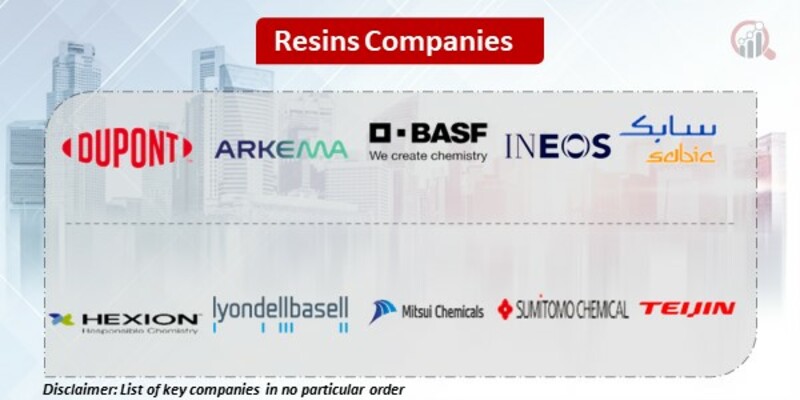
Key Companies in the Resins market include
DuPont
Arkema
BASF SE
INEOS Holdings Ltd.
Hexion
Invista
LyondellBasell
Mitsubishi Engineering-Plastics Corporation
Mitsui Chemicals
Nova Chemicals
Qenos
Radici Group
SABIC
Repsol
Sumitomo Chemical Co. Ltd.
Teijin Limited
Tosoh Corporation
Toray Group
Recent Developments:
- August 2023: Dow Chemical Co. unveils a new bio-based epoxy resin derived from plant oils, catering to the growing demand for sustainable solutions.
- September 2023: BASF SE partners with a leading electric vehicle manufacturer to develop lightweight and durable composite materials for car bodies.
- October 2023: ExxonMobil Corporation invests in a recycling facility for used plastic resins, aiming to close the loop and minimize waste.
- November 2023: LyondellBasell Industries NV collaborates with a research institute to develop self-healing plastic materials for improved product longevity.
- December 2023: SABIC launches a new line of UV-curable resins for energy-efficient printing applications, contributing to sustainable manufacturing practices.

 Noah Malgeri
Co-Founder
Noah Malgeri
Co-Founder

 Peter Groot koerkamp
Account and Business Manager
Peter Groot koerkamp
Account and Business Manager

 Younghwan Choi
Senior Retail Manager
Younghwan Choi
Senior Retail Manager

 Mark Irwin
Management Consultant
Mark Irwin
Management Consultant

 Akif Moroglu
Strategy & Business Development Director
Akif Moroglu
Strategy & Business Development Director

 Guilherme Gomes Martins
Product Management Director
Guilherme Gomes Martins
Product Management Director

 Joseph Aguayo
Sales Operations & Pricing Manager
Joseph Aguayo
Sales Operations & Pricing Manager

 La Terria Dodd
Program Support Specialist
La Terria Dodd
Program Support Specialist

 Rob Kooiker
Group Product Manager HVAC & Fire Protection GMA
Rob Kooiker
Group Product Manager HVAC & Fire Protection GMA


