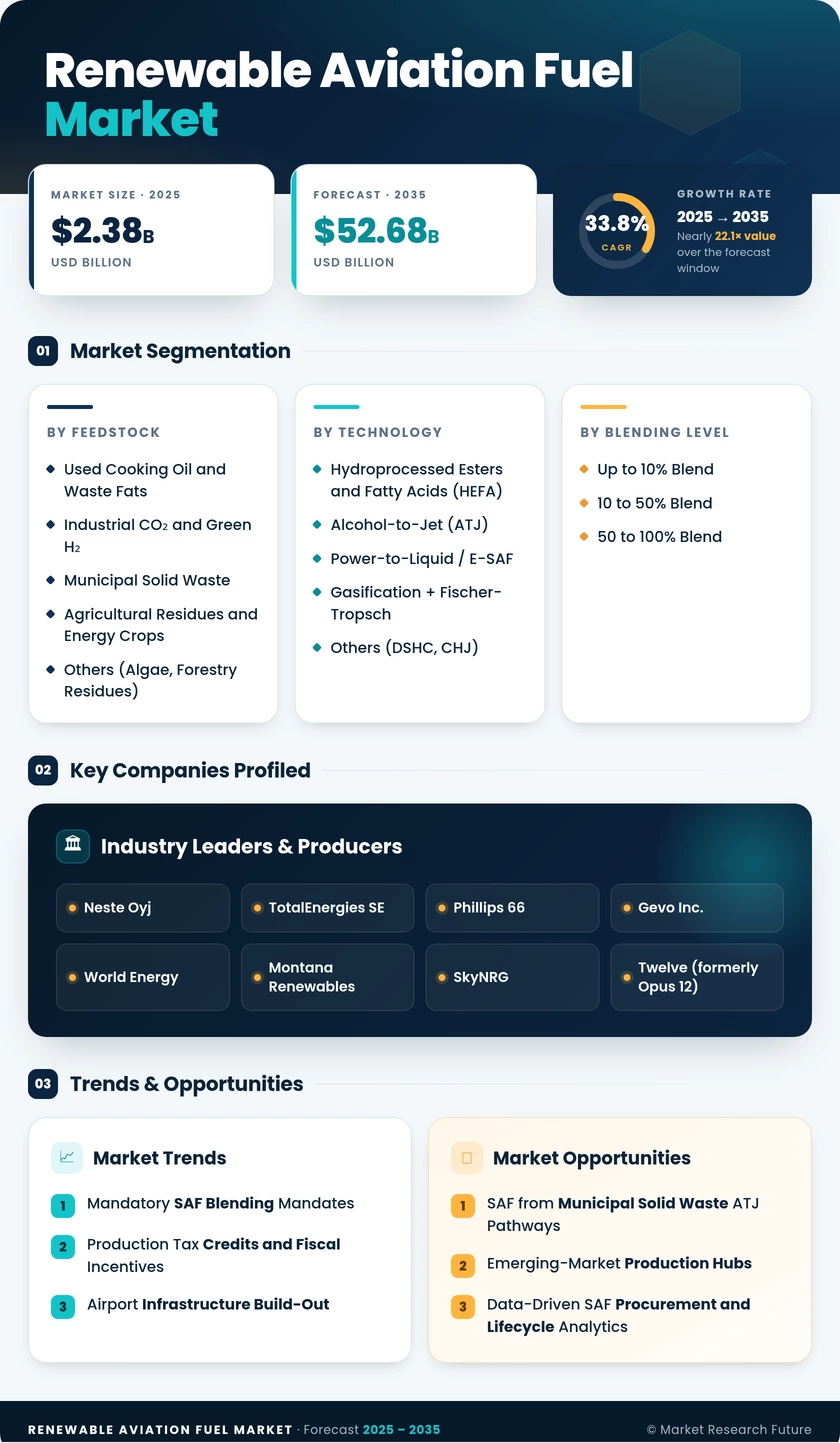
Segmentation Quick Reference
| Dimension | Sub-Segments | Dominant Segment | Fastest Growing Segment |
| By Feedstock | Used Cooking Oil and Waste Fats; Industrial CO₂ and Green H₂; Municipal Solid Waste; Agricultural Residues and Energy Crops; Others | Used Cooking Oil and Waste Fats (43.1% share, 2025) | Industrial CO₂ and Green H₂ (54.6% CAGR) |
| By Renewable Aviation Fuel Market | HEFA; ATJ; Power-to-Liquid / E-SAF; Gasification + FT; Others | HEFA (74.2% share, 2025) | Power-to-Liquid / E-SAF (51.3% CAGR) |
| By Blending Level | Up to 10%; 10–50%; 50–100% | 10–50% Blend (82.4% share, 2025) | 50–100% Blend (48.3% CAGR) |
| By Application | Commercial Airlines; Cargo and Freight; Business and General Aviation; Military and Government | Commercial Airlines (85.1% share, 2025) | Cargo and Freight (29.3% CAGR) |
Market Segmentation Overview
By Feedstock
| Sub-Segment | Key Trend |
| Used Cooking Oil and Waste Fats | Supply ceiling approaching; traceability and fraud scrutiny intensifying in Asian exports |
| Industrial CO₂ and Green H₂ | Electrolyzer cost declines and DAC scale-up opening a feedstock-unlimited pathway |
| Municipal Solid Waste | Landfill diversion policies in Japan, the UK, and the EU creating dual-revenue SAF production models |
| Agricultural Residues and Energy Crops | Cellulosic ethanol integration with existing sugar-mill infrastructure in Brazil and India |
| Others (Algae, Forestry Residues) | R&D-stage; algal lipids and lignin-derived syngas offer long-term feedstock diversification |
Feedstock availability is the binding constraint on near-term Renewable Aviation Fuel Market growth. While used cooking oil remains cost-effective today, the industry's trajectory depends on successfully commercializing industrial CO₂ and green hydrogen pathways that decouple SAF production from finite biogenic lipid supplies.
By Renewable Aviation Fuel Market
| Sub-Segment | Key Trend |
| HEFA | Brownfield refinery conversions by oil majors; mature drop-in fuel with the broadest certification |
| ATJ | Commercial-scale plants operational; ethanol abundance reduces feedstock risk |
| Power-to-Liquid / E-SAF | Explosive growth driven by e-SAF mandates and deep decarbonization potential |
| Gasification + Fischer-Tropsch | MSW and biomass gasification enabling waste-valorization SAF |
| Others (DSHC, CHJ) | Emerging catalytic routes under ASTM evaluation |
Renewable Aviation Fuel Market diversification is critical for the Renewable Aviation Fuel Market to scale beyond HEFA's feedstock limitations. Power-to-liquid and alcohol-to-jet pathways together are expected to capture over 35% of production capacity by 2035, fundamentally reshaping the competitive landscape.
By Blending Level
| Sub-Segment | Key Trend |
| Up to 10% Blend | Entry-level compliance tier; suitable for airports without dedicated blending infrastructure |
| 10 to 50% Blend | Regulatory sweet spot; most mandates and offtake agreements structured within this band |
| 50 to 100% Blend | Engine OEM certification push toward 100% SAF by 2030; demonstration flights completed |
The blending-level mix within the Renewable Aviation Fuel Market is shifting upward as engine manufacturers accelerate 100% SAF compatibility certification and regulators tighten volumetric mandates beyond initial single-digit blend obligations.
By Application
| Sub-Segment | Key Trend |
| Commercial Airlines | Largest demand pool; regulatory and reputational drivers converging |
| Cargo and Freight | E-commerce shippers demanding green logistics; dedicated freighter SAF programs emerging |
| Business and General Aviation | Corporate travel policies accelerating FBO-level SAF availability |
| Military and Government | Energy security and operational resilience driving defense SAF adoption |
Commercial airlines will continue to anchor the Renewable Aviation Fuel Market through 2035, but cargo operators and military buyers represent high-growth adjacencies as supply chains mature and blending infrastructure reaches secondary airports and military bases.


 Noah Malgeri
Co-Founder

 Peter Groot koerkamp
Account and Business Manager

 Younghwan Choi
Senior Retail Manager

 Mark Irwin
Management Consultant

 Akif Moroglu
Strategy & Business Development Director

 Guilherme Gomes Martins
Product Management Director

 Joseph Aguayo
Sales Operations & Pricing Manager

 La Terria Dodd
Program Support Specialist

 Rob Kooiker
Group Product Manager HVAC & Fire Protection GMA