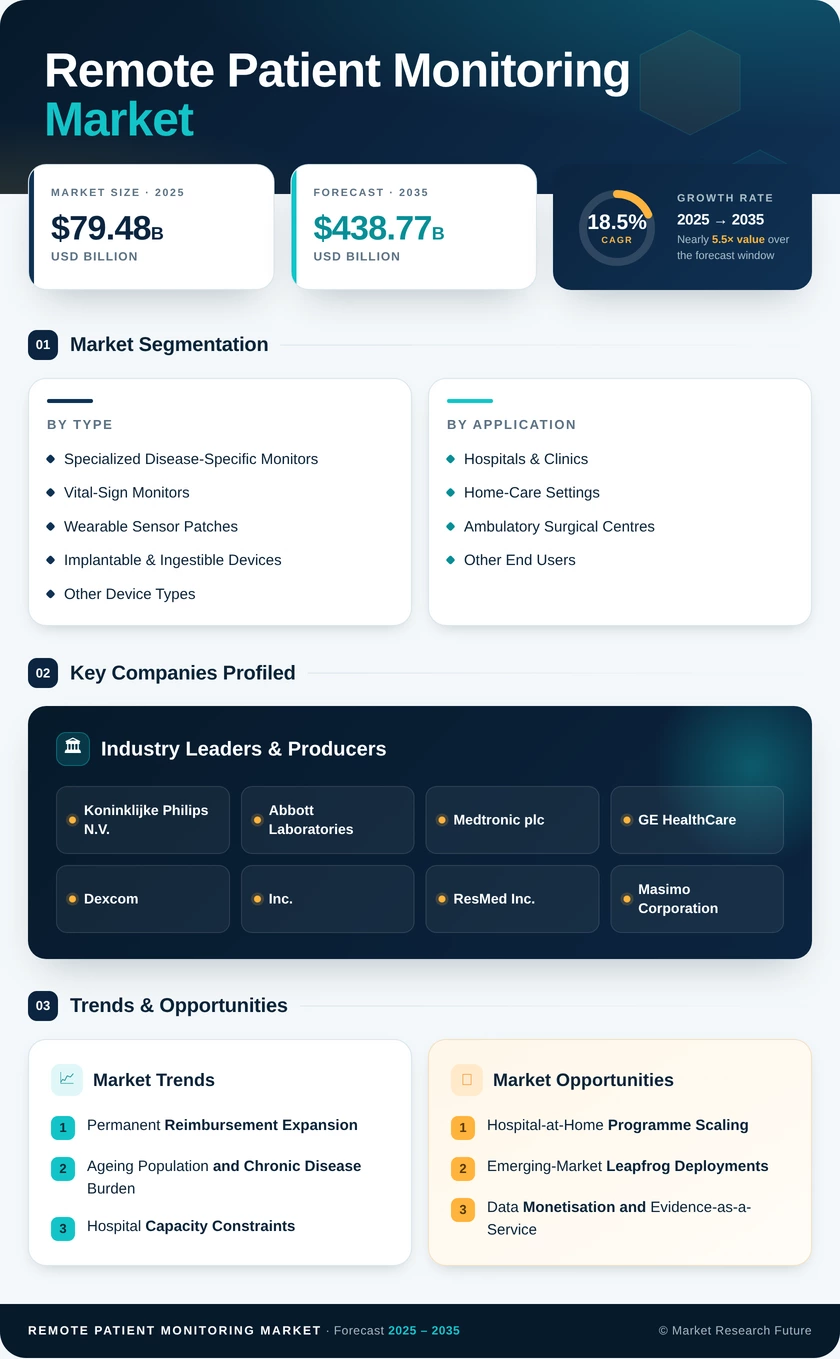
Segmentation Quick Reference
| Dimension | Sub-Segments | Dominant Segment | Fastest Growing Segment |
| By Device Type | Vital-Sign Monitors; Specialized Disease-Specific Monitors; Wearable Sensor Patches; Implantable & Ingestible Devices; Other Device Types | Specialized Disease-Specific Monitors | Wearable Sensor Patches |
| By Application | Cardiovascular Diseases; Diabetes Management; Respiratory & COPD; Neurological Disorders; Oncology; Other Applications | Cardiovascular Diseases | Diabetes Management |
| By End User | Hospitals & Clinics; Home-Care Settings; Ambulatory Surgical Centres; Other End Users | Hospitals & Clinics | Home-Care Settings |
| By Geography | North America; Europe; Asia-Pacific; South America; Middle East & Africa | North America | Asia-Pacific |
Market Segmentation Overview
By Device Type
| Sub-Segment | Key Trend |
| Vital-Sign Monitors | Migration from bedside carts to cellular-native home kits |
| Specialized Disease-Specific Monitors | Guideline endorsement drives reimbursement-linked volume |
| Wearable Sensor Patches | Disposable economics displacing durable Holter hardware |
| Implantable & Ingestible Devices | Pressure-sensing implants extend heart-failure surveillance |
| Other Device Types | Accessory and connectivity peripherals grow with fleet size |
Device taxonomy is converging on a two-tier structure: cheap disposable sensing at the edge, and expensive implantable or specialized hardware where clinical stakes justify the cost. The middle tier of general-purpose durable monitors faces the sharpest margin pressure.
By Application
| Sub-Segment | Key Trend |
| Cardiovascular Diseases | Readmission penalties sustain the largest revenue pool |
| Diabetes Management | Type 2 and pre-diabetic coverage expansion accelerates volume |
| Respiratory & COPD | Post-exacerbation surveillance becomes a discharge condition |
| Neurological Disorders | Seizure and movement-disorder tracking gains payer traction |
| Oncology | Symptom and toxicity monitoring attaches to episode payments |
| Other Applications | Maternal health and post-surgical recovery scale from pilots |
Applications with existing episode-based or penalty-linked payment structures adopt fastest, since procurement does not require creating a new reimbursement category. Oncology and maternal health represent the clearest near-term expansion frontiers.
By End User
| Sub-Segment | Key Trend |
| Hospitals & Clinics | Capacity pressure converts monitoring into an operational necessity |
| Home-Care Settings | Hospital-at-home waivers redirect inpatient budgets outward |
| Ambulatory Surgical Centres | Same-day discharge protocols require post-op surveillance |
| Other End Users | Payers and long-term care facilities emerge as direct buyers |
Purchasing authority is diffusing. Hospitals still hold the largest budgets, but payers buying monitoring as a supplemental benefit represent the structurally faster-growing channel because their savings accrue directly rather than through avoided penalties.


 Noah Malgeri
Co-Founder
Noah Malgeri
Co-Founder

 Peter Groot koerkamp
Account and Business Manager
Peter Groot koerkamp
Account and Business Manager

 Younghwan Choi
Senior Retail Manager
Younghwan Choi
Senior Retail Manager

 Mark Irwin
Management Consultant
Mark Irwin
Management Consultant

 Akif Moroglu
Strategy & Business Development Director
Akif Moroglu
Strategy & Business Development Director

 Guilherme Gomes Martins
Product Management Director
Guilherme Gomes Martins
Product Management Director

 Joseph Aguayo
Sales Operations & Pricing Manager
Joseph Aguayo
Sales Operations & Pricing Manager

 La Terria Dodd
Program Support Specialist
La Terria Dodd
Program Support Specialist

 Rob Kooiker
Group Product Manager HVAC & Fire Protection GMA
Rob Kooiker
Group Product Manager HVAC & Fire Protection GMA