
Request Free Sample ×

Kindly complete the form below to receive a free sample of this Report

* Please use a valid business email

Leading companies partner with us for data-driven Insights

clients tt-cursor
Hero Background
English
Chinese
French
Japanese
Korean
German
Spanish

Real Time Payment Market Share

ID: MRFR/BS/5595-HCR
200 Pages
Aarti Dhapte
April 2026

Real-Time Payment Market Size, Share & Industry Analysis By Technology (Blockchain, Artificial Intelligence, Mobile Payment Solutions, Card Payment Systems), By Application (Retail Payments, Business Payments, Peer-to-Peer Payments, Government Payments), By End Use (Consumer, Businesses, Financial Institutions), By Payment Mode (Remote, In-Store, Online) and By Regional (North America, Europe, South America, Asia Pacific, Middle East and Africa) - Industry Forecast Till 2035

Share:
Download PDF ×

We do not share your information with anyone. However, we may send you emails based on your report interest from time to time. You may contact us at any time to opt-out.

Real Time Payment Market Infographic
Purchase Options

Market Share

Real Time Payment Market Share Analysis

The demand for faster and more efficient payment methods has driven the Real Time Payment (RTP) market's growth. As competition increases in this niche, companies are using market share positioning tools to gain an edge.

Separation via mechanical development is common. RTP companies invest in cutting-edge payment tech to improve business processes. Computerized reasoning, blockchain, and other developments allow these companies to offer faster, safer, and simpler payment options. By staying ahead of innovation, companies want to stand out and gain market share.

Cooperation and associations are another market positioning approach. Many RTP market participants value key alliances to expand their capabilities. Coordinated initiatives with financial institutions, innovation groups, and other partners enable enterprises to exploit each other's assets and create a more comprehensive payment biological system. RTP providers can grow their market share by reaching new customers through key organizations.

Real Time Payment market share is also affected by value seriously. Some firms provide serious pricing as an expenditure effort. This technique targets cost-sensitive clientele that prioritize cost-adequacy while choosing payment methods. RTP providers may expand their clientele and get a competitive edge by accurately pricing their services.

Market segmentation is another way RTP providers target certain client groups. Organizations can adjust their contributions by understanding market segment demands and preferences. Some companies focus on certain industries like internet commerce, medical care, or retail, tailoring their payment solutions to their needs. RTP providers may capture a niche market and strengthen their position using this method.

Brand positioning and reputation the board play a key role in Real Time Payment market share. A reliable brand must highlight its strengths to attract and retain customers. Companies invest in marketing to demonstrate their reliability, security, and customer service. Great brand discernment attracts new customers and retains existing ones, increasing market share over time.

Administrative consistency adds to RTP market share. Financial exchanges are sensitive, thus companies should follow strict administrative rules to ensure security and confidence. RTP providers that ensure consistency and safety are trusted partners for customers and businesses. Meeting administrative requirements reduces risk and boosts the company's reputation, affecting market share.


Author
Author Profile
Aarti Dhapte
AVP - Research

A consulting professional focused on helping businesses navigate complex markets through structured research and strategic insights. I partner with clients to solve high-impact business problems across market entry strategy, competitive intelligence, and opportunity assessment. Over the course of my experience, I have led and contributed to 100+ market research and consulting engagements, delivering insights across multiple industries and geographies, and supporting strategic decisions linked to $500M+ market opportunities. My core expertise lies in building robust market sizing, forecasting, and commercial models (top-down and bottom-up), alongside deep-dive competitive and industry analysis. I have played a key role in shaping go-to-market strategies, investment cases, and growth roadmaps, enabling clients to make confident, data-backed decisions in dynamic markets.

Leave a Comment

FAQs

What is the projected market valuation of the Real-Time Payment Market by 2035?

<p>The Real-Time Payment Market is projected to reach a valuation of 265.83 USD Billion by 2035.</p>

What was the market valuation of the Real-Time Payment Market in 2024?

<p>In 2024, the Real-Time Payment Market had a valuation of 12.3 USD Billion.</p>

What is the expected CAGR for the Real-Time Payment Market during the forecast period 2025 - 2035?

<p>The expected CAGR for the Real-Time Payment Market during the forecast period 2025 - 2035 is 32.23%.</p>

Which technology segment is projected to have the highest valuation in the Real-Time Payment Market?

<p>Mobile Payment Solutions is projected to have the highest valuation, reaching 120.0 USD Billion by 2035.</p>

What are the key applications driving the Real-Time Payment Market?

<p>Key applications include Business Payments, projected to reach 113.45 USD Billion, and Retail Payments, expected to reach 83.15 USD Billion by 2035.</p>

Who are the leading players in the Real-Time Payment Market?

<p>Leading players in the Real-Time Payment Market include Visa, Mastercard, PayPal, and Square.</p>

What is the projected valuation for Peer-to-Peer Payments by 2035?

<p>Peer-to-Peer Payments is projected to reach a valuation of 57.25 USD Billion by 2035.</p>

How do end-use segments contribute to the Real-Time Payment Market?

<p>Businesses are expected to contribute significantly, with a projected valuation of 124.75 USD Billion by 2035.</p>

What is the expected growth for the Card Payment Systems segment?

<p>The Card Payment Systems segment is projected to grow to 40.0 USD Billion by 2035.</p>

What payment mode is anticipated to dominate the Real-Time Payment Market?

<p>In-Store payments are anticipated to dominate, with a projected valuation of 109.65 USD Billion by 2035.</p>

Market Summary

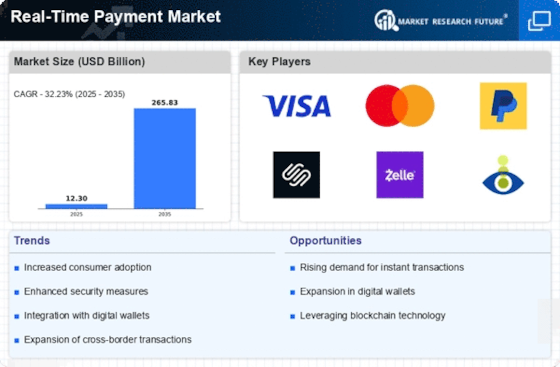
As per Market Research Future analysis, the Real-Time Payment Market Size was estimated at 12.3 USD Billion in 2024. The Real-Time Payment industry is projected to grow from 16.26 USD Billion in 2025 to 265.83 USD Billion by 2035, exhibiting a compound annual growth rate (CAGR) of 32.23% during the forecast period 2025 - 2035

Key Market Trends & Highlights

The Real-Time Payment Market is experiencing robust growth driven by technological advancements and evolving consumer preferences.

  • The adoption of mobile payments is witnessing a notable increase, particularly in North America, as consumers seek convenience and speed. Integration of advanced technologies, such as blockchain and artificial intelligence, is reshaping payment systems, enhancing security and efficiency. Regulatory developments and standardization efforts are fostering a more cohesive framework for real-time payments, especially in the Asia-Pacific region. The growing consumer demand for instant transactions and the expansion of e-commerce are key drivers propelling the market forward.

Market Size & Forecast

2024 Market Size 12.3 (USD Billion)
2035 Market Size 265.83 (USD Billion)
CAGR (2025 - 2035) 32.23%
Largest Regional Market Share in 2024 North America

Major Players

Visa (US), Mastercard (US), PayPal (US), Square (US), Zelle (US), Revolut (GB), TransferWise (GB), Alipay (CN), WeChat Pay (CN), N26 (DE)

Market Trends

The Real-Time Payment Market is currently experiencing a transformative phase characterized by rapid technological advancements and evolving consumer preferences. As digital transactions become increasingly prevalent, the demand for instantaneous payment solutions is surging. This shift is driven by the need for efficiency and convenience in financial transactions, prompting various stakeholders, including banks, fintech companies, and payment service providers, to innovate and enhance their offerings. The integration of advanced technologies such as artificial intelligence and blockchain is reshaping the landscape, enabling secure and seamless transactions that cater to the needs of both businesses and consumers. Moreover, regulatory frameworks are adapting to accommodate the growth of the Real-Time Payment Market, fostering an environment conducive to innovation. Governments and financial institutions are collaborating to establish standards that ensure security and interoperability among different payment systems. This collaborative approach not only enhances consumer trust but also encourages wider adoption of real-time payment solutions across various sectors. As the market continues to evolve, it appears poised for sustained growth, driven by the increasing reliance on digital payment methods and the ongoing quest for enhanced user experiences.

Increased Adoption of Mobile Payments

The Real-Time Payment Market is witnessing a notable shift towards mobile payment solutions. Consumers are increasingly favoring mobile wallets and applications that facilitate instant transactions. This trend is likely influenced by the growing penetration of smartphones and the convenience they offer, allowing users to make payments on-the-go.

Integration of Advanced Technologies

Technological innovation plays a crucial role in the evolution of the Real-Time Payment Market. The incorporation of artificial intelligence and blockchain technology is enhancing transaction security and efficiency. These advancements may lead to more reliable payment systems, fostering greater consumer confidence in digital transactions.

Regulatory Developments and Standardization

The Real-Time Payment Market is also shaped by evolving regulatory frameworks. Governments and financial authorities are working towards establishing standards that promote interoperability and security among payment systems. This regulatory support is essential for building trust and encouraging broader adoption of real-time payment solutions.

Real Time Payment Market Market Drivers

Increased Focus on Financial Inclusion

The Real-Time Payment Market is also being driven by an increased focus on financial inclusion. Many regions are striving to provide unbanked and underbanked populations with access to financial services. Real-time payment solutions offer a viable pathway to achieve this goal, as they can facilitate low-cost transactions and enable individuals to participate in the formal economy. Recent initiatives by governments and NGOs aim to leverage technology to expand access to financial services, thereby promoting economic empowerment. As these efforts gain traction, the Real-Time Payment Market is expected to grow, driven by the need to create inclusive financial ecosystems.

Regulatory Support for Real-Time Payments

Regulatory support is emerging as a crucial driver for the Real-Time Payment Market. Governments and regulatory bodies are increasingly recognizing the importance of real-time payment systems in promoting financial inclusion and economic growth. Initiatives aimed at standardizing payment systems and ensuring interoperability among different platforms are gaining momentum. For example, several countries have implemented frameworks that encourage the adoption of real-time payment solutions among financial institutions. This regulatory backing not only fosters innovation but also instills confidence among consumers and businesses in utilizing these systems. As a result, the Real-Time Payment Market is likely to benefit from enhanced regulatory support in the coming years.

Expansion of E-Commerce and Digital Services

The Real-Time Payment Market is significantly influenced by the expansion of e-commerce and digital services. As online shopping continues to gain traction, the need for efficient payment solutions becomes critical. Recent statistics indicate that e-commerce sales have seen a steady increase, with projections suggesting a growth rate of over 15% annually. This trend necessitates the integration of real-time payment systems to facilitate seamless transactions. Retailers and service providers are increasingly adopting these solutions to enhance customer experience and reduce cart abandonment rates. The Real-Time Payment Market is thus poised for growth, driven by the imperative to support the evolving landscape of digital commerce.

Technological Advancements in Payment Systems

Technological advancements are playing a pivotal role in shaping the Real-Time Payment Market. Innovations such as blockchain technology, artificial intelligence, and machine learning are enhancing the efficiency and security of payment systems. These technologies enable faster transaction processing and reduce the risk of fraud, which is paramount in the current digital age. For instance, the implementation of blockchain in payment systems has the potential to streamline cross-border transactions, making them faster and more cost-effective. As these technologies continue to evolve, they are likely to drive further adoption of real-time payment solutions, thereby propelling the Real-Time Payment Market forward.

Growing Consumer Demand for Instant Transactions

The Real-Time Payment Market is experiencing a surge in consumer demand for instant transactions. As individuals increasingly seek immediate access to their funds, the necessity for real-time payment solutions becomes more pronounced. According to recent data, nearly 70% of consumers express a preference for instant payment options over traditional methods. This shift in consumer behavior is driving financial institutions to innovate and enhance their payment systems. The expectation for instantaneous transactions is not limited to personal finance; businesses are also adapting to this trend, as they recognize the competitive advantage of offering real-time payment solutions. Consequently, the Real-Time Payment Market is likely to expand as more entities strive to meet this growing demand.

Market Segment Insights

By Technology: Blockchain (Largest) vs. Artificial Intelligence (Fastest-Growing)

In the Real-Time Payment Market, the technology segment exhibits diverse contributions from several leading technologies. Blockchain has emerged as the largest share contributor, revolutionizing payment processes with its security and transparency features. Following closely are Artificial Intelligence solutions, which, while smaller in share, are rapidly capturing market attention due to their ability to enhance decision-making and fraud detection capabilities.

Blockchain (Dominant) vs. Mobile Payment Solutions (Emerging)

Blockchain technology is the dominant force in the Real-Time Payment Market, offering unparalleled advantages such as decentralized processing and enhanced security. Its robustness attracts a wide range of users, including banks and financial institutions. Conversely, Mobile Payment Solutions are emerging as key players, appealing to the growing segment of consumers who prefer ease of use and quick transactions via smartphones. This segment is characterized by its adaptability and integration with mobile applications, appealing particularly to younger demographics. As the market trends shift towards convenience, the potential for mobile payments to gain ground is significant.

By Application: Retail Payments (Largest) vs. Business Payments (Fastest-Growing)

The Real-Time Payment Market showcases a diverse distribution of applications. Among these, Retail Payments dominate the landscape as the largest segment, reflecting extensive adoption by consumers for daily transactions, while Business Payments are rapidly catching up, being recognized as the fastest-growing segment. This growth is driven by an increased awareness of efficiency and the need for immediate fund transfers in a fast-paced business environment. Government Payments and Peer-to-Peer Payments also contribute to the application profile, although their market share is comparatively smaller. The evolution of technology and rising consumer expectations continue to shape the trends within each segment, with Retail Payments leveraging existing infrastructures while businesses strive to integrate more real-time solutions to streamline their operations.

Retail Payments (Dominant) vs. Peer-to-Peer Payments (Emerging)

Retail Payments stand out as the dominant force within the Real-Time Payment Market, characterized by widespread usage among consumers for immediate transactions in stores and online. This segment benefits from the established infrastructure of payment gateways, enhancing customer convenience and merchant acceptance. On the other hand, Peer-to-Peer Payments are emerging as a rapidly evolving segment driven by the rise of mobile applications and social media integration. Users are increasingly favoring easy, instant transfers facilitated by digital wallets, making Peer-to-Peer Payments a noteworthy competitor. Both segments reflect changing consumer behaviors and technological advancements, with Retail Payments maintaining a stronghold while Peer-to-Peer Payments seek to expand its presence.

By End Use: Consumers (Largest) vs. Businesses (Fastest-Growing)

In the Real-Time Payment Market, the Consumers segment holds the largest market share, driven by the increasing demand for instant transactions and seamless payment experiences. This segment benefits from the proliferation of mobile wallets and contactless payment methods, catering to the tech-savvy consumer base that prefers convenience and speed. On the other hand, the Businesses segment is witnessing remarkable growth, as organizations seek to enhance cash flow and improve financial agility through real-time payment solutions. This shift is further fueled by the ongoing digital transformation across industries, emphasizing the need for efficient financial processes and rapid fund availability.

Consumers (Dominant) vs. Businesses (Emerging)

The Consumers segment in the Real-Time Payment Market stands out as the dominant force, characterized by an overwhelming preference for digital transactions that offer immediacy and ease. As more consumers adopt smartphones and internet banking, expectations for instant payment confirmations have risen sharply. In contrast, the Businesses segment is emerging rapidly, as companies increasingly recognize the value of real-time payments in enhancing operational efficiencies and customer satisfaction. Businesses are leveraging these solutions to streamline payroll, manage supplier payments, and respond swiftly to market demands, leading to heightened competition and innovation in the payment technologies they utilize.

By Payment Mode: Online (Largest) vs. In-Store (Fastest-Growing)

The Real-Time Payment Market exhibits a diverse distribution among payment modes, with online transactions holding the largest market share due to the rapid adoption of technology and increasing consumer preference for digital transactions. In-store payments, while currently smaller in share, are gaining traction with the integration of advanced point-of-sale systems that enable real-time updates and seamless transactions.

Online (Dominant) vs. In-Store (Emerging)

Online payment modes dominate the Real-Time Payment Market thanks to their convenience and speed. This segment benefits from technological advancements in cyber-security and user-friendly interfaces that enhance customer experiences. On the other hand, in-store payments are emerging fast, appealing to consumers who prefer immediate interactions and tangible transactions. The rise of mobile payment solutions and contactless transactions further drives the growth of in-store payments, making it a vital part of the market. Both segments reflect evolving consumer preferences and technological developments.

Get more detailed insights about Real Time Payment Market Research Report – Global Forecast till 2035

Regional Insights

The Real-Time Payment Market is experiencing significant growth, with a valuation of 23.24 USD Billion in 2024, projected to reach 50.0 USD Billion by 2035. Within this market, North America emerges as a dominant player, holding a substantial majority with a value of 10.5 USD Billion in 2024 and expected to grow to 22.0 USD Billion by 2035. This region's advanced technological infrastructure and high adoption rates drive its market leadership. Europe follows, with a valuation of 6.5 USD Billion in 2024, anticipated to grow to 13.5 USD Billion by 2035, reflecting strong consumer demand for efficient payment solutions.

The APAC region, valued at 4.5 USD Billion in 2024 and projected to reach 9.5 USD Billion in 2035, highlights the rapid digital transformation in emerging economies, enhancing payment accessibility. South America, while smaller in size, shows potential with its value of 1.5 USD Billion in 2024, expected to double to 3.0 USD Billion by 2035 as financial inclusion initiatives gain momentum. The Middle East and Africa (MEA) exhibit the lowest market size with 0.24 USD Billion in 2024, growing to 2.0 USD Billion by 2035, driven by increased mobile banking adoption.

The growth and significance of these regions ultimately contribute to the Real-Time Payment Market data, highlighting diverse opportunities and trends shaping this evolving industry landscape.

Key Players and Competitive Insights

The Real-Time Payment Market has been experiencing significant growth driven by the increasing demand for instant transaction capabilities and the rise of digital payment platforms. As financial technology evolves, various players are competing to offer innovative solutions that cater to businesses and consumers alike. The market landscape is characterized by established financial institutions, tech companies, and new fintech startups, each bringing unique capabilities to enhance the payment experience. The competitive dynamics are greatly influenced by factors such as regulatory frameworks, technological advancements, and consumer preferences for speed and security. As a result, companies that can effectively leverage these factors stand to gain a competitive edge in this rapidly evolving market.FIS has positioned itself as a key player within the Real-Time Payment Market due to its comprehensive suite of financial solutions and robust technological infrastructure. The company leverages its extensive expertise in the payments domain to provide fast, modern, and secure payment processing services. FIS's strengths lie in its ability to integrate various payment methods across multiple platforms, thereby enhancing user experiences and increasing transaction efficiency.Additionally, the company's focus on innovation enables it to quickly adapt to evolving market trends, ensuring that it remains competitive. With a strong global presence, FIS has established partnerships with various financial institutions, which further bolsters its position in the real-time payments landscape.UnionPay has also made significant strides in the Real-Time Payment Market, showcasing its offerings that facilitate seamless cross-border transactions. The company's key products and services include a comprehensive payment network that supports various real-time payment solutions for both domestic and international users. UnionPay's strengths are amplified by its extensive network partnerships and collaborations, allowing it to provide reliable and efficient services across different regions. Furthermore, UnionPay has engaged in strategic mergers and acquisitions, enhancing its capabilities and market reach.This has equipped the company to better cater to the evolving needs of its global clientele by offering innovative payment solutions and improving customer experience. With a focus on expanding its global footprint, UnionPay continues to strengthen its position as a formidable competitor in the real-time payments sector.

Key Companies in the Real Time Payment Market include

Industry Developments

The Real-Time Payment Market has seen significant developments in recent months. Companies such as FIS, UnionPay, and Alipay continue to enhance their payment solutions, focusing on security and speed, which is crucial for consumer demand. In September 2023, PayPal expanded its offerings by integrating new real-time payment capabilities aimed at improving user experience across various platforms. Meanwhile, American Express has been diversifying its operational strategies, emphasizing partnerships with fintech companies to broaden its service offerings. Notably, Visa announced an increase in its investments in blockchain technology to facilitate fast and secure payment systems. 

In terms of mergers and acquisitions, Square recently acquired a payment processing platform in October 2023, signaling a strategic move to bolster its position in the market. Similarly, Adyen has entered into discussions to acquire a smaller competitor to strengthen its service portfolio. The market valuation has shown robust growth, reflected in the rising stock prices of these companies, which has been driven by increased consumer reliance on digital transactions. Over the last few years, developments such as the widespread adoption of mobile wallets and real-time payment systems have transformed the landscape, significantly impacting traditional banking practices globally.

Future Outlook

Real Time Payment Market Future Outlook

The Real-Time Payment Market is projected to grow at a 32.23% CAGR from 2025 to 2035, driven by technological advancements, increased consumer demand, and regulatory support.

New opportunities lie in:

  • Integration of AI-driven fraud detection systems</p><p>Expansion of cross-border payment solutions</p><p>Development of mobile wallet partnerships with retailers

By 2035, the market is expected to be robust, reflecting substantial growth and innovation.

Market Segmentation

Real Time Payment Market End Use Outlook

  • Consumers
  • Businesses
  • Financial Institutions

Real Time Payment Market Technology Outlook

  • Blockchain
  • Artificial Intelligence
  • Mobile Payment Solutions
  • Card Payment Systems

Real Time Payment Market Application Outlook

  • Retail Payments
  • Business Payments
  • Peer-to-Peer Payments
  • Government Payments

Real Time Payment Market Payment Mode Outlook

  • Remote
  • In-Store
  • Online

Report Scope

MARKET SIZE 2024 12.3(USD Billion)
MARKET SIZE 2025 16.26(USD Billion)
MARKET SIZE 2035 265.83(USD Billion)
COMPOUND ANNUAL GROWTH RATE (CAGR) 32.23% (2025 - 2035)
REPORT COVERAGE Revenue Forecast, Competitive Landscape, Growth Factors, and Trends
BASE YEAR 2024
Market Forecast Period 2025 - 2035
Historical Data 2019 - 2024
Market Forecast Units USD Billion
Key Companies Profiled Visa (US), Mastercard (US), PayPal (US), Square (US), Zelle (US), Revolut (GB), TransferWise (GB), Alipay (CN), WeChat Pay (CN), N26 (DE)
Segments Covered Technology, Application, End Use, Payment Mode, Regional
Key Market Opportunities Integration of blockchain technology enhances security and efficiency in the Real-Time Payment Market.
Key Market Dynamics Rising consumer demand for instantaneous transactions drives innovation and competition in the Real-Time Payment Market.
Countries Covered North America, Europe, APAC, South America, MEA

FAQs

What is the projected market valuation of the Real-Time Payment Market by 2035?

<p>The Real-Time Payment Market is projected to reach a valuation of 265.83 USD Billion by 2035.</p>

What was the market valuation of the Real-Time Payment Market in 2024?

<p>In 2024, the Real-Time Payment Market had a valuation of 12.3 USD Billion.</p>

What is the expected CAGR for the Real-Time Payment Market during the forecast period 2025 - 2035?

<p>The expected CAGR for the Real-Time Payment Market during the forecast period 2025 - 2035 is 32.23%.</p>

Which technology segment is projected to have the highest valuation in the Real-Time Payment Market?

<p>Mobile Payment Solutions is projected to have the highest valuation, reaching 120.0 USD Billion by 2035.</p>

What are the key applications driving the Real-Time Payment Market?

<p>Key applications include Business Payments, projected to reach 113.45 USD Billion, and Retail Payments, expected to reach 83.15 USD Billion by 2035.</p>

Who are the leading players in the Real-Time Payment Market?

<p>Leading players in the Real-Time Payment Market include Visa, Mastercard, PayPal, and Square.</p>

What is the projected valuation for Peer-to-Peer Payments by 2035?

<p>Peer-to-Peer Payments is projected to reach a valuation of 57.25 USD Billion by 2035.</p>

How do end-use segments contribute to the Real-Time Payment Market?

<p>Businesses are expected to contribute significantly, with a projected valuation of 124.75 USD Billion by 2035.</p>

What is the expected growth for the Card Payment Systems segment?

<p>The Card Payment Systems segment is projected to grow to 40.0 USD Billion by 2035.</p>

What payment mode is anticipated to dominate the Real-Time Payment Market?

<p>In-Store payments are anticipated to dominate, with a projected valuation of 109.65 USD Billion by 2035.</p>

  1. SECTION I: EXECUTIVE SUMMARY AND KEY HIGHLIGHTS
    1. | 1.1 EXECUTIVE SUMMARY
    2. | | 1.1.1 Market Overview
    3. | | 1.1.2 Key Findings
    4. | | 1.1.3 Market Segmentation
    5. | | 1.1.4 Competitive Landscape
    6. | | 1.1.5 Challenges and Opportunities
    7. | | 1.1.6 Future Outlook
  2. SECTION II: SCOPING, METHODOLOGY AND MARKET STRUCTURE
    1. | 2.1 MARKET INTRODUCTION
    2. | | 2.1.1 Definition
    3. | | 2.1.2 Scope of the study
    4. | | | 2.1.2.1 Research Objective
    5. | | | 2.1.2.2 Assumption
    6. | | | 2.1.2.3 Limitations
    7. | 2.2 RESEARCH METHODOLOGY
    8. | | 2.2.1 Overview
    9. | | 2.2.2 Data Mining
    10. | | 2.2.3 Secondary Research
    11. | | 2.2.4 Primary Research
    12. | | | 2.2.4.1 Primary Interviews and Information Gathering Process
    13. | | | 2.2.4.2 Breakdown of Primary Respondents
    14. | | 2.2.5 Forecasting Model
    15. | | 2.2.6 Market Size Estimation
    16. | | | 2.2.6.1 Bottom-Up Approach
    17. | | | 2.2.6.2 Top-Down Approach
    18. | | 2.2.7 Data Triangulation
    19. | | 2.2.8 Validation
  3. SECTION III: QUALITATIVE ANALYSIS
    1. | 3.1 MARKET DYNAMICS
    2. | | 3.1.1 Overview
    3. | | 3.1.2 Drivers
    4. | | 3.1.3 Restraints
    5. | | 3.1.4 Opportunities
    6. | 3.2 MARKET FACTOR ANALYSIS
    7. | | 3.2.1 Value chain Analysis
    8. | | 3.2.2 Porter's Five Forces Analysis
    9. | | | 3.2.2.1 Bargaining Power of Suppliers
    10. | | | 3.2.2.2 Bargaining Power of Buyers
    11. | | | 3.2.2.3 Threat of New Entrants
    12. | | | 3.2.2.4 Threat of Substitutes
    13. | | | 3.2.2.5 Intensity of Rivalry
    14. | | 3.2.3 COVID-19 Impact Analysis
    15. | | | 3.2.3.1 Market Impact Analysis
    16. | | | 3.2.3.2 Regional Impact
    17. | | | 3.2.3.3 Opportunity and Threat Analysis
  4. SECTION IV: QUANTITATIVE ANALYSIS
    1. | 4.1 BFSI, BY Technology (USD Billion)
    2. | | 4.1.1 Blockchain
    3. | | 4.1.2 Artificial Intelligence
    4. | | 4.1.3 Mobile Payment Solutions
    5. | | 4.1.4 Card Payment Systems
    6. | 4.2 BFSI, BY Application (USD Billion)
    7. | | 4.2.1 Retail Payments
    8. | | 4.2.2 Business Payments
    9. | | 4.2.3 Peer-to-Peer Payments
    10. | | 4.2.4 Government Payments
    11. | 4.3 BFSI, BY End Use (USD Billion)
    12. | | 4.3.1 Consumers
    13. | | 4.3.2 Businesses
    14. | | 4.3.3 Financial Institutions
    15. | 4.4 BFSI, BY Payment Mode (USD Billion)
    16. | | 4.4.1 Remote
    17. | | 4.4.2 In-Store
    18. | | 4.4.3 Online
    19. | 4.5 BFSI, BY Region (USD Billion)
    20. | | 4.5.1 North America
    21. | | | 4.5.1.1 US
    22. | | | 4.5.1.2 Canada
    23. | | 4.5.2 Europe
    24. | | | 4.5.2.1 Germany
    25. | | | 4.5.2.2 UK
    26. | | | 4.5.2.3 France
    27. | | | 4.5.2.4 Russia
    28. | | | 4.5.2.5 Italy
    29. | | | 4.5.2.6 Spain
    30. | | | 4.5.2.7 Rest of Europe
    31. | | 4.5.3 APAC
    32. | | | 4.5.3.1 China
    33. | | | 4.5.3.2 India
    34. | | | 4.5.3.3 Japan
    35. | | | 4.5.3.4 South Korea
    36. | | | 4.5.3.5 Malaysia
    37. | | | 4.5.3.6 Thailand
    38. | | | 4.5.3.7 Indonesia
    39. | | | 4.5.3.8 Rest of APAC
    40. | | 4.5.4 South America
    41. | | | 4.5.4.1 Brazil
    42. | | | 4.5.4.2 Mexico
    43. | | | 4.5.4.3 Argentina
    44. | | | 4.5.4.4 Rest of South America
    45. | | 4.5.5 MEA
    46. | | | 4.5.5.1 GCC Countries
    47. | | | 4.5.5.2 South Africa
    48. | | | 4.5.5.3 Rest of MEA
  5. SECTION V: COMPETITIVE ANALYSIS
    1. | 5.1 Competitive Landscape
    2. | | 5.1.1 Overview
    3. | | 5.1.2 Competitive Analysis
    4. | | 5.1.3 Market share Analysis
    5. | | 5.1.4 Major Growth Strategy in the BFSI
    6. | | 5.1.5 Competitive Benchmarking
    7. | | 5.1.6 Leading Players in Terms of Number of Developments in the BFSI
    8. | | 5.1.7 Key developments and growth strategies
    9. | | | 5.1.7.1 New Product Launch/Service Deployment
    10. | | | 5.1.7.2 Merger & Acquisitions
    11. | | | 5.1.7.3 Joint Ventures
    12. | | 5.1.8 Major Players Financial Matrix
    13. | | | 5.1.8.1 Sales and Operating Income
    14. | | | 5.1.8.2 Major Players R&D Expenditure. 2023
    15. | 5.2 Company Profiles
    16. | | 5.2.1 Visa (US)
    17. | | | 5.2.1.1 Financial Overview
    18. | | | 5.2.1.2 Products Offered
    19. | | | 5.2.1.3 Key Developments
    20. | | | 5.2.1.4 SWOT Analysis
    21. | | | 5.2.1.5 Key Strategies
    22. | | 5.2.2 Mastercard (US)
    23. | | | 5.2.2.1 Financial Overview
    24. | | | 5.2.2.2 Products Offered
    25. | | | 5.2.2.3 Key Developments
    26. | | | 5.2.2.4 SWOT Analysis
    27. | | | 5.2.2.5 Key Strategies
    28. | | 5.2.3 PayPal (US)
    29. | | | 5.2.3.1 Financial Overview
    30. | | | 5.2.3.2 Products Offered
    31. | | | 5.2.3.3 Key Developments
    32. | | | 5.2.3.4 SWOT Analysis
    33. | | | 5.2.3.5 Key Strategies
    34. | | 5.2.4 Square (US)
    35. | | | 5.2.4.1 Financial Overview
    36. | | | 5.2.4.2 Products Offered
    37. | | | 5.2.4.3 Key Developments
    38. | | | 5.2.4.4 SWOT Analysis
    39. | | | 5.2.4.5 Key Strategies
    40. | | 5.2.5 Zelle (US)
    41. | | | 5.2.5.1 Financial Overview
    42. | | | 5.2.5.2 Products Offered
    43. | | | 5.2.5.3 Key Developments
    44. | | | 5.2.5.4 SWOT Analysis
    45. | | | 5.2.5.5 Key Strategies
    46. | | 5.2.6 Revolut (GB)
    47. | | | 5.2.6.1 Financial Overview
    48. | | | 5.2.6.2 Products Offered
    49. | | | 5.2.6.3 Key Developments
    50. | | | 5.2.6.4 SWOT Analysis
    51. | | | 5.2.6.5 Key Strategies
    52. | | 5.2.7 TransferWise (GB)
    53. | | | 5.2.7.1 Financial Overview
    54. | | | 5.2.7.2 Products Offered
    55. | | | 5.2.7.3 Key Developments
    56. | | | 5.2.7.4 SWOT Analysis
    57. | | | 5.2.7.5 Key Strategies
    58. | | 5.2.8 Alipay (CN)
    59. | | | 5.2.8.1 Financial Overview
    60. | | | 5.2.8.2 Products Offered
    61. | | | 5.2.8.3 Key Developments
    62. | | | 5.2.8.4 SWOT Analysis
    63. | | | 5.2.8.5 Key Strategies
    64. | | 5.2.9 WeChat Pay (CN)
    65. | | | 5.2.9.1 Financial Overview
    66. | | | 5.2.9.2 Products Offered
    67. | | | 5.2.9.3 Key Developments
    68. | | | 5.2.9.4 SWOT Analysis
    69. | | | 5.2.9.5 Key Strategies
    70. | | 5.2.10 N26 (DE)
    71. | | | 5.2.10.1 Financial Overview
    72. | | | 5.2.10.2 Products Offered
    73. | | | 5.2.10.3 Key Developments
    74. | | | 5.2.10.4 SWOT Analysis
    75. | | | 5.2.10.5 Key Strategies
    76. | 5.3 Appendix
    77. | | 5.3.1 References
    78. | | 5.3.2 Related Reports
  6. LIST OF FIGURES
    1. | 6.1 MARKET SYNOPSIS
    2. | 6.2 NORTH AMERICA MARKET ANALYSIS
    3. | 6.3 US MARKET ANALYSIS BY TECHNOLOGY
    4. | 6.4 US MARKET ANALYSIS BY APPLICATION
    5. | 6.5 US MARKET ANALYSIS BY END USE
    6. | 6.6 US MARKET ANALYSIS BY PAYMENT MODE
    7. | 6.7 CANADA MARKET ANALYSIS BY TECHNOLOGY
    8. | 6.8 CANADA MARKET ANALYSIS BY APPLICATION
    9. | 6.9 CANADA MARKET ANALYSIS BY END USE
    10. | 6.10 CANADA MARKET ANALYSIS BY PAYMENT MODE
    11. | 6.11 EUROPE MARKET ANALYSIS
    12. | 6.12 GERMANY MARKET ANALYSIS BY TECHNOLOGY
    13. | 6.13 GERMANY MARKET ANALYSIS BY APPLICATION
    14. | 6.14 GERMANY MARKET ANALYSIS BY END USE
    15. | 6.15 GERMANY MARKET ANALYSIS BY PAYMENT MODE
    16. | 6.16 UK MARKET ANALYSIS BY TECHNOLOGY
    17. | 6.17 UK MARKET ANALYSIS BY APPLICATION
    18. | 6.18 UK MARKET ANALYSIS BY END USE
    19. | 6.19 UK MARKET ANALYSIS BY PAYMENT MODE
    20. | 6.20 FRANCE MARKET ANALYSIS BY TECHNOLOGY
    21. | 6.21 FRANCE MARKET ANALYSIS BY APPLICATION
    22. | 6.22 FRANCE MARKET ANALYSIS BY END USE
    23. | 6.23 FRANCE MARKET ANALYSIS BY PAYMENT MODE
    24. | 6.24 RUSSIA MARKET ANALYSIS BY TECHNOLOGY
    25. | 6.25 RUSSIA MARKET ANALYSIS BY APPLICATION
    26. | 6.26 RUSSIA MARKET ANALYSIS BY END USE
    27. | 6.27 RUSSIA MARKET ANALYSIS BY PAYMENT MODE
    28. | 6.28 ITALY MARKET ANALYSIS BY TECHNOLOGY
    29. | 6.29 ITALY MARKET ANALYSIS BY APPLICATION
    30. | 6.30 ITALY MARKET ANALYSIS BY END USE
    31. | 6.31 ITALY MARKET ANALYSIS BY PAYMENT MODE
    32. | 6.32 SPAIN MARKET ANALYSIS BY TECHNOLOGY
    33. | 6.33 SPAIN MARKET ANALYSIS BY APPLICATION
    34. | 6.34 SPAIN MARKET ANALYSIS BY END USE
    35. | 6.35 SPAIN MARKET ANALYSIS BY PAYMENT MODE
    36. | 6.36 REST OF EUROPE MARKET ANALYSIS BY TECHNOLOGY
    37. | 6.37 REST OF EUROPE MARKET ANALYSIS BY APPLICATION
    38. | 6.38 REST OF EUROPE MARKET ANALYSIS BY END USE
    39. | 6.39 REST OF EUROPE MARKET ANALYSIS BY PAYMENT MODE
    40. | 6.40 APAC MARKET ANALYSIS
    41. | 6.41 CHINA MARKET ANALYSIS BY TECHNOLOGY
    42. | 6.42 CHINA MARKET ANALYSIS BY APPLICATION
    43. | 6.43 CHINA MARKET ANALYSIS BY END USE
    44. | 6.44 CHINA MARKET ANALYSIS BY PAYMENT MODE
    45. | 6.45 INDIA MARKET ANALYSIS BY TECHNOLOGY
    46. | 6.46 INDIA MARKET ANALYSIS BY APPLICATION
    47. | 6.47 INDIA MARKET ANALYSIS BY END USE
    48. | 6.48 INDIA MARKET ANALYSIS BY PAYMENT MODE
    49. | 6.49 JAPAN MARKET ANALYSIS BY TECHNOLOGY
    50. | 6.50 JAPAN MARKET ANALYSIS BY APPLICATION
    51. | 6.51 JAPAN MARKET ANALYSIS BY END USE
    52. | 6.52 JAPAN MARKET ANALYSIS BY PAYMENT MODE
    53. | 6.53 SOUTH KOREA MARKET ANALYSIS BY TECHNOLOGY
    54. | 6.54 SOUTH KOREA MARKET ANALYSIS BY APPLICATION
    55. | 6.55 SOUTH KOREA MARKET ANALYSIS BY END USE
    56. | 6.56 SOUTH KOREA MARKET ANALYSIS BY PAYMENT MODE
    57. | 6.57 MALAYSIA MARKET ANALYSIS BY TECHNOLOGY
    58. | 6.58 MALAYSIA MARKET ANALYSIS BY APPLICATION
    59. | 6.59 MALAYSIA MARKET ANALYSIS BY END USE
    60. | 6.60 MALAYSIA MARKET ANALYSIS BY PAYMENT MODE
    61. | 6.61 THAILAND MARKET ANALYSIS BY TECHNOLOGY
    62. | 6.62 THAILAND MARKET ANALYSIS BY APPLICATION
    63. | 6.63 THAILAND MARKET ANALYSIS BY END USE
    64. | 6.64 THAILAND MARKET ANALYSIS BY PAYMENT MODE
    65. | 6.65 INDONESIA MARKET ANALYSIS BY TECHNOLOGY
    66. | 6.66 INDONESIA MARKET ANALYSIS BY APPLICATION
    67. | 6.67 INDONESIA MARKET ANALYSIS BY END USE
    68. | 6.68 INDONESIA MARKET ANALYSIS BY PAYMENT MODE
    69. | 6.69 REST OF APAC MARKET ANALYSIS BY TECHNOLOGY
    70. | 6.70 REST OF APAC MARKET ANALYSIS BY APPLICATION
    71. | 6.71 REST OF APAC MARKET ANALYSIS BY END USE
    72. | 6.72 REST OF APAC MARKET ANALYSIS BY PAYMENT MODE
    73. | 6.73 SOUTH AMERICA MARKET ANALYSIS
    74. | 6.74 BRAZIL MARKET ANALYSIS BY TECHNOLOGY
    75. | 6.75 BRAZIL MARKET ANALYSIS BY APPLICATION
    76. | 6.76 BRAZIL MARKET ANALYSIS BY END USE
    77. | 6.77 BRAZIL MARKET ANALYSIS BY PAYMENT MODE
    78. | 6.78 MEXICO MARKET ANALYSIS BY TECHNOLOGY
    79. | 6.79 MEXICO MARKET ANALYSIS BY APPLICATION
    80. | 6.80 MEXICO MARKET ANALYSIS BY END USE
    81. | 6.81 MEXICO MARKET ANALYSIS BY PAYMENT MODE
    82. | 6.82 ARGENTINA MARKET ANALYSIS BY TECHNOLOGY
    83. | 6.83 ARGENTINA MARKET ANALYSIS BY APPLICATION
    84. | 6.84 ARGENTINA MARKET ANALYSIS BY END USE
    85. | 6.85 ARGENTINA MARKET ANALYSIS BY PAYMENT MODE
    86. | 6.86 REST OF SOUTH AMERICA MARKET ANALYSIS BY TECHNOLOGY
    87. | 6.87 REST OF SOUTH AMERICA MARKET ANALYSIS BY APPLICATION
    88. | 6.88 REST OF SOUTH AMERICA MARKET ANALYSIS BY END USE
    89. | 6.89 REST OF SOUTH AMERICA MARKET ANALYSIS BY PAYMENT MODE
    90. | 6.90 MEA MARKET ANALYSIS
    91. | 6.91 GCC COUNTRIES MARKET ANALYSIS BY TECHNOLOGY
    92. | 6.92 GCC COUNTRIES MARKET ANALYSIS BY APPLICATION
    93. | 6.93 GCC COUNTRIES MARKET ANALYSIS BY END USE
    94. | 6.94 GCC COUNTRIES MARKET ANALYSIS BY PAYMENT MODE
    95. | 6.95 SOUTH AFRICA MARKET ANALYSIS BY TECHNOLOGY
    96. | 6.96 SOUTH AFRICA MARKET ANALYSIS BY APPLICATION
    97. | 6.97 SOUTH AFRICA MARKET ANALYSIS BY END USE
    98. | 6.98 SOUTH AFRICA MARKET ANALYSIS BY PAYMENT MODE
    99. | 6.99 REST OF MEA MARKET ANALYSIS BY TECHNOLOGY
    100. | 6.100 REST OF MEA MARKET ANALYSIS BY APPLICATION
    101. | 6.101 REST OF MEA MARKET ANALYSIS BY END USE
    102. | 6.102 REST OF MEA MARKET ANALYSIS BY PAYMENT MODE
    103. | 6.103 KEY BUYING CRITERIA OF BFSI
    104. | 6.104 RESEARCH PROCESS OF MRFR
    105. | 6.105 DRO ANALYSIS OF BFSI
    106. | 6.106 DRIVERS IMPACT ANALYSIS: BFSI
    107. | 6.107 RESTRAINTS IMPACT ANALYSIS: BFSI
    108. | 6.108 SUPPLY / VALUE CHAIN: BFSI
    109. | 6.109 BFSI, BY TECHNOLOGY, 2024 (% SHARE)
    110. | 6.110 BFSI, BY TECHNOLOGY, 2024 TO 2035 (USD Billion)
    111. | 6.111 BFSI, BY APPLICATION, 2024 (% SHARE)
    112. | 6.112 BFSI, BY APPLICATION, 2024 TO 2035 (USD Billion)
    113. | 6.113 BFSI, BY END USE, 2024 (% SHARE)
    114. | 6.114 BFSI, BY END USE, 2024 TO 2035 (USD Billion)
    115. | 6.115 BFSI, BY PAYMENT MODE, 2024 (% SHARE)
    116. | 6.116 BFSI, BY PAYMENT MODE, 2024 TO 2035 (USD Billion)
    117. | 6.117 BENCHMARKING OF MAJOR COMPETITORS
  7. LIST OF TABLES
    1. | 7.1 LIST OF ASSUMPTIONS
    2. | | 7.1.1
    3. | 7.2 North America MARKET SIZE ESTIMATES; FORECAST
    4. | | 7.2.1 BY TECHNOLOGY, 2025-2035 (USD Billion)
    5. | | 7.2.2 BY APPLICATION, 2025-2035 (USD Billion)
    6. | | 7.2.3 BY END USE, 2025-2035 (USD Billion)
    7. | | 7.2.4 BY PAYMENT MODE, 2025-2035 (USD Billion)
    8. | 7.3 US MARKET SIZE ESTIMATES; FORECAST
    9. | | 7.3.1 BY TECHNOLOGY, 2025-2035 (USD Billion)
    10. | | 7.3.2 BY APPLICATION, 2025-2035 (USD Billion)
    11. | | 7.3.3 BY END USE, 2025-2035 (USD Billion)
    12. | | 7.3.4 BY PAYMENT MODE, 2025-2035 (USD Billion)
    13. | 7.4 Canada MARKET SIZE ESTIMATES; FORECAST
    14. | | 7.4.1 BY TECHNOLOGY, 2025-2035 (USD Billion)
    15. | | 7.4.2 BY APPLICATION, 2025-2035 (USD Billion)
    16. | | 7.4.3 BY END USE, 2025-2035 (USD Billion)
    17. | | 7.4.4 BY PAYMENT MODE, 2025-2035 (USD Billion)
    18. | 7.5 Europe MARKET SIZE ESTIMATES; FORECAST
    19. | | 7.5.1 BY TECHNOLOGY, 2025-2035 (USD Billion)
    20. | | 7.5.2 BY APPLICATION, 2025-2035 (USD Billion)
    21. | | 7.5.3 BY END USE, 2025-2035 (USD Billion)
    22. | | 7.5.4 BY PAYMENT MODE, 2025-2035 (USD Billion)
    23. | 7.6 Germany MARKET SIZE ESTIMATES; FORECAST
    24. | | 7.6.1 BY TECHNOLOGY, 2025-2035 (USD Billion)
    25. | | 7.6.2 BY APPLICATION, 2025-2035 (USD Billion)
    26. | | 7.6.3 BY END USE, 2025-2035 (USD Billion)
    27. | | 7.6.4 BY PAYMENT MODE, 2025-2035 (USD Billion)
    28. | 7.7 UK MARKET SIZE ESTIMATES; FORECAST
    29. | | 7.7.1 BY TECHNOLOGY, 2025-2035 (USD Billion)
    30. | | 7.7.2 BY APPLICATION, 2025-2035 (USD Billion)
    31. | | 7.7.3 BY END USE, 2025-2035 (USD Billion)
    32. | | 7.7.4 BY PAYMENT MODE, 2025-2035 (USD Billion)
    33. | 7.8 France MARKET SIZE ESTIMATES; FORECAST
    34. | | 7.8.1 BY TECHNOLOGY, 2025-2035 (USD Billion)
    35. | | 7.8.2 BY APPLICATION, 2025-2035 (USD Billion)
    36. | | 7.8.3 BY END USE, 2025-2035 (USD Billion)
    37. | | 7.8.4 BY PAYMENT MODE, 2025-2035 (USD Billion)
    38. | 7.9 Russia MARKET SIZE ESTIMATES; FORECAST
    39. | | 7.9.1 BY TECHNOLOGY, 2025-2035 (USD Billion)
    40. | | 7.9.2 BY APPLICATION, 2025-2035 (USD Billion)
    41. | | 7.9.3 BY END USE, 2025-2035 (USD Billion)
    42. | | 7.9.4 BY PAYMENT MODE, 2025-2035 (USD Billion)
    43. | 7.10 Italy MARKET SIZE ESTIMATES; FORECAST
    44. | | 7.10.1 BY TECHNOLOGY, 2025-2035 (USD Billion)
    45. | | 7.10.2 BY APPLICATION, 2025-2035 (USD Billion)
    46. | | 7.10.3 BY END USE, 2025-2035 (USD Billion)
    47. | | 7.10.4 BY PAYMENT MODE, 2025-2035 (USD Billion)
    48. | 7.11 Spain MARKET SIZE ESTIMATES; FORECAST
    49. | | 7.11.1 BY TECHNOLOGY, 2025-2035 (USD Billion)
    50. | | 7.11.2 BY APPLICATION, 2025-2035 (USD Billion)
    51. | | 7.11.3 BY END USE, 2025-2035 (USD Billion)
    52. | | 7.11.4 BY PAYMENT MODE, 2025-2035 (USD Billion)
    53. | 7.12 Rest of Europe MARKET SIZE ESTIMATES; FORECAST
    54. | | 7.12.1 BY TECHNOLOGY, 2025-2035 (USD Billion)
    55. | | 7.12.2 BY APPLICATION, 2025-2035 (USD Billion)
    56. | | 7.12.3 BY END USE, 2025-2035 (USD Billion)
    57. | | 7.12.4 BY PAYMENT MODE, 2025-2035 (USD Billion)
    58. | 7.13 APAC MARKET SIZE ESTIMATES; FORECAST
    59. | | 7.13.1 BY TECHNOLOGY, 2025-2035 (USD Billion)
    60. | | 7.13.2 BY APPLICATION, 2025-2035 (USD Billion)
    61. | | 7.13.3 BY END USE, 2025-2035 (USD Billion)
    62. | | 7.13.4 BY PAYMENT MODE, 2025-2035 (USD Billion)
    63. | 7.14 China MARKET SIZE ESTIMATES; FORECAST
    64. | | 7.14.1 BY TECHNOLOGY, 2025-2035 (USD Billion)
    65. | | 7.14.2 BY APPLICATION, 2025-2035 (USD Billion)
    66. | | 7.14.3 BY END USE, 2025-2035 (USD Billion)
    67. | | 7.14.4 BY PAYMENT MODE, 2025-2035 (USD Billion)
    68. | 7.15 India MARKET SIZE ESTIMATES; FORECAST
    69. | | 7.15.1 BY TECHNOLOGY, 2025-2035 (USD Billion)
    70. | | 7.15.2 BY APPLICATION, 2025-2035 (USD Billion)
    71. | | 7.15.3 BY END USE, 2025-2035 (USD Billion)
    72. | | 7.15.4 BY PAYMENT MODE, 2025-2035 (USD Billion)
    73. | 7.16 Japan MARKET SIZE ESTIMATES; FORECAST
    74. | | 7.16.1 BY TECHNOLOGY, 2025-2035 (USD Billion)
    75. | | 7.16.2 BY APPLICATION, 2025-2035 (USD Billion)
    76. | | 7.16.3 BY END USE, 2025-2035 (USD Billion)
    77. | | 7.16.4 BY PAYMENT MODE, 2025-2035 (USD Billion)
    78. | 7.17 South Korea MARKET SIZE ESTIMATES; FORECAST
    79. | | 7.17.1 BY TECHNOLOGY, 2025-2035 (USD Billion)
    80. | | 7.17.2 BY APPLICATION, 2025-2035 (USD Billion)
    81. | | 7.17.3 BY END USE, 2025-2035 (USD Billion)
    82. | | 7.17.4 BY PAYMENT MODE, 2025-2035 (USD Billion)
    83. | 7.18 Malaysia MARKET SIZE ESTIMATES; FORECAST
    84. | | 7.18.1 BY TECHNOLOGY, 2025-2035 (USD Billion)
    85. | | 7.18.2 BY APPLICATION, 2025-2035 (USD Billion)
    86. | | 7.18.3 BY END USE, 2025-2035 (USD Billion)
    87. | | 7.18.4 BY PAYMENT MODE, 2025-2035 (USD Billion)
    88. | 7.19 Thailand MARKET SIZE ESTIMATES; FORECAST
    89. | | 7.19.1 BY TECHNOLOGY, 2025-2035 (USD Billion)
    90. | | 7.19.2 BY APPLICATION, 2025-2035 (USD Billion)
    91. | | 7.19.3 BY END USE, 2025-2035 (USD Billion)
    92. | | 7.19.4 BY PAYMENT MODE, 2025-2035 (USD Billion)
    93. | 7.20 Indonesia MARKET SIZE ESTIMATES; FORECAST
    94. | | 7.20.1 BY TECHNOLOGY, 2025-2035 (USD Billion)
    95. | | 7.20.2 BY APPLICATION, 2025-2035 (USD Billion)
    96. | | 7.20.3 BY END USE, 2025-2035 (USD Billion)
    97. | | 7.20.4 BY PAYMENT MODE, 2025-2035 (USD Billion)
    98. | 7.21 Rest of APAC MARKET SIZE ESTIMATES; FORECAST
    99. | | 7.21.1 BY TECHNOLOGY, 2025-2035 (USD Billion)
    100. | | 7.21.2 BY APPLICATION, 2025-2035 (USD Billion)
    101. | | 7.21.3 BY END USE, 2025-2035 (USD Billion)
    102. | | 7.21.4 BY PAYMENT MODE, 2025-2035 (USD Billion)
    103. | 7.22 South America MARKET SIZE ESTIMATES; FORECAST
    104. | | 7.22.1 BY TECHNOLOGY, 2025-2035 (USD Billion)
    105. | | 7.22.2 BY APPLICATION, 2025-2035 (USD Billion)
    106. | | 7.22.3 BY END USE, 2025-2035 (USD Billion)
    107. | | 7.22.4 BY PAYMENT MODE, 2025-2035 (USD Billion)
    108. | 7.23 Brazil MARKET SIZE ESTIMATES; FORECAST
    109. | | 7.23.1 BY TECHNOLOGY, 2025-2035 (USD Billion)
    110. | | 7.23.2 BY APPLICATION, 2025-2035 (USD Billion)
    111. | | 7.23.3 BY END USE, 2025-2035 (USD Billion)
    112. | | 7.23.4 BY PAYMENT MODE, 2025-2035 (USD Billion)
    113. | 7.24 Mexico MARKET SIZE ESTIMATES; FORECAST
    114. | | 7.24.1 BY TECHNOLOGY, 2025-2035 (USD Billion)
    115. | | 7.24.2 BY APPLICATION, 2025-2035 (USD Billion)
    116. | | 7.24.3 BY END USE, 2025-2035 (USD Billion)
    117. | | 7.24.4 BY PAYMENT MODE, 2025-2035 (USD Billion)
    118. | 7.25 Argentina MARKET SIZE ESTIMATES; FORECAST
    119. | | 7.25.1 BY TECHNOLOGY, 2025-2035 (USD Billion)
    120. | | 7.25.2 BY APPLICATION, 2025-2035 (USD Billion)
    121. | | 7.25.3 BY END USE, 2025-2035 (USD Billion)
    122. | | 7.25.4 BY PAYMENT MODE, 2025-2035 (USD Billion)
    123. | 7.26 Rest of South America MARKET SIZE ESTIMATES; FORECAST
    124. | | 7.26.1 BY TECHNOLOGY, 2025-2035 (USD Billion)
    125. | | 7.26.2 BY APPLICATION, 2025-2035 (USD Billion)
    126. | | 7.26.3 BY END USE, 2025-2035 (USD Billion)
    127. | | 7.26.4 BY PAYMENT MODE, 2025-2035 (USD Billion)
    128. | 7.27 MEA MARKET SIZE ESTIMATES; FORECAST
    129. | | 7.27.1 BY TECHNOLOGY, 2025-2035 (USD Billion)
    130. | | 7.27.2 BY APPLICATION, 2025-2035 (USD Billion)
    131. | | 7.27.3 BY END USE, 2025-2035 (USD Billion)
    132. | | 7.27.4 BY PAYMENT MODE, 2025-2035 (USD Billion)
    133. | 7.28 GCC Countries MARKET SIZE ESTIMATES; FORECAST
    134. | | 7.28.1 BY TECHNOLOGY, 2025-2035 (USD Billion)
    135. | | 7.28.2 BY APPLICATION, 2025-2035 (USD Billion)
    136. | | 7.28.3 BY END USE, 2025-2035 (USD Billion)
    137. | | 7.28.4 BY PAYMENT MODE, 2025-2035 (USD Billion)
    138. | 7.29 South Africa MARKET SIZE ESTIMATES; FORECAST
    139. | | 7.29.1 BY TECHNOLOGY, 2025-2035 (USD Billion)
    140. | | 7.29.2 BY APPLICATION, 2025-2035 (USD Billion)
    141. | | 7.29.3 BY END USE, 2025-2035 (USD Billion)
    142. | | 7.29.4 BY PAYMENT MODE, 2025-2035 (USD Billion)
    143. | 7.30 Rest of MEA MARKET SIZE ESTIMATES; FORECAST
    144. | | 7.30.1 BY TECHNOLOGY, 2025-2035 (USD Billion)
    145. | | 7.30.2 BY APPLICATION, 2025-2035 (USD Billion)
    146. | | 7.30.3 BY END USE, 2025-2035 (USD Billion)
    147. | | 7.30.4 BY PAYMENT MODE, 2025-2035 (USD Billion)
    148. | 7.31 PRODUCT LAUNCH/PRODUCT DEVELOPMENT/APPROVAL
    149. | | 7.31.1
    150. | 7.32 ACQUISITION/PARTNERSHIP
    151. | | 7.32.1

BFSI Market Segmentation

BFSI By Technology (USD Billion, 2025-2035)

  • Blockchain
  • Artificial Intelligence
  • Mobile Payment Solutions
  • Card Payment Systems

BFSI By Application (USD Billion, 2025-2035)

  • Retail Payments
  • Business Payments
  • Peer-to-Peer Payments
  • Government Payments

BFSI By End Use (USD Billion, 2025-2035)

  • Consumers
  • Businesses
  • Financial Institutions

BFSI By Payment Mode (USD Billion, 2025-2035)

  • Remote
  • In-Store
  • Online
Infographic

Free Sample Request

Kindly complete the form below to receive a free sample of this Report

Get Free Sample

Customer Strories

Compare Licence

×
Features License Type
Single User Multiuser License Enterprise User
Price $4,950 $5,950 $7,250
Maximum User Access Limit 1 User Upto 10 Users Unrestricted Access Throughout the Organization
Free Customization
Direct Access to Analyst
Deliverable Format
Platform Access
Discount on Next Purchase 10% 15% 15%
Printable Versions
%>