×
Request Free Sample ×

Kindly complete the form below to receive a free sample of this Report

* Please use a valid business email

Leading companies partner with us for data-driven Insights

clients tt-cursor
Hero Background

Radio Frequency Component Market

ID: MRFR/SEM/1509-HCR
200 Pages
Aarti Dhapte
October 2025

Global Radio Frequency Component (RFC) Market Research Report By Application (Telecommunications, Consumer Electronics, Automotive, Aerospace), By Component Type (Filters, Amplifiers, Oscillators, Mixers), By Frequency Range (Low Frequency, High Frequency, Ultra High Frequency, Microwave), By End Use Industry (Defense, Healthcare, Industrial) and By Regional (North America, Europe, South America, Asia Pacific, Middle East and Africa) - Forecast to 2035

Share:
Download PDF ×

We do not share your information with anyone. However, we may send you emails based on your report interest from time to time. You may contact us at any time to opt-out.

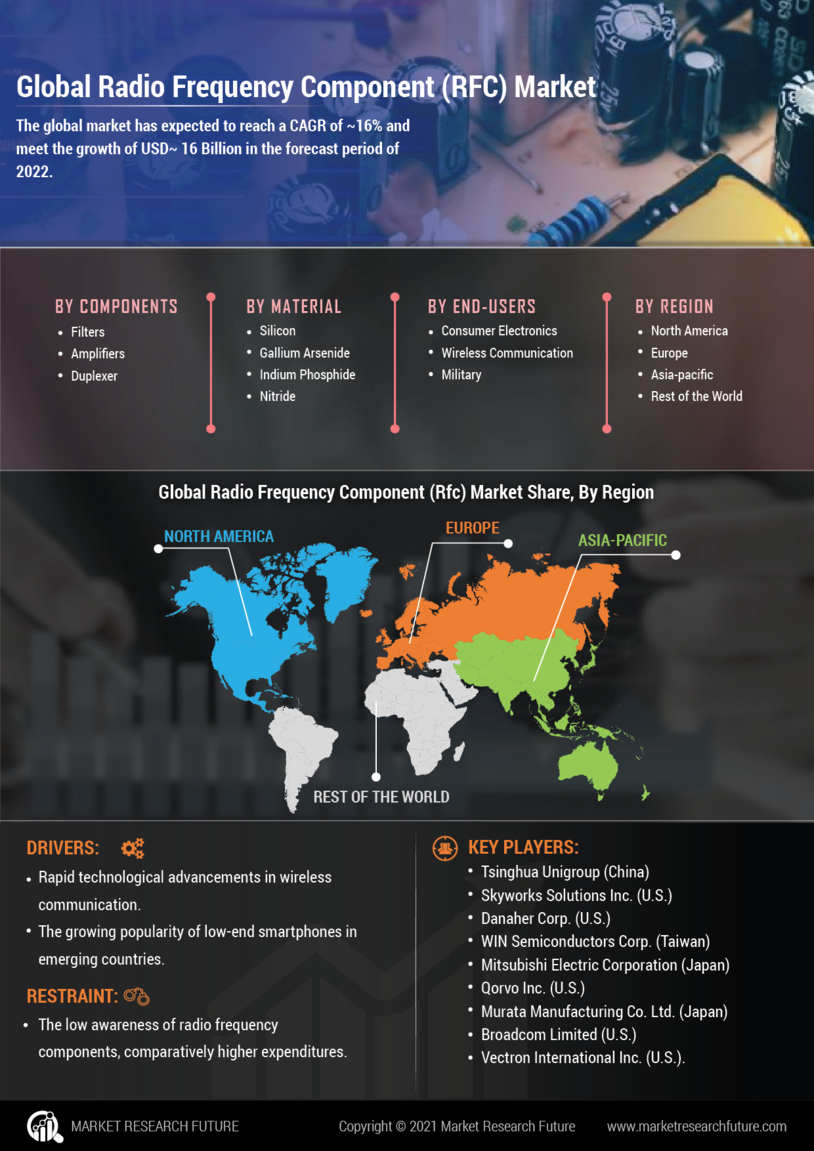
Radio Frequency Component Market Infographic
Purchase Options

Radio Frequency Component Market Summary

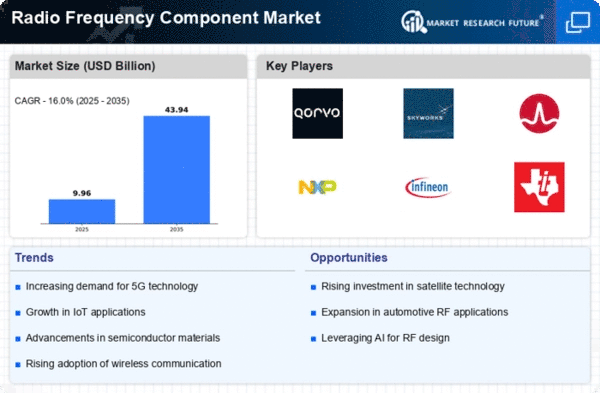
As per MRFR analysis, the Radio Frequency Component Market Size was estimated at 8.59 USD Billion in 2024. The Radio Frequency Component industry is projected to grow from 9.96 USD Billion in 2025 to 43.94 USD Billion by 2035, exhibiting a compound annual growth rate (CAGR) of 16.0 during the forecast period 2025 - 2035.

Key Market Trends & Highlights

The Radio Frequency Component Market is poised for substantial growth driven by technological advancements and increasing demand across various sectors.

  • The market is witnessing a trend towards miniaturization of components, enhancing device portability and performance.
  • Integration of advanced technologies is becoming prevalent, particularly in telecommunications and automotive applications.
  • Sustainability and energy efficiency are gaining traction, influencing design and manufacturing processes across the industry.
  • The increasing demand for wireless communication and the emergence of 5G technology are key drivers propelling growth in North America and Asia-Pacific.

Market Size & Forecast

2024 Market Size 8.59 (USD Billion)
2035 Market Size 43.94 (USD Billion)
CAGR (2025 - 2035) 16.0%

Major Players

Qorvo (US), Skyworks Solutions (US), Broadcom (US), NXP Semiconductors (NL), Infineon Technologies (DE), Texas Instruments (US), Analog Devices (US), STMicroelectronics (CH), Murata Manufacturing (JP)

Radio Frequency Component Market Trends

The Radio Frequency Component Market is currently experiencing a dynamic evolution, driven by advancements in technology and increasing demand across various sectors. The proliferation of wireless communication systems, including mobile devices and IoT applications, has led to a heightened need for efficient and reliable radio frequency components. This market encompasses a wide range of products, including amplifiers, filters, and oscillators, which are essential for ensuring optimal performance in communication systems. As industries continue to innovate, the Radio Frequency Component Market is poised for substantial growth, reflecting the ongoing integration of advanced technologies into everyday applications. Moreover, the market landscape is characterized by a growing emphasis on miniaturization and enhanced functionality. Manufacturers are increasingly focusing on developing compact components that deliver superior performance while minimizing power consumption. This trend aligns with the broader movement towards energy efficiency and sustainability, as companies seek to reduce their environmental footprint. Additionally, the rise of smart technologies and the expansion of 5G networks are likely to further propel the demand for sophisticated radio frequency components, indicating a robust future for this sector. The interplay of these factors suggests that the Radio Frequency Component Market will continue to thrive in the coming years, adapting to the evolving needs of consumers and industries alike.

Miniaturization of Components

The trend towards miniaturization in the Radio Frequency Component Market is becoming increasingly pronounced. Manufacturers are striving to create smaller, more efficient components that do not compromise on performance. This shift is largely driven by the demand for compact devices in consumer electronics and telecommunications, where space is often at a premium.

Integration of Advanced Technologies

The integration of advanced technologies, such as artificial intelligence and machine learning, is influencing the Radio Frequency Component Market. These technologies enable smarter and more adaptive components, enhancing their functionality and performance. As industries adopt these innovations, the demand for sophisticated radio frequency components is expected to rise.

Sustainability and Energy Efficiency

Sustainability is emerging as a key focus within the Radio Frequency Component Market. Manufacturers are increasingly prioritizing energy-efficient designs and materials to meet regulatory standards and consumer expectations. This trend reflects a broader commitment to reducing environmental impact while maintaining high performance in radio frequency applications.

Radio Frequency Component Market Drivers

Advancements in RF Technology

Technological advancements play a pivotal role in shaping the Global Radio Frequency Component Market RFC Market Industry. Innovations in materials and design have led to the development of high-performance RF components that offer improved efficiency and reliability. For instance, the introduction of GaN (Gallium Nitride) technology has enabled the production of RF amplifiers with higher power density and efficiency. This evolution is expected to drive market growth, with projections indicating a market size of 55.4 USD Billion by 2035. As industries increasingly adopt these advanced RF technologies, the demand for sophisticated components is likely to rise, further propelling the market forward.

Emergence of Smart Technologies

The emergence of smart technologies is reshaping the Global Radio Frequency Component Market RFC Market Industry. Smart devices, ranging from wearables to smart appliances, rely heavily on RF components for connectivity and functionality. As consumers increasingly adopt these technologies, the demand for efficient and reliable RF components is likely to rise. This trend is further supported by the growing emphasis on automation and smart solutions across various sectors. The market's growth trajectory, with a projected size of 33.9 USD Billion in 2024, indicates the pivotal role that RF components will play in the proliferation of smart technologies.

Expansion of the Internet of Things (IoT)

The expansion of the Internet of Things IoT is significantly influencing the Global Radio Frequency Component Market RFC Market Industry. As more devices become interconnected, the demand for RF components that facilitate communication between these devices is escalating. This trend is particularly evident in smart home applications, industrial automation, and healthcare monitoring systems. The growing number of IoT devices is expected to contribute to a compound annual growth rate CAGR of 4.57% from 2025 to 2035. Consequently, the market is poised for substantial growth as manufacturers seek to develop RF components that meet the unique requirements of IoT applications.

Growing Demand for Wireless Communication

The Global Radio Frequency Component Market RFC Market Industry is experiencing a surge in demand driven by the increasing reliance on wireless communication technologies. As mobile devices and IoT applications proliferate, the need for efficient RF components becomes paramount. In 2024, the market is projected to reach 33.9 USD Billion, reflecting the critical role of RF components in enabling seamless connectivity. This trend is likely to continue as advancements in 5G technology further enhance the capabilities of wireless communication, thereby expanding the market's potential. The integration of RF components in various sectors, including telecommunications and automotive, underscores their importance in the evolving digital landscape.

Increased Investment in Telecommunications Infrastructure

Investment in telecommunications infrastructure is a key driver of the Global Radio Frequency Component Market RFC Market Industry. Governments and private entities are allocating substantial resources to enhance network capabilities, particularly with the rollout of 5G networks. This investment not only boosts the demand for RF components but also fosters innovation in the sector. As countries strive to improve their telecommunications infrastructure, the market is expected to benefit from increased procurement of RF components. The anticipated growth in market size to 55.4 USD Billion by 2035 underscores the importance of these investments in shaping the future of communication technologies.

Market Segment Insights

By Application: Telecommunications (Largest) vs. Consumer Electronics (Fastest-Growing)

In the Radio Frequency Component Market, the application segment showcases a diverse distribution among various sectors. Telecommunications stands as the largest segment, driven by the increasing demand for mobile communication and 5G technology. Other notable segments include aerospace and defense, which also hold significant shares owing to their critical reliance on RF components for secure communications and navigation systems. Consumer electronics is catching up quickly, fueled by the rising penetration of smart devices and IoT applications.

Telecommunications (Dominant) vs. Consumer Electronics (Emerging)

Telecommunications is the dominant player in the Radio Frequency Component Market, primarily due to the continuous advancements in mobile communication networks. This sector relies heavily on RF components for signal transmission and improves data throughput rates, thus enhancing user experiences. On the other hand, Consumer Electronics is emerging as a significant segment, driven by the proliferation of smart devices such as smartphones, smart TVs, and wearables. The growth in IoT applications further propels the utilization of RF components, as they are essential for seamless connectivity and performance in these devices. As technology evolves, both telecommunications and consumer electronics are set to play pivotal roles in shaping the future landscape of the RF component market.

By Component Type: Amplifiers (Largest) vs. Filters (Fastest-Growing)

In the Radio Frequency Component Market, Amplifiers hold the largest share among component types, driven by their essential role in signal enhancement. Filters follow, characterized as the fastest-growing segment due to rising demand for more precise communication channels to support advanced technologies like 5G and IoT, effectively segregating desired frequencies from unwanted signals. Mixers, Oscillators, and Antennas also contribute to the segment but at a comparatively smaller scale, showcasing significant potential for growth as the market evolves. The growth trends in this segment are propelled by the rapid advancement in wireless communication technologies and increasing consumer demand for high-performance devices. Amplifiers continue to dominate, specifically in mobile and satellite communications, while Filters capitalize on the necessity for improved signal quality and bandwidth efficiency. The integration of RF components into a broader range of applications, including automotive, healthcare, and consumer electronics, indicates a robust momentum across the board in this rapidly growing market.

Amplifiers (Dominant) vs. Filters (Emerging)

Amplifiers are pivotal in the Radio Frequency Component Market, functioning to enhance the strength of signals across various communication systems. Their dominant position can be attributed to a growing reliance on mobile and satellite communication, where signal integrity is paramount. Additionally, advancements in amplifier technologies, such as low-noise amplifiers, have further solidified their market presence. Conversely, Filters, while considered emerging, are rapidly gaining traction thanks to the expansion of wireless applications and the increasing complexity of frequency requirements. The rise of 5G technology demands superior filtering solutions to manage extensive data transmission, thereby enhancing the demand for Filters. As network infrastructure develops, both Amplifiers and Filters are anticipated to complement each other's capabilities, establishing a more robust and efficient RF landscape.

By Frequency Range: Ultra High Frequency (Largest) vs. Microwave (Fastest-Growing)

The Radio Frequency Component Market shows a diverse distribution across its frequency range segments. Low Frequency holds a substantial share, but Ultra High Frequency stands out as the largest segment, favored for its use in telecommunications and broadcasting. Medium Frequency and High Frequency segments also contribute significantly, while Microwave is gaining traction due to its applications in emerging technologies like 5G and IoT, indicating a shift in market preferences.

Ultra High Frequency: Dominant vs. Microwave: Emerging

Ultra High Frequency (UHF) is the dominant player in the Radio Frequency Component Market, primarily used in television broadcasting, mobile communications, and various wireless services, making it a cornerstone of the industry. Its robust applications lead to consistent demand from industries reliant on effective communication systems. On the other hand, Microwave technology is rapidly emerging, drawing attention for its critical role in advanced communication systems, including satellite communications and high-speed data transfers. While UHF benefits from established applications, Microwave’s growth is driven by the increasing need for faster, more efficient data processing and transmission in modern technology.

By End Use: Commercial (Largest) vs. Military (Fastest-Growing)

In the Radio Frequency Component Market, the end use segment is primarily dominated by the commercial sector, which holds the largest market share due to the increasing demand for RF technologies in telecommunications and consumer electronics. This segment encompasses a wide range of applications, including wireless communication systems, broadcasting, and more, indicating significant penetration in everyday commercial activities. Conversely, the military segment, while smaller in market share, is emerging rapidly as a key player because of escalating defense budgets that prioritize advanced communication and radar systems, highlighting a growing emphasis on secure and efficient military operations. As technology evolves, the growth trends within this segment are driven by increasing investments in sectors like telecommunications and defense. The commercial end use benefits from the rapid adoption of 5G technology, which necessitates enhanced RF components for better connectivity and performance. On the other hand, the military segment is fueled by the demand for sophisticated RF solutions for surveillance, reconnaissance, and secure communications, suggesting sustained growth as governments continue to amplify their military capabilities and technological advancements in defense systems.

Commercial (Dominant) vs. Military (Emerging)

The commercial end use in the Radio Frequency Component Market stands as the dominant force, characterized by its extensive applications across various industries, particularly in telecommunications, consumer electronics, and broadcasting. The demand in this sector is largely driven by advancements in technology, leading to an increased requirement for RF components that enhance signal quality and transmission efficiency. In contrast, the military segment represents an emerging force, seeking innovative RF solutions to meet the needs of modern defense systems. This segment is marked by substantial government investment in advanced technologies such as electronic warfare, secure communications, and unmanned aerial vehicles, indicating a shift towards modernized military operations. The interplay between these two segments showcases the dynamic landscape of the RF components market, with commercial operations leading the charge while military applications grow exponentially in significance.

Get more detailed insights about Radio Frequency Component Market

Regional Insights

North America : Market Leader in RF Components

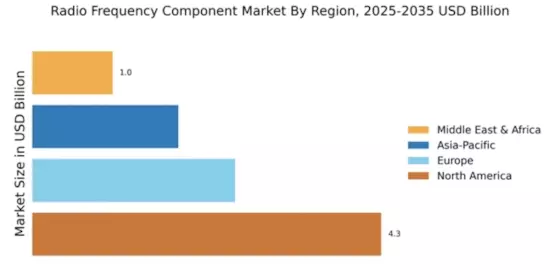
North America is poised to maintain its leadership in the Radio Frequency Component Market, holding a significant market share of 4.5 in 2024. The region's growth is driven by increasing demand for wireless communication technologies, IoT applications, and advancements in 5G infrastructure. Regulatory support and investments in R&D further catalyze market expansion, ensuring a robust environment for innovation and development. The competitive landscape is characterized by major players such as Qorvo, Skyworks Solutions, and Broadcom, which are at the forefront of technological advancements. The U.S. remains the leading country, supported by a strong ecosystem of semiconductor manufacturers and a focus on enhancing communication capabilities. This dynamic environment fosters collaboration and innovation, positioning North America as a key player in the global market.

Europe : Emerging Market with Growth Potential

Europe is witnessing a growing demand for Radio Frequency Components, with a market size of 2.5 in 2024. The region's growth is fueled by the increasing adoption of wireless technologies, smart devices, and the push for sustainable energy solutions. Regulatory frameworks promoting digital transformation and green technologies are significant catalysts for market growth, enhancing the region's competitive edge in the global landscape. Leading countries such as Germany, France, and the UK are at the forefront of this expansion, supported by key players like NXP Semiconductors and Infineon Technologies. The competitive landscape is evolving, with a focus on innovation and collaboration among industry stakeholders. As Europe continues to invest in advanced technologies, it is well-positioned to capture a larger share of the global market.

Asia-Pacific : Rapid Growth in Emerging Markets

Asia-Pacific is emerging as a significant player in the Radio Frequency Component Market, with a market size of 1.9 in 2024. The region's growth is driven by rapid urbanization, increasing smartphone penetration, and the expansion of 5G networks. Government initiatives aimed at enhancing digital infrastructure and promoting technological innovation are key factors propelling market demand in this dynamic region. Countries like China, Japan, and South Korea are leading the charge, supported by major companies such as Murata Manufacturing and Analog Devices. The competitive landscape is characterized by a mix of established players and innovative startups, fostering a vibrant ecosystem for growth. As the region continues to invest in advanced communication technologies, it is set to play a crucial role in The Radio Frequency Component.

Middle East and Africa : Emerging Market with Untapped Potential

The Middle East and Africa region is gradually emerging in the Radio Frequency Component Market, with a market size of 0.69 in 2024. The growth is driven by increasing investments in telecommunications infrastructure and the rising demand for wireless communication solutions. Regulatory initiatives aimed at enhancing connectivity and digital transformation are pivotal in shaping the market landscape, providing a foundation for future growth. Countries such as South Africa and the UAE are leading the way, with a focus on improving communication networks and fostering technological advancements. The competitive landscape is still developing, with opportunities for both local and international players to establish a presence. As the region continues to evolve, it holds significant potential for growth in the RF component sector.

Key Players and Competitive Insights

The Radio Frequency Component Market is currently characterized by a dynamic competitive landscape, driven by the increasing demand for wireless communication technologies and the proliferation of IoT devices. Key players such as Qorvo (US), Skyworks Solutions (US), and Broadcom (US) are strategically positioned to leverage their technological expertise and extensive product portfolios. Qorvo (US) focuses on innovation in RF solutions, particularly in the areas of 5G and IoT, while Skyworks Solutions (US) emphasizes partnerships with major smartphone manufacturers to enhance its market reach. Broadcom (US), on the other hand, is concentrating on mergers and acquisitions to expand its capabilities in RF components, thereby shaping a competitive environment that is increasingly reliant on technological advancement and strategic collaborations.

The business tactics employed by these companies include localizing manufacturing and optimizing supply chains to enhance operational efficiency. The market structure appears moderately fragmented, with several key players exerting considerable influence. This fragmentation allows for a diverse range of products and solutions, fostering competition that drives innovation and responsiveness to market demands.

In November 2025, Qorvo (US) announced a strategic partnership with a leading telecommunications provider to develop advanced RF solutions for 5G networks. This collaboration is likely to enhance Qorvo's position in the market by enabling it to deliver cutting-edge technology that meets the growing demands of high-speed connectivity. The partnership underscores the importance of aligning with industry leaders to drive innovation and capture market share.

In October 2025, Skyworks Solutions (US) launched a new line of RF components specifically designed for IoT applications, targeting the burgeoning smart home market. This strategic move not only diversifies Skyworks' product offerings but also positions the company to capitalize on the increasing adoption of IoT devices. By focusing on this high-growth segment, Skyworks is likely to strengthen its competitive edge and drive revenue growth.

In September 2025, Broadcom (US) completed the acquisition of a smaller RF component manufacturer, enhancing its technological capabilities and expanding its product portfolio. This acquisition is indicative of Broadcom's strategy to consolidate its position in the market and leverage synergies to improve operational efficiencies. Such strategic actions are essential for maintaining competitiveness in an evolving landscape.

As of December 2025, the Radio Frequency Component Market is witnessing trends such as digitalization, sustainability, and the integration of AI technologies. These trends are reshaping the competitive landscape, with companies increasingly forming strategic alliances to enhance their technological capabilities and market presence. The shift from price-based competition to a focus on innovation, technology, and supply chain reliability is becoming evident. Moving forward, competitive differentiation will likely hinge on the ability to innovate and adapt to rapidly changing market conditions.

Key Companies in the Radio Frequency Component Market market include

Industry Developments

Recent changes in the Global Radio Frequency Component Market (RFC) Market have shown that key players are making big moves and growing quickly. Qorvo said in October 2023 that it would be expanding its semiconductor solutions to improve connectivity in 5G and IoT applications. This move strengthened its position in the market. Skyworks Solutions also showed off new RF front-end modules in September 2023. These modules are meant to meet the growing need for advanced communication technologies in mobile and wireless infrastructure.

Broadcom has also put more effort into improving its RF capabilities through internal R&D and technology integration, which keeps it a major player in the market. Reports say that NXP Semiconductors added to its RF portfolio in August 2023, but no specific acquisition has been officially confirmed during that time. 

Murata Manufacturing has also been working hard to increase its manufacturing capacity to meet the growing demand for RF applications in cars and mobile devices, especially in Asia. The market value of top companies like Texas Instruments and Analog Devices (which bought Maxim Integrated in August 2021) keeps going up, which is good for the overall RFC market. In the last two years, the faster adoption of 5G technology has been a big reason for new ideas and investments in RF components around the world. Trends suggest that this growth will continue through 2025 and beyond.

Future Outlook

Radio Frequency Component Market Future Outlook

The Radio Frequency Component Market is projected to grow at a 16.0% CAGR from 2024 to 2035, driven by advancements in telecommunications, IoT, and automotive technologies.

New opportunities lie in:

  • Development of 5G infrastructure components for urban areas.
  • Expansion into emerging markets with tailored RF solutions.
  • Integration of RF components in smart home devices for enhanced connectivity.

By 2035, the market is expected to achieve substantial growth, reflecting evolving technological demands.

Market Segmentation

Radio Frequency Component Market End Use Outlook

  • Commercial
  • Industrial
  • Military
  • Healthcare
  • Research

Radio Frequency Component Market Application Outlook

  • Telecommunications
  • Aerospace
  • Defense
  • Consumer Electronics
  • Automotive

Radio Frequency Component Market Component Type Outlook

  • Amplifiers
  • Filters
  • Mixers
  • Oscillators
  • Antennas

Radio Frequency Component Market Frequency Range Outlook

  • Low Frequency
  • Medium Frequency
  • High Frequency
  • Ultra High Frequency
  • Microwave

Report Scope

MARKET SIZE 20248.59(USD Billion)
MARKET SIZE 20259.96(USD Billion)
MARKET SIZE 203543.94(USD Billion)
COMPOUND ANNUAL GROWTH RATE (CAGR)16.0% (2024 - 2035)
REPORT COVERAGERevenue Forecast, Competitive Landscape, Growth Factors, and Trends
BASE YEAR2024
Market Forecast Period2025 - 2035
Historical Data2019 - 2024
Market Forecast UnitsUSD Billion
Key Companies ProfiledQorvo (US), Skyworks Solutions (US), Broadcom (US), NXP Semiconductors (NL), Infineon Technologies (DE), Texas Instruments (US), Analog Devices (US), STMicroelectronics (CH), Murata Manufacturing (JP)
Segments CoveredApplication, Component Type, Frequency Range, End Use
Key Market OpportunitiesIntegration of advanced materials enhances performance in the Radio Frequency Component Market.
Key Market DynamicsTechnological advancements drive demand for Radio Frequency Components, influencing competitive dynamics and supply chain strategies.
Countries CoveredNorth America, Europe, APAC, South America, MEA

Market Highlights

Author
Aarti Dhapte
Team Lead - Research

She holds an experience of about 6+ years in Market Research and Business Consulting, working under the spectrum of Information Communication Technology, Telecommunications and Semiconductor domains. Aarti conceptualizes and implements a scalable business strategy and provides strategic leadership to the clients. Her expertise lies in market estimation, competitive intelligence, pipeline analysis, customer assessment, etc.

Leave a Comment

FAQs

What is the estimated market size of the Global Radio Frequency Component (RFC) Market in 2024?

The estimated market size of the Global Radio Frequency Component (RFC) Market in 2024 is valued at approximately 33.88 USD billion.

What is the projected market size for the Global Radio Frequency Component (RFC) Market by 2035?

By 2035, the projected market size for the Global Radio Frequency Component (RFC) Market is expected to reach around 55.4 USD billion.

What is the expected CAGR for the Global Radio Frequency Component (RFC) Market between 2024 and 2035?

The expected CAGR for the Global Radio Frequency Component (RFC) Market from 2025 to 2035 is 4.57%.

Which region is anticipated to have the largest market share for the Global Radio Frequency Component (RFC) Market in 2024?

North America is anticipated to have the largest market share for the Global Radio Frequency Component (RFC) Market in 2024, valued at approximately 15.05 USD billion.

How is the Global Radio Frequency Component (RFC) Market expected to grow in the Asia Pacific region by 2035?

By 2035, the Global Radio Frequency Component (RFC) Market in the Asia Pacific region is expected to grow to approximately 9.81 USD billion.

What is the market size for the telecommunications application in 2024?

The market size for the telecommunications application in the Global Radio Frequency Component (RFC) Market is valued at around 12.0 USD billion in 2024.

What are the key competitors in the Global Radio Frequency Component (RFC) Market?

Key competitors in the Global Radio Frequency Component (RFC) Market include Skyworks Solutions, Broadcom, Littelfuse, AVX Corporation, and NXP Semiconductors.

What is the market value for consumer electronics applications in 2035?

The market value for the consumer electronics application in the Global Radio Frequency Component (RFC) Market is expected to be around 16.0 USD billion by 2035.

What growth rate is anticipated for the automotive application segment from 2025 to 2035?

The automotive application segment is expected to grow from around 6.0 USD billion in 2024 to approximately 9.0 USD billion by 2035.

What challenges may impact the Global Radio Frequency Component (RFC) Market in the coming years?

Challenges that may impact the Global Radio Frequency Component (RFC) Market include technological advancements and increased competition among key players.

Download Free Sample

Kindly complete the form below to receive a free sample of this Report

Compare Licence

×
Features License Type
Single User Multiuser License Enterprise User
Price $4,950 $5,950 $7,250
Maximum User Access Limit 1 User Upto 10 Users Unrestricted Access Throughout the Organization
Free Customization
Direct Access to Analyst
Deliverable Format
Platform Access
Discount on Next Purchase 10% 15% 15%
Printable Versions