×
Hero Background
English
Chinese
French
Japanese
Korean
German
Spanish

Radio Transmitter Market Size

ID: MRFR/SEM/5933-HCR
100 Pages
Aarti Dhapte
October 2025

Radio Transmitter Market Research Report, by technology (Analog, Digital), Power Capacity (Upto 5 kW, 5-20 kW, above 20 kW), Type (Shortwave Radio Transmitter, Medium Wave Transmitter, VHF Radio Transmitter), End-User (Aerospace & Defense, Automotive, Electronic, Others) — Forecast till 2035

Share:
Download PDF ×

We do not share your information with anyone. However, we may send you emails based on your report interest from time to time. You may contact us at any time to opt-out.

Radio Transmitter Market Infographic
Purchase Options

Radio Transmitter Size

Radio Transmitter Market Growth Projections and Opportunities

The radio transmitter market is a dynamic landscape influenced by various market factors that shape its trajectory. These factors determine radio transmitter technologies' demand, supply, and growth. One of the key drivers in this market is the increasing demand for wireless communication across industries. As businesses and consumers seek seamless and efficient communication, the need for advanced radio transmitter solutions rises. This demand is further fueled by the expanding Internet of Things (IoT) ecosystem, where interconnected devices rely on robust radio transmission capabilities. Moreover, technological advancements and innovations contribute significantly to market dynamics. As new and improved radio transmitter technologies emerge, businesses and industries are prompted to upgrade their existing systems, fostering market growth. The ongoing development of digital radio transmitters, for instance, enhances the signal quality and transmission efficiency, addressing the evolving needs of users. Government regulations and policies also play a crucial role in shaping the radio transmitter market. Compliance with spectrum regulations and licensing requirements is imperative for manufacturers and users alike. Changes in regulatory frameworks can impact market dynamics, influencing product development strategies and market entry barriers. Therefore, staying abreast of regulatory developments is essential for stakeholders in the radio transmitter industry. Global economic conditions are another determinant of the market's performance. Economic growth and stability can lead to increased investments in communication infrastructure, positively impacting the demand for radio transmitters. Conversely, economic downturns may result in budget constraints, affecting spending on technology upgrades. Competitive forces within the industry contribute to market dynamics as well. The presence of established players, emerging competitors, and technological disruptors all shape the competitive landscape. Market competition often drives innovation and product differentiation, offering consumers diverse options and fostering continuous advancements in radio transmitter technologies. Customer preferences and evolving market trends also influence the radio transmitter market. As end-users seek more portable, energy-efficient, and feature-rich solutions, manufacturers respond with products that align with these preferences. Additionally, the growing popularity of wireless audio streaming and broadcasting services contributes to the demand for high-quality radio transmitters. Environmental considerations are gaining prominence in the market as well. The shift towards eco-friendly and sustainable technologies prompts manufacturers to develop energy-efficient and environmentally conscious radio transmitters. This trend reflects a broader industry effort to reduce the environmental impact of electronic devices. Furthermore, partnerships and collaborations between industry players contribute to market growth. Strategic alliances can facilitate the exchange of technological know-how, expand market reach, and drive joint research and development initiatives. These collaborations enhance the overall capabilities of the market and promote a collaborative approach to addressing industry challenges.

Radio Transmitter Market Size Graph
Author
Aarti Dhapte
Team Lead - Research

She holds an experience of about 6+ years in Market Research and Business Consulting, working under the spectrum of Information Communication Technology, Telecommunications and Semiconductor domains. Aarti conceptualizes and implements a scalable business strategy and provides strategic leadership to the clients. Her expertise lies in market estimation, competitive intelligence, pipeline analysis, customer assessment, etc.

Leave a Comment

FAQs

What is the market’s expectation on the parameters of growth in the furture?

The global radio transmitter market will be achieving USD 1.12 billion by 2032, at a CAGR of 8.82% in the future.

What is making the market to rise high in the future?

Rise in smartphones, digitization of radio stations, and technological advancement in FM radio transmitters are making the market to rise high in the future.

Who are the top four key players investing in the market’s growth process?

GatesAir (US), Broadcast Electronics (US), Nautel Ltd. (Canada), RIZ-Transmitters Co. (Croatia) are the top four key players investing in the market’s growth.

What are the segments included in the study of the market?

Technology, power capacity, application, end-user are the segments of the market included in the study.

Define the key regions mentioned in the study of the market.

North America, Europe, Asia-Pacific and the Rest of the World are the key regions being studied in the market study.

Market Summary

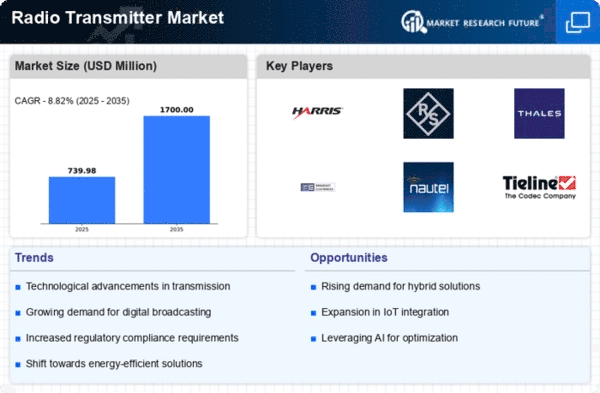
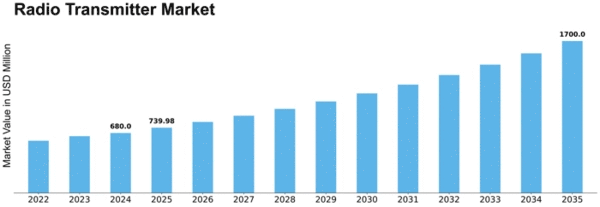
As per MRFR analysis, the Radio Transmitter Market Size was estimated at 680.0 USD Million in 2024. The Radio Transmitter industry is projected to grow from 732.0 in 2025 to 1700.0 by 2035, exhibiting a compound annual growth rate (CAGR) of 8.82 during the forecast period 2025 - 2035.

Key Market Trends & Highlights

The Radio Transmitter Market is poised for growth driven by technological advancements and increasing demand for broadcasting services.

  • Technological advancements are reshaping the Radio Transmitter Market, enhancing efficiency and performance.
  • North America remains the largest market, while the Asia-Pacific region is recognized as the fastest-growing area for radio transmitters.
  • The Broadcasting segment continues to dominate the market, whereas the Communication segment is experiencing rapid growth.
  • Key drivers include the increasing demand for broadcasting services and the emergence of digital radio technologies.

Market Size & Forecast

2024 Market Size 680.0 (USD Million)
2035 Market Size 1700.0 (USD Million)
CAGR (2025 - 2035) 8.82%
Largest Regional Market Share in 2024 North America

Major Players

<p>Harris Corporation (US), Rohde & Schwarz (DE), Thales Group (FR), Broadcast Electronics (US), Nautel (CA), GatesAir (US), Tieline Technology (AU), Syes (ES), Airsys (BR)</p>

Market Trends

The Radio Transmitter Market is currently experiencing a transformative phase, driven by advancements in technology and the increasing demand for high-quality broadcasting solutions. As the world becomes more interconnected, the need for reliable communication systems has intensified. This market appears to be evolving rapidly, with innovations in digital transmission methods and the integration of smart technologies. Furthermore, the rise of internet-based broadcasting platforms is reshaping traditional broadcasting paradigms, compelling manufacturers to adapt their offerings to meet new consumer expectations. In addition, regulatory changes and the push for more efficient spectrum utilization are influencing market dynamics. Governments are increasingly focusing on optimizing frequency allocations, which may lead to new opportunities for growth within the Radio Transmitter Market. The emphasis on sustainability and energy efficiency is also becoming more pronounced, as stakeholders seek to minimize environmental impacts. Overall, the market seems poised for continued expansion, with various factors converging to create a vibrant landscape for both established players and new entrants.

Technological Advancements

The Radio Transmitter Market is witnessing rapid technological advancements, particularly in digital transmission and smart broadcasting solutions. These innovations enhance signal quality and reliability, catering to the evolving needs of consumers.

Regulatory Changes

Ongoing regulatory changes are shaping the Radio Transmitter Market, as governments strive to optimize frequency allocations and promote efficient spectrum use. This trend may create new opportunities for market participants.

Sustainability Focus

There is a growing emphasis on sustainability within the Radio Transmitter Market, with stakeholders increasingly prioritizing energy-efficient solutions. This focus on environmental responsibility could drive innovation and reshape product offerings.

Radio Transmitter Market Market Drivers

Technological Advancements

The Global Radio Transmitter Market Industry is experiencing a surge in technological advancements, particularly in digital transmission technologies. Innovations such as software-defined radio (SDR) and digital audio broadcasting (DAB) are enhancing the efficiency and quality of radio transmissions. These technologies allow for better spectrum utilization and improved audio quality, which are crucial for meeting the demands of modern listeners. As a result, the market is projected to grow from 0.56 USD Billion in 2024 to 1.44 USD Billion by 2035, indicating a robust growth trajectory driven by these advancements.

Regulatory Support and Standards

Regulatory frameworks and standards play a crucial role in shaping the Global Radio Transmitter Market Industry. Governments worldwide are establishing guidelines that promote the adoption of advanced broadcasting technologies while ensuring spectrum efficiency. For instance, initiatives aimed at transitioning from analog to digital broadcasting are gaining traction, which not only enhances transmission quality but also optimizes frequency usage. This regulatory support is likely to stimulate market growth, as it encourages investment in new technologies and infrastructure, thereby contributing to the projected market expansion.

Emerging Markets and Urbanization

Emerging markets and urbanization are pivotal factors driving the Global Radio Transmitter Market Industry. As urban populations grow, there is an increasing need for reliable communication channels, including radio broadcasting. Countries in Asia and Africa are witnessing rapid urbanization, leading to a surge in demand for radio services that cater to urban audiences. This demographic shift is likely to propel market growth, with the industry expected to experience a CAGR of 9.02% from 2025 to 2035, as new markets open up for radio broadcasters.

Expansion of Internet Connectivity

The expansion of internet connectivity is significantly impacting the Global Radio Transmitter Market Industry. As internet access becomes more widespread, particularly in developing regions, the integration of internet-based radio services is on the rise. This trend is fostering a hybrid model where traditional radio and internet broadcasting coexist, enhancing listener engagement. The market is expected to benefit from this convergence, with a projected growth from 0.56 USD Billion in 2024 to 1.44 USD Billion by 2035, as more consumers turn to diverse platforms for their audio content.

Increasing Demand for Broadcasting Services

The demand for broadcasting services is a primary driver of the Global Radio Transmitter Market Industry. With the proliferation of digital content and the rise of internet radio, traditional broadcasting remains a vital medium for information dissemination. This demand is further fueled by the need for localized content, which radio provides effectively. As audiences continue to seek diverse programming, the market is poised for growth, with projections indicating a compound annual growth rate (CAGR) of 9.02% from 2025 to 2035, reflecting the enduring relevance of radio in the media landscape.

Market Segment Insights

By Application: Broadcasting (Largest) vs. Communication (Fastest-Growing)

<p>In the Radio Transmitter Market, the application segment showcases diverse values including Broadcasting, Communication, Emergency Services, Military, and Aerospace. Broadcasting holds the largest market share, driven by its established role in delivering radio signals to consumers across various platforms. Communication applications follow closely, relying on transmitters for effective data transfer in personal and business contexts, positioning themselves as a significant contributor to the market.</p>

<p>Broadcasting (Dominant) vs. Communication (Emerging)</p>

<p>Broadcasting remains the dominant application in the Radio Transmitter Market, primarily due to its extensive infrastructure and historical significance in media dissemination. Traditional radio stations and newer streaming services utilize broadcasting transmitters for high-quality signal distribution. In contrast, the Communication sector represents an emerging segment, fueled by the growing demand for wireless connectivity across industries. This segment leverages advanced technology for data and voice transmission, enhancing overall communication efficiency. As businesses and individuals increasingly rely on seamless communication, this sector is poised for rapid expansion.</p>

By End Use: Commercial (Largest) vs. Government (Fastest-Growing)

<p>The Radio Transmitter Market is characterized by a diverse range of end-use segments, with commercial applications accounting for the largest share. This segment includes various broadcasting organizations and telecommunication companies, which heavily rely on advanced radio transmitter technology to deliver content and maintain communication lines. In contrast, the government segment, although smaller, is rapidly gaining traction as an essential area for growth. Government bodies utilize radio transmitters for emergency services, public safety communications, and defense operations, making this segment critical for national infrastructure.</p>

<p>Commercial: Dominant vs. Government: Emerging</p>

<p>In the Radio Transmitter Market, the commercial segment stands out as the dominant player, largely driven by the increasing demand for broadcasting services and the expansion of telecommunication networks. Commercial enterprises frequently upgrade their transmitter systems to accommodate higher frequencies and enhanced functionalities, ensuring optimal performance in diverse environments. On the other hand, the government segment is emerging as a key area of interest due to rising investments in public safety and defense communications. Governments are increasingly implementing sophisticated communication systems powered by high-quality radio transmitters to ensure efficient emergency responses and secure information dissemination. In summary, while commercial applications continue to lead the market, governmental use is positioned for notable growth.</p>

By Technology: Digital (Largest) vs. Software Defined (Fastest-Growing)

<p>The Radio Transmitter Market showcases a diverse technology landscape, primarily dominated by Digital transmitters, which hold a significant portion of the market share. Analog transmitters have gradually declined in prevalence as the industry shifts towards more advanced digital solutions. Meanwhile, Software Defined technology has gained traction, appealing to organizations looking for flexibility and adaptability in their broadcasting capabilities. This technological shift not only marks a transition towards superior audio quality but also reflects changing user preferences for modern broadcasting standards. As the demand for streaming and high-definition content surges, the market is witnessing robust growth in Software Defined technologies, which are designed to enhance efficiency and operational capabilities. This segment thrives on its ability to adapt quickly to technological advancements and audience demands, positioning itself as a crucial player in the evolving broadcast landscape. The increased adoption of flexible broadcasting systems is likely to propel this technology’s growth further, indicating a bright future ahead for the Software Defined transmitters in the Radio Transmitter Market.</p>

<p>Technology: Digital (Dominant) vs. Analog (Emerging)</p>

<p>Digital transmitters represent the dominant force in the Radio Transmitter Market due to their unparalleled audio fidelity and advanced features, making them the preferred choice for broadcasters seeking to deliver high-quality content. This technology integrates aspects such as data transmission and facilitates high-definition sound, setting new benchmarks for audio quality in multimedia broadcasting. Conversely, Analog transmitters, although in decline, are carving a niche for specific applications and localized broadcasting. They are seen as reliable in areas with limited technological advancements, serving as an entry point for smaller, independent broadcasters. While Digital remains at the forefront, the resilience of Analog technology cannot be overlooked, as it provides essential services in underserved markets.</p>

By Frequency Range: Very High Frequency (Largest) vs. Low Frequency (Fastest-Growing)

<p>The Radio Transmitter Market displays a distinct share distribution among the frequency ranges. The Very High Frequency (VHF) segment commands the largest share, attributed to its widespread applications in communication and broadcasting. Following VHF is the High Frequency (HF) segment, which serves a significant role in long-distance communication. Low Frequency (LF) and Medium Frequency (MF) segments also capture notable shares, but with LF emerging rapidly due to its advantages in rural broadcasting and automated systems.</p>

<p>Low Frequency (Emerging) vs. High Frequency (Dominant)</p>

<p>Low Frequency (LF) transmitters are increasingly becoming essential in the radio transmitter market due to their superior coverage capabilities, particularly in rural and remote areas. This segment is recognized for its rapid growth, driven by technological advancements and an expanding demand for communication solutions in developing regions. Conversely, the High Frequency (HF) segment remains dominant due to its established use in international broadcasting and maritime services. HF transmitters are valued for their reliability and superior signal quality over long distances, catering well to both commercial and governmental needs. As the market evolves, LF may catch up, but HF's established position ensures it continues to lead in various applications.</p>

By Power Output: High Power (Largest) vs. Medium Power (Fastest-Growing)

<p>In the Radio Transmitter Market, the power output segment is primarily divided into low power, medium power, and high power transmitters. Among these, high power transmitters account for the largest share, as they are essential for long-range broadcasting. Medium power transmitters, while smaller in market share, are gaining traction due to their efficiency in regional broadcasting, catering to the growing demand for local content.</p>

<p>High Power (Dominant) vs. Medium Power (Emerging)</p>

<p>High power transmitters are designed for extensive coverage and are commonly used by major broadcasters to reach vast audiences, making them the dominant force in the market. These transmitters are characterized by their robust design and ability to function effectively over longer distances. Conversely, medium power transmitters represent an emerging segment, offering a balance between coverage and operational cost. They are increasingly favored for niche markets and regional broadcasts where high power transmitters may be unnecessary. This shift highlights a trend towards more localized content delivery, aligning with consumer preferences for customized audio experiences.</p>

Get more detailed insights about Radio Transmitter Market Research Report – Global Forecast till 2035

Regional Insights

North America : Market Leader in Innovation

North America continues to lead the Radio Transmitter Market, holding a significant share of 340.0M in 2024. The region's growth is driven by advancements in broadcasting technology, increasing demand for high-quality audio transmission, and supportive regulatory frameworks. The Federal Communications Commission (FCC) has implemented policies that encourage innovation and investment in broadcasting infrastructure, further propelling market expansion. The competitive landscape is robust, with key players like Harris Corporation, GatesAir, and Nautel dominating the market. The U.S. remains the largest contributor, followed by Canada, which is also witnessing growth in digital broadcasting. The presence of established companies fosters a competitive environment, driving technological advancements and enhancing service offerings, ensuring North America's continued leadership in the global market.

Europe : Emerging Regulatory Frameworks

Europe's Radio Transmitter Market is valued at 180.0M, reflecting a growing demand for efficient broadcasting solutions. The region is experiencing a shift towards digital transmission, driven by regulatory changes aimed at improving broadcast quality and spectrum efficiency. The European Union's initiatives to harmonize broadcasting standards across member states are expected to further stimulate market growth, enhancing competitiveness and innovation in the sector. Leading countries such as Germany, France, and the UK are at the forefront of this transformation, with companies like Rohde & Schwarz and Thales Group playing pivotal roles. The competitive landscape is characterized by a mix of established firms and emerging players, all striving to meet the evolving demands of the market. This dynamic environment is fostering innovation and collaboration, positioning Europe as a key player in The Radio Transmitter.

Asia-Pacific : Rapid Growth in Broadcasting

The Asia-Pacific region, with a market size of 130.0M, is witnessing rapid growth in the Radio Transmitter Market, driven by increasing investments in broadcasting infrastructure and rising consumer demand for diverse media content. Countries like China and India are leading this growth, supported by government initiatives aimed at expanding digital broadcasting capabilities. The region's regulatory bodies are also promoting the adoption of advanced technologies, which is expected to further enhance market dynamics. The competitive landscape is evolving, with both local and international players vying for market share. Companies such as Tieline Technology and Syes are making significant inroads, while established firms continue to innovate. The presence of a diverse range of broadcasters and content providers is driving competition, leading to improved service offerings and technological advancements in the region.

Middle East and Africa : Untapped Market Potential

The Middle East and Africa region, with a market size of 30.0M, presents significant growth opportunities in the Radio Transmitter Market. The demand for broadcasting services is on the rise, driven by increasing urbanization and a growing middle class. Governments in the region are recognizing the importance of media and communication, leading to investments in broadcasting infrastructure and regulatory reforms that support market growth. Countries like South Africa and the UAE are emerging as key players in the market, with local companies and international firms collaborating to enhance broadcasting capabilities. The competitive landscape is characterized by a mix of established broadcasters and new entrants, all aiming to capture the growing audience. This dynamic environment is expected to foster innovation and improve service delivery in the region.

Key Players and Competitive Insights

The Radio Transmitter Market is currently characterized by a dynamic competitive landscape, driven by technological advancements and increasing demand for high-quality broadcasting solutions. Key players such as Harris Corporation (US), Rohde & Schwarz (DE), and Thales Group (FR) are strategically positioned to leverage innovation and regional expansion to enhance their market presence. Harris Corporation (US) focuses on integrating advanced digital technologies into their transmitter solutions, while Rohde & Schwarz (DE) emphasizes partnerships with local broadcasters to tailor their offerings to specific regional needs. Thales Group (FR) is actively pursuing mergers and acquisitions to consolidate its market position, indicating a trend towards a more concentrated competitive environment.

In terms of business tactics, companies are increasingly localizing manufacturing and optimizing supply chains to reduce costs and improve service delivery. The market appears moderately fragmented, with several players vying for market share, yet the collective influence of major companies is shaping a more cohesive competitive structure. This fragmentation allows for niche players to thrive, while larger corporations capitalize on economies of scale and technological advancements.

In November 2025, Rohde & Schwarz (DE) announced the launch of its latest line of energy-efficient transmitters, which are designed to reduce operational costs for broadcasters. This strategic move not only aligns with the growing emphasis on sustainability but also positions the company as a leader in eco-friendly broadcasting solutions. The introduction of these transmitters is likely to attract environmentally conscious clients, thereby enhancing Rohde & Schwarz's competitive edge.

In October 2025, Thales Group (FR) completed the acquisition of a regional broadcasting technology firm, which is expected to bolster its capabilities in the digital transmission space. This acquisition reflects Thales's commitment to expanding its technological portfolio and enhancing its service offerings. By integrating the acquired firm's innovative technologies, Thales Group aims to provide more comprehensive solutions to its clients, thereby strengthening its market position.

In September 2025, GatesAir (US) launched a new cloud-based management platform for radio transmitters, which allows broadcasters to monitor and control their operations remotely. This strategic initiative underscores the growing trend towards digitalization in the industry, as broadcasters seek to enhance operational efficiency and reduce downtime. GatesAir's focus on cloud technology may provide it with a competitive advantage as the market increasingly shifts towards integrated digital solutions.

As of December 2025, the Radio Transmitter Market is witnessing trends such as digitalization, sustainability, and the integration of AI technologies. Strategic alliances among key players are shaping the competitive landscape, fostering innovation and collaboration. The shift from price-based competition to a focus on technological advancement and supply chain reliability is becoming increasingly evident. Companies that prioritize innovation and sustainability are likely to differentiate themselves in this evolving market, suggesting a future where competitive advantage hinges on technological prowess rather than cost alone.

Key Companies in the Radio Transmitter Market market include

Industry Developments

February 2023 - 

In February 2023, GatesAir signed a partnership and distribution deal to supply Transmitters for ATSC 3.0 Research and Testing in Canada to expand its business horizons.

October 2023 - 

In October 2023, Broadcast Electronics introduced a generation next version of Radio Experience with TREplus.

Radio Transmitter Market Segment Overview 

Radio Transmitter Market by Type 

    • Digital
    • Analog

Radio Transmitter Market by Application 

    • FM Radio Transmitter Market
    • Television Transmitter

Radio Transmitter Market by End-user

    • Automotive
    • Aerospace & Defense
    • Consumer Electronics
    • Others

By Region

The U.S.

    • Canada
    • North America
    • Mexico

Europe

    • the UK
    • France
    • Germany
    • Rest of Europe
    • Italy

Asia-Pacific

    • Japan
    • India
    • South Korea
    • China
    • Rest of Asia-Pacific
    • Latin America
    • the Middle East
    • LAMEA
    • Africa

Future Outlook

Radio Transmitter Market Future Outlook

<p>The Radio Transmitter Market is projected to grow at an 8.82% CAGR from 2024 to 2035, driven by technological advancements, increasing demand for broadcasting, and the expansion of communication networks.</p>

New opportunities lie in:

  • <p>Development of integrated digital broadcasting solutions</p>
  • <p>Expansion into emerging markets with tailored transmitter designs</p>
  • <p>Investment in renewable energy-powered transmitter stations</p>

<p>By 2035, the market is expected to achieve robust growth, solidifying its position in the global communications landscape.</p>

Market Segmentation

Radio Transmitter Market End Use Outlook

  • Commercial
  • Government
  • Industrial
  • Residential

Radio Transmitter Market Technology Outlook

  • Analog
  • Digital
  • Software Defined
  • Hybrid

Radio Transmitter Market Application Outlook

  • Broadcasting
  • Communication
  • Emergency Services
  • Military
  • Aerospace

Radio Transmitter Market Power Output Outlook

  • Low Power
  • Medium Power
  • High Power

Radio Transmitter Market Frequency Range Outlook

  • Low Frequency
  • Medium Frequency
  • High Frequency
  • Very High Frequency

Report Scope

MARKET SIZE 2024680.0(USD Million)
MARKET SIZE 2025732.0(USD Million)
MARKET SIZE 20351700.0(USD Million)
COMPOUND ANNUAL GROWTH RATE (CAGR)8.82% (2024 - 2035)
REPORT COVERAGERevenue Forecast, Competitive Landscape, Growth Factors, and Trends
BASE YEAR2024
Market Forecast Period2025 - 2035
Historical Data2019 - 2024
Market Forecast UnitsUSD Million
Key Companies ProfiledHarris Corporation (US), Rohde & Schwarz (DE), Thales Group (FR), Broadcast Electronics (US), Nautel (CA), GatesAir (US), Tieline Technology (AU), Syes (ES), Airsys (BR)
Segments CoveredApplication, End Use, Technology, Frequency Range, Power Output
Key Market OpportunitiesIntegration of advanced digital technologies enhances efficiency in the Radio Transmitter Market.
Key Market DynamicsTechnological advancements and regulatory changes drive innovation and competition in the Radio Transmitter Market.
Countries CoveredNorth America, Europe, APAC, South America, MEA

FAQs

What is the market’s expectation on the parameters of growth in the furture?

The global radio transmitter market will be achieving USD 1.12 billion by 2032, at a CAGR of 8.82% in the future.

What is making the market to rise high in the future?

Rise in smartphones, digitization of radio stations, and technological advancement in FM radio transmitters are making the market to rise high in the future.

Who are the top four key players investing in the market’s growth process?

GatesAir (US), Broadcast Electronics (US), Nautel Ltd. (Canada), RIZ-Transmitters Co. (Croatia) are the top four key players investing in the market’s growth.

What are the segments included in the study of the market?

Technology, power capacity, application, end-user are the segments of the market included in the study.

Define the key regions mentioned in the study of the market.

North America, Europe, Asia-Pacific and the Rest of the World are the key regions being studied in the market study.

  1. Report Prologue
  2. Scope of The Report
    1. Market Definition
    2. Scope of The Study
      1. Research Objectives
    3. Market Structure
  3. Research Methodology
    1. Research Process
    2. Primary Research
    3. Secondary Research
    4. Market Size Estimation
    5. Forecast Model
    6. Assumptions
    7. Limitations
  4. Market Dynamics
    1. Introduction
    2. Drivers
    3. Restraints
    4. Challenges
    5. Opportunity
  5. Market Factor Analysis
    1. Supply Chain Analysis
      1. Threat of New Entrants
      2. Threat of Substitute
      3. Bargaining Power of
      4. Bargaining Power of Buyer
    2. Porter’s Five Force Analysis
    3. Threat of Rivalry
    4. Supplier
  6. Global Radio TransmitterMarket,
    1. By Technology
    2. Introduction
    3. Analog
      1. Market Estimates
      2. Market Estimates & Forecast by Region/Country,
    4. & Forecast, 2024- 2032
    5. Digital
      1. Market Estimates & Forecast, 2024- 2032
      2. Market Estimates & Forecast by Region/Country, 2024- 2032
  7. Global
    1. Radio TransmitterMarket, By Power Capacity
    2. Introduction
    3. Upto 5kW
      1. Market Estimates & Forecast, 2024- 2032
      2. Market Estimates
    4. & Forecast by Region/Country, 2024- 2032
    5. 5-20 kW
      1. Market
      2. Market Estimates & Forecast
    6. Estimates & Forecast, 2024- 2032
    7. by Region/Country, 2024- 2032
    8. Above 20 kW
      1. Market Estimates &
      2. Market Estimates & Forecast by Region/Country,
    9. Forecast, 2024- 2032
  8. Global Radio TransmitterMarket, By Type
    1. Introduction
    2. Shortwave Radio Transmitter
      1. Market Estimates & Forecast, 2024-
      2. Market Estimates & Forecast by Region/Country, 2024- 2032
    3. Medium Wave Transmitter
      1. Market Estimates & Forecast, 2024-
      2. Market Estimates & Forecast by Region/Country, 2024- 2032
    4. VHF Radio Transmitter
      1. Market Estimates & Forecast, 2024- 2032
      2. Market Estimates & Forecast by Region/Country, 2024- 2032
  9. Global
    1. Radio TransmitterMarket, By End User
    2. Introduction
    3. Aerospace &
      1. Market Estimates & Forecast, 2024- 2032
      2. Market
    4. Defense
    5. Estimates & Forecast by Region/Country, 2024- 2032
    6. Automotive
      1. Market Estimates & Forecast
    7. Market Estimates & Forecast, 2024- 2032
    8. by Region/Country, 2024- 2032
    9. Electronic
      1. Market Estimates &
      2. Market Estimates & Forecast by Region/Country,
    10. Forecast, 2024- 2032
    11. Others
      1. Market Estimates & Forecast, 2024- 2032
      2. Market Estimates & Forecast by Region/Country, 2024- 2032
  10. Global
    1. Radio TransmitterMarket, By Region
    2. Introduction
    3. North America
      1. Market Estimates & Forecast, by Country, 2024- 2032
      2. Market
      3. Market Estimates
      4. Market Estimates & Forecast by
      5. Market Estimates & Forecast by End User,
      6. US
      7. Canada
      8. Mexico
      9. Market Estimates & Forecast, by Country, 2024- 2032
      10. Market Estimates
      11. Market Estimates & Forecast by
      12. Market Estimates & Forecast by End User,
      13. Germany
      14. UK
      15. France
      16. Rest of Europe
    4. Estimates & Forecast by Technology, 2024- 2032
    5. & Forecast by Type, 2024- 2032
    6. Power Capacity, 2024- 2032
    7. Market Estimates & Forecast by End User, 2024- 2032
    8. Market Estimates & Forecast by Technology, 2024- 2032
    9. & Forecast by Type, 2024- 2032
    10. by Power Capacity, 2024- 2032
    11. User, 2024- 2032
    12. by Technology, 2024- 2032
    13. Europe
    14. Market Estimates & Forecast by Technology, 2024- 2032
    15. & Forecast by Type, 2024- 2032
    16. Power Capacity, 2024- 2032
    17. Technology, 2024- 2032
    18. Market Estimates & Forecast by Type, 2024- 2032
    19. & Forecast by Power Capacity, 2024- 2032
    20. Forecast by End User, 2024- 2032
    21. & Forecast by Technology, 2024- 2032
    22. by Type, 2024- 2032
    23. Market Estimates & Forecast by End User, 2024- 2032
    24. Asia Pacific
      1. Market Estimates & Forecast, by Country, 2024- 2032
      2. Market
      3. Market Estimates
      4. Market Estimates & Forecast by
      5. Market Estimates & Forecast by End User,
      6. China
      7. Japan
      8. India
    25. Estimates & Forecast by Technology, 2024- 2032
    26. & Forecast by Type, 2024- 2032
    27. Power Capacity, 2024- 2032
    28. Market Estimates & Forecast by End User, 2024- 2032
    29. Market Estimates & Forecast by Technology, 2024- 2032
    30. & Forecast by Type, 2024- 2032
    31. by Power Capacity, 2024- 2032
    32. User, 2024- 2032
    33. by Technology, 2024- 2032
    34. Rest of Asia Pacific
    35. Market Estimates & Forecast by End User, 2024- 2032
    36. Rest of the World
      1. Market Estimates & Forecast, by Country, 2024- 2032
      2. Market
      3. Market Estimates
      4. Market Estimates & Forecast by
      5. Market Estimates & Forecast by End User,
      6. Middle East & Africa
      7. Latin America
    37. Estimates & Forecast by Technology, 2024- 2032
    38. & Forecast by Type, 2024- 2032
    39. Power Capacity, 2024- 2032
    40. Forecast by Technology, 2024- 2032
    41. by Type, 2024- 2032
    42. Market Estimates & Forecast by End User, 2024- 2032
  11. Competitive Landscape
    1. Introduction
    2. Market Strategy Analysis
    3. Competitive Benchmarking
    4. of Market Players
  12. Company Profile
    1. GatesAir
      1. Company
      2. Financials
      3. Products
      4. Strategy
    2. Overview
    3. Key Developments
    4. Broadcast Electronics
      1. Company Overview
      2. Financials
      3. Products
      4. Strategy
      5. Key Developments
    5. Nautel Ltd.
      1. Company Overview
      2. Financials
      3. Key Development
    6. Products
    7. RIZ-Transmitters Co.
      1. Financials
      2. Products
      3. Strategy
      4. Key Developments
    8. Company Overview
    9. Continental Electronics
      1. Company
      2. Financials
      3. Products
      4. Strategy
    10. Overview
    11. Key Developments
    12. NEC Corporation
      1. Company Overview
      2. Products
      3. Strategy
      4. Key Developments
    13. Financials
    14. Rohde&Schwarz
      1. Company Overview
      2. Financials
      3. Products
      4. Strategy
      5. Key Developments
    15. Comsa
      1. Company Overview
      2. Financials
      3. Strategy
      4. Key Developments
    16. Corporación
    17. Products
    18. Beijing BBEF
      1. Company Overview
      2. Financials
      3. Products
      4. Strategy
      5. Key Developments
    19. Science & Technology Co., Ltd.
    20. Thomson
      1. Company Overview
      2. Financials
      3. Products
      4. Strategy
      5. Key Developments
    21. Broadcast
  13. Appendix
    1. Discussion
    2. Blue Print
    3. References
    4. ** Note: Details on Financial Overview, SWOT
    5. Analysis, Key Strategy Might Not Be Captured in Case of Unlisted Companies
  14. LIST OF TABLES
  15. Global Radio Transmitter Market, by Region, 2024-2032
  16. North America: Radio Transmitter Market, by Country, 2024-2032
    1. Table
  17. Europe: Radio Transmitter Market, by Country, 2024-2032
  18. Asia-Pacific:
  19. Radio Transmitter Market, by Country, 2024-2032
  20. Middle East & Africa:
  21. Radio Transmitter Market, by Country, 2024-2032
  22. Latin America: Radio
  23. Transmitter Market, by Country, 2024-2032
  24. Global Radio Transmitter
  25. Market, by Region, 2024-2032
  26. North America: Radio Transmitter Market,
    1. by Country, 2024-2032
  27. Europe: Radio Transmitter Market, by Country,
  28. Table10 Asia-Pacific: Radio Transmitter Market, by Country, 2024-2032
  29. Table11 Middle East & Africa: Radio Transmitter Market, by Country, 2024-2032
  30. Table12 Latin America: Radio Transmitter Market, by Country, 2024-2032
    1. Table13
  31. Global Radio Transmitter Technology Market, by Region, 2024-2032
    1. Table14 North
  32. America: Radio Transmitter Technology Market, by Country, 2024-2032
    1. Table15
  33. Europe: Radio Transmitter Technology Market, by Country, 2024-2032
    1. Table16
  34. Asia-Pacific: Radio Transmitter Technology Market, by Country, 2024-2032
    1. Table17
  35. Middle East & Africa: Radio Transmitter Technology Market, by Country, 2024-2032
  36. Table18 Latin America: Radio Transmitter Technology Market, by Country, 2024-2032
  37. Table19 North America: Radio Transmitter Market, by Country
    1. Table20 North
  38. America: Radio Transmitter Market, by Power Capacity
    1. Table21 North America:
  39. Radio Transmitter Market, by Technology
    1. Table22 Europe: Radio Transmitter Market,
    2. by Country
  40. Table23 Europe: Radio Transmitter Market, by Power Capacity
    1. Table24
  41. Europe: Radio Transmitter Market, by Technology
    1. Table25 Asia-Pacific: Radio
  42. Transmitter Market, by Country
    1. Table26 Asia-Pacific: Radio Transmitter Market,
    2. by Power Capacity
  43. Table27 Asia-Pacific: Radio Transmitter Market, by Technology
  44. Table28 Middle East & Africa: Radio Transmitter Market, by Country
    1. Table29
  45. Middle East & Africa: Radio Transmitter Market, by Power Capacity
    1. Table30
  46. Middle East & Africa: Radio Transmitter Market, by Technology
    1. Table31 Latin
  47. America: Radio Transmitter Market, by Country
    1. Table32 Latin America: Radio
  48. Transmitter Market, by Power Capacity
    1. Table33 Latin America: Radio Transmitter
  49. Market, by Technology
  50. LIST OF FIGURES
  51. Global
    1. Radio Transmitter Market Segmentation
  52. Forecast Methodology
    1. FIGURE
  53. Porter’s Five Forces Analysis of Global Radio Transmitter Market
    1. FIGURE
  54. Value Chain of Global Radio Transmitter Market
  55. Share of Global Radio
  56. Transmitter Market in 2020, by Country (in %)
  57. Global Radio Transmitter
    1. Market, 2024-2032
  58. Global Radio Transmitter Market Size, by Power Capacity,
  59. Share of Global Radio Transmitter Market, by Power Capacity,
  60. Global Radio Transmitter Market Size, by Technology,
  61. Share of Global Radio Transmitter Market, by Technology, 2024
    1. to 2032

Radio Transmitter Market Segmentation

Market Segmentation Overview

  • Detailed segmentation data will be available in the full report
  • Comprehensive analysis by multiple parameters
  • Regional and country-level breakdowns
  • Market size forecasts by segment
Infographic

Free Sample Request

Kindly complete the form below to receive a free sample of this Report

Get Free Sample

Customer Strories

Compare Licence

×
Features License Type
Single User Multiuser License Enterprise User
Price $4,950 $5,950 $7,250
Maximum User Access Limit 1 User Upto 10 Users Unrestricted Access Throughout the Organization
Free Customization
Direct Access to Analyst
Deliverable Format
Platform Access
Discount on Next Purchase 10% 15% 15%
Printable Versions