Request Free Sample ×

Kindly complete the form below to receive a free sample of this Report

* Please use a valid business email

Leading companies partner with us for data-driven Insights

clients tt-cursor
Hero Background
English
Chinese
French
Japanese
Korean
German
Spanish

Radiopharmaceuticals Market Size

ID: MRFR/HC/1119-CR
200 Pages
Nidhi Mandole
July 2025

Radiopharmaceuticals Market Research Report: Size, Share, Trend Analysis By Applications (Diagnosis, Therapy, Research), By Types (Diagnostic Radiopharmaceuticals, Therapeutic Radiopharmaceuticals), By Radiopharmaceutical Class (Radioisotopes, Radiolabeled Compounds, Radiopharmaceutical Generators), By End Use (Hospitals, Diagnostic Imaging Centers, Research Institutions) and By Regional (North America, Europe, South America, Asia Pacific, Middle East and Africa) - Growth Outlook & Industry Forecast 2025 To 2035

Share:
Download PDF ×

We do not share your information with anyone. However, we may send you emails based on your report interest from time to time. You may contact us at any time to opt-out.

Radio Pharmaceutical Market Infographic
Purchase Options

Radio Pharmaceutical Size

Radio Pharmaceutical Market Growth Projections and Opportunities

The Blue Biotechnology market is influenced by different variables that define its development trajectory. Blue Biotechnology, focused on marine organic entities for biotechnological applications, encompasses diverse fields from pharmaceuticals to sustainable energy. Understanding the market factors driving this sector is pivotal for stakeholders exploring its complexities. The rich biodiversity of marine creatures is an essential driver of the Blue Biotechnology market. The oceans harbor a huge range of unique creatures with bioactive mixtures and genetic resources. Exploration and usage of these marine resources contribute to the development of novel biotechnological items. The pharmaceutical business' interest in marine-derived builds is a critical market influencer. Blue Biotechnology provides a source of bioactive molecules with potential therapeutic applications. Marine-derived drugs, like anticancer agents and anti-toxins, contribute to the development of innovative pharmaceuticals. The wholesome and utilitarian benefits of marine-derived ingredients drive demand in the Blue Biotechnology market. Marine mixtures are used in the development of nutraceuticals and utilitarian food sources, gaining by their health-advancing properties. Consumer interest in normal and sustainable ingredients further backings this market segment. The exploration of marine creatures for bioenergy and biomaterials is a key market factor. Blue Biotechnology contributes to the development of biofuels and renewable energy sources derived from marine microorganisms. Furthermore, marine-derived biomaterials find applications in industries like textiles and bundling. The emphasis on environmental sustainability and conservation is forming the Blue Biotechnology market. Sustainable practices in harvesting marine resources and the development of eco-friendly biotechnological processes are gaining importance. Responsible use of marine biodiversity lines up with global conservation efforts. Research awards and incentives encourage scientific exploration and commercial applications. Public-private partnerships foster collaborative efforts to harness marine resources for economic and environmental benefits. The effect of global climate change influences the Blue Biotechnology market. Changes in ocean temperatures and ecosystems affect the dissemination of marine organic entities and their biochemical creation. Adjusting biotechnological processes to these changes is pivotal for sustainable usage. Outreach programs and educational campaigns feature the value of marine biodiversity and its applications, fostering a better understanding among general society and industry stakeholders.

Radio Pharmaceutical Market Size Graph
Author
Author Profile
Nidhi Mandole
Senior Research Analyst

She is an extremely curious individual currently working in Healthcare and Medical Devices Domain. Nidhi is comfortably versed in data centric research backed by healthcare educational background. She leverages extensive data mining and analytics tools such as Primary and Secondary Research, Statistical Analysis, Machine Learning, Data Modelling. Her key role also involves Technical Sales Support, Client Interaction and Project management within the Healthcare team. Lastly, she showcases extensive affinity towards learning new skills and remain fascinated in implementing them.

Leave a Comment

FAQs

What is the projected market valuation of the Radiopharmaceuticals Market by 2035?

<p>The Radiopharmaceuticals Market is projected to reach a valuation of 18.52 USD Billion by 2035.</p>

What was the market valuation of the Radiopharmaceuticals Market in 2024?

<p>In 2024, the Radiopharmaceuticals Market was valued at 7.09 USD Billion.</p>

What is the expected CAGR for the Radiopharmaceuticals Market during the forecast period 2025 - 2035?

<p>The expected CAGR for the Radiopharmaceuticals Market during the forecast period 2025 - 2035 is 9.12%.</p>

Which companies are considered key players in the Radiopharmaceuticals Market?

<p>Key players in the Radiopharmaceuticals Market include Cardinal Health, GE Healthcare, Bayer AG, Novartis AG, Siemens Healthineers, Elekta AB, Lantheus Medical Imaging, Bracco Imaging S.p.A., and NorthStar Medical Radioisotopes.</p>

What are the projected valuations for the Diagnostic and Therapeutic Radiopharmaceuticals segments by 2035?

<p>By 2035, the Diagnostic Radiopharmaceuticals segment is projected to reach 7.36 USD Billion, while the Therapeutic Radiopharmaceuticals segment is expected to reach 11.16 USD Billion.</p>

How do the end-use segments of the Radiopharmaceuticals Market compare in 2024?

<p>In 2024, the Hospitals segment was valued at 2.83 USD Billion, Diagnostic Imaging Centers at 2.12 USD Billion, and Research Institutions at 2.14 USD Billion.</p>

What is the anticipated growth for the Research segment of the Radiopharmaceuticals Market by 2035?

<p>The Research segment is anticipated to grow to 3.8 USD Billion by 2035.</p>

What are the projected values for Radioisotopes and Radiolabeled Compounds by 2035?

<p>By 2035, both Radioisotopes and Radiolabeled Compounds are projected to reach 7.36 USD Billion.</p>

What is the expected market trend for Diagnostic Imaging Centers in the Radiopharmaceuticals Market?

<p>The Diagnostic Imaging Centers segment is expected to grow to 5.51 USD Billion by 2035.</p>

How does the Radiopharmaceuticals Market's growth compare to other healthcare sectors?

<p>The Radiopharmaceuticals Market's growth, with a projected CAGR of 9.12%, indicates a robust expansion compared to many other healthcare sectors.</p>

Market Summary

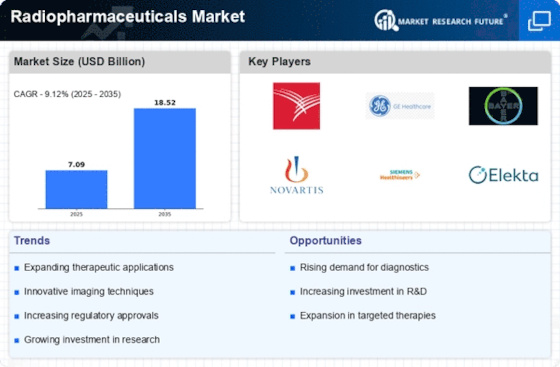
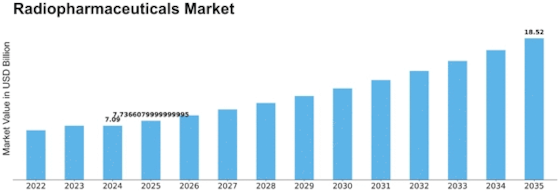
According to Market Research Future analysis, the Radiopharmaceuticals Market size was valued at USD 7.09 Billion in 2024 and the market is projected to grow from USD 7.737 Billion in 2025 to USD 18.52 Billion by 2035, exhibiting a CAGR of 9.12% during the forecast period 2025–2035. North America led the market with over 45.13% share, generating around USD 3.2 billion in revenue.
 
The Radiopharmaceuticals Market is primarily driven by the rising prevalence of cancer and cardiovascular diseases, increasing demand for early and accurate diagnostics, and growing adoption of targeted therapies, supported by continuous advancements in nuclear medicine and imaging technologies.
 
According to WHO, cancer accounts for nearly 10 million deaths annually, while IHME reports increasing global disease burden. CDC highlights rising chronic disease prevalence, and PAHO confirms growing diagnostic imaging demand, collectively accelerating radiopharmaceutical adoption in modern healthcare systems worldwide.

Key Market Trends & Highlights

The radiopharmaceuticals market is poised for substantial growth driven by technological advancements and increasing demand for personalized medicine.

  • North America leads with 40% share, with United States contributing 32%, supported by advanced nuclear medicine infrastructure. Diagnostic radiopharmaceuticals hold 62% share, reflecting strong adoption in non-invasive imaging and disease identification technologies worldwide. Hospitals account for 52% share, driven by availability of advanced treatment facilities and growing demand for integrated diagnostic services. Diagnostic applications dominate with 58% share, driven by increasing demand for early disease detection and imaging procedures globally.

Market Size & Forecast

2024 Market Size 7.09 (USD Billion)
2035 Market Size 18.52 (USD Billion)
CAGR (2025 - 2035) 9.12%
Largest Regional Market Share in 2024 North America

Major Players

Companies such as <a href="https://www.cardinalhealth.com/en/product-solutions/pharmaceutical-products/nuclear-medicine/radiopharmaceuticals.html" target="_blank" rel="noopener">Cardinal Health</a> (US), GE Healthcare (GB), Bayer AG (DE), <a href="https://www.novartis.com/about/products">Novartis </a>AG (CH), Siemens Healthineers (DE), Elekta AB (SE), Lantheus Medical Imaging (US), Bracco Imaging S.p.A. (IT), NorthStar Medical Radioisotopes, LLC (US) are some of the major participants in the global market.

Market Trends

The Radiopharmaceuticals Market is currently experiencing a transformative phase, driven by advancements in nuclear medicine and an increasing prevalence of chronic diseases. The integration of innovative technologies, such as artificial intelligence and machine learning, is enhancing the precision of diagnostic imaging and therapeutic applications.

This evolution is not only improving patient outcomes but also streamlining the development processes for new radiopharmaceuticals. Furthermore, the growing emphasis on personalized medicine is likely to propel the demand for targeted therapies, which utilize radiopharmaceuticals to deliver treatment tailored to individual patient profiles. In addition, regulatory bodies are becoming more supportive of the market, facilitating faster approvals for new products.

This trend is indicative of a broader recognition of the value that radiopharmaceuticals bring to healthcare. As research continues to uncover novel applications and benefits, the market appears poised for sustained growth. The collaboration between pharmaceutical companies and research institutions is fostering an environment ripe for innovation, potentially leading to breakthroughs that could redefine treatment paradigms in oncology and other fields. Overall, the radiopharmaceuticals market is on a promising trajectory, characterized by dynamic developments and a commitment to enhancing patient care.

Technological Advancements

The Radiopharmaceuticals Market is witnessing rapid technological advancements that enhance both diagnostic and therapeutic capabilities. Innovations in imaging techniques and radiochemistry are enabling more precise targeting of diseases, particularly in oncology. These developments are likely to improve the efficacy of treatments and reduce side effects, thereby increasing patient compliance and satisfaction.

WHO highlights growing adoption of advanced imaging technologies in over 70% of healthcare systems globally. ECDC reports increased utilization of nuclear medicine diagnostics across Europe, while CDC confirms rising imaging procedure volumes, reinforcing demand for advanced radiopharmaceutical technologies improving diagnostic accuracy.

Personalized Medicine

There is a growing trend towards personalized medicine within the Radiopharmaceuticals Market. Tailoring treatments to individual patient profiles allows for more effective interventions, particularly in complex diseases. This shift is expected to drive demand for radiopharmaceuticals that can be customized based on genetic and molecular characteristics, leading to improved therapeutic outcomes.

IHME reports increasing focus on precision medicine due to rising chronic disease complexity. WHO emphasizes targeted therapies improving treatment outcomes, while PAHO highlights growing adoption of individualized care approaches in oncology, supporting demand for customized radiopharmaceutical solutions and improved patient-specific treatment effectiveness.

Regulatory Support

Regulatory bodies are increasingly supportive of the Radiopharmaceuticals Market, streamlining approval processes for new products. This trend suggests a recognition of the critical role that radiopharmaceuticals play in modern healthcare. Enhanced collaboration between industry stakeholders and regulators may lead to faster market entry for innovative therapies, ultimately benefiting patients. 

ECDC notes strengthening regulatory frameworks across Europe for advanced therapeutics. WHO supports accelerated approvals for innovative treatments, while Global Fund investments exceeding USD 5 billion annually enhance healthcare systems, enabling faster adoption of novel radiopharmaceuticals and improving patient access globally.

Radio Pharmaceutical Market Market Drivers

Increasing Incidence of Cancer

The rising incidence of cancer worldwide is a primary driver for the Radiopharmaceuticals Market. As cancer cases continue to escalate, the demand for effective diagnostic and therapeutic solutions intensifies. Radiopharmaceuticals, which are pivotal in both imaging and treatment, are increasingly utilized in oncology. 
 
According to recent data, cancer is projected to affect approximately 1 in 5 individuals during their lifetime, leading to a surge in the need for advanced radiopharmaceuticals. This trend is likely to propel the market forward, as healthcare providers seek innovative solutions to enhance patient outcomes and improve survival rates. The Radiopharmaceuticals Market is thus positioned to benefit significantly from this growing patient population, as new therapies and imaging techniques are developed to address the complexities of cancer treatment.

Supportive Regulatory Framework

A supportive regulatory framework is crucial for the growth of the Radiopharmaceuticals Market. Regulatory bodies are increasingly recognizing the importance of radiopharmaceuticals in modern medicine, leading to streamlined approval processes for new products. This regulatory support fosters innovation and encourages investment in research and development.
 
For instance, the introduction of expedited pathways for breakthrough therapies has enabled faster access to novel radiopharmaceuticals for patients. As a result, the market is likely to see an influx of new products that meet the evolving needs of healthcare providers and patients. The Radiopharmaceuticals Market stands to benefit from this favorable regulatory environment, which not only enhances the availability of innovative treatments but also promotes competition among manufacturers.

Advancements in Nuclear Medicine

Technological advancements in nuclear medicine are significantly influencing the Radiopharmaceuticals Market. Innovations in imaging techniques, such as positron emission tomography (PET) and single-photon emission computed tomography (SPECT), have enhanced the precision of diagnostics. These advancements facilitate earlier detection of diseases, particularly cancers, which is crucial for effective treatment.
 
The market is witnessing a shift towards more sophisticated radiopharmaceuticals that offer improved efficacy and safety profiles. Furthermore, the development of new isotopes and radiolabeling techniques is expanding the therapeutic applications of radiopharmaceuticals. As a result, the Radiopharmaceuticals Market is expected to experience robust growth, driven by the continuous evolution of nuclear medicine technologies that enhance patient care and treatment outcomes.

Growing Demand for Targeted Therapies

The increasing demand for targeted therapies is reshaping the Radiopharmaceuticals Market. Patients and healthcare providers are increasingly favoring treatments that offer specificity and reduced side effects. Radiopharmaceuticals, which can be designed to target specific cellular receptors or tumor markers, align well with this trend.
 
The market is projected to grow as more targeted radiopharmaceuticals are developed, particularly in oncology and cardiology. Recent estimates suggest that the targeted therapy segment could account for a substantial portion of the overall radiopharmaceuticals market by 2026. This shift towards personalized medicine is likely to drive innovation and investment in the Radiopharmaceuticals Market, as stakeholders seek to develop novel agents that cater to the unique needs of individual patients.

Rising Awareness and Acceptance of Nuclear Medicine

Rising awareness and acceptance of nuclear medicine among healthcare professionals and patients are driving the Radiopharmaceuticals Market. Educational initiatives and outreach programs have significantly improved understanding of the benefits and applications of radiopharmaceuticals. As more healthcare providers recognize the value of nuclear medicine in diagnostics and treatment, the adoption of radiopharmaceuticals is likely to increase.
 
Additionally, patient acceptance of these therapies is growing, as they become more informed about the advantages of radiopharmaceuticals in managing various health conditions. This trend is expected to contribute to the expansion of the Radiopharmaceuticals Market, as increased utilization of these therapies leads to improved patient outcomes and satisfaction.

Market Segment Insights

By Application: Diagnosis (Largest) vs. Therapy (Fastest-Growing)

The application segment is diverse, with diagnosis holding the largest Radiopharmaceuticals Market share at 64%. This category encompasses a broad range of imaging techniques that utilize radiopharmaceuticals, which are essential for accurate disease detection and management. Following Diagnosis, Therapy represents a rapidly expanding area within this market, highlighting the increasing reliance on targeted radiation treatments for various malignancies. Research applications also play a pivotal role, contributing to advancements in both diagnosis and therapeutic methodologies, although they hold a comparatively smaller market share. Recent trends indicate that the Therapy segment is experiencing significant growth, driven by technological advancements in radiotherapy treatments and increasing approvals for radiopharmaceuticals in various therapeutic applications. The demand for personalized medicine and precision targeting is continually pushing this segment forward. Moreover, growing collaborations between research institutions and pharmaceutical companies are fostering innovation in the Discovery and development of novel radiopharmaceutical applications across disease types, particularly cancer. This shift towards more effective treatments positions Therapy as a key player in the future of the Radiopharmaceuticals Market.

Diagnosis (Dominant) vs. Research (Emerging)

The Diagnosis segment in the Radiopharmaceuticals Market is characterized by its extensive use of imaging techniques, which are crucial for early detection of diseases such as cancer and cardiovascular disorders. It currently holds a dominant position due to the established role of nuclear medicine in patient management. This segment benefits from continuous innovations, including the development of new radiotracers and more efficient imaging equipment, making it integral to diagnostic processes. In contrast, Research is an emerging segment, characterized by its focus on developing novel radiopharmaceutical compounds and enhancing existing formulations. This segment is progressively gaining importance as more institutions seek to leverage radiopharmaceuticals for clinical trials and experimental therapies, thereby contributing to essential breakthroughs in medical science. While still growing, the Research segment is vital for future advancements in both diagnostics and therapeutics.

By Type: Diagnostic Radiopharmaceuticals (Largest) vs. Therapeutic Radiopharmaceuticals (Fastest-Growing)

The market is characterized by two primary segments: Diagnostic and Therapeutic Radiopharmaceuticals. Diagnostic radiopharmaceuticals currently hold the largest Radiopharmaceuticals Market share at 68%, driven by their extensive application in imaging and diagnostics. This segment benefits from technological advancements and a growing preference for minimally invasive diagnostic procedures. In contrast, Therapeutic Radiopharmaceuticals, although smaller in market share, are rapidly gaining traction due to their innovative applications in targeted cancer therapies, showcasing significant growth potential.

Radiopharmaceuticals: Diagnostic (Dominant) vs. Therapeutic (Emerging)

The Diagnostic Radiopharmaceuticals segment is dominant due to its established role in imaging techniques such as PET and SPECT, widely used in clinical practice for disease detection. This segment is characterized by a variety of agents tailored for specific imaging needs, making it indispensable in modern medical procedures. On the other hand, Therapeutic Radiopharmaceuticals are emerging as an innovative force in treatment protocols. They offer targeted therapy options that minimize collateral damage to healthy tissues, proving advantageous in oncology. The shift towards personalized medicine and increasing clinical trials in radiotherapy are leading this segment to expand rapidly, positioning it as a vital player in the evolving landscape of healthcare.

By Radiopharmaceutical Class: Radioisotopes (Largest) vs. Radiolabeled Compounds (Fastest-Growing)

The radiopharmaceutical class segment exhibits a distinct distribution in market share among various factors. Radioisotopes hold the largest share at 66%, leading the market due to their prominent role in diagnostic and therapeutic applications. Radiolabeled compounds, while relatively smaller in share, are quickly gaining traction and evolving into an increasingly significant part of this market, driven by technological advancements and increasing clinical demand.

Radioisotopes (Dominant) vs. Radiolabeled Compounds (Emerging)

Radioisotopes dominate the radiopharmaceutical market due to their established applications in both therapeutic and diagnostic modalities, particularly in oncology and cardiology. Their stability and effectiveness make them indispensable in medical imaging and therapy. Conversely, radiolabeled compounds are emerging as a vital component of precision medicine, offering innovative approaches to targeted therapy and personalized treatment options. The rapid advancement in radiolabeling techniques and increased research in this area are propelling the growth of radiolabeled compounds, as they provide unique solutions that enhance patient outcomes through enhanced specificity and reduced side effects.

By End Use: Hospitals (Largest) vs. Diagnostic Imaging Centers (Fastest-Growing)

Hospitals are the largest end-use segment in the Radiopharmaceuticals Market, with a 62% share, capturing a significant portion of the market due to their comprehensive diagnostic and therapeutic capabilities. <a href="https://www.marketresearchfuture.com/reports/diagnostic-imaging-market-6765">Diagnostic imaging</a> centers follow closely behind, reflecting a notable shift in healthcare settings where targeted imaging approaches are favored, leading to enhanced patient outcomes and increased adoption of radiopharmaceutical products. Research institutions also play a vital role but have a smaller share as they primarily focus on clinical trials and innovative therapeutic developments, contributing to the overall advancement of radiopharmaceuticals.

Hospitals (Dominant) vs. Research Institutions (Emerging)

Hospitals are the dominant players in the market share, leveraging their extensive infrastructure and trained personnel to administer complex radioisotope therapies. Their large-scale operations and the integration of radiopharmaceuticals into both diagnostic and treatment protocols establish a solid foundation for their market presence. On the other hand, research institutions serve as emerging agents of change within the sector, driving innovation through clinical research and trial programs. While they may not command the same market share as hospitals, their contributions to the development of novel radiopharmaceutical applications and therapies position them as essential partners in advancing the field.

Diagnosis (Dominant) vs. Research (Emerging)

The Diagnosis segment in the Radiopharmaceuticals Market is characterized by its extensive use of imaging techniques, which are crucial for early detection of diseases such as cancer and cardiovascular disorders. It currently holds a dominant position due to the established role of nuclear medicine in patient management. This segment benefits from continuous innovations, including the development of new radiotracers and more efficient imaging equipment, making it integral to diagnostic processes. In contrast, Research is an emerging segment, characterized by its focus on developing novel radiopharmaceutical compounds and enhancing existing formulations. This segment is progressively gaining importance as more institutions seek to leverage radiopharmaceuticals for clinical trials and experimental therapies, thereby contributing to essential breakthroughs in medical science. While still growing, the Research segment is vital for future advancements in both diagnostics and therapeutics.

Get more detailed insights about Radiopharmaceuticals Market Research Report - Forecast to 2035

Regional Insights

North America : Market Leader in Innovation

North America leads in the Radiopharmaceuticals Market Size, accounting for over 45.13% of the global revenue in 2024. The growth is driven by increasing cancer prevalence, advancements in nuclear medicine, and supportive regulatory frameworks. The U.S. Food and Drug Administration (FDA) plays a crucial role in expediting the approval of new radiopharmaceuticals, enhancing market dynamics. The region's robust healthcare infrastructure and high investment in research and development further bolster demand.

The United States holds 78% share with a market value of USD 2.22 Billion, driven by advanced nuclear medicine adoption, while Canada holds 22% with a market value of USD 0.63 Billion supported by expanding oncology diagnostics.

The United States leads the North American market, with significant contributions from Canada. Key players such as Cardinal Health, GE Healthcare, and Lantheus Medical Imaging dominate the landscape, focusing on innovative solutions and strategic partnerships. The competitive environment is characterized by continuous advancements in technology and a strong emphasis on patient-centric approaches, ensuring a steady growth trajectory for the radiopharmaceuticals market in this region.

Europe : Emerging Market with Potential

Europe Radiopharmaceuticals Market size was valued at USD 2.13 billion in 2024, making it the second-largest regional market with a 30% share. The increasing incidence of chronic diseases, coupled with advancements in imaging technologies, is driving demand. Regulatory bodies like the European Medicines Agency (EMA) are actively facilitating the approval process for new radiopharmaceuticals, which is expected to further enhance market growth.

Germany contributing 27% with a market value of USD 0.57 Billion, due to strong research capabilities, while the UK holds 23% with a market value of USD 0.49 Billion driven by precision medicine adoption.

The region's focus on personalized medicine and innovative therapies is also a key growth driver. Leading countries in Europe include Germany, France, and the United Kingdom, which are home to several key players such as Bayer AG and Siemens Healthineers. The competitive landscape is marked by collaborations between pharmaceutical companies and research institutions, fostering innovation. The presence of established manufacturers and a growing number of startups in the radiopharmaceuticals sector contribute to a dynamic market environment, positioning Europe as a significant player in the global landscape.

Asia-Pacific : Rapidly Growing Market

Asia-Pacific is emerging as a rapidly growing market for radiopharmaceuticals, accounting for approximately 20% of the global share. The growth is driven by rising healthcare expenditures, increasing awareness of nuclear medicine, and a growing aging population. Countries like China and India are witnessing a surge in demand for advanced diagnostic and therapeutic solutions, supported by favorable government initiatives and investments in healthcare infrastructure.

China accounts for 35% with a market value of USD 0.50 Billion, driven by rising cancer burden, while Japan holds 25% with a market value of USD 0.36 Billion supported by technological advancements.

Regulatory bodies are also streamlining approval processes to facilitate market entry for new products. China and Japan are the leading countries in this region, with significant contributions from Australia and India. The competitive landscape is characterized by the presence of both multinational corporations and local players, such as Bracco Imaging and NorthStar Medical Radioisotopes. The focus on research and development, along with strategic collaborations, is expected to drive innovation and enhance the availability of radiopharmaceuticals in the Asia-Pacific market, making it a key area for future growth.

Middle East and Africa : Emerging Opportunities Ahead

The Middle East and Africa region is gradually emerging in the radiopharmaceuticals market, holding approximately 5% of the global share. The growth is primarily driven by increasing investments in healthcare infrastructure, rising awareness of nuclear medicine, and a growing prevalence of chronic diseases. Countries like South Africa and the UAE are focusing on enhancing their healthcare systems, which is expected to create new opportunities for radiopharmaceuticals.

Saudi Arabia holding 40% with a market value of USD 0.14 Billion, driven by healthcare investments, while South Africa holds 25% with a market value of USD 0.09 Billion supported by improving diagnostic infrastructure.

Regulatory bodies are also working towards establishing frameworks to support market growth. South Africa and the UAE are the leading markets in this region, with a growing number of healthcare facilities adopting advanced diagnostic technologies. The competitive landscape is evolving, with both local and international players entering the market. Companies are focusing on partnerships and collaborations to enhance their product offerings and expand their market reach, positioning the Middle East and Africa as a region with significant growth potential in the radiopharmaceuticals sector.

Key Players and Competitive Insights

The Radiopharmaceuticals Market is characterized by a dynamic competitive landscape, driven by advancements in medical imaging and targeted therapies. Key players such as Cardinal Health (US), GE Healthcare (GB), and Bayer AG (DE) are at the forefront, each adopting distinct strategies to enhance their market presence. Cardinal Health (US) focuses on expanding its product portfolio through strategic partnerships and acquisitions, while GE Healthcare (GB) emphasizes innovation in imaging technologies, particularly in PET and SPECT applications.
 
Bayer AG (DE) is leveraging its strong research capabilities to develop novel radiopharmaceuticals, thereby positioning itself as a leader in therapeutic applications. Collectively, these strategies contribute to a competitive environment that is increasingly shaped by technological advancements and collaborative efforts. In terms of business tactics, companies are increasingly localizing manufacturing to reduce supply chain vulnerabilities and enhance responsiveness to regional market demands. The competitive structure of the Radiopharmaceuticals Market appears moderately fragmented, with several players vying for market share.
 
However, the influence of major companies is substantial, as they often set industry standards and drive innovation through their extensive research and development initiatives. In August 2025, Lantheus Medical Imaging (US) announced the launch of a new radiopharmaceutical aimed at improving diagnostic accuracy in oncology. This strategic move is significant as it not only enhances Lantheus's product offerings but also reinforces its commitment to addressing unmet clinical needs in cancer diagnostics. The introduction of this product is likely to strengthen its competitive position in a market that increasingly values precision medicine.
 
In September 2025, Siemens Healthineers (DE) unveiled a partnership with a leading biotechnology firm to co-develop advanced radiopharmaceuticals for personalized therapy. This collaboration is indicative of a broader trend towards integrating biotechnology with radiopharmaceutical development, potentially leading to more effective treatment options. Such strategic alliances may enhance Siemens's capabilities in delivering innovative solutions that align with the growing demand for personalized medicine.
 
In October 2025, NorthStar Medical Radioisotopes, LLC (US) expanded its production capacity by investing in a new facility dedicated to the manufacturing of medical isotopes. This expansion is crucial as it addresses the increasing global demand for radiopharmaceuticals, particularly in diagnostic imaging. By enhancing its production capabilities, NorthStar is likely to improve its market position and ensure a reliable supply of critical isotopes to healthcare providers.
 
As of October 2025, the Radiopharmaceuticals Market is witnessing trends such as digitalization, sustainability, and the integration of artificial intelligence in product development and manufacturing processes. Strategic alliances are becoming increasingly vital, as they enable companies to pool resources and expertise, thereby accelerating innovation. Looking ahead, competitive differentiation is expected to evolve, with a shift from traditional price-based competition towards a focus on technological innovation, supply chain reliability, and the development of advanced therapeutic solutions.

Key Companies in the Radio Pharmaceutical Market include

Industry Developments

The Radiopharmaceuticals Market has witnessed several significant developments recently.

In November 2025, Curium — a leading radiopharma manufacturer/distributor — was recapitalized by investment firm CapVest Partners LLP in a deal valuing Curium at ~US $7 billion — described as “the largest transaction in nuclear medicine globally.

In January 2024, Novartis obtained FDA approval for the commercial production of Pluvicto at its new radioligand manufacturing facility in Indianapolis, Indiana.

In February 2024, Bristol-Myers Squibb finalized its $4.1 billion acquisition of RayzeBio, which bolstered its actinium-based radiopharmaceutical pipeline.

AstraZeneca acquired Fusion Pharmaceuticals for $2.4 billion in March 2024, thereby acquiring access to its FPI-2265 prostate cancer radioconjugate and manufacturing assets.

Future Outlook

Radio Pharmaceutical Market Future Outlook

The Radiopharmaceuticals Market size is projected to reach USD 18.52 billion by 2035, growing at a CAGR of 9.12%, driven by advancements in diagnostic imaging and targeted therapies.

New opportunities lie in:

  • <p>Expansion of theranostic applications in oncology Development of novel radiotracers for neurodegenerative diseases Investment in automated radiopharmaceutical production facilities</p>

By 2035, the Radiopharmaceuticals Market is poised for robust growth, reflecting its critical role in modern healthcare.

Market Segmentation

Radio Pharmaceutical Market Type Outlook

  • Diagnostic Radiopharmaceuticals
  • Therapeutic Radiopharmaceuticals

Radio Pharmaceutical Market End Use Outlook

  • Hospitals
  • Diagnostic Imaging Centers
  • Research Institutions

Radio Pharmaceutical Market Application Outlook

  • Diagnosis
  • Therapy
  • Research

Radio Pharmaceutical Market Radiopharmaceutical Class Outlook

  • Radioisotopes
  • Radiolabeled Compounds
  • Radiopharmaceutical Generators

Report Scope

MARKET SIZE 2024 7.09(USD Billion)
MARKET SIZE 2025 7.737(USD Billion)
MARKET SIZE 2035 18.52(USD Billion)
COMPOUND ANNUAL GROWTH RATE (CAGR) 9.12% (2025 - 2035)
REPORT COVERAGE Revenue Forecast, Competitive Landscape, Growth Factors, and Trends
BASE YEAR 2024
Market Forecast Period 2025 - 2035
Historical Data 2019 - 2024
Market Forecast Units USD Billion
Key Companies Profiled Cardinal Health (US), GE Healthcare (GB), Bayer AG (DE), Novartis AG (CH), Siemens Healthineers (DE), Elekta AB (SE), Lantheus Medical Imaging (US), Bracco Imaging S.p.A. (IT), NorthStar Medical Radioisotopes, LLC (US)
Segments Covered Applications, Types, Radiopharmaceutical Class, End Use, Regional
Key Market Opportunities Advancements in targeted therapies and personalized medicine drive growth in the Radiopharmaceuticals Market.
Key Market Dynamics Technological advancements and regulatory changes drive innovation and competition in the radiopharmaceuticals market.
Countries Covered North America, Europe, APAC, South America, MEA

FAQs

What is the projected market valuation of the Radiopharmaceuticals Market by 2035?

<p>The Radiopharmaceuticals Market is projected to reach a valuation of 18.52 USD Billion by 2035.</p>

What was the market valuation of the Radiopharmaceuticals Market in 2024?

<p>In 2024, the Radiopharmaceuticals Market was valued at 7.09 USD Billion.</p>

What is the expected CAGR for the Radiopharmaceuticals Market during the forecast period 2025 - 2035?

<p>The expected CAGR for the Radiopharmaceuticals Market during the forecast period 2025 - 2035 is 9.12%.</p>

Which companies are considered key players in the Radiopharmaceuticals Market?

<p>Key players in the Radiopharmaceuticals Market include Cardinal Health, GE Healthcare, Bayer AG, Novartis AG, Siemens Healthineers, Elekta AB, Lantheus Medical Imaging, Bracco Imaging S.p.A., and NorthStar Medical Radioisotopes.</p>

What are the projected valuations for the Diagnostic and Therapeutic Radiopharmaceuticals segments by 2035?

<p>By 2035, the Diagnostic Radiopharmaceuticals segment is projected to reach 7.36 USD Billion, while the Therapeutic Radiopharmaceuticals segment is expected to reach 11.16 USD Billion.</p>

How do the end-use segments of the Radiopharmaceuticals Market compare in 2024?

<p>In 2024, the Hospitals segment was valued at 2.83 USD Billion, Diagnostic Imaging Centers at 2.12 USD Billion, and Research Institutions at 2.14 USD Billion.</p>

What is the anticipated growth for the Research segment of the Radiopharmaceuticals Market by 2035?

<p>The Research segment is anticipated to grow to 3.8 USD Billion by 2035.</p>

What are the projected values for Radioisotopes and Radiolabeled Compounds by 2035?

<p>By 2035, both Radioisotopes and Radiolabeled Compounds are projected to reach 7.36 USD Billion.</p>

What is the expected market trend for Diagnostic Imaging Centers in the Radiopharmaceuticals Market?

<p>The Diagnostic Imaging Centers segment is expected to grow to 5.51 USD Billion by 2035.</p>

How does the Radiopharmaceuticals Market's growth compare to other healthcare sectors?

<p>The Radiopharmaceuticals Market's growth, with a projected CAGR of 9.12%, indicates a robust expansion compared to many other healthcare sectors.</p>

  1. SECTION I: EXECUTIVE SUMMARY AND KEY HIGHLIGHTS |
    1. EXECUTIVE SUMMARY | |
      1. Market Overview | |
      2. Key Findings | |
      3. Market Segmentation | |
      4. Competitive Landscape | |
      5. Challenges and Opportunities | |
      6. Future Outlook 2
  2. SECTION II: SCOPING, METHODOLOGY AND MARKET STRUCTURE |
    1. MARKET INTRODUCTION | |
      1. Definition | |
      2. Scope of the study | | |
    2. RESEARCH METHODOLOGY | |
      1. Overview | |
      2. Data Mining | |
      3. Secondary Research | |
      4. Primary Research | | |
      5. Forecasting Model | |
      6. Market Size Estimation | | |
      7. Data Triangulation | |
      8. Validation 3
  3. SECTION III: QUALITATIVE ANALYSIS |
    1. MARKET DYNAMICS | |
      1. Overview | |
      2. Drivers | |
      3. Restraints | |
      4. Opportunities |
    2. MARKET FACTOR ANALYSIS | |
      1. Value chain Analysis | |
      2. Porter's Five Forces Analysis | | |
      3. COVID-19 Impact Analysis | | |
  4. SECTION IV: QUANTITATIVE ANALYSIS |
    1. Healthcare, BY Application (USD Billion) | |
      1. Diagnosis | |
      2. Therapy | |
      3. Research |
    2. Healthcare, BY Type (USD Billion) | |
      1. Diagnostic Radiopharmaceuticals | |
      2. Therapeutic Radiopharmaceuticals |
    3. Healthcare, BY Radiopharmaceutical Class (USD Billion) | |
      1. Radioisotopes | |
      2. Radiolabeled Compounds | |
      3. Radiopharmaceutical Generators |
    4. Healthcare, BY End Use (USD Billion) | |
      1. Hospitals | |
      2. Diagnostic Imaging Centers | |
      3. Research Institutions |
    5. Healthcare, BY Region (USD Billion) | |
      1. North America | | |
      2. Europe | | |
      3. APAC | | |
      4. South America | | |
      5. MEA | | |
  5. SECTION V: COMPETITIVE ANALYSIS |
    1. Competitive Landscape | |
      1. Overview | |
      2. Competitive Analysis | |
      3. Market share Analysis | |
      4. Major Growth Strategy in the Healthcare | |
      5. Competitive Benchmarking | |
      6. Leading Players in Terms of Number of Developments in the Healthcare | |
      7. Key developments and growth strategies | | |
      8. Major Players Financial Matrix | | |
    2. Company Profiles | |
      1. Cardinal Health (US) | | |
      2. GE Healthcare (GB) | | |
      3. Bayer AG (DE) | | |
      4. Novartis AG (CH) | | |
      5. Siemens Healthineers (DE) | | |
      6. Elekta AB (SE) | | |
      7. Lantheus Medical Imaging (US) | | |
      8. Bracco Imaging S.p.A. (IT) | | |
      9. NorthStar Medical Radioisotopes, LLC (US) | | |
    3. Appendix | |
      1. References | |
      2. Related Reports 6 LIST OF FIGURES |
    4. MARKET SYNOPSIS |
    5. NORTH AMERICA MARKET ANALYSIS |
    6. US MARKET ANALYSIS BY APPLICATION |
    7. US MARKET ANALYSIS BY TYPE |
    8. US MARKET ANALYSIS BY RADIOPHARMACEUTICAL CLASS |
    9. US MARKET ANALYSIS BY END USE |
    10. CANADA MARKET ANALYSIS BY APPLICATION |
    11. CANADA MARKET ANALYSIS BY TYPE |
    12. CANADA MARKET ANALYSIS BY RADIOPHARMACEUTICAL CLASS |
    13. CANADA MARKET ANALYSIS BY END USE |
    14. EUROPE MARKET ANALYSIS |
    15. GERMANY MARKET ANALYSIS BY APPLICATION |
    16. GERMANY MARKET ANALYSIS BY TYPE |
    17. GERMANY MARKET ANALYSIS BY RADIOPHARMACEUTICAL CLASS |
    18. GERMANY MARKET ANALYSIS BY END USE |
    19. UK MARKET ANALYSIS BY APPLICATION |
    20. UK MARKET ANALYSIS BY TYPE |
    21. UK MARKET ANALYSIS BY RADIOPHARMACEUTICAL CLASS |
    22. UK MARKET ANALYSIS BY END USE |
    23. FRANCE MARKET ANALYSIS BY APPLICATION |
    24. FRANCE MARKET ANALYSIS BY TYPE |
    25. FRANCE MARKET ANALYSIS BY RADIOPHARMACEUTICAL CLASS |
    26. FRANCE MARKET ANALYSIS BY END USE |
    27. RUSSIA MARKET ANALYSIS BY APPLICATION |
    28. RUSSIA MARKET ANALYSIS BY TYPE |
    29. RUSSIA MARKET ANALYSIS BY RADIOPHARMACEUTICAL CLASS |
    30. RUSSIA MARKET ANALYSIS BY END USE |
    31. ITALY MARKET ANALYSIS BY APPLICATION |
    32. ITALY MARKET ANALYSIS BY TYPE |
    33. ITALY MARKET ANALYSIS BY RADIOPHARMACEUTICAL CLASS |
    34. ITALY MARKET ANALYSIS BY END USE |
    35. SPAIN MARKET ANALYSIS BY APPLICATION |
    36. SPAIN MARKET ANALYSIS BY TYPE |
    37. SPAIN MARKET ANALYSIS BY RADIOPHARMACEUTICAL CLASS |
    38. SPAIN MARKET ANALYSIS BY END USE |
    39. REST OF EUROPE MARKET ANALYSIS BY APPLICATION |
    40. REST OF EUROPE MARKET ANALYSIS BY TYPE |
    41. REST OF EUROPE MARKET ANALYSIS BY RADIOPHARMACEUTICAL CLASS |
    42. REST OF EUROPE MARKET ANALYSIS BY END USE |
    43. APAC MARKET ANALYSIS |
    44. CHINA MARKET ANALYSIS BY APPLICATION |
    45. CHINA MARKET ANALYSIS BY TYPE |
    46. CHINA MARKET ANALYSIS BY RADIOPHARMACEUTICAL CLASS |
    47. CHINA MARKET ANALYSIS BY END USE |
    48. INDIA MARKET ANALYSIS BY APPLICATION |
    49. INDIA MARKET ANALYSIS BY TYPE |
    50. INDIA MARKET ANALYSIS BY RADIOPHARMACEUTICAL CLASS |
    51. INDIA MARKET ANALYSIS BY END USE |
    52. JAPAN MARKET ANALYSIS BY APPLICATION |
    53. JAPAN MARKET ANALYSIS BY TYPE |
    54. JAPAN MARKET ANALYSIS BY RADIOPHARMACEUTICAL CLASS |
    55. JAPAN MARKET ANALYSIS BY END USE |
    56. SOUTH KOREA MARKET ANALYSIS BY APPLICATION |
    57. SOUTH KOREA MARKET ANALYSIS BY TYPE |
    58. SOUTH KOREA MARKET ANALYSIS BY RADIOPHARMACEUTICAL CLASS |
    59. SOUTH KOREA MARKET ANALYSIS BY END USE |
    60. MALAYSIA MARKET ANALYSIS BY APPLICATION |
    61. MALAYSIA MARKET ANALYSIS BY TYPE |
    62. MALAYSIA MARKET ANALYSIS BY RADIOPHARMACEUTICAL CLASS |
    63. MALAYSIA MARKET ANALYSIS BY END USE |
    64. THAILAND MARKET ANALYSIS BY APPLICATION |
    65. THAILAND MARKET ANALYSIS BY TYPE |
    66. THAILAND MARKET ANALYSIS BY RADIOPHARMACEUTICAL CLASS |
    67. THAILAND MARKET ANALYSIS BY END USE |
    68. INDONESIA MARKET ANALYSIS BY APPLICATION |
    69. INDONESIA MARKET ANALYSIS BY TYPE |
    70. INDONESIA MARKET ANALYSIS BY RADIOPHARMACEUTICAL CLASS |
    71. INDONESIA MARKET ANALYSIS BY END USE |
    72. REST OF APAC MARKET ANALYSIS BY APPLICATION |
    73. REST OF APAC MARKET ANALYSIS BY TYPE |
    74. REST OF APAC MARKET ANALYSIS BY RADIOPHARMACEUTICAL CLASS |
    75. REST OF APAC MARKET ANALYSIS BY END USE |
    76. SOUTH AMERICA MARKET ANALYSIS |
    77. BRAZIL MARKET ANALYSIS BY APPLICATION |
    78. BRAZIL MARKET ANALYSIS BY TYPE |
    79. BRAZIL MARKET ANALYSIS BY RADIOPHARMACEUTICAL CLASS |
    80. BRAZIL MARKET ANALYSIS BY END USE |
    81. MEXICO MARKET ANALYSIS BY APPLICATION |
    82. MEXICO MARKET ANALYSIS BY TYPE |
    83. MEXICO MARKET ANALYSIS BY RADIOPHARMACEUTICAL CLASS |
    84. MEXICO MARKET ANALYSIS BY END USE |
    85. ARGENTINA MARKET ANALYSIS BY APPLICATION |
    86. ARGENTINA MARKET ANALYSIS BY TYPE |
    87. ARGENTINA MARKET ANALYSIS BY RADIOPHARMACEUTICAL CLASS |
    88. ARGENTINA MARKET ANALYSIS BY END USE |
    89. REST OF SOUTH AMERICA MARKET ANALYSIS BY APPLICATION |
    90. REST OF SOUTH AMERICA MARKET ANALYSIS BY TYPE |
    91. REST OF SOUTH AMERICA MARKET ANALYSIS BY RADIOPHARMACEUTICAL CLASS |
    92. REST OF SOUTH AMERICA MARKET ANALYSIS BY END USE |
    93. MEA MARKET ANALYSIS |
    94. GCC COUNTRIES MARKET ANALYSIS BY APPLICATION |
    95. GCC COUNTRIES MARKET ANALYSIS BY TYPE |
    96. GCC COUNTRIES MARKET ANALYSIS BY RADIOPHARMACEUTICAL CLASS |
    97. GCC COUNTRIES MARKET ANALYSIS BY END USE |
    98. SOUTH AFRICA MARKET ANALYSIS BY APPLICATION |
    99. SOUTH AFRICA MARKET ANALYSIS BY TYPE |
    100. SOUTH AFRICA MARKET ANALYSIS BY RADIOPHARMACEUTICAL CLASS |
    101. SOUTH AFRICA MARKET ANALYSIS BY END USE |
    102. REST OF MEA MARKET ANALYSIS BY APPLICATION |
    103. REST OF MEA MARKET ANALYSIS BY TYPE |
    104. REST OF MEA MARKET ANALYSIS BY RADIOPHARMACEUTICAL CLASS |
    105. REST OF MEA MARKET ANALYSIS BY END USE |
    106. KEY BUYING CRITERIA OF HEALTHCARE |
    107. RESEARCH PROCESS OF MRFR |
    108. DRO ANALYSIS OF HEALTHCARE |
    109. DRIVERS IMPACT ANALYSIS: HEALTHCARE |
    110. RESTRAINTS IMPACT ANALYSIS: HEALTHCARE |
    111. SUPPLY / VALUE CHAIN: HEALTHCARE |
    112. HEALTHCARE, BY APPLICATION, 2024 (% SHARE) |
    113. HEALTHCARE, BY APPLICATION, 2024 TO 2035 (USD Billion) |
    114. HEALTHCARE, BY TYPE, 2024 (% SHARE) |
    115. HEALTHCARE, BY TYPE, 2024 TO 2035 (USD Billion) |
    116. HEALTHCARE, BY RADIOPHARMACEUTICAL CLASS, 2024 (% SHARE) |
    117. HEALTHCARE, BY RADIOPHARMACEUTICAL CLASS, 2024 TO 2035 (USD Billion) |
    118. HEALTHCARE, BY END USE, 2024 (% SHARE) |
    119. HEALTHCARE, BY END USE, 2024 TO 2035 (USD Billion) |
    120. BENCHMARKING OF MAJOR COMPETITORS 7 LIST OF TABLES |
    121. LIST OF ASSUMPTIONS | |
      1. |
    122. North America MARKET SIZE ESTIMATES; FORECAST | |
      1. BY APPLICATION, 2025-2035 (USD Billion) | |
      2. BY TYPE, 2025-2035 (USD Billion) | |
      3. BY RADIOPHARMACEUTICAL CLASS, 2025-2035 (USD Billion) | |
      4. BY END USE, 2025-2035 (USD Billion) |
    123. US MARKET SIZE ESTIMATES; FORECAST | |
      1. BY APPLICATION, 2025-2035 (USD Billion) | |
      2. BY TYPE, 2025-2035 (USD Billion) | |
      3. BY RADIOPHARMACEUTICAL CLASS, 2025-2035 (USD Billion) | |
      4. BY END USE, 2025-2035 (USD Billion) |
    124. Canada MARKET SIZE ESTIMATES; FORECAST | |
      1. BY APPLICATION, 2025-2035 (USD Billion) | |
      2. BY TYPE, 2025-2035 (USD Billion) | |
      3. BY RADIOPHARMACEUTICAL CLASS, 2025-2035 (USD Billion) | |
      4. BY END USE, 2025-2035 (USD Billion) |
    125. Europe MARKET SIZE ESTIMATES; FORECAST | |
      1. BY APPLICATION, 2025-2035 (USD Billion) | |
      2. BY TYPE, 2025-2035 (USD Billion) | |
      3. BY RADIOPHARMACEUTICAL CLASS, 2025-2035 (USD Billion) | |
      4. BY END USE, 2025-2035 (USD Billion) |
    126. Germany MARKET SIZE ESTIMATES; FORECAST | |
      1. BY APPLICATION, 2025-2035 (USD Billion) | |
      2. BY TYPE, 2025-2035 (USD Billion) | |
      3. BY RADIOPHARMACEUTICAL CLASS, 2025-2035 (USD Billion) | |
      4. BY END USE, 2025-2035 (USD Billion) |
    127. UK MARKET SIZE ESTIMATES; FORECAST | |
      1. BY APPLICATION, 2025-2035 (USD Billion) | |
      2. BY TYPE, 2025-2035 (USD Billion) | |
      3. BY RADIOPHARMACEUTICAL CLASS, 2025-2035 (USD Billion) | |
      4. BY END USE, 2025-2035 (USD Billion) |
    128. France MARKET SIZE ESTIMATES; FORECAST | |
      1. BY APPLICATION, 2025-2035 (USD Billion) | |
      2. BY TYPE, 2025-2035 (USD Billion) | |
      3. BY RADIOPHARMACEUTICAL CLASS, 2025-2035 (USD Billion) | |
      4. BY END USE, 2025-2035 (USD Billion) |
    129. Russia MARKET SIZE ESTIMATES; FORECAST | |
      1. BY APPLICATION, 2025-2035 (USD Billion) | |
      2. BY TYPE, 2025-2035 (USD Billion) | |
      3. BY RADIOPHARMACEUTICAL CLASS, 2025-2035 (USD Billion) | |
      4. BY END USE, 2025-2035 (USD Billion) |
    130. Italy MARKET SIZE ESTIMATES; FORECAST | |
      1. BY APPLICATION, 2025-2035 (USD Billion) | |
      2. BY TYPE, 2025-2035 (USD Billion) | |
      3. BY RADIOPHARMACEUTICAL CLASS, 2025-2035 (USD Billion) | |
      4. BY END USE, 2025-2035 (USD Billion) |
    131. Spain MARKET SIZE ESTIMATES; FORECAST | |
      1. BY APPLICATION, 2025-2035 (USD Billion) | |
      2. BY TYPE, 2025-2035 (USD Billion) | |
      3. BY RADIOPHARMACEUTICAL CLASS, 2025-2035 (USD Billion) | |
      4. BY END USE, 2025-2035 (USD Billion) |
    132. Rest of Europe MARKET SIZE ESTIMATES; FORECAST | |
      1. BY APPLICATION, 2025-2035 (USD Billion) | |
      2. BY TYPE, 2025-2035 (USD Billion) | |
      3. BY RADIOPHARMACEUTICAL CLASS, 2025-2035 (USD Billion) | |
      4. BY END USE, 2025-2035 (USD Billion) |
    133. APAC MARKET SIZE ESTIMATES; FORECAST | |
      1. BY APPLICATION, 2025-2035 (USD Billion) | |
      2. BY TYPE, 2025-2035 (USD Billion) | |
      3. BY RADIOPHARMACEUTICAL CLASS, 2025-2035 (USD Billion) | |
      4. BY END USE, 2025-2035 (USD Billion) |
    134. China MARKET SIZE ESTIMATES; FORECAST | |
      1. BY APPLICATION, 2025-2035 (USD Billion) | |
      2. BY TYPE, 2025-2035 (USD Billion) | |
      3. BY RADIOPHARMACEUTICAL CLASS, 2025-2035 (USD Billion) | |
      4. BY END USE, 2025-2035 (USD Billion) |
    135. India MARKET SIZE ESTIMATES; FORECAST | |
      1. BY APPLICATION, 2025-2035 (USD Billion) | |
      2. BY TYPE, 2025-2035 (USD Billion) | |
      3. BY RADIOPHARMACEUTICAL CLASS, 2025-2035 (USD Billion) | |
      4. BY END USE, 2025-2035 (USD Billion) |
    136. Japan MARKET SIZE ESTIMATES; FORECAST | |
      1. BY APPLICATION, 2025-2035 (USD Billion) | |
      2. BY TYPE, 2025-2035 (USD Billion) | |
      3. BY RADIOPHARMACEUTICAL CLASS, 2025-2035 (USD Billion) | |
      4. BY END USE, 2025-2035 (USD Billion) |
    137. South Korea MARKET SIZE ESTIMATES; FORECAST | |
      1. BY APPLICATION, 2025-2035 (USD Billion) | |
      2. BY TYPE, 2025-2035 (USD Billion) | |
      3. BY RADIOPHARMACEUTICAL CLASS, 2025-2035 (USD Billion) | |
      4. BY END USE, 2025-2035 (USD Billion) |
    138. Malaysia MARKET SIZE ESTIMATES; FORECAST | |
      1. BY APPLICATION, 2025-2035 (USD Billion) | |
      2. BY TYPE, 2025-2035 (USD Billion) | |
      3. BY RADIOPHARMACEUTICAL CLASS, 2025-2035 (USD Billion) | |
      4. BY END USE, 2025-2035 (USD Billion) |
    139. Thailand MARKET SIZE ESTIMATES; FORECAST | |
      1. BY APPLICATION, 2025-2035 (USD Billion) | |
      2. BY TYPE, 2025-2035 (USD Billion) | |
      3. BY RADIOPHARMACEUTICAL CLASS, 2025-2035 (USD Billion) | |
      4. BY END USE, 2025-2035 (USD Billion) |
    140. Indonesia MARKET SIZE ESTIMATES; FORECAST | |
      1. BY APPLICATION, 2025-2035 (USD Billion) | |
      2. BY TYPE, 2025-2035 (USD Billion) | |
      3. BY RADIOPHARMACEUTICAL CLASS, 2025-2035 (USD Billion) | |
      4. BY END USE, 2025-2035 (USD Billion) |
    141. Rest of APAC MARKET SIZE ESTIMATES; FORECAST | |
      1. BY APPLICATION, 2025-2035 (USD Billion) | |
      2. BY TYPE, 2025-2035 (USD Billion) | |
      3. BY RADIOPHARMACEUTICAL CLASS, 2025-2035 (USD Billion) | |
      4. BY END USE, 2025-2035 (USD Billion) |
    142. South America MARKET SIZE ESTIMATES; FORECAST | |
      1. BY APPLICATION, 2025-2035 (USD Billion) | |
      2. BY TYPE, 2025-2035 (USD Billion) | |
      3. BY RADIOPHARMACEUTICAL CLASS, 2025-2035 (USD Billion) | |
      4. BY END USE, 2025-2035 (USD Billion) |
    143. Brazil MARKET SIZE ESTIMATES; FORECAST | |
      1. BY APPLICATION, 2025-2035 (USD Billion) | |
      2. BY TYPE, 2025-2035 (USD Billion) | |
      3. BY RADIOPHARMACEUTICAL CLASS, 2025-2035 (USD Billion) | |
      4. BY END USE, 2025-2035 (USD Billion) |
    144. Mexico MARKET SIZE ESTIMATES; FORECAST | |
      1. BY APPLICATION, 2025-2035 (USD Billion) | |
      2. BY TYPE, 2025-2035 (USD Billion) | |
      3. BY RADIOPHARMACEUTICAL CLASS, 2025-2035 (USD Billion) | |
      4. BY END USE, 2025-2035 (USD Billion) |
    145. Argentina MARKET SIZE ESTIMATES; FORECAST | |
      1. BY APPLICATION, 2025-2035 (USD Billion) | |
      2. BY TYPE, 2025-2035 (USD Billion) | |
      3. BY RADIOPHARMACEUTICAL CLASS, 2025-2035 (USD Billion) | |
      4. BY END USE, 2025-2035 (USD Billion) |
    146. Rest of South America MARKET SIZE ESTIMATES; FORECAST | |
      1. BY APPLICATION, 2025-2035 (USD Billion) | |
      2. BY TYPE, 2025-2035 (USD Billion) | |
      3. BY RADIOPHARMACEUTICAL CLASS, 2025-2035 (USD Billion) | |
      4. BY END USE, 2025-2035 (USD Billion) |
    147. MEA MARKET SIZE ESTIMATES; FORECAST | |
      1. BY APPLICATION, 2025-2035 (USD Billion) | |
      2. BY TYPE, 2025-2035 (USD Billion) | |
      3. BY RADIOPHARMACEUTICAL CLASS, 2025-2035 (USD Billion) | |
      4. BY END USE, 2025-2035 (USD Billion) |
    148. GCC Countries MARKET SIZE ESTIMATES; FORECAST | |
      1. BY APPLICATION, 2025-2035 (USD Billion) | |
      2. BY TYPE, 2025-2035 (USD Billion) | |
      3. BY RADIOPHARMACEUTICAL CLASS, 2025-2035 (USD Billion) | |
      4. BY END USE, 2025-2035 (USD Billion) |
    149. South Africa MARKET SIZE ESTIMATES; FORECAST | |
      1. BY APPLICATION, 2025-2035 (USD Billion) | |
      2. BY TYPE, 2025-2035 (USD Billion) | |
      3. BY RADIOPHARMACEUTICAL CLASS, 2025-2035 (USD Billion) | |
      4. BY END USE, 2025-2035 (USD Billion) |
    150. Rest of MEA MARKET SIZE ESTIMATES; FORECAST | |
      1. BY APPLICATION, 2025-2035 (USD Billion) | |
      2. BY TYPE, 2025-2035 (USD Billion) | |
      3. BY RADIOPHARMACEUTICAL CLASS, 2025-2035 (USD Billion) | |
      4. BY END USE, 2025-2035 (USD Billion) |
    151. PRODUCT LAUNCH/PRODUCT DEVELOPMENT/APPROVAL | |
      1. |
    152. ACQUISITION/PARTNERSHIP | |

Healthcare Market Segmentation

Healthcare By Application (USD Billion, 2025-2035)

  • Diagnosis
  • Therapy
  • Research

Healthcare By Type (USD Billion, 2025-2035)

  • Diagnostic Radiopharmaceuticals
  • Therapeutic Radiopharmaceuticals

Healthcare By Radiopharmaceutical Class (USD Billion, 2025-2035)

  • Radioisotopes
  • Radiolabeled Compounds
  • Radiopharmaceutical Generators

Healthcare By End Use (USD Billion, 2025-2035)

  • Hospitals
  • Diagnostic Imaging Centers
  • Research Institutions
Infographic

Free Sample Request

Kindly complete the form below to receive a free sample of this Report

Get Free Sample

Customer Strories

Compare Licence

×
Features License Type
Single User Multiuser License Enterprise User
Price $4,950 $5,950 $7,250
Maximum User Access Limit 1 User Upto 10 Users Unrestricted Access Throughout the Organization
Free Customization
Direct Access to Analyst
Deliverable Format
Platform Access
Discount on Next Purchase 10% 15% 15%
Printable Versions