
Request Free Sample ×

Kindly complete the form below to receive a free sample of this Report

* Please use a valid business email

Leading companies partner with us for data-driven Insights

clients tt-cursor
Hero Background
English
Chinese
French
Japanese
Korean
German
Spanish

Radio Frequency Identification Market Trends

ID: MRFR/SEM/2298-HCR
200 Pages
Nirmit Biswas
March 2026

Radio Frequency Identification (RFID) Market Size, Share and Research Report By Product Type (Tags, Reader, Software), By Vertical (Transportation, BFSI, Animal Tracking, Agriculture, Commercial, Retail, Government, Healthcare, Logistic Aerospace, Others), By Wafer Size (200mm, 300mm, 450mm, Others), By Frequency (Low Frequency, High Frequency, Ultra-high Frequency, Active Ultra-High Frequency), By Component (Passive RFID, Active RFID, Other) and By Regional (North America, Europe, South America, Asia Pacific, Middle East and Africa) - Industry Forecast Till 2035

Share:
Download PDF ×

We do not share your information with anyone. However, we may send you emails based on your report interest from time to time. You may contact us at any time to opt-out.

Radio Frequency Identification Market Infographic
Purchase Options

Market Trends

Key Emerging Trends in the Radio Frequency Identification Market

The Radio-frequency identification field is seeing noticeable patterns that showcase the continuing transformation and acceptance of RFID technology in different sectors. One such trend is the growing convergence of RFID with other emergent technologies such as the internet of things and artificial intelligence. This integration helps to expand the functionality of RFID systems, thereby allowing more complex data analytics, real-time insights and automation. To illustrate, in relation to logistics and supply chain management; combining IoT sensors with radio frequency identification allows for an all-inclusive monitoring process in relation to environmental conditions as well as goods’ statuses along the whole supply chains which leads to greater efficiency leading to reduced operational risks. Another significant development within the market involves a rise in demand for passive RFID technology.

Localization alongside use of RFID in indoor positioning systems is a key market trend. Instead of just tracking assets traditionally, it has become evident that companies have found relevant uses for it to track real-time positions within confined spaces like hospitals or stores hence finding relevant uses especially on healthcare settings where movement of equipment and staff members can be monitored using radio frequency identification devices thus enhancing overall performance efficiency.

Sustainability aspects have impacted trends within the RFID market with an increasing focus on eco-friendly as well as recyclable radio frequency identification tags. As businesses grow more environmentally conscious, they seek out radio frequency identifiers solutions that meet their sustainability objectives. Manufacturers are increasingly developing low impact environmental-friendly radio frequency identifications that incorporate minimal waste production materials plus processes through which these tags are made. It epitomizes a greater tendency towards greener operations across industry lines.

Blockchain Integration is one of the top trends displaying in security and traceability that enable secure RFID data storage. As a consequence, organizations can use this combination to create safe mechanisms of tracking and controlling merchandise through supply chains that are open. This is especially relevant in industries where data integrity and traceability are paramount such as pharmaceuticals or high value goods.

Customization and personalization are emerging trends in RFID applications especially in fashion and luxury sectors. By using RFIDs brands can now identify every item uniquely thereby facilitating personal interaction between customers with products. Tags employing this feature help consumers make decisions about their purchases by providing personalized recommendations, authentication services and interactive stores experiences thus giving them room to actively engage out-brands that promote tailored communication with its clients."


Author
Author Profile
Nirmit Biswas
Senior Research Analyst

With 5+ years of expertise in Market Intelligence and Strategic Research, Nirmit Biswas specializes in ICT, Semiconductors, and BFSI. Backed by an MBA in Financial Services and a Computer Science foundation, Nirmit blends technical depth with business acumen. He has successfully led 100+ projects for global enterprises and startups, including Amazon, Cisco, L&T and Huawei, delivering market estimations, competitive benchmarking, and GTM strategies. His focus lies in transforming complex data into clear, actionable insights that drive growth, innovation, and investment decisions. Recognized for bridging engineering innovation with executive strategy, Nirmit helps businesses navigate dynamic markets with confidence.

Leave a Comment

FAQs

What is the projected market valuation of the Radio Frequency Identification Market by 2035?

<p>The Radio Frequency Identification Market is projected to reach a valuation of 96.98 USD Billion by 2035.</p>

What was the market valuation of the Radio Frequency Identification Market in 2024?

<p>In 2024, the market valuation of the Radio Frequency Identification Market was 24.79 USD Billion.</p>

What is the expected CAGR for the Radio Frequency Identification Market during the forecast period 2025 - 2035?

<p>The expected CAGR for the Radio Frequency Identification Market during the forecast period 2025 - 2035 is 13.2%.</p>

Which companies are considered key players in the Radio Frequency Identification Market?

<p>Key players in the Radio Frequency Identification Market include Zebra Technologies, Impinj, NXP Semiconductors, Avery Dennison, and Alien Technology.</p>

What are the projected valuations for the Asset Tracking application segment by 2035?

<p>The Asset Tracking application segment is projected to grow from 5.0 USD Billion to 20.0 USD Billion by 2035.</p>

How does the Inventory Management segment perform in terms of market valuation?

<p>The Inventory Management segment is expected to increase from 6.0 USD Billion in 2024 to 24.0 USD Billion by 2035.</p>

What is the market valuation for the Healthcare end-use segment in 2024?

<p>The Healthcare end-use segment had a market valuation of 4.0 USD Billion in 2024.</p>

What is the projected growth for the Passive RFID technology segment by 2035?

<p>The Passive RFID technology segment is anticipated to grow from 15.0 USD Billion to 60.0 USD Billion by 2035.</p>

What are the expected valuations for the Tags component segment by 2035?

<p>The Tags component segment is projected to increase from 5.0 USD Billion in 2024 to 20.0 USD Billion by 2035.</p>

Which end-use segment is expected to have the highest valuation by 2035?

<p>The Manufacturing end-use segment is expected to reach a valuation of 24.0 USD Billion by 2035.</p>

Market Summary

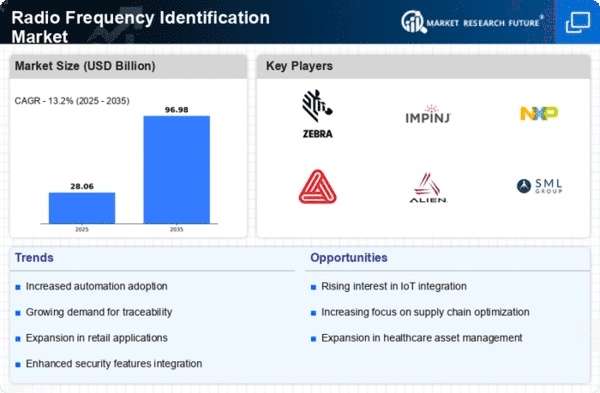
As per MRFR analysis, the Radio Frequency Identification Market was estimated at 24.79 USD Billion in 2024. The Radio Frequency Identification industry is projected to grow from 28.06 USD Billion in 2025 to 96.98 USD Billion by 2035, exhibiting a compound annual growth rate (CAGR) of 13.2% during the forecast period 2025 - 2035.

Key Market Trends & Highlights

The Radio Frequency Identification Market is poised for substantial growth driven by technological advancements and increasing automation demands.

  • The integration of RFID with IoT technologies is transforming operational efficiencies across various sectors. A growing focus on sustainability is prompting companies to adopt eco-friendly RFID solutions. Enhanced security features in RFID systems are becoming essential to protect sensitive data and assets. The rising demand for automation and government initiatives are key drivers propelling the adoption of RFID in the retail and healthcare sectors.

Market Size & Forecast

2024 Market Size 24.79 (USD Billion)
2035 Market Size 96.98 (USD Billion)
CAGR (2025 - 2035) 13.2%
Largest Regional Market Share in 2024 North America

Major Players

Zebra Technologies (US), Impinj (US), NXP Semiconductors (NL), Avery Dennison (US), Alien Technology (US), SML Group (HK), Honeywell (US), RFID Global Solution (US), Mojix (US)

Market Trends

The Radio Frequency Identification Market is currently experiencing a transformative phase, driven by advancements in technology and increasing adoption across various sectors. This market encompasses a range of applications, including inventory management, supply chain optimization, and asset tracking. As organizations seek to enhance operational efficiency and improve visibility, the demand for RFID solutions appears to be on the rise. Furthermore, the integration of Internet of Things (IoT) technologies with RFID systems is likely to create new opportunities for innovation and growth. In addition to technological advancements, regulatory frameworks and standards are evolving to support the deployment of RFID solutions. This evolution may facilitate greater interoperability and compatibility among different systems, thereby enhancing user experience. Moreover, the growing emphasis on sustainability and environmental responsibility is prompting companies to explore RFID applications that contribute to waste reduction and resource optimization. As the Radio Frequency Identification Market continues to mature, it seems poised to play a crucial role in shaping the future of various industries, from retail to healthcare.

Integration with IoT Technologies

The convergence of Radio Frequency Identification and Internet of Things technologies is becoming increasingly prevalent. This integration allows for real-time data collection and analysis, enhancing operational efficiency and decision-making processes. Organizations are likely to leverage this synergy to create smarter supply chains and improve asset management.

Focus on Sustainability

There is a growing trend towards sustainability within the Radio Frequency Identification Market. Companies are exploring eco-friendly RFID solutions that minimize environmental impact. This focus on sustainability may drive innovation in product design and materials, aligning with global efforts to reduce waste and promote responsible consumption.

Enhanced Security Features

As security concerns rise, the Radio Frequency Identification Market is witnessing a shift towards enhanced security features. Manufacturers are developing advanced encryption and authentication methods to protect sensitive data. This trend indicates a proactive approach to safeguarding information, which is essential for maintaining consumer trust and compliance with regulations.

Radio Frequency Identification Market Market Drivers

Regulatory Support

Government regulations promoting the use of RFID technology in various industries are bolstering the Global Radio Frequency Identification Market (RFID) Market Industry. Regulatory bodies are increasingly recognizing the benefits of RFID in enhancing traceability and security, particularly in sectors such as healthcare and food safety. For example, initiatives aimed at improving food traceability have led to the adoption of RFID systems in supply chains. This regulatory support is likely to facilitate market expansion, contributing to a compound annual growth rate (CAGR) of 6.46% from 2025 to 2035.

Technological Advancements

The Global Radio Frequency Identification Market (RFID) Market Industry is experiencing rapid technological advancements, which are enhancing the capabilities and applications of RFID systems. Innovations such as the development of passive RFID tags that can operate without batteries and the integration of RFID with IoT technologies are driving market growth. These advancements enable real-time tracking and inventory management across various sectors, including retail and logistics. As a result, the market is projected to reach 15.3 USD Billion in 2024, reflecting a growing demand for efficient supply chain solutions.

Increased Adoption in Retail

The retail sector is increasingly adopting RFID technology to improve inventory accuracy and enhance customer experience. The Global Radio Frequency Identification Market (RFID) Market Industry indicates that retailers are utilizing RFID for real-time inventory tracking, which reduces stock discrepancies and enhances operational efficiency. For instance, major retailers have reported inventory accuracy rates exceeding 95% after implementing RFID systems. This trend is expected to contribute significantly to the market's growth, with projections indicating a rise to 30.5 USD Billion by 2035, driven by the need for improved supply chain management.

Emerging Applications in Healthcare

The healthcare sector is witnessing a surge in the adoption of RFID technology, which is transforming patient care and asset management. The Global Radio Frequency Identification Market (RFID) Market Industry highlights the use of RFID for tracking medical equipment, medications, and even patients. This technology enhances operational efficiency and improves patient safety by reducing errors associated with medication administration. As healthcare providers increasingly recognize the benefits of RFID, the market is expected to experience significant growth, contributing to the overall expansion of the industry.

Growing Demand for Supply Chain Efficiency

The demand for enhanced supply chain efficiency is a significant driver of the Global Radio Frequency Identification Market (RFID) Market Industry. Organizations are increasingly seeking solutions to streamline operations and reduce costs, leading to a higher adoption of RFID technology. By providing real-time visibility into inventory levels and asset locations, RFID systems enable companies to optimize their supply chains. This trend is particularly evident in logistics and manufacturing sectors, where efficiency gains can lead to substantial cost savings. As a result, the market is poised for robust growth, with expectations of reaching 30.5 USD Billion by 2035.

Market Segment Insights

By Application: Asset Tracking (Largest) vs. Smart Packaging (Fastest-Growing)

<p>The Radio Frequency Identification (RFID) market displays a diverse application landscape where asset tracking and inventory management emerge as the most significant segments. Asset tracking holds the largest share, driven by the need for improved operational efficiency and visibility in various industries. Other notable segments include inventory management and access control, showcasing a competitive distribution of market demand as user requirements evolve.</p>

<p>Inventory Management (Dominant) vs. Supply Chain Management (Emerging)</p>

<p>Inventory management stands as a dominant application in the RFID market due to its critical role in ensuring product availability and reducing stock losses. Companies leverage RFID technology to enhance inventory accuracy and reduce manual handling, resulting in lower operational costs. Conversely, supply chain management is an emerging sector leveraging RFID for real-time tracking and efficiency enhancement. The shift towards automation and digital transformation in supply chains is driving its adoption, as businesses seek to streamline processes and improve the overall efficiency of goods flow.</p>

By End Use: Retail (Largest) vs. Healthcare (Fastest-Growing)

In the Radio Frequency Identification (RFID) Market, the End Use segment shows significant differentiation in terms of application, with Retail commanding the largest share. Retail utilizes RFID technology for inventory management, customer engagement, and loss prevention, leading to widespread adoption across various retail formats. On the other hand, the Healthcare sector is gaining momentum and is recognized as the fastest-growing segment. This growth is driven by an increasing focus on patient safety, medication tracking, and efficient supply chain management within healthcare facilities. In addition, the growing demand for real-time tracking of medical assets further propels the use of RFID in this sector.

Retail (Dominant) vs. Healthcare (Emerging)

The Retail segment of the RFID market is characterized by its extensive use of technology to streamline operations, enhance customer experiences, and increase operational efficiency. Retailers leverage RFID systems for better inventory accuracy and to minimize stockouts and overages, making it a dominant force in the market. Conversely, the Healthcare segment is emerging rapidly, characterized by its adoption of RFID for improved tracking of medical supplies, increased patient safety, and streamlined workflows. As healthcare providers face mounting pressure to optimize resources and ensure compliance, the integration of RFID into existing systems is becoming increasingly common. This juxtaposition highlights the strategic importance of RFID technology across varying sectors, with Retail leading and Healthcare on a robust growth trajectory.

By Technology: Active RFID (Largest) vs. Passive RFID (Fastest-Growing)

In the Radio Frequency Identification (RFID) market, the technology segment showcases a diverse array of solutions, with Active RFID leading the pack in terms of market share. As the most widely adopted technology, Active RFID benefits from its ability to provide real-time tracking and monitoring across various industries, including logistics, healthcare, and asset management. Meanwhile, Passive RFID is rapidly gaining traction, especially in retail and supply chain management, where its cost-effectiveness and efficient inventory management capabilities make it an appealing choice for businesses seeking to enhance operational efficiency. The growth trends within the RFID technology segment indicate a shift towards greater adoption of Passive RFID, driven by increasing demand for affordable and scalable solutions. Factors such as the rise of IoT applications and smart logistics are further propelling this growth, as businesses strive for more integrated and automated systems. As companies continue to invest in automation and efficiency, the demand for Passive RFID solutions is expected to outpace that of Active RFID in the coming years, solidifying its position as the fastest-growing technology in the RFID market.

Technology: Active RFID (Dominant) vs. Passive RFID (Emerging)

Active RFID technology is characterized by its use of battery-powered tags that actively transmit signals, enabling real-time data collection and asset tracking. This dominance stems from its extensive range and reliability, making it the preferred choice for high-value asset management in sectors such as logistics and healthcare. Conversely, Passive RFID represents a more recent emergent technology, where tags harvest energy from the reader's signal. This makes Passive RFID an increasingly appealing option for cost-sensitive applications, particularly in retail environments. As businesses transition towards more integrated operational frameworks, Passive RFID's lower entry costs and ease of implementation position it as a formidable contender against the established dominance of Active RFID.

By Frequency: Ultra High Frequency (Largest) vs. Low Frequency (Fastest-Growing)

In the Radio Frequency Identification Market, the segment distribution is predominantly led by Ultra High Frequency (UHF) technology, which holds the largest market share due to its wide-ranging applications in logistics, supply chain, and retail. High Frequency (HF) and Low Frequency (LF) segments also have significant shares, but they cater to more niche applications, such as access control and animal tracking respectively. As industries increasingly adopt RFID solutions, UHF continues to expand its lead over other frequencies in terms of usage and implementation.

Frequency: UHF (Dominant) vs. LF (Emerging)

Ultra High Frequency (UHF) RFID technology has established itself as the dominant force in the market, thanks to its ability to read multiple tags at greater distances and speeds. This segment is particularly favored in supply chain management and inventory control, where efficiency is paramount. In contrast, Low Frequency (LF) RFID is emerging as a vital segment, particularly in access control and animal tracking. While LF operates at lower ranges and has shorter read distances than UHF, it excels in applications requiring reliable read rates in challenging environments, thus carving out its niche in the rapidly evolving RFID landscape.

By Component: Tags (Largest) vs. Readers (Fastest-Growing)

The Radio Frequency Identification (RFID) market is witnessing a notable distribution of market share across its key components. Tags are currently the largest segment, enjoying widespread adoption across various industries like retail, logistics, and healthcare. Readers, while trailing in overall share, are rapidly gaining traction due to advancements in technology and increased investments in infrastructure for automated systems. Antennas, software, and middleware also play crucial roles, contributing to the robustness and functionality of RFID solutions. The growth trends in the RFID component segment are significantly influenced by technological innovations and the rising demand for automation. Tags are becoming increasingly sophisticated with enhanced capabilities, driving demand for improved reading technologies provided by readers. The fastest growth of readers can be attributed to the integration of IoT and smart devices, facilitating seamless data collection and management, which is essential for modern businesses seeking to streamline operations.

Tags (Dominant) vs. Software (Emerging)

Tags hold a position of dominance within the RFID market due to their essential role in item identification and tracking across diverse applications. They are versatile in functionality, accommodating different frequency ranges and form factors, thus catering to a wide array of industries. On the other hand, software is emerging as a critical element for managing RFID systems, offering significant value in <a href="https://www.marketresearchfuture.com/reports/data-analytics-in-banking-market-29208">data analytics</a>, visibility, and inventory management. As organizations increasingly recognize the importance of actionable data, software solutions that integrate seamlessly with RFID systems are gaining prominence. This shift not only enhances operational efficiencies but also provides meaningful insights that drive strategic decision-making in businesses.

Get more detailed insights about Radio-Frequency Identification (RFID) Market Research Report- Forecast 2035

Regional Insights

North America : Market Leader in RFID Technology

North America continues to lead the Radio Frequency Identification (RFID) market, holding a significant share of 12.0 in 2024. The growth is driven by increasing adoption across various sectors, including retail, healthcare, and logistics. Regulatory support for supply chain transparency and inventory management further fuels demand. The region's technological advancements and investment in smart infrastructure are pivotal in shaping the market landscape. The competitive landscape in North America is robust, featuring key players such as Zebra Technologies, Impinj, and Avery Dennison. The U.S. stands out as a major contributor, with a strong focus on innovation and integration of RFID solutions in business operations. Companies are leveraging RFID for enhanced tracking and data management, solidifying their market positions and driving further growth in the sector.

Europe : Emerging RFID Adoption Trends

Europe is witnessing a growing interest in Radio Frequency Identification (RFID) technology, with a market size of 6.0 in 2024. The region's growth is propelled by increasing regulatory requirements for traceability and efficiency in supply chains. Countries are investing in smart technologies to enhance operational efficiency, which is expected to drive further adoption of RFID solutions across various industries. Leading countries in Europe include Germany, the UK, and France, where companies are actively integrating RFID into their operations. The competitive landscape features key players like NXP Semiconductors and Avery Dennison, who are innovating to meet the rising demand. The European market is characterized by a focus on sustainability and compliance, which is shaping the future of RFID technology in the region.

Asia-Pacific : Rapid Growth in RFID Solutions

The Asia-Pacific region is experiencing a surge in Radio Frequency Identification (RFID) technology adoption, with a market size of 5.0 in 2024. This growth is driven by increasing demand for automation and efficiency in sectors such as retail, manufacturing, and logistics. Government initiatives promoting smart city projects and digital transformation are also significant catalysts for market expansion in this region. Countries like China, Japan, and India are leading the charge in RFID implementation, with a competitive landscape featuring companies such as SML Group and Alien Technology. The region's focus on technological innovation and cost-effective solutions is fostering a dynamic environment for RFID growth. As businesses seek to enhance operational efficiency, the demand for RFID solutions is expected to continue rising in the coming years.

Middle East and Africa : Emerging Market Potential

The Middle East and Africa (MEA) region is gradually emerging as a potential market for Radio Frequency Identification (RFID) technology, with a market size of 1.79 in 2024. The growth is driven by increasing investments in infrastructure and technology, alongside a rising demand for efficient supply chain management. Regulatory frameworks are evolving to support the adoption of RFID solutions, particularly in logistics and retail sectors. Countries like South Africa and the UAE are at the forefront of RFID adoption, with a growing number of companies exploring its benefits. The competitive landscape is still developing, with opportunities for both local and international players to establish a presence. As awareness of RFID technology increases, the region is poised for significant growth in the coming years.

Key Players and Competitive Insights

The Radio Frequency Identification Market is currently characterized by a dynamic competitive landscape, driven by technological advancements and increasing demand for automation across various sectors. Key players such as Zebra Technologies (US), Impinj (US), and NXP Semiconductors (NL) are strategically positioned to leverage innovation and partnerships to enhance their market presence. Zebra Technologies (US) focuses on integrating RFID solutions with IoT technologies, thereby enhancing operational efficiency for its clients. Meanwhile, Impinj (US) emphasizes the development of high-performance RFID solutions that cater to retail and logistics, indicating a strong commitment to sector-specific innovations. NXP Semiconductors (NL) appears to be concentrating on expanding its product portfolio to include advanced RFID chips that support secure transactions, which is crucial in today's digital economy.
The business tactics employed by these companies reflect a trend towards localizing manufacturing and optimizing supply chains to meet regional demands. The market structure is moderately fragmented, with several players competing for market share while also collaborating through strategic partnerships. This collective influence of key players fosters a competitive environment that encourages innovation and responsiveness to market needs.
In November 2025, Zebra Technologies (US) announced a partnership with a leading logistics firm to implement RFID solutions aimed at streamlining inventory management. This strategic move is likely to enhance Zebra's market penetration in the logistics sector, showcasing its commitment to providing tailored solutions that address specific industry challenges. The partnership not only strengthens Zebra's operational capabilities but also positions it as a leader in the logistics RFID space.
In October 2025, Impinj (US) launched a new line of RFID readers designed for high-density environments, such as retail stores and warehouses. This product introduction is significant as it addresses the growing need for efficient inventory tracking in crowded spaces, thereby enhancing customer experience and operational efficiency. Impinj's focus on high-density applications suggests a strategic alignment with market demands, potentially increasing its competitive edge.
In September 2025, NXP Semiconductors (NL) unveiled a new RFID chip that integrates advanced security features, catering to the rising concerns over data privacy and security in transactions. This development is particularly relevant as it aligns with global trends towards enhanced security measures in technology. NXP's proactive approach in addressing these concerns may solidify its position as a trusted provider in the RFID market.
As of December 2025, the competitive trends in the Radio Frequency Identification Market are increasingly defined by digitalization, sustainability, and the integration of AI technologies. Strategic alliances among key players are shaping the landscape, fostering innovation and collaborative solutions. The shift from price-based competition to a focus on technological advancement and supply chain reliability is evident, suggesting that future competitive differentiation will hinge on the ability to innovate and adapt to evolving market demands.

Key Companies in the Radio Frequency Identification Market include

Industry Developments

Recent changes in the Radio Frequency Identification Market (RFID) Market have shown that major players are still coming up with new ideas and making strategic moves. Companies like NXP Semiconductors and Avery Dennison have been adding to their RFID product lines to make supply chains run more smoothly and help businesses manage their inventory better in fields like retail, logistics, and manufacturing. Zebra Technologies bought Antuit.ai in October 2021. The goal was to combine AI-driven demand forecasting with its retail solutions. This was a strategic addition to its RFID-enabled inventory management systems, even though it wasn't directly related.

Honeywell released a new line of RFID-enabled handheld readers and fixed scanners for the healthcare sector in September 2023. These devices help improve asset tracking and patient safety in the face of ongoing global logistics problems. The RFID market has grown quickly from 2021 to 2023. This is because more people are using IoT and cloud-based infrastructure, which has made it easier to see things in real time and automate the supply chain more intelligently.

Also, in August 2023 and June 2023, top RFID IC and reader companies like Impinj and Alien Technology added more products to their lines. These new products are meant for a wider range of industries, such as retail, industrial warehousing, and smart inventory systems. These efforts show how RFID technology is becoming more and more important for supporting automation, data-driven operations, and digital transformation around the world.

Future Outlook

Radio Frequency Identification Market Future Outlook

The Radio Frequency Identification Market is projected to grow at a 13.2% CAGR from 2025 to 2035, driven by advancements in IoT, supply chain optimization, and increased demand for automation.

New opportunities lie in:

  • Integration of RFID with IoT for real-time asset tracking solutions.
  • Development of RFID-enabled smart packaging for enhanced consumer engagement.
  • Expansion of RFID applications in healthcare for patient and inventory management.

By 2035, the Radio Frequency Identification Market is expected to be a pivotal component of global supply chain and automation strategies.

Market Segmentation

Radio Frequency Identification Market End Use Outlook

  • Retail
  • Healthcare
  • Manufacturing
  • Transportation
  • Logistics

Radio Frequency Identification Market Component Outlook

  • Tags
  • Readers
  • Software
  • Antennas
  • Middleware

Radio Frequency Identification Market Frequency Outlook

  • Low Frequency
  • High Frequency
  • Ultra High Frequency

Radio Frequency Identification Market Technology Outlook

  • Active RFID
  • Passive RFID
  • Semi-Passive RFID
  • Near Field Communication
  • Ultra-High Frequency

Radio Frequency Identification Market Application Outlook

  • Asset Tracking
  • Inventory Management
  • Access Control
  • Supply Chain Management
  • Retail Management

Report Scope

MARKET SIZE 2024 24.79(USD Billion)
MARKET SIZE 2025 28.06(USD Billion)
MARKET SIZE 2035 96.98(USD Billion)
COMPOUND ANNUAL GROWTH RATE (CAGR) 13.2% (2025 - 2035)
REPORT COVERAGE Revenue Forecast, Competitive Landscape, Growth Factors, and Trends
BASE YEAR 2024
Market Forecast Period 2025 - 2035
Historical Data 2019 - 2024
Market Forecast Units USD Billion
Key Companies Profiled Zebra Technologies (US), Impinj (US), NXP Semiconductors (NL), Avery Dennison (US), Alien Technology (US), SML Group (HK), Honeywell (US), RFID Global Solution (US), Mojix (US)
Segments Covered Application, End Use, Technology, Frequency, Component
Key Market Opportunities Integration of Radio Frequency Identification technology in supply chain automation enhances operational efficiency and accuracy.
Key Market Dynamics Rising demand for automation drives innovation and competition in the Radio Frequency Identification technology sector.
Countries Covered North America, Europe, APAC, South America, MEA

FAQs

What is the projected market valuation of the Radio Frequency Identification Market by 2035?

<p>The Radio Frequency Identification Market is projected to reach a valuation of 96.98 USD Billion by 2035.</p>

What was the market valuation of the Radio Frequency Identification Market in 2024?

<p>In 2024, the market valuation of the Radio Frequency Identification Market was 24.79 USD Billion.</p>

What is the expected CAGR for the Radio Frequency Identification Market during the forecast period 2025 - 2035?

<p>The expected CAGR for the Radio Frequency Identification Market during the forecast period 2025 - 2035 is 13.2%.</p>

Which companies are considered key players in the Radio Frequency Identification Market?

<p>Key players in the Radio Frequency Identification Market include Zebra Technologies, Impinj, NXP Semiconductors, Avery Dennison, and Alien Technology.</p>

What are the projected valuations for the Asset Tracking application segment by 2035?

<p>The Asset Tracking application segment is projected to grow from 5.0 USD Billion to 20.0 USD Billion by 2035.</p>

How does the Inventory Management segment perform in terms of market valuation?

<p>The Inventory Management segment is expected to increase from 6.0 USD Billion in 2024 to 24.0 USD Billion by 2035.</p>

What is the market valuation for the Healthcare end-use segment in 2024?

<p>The Healthcare end-use segment had a market valuation of 4.0 USD Billion in 2024.</p>

What is the projected growth for the Passive RFID technology segment by 2035?

<p>The Passive RFID technology segment is anticipated to grow from 15.0 USD Billion to 60.0 USD Billion by 2035.</p>

What are the expected valuations for the Tags component segment by 2035?

<p>The Tags component segment is projected to increase from 5.0 USD Billion in 2024 to 20.0 USD Billion by 2035.</p>

Which end-use segment is expected to have the highest valuation by 2035?

<p>The Manufacturing end-use segment is expected to reach a valuation of 24.0 USD Billion by 2035.</p>

  1. SECTION I: EXECUTIVE SUMMARY AND KEY HIGHLIGHTS
    1. | 1.1 EXECUTIVE SUMMARY
    2. | | 1.1.1 Market Overview
    3. | | 1.1.2 Key Findings
    4. | | 1.1.3 Market Segmentation
    5. | | 1.1.4 Competitive Landscape
    6. | | 1.1.5 Challenges and Opportunities
    7. | | 1.1.6 Future Outlook
  2. SECTION II: SCOPING, METHODOLOGY AND MARKET STRUCTURE
    1. | 2.1 MARKET INTRODUCTION
    2. | | 2.1.1 Definition
    3. | | 2.1.2 Scope of the study
    4. | | | 2.1.2.1 Research Objective
    5. | | | 2.1.2.2 Assumption
    6. | | | 2.1.2.3 Limitations
    7. | 2.2 RESEARCH METHODOLOGY
    8. | | 2.2.1 Overview
    9. | | 2.2.2 Data Mining
    10. | | 2.2.3 Secondary Research
    11. | | 2.2.4 Primary Research
    12. | | | 2.2.4.1 Primary Interviews and Information Gathering Process
    13. | | | 2.2.4.2 Breakdown of Primary Respondents
    14. | | 2.2.5 Forecasting Model
    15. | | 2.2.6 Market Size Estimation
    16. | | | 2.2.6.1 Bottom-Up Approach
    17. | | | 2.2.6.2 Top-Down Approach
    18. | | 2.2.7 Data Triangulation
    19. | | 2.2.8 Validation
  3. SECTION III: QUALITATIVE ANALYSIS
    1. | 3.1 MARKET DYNAMICS
    2. | | 3.1.1 Overview
    3. | | 3.1.2 Drivers
    4. | | 3.1.3 Restraints
    5. | | 3.1.4 Opportunities
    6. | 3.2 MARKET FACTOR ANALYSIS
    7. | | 3.2.1 Value chain Analysis
    8. | | 3.2.2 Porter's Five Forces Analysis
    9. | | | 3.2.2.1 Bargaining Power of Suppliers
    10. | | | 3.2.2.2 Bargaining Power of Buyers
    11. | | | 3.2.2.3 Threat of New Entrants
    12. | | | 3.2.2.4 Threat of Substitutes
    13. | | | 3.2.2.5 Intensity of Rivalry
    14. | | 3.2.3 COVID-19 Impact Analysis
    15. | | | 3.2.3.1 Market Impact Analysis
    16. | | | 3.2.3.2 Regional Impact
    17. | | | 3.2.3.3 Opportunity and Threat Analysis
  4. SECTION IV: QUANTITATIVE ANALYSIS
    1. | 4.1 Semiconductor & Electronics, BY Application (USD Billion)
    2. | | 4.1.1 Asset Tracking
    3. | | 4.1.2 Inventory Management
    4. | | 4.1.3 Access Control
    5. | | 4.1.4 Supply Chain Management
    6. | | 4.1.5 Smart Packaging
    7. | 4.2 Semiconductor & Electronics, BY End Use (USD Billion)
    8. | | 4.2.1 Retail
    9. | | 4.2.2 Healthcare
    10. | | 4.2.3 Manufacturing
    11. | | 4.2.4 Transportation
    12. | | 4.2.5 Logistics
    13. | 4.3 Semiconductor & Electronics, BY Technology (USD Billion)
    14. | | 4.3.1 Active RFID
    15. | | 4.3.2 Passive RFID
    16. | | 4.3.3 Semi-Passive RFID
    17. | | 4.3.4 Near Field Communication
    18. | | 4.3.5 Ultra-High Frequency
    19. | 4.4 Semiconductor & Electronics, BY Frequency (USD Billion)
    20. | | 4.4.1 Low Frequency
    21. | | 4.4.2 High Frequency
    22. | | 4.4.3 Ultra High Frequency
    23. | 4.5 Semiconductor & Electronics, BY Component (USD Billion)
    24. | | 4.5.1 Tags
    25. | | 4.5.2 Readers
    26. | | 4.5.3 Software
    27. | | 4.5.4 Middleware
    28. | | 4.5.5 Antennas
    29. | 4.6 Semiconductor & Electronics, BY Region (USD Billion)
    30. | | 4.6.1 North America
    31. | | | 4.6.1.1 US
    32. | | | 4.6.1.2 Canada
    33. | | 4.6.2 Europe
    34. | | | 4.6.2.1 Germany
    35. | | | 4.6.2.2 UK
    36. | | | 4.6.2.3 France
    37. | | | 4.6.2.4 Russia
    38. | | | 4.6.2.5 Italy
    39. | | | 4.6.2.6 Spain
    40. | | | 4.6.2.7 Rest of Europe
    41. | | 4.6.3 APAC
    42. | | | 4.6.3.1 China
    43. | | | 4.6.3.2 India
    44. | | | 4.6.3.3 Japan
    45. | | | 4.6.3.4 South Korea
    46. | | | 4.6.3.5 Malaysia
    47. | | | 4.6.3.6 Thailand
    48. | | | 4.6.3.7 Indonesia
    49. | | | 4.6.3.8 Rest of APAC
    50. | | 4.6.4 South America
    51. | | | 4.6.4.1 Brazil
    52. | | | 4.6.4.2 Mexico
    53. | | | 4.6.4.3 Argentina
    54. | | | 4.6.4.4 Rest of South America
    55. | | 4.6.5 MEA
    56. | | | 4.6.5.1 GCC Countries
    57. | | | 4.6.5.2 South Africa
    58. | | | 4.6.5.3 Rest of MEA
  5. SECTION V: COMPETITIVE ANALYSIS
    1. | 5.1 Competitive Landscape
    2. | | 5.1.1 Overview
    3. | | 5.1.2 Competitive Analysis
    4. | | 5.1.3 Market share Analysis
    5. | | 5.1.4 Major Growth Strategy in the Semiconductor & Electronics
    6. | | 5.1.5 Competitive Benchmarking
    7. | | 5.1.6 Leading Players in Terms of Number of Developments in the Semiconductor & Electronics
    8. | | 5.1.7 Key developments and growth strategies
    9. | | | 5.1.7.1 New Product Launch/Service Deployment
    10. | | | 5.1.7.2 Merger & Acquisitions
    11. | | | 5.1.7.3 Joint Ventures
    12. | | 5.1.8 Major Players Financial Matrix
    13. | | | 5.1.8.1 Sales and Operating Income
    14. | | | 5.1.8.2 Major Players R&D Expenditure. 2023
    15. | 5.2 Company Profiles
    16. | | 5.2.1 Zebra Technologies (US)
    17. | | | 5.2.1.1 Financial Overview
    18. | | | 5.2.1.2 Products Offered
    19. | | | 5.2.1.3 Key Developments
    20. | | | 5.2.1.4 SWOT Analysis
    21. | | | 5.2.1.5 Key Strategies
    22. | | 5.2.2 Impinj (US)
    23. | | | 5.2.2.1 Financial Overview
    24. | | | 5.2.2.2 Products Offered
    25. | | | 5.2.2.3 Key Developments
    26. | | | 5.2.2.4 SWOT Analysis
    27. | | | 5.2.2.5 Key Strategies
    28. | | 5.2.3 NXP Semiconductors (NL)
    29. | | | 5.2.3.1 Financial Overview
    30. | | | 5.2.3.2 Products Offered
    31. | | | 5.2.3.3 Key Developments
    32. | | | 5.2.3.4 SWOT Analysis
    33. | | | 5.2.3.5 Key Strategies
    34. | | 5.2.4 Avery Dennison (US)
    35. | | | 5.2.4.1 Financial Overview
    36. | | | 5.2.4.2 Products Offered
    37. | | | 5.2.4.3 Key Developments
    38. | | | 5.2.4.4 SWOT Analysis
    39. | | | 5.2.4.5 Key Strategies
    40. | | 5.2.5 Alien Technology (US)
    41. | | | 5.2.5.1 Financial Overview
    42. | | | 5.2.5.2 Products Offered
    43. | | | 5.2.5.3 Key Developments
    44. | | | 5.2.5.4 SWOT Analysis
    45. | | | 5.2.5.5 Key Strategies
    46. | | 5.2.6 SML Group (HK)
    47. | | | 5.2.6.1 Financial Overview
    48. | | | 5.2.6.2 Products Offered
    49. | | | 5.2.6.3 Key Developments
    50. | | | 5.2.6.4 SWOT Analysis
    51. | | | 5.2.6.5 Key Strategies
    52. | | 5.2.7 RFID Global Solution (US)
    53. | | | 5.2.7.1 Financial Overview
    54. | | | 5.2.7.2 Products Offered
    55. | | | 5.2.7.3 Key Developments
    56. | | | 5.2.7.4 SWOT Analysis
    57. | | | 5.2.7.5 Key Strategies
    58. | | 5.2.8 GAO RFID (CA)
    59. | | | 5.2.8.1 Financial Overview
    60. | | | 5.2.8.2 Products Offered
    61. | | | 5.2.8.3 Key Developments
    62. | | | 5.2.8.4 SWOT Analysis
    63. | | | 5.2.8.5 Key Strategies
    64. | | 5.2.9 Mojix (US)
    65. | | | 5.2.9.1 Financial Overview
    66. | | | 5.2.9.2 Products Offered
    67. | | | 5.2.9.3 Key Developments
    68. | | | 5.2.9.4 SWOT Analysis
    69. | | | 5.2.9.5 Key Strategies
    70. | 5.3 Appendix
    71. | | 5.3.1 References
    72. | | 5.3.2 Related Reports
  6. LIST OF FIGURES
    1. | 6.1 MARKET SYNOPSIS
    2. | 6.2 NORTH AMERICA MARKET ANALYSIS
    3. | 6.3 US MARKET ANALYSIS BY APPLICATION
    4. | 6.4 US MARKET ANALYSIS BY END USE
    5. | 6.5 US MARKET ANALYSIS BY TECHNOLOGY
    6. | 6.6 US MARKET ANALYSIS BY FREQUENCY
    7. | 6.7 US MARKET ANALYSIS BY COMPONENT
    8. | 6.8 CANADA MARKET ANALYSIS BY APPLICATION
    9. | 6.9 CANADA MARKET ANALYSIS BY END USE
    10. | 6.10 CANADA MARKET ANALYSIS BY TECHNOLOGY
    11. | 6.11 CANADA MARKET ANALYSIS BY FREQUENCY
    12. | 6.12 CANADA MARKET ANALYSIS BY COMPONENT
    13. | 6.13 EUROPE MARKET ANALYSIS
    14. | 6.14 GERMANY MARKET ANALYSIS BY APPLICATION
    15. | 6.15 GERMANY MARKET ANALYSIS BY END USE
    16. | 6.16 GERMANY MARKET ANALYSIS BY TECHNOLOGY
    17. | 6.17 GERMANY MARKET ANALYSIS BY FREQUENCY
    18. | 6.18 GERMANY MARKET ANALYSIS BY COMPONENT
    19. | 6.19 UK MARKET ANALYSIS BY APPLICATION
    20. | 6.20 UK MARKET ANALYSIS BY END USE
    21. | 6.21 UK MARKET ANALYSIS BY TECHNOLOGY
    22. | 6.22 UK MARKET ANALYSIS BY FREQUENCY
    23. | 6.23 UK MARKET ANALYSIS BY COMPONENT
    24. | 6.24 FRANCE MARKET ANALYSIS BY APPLICATION
    25. | 6.25 FRANCE MARKET ANALYSIS BY END USE
    26. | 6.26 FRANCE MARKET ANALYSIS BY TECHNOLOGY
    27. | 6.27 FRANCE MARKET ANALYSIS BY FREQUENCY
    28. | 6.28 FRANCE MARKET ANALYSIS BY COMPONENT
    29. | 6.29 RUSSIA MARKET ANALYSIS BY APPLICATION
    30. | 6.30 RUSSIA MARKET ANALYSIS BY END USE
    31. | 6.31 RUSSIA MARKET ANALYSIS BY TECHNOLOGY
    32. | 6.32 RUSSIA MARKET ANALYSIS BY FREQUENCY
    33. | 6.33 RUSSIA MARKET ANALYSIS BY COMPONENT
    34. | 6.34 ITALY MARKET ANALYSIS BY APPLICATION
    35. | 6.35 ITALY MARKET ANALYSIS BY END USE
    36. | 6.36 ITALY MARKET ANALYSIS BY TECHNOLOGY
    37. | 6.37 ITALY MARKET ANALYSIS BY FREQUENCY
    38. | 6.38 ITALY MARKET ANALYSIS BY COMPONENT
    39. | 6.39 SPAIN MARKET ANALYSIS BY APPLICATION
    40. | 6.40 SPAIN MARKET ANALYSIS BY END USE
    41. | 6.41 SPAIN MARKET ANALYSIS BY TECHNOLOGY
    42. | 6.42 SPAIN MARKET ANALYSIS BY FREQUENCY
    43. | 6.43 SPAIN MARKET ANALYSIS BY COMPONENT
    44. | 6.44 REST OF EUROPE MARKET ANALYSIS BY APPLICATION
    45. | 6.45 REST OF EUROPE MARKET ANALYSIS BY END USE
    46. | 6.46 REST OF EUROPE MARKET ANALYSIS BY TECHNOLOGY
    47. | 6.47 REST OF EUROPE MARKET ANALYSIS BY FREQUENCY
    48. | 6.48 REST OF EUROPE MARKET ANALYSIS BY COMPONENT
    49. | 6.49 APAC MARKET ANALYSIS
    50. | 6.50 CHINA MARKET ANALYSIS BY APPLICATION
    51. | 6.51 CHINA MARKET ANALYSIS BY END USE
    52. | 6.52 CHINA MARKET ANALYSIS BY TECHNOLOGY
    53. | 6.53 CHINA MARKET ANALYSIS BY FREQUENCY
    54. | 6.54 CHINA MARKET ANALYSIS BY COMPONENT
    55. | 6.55 INDIA MARKET ANALYSIS BY APPLICATION
    56. | 6.56 INDIA MARKET ANALYSIS BY END USE
    57. | 6.57 INDIA MARKET ANALYSIS BY TECHNOLOGY
    58. | 6.58 INDIA MARKET ANALYSIS BY FREQUENCY
    59. | 6.59 INDIA MARKET ANALYSIS BY COMPONENT
    60. | 6.60 JAPAN MARKET ANALYSIS BY APPLICATION
    61. | 6.61 JAPAN MARKET ANALYSIS BY END USE
    62. | 6.62 JAPAN MARKET ANALYSIS BY TECHNOLOGY
    63. | 6.63 JAPAN MARKET ANALYSIS BY FREQUENCY
    64. | 6.64 JAPAN MARKET ANALYSIS BY COMPONENT
    65. | 6.65 SOUTH KOREA MARKET ANALYSIS BY APPLICATION
    66. | 6.66 SOUTH KOREA MARKET ANALYSIS BY END USE
    67. | 6.67 SOUTH KOREA MARKET ANALYSIS BY TECHNOLOGY
    68. | 6.68 SOUTH KOREA MARKET ANALYSIS BY FREQUENCY
    69. | 6.69 SOUTH KOREA MARKET ANALYSIS BY COMPONENT
    70. | 6.70 MALAYSIA MARKET ANALYSIS BY APPLICATION
    71. | 6.71 MALAYSIA MARKET ANALYSIS BY END USE
    72. | 6.72 MALAYSIA MARKET ANALYSIS BY TECHNOLOGY
    73. | 6.73 MALAYSIA MARKET ANALYSIS BY FREQUENCY
    74. | 6.74 MALAYSIA MARKET ANALYSIS BY COMPONENT
    75. | 6.75 THAILAND MARKET ANALYSIS BY APPLICATION
    76. | 6.76 THAILAND MARKET ANALYSIS BY END USE
    77. | 6.77 THAILAND MARKET ANALYSIS BY TECHNOLOGY
    78. | 6.78 THAILAND MARKET ANALYSIS BY FREQUENCY
    79. | 6.79 THAILAND MARKET ANALYSIS BY COMPONENT
    80. | 6.80 INDONESIA MARKET ANALYSIS BY APPLICATION
    81. | 6.81 INDONESIA MARKET ANALYSIS BY END USE
    82. | 6.82 INDONESIA MARKET ANALYSIS BY TECHNOLOGY
    83. | 6.83 INDONESIA MARKET ANALYSIS BY FREQUENCY
    84. | 6.84 INDONESIA MARKET ANALYSIS BY COMPONENT
    85. | 6.85 REST OF APAC MARKET ANALYSIS BY APPLICATION
    86. | 6.86 REST OF APAC MARKET ANALYSIS BY END USE
    87. | 6.87 REST OF APAC MARKET ANALYSIS BY TECHNOLOGY
    88. | 6.88 REST OF APAC MARKET ANALYSIS BY FREQUENCY
    89. | 6.89 REST OF APAC MARKET ANALYSIS BY COMPONENT
    90. | 6.90 SOUTH AMERICA MARKET ANALYSIS
    91. | 6.91 BRAZIL MARKET ANALYSIS BY APPLICATION
    92. | 6.92 BRAZIL MARKET ANALYSIS BY END USE
    93. | 6.93 BRAZIL MARKET ANALYSIS BY TECHNOLOGY
    94. | 6.94 BRAZIL MARKET ANALYSIS BY FREQUENCY
    95. | 6.95 BRAZIL MARKET ANALYSIS BY COMPONENT
    96. | 6.96 MEXICO MARKET ANALYSIS BY APPLICATION
    97. | 6.97 MEXICO MARKET ANALYSIS BY END USE
    98. | 6.98 MEXICO MARKET ANALYSIS BY TECHNOLOGY
    99. | 6.99 MEXICO MARKET ANALYSIS BY FREQUENCY
    100. | 6.100 MEXICO MARKET ANALYSIS BY COMPONENT
    101. | 6.101 ARGENTINA MARKET ANALYSIS BY APPLICATION
    102. | 6.102 ARGENTINA MARKET ANALYSIS BY END USE
    103. | 6.103 ARGENTINA MARKET ANALYSIS BY TECHNOLOGY
    104. | 6.104 ARGENTINA MARKET ANALYSIS BY FREQUENCY
    105. | 6.105 ARGENTINA MARKET ANALYSIS BY COMPONENT
    106. | 6.106 REST OF SOUTH AMERICA MARKET ANALYSIS BY APPLICATION
    107. | 6.107 REST OF SOUTH AMERICA MARKET ANALYSIS BY END USE
    108. | 6.108 REST OF SOUTH AMERICA MARKET ANALYSIS BY TECHNOLOGY
    109. | 6.109 REST OF SOUTH AMERICA MARKET ANALYSIS BY FREQUENCY
    110. | 6.110 REST OF SOUTH AMERICA MARKET ANALYSIS BY COMPONENT
    111. | 6.111 MEA MARKET ANALYSIS
    112. | 6.112 GCC COUNTRIES MARKET ANALYSIS BY APPLICATION
    113. | 6.113 GCC COUNTRIES MARKET ANALYSIS BY END USE
    114. | 6.114 GCC COUNTRIES MARKET ANALYSIS BY TECHNOLOGY
    115. | 6.115 GCC COUNTRIES MARKET ANALYSIS BY FREQUENCY
    116. | 6.116 GCC COUNTRIES MARKET ANALYSIS BY COMPONENT
    117. | 6.117 SOUTH AFRICA MARKET ANALYSIS BY APPLICATION
    118. | 6.118 SOUTH AFRICA MARKET ANALYSIS BY END USE
    119. | 6.119 SOUTH AFRICA MARKET ANALYSIS BY TECHNOLOGY
    120. | 6.120 SOUTH AFRICA MARKET ANALYSIS BY FREQUENCY
    121. | 6.121 SOUTH AFRICA MARKET ANALYSIS BY COMPONENT
    122. | 6.122 REST OF MEA MARKET ANALYSIS BY APPLICATION
    123. | 6.123 REST OF MEA MARKET ANALYSIS BY END USE
    124. | 6.124 REST OF MEA MARKET ANALYSIS BY TECHNOLOGY
    125. | 6.125 REST OF MEA MARKET ANALYSIS BY FREQUENCY
    126. | 6.126 REST OF MEA MARKET ANALYSIS BY COMPONENT
    127. | 6.127 KEY BUYING CRITERIA OF SEMICONDUCTOR & ELECTRONICS
    128. | 6.128 RESEARCH PROCESS OF MRFR
    129. | 6.129 DRO ANALYSIS OF SEMICONDUCTOR & ELECTRONICS
    130. | 6.130 DRIVERS IMPACT ANALYSIS: SEMICONDUCTOR & ELECTRONICS
    131. | 6.131 RESTRAINTS IMPACT ANALYSIS: SEMICONDUCTOR & ELECTRONICS
    132. | 6.132 SUPPLY / VALUE CHAIN: SEMICONDUCTOR & ELECTRONICS
    133. | 6.133 SEMICONDUCTOR & ELECTRONICS, BY APPLICATION, 2024 (% SHARE)
    134. | 6.134 SEMICONDUCTOR & ELECTRONICS, BY APPLICATION, 2024 TO 2035 (USD Billion)
    135. | 6.135 SEMICONDUCTOR & ELECTRONICS, BY END USE, 2024 (% SHARE)
    136. | 6.136 SEMICONDUCTOR & ELECTRONICS, BY END USE, 2024 TO 2035 (USD Billion)
    137. | 6.137 SEMICONDUCTOR & ELECTRONICS, BY TECHNOLOGY, 2024 (% SHARE)
    138. | 6.138 SEMICONDUCTOR & ELECTRONICS, BY TECHNOLOGY, 2024 TO 2035 (USD Billion)
    139. | 6.139 SEMICONDUCTOR & ELECTRONICS, BY FREQUENCY, 2024 (% SHARE)
    140. | 6.140 SEMICONDUCTOR & ELECTRONICS, BY FREQUENCY, 2024 TO 2035 (USD Billion)
    141. | 6.141 SEMICONDUCTOR & ELECTRONICS, BY COMPONENT, 2024 (% SHARE)
    142. | 6.142 SEMICONDUCTOR & ELECTRONICS, BY COMPONENT, 2024 TO 2035 (USD Billion)
    143. | 6.143 BENCHMARKING OF MAJOR COMPETITORS
  7. LIST OF TABLES
    1. | 7.1 LIST OF ASSUMPTIONS
    2. | | 7.1.1
    3. | 7.2 North America MARKET SIZE ESTIMATES; FORECAST
    4. | | 7.2.1 BY APPLICATION, 2025-2035 (USD Billion)
    5. | | 7.2.2 BY END USE, 2025-2035 (USD Billion)
    6. | | 7.2.3 BY TECHNOLOGY, 2025-2035 (USD Billion)
    7. | | 7.2.4 BY FREQUENCY, 2025-2035 (USD Billion)
    8. | | 7.2.5 BY COMPONENT, 2025-2035 (USD Billion)
    9. | 7.3 US MARKET SIZE ESTIMATES; FORECAST
    10. | | 7.3.1 BY APPLICATION, 2025-2035 (USD Billion)
    11. | | 7.3.2 BY END USE, 2025-2035 (USD Billion)
    12. | | 7.3.3 BY TECHNOLOGY, 2025-2035 (USD Billion)
    13. | | 7.3.4 BY FREQUENCY, 2025-2035 (USD Billion)
    14. | | 7.3.5 BY COMPONENT, 2025-2035 (USD Billion)
    15. | 7.4 Canada MARKET SIZE ESTIMATES; FORECAST
    16. | | 7.4.1 BY APPLICATION, 2025-2035 (USD Billion)
    17. | | 7.4.2 BY END USE, 2025-2035 (USD Billion)
    18. | | 7.4.3 BY TECHNOLOGY, 2025-2035 (USD Billion)
    19. | | 7.4.4 BY FREQUENCY, 2025-2035 (USD Billion)
    20. | | 7.4.5 BY COMPONENT, 2025-2035 (USD Billion)
    21. | 7.5 Europe MARKET SIZE ESTIMATES; FORECAST
    22. | | 7.5.1 BY APPLICATION, 2025-2035 (USD Billion)
    23. | | 7.5.2 BY END USE, 2025-2035 (USD Billion)
    24. | | 7.5.3 BY TECHNOLOGY, 2025-2035 (USD Billion)
    25. | | 7.5.4 BY FREQUENCY, 2025-2035 (USD Billion)
    26. | | 7.5.5 BY COMPONENT, 2025-2035 (USD Billion)
    27. | 7.6 Germany MARKET SIZE ESTIMATES; FORECAST
    28. | | 7.6.1 BY APPLICATION, 2025-2035 (USD Billion)
    29. | | 7.6.2 BY END USE, 2025-2035 (USD Billion)
    30. | | 7.6.3 BY TECHNOLOGY, 2025-2035 (USD Billion)
    31. | | 7.6.4 BY FREQUENCY, 2025-2035 (USD Billion)
    32. | | 7.6.5 BY COMPONENT, 2025-2035 (USD Billion)
    33. | 7.7 UK MARKET SIZE ESTIMATES; FORECAST
    34. | | 7.7.1 BY APPLICATION, 2025-2035 (USD Billion)
    35. | | 7.7.2 BY END USE, 2025-2035 (USD Billion)
    36. | | 7.7.3 BY TECHNOLOGY, 2025-2035 (USD Billion)
    37. | | 7.7.4 BY FREQUENCY, 2025-2035 (USD Billion)
    38. | | 7.7.5 BY COMPONENT, 2025-2035 (USD Billion)
    39. | 7.8 France MARKET SIZE ESTIMATES; FORECAST
    40. | | 7.8.1 BY APPLICATION, 2025-2035 (USD Billion)
    41. | | 7.8.2 BY END USE, 2025-2035 (USD Billion)
    42. | | 7.8.3 BY TECHNOLOGY, 2025-2035 (USD Billion)
    43. | | 7.8.4 BY FREQUENCY, 2025-2035 (USD Billion)
    44. | | 7.8.5 BY COMPONENT, 2025-2035 (USD Billion)
    45. | 7.9 Russia MARKET SIZE ESTIMATES; FORECAST
    46. | | 7.9.1 BY APPLICATION, 2025-2035 (USD Billion)
    47. | | 7.9.2 BY END USE, 2025-2035 (USD Billion)
    48. | | 7.9.3 BY TECHNOLOGY, 2025-2035 (USD Billion)
    49. | | 7.9.4 BY FREQUENCY, 2025-2035 (USD Billion)
    50. | | 7.9.5 BY COMPONENT, 2025-2035 (USD Billion)
    51. | 7.10 Italy MARKET SIZE ESTIMATES; FORECAST
    52. | | 7.10.1 BY APPLICATION, 2025-2035 (USD Billion)
    53. | | 7.10.2 BY END USE, 2025-2035 (USD Billion)
    54. | | 7.10.3 BY TECHNOLOGY, 2025-2035 (USD Billion)
    55. | | 7.10.4 BY FREQUENCY, 2025-2035 (USD Billion)
    56. | | 7.10.5 BY COMPONENT, 2025-2035 (USD Billion)
    57. | 7.11 Spain MARKET SIZE ESTIMATES; FORECAST
    58. | | 7.11.1 BY APPLICATION, 2025-2035 (USD Billion)
    59. | | 7.11.2 BY END USE, 2025-2035 (USD Billion)
    60. | | 7.11.3 BY TECHNOLOGY, 2025-2035 (USD Billion)
    61. | | 7.11.4 BY FREQUENCY, 2025-2035 (USD Billion)
    62. | | 7.11.5 BY COMPONENT, 2025-2035 (USD Billion)
    63. | 7.12 Rest of Europe MARKET SIZE ESTIMATES; FORECAST
    64. | | 7.12.1 BY APPLICATION, 2025-2035 (USD Billion)
    65. | | 7.12.2 BY END USE, 2025-2035 (USD Billion)
    66. | | 7.12.3 BY TECHNOLOGY, 2025-2035 (USD Billion)
    67. | | 7.12.4 BY FREQUENCY, 2025-2035 (USD Billion)
    68. | | 7.12.5 BY COMPONENT, 2025-2035 (USD Billion)
    69. | 7.13 APAC MARKET SIZE ESTIMATES; FORECAST
    70. | | 7.13.1 BY APPLICATION, 2025-2035 (USD Billion)
    71. | | 7.13.2 BY END USE, 2025-2035 (USD Billion)
    72. | | 7.13.3 BY TECHNOLOGY, 2025-2035 (USD Billion)
    73. | | 7.13.4 BY FREQUENCY, 2025-2035 (USD Billion)
    74. | | 7.13.5 BY COMPONENT, 2025-2035 (USD Billion)
    75. | 7.14 China MARKET SIZE ESTIMATES; FORECAST
    76. | | 7.14.1 BY APPLICATION, 2025-2035 (USD Billion)
    77. | | 7.14.2 BY END USE, 2025-2035 (USD Billion)
    78. | | 7.14.3 BY TECHNOLOGY, 2025-2035 (USD Billion)
    79. | | 7.14.4 BY FREQUENCY, 2025-2035 (USD Billion)
    80. | | 7.14.5 BY COMPONENT, 2025-2035 (USD Billion)
    81. | 7.15 India MARKET SIZE ESTIMATES; FORECAST
    82. | | 7.15.1 BY APPLICATION, 2025-2035 (USD Billion)
    83. | | 7.15.2 BY END USE, 2025-2035 (USD Billion)
    84. | | 7.15.3 BY TECHNOLOGY, 2025-2035 (USD Billion)
    85. | | 7.15.4 BY FREQUENCY, 2025-2035 (USD Billion)
    86. | | 7.15.5 BY COMPONENT, 2025-2035 (USD Billion)
    87. | 7.16 Japan MARKET SIZE ESTIMATES; FORECAST
    88. | | 7.16.1 BY APPLICATION, 2025-2035 (USD Billion)
    89. | | 7.16.2 BY END USE, 2025-2035 (USD Billion)
    90. | | 7.16.3 BY TECHNOLOGY, 2025-2035 (USD Billion)
    91. | | 7.16.4 BY FREQUENCY, 2025-2035 (USD Billion)
    92. | | 7.16.5 BY COMPONENT, 2025-2035 (USD Billion)
    93. | 7.17 South Korea MARKET SIZE ESTIMATES; FORECAST
    94. | | 7.17.1 BY APPLICATION, 2025-2035 (USD Billion)
    95. | | 7.17.2 BY END USE, 2025-2035 (USD Billion)
    96. | | 7.17.3 BY TECHNOLOGY, 2025-2035 (USD Billion)
    97. | | 7.17.4 BY FREQUENCY, 2025-2035 (USD Billion)
    98. | | 7.17.5 BY COMPONENT, 2025-2035 (USD Billion)
    99. | 7.18 Malaysia MARKET SIZE ESTIMATES; FORECAST
    100. | | 7.18.1 BY APPLICATION, 2025-2035 (USD Billion)
    101. | | 7.18.2 BY END USE, 2025-2035 (USD Billion)
    102. | | 7.18.3 BY TECHNOLOGY, 2025-2035 (USD Billion)
    103. | | 7.18.4 BY FREQUENCY, 2025-2035 (USD Billion)
    104. | | 7.18.5 BY COMPONENT, 2025-2035 (USD Billion)
    105. | 7.19 Thailand MARKET SIZE ESTIMATES; FORECAST
    106. | | 7.19.1 BY APPLICATION, 2025-2035 (USD Billion)
    107. | | 7.19.2 BY END USE, 2025-2035 (USD Billion)
    108. | | 7.19.3 BY TECHNOLOGY, 2025-2035 (USD Billion)
    109. | | 7.19.4 BY FREQUENCY, 2025-2035 (USD Billion)
    110. | | 7.19.5 BY COMPONENT, 2025-2035 (USD Billion)
    111. | 7.20 Indonesia MARKET SIZE ESTIMATES; FORECAST
    112. | | 7.20.1 BY APPLICATION, 2025-2035 (USD Billion)
    113. | | 7.20.2 BY END USE, 2025-2035 (USD Billion)
    114. | | 7.20.3 BY TECHNOLOGY, 2025-2035 (USD Billion)
    115. | | 7.20.4 BY FREQUENCY, 2025-2035 (USD Billion)
    116. | | 7.20.5 BY COMPONENT, 2025-2035 (USD Billion)
    117. | 7.21 Rest of APAC MARKET SIZE ESTIMATES; FORECAST
    118. | | 7.21.1 BY APPLICATION, 2025-2035 (USD Billion)
    119. | | 7.21.2 BY END USE, 2025-2035 (USD Billion)
    120. | | 7.21.3 BY TECHNOLOGY, 2025-2035 (USD Billion)
    121. | | 7.21.4 BY FREQUENCY, 2025-2035 (USD Billion)
    122. | | 7.21.5 BY COMPONENT, 2025-2035 (USD Billion)
    123. | 7.22 South America MARKET SIZE ESTIMATES; FORECAST
    124. | | 7.22.1 BY APPLICATION, 2025-2035 (USD Billion)
    125. | | 7.22.2 BY END USE, 2025-2035 (USD Billion)
    126. | | 7.22.3 BY TECHNOLOGY, 2025-2035 (USD Billion)
    127. | | 7.22.4 BY FREQUENCY, 2025-2035 (USD Billion)
    128. | | 7.22.5 BY COMPONENT, 2025-2035 (USD Billion)
    129. | 7.23 Brazil MARKET SIZE ESTIMATES; FORECAST
    130. | | 7.23.1 BY APPLICATION, 2025-2035 (USD Billion)
    131. | | 7.23.2 BY END USE, 2025-2035 (USD Billion)
    132. | | 7.23.3 BY TECHNOLOGY, 2025-2035 (USD Billion)
    133. | | 7.23.4 BY FREQUENCY, 2025-2035 (USD Billion)
    134. | | 7.23.5 BY COMPONENT, 2025-2035 (USD Billion)
    135. | 7.24 Mexico MARKET SIZE ESTIMATES; FORECAST
    136. | | 7.24.1 BY APPLICATION, 2025-2035 (USD Billion)
    137. | | 7.24.2 BY END USE, 2025-2035 (USD Billion)
    138. | | 7.24.3 BY TECHNOLOGY, 2025-2035 (USD Billion)
    139. | | 7.24.4 BY FREQUENCY, 2025-2035 (USD Billion)
    140. | | 7.24.5 BY COMPONENT, 2025-2035 (USD Billion)
    141. | 7.25 Argentina MARKET SIZE ESTIMATES; FORECAST
    142. | | 7.25.1 BY APPLICATION, 2025-2035 (USD Billion)
    143. | | 7.25.2 BY END USE, 2025-2035 (USD Billion)
    144. | | 7.25.3 BY TECHNOLOGY, 2025-2035 (USD Billion)
    145. | | 7.25.4 BY FREQUENCY, 2025-2035 (USD Billion)
    146. | | 7.25.5 BY COMPONENT, 2025-2035 (USD Billion)
    147. | 7.26 Rest of South America MARKET SIZE ESTIMATES; FORECAST
    148. | | 7.26.1 BY APPLICATION, 2025-2035 (USD Billion)
    149. | | 7.26.2 BY END USE, 2025-2035 (USD Billion)
    150. | | 7.26.3 BY TECHNOLOGY, 2025-2035 (USD Billion)
    151. | | 7.26.4 BY FREQUENCY, 2025-2035 (USD Billion)
    152. | | 7.26.5 BY COMPONENT, 2025-2035 (USD Billion)
    153. | 7.27 MEA MARKET SIZE ESTIMATES; FORECAST
    154. | | 7.27.1 BY APPLICATION, 2025-2035 (USD Billion)
    155. | | 7.27.2 BY END USE, 2025-2035 (USD Billion)
    156. | | 7.27.3 BY TECHNOLOGY, 2025-2035 (USD Billion)
    157. | | 7.27.4 BY FREQUENCY, 2025-2035 (USD Billion)
    158. | | 7.27.5 BY COMPONENT, 2025-2035 (USD Billion)
    159. | 7.28 GCC Countries MARKET SIZE ESTIMATES; FORECAST
    160. | | 7.28.1 BY APPLICATION, 2025-2035 (USD Billion)
    161. | | 7.28.2 BY END USE, 2025-2035 (USD Billion)
    162. | | 7.28.3 BY TECHNOLOGY, 2025-2035 (USD Billion)
    163. | | 7.28.4 BY FREQUENCY, 2025-2035 (USD Billion)
    164. | | 7.28.5 BY COMPONENT, 2025-2035 (USD Billion)
    165. | 7.29 South Africa MARKET SIZE ESTIMATES; FORECAST
    166. | | 7.29.1 BY APPLICATION, 2025-2035 (USD Billion)
    167. | | 7.29.2 BY END USE, 2025-2035 (USD Billion)
    168. | | 7.29.3 BY TECHNOLOGY, 2025-2035 (USD Billion)
    169. | | 7.29.4 BY FREQUENCY, 2025-2035 (USD Billion)
    170. | | 7.29.5 BY COMPONENT, 2025-2035 (USD Billion)
    171. | 7.30 Rest of MEA MARKET SIZE ESTIMATES; FORECAST
    172. | | 7.30.1 BY APPLICATION, 2025-2035 (USD Billion)
    173. | | 7.30.2 BY END USE, 2025-2035 (USD Billion)
    174. | | 7.30.3 BY TECHNOLOGY, 2025-2035 (USD Billion)
    175. | | 7.30.4 BY FREQUENCY, 2025-2035 (USD Billion)
    176. | | 7.30.5 BY COMPONENT, 2025-2035 (USD Billion)
    177. | 7.31 PRODUCT LAUNCH/PRODUCT DEVELOPMENT/APPROVAL
    178. | | 7.31.1
    179. | 7.32 ACQUISITION/PARTNERSHIP
    180. | | 7.32.1

Semiconductor & Electronics Market Segmentation

Semiconductor & Electronics By Application (USD Billion, 2025-2035)

  • Asset Tracking
  • Inventory Management
  • Access Control
  • Supply Chain Management
  • Smart Packaging

Semiconductor & Electronics By End Use (USD Billion, 2025-2035)

  • Retail
  • Healthcare
  • Manufacturing
  • Transportation
  • Logistics

Semiconductor & Electronics By Technology (USD Billion, 2025-2035)

  • Active RFID
  • Passive RFID
  • Semi-Passive RFID
  • Near Field Communication
  • Ultra-High Frequency

Semiconductor & Electronics By Frequency (USD Billion, 2025-2035)

  • Low Frequency
  • High Frequency
  • Ultra High Frequency

Semiconductor & Electronics By Component (USD Billion, 2025-2035)

  • Tags
  • Readers
  • Software
  • Middleware
  • Antennas
Infographic

Free Sample Request

Kindly complete the form below to receive a free sample of this Report

Get Free Sample

Customer Strories

Compare Licence

×
Features License Type
Single User Multiuser License Enterprise User
Price $4,950 $5,950 $7,250
Maximum User Access Limit 1 User Upto 10 Users Unrestricted Access Throughout the Organization
Free Customization
Direct Access to Analyst
Deliverable Format
Platform Access
Discount on Next Purchase 10% 15% 15%
Printable Versions