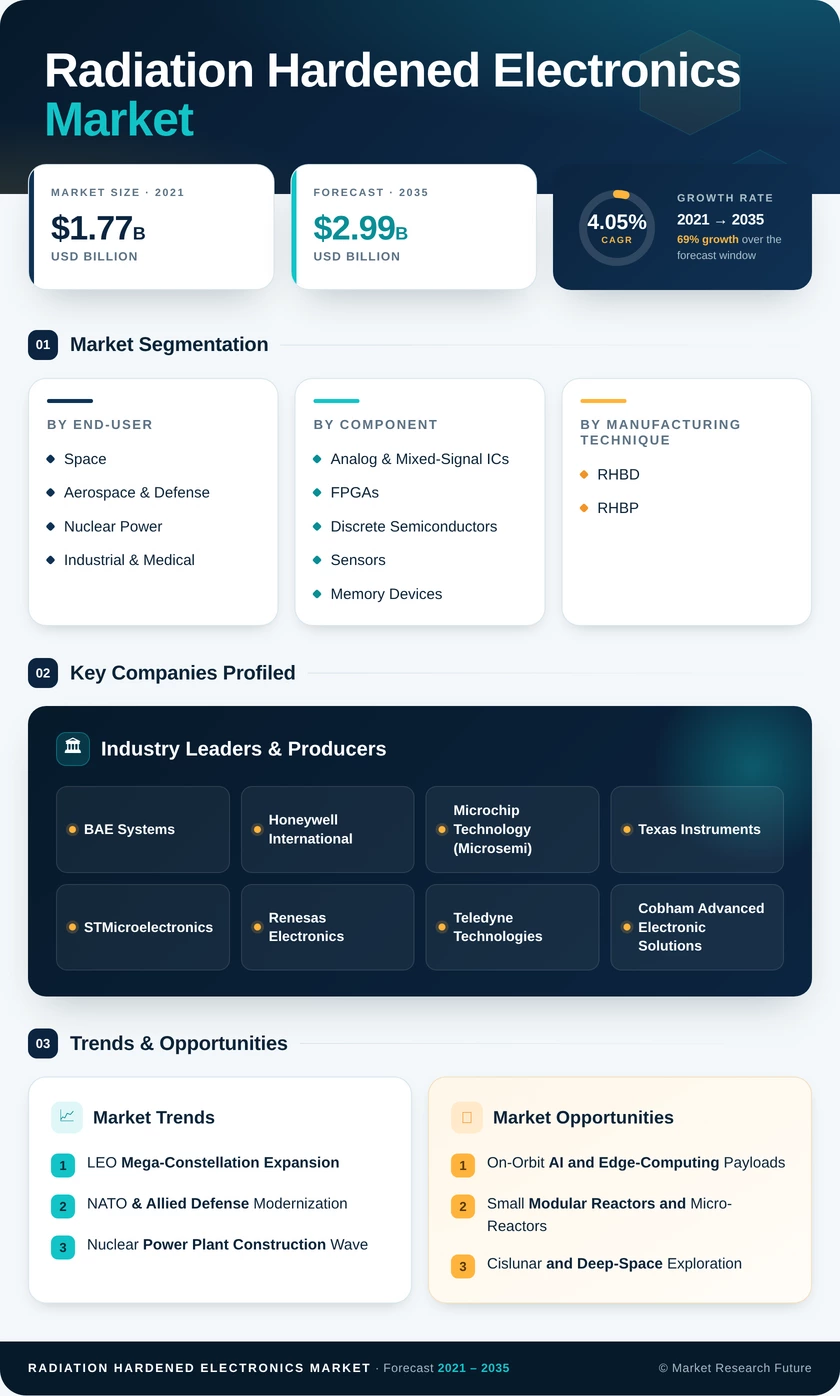
Radiation Hardened Electronics Market

ID: MRFR/SEM/20300-HCR
200 Pages
Aarti Dhapte
Last Updated: June 22, 2026
Radiation Hardened Electronics Market Size, Share and Research Report By End-User (Space, Aerospace & Defense, Nuclear Power, Industrial & Medical), By Component (Analog & Mixed-Signal ICs, FPGAs, Discrete Semiconductors, Sensors, Memory Devices), By Manufacturing Technique (Radiation-Hard-by-Design (RHBD), Radiation-Hard-by-Process (RHBP)), By Semiconductor Material (Silicon, Silicon Carbide (SiC), Gallium Nitride (GaN)), By Radiation Type (Total Ionizing Dose (TID), Single-Event Effects (SEE), Displacement Damage) and By Regional (North America, Europe, South America, Asia Pacific, Middle East and Africa) - Industry Forecast to 2035.
Download PDF ×

We do not share your information with anyone. However, we may send you emails based on your report interest from time to time. You may contact us at any time to opt-out.

Radiation Hardened Electronics Market

Market Size

Forecast Period2026-2035
CAGR (2026-2035)4.05%
2025 Market SizeUSD 2.01 Billion
2035 Market SizeUSD 2.99 Billion

Key Players

BAE Systems
Honeywell International
Microchip Technology
Texas Instruments
STMicroelectronics
Renesas Electronics
Opportunities
  • On-Orbit AI and Edge-Computing Payloads
  • Small Modular Reactors and Micro-Reactors
  • Cislunar and Deep-Space Exploration
  1. 1 Market Overview |
    1. 1.1 Study Assumptions & Market Definition |
    2. 1.2 Scope of the Study |
    3. 1.3 Research Methodology
  2. 2 Market Summary & Key Takeaways
  3. 3 Market Dynamics |
    1. 3.1 Market Drivers Analysis | |
      1. 3.1.1 LEO Mega-Constellation Expansion | |
      2. 3.1.2 NATO & Allied Defense Modernization | |
      3. 3.1.3 Nuclear Power Plant Construction Wave | |
      4. 3.1.4 FPGA & GaN Device Qualification Cycles | |
      5. 3.1.5 Space-Based Edge Computing Demand | |
      6. 3.1.6 Cislunar and Deep-Space Mission Funding |
    2. 3.2 Market Restraints Analysis | |
      1. 3.2.1 ITAR & Export-Control Restrictions | |
      2. 3.2.2 Limited Foundry Access & Capacity | |
      3. 3.2.3 Extended Qualification Timelines | |
      4. 3.2.4 High Per-Unit Cost vs. COTS Alternatives | |
      5. 3.2.5 Technology Obsolescence of RHBP Nodes |
    3. 3.3 Market Opportunity Analysis | |
      1. 3.3.1 On-Orbit AI and Edge-Computing Payloads | |
      2. 3.3.2 Small Modular Reactors and Micro-Reactors | |
      3. 3.3.3 Cislunar and Deep-Space Exploration | |
      4. 3.3.4 Emerging-Market Space Agencies | |
      5. 3.3.5 Rad-Hard IP Licensing and Design-Service Models |
    4. 3.4 Industry Value Chain Analysis |
    5. 3.5 Porter's Five Forces Analysis
  4. 4 Global Radiation Hardened Electronics Market Size & Forecast (2021–2035) |
    1. 4.1 Historical Market Size (2021–2025) |
    2. 4.2 Current & Forecast Market Size (2026–2035) |
    3. 4.3 Market Size by Revenue (USD Billion) |
    4. 4.4 Year-over-Year Growth Analysis
  5. 5 Segmentation Analysis |
    1. 5.1 By End-User | |
      1. 5.1.1 Space | |
      2. 5.1.2 Aerospace & Defense | |
      3. 5.1.3 Nuclear Power | |
      4. 5.1.4 Industrial & Medical |
    2. 5.2 By Component | |
      1. 5.2.1 Analog & Mixed-Signal ICs | |
      2. 5.2.2 FPGAs | |
      3. 5.2.3 Discrete Semiconductors | |
      4. 5.2.4 Sensors | |
      5. 5.2.5 Memory Devices |
    3. 5.3 By Manufacturing Technique | |
      1. 5.3.1 Radiation-Hard-by-Design (RHBD) | |
      2. 5.3.2 Radiation-Hard-by-Process (RHBP) |
    4. 5.4 By Semiconductor Material | |
      1. 5.4.1 Silicon | |
      2. 5.4.2 Silicon Carbide (SiC) | |
      3. 5.4.3 Gallium Nitride (GaN) |
    5. 5.5 By Radiation Type | |
      1. 5.5.1 Total Ionizing Dose (TID) | |
      2. 5.5.2 Single-Event Effects (SEE) | |
      3. 5.5.3 Displacement Damage
  6. 6 Regional Analysis |
    1. 6.1 North America | |
      1. 6.1.1 United States | |
      2. 6.1.2 Canada | |
      3. 6.1.3 Mexico |
    2. 6.2 Europe | |
      1. 6.2.1 Germany | |
      2. 6.2.2 United Kingdom | |
      3. 6.2.3 France | |
      4. 6.2.4 Italy | |
      5. 6.2.5 Spain | |
      6. 6.2.6 Nordic Countries | |
      7. 6.2.7 Russia | |
      8. 6.2.8 Rest of Europe |
    3. 6.3 Asia-Pacific | |
      1. 6.3.1 China | |
      2. 6.3.2 India | |
      3. 6.3.3 Japan | |
      4. 6.3.4 South Korea | |
      5. 6.3.5 ASEAN | |
      6. 6.3.6 Rest of Asia-Pacific |
    4. 6.4 South America | |
      1. 6.4.1 Brazil | |
      2. 6.4.2 Argentina | |
      3. 6.4.3 Rest of South America |
    5. 6.5 Middle East & Africa | |
      1. 6.5.1 Saudi Arabia | |
      2. 6.5.2 UAE | |
      3. 6.5.3 South Africa | |
      4. 6.5.4 Egypt | |
      5. 6.5.5 Rest of MEA
  7. 7 Competitive Landscape |
    1. 7.1 Market Share Analysis (2025) |
    2. 7.2 Competitive Benchmarking Matrix |
    3. 7.3 Company Profiles | |
      1. 7.3.1 BAE Systems | |
      2. 7.3.2 Honeywell International | |
      3. 7.3.3 Microchip Technology (Microsemi) | |
      4. 7.3.4 Texas Instruments | |
      5. 7.3.5 STMicroelectronics | |
      6. 7.3.6 Renesas Electronics | |
      7. 7.3.7 Teledyne Technologies | |
      8. 7.3.8 Cobham Advanced Electronic Solutions | |
      9. 7.3.9 Infineon Technologies | |
      10. 7.3.10 Vorago Technologies
  8. 8 Future Outlook & Strategic Recommendations (2026–2035) |
    1. 8.1 Near-Term Outlook (2026–2028) |
    2. 8.2 Medium-Term Outlook (2029–2031) |
    3. 8.3 Long-Term Outlook (2032–2035)
  9. 9 Recent Developments & News
  10. 10 Frequently Asked Questions (FAQs)
  11. 11 Report Scope & Methodology |
    1. 11.1 Study Period & Base Year |
    2. 11.2 Data Sources & Citations |
    3. 11.3 Abbreviations
  12. 12 LIST OF TABLES |
  13. TABLE 1 Global Radiation Hardened Electronics Market Size & Forecast, by Revenue (USD Billion), 2021–2035 |
  14. TABLE 2 Global Radiation Hardened Electronics Market — Year-over-Year Growth Analysis, 2021–2035 |
  15. TABLE 3 Driver Impact Analysis — Radiation Hardened Electronics Market, 2026–2035 |
  16. TABLE 4 Restraints Impact Analysis — Radiation Hardened Electronics Market, 2026–2035 |
  17. TABLE 5 Regional Market Share Summary, 2025 |
  18. TABLE 6 North America Radiation Hardened Electronics Market Size, by Country, 2021–2035 (USD Billion) |
  19. TABLE 7 Europe Radiation Hardened Electronics Market Size, by Country, 2021–2035 (USD Billion) |
  20. TABLE 8 Asia-Pacific Radiation Hardened Electronics Market Size, by Country, 2021–2035 (USD Billion) |
  21. TABLE 9 South America Radiation Hardened Electronics Market Size, by Country, 2021–2035 (USD Billion) |
  22. TABLE 10 Middle East & Africa Radiation Hardened Electronics Market Size, by Country, 2021–2035 (USD Billion) |
  23. TABLE 11 Global Radiation Hardened Electronics Market Size, by End-User, 2021–2035 (USD Billion) |
  24. TABLE 12 Global Radiation Hardened Electronics Market Size, by Component, 2021–2035 (USD Billion) |
  25. TABLE 13 Global Radiation Hardened Electronics Market Size, by Manufacturing Technique, 2021–2035 (USD Billion) |
  26. TABLE 14 Global Radiation Hardened Electronics Market Size, by Semiconductor Material, 2021–2035 (USD Billion) |
  27. TABLE 15 Global Radiation Hardened Electronics Market Size, by Radiation Type, 2021–2035 (USD Billion) |
  28. TABLE 16 Global Radiation Hardened Electronics Market Size, by Region, 2021–2035 (USD Billion) |
  29. TABLE 17 Competitive Benchmarking Matrix — Radiation Hardened Electronics Market, 2025 |
  30. TABLE 18 Company Profiles — Key Players, Radiation Hardened Electronics Market |
  31. TABLE 19 Recent Developments & Strategic Announcements, 2023–2025 |
  32. TABLE 20 North America Radiation Hardened Electronics Market Size, by End-User, 2021–2035 (USD Billion) |
  33. TABLE 21 North America Radiation Hardened Electronics Market Size, by Component, 2021–2035 (USD Billion) |
  34. TABLE 22 North America Radiation Hardened Electronics Market Size, by Manufacturing Technique, 2021–2035 (USD Billion) |
  35. TABLE 23 North America Radiation Hardened Electronics Market Size, by Semiconductor Material, 2021–2035 (USD Billion) |
  36. TABLE 24 North America Radiation Hardened Electronics Market Size, by Radiation Type, 2021–2035 (USD Billion) |
  37. TABLE 25 Europe Radiation Hardened Electronics Market Size, by End-User, 2021–2035 (USD Billion) |
  38. TABLE 26 Europe Radiation Hardened Electronics Market Size, by Component, 2021–2035 (USD Billion) |
  39. TABLE 27 Europe Radiation Hardened Electronics Market Size, by Manufacturing Technique, 2021–2035 (USD Billion) |
  40. TABLE 28 Europe Radiation Hardened Electronics Market Size, by Semiconductor Material, 2021–2035 (USD Billion) |
  41. TABLE 29 Europe Radiation Hardened Electronics Market Size, by Radiation Type, 2021–2035 (USD Billion) |
  42. TABLE 30 Asia-Pacific Radiation Hardened Electronics Market Size, by End-User, 2021–2035 (USD Billion) |
  43. TABLE 31 Asia-Pacific Radiation Hardened Electronics Market Size, by Component, 2021–2035 (USD Billion) |
  44. TABLE 32 Asia-Pacific Radiation Hardened Electronics Market Size, by Manufacturing Technique, 2021–2035 (USD Billion) |
  45. TABLE 33 Asia-Pacific Radiation Hardened Electronics Market Size, by Semiconductor Material, 2021–2035 (USD Billion) |
  46. TABLE 34 Asia-Pacific Radiation Hardened Electronics Market Size, by Radiation Type, 2021–2035 (USD Billion) |
  47. TABLE 35 South America Radiation Hardened Electronics Market Size, by End-User, 2021–2035 (USD Billion) |
  48. TABLE 36 South America Radiation Hardened Electronics Market Size, by Component, 2021–2035 (USD Billion) |
  49. TABLE 37 South America Radiation Hardened Electronics Market Size, by Manufacturing Technique, 2021–2035 (USD Billion) |
  50. TABLE 38 South America Radiation Hardened Electronics Market Size, by Semiconductor Material, 2021–2035 (USD Billion) |
  51. TABLE 39 South America Radiation Hardened Electronics Market Size, by Radiation Type, 2021–2035 (USD Billion) |
  52. TABLE 40 Middle East & Africa Radiation Hardened Electronics Market Size, by End-User, 2021–2035 (USD Billion) |
  53. TABLE 41 Middle East & Africa Radiation Hardened Electronics Market Size, by Component, 2021–2035 (USD Billion) |
  54. TABLE 42 Middle East & Africa Radiation Hardened Electronics Market Size, by Manufacturing Technique, 2021–2035 (USD Billion) |
  55. TABLE 43 Middle East & Africa Radiation Hardened Electronics Market Size, by Semiconductor Material, 2021–2035 (USD Billion) |
  56. TABLE 44 Middle East & Africa Radiation Hardened Electronics Market Size, by Radiation Type, 2021–2035 (USD Billion) |
  57. TABLE 45 Report Scope & Methodology Summary |
  58. TABLE 46 Detailed Sources and Citations
  59. 13 LIST OF FIGURES |
  60. FIGURE 1 Radiation Hardened Electronics Market Dynamics — Drivers, Restraints, and Opportunities |
  61. FIGURE 2 Industry Value Chain — Radiation Hardened Electronics Market |
  62. FIGURE 3 Porter's Five Forces Analysis — Radiation Hardened Electronics Market |
  63. FIGURE 4 Global Radiation Hardened Electronics Market Size Trend (USD Billion), 2021–2035 |
  64. FIGURE 5 Radiation Hardened Electronics Market Share, by End-User, 2025 |
  65. FIGURE 6 Radiation Hardened Electronics Market Share, by Component, 2025 |
  66. FIGURE 7 Radiation Hardened Electronics Market Share, by Manufacturing Technique, 2025 |
  67. FIGURE 8 Radiation Hardened Electronics Market Share, by Semiconductor Material, 2025 |
  68. FIGURE 9 Radiation Hardened Electronics Market Share, by Radiation Type, 2025 |
  69. FIGURE 10 Radiation Hardened Electronics Market Share, by Region, 2025 |
  70. FIGURE 11 North America Radiation Hardened Electronics Market — Country Share, 2025 |
  71. FIGURE 12 Europe Radiation Hardened Electronics Market — Country Share, 2025 |
  72. FIGURE 13 Asia-Pacific Radiation Hardened Electronics Market — Country Share, 2025 |
  73. FIGURE 14 South America Radiation Hardened Electronics Market — Country Share, 2025 |
  74. FIGURE 15 Middle East & Africa Radiation Hardened Electronics Market — Country Share, 2025 |
  75. FIGURE 16 Competitive Landscape — Revenue Share Distribution, 2025

Segmentation Quick Reference

DimensionSub-SegmentsDominant SegmentFastest Growing Segment
End-UserSpace; Aerospace & Defense; Nuclear Power; Industrial & MedicalSpace (49.6% share, 2025)Aerospace & Defense (4.41% CAGR)
ComponentAnalog & Mixed-Signal ICs; FPGAs; Discrete Semiconductors; Sensors; Memory DevicesAnalog & Mixed-Signal ICs (37.8% share, 2025)FPGAs (4.75% CAGR)
Manufacturing TechniqueRHBD; RHBPRHBD (56.1% share, 2025)RHBD (4.43% CAGR)
Semiconductor MaterialSilicon; SiC; GaNSilicon (68.8% share, 2025)GaN (4.85% CAGR)
Radiation TypeTID; SEE; Displacement DamageTID (51.7% share, 2025)SEE (5.52% CAGR)
GeographyNorth America; Europe; Asia-Pacific; South America; MEANorth America (44.6% share, 2025)Asia-Pacific (5.37% CAGR)


Market Segmentation Overview

By End-User

Sub-SegmentKey Trend
SpaceLEO mega-constellation demand is sustaining 200+ launches per year globally
Aerospace & DefenseNATO modernization cycles are refreshing avionics and missile guidance electronics
Nuclear Power60+ reactor units under construction across Asia and the Middle East
Industrial & MedicalProton therapy and particle accelerator instrumentation are driving niche uptake.


Space end users account for the largest share of the Radiation Hardened Electronics Market, underpinned by commercial constellation build-outs and government reconnaissance programs that require qualified radiation-tolerant components across every satellite subsystem.

By Component

Sub-SegmentKey Trend
Analog & Mixed-Signal ICsUbiquitous need for hardened power management and data conversion
FPGAsReprogrammable on-orbit computing replacing fixed-function ASICs
Discrete SemiconductorsPower switching and voltage regulation across all platforms
SensorsStar trackers, dosimeters, and imaging arrays for space payloads
Memory DevicesNon-volatile flight-software storage with error-correcting codes


Analog and mixed-signal ICs dominate component demand because every satellite bus and reactor system requires hardened voltage regulators and signal-conditioning front ends. FPGAs are the fastest-growing line as rad-hard space electronics designers adopt reconfigurable logic for on-orbit updates.

By Manufacturing Technique

Sub-SegmentKey Trend
Radiation-Hard-by-Design (RHBD)Migration to 65 nm and 45 nm commercial nodes with circuit-level hardening
Radiation-Hard-by-Process (RHBP)Heritage 150 nm nodes are maintained for legacy platform sustainment


RHBD solutions are expanding share as designers capitalize on smaller commercial geometries, cutting die area and power consumption while maintaining radiation tolerance above 100 krad for space-grade hardened ICs.

By Semiconductor Material

Sub-SegmentKey Trend
SiliconDominant mature ecosystem; broadest qualified-parts catalog
Silicon Carbide (SiC)High-temperature operation for reactor-adjacent instrumentation
Gallium Nitride (GaN)High-power RF and electric-propulsion driver applications


Silicon's extensive qualification history ensures its continued dominance, while GaN is gaining rapid traction in nuclear-resistant electronics applications demanding higher power density and efficiency.

By Radiation Type

Sub-SegmentKey Trend
Total Ionizing Dose (TID)Protection against cumulative ionizing exposure in GEO and nuclear environments
Single-Event Effects (SEE)Mitigation of heavy-ion and proton-induced transients in advanced nodes
Displacement DamageNeutron-flux hardening for reactor containment electronics


TID protection remains the largest category, but SEE mitigation is accelerating as transistor scaling below 65 nm increases vulnerability to single-particle upsets in radiation shielded circuits.