Request Free Sample ×

Kindly complete the form below to receive a free sample of this Report

* Please use a valid business email

Leading companies partner with us for data-driven Insights

clients tt-cursor
Hero Background
English
Chinese
French
Japanese
Korean
German
Spanish

Radar Sensors Market Size

ID: MRFR/AD/2815-HCR
100 Pages
Shubham Munde
March 2026

Radar Sensors Market Size, Share, Industry Trend & Analysis Research Report Information By Type (Radar Detector, Radar Scrambling, and Others), By Application (Automotive, Traffic Monitoring, Aerospace & Defense, Industrial, Security & Surveillance, Weather Monitoring, and Others), By Component (Antenna, Duplexer, Transmitter, Receiver, Video Amplifier, and Processor) And By Region (North America, Europe, Asia-Pacific, And Rest Of The World) – Forecast Till 2035.

Share:
Download PDF ×

We do not share your information with anyone. However, we may send you emails based on your report interest from time to time. You may contact us at any time to opt-out.

Radar Sensors Market Infographic
Purchase Options

Radar Sensors Size

Market Size Snapshot

Year Value
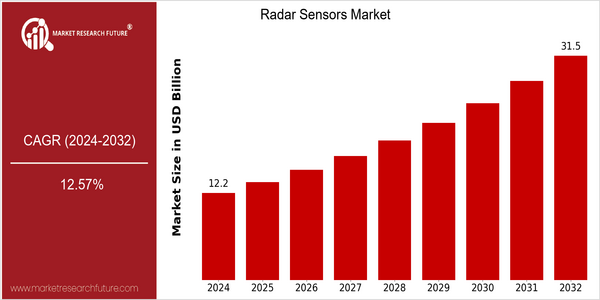
2024 USD 12.1925325 Billion
2032 USD 31.45808 Billion
CAGR (2024-2032) 12.57 %

Note – Market size depicts the revenue generated over the financial year

The global radar sensors market is poised for significant growth, with a current market size of approximately USD 12.19 billion in 2024, projected to expand to USD 31.46 billion by 2032. This robust growth trajectory reflects a compound annual growth rate (CAGR) of 12.57% over the forecast period. The increasing demand for advanced sensing technologies across various sectors, including automotive, aerospace, and defense, is a primary driver of this market expansion. As industries increasingly adopt automation and smart technologies, radar sensors are becoming essential for applications such as collision avoidance, traffic monitoring, and environmental sensing.

Technological advancements, particularly in the miniaturization of radar systems and the integration of artificial intelligence, are further propelling market growth. Companies like Texas Instruments, Raytheon Technologies, and Bosch are at the forefront of innovation, investing in research and development to enhance radar sensor capabilities. Strategic initiatives, such as partnerships for developing next-generation radar technologies and product launches aimed at expanding application areas, are also contributing to the market's dynamic landscape. As the demand for safety and efficiency in various applications continues to rise, the radar sensors market is expected to thrive in the coming years.
home-ubuntu-www-mrf_ne_design-batch-5-cp-radar-sensors-market size

Regional Market Size

Regional Deep Dive

The Radar Sensors Market is experiencing significant growth across various regions, driven by advancements in technology, increasing demand for automation, and the rising need for safety and security in various applications. Each region exhibits unique characteristics influenced by local economic conditions, regulatory frameworks, and technological adoption rates. North America leads in innovation and deployment, while Europe focuses on regulatory compliance and sustainability. Asia-Pacific is rapidly expanding due to industrialization and urbanization, while the Middle East and Africa are witnessing growth through investments in infrastructure and defense. Latin America is gradually adopting radar technologies, influenced by economic development and modernization efforts.

Europe

  • The European Union has implemented stringent regulations on automotive safety, pushing manufacturers to adopt radar sensors for advanced driver-assistance systems (ADAS), thereby expanding the market.
  • Key players such as Bosch and Continental are investing in R&D to develop next-generation radar sensors that comply with these regulations, enhancing vehicle safety and performance.

Asia Pacific

  • China's rapid urbanization and industrial growth have led to increased demand for radar sensors in smart city projects, with significant investments from the government in infrastructure development.
  • Companies like NEC Corporation and Mitsubishi Electric are innovating in radar technology for applications in transportation and security, contributing to the region's market expansion.

Latin America

  • Brazil is focusing on modernizing its transportation infrastructure, which includes the integration of radar sensors for traffic monitoring and control systems.
  • Government initiatives aimed at improving public safety are driving the adoption of radar technologies in law enforcement and surveillance applications.

North America

  • The U.S. Department of Defense has increased its investment in radar technologies, particularly for defense applications, which is expected to drive innovation and market growth in the region.
  • Companies like Raytheon Technologies and Northrop Grumman are leading the development of advanced radar systems, focusing on integrating artificial intelligence to enhance detection capabilities.

Middle East And Africa

  • The UAE is investing heavily in smart city initiatives, which include the deployment of radar sensors for traffic management and security, indicating a growing market potential.
  • Local companies, such as Emirates Defense Industries Company, are collaborating with international firms to enhance radar technology capabilities for defense and surveillance applications.

Did You Know?

“Radar sensors can detect objects at distances of up to several hundred kilometers, making them essential for applications ranging from aviation to automotive safety.” — National Aeronautics and Space Administration (NASA)

Segmental Market Size

The Radar Sensors Market is experiencing robust growth, driven by increasing demand for advanced sensing technologies across various industries. Key factors propelling this segment include the rising need for safety and automation in automotive applications, as well as the growing adoption of radar systems in aerospace and defense for surveillance and navigation. Additionally, regulatory policies promoting vehicle safety standards are further fueling demand for radar sensors in automotive applications.

Currently, the adoption of radar sensors is in the scaled deployment stage, with notable examples including companies like Bosch and Continental, which are integrating radar technology into their advanced driver-assistance systems (ADAS). Primary applications of radar sensors encompass automotive collision avoidance systems, air traffic control, and industrial automation, showcasing their versatility across sectors. Trends such as the push for smart city initiatives and sustainability efforts are accelerating growth, as radar sensors contribute to efficient traffic management and energy conservation. Technologies like millimeter-wave radar and frequency-modulated continuous wave (FMCW) are shaping the segment's evolution, enhancing detection capabilities and accuracy.

Future Outlook

The Radar Sensors Market is poised for significant growth from 2024 to 2032, with a projected market value increase from approximately $12.19 billion to $31.46 billion, reflecting a robust compound annual growth rate (CAGR) of 12.57%. This growth trajectory is underpinned by the increasing adoption of radar technology across various sectors, including automotive, aerospace, and defense. As industries continue to prioritize safety and automation, the demand for advanced radar sensors, particularly in autonomous vehicles and smart city applications, is expected to surge. By 2032, it is anticipated that radar sensors will penetrate over 30% of the automotive market, driven by regulatory mandates for enhanced safety features and the growing consumer preference for advanced driver-assistance systems (ADAS).

Key technological advancements, such as the integration of artificial intelligence and machine learning with radar systems, are set to enhance the capabilities of these sensors, enabling more accurate object detection and tracking. Additionally, government policies promoting smart infrastructure and sustainable transportation solutions will further catalyze market growth. Emerging trends, including the miniaturization of radar sensors and the development of multi-functional devices, will also play a crucial role in expanding their applications across various industries. As the market evolves, stakeholders must remain agile to leverage these trends and capitalize on the burgeoning opportunities within the radar sensors landscape.

Radar Sensors Market Size Graph
Author
Author Profile
Shubham Munde
Team Lead - Research

Shubham brings over 7 years of expertise in Market Intelligence and Strategic Consulting, with a strong focus on the Automotive, Aerospace, and Defense sectors. Backed by a solid foundation in semiconductors, electronics, and software, he has successfully delivered high-impact syndicated and custom research on a global scale. His core strengths include market sizing, forecasting, competitive intelligence, consumer insights, and supply chain mapping. Widely recognized for developing scalable growth strategies, Shubham empowers clients to navigate complex markets and achieve a lasting competitive edge. Trusted by start-ups and Fortune 500 companies alike, he consistently converts challenges into strategic opportunities that drive sustainable growth.

Leave a Comment

FAQs

What is the projected market valuation of the Radar Sensors Market by 2035?

<p>The Radar Sensors Market is projected to reach a valuation of 44.86 USD Billion by 2035.</p>

What was the market valuation of the Radar Sensors Market in 2024?

<p>In 2024, the Radar Sensors Market was valued at 12.19 USD Billion.</p>

What is the expected CAGR for the Radar Sensors Market during the forecast period 2025 - 2035?

<p>The expected CAGR for the Radar Sensors Market during the forecast period 2025 - 2035 is 12.57%.</p>

Which companies are considered key players in the Radar Sensors Market?

<p>Key players in the Radar Sensors Market include Lockheed Martin, Raytheon Technologies, Northrop Grumman, and Thales Group.</p>

What are the main application segments of the Radar Sensors Market?

<p>The main application segments include Automotive, Aerospace & Defense, and Security & Surveillance, among others.</p>

What was the market size for the Automotive segment in 2024?

<p>The market size for the Automotive segment in 2024 was 2.5 USD Billion.</p>

How much is the Aerospace & Defense segment projected to grow by 2035?

The Aerospace &amp; Defense segment is projected to grow to 12.0 USD Billion by 2035.

What are the key components of radar sensors?

Key components of radar sensors include Antenna, Transmitter, and Receiver, each valued at 2.44 USD Billion in 2024.

What was the market size for Radar Detectors in 2024?

The market size for Radar Detectors in 2024 was 4.87 USD Billion.

What is the projected market size for Traffic Monitoring applications by 2035?

The projected market size for Traffic Monitoring applications is expected to reach 3.5 USD Billion by 2035.

Market Summary

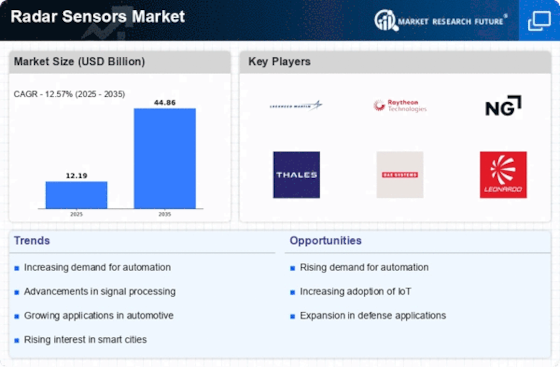
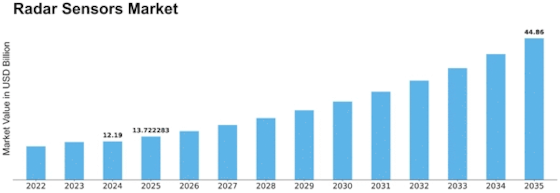
As per Market Research Future analysis, the Radar Sensors Market Size was estimated at 12.19 USD Billion in 2024. The Radar Sensors industry is projected to grow from 13.73 USD Billion in 2025 to 44.86 USD Billion by 2035, exhibiting a compound annual growth rate (CAGR) of 12.57% during the forecast period 2025 – 2035 supported by expanding applications across automotive, defense, and urban infrastructure, as highlighted in ongoing radar sensors market analysis.

Key Market Trends & Highlights

The Radar Sensors Market is poised for substantial growth driven by technological advancements and increasing applications across various sectors.

  • North America remains the largest market for radar sensors, primarily due to its robust automotive sector. The Asia-Pacific region is emerging as the fastest-growing market, fueled by rapid urbanization and smart city initiatives. Radar detectors continue to dominate the market, while radar scrambling technology is witnessing the fastest growth due to rising security concerns. Technological advancements in radar sensors and the growing demand in the automotive sector are key drivers propelling market expansion.

Market Size & Forecast

2024 Market Size 12.19 (USD Billion)
2035 Market Size 44.86 (USD Billion)
CAGR (2025 - 2035) 12.57%
Largest Regional Market Share in 2024 Europe

Major Players

<p>Lockheed Martin (US), Raytheon Technologies (US), Northrop Grumman (US), Thales Group (FR), BAE Systems (GB), Leonardo S.p.A. (IT), Honeywell International Inc. (US), General Dynamics (US), Elbit Systems (IL), Kongsberg Gruppen (NO)</p>

Market Trends

The Radar Sensors Market is currently experiencing a transformative phase, driven by advancements in technology and increasing demand across various sectors, reflecting evolving radar sensors market trends. The integration of radar sensors into automotive applications, particularly in autonomous vehicles, is reshaping the landscape of the automotive radar sensors market. These sensors enhance safety features, enabling vehicles to detect obstacles and navigate complex environments. Additionally, the growing emphasis on smart city initiatives is propelling the adoption of radar technology for traffic management and surveillance, strengthening the radar sensors for smart city applications market. Furthermore, the defense sector continues to be a significant contributor, utilizing radar sensors for surveillance, reconnaissance, and target tracking, reinforcing the role of the security radar sensors market in national security. Moreover, the radar sensors market is likely to witness further growth as industries explore innovative applications. The rise of Internet of Things (IoT) devices is expected to create new opportunities for radar technology, allowing for enhanced connectivity and data collection. As industries increasingly prioritize automation and efficiency, radar sensors may become integral to various processes, from manufacturing to logistics, positively influencing overall radar sensors market share distribution. This trend suggests a promising future for the market, as stakeholders seek to leverage radar technology to improve operational capabilities and drive competitive advantage.

Automotive Advancements

The integration of radar sensors in the automotive sector is revolutionizing vehicle safety and automation, supporting sustained growth in the automotive radar sensors market. These sensors facilitate advanced driver-assistance systems, enabling features such as adaptive cruise control and collision avoidance.

Smart City Initiatives

The push for smart cities is fostering the adoption of radar technology for urban management, contributing significantly to the radar sensors for smart city applications market. Radar sensors are utilized for traffic monitoring, enhancing public safety, and optimizing resource allocation in urban environments.

Defense and Security Applications

The defense sector remains a key driver of the Radar Sensors Market, employing these technologies for surveillance and reconnaissance. Their ability to detect and track targets is vital for national security operations, strengthening demand within the security radar sensors market.

Radar Sensors Market Market Drivers

Expansion of Smart City Projects

The expansion of smart city projects is significantly influencing the Radar Sensors Market. As urban areas increasingly adopt smart technologies to improve infrastructure and public safety, radar sensors are becoming integral to various applications, including traffic management and surveillance. The market for radar sensors in smart city initiatives is expected to grow at a CAGR of around 12% in the coming years. This growth is driven by the need for real-time data collection and analysis to enhance urban living conditions. Moreover, the integration of radar sensors with IoT devices is likely to create new opportunities for innovation within the Radar Sensors Market, fostering a more connected and efficient urban environment.

Defense and Security Applications

The defense and security sector remains a crucial driver for the Radar Sensors Market, as nations prioritize national security and surveillance capabilities. Radar sensors are essential for applications such as border security, air traffic control, and military reconnaissance. The global defense spending is projected to increase, with radar technologies being a focal point for modernization efforts. In 2025, the defense segment is anticipated to represent a significant portion of the radar sensor market, reflecting the ongoing demand for advanced surveillance systems. This trend underscores the importance of radar sensors in enhancing situational awareness and operational effectiveness, thereby solidifying their role within the Radar Sensors Market.

Growing Demand in Automotive Sector

The automotive sector is a significant driver for the Radar Sensors Market, primarily due to the increasing implementation of advanced driver-assistance systems (ADAS). As vehicles become more automated, the need for reliable radar sensors to facilitate features such as adaptive cruise control and collision avoidance systems is escalating. In 2025, it is estimated that the automotive segment will account for over 40% of the total radar sensor market share. This trend is further supported by regulatory mandates for enhanced safety features in vehicles, which are likely to boost the demand for radar technologies. Consequently, the Radar Sensors Market is poised for substantial growth as automotive manufacturers invest in these critical technologies.

Technological Advancements in Radar Sensors

The Radar Sensors Market is experiencing a surge in technological advancements, particularly in signal processing and sensor miniaturization. Innovations such as phased array radar and frequency-modulated continuous wave (FMCW) radar are enhancing detection capabilities and accuracy. These advancements are likely to drive the adoption of radar sensors across various sectors, including automotive and aerospace. The market is projected to grow at a compound annual growth rate (CAGR) of approximately 10% over the next five years, indicating a robust demand for advanced radar technologies. As industries increasingly prioritize safety and efficiency, the integration of cutting-edge radar systems is becoming essential, thereby propelling the Radar Sensors Market forward.

Emerging Applications in Industrial Automation

Emerging applications in industrial automation are contributing to the growth of the Radar Sensors Market. Industries are increasingly adopting radar sensors for non-contact level measurement, object detection, and process automation. The ability of radar sensors to operate in challenging environments, such as extreme temperatures and dusty conditions, makes them particularly valuable in manufacturing and logistics. The industrial segment is expected to witness a CAGR of approximately 9% over the next few years, driven by the need for efficiency and safety in operations. As companies seek to optimize their processes, the integration of radar technologies is likely to become more prevalent, further enhancing the Radar Sensors Market.

Market Segment Insights

By Type: Radar Detector (Largest) vs. Radar Scrambling (Fastest-Growing)

<p>In the Radar Sensors Market, the market share among the segments reveals that Radar Detectors are currently the largest segment, contributing significantly to overall radar sensors market share. They dominate due to their widespread adoption in various applications, including traffic enforcement and safety systems. In contrast, Radar Scrambling technology is emerging rapidly, capturing an increasing share of the market as it addresses evolving security requirements identified through ongoing radar sensors market analysis. The growth trends indicate that Radar Scrambling is poised for substantial expansion, driven by the escalating demand for improved security measures across both military and civilian sectors. This segment's adoption is fueled by advancements in technology that enhance the functionality of radar sensors, thereby creating new applications and opportunities in the market.</p>

<p>Radar Detector (Dominant) vs. Radar Scrambling (Emerging)</p>

<p>Radar Detectors are positioned as the dominant segment within the Radar Sensors Market, appreciated for their reliability and effectiveness in detecting and tracking moving objects. Their extensive application across law enforcement and automotive industries ensures their sustained relevance. In contrast, Radar Scrambling represents an emerging technology aligned with rising demand in the security radar sensors market, particularly as cyber and electronic threats increase. As cyber threats rise, the demand for reliable scrambling solutions in both military and civilian sectors is increasing. This presents Radar Scrambling as a forward-looking segment with significant growth potential, particularly as innovations continue to enhance its capabilities.</p>

By Application: Automotive (Largest) vs. Traffic Monitoring (Fastest-Growing)

<p>In the Radar Sensors Market, the application segment is primarily dominated by the automotive sector, holding the largest market share due to increasing demand for ADAS and autonomous vehicles, reinforcing the growth trajectory of the automotive radar sensors market. Traffic monitoring follows closely, supported by smart infrastructure investments within the radar sensors for smart city applications market.</p>

<p>Traffic Monitoring: Dominant vs. Security &amp; Surveillance: Emerging</p>

<p>Traffic monitoring remains a dominant application, while security and surveillance are emerging rapidly, driven by rising investments in the security radar sensors market across public and private sectors.</p> <p>This segment relies on radar sensors to monitor vehicle speeds, detect incidents, and improve congestion management. In contrast, the security and surveillance application is emerging rapidly, driven by the need for enhanced security measures in both public and private sectors. As technological innovations continue, security systems are increasingly incorporating advanced radar technologies for perimeter monitoring and threat detection, positioning this segment for growth alongside the established traffic monitoring domain.</p>

By Components: Receiver (Largest) vs. Processor (Fastest-Growing)

<p>The Components segment of the Radar Sensors Market is primarily dominated by the Receiver, which plays a crucial role in signal processing and contributes significantly to overall radar sensors market share. Following the Receiver are key components such as Antenna and Duplexer, which play critical roles in transmitting and receiving signals, contributing to the overall functionality and efficiency of radar systems. The Transmitter, Video Amplifier, and Processor also contribute to the segment, yet their shares remain comparatively smaller within this dynamic market.</p>

<p>Antenna (Dominant) vs. Processor (Emerging)</p>

<p>The Antenna remains a dominant component, while the Processor is emerging due to advancements in data processing, supporting broader radar sensors market trends related to automation and smart technologies. Its widespread use across various applications, including automotive and aerospace industries, helps maintain its position as a market leader. On the other hand, the Processor is an emerging component gaining traction due to advancements in technology and demand for improved data processing capabilities. Its ability to handle complex algorithms and enhance the efficiency of radar systems positions it for significant growth, appealing to sectors focused on automation and smart technologies.</p>

Get more detailed insights about Radar Sensors Market Research Report - Global Forecast till 2035

Regional Insights

North America : Defense and Technology Leader

North America is the largest market for radar sensors, holding approximately 45% of the global share, making it a key contributor to the global radar sensors market. The region's growth is driven by increasing defense budgets, technological advancements, and a rising demand for advanced surveillance systems. Regulatory support from government initiatives, such as the National Defense Authorization Act, further catalyzes market expansion. The U.S. is the primary contributor, followed by Canada, which is also investing in radar technology for defense and civilian applications. The competitive landscape in North America is robust, featuring key players like Lockheed Martin, Raytheon Technologies, and Northrop Grumman. These companies are at the forefront of innovation, developing cutting-edge radar systems for military and commercial use. The presence of advanced research facilities and collaborations with government agencies enhances the region's capability to lead in radar sensor technology, ensuring a continuous flow of innovations and solutions to meet evolving market demands.

Europe : Emerging Defense Technology Hub

Europe accounts for approximately 30% of the global share and remains a critical region influencing radar sensors market analysis through defense modernization initiatives. The region's expansion is fueled by increasing defense expenditures, particularly in response to geopolitical tensions. Countries like France and Germany are leading the charge, investing heavily in modernizing their military capabilities. Regulatory frameworks, such as the European Defense Fund, are also promoting collaborative defense projects, enhancing the demand for advanced radar technologies. Leading countries in Europe include France, Germany, and the UK, with major players like Thales Group and BAE Systems driving innovation. The competitive landscape is characterized by a mix of established defense contractors and emerging tech firms focusing on radar solutions. The collaboration between government and industry is fostering a conducive environment for research and development, ensuring that Europe remains a key player in The Radar Sensors Market.

Asia-Pacific : Rapidly Growing Market Potential

Asia-Pacific holds around 20% of the global share and is witnessing rapid expansion, supported by defense investments and smart infrastructure development within the radar sensors for smart city applications market. The region's growth is driven by increasing military modernization efforts, particularly in countries like China and India, which are investing heavily in advanced radar technologies. Additionally, the rise in natural disasters has spurred demand for radar systems in civilian applications, such as weather monitoring and disaster management. Regulatory support from national governments is also enhancing market growth. China, India, and Japan are the leading countries in this region, with a competitive landscape that includes both domestic and international players. Companies like Elbit Systems and Kongsberg Gruppen are expanding their presence in Asia-Pacific, focusing on tailored solutions for local markets. The region's diverse needs and increasing investments in defense and technology are expected to drive further growth in the radar sensors market.

Middle East and Africa : Emerging Market with Challenges

The Middle East and Africa region holds about 5% of the global share, with growth driven by rising demand for defense and border surveillance solutions linked to the security radar sensors market. The growth is primarily driven by increasing defense spending in response to regional conflicts and security concerns. Countries like the UAE and Saudi Arabia are leading investments in advanced radar technologies, supported by government initiatives aimed at enhancing national security. However, challenges such as political instability and economic fluctuations can impact market growth. In this region, the competitive landscape is evolving, with key players like Honeywell International and local firms expanding their capabilities. The focus is on developing radar systems for both military and civilian applications, including border security and traffic management. As the region continues to stabilize, the demand for radar sensors is expected to rise, presenting opportunities for both local and international companies to invest and innovate.

Key Players and Competitive Insights

The Radar Sensors Market is characterized by a competitive landscape shaped by innovation, defense spending, and automotive adoption, influencing both radar sensors market share and long-term radar sensors market trends. Strategic partnerships, acquisitions, and product launches remain central to strengthening positions within the global radar sensor market. Key players such as Lockheed Martin (US), Raytheon Technologies (US), and Thales Group (FR) are strategically positioned to leverage their technological expertise and extensive portfolios. Lockheed Martin (US) focuses on innovation in radar technology, particularly in enhancing detection capabilities, while Raytheon Technologies (US) emphasizes partnerships with government agencies to secure contracts for advanced radar systems. Thales Group (FR) is actively pursuing regional expansion, particularly in Asia-Pacific, to tap into emerging markets, thereby shaping a competitive environment that is increasingly collaborative yet fiercely competitive. In terms of business tactics, companies are localizing manufacturing to reduce costs and enhance supply chain efficiency. The Radar Sensors Market appears moderately fragmented, with a mix of established players and emerging companies vying for market share. The collective influence of these key players is significant, as they drive technological advancements and set industry standards, which in turn influences the competitive structure of the market.

In August Lockheed Martin (US) announced a partnership with a leading automotive manufacturer to develop advanced radar systems for autonomous vehicles. This collaboration is strategically important as it positions Lockheed Martin at the forefront of the rapidly evolving automotive radar sector, potentially leading to increased market share and revenue diversification. Similarly, in July 2025, Raytheon Technologies (US) secured a multi-million dollar contract with the U.S. Department of Defense to supply next-generation radar systems. This contract not only reinforces Raytheon's position in the defense sector but also highlights the growing reliance on advanced radar technologies for national security.

In September Thales Group (FR) launched a new radar system designed for maritime applications, aimed at enhancing surveillance and navigation capabilities. This launch is indicative of Thales's commitment to innovation and its strategic focus on expanding its product offerings in niche markets, which could lead to increased competitiveness in the maritime sector. Furthermore, in October 2025, BAE Systems (GB) announced the acquisition of a radar technology firm, which is expected to bolster its capabilities in electronic warfare and surveillance systems. This acquisition reflects a broader trend of consolidation within the industry, as companies seek to enhance their technological capabilities and market presence.

As of October current competitive trends in the Radar Sensors Market include a strong emphasis on digitalization, sustainability, and the integration of artificial intelligence. Strategic alliances are increasingly shaping the landscape, as companies recognize the need for collaboration to drive innovation and meet evolving customer demands. Looking ahead, competitive differentiation is likely to evolve from traditional price-based competition to a focus on technological innovation, reliability in supply chains, and the ability to deliver sustainable solutions. This shift underscores the importance of agility and adaptability in a rapidly changing market environment.

Key Companies in the Radar Sensors Market include

Industry Developments

Recent developments continue to reshape the radar sensors market, highlighting increased investments, technological innovation, and expanding applications across automotive, industrial, and defense sectors.

Future Outlook

Radar Sensors Market Future Outlook

<p>The radar sensors market is projected to grow at a 12.57% CAGR from 2025 to 2035, driven by advancements in automotive safety, defense applications, and smart city initiatives, aligned with broader radar sensors market trends.</p>

New opportunities lie in:

  • <p>Development of advanced automotive radar systems for autonomous vehicles.</p>
  • <p> </p>
  • <p>Integration of radar sensors in smart city infrastructure for traffic management.</p>
  • <p>Expansion into emerging markets with tailored radar solutions for industrial applications.</p>

<p>By 2035, the Radar Sensors Market is expected to achieve substantial growth, reflecting its critical role in various sectors.</p>

Market Segmentation

Radar Sensors Market Type Outlook

  • Radar Detector
  • Radar Scrambling
  • Others

Radar Sensors Market Components Outlook

  • Antenna
  • Duplexer
  • Transmitter
  • Receiver
  • Video Amplifier
  • Processor

Radar Sensors Market Application Outlook

  • Automotive
  • Traffic Monitoring
  • Aerospace & Defense
  • Industrial
  • Security & Surveillance
  • Weather Monitoring
  • Others

Report Scope

MARKET SIZE 2024 12.19(USD Billion)
MARKET SIZE 2025 13.73(USD Billion)
MARKET SIZE 2035 44.86(USD Billion)
COMPOUND ANNUAL GROWTH RATE (CAGR) 12.57% (2025 - 2035)
REPORT COVERAGE Revenue Forecast, Competitive Landscape, Growth Factors, and Trends
BASE YEAR 2024
Market Forecast Period 2025 - 2035
Historical Data 2019 - 2024
Market Forecast Units USD Billion
Key Companies Profiled Lockheed Martin (US), Raytheon Technologies (US), Northrop Grumman (US), Thales Group (FR), BAE Systems (GB), Leonardo S.p.A. (IT), Honeywell International Inc. (US), General Dynamics (US), Elbit Systems (IL), Kongsberg Gruppen (NO)
Segments Covered Type, Application, Component, Region
Key Market Opportunities Integration of advanced artificial intelligence in Radar Sensors Market enhances detection capabilities and operational efficiency.
Key Market Dynamics Technological advancements in radar sensors drive competitive dynamics and regulatory compliance across various industries.
Countries Covered North America, Europe, APAC, South America, MEA

FAQs

What is the projected market valuation of the Radar Sensors Market by 2035?

<p>The Radar Sensors Market is projected to reach a valuation of 44.86 USD Billion by 2035.</p>

What was the market valuation of the Radar Sensors Market in 2024?

<p>In 2024, the Radar Sensors Market was valued at 12.19 USD Billion.</p>

What is the expected CAGR for the Radar Sensors Market during the forecast period 2025 - 2035?

<p>The expected CAGR for the Radar Sensors Market during the forecast period 2025 - 2035 is 12.57%.</p>

Which companies are considered key players in the Radar Sensors Market?

<p>Key players in the Radar Sensors Market include Lockheed Martin, Raytheon Technologies, Northrop Grumman, and Thales Group.</p>

What are the main application segments of the Radar Sensors Market?

<p>The main application segments include Automotive, Aerospace & Defense, and Security & Surveillance, among others.</p>

What was the market size for the Automotive segment in 2024?

<p>The market size for the Automotive segment in 2024 was 2.5 USD Billion.</p>

How much is the Aerospace & Defense segment projected to grow by 2035?

The Aerospace &amp; Defense segment is projected to grow to 12.0 USD Billion by 2035.

What are the key components of radar sensors?

Key components of radar sensors include Antenna, Transmitter, and Receiver, each valued at 2.44 USD Billion in 2024.

What was the market size for Radar Detectors in 2024?

The market size for Radar Detectors in 2024 was 4.87 USD Billion.

What is the projected market size for Traffic Monitoring applications by 2035?

The projected market size for Traffic Monitoring applications is expected to reach 3.5 USD Billion by 2035.

  1. SECTION I: EXECUTIVE SUMMARY AND KEY HIGHLIGHTS
    1. | 1.1 EXECUTIVE SUMMARY
    2. | | 1.1.1 Market Overview
    3. | | 1.1.2 Key Findings
    4. | | 1.1.3 Market Segmentation
    5. | | 1.1.4 Competitive Landscape
    6. | | 1.1.5 Challenges and Opportunities
    7. | | 1.1.6 Future Outlook
  2. SECTION II: SCOPING, METHODOLOGY AND MARKET STRUCTURE
    1. | 2.1 MARKET INTRODUCTION
    2. | | 2.1.1 Definition
    3. | | 2.1.2 Scope of the study
    4. | | | 2.1.2.1 Research Objective
    5. | | | 2.1.2.2 Assumption
    6. | | | 2.1.2.3 Limitations
    7. | 2.2 RESEARCH METHODOLOGY
    8. | | 2.2.1 Overview
    9. | | 2.2.2 Data Mining
    10. | | 2.2.3 Secondary Research
    11. | | 2.2.4 Primary Research
    12. | | | 2.2.4.1 Primary Interviews and Information Gathering Process
    13. | | | 2.2.4.2 Breakdown of Primary Respondents
    14. | | 2.2.5 Forecasting Model
    15. | | 2.2.6 Market Size Estimation
    16. | | | 2.2.6.1 Bottom-Up Approach
    17. | | | 2.2.6.2 Top-Down Approach
    18. | | 2.2.7 Data Triangulation
    19. | | 2.2.8 Validation
  3. SECTION III: QUALITATIVE ANALYSIS
    1. | 3.1 MARKET DYNAMICS
    2. | | 3.1.1 Overview
    3. | | 3.1.2 Drivers
    4. | | 3.1.3 Restraints
    5. | | 3.1.4 Opportunities
    6. | 3.2 MARKET FACTOR ANALYSIS
    7. | | 3.2.1 Value chain Analysis
    8. | | 3.2.2 Porter's Five Forces Analysis
    9. | | | 3.2.2.1 Bargaining Power of Suppliers
    10. | | | 3.2.2.2 Bargaining Power of Buyers
    11. | | | 3.2.2.3 Threat of New Entrants
    12. | | | 3.2.2.4 Threat of Substitutes
    13. | | | 3.2.2.5 Intensity of Rivalry
    14. | | 3.2.3 COVID-19 Impact Analysis
    15. | | | 3.2.3.1 Market Impact Analysis
    16. | | | 3.2.3.2 Regional Impact
    17. | | | 3.2.3.3 Opportunity and Threat Analysis
  4. SECTION IV: QUANTITATIVE ANALYSIS
    1. | 4.1 Aerospace & Defense, BY Type (USD Billion)
    2. | | 4.1.1 Radar Detector
    3. | | 4.1.2 Radar Scrambling
    4. | | 4.1.3 Others
    5. | 4.2 Aerospace & Defense, BY Application (USD Billion)
    6. | | 4.2.1 Automotive
    7. | | 4.2.2 Traffic Monitoring
    8. | | 4.2.3 Aerospace & Defense
    9. | | 4.2.4 Industrial
    10. | | 4.2.5 Security & Surveillance
    11. | | 4.2.6 Weather Monitoring
    12. | | 4.2.7 Others
    13. | 4.3 Aerospace & Defense, BY Components (USD Billion)
    14. | | 4.3.1 Antenna
    15. | | 4.3.2 Duplexer
    16. | | 4.3.3 Transmitter
    17. | | 4.3.4 Receiver
    18. | | 4.3.5 Video Amplifier
    19. | | 4.3.6 Processor
    20. | 4.4 Aerospace & Defense, BY Region (USD Billion)
    21. | | 4.4.1 North America
    22. | | | 4.4.1.1 US
    23. | | | 4.4.1.2 Canada
    24. | | 4.4.2 Europe
    25. | | | 4.4.2.1 Germany
    26. | | | 4.4.2.2 UK
    27. | | | 4.4.2.3 France
    28. | | | 4.4.2.4 Russia
    29. | | | 4.4.2.5 Italy
    30. | | | 4.4.2.6 Spain
    31. | | | 4.4.2.7 Rest of Europe
    32. | | 4.4.3 APAC
    33. | | | 4.4.3.1 China
    34. | | | 4.4.3.2 India
    35. | | | 4.4.3.3 Japan
    36. | | | 4.4.3.4 South Korea
    37. | | | 4.4.3.5 Malaysia
    38. | | | 4.4.3.6 Thailand
    39. | | | 4.4.3.7 Indonesia
    40. | | | 4.4.3.8 Rest of APAC
    41. | | 4.4.4 South America
    42. | | | 4.4.4.1 Brazil
    43. | | | 4.4.4.2 Mexico
    44. | | | 4.4.4.3 Argentina
    45. | | | 4.4.4.4 Rest of South America
    46. | | 4.4.5 MEA
    47. | | | 4.4.5.1 GCC Countries
    48. | | | 4.4.5.2 South Africa
    49. | | | 4.4.5.3 Rest of MEA
  5. SECTION V: COMPETITIVE ANALYSIS
    1. | 5.1 Competitive Landscape
    2. | | 5.1.1 Overview
    3. | | 5.1.2 Competitive Analysis
    4. | | 5.1.3 Market share Analysis
    5. | | 5.1.4 Major Growth Strategy in the Aerospace & Defense
    6. | | 5.1.5 Competitive Benchmarking
    7. | | 5.1.6 Leading Players in Terms of Number of Developments in the Aerospace & Defense
    8. | | 5.1.7 Key developments and growth strategies
    9. | | | 5.1.7.1 New Product Launch/Service Deployment
    10. | | | 5.1.7.2 Merger & Acquisitions
    11. | | | 5.1.7.3 Joint Ventures
    12. | | 5.1.8 Major Players Financial Matrix
    13. | | | 5.1.8.1 Sales and Operating Income
    14. | | | 5.1.8.2 Major Players R&D Expenditure. 2023
    15. | 5.2 Company Profiles
    16. | | 5.2.1 Lockheed Martin (US)
    17. | | | 5.2.1.1 Financial Overview
    18. | | | 5.2.1.2 Products Offered
    19. | | | 5.2.1.3 Key Developments
    20. | | | 5.2.1.4 SWOT Analysis
    21. | | | 5.2.1.5 Key Strategies
    22. | | 5.2.2 Raytheon Technologies (US)
    23. | | | 5.2.2.1 Financial Overview
    24. | | | 5.2.2.2 Products Offered
    25. | | | 5.2.2.3 Key Developments
    26. | | | 5.2.2.4 SWOT Analysis
    27. | | | 5.2.2.5 Key Strategies
    28. | | 5.2.3 Northrop Grumman (US)
    29. | | | 5.2.3.1 Financial Overview
    30. | | | 5.2.3.2 Products Offered
    31. | | | 5.2.3.3 Key Developments
    32. | | | 5.2.3.4 SWOT Analysis
    33. | | | 5.2.3.5 Key Strategies
    34. | | 5.2.4 Thales Group (FR)
    35. | | | 5.2.4.1 Financial Overview
    36. | | | 5.2.4.2 Products Offered
    37. | | | 5.2.4.3 Key Developments
    38. | | | 5.2.4.4 SWOT Analysis
    39. | | | 5.2.4.5 Key Strategies
    40. | | 5.2.5 BAE Systems (GB)
    41. | | | 5.2.5.1 Financial Overview
    42. | | | 5.2.5.2 Products Offered
    43. | | | 5.2.5.3 Key Developments
    44. | | | 5.2.5.4 SWOT Analysis
    45. | | | 5.2.5.5 Key Strategies
    46. | | 5.2.6 Leonardo S.p.A. (IT)
    47. | | | 5.2.6.1 Financial Overview
    48. | | | 5.2.6.2 Products Offered
    49. | | | 5.2.6.3 Key Developments
    50. | | | 5.2.6.4 SWOT Analysis
    51. | | | 5.2.6.5 Key Strategies
    52. | | 5.2.7 Honeywell International Inc. (US)
    53. | | | 5.2.7.1 Financial Overview
    54. | | | 5.2.7.2 Products Offered
    55. | | | 5.2.7.3 Key Developments
    56. | | | 5.2.7.4 SWOT Analysis
    57. | | | 5.2.7.5 Key Strategies
    58. | | 5.2.8 General Dynamics (US)
    59. | | | 5.2.8.1 Financial Overview
    60. | | | 5.2.8.2 Products Offered
    61. | | | 5.2.8.3 Key Developments
    62. | | | 5.2.8.4 SWOT Analysis
    63. | | | 5.2.8.5 Key Strategies
    64. | | 5.2.9 Elbit Systems (IL)
    65. | | | 5.2.9.1 Financial Overview
    66. | | | 5.2.9.2 Products Offered
    67. | | | 5.2.9.3 Key Developments
    68. | | | 5.2.9.4 SWOT Analysis
    69. | | | 5.2.9.5 Key Strategies
    70. | | 5.2.10 Kongsberg Gruppen (NO)
    71. | | | 5.2.10.1 Financial Overview
    72. | | | 5.2.10.2 Products Offered
    73. | | | 5.2.10.3 Key Developments
    74. | | | 5.2.10.4 SWOT Analysis
    75. | | | 5.2.10.5 Key Strategies
    76. | 5.3 Appendix
    77. | | 5.3.1 References
    78. | | 5.3.2 Related Reports
  6. LIST OF FIGURES
    1. | 6.1 MARKET SYNOPSIS
    2. | 6.2 NORTH AMERICA MARKET ANALYSIS
    3. | 6.3 US MARKET ANALYSIS BY TYPE
    4. | 6.4 US MARKET ANALYSIS BY APPLICATION
    5. | 6.5 US MARKET ANALYSIS BY COMPONENTS
    6. | 6.6 CANADA MARKET ANALYSIS BY TYPE
    7. | 6.7 CANADA MARKET ANALYSIS BY APPLICATION
    8. | 6.8 CANADA MARKET ANALYSIS BY COMPONENTS
    9. | 6.9 EUROPE MARKET ANALYSIS
    10. | 6.10 GERMANY MARKET ANALYSIS BY TYPE
    11. | 6.11 GERMANY MARKET ANALYSIS BY APPLICATION
    12. | 6.12 GERMANY MARKET ANALYSIS BY COMPONENTS
    13. | 6.13 UK MARKET ANALYSIS BY TYPE
    14. | 6.14 UK MARKET ANALYSIS BY APPLICATION
    15. | 6.15 UK MARKET ANALYSIS BY COMPONENTS
    16. | 6.16 FRANCE MARKET ANALYSIS BY TYPE
    17. | 6.17 FRANCE MARKET ANALYSIS BY APPLICATION
    18. | 6.18 FRANCE MARKET ANALYSIS BY COMPONENTS
    19. | 6.19 RUSSIA MARKET ANALYSIS BY TYPE
    20. | 6.20 RUSSIA MARKET ANALYSIS BY APPLICATION
    21. | 6.21 RUSSIA MARKET ANALYSIS BY COMPONENTS
    22. | 6.22 ITALY MARKET ANALYSIS BY TYPE
    23. | 6.23 ITALY MARKET ANALYSIS BY APPLICATION
    24. | 6.24 ITALY MARKET ANALYSIS BY COMPONENTS
    25. | 6.25 SPAIN MARKET ANALYSIS BY TYPE
    26. | 6.26 SPAIN MARKET ANALYSIS BY APPLICATION
    27. | 6.27 SPAIN MARKET ANALYSIS BY COMPONENTS
    28. | 6.28 REST OF EUROPE MARKET ANALYSIS BY TYPE
    29. | 6.29 REST OF EUROPE MARKET ANALYSIS BY APPLICATION
    30. | 6.30 REST OF EUROPE MARKET ANALYSIS BY COMPONENTS
    31. | 6.31 APAC MARKET ANALYSIS
    32. | 6.32 CHINA MARKET ANALYSIS BY TYPE
    33. | 6.33 CHINA MARKET ANALYSIS BY APPLICATION
    34. | 6.34 CHINA MARKET ANALYSIS BY COMPONENTS
    35. | 6.35 INDIA MARKET ANALYSIS BY TYPE
    36. | 6.36 INDIA MARKET ANALYSIS BY APPLICATION
    37. | 6.37 INDIA MARKET ANALYSIS BY COMPONENTS
    38. | 6.38 JAPAN MARKET ANALYSIS BY TYPE
    39. | 6.39 JAPAN MARKET ANALYSIS BY APPLICATION
    40. | 6.40 JAPAN MARKET ANALYSIS BY COMPONENTS
    41. | 6.41 SOUTH KOREA MARKET ANALYSIS BY TYPE
    42. | 6.42 SOUTH KOREA MARKET ANALYSIS BY APPLICATION
    43. | 6.43 SOUTH KOREA MARKET ANALYSIS BY COMPONENTS
    44. | 6.44 MALAYSIA MARKET ANALYSIS BY TYPE
    45. | 6.45 MALAYSIA MARKET ANALYSIS BY APPLICATION
    46. | 6.46 MALAYSIA MARKET ANALYSIS BY COMPONENTS
    47. | 6.47 THAILAND MARKET ANALYSIS BY TYPE
    48. | 6.48 THAILAND MARKET ANALYSIS BY APPLICATION
    49. | 6.49 THAILAND MARKET ANALYSIS BY COMPONENTS
    50. | 6.50 INDONESIA MARKET ANALYSIS BY TYPE
    51. | 6.51 INDONESIA MARKET ANALYSIS BY APPLICATION
    52. | 6.52 INDONESIA MARKET ANALYSIS BY COMPONENTS
    53. | 6.53 REST OF APAC MARKET ANALYSIS BY TYPE
    54. | 6.54 REST OF APAC MARKET ANALYSIS BY APPLICATION
    55. | 6.55 REST OF APAC MARKET ANALYSIS BY COMPONENTS
    56. | 6.56 SOUTH AMERICA MARKET ANALYSIS
    57. | 6.57 BRAZIL MARKET ANALYSIS BY TYPE
    58. | 6.58 BRAZIL MARKET ANALYSIS BY APPLICATION
    59. | 6.59 BRAZIL MARKET ANALYSIS BY COMPONENTS
    60. | 6.60 MEXICO MARKET ANALYSIS BY TYPE
    61. | 6.61 MEXICO MARKET ANALYSIS BY APPLICATION
    62. | 6.62 MEXICO MARKET ANALYSIS BY COMPONENTS
    63. | 6.63 ARGENTINA MARKET ANALYSIS BY TYPE
    64. | 6.64 ARGENTINA MARKET ANALYSIS BY APPLICATION
    65. | 6.65 ARGENTINA MARKET ANALYSIS BY COMPONENTS
    66. | 6.66 REST OF SOUTH AMERICA MARKET ANALYSIS BY TYPE
    67. | 6.67 REST OF SOUTH AMERICA MARKET ANALYSIS BY APPLICATION
    68. | 6.68 REST OF SOUTH AMERICA MARKET ANALYSIS BY COMPONENTS
    69. | 6.69 MEA MARKET ANALYSIS
    70. | 6.70 GCC COUNTRIES MARKET ANALYSIS BY TYPE
    71. | 6.71 GCC COUNTRIES MARKET ANALYSIS BY APPLICATION
    72. | 6.72 GCC COUNTRIES MARKET ANALYSIS BY COMPONENTS
    73. | 6.73 SOUTH AFRICA MARKET ANALYSIS BY TYPE
    74. | 6.74 SOUTH AFRICA MARKET ANALYSIS BY APPLICATION
    75. | 6.75 SOUTH AFRICA MARKET ANALYSIS BY COMPONENTS
    76. | 6.76 REST OF MEA MARKET ANALYSIS BY TYPE
    77. | 6.77 REST OF MEA MARKET ANALYSIS BY APPLICATION
    78. | 6.78 REST OF MEA MARKET ANALYSIS BY COMPONENTS
    79. | 6.79 KEY BUYING CRITERIA OF AEROSPACE & DEFENSE
    80. | 6.80 RESEARCH PROCESS OF MRFR
    81. | 6.81 DRO ANALYSIS OF AEROSPACE & DEFENSE
    82. | 6.82 DRIVERS IMPACT ANALYSIS: AEROSPACE & DEFENSE
    83. | 6.83 RESTRAINTS IMPACT ANALYSIS: AEROSPACE & DEFENSE
    84. | 6.84 SUPPLY / VALUE CHAIN: AEROSPACE & DEFENSE
    85. | 6.85 AEROSPACE & DEFENSE, BY TYPE, 2024 (% SHARE)
    86. | 6.86 AEROSPACE & DEFENSE, BY TYPE, 2024 TO 2035 (USD Billion)
    87. | 6.87 AEROSPACE & DEFENSE, BY APPLICATION, 2024 (% SHARE)
    88. | 6.88 AEROSPACE & DEFENSE, BY APPLICATION, 2024 TO 2035 (USD Billion)
    89. | 6.89 AEROSPACE & DEFENSE, BY COMPONENTS, 2024 (% SHARE)
    90. | 6.90 AEROSPACE & DEFENSE, BY COMPONENTS, 2024 TO 2035 (USD Billion)
    91. | 6.91 BENCHMARKING OF MAJOR COMPETITORS
  7. LIST OF TABLES
    1. | 7.1 LIST OF ASSUMPTIONS
    2. | | 7.1.1
    3. | 7.2 North America MARKET SIZE ESTIMATES; FORECAST
    4. | | 7.2.1 BY TYPE, 2025-2035 (USD Billion)
    5. | | 7.2.2 BY APPLICATION, 2025-2035 (USD Billion)
    6. | | 7.2.3 BY COMPONENTS, 2025-2035 (USD Billion)
    7. | 7.3 US MARKET SIZE ESTIMATES; FORECAST
    8. | | 7.3.1 BY TYPE, 2025-2035 (USD Billion)
    9. | | 7.3.2 BY APPLICATION, 2025-2035 (USD Billion)
    10. | | 7.3.3 BY COMPONENTS, 2025-2035 (USD Billion)
    11. | 7.4 Canada MARKET SIZE ESTIMATES; FORECAST
    12. | | 7.4.1 BY TYPE, 2025-2035 (USD Billion)
    13. | | 7.4.2 BY APPLICATION, 2025-2035 (USD Billion)
    14. | | 7.4.3 BY COMPONENTS, 2025-2035 (USD Billion)
    15. | 7.5 Europe MARKET SIZE ESTIMATES; FORECAST
    16. | | 7.5.1 BY TYPE, 2025-2035 (USD Billion)
    17. | | 7.5.2 BY APPLICATION, 2025-2035 (USD Billion)
    18. | | 7.5.3 BY COMPONENTS, 2025-2035 (USD Billion)
    19. | 7.6 Germany MARKET SIZE ESTIMATES; FORECAST
    20. | | 7.6.1 BY TYPE, 2025-2035 (USD Billion)
    21. | | 7.6.2 BY APPLICATION, 2025-2035 (USD Billion)
    22. | | 7.6.3 BY COMPONENTS, 2025-2035 (USD Billion)
    23. | 7.7 UK MARKET SIZE ESTIMATES; FORECAST
    24. | | 7.7.1 BY TYPE, 2025-2035 (USD Billion)
    25. | | 7.7.2 BY APPLICATION, 2025-2035 (USD Billion)
    26. | | 7.7.3 BY COMPONENTS, 2025-2035 (USD Billion)
    27. | 7.8 France MARKET SIZE ESTIMATES; FORECAST
    28. | | 7.8.1 BY TYPE, 2025-2035 (USD Billion)
    29. | | 7.8.2 BY APPLICATION, 2025-2035 (USD Billion)
    30. | | 7.8.3 BY COMPONENTS, 2025-2035 (USD Billion)
    31. | 7.9 Russia MARKET SIZE ESTIMATES; FORECAST
    32. | | 7.9.1 BY TYPE, 2025-2035 (USD Billion)
    33. | | 7.9.2 BY APPLICATION, 2025-2035 (USD Billion)
    34. | | 7.9.3 BY COMPONENTS, 2025-2035 (USD Billion)
    35. | 7.10 Italy MARKET SIZE ESTIMATES; FORECAST
    36. | | 7.10.1 BY TYPE, 2025-2035 (USD Billion)
    37. | | 7.10.2 BY APPLICATION, 2025-2035 (USD Billion)
    38. | | 7.10.3 BY COMPONENTS, 2025-2035 (USD Billion)
    39. | 7.11 Spain MARKET SIZE ESTIMATES; FORECAST
    40. | | 7.11.1 BY TYPE, 2025-2035 (USD Billion)
    41. | | 7.11.2 BY APPLICATION, 2025-2035 (USD Billion)
    42. | | 7.11.3 BY COMPONENTS, 2025-2035 (USD Billion)
    43. | 7.12 Rest of Europe MARKET SIZE ESTIMATES; FORECAST
    44. | | 7.12.1 BY TYPE, 2025-2035 (USD Billion)
    45. | | 7.12.2 BY APPLICATION, 2025-2035 (USD Billion)
    46. | | 7.12.3 BY COMPONENTS, 2025-2035 (USD Billion)
    47. | 7.13 APAC MARKET SIZE ESTIMATES; FORECAST
    48. | | 7.13.1 BY TYPE, 2025-2035 (USD Billion)
    49. | | 7.13.2 BY APPLICATION, 2025-2035 (USD Billion)
    50. | | 7.13.3 BY COMPONENTS, 2025-2035 (USD Billion)
    51. | 7.14 China MARKET SIZE ESTIMATES; FORECAST
    52. | | 7.14.1 BY TYPE, 2025-2035 (USD Billion)
    53. | | 7.14.2 BY APPLICATION, 2025-2035 (USD Billion)
    54. | | 7.14.3 BY COMPONENTS, 2025-2035 (USD Billion)
    55. | 7.15 India MARKET SIZE ESTIMATES; FORECAST
    56. | | 7.15.1 BY TYPE, 2025-2035 (USD Billion)
    57. | | 7.15.2 BY APPLICATION, 2025-2035 (USD Billion)
    58. | | 7.15.3 BY COMPONENTS, 2025-2035 (USD Billion)
    59. | 7.16 Japan MARKET SIZE ESTIMATES; FORECAST
    60. | | 7.16.1 BY TYPE, 2025-2035 (USD Billion)
    61. | | 7.16.2 BY APPLICATION, 2025-2035 (USD Billion)
    62. | | 7.16.3 BY COMPONENTS, 2025-2035 (USD Billion)
    63. | 7.17 South Korea MARKET SIZE ESTIMATES; FORECAST
    64. | | 7.17.1 BY TYPE, 2025-2035 (USD Billion)
    65. | | 7.17.2 BY APPLICATION, 2025-2035 (USD Billion)
    66. | | 7.17.3 BY COMPONENTS, 2025-2035 (USD Billion)
    67. | 7.18 Malaysia MARKET SIZE ESTIMATES; FORECAST
    68. | | 7.18.1 BY TYPE, 2025-2035 (USD Billion)
    69. | | 7.18.2 BY APPLICATION, 2025-2035 (USD Billion)
    70. | | 7.18.3 BY COMPONENTS, 2025-2035 (USD Billion)
    71. | 7.19 Thailand MARKET SIZE ESTIMATES; FORECAST
    72. | | 7.19.1 BY TYPE, 2025-2035 (USD Billion)
    73. | | 7.19.2 BY APPLICATION, 2025-2035 (USD Billion)
    74. | | 7.19.3 BY COMPONENTS, 2025-2035 (USD Billion)
    75. | 7.20 Indonesia MARKET SIZE ESTIMATES; FORECAST
    76. | | 7.20.1 BY TYPE, 2025-2035 (USD Billion)
    77. | | 7.20.2 BY APPLICATION, 2025-2035 (USD Billion)
    78. | | 7.20.3 BY COMPONENTS, 2025-2035 (USD Billion)
    79. | 7.21 Rest of APAC MARKET SIZE ESTIMATES; FORECAST
    80. | | 7.21.1 BY TYPE, 2025-2035 (USD Billion)
    81. | | 7.21.2 BY APPLICATION, 2025-2035 (USD Billion)
    82. | | 7.21.3 BY COMPONENTS, 2025-2035 (USD Billion)
    83. | 7.22 South America MARKET SIZE ESTIMATES; FORECAST
    84. | | 7.22.1 BY TYPE, 2025-2035 (USD Billion)
    85. | | 7.22.2 BY APPLICATION, 2025-2035 (USD Billion)
    86. | | 7.22.3 BY COMPONENTS, 2025-2035 (USD Billion)
    87. | 7.23 Brazil MARKET SIZE ESTIMATES; FORECAST
    88. | | 7.23.1 BY TYPE, 2025-2035 (USD Billion)
    89. | | 7.23.2 BY APPLICATION, 2025-2035 (USD Billion)
    90. | | 7.23.3 BY COMPONENTS, 2025-2035 (USD Billion)
    91. | 7.24 Mexico MARKET SIZE ESTIMATES; FORECAST
    92. | | 7.24.1 BY TYPE, 2025-2035 (USD Billion)
    93. | | 7.24.2 BY APPLICATION, 2025-2035 (USD Billion)
    94. | | 7.24.3 BY COMPONENTS, 2025-2035 (USD Billion)
    95. | 7.25 Argentina MARKET SIZE ESTIMATES; FORECAST
    96. | | 7.25.1 BY TYPE, 2025-2035 (USD Billion)
    97. | | 7.25.2 BY APPLICATION, 2025-2035 (USD Billion)
    98. | | 7.25.3 BY COMPONENTS, 2025-2035 (USD Billion)
    99. | 7.26 Rest of South America MARKET SIZE ESTIMATES; FORECAST
    100. | | 7.26.1 BY TYPE, 2025-2035 (USD Billion)
    101. | | 7.26.2 BY APPLICATION, 2025-2035 (USD Billion)
    102. | | 7.26.3 BY COMPONENTS, 2025-2035 (USD Billion)
    103. | 7.27 MEA MARKET SIZE ESTIMATES; FORECAST
    104. | | 7.27.1 BY TYPE, 2025-2035 (USD Billion)
    105. | | 7.27.2 BY APPLICATION, 2025-2035 (USD Billion)
    106. | | 7.27.3 BY COMPONENTS, 2025-2035 (USD Billion)
    107. | 7.28 GCC Countries MARKET SIZE ESTIMATES; FORECAST
    108. | | 7.28.1 BY TYPE, 2025-2035 (USD Billion)
    109. | | 7.28.2 BY APPLICATION, 2025-2035 (USD Billion)
    110. | | 7.28.3 BY COMPONENTS, 2025-2035 (USD Billion)
    111. | 7.29 South Africa MARKET SIZE ESTIMATES; FORECAST
    112. | | 7.29.1 BY TYPE, 2025-2035 (USD Billion)
    113. | | 7.29.2 BY APPLICATION, 2025-2035 (USD Billion)
    114. | | 7.29.3 BY COMPONENTS, 2025-2035 (USD Billion)
    115. | 7.30 Rest of MEA MARKET SIZE ESTIMATES; FORECAST
    116. | | 7.30.1 BY TYPE, 2025-2035 (USD Billion)
    117. | | 7.30.2 BY APPLICATION, 2025-2035 (USD Billion)
    118. | | 7.30.3 BY COMPONENTS, 2025-2035 (USD Billion)
    119. | 7.31 PRODUCT LAUNCH/PRODUCT DEVELOPMENT/APPROVAL
    120. | | 7.31.1
    121. | 7.32 ACQUISITION/PARTNERSHIP
    122. | | 7.32.1

Aerospace & Defense Market Segmentation

Aerospace & Defense By Type (USD Billion, 2025-2035)

  • Radar Detector
  • Radar Scrambling
  • Others

Aerospace & Defense By Application (USD Billion, 2025-2035)

  • Automotive
  • Traffic Monitoring
  • Aerospace & Defense
  • Industrial
  • Security & Surveillance
  • Weather Monitoring
  • Others

Aerospace & Defense By Components (USD Billion, 2025-2035)

  • Antenna
  • Duplexer
  • Transmitter
  • Receiver
  • Video Amplifier
  • Processor
Infographic

Free Sample Request

Kindly complete the form below to receive a free sample of this Report

Get Free Sample

Customer Strories

Compare Licence

×
Features License Type
Single User Multiuser License Enterprise User
Price $4,950 $5,950 $7,250
Maximum User Access Limit 1 User Upto 10 Users Unrestricted Access Throughout the Organization
Free Customization
Direct Access to Analyst
Deliverable Format
Platform Access
Discount on Next Purchase 10% 15% 15%
Printable Versions