Request Free Sample ×

Kindly complete the form below to receive a free sample of this Report

* Please use a valid business email

Leading companies partner with us for data-driven Insights

clients tt-cursor
Hero Background
English
Chinese
French
Japanese
Korean
German
Spanish

Radar Sensors for Smart City Applications Market Trends

ID: MRFR/SEM/10223-HCR
196 Pages
Aarti Dhapte
April 2026

Radar Sensors for Smart City Applications Market Size, Share and Research Report: By Type (Ground Radar Sensors, Overhead Radar Sensors), By Frequency (24 GHz, 10.5 GHz, Others), By Application (Traffic Monitoring, Pedestrian (Crowd) Monitoring), And By Region (North America, Europe, Asia-Pacific, And Rest Of The World) - Industry Forecast Till 2035

Share:
Download PDF ×

We do not share your information with anyone. However, we may send you emails based on your report interest from time to time. You may contact us at any time to opt-out.

Radar Sensors for Smart City Applications Market Infographic
Purchase Options

Market Trends

Key Emerging Trends in the Radar Sensors for Smart City Applications Market

The market trends of radar sensors for smart city applications are undergoing rapid evolution, reflecting the dynamic landscape of urban technological advancements. One prominent trend is the increasing integration of radar sensors in the burgeoning ecosystem of the Internet of Things (IoT). As cities strive to become more interconnected, radar sensors play a pivotal role by providing real-time data that enables intelligent decision-making in areas such as traffic management, parking solutions, and environmental monitoring. This trend underscores the growing importance of radar sensors as foundational elements in the broader smart city infrastructure.

The rise of 5G technology is another influential trend shaping the market for radar sensors in smart city applications. The high-speed, low-latency capabilities of 5G networks enhance the efficiency of data transmission, enabling radar sensors to communicate seamlessly with other connected devices and systems. This facilitates quicker response times in applications like autonomous vehicles and supports the scalability of smart city initiatives. The intersection of radar sensor technology with 5G networks marks a pivotal trend, unlocking new possibilities for innovative and interconnected smart city solutions.

Furthermore, the trend toward sustainability and environmental consciousness is driving the adoption of radar sensors in smart city applications. These sensors contribute to eco-friendly initiatives by optimizing traffic flow, reducing congestion, and enhancing energy efficiency in urban environments. As cities worldwide prioritize environmental sustainability, the demand for radar sensors that enable smart solutions to mitigate the impact of urbanization on the environment continues to grow.

The increased focus on edge computing is another notable trend in the market for radar sensors. Edge computing involves processing data closer to the source, reducing latency and enhancing real-time decision-making. Radar sensors integrated with edge computing capabilities offer faster and more efficient responses in applications like smart traffic management and public safety. This trend aligns with the need for quick, localized processing in smart city environments and contributes to the overall optimization of urban operations.

In addition, the trend of open data initiatives is shaping the market for radar sensors. Many cities are adopting open data policies, making real-time information from radar sensors and other sources accessible to the public. This transparency fosters innovation, encourages civic engagement, and allows third-party developers to create applications that leverage radar sensor data for the benefit of the community. The open data trend aligns with the broader movement toward citizen-centric smart cities, where the active involvement of residents contributes to the success of urban initiatives.

However, challenges persist, and one significant trend revolves around addressing these obstacles to ensure sustainable growth. Privacy and security concerns associated with the vast amounts of data generated by radar sensors are prompting the development of robust cybersecurity measures and privacy protocols. This trend reflects the industry's commitment to balancing the benefits of smart city technologies with the protection of individual privacy and data security.

Author
Author Profile
Aarti Dhapte
AVP - Research

A consulting professional focused on helping businesses navigate complex markets through structured research and strategic insights. I partner with clients to solve high-impact business problems across market entry strategy, competitive intelligence, and opportunity assessment. Over the course of my experience, I have led and contributed to 100+ market research and consulting engagements, delivering insights across multiple industries and geographies, and supporting strategic decisions linked to $500M+ market opportunities. My core expertise lies in building robust market sizing, forecasting, and commercial models (top-down and bottom-up), alongside deep-dive competitive and industry analysis. I have played a key role in shaping go-to-market strategies, investment cases, and growth roadmaps, enabling clients to make confident, data-backed decisions in dynamic markets.

Leave a Comment

FAQs

What is the projected market valuation for Radar Sensors for Smart City Applications by 2035?

<p>The projected market valuation for Radar Sensors for Smart City Applications is expected to reach 927.7 USD Million by 2035.</p>

What was the overall market valuation for Radar Sensors in 2024?

<p>The overall market valuation for Radar Sensors for Smart City Applications was 278.68 USD Million in 2024.</p>

What is the expected CAGR for the Radar Sensors market during the forecast period 2025 - 2035?

<p>The expected CAGR for the Radar Sensors for Smart City Applications Market during the forecast period 2025 - 2035 is 11.68%.</p>

Which application segment is projected to have the highest valuation by 2035?

<p>The Traffic Management application segment is projected to reach a valuation of 170.0 USD Million by 2035.</p>

How does the Public Safety segment perform in terms of market valuation?

The Public Safety segment was valued at 200.0 USD Million in 2035, indicating strong growth potential.

What are the key players in the Radar Sensors for Smart City Applications Market?

Key players in the market include Siemens, Honeywell, Bosch, Thales, and Raytheon Technologies.

Which technology segment is expected to show significant growth by 2035?

The Doppler Radar technology segment is expected to reach a valuation of 240.0 USD Million by 2035.

What is the projected valuation for the Utilities end-use segment by 2035?

The Utilities end-use segment is projected to reach a valuation of 170.0 USD Million by 2035.

How does the market for Integrated deployment types compare to others?

The Integrated deployment type is expected to reach a valuation of 220.0 USD Million by 2035, showcasing its importance.

What is the expected market performance for the Signal Processor component by 2035?

The Signal Processor component is projected to achieve a valuation of 240.0 USD Million by 2035, indicating robust demand.

Market Summary

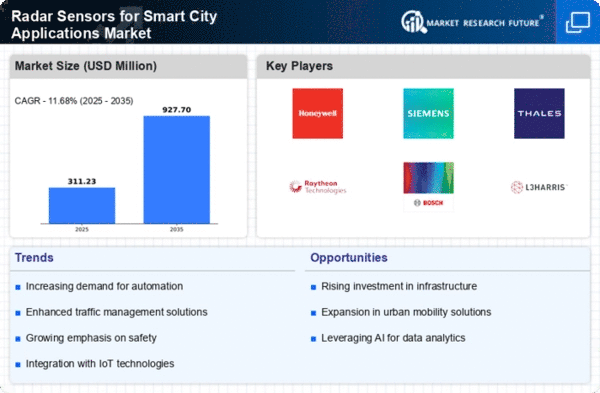
As per MRFR analysis, the Radar Sensors for Smart City Applications Market was estimated at 278.68 USD Million in 2024. The radar sensors industry is projected to grow from 307.09 USD Million in 2025 to 927.7 USD Million by 2035, exhibiting a compound annual growth rate (CAGR) of 11.68% during the forecast period 2025 - 2035.

Key Market Trends & Highlights

The Radar Sensors for Smart City Applications Market is poised for substantial growth driven by technological advancements and increasing urbanization.

  • The integration of radar sensors with IoT technologies is enhancing data collection and operational efficiency in smart cities. Public safety remains a focal point, with radar sensors being deployed to improve emergency response and crime prevention measures. North America leads the market, while the Asia-Pacific region is experiencing rapid growth due to urbanization and smart city initiatives. Key market drivers include the growing demand for smart infrastructure and advancements in radar technology, which are shaping the future of urban environments.

Market Size & Forecast

2024 Market Size 278.68 (USD Million)
2035 Market Size 927.7 (USD Million)
CAGR (2025 - 2035) 11.68%
Largest Regional Market Share in 2024 North America

Major Players

Honeywell (US), Siemens (DE), Thales (FR), Raytheon Technologies (US), Bosch (DE), L3Harris Technologies (US), NXP Semiconductors (NL), Kongsberg Gruppen (NO), Teledyne Technologies (US)

Market Trends

The Radar Sensors for Smart City Applications Market is currently experiencing a transformative phase, driven by the increasing demand for efficient urban management and enhanced public safety. These sensors, which utilize radio waves to detect objects and measure distances, are becoming integral to various applications, including traffic monitoring, environmental sensing, and security systems. As cities evolve into smart ecosystems, the integration of radar technology is likely to facilitate real-time data collection and analysis, thereby improving decision-making processes for urban planners and local authorities. Furthermore, the growing emphasis on sustainability and energy efficiency in urban environments appears to be propelling the adoption of radar sensors, as they offer reliable performance with minimal energy consumption. In addition, advancements in radar technology are fostering innovation within the Radar Sensors for Smart City Applications Market. The development of compact, cost-effective, and high-performance radar systems is enabling broader deployment across diverse urban settings. This trend is complemented by the increasing collaboration between technology providers and municipal governments, which seems to enhance the implementation of radar solutions in smart city initiatives. As the market continues to mature, it is anticipated that the integration of artificial intelligence and machine learning with radar sensors will further augment their capabilities, leading to more sophisticated applications and improved urban living conditions.

Integration with IoT

The convergence of radar sensors with Internet of Things (IoT) technologies is reshaping the Radar Sensors for Smart City Applications Market. This integration allows for seamless communication between devices, enabling real-time data sharing and analysis. As cities adopt IoT frameworks, radar sensors are likely to play a pivotal role in enhancing operational efficiency and responsiveness.

Focus on Public Safety

There is a growing emphasis on public safety within urban environments, which is influencing the Radar Sensors for Smart City Applications Market. Radar sensors are increasingly utilized for surveillance, traffic management, and emergency response systems. This trend suggests that municipalities are prioritizing the deployment of advanced technologies to ensure the safety and security of their residents.

Sustainability Initiatives

Sustainability is becoming a central theme in urban planning, impacting the Radar Sensors for Smart City Applications Market. Radar sensors, known for their low energy consumption and minimal environmental impact, are being favored in smart city projects. This trend indicates a shift towards greener technologies that align with global sustainability goals.

Radar Sensors for Smart City Applications Market Market Drivers

Increasing Urbanization

The rapid pace of urbanization globally drives the demand for advanced infrastructure solutions, including radar sensors for smart city applications. As cities expand, the need for efficient traffic management, public safety, and environmental monitoring becomes paramount. The Global Radar Sensors for Smart City Applications Market Industry is poised to benefit significantly from this trend, with projections indicating a market value of 276.7 USD Million in 2024. Urban areas are increasingly adopting radar technology to enhance their operational efficiency and improve the quality of life for residents, suggesting a robust growth trajectory in the coming years.

Market Segment Insights

By Application: Traffic Management (Largest) vs. Public Safety (Fastest-Growing)

In the Radar Sensors for Smart City Applications Market, Traffic Management holds the largest market share due to its critical role in optimizing urban traffic flow and reducing congestion. This segment is heavily relied upon by municipal authorities to facilitate smart traffic systems and enhance the efficiency of transportation networks. Following closely, Public Safety emerges as the fastest-growing segment, driven by increasing investments in smart city initiatives aimed at enhancing community safety and response times. This focus on urban security is leading to a rising adoption of advanced radar sensors in various public safety applications.

Traffic Management: Dominant vs. Environmental Monitoring: Emerging

Traffic Management is positioned as the dominant application in the Radar Sensors for Smart City Applications Market, leveraging radar technology to provide real-time data for traffic monitoring, vehicle counting, and incident detection. This segment is significantly supported by municipal budgets directed towards digital infrastructure upgrades. In contrast, Environmental Monitoring emerges as an important yet expanding segment, with a growing focus on urban sustainability and compliance with environmental regulations. This category utilizes radar sensors to monitor air quality, noise levels, and other environmental factors, reflecting the increasing demand for sustainable city solutions. Together, these segments illustrate the crucial relationship between urban planning and technological advancement.

By End Use: Transportation (Largest) vs. Utilities (Fastest-Growing)

<p>In the Radar Sensors for Smart City Applications Market, the 'End Use' segment reveals a varied distribution of market share. Notably, the Transportation sector dominates this landscape due to the increasing need for smart traffic management solutions, vehicle monitoring, and public safety enhancements. Following closely, the Government segment harnesses radar sensors for law enforcement and public infrastructure monitoring, while Construction and Telecommunications also represent significant, albeit smaller, shares of the market.</p>

<p>Government: Dominant vs. Transportation: Emerging</p>

<p>Within the End Use segment, the Government sector stands out as a dominant player, leveraging radar sensor technology for applications such as traffic monitoring, security surveillance, and urban planning. This sector's sustained investment in smart city initiatives aligns with its focus on public safety and efficiency enhancements. Conversely, the Transportation sector is emerging rapidly, driven by advancements in connected vehicle technologies and the growing demand for intelligent transportation systems. This shift towards automation and real-time data analytics in transportation is reshaping how cities manage urban mobility, making it a critical area for future growth.</p>

By Technology: Doppler Radar (Largest) vs. Millimeter Wave Radar (Fastest-Growing)

<p>In the Radar Sensors for Smart City Applications Market, Doppler Radar emerges as the largest segment, dominating market share due to its established reliability and effectiveness in traffic monitoring and speed detection. Following closely are other technologies, including Frequency Modulation and Phased Array Radar, which cater to niche applications in smart city infrastructure such as environmental monitoring and autonomous vehicle navigation. Each technology has its unique strengths, yet Doppler Radar's widespread adoption positions it prominently in this market landscape. The growth dynamics for radar technologies in smart cities are driven primarily by increasing urbanization and the need for enhanced traffic management systems. Millimeter Wave Radar, recognized as the fastest-growing technology, is gaining traction for its capability to provide high-resolution data crucial for smart transportation systems and autonomous operation. Innovations in radar technology, combined with government initiatives to develop smart cities, contribute significantly to market expansion and diversification of applications.</p>

<p>Doppler Radar (Dominant) vs. Millimeter Wave Radar (Emerging)</p>

<p>Doppler Radar serves as the dominant technology in the Radar Sensors for Smart City Applications Market, primarily due to its effectiveness in detecting motion and measuring speed, making it essential for traffic monitoring and management. Its reliability and proven performance have led to widespread applications within law enforcement and transportation management systems. Conversely, Millimeter Wave Radar is an emerging technology characterized by its ability to operate at higher frequencies, resulting in improved precision and resolution. This technology is quickly becoming invaluable for smart city applications like autonomous vehicles and intricate environmental sensing. As urban environments continue to evolve, both technologies complement each other, with Doppler Radar providing dependable solutions, while Millimeter Wave Radar presents opportunities for innovative advancements.</p>

By Component: Receiver (Largest) vs. Transmitter (Fastest-Growing)

<p>In the Radar Sensors for Smart City Applications Market, the component segment is primarily dominated by Receivers, which hold the largest share due to their critical role in accurately detecting and processing data in various smart city applications. Following Receivers, Transmitters also occupy a significant position but are rapidly gaining ground in market share as technology advances. Other components like Antennas, Signal Processors, and Power Supplies play supportive roles but do not match the comparatively higher standings of Receivers and Transmitters.</p>

<p>Receiver (Dominant) vs. Transmitter (Emerging)</p>

<p>Receivers are central to Radar Sensors, acting as the primary element for capturing reflected radar signals, which is essential for various applications, including traffic management and public safety initiatives within smart cities. They benefit from advancements in signal processing technology and are widely recognized for their precision and reliability. In contrast, Transmitters are emerging as a vital component, driven by the increasing demand for enhanced signal range and robustness to adapt to evolving smart city needs. As urban environments grow more complex, the adoption of advanced Transmitters is becoming pivotal in enhancing the overall radar sensing capabilities, positioning them for significant growth.</p>

By Deployment Type: Fixed (Largest) vs. Mobile (Fastest-Growing)

The Radar Sensors for Smart City Applications Market is distinctly segmented by deployment type, with the fixed deployment segment holding the largest market share. This segment includes sensors permanently installed at strategic locations, providing continuous monitoring and data collection. Following closely are the mobile and portable segments, which are increasingly being utilized for various applications within smart city infrastructure. The integrated and standalone sensors, while smaller in share, represent niche markets focusing on specific use cases within smart cities.

Radar Sensors: Fixed (Dominant) vs. Mobile (Emerging)

Fixed radar sensors dominate the smart city applications market due to their reliability and consistent performance in traffic management, security, and environmental monitoring. These sensors are typically installed in critical areas for long-term data acquisition, making them invaluable for urban planning and resource management. On the other hand, mobile radar sensors are emerging rapidly, driven by flexibility and adaptability. These sensors can be deployed temporarily for events or in varying urban conditions, responding to immediate needs such as traffic monitoring during construction zones. As cities evolve, both types of sensors play crucial roles, but fixed sensors currently lead in market share.

Get more detailed insights about Radar Sensors for Smart City Applications Market Research Report—Global Forecast till 2035

Regional Insights

North America : Market Leader in Innovation

North America is poised to maintain its leadership in the Radar Sensors for Smart City Applications Market, holding a significant market share of 139.0 million in 2025. The region's growth is driven by increasing urbanization, government initiatives for smart city projects, and advancements in radar technology. Regulatory support for infrastructure development and public safety is also a key catalyst for market expansion. The competitive landscape in North America is robust, featuring major players like Honeywell, Raytheon Technologies, and L3Harris Technologies. These companies are investing heavily in R&D to enhance radar sensor capabilities. The U.S. leads the market, with Canada also showing promising growth due to its smart city initiatives. The presence of established firms ensures a dynamic market environment, fostering innovation and collaboration.

Europe : Emerging Market with Potential

Europe is witnessing a growing demand for radar sensors in smart city applications, with a market size of 85.0 million in 2025. The region's growth is fueled by stringent regulations aimed at enhancing urban safety and sustainability. Initiatives from the European Union to promote smart city technologies are also significant drivers, encouraging investments in innovative solutions and infrastructure development. Leading countries in Europe include Germany, France, and the Netherlands, where companies like Siemens and Bosch are at the forefront of radar sensor technology. The competitive landscape is characterized by a mix of established firms and innovative startups, fostering a collaborative environment for technological advancements. The European market is expected to grow as cities increasingly adopt smart technologies to improve urban living conditions.

Asia-Pacific : Rapidly Growing Market

Asia-Pacific is emerging as a significant player in the Radar Sensors for Smart City Applications Market, with a projected size of 45.0 million in 2025. The region's rapid urbanization and increasing investments in smart city initiatives are key growth drivers. Governments are focusing on enhancing public safety and traffic management, leading to a surge in demand for advanced radar technologies. Countries like China, Japan, and India are leading the charge, with substantial investments in smart infrastructure. The competitive landscape features both local and international players, including NXP Semiconductors and Kongsberg Gruppen. As cities in Asia-Pacific adopt smart technologies, the market is expected to expand, driven by innovation and regulatory support for urban development.

Middle East and Africa : Emerging Market Opportunities

The Middle East and Africa region is gradually emerging in the Radar Sensors for Smart City Applications Market, with a market size of 9.68 million in 2025. The growth is primarily driven by urbanization and government initiatives aimed at enhancing city infrastructure. Countries are increasingly recognizing the importance of smart technologies in urban planning, leading to a rise in demand for radar sensors. Leading countries in this region include the UAE and South Africa, where investments in smart city projects are gaining momentum. The competitive landscape is still developing, with opportunities for both local and international players to enter the market. As governments prioritize urban development, the radar sensor market is expected to grow, supported by regulatory frameworks promoting smart city initiatives.

Key Players and Competitive Insights

The Radar Sensors for Smart City Applications Market is currently characterized by a dynamic competitive landscape, driven by the increasing demand for smart infrastructure and enhanced urban mobility solutions. Key players such as Honeywell (US), Siemens (DE), and Thales (FR) are strategically positioning themselves through innovation and partnerships, which collectively shape the competitive environment. For instance, Honeywell (US) has focused on integrating advanced radar technologies into its smart city solutions, enhancing urban safety and traffic management. Meanwhile, Siemens (DE) emphasizes digital transformation, leveraging its expertise in automation and data analytics to optimize urban operations.
The market structure appears moderately fragmented, with several players vying for market share. Companies are adopting various business tactics, such as localizing manufacturing and optimizing supply chains, to enhance operational efficiency and reduce costs. This competitive structure allows for a diverse range of offerings, catering to the specific needs of different urban environments. The collective influence of these key players is significant, as they drive innovation and set industry standards.
In November 2025, Thales (FR) announced a strategic partnership with a leading telecommunications provider to develop integrated radar solutions for smart traffic management systems. This collaboration aims to enhance real-time data processing capabilities, thereby improving traffic flow and reducing congestion in urban areas. The strategic importance of this partnership lies in its potential to leverage advanced communication technologies alongside radar systems, creating a more interconnected urban ecosystem.
In October 2025, Bosch (DE) unveiled its latest radar sensor technology designed specifically for smart city applications, focusing on sustainability and energy efficiency. This innovation is expected to significantly reduce energy consumption in urban monitoring systems. The introduction of this technology underscores Bosch's commitment to sustainability, aligning with The Radar Sensors for Smart City Applications.
In September 2025, Raytheon Technologies (US) expanded its radar sensor portfolio by acquiring a small tech firm specializing in AI-driven analytics for urban applications. This acquisition is likely to bolster Raytheon's capabilities in integrating artificial intelligence with radar technology, thereby enhancing the functionality and effectiveness of smart city solutions. The strategic move reflects a broader trend of integrating AI into radar systems, which is becoming increasingly vital for real-time decision-making in urban environments.
As of December 2025, the competitive trends in the Radar Sensors for Smart City Applications Market are heavily influenced by digitalization, sustainability, and AI integration. Strategic alliances are becoming more prevalent, as companies recognize the need for collaborative approaches to tackle complex urban challenges. Looking ahead, competitive differentiation is expected to evolve, shifting from price-based competition to a focus on innovation, technology, and supply chain reliability. This transition suggests that companies that prioritize advanced technological solutions and sustainable practices will likely emerge as leaders in the market.

Key Companies in the Radar Sensors for Smart City Applications Market include

Industry Developments

August 2022: A South Korean firm called Bitsensing creates cutting-edge radar sensing solutions for a connected and intelligent world. Offerings span the automotive, smart city, and healthcare industries. It also has a cooperation with a major automaker to jointly develop a 4D imaging radar solution that is anticipated to hit the market this year. Additionally, the business has partnered with Nvidia and Infineon, two major worldwide chipmakers. Hospitals and local governments are among its customers for wellness and smart infrastructure. It intends to break into the international market and will utilise CES 2023 as a platform to present its goods.

By joining Nvidia's Metropolis Partner Program, an application framework that assists businesses, governments, and integration partners in using top-tier AI-enabled solutions, Bitsenging has increased its relationship with the company. It is a participant in the NVIDIA Inception initiative, which creates intelligent traffic control systems. It participates in Thailand's Plug and Play Initiative, which links early-stage investors and startups to develop fresh smart city solutions, as part of its business operations in South East Asia.

July 2021: Smart cities have been projected to provide USD 20 trillion in economic benefits by 2026. Support for this is coming through funding being made available for smart city-based projects, including green (programs that reduce fuel consumption and vehicle emissions, for example), transit, and CAV initiatives, all of which help ensure a shared reusability and return on investment for these infrastructure devices. Moving forward, the most important investment will be in the information-based technologies and solutions that sense, aggregate, transmit, and share traffic data. Data is becoming increasingly vital.

Future Outlook

Radar Sensors for Smart City Applications Market Future Outlook

The Radar Sensors for Smart City Applications Market is projected to grow at 11.68% CAGR from 2025 to 2035, driven by urbanization, technological advancements, and increased demand for smart infrastructure.

New opportunities lie in:

  • Integration of radar sensors with AI for predictive analytics in traffic management.
  • Development of compact radar systems for smart waste management solutions.
  • Partnerships with municipalities for real-time environmental monitoring systems.

By 2035, the market is expected to be robust, driven by innovation and strategic partnerships.

Market Segmentation

Radar Sensors for Smart City Applications Market End Use Outlook

  • Government
  • Transportation
  • Utilities
  • Construction
  • Telecommunications

Radar Sensors for Smart City Applications Market Component Outlook

  • Transmitter
  • Receiver
  • Antenna
  • Signal Processor
  • Power Supply

Radar Sensors for Smart City Applications Market Technology Outlook

  • Frequency Modulated Continuous Wave
  • Pulse-Doppler
  • Millimeter Wave
  • Ultra-Wideband
  • Phased Array

Radar Sensors for Smart City Applications Market Application Outlook

  • Traffic Management
  • Public Safety
  • Environmental Monitoring
  • Smart Parking
  • Infrastructure Management

Radar Sensors for Smart City Applications Market Deployment Type Outlook

  • Fixed
  • Mobile
  • Portable
  • Integrated
  • Standalone

Report Scope

MARKET SIZE 2024 278.68(USD Million)
MARKET SIZE 2025 307.09(USD Million)
MARKET SIZE 2035 927.7(USD Million)
COMPOUND ANNUAL GROWTH RATE (CAGR) 11.68% (2025 - 2035)
REPORT COVERAGE Revenue Forecast, Competitive Landscape, Growth Factors, and Trends
BASE YEAR 2024
Market Forecast Period 2025 - 2035
Historical Data 2019 - 2024
Market Forecast Units USD Million
Key Companies Profiled Honeywell (US), Siemens (DE), Thales (FR), Raytheon Technologies (US), Bosch (DE), L3Harris Technologies (US), NXP Semiconductors (NL), Kongsberg Gruppen (NO), Teledyne Technologies (US)
Segments Covered Application, End Use, Technology, Component, Deployment Type
Key Market Opportunities Integration of advanced radar sensors enhances urban mobility and safety in Smart City Applications.
Key Market Dynamics Rising demand for smart infrastructure drives innovation and competition in radar sensor technologies for urban applications.
Countries Covered North America, Europe, APAC, South America, MEA

FAQs

What is the projected market valuation for Radar Sensors for Smart City Applications by 2035?

<p>The projected market valuation for Radar Sensors for Smart City Applications is expected to reach 927.7 USD Million by 2035.</p>

What was the overall market valuation for Radar Sensors in 2024?

<p>The overall market valuation for Radar Sensors for Smart City Applications was 278.68 USD Million in 2024.</p>

What is the expected CAGR for the Radar Sensors market during the forecast period 2025 - 2035?

<p>The expected CAGR for the Radar Sensors for Smart City Applications Market during the forecast period 2025 - 2035 is 11.68%.</p>

Which application segment is projected to have the highest valuation by 2035?

<p>The Traffic Management application segment is projected to reach a valuation of 170.0 USD Million by 2035.</p>

How does the Public Safety segment perform in terms of market valuation?

The Public Safety segment was valued at 200.0 USD Million in 2035, indicating strong growth potential.

What are the key players in the Radar Sensors for Smart City Applications Market?

Key players in the market include Siemens, Honeywell, Bosch, Thales, and Raytheon Technologies.

Which technology segment is expected to show significant growth by 2035?

The Doppler Radar technology segment is expected to reach a valuation of 240.0 USD Million by 2035.

What is the projected valuation for the Utilities end-use segment by 2035?

The Utilities end-use segment is projected to reach a valuation of 170.0 USD Million by 2035.

How does the market for Integrated deployment types compare to others?

The Integrated deployment type is expected to reach a valuation of 220.0 USD Million by 2035, showcasing its importance.

What is the expected market performance for the Signal Processor component by 2035?

The Signal Processor component is projected to achieve a valuation of 240.0 USD Million by 2035, indicating robust demand.

  1. SECTION I: EXECUTIVE SUMMARY AND KEY HIGHLIGHTS
    1. | 1.1 EXECUTIVE SUMMARY
    2. | | 1.1.1 Market Overview
    3. | | 1.1.2 Key Findings
    4. | | 1.1.3 Market Segmentation
    5. | | 1.1.4 Competitive Landscape
    6. | | 1.1.5 Challenges and Opportunities
    7. | | 1.1.6 Future Outlook
  2. SECTION II: SCOPING, METHODOLOGY AND MARKET STRUCTURE
    1. | 2.1 MARKET INTRODUCTION
    2. | | 2.1.1 Definition
    3. | | 2.1.2 Scope of the study
    4. | | | 2.1.2.1 Research Objective
    5. | | | 2.1.2.2 Assumption
    6. | | | 2.1.2.3 Limitations
    7. | 2.2 RESEARCH METHODOLOGY
    8. | | 2.2.1 Overview
    9. | | 2.2.2 Data Mining
    10. | | 2.2.3 Secondary Research
    11. | | 2.2.4 Primary Research
    12. | | | 2.2.4.1 Primary Interviews and Information Gathering Process
    13. | | | 2.2.4.2 Breakdown of Primary Respondents
    14. | | 2.2.5 Forecasting Model
    15. | | 2.2.6 Market Size Estimation
    16. | | | 2.2.6.1 Bottom-Up Approach
    17. | | | 2.2.6.2 Top-Down Approach
    18. | | 2.2.7 Data Triangulation
    19. | | 2.2.8 Validation
  3. SECTION III: QUALITATIVE ANALYSIS
    1. | 3.1 MARKET DYNAMICS
    2. | | 3.1.1 Overview
    3. | | 3.1.2 Drivers
    4. | | 3.1.3 Restraints
    5. | | 3.1.4 Opportunities
    6. | 3.2 MARKET FACTOR ANALYSIS
    7. | | 3.2.1 Value chain Analysis
    8. | | 3.2.2 Porter's Five Forces Analysis
    9. | | | 3.2.2.1 Bargaining Power of Suppliers
    10. | | | 3.2.2.2 Bargaining Power of Buyers
    11. | | | 3.2.2.3 Threat of New Entrants
    12. | | | 3.2.2.4 Threat of Substitutes
    13. | | | 3.2.2.5 Intensity of Rivalry
    14. | | 3.2.3 COVID-19 Impact Analysis
    15. | | | 3.2.3.1 Market Impact Analysis
    16. | | | 3.2.3.2 Regional Impact
    17. | | | 3.2.3.3 Opportunity and Threat Analysis
  4. SECTION IV: QUANTITATIVE ANALYSIS
    1. | 4.1 Semiconductor & Electronics, BY Application (USD Million)
    2. | | 4.1.1 Traffic Management
    3. | | 4.1.2 Public Safety
    4. | | 4.1.3 Environmental Monitoring
    5. | | 4.1.4 Smart Parking
    6. | | 4.1.5 Infrastructure Management
    7. | 4.2 Semiconductor & Electronics, BY End Use (USD Million)
    8. | | 4.2.1 Government
    9. | | 4.2.2 Transportation
    10. | | 4.2.3 Utilities
    11. | | 4.2.4 Construction
    12. | | 4.2.5 Telecommunications
    13. | 4.3 Semiconductor & Electronics, BY Technology (USD Million)
    14. | | 4.3.1 Frequency Modulation
    15. | | 4.3.2 Doppler Radar
    16. | | 4.3.3 Phased Array Radar
    17. | | 4.3.4 Millimeter Wave Radar
    18. | | 4.3.5 Ultra-Wideband Radar
    19. | 4.4 Semiconductor & Electronics, BY Component (USD Million)
    20. | | 4.4.1 Transmitter
    21. | | 4.4.2 Receiver
    22. | | 4.4.3 Antenna
    23. | | 4.4.4 Signal Processor
    24. | | 4.4.5 Power Supply
    25. | 4.5 Semiconductor & Electronics, BY Deployment Type (USD Million)
    26. | | 4.5.1 Fixed
    27. | | 4.5.2 Mobile
    28. | | 4.5.3 Portable
    29. | | 4.5.4 Integrated
    30. | | 4.5.5 Remote
    31. | 4.6 Semiconductor & Electronics, BY Region (USD Million)
    32. | | 4.6.1 North America
    33. | | | 4.6.1.1 US
    34. | | | 4.6.1.2 Canada
    35. | | 4.6.2 Europe
    36. | | | 4.6.2.1 Germany
    37. | | | 4.6.2.2 UK
    38. | | | 4.6.2.3 France
    39. | | | 4.6.2.4 Russia
    40. | | | 4.6.2.5 Italy
    41. | | | 4.6.2.6 Spain
    42. | | | 4.6.2.7 Rest of Europe
    43. | | 4.6.3 APAC
    44. | | | 4.6.3.1 China
    45. | | | 4.6.3.2 India
    46. | | | 4.6.3.3 Japan
    47. | | | 4.6.3.4 South Korea
    48. | | | 4.6.3.5 Malaysia
    49. | | | 4.6.3.6 Thailand
    50. | | | 4.6.3.7 Indonesia
    51. | | | 4.6.3.8 Rest of APAC
    52. | | 4.6.4 South America
    53. | | | 4.6.4.1 Brazil
    54. | | | 4.6.4.2 Mexico
    55. | | | 4.6.4.3 Argentina
    56. | | | 4.6.4.4 Rest of South America
    57. | | 4.6.5 MEA
    58. | | | 4.6.5.1 GCC Countries
    59. | | | 4.6.5.2 South Africa
    60. | | | 4.6.5.3 Rest of MEA
  5. SECTION V: COMPETITIVE ANALYSIS
    1. | 5.1 Competitive Landscape
    2. | | 5.1.1 Overview
    3. | | 5.1.2 Competitive Analysis
    4. | | 5.1.3 Market share Analysis
    5. | | 5.1.4 Major Growth Strategy in the Semiconductor & Electronics
    6. | | 5.1.5 Competitive Benchmarking
    7. | | 5.1.6 Leading Players in Terms of Number of Developments in the Semiconductor & Electronics
    8. | | 5.1.7 Key developments and growth strategies
    9. | | | 5.1.7.1 New Product Launch/Service Deployment
    10. | | | 5.1.7.2 Merger & Acquisitions
    11. | | | 5.1.7.3 Joint Ventures
    12. | | 5.1.8 Major Players Financial Matrix
    13. | | | 5.1.8.1 Sales and Operating Income
    14. | | | 5.1.8.2 Major Players R&D Expenditure. 2023
    15. | 5.2 Company Profiles
    16. | | 5.2.1 Siemens (DE)
    17. | | | 5.2.1.1 Financial Overview
    18. | | | 5.2.1.2 Products Offered
    19. | | | 5.2.1.3 Key Developments
    20. | | | 5.2.1.4 SWOT Analysis
    21. | | | 5.2.1.5 Key Strategies
    22. | | 5.2.2 Honeywell (US)
    23. | | | 5.2.2.1 Financial Overview
    24. | | | 5.2.2.2 Products Offered
    25. | | | 5.2.2.3 Key Developments
    26. | | | 5.2.2.4 SWOT Analysis
    27. | | | 5.2.2.5 Key Strategies
    28. | | 5.2.3 Bosch (DE)
    29. | | | 5.2.3.1 Financial Overview
    30. | | | 5.2.3.2 Products Offered
    31. | | | 5.2.3.3 Key Developments
    32. | | | 5.2.3.4 SWOT Analysis
    33. | | | 5.2.3.5 Key Strategies
    34. | | 5.2.4 Thales (FR)
    35. | | | 5.2.4.1 Financial Overview
    36. | | | 5.2.4.2 Products Offered
    37. | | | 5.2.4.3 Key Developments
    38. | | | 5.2.4.4 SWOT Analysis
    39. | | | 5.2.4.5 Key Strategies
    40. | | 5.2.5 Raytheon Technologies (US)
    41. | | | 5.2.5.1 Financial Overview
    42. | | | 5.2.5.2 Products Offered
    43. | | | 5.2.5.3 Key Developments
    44. | | | 5.2.5.4 SWOT Analysis
    45. | | | 5.2.5.5 Key Strategies
    46. | | 5.2.6 L3Harris Technologies (US)
    47. | | | 5.2.6.1 Financial Overview
    48. | | | 5.2.6.2 Products Offered
    49. | | | 5.2.6.3 Key Developments
    50. | | | 5.2.6.4 SWOT Analysis
    51. | | | 5.2.6.5 Key Strategies
    52. | | 5.2.7 NXP Semiconductors (NL)
    53. | | | 5.2.7.1 Financial Overview
    54. | | | 5.2.7.2 Products Offered
    55. | | | 5.2.7.3 Key Developments
    56. | | | 5.2.7.4 SWOT Analysis
    57. | | | 5.2.7.5 Key Strategies
    58. | | 5.2.8 Kongsberg Gruppen (NO)
    59. | | | 5.2.8.1 Financial Overview
    60. | | | 5.2.8.2 Products Offered
    61. | | | 5.2.8.3 Key Developments
    62. | | | 5.2.8.4 SWOT Analysis
    63. | | | 5.2.8.5 Key Strategies
    64. | | 5.2.9 Teledyne Technologies (US)
    65. | | | 5.2.9.1 Financial Overview
    66. | | | 5.2.9.2 Products Offered
    67. | | | 5.2.9.3 Key Developments
    68. | | | 5.2.9.4 SWOT Analysis
    69. | | | 5.2.9.5 Key Strategies
    70. | 5.3 Appendix
    71. | | 5.3.1 References
    72. | | 5.3.2 Related Reports
  6. LIST OF FIGURES
    1. | 6.1 MARKET SYNOPSIS
    2. | 6.2 NORTH AMERICA MARKET ANALYSIS
    3. | 6.3 US MARKET ANALYSIS BY APPLICATION
    4. | 6.4 US MARKET ANALYSIS BY END USE
    5. | 6.5 US MARKET ANALYSIS BY TECHNOLOGY
    6. | 6.6 US MARKET ANALYSIS BY COMPONENT
    7. | 6.7 US MARKET ANALYSIS BY DEPLOYMENT TYPE
    8. | 6.8 CANADA MARKET ANALYSIS BY APPLICATION
    9. | 6.9 CANADA MARKET ANALYSIS BY END USE
    10. | 6.10 CANADA MARKET ANALYSIS BY TECHNOLOGY
    11. | 6.11 CANADA MARKET ANALYSIS BY COMPONENT
    12. | 6.12 CANADA MARKET ANALYSIS BY DEPLOYMENT TYPE
    13. | 6.13 EUROPE MARKET ANALYSIS
    14. | 6.14 GERMANY MARKET ANALYSIS BY APPLICATION
    15. | 6.15 GERMANY MARKET ANALYSIS BY END USE
    16. | 6.16 GERMANY MARKET ANALYSIS BY TECHNOLOGY
    17. | 6.17 GERMANY MARKET ANALYSIS BY COMPONENT
    18. | 6.18 GERMANY MARKET ANALYSIS BY DEPLOYMENT TYPE
    19. | 6.19 UK MARKET ANALYSIS BY APPLICATION
    20. | 6.20 UK MARKET ANALYSIS BY END USE
    21. | 6.21 UK MARKET ANALYSIS BY TECHNOLOGY
    22. | 6.22 UK MARKET ANALYSIS BY COMPONENT
    23. | 6.23 UK MARKET ANALYSIS BY DEPLOYMENT TYPE
    24. | 6.24 FRANCE MARKET ANALYSIS BY APPLICATION
    25. | 6.25 FRANCE MARKET ANALYSIS BY END USE
    26. | 6.26 FRANCE MARKET ANALYSIS BY TECHNOLOGY
    27. | 6.27 FRANCE MARKET ANALYSIS BY COMPONENT
    28. | 6.28 FRANCE MARKET ANALYSIS BY DEPLOYMENT TYPE
    29. | 6.29 RUSSIA MARKET ANALYSIS BY APPLICATION
    30. | 6.30 RUSSIA MARKET ANALYSIS BY END USE
    31. | 6.31 RUSSIA MARKET ANALYSIS BY TECHNOLOGY
    32. | 6.32 RUSSIA MARKET ANALYSIS BY COMPONENT
    33. | 6.33 RUSSIA MARKET ANALYSIS BY DEPLOYMENT TYPE
    34. | 6.34 ITALY MARKET ANALYSIS BY APPLICATION
    35. | 6.35 ITALY MARKET ANALYSIS BY END USE
    36. | 6.36 ITALY MARKET ANALYSIS BY TECHNOLOGY
    37. | 6.37 ITALY MARKET ANALYSIS BY COMPONENT
    38. | 6.38 ITALY MARKET ANALYSIS BY DEPLOYMENT TYPE
    39. | 6.39 SPAIN MARKET ANALYSIS BY APPLICATION
    40. | 6.40 SPAIN MARKET ANALYSIS BY END USE
    41. | 6.41 SPAIN MARKET ANALYSIS BY TECHNOLOGY
    42. | 6.42 SPAIN MARKET ANALYSIS BY COMPONENT
    43. | 6.43 SPAIN MARKET ANALYSIS BY DEPLOYMENT TYPE
    44. | 6.44 REST OF EUROPE MARKET ANALYSIS BY APPLICATION
    45. | 6.45 REST OF EUROPE MARKET ANALYSIS BY END USE
    46. | 6.46 REST OF EUROPE MARKET ANALYSIS BY TECHNOLOGY
    47. | 6.47 REST OF EUROPE MARKET ANALYSIS BY COMPONENT
    48. | 6.48 REST OF EUROPE MARKET ANALYSIS BY DEPLOYMENT TYPE
    49. | 6.49 APAC MARKET ANALYSIS
    50. | 6.50 CHINA MARKET ANALYSIS BY APPLICATION
    51. | 6.51 CHINA MARKET ANALYSIS BY END USE
    52. | 6.52 CHINA MARKET ANALYSIS BY TECHNOLOGY
    53. | 6.53 CHINA MARKET ANALYSIS BY COMPONENT
    54. | 6.54 CHINA MARKET ANALYSIS BY DEPLOYMENT TYPE
    55. | 6.55 INDIA MARKET ANALYSIS BY APPLICATION
    56. | 6.56 INDIA MARKET ANALYSIS BY END USE
    57. | 6.57 INDIA MARKET ANALYSIS BY TECHNOLOGY
    58. | 6.58 INDIA MARKET ANALYSIS BY COMPONENT
    59. | 6.59 INDIA MARKET ANALYSIS BY DEPLOYMENT TYPE
    60. | 6.60 JAPAN MARKET ANALYSIS BY APPLICATION
    61. | 6.61 JAPAN MARKET ANALYSIS BY END USE
    62. | 6.62 JAPAN MARKET ANALYSIS BY TECHNOLOGY
    63. | 6.63 JAPAN MARKET ANALYSIS BY COMPONENT
    64. | 6.64 JAPAN MARKET ANALYSIS BY DEPLOYMENT TYPE
    65. | 6.65 SOUTH KOREA MARKET ANALYSIS BY APPLICATION
    66. | 6.66 SOUTH KOREA MARKET ANALYSIS BY END USE
    67. | 6.67 SOUTH KOREA MARKET ANALYSIS BY TECHNOLOGY
    68. | 6.68 SOUTH KOREA MARKET ANALYSIS BY COMPONENT
    69. | 6.69 SOUTH KOREA MARKET ANALYSIS BY DEPLOYMENT TYPE
    70. | 6.70 MALAYSIA MARKET ANALYSIS BY APPLICATION
    71. | 6.71 MALAYSIA MARKET ANALYSIS BY END USE
    72. | 6.72 MALAYSIA MARKET ANALYSIS BY TECHNOLOGY
    73. | 6.73 MALAYSIA MARKET ANALYSIS BY COMPONENT
    74. | 6.74 MALAYSIA MARKET ANALYSIS BY DEPLOYMENT TYPE
    75. | 6.75 THAILAND MARKET ANALYSIS BY APPLICATION
    76. | 6.76 THAILAND MARKET ANALYSIS BY END USE
    77. | 6.77 THAILAND MARKET ANALYSIS BY TECHNOLOGY
    78. | 6.78 THAILAND MARKET ANALYSIS BY COMPONENT
    79. | 6.79 THAILAND MARKET ANALYSIS BY DEPLOYMENT TYPE
    80. | 6.80 INDONESIA MARKET ANALYSIS BY APPLICATION
    81. | 6.81 INDONESIA MARKET ANALYSIS BY END USE
    82. | 6.82 INDONESIA MARKET ANALYSIS BY TECHNOLOGY
    83. | 6.83 INDONESIA MARKET ANALYSIS BY COMPONENT
    84. | 6.84 INDONESIA MARKET ANALYSIS BY DEPLOYMENT TYPE
    85. | 6.85 REST OF APAC MARKET ANALYSIS BY APPLICATION
    86. | 6.86 REST OF APAC MARKET ANALYSIS BY END USE
    87. | 6.87 REST OF APAC MARKET ANALYSIS BY TECHNOLOGY
    88. | 6.88 REST OF APAC MARKET ANALYSIS BY COMPONENT
    89. | 6.89 REST OF APAC MARKET ANALYSIS BY DEPLOYMENT TYPE
    90. | 6.90 SOUTH AMERICA MARKET ANALYSIS
    91. | 6.91 BRAZIL MARKET ANALYSIS BY APPLICATION
    92. | 6.92 BRAZIL MARKET ANALYSIS BY END USE
    93. | 6.93 BRAZIL MARKET ANALYSIS BY TECHNOLOGY
    94. | 6.94 BRAZIL MARKET ANALYSIS BY COMPONENT
    95. | 6.95 BRAZIL MARKET ANALYSIS BY DEPLOYMENT TYPE
    96. | 6.96 MEXICO MARKET ANALYSIS BY APPLICATION
    97. | 6.97 MEXICO MARKET ANALYSIS BY END USE
    98. | 6.98 MEXICO MARKET ANALYSIS BY TECHNOLOGY
    99. | 6.99 MEXICO MARKET ANALYSIS BY COMPONENT
    100. | 6.100 MEXICO MARKET ANALYSIS BY DEPLOYMENT TYPE
    101. | 6.101 ARGENTINA MARKET ANALYSIS BY APPLICATION
    102. | 6.102 ARGENTINA MARKET ANALYSIS BY END USE
    103. | 6.103 ARGENTINA MARKET ANALYSIS BY TECHNOLOGY
    104. | 6.104 ARGENTINA MARKET ANALYSIS BY COMPONENT
    105. | 6.105 ARGENTINA MARKET ANALYSIS BY DEPLOYMENT TYPE
    106. | 6.106 REST OF SOUTH AMERICA MARKET ANALYSIS BY APPLICATION
    107. | 6.107 REST OF SOUTH AMERICA MARKET ANALYSIS BY END USE
    108. | 6.108 REST OF SOUTH AMERICA MARKET ANALYSIS BY TECHNOLOGY
    109. | 6.109 REST OF SOUTH AMERICA MARKET ANALYSIS BY COMPONENT
    110. | 6.110 REST OF SOUTH AMERICA MARKET ANALYSIS BY DEPLOYMENT TYPE
    111. | 6.111 MEA MARKET ANALYSIS
    112. | 6.112 GCC COUNTRIES MARKET ANALYSIS BY APPLICATION
    113. | 6.113 GCC COUNTRIES MARKET ANALYSIS BY END USE
    114. | 6.114 GCC COUNTRIES MARKET ANALYSIS BY TECHNOLOGY
    115. | 6.115 GCC COUNTRIES MARKET ANALYSIS BY COMPONENT
    116. | 6.116 GCC COUNTRIES MARKET ANALYSIS BY DEPLOYMENT TYPE
    117. | 6.117 SOUTH AFRICA MARKET ANALYSIS BY APPLICATION
    118. | 6.118 SOUTH AFRICA MARKET ANALYSIS BY END USE
    119. | 6.119 SOUTH AFRICA MARKET ANALYSIS BY TECHNOLOGY
    120. | 6.120 SOUTH AFRICA MARKET ANALYSIS BY COMPONENT
    121. | 6.121 SOUTH AFRICA MARKET ANALYSIS BY DEPLOYMENT TYPE
    122. | 6.122 REST OF MEA MARKET ANALYSIS BY APPLICATION
    123. | 6.123 REST OF MEA MARKET ANALYSIS BY END USE
    124. | 6.124 REST OF MEA MARKET ANALYSIS BY TECHNOLOGY
    125. | 6.125 REST OF MEA MARKET ANALYSIS BY COMPONENT
    126. | 6.126 REST OF MEA MARKET ANALYSIS BY DEPLOYMENT TYPE
    127. | 6.127 KEY BUYING CRITERIA OF SEMICONDUCTOR & ELECTRONICS
    128. | 6.128 RESEARCH PROCESS OF MRFR
    129. | 6.129 DRO ANALYSIS OF SEMICONDUCTOR & ELECTRONICS
    130. | 6.130 DRIVERS IMPACT ANALYSIS: SEMICONDUCTOR & ELECTRONICS
    131. | 6.131 RESTRAINTS IMPACT ANALYSIS: SEMICONDUCTOR & ELECTRONICS
    132. | 6.132 SUPPLY / VALUE CHAIN: SEMICONDUCTOR & ELECTRONICS
    133. | 6.133 SEMICONDUCTOR & ELECTRONICS, BY APPLICATION, 2024 (% SHARE)
    134. | 6.134 SEMICONDUCTOR & ELECTRONICS, BY APPLICATION, 2024 TO 2035 (USD Million)
    135. | 6.135 SEMICONDUCTOR & ELECTRONICS, BY END USE, 2024 (% SHARE)
    136. | 6.136 SEMICONDUCTOR & ELECTRONICS, BY END USE, 2024 TO 2035 (USD Million)
    137. | 6.137 SEMICONDUCTOR & ELECTRONICS, BY TECHNOLOGY, 2024 (% SHARE)
    138. | 6.138 SEMICONDUCTOR & ELECTRONICS, BY TECHNOLOGY, 2024 TO 2035 (USD Million)
    139. | 6.139 SEMICONDUCTOR & ELECTRONICS, BY COMPONENT, 2024 (% SHARE)
    140. | 6.140 SEMICONDUCTOR & ELECTRONICS, BY COMPONENT, 2024 TO 2035 (USD Million)
    141. | 6.141 SEMICONDUCTOR & ELECTRONICS, BY DEPLOYMENT TYPE, 2024 (% SHARE)
    142. | 6.142 SEMICONDUCTOR & ELECTRONICS, BY DEPLOYMENT TYPE, 2024 TO 2035 (USD Million)
    143. | 6.143 BENCHMARKING OF MAJOR COMPETITORS
  7. LIST OF TABLES
    1. | 7.1 LIST OF ASSUMPTIONS
    2. | | 7.1.1
    3. | 7.2 North America MARKET SIZE ESTIMATES; FORECAST
    4. | | 7.2.1 BY APPLICATION, 2025-2035 (USD Million)
    5. | | 7.2.2 BY END USE, 2025-2035 (USD Million)
    6. | | 7.2.3 BY TECHNOLOGY, 2025-2035 (USD Million)
    7. | | 7.2.4 BY COMPONENT, 2025-2035 (USD Million)
    8. | | 7.2.5 BY DEPLOYMENT TYPE, 2025-2035 (USD Million)
    9. | 7.3 US MARKET SIZE ESTIMATES; FORECAST
    10. | | 7.3.1 BY APPLICATION, 2025-2035 (USD Million)
    11. | | 7.3.2 BY END USE, 2025-2035 (USD Million)
    12. | | 7.3.3 BY TECHNOLOGY, 2025-2035 (USD Million)
    13. | | 7.3.4 BY COMPONENT, 2025-2035 (USD Million)
    14. | | 7.3.5 BY DEPLOYMENT TYPE, 2025-2035 (USD Million)
    15. | 7.4 Canada MARKET SIZE ESTIMATES; FORECAST
    16. | | 7.4.1 BY APPLICATION, 2025-2035 (USD Million)
    17. | | 7.4.2 BY END USE, 2025-2035 (USD Million)
    18. | | 7.4.3 BY TECHNOLOGY, 2025-2035 (USD Million)
    19. | | 7.4.4 BY COMPONENT, 2025-2035 (USD Million)
    20. | | 7.4.5 BY DEPLOYMENT TYPE, 2025-2035 (USD Million)
    21. | 7.5 Europe MARKET SIZE ESTIMATES; FORECAST
    22. | | 7.5.1 BY APPLICATION, 2025-2035 (USD Million)
    23. | | 7.5.2 BY END USE, 2025-2035 (USD Million)
    24. | | 7.5.3 BY TECHNOLOGY, 2025-2035 (USD Million)
    25. | | 7.5.4 BY COMPONENT, 2025-2035 (USD Million)
    26. | | 7.5.5 BY DEPLOYMENT TYPE, 2025-2035 (USD Million)
    27. | 7.6 Germany MARKET SIZE ESTIMATES; FORECAST
    28. | | 7.6.1 BY APPLICATION, 2025-2035 (USD Million)
    29. | | 7.6.2 BY END USE, 2025-2035 (USD Million)
    30. | | 7.6.3 BY TECHNOLOGY, 2025-2035 (USD Million)
    31. | | 7.6.4 BY COMPONENT, 2025-2035 (USD Million)
    32. | | 7.6.5 BY DEPLOYMENT TYPE, 2025-2035 (USD Million)
    33. | 7.7 UK MARKET SIZE ESTIMATES; FORECAST
    34. | | 7.7.1 BY APPLICATION, 2025-2035 (USD Million)
    35. | | 7.7.2 BY END USE, 2025-2035 (USD Million)
    36. | | 7.7.3 BY TECHNOLOGY, 2025-2035 (USD Million)
    37. | | 7.7.4 BY COMPONENT, 2025-2035 (USD Million)
    38. | | 7.7.5 BY DEPLOYMENT TYPE, 2025-2035 (USD Million)
    39. | 7.8 France MARKET SIZE ESTIMATES; FORECAST
    40. | | 7.8.1 BY APPLICATION, 2025-2035 (USD Million)
    41. | | 7.8.2 BY END USE, 2025-2035 (USD Million)
    42. | | 7.8.3 BY TECHNOLOGY, 2025-2035 (USD Million)
    43. | | 7.8.4 BY COMPONENT, 2025-2035 (USD Million)
    44. | | 7.8.5 BY DEPLOYMENT TYPE, 2025-2035 (USD Million)
    45. | 7.9 Russia MARKET SIZE ESTIMATES; FORECAST
    46. | | 7.9.1 BY APPLICATION, 2025-2035 (USD Million)
    47. | | 7.9.2 BY END USE, 2025-2035 (USD Million)
    48. | | 7.9.3 BY TECHNOLOGY, 2025-2035 (USD Million)
    49. | | 7.9.4 BY COMPONENT, 2025-2035 (USD Million)
    50. | | 7.9.5 BY DEPLOYMENT TYPE, 2025-2035 (USD Million)
    51. | 7.10 Italy MARKET SIZE ESTIMATES; FORECAST
    52. | | 7.10.1 BY APPLICATION, 2025-2035 (USD Million)
    53. | | 7.10.2 BY END USE, 2025-2035 (USD Million)
    54. | | 7.10.3 BY TECHNOLOGY, 2025-2035 (USD Million)
    55. | | 7.10.4 BY COMPONENT, 2025-2035 (USD Million)
    56. | | 7.10.5 BY DEPLOYMENT TYPE, 2025-2035 (USD Million)
    57. | 7.11 Spain MARKET SIZE ESTIMATES; FORECAST
    58. | | 7.11.1 BY APPLICATION, 2025-2035 (USD Million)
    59. | | 7.11.2 BY END USE, 2025-2035 (USD Million)
    60. | | 7.11.3 BY TECHNOLOGY, 2025-2035 (USD Million)
    61. | | 7.11.4 BY COMPONENT, 2025-2035 (USD Million)
    62. | | 7.11.5 BY DEPLOYMENT TYPE, 2025-2035 (USD Million)
    63. | 7.12 Rest of Europe MARKET SIZE ESTIMATES; FORECAST
    64. | | 7.12.1 BY APPLICATION, 2025-2035 (USD Million)
    65. | | 7.12.2 BY END USE, 2025-2035 (USD Million)
    66. | | 7.12.3 BY TECHNOLOGY, 2025-2035 (USD Million)
    67. | | 7.12.4 BY COMPONENT, 2025-2035 (USD Million)
    68. | | 7.12.5 BY DEPLOYMENT TYPE, 2025-2035 (USD Million)
    69. | 7.13 APAC MARKET SIZE ESTIMATES; FORECAST
    70. | | 7.13.1 BY APPLICATION, 2025-2035 (USD Million)
    71. | | 7.13.2 BY END USE, 2025-2035 (USD Million)
    72. | | 7.13.3 BY TECHNOLOGY, 2025-2035 (USD Million)
    73. | | 7.13.4 BY COMPONENT, 2025-2035 (USD Million)
    74. | | 7.13.5 BY DEPLOYMENT TYPE, 2025-2035 (USD Million)
    75. | 7.14 China MARKET SIZE ESTIMATES; FORECAST
    76. | | 7.14.1 BY APPLICATION, 2025-2035 (USD Million)
    77. | | 7.14.2 BY END USE, 2025-2035 (USD Million)
    78. | | 7.14.3 BY TECHNOLOGY, 2025-2035 (USD Million)
    79. | | 7.14.4 BY COMPONENT, 2025-2035 (USD Million)
    80. | | 7.14.5 BY DEPLOYMENT TYPE, 2025-2035 (USD Million)
    81. | 7.15 India MARKET SIZE ESTIMATES; FORECAST
    82. | | 7.15.1 BY APPLICATION, 2025-2035 (USD Million)
    83. | | 7.15.2 BY END USE, 2025-2035 (USD Million)
    84. | | 7.15.3 BY TECHNOLOGY, 2025-2035 (USD Million)
    85. | | 7.15.4 BY COMPONENT, 2025-2035 (USD Million)
    86. | | 7.15.5 BY DEPLOYMENT TYPE, 2025-2035 (USD Million)
    87. | 7.16 Japan MARKET SIZE ESTIMATES; FORECAST
    88. | | 7.16.1 BY APPLICATION, 2025-2035 (USD Million)
    89. | | 7.16.2 BY END USE, 2025-2035 (USD Million)
    90. | | 7.16.3 BY TECHNOLOGY, 2025-2035 (USD Million)
    91. | | 7.16.4 BY COMPONENT, 2025-2035 (USD Million)
    92. | | 7.16.5 BY DEPLOYMENT TYPE, 2025-2035 (USD Million)
    93. | 7.17 South Korea MARKET SIZE ESTIMATES; FORECAST
    94. | | 7.17.1 BY APPLICATION, 2025-2035 (USD Million)
    95. | | 7.17.2 BY END USE, 2025-2035 (USD Million)
    96. | | 7.17.3 BY TECHNOLOGY, 2025-2035 (USD Million)
    97. | | 7.17.4 BY COMPONENT, 2025-2035 (USD Million)
    98. | | 7.17.5 BY DEPLOYMENT TYPE, 2025-2035 (USD Million)
    99. | 7.18 Malaysia MARKET SIZE ESTIMATES; FORECAST
    100. | | 7.18.1 BY APPLICATION, 2025-2035 (USD Million)
    101. | | 7.18.2 BY END USE, 2025-2035 (USD Million)
    102. | | 7.18.3 BY TECHNOLOGY, 2025-2035 (USD Million)
    103. | | 7.18.4 BY COMPONENT, 2025-2035 (USD Million)
    104. | | 7.18.5 BY DEPLOYMENT TYPE, 2025-2035 (USD Million)
    105. | 7.19 Thailand MARKET SIZE ESTIMATES; FORECAST
    106. | | 7.19.1 BY APPLICATION, 2025-2035 (USD Million)
    107. | | 7.19.2 BY END USE, 2025-2035 (USD Million)
    108. | | 7.19.3 BY TECHNOLOGY, 2025-2035 (USD Million)
    109. | | 7.19.4 BY COMPONENT, 2025-2035 (USD Million)
    110. | | 7.19.5 BY DEPLOYMENT TYPE, 2025-2035 (USD Million)
    111. | 7.20 Indonesia MARKET SIZE ESTIMATES; FORECAST
    112. | | 7.20.1 BY APPLICATION, 2025-2035 (USD Million)
    113. | | 7.20.2 BY END USE, 2025-2035 (USD Million)
    114. | | 7.20.3 BY TECHNOLOGY, 2025-2035 (USD Million)
    115. | | 7.20.4 BY COMPONENT, 2025-2035 (USD Million)
    116. | | 7.20.5 BY DEPLOYMENT TYPE, 2025-2035 (USD Million)
    117. | 7.21 Rest of APAC MARKET SIZE ESTIMATES; FORECAST
    118. | | 7.21.1 BY APPLICATION, 2025-2035 (USD Million)
    119. | | 7.21.2 BY END USE, 2025-2035 (USD Million)
    120. | | 7.21.3 BY TECHNOLOGY, 2025-2035 (USD Million)
    121. | | 7.21.4 BY COMPONENT, 2025-2035 (USD Million)
    122. | | 7.21.5 BY DEPLOYMENT TYPE, 2025-2035 (USD Million)
    123. | 7.22 South America MARKET SIZE ESTIMATES; FORECAST
    124. | | 7.22.1 BY APPLICATION, 2025-2035 (USD Million)
    125. | | 7.22.2 BY END USE, 2025-2035 (USD Million)
    126. | | 7.22.3 BY TECHNOLOGY, 2025-2035 (USD Million)
    127. | | 7.22.4 BY COMPONENT, 2025-2035 (USD Million)
    128. | | 7.22.5 BY DEPLOYMENT TYPE, 2025-2035 (USD Million)
    129. | 7.23 Brazil MARKET SIZE ESTIMATES; FORECAST
    130. | | 7.23.1 BY APPLICATION, 2025-2035 (USD Million)
    131. | | 7.23.2 BY END USE, 2025-2035 (USD Million)
    132. | | 7.23.3 BY TECHNOLOGY, 2025-2035 (USD Million)
    133. | | 7.23.4 BY COMPONENT, 2025-2035 (USD Million)
    134. | | 7.23.5 BY DEPLOYMENT TYPE, 2025-2035 (USD Million)
    135. | 7.24 Mexico MARKET SIZE ESTIMATES; FORECAST
    136. | | 7.24.1 BY APPLICATION, 2025-2035 (USD Million)
    137. | | 7.24.2 BY END USE, 2025-2035 (USD Million)
    138. | | 7.24.3 BY TECHNOLOGY, 2025-2035 (USD Million)
    139. | | 7.24.4 BY COMPONENT, 2025-2035 (USD Million)
    140. | | 7.24.5 BY DEPLOYMENT TYPE, 2025-2035 (USD Million)
    141. | 7.25 Argentina MARKET SIZE ESTIMATES; FORECAST
    142. | | 7.25.1 BY APPLICATION, 2025-2035 (USD Million)
    143. | | 7.25.2 BY END USE, 2025-2035 (USD Million)
    144. | | 7.25.3 BY TECHNOLOGY, 2025-2035 (USD Million)
    145. | | 7.25.4 BY COMPONENT, 2025-2035 (USD Million)
    146. | | 7.25.5 BY DEPLOYMENT TYPE, 2025-2035 (USD Million)
    147. | 7.26 Rest of South America MARKET SIZE ESTIMATES; FORECAST
    148. | | 7.26.1 BY APPLICATION, 2025-2035 (USD Million)
    149. | | 7.26.2 BY END USE, 2025-2035 (USD Million)
    150. | | 7.26.3 BY TECHNOLOGY, 2025-2035 (USD Million)
    151. | | 7.26.4 BY COMPONENT, 2025-2035 (USD Million)
    152. | | 7.26.5 BY DEPLOYMENT TYPE, 2025-2035 (USD Million)
    153. | 7.27 MEA MARKET SIZE ESTIMATES; FORECAST
    154. | | 7.27.1 BY APPLICATION, 2025-2035 (USD Million)
    155. | | 7.27.2 BY END USE, 2025-2035 (USD Million)
    156. | | 7.27.3 BY TECHNOLOGY, 2025-2035 (USD Million)
    157. | | 7.27.4 BY COMPONENT, 2025-2035 (USD Million)
    158. | | 7.27.5 BY DEPLOYMENT TYPE, 2025-2035 (USD Million)
    159. | 7.28 GCC Countries MARKET SIZE ESTIMATES; FORECAST
    160. | | 7.28.1 BY APPLICATION, 2025-2035 (USD Million)
    161. | | 7.28.2 BY END USE, 2025-2035 (USD Million)
    162. | | 7.28.3 BY TECHNOLOGY, 2025-2035 (USD Million)
    163. | | 7.28.4 BY COMPONENT, 2025-2035 (USD Million)
    164. | | 7.28.5 BY DEPLOYMENT TYPE, 2025-2035 (USD Million)
    165. | 7.29 South Africa MARKET SIZE ESTIMATES; FORECAST
    166. | | 7.29.1 BY APPLICATION, 2025-2035 (USD Million)
    167. | | 7.29.2 BY END USE, 2025-2035 (USD Million)
    168. | | 7.29.3 BY TECHNOLOGY, 2025-2035 (USD Million)
    169. | | 7.29.4 BY COMPONENT, 2025-2035 (USD Million)
    170. | | 7.29.5 BY DEPLOYMENT TYPE, 2025-2035 (USD Million)
    171. | 7.30 Rest of MEA MARKET SIZE ESTIMATES; FORECAST
    172. | | 7.30.1 BY APPLICATION, 2025-2035 (USD Million)
    173. | | 7.30.2 BY END USE, 2025-2035 (USD Million)
    174. | | 7.30.3 BY TECHNOLOGY, 2025-2035 (USD Million)
    175. | | 7.30.4 BY COMPONENT, 2025-2035 (USD Million)
    176. | | 7.30.5 BY DEPLOYMENT TYPE, 2025-2035 (USD Million)
    177. | 7.31 PRODUCT LAUNCH/PRODUCT DEVELOPMENT/APPROVAL
    178. | | 7.31.1
    179. | 7.32 ACQUISITION/PARTNERSHIP
    180. | | 7.32.1

Semiconductor & Electronics Market Segmentation

Semiconductor & Electronics By Application (USD Million, 2025-2035)

  • Traffic Management
  • Public Safety
  • Environmental Monitoring
  • Smart Parking
  • Infrastructure Management

Semiconductor & Electronics By End Use (USD Million, 2025-2035)

  • Government
  • Transportation
  • Utilities
  • Construction
  • Telecommunications

Semiconductor & Electronics By Technology (USD Million, 2025-2035)

  • Frequency Modulation
  • Doppler Radar
  • Phased Array Radar
  • Millimeter Wave Radar
  • Ultra-Wideband Radar

Semiconductor & Electronics By Component (USD Million, 2025-2035)

  • Transmitter
  • Receiver
  • Antenna
  • Signal Processor
  • Power Supply

Semiconductor & Electronics By Deployment Type (USD Million, 2025-2035)

  • Fixed
  • Mobile
  • Portable
  • Integrated
  • Remote
Infographic

Free Sample Request

Kindly complete the form below to receive a free sample of this Report

Get Free Sample

Customer Strories

Compare Licence

×
Features License Type
Single User Multiuser License Enterprise User
Price $4,950 $5,950 $7,250
Maximum User Access Limit 1 User Upto 10 Users Unrestricted Access Throughout the Organization
Free Customization
Direct Access to Analyst
Deliverable Format
Platform Access
Discount on Next Purchase 10% 15% 15%
Printable Versions