Request Free Sample ×

Kindly complete the form below to receive a free sample of this Report

* Please use a valid business email

Leading companies partner with us for data-driven Insights

clients tt-cursor
Hero Background

Content Delivery Network Market

ID: MRFR/ICT/2079-CR
156 Pages
Aarti Dhapte
May 2019

Content Delivery Network Market Size, Share and Research Report: By Type (Standard Content Delivery Network Market and Video Content Delivery Network Market), By Solution (Media Delivery, Web Performance Optimization, And Cloud Security), By Application (OTT Streaming, Network Optimization, Website & API Management, And Analytics & Performance Monitoring) And By Region (Europe, Asia-Pacific, North America, And Rest Of The World) –Market Forecast Till 2035.

Share:
Download PDF ×

We do not share your information with anyone. However, we may send you emails based on your report interest from time to time. You may contact us at any time to opt-out.

Content Delivery Network Market Infographic
Purchase Options

Content Delivery Network Market Summary

As per Market Research Future analysis, the Content Delivery Network Market Size was estimated at 18.26 USD Billion in 2024. The Content Delivery Network industry is projected to grow from 21.49 USD Billion in 2025 to 109.37 USD Billion by 2035, exhibiting a compound annual growth rate (CAGR) of 17.67% during the forecast period 2025 - 2035

Key Market Trends & Highlights

The Content Delivery Network Market is experiencing robust growth driven by evolving consumer demands and technological advancements.

  • The demand for streaming services continues to surge, particularly in North America, which remains the largest market.
  • Security solutions are increasingly prioritized as organizations seek to protect their digital assets in a rapidly evolving threat landscape.
  • Edge computing adoption is gaining traction, especially in the Asia-Pacific region, which is recognized as the fastest-growing market.
  • The growth of video streaming platforms and rising e-commerce activities are key drivers propelling the expansion of the Content Delivery Network Market.

Market Size & Forecast

2024 Market Size 18.26 (USD Billion)
2035 Market Size 109.37 (USD Billion)
CAGR (2025 - 2035) 17.67%

Major Players

Akamai Technologies (US), Amazon Web Services (US), Cloudflare (US), Microsoft Azure (US), Fastly (US), Limelight Networks (US), StackPath (US), CDN77 (US), KeyCDN (US)

Our Impact
Enabled $4.3B Revenue Impact for Fortune 500 and Leading Multinationals
Partnering with 2000+ Global Organizations Each Year
30K+ Citations by Top-Tier Firms in the Industry

Content Delivery Network Market Trends

The Content Delivery Network Market is currently experiencing a transformative phase, driven by the increasing demand for high-quality digital content and the necessity for rapid data transmission. As organizations expand their online presence, the reliance on efficient content delivery systems becomes paramount. This market appears to be evolving in response to the growing expectations of consumers for seamless streaming experiences and instantaneous access to information. Furthermore, the proliferation of mobile devices and the rise of cloud computing are likely to further influence the dynamics of this sector, as businesses seek to optimize their content distribution strategies. The global content delivery network ecosystem continues to expand as the broader content delivery networks market benefits from rising digital consumption. Growth in the content delivery market reflects increasing enterprise demand for faster, low-latency content distribution. Advances in content networking are improving data routing efficiency and reducing latency. Modern content network architectures increasingly rely on distributed edge computing. The rise of the cloud delivery network model is enabling scalable content distribution.

In addition, the Content Delivery Network Market seems to be witnessing a shift towards enhanced security measures. With the rise in cyber threats, companies are increasingly prioritizing the protection of their digital assets. This trend indicates a potential for growth in services that offer robust security features alongside traditional content delivery capabilities. As the landscape continues to change, stakeholders in this market must remain agile, adapting to new technologies and consumer preferences to maintain a competitive edge.

Major CDN companies in USA continue to dominate global infrastructure investments. Competitive strategies are reshaping CDN market share dynamics across regions. The evolving CDN marketplace is encouraging innovation and service differentiation. Advanced content delivery network solutions are enabling secure, low-latency distribution. Integrated content delivery software platforms support analytics, optimization, and automation. The expansion of content delivery network Canada infrastructure is strengthening regional performance capabilities. Partnerships between CDN providers and CDN telecom operators are enhancing network reliability and scalability.

Increased Demand for Streaming Services

The Content Delivery Network Market is likely to see a surge in demand for streaming services as consumers increasingly favor on-demand content. This trend suggests that businesses will need to enhance their infrastructure to support high-quality video and audio streaming.

Focus on Security Solutions

There appears to be a growing emphasis on security within the Content Delivery Network Market. Organizations are prioritizing the implementation of advanced security protocols to safeguard their content from potential cyber threats.

Adoption of Edge Computing

The integration of edge computing into the Content Delivery Network Market seems to be gaining traction. This approach may enhance data processing speeds and reduce latency, thereby improving user experiences.

Content Delivery Network Market Drivers

Emergence of IoT Devices

The rapid emergence of Internet of Things (IoT) devices is reshaping the landscape of the Content Delivery Network Market. As more devices become interconnected, the volume of data generated is escalating, necessitating efficient content delivery solutions. By 2025, the number of connected IoT devices is projected to reach 30 billion, creating a substantial demand for CDNs that can handle diverse data types and ensure timely delivery. This trend suggests that businesses must adopt CDNs to manage the complexities associated with IoT data traffic. Consequently, the Content Delivery Network Market is likely to experience growth as organizations seek to optimize their content delivery strategies in response to the IoT revolution.

Rising E-commerce Activities

The surge in e-commerce activities has been a pivotal driver for the Content Delivery Network Market. As online shopping continues to gain traction, businesses are increasingly reliant on CDNs to ensure fast and reliable delivery of content. In 2025, the e-commerce sector is projected to reach a valuation of over 6 trillion USD, necessitating robust CDN solutions to handle the influx of traffic and data. This demand for seamless user experiences compels retailers to invest in CDNs, which can optimize website performance and reduce latency. Consequently, the Content Delivery Network Market is likely to witness substantial growth as more companies seek to enhance their online presence and customer satisfaction through efficient content delivery.

Growth of Video Streaming Platforms

The proliferation of video streaming platforms has significantly influenced the Content Delivery Network Market. With the increasing consumption of video content, platforms are compelled to deliver high-quality streaming experiences. In 2025, the video streaming market is expected to surpass 100 billion USD, driving the need for CDNs that can support high bandwidth and low latency. This trend indicates that content providers must leverage CDNs to manage large volumes of data and ensure uninterrupted service. As a result, the Content Delivery Network Market is poised for expansion, as providers seek to enhance their infrastructure to accommodate the growing demand for video content.

Demand for Enhanced Security Features

The rising demand for enhanced security features is a critical driver for the Content Delivery Network Market. As cyber threats become more sophisticated, organizations are increasingly seeking CDNs that offer robust security measures, such as DDoS protection and data encryption. In 2025, the cybersecurity market is projected to exceed 300 billion USD, indicating a strong correlation between security needs and CDN adoption. This trend suggests that businesses must prioritize secure content delivery to protect sensitive information and maintain customer trust. Consequently, the Content Delivery Network Market is likely to expand as organizations invest in CDNs that provide comprehensive security solutions.

Increased Focus on Digital Transformation

The ongoing digital transformation across various sectors is a significant driver for the Content Delivery Network Market. Organizations are increasingly adopting digital solutions to enhance operational efficiency and customer engagement. In 2025, the digital transformation market is anticipated to reach 2 trillion USD, prompting businesses to invest in CDNs to support their digital initiatives. This investment is crucial for ensuring that content is delivered swiftly and securely, thereby improving user experiences. As companies prioritize digital strategies, the Content Delivery Network Market is expected to flourish, driven by the need for reliable and scalable content delivery solutions.


Market Segment Insights

By Application: Video Streaming (Largest) vs. Gaming (Fastest-Growing)

In the content delivery network (CDN) market, video streaming has established itself as the largest application segment due to the rising demand for high-quality video content across various platforms. Content providers are increasingly investing in CDNs to ensure rapid transmission and minimal buffering for users, which is crucial in retaining audience engagement. Meanwhile, web content delivery, software distribution, and e-commerce, while significant, capture a smaller share of the market, each contributing to the overall ecosystem but not reaching the magnitudes of video streaming. Growth in the CDN market is significantly driven by the surge in online video consumption, particularly in streaming services like OTT platforms. Furthermore, the gaming sector is emerging as the fastest-growing application, propelled by the increasing popularity of online gaming and eSports. Factors such as the need for low latency and high-speed connectivity are fueling investments in CDN infrastructures tailored for real-time gaming environments, showcasing a dynamic shift in user expectations and technology advancements.

Video Streaming (Dominant) vs. Gaming (Emerging)

Video streaming stands out as the dominant force within the content delivery network market, characterized by extensive content libraries and the necessity for seamless delivery to diverse devices. This segment is defined by its reliance on robust CDN architectures capable of handling high traffic volumes, offering features like adaptive bitrate streaming to optimize user experience. In contrast, the gaming segment is rapidly emerging, driven by increasing digital game downloads and online multiplayer experiences. The unique needs of gamers, who demand ultra-low latency and uninterrupted service, are pushing CDN providers to innovate their offerings, ensuring reliable and swift content delivery. As technology evolves, both segments will continue to shape the CDN landscape, with video streaming maintaining its stronghold while gaming accelerates its growth trajectory.

By End Use: Media and Entertainment (Largest) vs. Education (Fastest-Growing)

The content delivery network market is notably diverse, with Media and Entertainment holding the largest share among the end-use segments. This sector benefits significantly from the increasing consumption of high-bandwidth content like video streaming and gaming, making it a primary driver for CDN services. Following closely, Retail, Healthcare, and Information Technology also contribute to market dynamics, but Media and Entertainment distinctly leads in terms of user demand and service requirements. In contrast, the Education segment is emerging rapidly due to the growing reliance on digital learning platforms and online education. As more institutions adopt e-learning technologies, the need for reliable and efficient content delivery has surged. This shift is largely driven by the increasing penetration of internet services and the accelerating trend of digital transformation across various educational institutions, solidifying its position as the fastest-growing segment in the CDN market.

Media and Entertainment: Dominant vs. Education: Emerging

Media and Entertainment dominates the content delivery network market propelled by the surge in streaming services and content consumption. This segment is characterized by a robust demand for seamless video delivery, low latency, and high reliability, necessitating sophisticated CDN infrastructures. Key players in this sector prioritize real-time streaming and large-scale content distribution to meet consumer expectations for quality and speed. On the other hand, the Education sector represents an emerging opportunity with its rapid digital transformation. Educational institutions increasingly leverage CDN capabilities to enhance the learning experience through reliable content access and interactive multimedia features. This emerging segment is marked by the need for scalability, adaptive learning resources, and robust security features, making it a key area of growth for CDN providers.

By Deployment Type: Cloud-based (Largest) vs. Hybrid (Fastest-Growing)

The content delivery network market shows a significant distribution of deployment types, with cloud-based solutions leading the pack due to their scalability and flexibility. Organizations are increasingly adopting cloud-based CDNs to ensure efficient content delivery across diverse geographical locations. On-premises solutions, while still relevant, are steadily declining as businesses shift towards more dynamic deployment models that adapt to changing demands. On the other hand, hybrid deployment is emerging as the fastest-growing segment, allowing companies to leverage both cloud infrastructure and on-premises resources. This model appeals particularly to businesses with specific compliance and data sovereignty requirements while still wanting the benefits of cloud capabilities. The growth of hybrid solutions is driven by the increasing need for redundancy and performance optimization in digital content distribution.

Cloud-based (Dominant) vs. Hybrid (Emerging)

Cloud-based deployment is the dominant model in the content delivery network market, as it provides unmatched scalability, cost-effectiveness, and ease of integration with existing cloud services. Many enterprises leverage cloud CDNs to enhance their content accessibility and improve user experiences, benefiting from high availability and egress efficiency. In contrast, hybrid deployments are seeing a rapid rise, attracting businesses that seek the flexibility of cloud solutions while maintaining some level of control over their proprietary data through on-premises infrastructure. This combination not only optimizes performance but also addresses specific regulatory and compliance concerns, making hybrid models particularly appealing to industries such as finance and healthcare.

By Service Type: Managed Services (Largest) vs. Support Services (Fastest-Growing)

In the content delivery network market, Managed Services currently holds the largest share, significantly influencing the overall service landscape. This segment has established itself as the preferred choice among enterprises due to its comprehensive solutions, which include network management, content optimization, and performance analytics. Support Services also contribute notably to the sector, ensuring continuous operation and resolution of issues for users, but they represent a smaller portion compared to Managed Services. On the other hand, Support Services are emerging as the fastest-growing segment within this market. The rise of cloud-based solutions and a greater reliance on digital content delivery has driven demand for specialized technical support services. As organizations seek to enhance their user experiences and reduce downtime, the need for reliable support services is becoming paramount, leading to rapid growth in this area.

Managed Services (Dominant) vs. Professional Services (Emerging)

Managed Services are the dominant force in the content delivery network market, providing a range of solutions that optimize network performance and enhance content delivery efficiency. This segment is characterized by a proactive approach where service providers manage and maintain network infrastructure on behalf of clients, allowing businesses to focus on core activities. In contrast, Professional Services, while considered an emerging segment, are essential for organizations looking to implement tailored strategies and solutions. This includes strategic consulting, system integration, and custom development that enhance operational efficiency. As organizations increasingly recognize the need for bespoke solutions, the demand for Professional Services is expected to grow, providing critical support for businesses navigating the complexities of digital delivery.

By Network Type: Public Network (Largest) vs. Private Network (Fastest-Growing)

The content delivery network (CDN) market is witnessing a significant distribution of market share among its network types. The public network stands out as the largest segment, capturing a substantial portion of total CDN traffic. This high share is attributed to the widespread adoption of public cloud services and the increasing reliance on third-party content delivery solutions by businesses. In contrast, the private network segment although smaller, is rapidly gaining ground due to the rising demands for security and customized solutions, appealing particularly to enterprises with sensitive data needs.

Public Network (Dominant) vs. Private Network (Emerging)

The public network segment of the CDN market is characterized by its scalability, cost-effectiveness, and extensive reach, making it the dominant choice for many organizations. This segment thrives on the capability to distribute large volumes of content seamlessly across varied geographic locations, ensuring high availability and performance. On the other hand, private networks are emerging as a preferred solution for businesses seeking enhanced security and dedicated resources. These networks enable content delivery tailored to specific organizational needs, thus appealing to industries with strict compliance requirements and greater control over their data flows. This shift towards private networks indicates an evolving landscape where businesses prioritize security alongside performance.

Get more detailed insights about Content Delivery Network Market

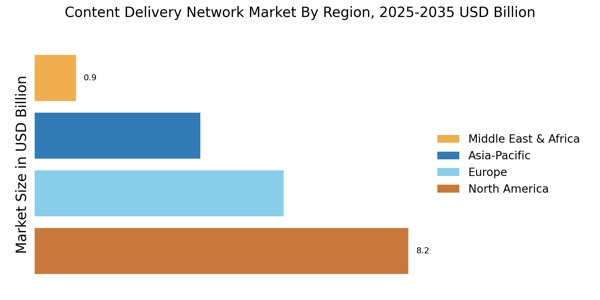
Regional Insights

North America : Digital Innovation Leader

North America is the largest market for Content Delivery Networks (CDN), holding approximately 45% of the global market share. The region's growth is driven by increasing internet penetration, the rise of e-commerce, and the demand for high-quality streaming services. Regulatory support for digital infrastructure and data privacy laws further catalyze market expansion, making it a hub for technological advancements. The United States is the leading country in this region, hosting major CDN providers like Akamai Technologies, Amazon Web Services, and Cloudflare. The competitive landscape is characterized by rapid innovation and strategic partnerships among key players. The presence of advanced data centers and a robust internet backbone enhances service delivery, positioning North America as a frontrunner in the CDN market.

Europe : Emerging Digital Ecosystem

Europe is witnessing significant growth in the Content Delivery Network Market, accounting for approximately 30% of the global share. The region's demand is fueled by the increasing consumption of digital content, regulatory frameworks promoting data protection, and the expansion of cloud services. Countries are investing in digital infrastructure to support the growing online economy, which is expected to further boost CDN adoption. Leading countries in Europe include the United Kingdom, Germany, and France, where major players like Microsoft Azure and Fastly are establishing a strong presence. The competitive landscape is evolving, with local providers emerging alongside global giants. The region's focus on sustainability and compliance with GDPR regulations is shaping the CDN offerings, ensuring that services are both efficient and secure.

Asia-Pacific : Rapidly Growing Market

Asia-Pacific is rapidly emerging as a key player in the Content Delivery Network Market, holding around 20% of the global market share. The region's growth is driven by increasing internet users, mobile penetration, and the rise of video streaming services. Governments are also investing in digital infrastructure, which is expected to enhance CDN capabilities and accessibility across diverse markets. Countries like China, India, and Japan are leading the charge, with a mix of local and international CDN providers competing for market share. The competitive landscape is marked by innovation and the introduction of localized services to cater to diverse consumer needs. As the region continues to embrace digital transformation, the demand for CDN solutions is anticipated to grow significantly, driven by both enterprise and consumer segments.

Middle East and Africa : Emerging Digital Frontier

The Middle East and Africa region is gradually emerging in the Content Delivery Network Market, currently holding about 5% of the global share. The growth is primarily driven by increasing internet penetration, mobile device usage, and the demand for high-quality content delivery. Governments are focusing on enhancing digital infrastructure, which is expected to catalyze CDN adoption across various sectors, including e-commerce and entertainment. Leading countries in this region include South Africa, the UAE, and Nigeria, where local and international CDN providers are establishing their presence. The competitive landscape is characterized by a mix of established players and new entrants, all vying to capture the growing demand. As the region continues to develop its digital economy, the CDN market is poised for significant growth, supported by favorable regulatory environments and investment in technology.

Content Delivery Network Market Regional Image

Key Players and Competitive Insights

The Content Delivery Network Market (CDN) market is currently characterized by a dynamic competitive landscape, driven by the increasing demand for high-speed content delivery and the proliferation of digital media. Leading content delivery network providers are strengthening global infrastructure to meet rising bandwidth requirements. The competitive landscape features major content delivery network companies delivering scalable services to enterprises. Collaboration among content delivery providers is accelerating performance innovation. Each content delivery network CDN provider differentiates through performance optimization, security, and global reach.  
Key players such as Akamai Technologies (US), Amazon Web Services (US), and Cloudflare (US) are at the forefront, each adopting distinct strategies to enhance their market positioning. Akamai Technologies (US) focuses on innovation through continuous investment in its security solutions, while Amazon Web Services (US) leverages its extensive cloud infrastructure to offer integrated CDN services. Cloudflare (US), on the other hand, emphasizes its commitment to performance and security, appealing to a diverse clientele ranging from small businesses to large enterprises. Collectively, these strategies not only enhance their competitive edge but also contribute to a rapidly evolving market environment.In terms of business tactics, companies are increasingly localizing their operations to better serve regional markets, optimizing supply chains to ensure efficiency and reliability. The CDN market appears moderately fragmented, with a mix of established players and emerging startups. This structure allows for a competitive interplay where larger firms can leverage their resources while smaller entities innovate rapidly, creating a vibrant ecosystem that fosters growth and adaptation.
In August Akamai Technologies (US) announced a strategic partnership with a leading cybersecurity firm to enhance its CDN security offerings. This collaboration is poised to fortify Akamai's position in the market by addressing the growing concerns around data breaches and cyber threats, thereby appealing to enterprises seeking robust security measures alongside content delivery.
In September Amazon Web Services (US) unveiled a new suite of tools aimed at optimizing CDN performance for streaming services. This initiative is significant as it not only enhances the user experience but also positions AWS as a leader in the streaming CDN segment, catering to the increasing demand for high-quality video content delivery.
In July Cloudflare (US) launched a new edge computing platform that integrates seamlessly with its CDN services. This move is strategically important as it allows Cloudflare to offer enhanced processing capabilities at the edge, reducing latency and improving performance for its clients. Such innovations are likely to attract more businesses looking for comprehensive solutions that combine CDN and edge computing.
As of October the competitive trends in the CDN market are increasingly defined by digitalization, sustainability, and the integration of artificial intelligence. Strategic alliances are becoming more prevalent, as companies recognize the value of collaboration in enhancing service offerings and expanding market reach. Looking ahead, it is anticipated that competitive differentiation will increasingly pivot from traditional price-based strategies to a focus on innovation, technological advancements, and the reliability of supply chains. This shift underscores the necessity for companies to adapt and evolve in a landscape that is rapidly changing.

Key Companies in the Content Delivery Network Market include

Industry Developments

  • Q2 2024: Vultr launched Vultr CDN, that pushes content closer to the edge without compromising security. In February 2024, Vultr announced the launch of Vultr CDN, a new content delivery network service built on its global infrastructure, enabling global content and media caching for developers and businesses.
  • Q2 2024: Trump Media & Technology Group Corp. announced that after six months of testing on its Web and iOS platforms, the company has finished the research and development phase of its new live TV streaming platform and will begin scaling up its content delivery network ('CDN'). In April 2024, Trump Media & Technology Group Corp. completed R&D for its live TV streaming platform and announced plans to scale up its proprietary content delivery network to support the new service.

Future Outlook

Content Delivery Network Market Future Outlook

The Content Delivery Network Market is projected to grow at a 17.67% CAGR from 2025 to 2035, driven by increasing demand for high-speed content delivery and cloud services.

New opportunities lie in:

  • Expansion into edge computing solutions for enhanced performance. Development of AI-driven analytics tools for content optimization. Partnerships with e-commerce platforms to improve delivery efficiency.

By 2035, the market is expected to be robust, driven by technological advancements and strategic partnerships.

Market Segmentation

Content Delivery Network Market Type Outlook

  • Standard Content Delivery Network
  • Video Content Delivery Network

Content Delivery Network Market Solution Outlook

  • Media Delivery
  • Web Performance Optimization
  • Cloud Security

Content Delivery Network Market Application Outlook

  • OTT Streaming
  • Network Optimization
  • Website & API Management
  • Analytics & Performance Monitoring

Report Scope

MARKET SIZE 2024 18.26(USD Billion)
MARKET SIZE 2025 21.49(USD Billion)
MARKET SIZE 2035 109.37(USD Billion)
COMPOUND ANNUAL GROWTH RATE (CAGR) 17.67% (2025 - 2035)
REPORT COVERAGE Revenue Forecast, Competitive Landscape, Growth Factors, and Trends
BASE YEAR 2024
Market Forecast Period 2025 - 2035
Historical Data 2019 - 2024
Market Forecast Units USD Billion
Key Companies Profiled Akamai Technologies (US), Amazon Web Services (US), Cloudflare (US), Microsoft Azure (US), Fastly (US), Limelight Networks (US), StackPath (US), CDN77 (US), KeyCDN (US)
Segments Covered Type, Solution, Application, Region
Key Market Opportunities Integration of edge computing enhances performance and scalability in the Content Delivery Network Market.
Key Market Dynamics Rising demand for low-latency content delivery drives technological advancements and competitive consolidation in the Content Delivery Network market.
Countries Covered North America, Europe, APAC, South America, MEA

Market Highlights

Author
Author Profile
Aarti Dhapte LinkedIn
AVP - Research

A consulting professional focused on helping businesses navigate complex markets through structured research and strategic insights. I partner with clients to solve high-impact business problems across market entry strategy, competitive intelligence, and opportunity assessment. Over the course of my experience, I have led and contributed to 100+ market research and consulting engagements, delivering insights across multiple industries and geographies, and supporting strategic decisions linked to $500M+ market opportunities. My core expertise lies in building robust market sizing, forecasting, and commercial models (top-down and bottom-up), alongside deep-dive competitive and industry analysis. I have played a key role in shaping go-to-market strategies, investment cases, and growth roadmaps, enabling clients to make confident, data-backed decisions in dynamic markets.

Leave a Comment

FAQs

What is the projected market valuation of the content delivery network market by 2035?

<p>The content delivery network market is projected to reach a valuation of 50.0 USD Billion by 2035.</p>

What was the overall market valuation of the content delivery network market in 2024?

<p>In 2024, the overall market valuation of the content delivery network market was 25.0 USD Billion.</p>

What is the expected CAGR for the content delivery network market during the forecast period 2025 - 2035?

<p>The expected CAGR for the content delivery network market during the forecast period 2025 - 2035 is 6.5%.</p>

Which application segment is expected to show significant growth in the content delivery network market?

<p>The video streaming application segment is expected to grow from 8.0 to 16.0 USD Billion by 2035.</p>

What are the key players in the content delivery network market?

<p>Key players in the content delivery network market include Akamai Technologies, Cloudflare, Amazon Web Services, and Microsoft Azure.</p>

How does the cloud-based deployment type compare to others in the content delivery network market?

<p>The cloud-based deployment type is projected to grow from 10.0 to 20.0 USD Billion by 2035, indicating strong demand.</p>

What is the expected growth for the managed services segment in the content delivery network market?

<p>The managed services segment is anticipated to expand from 10.0 to 20.0 USD Billion by 2035.</p>

Which end-use sector is projected to have the highest valuation in the content delivery network market?

<p>The media and entertainment sector is projected to grow from 8.0 to 16.0 USD Billion by 2035.</p>

What is the anticipated growth for the private network type in the content delivery network market?

<p>The private network type is expected to grow from 7.5 to 15.0 USD Billion by 2035.</p>

How does the gaming application segment perform in the content delivery network market?

<p>The gaming application segment is projected to grow from 4.0 to 8.0 USD Billion by 2035, reflecting increasing demand.</p>

Research Approach

Secondary Research

The secondary research process involved comprehensive analysis of regulatory telecommunications databases, internet infrastructure publications, cloud computing journals, and authoritative digital economy organizations. Key sources included the International Telecommunication Union (ITU), Federal Communications Commission (FCC), European Commission Digital Economy Reports, Ofcom (UK Office of Communications), Internet Engineering Task Force (IETF), Streaming Video Technology Alliance, CDN Alliance, GSMA Intelligence, Asia-Pacific Telecommunity (APT), Organisation for Economic Co-operation and Development (OECD) Digital Economy Outlook, World Economic Forum Global Internet Access Reports, Cisco Visual Networking Index (VNI), Sandvine Global Internet Phenomena Report, World Bank Digital Development Indicators, National Institute of Standards and Technology (NIST) Cloud Computing Standards, IEEE Xplore Digital Library, ACM Digital Library, and national telecom regulator reports from key markets (India TRAI, China MIIT, Brazil Anatel).

These sources were used to collect bandwidth consumption statistics, regulatory compliance data, network infrastructure deployments, pricing benchmarks, and industry adoption patterns for video streaming, web acceleration, cloud security, and edge computing solutions.

Primary Research

In the primary research process, qualitative and quantitative insights specific to content delivery infrastructure were obtained by interviewing supply-side and demand-side stakeholders. The supply-side sources consisted of CEOs, CTOs, VPs of Network Infrastructure, Chief Product Officers, and Heads of Edge Engineering from pure-play CDN providers, hyperscale cloud CDN operators, telecommunications carriers with CDN offerings, and video streaming infrastructure companies. Demand-side sources included Chief Digital Officers, VP of Engineering, Heads of Streaming Operations, and Procurement Leads from media and entertainment conglomerates, OTT platforms, enterprise e-commerce retailers, online gaming publishers, broadcasters, and enterprise IT organizations that were implementing CDN services. The primary research validated market segmentation between video and non-video content categories, confirmed the timeline for edge computing integration, and collected insights on pricing models (per-GB, per-request, and committed-use), multi-cloud CDN strategies, and latency optimization requirements.

Primary Respondent Breakdown:

By Designation: C-level Primaries (32%), Director Level (35%), Others (33%)

By Region: North America (38%), Europe (25%), Asia-Pacific (32%), Rest of World (5%)

Market Size Estimation

Revenue mapping and data traffic volume analysis were employed to determine the global market valuation. The methodology comprised the following:

Identification of over 40 important CDN providers in North America, Europe, Asia-Pacific, and Latin America, including pure-play CDNs, cloud hyperscalers (AWS, Azure, GCP), telecommunications CDNs, and peer-to-peer CDNs

Product mapping is conducted across video CDN and non-video CDN varieties, with additional segmentation into cloud security solutions, web performance optimization, and media delivery.

Application-level segmentation encompasses network optimization, OTT streaming, website and API administration, and analytics and performance monitoring.

An examination of the annual revenues that have been reported and modeled for CDN service portfolios, with a distinction between commercial third-party CDN services and self-built private CDNs.

Coverage of manufacturers and service providers that account for 75-80% of the global market share in 2024

Derive segment-specific valuations for video streaming acceleration, dynamic content delivery, and edge security services through extrapolation using bottom-up (data transfer volume × average selling price by country/region) and top-down (public company revenue reporting validation, cloud provider segment disclosures) approaches.

Download Free Sample

Kindly complete the form below to receive a free sample of this Report

Compare Licence

×
Features License Type
Single User Multiuser License Enterprise User
Price $4,950 $5,950 $7,250
Maximum User Access Limit 1 User Upto 10 Users Unrestricted Access Throughout the Organization
Free Customization
Direct Access to Analyst
Deliverable Format
Platform Access
Discount on Next Purchase 10% 15% 15%
Printable Versions