Request Free Sample ×

Kindly complete the form below to receive a free sample of this Report

* Please use a valid business email

Leading companies partner with us for data-driven Insights

clients tt-cursor
Hero Background
English
Chinese
French
Japanese
Korean
German
Spanish

Q Fever Market Analysis

ID: MRFR/Pharma/4044-CR
123 Pages
Vikita Thakur
Last Updated: March 27, 2026

Q fever market information by Type (Acute & Chronic), by Diagnosis (Serology Tests, & Others), and by Treatment (Antibiotics & Surgery) by Region (Asia Pacific, Europe, North America, Latin America, and Middle East &Africa) - Forecast till 2035

Share:
Download PDF ×

We do not share your information with anyone. However, we may send you emails based on your report interest from time to time. You may contact us at any time to opt-out.

Q Fever Market Infographic
Purchase Options

Market Analysis

In-depth Analysis of Q Fever Market Industry Landscape

Coxiella burnetii is the bacterium that causes Q fever, a zoonotic infection mainly transmitted from animals to humans. As we delve into the market dynamics of Q Fever, it's crucial to understand the various factors shaping its landscape. The market for Q fever is influenced by both epidemiological and economic considerations. Q Fever incidence varies worldwide with high livestock farming regions having more cases reported. Notably, Australia has been an important epicenter of Q Fever owing to its large scale sheep and cattle husbandry practices.

One of the primary market drivers is increasing awareness and diagnosis of Q Fever. Increasing healthcare awareness leads to more cases being captured and documented. This has boosted demand for diagnostic tools and testing kits leading to increased growth of the Q fever diagnostics market. Furthermore, governments in partnership with health organizations are investing heavily on public health campaigns which educate communities on preventive measures thus expanding the market even further.

Healthcare infrastructure together with regulatory environment play a pivotal role in shaping the dynamics within the Q Fever market. Regions having strong healthcare systems tend to diagnose and manage Q Fever better than most others might be able to do so effectively as well .This directly affects the sector through influencing adoption of sophisticated diagnostic technologies alongside treatment options available .Regulatory frameworks also influence the development as well as commercialization process associated with products related to Q Fevers thereby informing market trends.

Involvement by pharmaceutical industry represents one other significant aspect of these dynamics in this particular trade. Research and development efforts concerning antimicrobial drugs are ongoing despite absence of any specific therapy for q fever at present.The pharmaceutical industry’s interest in addressing unmet medical needs associated with q fever may have substantial effect on market dynamics.Collaborations between pharmaceutical companies, research institutions, and government bodies can accelerate the development of novel therapeutics for Q Fever.

Economic burden of q fever also shapes Market Dynamics since there involves direct and indirect costs such as on healthcare services, productivity losses on one hand and veterinary interventions on the other hand. As a result, there is a growing emphasis on cost-effective preventive measures, such as vaccination programs for at-risk populations and livestock.

Globalization and international trade play a role in the spread of Q Fever and influence market dynamics. The movement of animals and their products can lead to transmission of the bacterium hence affecting how widely q fever occurs in different areas. This interconnectedness underscores the need for collaborative efforts on a global scale to address the challenges posed by Q Fever.

Emerging technologies and innovations also contribute to the market dynamics of Q Fever. Advances in diagnostic tools such as molecular techniques along with serological assays have increased accuracy and efficiency in diagnosing Q fever. Additionally, ongoing research into vaccine development as well as therapeutic modalities can reshape the market landscape providing new avenues for intervention or control in this direction.


Author
Author Profile
Vikita Thakur
Senior Research Analyst

She holds an experience of about 5+ years in market research and business consulting projects for sectors such as life sciences, medical devices, and healthcare IT. She possesses a robust background in data analysis, market estimation, competitive intelligence, pipeline analysis market trend identification, and consumer behavior insights. Her expertise lies in technical Sales support, client interaction and project management, designing and implementing market research studies, conducting competitive analysis, and synthesizing complex data into actionable recommendations that drive business growth.

Leave a Comment

FAQs

What is the projected market valuation of the Q Fever Market by 2035?

<p>The Q Fever Market is projected to reach a valuation of 5.478 USD Billion by 2035.</p>

What was the market valuation of the Q Fever Market in 2024?

<p>In 2024, the Q Fever Market was valued at 0.76 USD Billion.</p>

What is the expected CAGR for the Q Fever Market during the forecast period 2025 - 2035?

<p>The expected CAGR for the Q Fever Market during the forecast period 2025 - 2035 is 19.67%.</p>

Which companies are key players in the Q Fever Market?

<p>Key players in the Q Fever Market include Sanofi, Merck & Co., Pfizer, and GlaxoSmithKline.</p>

What are the main segments of the Q Fever Market?

<p>The main segments of the Q Fever Market include Type, Diagnosis, Treatment, and End User.</p>

What was the valuation of the Acute segment in 2024?

The Acute segment was valued at 0.456 USD Billion in 2024.

How much is the Serology Tests segment projected to be worth by 2035?

The Serology Tests segment is projected to reach 4.2 USD Billion by 2035.

What is the projected valuation for the Treatment segment by 2035?

The Treatment segment, which includes Antibiotics and Surgery, is expected to grow significantly, with Antibiotics valued at 3.286 USD Billion by 2035.

What is the expected market size for hospitals as an end user by 2035?

The market size for hospitals as an end user is projected to reach 1.5 USD Billion by 2035.

How does the Q Fever Market's growth compare to other infectious disease markets?

The Q Fever Market's growth, with a projected CAGR of 19.67%, suggests a robust expansion compared to many other infectious disease markets.

Market Summary

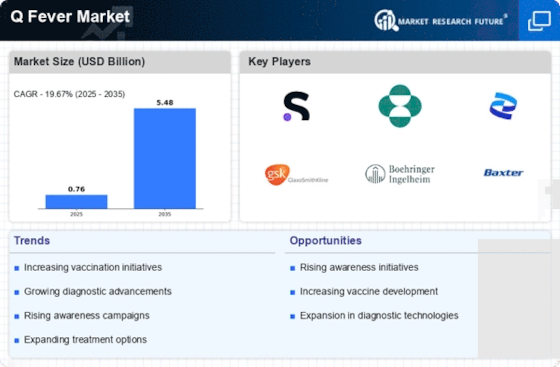
As per Market Research Future analysis, the Q Fever Market Size was estimated at 0.76 USD Billion in 2024. The Q Fever industry is projected to grow from USD 0.9095 Billion in 2025 to USD 5.478 Billion by 2035, exhibiting a compound annual growth rate (CAGR) of 19.67% during the forecast period 2025 - 2035

Key Market Trends & Highlights

The Q Fever Market is experiencing notable growth driven by increased awareness and technological advancements.

  • North America remains the largest market for Q Fever Market, driven by heightened public health initiatives and awareness.
  • The Asia-Pacific region is emerging as the fastest-growing market, reflecting a surge in healthcare investments and preventive measures.
  • Acute Q Fever Market continues to dominate the market, while the chronic segment is witnessing rapid growth due to rising awareness of long-term health impacts.
  • Key market drivers include the rising incidence of Q Fever Market cases and regulatory support for vaccine development, which are shaping the market landscape.

Market Size & Forecast

2024 Market Size 0.76 (USD Billion)
2035 Market Size 5.478 (USD Billion)
CAGR (2025 - 2035) 19.67%
Largest Regional Market Share in 2024 Asia Pacific

Major Players

Sanofi (FR), Merck & Co. (US), Pfizer (US), GlaxoSmithKline (GB), Boehringer Ingelheim (DE), Baxter International (US), Novartis (CH), AstraZeneca (GB), Bristol-Myers Squibb (US)

Market Trends

The Q Fever Market is currently experiencing a notable evolution, driven by a combination of factors including heightened awareness of zoonotic diseases and advancements in diagnostic technologies. This condition, caused by the bacterium Coxiella burnetii, has garnered increased attention from healthcare professionals and researchers alike. The growing incidence of Q Fever Market in various regions has prompted governments and health organizations to implement more rigorous surveillance and control measures. As a result, the market is witnessing a surge in demand for effective diagnostic tools and treatment options, which may lead to further innovations in the field. Moreover, the Q Fever Market appears to be influenced by the rising trend of preventive healthcare. With a focus on early detection and management, stakeholders are likely to invest in research and development initiatives aimed at improving vaccine efficacy and accessibility. This shift towards proactive health measures could potentially reshape the landscape of the Q Fever Market, fostering collaborations between public health entities and private sector players. As awareness continues to grow, the market may evolve to meet the needs of diverse populations, ensuring that effective solutions are available to combat this infectious disease.

Increased Awareness and Education

There is a growing emphasis on educating healthcare professionals and the public about Q Fever Market. This trend is likely to enhance understanding of the disease, its transmission, and prevention strategies, potentially leading to earlier diagnosis and treatment.

Advancements in Diagnostic Technologies

The Q Fever Market is witnessing innovations in diagnostic methods, which may improve the accuracy and speed of identifying infections. Enhanced testing capabilities could facilitate timely interventions and better management of the disease.

Focus on Preventive Healthcare

A shift towards preventive measures is becoming evident, with stakeholders prioritizing vaccination and public health initiatives. This trend may contribute to a reduction in Q Fever Market cases and promote overall community health.

Q Fever Market Market Drivers

Rising Incidence of Q Fever Cases

The increasing incidence of Q Fever Market cases is a notable driver in the Q Fever Market. Recent data indicates that the number of reported cases has been on the rise, particularly in regions with high livestock populations. This trend is likely to spur demand for diagnostic tests and vaccines, as healthcare providers seek to manage and control outbreaks effectively. The heightened awareness surrounding zoonotic diseases, including Q Fever Market, has led to increased funding for research and development in this area. Consequently, the Q Fever Market is expected to experience growth as stakeholders respond to the urgent need for effective prevention and treatment options.

Growing Demand for Veterinary Vaccines

The growing demand for veterinary vaccines is a significant driver in the Q Fever Market. As livestock farming continues to expand, the need for effective vaccination programs to protect animal health becomes increasingly apparent. Vaccines that prevent Q Fever Market in livestock not only safeguard animal populations but also reduce the risk of transmission to humans. This interconnection between animal and human health underscores the importance of veterinary vaccines in controlling Q Fever Market outbreaks. Consequently, the Q Fever Market is likely to see a rise in investments aimed at developing and distributing veterinary vaccines.

Technological Innovations in Diagnostics

Technological innovations in diagnostic methods are transforming the Q Fever Market. The advent of advanced molecular techniques, such as PCR and serological assays, has significantly improved the accuracy and speed of Q Fever Market diagnosis. These innovations enable healthcare providers to identify cases more efficiently, thereby facilitating timely treatment and containment of outbreaks. As diagnostic technologies continue to evolve, the Q Fever Market is likely to witness increased adoption of these methods, leading to enhanced disease management and control strategies.

Regulatory Support for Vaccine Development

Regulatory bodies are increasingly supporting the development of vaccines against Q Fever Market, which serves as a significant driver in the Q Fever Market. Recent initiatives have streamlined the approval processes for vaccine candidates, encouraging pharmaceutical companies to invest in research and development. This regulatory support is crucial, as it not only accelerates the availability of vaccines but also enhances public confidence in vaccination programs. As a result, the Q Fever Market is poised for expansion, with a growing number of vaccine candidates entering clinical trials and potentially reaching the market in the near future.

Increased Investment in Public Health Initiatives

Increased investment in public health initiatives aimed at controlling zoonotic diseases is a critical driver in the Q Fever Market. Governments and non-governmental organizations are allocating resources to enhance surveillance, education, and vaccination programs. This focus on preventive healthcare is essential for reducing the burden of Q Fever Market and other zoonotic diseases. As funding for these initiatives grows, the Q Fever Market is expected to benefit from improved public health infrastructure and increased awareness among healthcare professionals and the general population.

Market Segment Insights

By Type: Acute (Largest) vs. Chronic (Fastest-Growing)

<p>The Q Fever market is primarily divided into two prominent segments: Acute and Chronic. The Acute segment currently holds the largest market share, largely due to its frequent incidence and easily recognizable symptoms. This segment attracts attention from healthcare professionals and patients alike, leading to increased diagnosis and treatment options, which significantly bolster its position in the market.</p>

<p>Q Fever: Acute (Dominant) vs. Chronic (Emerging)</p>

<p>The Acute Q Fever segment is characterized by its rapid onset and noticeable symptoms, primarily following infection with Coxiella burnetii. This segment is often prioritized in medical settings due to its severity and the urgent need for diagnosis and treatment among affected individuals. On the other hand, the Chronic segment, while smaller, is experiencing rapid growth as awareness increases regarding long-term complications of Q Fever. This growth can be attributed to the rising recognition of chronic manifestations, prompting research and innovation in treatment options. As healthcare providers become more attuned to these emerging needs, the Chronic segment is set to become an integral part of the Q Fever market.</p>

By Diagnosis: Serology Tests (Largest) vs. Others (Fastest-Growing)

<p>In the Q Fever Market, the Diagnosis segment is predominantly driven by serology tests, which have captured a significant portion of the market share. These tests are favored for their reliability and effectiveness in diagnosing Q fever, making them the first choice among healthcare professionals. On the other hand, other diagnostic methods are gaining traction, albeit at a slower pace. Their market share is smaller, but they represent an essential part of the landscape, catering to specific needs that serology tests may not fully address.</p>

<p>Serology Tests (Dominant) vs. Others (Emerging)</p>

<p>Serology tests are widely considered the dominant diagnostic tool within the Q Fever Market, primarily due to their established accuracy and efficiency in detecting antibodies against Coxiella burnetii. These tests are well-regarded for their ability to provide definitive results, thereby contributing to timely and effective treatment. Conversely, other diagnostic methods are emerging as notable alternatives, particularly as technological advancements are paving the way for new solutions. These alternatives may include molecular techniques and <a href="https://www.marketresearchfuture.com/reports/rapid-tests-market-67673" target="_blank" title="rapid tests">rapid tests</a>, which, while not yet widespread, are expected to grow in popularity due to their potential for quicker results and increased accessibility, making them essential in the evolving landscape of Q fever diagnostics.</p>

By Treatment: Antibiotics (Largest) vs. Surgery (Fastest-Growing)

<p>In the Q Fever market, the treatment segment is primarily dominated by antibiotics, which have proven to be the most widely utilized and effective form of treatment for this infectious disease. Antibiotics hold a substantial share within the treatment market due to their efficacy in managing the acute phase of Q Fever, ensuring high recovery rates among patients. In contrast, surgery, while less commonly employed, represents a significant fast-growing segment. This growth can be attributed to the increasing recognition of surgical interventions in chronic cases or where complications arise, paving the way for surgical methods to gain traction among healthcare professionals.</p>

<p>Antibiotics: Market Leader vs. Surgery: Emerging Intervention</p>

<p>Antibiotics remain the dominant treatment option in the Q Fever market due to their strong track record of effectively managing acute infections. Their broad-spectrum activity allows for the treatment of various strains, making them the go-to solution for practitioners. On the other hand, surgery is an emerging intervention that has gained ground in treating severe complications or chronic manifestations of Q Fever. With advancements in surgical techniques and improved patient outcomes, this segment is witnessing a rapid evolution. Surgeons and healthcare systems are increasingly embracing surgical solutions, recognizing their importance in thorough patient care, thus giving rise to a dual approach that enhances treatment outcomes.</p>

By End User: Patients (Largest) vs. Hospitals (Fastest-Growing)

<p>The Q Fever market is segmented by end users into Patients, Hospitals, and Others. Patients represent the largest segment, driven by the prevalence of Q Fever infections that necessitate medical attention and therapies. Hospital settings cater to the majority of critical care requirements associated with Q Fever, thus holding a substantial share within the market dynamics. Meanwhile, Others include various institutions and organizations involved in the management and research of Q Fever, contributing to the overall landscape but to a lesser extent than the two primary segments.</p>

<p>Patients (Dominant) vs. Hospitals (Emerging)</p>

<p>The patient segment is dominant in the Q Fever market due to the direct impact of the disease on individuals, leading to substantial demand for diagnosis and treatment. This segment is characterized by a higher frequency of Q Fever cases that require immediate medical attention, thus driving healthcare spending. Hospitals, on the other hand, represent an emerging segment, witnessing rapid growth as healthcare providers enhance their capabilities to manage infectious diseases. Facilities are increasingly adopting advanced diagnostic tools and treatment protocols, signifying a strategic shift towards better patient outcomes and expanded care for Q Fever.</p>

Get more detailed insights about Q Fever Market Research Report - Forecast till 2035

Regional Insights

North America : Leading Market for Q Fever Market

North America is the largest market for Q Fever Market, accounting for approximately 45% of the global market share. The region's growth is driven by increasing awareness of Q Fever Market, advancements in vaccine development, and supportive regulatory frameworks. The U.S. and Canada are the primary contributors, with a rising demand for effective vaccination programs and public health initiatives aimed at controlling outbreaks. The competitive landscape in North America is robust, featuring key players such as Merck & Co., Pfizer, and Sanofi. These companies are actively involved in research and development to enhance vaccine efficacy and accessibility. The presence of established healthcare infrastructure and government support further strengthens the market, making it a focal point for Q Fever Market management and prevention efforts.

Europe : Emerging Market Dynamics

Europe is witnessing significant growth in the Q Fever Market, holding approximately 30% of the global share. The region's growth is fueled by increasing incidences of Q Fever Market and heightened awareness among healthcare professionals. Countries like France and Germany are leading the market, supported by stringent regulations and initiatives aimed at improving public health responses to infectious diseases. The competitive landscape in Europe includes major players such as GlaxoSmithKline and Boehringer Ingelheim, who are investing in innovative vaccine solutions. The European Medicines Agency plays a crucial role in regulating vaccine approvals, ensuring safety and efficacy. Collaborative efforts among countries to enhance surveillance and response strategies are also contributing to market growth, making Europe a key player in the global Q Fever Market landscape.

Asia-Pacific : Rapidly Expanding Market

The Asia-Pacific region is emerging as a significant player in the Q Fever Market, accounting for about 20% of the global share. The growth is driven by increasing livestock farming, which raises the risk of Q Fever Market outbreaks. Countries like Australia and New Zealand are at the forefront, implementing stringent biosecurity measures and vaccination programs to combat the disease. The rising awareness of zoonotic diseases is also propelling market demand. Key players in the Asia-Pacific market include Baxter International and Novartis, who are focusing on developing region-specific vaccines. The competitive landscape is evolving, with local manufacturers also entering the market to meet the growing demand. Government initiatives aimed at enhancing public health infrastructure and disease management are further supporting market growth in this region.

Middle East and Africa : Emerging Health Challenges

The Middle East and Africa region is gradually recognizing the importance of addressing Q Fever Market, holding about 5% of the global market share. The growth is primarily driven by increasing livestock farming and the need for effective disease management strategies. Countries like South Africa and Egypt are focusing on improving public health responses and vaccination efforts to mitigate the risks associated with Q Fever Market outbreaks. The competitive landscape is still developing, with a few key players like AstraZeneca and Bristol-Myers Squibb exploring opportunities in the region. Local governments are beginning to implement regulations and health initiatives aimed at raising awareness and improving vaccination coverage. Collaborative efforts with international organizations are also crucial in addressing the challenges posed by Q Fever Market in this region.

Key Players and Competitive Insights

The Q Fever Market is characterized by a complex interplay of competitive dynamics, driven by increasing awareness of zoonotic diseases and the need for effective vaccination strategies. Key players such as Sanofi (FR), Merck & Co. (US), and Pfizer (US) are strategically positioned to leverage their extensive research capabilities and established distribution networks. Sanofi (FR) focuses on innovation in vaccine development, while Merck & Co. (US) emphasizes partnerships with health organizations to enhance vaccine accessibility. Pfizer (US) is actively pursuing digital transformation initiatives to streamline operations and improve patient engagement, collectively shaping a competitive environment that prioritizes innovation and accessibility.

The market structure appears moderately fragmented, with several players vying for market share through localized manufacturing and optimized supply chains. Companies are increasingly localizing production to mitigate supply chain disruptions and enhance responsiveness to regional demands. This strategy not only reduces costs but also aligns with the growing emphasis on sustainability and local economic support, thereby influencing the competitive landscape.

In August 2025, Merck & Co. (US) announced a strategic partnership with a leading veterinary health organization to enhance the distribution of its Q fever vaccine in rural areas. This collaboration is significant as it aims to improve vaccine access in underserved regions, potentially increasing market penetration and addressing public health concerns related to zoonotic diseases. The partnership underscores Merck's commitment to expanding its reach and ensuring that vulnerable populations receive necessary vaccinations.

In September 2025, Sanofi (FR) launched a new digital platform aimed at educating healthcare providers about Q fever and its prevention. This initiative is crucial as it not only positions Sanofi as a thought leader in the field but also enhances its engagement with healthcare professionals. By providing comprehensive resources and training, Sanofi is likely to strengthen its market position and foster loyalty among healthcare providers, which could translate into increased vaccine uptake.

In October 2025, Pfizer (US) unveiled a new AI-driven analytics tool designed to optimize vaccine distribution logistics. This technological advancement is indicative of the growing trend towards digitalization in the pharmaceutical sector. By leveraging AI, Pfizer aims to enhance supply chain efficiency and ensure timely delivery of vaccines, which is essential in maintaining competitive advantage in a market that increasingly values reliability and responsiveness.

As of October 2025, current competitive trends in the Q Fever Market are heavily influenced by digitalization, sustainability, and the integration of advanced technologies such as AI. Strategic alliances are becoming more prevalent, as companies recognize the value of collaboration in addressing complex public health challenges. Looking ahead, competitive differentiation is likely to evolve from traditional price-based strategies to a focus on innovation, technological advancements, and supply chain reliability, reflecting a broader shift in the pharmaceutical landscape.

Key Companies in the Q Fever Market include

Industry Developments

Future Outlook

Q Fever Market Future Outlook

The Q Fever Market is projected to grow at a 19.67% CAGR from 2025 to 2035, driven by increasing awareness, advancements in diagnostics, and rising healthcare investments.

New opportunities lie in:

  • Development of targeted vaccines for livestock to reduce transmission risk.
  • Expansion of telemedicine platforms for remote Q Fever Market consultations.
  • Investment in rapid diagnostic kits for early detection in endemic regions.

By 2035, the Q Fever Market is expected to achieve substantial growth and innovation.

Market Segmentation

Q Fever Market Type Outlook

  • Acute
  • Chronic

Q Fever Market End User Outlook

  • Patients
  • Hospitals
  • Others

Q Fever Market Diagnosis Outlook

  • Serology Tests
  • Others

Q Fever Market Treatment Outlook

  • Antibiotics
  • Surgery

Report Scope

MARKET SIZE 2024 0.76(USD Billion)
MARKET SIZE 2025 0.9095(USD Billion)
MARKET SIZE 2035 5.478(USD Billion)
COMPOUND ANNUAL GROWTH RATE (CAGR) 19.67% (2025 - 2035)
REPORT COVERAGE Revenue Forecast, Competitive Landscape, Growth Factors, and Trends
BASE YEAR 2024
Market Forecast Period 2025 - 2035
Historical Data 2019 - 2024
Market Forecast Units USD Billion
Key Companies Profiled Sanofi (FR), Merck & Co. (US), Pfizer (US), GlaxoSmithKline (GB), Boehringer Ingelheim (DE), Baxter International (US), Novartis (CH), AstraZeneca (GB), Bristol-Myers Squibb (US)
Segments Covered Type, Diagnosis, Treatment, Region
Key Market Opportunities Advancements in diagnostic technologies enhance early detection and treatment options in the Q Fever Market.
Key Market Dynamics Rising awareness of Q Fever drives demand for effective diagnostics and treatment options amid evolving regulatory frameworks.
Countries Covered North America, Europe, APAC, South America, MEA

FAQs

What is the projected market valuation of the Q Fever Market by 2035?

<p>The Q Fever Market is projected to reach a valuation of 5.478 USD Billion by 2035.</p>

What was the market valuation of the Q Fever Market in 2024?

<p>In 2024, the Q Fever Market was valued at 0.76 USD Billion.</p>

What is the expected CAGR for the Q Fever Market during the forecast period 2025 - 2035?

<p>The expected CAGR for the Q Fever Market during the forecast period 2025 - 2035 is 19.67%.</p>

Which companies are key players in the Q Fever Market?

<p>Key players in the Q Fever Market include Sanofi, Merck & Co., Pfizer, and GlaxoSmithKline.</p>

What are the main segments of the Q Fever Market?

<p>The main segments of the Q Fever Market include Type, Diagnosis, Treatment, and End User.</p>

What was the valuation of the Acute segment in 2024?

The Acute segment was valued at 0.456 USD Billion in 2024.

How much is the Serology Tests segment projected to be worth by 2035?

The Serology Tests segment is projected to reach 4.2 USD Billion by 2035.

What is the projected valuation for the Treatment segment by 2035?

The Treatment segment, which includes Antibiotics and Surgery, is expected to grow significantly, with Antibiotics valued at 3.286 USD Billion by 2035.

What is the expected market size for hospitals as an end user by 2035?

The market size for hospitals as an end user is projected to reach 1.5 USD Billion by 2035.

How does the Q Fever Market's growth compare to other infectious disease markets?

The Q Fever Market's growth, with a projected CAGR of 19.67%, suggests a robust expansion compared to many other infectious disease markets.

  1. SECTION I: EXECUTIVE SUMMARY AND KEY HIGHLIGHTS
    1. | 1.1 EXECUTIVE SUMMARY
    2. | | 1.1.1 Market Overview
    3. | | 1.1.2 Key Findings
    4. | | 1.1.3 Market Segmentation
    5. | | 1.1.4 Competitive Landscape
    6. | | 1.1.5 Challenges and Opportunities
    7. | | 1.1.6 Future Outlook
  2. SECTION II: SCOPING, METHODOLOGY AND MARKET STRUCTURE
    1. | 2.1 MARKET INTRODUCTION
    2. | | 2.1.1 Definition
    3. | | 2.1.2 Scope of the study
    4. | | | 2.1.2.1 Research Objective
    5. | | | 2.1.2.2 Assumption
    6. | | | 2.1.2.3 Limitations
    7. | 2.2 RESEARCH METHODOLOGY
    8. | | 2.2.1 Overview
    9. | | 2.2.2 Data Mining
    10. | | 2.2.3 Secondary Research
    11. | | 2.2.4 Primary Research
    12. | | | 2.2.4.1 Primary Interviews and Information Gathering Process
    13. | | | 2.2.4.2 Breakdown of Primary Respondents
    14. | | 2.2.5 Forecasting Model
    15. | | 2.2.6 Market Size Estimation
    16. | | | 2.2.6.1 Bottom-Up Approach
    17. | | | 2.2.6.2 Top-Down Approach
    18. | | 2.2.7 Data Triangulation
    19. | | 2.2.8 Validation
  3. SECTION III: QUALITATIVE ANALYSIS
    1. | 3.1 MARKET DYNAMICS
    2. | | 3.1.1 Overview
    3. | | 3.1.2 Drivers
    4. | | 3.1.3 Restraints
    5. | | 3.1.4 Opportunities
    6. | 3.2 MARKET FACTOR ANALYSIS
    7. | | 3.2.1 Value chain Analysis
    8. | | 3.2.2 Porter's Five Forces Analysis
    9. | | | 3.2.2.1 Bargaining Power of Suppliers
    10. | | | 3.2.2.2 Bargaining Power of Buyers
    11. | | | 3.2.2.3 Threat of New Entrants
    12. | | | 3.2.2.4 Threat of Substitutes
    13. | | | 3.2.2.5 Intensity of Rivalry
    14. | | 3.2.3 COVID-19 Impact Analysis
    15. | | | 3.2.3.1 Market Impact Analysis
    16. | | | 3.2.3.2 Regional Impact
    17. | | | 3.2.3.3 Opportunity and Threat Analysis
  4. SECTION IV: QUANTITATIVE ANALYSIS
    1. | 4.1 Healthcare, BY Type (USD Billion)
    2. | | 4.1.1 Acute
    3. | | 4.1.2 Chronic
    4. | 4.2 Healthcare, BY Diagnosis (USD Billion)
    5. | | 4.2.1 Serology Tests
    6. | | 4.2.2 Others
    7. | 4.3 Healthcare, BY Treatment (USD Billion)
    8. | | 4.3.1 Antibiotics
    9. | | 4.3.2 Surgery
    10. | 4.4 Healthcare, BY End User (USD Billion)
    11. | | 4.4.1 Patients
    12. | | 4.4.2 Hospitals
    13. | | 4.4.3 Others
    14. | 4.5 Healthcare, BY Region (USD Billion)
    15. | | 4.5.1 North America
    16. | | | 4.5.1.1 US
    17. | | | 4.5.1.2 Canada
    18. | | 4.5.2 Europe
    19. | | | 4.5.2.1 Germany
    20. | | | 4.5.2.2 UK
    21. | | | 4.5.2.3 France
    22. | | | 4.5.2.4 Russia
    23. | | | 4.5.2.5 Italy
    24. | | | 4.5.2.6 Spain
    25. | | | 4.5.2.7 Rest of Europe
    26. | | 4.5.3 APAC
    27. | | | 4.5.3.1 China
    28. | | | 4.5.3.2 India
    29. | | | 4.5.3.3 Japan
    30. | | | 4.5.3.4 South Korea
    31. | | | 4.5.3.5 Malaysia
    32. | | | 4.5.3.6 Thailand
    33. | | | 4.5.3.7 Indonesia
    34. | | | 4.5.3.8 Rest of APAC
    35. | | 4.5.4 South America
    36. | | | 4.5.4.1 Brazil
    37. | | | 4.5.4.2 Mexico
    38. | | | 4.5.4.3 Argentina
    39. | | | 4.5.4.4 Rest of South America
    40. | | 4.5.5 MEA
    41. | | | 4.5.5.1 GCC Countries
    42. | | | 4.5.5.2 South Africa
    43. | | | 4.5.5.3 Rest of MEA
  5. SECTION V: COMPETITIVE ANALYSIS
    1. | 5.1 Competitive Landscape
    2. | | 5.1.1 Overview
    3. | | 5.1.2 Competitive Analysis
    4. | | 5.1.3 Market share Analysis
    5. | | 5.1.4 Major Growth Strategy in the Healthcare
    6. | | 5.1.5 Competitive Benchmarking
    7. | | 5.1.6 Leading Players in Terms of Number of Developments in the Healthcare
    8. | | 5.1.7 Key developments and growth strategies
    9. | | | 5.1.7.1 New Product Launch/Service Deployment
    10. | | | 5.1.7.2 Merger & Acquisitions
    11. | | | 5.1.7.3 Joint Ventures
    12. | | 5.1.8 Major Players Financial Matrix
    13. | | | 5.1.8.1 Sales and Operating Income
    14. | | | 5.1.8.2 Major Players R&D Expenditure. 2023
    15. | 5.2 Company Profiles
    16. | | 5.2.1 Sanofi (FR)
    17. | | | 5.2.1.1 Financial Overview
    18. | | | 5.2.1.2 Products Offered
    19. | | | 5.2.1.3 Key Developments
    20. | | | 5.2.1.4 SWOT Analysis
    21. | | | 5.2.1.5 Key Strategies
    22. | | 5.2.2 Merck & Co. (US)
    23. | | | 5.2.2.1 Financial Overview
    24. | | | 5.2.2.2 Products Offered
    25. | | | 5.2.2.3 Key Developments
    26. | | | 5.2.2.4 SWOT Analysis
    27. | | | 5.2.2.5 Key Strategies
    28. | | 5.2.3 Pfizer (US)
    29. | | | 5.2.3.1 Financial Overview
    30. | | | 5.2.3.2 Products Offered
    31. | | | 5.2.3.3 Key Developments
    32. | | | 5.2.3.4 SWOT Analysis
    33. | | | 5.2.3.5 Key Strategies
    34. | | 5.2.4 GlaxoSmithKline (GB)
    35. | | | 5.2.4.1 Financial Overview
    36. | | | 5.2.4.2 Products Offered
    37. | | | 5.2.4.3 Key Developments
    38. | | | 5.2.4.4 SWOT Analysis
    39. | | | 5.2.4.5 Key Strategies
    40. | | 5.2.5 Boehringer Ingelheim (DE)
    41. | | | 5.2.5.1 Financial Overview
    42. | | | 5.2.5.2 Products Offered
    43. | | | 5.2.5.3 Key Developments
    44. | | | 5.2.5.4 SWOT Analysis
    45. | | | 5.2.5.5 Key Strategies
    46. | | 5.2.6 Baxter International (US)
    47. | | | 5.2.6.1 Financial Overview
    48. | | | 5.2.6.2 Products Offered
    49. | | | 5.2.6.3 Key Developments
    50. | | | 5.2.6.4 SWOT Analysis
    51. | | | 5.2.6.5 Key Strategies
    52. | | 5.2.7 Novartis (CH)
    53. | | | 5.2.7.1 Financial Overview
    54. | | | 5.2.7.2 Products Offered
    55. | | | 5.2.7.3 Key Developments
    56. | | | 5.2.7.4 SWOT Analysis
    57. | | | 5.2.7.5 Key Strategies
    58. | | 5.2.8 AstraZeneca (GB)
    59. | | | 5.2.8.1 Financial Overview
    60. | | | 5.2.8.2 Products Offered
    61. | | | 5.2.8.3 Key Developments
    62. | | | 5.2.8.4 SWOT Analysis
    63. | | | 5.2.8.5 Key Strategies
    64. | | 5.2.9 Bristol-Myers Squibb (US)
    65. | | | 5.2.9.1 Financial Overview
    66. | | | 5.2.9.2 Products Offered
    67. | | | 5.2.9.3 Key Developments
    68. | | | 5.2.9.4 SWOT Analysis
    69. | | | 5.2.9.5 Key Strategies
    70. | 5.3 Appendix
    71. | | 5.3.1 References
    72. | | 5.3.2 Related Reports
  6. LIST OF FIGURES
    1. | 6.1 MARKET SYNOPSIS
    2. | 6.2 NORTH AMERICA MARKET ANALYSIS
    3. | 6.3 US MARKET ANALYSIS BY TYPE
    4. | 6.4 US MARKET ANALYSIS BY DIAGNOSIS
    5. | 6.5 US MARKET ANALYSIS BY TREATMENT
    6. | 6.6 US MARKET ANALYSIS BY END USER
    7. | 6.7 CANADA MARKET ANALYSIS BY TYPE
    8. | 6.8 CANADA MARKET ANALYSIS BY DIAGNOSIS
    9. | 6.9 CANADA MARKET ANALYSIS BY TREATMENT
    10. | 6.10 CANADA MARKET ANALYSIS BY END USER
    11. | 6.11 EUROPE MARKET ANALYSIS
    12. | 6.12 GERMANY MARKET ANALYSIS BY TYPE
    13. | 6.13 GERMANY MARKET ANALYSIS BY DIAGNOSIS
    14. | 6.14 GERMANY MARKET ANALYSIS BY TREATMENT
    15. | 6.15 GERMANY MARKET ANALYSIS BY END USER
    16. | 6.16 UK MARKET ANALYSIS BY TYPE
    17. | 6.17 UK MARKET ANALYSIS BY DIAGNOSIS
    18. | 6.18 UK MARKET ANALYSIS BY TREATMENT
    19. | 6.19 UK MARKET ANALYSIS BY END USER
    20. | 6.20 FRANCE MARKET ANALYSIS BY TYPE
    21. | 6.21 FRANCE MARKET ANALYSIS BY DIAGNOSIS
    22. | 6.22 FRANCE MARKET ANALYSIS BY TREATMENT
    23. | 6.23 FRANCE MARKET ANALYSIS BY END USER
    24. | 6.24 RUSSIA MARKET ANALYSIS BY TYPE
    25. | 6.25 RUSSIA MARKET ANALYSIS BY DIAGNOSIS
    26. | 6.26 RUSSIA MARKET ANALYSIS BY TREATMENT
    27. | 6.27 RUSSIA MARKET ANALYSIS BY END USER
    28. | 6.28 ITALY MARKET ANALYSIS BY TYPE
    29. | 6.29 ITALY MARKET ANALYSIS BY DIAGNOSIS
    30. | 6.30 ITALY MARKET ANALYSIS BY TREATMENT
    31. | 6.31 ITALY MARKET ANALYSIS BY END USER
    32. | 6.32 SPAIN MARKET ANALYSIS BY TYPE
    33. | 6.33 SPAIN MARKET ANALYSIS BY DIAGNOSIS
    34. | 6.34 SPAIN MARKET ANALYSIS BY TREATMENT
    35. | 6.35 SPAIN MARKET ANALYSIS BY END USER
    36. | 6.36 REST OF EUROPE MARKET ANALYSIS BY TYPE
    37. | 6.37 REST OF EUROPE MARKET ANALYSIS BY DIAGNOSIS
    38. | 6.38 REST OF EUROPE MARKET ANALYSIS BY TREATMENT
    39. | 6.39 REST OF EUROPE MARKET ANALYSIS BY END USER
    40. | 6.40 APAC MARKET ANALYSIS
    41. | 6.41 CHINA MARKET ANALYSIS BY TYPE
    42. | 6.42 CHINA MARKET ANALYSIS BY DIAGNOSIS
    43. | 6.43 CHINA MARKET ANALYSIS BY TREATMENT
    44. | 6.44 CHINA MARKET ANALYSIS BY END USER
    45. | 6.45 INDIA MARKET ANALYSIS BY TYPE
    46. | 6.46 INDIA MARKET ANALYSIS BY DIAGNOSIS
    47. | 6.47 INDIA MARKET ANALYSIS BY TREATMENT
    48. | 6.48 INDIA MARKET ANALYSIS BY END USER
    49. | 6.49 JAPAN MARKET ANALYSIS BY TYPE
    50. | 6.50 JAPAN MARKET ANALYSIS BY DIAGNOSIS
    51. | 6.51 JAPAN MARKET ANALYSIS BY TREATMENT
    52. | 6.52 JAPAN MARKET ANALYSIS BY END USER
    53. | 6.53 SOUTH KOREA MARKET ANALYSIS BY TYPE
    54. | 6.54 SOUTH KOREA MARKET ANALYSIS BY DIAGNOSIS
    55. | 6.55 SOUTH KOREA MARKET ANALYSIS BY TREATMENT
    56. | 6.56 SOUTH KOREA MARKET ANALYSIS BY END USER
    57. | 6.57 MALAYSIA MARKET ANALYSIS BY TYPE
    58. | 6.58 MALAYSIA MARKET ANALYSIS BY DIAGNOSIS
    59. | 6.59 MALAYSIA MARKET ANALYSIS BY TREATMENT
    60. | 6.60 MALAYSIA MARKET ANALYSIS BY END USER
    61. | 6.61 THAILAND MARKET ANALYSIS BY TYPE
    62. | 6.62 THAILAND MARKET ANALYSIS BY DIAGNOSIS
    63. | 6.63 THAILAND MARKET ANALYSIS BY TREATMENT
    64. | 6.64 THAILAND MARKET ANALYSIS BY END USER
    65. | 6.65 INDONESIA MARKET ANALYSIS BY TYPE
    66. | 6.66 INDONESIA MARKET ANALYSIS BY DIAGNOSIS
    67. | 6.67 INDONESIA MARKET ANALYSIS BY TREATMENT
    68. | 6.68 INDONESIA MARKET ANALYSIS BY END USER
    69. | 6.69 REST OF APAC MARKET ANALYSIS BY TYPE
    70. | 6.70 REST OF APAC MARKET ANALYSIS BY DIAGNOSIS
    71. | 6.71 REST OF APAC MARKET ANALYSIS BY TREATMENT
    72. | 6.72 REST OF APAC MARKET ANALYSIS BY END USER
    73. | 6.73 SOUTH AMERICA MARKET ANALYSIS
    74. | 6.74 BRAZIL MARKET ANALYSIS BY TYPE
    75. | 6.75 BRAZIL MARKET ANALYSIS BY DIAGNOSIS
    76. | 6.76 BRAZIL MARKET ANALYSIS BY TREATMENT
    77. | 6.77 BRAZIL MARKET ANALYSIS BY END USER
    78. | 6.78 MEXICO MARKET ANALYSIS BY TYPE
    79. | 6.79 MEXICO MARKET ANALYSIS BY DIAGNOSIS
    80. | 6.80 MEXICO MARKET ANALYSIS BY TREATMENT
    81. | 6.81 MEXICO MARKET ANALYSIS BY END USER
    82. | 6.82 ARGENTINA MARKET ANALYSIS BY TYPE
    83. | 6.83 ARGENTINA MARKET ANALYSIS BY DIAGNOSIS
    84. | 6.84 ARGENTINA MARKET ANALYSIS BY TREATMENT
    85. | 6.85 ARGENTINA MARKET ANALYSIS BY END USER
    86. | 6.86 REST OF SOUTH AMERICA MARKET ANALYSIS BY TYPE
    87. | 6.87 REST OF SOUTH AMERICA MARKET ANALYSIS BY DIAGNOSIS
    88. | 6.88 REST OF SOUTH AMERICA MARKET ANALYSIS BY TREATMENT
    89. | 6.89 REST OF SOUTH AMERICA MARKET ANALYSIS BY END USER
    90. | 6.90 MEA MARKET ANALYSIS
    91. | 6.91 GCC COUNTRIES MARKET ANALYSIS BY TYPE
    92. | 6.92 GCC COUNTRIES MARKET ANALYSIS BY DIAGNOSIS
    93. | 6.93 GCC COUNTRIES MARKET ANALYSIS BY TREATMENT
    94. | 6.94 GCC COUNTRIES MARKET ANALYSIS BY END USER
    95. | 6.95 SOUTH AFRICA MARKET ANALYSIS BY TYPE
    96. | 6.96 SOUTH AFRICA MARKET ANALYSIS BY DIAGNOSIS
    97. | 6.97 SOUTH AFRICA MARKET ANALYSIS BY TREATMENT
    98. | 6.98 SOUTH AFRICA MARKET ANALYSIS BY END USER
    99. | 6.99 REST OF MEA MARKET ANALYSIS BY TYPE
    100. | 6.100 REST OF MEA MARKET ANALYSIS BY DIAGNOSIS
    101. | 6.101 REST OF MEA MARKET ANALYSIS BY TREATMENT
    102. | 6.102 REST OF MEA MARKET ANALYSIS BY END USER
    103. | 6.103 KEY BUYING CRITERIA OF HEALTHCARE
    104. | 6.104 RESEARCH PROCESS OF MRFR
    105. | 6.105 DRO ANALYSIS OF HEALTHCARE
    106. | 6.106 DRIVERS IMPACT ANALYSIS: HEALTHCARE
    107. | 6.107 RESTRAINTS IMPACT ANALYSIS: HEALTHCARE
    108. | 6.108 SUPPLY / VALUE CHAIN: HEALTHCARE
    109. | 6.109 HEALTHCARE, BY TYPE, 2024 (% SHARE)
    110. | 6.110 HEALTHCARE, BY TYPE, 2024 TO 2035 (USD Billion)
    111. | 6.111 HEALTHCARE, BY DIAGNOSIS, 2024 (% SHARE)
    112. | 6.112 HEALTHCARE, BY DIAGNOSIS, 2024 TO 2035 (USD Billion)
    113. | 6.113 HEALTHCARE, BY TREATMENT, 2024 (% SHARE)
    114. | 6.114 HEALTHCARE, BY TREATMENT, 2024 TO 2035 (USD Billion)
    115. | 6.115 HEALTHCARE, BY END USER, 2024 (% SHARE)
    116. | 6.116 HEALTHCARE, BY END USER, 2024 TO 2035 (USD Billion)
    117. | 6.117 BENCHMARKING OF MAJOR COMPETITORS
  7. LIST OF TABLES
    1. | 7.1 LIST OF ASSUMPTIONS
    2. | | 7.1.1
    3. | 7.2 North America MARKET SIZE ESTIMATES; FORECAST
    4. | | 7.2.1 BY TYPE, 2025-2035 (USD Billion)
    5. | | 7.2.2 BY DIAGNOSIS, 2025-2035 (USD Billion)
    6. | | 7.2.3 BY TREATMENT, 2025-2035 (USD Billion)
    7. | | 7.2.4 BY END USER, 2025-2035 (USD Billion)
    8. | 7.3 US MARKET SIZE ESTIMATES; FORECAST
    9. | | 7.3.1 BY TYPE, 2025-2035 (USD Billion)
    10. | | 7.3.2 BY DIAGNOSIS, 2025-2035 (USD Billion)
    11. | | 7.3.3 BY TREATMENT, 2025-2035 (USD Billion)
    12. | | 7.3.4 BY END USER, 2025-2035 (USD Billion)
    13. | 7.4 Canada MARKET SIZE ESTIMATES; FORECAST
    14. | | 7.4.1 BY TYPE, 2025-2035 (USD Billion)
    15. | | 7.4.2 BY DIAGNOSIS, 2025-2035 (USD Billion)
    16. | | 7.4.3 BY TREATMENT, 2025-2035 (USD Billion)
    17. | | 7.4.4 BY END USER, 2025-2035 (USD Billion)
    18. | 7.5 Europe MARKET SIZE ESTIMATES; FORECAST
    19. | | 7.5.1 BY TYPE, 2025-2035 (USD Billion)
    20. | | 7.5.2 BY DIAGNOSIS, 2025-2035 (USD Billion)
    21. | | 7.5.3 BY TREATMENT, 2025-2035 (USD Billion)
    22. | | 7.5.4 BY END USER, 2025-2035 (USD Billion)
    23. | 7.6 Germany MARKET SIZE ESTIMATES; FORECAST
    24. | | 7.6.1 BY TYPE, 2025-2035 (USD Billion)
    25. | | 7.6.2 BY DIAGNOSIS, 2025-2035 (USD Billion)
    26. | | 7.6.3 BY TREATMENT, 2025-2035 (USD Billion)
    27. | | 7.6.4 BY END USER, 2025-2035 (USD Billion)
    28. | 7.7 UK MARKET SIZE ESTIMATES; FORECAST
    29. | | 7.7.1 BY TYPE, 2025-2035 (USD Billion)
    30. | | 7.7.2 BY DIAGNOSIS, 2025-2035 (USD Billion)
    31. | | 7.7.3 BY TREATMENT, 2025-2035 (USD Billion)
    32. | | 7.7.4 BY END USER, 2025-2035 (USD Billion)
    33. | 7.8 France MARKET SIZE ESTIMATES; FORECAST
    34. | | 7.8.1 BY TYPE, 2025-2035 (USD Billion)
    35. | | 7.8.2 BY DIAGNOSIS, 2025-2035 (USD Billion)
    36. | | 7.8.3 BY TREATMENT, 2025-2035 (USD Billion)
    37. | | 7.8.4 BY END USER, 2025-2035 (USD Billion)
    38. | 7.9 Russia MARKET SIZE ESTIMATES; FORECAST
    39. | | 7.9.1 BY TYPE, 2025-2035 (USD Billion)
    40. | | 7.9.2 BY DIAGNOSIS, 2025-2035 (USD Billion)
    41. | | 7.9.3 BY TREATMENT, 2025-2035 (USD Billion)
    42. | | 7.9.4 BY END USER, 2025-2035 (USD Billion)
    43. | 7.10 Italy MARKET SIZE ESTIMATES; FORECAST
    44. | | 7.10.1 BY TYPE, 2025-2035 (USD Billion)
    45. | | 7.10.2 BY DIAGNOSIS, 2025-2035 (USD Billion)
    46. | | 7.10.3 BY TREATMENT, 2025-2035 (USD Billion)
    47. | | 7.10.4 BY END USER, 2025-2035 (USD Billion)
    48. | 7.11 Spain MARKET SIZE ESTIMATES; FORECAST
    49. | | 7.11.1 BY TYPE, 2025-2035 (USD Billion)
    50. | | 7.11.2 BY DIAGNOSIS, 2025-2035 (USD Billion)
    51. | | 7.11.3 BY TREATMENT, 2025-2035 (USD Billion)
    52. | | 7.11.4 BY END USER, 2025-2035 (USD Billion)
    53. | 7.12 Rest of Europe MARKET SIZE ESTIMATES; FORECAST
    54. | | 7.12.1 BY TYPE, 2025-2035 (USD Billion)
    55. | | 7.12.2 BY DIAGNOSIS, 2025-2035 (USD Billion)
    56. | | 7.12.3 BY TREATMENT, 2025-2035 (USD Billion)
    57. | | 7.12.4 BY END USER, 2025-2035 (USD Billion)
    58. | 7.13 APAC MARKET SIZE ESTIMATES; FORECAST
    59. | | 7.13.1 BY TYPE, 2025-2035 (USD Billion)
    60. | | 7.13.2 BY DIAGNOSIS, 2025-2035 (USD Billion)
    61. | | 7.13.3 BY TREATMENT, 2025-2035 (USD Billion)
    62. | | 7.13.4 BY END USER, 2025-2035 (USD Billion)
    63. | 7.14 China MARKET SIZE ESTIMATES; FORECAST
    64. | | 7.14.1 BY TYPE, 2025-2035 (USD Billion)
    65. | | 7.14.2 BY DIAGNOSIS, 2025-2035 (USD Billion)
    66. | | 7.14.3 BY TREATMENT, 2025-2035 (USD Billion)
    67. | | 7.14.4 BY END USER, 2025-2035 (USD Billion)
    68. | 7.15 India MARKET SIZE ESTIMATES; FORECAST
    69. | | 7.15.1 BY TYPE, 2025-2035 (USD Billion)
    70. | | 7.15.2 BY DIAGNOSIS, 2025-2035 (USD Billion)
    71. | | 7.15.3 BY TREATMENT, 2025-2035 (USD Billion)
    72. | | 7.15.4 BY END USER, 2025-2035 (USD Billion)
    73. | 7.16 Japan MARKET SIZE ESTIMATES; FORECAST
    74. | | 7.16.1 BY TYPE, 2025-2035 (USD Billion)
    75. | | 7.16.2 BY DIAGNOSIS, 2025-2035 (USD Billion)
    76. | | 7.16.3 BY TREATMENT, 2025-2035 (USD Billion)
    77. | | 7.16.4 BY END USER, 2025-2035 (USD Billion)
    78. | 7.17 South Korea MARKET SIZE ESTIMATES; FORECAST
    79. | | 7.17.1 BY TYPE, 2025-2035 (USD Billion)
    80. | | 7.17.2 BY DIAGNOSIS, 2025-2035 (USD Billion)
    81. | | 7.17.3 BY TREATMENT, 2025-2035 (USD Billion)
    82. | | 7.17.4 BY END USER, 2025-2035 (USD Billion)
    83. | 7.18 Malaysia MARKET SIZE ESTIMATES; FORECAST
    84. | | 7.18.1 BY TYPE, 2025-2035 (USD Billion)
    85. | | 7.18.2 BY DIAGNOSIS, 2025-2035 (USD Billion)
    86. | | 7.18.3 BY TREATMENT, 2025-2035 (USD Billion)
    87. | | 7.18.4 BY END USER, 2025-2035 (USD Billion)
    88. | 7.19 Thailand MARKET SIZE ESTIMATES; FORECAST
    89. | | 7.19.1 BY TYPE, 2025-2035 (USD Billion)
    90. | | 7.19.2 BY DIAGNOSIS, 2025-2035 (USD Billion)
    91. | | 7.19.3 BY TREATMENT, 2025-2035 (USD Billion)
    92. | | 7.19.4 BY END USER, 2025-2035 (USD Billion)
    93. | 7.20 Indonesia MARKET SIZE ESTIMATES; FORECAST
    94. | | 7.20.1 BY TYPE, 2025-2035 (USD Billion)
    95. | | 7.20.2 BY DIAGNOSIS, 2025-2035 (USD Billion)
    96. | | 7.20.3 BY TREATMENT, 2025-2035 (USD Billion)
    97. | | 7.20.4 BY END USER, 2025-2035 (USD Billion)
    98. | 7.21 Rest of APAC MARKET SIZE ESTIMATES; FORECAST
    99. | | 7.21.1 BY TYPE, 2025-2035 (USD Billion)
    100. | | 7.21.2 BY DIAGNOSIS, 2025-2035 (USD Billion)
    101. | | 7.21.3 BY TREATMENT, 2025-2035 (USD Billion)
    102. | | 7.21.4 BY END USER, 2025-2035 (USD Billion)
    103. | 7.22 South America MARKET SIZE ESTIMATES; FORECAST
    104. | | 7.22.1 BY TYPE, 2025-2035 (USD Billion)
    105. | | 7.22.2 BY DIAGNOSIS, 2025-2035 (USD Billion)
    106. | | 7.22.3 BY TREATMENT, 2025-2035 (USD Billion)
    107. | | 7.22.4 BY END USER, 2025-2035 (USD Billion)
    108. | 7.23 Brazil MARKET SIZE ESTIMATES; FORECAST
    109. | | 7.23.1 BY TYPE, 2025-2035 (USD Billion)
    110. | | 7.23.2 BY DIAGNOSIS, 2025-2035 (USD Billion)
    111. | | 7.23.3 BY TREATMENT, 2025-2035 (USD Billion)
    112. | | 7.23.4 BY END USER, 2025-2035 (USD Billion)
    113. | 7.24 Mexico MARKET SIZE ESTIMATES; FORECAST
    114. | | 7.24.1 BY TYPE, 2025-2035 (USD Billion)
    115. | | 7.24.2 BY DIAGNOSIS, 2025-2035 (USD Billion)
    116. | | 7.24.3 BY TREATMENT, 2025-2035 (USD Billion)
    117. | | 7.24.4 BY END USER, 2025-2035 (USD Billion)
    118. | 7.25 Argentina MARKET SIZE ESTIMATES; FORECAST
    119. | | 7.25.1 BY TYPE, 2025-2035 (USD Billion)
    120. | | 7.25.2 BY DIAGNOSIS, 2025-2035 (USD Billion)
    121. | | 7.25.3 BY TREATMENT, 2025-2035 (USD Billion)
    122. | | 7.25.4 BY END USER, 2025-2035 (USD Billion)
    123. | 7.26 Rest of South America MARKET SIZE ESTIMATES; FORECAST
    124. | | 7.26.1 BY TYPE, 2025-2035 (USD Billion)
    125. | | 7.26.2 BY DIAGNOSIS, 2025-2035 (USD Billion)
    126. | | 7.26.3 BY TREATMENT, 2025-2035 (USD Billion)
    127. | | 7.26.4 BY END USER, 2025-2035 (USD Billion)
    128. | 7.27 MEA MARKET SIZE ESTIMATES; FORECAST
    129. | | 7.27.1 BY TYPE, 2025-2035 (USD Billion)
    130. | | 7.27.2 BY DIAGNOSIS, 2025-2035 (USD Billion)
    131. | | 7.27.3 BY TREATMENT, 2025-2035 (USD Billion)
    132. | | 7.27.4 BY END USER, 2025-2035 (USD Billion)
    133. | 7.28 GCC Countries MARKET SIZE ESTIMATES; FORECAST
    134. | | 7.28.1 BY TYPE, 2025-2035 (USD Billion)
    135. | | 7.28.2 BY DIAGNOSIS, 2025-2035 (USD Billion)
    136. | | 7.28.3 BY TREATMENT, 2025-2035 (USD Billion)
    137. | | 7.28.4 BY END USER, 2025-2035 (USD Billion)
    138. | 7.29 South Africa MARKET SIZE ESTIMATES; FORECAST
    139. | | 7.29.1 BY TYPE, 2025-2035 (USD Billion)
    140. | | 7.29.2 BY DIAGNOSIS, 2025-2035 (USD Billion)
    141. | | 7.29.3 BY TREATMENT, 2025-2035 (USD Billion)
    142. | | 7.29.4 BY END USER, 2025-2035 (USD Billion)
    143. | 7.30 Rest of MEA MARKET SIZE ESTIMATES; FORECAST
    144. | | 7.30.1 BY TYPE, 2025-2035 (USD Billion)
    145. | | 7.30.2 BY DIAGNOSIS, 2025-2035 (USD Billion)
    146. | | 7.30.3 BY TREATMENT, 2025-2035 (USD Billion)
    147. | | 7.30.4 BY END USER, 2025-2035 (USD Billion)
    148. | 7.31 PRODUCT LAUNCH/PRODUCT DEVELOPMENT/APPROVAL
    149. | | 7.31.1
    150. | 7.32 ACQUISITION/PARTNERSHIP
    151. | | 7.32.1

Healthcare Market Segmentation

Healthcare By Type (USD Billion, 2025-2035)

  • Acute
  • Chronic

Healthcare By Diagnosis (USD Billion, 2025-2035)

  • Serology Tests
  • Others

Healthcare By Treatment (USD Billion, 2025-2035)

  • Antibiotics
  • Surgery

Healthcare By End User (USD Billion, 2025-2035)

  • Patients
  • Hospitals
  • Others
Infographic

Free Sample Request

Kindly complete the form below to receive a free sample of this Report

Get Free Sample

Customer Strories

Compare Licence

×
Features License Type
Single User Multiuser License Enterprise User
Price $4,950 $5,950 $7,250
Maximum User Access Limit 1 User Upto 10 Users Unrestricted Access Throughout the Organization
Free Customization
Direct Access to Analyst
Deliverable Format
Platform Access
Discount on Next Purchase 10% 15% 15%
Printable Versions