×
Hero Background
English
Chinese
French
Japanese
Korean
German
Spanish

PVB Interlayers Market Size

ID: MRFR/CnM/6721-HCR
111 Pages
Priya Nagrale
October 2025

PVB Interlayers Market Research Report By Type (Structural PVB Interlayer, Standard PVB Interlayer) and By Application (Automotive, Construction, Photovoltaic Cells) – Forecast to 2035

Share:
Download PDF ×

We do not share your information with anyone. However, we may send you emails based on your report interest from time to time. You may contact us at any time to opt-out.

PVB Interlayers Market Infographic
Purchase Options

Pvb Interlayers Size

PVB Interlayers Market Growth Projections and Opportunities

The Polyvinyl Butyral (PVB) interlayers market is shaped by many factors. The vehicle industry, where PVB interlayers are crucial to windshield overlay glass, is a major driver. As security standards tighten, demand for covered glass with better strength and effect obstruction rises, affecting the PVB interlayers market. PVB interlayers find several uses in engineering overlaid glass for windows, exteriors, and overhangs, which boosts the market. PVB interlayers can improve covered glass's thermal and acoustic insulation, which boosts their popularity.

By 2030, the global PVB interlayers market might reach $5 billion with a 7.5% CAGR.

Mechanical advances also shape the PVB interlayers industry. Creative products with increased UV blocking, optical clarity, and compatibility with smart glass technologies result from continuous innovation. These advances meet end-user needs and enable new usage paths, expanding the market. PVB interlayers can also benefit from the growing interest in electric and autonomous automobiles, which often combine advanced glass technologies for improved safety and comfort.

International financial and currency patterns strongly impact the PVB interlayers market. Cash trade rates, geopolitical tensions, and economic deals affect unrefined component prices and production costs. Exchange barriers and levies can disrupt retail networks and market factors. Thus, PVB interlayers market players closely monitor international events and trade agreements to alter their methods and ensure production network stability.

Supportability and environmental restrictions are shaping the PVB interlayers industry. State-run administrations are strictly reducing fossil fuel wastes and promoting eco-friendly goods. PVB interlayers meet these environmental goals because they are recyclable and energy-efficient. Thus, market makers are investing in cost-effective techniques and promoting PVB interlayers as an eco-friendly option, winning over environmentally conscious consumers and businesses.

Cutthroat competition affects PVB interlayers market components. significant players, market share, and significant drivers like consolidations, acquisitions, and organizations affect seriousness. Organizations compete on product creation, quality, and cost, creating a vibrant market. Client preferences and brand reliability also shape market trends, as end-clients seek reliable and respected PVB interlayer providers.

Overall, the PVB interlayers market is shaped by industrial demands and global financial conditions. PVB interlayers will likely remain popular as car and development companies grow due to health and maintainability concerns. Innovative advances, natural contemplations, and serious factors complicate this market, thus industry partners must be open to these variables to find and exploit opportunities.
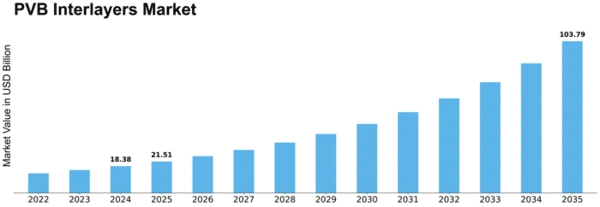
PVB Interlayers Market Size Graph
Author
Priya Nagrale
Senior Research Analyst

With an experience of over five years in market research industry (Chemicals & Materials domain), I gather and analyze market data from diverse sources to produce results, which are then presented back to a client. Also, provide recommendations based on the findings. As a Senior Research Analyst, I perform quality checks (QC) for market estimations, QC for reports, and handle queries and work extensively on client customizations. Also, handle the responsibilities of client proposals, report planning, report finalization, and execution

Leave a Comment

FAQs

What would be the PVB interlayer market valuation by 2035?

By 2035, the valuation would be USD 5 billion.

By type, which segment rules the PVB interlayer market?

The Structural PVB interlayer rules the market.

By application, which segment has the reins of the PVB interlayer market?

The automotive segment dominates.

By region, which zone has the maximum revenue for the PVB interlayer market?

The Asia Pacific region fetches maximum revenue.

What would be the PVB interlayer market CAGR during the forecast period (2019-2025)?

The PVB interlayer market would attain a CAGR of 7.5% during the forecast period (2019-2025).

Market Summary

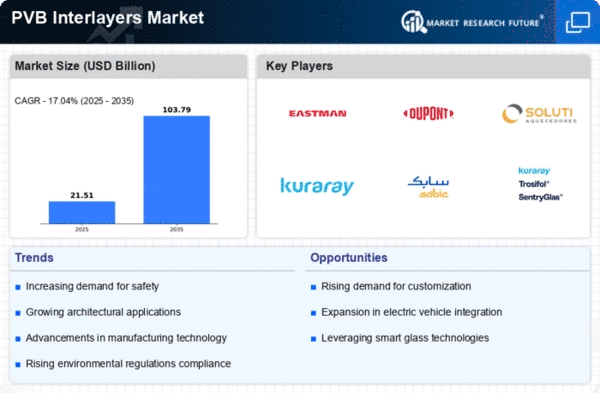
As per MRFR analysis, the PVB Interlayers Market Size was estimated at 18.38 USD Million in 2024. The PVB Interlayers industry is projected to grow from 21.51 USD Million in 2025 to 103.79 USD Million by 2035, exhibiting a compound annual growth rate (CAGR) of 17.04 during the forecast period 2025 - 2035.

Key Market Trends & Highlights

The PVB Interlayers Market is experiencing robust growth driven by safety and sustainability trends.

  • The demand for safety features in both automotive and architectural applications is rising significantly.
  • Sustainability initiatives are increasingly influencing product development and consumer preferences in the market.
  • Technological advancements are enhancing the performance and versatility of PVB interlayers, particularly in the automotive sector.
  • The growth in construction activities and regulatory standards for safety are major drivers propelling the market forward.

Market Size & Forecast

2024 Market Size 18.38 (USD Million)
2035 Market Size 103.79 (USD Million)
CAGR (2025 - 2035) 17.04%
Largest Regional Market Share in 2024 Asia-Pacific

Major Players

<p>Eastman Chemical Company (US), DuPont de Nemours, Inc. (US), Solutia Inc. (US), Kuraray Co., Ltd. (JP), SABIC (SA), Trosifol (DE), Fujifilm (JP), Saint-Gobain (FR), Asahi Glass Co., Ltd. (JP)</p>

Market Trends

The PVB Interlayers Market is currently experiencing a notable transformation, driven by various factors that influence its growth trajectory. The increasing demand for safety and security in architectural applications is propelling the adoption of PVB interlayers, as they provide enhanced impact resistance and sound insulation. Furthermore, the automotive sector is witnessing a shift towards laminated glass, which incorporates PVB interlayers to improve passenger safety and reduce noise levels. This trend appears to be supported by a growing consumer preference for vehicles that offer superior comfort and protection, thereby fostering innovation within the industry. In addition to safety considerations, sustainability is becoming a pivotal aspect of the PVB Interlayers Market. Manufacturers are exploring eco-friendly alternatives and production methods to meet the rising expectations of environmentally conscious consumers. This shift towards sustainable practices may not only enhance brand reputation but also align with global initiatives aimed at reducing carbon footprints. As the market evolves, it seems likely that advancements in technology and materials will further shape the landscape, potentially leading to new applications and increased market penetration across various sectors.

Rising Demand for Safety Features

The PVB Interlayers Market is witnessing an upsurge in demand for safety features, particularly in the construction and automotive industries. This trend is largely attributed to heightened awareness regarding personal safety and the need for robust building materials. PVB interlayers are increasingly utilized in laminated glass, which offers superior protection against impacts and enhances overall structural integrity.

Sustainability Initiatives

Sustainability is emerging as a critical focus within the PVB Interlayers Market. Manufacturers are actively seeking to develop eco-friendly products and processes, responding to consumer preferences for environmentally responsible options. This trend may lead to innovations in material sourcing and production techniques, potentially reducing the environmental impact associated with traditional PVB interlayers.

Technological Advancements

Technological advancements are playing a significant role in shaping the PVB Interlayers Market. Innovations in material science and production methods are likely to enhance the performance characteristics of PVB interlayers, making them more versatile for various applications. This evolution could open new avenues for market growth, as industries seek to leverage improved materials for enhanced functionality.

PVB Interlayers Market Market Drivers

Rising Demand for Safety Glass

The Global PVB Interlayers Market Industry experiences a notable surge in demand for safety glass, primarily driven by the increasing emphasis on safety regulations across various sectors. For instance, automotive manufacturers are integrating PVB interlayers into windshields to enhance impact resistance and reduce injury risks during accidents. This trend is reflected in the projected market value, which is expected to reach 2.94 USD Billion in 2024. As safety standards become more stringent globally, the adoption of PVB interlayers in construction and automotive applications is likely to grow, thereby bolstering the overall market.

Growth in Construction Activities

The Global PVB Interlayers Market Industry is significantly influenced by the expansion of construction activities worldwide. As urbanization accelerates, there is an increasing need for high-performance building materials that offer durability and safety. PVB interlayers are increasingly utilized in laminated glass for facades, skylights, and interior partitions, enhancing structural integrity and aesthetic appeal. The construction sector's robust growth is anticipated to contribute to the market's expansion, with projections indicating a rise to 7.18 USD Billion by 2035. This growth trajectory suggests a sustained demand for PVB interlayers as a crucial component in modern construction.

Emerging Markets and Economic Development

The Global PVB Interlayers Market Industry is benefiting from the economic development of emerging markets, where rapid urbanization and infrastructure projects are on the rise. Countries in Asia-Pacific and Latin America are experiencing significant growth in construction and automotive sectors, leading to an increased demand for PVB interlayers. As these regions invest in modernizing their infrastructure, the market for PVB interlayers is expected to expand, driven by the need for safer and more durable building materials. This trend indicates a promising future for the industry as it aligns with global economic growth patterns.

Increasing Awareness of Energy Efficiency

The Global PVB Interlayers Market Industry is witnessing a growing awareness of energy efficiency, particularly in the context of building materials. PVB interlayers contribute to energy savings by improving thermal insulation and reducing heat transfer in buildings. This aspect is increasingly recognized by architects and builders who aim to meet energy efficiency standards and certifications. As a result, the demand for energy-efficient solutions is likely to propel the adoption of PVB interlayers in both residential and commercial projects. This trend aligns with global sustainability goals, further reinforcing the market's potential for growth in the coming years.

Technological Advancements in Manufacturing

Technological advancements in the manufacturing processes of PVB interlayers are poised to drive the Global PVB Interlayers Market Industry forward. Innovations such as improved polymer formulations and enhanced production techniques are enabling manufacturers to produce interlayers with superior optical clarity and adhesion properties. These advancements not only enhance product performance but also reduce production costs, making PVB interlayers more accessible to a broader range of applications. As the industry continues to evolve, the integration of cutting-edge technologies is likely to support a compound annual growth rate of 8.45% from 2025 to 2035, reflecting the market's dynamic nature.

Market Segment Insights

By Application: Automotive (Largest) vs. Architectural (Fastest-Growing)

<p>In the PVB interlayers market, the automotive segment holds the largest share, driven by the increasing demand for safety and enhanced comfort features in vehicles. Meanwhile, the architectural segment is witnessing rapid growth as more builders and architects integrate laminated glass into structures, combining aesthetics with safety. Both segments reflect a clear trend towards greater emphasis on safety and design innovation within their respective fields.</p>

<p>Automotive (Dominant) vs. Architectural (Emerging)</p>

<p>The automotive sector stands out as the dominant application for PVB interlayers, primarily due to stringent safety regulations that necessitate the use of laminated glass in vehicles. This application enhances safety by minimizing injuries from glass shattering during accidents. On the other hand, the architectural sector is rapidly emerging, driven by the increasing preference for energy-efficient buildings and safety standards. Architects are increasingly utilizing PVB interlayers for massive windows in commercial and residential projects, making them a critical player in the market's evolution.</p>

By End Use: Construction (Largest) vs. Automotive (Fastest-Growing)

<p>In the PVB Interlayers Market, the end-use sector is predominantly led by the construction industry, which accounts for a significant market share. This sector is primarily driven by the rising demand for safety glass in architectural buildings and infrastructure, compelling manufacturers to innovate in PVB interlayer formulations for better performance. Following closely is the automotive sector, experiencing substantial growth due to increasing automotive production and a surge in demand for advanced glazing solutions that enhance vehicle safety and aesthetics.</p>

<p>Construction: Dominant vs. Automotive: Emerging</p>

<p>The construction segment is characterized by its extensive application of PVB interlayers in laminated glass for buildings, façades, and safety glazing solutions, confirming its position as the dominant force in the market. It benefits from the growing trend of green building designs and stringent safety regulations. Conversely, the automotive segment is emerging rapidly, fueled by advancements in driving technology and a heightened focus on passenger safety. Innovative glazing technologies, including acoustic and solar control features, are expanding the use of PVB interlayers in vehicles, making them essential in meeting modern automotive requirements.</p>

By Type: Standard PVB Interlayers (Largest) vs. Acoustic PVB Interlayers (Fastest-Growing)

<p>In the PVB Interlayers Market, Standard PVB Interlayers hold the largest market share, reflecting their dominance in various applications such as automotive and architectural glazing. The versatility and reliability of standard PVB interlayers make them a preferred choice for manufacturers across different sectors. In contrast, Acoustic PVB Interlayers are rapidly gaining traction, particularly in the construction and automotive industries, where noise reduction is becoming increasingly important to consumers. This shift can be attributed to the growing demand for soundproofing solutions in urbanized areas. The growth of Acoustic PVB Interlayers is driven by an increasing awareness of acoustics in living and working environments, leading to advancements in materials technology. Manufacturers are innovating by developing high-performance PVB interlayers that not only meet safety standards but also enhance acoustic performance. As urban development continues and regulatory frameworks become more stringent regarding noise pollution, the demand for these specialized solutions is expected to accelerate, positioning Acoustic PVB Interlayers as a vital growth area in the market.</p>

<p>Standard PVB Interlayers (Dominant) vs. High-Performance PVB Interlayers (Emerging)</p>

<p>Standard PVB Interlayers dominate the PVB Interlayers Market due to their widespread applications across various industry sectors, primarily automotive and architectural. Their known benefits, such as excellent adhesion, clarity, and safety features, make them a staple in laminated glass products. In contrast, High-Performance PVB Interlayers are emerging as a significant segment, offering enhanced durability and advanced functionalities such as UV protection and thermal resistance. These high-performance variants are increasingly preferred in specialized applications requiring enhanced strength and performance, particularly in premium automotive and high-end architectural projects. As manufacturers continue to focus on innovation and product differentiation, the high-performance segment is expected to capture a larger share of the market, addressing specific consumer needs with superior features.</p>

Get more detailed insights about PVB Interlayers Market Research Report - Global Forecast till 2035

Regional Insights

North America : Innovation and Demand Growth

The North American PVB interlayers market is projected to reach $5.51 billion by 2025, driven by increasing demand in the automotive and construction sectors. Regulatory support for safety standards and energy efficiency is further propelling market growth. The region's focus on innovation and sustainability is also a key driver, with manufacturers investing in advanced technologies to enhance product performance and reduce environmental impact. Leading countries in this region include the US and Canada, where major players like Eastman Chemical Company and DuPont de Nemours, Inc. dominate the market. The competitive landscape is characterized by strategic partnerships and collaborations aimed at expanding product offerings. The presence of established companies ensures a robust supply chain, catering to the growing demand for high-performance interlayers in various applications.

Europe : Sustainability and Innovation Focus

The European PVB interlayers market is expected to reach $4.92 billion by 2025, driven by stringent regulations promoting safety and sustainability. The region's commitment to reducing carbon emissions and enhancing energy efficiency is a significant catalyst for market growth. Additionally, the increasing adoption of PVB interlayers in architectural applications is contributing to rising demand, aligning with the EU's green building initiatives. Germany, France, and the UK are leading countries in this market, with key players like Trosifol and Saint-Gobain actively participating in innovation. The competitive landscape is marked by a focus on research and development, with companies striving to create eco-friendly products. The presence of regulatory bodies ensures compliance and fosters a favorable environment for market expansion.

Asia-Pacific : Emerging Powerhouse in Market

Asia-Pacific is the largest market for PVB interlayers, projected to reach $7.0 billion by 2025. The region's rapid urbanization and industrialization are key growth drivers, with increasing demand for safety glass in automotive and construction sectors. Government initiatives aimed at enhancing infrastructure and safety standards are also contributing to market expansion. The region's diverse applications further bolster demand, making it a focal point for manufacturers. China, Japan, and India are the leading countries in this market, with significant contributions from companies like Kuraray and Fujifilm. The competitive landscape is characterized by a mix of local and international players, fostering innovation and price competition. The presence of major manufacturers ensures a steady supply of high-quality interlayers, catering to the growing needs of various industries.

Middle East and Africa : Emerging Market Opportunities

The Middle East and Africa PVB interlayers market is projected to reach $0.95 billion by 2025, driven by increasing construction activities and a growing focus on safety standards. The region's expanding automotive sector is also contributing to demand, as manufacturers seek to enhance vehicle safety features. Regulatory frameworks are gradually evolving to support the adoption of advanced materials, creating opportunities for market growth. Leading countries in this region include the UAE and South Africa, where investments in infrastructure and construction are on the rise. The competitive landscape is still developing, with a mix of local and international players entering the market. As the region continues to grow, the presence of key players will be crucial in meeting the rising demand for PVB interlayers across various applications.

Key Players and Competitive Insights

The PVB Interlayers Market is characterized by a competitive landscape that is increasingly shaped by innovation, sustainability, and strategic partnerships. Key players such as Eastman Chemical Company (US), DuPont de Nemours, Inc. (US), and Kuraray Co., Ltd. (JP) are actively pursuing strategies that enhance their market positioning. Eastman Chemical Company (US) focuses on developing advanced interlayer technologies that cater to the growing demand for safety and aesthetic appeal in architectural applications. Meanwhile, DuPont de Nemours, Inc. (US) emphasizes sustainability in its product offerings, aligning with global trends towards eco-friendly materials. Kuraray Co., Ltd. (JP) is leveraging its strong R&D capabilities to innovate and expand its product portfolio, thereby enhancing its competitive edge in the market.

The business tactics employed by these companies include localizing manufacturing and optimizing supply chains to improve efficiency and reduce costs. The market structure appears moderately fragmented, with several players vying for market share. However, the collective influence of major companies like Eastman, DuPont, and Kuraray suggests a trend towards consolidation, as these firms seek to enhance their operational capabilities and market reach.

In November 2025, Eastman Chemical Company (US) announced the launch of a new line of PVB interlayers designed specifically for high-performance architectural glazing. This strategic move is likely to position Eastman as a leader in the premium segment of the market, catering to architects and builders seeking innovative solutions that enhance both safety and aesthetics. The introduction of this product line underscores Eastman's commitment to innovation and its responsiveness to evolving market demands.

In October 2025, DuPont de Nemours, Inc. (US) entered into a partnership with a leading automotive manufacturer to supply PVB interlayers for electric vehicle windshields. This collaboration not only highlights DuPont's focus on sustainability but also reflects a growing trend towards integrating advanced materials in the automotive sector. The partnership is expected to enhance DuPont's market presence while contributing to the development of more sustainable transportation solutions.

In September 2025, Kuraray Co., Ltd. (JP) expanded its production capacity for PVB interlayers in response to increasing global demand. This expansion is indicative of Kuraray's proactive approach to scaling operations and meeting customer needs. By enhancing its production capabilities, Kuraray aims to solidify its position in the market and respond effectively to the rising demand for high-quality interlayer products.

As of December 2025, the competitive trends in the PVB Interlayers Market are increasingly defined by digitalization, sustainability, and the integration of advanced technologies such as AI. Strategic alliances are becoming more prevalent, as companies recognize the value of collaboration in driving innovation and enhancing supply chain reliability. The shift from price-based competition to a focus on technological advancement and sustainable practices is likely to shape the future of the market, with companies that prioritize innovation and operational excellence poised to gain a competitive advantage.

Key Companies in the PVB Interlayers Market market include

Industry Developments

Future Outlook

PVB Interlayers Market Future Outlook

<p>The PVB Interlayers Market is projected to grow at a 17.04% CAGR from 2024 to 2035, driven by increasing demand in automotive and construction sectors.</p>

New opportunities lie in:

  • <p>Expansion into emerging markets with tailored PVB solutions.</p>
  • <p>Development of eco-friendly PVB interlayers for sustainability-focused clients.</p>
  • <p>Investment in advanced manufacturing technologies to enhance production efficiency.</p>

<p>By 2035, the PVB Interlayers Market is expected to achieve substantial growth and innovation.</p>

Market Segmentation

PVB Interlayers Market Type Outlook

  • Standard PVB Interlayers
  • Acoustic PVB Interlayers
  • Colored PVB Interlayers
  • Laminated PVB Interlayers
  • High-Performance PVB Interlayers

PVB Interlayers Market End Use Outlook

  • Construction
  • Automotive
  • Aerospace
  • Consumer Electronics
  • Renewable Energy

PVB Interlayers Market Application Outlook

  • Automotive
  • Architectural
  • Solar Energy
  • Safety Glass
  • Electronics

Report Scope

MARKET SIZE 202418.38(USD Million)
MARKET SIZE 202521.51(USD Million)
MARKET SIZE 2035103.79(USD Million)
COMPOUND ANNUAL GROWTH RATE (CAGR)17.04% (2024 - 2035)
REPORT COVERAGERevenue Forecast, Competitive Landscape, Growth Factors, and Trends
BASE YEAR2024
Market Forecast Period2025 - 2035
Historical Data2019 - 2024
Market Forecast UnitsUSD Million
Key Companies ProfiledEastman Chemical Company (US), DuPont de Nemours, Inc. (US), Solutia Inc. (US), Kuraray Co., Ltd. (JP), SABIC (SA), Trosifol (DE), Fujifilm (JP), Saint-Gobain (FR), Asahi Glass Co., Ltd. (JP)
Segments CoveredApplication, End Use, Type
Key Market OpportunitiesGrowing demand for safety and aesthetic applications in the PVB Interlayers Market presents significant opportunities.

Key Market DynamicsRising demand for safety and sustainability drives innovation in PVB interlayers for automotive and architectural applications.
Countries CoveredNorth America, Europe, APAC, South America, MEA

FAQs

What would be the PVB interlayer market valuation by 2035?

By 2035, the valuation would be USD 5 billion.

By type, which segment rules the PVB interlayer market?

The Structural PVB interlayer rules the market.

By application, which segment has the reins of the PVB interlayer market?

The automotive segment dominates.

By region, which zone has the maximum revenue for the PVB interlayer market?

The Asia Pacific region fetches maximum revenue.

What would be the PVB interlayer market CAGR during the forecast period (2019-2025)?

The PVB interlayer market would attain a CAGR of 7.5% during the forecast period (2019-2025).

  1. Executive Summary
  2. Market Introduction
    1. Market Definition
    2. Scope of the Study
    3. Assumptions &
    4. Limitations
    5. Market Structure
    6. Key Takeaways
  3. Market Insights
  4. Research Methodology
    1. Research Process
    2. Primary Research
    3. Secondary Research
    4. Market Size Estimation
    5. Forecast
    6. Model
  5. Market Dynamics
    1. Introduction
    2. Drivers
    3. Restraints
    4. Opportunities
    5. Challenges
    6. Trends
  6. Market
    1. Factor Analysis
    2. Supply Chain Analysis
      1. Raw Material Suppliers
      2. Manufacturers/Producers
      3. Distributors/Retailers/Wholesalers/E-Commerce
      4. Applications
    3. Merchants
    4. Porter’s Five Forces Analysis
      1. Threat of New Entrants
      2. Bargaining Power of Buyers
      3. Threat of Substitutes
      4. Intensity
    5. Bargaining Power of Suppliers
    6. of Rivalry
    7. Pricing Analysis
  7. Global PVB Interlayers Market, by
    1. Type
    2. Introduction
    3. Structural PVB Interlayer
      1. Market
      2. Market Estimates & Forecast,
    4. Estimates & Forecast, 2020–2027
    5. by Region, 2020–2027
    6. Standard PVB Interlayer
      1. Market Estimates
    7. & Forecast, 2020–2027
  8. Global PVB Interlayers Market, by Application
    1. Introduction
    2. Automotive
      1. Market Estimates & Forecast,
      2. Market Estimates & Forecast, by Region, 2020–2027
    3. Building & Construction
      1. Market Estimates & Forecast, 2020–2027
      2. Market Estimates & Forecast, by Region, 2020–2027
    4. Photovoltaic
      1. Market Estimates & Forecast, 2020–2027
      2. Market Estimates
    5. & Forecast, by Region, 2020–2027
  9. Global PVB Interlayers Market,
    1. by Region
    2. Introduction
    3. North America
      1. Market Estimates
      2. Market Estimates & Forecast, by Type,
      3. Market Estimates & Forecast, by Application, 2020–2027
      4. US
    4. & Forecast, 2020–2027
  10. Market Estimates & Forecast, by Type, 2020–2027
    1. & Forecast, by Application, 2020–2027
    2. Estimates & Forecast, 2020–2027
    3. by Type, 2020–2027
    4. Estimates & Forecast, by Application, 2020–2027
    5. & Forecast, by Type, 2020–2027
    6. by Application, 2020–2027
    7. & Forecast, 2020–2027
    8. Type, 2020–2027
  11. Market Estimates
  12. Canada
  13. Market
  14. Market Estimates & Forecast,
  15. Market Estimates & Forecast, by Application,
    1. Europe
      1. Market Estimates & Forecast, 2020–2027
      2. Market Estimates & Forecast, by Type, 2020–2027
      3. Market
      4. Germany
      5. France
      6. Italy
  16. Market Estimates & Forecast, by Application, 2020–2027
    1. & Forecast, by Type, 2020–2027
    2. by Application, 2020–2027
    3. Forecast, 2020–2027
  17. Spain
  18. Market Estimates & Forecast, 2020–2027
  19. Market Estimates
  20. Market Estimates & Forecast,
  21. UK
  22. Market Estimates &
  23. Market Estimates & Forecast, by Type,
  24. Market Estimates & Forecast, by Application, 2020–2027
  25. Russia
  26. Market Estimates & Forecast, 2020–2027
  27. Market Estimates & Forecast, by Type, 2020–2027
  28. Market Estimates & Forecast, by Application, 2020–2027
    1. Estimates & Forecast, by Type, 2020–2027
    2. & Forecast, by Application, 2020–2027
    3. Market Estimates & Forecast, 2020–2027
    4. Forecast, by Type, 2020–2027
    5. Application, 2020–2027
    6. Forecast, 2020–2027
  29. Poland
  30. Market Estimates & Forecast, 2020–2027
  31. Market
  32. Market Estimates
    1. Asia-Pacific
      1. Market Estimates &
      2. Market Estimates & Forecast, by
      3. China
      4. India
  33. Market Estimates & Forecast, by Type, 2020–2027
    1. & Forecast, by Application, 2020–2027
    2. Estimates & Forecast, 2020–2027
    3. by Type, 2020–2027
    4. New Zealand
  34. Market Estimates
  35. Japan
  36. Market
  37. Market Estimates & Forecast,
  38. Market Estimates & Forecast, by Application,
  39. Australia
  40. Market Estimates & Forecast,
  41. Market Estimates & Forecast, by Type, 2020–2027
  42. Market Estimates & Forecast, by Application, 2020–2027
  43. Market Estimates & Forecast, 2020–2027
  44. Market Estimates & Forecast, by Type, 2020–2027
    1. & Forecast, by Application, 2020–2027
    2. & Forecast, by Type, 2020–2027
    3. by Application, 2020–2027
    4. Estimates & Forecast, 2020–2027
    5. by Type, 2020–2027
    6. Israel
  45. Market Estimates
  46. Rest of Asia-Pacific
  47. Market Estimates & Forecast, 2020–2027
  48. Market Estimates
  49. Market Estimates & Forecast,
    1. Middle East & Africa
      1. Market
      2. Market Estimates & Forecast,
      3. Market Estimates & Forecast, by Application,
      4. Turkey
  50. Market Estimates & Forecast, by Type, 2020–2027
    1. & Forecast, by Application, 2020–2027
    2. Market Estimates & Forecast, 2020–2027
    3. Forecast, by Type, 2020–2027
    4. by Application, 2020–2027
    5. Forecast, 2020–2027
    6. Forecast, 2020–2027
    7. Estimates & Forecast, by Application, 2020–2027
    8. & Forecast, by Type, 2020–2027
    9. by Application, 2020–2027
    10. & Forecast, 2020–2027
    11. Type, 2020–2027
    12. Rest of Latin America
  51. Market Estimates
  52. South Africa
  53. Market Estimates &
  54. Market Estimates & Forecast,
  55. GCC
  56. Market Estimates &
  57. Market Estimates & Forecast, by Type,
  58. Market Estimates & Forecast, by Application, 2020–2027
  59. Rest of the Middle East & Africa
  60. Market Estimates &
  61. Market Estimates & Forecast, by Type,
  62. Market Estimates & Forecast, by Application, 2020–2027
    1. Latin America
      1. Market Estimates & Forecast, 2020–2027
      2. Market Estimates & Forecast, by Type, 2020–2027
      3. Market
      4. Brazil
      5. Argentina
      6. Mexico
  63. Market Estimates & Forecast, by Application, 2020–2027
  64. Competitive
    1. Landscape
    2. Introduction
    3. Market Strategy
    4. Key Development
    5. Analysis
    6. (Expansions/Mergers & Acquisitions/Joint Ventures/New Product
    7. Developments/Agreements/Investments)
  65. Company Profiles
    1. Eastman
      1. Company Overview
      2. Financial Updates
      3. Key Developments
      4. SWOT
      5. Strategies
    2. Chemical Company
    3. Product/Business Segment Overview
    4. Analysis
    5. Kuraray
      1. Company Overview
      2. Financial Updates
      3. Product/Business Segment Overview
      4. SWOT Analysis
      5. Strategies
    6. Key Developments
    7. Sekisui
      1. Company Overview
      2. Financial Updates
      3. Product/Business Segment Overview
      4. Key Developments
      5. Strategies
    8. Chemical Co., Ltd
    9. SWOT Analysis
    10. Everlam NV
      1. Company Overview
      2. Financial Updates
      3. Product/Business Segment Overview
      4. SWOT Analysis
      5. Strategies
    11. Key Developments
    12. Genau
      1. Company Overview
      2. Financial Updates
      3. Product/Business
      4. Key Developments
      5. SWOT Analysis
    13. PVB
    14. Segment Overview
    15. Strategies
    16. Kingboard (Fogang) Specialty Resins Limited
      1. Company
      2. Financial Updates
      3. Product/Business Segment Overview
      4. Key Developments
      5. SWOT Analysis
      6. Strategies
      7. Company Overview
      8. Financial Updates
      9. Product/Business Segment Overview
      10. Key Developments
      11. Strategies
    17. Overview
    18. Chang Chun Group
    19. SWOT Analysis
    20. DuLite PVB Film
      1. Company
      2. Financial Updates
      3. Product/Business Segment Overview
      4. Key Developments
      5. SWOT Analysis
      6. Strategies
      7. Company Overview
      8. Financial
      9. Product/Business Segment Overview
      10. Key Developments
      11. SWOT Analysis
      12. Strategies
    21. Overview
    22. Huakai Plastic (Chongqing) Co., Ltd
    23. Updates
    24. Tiantai Kanglai Industrial
      1. Company Overview
      2. Financial Updates
      3. Key Developments
      4. SWOT
      5. Strategies
    25. Co., Ltd
    26. Product/Business Segment Overview
    27. Analysis
    28. JE Berkowitz
      1. Company Overview
      2. Financial Updates
      3. Product/Business Segment Overview
      4. SWOT Analysis
      5. Strategies
    29. Key Developments
    30. Jiangsu
      1. Company Overview
      2. Product/Business Segment Overview
      3. Key
      4. SWOT Analysis
      5. Strategies
    31. Daruihengte Technology & Science Co., Ltd
    32. Financial Updates
    33. Developments
  66. Appendix
  67. LIST OF TABLES
  68. Global PVB Interlayers Market, by Region,
  69. North America: PVB Interlayers Market, by Country,
  70. Europe: PVB Interlayers Market, by Country, 2020–2027
  71. Asia-Pacific: PVB Interlayers Market, by Country, 2020–2027
  72. Middle East & Africa: PVB Interlayers Market, by Country, 2020–2027
  73. Latin America: PVB Interlayers Market, by Country, 2020–2027
  74. Global PVB Interlayers Type Market, by Region, 2020–2027
  75. North America: PVB Interlayers Type Market, by Country, 2020–2027
  76. Europe: PVB Interlayers Type Market, by Country, 2020–2027
  77. Asia-Pacific: PVB Interlayers Type Market, by Country, 2020–2027
  78. Middle East & Africa: PVB Interlayers Type Market, by Country,
  79. Latin America: PVB Interlayers Type Market, by Country,
  80. Global PVB Interlayers Application Market, by Region,
  81. North America: PVB Interlayers Application Market,
    1. by Country, 2020–2027
  82. Europe: PVB Interlayers Application Market,
    1. by Country, 2020–2027
  83. Asia-Pacific: PVB Interlayers Application
  84. Market, by Country, 2020–2027
  85. Middle East & Africa: PVB
  86. Interlayers Application Market, by Country, 2020–2027
  87. Latin
  88. America: PVB Interlayers Application Market, by Country, 2020–2027
    1. Table
  89. Global Type Market, by Region, 2020–2027
  90. Global Application
  91. Market, by Region, 2020–2027
  92. North America: PVB Interlayers
  93. Market, by Country, 2020–2027
  94. North America: PVB Interlayers
    1. Type Market, 2020–2027
  95. North America: PVB Interlayers Application
    1. Market, 2020–2027
  96. Europe: PVB Interlayers Market, by Country,
  97. Europe: PVB Interlayers Type Market, 2020–2027
  98. Europe: PVB Interlayers Application Market, 2020–2027
    1. Table
  99. Asia-Pacific: PVB Interlayers Market, by Country, 2020–2027
    1. Table
  100. Asia-Pacific: PVB Interlayers Type Market, 2020–2027
  101. Asia-Pacific:
    1. PVB Interlayers Application Market, 2020–2027
  102. Middle East &
  103. Africa: PVB Interlayers Market, by Country, 2020–2027
  104. Middle
    1. East & Africa: PVB Interlayers Type Market, 2020–2027
  105. Middle
    1. East & Africa: PVB Interlayers Application Market, 2020–2027
    2. Table
  106. Latin America: PVB Interlayers Market, by Country, 2020–2027
    1. Table
  107. Latin America: PVB Interlayers Type Market, 2020–2027
  108. Latin
    1. America: PVB Interlayers Application Market, 2020–2027
    2. LIST OF
    3. FIGURES
  109. Global PVB Interlayers Market Segmentation
  110. Forecast
    1. Methodology
  111. Porter’s Five Forces Analysis of the Global PVB
    1. Interlayers Market
  112. Supply Chain Analysis of the Global PVB Interlayers
    1. Market
  113. Share of the Global PVB Interlayers Market, by Country, 2020
    1. (%)
  114. Global PVB Interlayers Market, 2020–2027
  115. Sub-Segments
    1. of Type
  116. Global PVB Interlayers Market Size, by Type, 2020 (%)
    1. FIGURE
  117. Share of the Global PVB Interlayers Market, by Type, 2020–2027
    1. FIGURE
  118. Sub-Segments of Application
  119. Global PVB Interlayers Market Size,
    1. by Application, 2020 (%)
  120. Share of the Global PVB Interlayers Market,
    1. by Application, 2020–2027

PVB Interlayers Market Segmentation

Market Segmentation Overview

  • Detailed segmentation data will be available in the full report
  • Comprehensive analysis by multiple parameters
  • Regional and country-level breakdowns
  • Market size forecasts by segment
Infographic

Free Sample Request

Kindly complete the form below to receive a free sample of this Report

Get Free Sample

Customer Strories

Compare Licence

×
Features License Type
Single User Multiuser License Enterprise User
Price $4,950 $5,950 $7,250
Maximum User Access Limit 1 User Upto 10 Users Unrestricted Access Throughout the Organization
Free Customization
Direct Access to Analyst
Deliverable Format
Platform Access
Discount on Next Purchase 10% 15% 15%
Printable Versions